VOICE PROJECTION 2012
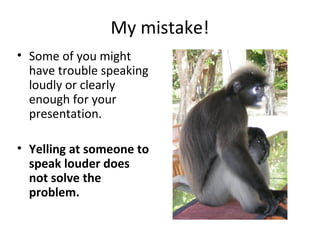
My mistake!
• Some of you might
have trouble speaking
loudly or clearly
enough for your
presentation.
• Yelling at someone to
speak louder does
not solve the
problem.
The Three Key Components of a
Powerful Sound
1. PERSONALITY
2. PASSION
3. STRONG VOCALS
• The first two are obtained by being yourself
and being clear about your aim.
• The third one comes with study and practice.
1. PERSONALITY
• Remember, your personality is
“you”. It cannot be changed.
• If you want to give a strong
voice for your presentation, you
will need to celebrate your real
self – do not try to “be
someone else”.
- “I can’t try to say it in somebody
else’s voice. I have to say it in
my voice.”
2. PASSION
• “The power of intention” – the more
you want them to believe you, the
better you say it.
• Your intention is what you want this
presentation to make people think.
• When your personality, information,
and intention align, this is passion.
• Passionate speakers sound more
genuine and interesting to the audience.
3. POWER
• Of course, this is the ability to
make a loud and resonant sound,
as well as control your breathing.
• Resonance and air are important
for speaking. There is a basis in
biology – you need more air to
make more resonance.
• Stand up straight, take a deep
breath and use more air to carry
your sound further.
Breathing 101
1. Sit forward in a chair and relax your
stomach.
2. Slowly breathe in through your nose –
imagine you are a jar being filled with water.
3. Fill up your stomach, your ribs, up to your
chin.
4. Hold for ten seconds.
5. Exhale slowly – do not stop pushing out your
ribs and keep your back up straight.
How does this help?
• If you did it correctly, your stomach would
have gone in, while your chest stayed up and
out.
• You were using your abdominal muscles to
breathe. Exercise them enough, and they
grow, like all muscles.
• It also makes you aware of your breathing,
makes you stand up straight looking confident,
and helps you calm down.
It’s very helpful
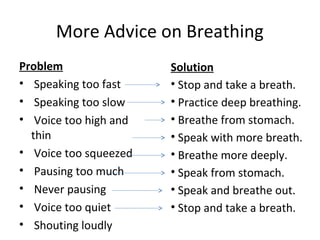
More Advice on Breathing
Problem
• Speaking too fast
• Speaking too slow
• Voice too high and
thin
• Voice too squeezed
• Pausing too much
• Never pausing
• Voice too quiet
• Shouting loudly
Solution
• Stop and take a breath.
• Practice deep breathing.
• Breathe from stomach.
• Speak with more breath.
• Breathe more deeply.
• Speak from stomach.
• Speak and breathe out.
• Stop and take a breath.
Low to High – literally!
• How do we speak? We push air through our
body, of course!
• We have a chest voice (low), and a face voice
(high).
• Try to speak only in your chest, and only in your
face – those are your chest and face voices.
• However, you can also resonate in your mask –
the front of your face, mouth and nose. A strong
mask resonance will always make a good
presentation voice, even with bad lungs and air.
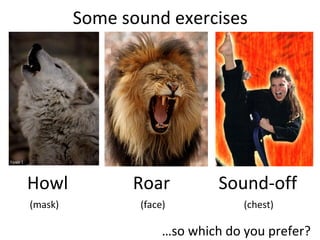
Some sound exercises
Howl Roar Sound-off
…so which do you prefer?
(mask) (face) (chest)
Remember the Three
PERSONALITY…
PASSION…
…AND POWER!

Voice projection 2012

  • 1.
  • 2.
    My mistake! • Someof you might have trouble speaking loudly or clearly enough for your presentation. • Yelling at someone to speak louder does not solve the problem.
  • 3.
    The Three KeyComponents of a Powerful Sound 1. PERSONALITY 2. PASSION 3. STRONG VOCALS • The first two are obtained by being yourself and being clear about your aim. • The third one comes with study and practice.
  • 4.
    1. PERSONALITY • Remember,your personality is “you”. It cannot be changed. • If you want to give a strong voice for your presentation, you will need to celebrate your real self – do not try to “be someone else”. - “I can’t try to say it in somebody else’s voice. I have to say it in my voice.”
  • 5.
    2. PASSION • “Thepower of intention” – the more you want them to believe you, the better you say it. • Your intention is what you want this presentation to make people think. • When your personality, information, and intention align, this is passion. • Passionate speakers sound more genuine and interesting to the audience.
  • 6.
    3. POWER • Ofcourse, this is the ability to make a loud and resonant sound, as well as control your breathing. • Resonance and air are important for speaking. There is a basis in biology – you need more air to make more resonance. • Stand up straight, take a deep breath and use more air to carry your sound further.
  • 7.
    Breathing 101 1. Sitforward in a chair and relax your stomach. 2. Slowly breathe in through your nose – imagine you are a jar being filled with water. 3. Fill up your stomach, your ribs, up to your chin. 4. Hold for ten seconds. 5. Exhale slowly – do not stop pushing out your ribs and keep your back up straight.
  • 8.
    How does thishelp? • If you did it correctly, your stomach would have gone in, while your chest stayed up and out. • You were using your abdominal muscles to breathe. Exercise them enough, and they grow, like all muscles. • It also makes you aware of your breathing, makes you stand up straight looking confident, and helps you calm down. It’s very helpful
  • 9.
    More Advice onBreathing Problem • Speaking too fast • Speaking too slow • Voice too high and thin • Voice too squeezed • Pausing too much • Never pausing • Voice too quiet • Shouting loudly Solution • Stop and take a breath. • Practice deep breathing. • Breathe from stomach. • Speak with more breath. • Breathe more deeply. • Speak from stomach. • Speak and breathe out. • Stop and take a breath.
  • 10.
    Low to High– literally! • How do we speak? We push air through our body, of course! • We have a chest voice (low), and a face voice (high). • Try to speak only in your chest, and only in your face – those are your chest and face voices. • However, you can also resonate in your mask – the front of your face, mouth and nose. A strong mask resonance will always make a good presentation voice, even with bad lungs and air.
  • 11.
    Some sound exercises HowlRoar Sound-off …so which do you prefer? (mask) (face) (chest)
  • 12.