Voice of the Parent:
How Schools can
Engage with
House Keeping
The recording and slides for today’s presentation will be made available as soon as
possible.
Please use the question window to submit questions throughout the webinar. We
have time designated at the end for Q&A.
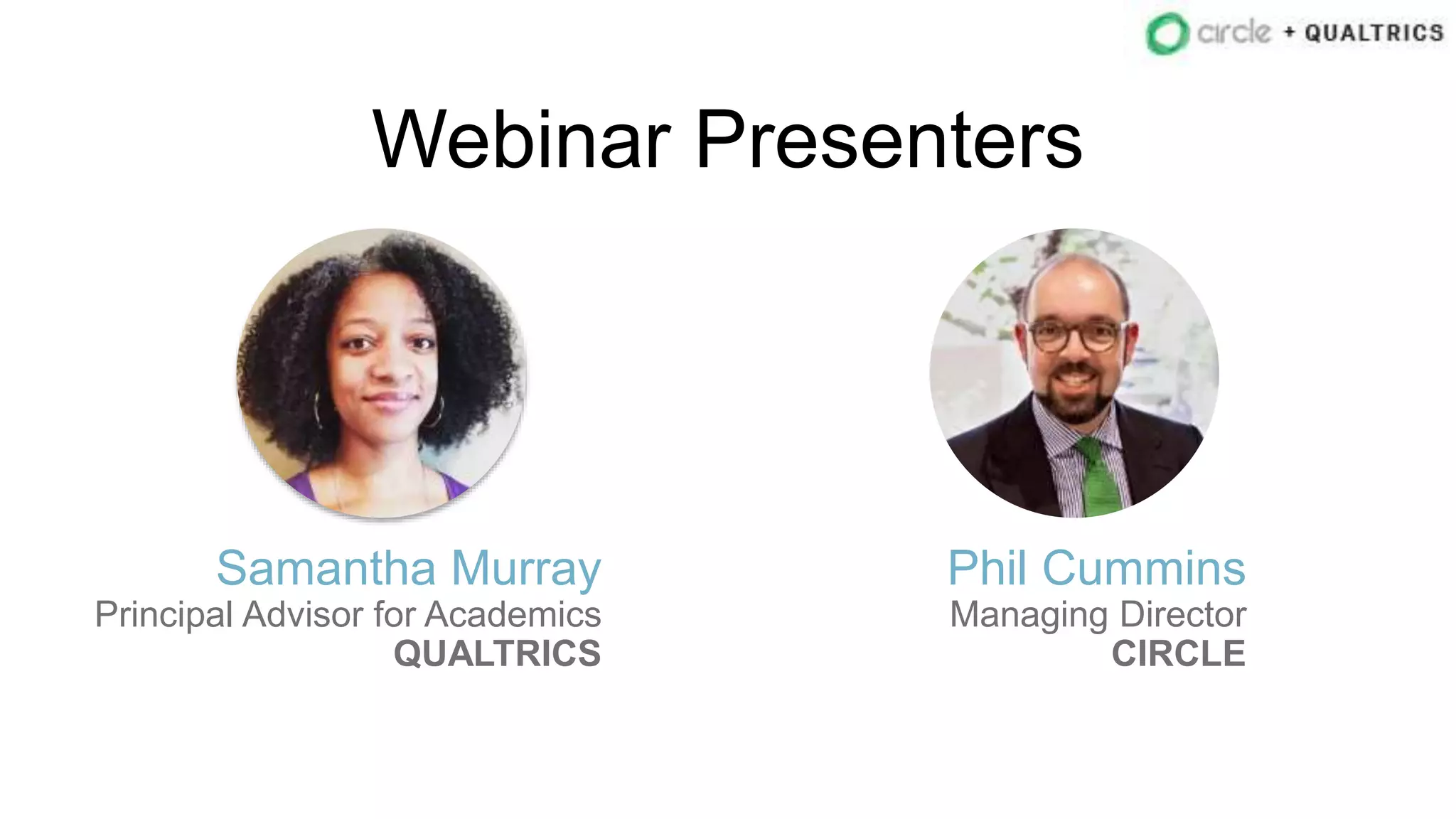
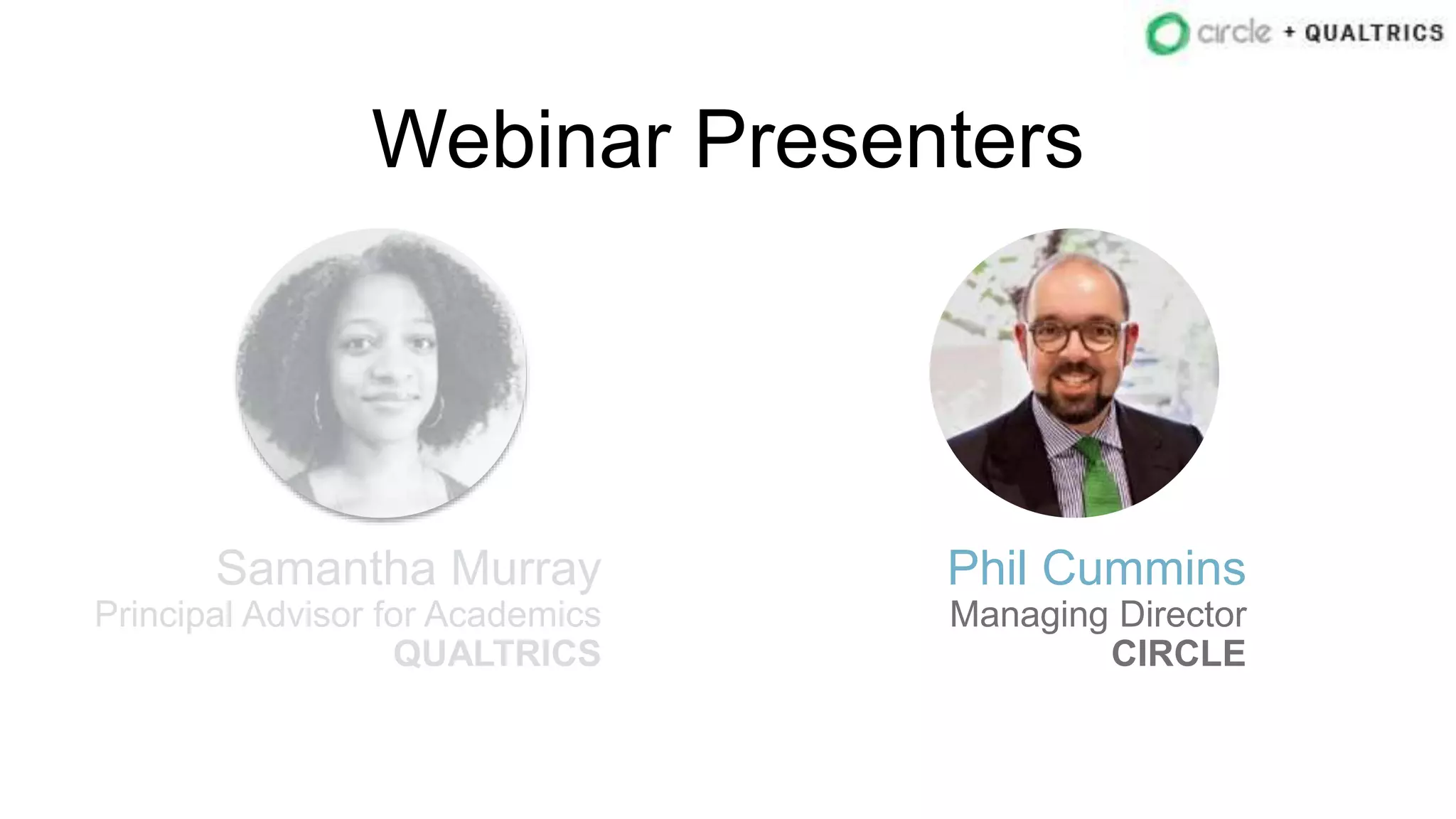
Webinar Presenters
Samantha Murray
Principal Advisor for Academics
QUALTRICS
Phil Cummins
Managing Director
CIRCLE
Today’s Agenda
• Using surveys to strengthen parent-
school relationships (Samantha
Murray)
• Asking the right questions to listen to
the voice of the parents (Phil
Webinar Presenters
Samantha Murray
Principal Advisor for Academics
QUALTRICS
Phil Cummins
Managing Director
CIRCLE
Voice of Parent Program
Using Surveys to Strengthen Parent-School Relationships
Samantha A. Murray
Principal Advisor for Academics
Qualtrics
Voice of Parent Program
Exploring how schools can use surveys to gather rich, actionable
data in Qualtrics to strengthen parent-school relationships.
Today’s Discussion
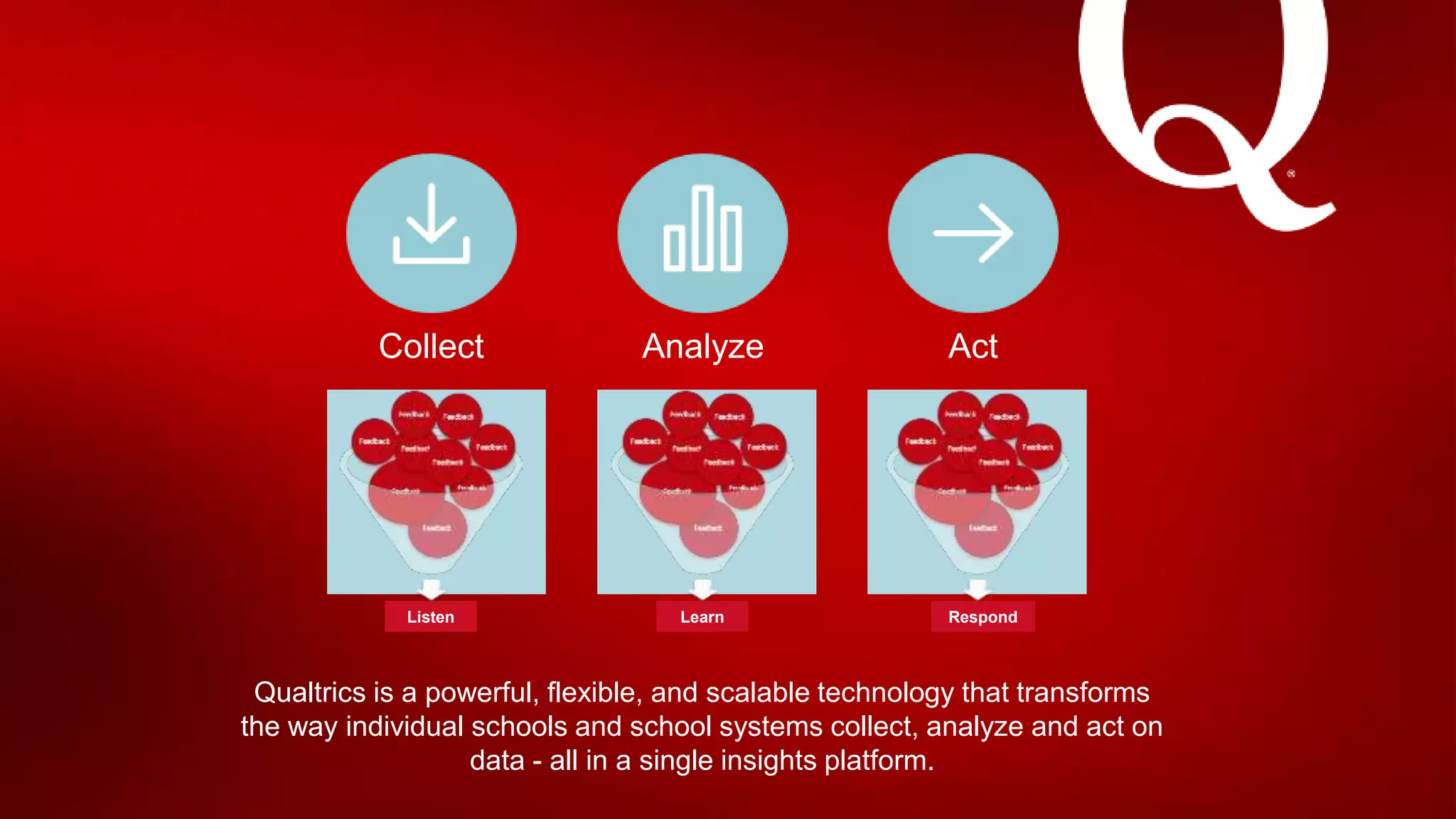
ActAnalyzeCollect
Qualtrics is a powerful, flexible, and scalable technology that transforms
the way individual schools and school systems collect, analyze and act on
data - all in a single insights platform.
Learn RespondListen
If you could ask only 1 question to get a parent
pulse, what would you ask?
Just to check in
Should be a closed-ended question
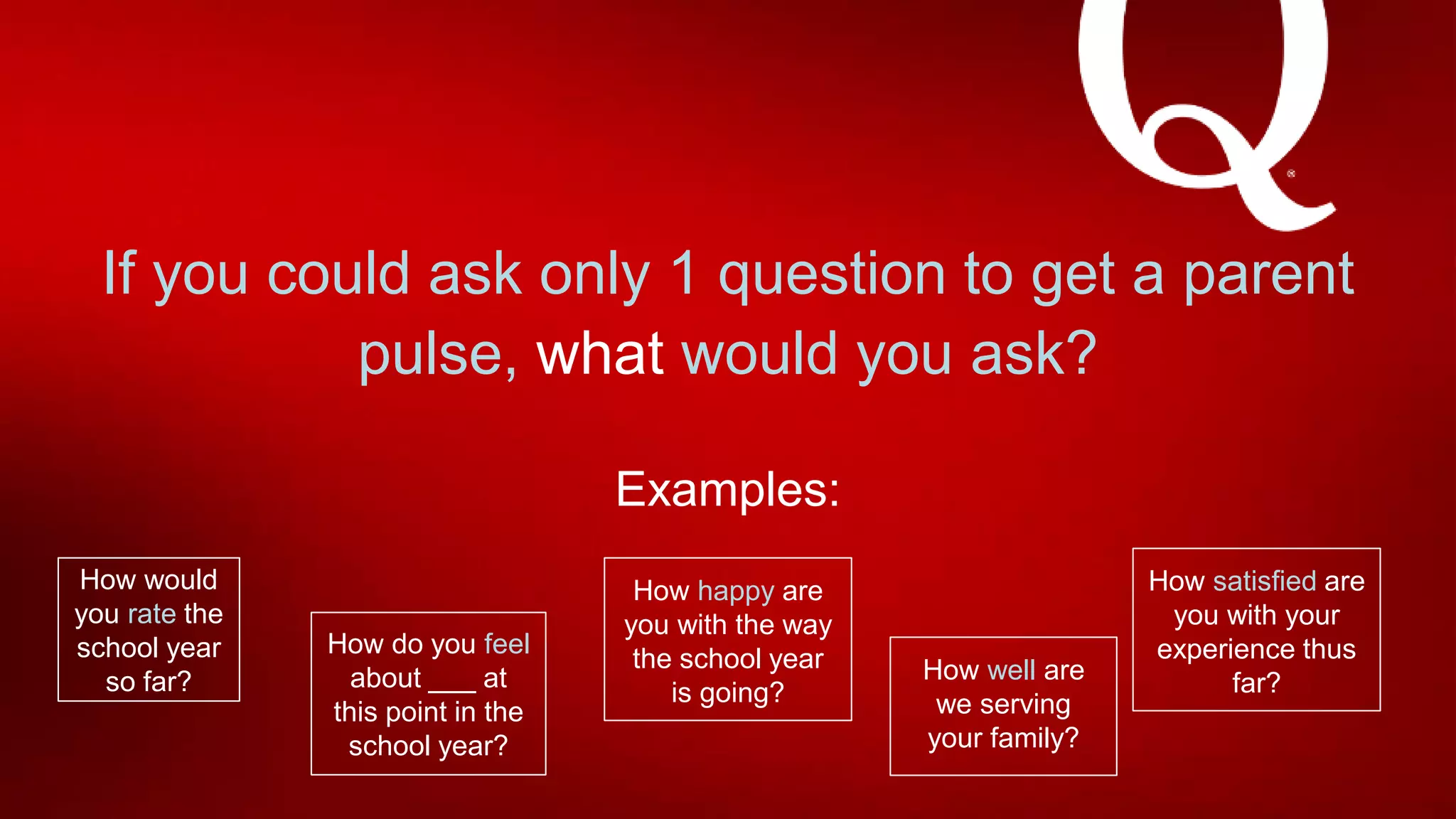
If you could ask only 1 question to get a parent
pulse, what would you ask?
Examples:
How would
you rate the
school year
so far?
How do you feel
about ___ at
this point in the
school year?
How happy are
you with the way
the school year
is going?
How satisfied are
you with your
experience thus
far?How well are
we serving
your family?
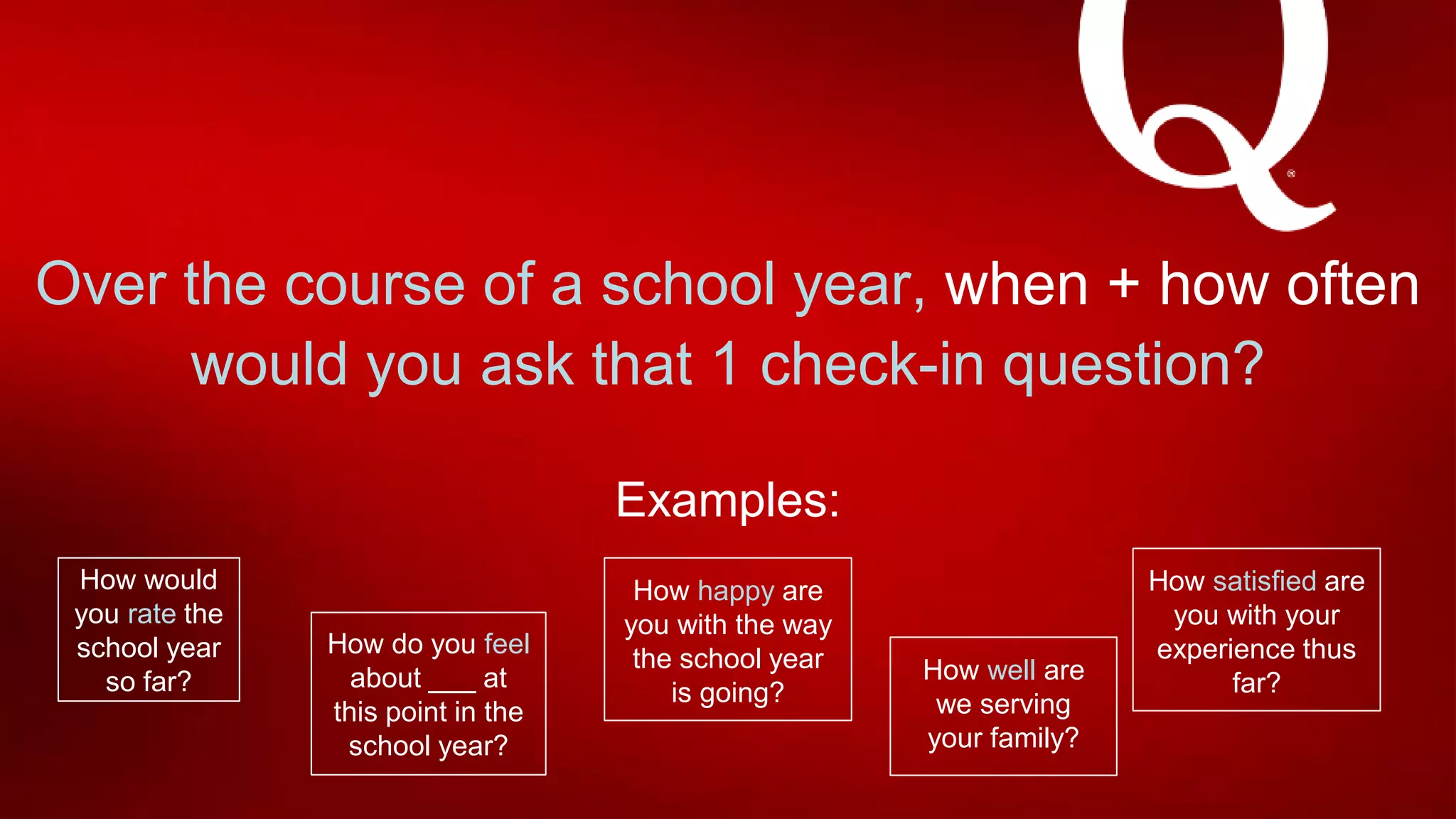
Over the course of a school year, when + how often
would you ask that 1 check-in question?
Examples:
How would
you rate the
school year
so far?
How do you feel
about ___ at
this point in the
school year?
How happy are
you with the way
the school year
is going?
How satisfied are
you with your
experience thus
far?How well are
we serving
your family?
Voice of Parent Program Design
An Example
Collect
Voice of
Parent
Analyze
Act
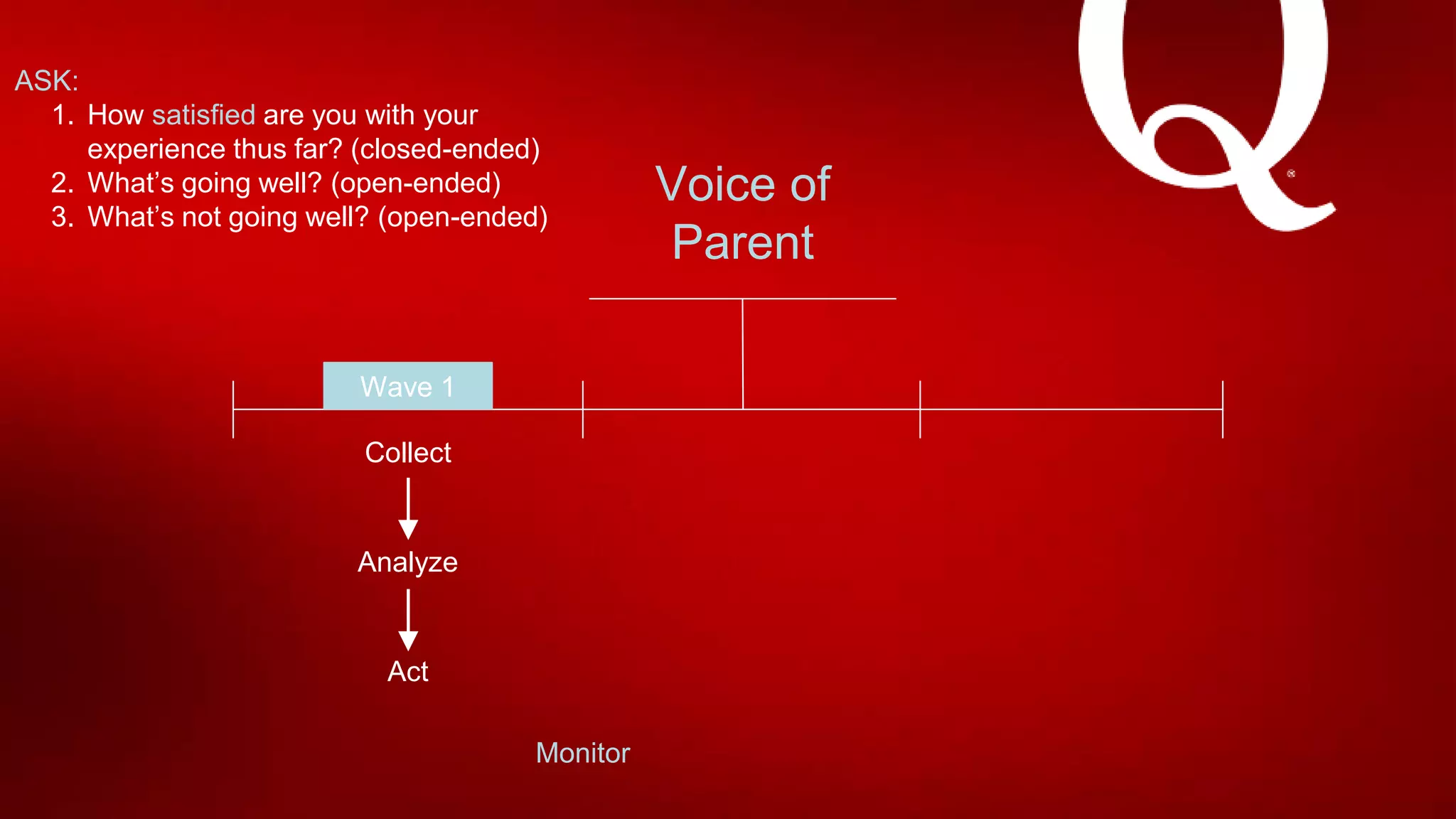
ASK:
1. How satisfied are you with your
experience thus far? (closed-ended)
2. What’s going well? (open-ended)
3. What’s not going well? (open-ended)
Wave 1
Monitor
Collect Collect
Voice of
Parent
Analyze Analyze
Act Act
Monitor
Wave 1 Wave 2
Monitor
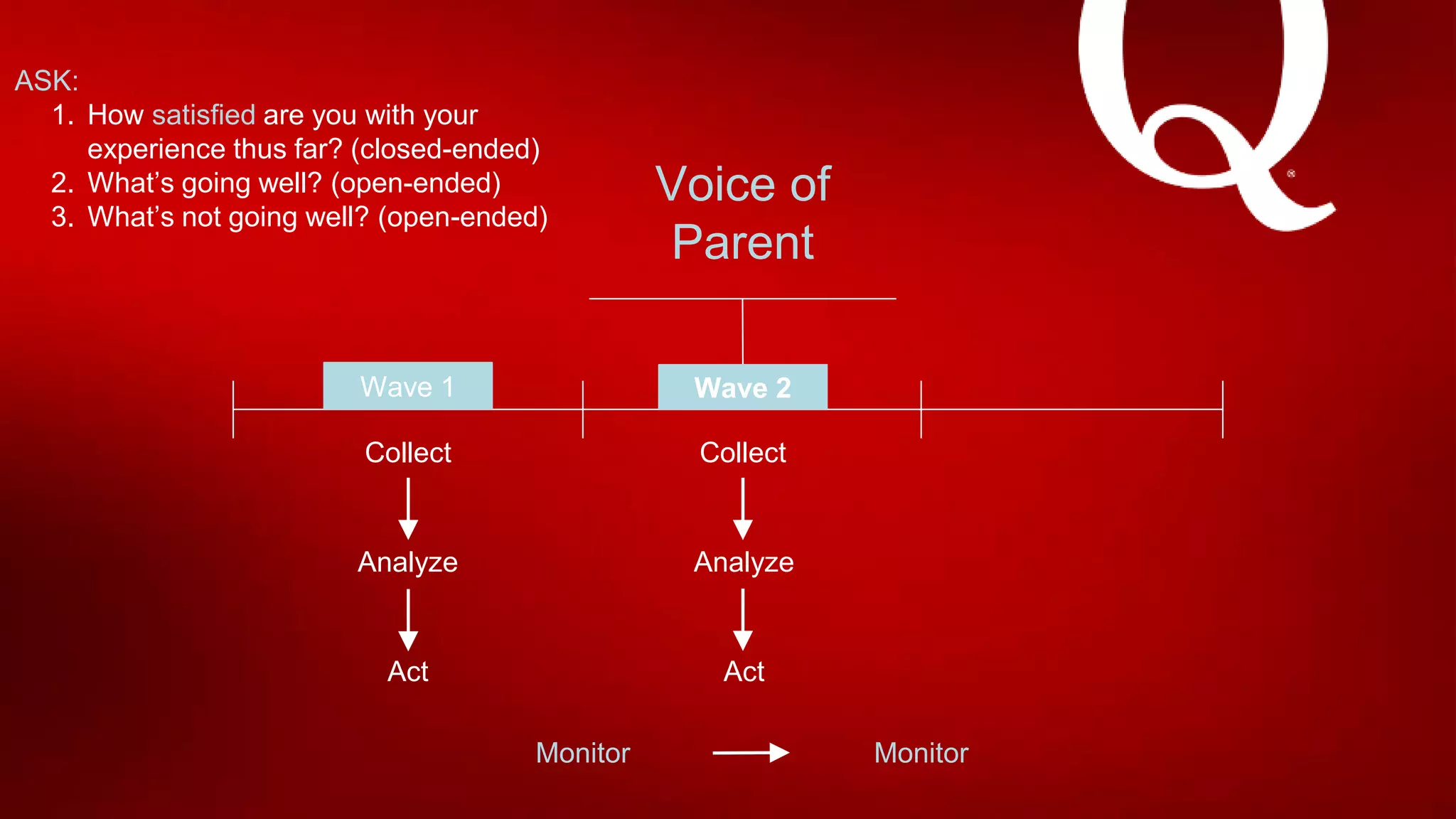
ASK:
1. How satisfied are you with your
experience thus far? (closed-ended)
2. What’s going well? (open-ended)
3. What’s not going well? (open-ended)
Collect Collect
Voice of
Parent
Analyze Analyze
Act Act
Monitor
Wave 1 Wave 2
Monitor
Collect
Analyze
Act
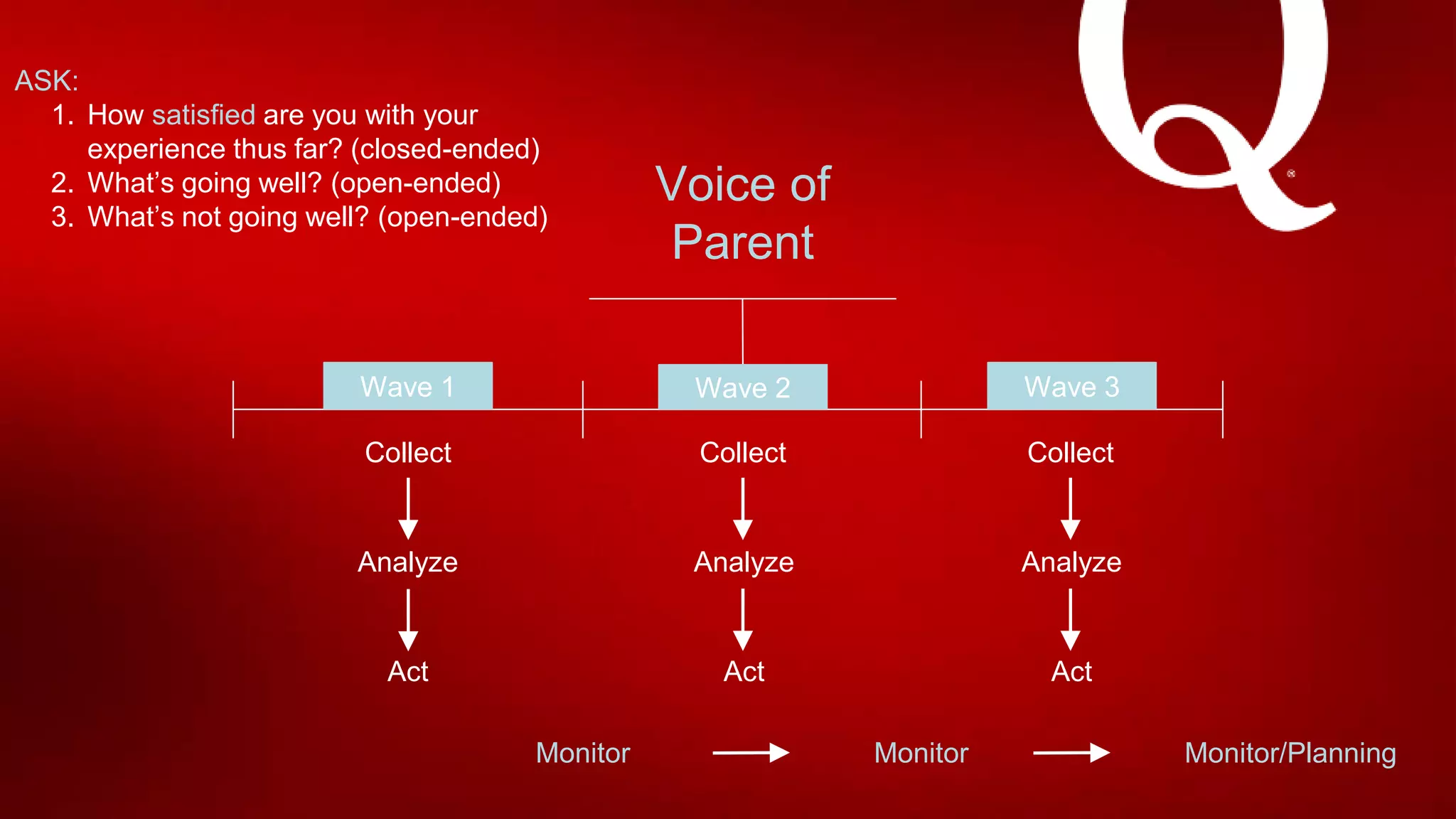
Wave 3
Monitor/Planning
ASK:
1. How satisfied are you with your
experience thus far? (closed-ended)
2. What’s going well? (open-ended)
3. What’s not going well? (open-ended)
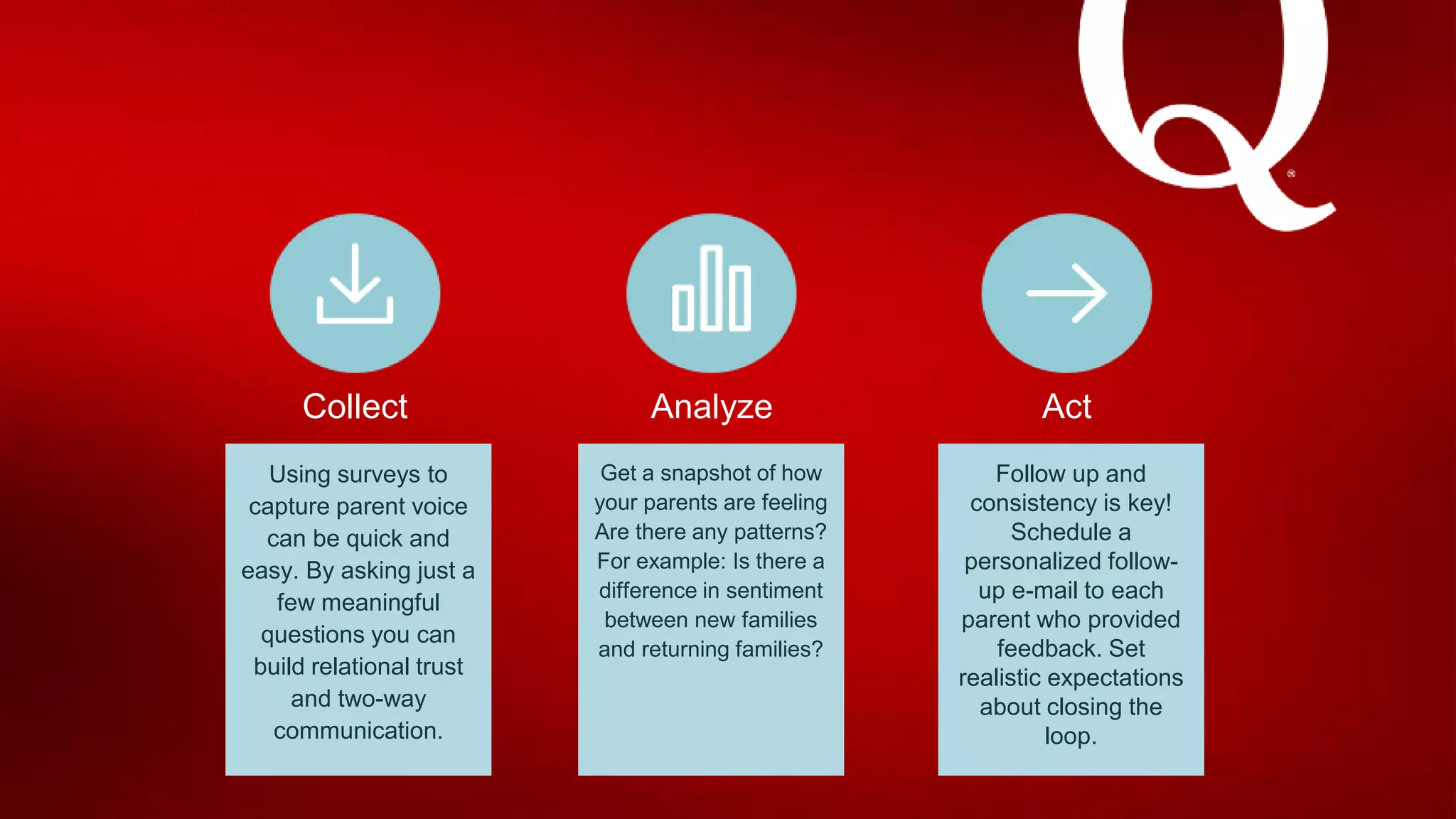
ActAnalyzeCollect
Using surveys to
capture parent voice
can be quick and
easy. By asking just a
few meaningful
questions you can
build relational trust
and two-way
communication.
Get a snapshot of how
your parents are feeling
Are there any patterns?
For example: Is there a
difference in sentiment
between new families
and returning families?
Follow up and
consistency is key!
Schedule a
personalized follow-
up e-mail to each
parent who provided
feedback. Set
realistic expectations
about closing the
loop.
Key Enabling Factors
for Voice of Parent Success
Leadership and Buy-In
Vision and Clarity
Engagement and Collaboration
Listening and Learning
Alignment, Action, and Monitoring
Patience and Commitment
Thank You!
samantham@qualtrics.com
@SamAngMurray
Webinar Presenters
Samantha Murray
Principal Advisor for Academics
QUALTRICS
Phil Cummins
Managing Director
CIRCLE
CIRCLE-QUALTRICS WEBINAR
OCTOBER 2016
Asking the right questions to listen to
the voice of parents
Dr Phil Cummins
CONTEXT: ABOUT US
CIRCLE – The Centre for Innovation, Research, Creativity and Leadership in Education
Working with over 1,750 schools internationally
An educational agency that equips, empowers and enables schools and school leaders through consultancy
and educational services
Achieving better outcomes for more learners by building cultures of excellence in leadership
and learning in communities of inquiry
Strategic alliances with tertiary bodies (including the University of Tasmania) and professional associations
Creating educational software solutions for improving school performance including Touchstones
Dr Philip SA Cummins phil@circle.education
Managing Director, CIRCLE
Adjunct Associate Professor, Faculty of Education, University of Tasmania
Working in and with schools since 1988
www.circle.education
www.mytouchstones.com
@CIRCLEcentral
4 STRATEGIES FOR PARENT ENGAGEMENT
Extracted from CIRCLE Nexus June 2016:
• Planning: Planning for deliberate, targeted and intentional engagement through events, campaigns,
communications and other specific activity
• Preparation: Rehearsing leaders in how to demonstrate their authentic care and concern and the school’s
approach in responding during informal contexts
• Partnerships: Cultivating partnerships with parents that utilise their strengths and gifts in a manner that best
suits their capacity and availability to contribute
• Politics: Using data collection and management to understand who is in the parent body, how they think and
what they want and need for their children
– Who is your community? Who are the key stakeholders you are trying to engage?
– How narrowly can you segment your stakeholder categories?
– How do you know what your parent community thinks?
– How do you know what your parent community wants from
– your school?
– What systems do you have in place to collect, identify, sort, analyse and evaluate the type of data that
will help you to answer these questions?
– Who can help you with this in your school?
GATHERING AND INTERPRETING DATA IN A
SCHOOL COMMUNITY
The CIRCLE Discovery Process
• Discover: What do we know about our performance and culture?
– Survey tools
– Focus group tools
– Workshop tools
• Diagnose: What key patterns and trends can we observe from the
data?
• Decide: What should we do?
• Direct: What strategies can we use to do this well?
• Deploy: How are we going to get there?
SEGMENTING YOUR COMMUNITY:
STANDARDS-REFERENCED EVALUATION
Using standards to evaluate both culture performance
• We use a series of established standards to describe desirable attainment across the 5
domains and the 5 criteria of the CIRCLE School Framework.
• These standards can be used in full or in a selected fashion to identify holistic or targeted
culture and performance.
• Each of the questions of the Discovery tool is linked to a specific standard and
stakeholders are asked to indicate a level of agreement on a 6 point Likert scale:
1. Well below expectation
2. Below expectation
3. Sometimes meets expectation
4. Meets expectation
5. Above expectation
6. Well above expectation
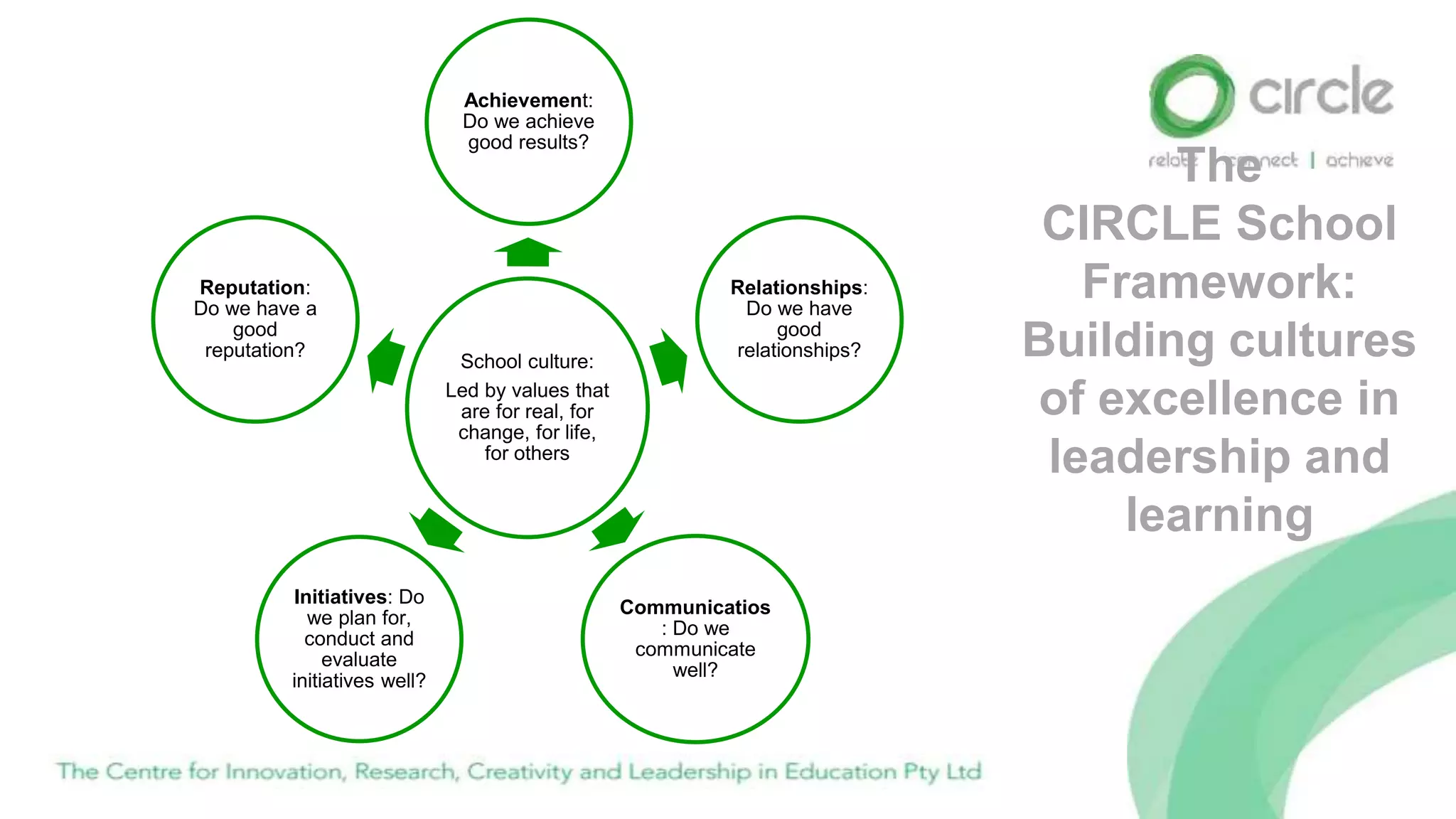
The
CIRCLE School
Framework:
Building cultures
of excellence in
leadership and
learning
School culture:
Led by values that
are for real, for
change, for life,
for others
Achievement:
Do we achieve
good results?
Relationships:
Do we have
good
relationships?
Communicatios
: Do we
communicate
well?
Initiatives: Do
we plan for,
conduct and
evaluate
initiatives well?
Reputation:
Do we have a
good
reputation?
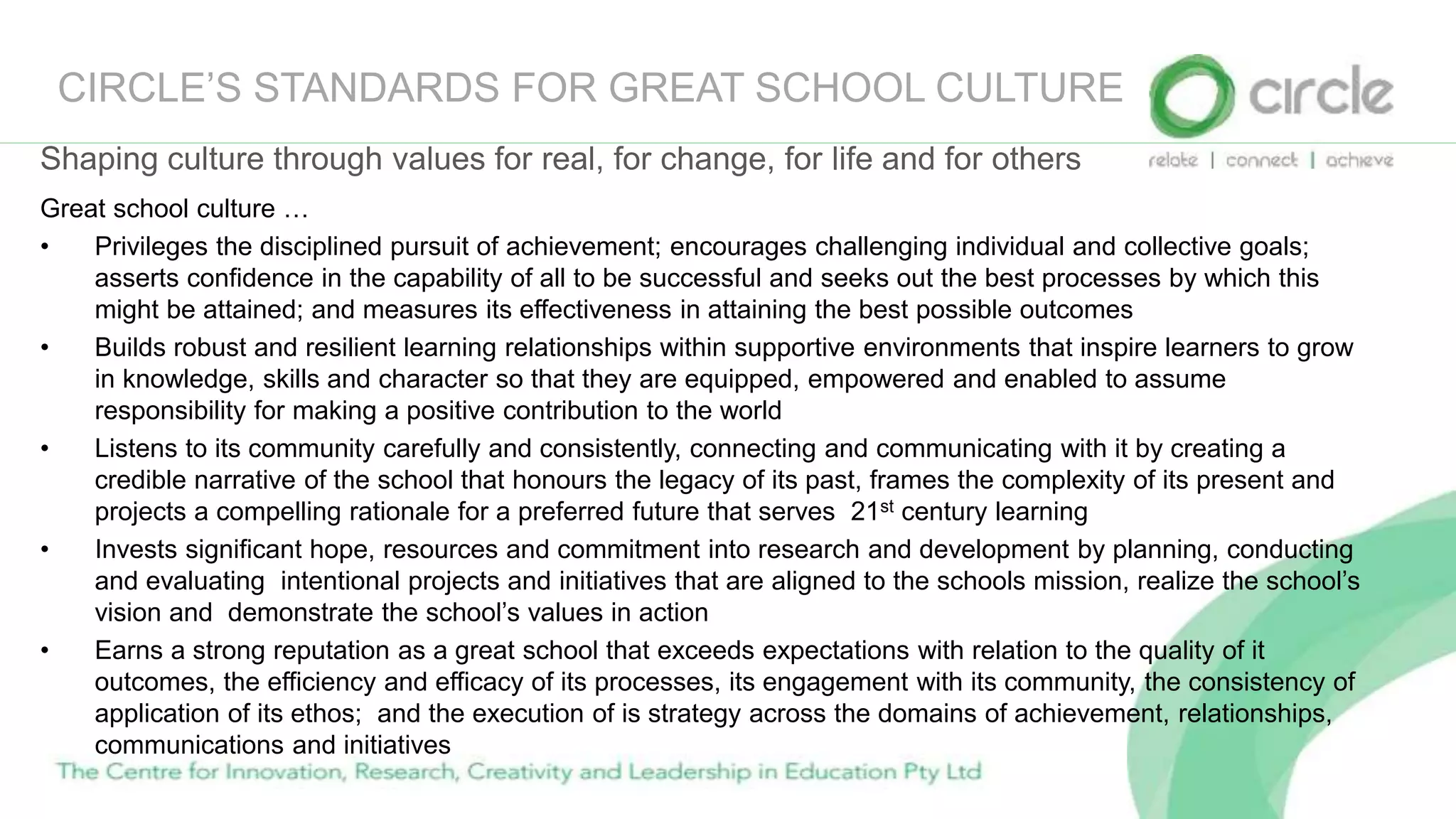
CIRCLE’S STANDARDS FOR GREAT SCHOOL CULTURE
Great school culture …
• Privileges the disciplined pursuit of achievement; encourages challenging individual and collective goals;
asserts confidence in the capability of all to be successful and seeks out the best processes by which this
might be attained; and measures its effectiveness in attaining the best possible outcomes
• Builds robust and resilient learning relationships within supportive environments that inspire learners to grow
in knowledge, skills and character so that they are equipped, empowered and enabled to assume
responsibility for making a positive contribution to the world
• Listens to its community carefully and consistently, connecting and communicating with it by creating a
credible narrative of the school that honours the legacy of its past, frames the complexity of its present and
projects a compelling rationale for a preferred future that serves 21st century learning
• Invests significant hope, resources and commitment into research and development by planning, conducting
and evaluating intentional projects and initiatives that are aligned to the schools mission, realize the school’s
vision and demonstrate the school’s values in action
• Earns a strong reputation as a great school that exceeds expectations with relation to the quality of it
outcomes, the efficiency and efficacy of its processes, its engagement with its community, the consistency of
application of its ethos; and the execution of is strategy across the domains of achievement, relationships,
communications and initiatives
Shaping culture through values for real, for change, for life and for others
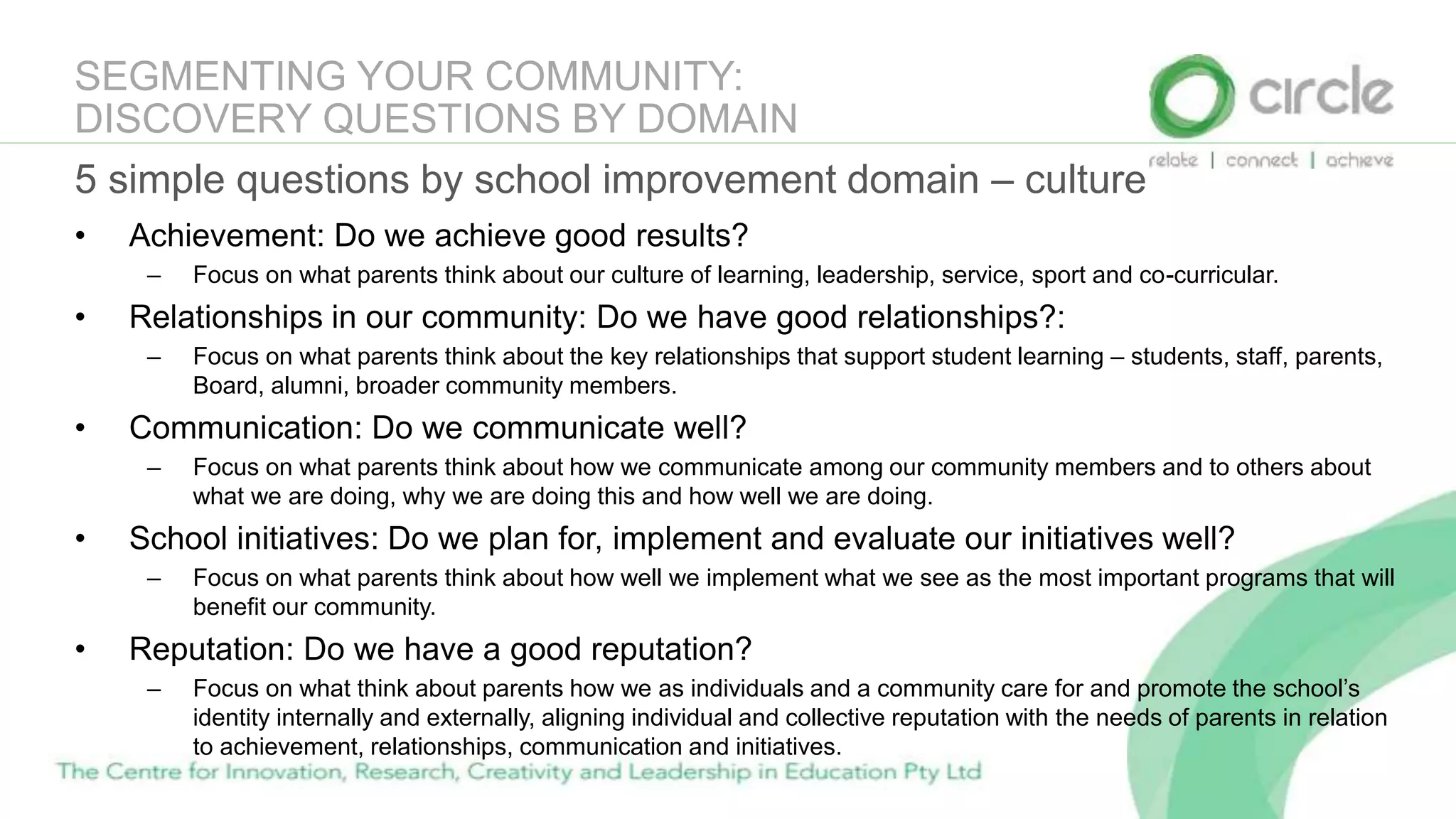
SEGMENTING YOUR COMMUNITY:
DISCOVERY QUESTIONS BY DOMAIN
5 simple questions by school improvement domain – culture
• Achievement: Do we achieve good results?
– Focus on what parents think about our culture of learning, leadership, service, sport and co-curricular.
• Relationships in our community: Do we have good relationships?:
– Focus on what parents think about the key relationships that support student learning – students, staff, parents,
Board, alumni, broader community members.
• Communication: Do we communicate well?
– Focus on what parents think about how we communicate among our community members and to others about
what we are doing, why we are doing this and how well we are doing.
• School initiatives: Do we plan for, implement and evaluate our initiatives well?
– Focus on what parents think about how well we implement what we see as the most important programs that will
benefit our community.
• Reputation: Do we have a good reputation?
– Focus on what think about parents how we as individuals and a community care for and promote the school’s
identity internally and externally, aligning individual and collective reputation with the needs of parents in relation
to achievement, relationships, communication and initiatives.
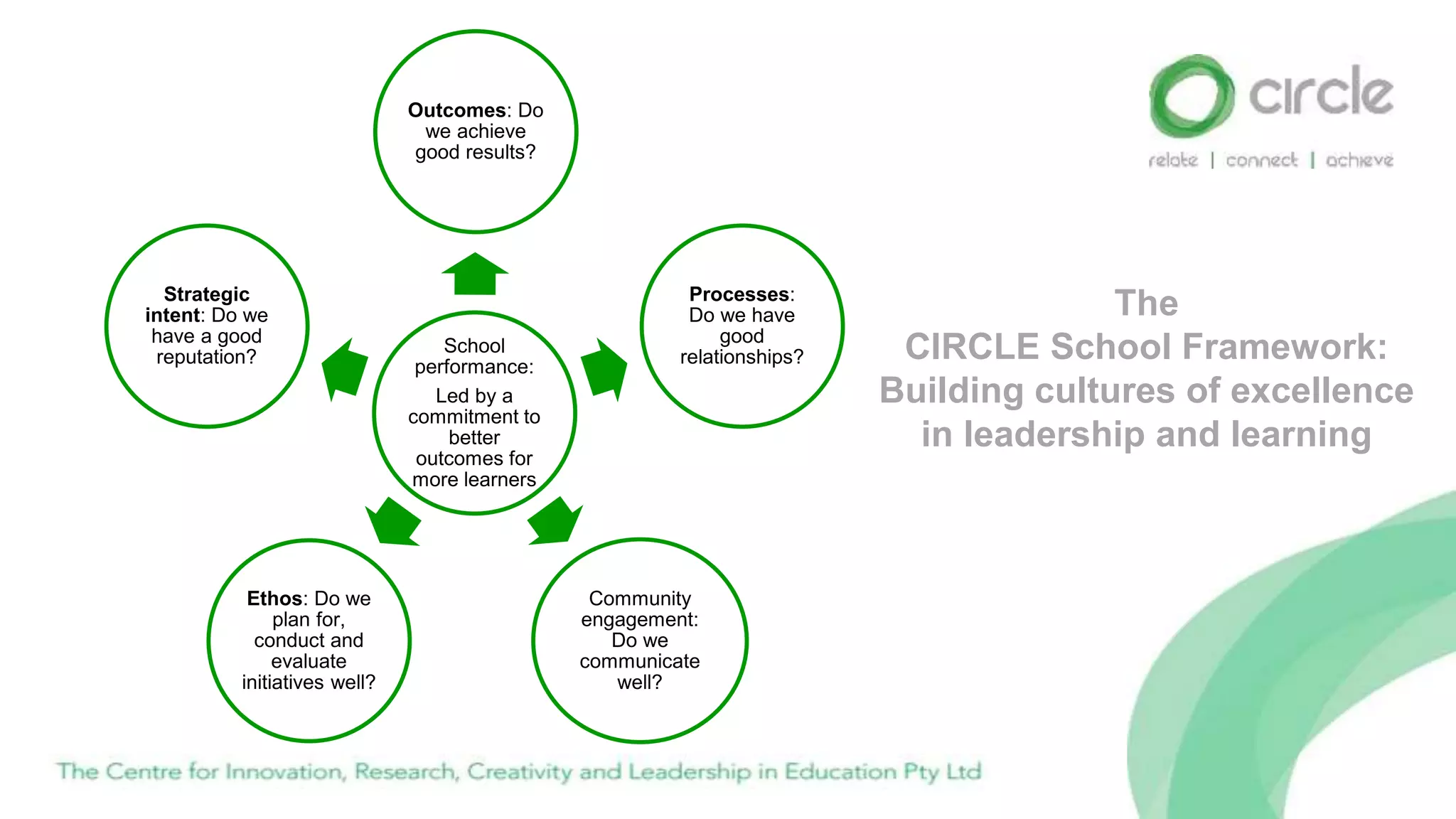
The
CIRCLE School Framework:
Building cultures of excellence
in leadership and learning
School
performance:
Led by a
commitment to
better
outcomes for
more learners
Outcomes: Do
we achieve
good results?
Processes:
Do we have
good
relationships?
Community
engagement:
Do we
communicate
well?
Ethos: Do we
plan for,
conduct and
evaluate
initiatives well?
Strategic
intent: Do we
have a good
reputation?
CIRCLE’S STANDARDS FOR
OUTSTANDING SCHOOL PERFORMANCE
Outstanding school performance is …
• Driven by a relentless passion for and shared practice in for setting, planning for, attaining, evaluating and (where possible)
improving the agreed key outcomes of the school that relate to the core learning, leadership, character, service, sport, co-
curricular and developmental activity of the school in particular, as well as the financial, governance and business stewardship of
the those resources needed to attain the educational mission of the school
• Enhanced by routine habits of researching, identifying and implementing the best possible teaching and learning, research and
development, information recording and tracking, evaluation and decision-making, and resourcing and other business processes,
based on cumulative internal data-gathering, regular programs of review and external research of other available options
• Energised by deliberate, targeted and intentional approaches to community engagement that is informed by an both
understanding of the relationships between what stakeholders what and need, and what the school promises and delivers on an
ongoing basis, and the identification of the broad and deep nature of community satisfaction with our school by testing the validity
of parent assumptions and anecdote against key data about performance
• Strengthened by the robustness and resilience of its ethos, particularly through the alignment of its stated and unstated culture as
demonstrated in the connections between our community’s words and its deeds, particularly the daily activity of students, staff
and leaders
• Guided by a common understanding of and judgment about our strategic intent that is most visible in the close and mutually
supporting relationship between our strategic vision, intention, planning, operations, communication and evaluation systems, and
also our capacity to deliver better outcomes for more learners by building cultures of excellence in leadership and learning
Crafting performance through commitment to better outcomes for more learners
SEGMENTING YOUR COMMUNITY:
DISCOVERY QUESTIONS BY CRITERIA
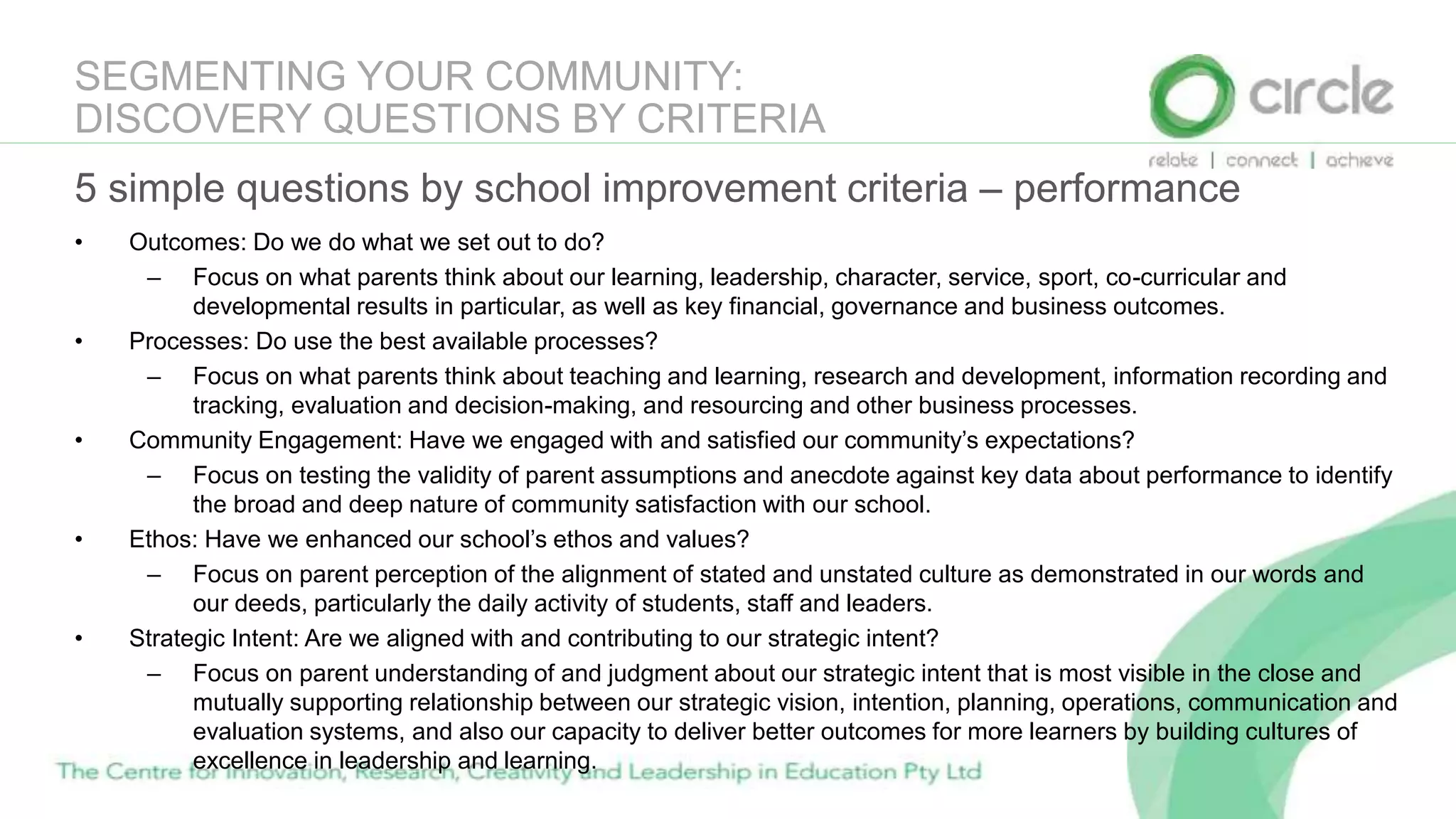
5 simple questions by school improvement criteria – performance
• Outcomes: Do we do what we set out to do?
– Focus on what parents think about our learning, leadership, character, service, sport, co-curricular and
developmental results in particular, as well as key financial, governance and business outcomes.
• Processes: Do use the best available processes?
– Focus on what parents think about teaching and learning, research and development, information recording and
tracking, evaluation and decision-making, and resourcing and other business processes.
• Community Engagement: Have we engaged with and satisfied our community’s expectations?
– Focus on testing the validity of parent assumptions and anecdote against key data about performance to identify
the broad and deep nature of community satisfaction with our school.
• Ethos: Have we enhanced our school’s ethos and values?
– Focus on parent perception of the alignment of stated and unstated culture as demonstrated in our words and
our deeds, particularly the daily activity of students, staff and leaders.
• Strategic Intent: Are we aligned with and contributing to our strategic intent?
– Focus on parent understanding of and judgment about our strategic intent that is most visible in the close and
mutually supporting relationship between our strategic vision, intention, planning, operations, communication and
evaluation systems, and also our capacity to deliver better outcomes for more learners by building cultures of
excellence in leadership and learning.
SEGMENTING YOUR COMMUNITY:
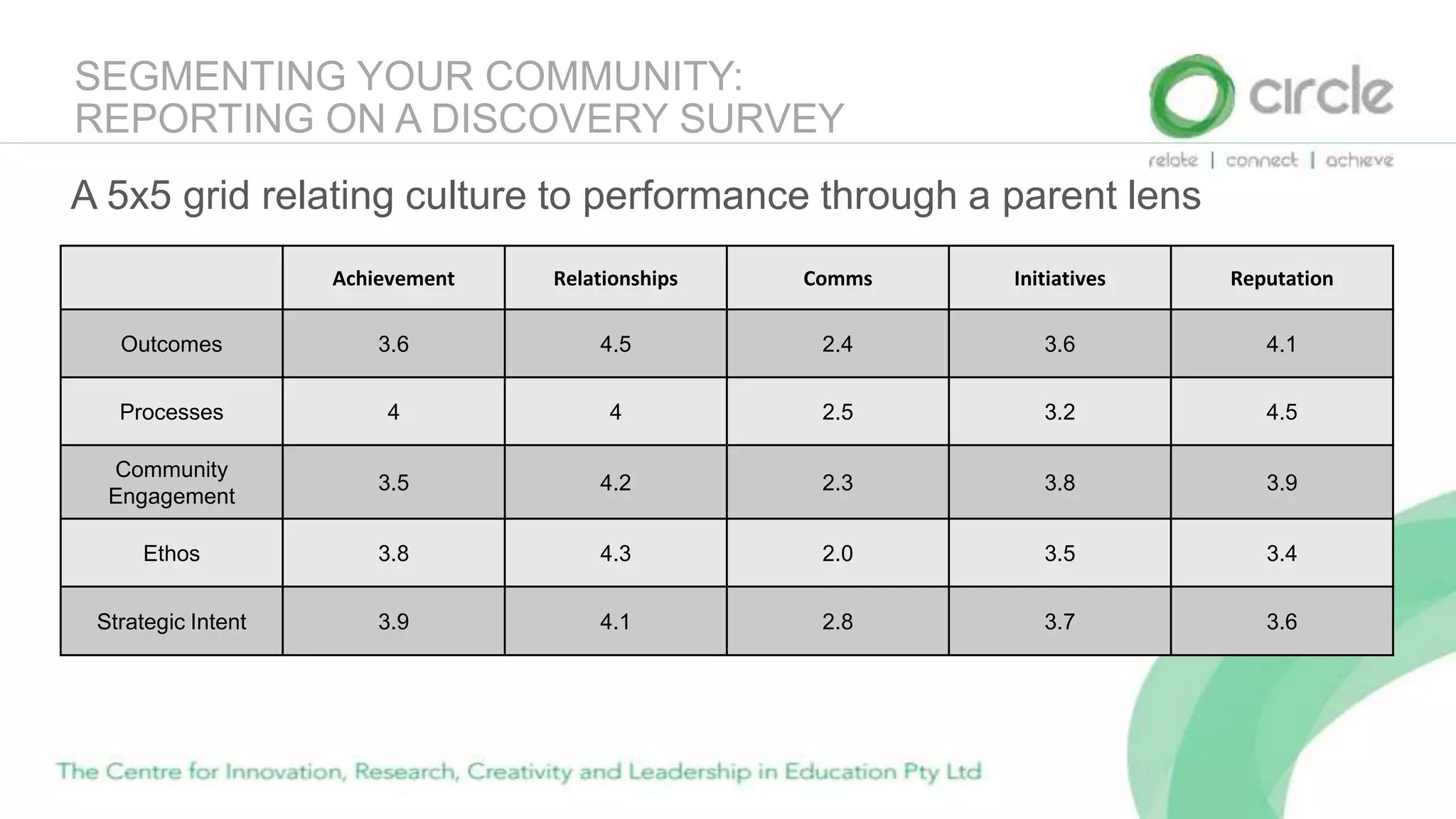
REPORTING ON A DISCOVERY SURVEY
A 5x5 grid relating culture to performance through a parent lens
Achievement Relationships Comms Initiatives Reputation
Outcomes 3.6 4.5 2.4 3.6 4.1
Processes 4 4 2.5 3.2 4.5
Community
Engagement
3.5 4.2 2.3 3.8 3.9
Ethos 3.8 4.3 2.0 3.5 3.4
Strategic Intent 3.9 4.1 2.8 3.7 3.6
SEGMENTING YOUR COMMUNITY:
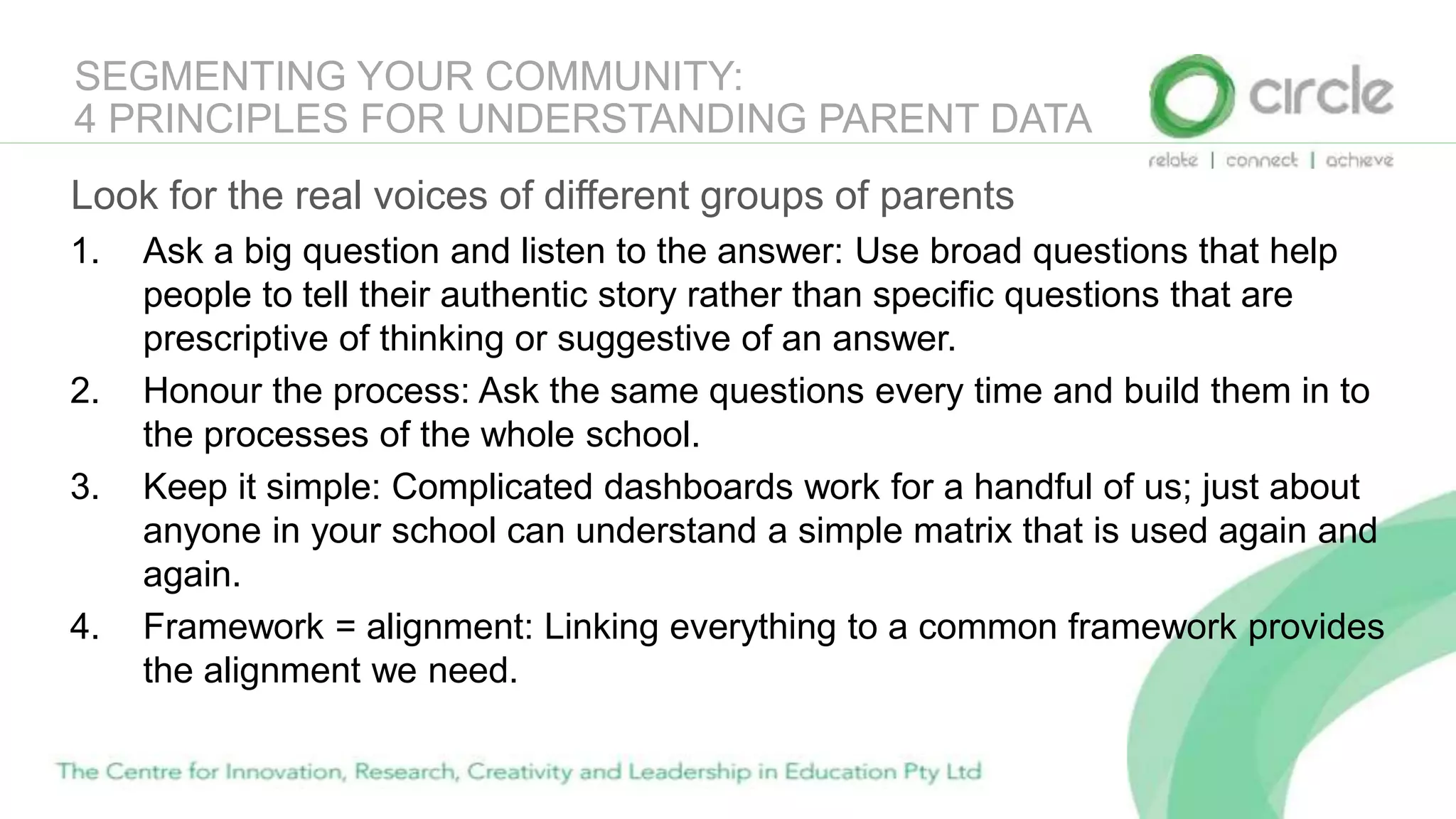
4 PRINCIPLES FOR UNDERSTANDING PARENT DATA
Look for the real voices of different groups of parents
1. Ask a big question and listen to the answer: Use broad questions that help
people to tell their authentic story rather than specific questions that are
prescriptive of thinking or suggestive of an answer.
2. Honour the process: Ask the same questions every time and build them in to
the processes of the whole school.
3. Keep it simple: Complicated dashboards work for a handful of us; just about
anyone in your school can understand a simple matrix that is used again and
again.
4. Framework = alignment: Linking everything to a common framework provides
the alignment we need.
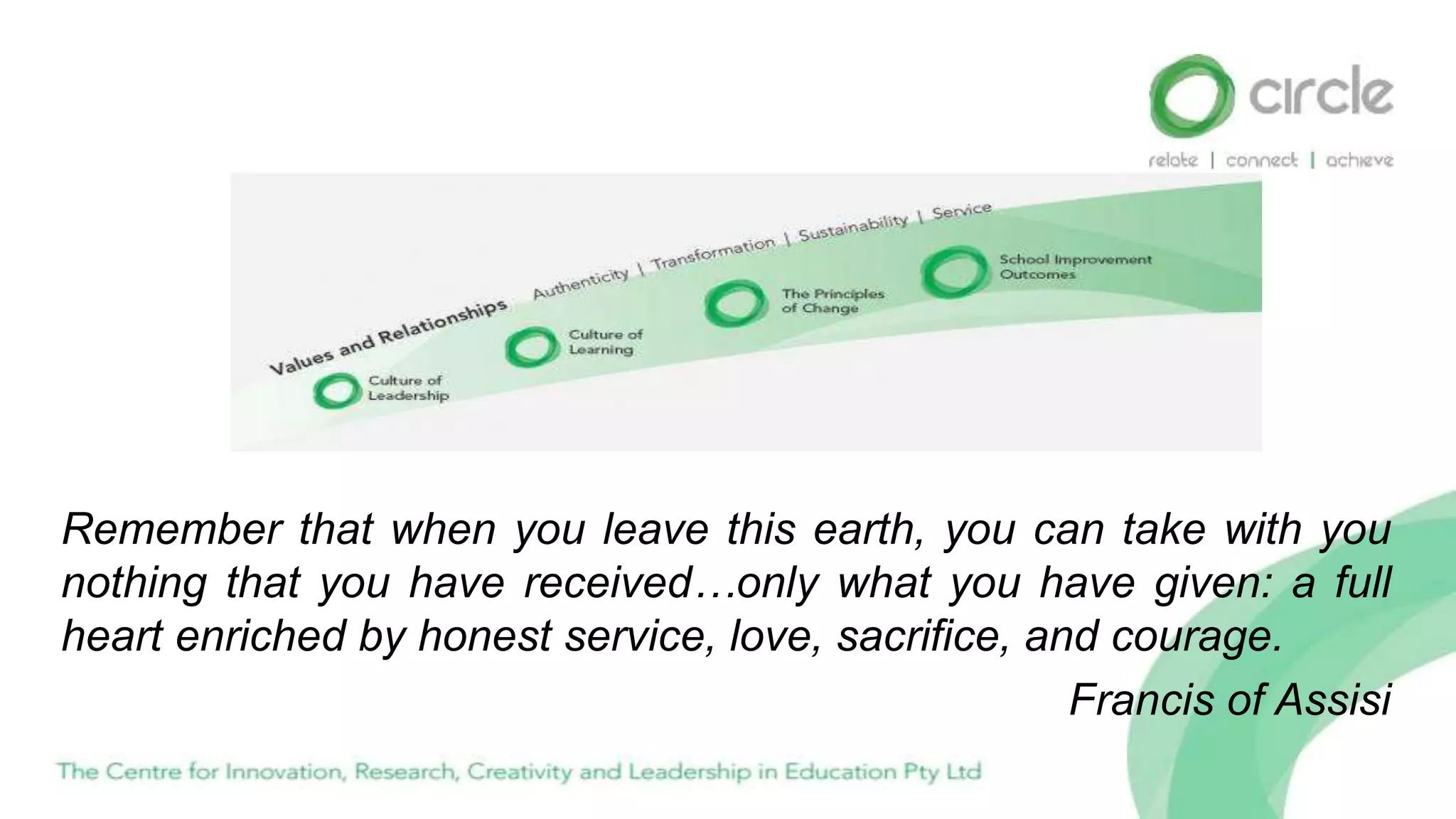
Remember that when you leave this earth, you can take with you
nothing that you have received…only what you have given: a full
heart enriched by honest service, love, sacrifice, and courage.
Francis of Assisi
Do you have other questions?
Do you want to know more?
Dr Phil Cummins phil@circle.education
www.circle.education
www.mytouchstones.com
@CIRCLEcentral
Q&A
Phil Cummins
phil@circle.education
www.circle.education
@CIRCLEcentral
Samantha Murray
samantham@qualtrics.com
www.qualtrics.com/k12
@SamAngMurray
Do you have other questions?

Voice of the Parent: How Schools can Engage with Parents

  • 1.
    Voice of theParent: How Schools can Engage with
  • 2.
    House Keeping The recordingand slides for today’s presentation will be made available as soon as possible. Please use the question window to submit questions throughout the webinar. We have time designated at the end for Q&A.
  • 3.
    Webinar Presenters Samantha Murray PrincipalAdvisor for Academics QUALTRICS Phil Cummins Managing Director CIRCLE
  • 4.
    Today’s Agenda • Usingsurveys to strengthen parent- school relationships (Samantha Murray) • Asking the right questions to listen to the voice of the parents (Phil
  • 5.
    Webinar Presenters Samantha Murray PrincipalAdvisor for Academics QUALTRICS Phil Cummins Managing Director CIRCLE
  • 6.
    Voice of ParentProgram Using Surveys to Strengthen Parent-School Relationships Samantha A. Murray Principal Advisor for Academics Qualtrics
  • 7.
    Voice of ParentProgram Exploring how schools can use surveys to gather rich, actionable data in Qualtrics to strengthen parent-school relationships. Today’s Discussion
  • 8.
    ActAnalyzeCollect Qualtrics is apowerful, flexible, and scalable technology that transforms the way individual schools and school systems collect, analyze and act on data - all in a single insights platform. Learn RespondListen
  • 9.
    If you couldask only 1 question to get a parent pulse, what would you ask? Just to check in Should be a closed-ended question
  • 10.
    If you couldask only 1 question to get a parent pulse, what would you ask? Examples: How would you rate the school year so far? How do you feel about ___ at this point in the school year? How happy are you with the way the school year is going? How satisfied are you with your experience thus far?How well are we serving your family?
  • 11.
    Over the courseof a school year, when + how often would you ask that 1 check-in question? Examples: How would you rate the school year so far? How do you feel about ___ at this point in the school year? How happy are you with the way the school year is going? How satisfied are you with your experience thus far?How well are we serving your family?
  • 12.
    Voice of ParentProgram Design An Example
  • 13.
    Collect Voice of Parent Analyze Act ASK: 1. Howsatisfied are you with your experience thus far? (closed-ended) 2. What’s going well? (open-ended) 3. What’s not going well? (open-ended) Wave 1 Monitor
  • 14.
    Collect Collect Voice of Parent AnalyzeAnalyze Act Act Monitor Wave 1 Wave 2 Monitor ASK: 1. How satisfied are you with your experience thus far? (closed-ended) 2. What’s going well? (open-ended) 3. What’s not going well? (open-ended)
  • 15.
    Collect Collect Voice of Parent AnalyzeAnalyze Act Act Monitor Wave 1 Wave 2 Monitor Collect Analyze Act Wave 3 Monitor/Planning ASK: 1. How satisfied are you with your experience thus far? (closed-ended) 2. What’s going well? (open-ended) 3. What’s not going well? (open-ended)
  • 16.
    ActAnalyzeCollect Using surveys to captureparent voice can be quick and easy. By asking just a few meaningful questions you can build relational trust and two-way communication. Get a snapshot of how your parents are feeling Are there any patterns? For example: Is there a difference in sentiment between new families and returning families? Follow up and consistency is key! Schedule a personalized follow- up e-mail to each parent who provided feedback. Set realistic expectations about closing the loop.
  • 17.
    Key Enabling Factors forVoice of Parent Success Leadership and Buy-In Vision and Clarity Engagement and Collaboration Listening and Learning Alignment, Action, and Monitoring Patience and Commitment
  • 18.
  • 19.
    Webinar Presenters Samantha Murray PrincipalAdvisor for Academics QUALTRICS Phil Cummins Managing Director CIRCLE
  • 20.
    CIRCLE-QUALTRICS WEBINAR OCTOBER 2016 Askingthe right questions to listen to the voice of parents Dr Phil Cummins
  • 21.
    CONTEXT: ABOUT US CIRCLE– The Centre for Innovation, Research, Creativity and Leadership in Education Working with over 1,750 schools internationally An educational agency that equips, empowers and enables schools and school leaders through consultancy and educational services Achieving better outcomes for more learners by building cultures of excellence in leadership and learning in communities of inquiry Strategic alliances with tertiary bodies (including the University of Tasmania) and professional associations Creating educational software solutions for improving school performance including Touchstones Dr Philip SA Cummins phil@circle.education Managing Director, CIRCLE Adjunct Associate Professor, Faculty of Education, University of Tasmania Working in and with schools since 1988 www.circle.education www.mytouchstones.com @CIRCLEcentral
  • 22.
    4 STRATEGIES FORPARENT ENGAGEMENT Extracted from CIRCLE Nexus June 2016: • Planning: Planning for deliberate, targeted and intentional engagement through events, campaigns, communications and other specific activity • Preparation: Rehearsing leaders in how to demonstrate their authentic care and concern and the school’s approach in responding during informal contexts • Partnerships: Cultivating partnerships with parents that utilise their strengths and gifts in a manner that best suits their capacity and availability to contribute • Politics: Using data collection and management to understand who is in the parent body, how they think and what they want and need for their children – Who is your community? Who are the key stakeholders you are trying to engage? – How narrowly can you segment your stakeholder categories? – How do you know what your parent community thinks? – How do you know what your parent community wants from – your school? – What systems do you have in place to collect, identify, sort, analyse and evaluate the type of data that will help you to answer these questions? – Who can help you with this in your school?
  • 23.
    GATHERING AND INTERPRETINGDATA IN A SCHOOL COMMUNITY The CIRCLE Discovery Process • Discover: What do we know about our performance and culture? – Survey tools – Focus group tools – Workshop tools • Diagnose: What key patterns and trends can we observe from the data? • Decide: What should we do? • Direct: What strategies can we use to do this well? • Deploy: How are we going to get there?
  • 24.
    SEGMENTING YOUR COMMUNITY: STANDARDS-REFERENCEDEVALUATION Using standards to evaluate both culture performance • We use a series of established standards to describe desirable attainment across the 5 domains and the 5 criteria of the CIRCLE School Framework. • These standards can be used in full or in a selected fashion to identify holistic or targeted culture and performance. • Each of the questions of the Discovery tool is linked to a specific standard and stakeholders are asked to indicate a level of agreement on a 6 point Likert scale: 1. Well below expectation 2. Below expectation 3. Sometimes meets expectation 4. Meets expectation 5. Above expectation 6. Well above expectation
  • 25.
    The CIRCLE School Framework: Building cultures ofexcellence in leadership and learning School culture: Led by values that are for real, for change, for life, for others Achievement: Do we achieve good results? Relationships: Do we have good relationships? Communicatios : Do we communicate well? Initiatives: Do we plan for, conduct and evaluate initiatives well? Reputation: Do we have a good reputation?
  • 26.
    CIRCLE’S STANDARDS FORGREAT SCHOOL CULTURE Great school culture … • Privileges the disciplined pursuit of achievement; encourages challenging individual and collective goals; asserts confidence in the capability of all to be successful and seeks out the best processes by which this might be attained; and measures its effectiveness in attaining the best possible outcomes • Builds robust and resilient learning relationships within supportive environments that inspire learners to grow in knowledge, skills and character so that they are equipped, empowered and enabled to assume responsibility for making a positive contribution to the world • Listens to its community carefully and consistently, connecting and communicating with it by creating a credible narrative of the school that honours the legacy of its past, frames the complexity of its present and projects a compelling rationale for a preferred future that serves 21st century learning • Invests significant hope, resources and commitment into research and development by planning, conducting and evaluating intentional projects and initiatives that are aligned to the schools mission, realize the school’s vision and demonstrate the school’s values in action • Earns a strong reputation as a great school that exceeds expectations with relation to the quality of it outcomes, the efficiency and efficacy of its processes, its engagement with its community, the consistency of application of its ethos; and the execution of is strategy across the domains of achievement, relationships, communications and initiatives Shaping culture through values for real, for change, for life and for others
  • 27.
    SEGMENTING YOUR COMMUNITY: DISCOVERYQUESTIONS BY DOMAIN 5 simple questions by school improvement domain – culture • Achievement: Do we achieve good results? – Focus on what parents think about our culture of learning, leadership, service, sport and co-curricular. • Relationships in our community: Do we have good relationships?: – Focus on what parents think about the key relationships that support student learning – students, staff, parents, Board, alumni, broader community members. • Communication: Do we communicate well? – Focus on what parents think about how we communicate among our community members and to others about what we are doing, why we are doing this and how well we are doing. • School initiatives: Do we plan for, implement and evaluate our initiatives well? – Focus on what parents think about how well we implement what we see as the most important programs that will benefit our community. • Reputation: Do we have a good reputation? – Focus on what think about parents how we as individuals and a community care for and promote the school’s identity internally and externally, aligning individual and collective reputation with the needs of parents in relation to achievement, relationships, communication and initiatives.
  • 28.
    The CIRCLE School Framework: Buildingcultures of excellence in leadership and learning School performance: Led by a commitment to better outcomes for more learners Outcomes: Do we achieve good results? Processes: Do we have good relationships? Community engagement: Do we communicate well? Ethos: Do we plan for, conduct and evaluate initiatives well? Strategic intent: Do we have a good reputation?
  • 29.
    CIRCLE’S STANDARDS FOR OUTSTANDINGSCHOOL PERFORMANCE Outstanding school performance is … • Driven by a relentless passion for and shared practice in for setting, planning for, attaining, evaluating and (where possible) improving the agreed key outcomes of the school that relate to the core learning, leadership, character, service, sport, co- curricular and developmental activity of the school in particular, as well as the financial, governance and business stewardship of the those resources needed to attain the educational mission of the school • Enhanced by routine habits of researching, identifying and implementing the best possible teaching and learning, research and development, information recording and tracking, evaluation and decision-making, and resourcing and other business processes, based on cumulative internal data-gathering, regular programs of review and external research of other available options • Energised by deliberate, targeted and intentional approaches to community engagement that is informed by an both understanding of the relationships between what stakeholders what and need, and what the school promises and delivers on an ongoing basis, and the identification of the broad and deep nature of community satisfaction with our school by testing the validity of parent assumptions and anecdote against key data about performance • Strengthened by the robustness and resilience of its ethos, particularly through the alignment of its stated and unstated culture as demonstrated in the connections between our community’s words and its deeds, particularly the daily activity of students, staff and leaders • Guided by a common understanding of and judgment about our strategic intent that is most visible in the close and mutually supporting relationship between our strategic vision, intention, planning, operations, communication and evaluation systems, and also our capacity to deliver better outcomes for more learners by building cultures of excellence in leadership and learning Crafting performance through commitment to better outcomes for more learners
  • 30.
    SEGMENTING YOUR COMMUNITY: DISCOVERYQUESTIONS BY CRITERIA 5 simple questions by school improvement criteria – performance • Outcomes: Do we do what we set out to do? – Focus on what parents think about our learning, leadership, character, service, sport, co-curricular and developmental results in particular, as well as key financial, governance and business outcomes. • Processes: Do use the best available processes? – Focus on what parents think about teaching and learning, research and development, information recording and tracking, evaluation and decision-making, and resourcing and other business processes. • Community Engagement: Have we engaged with and satisfied our community’s expectations? – Focus on testing the validity of parent assumptions and anecdote against key data about performance to identify the broad and deep nature of community satisfaction with our school. • Ethos: Have we enhanced our school’s ethos and values? – Focus on parent perception of the alignment of stated and unstated culture as demonstrated in our words and our deeds, particularly the daily activity of students, staff and leaders. • Strategic Intent: Are we aligned with and contributing to our strategic intent? – Focus on parent understanding of and judgment about our strategic intent that is most visible in the close and mutually supporting relationship between our strategic vision, intention, planning, operations, communication and evaluation systems, and also our capacity to deliver better outcomes for more learners by building cultures of excellence in leadership and learning.
  • 31.
    SEGMENTING YOUR COMMUNITY: REPORTINGON A DISCOVERY SURVEY A 5x5 grid relating culture to performance through a parent lens Achievement Relationships Comms Initiatives Reputation Outcomes 3.6 4.5 2.4 3.6 4.1 Processes 4 4 2.5 3.2 4.5 Community Engagement 3.5 4.2 2.3 3.8 3.9 Ethos 3.8 4.3 2.0 3.5 3.4 Strategic Intent 3.9 4.1 2.8 3.7 3.6
  • 32.
    SEGMENTING YOUR COMMUNITY: 4PRINCIPLES FOR UNDERSTANDING PARENT DATA Look for the real voices of different groups of parents 1. Ask a big question and listen to the answer: Use broad questions that help people to tell their authentic story rather than specific questions that are prescriptive of thinking or suggestive of an answer. 2. Honour the process: Ask the same questions every time and build them in to the processes of the whole school. 3. Keep it simple: Complicated dashboards work for a handful of us; just about anyone in your school can understand a simple matrix that is used again and again. 4. Framework = alignment: Linking everything to a common framework provides the alignment we need.
  • 33.
    Remember that whenyou leave this earth, you can take with you nothing that you have received…only what you have given: a full heart enriched by honest service, love, sacrifice, and courage. Francis of Assisi
  • 34.
    Do you haveother questions? Do you want to know more? Dr Phil Cummins phil@circle.education www.circle.education www.mytouchstones.com @CIRCLEcentral
  • 35.
  • 36.