VLT® 8000 AQUA
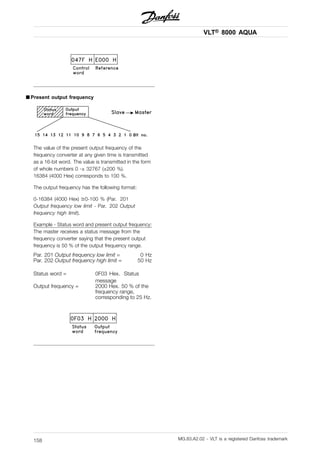
■ Contents
Introduction ......................................................................................................... 4
Software version ....................................................................................................... 4
Definitions ................................................................................................................ 5
Safety regulations ..................................................................................................... 7
Warning against unintended start ............................................................................. 7
Introduction to Operating Instructions ....................................................................... 9
Control principle ..................................................................................................... 10
AEO - Automatic Energy Optimization .................................................................... 10
Example of application - Constant pressure regulation in water supply system ....... 12
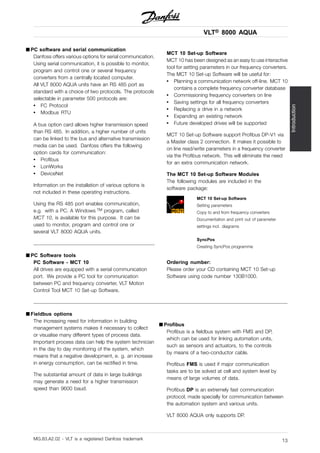
PC software and serial communication ................................................................... 13
PC Software tools .................................................................................................. 13
Fieldbus options ..................................................................................................... 13
Profibus .................................................................................................................. 13
LON - Local Operating Network ............................................................................. 14
DeviceNet .............................................................................................................. 14
Modbus RTU .......................................................................................................... 14
Cascade Controller Option ..................................................................................... 17
Unpacking and ordering a VLT frequency converter ................................................ 25
Type code ordering number string ......................................................................... 25
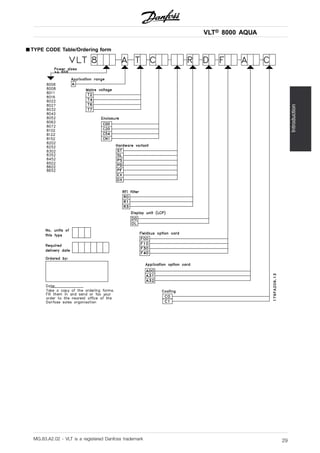
TYPE CODE Table/Ordering form ........................................................................... 29
Installation ......................................................................................................... 30
General technical data ............................................................................................ 30
Technical data, mains supply 3 x 200 - 240 V ......................................................... 36
Technical data, mains supply 3 x 380 - 480 V ........................................................ 38
Technical data, mains supply 3 x 525 - 600 V ......................................................... 43
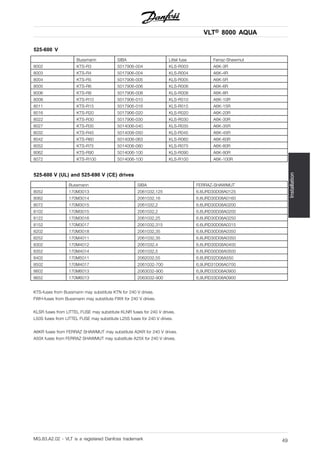
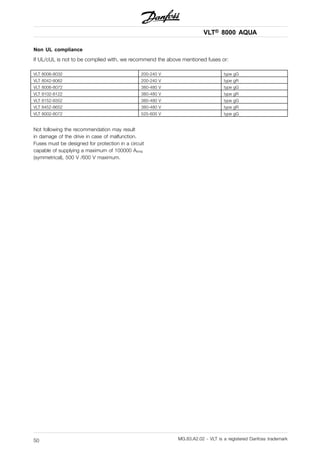
Fuses ..................................................................................................................... 48
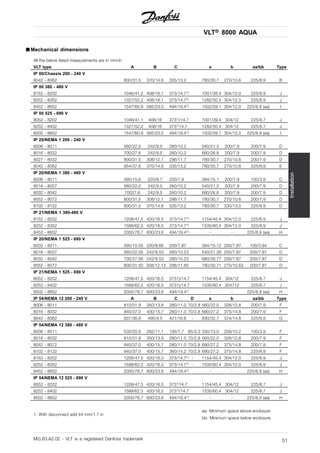
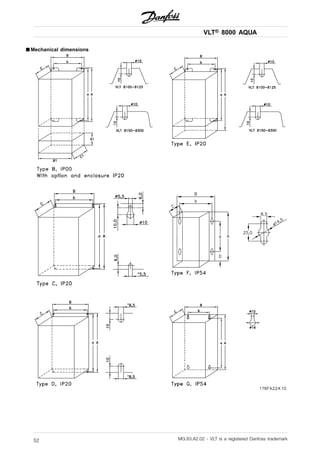
Mechanical dimensions .......................................................................................... 51
Mechanical installation ............................................................................................ 54
General information about electrical installation ...................................................... 56
High voltage warning .............................................................................................. 56
Earthing .................................................................................................................. 56
Cables .................................................................................................................... 56
Screened/armoured cables .................................................................................... 56
Extra protection with regard to indirect contact ....................................................... 57
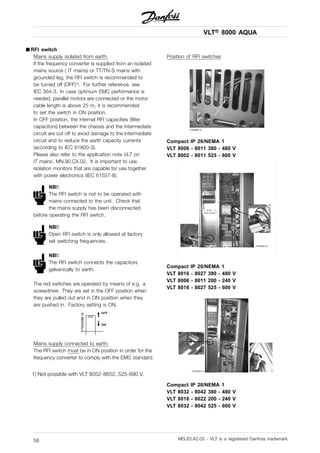
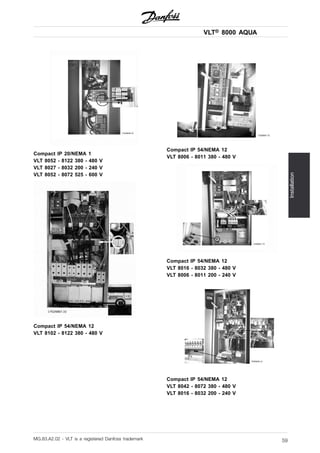
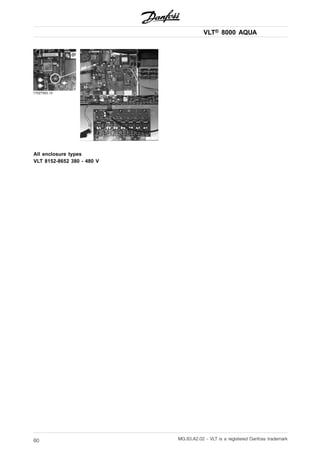
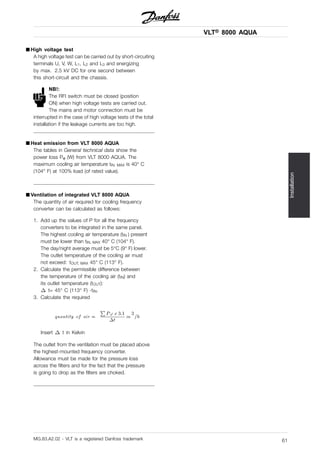
RFI switch .............................................................................................................. 58
High voltage test .................................................................................................... 61
Heat emission from VLT 8000 AQUA ...................................................................... 61
EMC-correct electrical installation ........................................................................... 62
Earthing/Grounding of screened/armoured control cables ...................................... 64
Electrical installation, enclosures ............................................................................. 65
Use of emc-correct cables ..................................................................................... 73
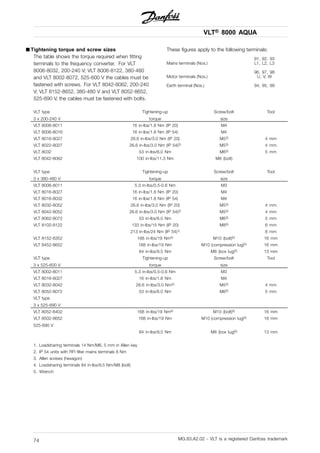
Tightening torque and screw sizes ......................................................................... 74
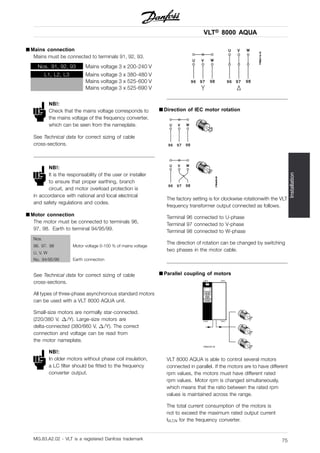
Mains connection ................................................................................................... 75
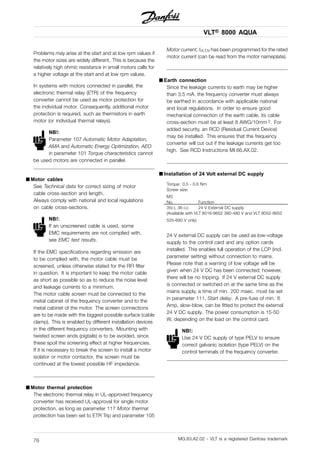
Motor connection ................................................................................................... 75
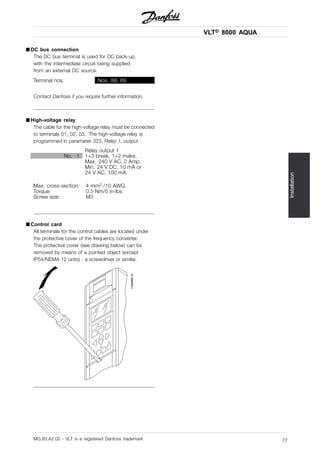
DC bus connection ................................................................................................ 77
High-voltage relay ................................................................................................... 77
Electrical installation, control cables ........................................................................ 78
Switches 1-4 .......................................................................................................... 79
Connection example VLT 8000 AQUA .................................................................... 81
Control unit LCP ..................................................................................................... 84
MG.83.A2.02 - VLT is a registered Danfoss trademark 1
VLT® 8000 AQUA
Control keys for parameter setup ........................................................................... 84
Indicator lamps ....................................................................................................... 85
Local control .......................................................................................................... 85
Display mode ......................................................................................................... 85
Navigation between display modes ........................................................................ 88
Changing data ........................................................................................................ 89
Manual initialisation ................................................................................................. 89
Quick Menu ............................................................................................................ 90
Programming .................................................................................................... 92
Operation and Display 001-017 .............................................................................. 92
The Setup configuration ......................................................................................... 92
Setup of user-defined readout ................................................................................ 93
Load and motor 100-124 ....................................................................................... 99
Configuration .......................................................................................................... 99
Motor power factor (Cos ø) .................................................................................. 105
References and limits 200-228 ............................................................................. 108
Reference handling ............................................................................................... 109
Reference type ..................................................................................................... 112
Initial ramp parameter 229 .................................................................................... 116
Fill Mode .............................................................................................................. 116
Fill Rate parameter 230 ........................................................................................ 117
Filled Setpoint parameter 231 ............................................................................... 117
Inputs and outputs 300-328 ................................................................................. 118
Analog inputs ....................................................................................................... 122
Analog/digital outputs ........................................................................................... 125
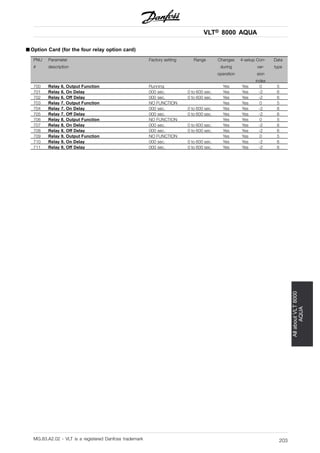
Relay outputs ....................................................................................................... 128
Application functions 400-434 .............................................................................. 131
Sleep mode .......................................................................................................... 132
PID for process control ......................................................................................... 137
PID overview ........................................................................................................ 139
Feedback handling ............................................................................................... 139
Enhanced Sleep Mode ......................................................................................... 145
Serial communication for FC protocol ................................................................... 149
Protocols .............................................................................................................. 149
Telegram communication ..................................................................................... 149
Telegram build-up under FC protocol ................................................................... 149
Data character (byte) ............................................................................................ 151
Process word ....................................................................................................... 154
Control word according to FC protocol ................................................................. 155
Status word according to FC protocol .................................................................. 156
Serial communication 500-556 ............................................................................. 159
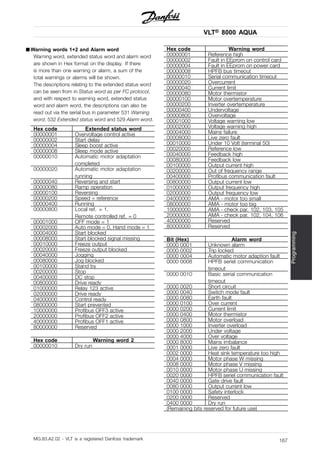
Warning words 1+2 and Alarm word .................................................................... 167
Service functions 600-631 .................................................................................... 168
Electrical installation of the relay card .................................................................... 173
All about VLT 8000 AQUA ......................................................................... 174
Status messages .................................................................................................. 174
List of warnings and alarms .................................................................................. 176
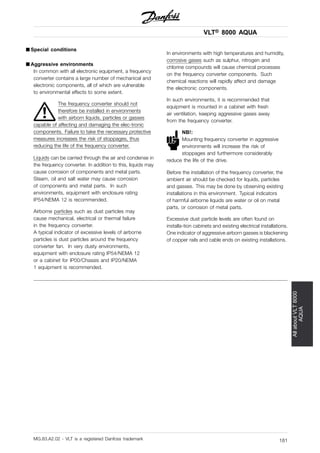
Special conditions ................................................................................................ 181
Aggressive environments ...................................................................................... 181
Calculation of resulting reference .......................................................................... 182
Extreme running conditions .................................................................................. 184
Peak voltage on motor ......................................................................................... 185
MG.83.A2.02 - VLT is a registered Danfoss trademark2
VLT® 8000 AQUA
Derating for ambient temperature ......................................................................... 187
Switching on the input .......................................................................................... 187
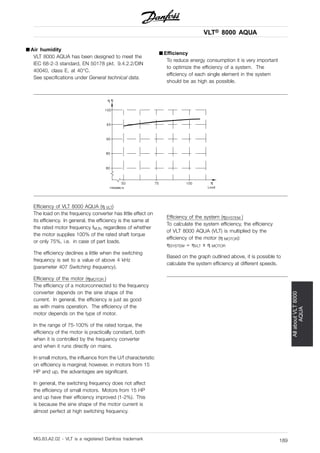
Efficiency .............................................................................................................. 189
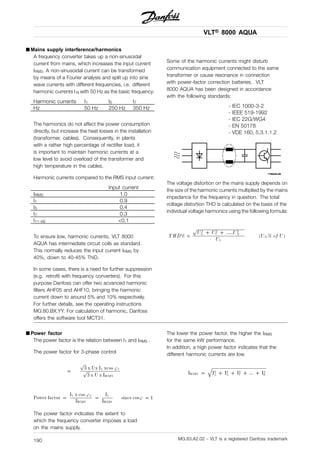
Mains supply interference/harmonics .................................................................... 190
CE labelling .......................................................................................................... 191
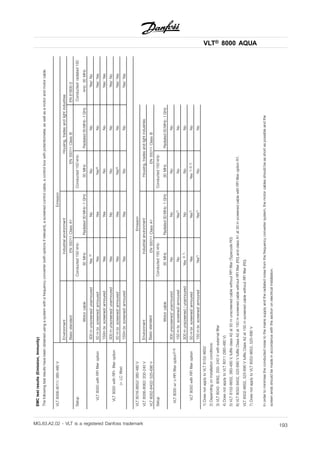
EMC test results (Emission, Immunity) .................................................................. 192
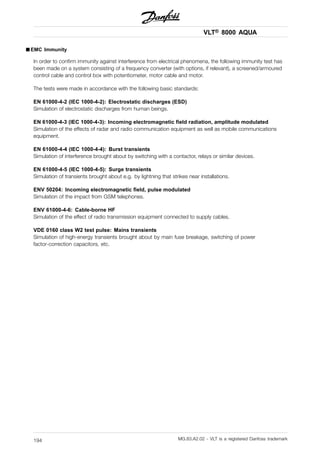
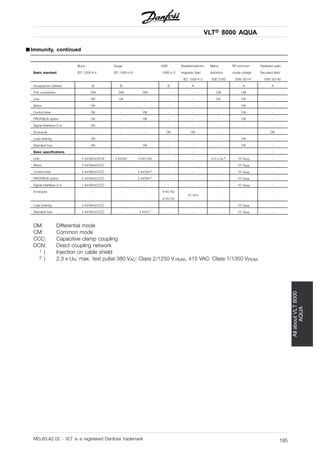
EMC Immunity ..................................................................................................... 194
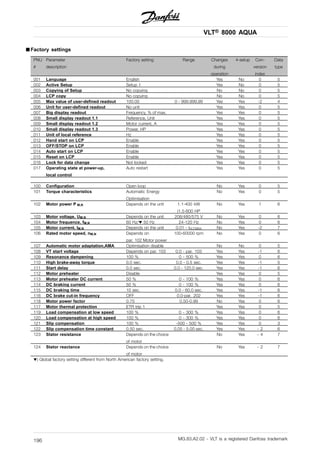
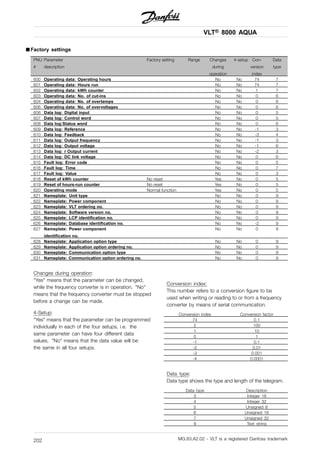
Factory settings .................................................................................................... 196
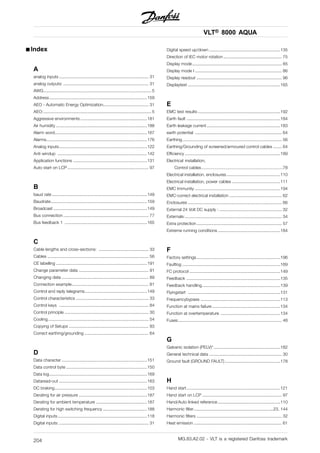
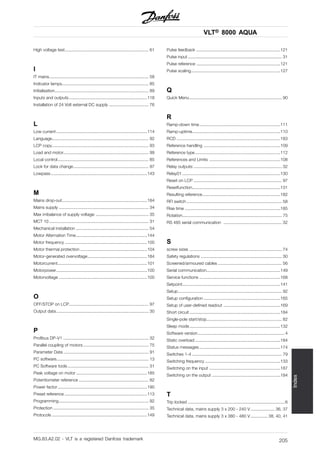
Index .................................................................................................................... 204
MG.83.A2.02 - VLT is a registered Danfoss trademark 3
VLT® 8000 AQUA
176FA145.16
VLT 8000 AQUA
Operating Instructions
Software version: 1.7x
These Operating Instructions can be used for all VLT 8000 AQUA
frequency converters with software version 1.7x.
The software version number can be seen from parameter 624
Software version no.
MG.83.A2.02 - VLT is a registered Danfoss trademark4
VLT® 8000 AQUA
Introduction
■ Definitions
Definitions are given in alphabetical order.
AEO:
Automatic Energy Optimization - function that
dynamically adjusts the current supplied to a
variable torque load to optimize motor power
factor and motor efficiency.
analog inputs:
The analog inputs can be used for controlling various
functions of the frequency converter.
There are two types of analog inputs:
Current input, 0-20 mA
Voltage input, 0-10 V DC.
analog ref.
A signal transmitted to input 53, 54 or 60.
Can be voltage or current.
analog outputs:
There are two analog outputs, which are able to supply
a signal of 0-20 mA, 4-20 mA or a digital signal.
Automatic motor adjustment, AMA:
Automatic motor adjustment algorithm, which
determines the electrical parameters for the
connected motor, at standstill.
AWG:
AWG means American Wire Gauge, i.e. the American
measuring unit for cable cross-section.
Control command:
By means of the control unit and the digital inputs, it is
possible to start and stop the connected motor.
Functions are divided into two groups, with
the following priorities:
Group 1 Reset, Coasting stop, Reset and
Coasting stop, DC braking, Stop and the
[OFF/ STOP] key.
Group 2 Start, Pulse start, Reversing, Start
reversing, Jog and Freeze output
Group 1 functions are called Start-disable commands.
The difference between group 1 and group 2 is that
in group 1 all stop signals must be cancelled for the
motor to start. The motor can then be started by
means of a single start signal in group 2.
A stop command given as a group 1 command
results in the display indication STOP.
A missing stop command given as a group 2 command
results in the display indication STAND BY.
CT:
Constant torque: used for e.g. heavy, solid
sludge pumps and centrifuges.
Digital inputs:
The digital inputs can be used for controlling various
functions of the frequency converter.
Digital outputs:
There are four digital outputs, two of which activate
a relay switch. The outputs are able to supply
a 24 V DC (max. 40 mA) signal.
fJOG
The output frequency from the frequency converter
transmitted to the motor when the jog function is
activated (via digital terminals or serial communication).
fM
The output frequency from the frequency converter
transmitted to the motor.
fM,N
The rated motor frequency (nameplate data).
fMAX
Maximum output frequency transmitted to the motor.
fMIN
Minimum output frequency transmitted to the motor.
IM
The current transmitted to the motor.
IM,N
The rated motor current (nameplate data).
Initializing:
If initializing is carried out (see parameter 620
Operating mode), the frequency converter
returns to the factory setting.
IVLT,MAX
The maximum output current.
IVLT,N
The rated output current supplied by the
frequency converter.
LCP:
The control panel, which makes up a complete
interface for control and programming of VLT 8000
AQUA. The control panel is detachable and may,
as an alternative, be installed up to 3 metres away
MG.83.A2.02 - VLT is a registered Danfoss trademark 5
VLT® 8000 AQUA
from the frequency converter, i.e. in a front panel,
by means of the installation kit option.
LSB:
Least significant bit.
Used in serial communication.
MCM:
Stands for Mille Circular Mil, an American measuring
unit for cable cross-section.
MSB:
Most significant bit.
Used in serial communication.
nM,N
The rated motor speed (nameplate data).
ηVLT
The efficiency of the frequency converter is defined as
the ratio between the power output and the power input.
On-line/off-line parameters:
On-line parameters are activated immediately after the
data value is changed. Off-line parameters are not
activated until OK has been entered on the control unit.
PID:
The PID regulator maintains the desired speed
(pressure, temperature, etc.) by adjusting the output
frequency to match the varying load.
PM,N
The rated power delivered by the motor
(nameplate data).
Preset ref.
A permanently defined reference, which can be
set from -100% to +100% of the reference range.
There are four preset references, which can be
selected via the digital terminals.
RefMAX
The maximum value which the reference signal
may have. Set in parameter 205 Maximum
reference, RefMAX.
RefMIN
The smallest value which the reference signal may
have. Set in parameter 204 Minimum reference, RefMIN.
Setup:
There are four Setups, in which it is possible to
save parameter settings. It is possible to change
between the four parameter Setups and to edit one
Setup, while another Setup is active.
Start-disable command:
A stop command that belongs to group 1 of the
control commands - see this group.
Stop command:
See Control commands.
Thermistor:
A temperature-dependent resistor placed where the
temperature is to be monitored (VLT or motor).
Trip:
A state which occurs in different situations, e.g.
if the frequency converter is subjected to an
over-temperature. A trip can be cancelled by pressing
reset or, in some cases, automatically.
Trip locked:
Trip locked is a state which occurs in different
situations, e.g. if the frequency converter is subject to
an over-temperature. A locked trip can be cancelled by
cutting off mains and restarting the frequency converter.
UM
The voltage transmitted to the motor.
UM,N
The rated motor voltage (nameplate data).
UVLT, MAX
The maximum output voltage.
VT characteristics:
Variable torque characteristics, used for
pumps and fans.
MG.83.A2.02 - VLT is a registered Danfoss trademark6
VLT® 8000 AQUA
Introduction
The voltage of the frequency converter
is dangerous whenever the equipment
is connected to mains. Incorrect
installation of the motor or the frequency converter
may cause damage to the equipment, serious
personal injury or death.
Consequently, the instructions in this manual,
as well as national and local rules and safety
regulations, must be complied with.
■ Safety regulations
1. The frequency converter must be disconnected
from the mains if repair work is to be carried out.
Check that the mains supply has been disconnected
and that the necessary time has passed before
removing motor and mains plugs.
2. The [OFF/STOP] key on the control panel of
the frequency converter does not disconnect
the equipment from mains and is thus not to
be used as a safety switch.
3. Correct protective earthing/grounding of the
equipment must be established, the user must be
protected against supply voltage, and the motor
must be protected against overload in accordance
with the National Electrical Code and local codes.
4. The earth leakage currents are higher than 3.5mA.
5. Protection against motor overload is not included in
the factory setting. If this function is required, set
parameter 117, Motor thermal protection, to data
value ETR trip or data value ETR warning.
Note: The function is initialised at 1.0 x rated motor
current and rated motor frequency (see parameter
117, Motor thermal protection). In UL/cUL
applications ETR provides Class 20, over-load
protection in accordance with the NEC ®.
6. Do not remove the plugs for the motor and
mains supply while the frequency converter is
connected to mains. Check that the mains supply
has been disconnected and that the necessary time
has passed before removing motor and mains plugs.
7. Please note that the frequency converter has more
voltage inputs than L1, L2, L3 when the DC-bus
terminals or AUX 24 V option are used.
Check that all voltage inputs have been
disconnected and that the necessary time has
passed before repair work is commenced.
■ Warning against unintended start
1. The motor can be brought to a stop by means
of digital commands, bus commands, references
or a local stop, while the frequency converter
is connected to mains. If personal safety
considerations make it necessary to ensure
that no unintended start occurs, these stop
functions are not sufficient.
2. While parameters are being changed, the motor
may start. Consequently, the stop key [OFF/
STOP] must always be activated, following
which data can be modified.
3. A stopped motor may start if a fault occurs in
the electronics of the frequency converter, or
if a temporary overload or a fault in the supply
mains or the motor connection ceases.
176FA159.15
Warning:
Touching the electrical parts may be fatal - even after the equipment has
been disconnected from line.
VLT 8006-8062, 200-240 V: wait at least 15 minutes
VLT 8006-8072, 380-480 V: wait at least 15 minutes
VLT 8102-8352, 380-480 V: wait at least 20 minutes
VLT 8452-8652, 380-480 V: wait at least 40 minutes
VLT 8002-8006, 525-600 V: wait at least 4 minutes
VLT 8008-8027, 525-600 V: wait at least 15 minutes
VLT 8032-8072, 525-600 V: wait at least 30 minutes
VLT 8052-8402, 525-690 V: wait at least 20 minutes
VLT 8502-8652, 525-690 V: wait at least 30 minutes
MG.83.A2.02 - VLT is a registered Danfoss trademark 7
VLT® 8000 AQUA
■ Use on isolated mains
See section RFI Switch regarding use on isolated mains.
It is important to follow the recommendations regarding
installation on IT-mains, since sufficient protection
of the complete installation must be observed.
Not taking care using relevant monitoring devices
for IT-mains may result in damage.
It is the responsibility of the user or the
person installing the VLT to provide proper
earthing/grounding, as well as motor
overload and branch circuit protection according to
local codes such as the Nation Electrical Code (NEC).
NB!:
Electrostatic Precaution; Electrostatic discharge
(ESD). Many electronic components are
sensitive to static electricity. Voltages so low
that they cannot be felt, seen or heard, can reduce
the life, affect performance, or completely destroy
sensitive electronic components. When performing
service, proper ESD equipment should be used to
prevent possible damage from occurring.
The frequency converter contains dangerous
voltages when connected to mains voltage.
After disconnecting from mains wait at least
15 minutes for VLT 8006-8062, 200-240 V
15 minutes for VLT 8006-8072, 380-480 V
20 minutes for VLT 8102-8352, 380-480 V
40 minutes for VLT 8452-8652, 380-480 V
4 minutes for VLT 8002-8006, 525-600 V
15 minutes for VLT 8008-8027, 525-600 V
30 minutes for VLT 8032-8072, 525-600 V
20 minutes for VLT 8052-8402, 525-690 V
30 minutes for VLT 8502-8652, 525-690 V
before touching any electrical components. Also
make sure that other voltage inputs have been
disconnected, such as external 24 VDC and
load-sharing (linkage of DC intermediate circuit). Only
a competent electrician should carry out the electrical
installation. Improper installation of the motor or the
VLT may cause equipment failure, serious injury or
death. Follow this manual and National Electrical
Codes (NEC) and local safety codes.
MG.83.A2.02 - VLT is a registered Danfoss trademark8
VLT® 8000 AQUA
Introduction
■ Introduction to Operating Instructions
These Operating Instructions are divided into four
sections with information about VLT 8000 AQUA.
Introduction to AQUA: This section tells you the advantages you can obtain by using a VLT
8000 AQUA - such as Automatic Energy Optimization, Constant Torque
or Variable Torque and other AQUA relevant functions.
This section also contains examples of applications as well as
information about Danfoss.
Installation: This section tells you how to carry out a mechanically correct installation
of the VLT 8000 AQUA.
Furthermore, a list is given of mains and motor connections, together
with a description of the control card terminals.
Programming: This section describes the control unit and the software parameters for
the VLT 8000 AQUA. Also included is a guide to the Quick Setup menu,
which allows you to get started on your application very quickly.
All about VLT 8000 AQUA: This section gives information about status, warning and error messages
from the VLT 8000 AQUA. Additionally, information is given on technical
data, ser-vice, factory settings and special conditions.
NB!:
Indicates something to be noted by the reader.
Indicates a general warning
Indicates a high-voltage warning
MG.83.A2.02 - VLT is a registered Danfoss trademark 9
VLT® 8000 AQUA
■ Control principle
A frequency converter rectifies AC voltage from
mains into DC voltage, after which this DC
voltage is converted into a AC current with a
variable amplitude and frequency.
The motor is thus supplied with variable voltage and
frequency, which enables infinitely variable speed
control of three-phased, standard AC motors.
1. Mains voltage
3 x 200 - 240 V AC, 50 / 60 Hz.
3 x 380 - 480 V AC, 50 / 60 Hz.
3 x 525 - 600 V AC, 50 / 60 Hz.
3 x 525 - 690 V AC, 50 / 60 Hz.
2. Rectifier
A three-phase rectifier bridge that rectifies AC
current into DC current.
3. Intermediate circuit
DC voltage = 1.35 x mains voltage [V].
4. Intermediate circuit coils
Even out the intermediate circuit voltage and reduce
the harmonic current feedback to the mains supply.
5. Intermediate circuit capacitors
Even out the intermediate circuit voltage.
6. Inverter
Converts DC voltage into variable AC voltage
with a variable frequency.
7. Motor voltage
Variable AC voltage, 0-100% of mains supply voltage.
8. Control card
This is where to find the computer that controls
the inverter which generates the pulse pattern by
which the DC voltage is converted into variable
AC voltage with a variable frequency.
■ AEO - Automatic Energy Optimization
Normally, the U/f characteristics have to be set on the
basis of the expected load at different frequencies.
However, knowing the load at a given frequency in an
installation is often a problem. This problem can be
solved by using a VLT 8000 AQUA with its integral
Automatic Energy Optimization (AEO), which ensures
optimum energy utilization. All VLT 8000 AQUA units
feature this function as a factory setting, i.e. it is
not necessary to adjust the frequency converter U/f
ratio in order to obtain maximum energy savings.
In other frequency converters, the given load and
voltage/frequency ratio (U/f) must be assessed to carry
out correct setting of the frequency converter.
Using Automatic Energy Optimization (AEO), you
no longer need to calculate or assess the system
characteristics of the installation, since Danfoss VLT
8000 AQUA units guarantee optimum, load-dependent
energy consumption by the motor at all times.
The figure on the right illustrates the working
range of the AEO function, within which energy
optimization is enabled.
If the AEO function has been selected in parameter 101,
Torque characteristics, this function will be constantly
active. If there is a major deviation from the optimum U/f
ratio, the frequency converter will quickly adjust itself.
Advantages of the AEO function
• Automatic energy optimization
• Compensation if an oversize motor is used
• AEO matches operations to daily or
seasonal fluctuations
MG.83.A2.02 - VLT is a registered Danfoss trademark10
VLT® 8000 AQUA
Introduction
• Energy savings in a constant air volume system
• Compensation in the oversynchronous
working range
• Reduces acoustic motor noise
MG.83.A2.02 - VLT is a registered Danfoss trademark 11
VLT® 8000 AQUA
■ Example of application - Constant pressure
regulation in water supply system
The demand for water from waterworks varies considerably during the course of a day. In the night,
practically no water is used, while in the morning and in the evening the consumption is high. In order to
maintain a suitable pressure in the water supply lines in relation to the current demand, the water supply
pumps are equipped with speed control. The use of a frequency converter enables the energy consumed by
the pumps to be kept at a minimum, while optimizing the water supply to consumers.
A VLT 8000 AQUA with its integral PID controller ensures simple and quick installation. For example, an
IP54/NEMA 12 unit can be mounted close to the pump on the wall and the existing mains cables can be
used as mains supply to the frequency converter. A Pressure transmitter (e.g. Danfoss MBS 33 or MBS
3000) can be fitted a few meters (feet) from the joint outlet point from the waterworks to obtain closed loop
regulation. Danfoss MBS 33 and MBS 3000 is a two-wire transmitter (4-20 mA) that can be powered directly
from a VLT 8000 AQUA. The required setpoint (e.g. 5 bar) can be set locally in parameter 418 Setpoint 1.
Assume:
Transmitter is scaled 0-10 Bar, minimum flow
is achieved at 30 Hz. An increase in motor
speed increases the pressure.
Set the following parameters:
Par. 100 Configuration Closed loop [1]
Par. 201 Minimum Output Frequency 30 Hz
Par. 202 Maximum Output Frequency 50 Hz (or 60 Hz)
Par. 204 Minimum Reference 0 Bar
Par. 205 Maximum Reference 10 Bar
Par. 302 Terminal 18 Digital inputs Start [1]
Par. 314 Terminal 60, analog input current Feedback signal [2]
Par. 315 Terminal 60, min. scaling 4 mA
Par. 316 Terminal 60, max. scaling 20 mA
Par. 403 Sleep mode timer 10 sec.
Par. 404 Sleep frequency 35 Hz
Par. 405 Wake-up frequency 45 Hz
Par. 406 Boost setpoint 125%
Par. 413 Minimum Feedback 0 Bar
Par. 414 Maximum Feedback 10 Bar
Par. 415 Process units Bar [16]
Par. 418 Setpoint 1 5 bar
Par. 420 PID control action Normal
Par. 423 PID Proportional gain 0.3*
Par. 424 PID Integral time 30 sec.*
* The PID tuning parameters depend on the actual system dynamics.
MG.83.A2.02 - VLT is a registered Danfoss trademark12
VLT® 8000 AQUA
Introduction
■ PC software and serial communication
Danfoss offers various options for serial communication.
Using serial communication, it is possible to monitor,
program and control one or several frequency
converters from a centrally located computer.
All VLT 8000 AQUA units have an RS 485 port as
standard with a choice of two protocols. The protocols
selectable in parameter 500 protocols are:
• FC Protocol
• Modbus RTU
A bus option card allows higher transmission speed
than RS 485. In addition, a higher number of units
can be linked to the bus and alternative transmission
media can be used. Danfoss offers the following
option cards for communication:
• Profibus
• LonWorks
• DeviceNet
Information on the installation of various options is
not included in these operating instructions.
Using the RS 485 port enables communication,
e.g. with a PC. A Windows TM program, called
MCT 10, is available for this purpose. It can be
used to monitor, program and control one or
several VLT 8000 AQUA units.
■ PC Software tools
PC Software - MCT 10
All drives are equipped with a serial communication
port. We provide a PC tool for communication
between PC and frequency converter, VLT Motion
Control Tool MCT 10 Set-up Software.
MCT 10 Set-up Software
MCT 10 has been designed as an easy to use interactive
tool for setting parameters in our frequency converters.
The MCT 10 Set-up Software will be useful for:
• Planning a communication network off-line. MCT 10
contains a complete frequency converter database
• Commissioning frequency converters on line
• Saving settings for all frequency converters
• Replacing a drive in a network
• Expanding an existing network
• Future developed drives will be supported
MCT 10 Set-up Software support Profibus DP-V1 via
a Master class 2 connection. It makes it possible to
on line read/write parameters in a frequency converter
via the Profibus network. This will eliminate the need
for an extra communication network.
The MCT 10 Set-up Software Modules
The following modules are included in the
software package:
MCT 10 Set-up Software
Setting parameters
Copy to and from frequency converters
Documentation and print out of parameter
settings incl. diagrams
SyncPos
Creating SyncPos programme
Ordering number:
Please order your CD containing MCT 10 Set-up
Software using code number 130B1000.
■ Fieldbus options
The increasing need for information in building
management systems makes it necessary to collect
or visualise many different types of process data.
Important process data can help the system technician
in the day to day monitoring of the system, which
means that a negative development, e. g. an increase
in energy consumption, can be rectified in time.
The substantial amount of data in large buildings
may generate a need for a higher transmission
speed than 9600 baud.
■ Profibus
Profibus is a fieldbus system with FMS and DP,
which can be used for linking automation units,
such as sensors and actuators, to the controls
by means of a two-conductor cable.
Profibus FMS is used if major communication
tasks are to be solved at cell and system level by
means of large volumes of data.
Profibus DP is an extremely fast communication
protocol, made specially for communication between
the automation system and various units.
VLT 8000 AQUA only supports DP.
MG.83.A2.02 - VLT is a registered Danfoss trademark 13
VLT® 8000 AQUA
■ LON - Local Operating Network
LonWorks is an intelligent fieldbus system which
improves the possibility of decentralising control,
as communication is enabled between individual
units in the same system (Peer-to-Peer).
This means that there is no need for a big main station
for handling all the signals of the system (Master-Slave).
Signals are sent direct to the unit that needs them
via a common network medium. This makes
communication much more flexible and the central
building state control and monitoring system can be
changed into a dedicated building state monitoring
system whose task is to ensure that everything is
running as planned. If the potential of LonWorks is
fully utilised, sensors will also be connected to the
bus, which means that a sensor signal can quickly
be moved to another controller. If room dividers are
mobile, this is a particularly useful feature.
■ DeviceNet
DeviceNet is a digital, multi-drop network, based
on the CAN protocol, that connects and serves
as a communication network between industrial
controllers and I/O devices.
Each device and/or controller is a node on the
network. DeviceNet is a producer-consumer
network that supports multiple communication
hierarchies and message prioritization.
DeviceNet systems can be configured to operate in a
master-slave or a distributed control architecture using
peer-to-peer communication. This system offers a
single point of connection for configuration and control
by supporting both I/O and explicit messaging.
DeviceNet also has the feature of having power
on the network. This allows devices with limited
power requirements to be powered directly from
the network via the 5-conductor cable.
■ Modbus RTU
MODBUS RTU (Remote Terminal Unit) Protocol is
a messaging structure developed by Modicon in
1979, used to establish master-slave/client-server
communication between intelligent devices.
MODBUS is used to monitor and program
devices; to communicate intelligent devices
with sensors and instruments; to monitor field
devices using PCs and HMIs.
MODBUS is often applied in Gas and Oil applications,
but also in building, infrastructure, transportation and
energy, applications are making use of its benefits.
MG.83.A2.02 - VLT is a registered Danfoss trademark14
VLT® 8000 AQUA
Introduction
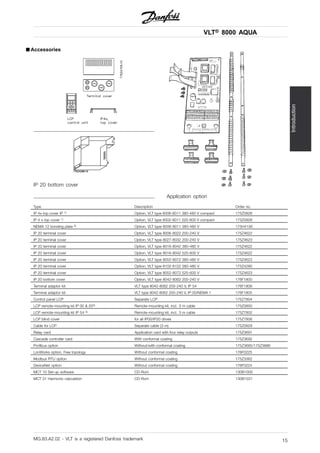
■ Accessories
IP 20 bottom cover
Application option
Type Description Order no.
IP 4x top cover IP 1) Option, VLT type 8006-8011 380-480 V compact 175Z0928
IP 4 x top cover 1) Option, VLT type 8002-8011 525-600 V compact 175Z0928
NEMA 12 bonding plate 2) Option, VLT type 8006-8011 380-480 V 175H4195
IP 20 terminal cover Option, VLT type 8006-8022 200-240 V 175Z4622
IP 20 terminal cover Option, VLT type 8027-8032 200-240 V 175Z4623
IP 20 terminal cover Option, VLT type 8016-8042 380-480 V 175Z4622
IP 20 terminal cover Option, VLT type 8016-8042 525-600 V 175Z4622
IP 20 terminal cover Option, VLT type 8052-8072 380-480 V 175Z4623
IP 20 terminal cover Option, VLT type 8102-8122 380-480 V 175Z4280
IP 20 terminal cover Option, VLT type 8052-8072 525-600 V 175Z4623
IP 20 bottom cover Option, VLT type 8042-8062 200-240 V 176F1800
Terminal adaptor kit VLT type 8042-8062 200-240 V, IP 54 176F1808
Terminal adaptor kit VLT type 8042-8062 200-240 V, IP 00/NEMA 1 176F1805
Control panel LCP Separate LCP 175Z7804
LCP remote-mounting kit IP 00 & 203) Remote-mounting kit, incl. 3 m cable 175Z0850
LCP remote-mounting kit IP 54 4) Remote-mounting kit, incl. 3 m cable 175Z7802
LCP blind cover for all IP00/IP20 drives 175Z7806
Cable for LCP Separate cable (3 m) 175Z0929
Relay card Application card with four relay outputs 175Z3691
Cascade controller card With conformal coating 175Z3692
Profibus option Without/with conformal coating 175Z3685/175Z3686
LonWorks option, Free topology Without conformal coating 176F0225
Modbus RTU option Without conformal coating 175Z3362
DeviceNet option Without conformal coating 176F0224
MCT 10 Set-up software CD-Rom 130B1000
MCT 31 Harmonic calculation CD-Rom 130B1031
MG.83.A2.02 - VLT is a registered Danfoss trademark 15
VLT® 8000 AQUA
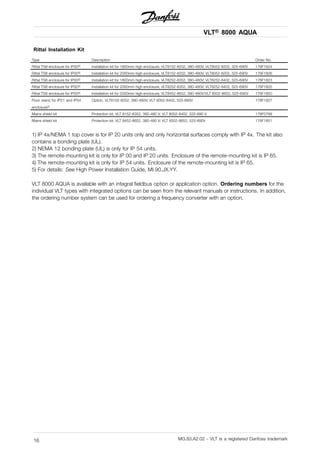
Rittal Installation Kit
Type Description Order No.
Rittal TS8 enclosure for IP005) Installation kit for 1800mm high enclosure, VLT8152-8202, 380-480V; VLT8052-8202, 525-690V 176F1824
Rittal TS8 enclosure for IP005) Installation kit for 2000mm high enclosure, VLT8152-8202, 380-480V; VLT8052-8202, 525-690V 176F1826
Rittal TS8 enclosure for IP005) Installation kit for 1800mm high enclosure, VLT8252-8352, 380-480V; VLT8252-8402, 525-690V 176F1823
Rittal TS8 enclosure for IP005) Installation kit for 2000mm high enclosure, VLT8252-8352, 380-480V; VLT8252-8402, 525-690V 176F1825
Rittal TS8 enclosure for IP005) Installation kit for 2000mm high enclosure, VLT8452-8652, 380-480V/VLT 8502-8652, 525-690V 176F1850
Floor stand for IP21 and IP54
enclosure5)
Option, VLT8152-8352, 380-480V; VLT 8052-8402, 525-690V 176F1827
Mains shield kit Protection kit, VLT 8152-8352, 380-480 V; VLT 8052-8402, 525-690 V 176F0799
Mains shield kit Protection kit, VLT 8452-8652, 380-480 V; VLT 8502-8652, 525-690V 176F1851
1) IP 4x/NEMA 1 top cover is for IP 20 units only and only horizontal surfaces comply with IP 4x. The kit also
contains a bonding plate (UL).
2) NEMA 12 bonding plate (UL) is only for IP 54 units.
3) The remote-mounting kit is only for IP 00 and IP 20 units. Enclosure of the remote-mounting kit is IP 65.
4) The remote-mounting kit is only for IP 54 units. Enclosure of the remote-mounting kit is IP 65.
5) For details: See High Power Installation Guide, MI.90.JX.YY.
VLT 8000 AQUA is available with an integral fieldbus option or application option. Ordering numbers for the
individual VLT types with integrated options can be seen from the relevant manuals or instructions. In addition,
the ordering number system can be used for ordering a frequency converter with an option.
MG.83.A2.02 - VLT is a registered Danfoss trademark16
VLT® 8000 AQUA
Introduction
■ Cascade Controller Option
In "Standard Mode", one motor is controlled by
the drive that has the Cascade Controller Option
card installed in it. Up to four additional fixed speed
motors can be sequenced on & off, as required
by the process, in lead-lag mode.
In "Master/Slave Mode", the drive that has the
Cascade Controller option card installed in it, along
with its associated motor, is designated as the
master. Up to four additional motors, each with
its own drive, can be operated in slave mode. The
Cascade Controller functions to stage the slave
drives/motors - on & off (as required), as a function
of "best system operating efficiency".
In "Lead Pump Alternation Mode", it is possible to
average out the usage of the pumps. This is done by
making the frequency converter switch between the
pumps (max. 4) by means of a timer. Please note
that this mode requires an external relay setup.
Consult your Danfoss Sales Office for
additional information.
■ LC filters for VLT 8000 AQUA
When a motor is controlled by a frequency converter,
resonance noise will be heard from the motor. This
noise, which is caused by the design of the motor,
occurs each time one of the inverter switches in
the frequency converter is activated. Consequently,
the resonance noise frequency corresponds to the
switching frequency of the frequency converter.
For the VLT 8000 AQUA, Danfoss offers a LC filter
to dampen the acoustic motor noise.
This filter reduces the voltage rise time, the peak voltage
UPEAK and the ripple current I to the motor, thereby
making current and voltage almost sinusoidal. The
acoustic motor noise is therefore reduced to a minimum.
Because of the ripple current in the coils, there will be
some noise from the coils. This problem can be solved
entirely by integrating the filter in a cabinet or similar.
■ Examples of the use of LC filters
Submersible pumps
For small motors with up to and including 5.5 kW
rated motor power, use an LC filter, unless the motor
is equipped with phase separation paper. This applies
e.g. to all wet running motors. If these motors are
used without LC filter in connection with a frequency
converter, the motor windings will short-circuit. If in
doubt, ask the motor manufacturer whether the motor
in question is equipped with phase separation paper.
Well pumps
If immersion pumps are used, e.g. submerged
pumps or well pumps, the supplier should be
contacted for clarification of requirements. It is
recommended to use a LC filter if a frequency converter
is used for well pump applications.
MG.83.A2.02 - VLT is a registered Danfoss trademark 17
VLT® 8000 AQUA
■ Ordering numbers, LC filter modules
Mains supply 3 x 200 - 240 V
LC filter LC filter Rated current Max. output Power
for VLT type enclosure at 200 V frequency loss Order no.
8006-8008 IP 00 25.0 A 60 Hz 110 W 175Z4600
8011 IP 00 32 A 60 Hz 120 W 175Z4601
8016 IP 00 46 A 60 Hz 150 W 175Z4602
8022 IP 00 61 A 60 Hz 210 W 175Z4603
8027 IP 00 73 A 60 Hz 290 W 175Z4604
8032 IP 00 88 A 60 Hz 320 W 175Z4605
8042 IP 00 115 A 60 Hz 600 W 175Z4702
8052 IP 00 143 A 60 Hz 600 W 175Z4702
8062 IP 00 170 A 60 Hz 700 W 175Z4703
Mains supply 3 x 380 - 480
LC filter LC filter Rated current Max. output Power
for VLT type enclosure at 400/480 V frequency loss Order no.
8006-8011 IP 20 16 A / 16 A 120 Hz 175Z0832
8016 IP 00 24 A/ 21.7 A 60 Hz 170 W 175Z4606
8022 IP 00 32 A / 27.9 A 60 Hz 180 W 175Z4607
8027 IP 00 37.5 A / 32 A 60 Hz 190 W 175Z4608
8032 IP 00 44 A / 41.4 A 60 Hz 210 W 175Z4609
8042 IP 00 61 A / 54 A 60 Hz 290 W 175Z4610
8052 IP 00 73 A / 65 A 60 Hz 410 W 175Z4611
8062 IP 00 90 A / 78 A 60 Hz 480 W 175Z4612
8072 IP 20 106 A / 106 A 60 Hz 500 W 175Z4701
8102 IP 20 147 A / 130 A 60 Hz 600 W 175Z4702
8122 IP 20 177 A / 160 A 60 Hz 750 W 175Z4703
8152 IP 20 212 A / 190 A 60 Hz 750 W 175Z4704
8202 IP 20 260 A / 240 A 60 Hz 900 W 175Z4705
8252 IP 20 315 A / 302 A 60 Hz 1000 W 175Z4706
8302 IP 20 395 A / 361 A 60 Hz 1100 W 175Z4707
8352 IP 20 480 A / 443 A 60 Hz 1700 W 175Z3139
8452 IP 20 600 A / 540 A 60 Hz 2100 W 175Z3140
8502 IP 20 658 A / 590 A 60 Hz 2100 W 175Z3141
8602 IP 20 745 A / 678 A 60 Hz 2500 W 175Z3142
Regarding LC filters for 525 - 600 V and VLT 8652,
380-480 V, please contact Danfoss.
NB!:
When using LC filters, the switching frequency
must be 4.5 kHz (see parameter 407).
For VLT 8452-8602 parameter 408 must be set to
LC filter fitted to obtain proper operation.
MG.83.A2.02 - VLT is a registered Danfoss trademark18
VLT® 8000 AQUA
Introduction
Mains supply 3 x 690 V
VLT
Rated Current at 690
V
Max. output
frequency (Hz)
Power
dissipation (W)
Ordering no. IP00
Ordering no.
IP20
8052 54 60 290 130B2223 130B2258
8062 73 60 390 130B2225 130B2260
8072 86 60 480 130B2225 130B2260
8102 108 60 600 130B2226 130B2261
8122 131 60 550 130B2228 130B2263
8152 155 60 680 130B2228 130B2263
8202 192 60 920 130B2229 130B2264
8252 242 60 750 130B2231 130B2266
8302 290 60 1000 130B2231 130B2266
8352 344 60 1050 130B2232 130B2267
8402 400 60 1150 130B2234 130B2269
8502 530 60 500 130B2241 130B2270
8602 600 60 570 130B2242 130B2271
8652 630 60 600 - -
dU/dt filters
The dU/dt filters reduce dU/dt to approx. 500 V / µsec. These filters do not reduce noise or Upeak.
NB!:
When using dU/dt filters, the switching
frequency must be 1.5 kHz (see parameter 411)
Mains supply 3 x 690 V
VLT
Rated Current at 690
V
Max. output
frequency (Hz)
Power
dissipation (W)
Ordering no. IP 00
Ordering no.
IP20
8052 54 60 90 130B2154 130B2188
8062 73 60 100 130B2155 130B2189
8072 86 60 110 130B2156 130B2190
8102 108 60 120 130B2157 130B2191
8122 131 60 150 130B2158 130B2192
8152 155 60 180 130B2159 130B2193
8202 192 60 190 130B2160 130B2194
8252 242 60 210 130B2161 130B2195
8302 290 60 350 130B2162 130B2196
8352 344 60 480 130B2163 130B2197
8402 400 60 540 130B2165 130B2199
8502 530 60 500 130B2236 130B2239
8602 600 60 570 130B2237 130B2240
8652 630 60 600 - -
MG.83.A2.02 - VLT is a registered Danfoss trademark 19
VLT® 8000 AQUA
■ LC filters VLT 8006-8011 380 - 480 V The drawing on the left gives the measurements of IP
20 LC filters for the above-mentioned power range.
Min. space above and under enclosure: 100 mm.
IP 20 LC filters have been designed for side-by-side
installation without any space between enclosures.
Max. motor cable length:
- 150 m screened/armoured cable
- 300 m unscreened/unarmoured cable
If EMC standards are to be complied with:
EN 55011-1B: Max. 50 screened/armoured
cable
EN 55011-1A: Max. 150 m screened/armoured
cable
Weight: 175Z0832 9.5 kg
■ Installation of LC filter IP 20
MG.83.A2.02 - VLT is a registered Danfoss trademark20
VLT® 8000 AQUA
Introduction
■ LC filters VLT 8006-8032, 200 - 240 V /
8016-8062 380 - 480 V
The table and the drawing give the measurements
of IP 00 LC filters for Compact units.
IP 00 LC filters must be integrated and protected
against dust, water and corrosive gases.
Max. motor cable length:
- 150 m screened/armoured cable
- 300 m unscreened/unarmoured cable
If EMC standards are to be complied with:
- EN 55011-1B: Max. 50 screened/armoured
cable
- EN 55011-1A: Max. 150 m screened/armoured
cable
LC filter IP 00
LC type A [mm] B [mm] C [mm] D [mm] E [mm] F [mm] G [mm] Weight [kg]
175Z4600 220 135 92 190 68 170 8 10
175Z4601 220 145 102 190 78 170 8 13
175Z4602 250 165 117 210 92 180 8 17
175Z4603 295 200 151 240 126 190 11 29
175Z4604 355 205 152 300 121 240 11 38
175Z4605 360 215 165 300 134 240 11 49
175Z4606 280 170 121 240 96 190 11 18
175Z4607 280 175 125 240 100 190 11 20
175Z4608 280 180 131 240 106 190 11 23
175Z4609 295 200 151 240 126 190 11 29
175Z4610 355 205 152 300 121 240 11 38
175Z4611 355 235 177 300 146 240 11 50
175Z4612 405 230 163 360 126 310 11 65
MG.83.A2.02 - VLT is a registered Danfoss trademark 21
VLT® 8000 AQUA
■ LC filter VLT 8042-8062 200-240 V /
8072-8602 380 - 480 V
The table and the drawing give the measurements of IP
20 LC filters. IP 20 LC filters must be integrated and
protected against dust, water and aggressive gases.
Max. motor cable length:
- 150 m screened/armoured cable
- 300 m unscreened/unarmoured cable
If EMC standards are to be complied with:
- EN 55011-1B: Max. 50 m screened/armoured
cable
- EN 55011-1A: Max. 150 m screened/armoured
cable
LC-filter IP 20
LC type A [mm] B [mm] C [mm] D [mm] E [mm] F [mm] G [mm] Weight [kg]
175Z4701 740 550 600 70
175Z4702 740 550 600 70
175Z4703 740 550 600 110
175Z4704 740 550 600 120
175Z4705 830 630 650 220
175Z4706 830 630 650 250
175Z4707 830 630 650 250
175Z3139 1350 800 1000 350
175Z3140 1350 800 1000 400
175Z3141 1350 800 1000 400
175Z3142 1350 800 1000 470
MG.83.A2.02 - VLT is a registered Danfoss trademark22
VLT® 8000 AQUA
Introduction
■ Harmonic filter
Harmonic currents do not directly affect the electricity
consumption but has an impact on following conditions:
Higher total current to be handled by the installations
- Increases load on transformer (sometimes it will
require a larger transformer, particular at retrofit)
- Increases heat losses in transformer and installation
- In some cases demands larger cables,
switches and fuses
Higher voltage distortion due to higher current
- Increase risk for disturbing electronic equipment
connected to same grid
A high percentage of rectifier load from eg frequency
converters, will increase the harmonic current, which
must be reduced to avoid the above consequences.
Therefore the frequency converter has as standard,
built in DC coils reducing the total current with about
40% (compared to devices without any arrangement
for harmonic suppression), down to 40-45% ThiD.
In some cases there is a need for further suppression
(eg retrofit with frequency converters). For this purpose
Danfoss can offer two advanced harmonic filters
AHF05 and AHF10, bringing the harmonic current
down to around 5% and 10% respectively. For further
details see instruction MG.80.BX.YY.
MCT 31
The MCT 31 harmonic calculation PC tool enables
easy estimation of the harmonic distortion in a given
application. Both the harmonic distortion of Danfoss
frequency converters as well as non-Danfoss frequency
converters with different additional harmonic reduction
measurements, such as Danfoss AHF filters and
12-18-pulse rectifiers, can be calculated.
Ordering number:
Please order your CD containing the MCT 31 PC
tool using code number 130B1031.
■ Ordering numbers, Harmonic filters
Harmonic filters are used to reduce mains harmonics
• AHF 010: 10% current distortion
• AHF 005: 5% current distortion
380-415 V, 50 Hz
Danfoss ordering numberIAHF,N Typical Motor Used
[kW] AHF 005 AHF 010
VLT 8000
10 A 4, 5.5 175G6600 175G6622 8006, 8008
19 A 7.5 175G6601 175G6623 8011, 8016
26 A 11 175G6602 175G6624 8022
35 A 15, 18.5 175G6603 175G6625 8027
43 A 22 175G6604 175G6626 8032
72 A 30, 37 175G6605 175G6627 8042, 8052
101 A 45. 55 175G6606 175G6628 8062, 8072
144 A 75 175G6607 175G6629 8102
180 A 90 175G6608 175G6630 8122
217 A 110 175G6609 175G6631 8152
289 A 132, 160 175G6610 175G6632 8202, 8252
324 A 175G6611 175G6633
370 A 200 175G6688 175G6691 8302
Higher ratings can be achieved by paralleling the filter units
434 A 250 Two 217 A units 8352
578 A 315 Two 289 A units 8452
613 A 355 289 A and 324 A units 8502
648 A 400 Two 324 A units 8602
740 A 450 Two 370 A units 8652
MG.83.A2.02 - VLT is a registered Danfoss trademark 23
VLT® 8000 AQUA
Please note that the matching of the typical Danfoss frequency converter and filter is pre-calculated based on
400 V and assuming typical motor load (4 or 2 pole motor). VLT 8000 is based on a max. 110% torque
application.
The pre-calculated filter current may be different than the input current ratings of VLT 8000 as stated in the
respective operating instructions, as these numbers are based on different operating conditions.
440-480 V, 60 Hz
Danfoss ordering numberIAHF,N Typical Motor Used
[HP] AHF 005 AHF 010
VLT 8000
19 A 10, 15 175G6612 175G6634 8011, 8016
26 A 20 175G6613 175G6635 8022
35 A 25, 30 175G6614 175G6636 8027, 8032
43 A 40 175G6615 175G6637 8042
72 A 50, 60 175G6616 175G6638 8052, 8062
101 A 75 175G6617 175G6639 8072
144 A 100, 125 175G6618 175G6640 8102, 8122
180 A 150 175G6619 175G6641 8152
217 A 200 175G6620 175G6642 8202
289 A 250 175G6621 175G6643 8252
324 A 300 175G6689 175G6692 8302
370 A 350 175G6690 175G6693 8352
Higher ratings can be achieved by paralleling the filter units
506 A 450 217 A and 289 A units 8452
578 A 500 Two 289 A units 8502
578 A 550 Two 289 A units 8602
648 A 600 Two 324 A units 8652
Please note that the matching of the Danfoss frequency converter and filter is pre-calculated based on 480 V
and assuming typical motor load. VLT 8000 is based on 110 % torque application.
The pre-calculated filter current may be varying from the input current ratings of VLT 8000 as stated in the
respective operating instructions, as these numbers are based on different operating conditions.
690 V, 50 Hz
I AHF,N Typical motor used Ordering no. AHF 005 Ordering no. AHF 010 VLT 8000 110%
43 37, 45 130B2328 130B2293 8052
72 55, 75 130B2330 130B2295 8062, 8072
101 90 130B2331 130B2296 8102
144 110, 132 130B2333 130B2298 8122, 8152
180 160 130B2334 130B2299 8202
217 200 130B2335 130B2300 8252
289 250 130B2331 & 130B2333 130B2301 8302
324 315 130B2333 & 130B2334 130B2302 8352
370 400 130B2334 & 130B2335 130B2304 8402
469 500 130B2333 & 2 x
130B2334
130B2299 & 130B2301 8502
578 560 3 x 130B2334 2 x 130B2301 8602
613 630 3 x 130B2335 130B2301 & 130B2302 8652
MG.83.A2.02 - VLT is a registered Danfoss trademark24
VLT® 8000 AQUA
Introduction
■ Unpacking and ordering a VLT frequency converter
If you are in doubt as to which frequency converter
you have received and which options it contains,
use the following to find out.
■ Type code ordering number string
On the basis of your order, the frequency converter is
given an ordering number that can be seen from the
nameplate on the unit. The number may look as follows:
VLT-8008-A-T4-C20-R3-DL-F10-A00-C0
This means that the frequency converter ordered is a
VLT 8008 for three-phase mains voltage of 380-480 V
(T4) in Compact enclosure IP 20 (C20). The hardware
variant is with integral RFI filter, classes A & B (R3). The
frequency converter features a control unit (DL) with a
PROFIBUS option card (F10). No option card (A00)
and no conformal coating (C0) Character no. 8 (A)
indicates the application range of the unit: A = AQUA.
IP 00: This enclosure is only available for the larger
power sizes of the VLT 8000 AQUA series. It is
recommended for installation in standard cabinets.
IP 20/NEMA 1: This enclosure is used as standard
enclosure for VLT 8000 AQUA. It is ideal for
cabinet installation in areas where a high degree
of protection is required. This enclose also
permits side-by-side installation.
IP 54: This enclosure can be fitted direct to the
wall. Cabinets are not required. IP 54 units can
also be installed side-by-side.
Hardware variant
The units in the programme are available in the
following hardware variants:
ST: Standard unit with or without control
unit. Without DC terminals, except for
VLT 8042-8062, 200-240 V
VLT 8016-8300, 525-600 V
SL: Standard unit with DC terminals.
EX: Extended unit with control unit, DC
terminals, connection of external 24 V
DC supply for back-up of control PCB.
DX: Extended unit with control unit, DC
terminals, built-in mains fuses and
disconnector, connection of external 24
V DC supply for back-up of control PCB.
PF: Standard unit with 24 V DC supply for
back-up of control PCB and built-in
main fuses. No DC terminals.
PS: Standard unit with 24 V DC supply
for back-up of control PCB. No DC
terminals.
PD: Standard unit with 24 V DC supply for
back-up of control PCB, built-in main
fuses and disconnect. No DC terminals.
RFI filter
Units for a mains voltage of 380-480 V and a motor
power of up to 7.5 kW (VLT 8011) are always
supplied with an integral class A1 & B filter. Units
for higher motor power than these can be ordered
either with or without an RFI filter. RFI filters are not
available for 525-600 V units.
A1 RFI is not offered on the VLT 8502 -8652 525-690V
Control unit (keypad and display)
All types of units in the programme, except for IP
54 units (and IP 21 VLT 8452-8652, 380-480 V and
VLT 8502-8652, 525-690 V), can be ordered either
with or without the control unit. IP 54 units always
come with a control unit.
All types of units in the programme are available
with built-in application options including a relay
card with four relays or a cascade controller card.
Conformal Coating
All types of units in the programme are available
with or without conformal coating of the PCB.
Please note VLT 8452-8652, 380-480 V and
VLT 8052-8652, 525-690 V are only available as
conformal coated.
MG.83.A2.02 - VLT is a registered Danfoss trademark 25
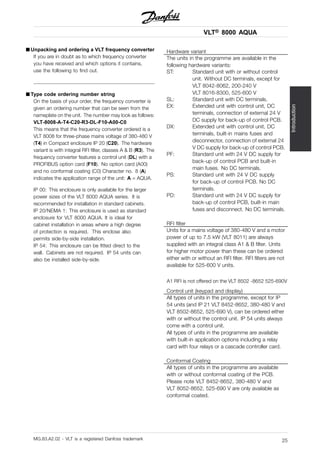
VLT® 8000 AQUA
200-240 V
Typecode
Position in string
T2
9-10
C00
11-13
C20
11-13
CN1
11-13
C54
11-13
ST
14-15
SL
14-15
R0
16-17
R1
16-17
R3
16-17
4.0 kW/5.0 HP 8006 X X X X X X
5.5 kW/7.5 HP 8008 X X X X X X
7.5 kW/10 HP 8011 X X X X X X
11 kW/15 HP 8016 X X X X X X
15 kW/20 HP 8022 X X X X X X
18.5 kW/25 HP 8027 X X X X X X
22 kW/30 HP 8032 X X X X X X
30 kW/40 HP 8042 X X X X X X
37 kW/50 HP 8052 X X X X X X
45 kW/60 HP 8062 X X X X X X
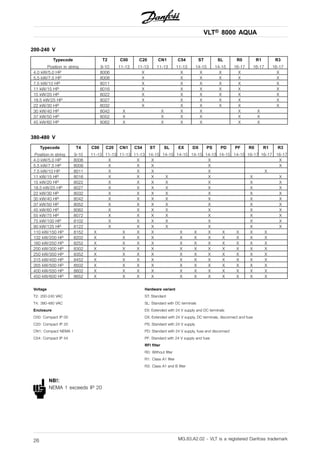
380-480 V
Typecode
Position in string
T4
9-10
C00
11-13
C20
11-13
CN1
11-13
C54
11-13
ST
14-15
SL
14-15
EX
14-15
DX
14-15
PS
14-15
PD
14-15
PF
14-15
R0
16-17
R1
16-17
R3
16-17
4.0 kW/5.0 HP 8006 X X X X X
5.5 kW/7.5 HP 8008 X X X X X
7.5 kW/10 HP 8011 X X X X X
11 kW/15 HP 8016 X X X X X X X
15 kW/20 HP 8022 X X X X X X X
18.5 kW/25 HP 8027 X X X X X X X
22 kW/30 HP 8032 X X X X X X X
30 kW/40 HP 8042 X X X X X X X
37 kW/50 HP 8052 X X X X X X X
45 kW/60 HP 8062 X X X X X X X
55 kW/75 HP 8072 X X X X X X X
75 kW/100 HP 8102 X X X X X X X
90 kW/125 HP 8122 X X X X X X X
110 kW/150 HP 8152 X X X X X X X X X X X
132 kW/200 HP 8202 X X X X X X X X X X X
160 kW/250 HP 8252 X X X X X X X X X X X
200 kW/300 HP 8302 X X X X X X X X X X X
250 kW/350 HP 8352 X X X X X X X X X X X
315 kW/450 HP 8452 X X X X X X X X X X X
355 kW/500 HP 8502 X X X X X X X X X X X
400 kW/550 HP 8602 X X X X X X X X X X X
450 kW/600 HP 8652 X X X X X X X X X X X
Voltage
T2: 200-240 VAC
T4: 380-480 VAC
Enclosure
C00: Compact IP 00
C20: Compact IP 20
CN1: Compact NEMA 1
C54: Compact IP 54
Hardware variant
ST: Standard
SL: Standard with DC terminals
EX: Extended with 24 V supply and DC terminals
DX: Extended with 24 V supply, DC terminals, disconnect and fuse
PS: Standard with 24 V supply
PD: Standard with 24 V supply, fuse and disconnect
PF: Standard with 24 V supply and fuse
RFI filter
R0: Without filter
R1: Class A1 filter
R3: Class A1 and B filter
NB!:
NEMA 1 exceeds IP 20
MG.83.A2.02 - VLT is a registered Danfoss trademark26
VLT® 8000 AQUA
Introduction
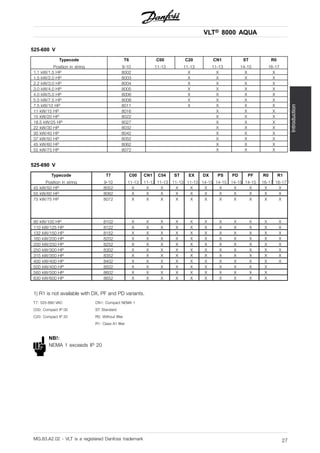
525-600 V
Typecode
Position in string
T6
9-10
C00
11-13
C20
11-13
CN1
11-13
ST
14-15
R0
16-17
1.1 kW/1.5 HP 8002 X X X X
1.5 kW/2.0 HP 8003 X X X X
2.2 kW/3.0 HP 8004 X X X X
3.0 kW/4.0 HP 8005 X X X X
4.0 kW/5.0 HP 8006 X X X X
5.5 kW/7.5 HP 8008 X X X X
7.5 kW/10 HP 8011 X X X X
11 kW/15 HP 8016 X X X
15 kW/20 HP 8022 X X X
18.5 kW/25 HP 8027 X X X
22 kW/30 HP 8032 X X X
30 kW/40 HP 8042 X X X
37 kW/50 HP 8052 X X X
45 kW/60 HP 8062 X X X
55 kW/75 HP 8072 X X X
525-690 V
Typecode
Position in string
T7
9-10
C00
11-13
CN1
11-13
C54
11-13
ST
11-13
EX
11-13
DX
14-15
PS
14-15
PD
14-15
PF
14-15
R0
16-17
R1
16-171)
45 kW/50 HP 8052 X X X X X X X X X X X
55 kW/60 HP 8062 X X X X X X X X X X X
75 kW/75 HP 8072 X X X X X X X X X X X
90 kW/100 HP 8102 X X X X X X X X X X X
110 kW/125 HP 8122 X X X X X X X X X X X
132 kW/150 HP 8152 X X X X X X X X X X X
160 kW/200 HP 8202 X X X X X X X X X X X
200 kW/250 HP 8252 X X X X X X X X X X X
250 kW/300 HP 8302 X X X X X X X X X X X
315 kW/350 HP 8352 X X X X X X X X X X X
400 kW/400 HP 8402 X X X X X X X X X X X
500 kW/400 HP 8502 X X X X X X X X X X
560 kW/500 HP 8602 X X X X X X X X X X
630 kW/600 HP 8652 X X X X X X X X X X
1) R1 is not available with DX, PF and PD variants.
T7: 525-690 VAC
C00: Compact IP 00
C20: Compact IP 20
CN1: Compact NEMA 1
ST: Standard
R0: Without filter
R1: Class A1 filter
NB!:
NEMA 1 exceeds IP 20
MG.83.A2.02 - VLT is a registered Danfoss trademark 27
VLT® 8000 AQUA
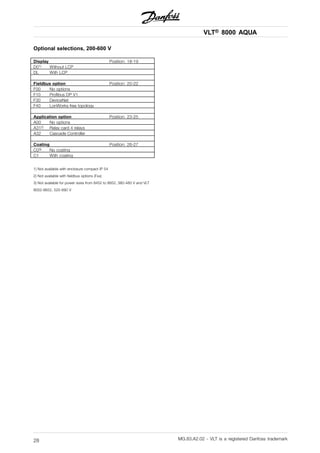
Optional selections, 200-600 V
Display Position: 18-19
D01) Without LCP
DL With LCP
Fieldbus option Position: 20-22
F00 No options
F10 Profibus DP V1
F30 DeviceNet
F40 LonWorks free topology
Application option Position: 23-25
A00 No options
A312) Relay card 4 relays
A32 Cascade Controller
Coating Position: 26-27
C03) No coating
C1 With coating
1) Not available with enclosure compact IP 54
2) Not available with fieldbus options (Fxx)
3) Not available for power sizes from 8452 to 8652, 380-480 V and VLT
8052-8652, 525-690 V
MG.83.A2.02 - VLT is a registered Danfoss trademark28
VLT® 8000 AQUA
Introduction
■ TYPE CODE Table/Ordering form
MG.83.A2.02 - VLT is a registered Danfoss trademark 29
VLT® 8000 AQUA
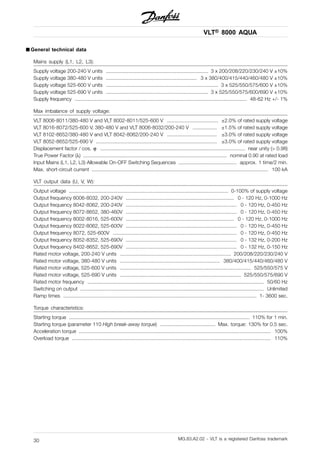
■ General technical data
Mains supply (L1, L2, L3):
Supply voltage 200-240 V units ........................................................................ 3 x 200/208/220/230/240 V ±10%
Supply voltage 380-480 V units ................................................................ 3 x 380/400/415/440/460/480 V ±10%
Supply voltage 525-600 V units ............................................................................... 3 x 525/550/575/600 V ±10%
Supply voltage 525-690 V units ........................................................................ 3 x 525/550/575/600/690 V ±10%
Supply frequency ......................................................................................................................... 48-62 Hz +/- 1%
Max imbalance of supply voltage:
VLT 8006-8011/380-480 V and VLT 8002-8011/525-600 V .................................... ±2.0% of rated supply voltage
VLT 8016-8072/525-600 V, 380-480 V and VLT 8006-8032/200-240 V ................. ±1.5% of rated supply voltage
VLT 8102-8652/380-480 V and VLT 8042-8062/200-240 V ................................... ±3.0% of rated supply voltage
VLT 8052-8652/525-690 V ..................................................................................... ±3.0% of rated supply voltage
Displacement factor / cos. ϕ ...................................................................................................... near unity (> 0.98)
True Power Factor (λ) ..................................................................................................... nominal 0.90 at rated load
Input Mains (L1, L2, L3) Allowable On-OFF Switching Sequences ......................................... approx. 1 time/2 min.
Max. short-circuit current ............................................................................................................................ 100 kA
VLT output data (U, V, W):
Output voltage ................................................................................................................ 0-100% of supply voltage
Output frequency 8006-8032, 200-240V ............................................................................ 0 - 120 Hz, 0-1000 Hz
Output frequency 8042-8062, 200-240V .............................................................................. 0 - 120 Hz, 0-450 Hz
Output frequency 8072-8652, 380-460V .............................................................................. 0 - 120 Hz, 0-450 Hz
Output frequency 8002-8016, 525-600V ............................................................................ 0 - 120 Hz, 0-1000 Hz
Output frequency 8022-8062, 525-600V .............................................................................. 0 - 120 Hz, 0-450 Hz
Output frequency 8072, 525-600V ....................................................................................... 0 - 120 Hz, 0-450 Hz
Output frequency 8052-8352, 525-690V .............................................................................. 0 - 132 Hz, 0-200 Hz
Output frequency 8402-8652, 525-690V .............................................................................. 0 - 132 Hz, 0-150 Hz
Rated motor voltage, 200-240 V units .............................................................................. 200/208/220/230/240 V
Rated motor voltage, 380-480 V units ...................................................................... 380/400/415/440/460/480 V
Rated motor voltage, 525-600 V units ............................................................................................ 525/550/575 V
Rated motor voltage, 525-690 V units ..................................................................................... 525/550/575/690 V
Rated motor frequency ............................................................................................................................ 50/60 Hz
Switching on output ................................................................................................................................. Unlimited
Ramp times ........................................................................................................................................ 1- 3600 sec.
Torque characteristics:
Starting torque ............................................................................................................................... 110% for 1 min.
Starting torque (parameter 110 High break-away torque) ....................................... Max. torque: 130% for 0.5 sec.
Acceleration torque ....................................................................................................................................... 100%
Overload torque ............................................................................................................................................ 110%
MG.83.A2.02 - VLT is a registered Danfoss trademark30
VLT® 8000 AQUA
Installation
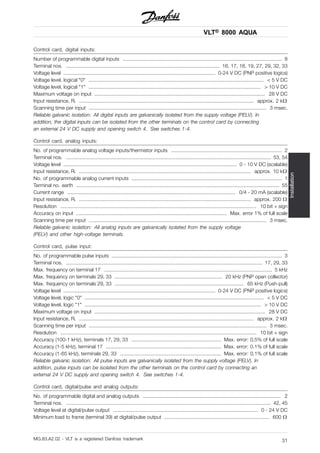
Control card, digital inputs:
Number of programmable digital inputs ................................................................................................................ 8
Terminal nos. ............................................................................................................ 16, 17, 18, 19, 27, 29, 32, 33
Voltage level ........................................................................................................... 0-24 V DC (PNP positive logics)
Voltage level, logical "0" ........................................................................................................................... < 5 V DC
Voltage level, logical "1" ......................................................................................................................... > 10 V DC
Maximum voltage on input ........................................................................................................................ 28 V DC
Input resistance, Ri ........................................................................................................................... approx. 2 k
Scanning time per input ............................................................................................................................. 3 msec.
Reliable galvanic isolation: All digital inputs are galvanically isolated from the supply voltage (PELV). In
addition, the digital inputs can be isolated from the other terminals on the control card by connecting
an external 24 V DC supply and opening switch 4. See switches 1-4.
Control card, analog inputs:
No. of programmable analog voltage inputs/thermistor inputs .............................................................................. 2
Terminal nos. ................................................................................................................................................ 53, 54
Voltage level .......................................................................................................................... 0 - 10 V DC (scalable)
Input resistance, Ri ......................................................................................................................... approx. 10 k
No. of programmable analog current inputs .......................................................................................................... 1
Terminal no. earth ............................................................................................................................................... 55
Current range ...................................................................................................................... 0/4 - 20 mA (scalable)
Input resistance, Ri ......................................................................................................................... approx. 200
Resolution .......................................................................................................................................... 10 bit + sign
Accuracy on input .......................................................................................................... Max. error 1% of full scale
Scanning time per input ............................................................................................................................. 3 msec.
Reliable galvanic isolation: All analog inputs are galvanically isolated from the supply voltage
(PELV) and other high-voltage terminals.
Control card, pulse input:
No. of programmable pulse inputs ........................................................................................................................ 3
Terminal nos. .......................................................................................................................................... 17, 29, 33
Max. frequency on terminal 17 ...................................................................................................................... 5 kHz
Max. frequency on terminals 29, 33 ............................................................................ 20 kHz (PNP open collector)
Max. frequency on terminals 29, 33 ........................................................................................... 65 kHz (Push-pull)
Voltage level ........................................................................................................... 0-24 V DC (PNP positive logics)
Voltage level, logic "0" .............................................................................................................................. < 5 V DC
Voltage level, logic "1" ............................................................................................................................ > 10 V DC
Maximum voltage on input ........................................................................................................................ 28 V DC
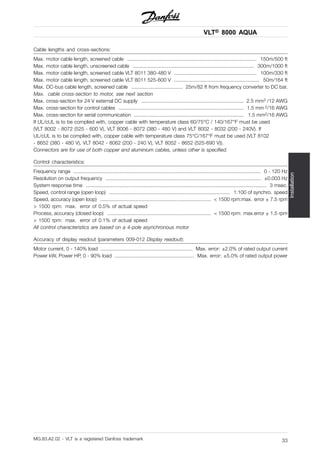
Input resistance, Ri ........................................................................................................................... approx. 2 k
Scanning time per input ............................................................................................................................. 3 msec.
Resolution .......................................................................................................................................... 10 bit + sign
Accuracy (100-1 kHz), terminals 17, 29, 33 ............................................................... Max. error: 0.5% of full scale
Accuracy (1-5 kHz), terminal 17 ................................................................................. Max. error: 0.1% of full scale
Accuracy (1-65 kHz), terminals 29, 33 ....................................................................... Max. error: 0.1% of full scale
Reliable galvanic isolation: All pulse inputs are galvanically isolated from the supply voltage (PELV). In
addition, pulse inputs can be isolated from the other terminals on the control card by connecting an
external 24 V DC supply and opening switch 4. See switches 1-4.
Control card, digital/pulse and analog outputs:
No. of programmable digital and analog outputs ................................................................................................. 2
Terminal nos. ................................................................................................................................................ 42, 45
Voltage level at digital/pulse output ...................................................................................................... 0 - 24 V DC
Minimum load to frame (terminal 39) at digital/pulse output .......................................................................... 600
MG.83.A2.02 - VLT is a registered Danfoss trademark 31
VLT® 8000 AQUA
Frequency ranges (digital output used as pulse output) ............................................................................ 0-32 kHz
Current range at analog output ............................................................................................................ 0/4 - 20 mA
Maximum load to frame (terminal 39) at analog output ................................................................................ 500
Accuracy of analog output ......................................................................................... Max. error: 1.5% of full scale
Resolution on analog output. ........................................................................................................................... 8 bit
Reliable galvanic isolation: All digital and analog outputs are galvanically isolated from the
supply voltage (PELV) and other high-voltage terminals.
Control card, 24 V DC supply:
Terminal nos. ................................................................................................................................................ 12, 13
Max. load .................................................................................................................................................. 200 mA
Terminal nos. earth ....................................................................................................................................... 20, 39
Reliable galvanic isolation: The 24 V DC supply is galvanically isolated from the supply voltage
(PELV), but has the same potential as the analog outputs.
Control card, RS 485 serial communication :
Terminal nos. .............................................................................................................. 68 (TX+, RX+), 69 (TX-, RX-)
Reliable galvanic isolation: Full galvanic isolation (PELV).
Relay outputs:1)
No. of programmable relay outputs ...................................................................................................................... 2
Terminal nos., control card (resistive load only) ....................................................................................... 4-5 (make)
Max. terminal load (AC1) on 4-5, control card ........................................................................ 50 V AC, 1 A, 50 VA
Max. terminal load (DC1 (IEC 947)) on 4-5, control card ................................. 25 V DC, 2 A / 50 V DC, 1 A, 50 W
Max. terminal load (DC1) on 4-5, control card for UL/cUL applications .................... 30 V AC, 1 A / 42.5 V DC, 1A
Terminal nos., power card (resistive and inductive load) ...................................................... 1-3 (break), 1-2 (make)
Max. terminal load (AC1) on 1-3, 1-2, power card ............................................................. 250 V AC, 2 A, 500 VA
Max. terminal load (DC1 (IEC 947)) on 1-3, 1-2, power card ............................. 25 V DC, 2 A / 50 V DC, 1A, 50 W
Min. terminal load (AC/DC) on 1-3, 1-2, power card ....................................... 24 V DC, 10 mA / 24 V AC, 100 mA
1) Rated values for up to 300,000 operations.
At inductive loads the number of operations are reduced by 50%, alternatively the current can be reduced by
50%, thus the 300,000 operations are maintained.
External 24 Volt DC supply :
Terminal nos. ................................................................................................................................................ 35, 36
Voltage range ....................................................................................... 24 V DC ±15% (max. 37 V DC for 10 sec.)
Max. voltage ripple ..................................................................................................................................... 2 V DC
Power consumption .............................................................................. 15 W - 50 W (50 W for start-up, 20 msec.)
Min. pre-fuse ............................................................................................................................................... 6 Amp
Reliable galvanic isolation: Full galvanic isolation if the external 24 V DC supply is also of the PELV type.
MG.83.A2.02 - VLT is a registered Danfoss trademark32
VLT® 8000 AQUA
Installation
Cable lengths and cross-sections:
Max. motor cable length, screened cable ........................................................................................... 150m/500 ft
Max. motor cable length, unscreened cable ..................................................................................... 300m/1000 ft
Max. motor cable length, screened cable VLT 8011 380-480 V .......................................................... 100m/330 ft
Max. motor cable length, screened cable VLT 8011 525-600 V ............................................................ 50m/164 ft
Max. DC-bus cable length, screened cable .................................... 25m/82 ft from frequency converter to DC bar.
Max. cable cross-section to motor, see next section
Max. cross-section for 24 V external DC supply ........................................................................ 2.5 mm2 /12 AWG
Max. cross-section for control cables ........................................................................................ 1.5 mm 2/16 AWG
Max. cross-section for serial communication ............................................................................. 1.5 mm2/16 AWG
If UL/cUL is to be complied with, copper cable with temperature class 60/75°C / 140/167°F must be used
(VLT 8002 - 8072 (525 - 600 V), VLT 8006 - 8072 (380 - 480 V) and VLT 8002 - 8032 (200 - 240V). If
UL/cUL is to be complied with, copper cable with temperature class 75°C/167°F must be used (VLT 8102
- 8652 (380 - 480 V), VLT 8042 - 8062 (200 - 240 V), VLT 8052 - 8652 (525-690 V)).
Connectors are for use of both copper and aluminium cables, unless other is specified.
Control characteristics:
Frequency range .................................................................................................................................... 0 - 120 Hz
Resolution on output frequency ............................................................................................................. ±0.003 Hz
System response time ............................................................................................................................... 3 msec.
Speed, control range (open loop) ..................................................................................... 1:100 of synchro. speed
Speed, accuracy (open loop) .............................................................................. < 1500 rpm:max. error ± 7.5 rpm
> 1500 rpm: max. error of 0.5% of actual speed
Process, accuracy (closed loop) ......................................................................... < 1500 rpm: max.error ± 1.5 rpm
> 1500 rpm: max. error of 0.1% of actual speed
All control characteristics are based on a 4-pole asynchronous motor
Accuracy of display readout (parameters 009-012 Display readout):
Motor current, 0 - 140% load ................................................................. Max. error: ±2.0% of rated output current
Power kW, Power HP, 0 - 90% load ........................................................ Max. error: ±5.0% of rated output power
MG.83.A2.02 - VLT is a registered Danfoss trademark 33
VLT® 8000 AQUA
Externals:
Enclosure .................................................................................. IP00/Chassis, IP20/IP21/NEMA 1, IP54/NEMA 12
Vibration test .................................. 0.7 g RMS 18-1000 Hz random. 3 directions for 2 hours (IEC 68-2-34/35/36)
Max. relative humidity ............................................................. 93 % +2 %, -3 % (IEC 68-2-3) for storage/transport
Max. relative humidity ................................................ 95% non condensing (IEC 721-3-3; class 3K3) for operation
Aggressive environment (IEC 721-3-3) .................................................................................... Uncoated class 3C2
Aggressive environment (IEC 721-3-3) ........................................................................................ Coated class 3C3
Ambient temperature, VLT 8006-8011 380-480 V,
8002-8011 525-600 V, IP 20//NEMA 1 .......................... Max. 45°C (117°F) (24-hour average max. 40°C (104°F))
Ambient temperature IP00/Chassis, IP20/NEMA 1, IP54/NEMA 12 ................................................................ Max.
40°C/104°F (24-hour average max. 35°C/95°F)
see Derating for high ambient temperature
Min. ambient temperature in full operation ............................................................................................. 0°C (32°F)
Min. ambient temperature at reduced performance ........................................................................... -10°C (14°F)
Temperature during storage/transport ......................................................... -25° - +65°/70°C (-13° - +149°/158°F)
Max. altitude above sea level ........................................................................................................ 1000 m (3300 ft)
see Derating for high air pressure.
IP54 units are not intended for direct outdoor installation. The IP54 rating does not relate to other
exposures as sun, icing, wind blown driving rain. Under such circumstances Danfoss recommends to
install the units in an enclosure designed for these environmental conditions. Alternatively, an installation
at minimum 0.5 m above surface and covered by a shed is recommended.
NB!:
VLT 8002-8072, 525-600 V units do not comply
with EMC, Low Voltage or PELV directives.
MG.83.A2.02 - VLT is a registered Danfoss trademark34
VLT® 8000 AQUA
Installation
VLT 8000 AQUA protection:
• Electronic motor thermal protection against overload.
• Temperature monitoring of heat-sink ensures that the frequency converter cuts out if the temperature
reaches 90°C (194 °F) for IP00, IP20 and NEMA 1. For IP54, the cut-out temperature is 80°C (176 °F). An
overtemperature can only be reset when the temperature of the heat-sink has fallen below 60°C (140 °F).
For the units mentioned below, the limits are as follows:
- VLT 8152, 380-480 V, cuts out at 75 °C (167 °F) and can be reset if the temperature is below 60
°C (140 °F).
- VLT 8202, 380-480 V, cuts out at 80 °C (176 °F) and can be reset if the temperature has fallen below
60° C (140 °F).
- VLT 8252, 380-480 V, cuts out at 95 °C (203 °F) and can be reset if the temperature has fallen below
65° C (149 °F).
- VLT 8302, 380-480 V, cuts out at 95 °C (203 °F) and can be reset if the temperature has fallen below
65° C (149 °F).
- VLT 8352, 380-480 V, cuts out at 105 °C (221 °F) and can be reset if the temperature has fallen
below 75° C (167 °F).
- VLT 8452-8652, 380-480 V, cuts out at 85 °C (185 °F) and can be reset if the temperature has fallen
below 60° C (140 °F).
- VLT 8052-8152, 525-690 V, cuts out at 75 °C (167 °F) and can be reset if the temperature has fallen
below 60° C (140 °F).
- VLT 8202-8402, 525-690 V, cuts out at 100°C (212 °F) and can be reset if the temperature has fallen
below 70° C (158 °F).
- VLT 8502-8652, 525-690 V, cuts out at 75°C (167 °F) and can be reset if the temperature has fallen
below 60° C (140 °F).
• The frequency converter is protected against short-circuiting on motor terminals U, V, W.
• The frequency converter is protected against earth fault on motor terminals U, V, W.
• Monitoring of the intermediate circuit voltage ensures that the frequency converter cuts out if the
intermediate circuit voltage gets too high or too low.
• If a motor phase is missing, the frequency converter cuts out.
• If there is a mains fault, the frequency converter is able to carry out a controlled decelleration.
• If a mains phase is missing, the frequency converter will cut out or autoderate when a load is placed on
the motor.
MG.83.A2.02 - VLT is a registered Danfoss trademark 35
VLT® 8000 AQUA
■ Technical data, mains supply 3 x 200 - 240 V
According to international requirements VLT type 8006 8008 8011
Output current4) IVLT,N [A] 16.7 24.2 30.8
IVLT, MAX (60 s) [A] 18.4 26.6 33.9
Output power (240 V) SVLT,N [kVA] 6.9 10.1 12.8
Typical shaft output PVLT,N [kW] 4.0 5.5 7.5
Typical shaft output PVLT,N [HP] 5 7.5 10
Max. cable cross-section to
motor
and DC-bus
[mm2 ]/[AWG]
10/8 16/6 16/6
Max. input current (200 V) (RMS)IL,N [A] 16.0 23.0 30.0
Max. cable
cross-section power
[mm2 ]/[AWG] 2 )
4/10 16/6 16/6
Max. pre-fuses [-]/UL1) [A] 35/30 50 60
Efficiency3) 0.95 0.95 0.95
Weight IP 20 [kg/lbs] 23/51 23/51 23/51
Weight IP 54 [kg/lbs] 35/77 35/77 38/84
Power loss at
max. load. [W]
Total 194 426 545
Enclosure VLT type IP 20/ NEMA 1, IP 54/NEMA 12
1. For type of fuse, see section Fuses.
2. American Wire Gauge.
3. Measured using 30 m/100 ft screened motor cables at rated load and rated frequency.
4. Current ratings fulfill UL requirements for 208-240 V.
MG.83.A2.02 - VLT is a registered Danfoss trademark36
VLT® 8000 AQUA
Installation
■ Technical data, mains supply 3 x 200 - 240 V
According to international requirements VLT type 8016 8022 8027 8032 8042 8052 8062
Output current4)
IVLT,N [A]
(200-230 V)
46.2 59.4 74.8 88.0 115 143 170
IVLT, MAX (60 s)
[A] (200-230 V)
50.6 65.3 82.3 96.8 127 158 187
IVLT,N[A] (240 V) 46.0 59.4 74.8 88.0 104 130 154
IVLT, MAX (60 s)
[A] (240 V)
50.6 65.3 82.3 96.8 115 143 170
Output power
SVLT,N [kVA]
(240 V)
19.1 24.7 31.1 36.6 41.0 52.0 61.0
Typical shaft
output
PVLT,N [kW] 11 15 18.5 22 30 37 45
Typical shaft
output
PVLT,N [HP] 15 20 25 30 40 50 60
Max. cable
cross-section
to motor and
DC-bus [mm2
]/[AWG]2) 5)
Copper
Aluminium6)
16/6
16/6
35/2
35/2
35/2
35/2
50/0
50/0
70/1/0
95/3/05)
95/3/0
90/250
mcm5)
120/4/0
120/300
mcm 5)
Min. cable cross-section to motor
and DC-bus [mm2 ]/[AWG]2)
10/8 10/8 10/8 16/6 10/8 10/8 10/8
Max. input current (200 V) (RMS)
IL,N[A]
46.0 59.2 74.8 88.0 101.3 126.6 149.9
Max. cable
cross-section
power [mm 2
]/[AWG]2) 5)
Copper
Aluminium6)
16/6
16/6
35/2
35/2
35/2
35/2
50/0
50/0
70/1/0
95/3/05)
95/3/0
90/250
mcm 5)
120/4/0
120/300
mcm 5)
Max. pre-fuses [-]/UL1) [A] 60 80 125 125 150 200 250
Efficiency3) 0.95 0.95 0.95 0.95 0.95 0.95 0.95
Weight IP
00/Chassis
[kg/lbs] - - - - 90/198 90/198 90/198
Weight IP
20/NEMA 1
[kg/lbs] 23/51 30/66 30/66 48/106 101/223 101/223 101/223
Weight IP 54 [kg/lbs] 38/84 49/108 50/110 55/121 104/229 104/229 104/229
Power loss at
max. load.
[W] 545 783 1042 1243 1089 1361 1613
Enclosure IP 00/IP 20/NEMA 1/IP 54/NEMA 12
1. For type of fuse, see section Fuses.
2. American Wire Gauge.
3. Measured using 30 m/100 ft screened motor cables at rated load and rated frequency.
4. Current ratings fulfill UL requirements for 208-240 V.
5. Connection stud 1 x M8 / 2 x M8.
6. Aluminium cables with cross section above 35 mm2 must be connected by use of an Al-Cu connector.
MG.83.A2.02 - VLT is a registered Danfoss trademark 37
VLT® 8000 AQUA
■ Technical data, mains supply 3 x 380 - 480 V
According to international requirements VLT type 8006 8008 8011
Output current IVLT,N [A] (380-440 V) 10.0 13.0 16.0
IVLT, MAX (60 s) [A]
(380-440 V)
11.0 14.3 17.6
IVLT, N [A] (441-480 V) 8.2 11.0 14.0
IVLT, MAX (60 s) [A]
(441-480 V)
9.0 12.1 15.4
Output power SVLT,N [kVA] (400 V) 7.2 9.3 11.5
SVLT,N [kVA] (460 V) 6.5 8.8 11.2
Typical shaft output PVLT,N [kW] 4.0 5.5 7.5
Typical shaft output PVLT,N [HP] 5 7.5 10
Max. cable cross-section
to motor
[mm2 ]/[AWG]2) 4)
4/10 4/10 4/10
Max. input current IL,N [A] (380 V) 9.1 12.2 15.0
(RMS) IL,N [A] (480 V) 8.3 10.6 14.0
Max. cable
cross-section power
[mm2 ]/[AWG] 2) 4)
4/10 4/10 4/10
Max. pre-fuses [-]/UL1)[A] 25/20 25/25 35/30
Efficiency3) 0.96 0.96 0.96
Weight IP 20/NEMA 1 [kg/lbs] 10.5/23 10.5/23 10.5/23
Weight IP 54/NEMA 12 [kg/lbs] 14/31 14/31 14/31
Power loss at
max. load. [W]
Total 198 250 295
Enclosure VLT type IP 20/NEMA 1/IP 54/NEMA 12
1. For type of fuse, see section Fuses.
2. American Wire Gauge.
3. Measured using 30 m/100 ft screened motor cables at rated load and rated frequency.
4. Max. cable cross section is the maximum possible cable cross section that can be fitted on the terminals.
Always comply with national and local regulations on min. cable cross-section.
MG.83.A2.02 - VLT is a registered Danfoss trademark38
VLT® 8000 AQUA
Installation
■ Technical data, mains supply 3 x 380 - 480 V
According to international requirements VLT type 8016 8022 8027 8032 8042
Output current IVLT,N [A] (380-440 V) 24.0 32.0 37.5 44.0 61.0
IVLT, MAX (60 s) [A]
(380-440 V)
26.4 35.2 41.3 48.4 67.1
IVLT,N[A] (441-480 V) 21.0 27.0 34.0 40.0 52.0
IVLT, MAX (60 s) [A]
(441-480 V)
23.1 29.7 37.4 44.0 57.2
Output power SVLT,N [kVA] (400 V) 17.3 23.0 27.0 31.6 43.8
SVLT,N [kVA] (460 V) 16.7 21.5 27.1 31.9 41.4
Typical shaft output PVLT,N [kW] 11 15 18.5 22 30
Typical shaft output PVLT,N [HP] 15 20 25 30 40
Max. cable cross-section to
motor and DC-bus, IP 20
16/6 16/6 16/6 35/2 35/2
Max. cable cross-section to
motor and DC-bus, IP 54
[mm2]/[AWG]2) 4)
16/6 16/6 16/6 16/6 35/2
Min. cable cross-section to
motor and DC-bus
[mm2]/[AWG]2) 4) 10/8 10/8 10/8 10/8 10/8
Max. input current IL,N[A] (380 V) 24.0 32.0 37.5 44.0 60.0
(RMS) IL,N[A] (480 V) 21.0 27.6 34.0 41.0 53.0
Max. cable cross-section
power, IP 20
16/6 16/6 16/6 35/2 35/2
Max. cable cross-section
power, IP 54
[mm2]/[AWG]2) 4)
16/6 16/6 16/6 16/6 35/2
Max. pre-fuses [-]/UL1) [A] 63/40 63/40 63/50 63/60 80/80
Efficiency at rated frequency 0.96 0.96 0.96 0.96 0.96
Weight IP 20/NEMA 1 [kg/lbs] 21/46 21/46 22/49 27/60 28/62
Weight IP 54/NEMA 12 [kg/lbs] 41/90 41/90 42/93 42/93 54/119
Power loss at max. load. [W] 419 559 655 768 1065
Enclosure IP 20/NEMA 1/ IP 54/NEMA 12
1. For type of fuse, see section Fuses.
2. American Wire Gauge.
3. Measured using 30 m/100 ft screened motor cables at rated load and rated frequency.
4. Min. cable cross-section is the smallest cable cross-section allowed to be fitted on the terminals. Max. cable
cross section is the maximum possible cable cross section that can be fitted on the terminals.
Always comply with national and local regulations on min. cable cross-section.
MG.83.A2.02 - VLT is a registered Danfoss trademark 39
VLT® 8000 AQUA
■ Technical data, mains supply 3 x 380 - 480 V
According to international requirements VLT type 8052 8062 8072 8102 8122
Output current IVLT,N [A] (380-440 V) 73.0 90.0 106 147 177
IVLT, MAX (60 s) [A]
(380-440 V)
80.3 99.0 117 162 195
IVLT,N[A] (441-480 V) 65.0 77.0 106 130 160
IVLT, MAX (60 s) [A]
(441-480 V)
71.5 84.7 117 143 176
Output power SVLT,N [kVA] (400 V) 52.5 64.7 73.4 102 123
SVLT,N [kVA] (460 V) 51.8 61.3 84.5 104 127
Typical shaft output PVLT,N [kW] 37 45 55 75 90
Typical shaft output PVLT,N [HP] 50 60 75 100 125
Max. cable
cross-section to motor
and DC-bus, IP 20
35/2 50/0 50/0
120 /
250
mcm5)
120 /
250
mcm5)
Max. cable
cross-section to motor
and DC-bus, IP 54
[mm2]/[AWG]2) 4) 6)
35/2 50/0 50/0
150 /
300
mcm5)
150 /
300
mcm5)
Min. cable cross-section
to motor and DC-bus
[mm2]/[AWG]2) 4) 10/8 16/6 16/6 25/4 25/4
Max. input current IL,N[A] (380 V) 72.0 89.0 104 145 174
(RMS) IL,N[A] (480 V) 64.0 77.0 104 128 158
Max. cable
cross-section power,
IP 20
35/2 50/0 50/0
120 /
250
mcm
120 /
250
mcm
Max. cable
cross-section power,
IP 54
[mm2]/[AWG]2) 4) 6)
35/2 50/0 50/0
150 /
300
mcm
150 /
300
mcm
Max. pre-fuses [-]/UL1) [A] 100/100 125/125 150/150 225/225 250/250
Efficiency at rated frequency 0.96 0.96 0.96 0.98 0.98
Weight IP 20/NEMA 1 [kg/lbs] 41/90 42/93 43/96 54/119 54/119
Weight IP 54/NEMA 12 [kg/lbs] 56/123 56/123 60/132 77/170 77/170
Power loss at max. load. [W] 1275 1571 1322 1467 1766
Enclosure IP 20/NEMA 1/IP 54/NEMA 12
1. For type of fuse, see section Fuses.
2. American Wire Gauge.
3. Measured using 30 m/100 ft screened motor cables at rated load and rated frequency.
4. Min. cable cross-section is the smallest cable cross-section allowed to be
fitted on the terminals. Max. cable cross section is the maximum possible
cable cross section that can be fitted on the terminals.
Always comply with national and local regulations on min. cable cross-section.
5. DC connection 95 mm2/AWG 3/0.
6. Aluminium cables with cross-section above 35 mm2 must be con-
nected by use of an Al-Cu connector.
MG.83.A2.02 - VLT is a registered Danfoss trademark40
VLT® 8000 AQUA
Installation
■ Technical data, mains supply 3 x 380 - 480 V
According to international requirements VLT type 8152 8202 8252 8302 8352
Output
current
IVLT,N [A] (380-440 V) 212 260 315 395 480
IVLT, MAX (60 s) [A] (380-440 V) 233 286 347 435 528
IVLT,N [A] (441-480 V) 190 240 302 361 443
IVLT, MAX (60 s) [A] (441-480 V) 209 264 332 397 487
Output
power
SVLT,N [kVA] (400 V) 147 180 218 274 333
SVLT,N [kVA] (460 V) 151 191 241 288 353
Typical shaft output (380-440 V) PVLT,N [kW] 110 132 160 200 250
Typical shaft output (441-480 V) PVLT,N [HP] 150 200 250 300 350
Max. cable cross-section to motor and
DC-bus [mm2]2) 4) 5) 2x70 2x70 2x185 2x185 2x185
Max. cable cross-section to motor and
DC-bus [AWG] 2) 4) 5)
2x2/0
mcm
2x2/0
mcm
2x350
mcm
2x350
mcm
2x350
mcm
Min. cable cross-section to motor and
DC-bus [mm2/AWG] 2) 4) 5)
35/2 35/2 35/2 35/2 35/2
Max. input
current
IL,N[A] (380 V) 208 256 317 385 467
(RMS) IL,N[A] (480 V) 185 236 304 356 431
Max. cable cross-section to power [mm2]2)
4) 5) 2x70 2x70 2x185 2x185 2x185
Max. cable cross-section to power [AWG]2)
4) 5)
2x2/0
mcm
2x2/0
mcm
2x350
mcm
2x350
mcm
2x350
mcm
Max. pre-
fuses
[-]/UL1) [A] 300/300 350/350 450/400 500/500 630/600
Weight
IP 00/
Chassis
[kg/lbs] 82/181 91/201 112/247 123/271 138/304
Weight
IP 20/
NEMA 1
[kg/lbs] 96/212 104/229 125/276 136/300 151/333
Weight
IP 54/
NEMA 12
[kg/lbs] 96/212 104/229 125/276 136/300 151/333
Efficiency at rated frequency 0.98
Power loss
at max.
load.
[W] 2619 3309 4163 4977 6107
Enclosure IP 00/Chassis/IP 21/NEMA 1/IP 54/NEMA 12
1. For type of fuse, see section Fuses.
2. American Wire Gauge.
3. Measured using 30 m/100 ft screened motor cables at rated load and rated frequency.
4. Min. cable cross-section is the smallest cable cross-section allowed to be fitted on the terminals. Max. cable
cross section is the maximum possible cable cross section that can be fitted on the terminals.
Always comply with national and local regulations on min. cable cross-section.
5. Connection bolt 1 x M10 / 2 x M10 (mains and motor), connection bolt 1 x M8 / 2 x M8 (DC-bus).
MG.83.A2.02 - VLT is a registered Danfoss trademark 41
VLT® 8000 AQUA
■ Technical data, mains supply 3 x 380 - 480 V
According to international requirements VLT type 8452 8502 8602 8652
Output current IVLT,N [A] (380-440 V) 600 658 745 800
IVLT, MAX (60 s) [A] (380-440 V) 660 724 820 880
IVLT,N [A] (441-480 V) 540 590 678 730
IVLT, MAX (60 s) [A] (441-480 V) 594 649 746 803
Output power SVLT,N [kVA] (400 V) 416 456 516 554
SVLT,N [kVA] (480 V) 430 470 540 582
Typical shaft output (380-440 V) PVLT,N [kW] 315 355 400 450
Typical shaft output (441-480 V) PVLT,N [HP] 450 500 550/600 600
Max. cable cross-section to motor and DC-bus
[mm2] 4) 5)
4 x 240 4 x 240 4 x 240 4 x 240
Max. cable cross-section to motor and DC-bus
[AWG] 2) 4) 5)
4 x 500 mcm 4 x 500 mcm 4 x 500 mcm 4 x 500 mcm
IL,MAX [A] (380 V) 584 648 734 787Max. input
current (RMS) IL,MAX [A] (480 V) 526 581 668 718
Max. cable cross-section to power [mm2]4) 5) 4 x 240 4 x 240 4 x 240 4 x 240
Max. cable cross-section to power [AWG]2) 4) 5) 4 x 500 mcm 4 x 500 mcm 4 x 500 mcm 4 x 500 mcm
Max. pre-fuses
(mains) [-]/UL [A]1 ) 700/700 900/900 900/900 900/900
Efficiency3) 0.98 0.98 0.98 0.98
Weight IP 00/
Chassis [kg/lbs] 221/488 234/516 236/521 277/611
Weight IP 20/
NEMA 1 [kg/lbs] 263/580 270/596 272/600 313/690
Weight IP 54/
NEMA 12 [kg/lbs] 263/580 270/596 272/600 313/690
Power loss at
max. load [W] 7630 7701 8879 9428
Enclosure IP 00/Chassis/IP 21/NEMA 1/IP 54/NEMA 12
1. For type of fuse, see section Fuses.
2. American Wire Gauge.
3. Measured using 30 m/100 ft screened motor cables at rated load and rated frequency.
4. Always comply with national and local regulations on min. cable cross-section. Max. cable cross
section is the maximum possible cable cross section that can be fitted on the terminals.
5. Connection bolt, power supply, motor and load sharing: M10 (compression lug), 2 x M8 (box lug).
MG.83.A2.02 - VLT is a registered Danfoss trademark42
VLT® 8000 AQUA
Installation
■ Technical data, mains supply 3 x 525 - 600 V
According to international requirements VLT type 8002 8003 8004 8005 8006 8008 8011
Output current IVLT,N [A] (550 V) 2.6 2.9 4.1 5.2 6.4 9.5 11.5
IVLT, MAX (60 s) [A] (550 V) 2.9 3.2 4.5 5.7 7.0 10.5 12.7
IVLT,N [A] (575 V) 2.4 2.7 3.9 4.9 6.1 9.0 11.0
IVLT, MAX (60 s) [A] (575 V) 2.6 3.0 4.3 5.4 6.7 9.9 12.1
Output S VLT,N [kVA] (550 V) 2.5 2.8 3.9 5.0 6.1 9.0 11.0
SVLT,N [kVA] (575 V) 2.4 2.7 3.9 4.9 6.1 9.0 11.0
Typical shaft output PVLT,N [kW] 1.1 1.5 2.2 3 4 5.5 7.5
Typical shaft output PVLT,N [HP] 1.5 2 3 4 5 7.5 10
Max. copper cable cross-section to motor and
loadsharing
[mm2] 4 4 4 4 4 4 4
[AWG]2) 10 10 10 10 10 10 10
Rated Input
Current
IVLT,N [A] (550 V)
I VLT,N [A] (600 V)
2.5
2.2
2.8
2.5
4.0
3.6
5.1
4.6
6.2
5.7
9.2
8.4
11.2
10.3
Max.copper cable cross-section, power
[mm2] 4 4 4 4 4 4 4
[AWG]2) 10 10 10 10 10 10 10
Max. prefuses (mains) 1)[ - ]/UL [A] 3 4 5 6 8 10 15
Efficiency 0.96
Weight IP 20
/ NEMA 1
[kg/lbs]
10.5/
23
10.5/
23
10.5/
23
10.5/
23
10.5/
23
10.5/
23
10.5/
23
Estimated power loss at max. load (550 V) [W] 65 73 103 131 161 238 288
Estimated power loss at max. load (600V) [W] 63 71 102 129 160 236 288
Enclosure IP 20/NEMA 1
1. For type of fuse, see section Fuses.
2. American Wire Gauge (AWG).
3. Min. cable cross-section is the smallest cable cross-section allowed to be fitted into the terminals to comply
with IP20. Always comply with national and local regulations on min. cable cross-section.
MG.83.A2.02 - VLT is a registered Danfoss trademark 43
VLT® 8000 AQUA
■ Technical data, mains supply 3 x 525 - 600 V
According to international requirements 8016 8022 8027 8032 8042 8052 8062 8072
Output current IVLT,N [A] (550 V) 18 23 28 34 43 54 65 81
IVLT, MAX (60 s) [A] (550V) 20 25 31 37 47 59 72 89
IVLT,N [A] (575 V) 17 22 27 32 41 52 62 77
IVLT, MAX (60 s) [A] (575 V) 19 24 30 35 45 57 68 85
Output SVLT,N [kVA] (550 V) 17 22 27 32 41 51 62 77
SVLT,N [kVA] (575 V) 17 22 27 32 41 52 62 77
Typical shaft output PVLT,N [kW] 11 15 18.5 22 30 37 45 55
Typical shaft output PVLT,N [HP] 15 20 25 30 40 50 60 75
Max. copper cable
cross-section to motor
and loadsharing4)
[mm2] 16 16 16 35 35 50 50 50
[AWG]2) 6 6 6 2 2 1/0 1/0 1/0
Min. cable
cross-section to motor
and loadsharing3)
[mm2] 0.5 0.5 0.5 10 10 16 16 16
[AWG]2) 20 20 20 8 8 6 6 6
Rated Input Current
I VLT.N[A] (550 V) 18 22 27 33 42 53 63 79
IVLT.N[A] (600 V) 16 21 25 30 38 49 38 72
[mm2] 16 16 16 35 35 50 50 50Max copper cable
cross section, power4) [AWG] 2) 6 6 6 2 2 1/0 1/0 1/0
Max. prefuses (mains) 1)[-]/UL [A] 20 30 35 45 60 75 90 100
Efficiency 0.96
Weight IP 20/NEMA 1 [kg/Ibs]
23/
51
23/
51
23/
51
30/
66
30/
66
48/
106
48/
106
48/
106
Estimated power loss at max. load (550 V) [W] 451 576 702 852 1077 1353 1628 2029
Estimated power loss at max. load (600 V) [W] 446 576 707 838 1074 1362 1624 2016
Enclosure
IP 20/NEMA 1
1. For type of fuse, see section Fuses.
2. American Wire Gauge (AWG).
3. Min. cable cross-section is the smallest cable cross-section allowed to be fitted into
the terminals to comply with IP 20.
Always comply with national and local regulations on min. cable cross-section.
4. Aluminium cables with cross-section above 35 mm2 must be connected by use of an Al-Cu connector.
MG.83.A2.02 - VLT is a registered Danfoss trademark44
VLT® 8000 AQUA
Installation
■ Technical data, mains supply 3 x 525 - 690 V
According to international requirements VLT type 8052 8062 8072 8102 8122
Output current IVLT,N [A] (525-550 V) 56 76 90 113 137
IVLT, MAX (60 s) [A] (525-550 V) 62 84 99 124 151
IVLT,N [A] (551-690 V) 54 73 86 108 131
IVLT, MAX (60 s) [A] (551-690 V) 59 80 95 119 144
Output SVLT,N [kVA] (550 V) 53 72 86 108 131
SVLT,N [kVA] (575 V) 54 73 86 108 130
SVLT,N [kVA] (690 V) 65 87 103 129 157
Typical shaft output [kW] (550 V) 37 45 55 75 90
[HP] (575 V) 50 60 75 100 125
[kW] (690 V) 45 55 75 90 110
Max. cable cross-section to
motor
[mm2]4,5
[AWG]2,4,5
2 x 70
2 x 2/0
Max. cable cross-section to
loadsharing and brake
[mm2]4,5
[AWG]2,4,5
2 x 70
2 x 2/0
Rated input current IL,N [A] (550 V) 60 77 89 110 130
IL,N [A] (575 V) 58 74 85 106 124
IL,N [A] (690 V) 58 77 87 109 128
Max. cable cross-section
power supply
[mm2]4,5
[AWG]2,4,5
2 x 70
2 x 2/0
Min. cable cross-section to
motor and power supply
[mm2]4,5
[AWG]2,4,5
35
2
Min. cable cross-section to
brake and loadsharing
[mm2]4,5
[AWG]2,4,5
10
8
Max. pre-fuses (mains) [-]/UL [A]1 125 160 200 200 250
Efficiency3 0.97 0.97 0.98 0.98 0.98
Power loss [W] 1458 1717 1913 2262 2662
Weight IP 00 [kg] 82
Weight IP 21/Nema1 [kg] 96
Weight IP 54/Nema12 [kg] 96
Enclosure IP 00, IP 21/Nema 1 and IP 54/Nema12
1. For type of fuse see section Fuses
2. American Wire Gauge.
3. Measured using 30 m screened motor cables at rated load and rated frequency.
4. Max. cable cross-section is the maximum possible cable cross-section allowed to be fitted on
the terminals. Min. cable cross-section is the minimum allowed cross-section. Always comply
with national and local regulations on min. cable cross-section.
5. Connection bolt 1 x M10 / 2 x M10 (mains and motor), connection bolt 1 x M8 / 2 x M8 (DC-bus).
MG.83.A2.02 - VLT is a registered Danfoss trademark 45
VLT® 8000 AQUA
■ Technical data, mains supply 3 x 525 - 690 V
According to international requirements VLT type 8152 8202 8252 8302 8352 8402
Output current IVLT,N [A] (525-550 V) 162 201 253 303 360 418
IVLT, MAX (60 s) [A]
(525-550 V)
178 221 278 333 396 460
IVLT,N [A] (551-690 V) 155 192 242 290 344 400
IVLT, MAX (60 s) [A]
(551-690 V)
171 211 266 319 378 440
Output SVLT,N [kVA] (550 V) 154 191 241 289 343 398
SVLT,N [kVA] (575 V) 154 191 241 289 343 398
SVLT,N [kVA] (690 V) 185 229 289 347 411 478
Typical shaft output [kW] (550 V) 110 132 160 200 250 315
[HP] (575 V) 150 200 250 300 350 400
[kW] (690 V) 132 160 200 250 315 400
Max. cable cross-section
to motor
[mm2]4,6
[AWG]2,4,5
2 x 70
2 x 2/0
2 x 185
2 x 350 mcm
Max. cable cross-section
to loadsharing and brake
[mm2]4,6
[AWG]2,4,5
2 x 70
2 x 2/0
2 x 185
2 x 350 mcm
Rated input current IL,N [A] (550 V) 158 198 245 299 355 408
IL,N [A] (575 V) 151 189 234 286 339 390
IL,N [A] (690 V) 155 197 240 296 352 400
Max. cable cross-section
power supply
[mm2]4,6
[AWG]2,4,5
2 x 70
2 x 2/0
2 x 185
2 x 350 mcm
Min. cable cross-section to
motor and power supply
[mm2]4,6
[AWG]2,4,5
35
2
Min. cable cross-section to
brake and loadsharing
[mm2]4,6
[AWG]2,4,5
10
8
Max. pre-fuses (mains)
[-]/UL
[A]1 315 350 350 400 500 550
Efficiency3 0,98
Power loss [W] 3114 3612 4293 5156 5821 6149
Weight IP 00 [kg] 82 91 112 123 138 151
Weight IP 21/Nema1 [kg] 96 104 125 136 151 165
Weight IP 54/Nema12 [kg] 96 104 125 136 151 165
Enclosure IP 00, IP 21/Nema 1 and IP 54/Nema12
1. For type of fuse see section Fuses
2. American Wire Gauge.
3. Measured using 30 m screened motor cables at rated load and rated frequency.
4. Max. cable cross-section is the maximum possible cable cross-section allowed to be fitted on
the terminals. Min. cable cross-section is the minimum allowed cross-section. Always comply
with national and local regulations on min. cable cross-section.
5. Connection bolt 1 x M10 / 2 x M10 (mains and motor), connection bolt 1 x M8 / 2 x M8 (DC-bus).
MG.83.A2.02 - VLT is a registered Danfoss trademark46
VLT® 8000 AQUA
Installation
■ Technical data, mains supply 3 x 525 - 690 V
According to international requirements VLT type 8502 8602 8652
Output current IVLT,N [A] (525-550 V) 523 596 630
IVLT, MAX (60 s) [A] (525-550 V) 575 656 693
IVLT,N [A] (551-690 V) 500 570 630
IVLT, MAX (60 s) [A] (551-690 V) 550 627 693
Output power SVLT,N [kVA] (550 V) 498 568 600
SVLT,N [kVA] (575 V) 498 568 627
SVLT,N [kVA] (690 V) 598 681 753
Typical shaft output (525-550 V) PVLT,N [kW] 500 560 630
Typical shaft output (551-690 V) PVLT,N [HP] 400 500 600
Max. cable cross-section to motor and DC-bus [mm2] 4) 5) 4 x 240 4 x 240 4 x 240
Max. cable cross-section to motor and DC-bus [AWG] 2)
4) 5)
4 x 500 mcm 4 x 500 mcm 4 x 500 mcm
IL,MAX [A] (550 V) 504 574 607
IL,MAX [A] (575 V) 482 549 607
Max. input
current (RMS)
IL,MAX [A] (690 V) 482 549 607
Max. cable cross-section to power [mm2]4) 5) 4 x 240 4 x 240 4 x 240
Max. cable cross-section to power [AWG]2) 4) 5) 4 x 500 mcm 4 x 500 mcm 4 x 500 mcm
Max. pre-fuses
(mains) [-]/UL [A]1 ) 700/700 900/900 900/900
Efficiency3) 0.98 0.98 0.98
Weight IP 00/
Chassis [kg/lbs] 221/488 236/520 277/611
Weight IP 20/
NEMA 1 [kg/lbs] 263/580 272/600 313/690
Weight IP 54/
NEMA 12 [kg/lbs] 263/580 272/600 313/690
Power loss at
max. load [W] 7249 8727 9673
Enclosure IP 00/Chassis/IP 21/NEMA 1/IP 54/NEMA 12
1. For type of fuse, see section Fuses.
2. American Wire Gauge.
3. Measured using 30 m/100 ft screened motor cables at rated load and rated frequency.
4. Always comply with national and local regulations on min. cable cross-section. Max. cable cross section
is the maximum possible cable cross section that can be fitted on the terminals.
5. Connection bolt, power supply, motor and load sharing: M10 (compression lug), 2 x M8 (box lug)
MG.83.A2.02 - VLT is a registered Danfoss trademark 47
VLT® 8000 AQUA
■ Fuses
UL compliance
To comply with UL/cUL approvals, pre-fuses according to the table below must be used.
200-240 V
VLT Bussmann SIBA Littel fuse Ferraz-Shawmut
8006 KTN-R30 5017906-032 KLN-R30 ATM-R30 or A2K-30R
8008 KTN-R50 5012406-050 KLN-R50 A2K-50R
8011, 8016 KTN-R60 5014006-063 KLN-R60 A2K-60R
8022 KTN-R80 5014006-080 KLN-R80 A2K-80R
8027, 8032 KTN-R125 2028220-125 KLN-R125 A2K-125R
8042 FWX-150 2028220-150 L25S-150 A25X-150
8052 FWX-200 2028220-200 L25S-200 A25X-200
8062 FWX-250 2028220-250 L25S-250 A25X-250
380-480 V
VLT Bussmann SIBA Littel fuse Ferraz-Shawmut
8006 KTS-R20 5017906-020 KLS-R20 ATM-R20 or A6K-20R
8008 KTS-R25 5017906-025 KLS-R25 ATM-R25 or A6K-25R
8011 KTS-R30 5012406-032 KLS-R30 ATM-R30 or A6K-30R
8016, 8022 KTS-R40 5014006-040 KLS-R40 A6K-40R
8027 KTS-R50 5014006-050 KLS-R50 A6K-50R
8032 KTS-R60 5014006-063 KLS-R60 A6K-60R
8042 KTS-R80 2028220-100 KLS-R80 A6K-80R
8052 KTS-R100 2028220-125 KLS-R100 A6K-100R
8062 KTS-R125 2028220-125 KLS-R125 A6K-125R
8072 KTS-R150 2028220-160 KLS-R150 A6K-150R
8102 FWH-220 2028220-200 L50S-225 A50-P225
8122 FWH-250 2028220-250 L50S-250 A50-P250
8152* FWH-300/170M3017 2028220-315 L50S-300 A50-P300
8202* FWH-350/170M3018 2028220-315 L50S-350 A50-P350
8252* FWH-400/170M4012 206xx32-400 L50S-400 A50-P400
8302* FWH-500/170M4014 206xx32-500 L50S-500 A50-P500
8352* FWH-600/170M4016 206xx32-600 L50S-600 A50-P600
8452 170M4017 2061032-700 6,9URD31D08A0700
8502 170M6013 2063032-900 6,9URD33D08A0900
8602 170M6013 2063032-900 6,9URD33D08A0900
8652 170M6013 2063032-900 6,9URD33D08A0900
* Circuit Breakers manufactured by General Electric, Cat. No. SKHA36AT0800 with the rating plug listed
below can be used to meet UL requirement.
8152 rating plug No. SRPK800 A 300
8202 rating plug No. SRPK800 A 400
8252 rating plug No. SRPK800 A 400
8302 rating plug No. SRPK800 A 500
8352 rating plug No. SRPK800 A 600
MG.83.A2.02 - VLT is a registered Danfoss trademark48
VLT® 8000 AQUA
Installation
525-600 V
Bussmann SIBA Littel fuse Ferraz-Shawmut
8002 KTS-R3 5017906-004 KLS-R003 A6K-3R
8003 KTS-R4 5017906-004 KLS-R004 A6K-4R
8004 KTS-R5 5017906-005 KLS-R005 A6K-5R
8005 KTS-R6 5017906-006 KLS-R006 A6K-6R
8006 KTS-R8 5017906-008 KLS-R008 A6K-8R
8008 KTS-R10 5017906-010 KLS-R010 A6K-10R
8011 KTS-R15 5017906-016 KLS-R015 A6K-15R
8016 KTS-R20 5017906-020 KLS-R020 A6K-20R
8022 KTS-R30 5017906-030 KLS-R030 A6K-30R
8027 KTS-R35 5014006-040 KLS-R035 A6K-35R
8032 KTS-R45 5014006-050 KLS-R045 A6K-45R
8042 KTS-R60 5014006-063 KLS-R060 A6K-60R
8052 KTS-R75 5014006-080 KLS-R075 A6K-80R
8062 KTS-R90 5014006-100 KLS-R090 A6K-90R
8072 KTS-R100 5014006-100 KLS-R100 A6K-100R
525-600 V (UL) and 525-690 V (CE) drives
Bussmann SIBA FERRAZ-SHAWMUT
8052 170M3013 2061032,125 6.6URD30D08A0125
8062 170M3014 2061032,16 6.6URD30D08A0160
8072 170M3015 2061032,2 6.6URD30D08A0200
8102 170M3015 2061032,2 6.6URD30D08A0200
8122 170M3016 2061032,25 6.6URD30D08A0250
8152 170M3017 2061032,315 6.6URD30D08A0315
8202 170M3018 2061032,35 6.6URD30D08A0350
8252 170M4011 2061032,35 6.6URD30D08A0350
8302 170M4012 2061032,4 6.6URD30D08A0400
8352 170M4014 2061032,5 6.6URD30D08A0500
8402 170M5011 2062032,55 6.6URD32D08A550
8502 170M4017 2061032-700 6,9URD31D08A0700
8602 170M6013 2063032-900 6,9URD33D08A0900
8652 170M6013 2063032-900 6,9URD33D08A0900
KTS-fuses from Bussmann may substitute KTN for 240 V drives.
FWH-fuses from Bussmann may substitute FWX for 240 V drives.
KLSR fuses from LITTEL FUSE may substitute KLNR fuses for 240 V drives.
L50S fuses from LITTEL FUSE may substitute L25S fuses for 240 V drives.
A6KR fuses from FERRAZ SHAWMUT may substitute A2KR for 240 V drives.
A50X fuses from FERRAZ SHAWMUT may substitute A25X for 240 V drives.
MG.83.A2.02 - VLT is a registered Danfoss trademark 49
VLT® 8000 AQUA
Non UL compliance
If UL/cUL is not to be complied with, we recommend the above mentioned fuses or:
VLT 8006-8032 200-240 V type gG
VLT 8042-8062 200-240 V type gR
VLT 8006-8072 380-480 V type gG
VLT 8102-8122 380-480 V type gR
VLT 8152-8352 380-480 V type gG
VLT 8452-8652 380-480 V type gR
VLT 8002-8072 525-600 V type gG
Not following the recommendation may result
in damage of the drive in case of malfunction.
Fuses must be designed for protection in a circuit
capable of supplying a maximum of 100000 Arms
(symmetrical), 500 V /600 V maximum.
MG.83.A2.02 - VLT is a registered Danfoss trademark50
VLT® 8000 AQUA
Installation
■ Mechanical dimensions
All the below listed measurements are in mm/in
VLT type A B C a b aa/bb Type
IP 00/Chassis 200 - 240 V
8042 - 8062 800/31.5 370/14.6 335/13.2 780/30.7 270/10.6 225/8.9 B
IP 00 380 - 480 V
8152 - 8202 1046/41.2 408/16.1 373/14.71) 1001/39.4 304/12.0 225/8.9 J
8252 - 8352 1327/52.2 408/16.1 373/14.71) 1282/50.5 304/12.0 225/8.9 J
8452 - 8652 1547/60.9 585/23.0 494/19.41) 1502/59.1 304/12.0 225/8.9 (aa) I
IP 00 525 - 690 V
8052 - 8202 1046/41.1 408/16 3731)/14.7 1001/39.4 304/12 225/8.7 J
8252 - 8402 1327/52.2 408/16 3731)14.7 1282/50.4 304/12 225/8.7 J
8502 - 8652 1547/60.9 585/23.0 494/19.41) 1502/59.1 304/12.0 225/8.9 (aa) I
IP 20/NEMA 1 200 - 240 V
8006 - 8011 560/22.0 242/9.5 260/10.2 540/21.3 200/7.9 200/7.9 D
8016 - 8022 700/27.6 242/9.5 260/10.2 680/26.8 200/7.9 200/7.9 D
8027 - 8032 800/31.5 308/12.1 296/11.7 780/30.7 270/10.6 200/7.9 D
8042 - 8062 954/37.6 370/14.6 335/13.2 780/30.7 270/10.6 225/8.9 E
IP 20/NEMA 1 380 - 480 V
8006 - 8011 395/15.6 220/8.7 200/7.9 384/15.1 200/7.9 100/3.9 C
8016 - 8027 560/22.0 242/9.5 260/10.2 540/21.3 200/7.9 200/7.9 D
8032 - 8042 70027.6 242/9.5 260/10.2 680/26.8 200/7.9 200/7.9 D
8052 - 8072 800/31.5 308/12.1 296/11.7 780/30.7 270/10.6 200/7.9 D
8102 - 8122 800/31.5 370/14.6 335/13.2 780/30.7 330/13.0 225/8.9 D
IP 21/NEMA 1 380-480 V
8152 - 8202 1208/47.5 420/16.5 373/14.71) 1154/45.4 304/12.0 225/8.9 J
8252 - 8352 1588/62.5 420/16.5 373/14.71) 1535/60.4 304/12.0 225/8.9 J
8452 - 8652 2000/78.7 600/23.6 494/19.41) - - 225/8.9 (aa) H
IP 20/NEMA 1 525 - 690 V
8002 - 8011 395/15.55 220/8.66 200/7.87 384/15.12 200/7.87 100/3.94 C
8016 - 8027 560/22.05 242/9.53 260/10.23 540/21.26 200/7.87 200/7.87 D
8032 - 8042 700/27.56 242/9.53 260/10.23 680/26.77 200/7.87 200/7.87 D
8052 - 8072 800/31.50 308/12.13 296/11.65 780/30.71 270/10.63 200/7.87 D
IP 21/NEMA 1 525 - 690 V
8052 - 8202 1208/47.5 420/16.5 3731)/14.7 1154/45.4 304/12 225/8.7 J
8252 - 8402 1588/62.5 420/16.5 3731)/14.7 1535/60.4 304712 225/8.7 J
8502 - 8652 2000/78.7 600/23.6 494/19.41) - - 225/8.9 (aa) H
IP 54/NEMA 12 200 - 240 V A B C D a b aa/bb Type
8006 - 8011 810/31.9 350/13.8 280/11.0 70/2.8 560/22.0 326/12.8 200/7.9 F
8016 - 8032 940/37.0 400/15.7 280/11.0 70/2.8 690/27.2 375/14.8 200/7.9 F
8042 - 8062 937/36.9 495/9.5 421/16.6 - 830/32.7 374/14.8 225/8.9 G
IP 54/NEMA 12 380 - 480 V
8006 - 8011 530/20.9 282/11.1 195/7.7 85/3.3 330/13.0 258/10.2 100/3.9 F
8016 - 8032 810/31.9 350/13.8 280/11.0 70/2.8 560/22.0 326/12.8 200/7.9 F
8042 - 8072 940/37.0 400/15.7 280/11.0 70/2.8 690/27.2 375/14.8 200/7.9 F
8102 - 8122 940/37.0 400/15.7 360/14.2 70/2.8 690/27.2 375/14.8 225/8.9 F
8152 - 8202 1208/47.5 420/16.3 373/14.71) - 1154/45.4 304/12.0 225/8.9 J
8252 - 8352 1588/62.5 420/16.3 373/14.71) - 1535/60.4 304/12.0 225/8.9 J
8452 - 8652 2000/78.7 600/23.6 494/19.41) - - 225/8.9 (aa) H
IP 54/NEMA 12 525 - 690 V
8052 - 8202 1208/47.5 420/16.5 3731)14.7 1154/45.4 304/12 225/8.7 J
8252 - 8402 1588/62.5 420/16.5 3731)/14.7 1535/60.4 304/12 225/8.7 J
8502 - 8652 2000/78.7 600/23.6 494/19.41) - - 225/8.9 (aa) H
1. With disconnect add 44 mm/1.7 in
aa: Minimum space above enclosure
bb: Minimum space below enclosure
MG.83.A2.02 - VLT is a registered Danfoss trademark 51
VLT® 8000 AQUA
■ Mechanical dimensions
MG.83.A2.02 - VLT is a registered Danfoss trademark52
VLT® 8000 AQUA
Installation
■ Mechanical dimensions (cont.)
Type H, IP 20, IP 54
Type I, IP 00
Type J, IP 00, IP 21, IP 54
MG.83.A2.02 - VLT is a registered Danfoss trademark 53
VLT® 8000 AQUA
■ Mechanical installation
Please pay attention to the requirements
that apply to integration and field mounting
kit, see the below list. The information given
in the list must be observed to avoid serious damage
or injury, especially when installing large units.
The frequency converter must be installed vertically.
The frequency converter is cooled by means of air
circulation. For the unit to be able to release its cooling
air, the minimum distance over and below the unit
must be as shown in the illustration below.
To protect the unit from overheating, it must be ensured
that the ambient temperature does not rise above the
max. temperature stated for the frequency converter
and that the 24-hour average temperature is not
exceeded. The max. temperature and 24-hour average
can be seen from the General Technical Data.
If the ambient temperature is in the range of 45°C -55°
C, derating of the frequency converter will become
relevant, see Derating for ambient temperature.
The service life of the frequency converter will
be reduced if derating for ambient temperature
is not taken into account.
■ Installation of VLT 8006-8652
All frequency converters must be installed in a
way that ensures proper cooling.
Cooling
All units require a minimum space above and
below the enclosure.
Side by side/flange by flange
All frequency converters can be mounted side
by side/flange by flange.
d [mm/in] Comments
Compact (all enclosure types)
VLT 8006-8011, 380-480 V 100/3.9
VLT 8002-8011, 525-600 V 100/3.9
Installation on a plane, vertical surface (no spacers)
VLT 8006-8032, 200-240 V 200/7.9
VLT 8016-8072 380-480 V 200/7.9
VLT 8102-8122 380-480 V 225/8.9
VLT 8016-8072 525-600 V 200/7.9
Installation on a plane, vertical surface (no spacers)
VLT 8042-8062, 200-240 V 225/8.9
VLT 8152-8352, 380-480 V 225/8.9
VLT 8052-8402, 525-690 V 225/8.9
Installation on a plane, vertical surface (no spacers)
IP 54 filter mats must be changed when they are dirty.
VLT 8452-8652, 380-480 V
VLT 8502-8652, 525-690 V
225/8.9 IP 00: Above and below enclosure.
IP 21/54: Only above enclosure
MG.83.A2.02 - VLT is a registered Danfoss trademark54
VLT® 8000 AQUA
Installation
■ Installation of VLT 8452-8652 380-480 V and
VLT 8502-8652, 525-690 V
Compact IP 00/Chassis, IP 21/NEMA 1
and IP 54/NEMA 12
Cooling Side-by-side
All units in the above-mentioned series require
a minimum space of 225 mm (8.9 in) above the
enclosure and must be installed on a plane floor. This
applies to IP 21/NEMA 1 and IP 54/NEMA 12 units.
Gaining access requires a minimum space of 579
mm (22.8 in) in front of the frequency converter.
All IP 21/NEMA 1 and IP 54/NEMA 12 units in the
above-mentioned series can be installed side by side
without any space between them, since these units
do not require cooling on the sides.
MG.83.A2.02 - VLT is a registered Danfoss trademark 55
VLT® 8000 AQUA
■ General information about electrical installation
■ High voltage warning
The voltage of the frequency converter
is dangerous whenever the equipment is
connected to mains. Incorrect installation
of the motor or the frequency converter may cause
damage to the equipment, serious personal injury
or death. Consequently, the instructions in these
Operating Instructions, as well as national and
local safety regulations, must be complied with.
Touching the electrical parts may be fatal - even
after disconnection from mains:
Using VLT 8006-8062, 200-240 V wait at
least 15 minutes
Using VLT 8006-8072, 380-480 V wait at
least 15 minutes
Using VLT 8102-8352, 380-480 V wait at
least 20 minutes
Using VLT 8452-8652, 380-480 V wait at
least 40 minutes
Using VLT 8002-8006, 525-600 V wait at least 4 minutes
Using VLT 8008-8027, 525-600 V wait at
least 15 minutes
Using VLT 8032-8302, 525-600 V wait at
least 30 minutes
Using VLT 8052-8402, 525-690 V wait at
least 20 minutes
Using VLT 8502-8652, 525-690 V wait at
least 30 minutes
NB!:
It is the user’s or certified electrician’s
responsibility to ensure correct earthing and
protection in accordance with applicable
national and local norms and standards.
■ Earthing
The following basic issues need to be considered
when installing a frequency converter, so as to obtain
electromagnetic compatibility (EMC).
• Safety earthing: Please note that the frequency
converter has a high leakage current and must
be earthed appropriately for safety reasons.
Apply local safety regulations.
• High-frequency earthing: Keep the earth wire
connections as short as possible.
Connect the different earth systems at the lowest
possible conductor impedance. The lowest possible
conductor impedance is obtained by keeping the
conductor as short as possible and by using the
greatest possible surface area. A flat conductor, for
example, has a lower HF impedance than a round
conductor for the same conductor cross-section
CVESS. If more than one device is installed in cabinets,
the cabinet rear plate, which must be made of
metal, should be used as a common earth reference
plate. The metal cabinets of the different devices
are mounted on the cabinet rear plate using the
lowest possible HF impedance. This avoids having
different HF voltages for the individual devices and
avoids the risk of radio interference currents running
in connection cables that may be used between
the devices. The radio interference will have been
reduced. In order to obtain a low HF impedance, use
the fastening bolts of the devices as HF connection
to the rear plate. It is necessary to remove insulating
paint or similar from the fastening points.
■ Cables
Control cables and the filtered mains cable should
be installed separate from the motor cables so
as to avoid interference overcoupling. Normally, a
distance of 204mm (8 in) will be sufficient, but it is
recommended to keep the greatest possible distance
wherever possible, especially where cables are installed
in parallel over a substantial distance.
With respect to sensitive signal cables, such as
telephone cables and data cables, the greatest
possible distance is recommended with a minimum
of 1m (3 ft) per 5m (15 ft) of power cable (mains
and motor cable). It must be pointed out that the
necessary distance depends on the sensitivity of the
installation and the signal cables, and that therefore
no precise values can be stated.
If cable jaws are used, sensitive signal cables
are not to be placed in the same cable jaws as
the motor cable or brake cable.
If signal cables are to cross power cables, this should
be done at an angle of 90 degrees.
Remember that all interference-filled in- or
outgoing cables to/from a cabinet should be
screened/armoured or filtered.
■ Screened/armoured cables
The screen must be a low HF-impedance screen.
This is ensured by using a braided screen of
copper, aluminium or iron. Screen armour intended
for mechanical protection, for example, is not
suitable for an EMC-correct installation. See
also Use of EMC-correct cables.
MG.83.A2.02 - VLT is a registered Danfoss trademark56
VLT® 8000 AQUA
Installation
■ Extra protection with regard to indirect contact
ELCB relays, multiple protective earthing or earthing can
be used as extra protection, provided that local safety
regulations are complied with. In the case of an earth
fault, a DC content may develop in the faulty current.
Never use ELCB relays, type A, since such relays
are not suitable for DC fault currents.
If ELCB relays are used, this must be:
• Suitable for protecting equipment with a direct
current content (DC) in the faulty current
(3-phase bridge rectifier)
• Suitable for power-up with short charging
current to earth
• Suitable for a high leakage current
MG.83.A2.02 - VLT is a registered Danfoss trademark 57
VLT® 8000 AQUA
■ RFI switch
Mains supply isolated from earth:
If the frequency converter is supplied from an isolated
mains source ( IT mains) or TT/TN-S mains with
grounded leg, the RFI switch is recommended to
be turned off (OFF)1). For further reference, see
IEC 364-3. In case optimum EMC performance is
needed, parallel motors are connected or the motor
cable length is above 25 m, it is recommended
to set the switch in ON position.
In OFF position, the internal RFI capacities (filter
capacitors) between the chassis and the intermediate
circuit are cut off to avoid damage to the intermediate
circuit and to reduce the earth capacity currents
(according to IEC 61800-3).
Please also refer to the application note VLT on
IT mains, MN.90.CX.02. It is important to use
isolation monitors that are capable for use together
with power electronics (IEC 61557-8).
NB!:
The RFI switch is not to be operated with
mains connected to the unit. Check that
the mains supply has been disconnected
before operating the RFI switch.
NB!:
Open RFI switch is only allowed at factory
set switching frequencies.
NB!:
The RFI switch connects the capacitors
galvanically to earth.
The red switches are operated by means of e.g. a
screwdriver. They are set in the OFF position when
they are pulled out and in ON position when they
are pushed in. Factory setting is ON.
Mains supply connected to earth:
The RFI switch must be in ON position in order for the
frequency converter to comply with the EMC standard.
1) Not possible with VLT 8052-8652, 525-690 V.
Position of RFI switches
Compact IP 20/NEMA 1
VLT 8006 - 8011 380 - 480 V
VLT 8002 - 8011 525 - 600 V
Compact IP 20/NEMA 1
VLT 8016 - 8027 380 - 480 V
VLT 8006 - 8011 200 - 240 V
VLT 8016 - 8027 525 - 600 V
Compact IP 20/NEMA 1
VLT 8032 - 8042 380 - 480 V
VLT 8016 - 8022 200 - 240 V
VLT 8032 - 8042 525 - 600 V
MG.83.A2.02 - VLT is a registered Danfoss trademark58
VLT® 8000 AQUA
Installation
Compact IP 20/NEMA 1
VLT 8052 - 8122 380 - 480 V
VLT 8027 - 8032 200 - 240 V
VLT 8052 - 8072 525 - 600 V
Compact IP 54/NEMA 12
VLT 8102 - 8122 380 - 480 V
Compact IP 54/NEMA 12
VLT 8006 - 8011 380 - 480 V
Compact IP 54/NEMA 12
VLT 8016 - 8032 380 - 480 V
VLT 8006 - 8011 200 - 240 V
Compact IP 54/NEMA 12
VLT 8042 - 8072 380 - 480 V
VLT 8016 - 8032 200 - 240 V
MG.83.A2.02 - VLT is a registered Danfoss trademark 59
VLT® 8000 AQUA
All enclosure types
VLT 8152-8652 380 - 480 V
MG.83.A2.02 - VLT is a registered Danfoss trademark60
VLT® 8000 AQUA
Installation
■ High voltage test
A high voltage test can be carried out by short-circuiting
terminals U, V, W, L1, L2 and L3 and energizing
by max. 2.5 kV DC for one second between
this short-circuit and the chassis.
NB!:
The RFI switch must be closed (position
ON) when high voltage tests are carried out.
The mains and motor connection must be
interrupted in the case of high voltage tests of the total
installation if the leakage currents are too high.
■ Heat emission from VLT 8000 AQUA
The tables in General technical data show the
power loss Pϕ (W) from VLT 8000 AQUA. The
maximum cooling air temperature tIN, MAX is 40° C
(104° F) at 100% load (of rated value).
■ Ventilation of integrated VLT 8000 AQUA
The quantity of air required for cooling frequency
converter can be calculated as follows:
1. Add up the values of P for all the frequency
converters to be integrated in the same panel.
The highest cooling air temperature (tIN ) present
must be lower than tIN, MAX 40° C (104° F).
The day/night average must be 5°C (9° F) lower.
The outlet temperature of the cooling air must
not exceed: tOUT, MAX 45° C (113° F).
2. Calculate the permissible difference between
the temperature of the cooling air (tIN) and
its outlet temperature (tOUT):
t= 45° C (113° F) -tIN.
3. Calculate the required
Insert t in Kelvin
The outlet from the ventilation must be placed above
the highest-mounted frequency converter.
Allowance must be made for the pressure loss
across the filters and for the fact that the pressure
is going to drop as the filters are choked.
MG.83.A2.02 - VLT is a registered Danfoss trademark 61
VLT® 8000 AQUA
■ EMC-correct electrical installation
525-600 V units do not comply with European
EMC and Low Voltage Directives.
The following is a guideline to good engineering
practice, when installing drives. Following these
guidelines is advised, where compliance with EN 50081,
EN 55011 or EN 61800-3 First environment is required.
If the installation is in EN 61800-3 Second environment,
then it is acceptable to deviate from these guidelines. It
is however not recommended. See also CE labelling,
Emission and EMC test results in this manual.
Good engineering practice to ensure EMC-correct
electrical installation:
• Use only braided screened/armoured motor cables
and braided screened/armoured control cables. The
screen should provide a minimum coverage of 80%.
The screen material must be metal, not limited to
but typically copper, aluminium, steel or lead. There
are no special requirements for the mains cable.
• Installations using rigid metal conduits are not
required to use screened cable, but the motor
cable must be installed in conduit separate from
the control and mains cables. Full connection
of the conduit from the drive to the motor is
required. The EMC performance of flexible
conduits varies a lot and information from the
manufacturer must be obtained.
• Connect the screen/armour/conduit to earth
at both ends for motor cables as well as for
control cables. See also Earthing of braided
screened/armoured control cables.
• Avoid terminating the screen/armour with
twisted ends (pigtails). Such a termination
increases the high frequency impedance of the
screen, which reduces its effectiveness at high
frequencies. Use low impedance cable clamps
or EMC cable glands instead.
• It is important to have good electrical contact
between the mounting plate on which the frequency
converter is installed and the metal chassis of
the frequency converter unit.
Exception:
- IP54/NEMA 12 units designed for wall mounting
- VLT 8042-8062 (200-240 V) IP20/NEMA 1
- VLT 8152-8652 (380-480 V) IP20/NEMA 1
- VLT 8152-8652 (525-690 V) IP20/NEMA 1
This however does not apply to IP54/NEMA 12
units as they are designed for wall mounting and
VLT 8152-8600, 380-480 VAC and VLT 8042-8062,
200-240 VAC in IP20/NEMA 1 enclosure.
• Use starwashers and galvanically conductive
installation plates to secure good electrical
connections for IP00/Chassis and IP20/NEMA
1 installations.
• Avoid using unscreened/unarmoured motor or
control cables inside cabinets housing the drive(s),
whenever this can be avoided.
• An uninterrupted high frequency connection
between the frequency converter and the motor
is required for IP54/NEMA 12 units.
The next illustration shows an example of an
EMC-correct electrical installation of an IP 20/NEMA
1 frequency converter; the frequency converter has
been installed in a cabinet (enclosure) together with
an output contactor and is connected to a PLC
which, in this example, is installed in a separate
cabinet. For IP 54/NEMA 12 units, VLT 8152-8652
(380-480 V) and VLT 8042-8062 (200-240 V) units
in IP20/NEMA 1 enclosures; screened cables are
connected by using EMC conduits to assure proper
EMC performance. (See next illustration.)
Other ways of making the installation may give as
good an EMC performance, provided the above
engineering practice guidelines are followed.
Please note, that when the installation is not made
according to these guidelines as well as when
unscreened cables and control wires are used, some
emission requirements are not complied with, although
the immunity requirements are fulfilled.
MG.83.A2.02 - VLT is a registered Danfoss trademark62
VLT® 8000 AQUA
Installation
MG.83.A2.02 - VLT is a registered Danfoss trademark 63
VLT® 8000 AQUA
■ Earthing/Grounding of screened/armoured
control cables
Generally speaking, control cables must be screened/
armoured and the screen must be connected
by means of a cable clamp at both ends to
the metal cabinet of the unit.
The drawing below indicates how correct
earthing/grounding is carried out.
Correct earthing/grounding
Control cables and cables for serial communication
must be fitted with cable clamps at both ends to
ensure the best possible electrical contact.
Wrong earthing/grounding
Do not use twisted cable ends (pigtails), since these
increase the screen impedance at high frequencies.
Protection with respect to earth potential
between PLC and frequency converter
If the earth potential between the frequency converter
and the PLC (etc.) is different, electric noise may
occur that will disturb the whole system. This
problem can be solved by fitting an equalizing
cable, to be placed next to the control cable.
Minimum cable cross-section: 8 AWG.
For 50/60 Hz earth loops
If very long control cables are used, 50/60 Hz
earth loopsmay occur that will disturb the whole
system. This problem can be solved by connecting
one end of the screen to via an earth 100nF
capacitor (keeping leads short).
Cables for serial communication
Low-frequency noise currents between two frequency
converter can be eliminated by connecting one end of
the screen to terminal 61. This terminal is connected
to earth via an internal RC link. It is recommended
to use twisted-pair cables to reduce the differential
mode interference between the conductors.
MG.83.A2.02 - VLT is a registered Danfoss trademark64
VLT® 8000 AQUA
Installation
■ Electrical installation, enclosures
Compact IP 54/NEMA 12
VLT 8006-8011, 380-480 V
Compact IP 20/NEMA 1
VLT 8006-8011, 380-480 V
VLT 8002-8011, 525-600 V
Compact IP 20/NEMA 1
VLT 8006-8032, 200-240 V
VLT 8016-8072, 380-480 V
VLT 8016-8072, 525-600 V
MG.83.A2.02 - VLT is a registered Danfoss trademark 65
VLT® 8000 AQUA
Compact IP 54/NEMA 12
VLT 8006-8032, 200-240 V
VLT 8016-8072, 380-480 V
Compact IP 20/NEMA 1
VLT 8042-8062, 200-240 V
Compact IP 00/Chassis
VLT 8042-8062, 200-240 V
Compact IP 54/NEMA 12
VLT 8042-8062, 200-240 V
MG.83.A2.02 - VLT is a registered Danfoss trademark66
VLT® 8000 AQUA
Installation
Compact IP 20/NEMA 1
VLT 8102-8122, 380-480 V
Compact IP 54/NEMA 12
VLT 8102-8122, 380-480 V
IP 54/NEMA 12, IP 21/NEMA 1
VLT 8152-8202, 380-480 V
VLT 8052-8202, 525-690 V
IP 00/Chassis
VLT 8152-8202, 380-480 V
VLT 8052-8202, 525-690 V
Note: The RFI switch has no function in
the 525-690 V drives.
MG.83.A2.02 - VLT is a registered Danfoss trademark 67
VLT® 8000 AQUA
IP 54/NEMA 12, IP 21/NEMA 1 with disconnect
and main fuse
VLT 8252-8352, 380-480 V
VLT 8252-8402, 525-690 V
IP 00/Chassis with disconnect and main fuse
VLT 8252-8352, 380-480 V
VLT 8252-8402, 525-690 V
Note: The RFI switch has no function in
the 525-690 V drives.
■ Electrical installation, power cables
IP 20/NEMA 1
VLT 8006-8032, 200-240 V
VLT 8016-8122, 380-480 V
VLT 8016-8072, 525-600 V
MG.83.A2.02 - VLT is a registered Danfoss trademark68
VLT® 8000 AQUA
Installation
Compact IP 20/NEMA 1, and IP 54/NEMA 12
VLT 8006-8011, 380-480 V
VLT 8002-8011, 525-600 V
IP 54/NEMA 12
VLT 8006-8032, 200-240 V
VLT 8016-8072, 380-480 V
MG.83.A2.02 - VLT is a registered Danfoss trademark 69
VLT® 8000 AQUA
■ Electrical installation, power cables
IP 00/Chassis and IP 20/NEMA 1
VLT 8042-8062, 200-240 V
IP 54/NEMA 12
VLT 8042-8062, 200-240 V
Compact IP 54 /NEMA 12
VLT 8102-8122, 380-480 V
MG.83.A2.02 - VLT is a registered Danfoss trademark70
VLT® 8000 AQUA
Installation
■ Electrical installation, power cables
Compact IP 00 with disconnect and fuse
VLT 8452-8652 380-480 V and VLT
8502-8652, 525-690 V
Compact IP 00 without disconnect and fuse
VLT 8452-8652 380-480 V and VLT
8502-8652, 525-690 V
Note: The RFI switch has no function in
the 525-690 V drives.
Position of earth terminals, IP 00
MG.83.A2.02 - VLT is a registered Danfoss trademark 71
VLT® 8000 AQUA
Compact IP 21 / IP 54 without disconnect and fuse
VLT 8452-8652 380-480 V and VLT
8502-8652, 525-690 V
Note: The RFI switch has no function in
the 525-690 V drives.
Position of earth terminals, IP 21 / IP 54
MG.83.A2.02 - VLT is a registered Danfoss trademark72
VLT® 8000 AQUA
Installation
■ Use of emc-correct cables
Braided screened/armoured cables are recommended
to optimise EMC immunity of the control cables and
the EMC emission from the motor cables.
The ability of a cable to reduce the in- and outgoing
radiation of electric noise depends on the transfer
impedance (ZT). The screen of a cable is normally
designed to reduce the transfer of electric noise;
however, a screen with a lower transfer impedance
(ZT) value is more effective than a screen with a
higher transfer impedance (ZT).
Transfer impedance (ZT) is rarely stated by
cable manufacturers, but it is often possible to
estimate transfer impedance (ZT) by assessing
the physical design of the cable.
Transfer impedance (ZT) can be assessed on the
basis of the following factors:
- The conductibility of the screen material.
- The contact resistance between the individual
screen conductors.
- The screen coverage, i.e. the physical area
of the cable covered by the screen - often
stated as a percentage value.
- Screen type, i.e. braided or twisted pattern.
Aluminium-clad with copper wire.
Twisted copper wire or armoured steel wire cable.
Single-layer braided copper wire with varying percentage screen
coverage.
This is the typical Danfoss reference cable.
Double-layer braided copper wire.
Twin layer of braided copper wire with a magnetic,
screened/armoured intermediate layer.
Cable that runs in copper tube or steel tube.
Lead cable with 1.1 mm wall thickness.
MG.83.A2.02 - VLT is a registered Danfoss trademark 73
VLT® 8000 AQUA
■ Tightening torque and screw sizes
The table shows the torque required when fitting
terminals to the frequency converter. For VLT
8006-8032, 200-240 V; VLT 8006-8122, 380-480
and VLT 8002-8072, 525-600 V the cables must be
fastened with screws. For VLT 8042-8062, 200-240
V; VLT 8152-8652, 380-480 V and VLT 8052-8652,
525-690 V, the cables must be fastened with bolts.
These figures apply to the following terminals:
91, 92, 93
Mains terminals (Nos.) L1, L2, L3
96, 97, 98
Motor terminals (Nos.) U, V, W
Earth terminal (Nos.) 94, 95, 99
VLT type
3 x 200-240 V
Tightening-up
torque
Screw/bolt
size
Tool
VLT 8006-8011 16 in-lbs/1.8 Nm (IP 20) M4
VLT 8006-8016 16 in-lbs/1.8 Nm (IP 54) M4
VLT 8016-8027 26.6 in-lbs/3.0 Nm (IP 20) M53) 4 mm
VLT 8022-8027 26.6 in-lbs/3.0 Nm (IP 54)2) M53) 4 mm
VLT 8032 53 in-lbs/6.0 Nm M63) 5 mm
VLT 8042-8062 100 in-lbs/11.3 Nm M8 (bolt)
VLT type
3 x 380-480 V
Tightening-up
torque
Screw/bolt
size
Tool
VLT 8006-8011 5.3 in-lbs/0.5-0.6 Nm M3
VLT 8016-8027 16 in-lbs/1.8 Nm (IP 20) M4
VLT 8016-8032 16 in-lbs/1.8 Nm (IP 54) M4
VLT 8032-8052 26.6 in-lbs/3.0 Nm (IP 20) M53) 4 mm
VLT 8042-8052 26.6 in-lbs/3.0 Nm (IP 54)2) M53) 4 mm
VLT 8062-8072 53 in-lbs/6.0 Nm M63) 5 mm
VLT 8102-8122 133 in-lbs/15 Nm (IP 20) M83) 6 mm
213 in-lbs/24 Nm (IP 54)1) 8 mm
VLT 8152-8352 168 in-lbs/19 Nm4) M10 (bolt)5) 16 mm
VLT 8452-8652 168 in-lbs/19 Nm M10 (compression lug)5) 16 mm
84 in-lbs/9.5 Nm M8 (box lug)5) 13 mm
VLT type
3 x 525-600 V
Tightening-up
torque
Screw/bolt
size
Tool
VLT 8002-8011 5.3 in-lbs/0.5-0.6 Nm M3
VLT 8016-8027 16 in-lbs/1.8 Nm M4
VLT 8032-8042 26.6 in-lbs/3.0 Nm2) M53) 4 mm
VLT 8052-8072 53 in-lbs/6.0 Nm M63) 5 mm
VLT type
3 x 525-690 V
VLT 8052-8402 168 in-lbs/19 Nm4) M10 (bolt)5) 16 mm
VLT 8502-8652
525-690 V
168 in-lbs/19 Nm M10 (compression lug)5) 16 mm
84 in-lbs/9.5 Nm M8 (box lug)5) 13 mm
1. Loadsharing terminals 14 Nm/M6, 5 mm in Allen key
2. IP 54 units with RFI filter mains terminals 6 Nm
3. Allen screws (hexagon)
4. Loadsharing terminals 84 in-lbs/9.5 Nm/M8 (bolt)
5. Wrench
MG.83.A2.02 - VLT is a registered Danfoss trademark74
VLT® 8000 AQUA
Installation
■ Mains connection
Mains must be connected to terminals 91, 92, 93.
Nos. 91, 92, 93 Mains voltage 3 x 200-240 V
L1, L2, L3 Mains voltage 3 x 380-480 V
Mains voltage 3 x 525-600 V
Mains voltage 3 x 525-690 V
NB!:
Check that the mains voltage corresponds to
the mains voltage of the frequency converter,
which can be seen from the nameplate.
See Technical data for correct sizing of cable
cross-sections.
NB!:
It is the responsability of the user or installer
to ensure that proper earthing, branch
circuit, and motor overload protection is
in accordance with national and local electrical
and safety regulations and codes.
■ Motor connection
The motor must be connected to terminals 96,
97, 98. Earth to terminal 94/95/99.
Nos.
96. 97. 98
U, V, W
Motor voltage 0-100 % of mains voltage
No. 94/95/99 Earth connection
See Technical data for correct sizing of cable
cross-sections.
All types of three-phase asynchronous standard motors
can be used with a VLT 8000 AQUA unit.
Small-size motors are normally star-connected.
(220/380 V, /Y). Large-size motors are
delta-connected (380/660 V, /Y). The correct
connection and voltage can be read from
the motor nameplate.
NB!:
In older motors without phase coil insulation,
a LC filter should be fitted to the frequency
converter output.
■ Direction of IEC motor rotation
The factory setting is for clockwise rotationwith the VLT
frequency transformer output connected as follows.
Terminal 96 connected to U-phase
Terminal 97 connected to V-phase
Terminal 98 connected to W-phase
The direction of rotation can be changed by switching
two phases in the motor cable.
■ Parallel coupling of motors
VLT 8000 AQUA is able to control several motors
connected in parallel. If the motors are to have different
rpm values, the motors must have different rated
rpm values. Motor rpm is changed simultaneously,
which means that the ratio between the rated rpm
values is maintained across the range.
The total current consumption of the motors is
not to exceed the maximum rated output current
IVLT,N for the frequency converter.
MG.83.A2.02 - VLT is a registered Danfoss trademark 75
VLT® 8000 AQUA
Problems may arise at the start and at low rpm values if
the motor sizes are widely different. This is because the
relatively high ohmic resistance in small motors calls for
a higher voltage at the start and at low rpm values.
In systems with motors connected in parallel, the
electronic thermal relay (ETR) of the frequency
converter cannot be used as motor protection for
the individual motor. Consequently, additional motor
protection is required, such as thermistors in earth
motor (or individual thermal relays).
NB!:
Parameter 107 Automatic Motor Adaptation,
AMA and Automatic Energy Optimization, AEO
in parameter 101 Torque characteristics cannot
be used motors are connected in parallel.
■ Motor cables
See Technical data for correct sizing of motor
cable cross-section and length.
Always comply with national and local regulations
on cable cross-sections.
NB!:
If an unscreened cable is used, some
EMC requirements are not complied with,
see EMC test results.
If the EMC specifications regarding emission are
to be complied with, the motor cable must be
screened, unless otherwise stated for the RFI filter
in question. It is important to keep the motor cable
as short as possible so as to reduce the noise level
and leakage currents to a minimum.
The motor cable screen must be connected to the
metal cabinet of the frequency converter and to the
metal cabinet of the motor. The screen connections
are to be made with the biggest possible surface (cable
clamp). This is enabled by different installation devices
in the different frequency converters. Mounting with
twisted screen ends (pigtails) is to be avoided, since
these spoil the screening effect at higher frequencies.
If it is necessary to break the screen to install a motor
isolator or motor contactor, the screen must be
continued at the lowest possible HF impedance.
■ Motor thermal protection
The electronic thermal relay in UL-approved frequency
converter has received UL-approval for single motor
protection, as long as parameter 117 Motor thermal
protection has been set to ETR Trip and parameter 105
Motor current, IVLT,N has been programmed for the rated
motor current (can be read from the motor nameplate).
■ Earth connection
Since the leakage currents to earth may be higher
than 3.5 mA, the frequency converter must always
be earthed in accordance with applicable national
and local regulations. In order to ensure good
mechanical connection of the earth cable, its cable
cross-section must be at least 8 AWG/10mm 2. For
added security, an RCD (Residual Current Device)
may be installed. This ensures that the frequency
converter will cut out if the leakage currents get too
high. See RCD Instructions MI.66.AX.02.
■ Installation of 24 Volt external DC supply
Torque: 0.5 - 0.6 Nm
Screw size:
M3
No. Function
35(-), 36 (+) 24 V External DC supply
(Available with VLT 8016-8652 380-480 V and VLT 8052-8652
525-690 V only)
24 V external DC supply can be used as low-voltage
supply to the control card and any option cards
installed. This enables full operation of the LCP (incl.
parameter setting) without connection to mains.
Please note that a warning of low voltage will be
given when 24 V DC has been connected; however,
there will be no tripping. If 24 V external DC supply
is connected or switched on at the same time as the
mains supply, a time of min. 200 msec. must be set
in parameter 111, Start delay. A pre-fuse of min. 6
Amp, slow-blow, can be fitted to protect the external
24 V DC supply. The power consumption is 15-50
W, depending on the load on the control card.
NB!:
Use 24 V DC supply of type PELV to ensure
correct galvanic isolation (type PELV) on the
control terminals of the frequency converter.
MG.83.A2.02 - VLT is a registered Danfoss trademark76
VLT® 8000 AQUA
Installation
■ DC bus connection
The DC bus terminal is used for DC back-up,
with the intermediate circuit being supplied
from an external DC source.
Terminal nos. Nos. 88, 89
Contact Danfoss if you require further information.
■ High-voltage relay
The cable for the high-voltage relay must be connected
to terminals 01, 02, 03. The high-voltage relay is
programmed in parameter 323, Relay 1, output.
Relay output 1
No. 1 1+3 break, 1+2 make.
Max. 240 V AC, 2 Amp.
Min. 24 V DC, 10 mA or
24 V AC, 100 mA.
Max. cross-section: 4 mm2 /10 AWG.
Torque: 0.5 Nm/5 in-lbs
Screw size: M3
■ Control card
All terminals for the control cables are located under
the protective cover of the frequency converter.
The protective cover (see drawing below) can be
removed by means of a pointed object (except
IP54/NEMA 12 units) - a screwdriver or similar.
MG.83.A2.02 - VLT is a registered Danfoss trademark 77
VLT® 8000 AQUA
■ Electrical installation, control cables
Torque: 0.5 Nm (5 in-lbs)
Screw size: M3.
Generally speaking, control cables must be screened/
armoured and the screen must be connected by
means of a cable clamp at both ends to the metal
cabinet of the unit (see Earthing/Grounding of
screened (armoured control cables).
Normally, the screen must also be connected to the
body of the controlling unit (follow the instructions for
installation given for the unit in question).
If very long control cables are used, 50/60 Hz
earth loops may occur that will disturb the whole
system. This problem can be solved by connecting
one end of the screen to earth via a 100nF
capacitor (keeping leads short).
■ Electrical installation, control cables
Torque: 0.5 Nm/5 in-lbs
Screw size: M3
See Earthing/Grounding of screened (armoured control
cables for correct termination of control cables.
No. Function
04, 05 Relay output 2 can be used for
indicating status and warnings.
12, 13 Voltage supply to digital inputs. For
the 24 V DC to be used for digital
inputs, switch 4 on the control card
must be closed, position "on".
16-33 Digital inputs. See parameters
300-307 Digital inputs.
20 Common for digital inputs.
39 Common for analog/digital outputs.
See Examples of connection.
42, 45 Analog/digital outputs for indicating
frequency, reference, current and
torque. See parameters 319-322
Analoge/digital outputs.
50 Supply voltage to potentiometer and
thermistor 10 V DC.
53, 54 Analog voltage input, 0 - 10 V DC.
55 Common for analog inputs.
60 Analog current input 0/4-20 mA. See
parameters 314-316 Terminal 60.
61 Termination of serial communication.
See Earthing/Grounding of screened
(armoured control cables.
This terminal is not normally to be
used.
68, 69 RS 485 interface, serial
communication. When multiple
frequency converters are connected
to a communication bus, switches 2
and 3 on control card in the first and
last units must be closed (position
ON). For the remaining frequency
converters, switches 2 and 3 must
be open (OFF). The factory setting is
closed (position ON).
MG.83.A2.02 - VLT is a registered Danfoss trademark78
VLT® 8000 AQUA
Installation
■ Switches 1-4
The dipswitch is located on the control card. It is used
for serial communication and external DC supply.
The switching position shown is the factory setting.
Switch 1 has no function.
Switches 2 and 3 are used for terminating an RS
485 interface, serial communication. In the first
and the last frequency converter, switches 2 and
3 must be ON. In the other frequency converter,
switches 2 and 3 must be OFF.
Switch 4 is used if an external 24 V DC supply is required
for the control terminals. Switch 4 separates the
common potential for the internal 24 V DC supply from
the common potential of the external 24 V DC supply.
NB!:
Please note that when Switch 4 is in position
"OFF", the external 24 V DC supply is galvanically
isolated from the frequency converter.
MG.83.A2.02 - VLT is a registered Danfoss trademark 79
VLT® 8000 AQUA
■ Bus connection
The serial bus connection in accordance with the RS
485 (2-conductor) norm is connected to terminals
68/69 of the frequency converter (signals P and N).
Signal P is the positive potential (TX+,RX+), while
signal N is the negative potential (TX-,RX-).
If more than one frequency converter is to be connected
to a given master, use parallel connections.
In order to avoid potential equalizing currents in the
screen, the cable screen can be earthed via terminal
61, which is connected to the frame via an RC-link.
Bus termination
The bus must be terminated by a resistor network
at both ends. For this purpose, set switches 2
and 3 on the control card for "ON".
MG.83.A2.02 - VLT is a registered Danfoss trademark80
VLT® 8000 AQUA
Installation
■ Connection example VLT 8000 AQUA
The diagram below gives an example of a typical
VLT 8000 AQUA installation.
The mains supply is connected to terminals 91 (L1),
92 (L2) and 93 (L3), while the motor is connected to
96 (U), 97 (V) and 98 (W). These numbers can also be
seen from the terminals of the frequency converter.
An external DC supply can be connected to
terminals 88 and 89.
Analog inputs can be connected to terminals 53 [V],
54 [V] and 60 [mA]. These inputs can be programmed
for either reference, feedback or thermistor. See
Analog inputs in parameter group 300.
There are 8 digital inputs, which are controlled with
24 V DC. Terminals 16-19, 27, 29, 32, 33. These
inputs can be programmed in accordance with the
table in Inputs and outputs 300-328.
There are two analog/digital outputs (terminals
42 and 45), which can be programmed to show
the present status or a process value, such as
0-fMAX. Relay outputs 1 and 2 can be used for
giving the present status or a warning.
On terminals 68 (P+) and 69 (N-) RS 485 interface,
the frequency converter can be controlled and
monitored via serial communication.
* These terminals can be programmed for
other functions.
MG.83.A2.02 - VLT is a registered Danfoss trademark 81
VLT® 8000 AQUA
■ Connection examples
■ Single-pole start/stop
- Start/stop using terminal 18.
Parameter 302 = Start [1]
- Quick-stop using terminal 27.
Parameter 304 = Coasting stop, inverse [0]
■ Digital speed up/down
- Speed up and down using terminals 32 and 33.
Parameter 306 = Speed up [7]
Parameter 307 = Speed down [7]
Parameter 305 = Freeze reference [2]
■ Potentiometer reference
-Parameter 308 = Reference [1]
Parameter 309 = Terminal 53, min. scaling
Parameter 310 = Terminal 53, max. scaling
■ Run permissive
- Start permitted with terminal 16.
Parameter 300 = Run permissive [8].
- Start/stop with terminal 18.
Parameter 302 = Start [1].
- Quickstop with terminal 27.
Parameter 304 = Coasting stop, inverse [0].
- Activated peripheral equip
Parameter 323 = Start command active [13].
■ 2-zone regulation
- Parameter 308 = Feedback [2].
- Parameter 311 = Feedback [2].
■ Transmitter connection
- Parameter 314 = Reference [1]
- Parameter 315 = Terminal 60, min. scaling
- Parameter 316 = Terminal 60, max. scaling
MG.83.A2.02 - VLT is a registered Danfoss trademark82
VLT® 8000 AQUA
Installation
■ 3-wire start/stop
- Stop inverse by means of terminal 32.
Parameter 306 = Stop inverse[14]
- Latched start using terminal 18.
Parameter 302 = Latched start [2]
- Jog by means of terminal 29.
Parameter 305 = Jog [12]
MG.83.A2.02 - VLT is a registered Danfoss trademark 83
VLT® 8000 AQUA
■ Control unit LCP
The front of the frequency converter features
a control panel - LCP (Local Control Panel).
This is a complete interface for operation and
programming of the VLT 8000 AQUA.
The control panel is detachable and can - as an
alternative - be installed up to 3m/10 ft away from
the frequency converter, e.g. on the front panel,
by means of a mounting kit option.
The functions of the control panel can be
divided into five groups:
1. Display
2. Keys for changing display mode
3. Keys for changing program parameters
4. Indicator lamps
5. Keys for local operation.
All data are indicated by means of a 4-line
alpha-numeric display, which, in normal operation,
is able to show 4 operating data values and 3
operating condition values continuously. During
programming, all the information required for quick,
effective parameter Setup of the frequency converter
will be displayed. As a supplement to the display,
there are three indicator lamps for voltage (ON),
warning (WARNING) and alarm (ALARM), respectively.
All frequency converter parameter Setups can be
changed immediately via the control panel, unless this
function has been programmed to be Locked [1] via
parameter 016 Lock for data change or via a digital
input, parameters 300-307 Lock for data change.
■ Control keys for parameter setup
The control keys are divided into functions. This means
that the keys between display and indicator lamps
are used for parameter Setup, including selecting the
display indication during normal operation.
[DISPLAY MODE] is used for selecting
the indication mode of the display or
when returning to the Display mode
from either the Quick menu or the
Extend menu mode.
[QUICK MENU] gives access to the
parameters used for the Quick menu.
It is possible to switch between the
Quick menu and the Extend menu
modes.
[EXTEND MENU] gives access to all
parameters. It is possible to switch
between the Extend menu and the
Quick menu modes.
[CHANGE DATA] is used for changing
a setting selected either in the Extend
menu or the Quick menu mode.
[CANCEL] is used if a change of
the selec-ted parameter is not to be
carried out.
[OK] is used for confirming a change
of the parameter selected.
MG.83.A2.02 - VLT is a registered Danfoss trademark84
VLT® 8000 AQUA
Installation
[+/-] is used for selecting parameters
and for changing a chosen parameter.
These keys are also used to change
the local reference.
In addition, the keys are used in
Display mode to switch between
operation variable readouts.
[<>] is used when selecting a
parameter group and for moving
the cursor when changing numerical
values.
■ Indicator lamps
At the bottom of the control panel is a red
alarm lamp and a yellow warning lamp, as well
as a green voltage LED.
If certain threshold values are exceeded, the
alarm and/ or warning lamp is activated, and a
status or alarm text is displayed.
NB!:
The voltage indicator lamp is activated when
the frequency converter receives voltage.
■ Local control
Underneath the indicator lamps are keys
for local control.
[HAND START] is used if the frequency
converter is to be controlled via the
control unit. The frequency converter
will start the motor, since a start
command is given by means of [HAND
START].
On the control terminals, the following
control signals will still be active when
[HAND START] is activated:
• Hand start - Off stop - Auto start
• Safety Interlock
• Reset
• Coasting stop inverse
• Reversing
• Setup select lsb - Setup select msb
• Jog
• Run permissive
• Lock for data change
• Stop command from serial
communication
NB!:
If parameter 201 Output frequency low limit
fMIN is set to an output frequency greater than
0 Hz, the motor will start and ramp up to this
frequency when [HAND START] is activated.
[OFF/STOP] is used for stopping the
connected motor. Can be selected as
Enable [1] or Disable [0] via parameter
013. If the stop function is activated,
line 2 will flash.
[AUTO START] is used if the frequency
converter is to be controlled via
the control terminals and/or serial
communication. When a start signal is
active on the control terminals and/or
the bus, the frequency converter will
start.
NB!:
An active HAND-OFF-AUTO signal via the digital
inputs will have higher priority than the control
keys [HAND START]-[AUTO START].
[RESET] is used for resetting the
frequency converter after an alarm
(trip). Can be selected as Enable [1]
or Disable [0] via parameter 015 Reset
on LCP.
See also List of warnings and alarms.
MG.83.A2.02 - VLT is a registered Danfoss trademark 85
VLT® 8000 AQUA
■ Display mode
In normal operation, any 4 different operating variables
can be indicated continuously: 1.1 and 1.2 and
1.3 and 2. The present operating status or alarms
and warnings that have arisen are shown in line 2
in the form of a number. In the case of alarms, the
alarm in question will be shown in lines 3 and 4,
accompanied by an explanatory note. Warnings will
flash in line 2, with an explanatory note in line 1. In
addition, the display shows the active Setup.
The arrow indicates the direction of rotation; here the
frequency converter has an active reversing signal. The
arrow body disappears if a stop command is given or if
the output frequency falls below 0.01 Hz. The bottom
line gives the status of the frequency converter.
The scroll list on the next page gives the operating
data that can be shown for variable 2 in display mode.
Changes are made via the [+/-] keys.
1st line
2nd line
3rd line
4th line
195NA113.10
VAR 2 SETUP
1
STATUS
VAR 1.1 VAR 1.2 VAR 1.3
■ Display mode, cont.
Three operating data values can be shown in the first
display line, while one operating variable can be shown
in the second display line. To be programmed via
parameters 007, 008, 009 and 010 Display read-out.
• Status line (4th line):
175ZA701.10
40.0Hz
80.0% 5.08A 2.15kW
SETUP
1
AUTO REMOTE RUNNING
HAND LOCAL STOP
LOCAL STOPRAMPING
HAND JOGGING
..
..
STAND BY
OFF
The left part of the status line indicates the
control ele-ment of the frequency converter that is
active. AUTO means that control is via the control
terminals, while HAND indicates that control is via
the local keys on the control unit.
OFF means that the frequency converter ignores all
control commands and stops the motor.
The centre part of the status line indicates the
refe-rence element that is active. REMOTE means
that the reference from the control terminals is active,
while LOCAL indicates that the reference is determined
via the [+/-] keys on the control panel.
The last part of the status line indicates the current
status, for example "Running", "Stop" or "Alarm".
■ Display mode I
VLT 8000 AQUA offers different display modes
depending on the mode selected for the
frequency converter.
Below is a display mode, in which the frequency
converter is in Auto mode with remote reference
at an output frequency of 40 Hz.
In this display mode, reference and control are
determined via the control terminals.
The text in line 1 gives the operating variable
shown in line 2.
175ZA683.10
SETUP
1
FREQUENCY
40.0Hz
AUTO REMOTE RUNNING
Line 2 gives the current output frequency
and the active Setup.
Line 4 says that the frequency converter is in Auto mode
with remote reference, and that the motor is running.
■ Display mode II:
This display mode makes it possible to have three
operating data values displayed at the same time in
line 1. The operating data values are determined
in parameters 007-010 Display readout.
175ZA685.10
50.0Hz SETUP
1
AUTO REMOTE RUNNING
100% 7.8A 5.9kW
■ Display mode III:
This display mode is active as long as the [DISPLAY
MODE] key is kept depressed. In the first line,
MG.83.A2.02 - VLT is a registered Danfoss trademark86
VLT® 8000 AQUA
Installation
operating data names and units of operating data
are displayed. In the second line, operating data 2
remains unchanged. When the key is released, the
different operating data values are shown.
175ZA695.10
50.0Hz SETUP
1
AUTO REMOTE RUNNING
REF% CURR.A.POW.,KW
■ Display mode IV:
This display mode is only active in connection with
local reference, see also Reference handling. In this
display mode, the reference is determined via the
[+/-] keys and control is carried out by means of the
keys underneath the indicator lamps. The first line
indicates the required reference. The third line gives
the relative value of the present output frequency at
any given time in relation to the maximum frequency.
The display is in the form of a bar graph.
176FA156.10
40.0Hz
HAND LOCAL RUNNING
USE +/- 40Hz
SETUP
1
0 ----60
MG.83.A2.02 - VLT is a registered Danfoss trademark 87
VLT® 8000 AQUA
■ Navigation between display modes
175ZA697.10
HAND LOCAL RUNNING
0 ---- 60
Display mode I
40.0Hz
AUTO REMOTE RUNNING
FREQUENCY
40.0 Hz
AUTO REMOTE RUNNING
80% 7,8A 5,9 KW
Press briefly
USE +/- 40Hz
40.0HzSETUP
1
Display mode IV
With remote
reference
Display mode II
▲▲▲▲▲
▲▲▲▲▲
Keep the [DISPLAY
MODE] key down
40.0 Hz
AUTO REMOTE RUNNING
REF% CURR.A POW.,KW
Display mode III
With local reference
HAND LOCAL RUNNING
▲▲▲▲▲
▲▲▲▲▲▲▲▲▲▲
MG.83.A2.02 - VLT is a registered Danfoss trademark88
VLT® 8000 AQUA
Installation
■ Changing data
Regardless of whether a parameter has been
selected under the Quick menu or the Extended
menu, the procedure for changing data is the same.
Pressing the [CHANGE DATA] key allows change
of the selected parameter, and the underlining
in line 4 will flash on the display.
The procedure for changing data depends on whether
the selected parameter represents a numerical
data value or a functional value.
If the chosen parameter represents a numeric data
value, the first digit can be changed by means of
the [+/-] keys. If the second digit is to be changed,
first move the cursor by using the [<>] keys, then
change the data value using the [+/-] keys.
175ZA698.10
24.2 Hz SETUP
1
FREQUENCY
205 MAX. REFERENCE
000060,000 Hz5
The selected digit is indicated by a flashing cursor. The
bottom display line gives the data value that will be
entered (saved) when signing off by pressing the [OK]
button. Use [CANCEL] to cancel the change.
If the selected parameter is a functional value,
the selected text value can be changed by
means of the [+/-] keys.
175ZA689.10
3.90 A SETUP
1
210 REFERENCE TYPE
SUM
MOTOR CURRENT
The functional value flashes until signing off by pressing
the [OK] button. The functional value has now been
selected. Use [CANCEL] to cancel the change.
■ Infinitely variable change of numeric data value
If the chosen parameter represents a numeric data
value, a digit is first selected by means of the [<>] keys.
175ZA699.10
SETUP
150.0 Hz
FREQUENCY
209 JOG FREQUENCY
09 .0 Hz
SETUP
1
Then the chosen digit is changed infinitely by
means of the [+/-] keys:
175ZA700.10
SETUP
150.0
FREQUENCY
209 JOG FREQUENCY
1 0.0 Hz
SETUP
1
The chosen digit flashes. The bottom display
line shows the data value that will be entered
(saved) when signing off with [OK].
■ Changing of data value, step-by-step
Certain parameters can be changed both step by
step and infinitely variably. This applies to Motor
power (parameter 102), Motor voltage (parameter
103) and Motor frequency (parameter 104).
This means that the parameters are changed
both as a group of numeric data values and as
numeric data values infinitely variably.
■ Manual initialisation
Disconnect from mains and hold the [DISPLAY MODE]
+ [CHANGE DATA] + [OK] keys down while at the
same time reconnecting the mains supply. Release
the keys; the frequency converter has now been
programmed for the factory setting.
The following parameters are not zeroed by means of manual
initialisation:
Parameter 500, Protocol
600, Operating hours
601, hours run
602, kWh counter
603, Number of power-ups
604, Number of overtemperatures
605, Number of overvoltages
It is also possible to carry out initialisation via
parameter 620 Operating mode.
MG.83.A2.02 - VLT is a registered Danfoss trademark 89
VLT® 8000 AQUA
■ Quick Menu
The QUICK MENU key gives access to 12 of the
most important setup parameters of the drive. After
programming, the drive will, in many cases, be ready
for operation. The 12 Quick Menu parameters are
shown in the table below. A complete description
of the function is given in the parameter
sections of this manual.
Quick Menu Parameter Description
Item Number Name
1 001 Language Selects language used for all displays.
2 102 Motor Power Sets output characteristics of drive based on kW size
of motor.
3 103 Motor Voltage Sets output characteristics of drive based on voltage
ofmotor.
4 104 Motor Frequency Sets output characteristics of drive based on nominal
frequency of motor. This is typically equal to line
frequency.
5 105 Motor Current Sets output characteristics of drive based on nominal
current in amps of motor.
6 106 Motor Nominal Speed Sets output characteristics of drive based on nominal
full load speed of motor.
7 201 Minimum Frequency Sets minimum controlled frequency at which motor
will run.
8 202 Maximum Frequency Sets maximum controlled frequency at which motor
will run.
9 206 Ramp Up Time Sets time to accelerate motor from 0 Hz to nominal
motor frequency set in Quick Menu Item 4.
10 207 Ramp Down Time Sets time to decelerate motor from nominal motor
frequency set in Quick Menu Item 4 to 0 Hz.
11 323 Relay1 Function Sets function of high voltage Form C relay.
12 326 Relay 2 Function Sets function of low voltage Form A relay.
MG.83.A2.02 - VLT is a registered Danfoss trademark90
VLT® 8000 AQUA
Installation
■ Parameter Data
Enter or change parameter dataor settings in
accordance with the following procedure.
1. Press Quick Menu key.
2. Use ‘+’ and ‘-’ keys to find parameter
you choose to edit.
3. Press Change Data key.
4. Use ‘+’ and ‘-’ keys to select correct parameter
setting. To move to a different digit within
parameter, use < and > arrows. Flashing cursor
indicates digit selected to change.
5. Press Cancel key to disregard change, or press
OK key to accept change and enter new setting.
Example of Changing Parameter Data
Assume parameter 206, Ramp Up Time, is set at 60
seconds. Change the ramp up time to 100 seconds
in accordance with the following procedure.
1. Press Quick Menu key.
2. Press ‘+’ key until you reach Parameter
206, Ramp Up Time.
3. Press Change Data key.
4. Press < key twice – hundreds digit will flash.
5. Press ‘+’ key once to change hundreds digit to ‘1.’
6. Press > key to change to tens digit.
7. Press ‘-’ key until ‘6’ counts down to ‘0’ and
setting for Ramp Up Time reads ‘100 s.’
8. Press OK key to enter new value into drive controller.
NB!:
Programming of extended parameters functions
available through EXTENDED MENU key is
done in accordance with same procedure
as described for Quick Menu functions.
MG.83.A2.02 - VLT is a registered Danfoss trademark 91
VLT® 8000 AQUA
■ Programming
Using the [EXTEND MENU] key, it
is possible to have access to all
the parameters for the frequency
converter.
■ Operation and Display 001-017
This parameter group allows to set up parameters
such as language, display readout and the possibility of
making the function keys on the control unit inactive.
001 Language
(LANGUAGE)
Value:
✭English (ENGLISH) [0]
German (DEUTSCH) [1]
French (FRANCAIS) [2]
Danish (DANSK) [3]
Spanish (ESPAÑOL) [4]
Italian (ITALIANO) [5]
Swedish (SVENSKA) [6]
Dutch (NEDERLANDS) [7]
Portuguese (PORTUGUESA) [8]
Finnish (SUOMI) [9]
State when delivered may vary from factory setting.
Function:
The choice in this parameter defines the language
to be used on the display.
Description of choice:
There is a choice of the languages indicated.
■ The Setup configuration
The frequency converter has four Setups (parameter
Setups) that can be programmed independently
of each other. The active Setup can be selected
in parameter 002 Active Setup. The active Setup
number will be shown in the display under "Setup".
It is also possible to set the frequency converter to
Multi-Setup to allow switching of Setups with the
digital inputs or serial communication.
Setup shifts can be used in systems where, one Setup
is used during the day and another at night.
Parameter 003 Copying of Setups enables copying
from one Setup to another.
By means of parameter 004 LCP copy, all Setups
can be transferred from one frequency converter
to another by moving the control panel. First all
parameter values are copied to the control panel. This
can then be moved to another frequency converter,
where all parameter values can be copied from the
control unit to the frequency converter.
002 Active Setup
(ACTIVE SETUP)
Value:
Factory Setup (FACTORY SETUP) [0]
✭Setup 1 (SETUP 1) [1]
Setup 2 (SETUP 2) [2]
Setup 3 (SETUP 3) [3]
Setup 4 (SETUP 4) [4]
MultiSetup (MULTI SETUP) [5]
Function:
The choice in this parameter defines the Setup number
you want to control the functions of the frequency
converter. All parameters can be programmed in four
individual parameter Setups, Setup 1 - Setup 4.
In addition, a pre-programmed Setup called the
Factory Setup exists. This only allows specific
parameters to be changed.
Description of choice:
Factory Setup [0] contains the parameter values pre-set
at the factory. Can be used as a data source if the
other Setups are to be returned to a common state. In
this case Factory Setup is selected as the active Setup.
Setups 1-4 [1]-[4] are four individual Setups that
can be selected as required.
MultiSetup [5] is used if remote switching between
different Setups is required. Terminals 16/17/29/32/33
and the serial communication port can be used
for switching between Setups.
✭ = factory setting. () = display text [] = value for use in communication via serial communication port
MG.83.A2.02 - VLT is a registered Danfoss trademark92
VLT® 8000 AQUA
Programming
Connection examples
Setup change
- Selection of Setup using terminals 32 and 33.
Parameter 306 = Selection of Setup, lsb [4]
Parameter 307 = Selection of Setup, msb [4]
Parameter 002 =MultiSetup [5].
003 Copying of Setups
(SETUP COPY)
Value:
✭No copying (NO COPY) [0]
Copy active Setup to Setup 1
(COPY TO SETUP 1) [1]
Copy active Setup to Setup 2
(COPY TO SETUP 2) [2]
Copy active Setup to Setup 3
(COPY TO SETUP 3) [3]
Copy active Setup to Setup 4 (COPY TO SETUP 4) [4]
Copy active Setup to all
(COPY TO ALL) [5]
Function:
A copy is made from the active Setup selected in
parameter 002 Active Setup to the Setup or Setups
selected in parameter 003 Copying of Setups.
NB!:
Copying is only possible in Stop mode (motor
stopped on a Stop command).
Description of choice:
The copying starts when the required copying function
has been selected and the [OK] key has been pressed.
The display indicates when copying is in progress.
004 LCP copy
(LCP COPY)
Value:
✭No copying (NO COPY) [0]
Upload all parameters
(UPLOAD ALL PARAMET.) [1]
Download all parameters
(DOWNLOAD ALL PARAM.) [2]
Download power-independent par.
(DOWNLOAD SIZE INDEP.) [3]
Function:
Parameter 004 LCP copy is used if the integrated
copying function of the control panel is to be used.
This function is used if all parameter Setups are
to be copied from one frequency converter to
another by moving the control panel.
Description of choice:
Select Upload all parameters [1] if all parameter values
are to be transmitted to the control panel.
Select Download all parameters [2] if all transmitted
parameter values are to be copied to the frequency
converter on which the control panel has been mounted.
Select Download power-independent par. [3] if only the
power-independent parameters are to be downloaded.
This is used if downloading to a frequency converter
that has a different rated power than the one from
where the parameter Setup originates.
NB!:
Uploading/Downloading can only be carried
out in the Stop mode.
■ Setup of user-defined readout
Parameter 005 Max. value of user-defined readout
and 006 Unit for user-defined readout allow users
to design their own readout which can be seen
if user-defined readout has been selected under
display readout. The range is set in parameter 005
Max. value of user-defined readout and the unit is
determined in parameter 006 Unit for user-defined
readout. The choice of unit decides whether the
ratio between the output frequency and the readout
is a linear, square or cubed ratio.
✭ = factory setting. () = display text [] = value for use in communication via serial communication port
MG.83.A2.02 - VLT is a registered Danfoss trademark 93
VLT® 8000 AQUA
005 Max. value of user-defined readout
(CUSTOM READOUT)
Value:
0.01 - 999,999.99 ✭ 100.00
Function:
This parameter allows a choice of the max. value
of the user-defined readout. The value is calculated
on the basis of the present motor frequency and the
unit selected in parameter 006 Unit for user-defined
readout. The programmed value is reached when
the output frequency in parameter 202 Output
frequency high limit, fMAX is reached. The unit also
decides whether the ratio between output frequency
and readout is linear, square or cubed.
Description of choice:
Set the required value for max. output frequency.
006 Unit for user-defined readout
(CUST. READ. UNIT)
✭No unit 1 [0] GPM 1 [21]
% 1 [1] gal/s 1 [22]
rpm 1 [2] gal/min 1 [23]
ppm 1 [3] gal/h 1 [24]
pulse/s 1 [4] lb/s 1 [25]
l/s 1 [5] lb/min 1 [26]
l/min 1 [6] lb/h 1 [27]
l/h 1 [7] CFM 1 [28]
kg/s 1 [8] ft 3/s 1 [29]
kg/min 1 [9] ft 3/min 1 [30]
kg/h 1 [10] ft 3/h 1 [31]
m 3/s 1 [11] ft 3/min 1 [32]
m 3/min 1 [12] ft/s 1 [33]
m 3/h 1 [13] in wg 2 [34]
m/s 1 [14] ft wg 2 [35]
mbar 2 [15] PSI 2 [36]
bar 2 [16] lb/in 2 [37]
Pa 2 [17] HP 3 [38]
kPa 2 [18]
MWG 2 [19]
kW 3 [20]
Flow and speed units are marked with 1.
Pressure units with 2, and power units with
3. See figure in next column.
Function:
Select a unit to be shown in the display in connection
with parameter 005 Max. value of user-defined readout.
If units such as flow or speed units are selected, the
ratio between readout and output frequency
will be a linear one.
If pressure units are selected (bar, Pa, MWG, PSI,
etc.), the ratio will be square. If power units (HP,
kW) are selected, the ratio will be cubed.
The value and the unit are shown in display mode
whenever User-defined readout [10] has been selected
in one of parameters 007-010 Display readout.
Description of choice:
Select the required unit for User-defined readout.
007 Large display readout
(LARGE READOUT)
Value:
Resulting reference [%] (REFERENCE [%]) [1]
Resulting reference [unit] (REFERENCE [UNIT]) [2]
✭Frequency [Hz] (FREQUENCY [HZ]) [3]
% of maximum output frequency [%]
(FREQUENCY [%]) [4]
Motor current [A] (MOTOR CURRENT [A]) [5]
Power [kW] (POWER [KW]) [6]
Power [HP] (POWER [HP]) [7]
Output energy [kWh] (ENERGI [UNIT]) [8]
Hours run [Hours] (OURS RUN [H]) [9]
User-defined readout [-]
(CUSTOM READ.[UNITS]) [10]
Setpoint 1 [unit] (SETPOINT 1 [UNITS]) [11]
Setpoint 2 [unit] (SETPOINT 2 [UNITS]) [12]
Feedback 1 (FEEDBACK 1 [UNITS]) [13]
Feedback 2 (FEEDBACK 2 [UNITS]) [14]
✭ = factory setting. () = display text [] = value for use in communication via serial communication port
MG.83.A2.02 - VLT is a registered Danfoss trademark94
VLT® 8000 AQUA
Programming
Feedback [unit] (FEEDBACK [UNITS]) [15]
Motor voltage [V] (MOTOR VOLTAGE [V]) [16]
DC link voltage [V] (DC VOLTAGE [V]) [17]
Thermal load, motor [%]
(THERM.MOTOR LOAD [%]) [18]
Thermal load, VLT [%]
(THERM.DRIVE LOAD [%]) [19]
Digital input [Binary code]
(DIGITAL INPUT [BIN]) [20]
Analog input 53 [V] (ANALOG INPUT 53 [V]) [21]
Analog input 54 [V] (ANALOG INPUT 54 [V]) [22]
Analog input 60 [mA]
(ANALOG INPUT 60 [MA]) [23]
Relay status [binary code] (RELAY STATUS) [24]
Pulse reference [Hz] (PULSE REFERENCE [HZ]) [25]
External reference [%] (EXT. REFERENCE [%]) [26]
Heat sink temp. [°C] (HEATSINK TEMP [°C]) [27]
Communication option card warning
(COMM OPT WARN [HEX]) [28]
LCP display text (FREE PROG.ARRAY) [29]
Status word (STATUS WORD [HEX]) [30]
Control word (CONTROL WORD [HEX]) [31]
Alarm word (ALARM WORD [HEX]) [32]
PID output [Hz] (PID OUTPUT [HZ]) [33]
PID output [%] (PID OUTPUT [%]) [34]
Function:
This parameter allows a choice of the data value to
be shown in the display, line 2, when the frequency
converter is turned on. The data values will also be
included in the display mode scroll-list. Parameters
008-010 Small display readout allow a choice of
another three data values, shown in line 1.
See the description of the control unit.
Description of choice:
No readout can only be selected in parameters
008-010 Small display readout.
Resulting reference [%] gives a percentage for
the resulting reference in the range from Minimum
reference, RefMIN to Maximum reference, RefMAX
. See also reference handling.
Reference [unit] gives the resulting reference in Hz
in Open loop. In Closed loop, the reference unit is
selected in parameter 415 Process units.
Frequency [Hz] gives the output frequency
from the frequency converter.
% of maximum output frequency [%] is the present
output frequency as a percentage value of parameter
202 Output frequency high limit, fMAX.
Motor current [A] states the phase current of the
motor measured as effective value.
Power [kW] states the actual power consumed
by the motor in kW.
Power [HP] states the actual power consumed
by the motor in HP.
Output energy [kWh] states the energy consumed
by the motor since the latest reset was made in
pa-rameter 618 Reset of kWh counter.
Hours run [Hours] states the number of hours
that the motor has run since the latest reset in
parameter 619 Reset of hours-run counter.
User -defined readout [-] is a user-defined value,
calculated on the basis of the present output frequency
and unit, as well as the scaling in parameter 005
Max. value of user-defined readout. Select unit in
parameter 006 Unit for user-defined readout.
Setpoint 1 [unit] is the programmed setpoint
value in parameter 418 Setpoint 1. The unit is
decided in parameter 415 Process units. See
also Feedback handling.
Setpoint 2 [unit] is the programmed setpoint value
in parameter 419 Setpoint 2. The unit is decided
in parameter 415 Process units.
Feedback 1 [unit] gives the signal value of the resulting
feedback 1 (Term. 53). The unit is decided in parameter
415 Process units. See also Feedback handling.
Feedback 2 [unit] gives the signal value of the
resulting feedback 2 (Term. 53). The unit is decided
in parameter 415 Process units.
Feedback [unit] gives the resulting signal value
using the unit/scaling selected in parameter 413
Minimum feedback, FBMIN, 414 Maximum feedback,
FBMAX and 415 Process units.
Motor voltage [V] states the voltage supplied
to the motor.
DC link voltage [V] states the intermediate circuit
voltage in the frequency converter.
Thermal load, motor [%] states the calculated/
estimated thermal load on the motor. 100%
is the cut-out limit. See also parameter 117
Motor thermal protection.
Thermal load, VLT [%] states the calculated/
estimated thermal load on the frequency converter.
100% is the cut-out limit.
Digital input [Binary code] states the signal status
from the 8 digital inputs (16, 17, 18, 19, 27, 29, 32
and 33). Terminal 16 corresponds to the bit at the far
left. ‘0’ = no signal, ‘1’ = connected signal.
Analog input 53 [V] states the voltage
value on terminal 53.
Analog input 54 [V] states the voltage
value on terminal 54.
Analog input 60 [mA] states the voltage
value on terminal 60.
Relay status [binary code] indicates the status of
each relay. The left (most significant) bit indicates
relay 1 followed by 2 and 6 through 9. A "1" indicates
✭ = factory setting. () = display text [] = value for use in communication via serial communication port
MG.83.A2.02 - VLT is a registered Danfoss trademark 95
VLT® 8000 AQUA
the relay is active, a "0" indicates inactive. Paramater
007 uses an 8-bit word with the last two positions
not used. Relays 6-9 are provided with the cascade
controller and four relay option cards
Pulse reference [Hz] states a pulse frequency in
Hz connected to terminal 17 or terminal 29.
External reference [%] gives the sum of the external
references as a percentage (the sum of analog/
pulse/serial communication) in the range from Minimum
reference, RefMIN to Maximum reference, RefMAX.
Heat sink temp. [°C] states the present heat sink
temperature of the frequency converter. The cut-out
limit is 90 ± 5°C; cutting back in occurs at 60 ± 5°C.
Communication option card warning [Hex] gives a
warning word if there is a fault on the communication
bus. This is only active if communication options
have been installed. Without communication
options, 0 Hex is displayed.
LCP display text shows the text programmed in
parameter 533 Display text 1 and 534 Display text
2 via LCP or the serial communication port.
LCP procedure for entering text
After selecting Display Text in parameter 007, select
display line parameter (533 or 534) and press the
CHANGE DATA key. Enter text directly into the
selected line by using UP, DN & LEFT, RIGHT arrow
keys on the LCP. The UP and DN arrow keys scroll
through the available characters. The Left and Right
arrow keys move the cursor through the line of text.
To lock in the text, press the OK key when the line of text
is completed. The CANCEL key will cancel the text.
The available characters are:
A B C D E F G H I J K L M N O P Q R S T U V W X Y Z
Æ Ø Å Ä Ö Ü É Ì Ù è . / - ( ) 0 1 2 3 4 5 6 7 8 9 ’space’
’space’ is the default value of parameter 533 &
534. To erase a character that has been entered,
it must be replaced with ’space’.
Status word displays the actual drive status
word (see parameter 608).
Control word displays the actual control word
(see parameter 607).
Alarm word displays the actual alarm word.
PID output shows the calculated PID output
in the display in either Hz [33] or percentage
of max frequency [34].
008 Small display readout 1.1
(SMALL READOUT 1)
Value:
See parameter 007 Large display readout
✭ Reference [Unit] [2]
Function:
This parameter enables a choice of the first of three data
values to be shown on the display, line 1, position 1.
This is a useful function, i.a. when setting the
PID regulator, in order to see how the process
reacts to a change of reference.
For display read-outs, press the [DISPLAY MODE]
button. Data option LCP display text [29] cannot
be selected with Small display readout.
Description of choice:
There is a choice of 33 different data values, see
parameter 007 Large display readout.
009 Small display readout 1.2
(SMALL READOUT 2)
Value:
See parameter 007 Large display readout
✭Motorcurrent [A] [5]
Function:
See the functional description for parameter 008 Small
display readout. Data option LCP display text [29]
cannot be selected with Small display readout.
Description of choice:
There is a choice of 33 different data values, see
parameter 007 Large display readout.
010 Small display readout 1.3
(SMALL READOUT 3)
Value:
Se parameter 007 Large display readout
✭Power [kW] [6]
Function:
See the functional description for parameter 008
Small data readout. Data option LCP display text [29]
cannot be selected with Small display readout.
Description of choice:
There is a choice of 33 different data values, see
parameter 007 Large display readout.
011 Unit of local reference
(UNIT OF LOC REF)
Value:
Hz (HZ) [0]
✭% of output frequency range (%) (% OF FMAX) [1]
✭ = factory setting. () = display text [] = value for use in communication via serial communication port
MG.83.A2.02 - VLT is a registered Danfoss trademark96
VLT® 8000 AQUA
Programming
Function:
This parameter decides the local reference unit.
Description of choice:
Choose the required unit for local reference.
012 Hand start on LCP
(HAND START BTTN)
Value:
Disable (DISABLE) [0]
✭Enable (ENABLE) [1]
Function:
This parameter allows selection/deselection of the
Hand start key on the control panel.
Description of choice:
If Disable [0] is selected in this parameter, the
[HAND START] key will be inactive.
013 OFF/STOP on LCP
(STOP BUTTON)
Value:
Disable (DISABLE) [0]
✭Enable (ENABLE) [1]
Function:
This parameter allows selection/deselection of the
local stop key on the control panel.
Description of choice:
If Disable [0] is selected in this parameter, the
[OFF/ STOP] key will be inactive.
NB!:
If Disable is selected, the motor cannot be
stopped by means of the [OFF/STOP] key.
014 Auto start on LCP
(AUTO START BTTN)
Value:
Disable (DISABLE) [0]
✭Enable (ENABLE) [1]
Function:
This parameter allows selection/deselection of the
auto start key on the control panel.
Description of choice:
If Disable [0] is selected in this parameter, the
[AUTO START] key will be inactive.
015 Reset on LCP
(RESET BUTTON)
Value:
Disable (DISABLE) [0]
✭Enable (ENABLE) [1]
Function:
This parameter allows selection/deselection of the
reset key on the control panel.
Description of choice:
If Disable [0] is selected in this parameter, the
[RESET] key will be inactive.
NB!:
Only select Disable [0] if an external reset signal
has been connected via the digital inputs.
016 Lock for data change
(DATA CHANGE LOCK)
Value:
✭Not locked (NOT LOCKED) [0]
Locked (LOCKED) [1]
Function:
This parameter allows the control panel to be "locked",
which means that it is not possible to carry out
data modifications via the control unit.
Description of choice:
If Locked [1] is selected, data modifications in the
parameters cannot be made, although it will still
be possible to carry out data modifications via the
bus. Parameters 007-010 Display readout can
be changed via the control panel.
It is also possible to lock for data modifications in
these parameters by means of a digital input, see
parameters 300-307 Digital inputs.
017 Operating state at power up, local control
(POWER UP ACTION)
Value:
✭Auto restart (AUTO RESTART) [0]
OFF/Stop (OFF/STOP) [1]
✭ = factory setting. () = display text [] = value for use in communication via serial communication port
MG.83.A2.02 - VLT is a registered Danfoss trademark 97
VLT® 8000 AQUA
Function:
Setting of the desired operating mode when the
mains voltage is reconnected.
Description of choice:
Auto restart [0] is selected if the frequency converter is to
start up in the same start/stop condition as immediately
before power to the frequency converter is cut off.
OFF/Stop [1] is selected if the frequency converter
is to remain stopped when the mains voltage is
connected, until a start command is active. To
restart, activate the key [HAND START] or [AUTO
START] by using the control panel.
NB!:
If [HAND START] or [AUTO START] cannot
be activated by the keys on the control
panel (see parameter 012/014 Hand/Auto
start on LCP) the motor will not be able to
restart if OFF/Stop [1] is selected. If Handstart
or Autostart has been programmed for activation
via the digital inputs, the motor will not be able
to restart if OFF/Stop [1] is selected.
✭ = factory setting. () = display text [] = value for use in communication via serial communication port
MG.83.A2.02 - VLT is a registered Danfoss trademark98
VLT® 8000 AQUA
Programming
■ Load and motor 100-124
This parameter group allows the configuration
of regulation parameters and the choice of
torque characteristics to which the frequency
converter is to be adapted.
The motor nameplate data must be set and automatic
motor adaptation can be carried out. In addition,
DC brake parameters can be set and the motor
thermal protection can be activated.
■ Configuration
The selection of configuration and torque characteristics
influences the parameters that can be seen in the
display. If Open loop [0] is selected, all parameters
relating to PID regulation will be hidden.
Consequently, the user is only able to see
the parameters that are of significance for
a given application.
100 Configuration
(CONFIG. MODE)
Value:
✭Open loop (OPEN LOOP) [0]
Closed loop (CLOSED LOOP) [1]
Function:
This parameter is used for selecting the configuration
to which the frequency converter is to be adapted.
Description of choice:
If Open loop [0] is selected, normal speed control is
obtained (without feedback signal), i.e. if the reference
is changed, the motor speed will change.
If Closed loop [1] is selected, the internal process
regulator is activated to enable accurate regulation
in relation to a given process signal.
The reference (setpoint) and the process signal
(feedback) can be set to a process unit as
programmed in parameter 415 Process units.
See Feedback handling.
101 Torque characteristics
(VT CHARACT)
Value:
✭Automatic Energy Optimization
(AEO FUNCTION) [0]
Constant Torque (CONSTANT TORQUE) [1]
Variable Torque Low (VT LOW) [2]
Variable Torque Medium (VT MED) [3]
Variable Torque High (VT HIGH) [4]
Function:
This parameter allows a choice of whether the frequency
converter operates with the controller adjusting the U/f
curve automatically in response to the load, or whether
variable or constant torque operation is selected.
Description of choice:
For variable torque loads such as centrifugal pumps
and fans, the drive provides two operational modes.
Automatic Energy Optimization enables the controller
to dynamically adjust the U/f ratio in response to the
motor load or speed changes to maximize motor and
drive efficiency while reducing motor heat and noise.
Parameter 118 makes it possible to set the power
factor (Cos ϕ) which is used by the AEO function.
In AEO mode the drive will provide constant torque
until it reaches reference or maximum frequency.
Then it changes to AEO function.
The Variable Torque option provides low, medium and
high levels of voltage as shown in the figure below (as a
percentage of nominal motor voltage.) VT may be used
with more than one motor connected to the output in
parallel. Select the torque characteristic with the most
reliable operation and the least energy consumption,
motor heat and noise. The starting voltage can be
selected in parameter 108, VT Start Voltage.
For constant torque loads such as conveyor belts,
presses, mixers, screws and so forth, select Constant
✭ = factory setting. () = display text [] = value for use in communication via serial communication port
MG.83.A2.02 - VLT is a registered Danfoss trademark 99
VLT® 8000 AQUA
Torque. CT operation is achieved by maintaining a
constant U/f ratio over the operating range.
NB!:
It is important that the values set in parameters
102-106 Nameplate data correspond to the
nameplate data of the motor with respect to
either star coupling Y or delta coupling .
102 Motor power, PM,NM,N
(MOTOR POWER)
Value:
0.25 HP (0.25 KW) [25]
0.5 HP (0.37 KW) [37]
0.75 HP (0.55 KW) [55]
1 HP (0.75 KW) [75]
1.5 HP (1.10 KW) [110]
2 HP (1.50 KW) [150]
3 HP (2.20 KW) [220]
4 HP (3.00 KW) [300]
5 HP (4.00 KW) [400]
7.5 HP (5.50 KW) [550]
10 HP (7.50 KW) [750]
15 HP (11.00 KW) [1100]
20 HP (15.00 KW) [1500]
25 HP (18.50 KW) [1850]
30 HP (22.00 KW) [2200]
40 HP (30.00 KW) [3000]
50 HP (37.00 KW) [3700]
60 HP (45.00 KW) [4500]
75 HP (55.00 KW) [5500]
100 HP (75.00 KW) [7500]
125 HP (90.00 KW) [9000]
150 HP (110.00 KW) [11000]
200 HP (132.00 KW) [13200]
250 HP (160.00 KW) [16000]
300 HP (200.00 KW) [20000]
350 HP (250.00 KW) [25000]
400 HP (300.00 KW) [30000]
450 HP (315.00 KW) [31500]
500 HP (355.00 KW) [35500]
550 HP (400.00 KW) [40000]
600 HP (450.00 KW) [45000]
HP (500.00 KW) [50000]
700 HP (530.00 KW) [53000]
HP (560.00 KW) [56000]
HP (630.00 KW) [63000]
✭Depends on the unit
Function:
This is where to select the kW value PM,N that
corresponds to the rated power of the motor.
At the works, a rated kW value P M,N has been
selected that depends on the type of unit.
Description of choice:
Select a value that equals the nameplate data on the
motor. There are 4 possible undersizes or 1 oversize
in comparison with the factory setting.
Also, alternatively it is possible to set the value of the
motor power infinitely variable value, see the procedure
for infinetely variable change of numeric data value .
103 Motor voltage, UM,N
(MOTOR VOLTAGE)
Value:
200 V [200]
208 V [208]
220 V [220]
230 V [230]
240 V [240]
380 V [380]
400 V [400]
415 V [415]
440 V [440]
460 V [460]
480 V [480]
500 V [500]
550 V [550]
575 V [575]
660 V [660]
690 V [690]
✭Depends on the unit
Function:
This is where the rated motor voltage UM,N is
set for either star Y or delta .
Description of choice:
Select a value that equals the nameplate data on
the motor, regardless of the mains voltage of the
frequency converter. Furthermore, alternatively it is
possible to set the value of the motor voltage infinitely
variably. Also refer to the procedure for infinitely
variable change of numeric data value.
104 Motor frequency, fM,N
(MOTOR FREQUENCY)
Value:
50 Hz (50 HZ) [50]
✭60 Hz (60 HZ) [60]
✭ = factory setting. () = display text [] = value for use in communication via serial communication port
MG.83.A2.02 - VLT is a registered Danfoss trademark100
VLT® 8000 AQUA
Programming
) Global factory setting different from North
American factory setting.
Function:
Select the rated motor frequency fM,N.
Description of choice:
Select a value that equals the nameplate
data on the motor.
105 Motor current, IM,N
(MOTOR CURRENT)
Value:
0.01 - IVLT,MAX A
✭ Depends on the choice of motor.
Function:
The rated motor current IM,N forms part of the frequency
converter calculations of torque and motor thermal
protection. Set the motor current IVLT,N, taking into
account the star Y or delta connected motor.
Description of choice:
Set a value that equals the nameplate data on the motor.
NB!:
It is important to enter the correct value, since
this forms part of the V V C PLUS control feature.
106 Rated motor speed, nM,N
(MOTOR NOM. SPEED)
Value:
100 - fM,N x 60 (max. 60000 rpm)
✭ Depends on parameter 102 Motor power, PM,N.
Function:
This sets the value that corresponds to the rated
motor speed n M,N, from the nameplate data.
Description of choice:
Choose a value that corresponds to the
motor nameplate data.
NB!:
It is important to set the correct value, since
this forms part of the V V C PLUS control feature.
The max. value equals fM,N x 60. fM,N is set
in parameter 104 Motor frequency, fM,N.
107 Automatic motor adaptation, AMA
(AUTO MOTOR ADAPT)
Value:
✭Optimization disable (NO AMA) [0]
Automatic adaptation (RUN AMA) [1]
Limited AMA
(RUN LIMITED AMA) [2]
Function:
Automatic motor adaptation is a test algorithm
that measures the electrical motor parameters
at motor standstill. This means that AMA itself
does not supply any torque.
AMA is useful when commissioning systems, where
the user wants to optimise the adjustment of the
frequency converter to the motor applied. This
feature is used where the factory setting does not
match requirements of the motor.
For the best adjustment of the frequency converter,
it is recommended to carry out AMA on a cold
motor. It must be noted that repeated AMA
runs may lead to a heating of the motor that will
result in an increase of the stator resistance RS.
However, this is not normally critical.
It is possible via parameter 107 Automatic motor
adaptation, AMA to choose whether a complete
automatic motor adaptation Automatic adaptation [1]
is to be carried out, or whether reduced automatic
motor adaptation Limited AMA [2] is to be made.
It is possible to carry out the reduced test if a LC-filter
has been placed between the frequency converter and
the motor. If a total setting is required, the LC-filter
can be removed and, after completion of the AMA,
it can be reinstalled. In Limited AMA [2] there is no
test of motor symmetry and of whether all motor
phases have been connected. The following must
be noted when the AMA function is used:
- For AMA to be able to determine the motor
parameters optimally, the correct nameplate data
for the motor connected to the frequency converter
must be entered in parameters 102 to 106.
- The duration of a total automatic motor adaptation
varies from a few minutes to approx. 10 minutes
for small motors, depending on the rating of
the motor used (the time for a 7.5 HP motor,
for example, is approx. 4 minutes).
- Alarms and warnings will be shown in the display
if faults occur during motor adaptation.
✭ = factory setting. () = display text [] = value for use in communication via serial communication port
MG.83.A2.02 - VLT is a registered Danfoss trademark 101
VLT® 8000 AQUA
- AMA can only be carried out if the rated motor
current of the motor is min. 35% of the rated
out-put current of the frequency converter.
NB!:
Some motors (such as motors with 6 or
more poles) may be unable to run Automatic
Adaptation. Limited AMA or use of parameters
123 and 124 is a procedure which can be effective
in such cases since procedure measures motor’s
stator and effects of cable length. Multiple motor
applications cannot use any form of AMA.
Description of choice:
Select Automatic adaptation [1] if the frequency
converter is to carry out a complete automatic motor
adaptation. Select Limited AMA [2] if an LC-filter has
been placed between the frequency converter and
the motor, or for six or more pole motors.
Procedure for automatic motor adaptation:
1. Set the motor parameters in accordance with
the motor nameplate data given in parameters
102-106 Nameplate data.
2. Connect 24 V DC (possibly from terminal 12)
to terminal 27 on the control card.
3. Select Automatic adaptation [1] or Limited AMA [2] in
parameter 107 Automatic motor adaptation, AMA.
4. Start up the frequency converter or connect terminal
18 (start) to 24 V DC (possibly from terminal 12).
If the automatic motor adaptation is to be stopped:
1. Press the [OFF/STOP] key.
After a normal sequence, the display
reads: AMA STOP
1. The frequency converter is now ready for operation.
NB!:
[RESET] key must be pressed after AMA is
completed to save results into drive.
If there is a fault, the display reads: ALARM 22
1. Check for possible causes of the fault in
accordance with the alarm message. See
list of warnings and alarms.
2. Press the [RESET] key to clear fault.
If there is a warning, the display reads:
WARNING 39-42
1. Check for possible causes of the fault in accordance
with the warning. See list of warnings and alarms.
2. Press the [CHANGE DATA] key and select
"Continue" if AMA is to continue despite the
warning, or press the [OFF/STOP] key to stop
the automatic motor adaptation.
108 Variable Torque Starting Voltage
(VT START VOLT)
Value:
0.0 - parameter 103 Motor voltage, UM,N
✭ depends on par. 103 Motor voltage, UM,N
Function:
This parameter specifies the start-up voltage for
VT characteristics at 0 Hz. It is also used for
motors connected in parallel.
The start-up voltage represents a supplementary
voltage input to the motor. By increasing the start-up
voltage, motors receive a higher start-up torque. This
is used especially for small motors (< 4.0 kW/5 HP)
connected in parallel, as they have a higher stator
resistance than motors above 5.5 kW/7.5 HP. This
function is only active if Variable torque [1], [2] or [3] has
been selected in parameter 101 Torque characteristics.
Description of choice:
Set the start-up voltage at 0 Hz. The maximum voltage
depends on parameter 103 Motor voltage, UM,N.
109 Resonance damping
(RESONANCE DAMP.)
Value:
0 - 500 % ✭ 100 %
Function:
High-frequency electric resonance problems between
the frequency converter and the motor can be
eliminated by adjusting the resonance damping.
✭ = factory setting. () = display text [] = value for use in communication via serial communication port
MG.83.A2.02 - VLT is a registered Danfoss trademark102
VLT® 8000 AQUA
Programming
Description of choice:
Adjust the damping percentage until the motor
resonance has disappeared.
110 High break-away torque
(HIGH START TORQ.)
Value:
0.0 - 0.5 sec. ✭ 0.0 sec.
Function:
In order to secure a high starting torque, the
maximum torque for max. 0.5 sec. is allowed.
However, the current is limited by the protection
limit of the frequency converter.
0 sec. corresponds to no high break-away torque.
Description of choice:
Set the necessary time in which a high starting
torque is desired.
111 Start delay
(START DELAY)
Value:
0.0 - 120.0 sec. ✭ 0.0 sec.
Function:
This parameter enables a delay of the starting time
after the conditions for start have been fulfilled.
When the time has passed, the output frequency
will start by ramping up to the reference.
Description of choice:
Set the desired time until acceleration is to begin.
112 Motor preheater
(MOTOR PREHEAT)
Value:
✭Disable (DISABLE) [0]
Enable (ENABLE) [1]
Function:
The motor preheater ensures that no condensate
develops in the motor at stop. This function can also
be used to evaporate condensed water in the motor.
The motor preheater is only active during stop.
Description of choice:
Select Disable [0] if this function is not required. Select
Enable [1] to activate motor preheating. The DC current
is set in parameter 113 Motor preheater DC current.
113 Motor preheater DC current
(PREHEAT DC-CURR.)
Value:
0 - 100 % ✭ 50 %
The maximum value depends on the rated motor
current, parameter 105 Motor current, IM,N.
Function:
The motor can be preheated at stop by means of a DC
current to prevent moisture from entering the motor.
VLT 8152-8602, 380-460 V and VLT 8052-8652,
525-690 V work with a reduced DC current. The level
can, depending on motor selection, be down to 80%.
Description of choice:
The motor can be preheated by means of a DC
current. At 0%, the function is inactive; at a value
higher than 0%, a DC current will be supplied to
the motor at stop (0 Hz). This function can also
be used to generate a holding torque.
If too high a DC current is supplied for too
long, the motor can be damaged.
■ DC braking
In DC braking, the motor receives a DC current
that brings the shaft to a halt. Parameter 114 DC
braking current, decides the DC braking current as
a percentage of the rated motor current IM,N.
In parameter 115 DC braking time, the DC braking
time is selected, and in parameter 116DC brake
cut-in frequency, the frequency is selected at
which DC braking becomes active.
If terminal 19 or 27 (parameter 303/304 Digital input) has
been programmed to DC braking inverse and shifts from
logic "1" to logic "0", the DC braking will be activated.
When the start signal on terminal 18 changes
from logic "1" to logic "0", the DC braking will be
activated when the output frequency becomes lower
than the brake coupling frequency.
NB!:
The DC brake is not to be used if the inertia
of the motor shaft is more than 20 times
the inertia of the motor itself.
✭ = factory setting. () = display text [] = value for use in communication via serial communication port
MG.83.A2.02 - VLT is a registered Danfoss trademark 103
VLT® 8000 AQUA
114 DC braking current
(DC BRAKE CURRENT)
Value:
✭ 50 %
The maximum value depends on the rated
motor current. If the DC braking current is
active, the frequency converter has a switching
frequency of 4 kHz.
Function:
This parameter is used for setting the DC braking
current that is activated upon a stop when the DC
brake frequency set in parameter 116, DC brake
cut-in frequency has been reached, or if DC brake
inverse is active via terminal 27 or via the serial
communication port. The DC braking current will
be active for the duration of the DC braking time
set in parameter 115 DC braking time.
VLT 8152-8602, 380-460 V and VLT 8052-8652,
525-690 V work with a reduced DC current. The level
can, depending on motor selection, be down to 80%.
Description of choice:
To be set as a percentage value of the rated motor
current IM,N set in parameter 105 Motor current, IVLT,N.
100% DC braking current corresponds to IM,N.
Make sure not to supply too high a braking
current for too long.The motor will be
damaged because of mechanical overload
or the heat generated in the motor.
115 DC braking time
(DC BRAKE TIME)
Value:
0.0 - 60.0 sec. ✭ 10 sec.
Function:
This parameter is for setting the DC braking time
for which the DC braking current (parameter
113) is to be active.
Description of choice:
Set the desired time.
116 DC brake cut-in frequency
(DC BRAKE CUT-IN)
Value:
0.0 (OFF) - par. 202
Output frequency high limit, fMAX ✭ OFF
Function:
This parameter is used for setting the DC brake cut-in
frequency at which DC braking is to be activated
in connection with a stop command.
Description of choice:
Set the desired frequency.
117 Motor thermal protection
(MOT. THERM PROTEC)
Value:
No protection (NO PROTECTION) [0]
Thermistor warning (THERMISTOR WARNING) [1]
Thermistor trip (THERMISTOR FAULT) [2]
ETR Warning 1 (ETR WARNING 1) [3]
✭ETR Trip 1 (ETR TRIP 1) [4]
ETR Warning 2 (ETR WARNING 2) [5]
ETR Trip 2 (ETR TRIP 2) [6]
ETR Warning 3 (ETR WARNING 3) [7]
ETR Trip 3 (ETR TRIP 3) [8]
ETR Warning 4 (ETR WARNING 4) [9]
ETR Trip 4 (ETR TRIP 4) [10]
Function:
The frequency converter is able to monitor the motor
temperature in two different ways:
- Via a thermistor sensor fitted to the motor. The
thermistor is connected to one of the analog
input terminals 53 and 54.
- Calculation of the thermal load (ETR - Electronic
Thermal Relay), based on the current load and
the time. This is compared with the rated motor
current IM,N and the rated motor frequency fM,N.
The calculations made take into account the
need for a lower load at lower speeds because
of less cooling in the motor itself.
ETR functions 1-4 do not start calculating the load until
there is a switch-over to the Setup in which they were
selected. This enables the use of the ETR function,
even where two or several motors alternate.
Description of choice:
Select No protection [0] if no warning or tripping is
required when the motor is overloaded.
Select Thermistor warning [1] if a warning is desired
when the connected thermistor gets too hot.
✭ = factory setting. () = display text [] = value for use in communication via serial communication port
MG.83.A2.02 - VLT is a registered Danfoss trademark104
VLT® 8000 AQUA
Programming
Select Thermistor trip [2] if cutting out (trip) is desired
when the connected thermistor overheats.
Select ETR Warning 1-4, if a warning is to come
up on the display when the motor is overloaded
according to the calculations.
The frequency converter can also be programmed to
give off a warning signal via one of the digital outputs.
Select ETR Trip 1-4 if tripping is desired when the
motor is overloaded according to the calculations.
NB!:
In UL / cUL applications ETR provides class
20 motor overload profection in accordance
with National Electrical Code.
118 Motor power factor (Cos ϕ)
(MOTOR PWR FACT)
Value:
0.50 - 0.99 ✭ 0.75
Function:
This parameter calibrates and optimizes the AEO
function for motors of different power factor (Cos ϕ).
Description of choice:
Motors having > 4 poles have a lower power factor
which would restrict or prevent use of the AEO function
for energy savings. This parameter allows the user
to calibrate the AEO function to the power factor of
the motor so that AEO can be used with motors of
6, 8, and 12 poles as well as 4 and 2 poles.
NB!:
The default value is 0.75 and should NOT
be changed unless the specific motor
has power factor lower than 0.75. This
is typically the case for motors having more than
4 poles or low efficiency motors.
119 Load compensation at low speed
(LOAD COMP LO SPD)
Value:
0 - 300 % ✭ 100 %
Function:
This parameter enables compensation of voltage in
relation to load when the motor is running at low speed.
Description of choice:
Optimum U/f characteristics are obtained, i.e.
compensation for the load at low speed. The frequency
range within which Load compensation at low speed
is active, depends on the motor size.
This function is active for:
Motor size Change-over
0.5 kW (.75 HP) - 7.5 kW (10 HP) < 10 Hz
11 kW (15 HP) - 45 kW (60 HP) < 5 Hz
55 kW (75 HP) - 355 kW (600 HP) < 3-4 Hz
120 Load compensation at high speed
(LOAD COMP HI SPD)
Value:
0 - 300 % ✭ 100 %
Function:
This parameter enables compensation of voltage in
relation to load when the motor is running at high speed.
Description of choice:
In Load compensation at high speed it is possible
to compensate for the load from the frequency
where Load compensation at low speed stopped
working to max.frequency.
This function is active for:
✭ = factory setting. () = display text [] = value for use in communication via serial communication port
MG.83.A2.02 - VLT is a registered Danfoss trademark 105
VLT® 8000 AQUA
Motor size Change-over
0.5 kW - 7.5 kW >10 Hz
11 kW - 45 kW >5 Hz
55 kW - 355 kW >3-4 Hz
121 Slip compensation
(SLIP COMPENSAT.)
Value:
-500 - 500 % ✭ 100 %
Function:
Slip compensation is calculated automatically, i.e. on
the basis of the rated motor speed nM,N.
In parameter 121, slip compensation can be
adjusted in detail, which compensates for
tolerances in the value of nM,N.
This function is not active together with Variable
torque (parameter 101 - variable torque graphs),
Torque control, Speed feedback and Special
motor characteristics.
Description of choice:
Enter a %-value of the rated motor frequency
(parameter 104).
122 Slip compensation time constant
(SLIP TIME CONST.)
Value:
0.05 - 5.00 sec. ✭ 0.50 sec.
Function:
This parameter determines the slip compensation
reaction speed.
Description of choice:
A high value results in slow reaction. Conversely,
a low value results in quick reaction.
If low-frequency resonance problems are encountered,
the time set must be longer.
123 Stator resistance
(STATOR RESIST)
Value:
✭Depends on the choice of motor
Function:
After setting motor data in parameters 102-106, a
number of adjustments of various parameters are
made automatically, including the stator resistance
RS. A manually entered RS must apply to a cold
motor. The shaft performance can be improved by
fine-tuning RS and X S, see procedure below.
Description of choice:
RS can be set as follows:
1. Automatic motor adaptation, where the frequency
converter actually tests the motor to determine this
value. All compensations are reset to 100%.
2. The values are stated by the motor supplier.
3. The values are obtained by means of
manual measurements:
- RS can be calculated by measuring the
resistance RPHASE-to-PHASE between two phase
terminals. If RPHASE-to-PHASE is lower than 1-2 ohm
(typically motors > 4 (5.4 HP) - 5.5 kW (7.4 HP), 400
V), a special ohm-meter should be used (Thomson
bridge or similar). RS = 0.5 x RPHASE-to-PHASE
4. The factory settings of RS, selected by the
frequency converter itself on the basis of the
motor nameplate data, are used.
✭ = factory setting. () = display text [] = value for use in communication via serial communication port
MG.83.A2.02 - VLT is a registered Danfoss trademark106
VLT® 8000 AQUA
Programming
124 Stator reactance
(STATOR REACT.)
Value:
✭depends on the choice of motor
Function:
After setting motor data in parameters 102-106, a
number of adjustments of various parameters are
made automatically, including the stator resistance
XS. The shaft performance can be improved by
fine-tuning R S and XS, see procedure below.
Description of choice:
XS can be set as follows:
1. Automatic motor adaptation, where the frequency
converter actually tests the motor to determine this
value. All compensations are reset to 100%.
2. The values are stated by the motor supplier.
3. These values are obtained by means of
manual measurements:
- XS can be calculated by connecting a motor to
mains and measuring the phase-to-phase voltage
UL as well as the idling current I.
Alternatively, these values can be recorded
during operation in idle running state at the
rated motor frequency fM,N, slip compensation
(par. 115) = 0% and load compensation at
high speed (par. 114) = 100%.
4. The factory settings of XS, selected by the
frequency converter itself on the basis of the
motor nameplate data, are used.
✭ = factory setting. () = display text [] = value for use in communication via serial communication port
MG.83.A2.02 - VLT is a registered Danfoss trademark 107
VLT® 8000 AQUA
■ References and Limits 200-228
In this parameter group, the frequency and reference
range of the frequency converter are established.
This parameter group also includes:
- Setting of ramp times
- Choice of four preset references
- Possibility of programming four bypass frequencies.
- Setting of maximum current to motor.
- Setting of warning limits for current, frequency,
reference and feedback.
201 Output frequency low limit, fMIN
(MIN. FREQUENCY)
Value:
0.0 - fMAX ✭ 0.0 HZ
Function:
This is where to select the minimum output frequency.
Description of choice:
A value from 0.0 Hz to the Output frequency high limit,
fMAX frequency set in parameter 202 can be selected.
202 Output frequency high limit, fMAX
(MAX. FREQUENCY)
Value:
fMIN - 120 Hz
(par. 200 Output frequency range)
✭ 60 Hz/ 50 Hz
) Global factory setting different from North
American factory setting.)
Function:
In this parameter, a maximum output frequency
can be selected that corresponds to the highest
speed at which the motor can be.
NB!:
The output frequency of the frequency
converter can never assume a value higher
than 1/10 of the switching frequency
(parameter 407 Switching frequency).
Description of choice:
A value from fMIN to the choice made in parameter
200 Output frequency range can be selected.
✭ = factory setting. () = display text [] = value for use in communication via serial communication port
MG.83.A2.02 - VLT is a registered Danfoss trademark108
VLT® 8000 AQUA
Programming
■ Reference handling
Reference handling is shown in the block
diagram underneath.
The block diagram shows how a change in a parameter
can affect the resulting reference.
Parameters 203 to 205 Reference handling, minimum
and maximum reference and parameter 210 Reference
type define the way reference handling can be
carried out. The mentioned parameters are active
both in a closed and in an open loop.
Remote references are defined as:
• External references, such as analog inputs 53, 54
and 60, pulse reference via terminal 17/29 and
reference from serial communication.
• Preset references.
The resulting reference can be shown in the display
by selecting Reference [%] in parameters 007-010
Display readout and in the form of a unit by selecting
Resulting reference [unit]. See the section on Feedback
handling in connection with a closed loop.
The sum of the external references can be shown
in the display as a percentage of the range from
Minimum reference, Ref MIN to Maximum reference, Ref
MAX. Select External reference, % [25] in parameters
007-010 Display readout if a readout is required.
It is possible to have both preset references and
external references at the same time. In parameter 210
Reference type a choice is made of how the preset
references are to be added to the external references.
Furthermore, an independent local reference exists,
where the resulting reference is set by means of
the [+/-] keys. If local reference has been selected,
the output frequency range is limited by parameter
201 Output frequency low limit, fMIN and parameter
202 Output frequency high limit, fMAX.
NB!:
If the local reference is active, the frequency
converter will always be in Open loop
[0], regardless of the choice made in
parameter 100 Configuration.
The unit of the local reference can be set either as Hz
or as a percentage of the output frequency range. The
unit is selected in parameter 011 Unit of local reference.
✭ = factory setting. () = display text [] = value for use in communication via serial communication port
MG.83.A2.02 - VLT is a registered Danfoss trademark 109
VLT® 8000 AQUA
203 Reference site
(REFERENCE SITE)
Value:
✭Hand/Auto linked reference
(LINKED TO HAND/AUTO) [0]
Remote reference (REMOTE) [1]
Local reference (LOCAL) [2]
Function:
This parameter determines the location of the active
reference. If Hand/Auto linked reference [0] is selected,
the resulting reference will depend on whether the
frequency converter is in Hand or Auto mode.
The table shows which references are active when
Hand/Auto linked reference [0], Remote reference [1] or
Local reference [2] has been selected. The Hand mode
or Auto mode can be selected via the control keys or
via a digital input, parameters 300-307 Digital inputs.
Reference
handling Hand mode Auto mode
Hand/Auto [0] Local ref. active Remote ref. active
Remote [1] Remote ref. active Remote ref. active
Local [2] Local ref. active Local ref. active
Description of choice:
If Hand/Auto linked reference [0] is chosen, the motor
speed in Hand mode will be decided by the local
reference, while in Auto mode it depends on remote
references and any setpoints selected.
If Remote reference [1] is selected, the motor speed will
depend on remote references, regardless of whether
Hand mode or Auto mode has been chosen.
If Local reference [2] is selected, the motor speed
will only depend on the local reference set via the
control panel, regardless of whether Hand mode
or Auto mode has been selected.
204 Minimum reference, RefMIN
(MIN. REFERENCE)
Value:
Parameter 100 Configuration = Open loop [0].
0.000 - parameter 205 RefMAX ✭ 0.000 Hz
Parameter 100 Configuration = Closed loop [1].
-Par. 413 Minimum feedback
- par. 205 RefMAX ✭ 0.000
Function:
The Minimum reference gives the minimum value
that can be assumed by the sum of all references.
If Closed loop has been selected in parameter 100
Configuration, the minimum reference is limited by
parameter 413 Minimum feedback.
Minimum reference is ignored when the local reference
is active (parameter 203 Reference site). The unit for
the reference can be seen from the following table:
Unit
Par. 100 Configuration = Open loop Hz
Par. 100 Configuration = Closed loop Par. 415
Description of choice:
Minimum reference is set if the motor is to run
at a minimum speed, regardless of whether
the resulting reference is 0.
205 Maximum reference, RefMAX
(MAX. REFERENCE)
Value:
Parameter 100 Configuration = Open loop [0]
Parameter 204 Ref MIN - 1000.000 Hz
✭ 60 Hz/50 Hz
Parameter 100 Configuration = Closed loop [1]
Par. 204 Ref MIN
- par. 414 Maximum feedback ✭ 60 Hz/ 50 Hz
) Global factory setting different from North
American factory setting).
Function:
The Maximum reference gives the maximum value
that can be assumed by the sum of all references.
If Closed loop [1] has been selected in parameter
100 Configuration, the maximum reference cannot be
set above parameter 414 Maximum feedback. The
Maximum reference is ignored when the local reference
is active (parameter 203 Reference site).
The reference unit can be determined on the
basis of the following table:
Unit
Par. 100 Configuration = Open loop Hz
Par. 100 Configuration = Closed loop Par. 415
Description of choice:
Maximum reference is set if the motor speed is not
to exceed the set value, regardless of whether the
resulting reference is higher than Maximum reference.
✭ = factory setting. () = display text [] = value for use in communication via serial communication port
MG.83.A2.02 - VLT is a registered Danfoss trademark110
VLT® 8000 AQUA
Programming
206 Ramp-up time
(RAMP UP TIME)
Value:
1 - 3600 sec. ✭ Depends on the unit
Function:
The ramp-up time is the acceleration time from 0
Hz to the rated motor frequency fM,N (parameter
104 Motor frequency, fM,N). It is assumed that the
output current does not reach the current limit (set
in parameter 215 Current limit ILIM).
Description of choice:
Program the desired ramp-up time.
207 Ramp-down time
(RAMP DOWN TIME)
Value:
1 - 3600 sec. ✭ Depends on the unit
Function:
The ramp-down time is the deceleration time
from the rated motor frequency fM,N (parameter
104 Motor frequency, f M,N) to 0 Hz, provided
there is no overvoltage in the inverter because of
the motor acting as a generator.
Description of choice:
Program the desired ramp-down time.
208 Automatic ramp-down
(AUTO RAMPING)
Value:
Disable (DISABLE) [0]
✭Enable (ENABLE) [1]
Function:
This function ensures that the frequency converter
does not trip during deceleration if the ramp-down
time set is too short. If, during deceleration, the
frequency converter registers that the intermediate
circuit voltage is higher than the max. value (see list
of warnings and alarms), the frequency converter
automatically extends the ramp-down time.
NB!:
If the function is chosen as Enable [1], the ramp
time may be considerably extended in relation to
the time set in parameter 207 Ramp-down time.
Description of choice:
Program this function as Enable [1] if the frequency
converter periodically trips during ramp-down. If a
quick ramp-down time has been programmed that
may lead to a trip under special conditions, the function
can be set to Enable [1] to avoid trips.
209 Jog frequency
(JOG FREQUENCY)
Value:
Par. 201 Output frequency Low limit - par. 202
Output frequency high limit ✭ 10.0 HZ
Function:
The jog frequency fJOG is the fixed output frequency
at which the frequency converter is running when
the jog function is activated.
Jog can be activated via the digital inputs.
Description of choice:
Set the desired frequency.
✭ = factory setting. () = display text [] = value for use in communication via serial communication port
MG.83.A2.02 - VLT is a registered Danfoss trademark 111
VLT® 8000 AQUA
■ Reference type
The example shows how the resulting reference is
calculated when Preset references are used together
with Sum and Relative in parameter 210 Reference
type. See Calculation of resulting reference. See
also the drawing in Reference handling.
The following parameters have been set:
Par. 204 Minimum reference: 10 Hz
Par. 205 Maximum reference: 50 Hz
Par. 211 Preset reference: 15%
Par. 308 Terminal 53, analog input: Reference [1]
Par. 309 Terminal 53, min. scaling: 0 V
Par. 310 Terminal 53, max. scaling: 10 V
When parameter 210 Reference type is set to Sum
[0], one of the adjusted Preset references (par. 211-
214) will be added to the external references as a
percentage of the reference range. If terminal 53
is energized by an analog input voltage of 4 V, the
resulting reference will be as follows:
Par. 210 Reference type = Sum [0]
Par. 204 Minimum reference = 10.0 Hz
Reference contribution at 4 V = 16.0 Hz
Par. 211Preset reference = 6.0 Hz
Resulting reference = 32.0 Hz
If parameter 210 Reference type is set to Relative
[1], one of the adjusted Preset references (par.
211-214) will be totaled as a percentage of the sum
of the present external references. If terminal 53
is energized by an analog input voltage of 4 V, the
resulting reference will be as follows:
Par. 210 Reference type = Relative [1]
Par. 204 Minimum reference = 10.0 Hz
Reference contribution at 4 V = 16.0 Hz
Par. 211Preset reference = 2.4 Hz
Resulting reference = 28.4 Hz
The graph in the next column shows the
resulting reference in relation to the external
reference varied from 0-10 V.
Parameter 210 Reference type has been programmed
for Sum [0] and Relative [1], respectively. In addition,
a graph is shown in which parameter 211 Preset
reference 1 is programmed for 0%.
210 Reference type
(REF. FUNCTION)
Value:
✭Sum (SUM) [0]
Relative (RELATIVE) [1]
External/preset (EXTERNAL/PRESET) [2]
Function:
It is possible to define how the preset references
are to be added to the other references. For
this purpose, Sum or Relative is used. It is also
possible - by using the External/preset function - to
select whether a shift between external references
and preset references is wanted.
See Reference handling.
Description of choice:
If Sum [0] is selected, one of the adjusted preset
references (parameters 211-214 Preset reference) is
added to the other external references as a percentage
of the reference range (RefMIN-RefMAX).
If Relative [1] is selected, one of the adjusted
preset references (parameters 211-214 Preset
reference ) is totaled as a percentage of the sum
of the present external references.
If External/preset [2] is selected, it is possible to shift
between external references and preset references via
terminal 16, 17, 29, 32 or 33 (parameter 300, 301,
305, 306 or 307 Digital inputs). Preset references will
be a percentage value of the reference range.
External reference is the sum of the analog
references, pulse references and any references
from serial communication.
✭ = factory setting. () = display text [] = value for use in communication via serial communication port
MG.83.A2.02 - VLT is a registered Danfoss trademark112
VLT® 8000 AQUA
Programming
NB!:
If Sum or Relative is selected, one of the
preset references will always be active. If the
preset references are to be without influence,
they should be set to 0% (as in the factory setting)
via the serial communication port.
211 Preset reference 1
(PRESET REF. 1)
212 Preset reference 2
(PRESET REF. 2)
213 Preset reference 3
(PRESET REF. 3)
214 Preset reference 4
(PRESET REF. 4)
Value:
-100.00 % - +100.00 % ✭ 0.00%
of the reference range/external reference
Function:
Four different preset references can be programmed
in parameters 211-214 Preset reference. The preset
reference is stated as a percentage value of the
reference range (RefMIN - Ref MAX) or as a percentage
of the other external references, depending on the
choice made in parameter 210 Reference type.
The choice between the preset references can
be made by activating terminal 16, 17, 29, 32
or 33, cf. the table below.
Terminal 17/29/33 Terminal 16/29/32
preset ref. msb preset ref. lsb
0 0 Preset ref. 1
0 1 Preset ref. 2
1 0 Preset ref. 3
1 1 Preset ref. 4
Description of choice:
Set the required preset reference(s) that is/are
to be the options.
215 Current limit, ILIM
(CURRENT LIMIT)
Value:
0.1 - 1.1 x IVLT,N ✭ 1.0 x IVLT,N [A]
Function:
This is where the maximum output current ILIM is set.
The factory setting corresponds to the rated output
current. If the current limit is to be used as motor
protection, the rated motor current must be set. If
the current limit is set within the range of 1.0-1.1
x IVLT,N (the rated output current of the frequency
converter), the frequency converter can only handle
a load intermittently, i.e. for short periods at a time.
After the load has been higher than IVLT,N, it must be
ensured that for a period the load is lower than IVLT,N.
Please note that if the current limit is set to
less than IVLT,N, the acceleration torque will be
reduced correspondingly.
Description of choice:
Set the required maximum output current ILIM.
216 Frequency bypass, bandwidth
(FREQUENCY BYPASS B.W)
Value:
0 (OFF) - 100 Hz ✭ Disable
Function:
Some systems call for some output frequencies
to be avoided because of mechanical resonance
problems in the system. These output frequencies can
be programmed in parameters 217-220 Frequency
bypass. In this parameter (216 Frequency bypass,
bandwidth), a definition can be given of a bandwidth
around each of these frequencies.
Description of choice:
The bypass bandwidth is equal to the programmed
bandwidth frequency. This bandwidth will be centered
around each bypass frequency.
217 Frequency bypass 1
(BYPASS FREQ. 1)
218 Frequency bypass 2
(BYPASS FREQ. 2)
219 Frequency bypass 3
(BYPASS FREQ. 3)
220 Frequency bypass 4
(BYPASS FREQ. 4)
Value:
0 - 120 HZ ✭ 120.0 Hz
Function:
Some systems call for some output frequencies
to be avoided because of mechanical resonance
problems in the system.
Description of choice:
Enter the frequencies to be avoided.
✭ = factory setting. () = display text [] = value for use in communication via serial communication port
MG.83.A2.02 - VLT is a registered Danfoss trademark 113
VLT® 8000 AQUA
See also parameter 216 Frequency bypass, bandwidth.
221 Warning: Low current, ILOW
(WARN. LOW CURR.)
Value:
0.0 - par. 222 Warning: High current IHIGH, ✭ 0.0A
Function:
When the motor current is below the limit, ILOW,
programmed in this parameter, the display shows a
flashing CURRENT LOW, provided Warning [1] has
been selected in parameter 409 Function in case of no
load. The frequency converter will trip if parameter 409
Function in case of no load has been selected as Trip [0].
The warning functions in parameters 221-228 are
not active during ramp-up after a start command,
ramp-down after a stop command or while
stopped. The warning functions are activated when
the output frequency has reached the resulting
reference. The signal outputs can be programmed
to generate a warning signal via terminal 42 or
45 and via the relay outputs.
Description of choice:
The lower signal limit ILOW must be programmed within
the normal working range of the frequency converter.
222 Warning: High current, IHIGH
(WARN. HIGH CURR.)
Value:
Parameter 221 - IVLT,MAX ✭ IVLT,MAX
Function:
If the motor current is above the limit, IHIGH,
programmed in this parameter, the display shows
a flashing CURRENT HIGH.
The warning functions in parameters 221-228 are
not active during ramp-up after a start command,
ramp-down after a stop command or while stopped.
The warning functions are activated when the output
frequency has reached the resulting reference.
The signal outputs can be programmed to
generate a warning signal via terminal 42 or
45 and via the relay outputs.
Description of choice:
The upper signal limit of the motor frequency, fHIGH,
must be programmed within the normal working
range of the frequency converter. See drawing at
parameter 221 Warning: Low current, ILOW.
223 Warning: Low frequency, fLOW
(WARN. LOW FREQ.)
Value:
0.0 - parameter 224 ✭ 0.0 Hz
Function:
If the output frequency is below the limit, fLOW,
programmed in this parameter, the display will
show a flashing FREQUENCY LOW.
The warning functions in parameters 221-228 are
not active during ramp-up after a start command,
ramp-down after a stop command or while stopped.
The warning functions are activated when the output
frequency has reached the selected reference.
The signal outputs can be programmed to
generate a warning signal via terminal 42 or
45 and via the relay outputs.
Description of choice:
The lower signal limit of the motor frequency, fLOW,
must be programmed within the normal working
range of the frequency converter. See drawing at
parameter 221Warning: Low current, ILOW.
224 Warning: High frequency, fHIGH
(WARN. HIGH FREQ.)
Value:
Par. 200 Output frequency range = 0-120 Hz [0].
parameter 223 - 120 Hz ✭ 120.0 Hz
Function:
If the output frequency is above the limit, fHIGH,
programmed in this parameter, the display will
show a flashing FREQUENCY HIGH.
✭ = factory setting. () = display text [] = value for use in communication via serial communication port
MG.83.A2.02 - VLT is a registered Danfoss trademark114
VLT® 8000 AQUA
Programming
The warning functions in parameters 221-228 are
not active during ramp-up after a start command,
ramp-down after a stop command or while
stopped. The warning functions are activated when
the output frequency has reached the selected
reference. The signal outputs can be programmed
to generate a warning signal via terminal 42 or
45 and via the relay outputs.
Description of choice:
The higher signal limit of the motor frequency, fHIGH,
must be programmed within the normal working
range of the frequency converter. See drawing at
parameter 221 Warning: Low current, ILOW.
225 Warning: Low reference, REFLOW
(WARN. LOW REF.)
Value:
-999,999.999 - REFHIGH (par.226) ✭ -999,999.999
Function:
When the remote reference lies under the limit,
RefLOW, programmed in this parameter, the display
shows a flashing REFERENCE LOW.
The warning functions in parameters 221-228 are
not active during ramp-up after a start command,
ramp-down after a stop command or while
stopped. The warning functions are activated when
the output frequency has reached the selected
reference. The signal outputs can be programmed
to generate a warning signal via terminal 42 or
45 and via the relay outputs.
The reference limits in parameter 226 Warning:
High reference, RefHIGH, and in parameter 225
Warning: Low reference, RefLOW, are only active
when remote reference has been selected.
In Open loop mode the unit for the reference is Hz,
while in Closed loop mode the unit is programmed
in parameter 415 Process units.
Description of choice:
The lower signal limit, RefLOW, of the reference must
be programmed within the normal working range of
the frequency converter, provided parameter 100
Configuration has been programmed for Open loop
[0]. In Closed loop [1] (parameter 100), RefLOW
must be within the reference range programmed
in parameters 204 and 205.
226 Warning: High reference , REFHIGH
(WARN. HIGH REF.)
Value:
REFLow (par. 225) - 999,999.999 ✭ 999,999.999
Function:
If the resulting reference is above the limit, RefHIGH,
programmed in this parameter, the display shows
a flashing REFERENCE HIGH.
The warning functions in parameters 221-228 are
not active during ramp-up after a start command,
ramp-down after a stop command or while stopped.
The warning functions are activated when the output
frequency has reached the resulting reference.
The signal outputs can be programmed to
generate a warning signal via terminal 42 or
45 and via the relay outputs.
The reference limits in parameter 226 Warning:
High reference, RefHIGH, and in parameter 225
Warning: Low reference, RefLOW , are only active
when remote reference has been selected.
In Open loop the unit for the reference is Hz,
while in Closed loop the unit is programmed in
parameter 415 Process units.
Description of choice:
The upper signal limit, RefHIGH, of the reference must
be programmed within the normal working range of
the frequency converter, provided parameter 100
Configuration has been programmed for Open loop
[0]. In Closed loop [1] (parameter 100), RefHIGH
must be within the reference range programmed
in parameters 204 and 205.
227 Warning: Low feedback, FBLOW
(WARN LOW FDBK)
Value:
-999,999.999 - FBHIGH
(parameter 228) ✭ -999.999,999
Function:
If the feedback signal is below the limit, FBLOW,
programmed in this parameter, the display will
show a flashing FEEDBACK LOW.
The warning functions in parameters 221-228 are
not active during ramp-up after a start command,
ramp-down after a stop command or while
stopped. The warning functions are activated when
the output frequency has reached the selected
reference. The signal outputs can be programmed
✭ = factory setting. () = display text [] = value for use in communication via serial communication port
MG.83.A2.02 - VLT is a registered Danfoss trademark 115
VLT® 8000 AQUA
to generate a warning signal via terminal 42 or
45 and via the relay outputs.
In Closed loop, the unit for the feedback is programmed
in parameter 415 Process units.
Description of choice:
Set the required value within the feedback range
(parameter 413 Minimum feedback, FBMIN, and
414 Maximum feedback, FBMAX ).
228 Warning: High feedback, FBHIGH
(WARN. HIGH FDBK)
Value:
FBLOW
(parameter 227) - 999,999.999 ✭ 999.999,999
Function:
If the feedback signal is above the limit, FBHIGH,
programmed in this parameter, the display will
show a flashing FEEDBACK HIGH.
The warning functions in parameters 221-228 are
not active during ramp-up after a start command,
ramp-down after a stop command or while stopped.
The warning functions are activated when the output
frequency has reached the selected reference.
The signal outputs can be programmed to
generate a warning signal via terminal 42 or
45 and via the relay outputs.
In Closed loop, the unit for the feedback is programmed
in parameter 415 Process units.
Description of choice:
Set the required value within the feedback range
(parameter 413 Minimum feedback, FBMIN, and
414 Maximum feedback, FBMAX).
229 Initial ramp
(INITIAL RAMP)
Value:
OFF/000.1s - 360.0 s ✭ OFF
Function:
Allows the motor/equipment to be brought up to
minimum speed (frequency) at a rate different than
the normal Ramp-Up rate (param. 206).
Description of choice:
As an example, vertical pumps and other equipment
often have a requirement to not operate below a
minimum speed any longer than necessary. Damage
and excessive wear can occur when operating below
minimum speed (frequency) for too long a period of
time. The Initial Ramp is used to quickly accelerate the
motor/equipment to minimum speed at which point,
the normal Ramp-Up rate (parameter 206) is made
active. The range of adjustment of the Initial Ramp is
from 000.1 second to 360.0 seconds; adjustable in 0.1
second increments. If this parameter is set to 000.0,
OFF is displayed in this parameter, the Initial Ramp is
not active, and the normal Ramp-Up is active.
■ Fill Mode
Fill Mode eliminates the occurrence of water hammer
associated with the rapid exhausting of air from
piping systems (such as Irrigation systems).
The frequency converter, set for Closed Loop
operation uses an adjustable Fill Rate, a "Filled
Pressure" setpoint, an operating pressure setpoint,
and a pressure feedback.
Fill Mode is available when:
• The VLT 8000 AQUA drive is in Closed Loop
mode (parameter 100).
• Parameter 230 is not 0
• Parameter 420 is set to NORMAL
After a start command, Fill Mode operation begins
when the frequency converter reaches minimum
frequency - set in parameter 201.
The "Filled" Setpoint - parameter 231 - is actually
a setpoint limit. When minimum speed is reached,
the pressure feedback is looked at, and the
frequency converter begins to ramp to the
"Filled" pressure setpoint at the rate established
by Fill Rate parameter 230.
The Fill Rate - parameter 230 - is dimensioned
in Units/Second. The Units will be the units
selected in parameter 415.
When the pressure feedback equals the "Filled"
Setpoint, the control transitions to the operating
setpoint (Setpoint 1 - param. 418 or Setpoint 2 -
✭ = factory setting. () = display text [] = value for use in communication via serial communication port
MG.83.A2.02 - VLT is a registered Danfoss trademark116
VLT® 8000 AQUA
Programming
param. 419 ) and continues operation in standard
(normal) "closed loop" mode.
NB!:
The pipe fill closed loop operation is not
started until the PID-start frequences, par.
422 has been reached.
The value to use for the "Filled" Setpoint parameter
231, can be determined by:
1. Use the DISPLAY MODE key on the LCP
to display FEEDBACK 1.
IMPORTANT! Be sure that you have selected the
UNITS in parameter 415 before this step.
2. Operate the VLT 8000 AQUA in HAND mode and
slowly advance the speed to fill the pipe while being
careful not to create a water hammer.
3. An observer at the end of the pipe must be able
to report when the pipe is filled.
4. At that instant, stop the motor, and observe the
value of pressure feedback (have the LCP display
set to observe the feedback before starting).
5. The value of feedback in step 4) is the value to
use in parameter 231 - "Filled" Setpoint.
The value to set in parameter 230 - Fill Rate can
be supplied by the system engineer from proper
calculation or from experience, or it can be determined
experimentally by performing numerous fill mode
sequences and either increasing or decreasing
the value of this parameter to obtain the fastest
fill without causing a water hammer.
230 Fill Rate
(FILL RATE)
Value:
OFF/000000.001 - 999999.999 (units/s) - ✭ OFF
Function:
Establishes the rate at which the pipe is filled.
Description of choice:
The dimension of this parameter is Units/Second. The
Units will be the value selected in parameter 415.
As an example, the Units could be Bar, or MPa, or
PSI, etc. If Bar is the selected unit in parameter 415,
then the number set in this parameter (230) would
be dimensioned as Bar/Second. Changes to this
parameter can be made in steps of .001 units.
231 Filled Setpoint
(FILLED SETPOINT)
Value:
Param. 413 - Param. 205 - ✭ Param. 413
Function:
The value set in this parameter corresponds to
the pressure that exists at the pressure sensor
when the pipe is filled.
Description of choice:
The Units of this parameter correspond to the units
selected in Parameter 415. The minimum value of
this parameter is Fbmin (param. 413). The maximum
value for this parameter is Refmax (param. 205). The
setpoint can be changed in .01 steps.
✭ = factory setting. () = display text [] = value for use in communication via serial communication port
MG.83.A2.02 - VLT is a registered Danfoss trademark 117
VLT® 8000 AQUA
■ Inputs and outputs 300-328
In this parameter group, the
functions that relate to the
input and output terminals
of the frequency converter
are defined. The digital
inputs (terminals 16, 17, 18,
19, 27, 29, 32 and 33) are
programmed in parameters
300-307.
The table below gives the options for programming
the inputs. The digital inputs require a signal of 0 or
24 V DC. A signal lower than 5 V DC is a logic ‘0’,
while a signal higher than 10 V DC is a logic ‘1’.
The terminals for the digital inputs can be
connected to the internal 24 V DC supply, or an
external 24 V DC supply can be connected.
The drawings in the next column show one Setup
using the internal 24 V DC supply and one Setup
using an external 24 V DC supply.
Switch 4, which is
located on the Dip
switch control card,
is used for separating the common potential of the
internal 24 V DC supply from the common potential
of the external 24 V DC supply. See Electrical
installation.
Please note that when Switch 4 is in the OFF
position, the external 24 V DC supply is galvanically
isolated from the frequency converter.
✭ = factory setting. () = display text [] = value for use in communication via serial communication port
MG.83.A2.02 - VLT is a registered Danfoss trademark118
VLT® 8000 AQUA
Programming
Digital inputs Terminal no. 16 17 18 19 27 29 32 33
parameter 300 301 302 303 304 305 306 307
Value:
No function (NO OPERATION) [0] [0] [0] [0] [0] [0]✭ [0]✭
Reset (RESET) [1]✭ [1] [1] [1] [1]
Coasting stop, inverse (COAST INVERSE) [0]
Reset and coasting stop, inverse (RESET & COAST
INVERS)
[1]
Start (START) [1]✭
Reversing (REVERSE) [1]✭
Reverse and start (START INVERSE) [2]
DC-braking, inverse (DC BRAKE
INVERSE)
[3] [2]
Safety interlock (SAFETY
INTERLOCK)
[3]✭
Freeze reference (FREEZE
REFERENCE)
[2] [2]✭ [2] [2] [2]
Freeze output (FREEZE OUTPUT) [3] [3] [3] [3] [3]
Selection of Setup, lsb (SETUP SELECT
LSB)
[4] [4] [4]
Selection of Setup, msb (SETUP SELECT
MSB)
[4] [5] [4]
Preset reference, on (PRESET REF. ON) [5] [5] [6] [5] [5]
Preset reference, lsb (PRESET REF. LSB) [6] [7] [6]
Preset reference, msb (PRESET REF. MSB) [6] [8] [6]
Speed down (SPEED DOWN) [7] [9] [7]
Speed up (SPEED UP) [7] [10] [7]
Run permissive (RUN PERMISSIVE) [8] [8] [11] [8] [8]
Jog (JOG) [9] [9] [12]✭[9] [9]
Data change lock (PROGRAMMING
LOCK)
[10] [10] [13] [10] [10]
Pulse reference (PULSE
REFERENCE)
[11] [14]
Pulse feedback (PULSE FEEDBACK) [11]
Hand start (HAND START) [11] [12] [15] [11] [12]
Auto start (AUTO START) [12] [13] [16] [12] [13]
Latched start (LATCHED START) [2]
Off stop (OFF STOP) [17] [13] [14]
Stop inverse (STOP INVERSE) [19] [14] [15]
Motor alternation (MOTOR
ALTERNATION)
[15] [16] [20] [15] [16]
) Global default setting
Function:
In parameters 300-307 Digital inputs it is possible to
choose between the different possible functions related
to the digital inputs (terminals 16-33). The functional
options are given in the table on the previous page.
Description of choice:
No function is selected if the frequency converter is
not to react to signals transmitted to the terminal.
Reset resets the frequency converter after an
alarm; however, not all alarms can be reset (trip
locked) cycling mains power supply. See table in
List of warnings and alarms. Reset will be activated
on the rising edge of the signal.
Coasting stop, inverse is used to force the
frequency converter to "release" the motor immediately.
the output transistors are "turned off" to remove
power to the motor, allowing it to coast to stop.
Logic "0" implements this mode.
Reset and coasting stop, inverse is used for
activating coasting stop at the same time as reset.
Logic "0" implements coasting stop and reset. Reset
will be activated on the falling edge of the signal.
DC braking, inverse is used for stopping the motor
by energizing it with a DC current for a given time, see
parameters 114-116 DC brake. Please note that this
function is only active if the value of parameters 114 DC
✭ = factory setting. () = display text [] = value for use in communication via serial communication port
MG.83.A2.02 - VLT is a registered Danfoss trademark 119
VLT® 8000 AQUA
brake current and 115 DC braking time is different from
0. Logic ‘0’ implements DC braking. See DC braking.
Safety interlock has the same function as Coasting
stop, inverse, but Safety interlock generates the alarm
message EXTERNAL FAULT on the display when
terminal 27 is logic ‘0’. The alarm message will also be
active via digital outputs 42/45 and relay outputs 1/2,
if programmed for Safety interlock. The alarm can be
reset using a digital input or the [OFF/STOP] key.
Start1) is selected if a start/stop command is required.
Logic "1" = start, logic "0" = stop.
Reversing is used for changing the direction of
rotation of the motor shaft. Logic "0" will not
implement reversing. Logic "1" will implement
reversing. The reversing signal only changes the
direction of rotation; it does not activate the start
function. It can not be used in Closed loop.
Reversing and start is used for start/stop and
reversing using the same signal.
A start signal via terminal 18 at the same
time is not allowed.
Is not active together with Closed loop.
Freeze reference freezes the present reference.
The frozen reference can now only be changed
by means of Speed up or Speed down. The
frozen reference is saved after a stop command
and in case of mains failure.
Freeze output freezes the present output frequency
(in Hz). The frozen output frequency can now only
be changed by Speed up or Speed down.
NB!:
If Freeze output is active, the frequency
converter cannot be stopped via terminal
18. The frequency converter can only be
stopped when terminal 27 or terminal 19 has been
programmed for DC braking, inverse.
Selection of Setup, lsb or Selection of Setup,
msb enables a choice of one of the four Setups.
However, this assumes that parameter 002 Active
Setup has been set at Multi Setup [5].
Setup, msb Setup, lsb
Setup 1 0 0
Setup 2 0 1
Setup 3 1 0
Setup 4 1 1
Preset reference, on is used for switching
between remote reference and preset reference.
This assumes that Remote/preset [2] has been
selected in parameter 210 Reference type. Logic
"0" = remote references active; logic "1" = one of
the four preset references is active in accordance
with the table on the next page.
Preset reference, lsb and Preset reference, msb
enables a choice of one of the four preset references,
in accordance with the table below.
Preset ref., msb Preset ref., lsb
Preset ref. 1 0 0
Preset ref. 2 0 1
Preset ref. 3 1 0
Preset ref. 4 1 1
Speed up and Speed down are selected if
digital control of the up/down speed is desired.
This function is only active if Freeze reference or
Freeze output has been selected.
As long as there is a logic "1" on the terminal selected
for Speed up, the reference or the output frequency will
increase by the Ramp-up time set in parameter 206.
As long as there is a logic "1" on the terminal selected for
Speed down, the reference or the output frequency will
decrease by the Ramp-down time set in parameter 207.
Pulses (logic "1" minimum high for 3 ms and a minimum
pause of 3 ms) will lead to a change of speed of 0.1%
(reference) or 0.1 Hz (output frequency).
Example:
Terminal Terminal Freeze ref./
(16) (17) Freeze output
No speed
change
0 0 1
Speed down 0 1 1
Speed up 1 0 1
Speed down 1 1 1
The speed reference, frozen via the control panel,
can be changed even if the frequency converter has
stopped. In addition, the frozen reference will be
remembered in case of a mains failure.
Run permissive. There must be an active start
signal via the terminal, where Run permissive has
been programmed, before a start command can be
accepted. Run permissive has a logic ‘AND’ function
related to Start (terminal 18, parameter 302 Terminal
18, Digital input), which means that in order to start
the motor, both conditions must be fulfilled. If Run
permissive is programmed on several terminals, Run
permissive must only be logic "1" on one of the
terminals for the function to be carried out.
Jog is used to override the output frequency to
the frequency set in parameter 209 Jog frequency
and issue a start command. If local reference is
✭ = factory setting. () = display text [] = value for use in communication via serial communication port
MG.83.A2.02 - VLT is a registered Danfoss trademark120
VLT® 8000 AQUA
Programming
active, the frequency converter will always be in
Open loop [0], regardless of the selection made
in parameter 100 Configuration.
Jog is not active if a stop command has been
given via terminal 27.
Data change lock is selected if data changes
to parameters are not to be made via the control
unit; however, it will still be possible to carry
out data changes via the bus.
Pulse reference is selected if a pulse sequence
(frequency) is selected as a reference signal. 0 Hz
corresponds to RefMIN, parameter 204 Minimum
reference, RefMIN. The frequency set in parameter
327 Pulse reference, max. frequency corresponds to
parameter 205 Maximum reference, RefMAX .
Pulse feedback is selected if a pulse sequence
(frequency) is selected as a feedback signal.
Parameter 328 Pulse feedback, max. frequency is
where the maximum frequency for pulse feedback is set.
Hand start is selected if the frequency converter is
to be controlled by means of an external hand/off
or H-O-A switch. A logic ‘1’ (Hand start active) will
mean that the frequency converter starts the motor.
A logic "0" means that the connected motor stops.
The frequency converter will then be in OFF/STOP
mode, unless there is an active Auto start signal.
See also the description in Local control.
NB!:
An active Hand and Auto signal via the digital
inputs will have higher priority than the [HAND
START]-[AUTO START] control keys.
Auto start is selected if the frequency converter is to be
controlled via an external auto/off or H-O-A switch. A
logic ’1’ will place the frequency converter in auto mode
allowing a start signal on the control terminals or the
serial communication port. If Auto start and Hand start
are active at the same time on the control terminals,
Auto start will have the highest priority. If Auto start and
Hand start are not active, the connected motor will stop
and the frequency converter will then be in OFF/STOP
mode. See also the description in Local control.
Latched start will start the motor if a pulse is
applied for a minimum of 3 ms, provided there
is no stop command active. The motor will stop
if Stop Inverse is briefly activated.
Off stop1) is used for stopping the connected motor.
The stop will be effected in accordance with the
selected ramp (par. 206 and 207).
Stop inverse1) is activated by interrupting the voltage
to the terminal. This means that if the terminal
has no voltage, the motor cannot run. The stop
will be effected in accordance with the selected
ramp (parameters 206 and 207).
None of the above-mentioned stop
commands (start-disable) are to be used
as disconnection switch in connection
with repairs. Cut mains instead.
Motor alternation is used with the motor alternation
function, see parameters 433 and 434 for further
information. A signal will overrule the timer, and a
forced alternation of the motor will take place. The timer
resets after completion of the alternation sequence.
1) If the frequency converter is in current limit
this function is not active.
✭ = factory setting. () = display text [] = value for use in communication via serial communication port
MG.83.A2.02 - VLT is a registered Danfoss trademark 121
VLT® 8000 AQUA
■ Analog inputs
Two analog inputs for voltage signals (terminals 53 and
54) are provided for reference and feedback signals.
Furthermore, an analog input is available for a current
signal (terminal 60). A thermistor can be connected
to voltage input 53 or 54. The two analog voltage
inputs can be scaled in the range of 0-10 V DC; the
current input in the range of 0-20 mA.
The table below gives the possibilities for
programming the analog inputs.
Parameter 317 Time out and 318 Function after time
out allow activation of a time-out function on all analog
inputs. If the signal value of the reference or feedback
signal connected to one of the analog in-put terminals
drops to below 50% of the minimum scaling, a function
will be activated after the time out determined in
parameter 318, Function after time out.
Analog inputs terminal no. 53(voltage) 54(voltage) 60(current)
parameter 308 311 314
Value:
No operation (NO OPERATION) [0] [0]✭ [0]
Reference (REFERENCE) [1]✭ [1] [1] ✭
Feedback (FEEDBACK) [2] [2] [2]
Thermistor (THERMISTOR) [3] [3]
308 Terminal 53, analog input voltage
(AI [V] 53 FUNCT.)
Function:
This parameter is used to select the required
function to be linked to terminal 53.
Description of choice:
No operation Is selected if the frequency converter is
not to react to signals connected to the terminal.
Reference Is selected to enable change of reference
by means of an analog reference signal. If reference
signals are connected to several inputs, these
reference signals must be added up.
Feedback If a feedback signal in connected,
there is a choice of a voltage input (terminal 53 or
54) or a current input (terminal 60) as feedback.
In the case of zone regulation, feedback signals
must be selected as voltage inputs (terminals 53
and 54). See Feedback handling.
Thermistor Is selected if a motor integrated thermistor
(according to DIN44080/81) should stop the frequency
converter in case of motor overtemperature. The
cut-out value is 3 kohm. If a motor features a thermal
switch instead, this can also be connected to the
input. If motors run in parallel, the thermistors/thermal
switches can be connected in series (total resistance
< 3 kohm). Parameter 117 Motor thermal protection
must be programmed for Thermal warning [1] or
Thermistor trip [2], and the thermistor must be
inserted between terminal 53 or 54 (analog voltage
input) and terminal 50 (+10 V supply).
A motor thermistor connected to terminals 53/54
must be double isolated to obtain PELV.
✭ = factory setting. () = display text [] = value for use in communication via serial communication port
MG.83.A2.02 - VLT is a registered Danfoss trademark122
VLT® 8000 AQUA
Programming
309 Terminal 53, min. scaling
(AI 53 SCALE LOW)
Value:
0.0 - 10.0 V ✭ 0.0 V
Function:
This parameter is used for setting the signal value
that has to correspond to the minimum reference
or the minimum feedback, parameter 204 Minimum
reference, RefMIN/413 Minimum feedback, FBMIN. See
Reference handling or Feedback handling.
Description of choice:
Set the required voltage value.
For reasons of accuracy, voltage losses in long
signal lines can be compensated for.
If the time-out function is to be applied (parameters
317 Time out and 318 Function after time out),
the value must be set to > 1 V.
310 Terminal 53, max. scaling
(AI 53 SCALE HIGH)
Value:
0.0 - 10.0 V ✭ 10.0 V
Function:
This parameter is used for setting the signal value that
has to correspond to the maximum reference value
or the maximum feedback, parameter 205 Maximum
reference, RefMAX/414 Maximum feedback, FBMAX.
See Reference handling or Feedback handling.
Description of choice:
Set the required voltage value.
For reasons of accuracy, voltage losses in long
signal lines can be compensated for.
311 Terminal 54, analog input voltage
(AI [V] 54 FUNCT.)
Value:
See description of parameter 308. ✭ No operation
Function:
This parameter chooses between the different functions
available for the input, terminal 54.
Scaling of the input signal is done in parameter
312 Terminal 54, min. scaling and in parameter
313 Terminal 54, max. scaling.
Description of choice:
See description of parameter 308.
For reasons of accuracy, voltage losses in long
signal lines should be compensated for.
312 Terminal 54, min. scaling
(AI 54 SCALE LOW)
Value:
0.0 - 10.0 V ✭ 0.0 V
Function:
This parameter is used for setting the signal value
that corresponds to the minimum reference value or
the minimum feedback, parameter 204 Minimum
reference, RefMIN /413 Minimum feedback, FBMIN.
See Reference handling or Feedback handling.
Description of choice:
Set the required voltage value.
For reasons of accuracy, voltage losses in long
signal lines can be compensated for.
If the time-out function is to be applied (parameters
317 Time out and 318 Function after time out),
the value must be set to > 1 V.
313 Terminal 54, max. scaling
(AI 54 SCALE HIGH)
Value:
0.0 - 10.0 V ✭ 10.0 V
Function:
This parameter is used for setting the signal value
that corresponds to the maximum reference value
or the maximum feedback, parameter 204 Minimum
reference, RefMIN/414Maximum feedback, FBMAX. See
Reference handling or Feedback handling.
Description of choice:
Set the required voltage value.
For reasons of accuracy, voltage losses in long
signal lines can be compensated for.
314 Terminal 60, analog input current
(AI [MA] 60 FUNCT.)
Value:
See description of parameter 308. ✭ Reference
Function:
This parameter allows a choice between the
different functions available for the input, terminal
60. Scaling of the input signal is done in parameter
✭ = factory setting. () = display text [] = value for use in communication via serial communication port
MG.83.A2.02 - VLT is a registered Danfoss trademark 123
VLT® 8000 AQUA
315 Terminal 60, min. scaling and in parameter
316 Terminal 60, max. scaling.
315 Terminal 60, min. scaling
(AI 60 SCALE LOW)
Value:
0.0 - 20.0 mA ✭ 4.0 mA
Function:
This parameter determines the signal value that
corresponds to the minimum reference or the minimum
feedback, parameter 204 Minimum reference,
RefMIN/413 Minimum feedback, FBMIN. See Reference
handling or Feedback handling.
Description of choice:
Set the required current value.
The time-out function is to be used (parameters
317 Time out and 318 Function after time out),
the value must be set to > 2 mA.
316 Terminal 60, max. scaling
(AI 60 SCALE HIGH)
Value:
0.0 - 20.0 mA ✭ 20.0 mA
Function:
This parameter determines the signal value that
corresponds to the maximum reference value,
parameter 205 Maximum reference value, RefMAX.
See Reference handling or Feedback handling.
Description of choice:
Set the desired current value.
317 Time out
(LIVE ZERO TIME)
Value:
1 - 99 sec. ✭ 10 sec.
Function:
If the signal value of the reference or feedback
signal connected to one of the input terminals 53,
54 or 60 drops to below 50% of the minimum
scaling during a period longer than the preset time,
the function selected in parameter 318 Function
after time out will be activated.
This function will only be active if, in parameter 309
or 312, a value has been selected for terminals
53 and 54, min. scaling that exceeds 1 V, or if, in
parameter 315 Terminal 60, min. scaling, a value
has been selected that exceeds 2 mA.
Description of choice:
Set the desired time.
318 Function after time out
(LIVE ZERO FUNCT.)
Value:
✭Off (NO FUNCTION) [0]
Freeze output frequency (FREEZE OUTPUT FREQ.) [1]
Stop (STOP) [2]
Jog (JOG FREQUENCY) [3]
Max. output frequency (MAX FREQUENCY) [4]
Stop and trip (STOP AND TRIP) [5]
Function:
This is where to select the function to be activated after
the end of the time-out period (parameter 317 Time out).
If a time-out function occurs at the same time
as a bus time-out function (parameter 556 Bus
time interval function), the time-out function in
parameter 318 will be activated.
Description of choice:
The output frequency of the frequency converter can be:
- frozen at the present value [1]
- overruled to stop [2]
- overruled to jog frequency [3]
- overruled to max. output frequency [4]
- overruled to stop with subsequent trip [5].
✭ = factory setting. () = display text [] = value for use in communication via serial communication port
MG.83.A2.02 - VLT is a registered Danfoss trademark124
VLT® 8000 AQUA
Programming
■ Analog/digital outputs
The two analog/digital outputs (terminals 42 and
45) can be programmed to show the present status
or a process value such as 0 - fMAX.
If the frequency converter is used as a digital output,
it gives the present status by means of 0 or 24 V DC.
If the analog output is used for giving a process value,
there is a choice of three types of output signals:
0-20 mA, 4-20 mA or 0-32000 pulses
(depending on the value set in parameter 322 Terminal
45, output, pulse scaling. If the output is used as
a voltage output (0-10 V), a pull-down resistor of
470 (max. 500 ) should be fitted to terminal 39
(common for analog/digital outputs). If the output is
used as a current output, the resulting impedance of
the connected equipment should not exceed 500 .
Outputs terminal no. 42 45
parameter 319 321
Value:
No function (NO FUNCTION) [0] [0]
Drive ready (READY) [1] [1]
Standby (ENABLED & NO WARNING) [2] [2]
Running (RUNNING) [3] [3]
Running at ref. value (RUNNING AT REFERENCE) [4] [4]
Running, no warning (RUNNING NO WARNING) [5] [5]
Local reference active (DRIVE IN LOCAL REF.) [6] [6]
Remote references active (DRIVE IN REMOTE REF.) [7] [7]
Alarm (ALARM) [8] [8]
Alarm or warning (ALARM OR WARNING) [9] [9]
No alarm (NO ALARM) [10] [10]
Current limit (CURRENT LIMIT) [11] [11]
Safety interlock (SAFETY INTERLOCK) [12] [12]
Start command active (START SIGNAL APPLIED) [13] [13]
Reversing (REVERSE OPERATION) [14] [14]
Thermal warning (THERMAL WARNING) [15] [15]
Hand mode active (DRIVE IN HAND MODE) [16] [16]
Auto mode active (DRIVE IN AUTO MODE) [17] [17]
Sleep mode (SLEEP MODE) [18] [18]
Output frequency lower than fLOW parameter 223 (F OUT < F LOW) [19] [19]
Output frequency higher than fHIGH parameter 224 (F OUT > F HIGH) [20] [20]
Out of frequency range (FREQ. RANGE WARN.) [21] [21]
Output current lower than ILOW parameter 221 (I OUT < I LOW) [22] [22]
Output current higher than IHIGH parameter 222 (I OUT > I HIGH) [23] [23]
Out of current range (CURRENT RANGE WARN) [24] [24]
Out of feedback range (FEEDBACK RANGE WARN.) [25] [25]
Out of reference range (REFERENCE RANGE WARN) [26] [26]
Relay 123 (RELAY 123) [27] [27]
Mains imbalance (MAINS IMBALANCE) [28] [28]
Output frequency, 0 - fMAX ⇒0-20 mA (OUT. FREQ. 0-20 mA) [29] [29]
Output frequency, 0 - fMAX ⇒4-20 mA (OUT. FREQ. 4-20 mA) [30] ✭[30]
Output frequency (pulse sequence), 0 - fMAX ⇒0-32000 p (OUT. FREQ. PULSE) [31] [31]
External reference, RefMIN - RefMAX ⇒0-20 mA (EXT. REF. 0-20 mA) [32] [32]
External reference, RefMIN - RefMAX ⇒4-20 mA (EXTERNAL REF. 4-20 mA) [33] [33]
External reference (pulse sequence), Ref MIN - RefMAX ⇒0-32000 p (EXTERNAL REF. PULSE) [34] [34]
Feedback, FBMIN - FBMAX ⇒0-20 mA (FEEDBACK 0-20 mA) [35] [35]
Feedback, FBMIN - FBMAX ⇒4-20 mA (FEEDBACK 4-20 mA) [36] [36]
Feedback (pulse sequence), FBMIN - FBMAX ⇒0 - 32000 p (FEEDBACK PULSE) [37] [37]
Output current, 0 - IMAX ⇒0-20 mA (MOTOR CUR. 0- 20 mA) [38] [38]
Output current, 0 - IMAX ⇒4-20 mA (MOTOR CUR. 4- 20 mA) ✭[39] [39]
Output current (pulse sequence), 0 - I MAX ⇒0 - 32000 p (MOTOR CUR. PULSE) [40] [40]
Output power, 0 - PNOM ⇒0-20 mA (MOTOR POWER 0-20 mA) [41] [41]
Output power, 0 - PNOM ⇒4-20 mA (MOTOR POWER 4-20 mA) [42] [42]
Output power (pulse sequence), 0 - P NOM ⇒0- 32000 p (MOTOR POWER PULSE) [43] [43]
Bus control, 0.0-100.0% ⇒0-20 mA (BUS CONTROL 0-20 MA) [44] [44]
Bus control, 0.0-100.0% ⇒4-20 mA (BUS CONTROL 4-20 MA) [45] [45]
Bus control (pulse sequence), 0.0-100.0% ⇒0 - 32.000 Pulses (BUS CONTROL PULS) [46] [46]
Motor alteration (MOTOR ALTERATION) [50] [50]
Function:
This output can act both as a digital or an analog
output. If used as a digital output (data value [0]-[59]), a
0/24 V DC signal is transmitted; if used as an analoge
output, either a 0-20 mA signal, a 4-20 mA signal or a
pulse sequence of 0-32000 pulses is transmitted.
✭ = factory setting. () = display text [] = value for use in communication via serial communication port
MG.83.A2.02 - VLT is a registered Danfoss trademark 125
VLT® 8000 AQUA
Description of choice:
No function Selected if the frequency converter
is not to react to signals.
Drive ready The frequency converter control
card receives a supply voltage and the frequency
converter is ready for operation.
Stand by The frequency converter is ready
for operation, but no start command has
been given. No warning.
Running Is active when there is a start command
or the output frequency is above 0.1 Hz.
Running at ref. value Speed according to reference.
Running, no warning A start command has
been given. No warning.
Local reference active The output is active
when the motor is controlled by means of the
local reference via the control unit.
Remote references active The output is active
when the frequency converter is controlled by
means of the remote references.
Alarm The output is activated by an alarm.
Alarm or warning The output is activated
by an alarm or a warning.
No alarm The output is active when there is no alarm.
Current limit The output current is greater than the
value programmed in parameter 215 Current limit ILIM.
Safety interlock The output is active when
terminal 27 is a logic ‘1’ and Safety interlock
has been selected on the input.
Start command active A start command
has been given.
Reversing There is 24 V DC on the output when the
motor rotates counter-clockwise. When the motor
rotates clockwise, the value is 0 V DC.
Thermal warning The temperature limit in either
the motor, the frequency converter or a thermistor
connected to an analog input has been exceeded.
Hand mode activeThe output is active when the
frequency converter is in Hand mode.
Auto mode active The output is active when the
frequency converter is in Auto mode.
Sleep mode Active when the frequency
converter is in Sleep mode.
Output frequency lower than fLOW The output
frequency is lower than the value set in parameter
223 Warning: Low frequency, fLOW.
Output frequency higher than fHIGH The output
frequency is higher than the value set in parameter
224 Warning: High frequency, fHIGH.
Out of frequency range The output frequency
is outside the frequency range programmed in
parameter 223 Warning: Low frequency, fLOW and
224 Warning: High frequency, fHIGH.
Output current lower ILOW The output current
is lower than the value set in parameter 221
Warning: Low current, ILOW.
Output current higher than IHIGH The output
current is higher than the value set in parameter
222 Warning: High current, IHIGH.
Out of current range The output current is outside the
range programmed in parameter 221 Warning: Low
current, ILOW and 222 Warning, High current, IHIGH.
Out of feedback range The feedback signal
is outside the range programmed in parameter
227 Warning: Low feedback, FBLOW and 228
Warning: High feedback, FBHIGH.
Out of reference range The reference lies
outside the range programmed in parameter
225 Warning: Low reference, RefLOWand 226
Warning, High reference, RefHIGH.
Relay 123 This function is only used when a
profibus option card is installed.
Mains imbalance This output is activated at
too high mains imbalance or when a phase is
missing in the mains supply. Check the mains
voltage to the frequency converter.
0-fMAX ⇒0-20 mA and
0-fMAX ⇒4-20 mA and
0-fMAX⇒0-32000 p, which generates an output signal
proportional to the output frequency in the interval 0 -
fMAX (parameter 202 Output frequency, high limit, fMAX).
✭ = factory setting. () = display text [] = value for use in communication via serial communication port
MG.83.A2.02 - VLT is a registered Danfoss trademark126
VLT® 8000 AQUA
Programming
External RefMIN - Ref MAX ⇒0-20 mA and
External RefMIN - RefMAX ⇒4-20 mA and
External RefMIN - RefMAX ⇒ 0-32000 p which
generates an output signal proportional to the resulting
reference value in the interval Minimum reference, RefMIN
- Maximum reference, RefMAX (parameters 204/205).
FBMIN-FBMAX ⇒ 0-20 mA and
FBMIN-FB MAX ⇒ 4-20mA and
FBMIN-FBMAX ⇒ 0-32000 p an output signal
proportional to the reference value in the interval
Minimum feedback, FBMIN - Maximum feedback,
FBMAX (parameters 413/414) is obtained.
0 - IVLT,MAX ⇒0-20 mA and
0 - IVLT,MAX ⇒ 4-20 mA and
0 - IVLT,MAX ⇒ 0-32000 p, an output signal
proportional to the output current in the interval
0 - IVLT,MAX is obtained.
0 - pNOM ⇒0-20 mA and
0 - pNOM ⇒4-20 mA and
0 - pNOM ⇒0-32000 p, which generates an
output signal proportional to the present output
power. 20 mA corresponds to the value set in
parameter 102 Motor power, PM,N.
0.0 - 100.0% ⇒ 0 - 20 mA and
0.0 - 100.0% ⇒ 4 - 20 mA and
0.0 - 100.0% ⇒ 0 - 32.000 pulses which generates an
output signal proportional to the value (0.0-100.0%)
received by serial communication. Writing from Serial
communication is done to parameter 364 (terminal
42) and 365 (terminal 45). This function is limited to
the following protocols: FC bus, Profibus, LonWorks
FTP, DeviceNet, and Modbus RTU.
Motor alternation A relay or digital output can be used
in conjunction with output contactors to alternate the
frequency converter’s output between motors based
on an internal timer. See parameters 433 and 434 for
further information and programming information.
320 Terminal 42, output, pulse scaling
(AO 42 PULS SCALE)
Value:
1 - 32000 Hz ✭ 5000 Hz
Function:
This parameter allows scaling of the pulse output signal.
Description of choice:
Set the desired value.
321 Terminal 45, output
(AO 45 FUNCTION)
Value:
See description of parameter 319 Terminal 42, Output.
Function:
This output can function both as a digital or an analog
output. When used as a digital output (data value
[0]-[26]) it generates a 24 V (max. 40 mA) signal. For
the analog outputs (data value [27] - [41]) there is a
choice of 0-20 mA, 4-20 mA or a pulse sequence.
Description of choice:
See description of parameter 319 Terminal 42, Output.
✭ = factory setting. () = display text [] = value for use in communication via serial communication port
MG.83.A2.02 - VLT is a registered Danfoss trademark 127
VLT® 8000 AQUA
322 Terminal 45, output, pulse scaling
(AO 45 PULS SCALE)
Value:
1 - 32000 Hz ✭ 5000 Hz
Function:
This parameter allows scaling of the pulse output signal.
Description of choice:
Set the desired value.
■ Relay outputs
Relay outputs Relay outputs 1 and 2 can be used to give the present status or a warning.
Relay 1
1 - 3 break, 1 - 2 make
Max. 240 V AC, 2 Amp.
The relay is placed with
mains and motor terminals.
Relay 2
4 - 5 make
Max. 50 V AC, 1 A, 60 VA.
Max. 75 V DC, 1 A 30 W.
The relay is placed on the control card, see
Electrical installation, control cables.
Relay Outputs terminal no. 1 2
parameter 323 326
Value:
No function (NO FUNCTION) [0] [0]
Ready signal (READY) [1] [1]
Standby (STAND BY) [2] [2]
Running (RUNNING) [3] ✭[3]
Running at ref. value (RUNNING AT REFERENCE) [4] [4]
Running, no warning (RUNNING NO WARNING) [5] [5]
Local reference active (DRIVE IN LOCAL REF) [6] [6]
Remote references active (DRIVE IN REMOTE REF.) [7] [7]
Alarm (ALARM) [8] [8]
Alarm or warning (ALARM OR WARNING) [9] [9]
No alarm (NO ALARM) ✭[10] [10]
Current limit (CURRENT LIMIT) [11] [11]
Safety interlock (SAFETY INTERLOCK) [12] [12]
Start command active (START SIGNAL APPLIED) [13] [13]
Reversing (RUNNING IN REVERSE) [14] [14]
Thermal warning (THERMAL WARNING) [15] [15]
Hand mode active (DRIVE IN HAND MODE) [16] [16]
Auto mode active (DRIVE IN AUTO MODE) [17] [17]
Sleep mode (SLEEP MODE) [18] [18]
Output frequency lower than fLOW parameter 223 (F OUT < F LOW) [19] [19]
Output frequency higher than fHIGH parameter 224 (F OUT > F HIGH) [20] [20]
Out of frequency range (FREQ RANGE WARN.) [21] [21]
Output current lower than ILOW parameter 221 (I OUT < I LOW) [22] [22]
Output current higher than IHIGH parameter 222 (I OUT > I HIGH) [23] [23]
Out of current range (CURRENT RANGE WARN.) [24] [24]
Out of feedback range (FEEDBACK RANGE WARN.) [25] [25]
Out of reference range (REFERENCE RANGE WARN.) [26] [26]
Relay 123 (RELAY 123) [27] [27]
Mains imbalance (MAINS IMBALANCE) [28] [28]
Control word 11/12 (CONTROL WORD 11/12) [29] [29]
Motor alteration (MOTOR ALTERATION) [30] [30]
Function:
Description of choice:
See description of [0] - [28] in Analog/digital outputs.
Control word bit 11/12. Relay 1 and relay 2 can
be activated via the serial communication. Bit 11
activates relay 1 and bit 12 activates relay 2.
✭ = factory setting. () = display text [] = value for use in communication via serial communication port
MG.83.A2.02 - VLT is a registered Danfoss trademark128
VLT® 8000 AQUA
Programming
If the parameter 556 Bus time interval function
becomes active, relay 1 and relay 2 will become cut off
if they are activated via the serial communication.
Motor Alteration. The output is controlled by
a timer to activate alternate available run time
between multiple motors.
✭ = factory setting. () = display text [] = value for use in communication via serial communication port
MG.83.A2.02 - VLT is a registered Danfoss trademark 129
VLT® 8000 AQUA
323 Relay 1, output function
(RELAY1 FUNCTION)
Function:
This output activates a relay switch. Relay switch
01 can be used for indicating status and warnings.
The relay is activated when the conditions for the
relevant data values have been fulfilled.
Activation/deactivation can be programmed in
parameter 324 Relay 1, ON delay and parameter
325 Relay 1, OFF delay.
See General technical data.
Description of choice:
See data choice and connections in Relay outputs.
324 Relay 01, ON delay
(RELAY1 ON DELAY)
Value:
0 - 600 sec. ✭ 0 sec.
Function:
This parameter allows a delay of the cut-in time
of relay 1 (terminals 1-2).
Description of choice:
Enter the desired value.
325 Relay 01, OFF delay
(RELAY1 OFF DELAY)
Value:
0 - 600 sec. ✭ 2 sec.
Function:
This parameter makes it possible to delay the
cut-out time of relay 01 (terminals 1-2).
Description of choice:
Enter the desired value.
326 Relay 2, output function
(RELAY2 FUNCTION)
Value:
See functions of relay 2 on previous page.
Function:
This output activates a relay switch. Relay switch
2 can be used for indicating status and warnings.
The relay is activated when the conditions for the
relevant data values have been fulfilled.
See General technical data.
Description of choice:
See data choice and connections in Relay outputs.
327 Pulse reference, max. frequency
(PULSE REF. MAX)
Value:
100 - 65000 Hz at terminal 29 ✭ 5000 Hz
100 - 5000 Hz at terminal 17
Function:
This parameter is used to set the pulse value that must
correspond to the maximum reference, parameter
205 Maximum reference, RefMAX.
The pulse reference signal can be connected
via terminal 17 or 29.
Description of choice:
Set the required maximum pulse reference.
328 Pulse feedback, max. frequency
(PULSE FDBK MAX.)
Value:
100 - 65000 Hz at terminal 33 ✭ 25000 Hz
Function:
This is where the pulse value that must correspond
to the maximum feedback value is set. The pulse
fedback signal is connected via terminal 33.
Description of choice:
Set the desired feedback value.
364 Terminal 42, bus control
(CONTROL OUTPUT 42)
365 Terminal 45, bus control
(CONTROL OUTPUT 45)
Value:
0.0 - 100 % ✭ 0
Function:
Through serial communication, a value between 0.1
and 100.0 is written to the parameter.
The parameter is hidden and cannot be
seen from the LCP.
✭ = factory setting. () = display text [] = value for use in communication via serial communication port
MG.83.A2.02 - VLT is a registered Danfoss trademark130
VLT® 8000 AQUA
Programming
■ Application functions 400-434
Includes this parameter group, the special functions
of the frequency converter PID regulation, setting of
the feedback range and the Setup of the Sleep mode
function. Additionally, this parameter group includes:
- Reset function.
- Flying start.
- Option of interference reduction method.
- Setup of any function upon loss of load, e.g.
because of a damaged V-belt.
- Setting of switching frequency.
- Selection of process units.
400 Reset function
(RESET FUNCTION)
Value:
✭Manual reset (MANUAL RESET) [0]
Automatic reset x 1 (AUTOMATIC X 1) [1]
Automatic reset x 2 (AUTOMATIC X 2) [2]
Automatic reset x 3 (AUTOMATIC X 3) [3]
Automatic reset x 4 (AUTOMATIC X 4) [4]
Automatic reset x 5 (AUTOMATIC X 5) [5]
Automatic reset x 10 (AUTOMATIC X 10) [6]
Automatic reset x 15 (AUTOMATIC X 15) [7]
Automatic reset x 20 (AUTOMATIC X 20) [8]
Infinite automatic reset (INFINITE AUTOMATIC) [9]
Function:
This parameter allows a choice of whether to reset and
restart manually after a trip, or whether the frequency
converter is to be reset and restarted automatically. In
addition, there is a choice of the number of times the
unit is to attempt a restart. The time between each reset
attempt is set in parameter 401 Automatic restart time.
Description of choice:
If Manual reset [0] is selected, resetting must be
effected via the "Reset" key or via a digital input. If the
frequency converter is to carry out an automatic reset
and restart after a trip, select data value [1]-[9].
The motor may start without warning.
401 Automatic restart time
(AUTORESTART TIME)
Value:
0 - 1800 sec. ✭ 10 sec.
Function:
This parameter allows setting of the time from
tripping until the automatic reset function begins. It
is assumed that automatic reset has been selected
in parameter 400 Reset function.
Description of choice:
Set the desired time.
402 Flying start
(FLYING START)
Value:
✭Disable (DISABLE) [0]
Enable (ENABLE) [1]
DC brake and start (DC BRAKE AND START) [3]
Function:
This function makes it possible for the frequency
converter to "catch" a spinning motor, which - e.g.
because of a mains failure - is no longer controlled
by the frequency converter. This function is activated
whenever a start command is active.
For the VLT frequency converter to be able to "catch"
the spinning motor, the motor speed must be lower
than the frequency that corresponds to the frequency
in parameter 202 Output frequency high limit, fMAX.
Description of choice:
Select Disable [0] if this function is not required. Select
Enable[1] if the VLT frequency converter is to be able
to "catch" and control a spinning motor. Select DC
brake and start [2] if the VLT frequency converter is
to brake the motor with DC braking, and then restart
the motor. It is assumed that parameters 114-116
DC braking are enabled. In the case of a substantial
"windmilling" effect (spinning motor), the VLT frequency
converter will not "catch" a spinning motor unless
DC brake and start has been selected.
✭ = factory setting. () = display text [] = value for use in communication via serial communication port
MG.83.A2.02 - VLT is a registered Danfoss trademark 131
VLT® 8000 AQUA
■ Sleep mode
Sleep mode makes it possible to stop the motor
when it is running at low speed, similar to a no
load situation. If consumption in the system goes
back up, the frequency converter will start the
motor and supply the power required.
NB!:
Energy can be saved with this function,
since the motor is only in operation when
the system needs it.
Sleep mode is not active if Local reference
or Jog has been selected
The function is active in both Open loop
and Closed loop.
In parameter 403 Sleep mode timer, the Sleep mode is
activated. In parameter 403 Sleep mode timer, a timer
is set that determines how long the output frequency
can be lower than the frequency set in parameter
404 Sleep frequency. When the timer runs out, the
frequency converter will ramp down the motor to stop
via parameter 207 Ramp-down time. If the output
frequency rises above the frequency set in parameter
404 Sleep frequency, the timer is reset.
While the frequency converter has stopped the
motor in sleep mode, a theoretical output frequency
is calculated on the basis of the reference signal.
When the theoretical output frequency rises above
the frequency in parameter 405 Wake up frequency,
the frequency converter will restart the motor and the
output frequency will ramp up to the reference.
In systems with constant pressure regulation, it
is advantageous to provide extra pressure to the
system before the frequency converter stops the
motor. This extends the time during which the
frequency converter has stopped the motor and
helps to avoid frequent starting and stopping of the
motor, e.g. in the case of system leaks.
If 25% more pressure is required before the
frequency converter stops the motor, parameter
406 Boost setpoint is set to 125%.
Parameter 406 Boost setpoint is only active
in Closed loop.
NB!:
In highly dynamic pumping processes, it
is recommended to switch off the Flying
Start function (parameter 402).
✭ = factory setting. () = display text [] = value for use in communication via serial communication port
MG.83.A2.02 - VLT is a registered Danfoss trademark132
VLT® 8000 AQUA
Programming
403 Sleep mode timer
(SLEEP MODE TIMER)
Value:
0 - 300 sec.(OFF) ✭ OFF
Function:
This parameter enables the frequency converter to
stop the motor if the load on the motor is minimal.
The timer in parameter 403 Sleep mode timer
starts when the output frequency drops below the
frequency set in parameter 404 Sleep frequency.
When the time set in the timer has expired, the
frequency converter will turn off the motor.
The frequency converter will restart the motor, when
the theoretical output frequency exceeds the frequency
in parameter 405 Wake up frequency.
Description of choice:
Select OFF if this function is not wanted.
Set the threshold value that is to activate Sleep
mode after the output frequency has fallen below
parameter 404 Sleep frequency.
404 Sleep frequency
(SLEEP FREQUENCY)
Value:
000,0 - par. 405 Wake up frequency ✭ 0.0 Hz
Function:
When the output frequency falls below the preset value,
the timer will start the time count set in parameter 403
Sleep mode. The present output frequency will follow
the theoretical output frequency until fMIN is reached.
Description of choice:
Set the required frequency.
405 Wake up frequency
(WAKEUP FREQUENCY)
Value:
Par 404 Sleep frequency - par. 202 fMAX ✭ 50 Hz
Function:
When the theoretical output frequency exceeds the
preset value, the frequency converter restarts the motor.
Description of choice:
Set the required frequency.
406 Boost setpoint
(BOOST SETPOINT)
Value:
1 - 200 % ✭ 100 % of setpoint
Function:
This function can only be used if Closed loop has
been selected in parameter 100.
In systems with constant pressure regulation, it is
advantageous to increase the pressure in the system
before the frequency converter stops the motor.
This extends the time during which the frequency
converter stops the motor and helps to avoid frequent
starting and stopping of the motor, e.g. in the case
of leaks in the water supply system.
Use Boost Time-Out, par. 472, to set the boost
time-out. If the boost set-point cannot be reached
within the specified time, the frequency converter will
continue in normal operation (Not entering sleep mode).
Description of choice:
Set the required Boost setpoint as a percentage
of the resulting reference under normal operation.
100% corresponds to the reference without
boost (supplement).
407 Switching frequency
(SWITCHING FREQ.)
Value:
Depends on the size of the unit.
Function:
The preset value determines the switching frequency of
the inverter, provided Fixed switching frequency [1] has
been selected in parameter 408 Interference reduction
method. If the switching frequency is changed, this may
help to minimise possible acoustic noise from the motor.
NB!:
The output frequency of the frequency converter
can never assume a value higher than 1/10
of the switching frequency.
Description of choice:
When the motor is running, the switching frequency
is adjusted in parameter 407 Switching frequency,
until the frequency has been achieved at which
the motor is as quiet as possible.
✭ = factory setting. () = display text [] = value for use in communication via serial communication port
MG.83.A2.02 - VLT is a registered Danfoss trademark 133
VLT® 8000 AQUA
NB!:
Switching frequencies higher than 4.5 kHz
implement automatic derating of the maximum
output of the frequency converter. See
Derating of high switching frequency.
408 Interference reduction method
(NOISE REDUCTION)
Value:
✭ASFM (ASFM) [0]
Fixed switching frequency
(FIXED SWITCHING FREQ.) [1]
LC filter fitted (LC-FILTER CONNECTED) [2]
Function:
Used to select different methods for reducing the
amount of acoustic interference from the motor.
Description of choice:
ASFM [0] guarantees that the maximum switching
frequency, determined by parameter 407, is used at
all times without derating of the frequency converter.
This is done by monitoring the load.
Fixed switching frequency [1] makes it possible to
set a fixed high/low switching frequency. This can
generate the best result, as the switching frequency
can be set to reduce acoustic noise in the motor.
The switching frequency is adjusted in parameter
407 Switching frequency. LC-filter fitted [2] is to be
used if an LC-filter is fitted between the frequency
converter and the motor, as the frequency converter
will otherwise not be able to protect the LC-filter.
Note: ASFM has no function for VLT 8502-8652,
380-480 V and VLT 8052-8652, 525-690 V.
409 Function in case of no load
(FUNCT. LOW CURR.)
Value:
Trip (TRIP) [0]
✭Warning (WARNING) [1]
Function:
This function is activated when the output current goes
below parameter 221 Warning: Low current.
Description of choice:
In the case of a Trip [1], the frequency converter
will stop the motor.
If Warning [2] is selected, the frequency converter
will give a warning if the output current drops
below the threshold value in parameter 221
Warning: Low current, ILOW.
410 Function at mains failure
(MAINS FAILURE)
Value:
✭Trip (TRIP) [0]
Autoderate & warning
(AUTODERATE & WARNING) [1]
Warning (WARNING) [2]
Function:
Select the function which is to be activated if the mains
imbalance becomes too high or if a phase is missing.
Description of choice:
At Trip [0] the frequency converter will stop the motor
within a few seconds (depending on drive size).
If Autoderate & warning [1] is selected, the drive
will export a warning and reduce the output current
to 30 % of IVLT,N to maintain operation.
At Warning [2] only a warning will be exported when
a mains failure occurs, but in severe cases, other
extreme conditions might result in a trip.
NB!:
If Warning has been selected, the life
expectancy of the drive will be reduced
when the mains failure persists.
NB!:
At phase loss the cooling fans cannot be
powered and the frequency converter might
trip on overheating. This applies to
IP 00/IP 20/Nema 1
• VLT 8042-8062, 200-240 V
• VLT 8152-8652, 380-480 V
• VLT 8052-8652, 525-690 V
IP 54
• VLT 8006-8062, 200-240 V
• VLT 8016-8652, 380-480 V
• VLT 8016-8072, 525-600 V
• VLT 8052-8652, 525-690 V
411 Function at overtemperature
(FUNCT. OVERTEMP)
Value:
✭Trip (TRIP) [0]
Autoderate & warning
(AUTODERATE & WARNING) [1]
✭ = factory setting. () = display text [] = value for use in communication via serial communication port
MG.83.A2.02 - VLT is a registered Danfoss trademark134
VLT® 8000 AQUA
Programming
Function:
Select the function which is to be activated
when the frequency converter is exposed to
an overtemperature condition.
Description of choice:
At Trip [0] the frequency converter will stop the
motor and export an alarm.
At Autoderate & warning [1] the frequency converter will
first reduce the switching frequency to minimize internal
losses. If the overtemperature condition persists, the
frequency converter will reduce the output current
until the heat sink temperature stabilizes. When the
function is active, a warning will be exported.
412 Trip delay overcurrent, ILIM ()
(OVERLOAD DELAY)
Value:
0 - 60 sec. (61=OFF) ✭ 61 sec. (OFF)
Function:
When the frequency converter registers that the output
current has reached the current limit ILIM (parameter
215 Current limit) and stays there for the duration
selected, a cut-out will be performed.
Description of choice:
Select for how long the frequency converter is to
be able to keep up with the output current at the
current limit ILIM before it cuts out.
In OFF mode, parameter 412 Trip delay overcurrent,
ILIM is inactive, i.e. cut-outs are not performed.
■ Feedback signals in open loop
Normally, feedback signals and thus feedback
parameters are only used in Closed loop operation;
in VLT 8000 AQUA units, however, the feedback
parameters are also active in Open loop operation.
In Open loop mode, the feedback parameters can
be used to show a process value in the display.
If the present temperature is to be displayed, the
temperature range can be scaled in parameters
413/414 Minimum/Maximum feedback, and the unit
(°C, °F) in parameter 415 Process units.
413 Minimum feedback , FBMIN
(MIN. FEEDBACK)
Value:
-999,999.999 - FBMAX ✭ 0.000
Function:
Parameters 413 Minimum feedback, FBMIN and
414 Maximum feedback, FB MAX are used to
scale the display indication, thereby ensuring that
it shows the feedback signal in a process unit
proportionally to the signal at the input.
Description of choice:
Set the value to be shown on the display at minimum
feedback signal value (par. 309, 312, 315 Min.
scaling) on the selected feedback input (parameters
308/311/314 Analog inputs).
414 Maximum feedback, FBMAX
(MAX. FEEDBACK)
Value:
FBMIN - 999,999.999 ✭ 100.000
Function:
See the description of par. 413 Minimum
feedback, FBMIN.
Description of choice:
Set the value to be shown on the display when
maximum feedback (par. 310, 313, 316 Max. scaling)
has been achieved at the selected feedback input
(parameters 308/311/314 Analoge inputs).
✭ = factory setting. () = display text [] = value for use in communication via serial communication port
MG.83.A2.02 - VLT is a registered Danfoss trademark 135
VLT® 8000 AQUA
415 Units relating to closed loop
(REF. / FDBK. UNIT)
No unit [0] °C [21]
✭% [1] GPM [22]
rpm [2] gal/s [23]
ppm [3] gal/min [24]
pulse/s [4] gal/h [25]
l/s [5] lb/s [26]
l/min [6] lb/min [27]
l/h [7] lb/h [28]
kg/s [8] CFM [29]
kg/min [9] ft 3/s [30]
kg/h [10] ft 3/min [31]
m 3/s [11] ft 3/h [32]
m 3/min [12] ft/s [33]
m 3/h [13] in wg [34]
m/s [14] ft wg [35]
mbar [15] PSI [36]
bar [16] lb/in 2 [37]
Pa [17] HP [38]
KPa [18] °F [39]
mWG [19]
kW [20]
Function:
Selection of unit to be shown on the display.
This unit will be used if Reference [unit] [2] or
Feedback [unit] [3] has been selected in one of the
parameters 007-010, as well as in the Display mode.
In Closed loop, the unit is also used as a unit for
Minimum/Maximum reference and Minimum/ Maximum
feedback, as well as Setpoint 1 and Setpoint 2.
Description of choice:
Select the required unit for the reference/feed-
back signal.
✭ = factory setting. () = display text [] = value for use in communication via serial communication port
MG.83.A2.02 - VLT is a registered Danfoss trademark136
VLT® 8000 AQUA
Programming
■ PID for process control
The PID controller maintains a constant process
condition (pressure, temperature, flow, etc.) and
adjusts motor speed on the basis of a reference/
setpoint and the feedback signal.
A transmitter supplies the PID controller with a
feedback signal from the process to indicate its actual
state. The feedback signal varies with the process load.
This means that deviations occur between the
reference/setpoint and the actual process state. Such
deviations are evened out by the PID regulator, in
that it regulates the output frequency up or down
in relation to the deviation between the reference/
setpoint and the feedback signal.
The integral PID regulator in VLT 8000 AQUA units
have been optimised for use in water applications.
This means that a number of specialised functions
are available in VLT 8000 AQUA units.
Using the VLT 8000 AQUA, there is no need for
extra modules to be installed. For example, only
one required reference/setpoint and the handling
of feedback need to be programmed.
There is a built in option for connecting two
feed-back signals to the system.
Correction for voltage losses in long signal cables
can be carried out when using a transmitter
with a voltage output. This is done in parameter
group 300 Min./Max.scaling.
Feedback
The feedback signal must be connected to a
terminal on the frequency converter. Use the
list below to decide which terminal to use and
which parameters to program.
Feedback type Terminal Parameters
Pulse 33 307
Voltage 53, 54 308, 309, 310 or
311, 312, 313
Current 60 314, 315, 316
Bus feedback 1 68+69 535
Bus feedback 2 68+69 536
Please note that the feedback value in parameter
535/536 Bus feedback 1 and 2 can only be set via
serial communication (not via the control unit).
Furthermore, the minimum and maximum feedback
(parameters 413 and 414) must be set to a value in
the process unit that corresponds to the minimum
and maximum scaling value for signals connected
to the terminal. The process unit is selected in
parameter 415 Process units.
Reference
In parameter 205 Maximum reference, RefMAX,
a maximum reference that scales the sum of all
references, i.e. the resulting reference, can be set. The
minimum reference in parameter 204 indicates the
smallest value that the resulting reference can assume.
The reference range cannot exceed the feedback range.
If Preset references are required, set these in parameters
211 to 214 Preset reference. See Reference type.
See also Reference handling.
If a current signal is used as a feedback signal,
voltage can be used as analog reference. Use
the list below to decide which terminal to use
and which parameters to program.
Reference type Terminal Parameters
Pulse 17 or 29 301 or 305
Voltage 53 or 54 308, 309, 310 or
311, 312, 313
Current 60 314, 315, 316
Preset reference 211, 212, 213, 214
Setpoints 418, 419
Bus reference 68+69
Please note that the bus reference can only be
set via serial communication.
NB!:
Terminals that are not in use may preferably
be set to No function [0].
Inverse regulation
Normal regulation means that the motor speed
increases when the reference/setpoint is higher than
the feedback signal. If there is a need for inverse
regulation, in which the speed is reduced when
the reference/setpoint is higher than the feedback
signal, inverse must be programmed in parameter
420 PID normal/inverse control.
Anti Windup
The process regulator is factory preset with an active
anti-windup function. This function ensures that
when either a frequency limit, current limit or voltage
limit is reached, the integrator will be initialised for
a frequency that corresponds to the present output
frequency. This avoids integration on a deviation
between the reference/setpoint and the actual state
of the process, the controller of which is not possible
by means of a speed change. This function can be
disabled in parameter 421 PID anti windup.
✭ = factory setting. () = display text [] = value for use in communication via serial communication port
MG.83.A2.02 - VLT is a registered Danfoss trademark 137
VLT® 8000 AQUA
Start-up conditions
In some applications, optimum setting of the process
regulator will mean that it takes an exces-sive time
for the required process state to be reached. In
such applications it might be an advantage to fix an
output frequency to which the frequency converter
is to bring the motor before the process regulator
is activated. This is done by programming a PID
start-up frequency in parameter 422.
Differentiator gain limit
If there are very quick variations in a given application
with respect to the reference/setpoint signal or the
feedback signal, the deviation between reference/
setpoint and the actual process state will quickly
change. The differentiator may thus become too
dominant. This is because it reacts to the deviation
between the reference/setpoint and the actual
process state. The quicker the deviation changes,
the stronger the resulting differentiator frequency
contribution. The differentiator frequency contribution
can thus be limited to allow the setting of a reasonable
differentiation time for slow changes and a suitable
frequency contribution for quick changes. This is done
in parameter 426, PID Differentiator gain limit.
Lowpass filter
If there are ripple currents/voltages on the feedback
signal, these can be dampened by means of a built-in
lowpass filter. Set a suitable lowpass filter time constant.
This time constant represents the limit frequency of
the ripples occurring on the feedback signal.
If the lowpass filter has been set to 0.1s, the limit
frequency will be 10 RAD/sec., corresponding to (10/
2 x π ) = 1.6 Hz. This means that all currents/voltages
that vary by more than 1.6 oscillations per second
will be removed by the filter.
In other words, regulation will only be carried out
on a feedback signal that varies by a frequency of
less than 1.6 Hz. Choose a suitable time constant
in parameter 427, PID Lowpass filter time.
Optimisation of the process regulator
The basic settings have now been made; all that
remains to be done is to optimize the proportional
gain, the integration time and the differentiation time
(parameters 423, 424 and 425). In most processes, this
can be done by following the guidelines given below.
1. Start the motor.
2. Set parameter 423 PID proportional gain to 0.3
and increase it until the process shows that the
feedback signal is unstable. Then reduce the
value until the feedback signal has stabilised. Now
lower the proportional gain by 40-60%.
3. Set parameter 424 PID integration time to 20 s
and reduce the value until the process shows
that the feedback signal is unstable. Increase the
integration time until the feedback signal stabilizes,
followed by an increase of 15-50%.
4. Parameter 425 PID differentiation time is only
used in very fast-acting systems. The typical
value is 1/4 of the value set in parameter 424 PID
Integration time. The differentiator should only be
used when the setting of the proportional gain and
the integration time have been fully optimized.
NB!:
If necessary, start/stop can be activated
a number of times in order to provoke an
unstable feedback signal.
✭ = factory setting. () = display text [] = value for use in communication via serial communication port
MG.83.A2.02 - VLT is a registered Danfoss trademark138
VLT® 8000 AQUA
Programming
■ PID overview
The block diagram below shows reference and
setpoint in relation to the feedback signal.
As can be seen, the remote reference is totalled
with setpoint 1 or setpoint 2. See also Reference
handling. Which setpoint is to be totalled with the
remote reference depends on the selection made
in parameter 417 Feedback function.
■ Feedback handling
The feedback handling can be seen from the
block diagram on the next page.
The block diagram shows how and by which
parameters the feedback handling can be affected.
Options as feedback signals are: voltage, current,
pulse and bus feedback signals. In zone regulation,
feedback signals must be selected as voltage inputs
(terminals 53 and 54). Please note that Feedback 1
consists of bus feedback 1 (parameter 535) totalled
with the feedback signal value of terminal 53. Feedback
2 consists of bus feedback 2 (parameter 536) totalled
with the feedback signal value of terminal 54.
In addition, the frequency converter has an integral
calculator capable of converting a pressure signal
into a "linear flow" feedback signal. This function is
activated in parameter 416 Feedback conversion.
The parameters for feedback handling are active both
in closed and open loop modes. In open loop, the
present temperature can be displayed by connecting
a temperature transmitter to a feedback input.
In a closed loop, there are - roughly speaking -
three possibilities of using the integral PID regulator
and set-point/ feedback handling:
1. 1 setpoint and 1 feedback
2. 1 setpoint and 2 feedbacks
3. 2 Setpoints and 2 feedbacks
✭ = factory setting. () = display text [] = value for use in communication via serial communication port
MG.83.A2.02 - VLT is a registered Danfoss trademark 139
VLT® 8000 AQUA
1 setpoint and 1 feedback
If only 1 setpoint and 1 feedback signal are used,
parameter 418 Setpoint 1 will be added to the remote
reference. The sum of the remote reference and
Setpoint 1 becomes the resulting reference, which will
then be compared with the feedback signal.
1 setpoint and 2 feedbacks
Just like in the above situation, the remote reference
is added to Setpoint 1 in parameter 418. Depending
on the feedback function selected in parameter
417 Feedback function, a calculation will be made
of the feedback signal with which the sum of the
references and the setpoint is to be compared. A
description of the individual feedback functions is
given in parameter 417 Feedback function.
2 Setpoints and 2 feedbacks
Used in 2-zone regulation, where the function selected
in parameter 417 Feedback function calculates the
setpoint to be added to the remote reference.
416 Feedback conversion
(FEEDBACK CONV.)
Value:
✭Linear (LINEAR) [0]
Square root (SQUARE ROOT) [1]
Function:
In this parameter, a function is selected which
converts a connected feedback signal from the
process to a feedback value that equals the square
root of the connected signal.
This is used, e.g. where regulation of a flow (volume)
is required on the basis of pressure as feedback signal
(flow = constant x √pressure). This conversion makes it
possible to set the reference in such a way that there
is a linear connection between the reference and the
flow required. See drawing in next column.
Feedback conversion should not be used if
2-zone regulation in parameter 417 Feedback
function has been selected.
Description of choice:
If Linear [0] is selected, the feedback signal and
the feedback value will be proportional.
If Square root [1] is selected, the frequency converter
translates the feedback signal to a square root value.
✭ = factory setting. () = display text [] = value for use in communication via serial communication port
MG.83.A2.02 - VLT is a registered Danfoss trademark140
VLT® 8000 AQUA
Programming
417 Feedback function
(2 FEEDBACK, CALC.)
Value:
Minimum (MINIMUM) [0]
✭Maximum (MAXIMUM) [1]
Sum (SUM) [2]
Difference (DIFFERENCE) [3]
Average (AVERAGE) [4]
2-zone minimum (2 ZONE MIN) [5]
2-zone maximum (2 ZONE MAX) [6]
Feedback 1 only (FEEDBACK 1 ONLY) [7]
Feedback 2 only (FEEDBACK 2 ONLY) [8]
Function:
This parameter allows a choice between
different calculation methods whenever two
feedback signals are used.
Description of choice:
If Minimum [0] is selected, the frequency converter will
compare feedback 1 with feedback 2 and regulate
on the basis of the lower feedback value.
Feedback 1 = Sum of parameter 535 Bus feedback
1 and the feedback signal value of terminal 53.
Feedback 2 = Sum of parameter 536 Bus feedback
2 and the feedback signal value of terminal 54.
If Maximum [1] is selected, the frequency converter
will compare feedback 1 with feedback 2 and regulate
on the basis of the higher feedback value.
If Sum [2] is selected, the frequency converter will total
feedback 1 with feedback 2. Please note that the
remote reference will be added to Setpoint 1.
If Difference [3] is selected, the frequency converter
will subtract feedback 1 from feedback 2.
If Average [4] is selected, the frequency converter
will calculate the average of feedback 1 and
feedback 2. Please note that the remote reference
will be added to the Setpoint 1.
If 2-zone minimum [5] is selected, the frequency
converter will calculate the difference between
Setpoint 1 and feedback 1 as well as Setpoint 2
and feedback 2. After this calculation, the frequency
converter will use the larger difference. A positive
difference, i.e. a setpoint higher than the feedback,
is always larger than a negative difference.
If the difference between Setpoint 1 and feedback
1 is the larger of the two, parameter 418 Setpoint
1 will be added to the remote reference.
If the difference between Setpoint 2 and feedback 2
is the larger of the two, the remote reference will be
added to the parameter 419 Setpoint 2.
If 2-zone maximum [6] is selected, the frequency
converter will calculate the difference between Setpoint
1 and feedback 1 as well as Setpoint 2 and feedback 2.
After the calculation, the frequency converter will use
the smaller difference. A negative difference, i.e. one
where the setpoint is lower than the feedback, is
always smaller than a positive difference.
If the difference between Setpoint 1 and feedback 1
is the smaller of the two, the remote reference will
be added to the parameter 418 Setpoint 1.
If the difference between Setpoint 2 and feedback 2
is the smaller of the two, the remote reference will
be added to parameter 419 Setpoint 2.
If Feedback 1 only is selected, terminal 53 is
read as the feedback signal and terminal 54 is
ignored. The feedback from terminal 53 is directly
associated with Setpoint 1.
If Feedback 2 only is selected, terminal 54 is
read as the feedback signal and terminal 53 is
ignored. The feedback from terminal 54 is directly
associated with Setpoint 2.
418 Setpoint 1
(SETPOINT 1)
Value:
RefMIN - RefMAX ✭ 0.000
Function:
Setpoint 1 is used in closed loop as the reference to
compare the feedback values with. See description
of parameter 417 Feedback function. The setpoint
can be offset with digital, analog or bus references,
see Reference handling. Used in Closed loop
[1] parameter 100 Configuration.
Description of choice:
Set the required value. The process unit is selected
in parameter 415 Process units.
419 Setpoint 2
(SETPOINT 2)
Value:
RefMIN - RefMAX ✭ 0.000
Function:
Setpoint 2 is used in closed loop as the reference to
compare the feedback values with. See description
of parameter 417 Feedbackfunction.
✭ = factory setting. () = display text [] = value for use in communication via serial communication port
MG.83.A2.02 - VLT is a registered Danfoss trademark 141
VLT® 8000 AQUA
The setpoint can be offset with digital, analog or
bus signals, see reference handling.
Used in Closed loop [1] parameter 100 Configuration
and only if 2-zone minimum/maximum is selected
in parameter 417 Feedbackfunction.
Description of choice:
Set the required value. The process unit is selected
in parameter 415 Process units.
420 PID normal/inverse control
(PID NOR/INV. CTRL)
Value:
✭Normal (NORMAL) [0]
Inverse (INVERSE) [1]
Function:
It is possible to choose whether the process
regulator is to increase/reduce the output frequency
if there is a deviation between reference/setpoint
and the actual process state.
Used in Closed loop [1] (parameter 100).
Description of choice:
If the frequency converter is to reduce the
output frequency in case the feedback signal
increases, select Normal [0].
If the frequency converter is to increase the
output frequency in case the feedback signal
increases, select Inverse [1].
421 PID anti windup
(PID ANTI WINDUP)
Value:
Off (DISABLE) [0]
✭On (ENABLE) [1]
Function:
It is possible to choose whether the process regulator
is to continue regulating on a deviation even if it is not
possible to increase/reduce the output frequency.
Used in Closed loop [1] (parameter 100).
Description of choice:
The factory setting is On [1], which means that
the integration link is adjusted to the actual output
frequency if either the current limit, the voltage limit
or the max./min. frequency has been reached. The
process regulator will not be engaged again, until either
the deviation is zero or its prefix has changed.
Select Off [0] if the integrator is to continue
integrating to the deviation even if it is not possible
to remove the deviation by regulation.
NB!:
If Off [0] is selected, it will mean that when
the deviation changes its prefix, the integrator
will first have to integrate down from the level
obtained as a result of the former error, before any
change to the output frequency occurs.
422 PID start-up frequency
(PID START VALUE)
Value:
fMIN-fMAX (parameter 201 and 202) ✭ 0 Hz
Function:
When the start signal comes, the frequency converter
will react in the form of Open loop [0] following the
ramp. Only when the programmed start frequency
has been obtained, will it change over to Closed
loop [1]. In addition, it is possible to set a frequency
that corresponds to the speed at which the process
normally runs, which will enable the required process
conditions to be reached sooner.
Used in Closed loop [1] (parameter 100).
Description of choice:
Set the required start frequency.
NB!:
If the frequency converter is running at the
current limit before the desired start frequency
is obtained, the process regulator will not be
activated. For the regulator to be activated anyway, the
start frequency must be lowered to the required output
frequency. This can be done during operation.
NB!:
PID start frequency is always applied in
clockwise direction.
423 PID proportional gain
(PID PROP. GAIN)
Value:
0.00 - 10.00 ✭ 0.01
Function:
The proportional gain indicates the number of times
the deviation between the reference/setpoint and
the feedback signal is to be applied.
✭ = factory setting. () = display text [] = value for use in communication via serial communication port
MG.83.A2.02 - VLT is a registered Danfoss trademark142
VLT® 8000 AQUA
Programming
Used in Closed loop [1] (parameter 100).
Description of choice:
Quick regulation is obtained by a high gain, but if the
gain is too high, the process may become unstable.
424 PID integration time
(PID INTEGR.TIME)
Value:
0.01 - 9999.00 sec. (OFF) ✭ OFF
Function:
The integrator provides a constant change of the
output frequency during constant error between the
reference/setpoint and the feedback signal. The
greater the error, the quicker the integrator frequency
contribution will increase. The integration time is the
time needed by the integrator to reach the same gain
as the proportional gain for a given deviation.
Used in Closed loop [1] (parameter 100).
Description of choice:
Fast regulation is obtained in connection with a
short integration time. However, this time may be
too short, which means that the process may be
destabilised as a result of overswings.
If the integral time is long, major deviations from
the required set point may occur, since the
process regulator will take a long time to regulate
in relation to a given error.
425 PID differentiation time
(PID DIFF. TIME)
Value:
0.00 (OFF) - 10.00 sec. ✭ OFF
Function:
The differentiator does not react to a constant error. It
only contributes when the error changes. The quicker
the error changes, the stronger the contribution from
the differentiator will be. This influence is proportional
to the speed by which the deviation changes.
Used in Closed loop [1] (parameter 100).
Description of choice:
Fast regulation can be obtained by means of a
long differentiation time. However, this time may
be too long, which means that the process may be
destabilised as a result of overswings.
426 PID differentiator gain limit
(PID DIFF. GAIN)
Value:
5.0 - 50.0 ✭ 5.0
Function:
It is possible to set a limit for the differentiator gain.
The differentiator gain will increase if there are fast
changes, which is why it can be beneficial to limit this
gain, thereby obtaining a pure differentiator gain at
slow changes and a constant differentiator gain where
quick changes to the deviation are made.
Used in Closed loop [1] (parameter 100).
Description of choice:
Select a limit to differentiator gain as required.
427 PID lowpass filter time
(PID FILTER TIME)
Value:
0.01 - 10.00 ✭ 0.01
Function:
Oscillations on the feedback signal are dampened by
the lowpass filter in order to reduce their impact on
the process regulation. This can be an advantage
if there is a lot of noise on the signal.
Used in Closed loop [1] (parameter 100).
Description of choice:
Select the desired time constant (τ). If a time constant
(τ) of 0.1 s is programmed, the break frequency
for the lowpass filter will be 1/0.1 = 10 RAD/sec.,
corresponding to (10/(2 x π )) = 1.6 Hz.
The process regulator will thus only regulate a feedback
signal that varies by a frequency lower than 1.6 Hz.
If the feedback signal varies by a higher frequency than
1.6 Hz, the Process regulator will not react.
✭ = factory setting. () = display text [] = value for use in communication via serial communication port
MG.83.A2.02 - VLT is a registered Danfoss trademark 143
VLT® 8000 AQUA
433 Motor Alternation Time
(MOTOR ALT. TIME)
Value:
0 (OFF) - 999 hrs ✭ OFF
Function:
This is the time that sets the length of time between
motor alternation events. When the time elapses,
the relay selected in parameter 323 or 326 changes
state and initiates the external control devices that
disconnect the active motor and connect the alternate
motor. (Contactors or Starters used to connect and
disconnect the motors are supplied by others.)
The timer resets after completition of the
alteration sequence.
Parameter 434 - Motor Alteration Function, selects
the type of stop - Ramp or Coast.
Description of choice:
Sets the time between motor alternation events.
434 Motor Alteration Function
(MOTOR ALT. FUNCTION)
Value:
✭Ramp (RAMP) [0]
Coast (COAST) [1]
Function:
When a motor is stopped after the duration set in
parameter 433, Motor alternation time expires, the
motor is commanded to either coast or ramp to a stop.
If the motor is not running at the time of alteration, the
relay simply changes state. If the motor is running
at the time of alteration, a start command is sent
following alteration. Motor Alteration is displayed on
the drive control panel during alternation.
When Coast is selected, after coasting is initiated, a
delay of 2 seconds occurs prior to the relay changing
state. Ramp-down time is set in parameter 207.
Description of choice:
Set the desired stop function.
483 Dynamic DC link compensation
(DC LINK COMP.)
Value:
Off [0]
✭On [1]
Function:
The frequency converter includes a feature, which
ensures that the output voltage is independent of
any voltage fluctuation in the DC link, e.g. caused
by fast fluctuation in the mains supply voltage. The
benefit is a very steady torque on motor shaft (low
torque ripple) under most mains conditions.
Description of choice:
In some cases this dynamic compensation can
cause resonance’s in the DC link and should then
be disabled. Typical cases are where a line choke or
a passive harmonic filter (e.g. filters AHF005/010)
is mounted in the mains supply to the frequency
converter to suppress harmonics. Can also occur
on mains with low short circuit ratio.
NB!:
This is a hidden parameter. The only access
is with the MCT 10 software tool.
✭ = factory setting. () = display text [] = value for use in communication via serial communication port
MG.83.A2.02 - VLT is a registered Danfoss trademark144
VLT® 8000 AQUA
Programming
■ Enhanced Sleep Mode
Using the frequency for initiating sleep-mode is
acceptable in many cases, but if the suction pressure
is varying or the pump has a flat pump curve toward
low speed, this method might not be accurate enough.
The enhanced sleep mode has been developed to
overcome problems under such conditions.
If operating with constant pressure control in the
system, for instance a drop in the suction pressure
will lead to an increase in frequency to maintain
pressure. Consequently there is a situation, where
the frequency will vary independent of the flow. This
can lead to inappropriate activation of sleep mode
or wake-up of the frequency converter.
Flat pump curves leads to a situation where there
will be little or no change in frequency in response
to flow variation. Consequently, the frequency
converter might not reach the sleep frequency
when setting it at a low value.
■ How Does It Work?
Enhanced sleep mode is based on power/frequency
monitoring and works in closed loop only. Stop due
to the enhanced sleep mode function is initiated
under the following conditions:
• Power consumption is below the no/low flow power
curve and stays there for a certain time (parameter
463 Enhanced sleep mode timer) or
• The pressure feedback is above the reference
when running at minimum speed and stays
there for a certain time (parameter 463
Enhanced sleep mode timer).
If the feedback pressure falls below the wakeup
pressure (Parameter 464 Wakeup pressure), the
frequency converter restarts the motor.
■ Dry Run Detection
For most pumps, especially submersible bore-hole
pumps, it must be assured that the pump is
stopped in case of dry run. This is assured by
the Dry run detection feature.
How Does It Work?
Dry run detection is based on power/frequency
monitoring and works in both closed and open loop.
Stop (trip) due to dry run is initiated under
following conditions:
• Closed loop:
• The frequency converter is running at maximum
frequency (parameter 202 Output frequency
high limit, fMAX) and
• Feedback is below minimum reference (parameter
204 Minimum reference, Ref,MIN) and
• Power consumption is below the no/low flow
power curve for a certain time (parameter
470 Dry run time out)
• Open loop:
• Whenever the power consumption is below
the no/low flow power curve for a certain
time (parameter 470 Dry run time out) the
frequency converter will trip.
• The frequency converter can be set up for either
manual or automatic restart after stop (parameters 400
Reset function and 401 Automatic restart time).
■ Enabling and disabling the features
• Enhanced Sleep Mode and Dry Run Detection
can be enabled and disabled independently. This
is done in parameter 463 Enhanced sleep mode
timer and parameter 470 Dry run time out.
Centrifugal pumps with radial impellers show a clear
one-to-one relation between power consumption and
flow, which is utilized to detect a no or low flow situation.
It is only necessary to enter two sets of values for
power and frequency (min and max) at no or low flow.
The frequency converter then automatically calculates
all data in-between those two sets of values and
generates the no/low flow power curve.
If the power consumption falls below the power curve,
the frequency converter enters Sleep-mode or trips
due to dry run, depending on the configuration.
✭ = factory setting. () = display text [] = value for use in communication via serial communication port
MG.83.A2.02 - VLT is a registered Danfoss trademark 145
VLT® 8000 AQUA
• Dry run protection. Shuts down at no or low flow
and protects the motor and pump from overheating.
• Improved energy savings with Enhanced
sleep mode.
• Minimized risk of bacterial growth in drinking water
because of insufficient motor cooling.
• Easy commissioning.
• Works together with the Danfoss cascade controller.
Only centrifugal pumps with radial impeller show
a clear one to one relationship between flow and
power. Consequently proper functionality of the
Enhanced Sleep Mode and Dry Run Detection is
only given for this type of pump.
463 Enhanced Sleep Mode Timer
(ESL TIMER)
Value:
Value 0 – 9999 sec. ✭ 0 = OFF
Function:
The timer prevents cycling between Sleep mode and
normal operation. If for instance the power consumption
falls below the no/low flow power curve the frequency
converter will change mode when the timer expires.
Description of choice:
In case of cycling, set the timer to an appropriate
value that limits the number of cycles.
The value 0 disables Enhanced sleep mode.
Note: In parameter 406 Boost set point it is possible to
set up the frequency converter to provide a pressure
boost before the pump is stopped.
NB!:
The value of this parameter must be set higher
than the value of Dry Run Time Out, par. 470.
Otherwise dry run trip will never occur.
464 Wakeup Pressure
(WAKEUP PRESSURE)
Value:
Par. 204 RefMIN – par. 418 Setpoint 1 ✭ 0
Function:
When in Sleep mode the frequency converter
will wake up when the pressure is below the
Wakeup pressure for the time set in parameter
463 Enhanced sleep mode timer.
Description of choice:
Set an appropriate value for the system. The
unit is set in parameter 415.
465 Minimum pump frequency
(PUMP MIN. FREQ.)
Value:
Value par. 201 fMIN – par. 202 fMAX (Hz) ✭ 20
Function:
This parameter is linked to parameter 467 Minimum
Power and is used for no/low flow power curve.
Description of choice:
Enter a value equal or close to the desired minimum
frequency set in parameter 201 Output frequency
low limit, fMIN. Please note, that the extension of the
no/low flow power curve is limited by parameters 201
and 202 and not by parameters 465 and 466.
✭ = factory setting. () = display text [] = value for use in communication via serial communication port
MG.83.A2.02 - VLT is a registered Danfoss trademark146
VLT® 8000 AQUA
Programming
466 Maximum Pump Frequency
(PUMP MAX. FREQ)
Value:
Value par. 201 fMIN - par. 202 fMAX (Hz) ✭ 50
Function:
This parameter is linked to parameter 468
Maximum pump power and is used for the
no/low flow power curve.
Description of choice:
Enter a value equal or close to the desired
maximum frequency set in parameter 202 Output
frequency high limit, fMAX.
467 Minimum Pump Power
(MIN. PUMP POWER)
Value:
0 – 500.000 W ✭ 0
Function:
The associated power consumption at the frequency
entered in parameter 465 Minimum pump frequency.
Description of choice:
Enter the no/low flow power reading at minimum
pump frequency entered in parameter 465.
468 Maximum Pump Power
(MAX. PUMP POWER)
Value:
0 – 500.000 W ✭ 0
Function:
The associated power consumption at the frequency
entered in parameter 466 Minimum pump frequency.
Description of choice:
Enter the no/low flow power reading at maximum
pump frequency entered in parameter 466.
469 No Flow Power Compensation
(NF POWER COMP)
Value:
0.01 - 2 ✭ 1.2
Function:
This function is used for an off-set of the no/low
flow power curve, which can be used as a safety
factor or for fine tuning of the system.
Description of choice:
Description The factor is multiplied to the power
values. E.g. 1.2 will increase the power value with
1.2 over the whole frequency range.
470 Dry Run Time Out
(DRY RUN TIME OUT)
Value:
5-30 sec. ✭ 30 = OFF
Function:
If the power is below the no/low flow power curve,
running at max speed for the time set in this parameter,
the frequency converter will trip on Alarm 75: Dry run.
In open loop operation the maximum speed does not
necessarily need to be reached before tripping.
Description of choice:
Set the value to obtain the desired delay before
tripping. Manual or automatic restart can be
programmed in parameter 400 Reset function
and 401 automatic restart time.
The value 30 disables Dry run detection.
NB!:
The value of this parameter must be set
lower than the value of ESL Timer, par. 463.
Otherwise dry run trip will never occur.
471 Dry Run Interlock Timer
(DRY RUN INT TIME)
Value:
0.5-60 min. ✭ 30 min.
Function:
This timer determines when a trip due to dry run can
be reset (both automatically and manually). When
the timer expires, restart the frequency converter by
resetting it either automatically or manually.
Description of choice:
Parameter 401 Automatic restart time still determines
how frequent an attempt to reset a trip will be
performed. If for instance parameter 401 Automatic
restart time is set to 10 sec. and parameter 400
Reset function is set to Automatic Reset x10 the
frequency converter will attempt to reset the trip 10
times within 100 seconds. If parameter 471 is set
to 30 min. the frequency converter will consequently
✭ = factory setting. () = display text [] = value for use in communication via serial communication port
MG.83.A2.02 - VLT is a registered Danfoss trademark 147
VLT® 8000 AQUA
not be able to reset (automatically or manually) a
dry run trip before the timer has expired.
472 Boost Time-Out
(BOOST TIMEOUT)
Value:
0 (DISABLE) - 999 s ✭ 30 min.
Function:
Use this parameter to specify the maximum time spent
to reach the Boost setpoint specified in parameter
406. If the boost setpoint cannot be reached within the
specified time, the frequency converter will continue
in normal operation (Not entering sleep mode).
Description of choice:
Set the maximum number of seconds allowed to
reach the value of Boost Setpoint, par. 406.
✭ = factory setting. () = display text [] = value for use in communication via serial communication port
MG.83.A2.02 - VLT is a registered Danfoss trademark148
VLT® 8000 AQUA
Programming
■ Serial communication for FC protocol
■ Protocols
As standard, all VLT 8000 AQUA units have a RS 485
port which enables a choice among four protocols.
• FC
• Profibus*
• Modbus RTU*
• DeviceNet*
• LonWorks*
* Please note that these are option cards with
separate input terminals.
■ Telegram communication
Control and reply telegrams
The telegram communication in a master/slave system
is controlled by the master. A maximum of 31 slaves
can be connected to one master, unless a repeater
is used. If a repeater is used, a maximum of 126
slaves can be connected to one master.
The master continuously sends telegrams addressed
to the slaves and awaits reply telegrams from these.
The response time of the slaves is max. 50 ms.
Only a slave that has received a faultless
telegram addressed to that slave will response
by sending a reply telegram.
Broadcast
A master can send the same telegram at the same
time to all slaves connected to the bus. In such
broadcast communication, the slave does not send
a reply telegram to the master, provided the telegram
has been correctly received. Broadcast communication
is set up in the address format (ADR), see the next
page. Contents of a character (byte)
Each transferred character begins with a start
bit. Subsequently, 8 data-bits are transferred,
corresponding to one byte. Each character is secured
via a parity bit set to "1" when there is even parity (i.e.
an even number of binary 1’s in the 8 data-bits and
the parity bit combined). A character ends with a stop
bite and thus consists of a total of 11 bits.
■ Telegram build-up under FC protocol
Each telegram begins with a start character (STX) =
02 Hex, followed by a byte that gives the telegram
length (LGE) and a byte that gives the VLT address
(ADR). Then follows a number of data bytes (variable,
depending on telegram type). The telegram ends
with a data control byte (BCC).
Telegram times
The speed of communication between a master
and a slave depends on the baud rate. The
baud rate of the frequency converter must be
the same as the baud rate of the master and is
selected in parameter 502 Baudrate.
After a reply telegram from the slave, there must be
a minimum pause of 2 characters (22 bits) before
the master is able to send another telegram. At a
baudrate of 9600 kbaud, there must be a minimum
pause of 2.3 msec. After the master has completed
the telegram, the response time of the slave back
to the master will be max. 20 msec. and there will
be a minimum pause of 2 characters.
MG.83.A2.02 - VLT is a registered Danfoss trademark 149
VLT® 8000 AQUA
Pause time, min.: 2 characters
Response time, min.: 2 characters
Response time, max.: 20 msec.
The time between individual characters in a telegram is
not to exceed 2 characters and the telegram must be
completed within 1.5 times the rated telegram time.
If the baudrate is 9600 kbaud and the telegram
length is 16 baud, the telegram must be
completed within 27.5 msec.
Telegram length (LGE)
Thetelegram length is the number of data bytes plus
address byte ADR plus data control byte BCC.
Telegrams with 4 data bytes have a length of:
LGE = 4 + 1 + 1 = 6 bytes
Telegrams with 12 data bytes have a length of:
LGE = 12 + 1 + 1 = 14 bytes
Telegrams that contain text have a length of 10+n
bytes. 10 is the fixed characters, while ’n’ is variable
(depending on the length of the text).
Frequency converter address (ADR)
Two different address formats are used, in which
the address range of the frequency converter is
either from 1-31 or from 1-126.
1. Address format 1-31
The byte for this address range has the following profile:
Bit 7 = 0 (address format 1-31 active)
Bit 6 is not used
Bit 5 = 1: Broadcast, address bits (0-4), not used
Bit 5 = 0: No Broadcast
Bit 0-4 = frequency converter address 1-31
2. Address format 1-126
The byte for the 1-126 address range has
the following profile:
Bit 7 = 1 (address format 1-126 active)
Bit 0-6 = frequency converter address 1-126
Bit 0-6 = 0 Broadcast
The slave sends the address byte back to the master
in the reply telegram in unchanged form.
Example:
A telegram is sent to frequency converter address
22 using address format 1-31:
Data control byte (BCC)
The data control byte can be explained by means of
an example: Before the first byte of the telegram is
received, the calculated check sum (BCS) is 0.
After the first byte (02H) has been received:
BCS = BCC EXOR "first byte"
(EXOR = exclusive-or gate)
BCS = 0 0 0 0 0 0 0 0 (00H)
EXOR
"first byte" = 0 0 0 0 0 0 1 0 (02H)
BCC = 0 0 0 0 0 0 1 0
Each additional, subsequent byte is gated with BCS
EXOR and results in a new BCC, such as:
BCS = 0 0 0 0 0 0 1 0 (02H)
EXOR
"second byte" = 1 1 0 1 0 1 1 0 (D6H)
BCC = 1 1 0 1 0 1 0 0
MG.83.A2.02 - VLT is a registered Danfoss trademark150
VLT® 8000 AQUA
Programming
■ Data character (byte)
The build-up of data blocks depends on the type of
telegram. There are three types of telegram and the
telegram type applies to both control telegram (master
⇒ slave) and reply telegram (slave ⇒ master). The
three types of telegram are the following:
1. Parameter block, used for transferring parameters
between master and slave. The data block has 12
bytes (6 words) and also contains the process block.
2. Process block, built up as a data block with
four bytes (2 words), covering:
- Control word and reference value (from
master to slave)
- Status word and present output frequency
(from slave to master).
3. Text block, used for reading or writing texts
via the data block.
1. Parameter bytes
Parameter commands and replies (AK) Bits
no. 12-15 are used for transferring parameter
commands from master to slave and the slave’s
processed reply back to the master.
Parameter commands → master slave:
Bit no.
15 14 13 12 Parameter command
0 0 0 0 No command
0 0 0 1 Read parameter value
0 0 1 0 Write parameter value in RAM
(word)
0 0 1 1 Write parameter value in RAM
(double word)
1 1 0 1 Write parameter value in RAM
and EEPROM (double word)
1 1 1 0 Write parameter value in RAM
and EEPROM (word)
1 1 1 1 Read/write text
Reply slave→ master:
Bit no.
15 14 13 12 Reply
0 0 0 0 No reply
0 0 0 1 Parameter value transferred
(word)
0 0 1 0 Parameter value transferred
(double word)
0 1 1 1 Command cannot be executed
1 1 1 1 Text transferred
MG.83.A2.02 - VLT is a registered Danfoss trademark 151
VLT® 8000 AQUA
If the command cannot be carried out, the slave
will send this reply (0111) Command cannot be
executed and give the following error message
in the parameter value (PWE):
(reply 0111) Error message
0 The parameter number used does
not exist
1 There is no write access to the
parameter called
2 The data value exceeds the
parameter limits
3 The used sub-index does not exist
4 The parameter is not of the array
type
5 The data type does not match the
parameter called
17 Data change in the parameter
called is not possible in the
present mode of the frequency
converter. E.g. some parameters
can only be changed when the
motor has stopped
130 There is no bus access to the
parameter called
131 Data change is not possible
because factory Setup has been
selected
Parameter number PNU)
Bits no. 0-10 are used for transmitting parameter
numbers. The function of a given parameter is defined in
the parameter description in the Programming section.
Index
Index is used together with the parameter number for
read/write access to parameters with an index, such
as parameter 615 Error code. Index has 2 bytes - a
lowbyte and a highbyte. However, only the lowbyte
is used. See example on the following page.
Example - Index:
The first error code (index [1]) in parameter 615
Error code must be read.
PKE = 1267 Hex (read parameter 615 Error code).
IND = 0001 Hex - Index no. 1.
The frequency converter will respond in the parameter
value (PWE) block by means of an error code
with a value from 1-99. See List of warnings and
alarms to identify the error code.
Parameter value (PWE)
The parameter value block consists of 2 words
(4 bytes) and its value depends on the command
given (AK). If the master enquires about a parameter
value, the PWE block contains no value.
If a parameter value is to be changed by the
master (write), the new value is entered in the
PWE block and sent to the slave.
If the slave responds to a parameter requirement (read
command), the present parameter value is transferred
in the PWE block and returned to the master.
If a parameter does not contain a numerical value, but
several data selection options, e.g. parameter 001
Language, where [0] is English and [1] is Danish, the
data value is selected by writing the value in the PWE
block. See example on the following page.
Via the serial communication it is only possible to read
parameters with data type 9 (text string). In VLT 8000
AQUA, parameters 621-631 Nameplate data have data
type 9. For example, it is possible in parameter 621
(Unit Type) to read the unit size and mains voltage range.
When a text string is transferred (read), the telegram
length is variable, since the texts have different
lengths. The telegram length is stated in the 2nd
byte of the telegram, called LGE.
In order to read a text via the PWE block, the parameter
command (AK) must be set to ’F’ Hex.
MG.83.A2.02 - VLT is a registered Danfoss trademark152
VLT® 8000 AQUA
Programming
The index character is used to indicate whether
the command in question is a read or write
command. For a read command, the index
must have the following format:
VLT 8000 AQUA has two parameters for which a text
can be written: parameters 533 and 534 Display text,
see the description of these under the parameter
description. In order to write a text via the PWE block,
the parameter command (AK) must be set to ’F’ Hex.
For a write command, the index must have
the following format:
Data types supported by the frequency converter
Datatype Description
3 Integer 16
4 Integer 32
5 Unsigned 8
6 Unsigned 16
7 Unsigned 32
9 Text string
Unsigned means there is no sign included
in the telegram.
Example - Write a parameter value:
Parameter 202 Output frequency high limit, fMAX is to
be changed to 100 Hz. This value must be remember
after a power failure, so it is written in EEPROM.
PKE = E0CA Hex - Write to parameter 202
Output frequency high limit, fMAX
IND = 0000 Hex
PWEHIGH = 0000 Hex
PWELOW 03E8 Hex - Data value 1000,
corresponding to 100 Hz, see
Conversion.
The reply from the slave to the master will be:
Example - Choice of a data value:
kW [20] is to be selected in parameter 415 Process
units. This value must be remembered after a power
failure, so it is written in EEPROM.
PKE = E19F Hex - Write to parameter 415
Process units
IND = 0000 Hex
PWEHIGH = 0000 Hex
PWELOW 0014 Hex - Choose data choice kW
[20]
Svaret fra slaven til masteren vil være:
Example - Read a parameter value:
The value in parameter 206 Ramp-up time is required.
The master sends the following inquiry:
PKE = 10CE Hex - read parameter 206
Ramp-up time
IND = 0000 Hex
PWEHIGH = 0000 Hex
PWELOW 0000 Hex
If the parameter value in parameter 206 Ramp-up
time is 10 seconds, the reply from the slave to
the master will be as follows:
MG.83.A2.02 - VLT is a registered Danfoss trademark 153
VLT® 8000 AQUA
Conversion:
The different attributes for each parameter can be seen
in the section on factory settings. Since a parameter
value can only be transferred as a whole number, a
conversion factor must be used to transfer decimals.
Example:
Parameter 201: minimum frequency, conversion factor
0.1. If parameter 201 is to be set to 10 Hz, a value of
100 must be transferred, since a conversion factor of
0.1 means that the transferred value will be multiplied
by 0.1. A value of 100 will thus be understood as 10.0.
Conversion table:
Conversion Conversion
index factor
74 3.6
2 100
1 10
0 1
-1 0.1
-2 0.01
-3 0.001
-4 0.0001
■ Process word
The process word block is divided into two blocks each
of 16 bits, which always come in the sequence stated.
PCD1 PCD 2
Control telegram
(master → slave)
Control
word
Reference
value
Reply telegram
(slave → master)
Status
word
Given output
frequency
MG.83.A2.02 - VLT is a registered Danfoss trademark154
VLT® 8000 AQUA
Programming
■ Control word according to FC protocol
The control word is used for transmitting commands
from a master (e.g. a PC) to a slave.
Bit Bit = 0 Bit =1
00 Preset ref. lsb
01 Preset ref. msb
02 DC braking
03 Coasting stop
04 Quick stop
05 Freeze output frequency
06 Ramp stop Start
07 Reset
08 Jog
09 No function No function
10 Data not valid Data valid
11 Activate relay 1
12 Activate relay 2
13 Choice of setup lsb
14 Choice of setup msb
15 Reversing
Bit 00/01:
Bits 00 and 01 are used for choosing between the four
pre-programmed references (parameters 211- 214
Preset reference) in accordance with the following table:
Preset ref. Parameter Bit 01 Bit 00
1 211 0 0
2 212 0 1
3 213 1 0
4 214 1 1
NB!:
Parameter 508 Choice of preset reference
is used to choose how bits 00/01 are
to be gated with the corresponding
functions of the digital inputs.
Bit 02, DC BRAKE:
Bit 02 = 0 leads to DC braking and stop. Set
braking current and duration in parameter 114 DC
braking current and in parameter 115 DC braking
time. Note: Parameter 504 DC brake is used
for selecting how bit 02 is to be gated with the
corresponding function of terminal 27.
Bit 03, Coasting stop:
Bit 03 = "0" means that the frequency converter
immediately "lets go" of the motor (the output
transistors are "turned off"), which means that
the motor runs freely until it stops.
Bit 03 = "1" means that the frequency converter is able
to start the motor, provided the other conditions for
starting are fulfilled. Note: In parameter 503 Coasting
stop the choice is made of how bit 03 is to be gated
with the corresponding function of terminal 27.
Bit 04, Quick stop:
Bit 04 = "0" leads to a stop in which the motor
speed is ramped down to stop via parameter
207 Ramp-down time.
Bit 05, Freeze output frequency:
Bit 05 = "0" means that the given output frequency (in
Hz) is frozen. The frozen output frequency can now
only be changed via the digital inputs programmed
for Speed up and Speed down.
NB!:
If Freeze output is active, the frequency
converter cannot be stopped via Bit 06 Start
or via terminal 18. The frequency converter
can only be stopped in the following ways:
• Bit 03 Coasting stop
• Terminal 27
• Bit 02 DC braking
• Terminal 19 programmed for DC braking
Bit 06, Ramp stop/start:
wBit 04 = "0" leads to a stop in which the motor
speed is ramped down to stop via parameter
207 Ramp-down time.
Bit 06 = "1" means that the frequency converter is able
to start the motor, provided the other conditions for
starting are fulfilled. Note: In parameter 505 Start a
choice is made of the way bit 06 Ramp stop/start is to
be gated with the corresponding function of terminal 18.
Bit 07, Reset:
Bit 07 = "0" leads to no reset.
Bit 07 = "1"means that a trip is reset.
Reset is activated on the leading edge of the signal,
i.e. at the change from logic ’0’ to logic ’1’.
Bit 08, Jog:
Bit 08 = "1" means that the output frequency is
determined by parameter 209 Jog frequency.
Bit 09, No function:
Bit 09 has no function.
Bit 10, Data not valid/Data valid:
Used for telling the frequency converter whether the
control is to be used or ignored. Bit 10 = "0" means that
the control word is ignored. Bit 10 = "1" means that the
control word is used. This function is relevant because
the control word is always contained in the telegram,
regardless of the type of telegram used, i.e. it is possible
MG.83.A2.02 - VLT is a registered Danfoss trademark 155
VLT® 8000 AQUA
to disconnect the control word if it is not to be used in
connection with updating or reading of parameters.
Bit 11, Relay 1:
Bit 11 = "0": Relay 1 is not activated.
Bit 11 = "1": Relay 1 is activated, provided
Control word bits 11/12 has been selected in
parameter 323 Relay outputs.
Bit 12, Relay 2:
Bit 12 = "0": Relay 2 is not activated.
Bit 12 = "1": Relay 2 is activated, provided
Control word bits 11/12has been selected in
parameter 326 Relay outputs.
NB!:
If the time-out period set in parameter 556
Bus time interval function is exceeded, relays
1 and 2 will lose their voltage if they have
been activated via serial communication.
Bits 13/14, Choice of Setup:
Bits 13 and 14 are used to choose among the four
menu Setups in accordance with the following table:
Setup Bit 14 Bit 13
1 0 0
2 0 1
3 1 0
4 1 1
This function is only possible if Multi-setups has
been selected in parameter 004.
Note: In parameter 507 Choice of Setup a choice is
made of the way bits 13/14 are to be gated with the
corresponding function of the digital inputs.
Bit 15, No function/reversing:
Bit 15 = "0" leads to no reversing.
Bit 15 = "1" leads to reversing.
Please note that, in the factory setting, reversing has
been selected as digital in parameter 506 Reversing,
which means that bit 15 only leads to reversing, if
bus, logic or orlogic and has been selected (however,
logic and only together with terminal 19).
■ Status word according to FC protocol
The status word is used to inform the master (e.g. a
PC) of the condition of the slave (VLT 8000 AQUA).
Bit Bit = 0 Bit =1
00 Trip Control ready
01 Drive ready
02 Stand by
03 No trip Trip
04 Not in use
05 Not in use
06 Not in use
07 No warning Warning
08 Speed ≠ref. Speed = ref.
09 Local operation Serial com. control
10 Out of frequency range
11 Running
12 No function No function
13 Voltage warning
high/low
14 Current limit
15 Thermal warning
Bit 00, Control ready:
Bit 00 = "1". The frequency converter is
ready for operation.
Bit 00 = "0". The frequency converter has tripped.
Bit 01, Drive ready:
Bit 01 = "1". The frequency converter is ready for
operation, but terminal 27 is a logic ’0’ and/or a coasting
command has been received via serial communication.
Bit 02, Stand by:
Bit 02 = "1". The frequency converter is able to start
the motor when a start command is given.
Bit 03, No trip/trip:
Bit 03 = "0" means that the VLT 8000 AQUA
is not in an error state.
Bit 03 = "1" means that the VLT 8000 AQUA
has tripped and needs a reset signal in order
for operation to be resumed.
Bit 04, Not in use:
Bit 04 is not used in the status word.
Bit 05, Not in use:
Bit 05 is not used in the status word.
Bit 06, trip lock:
Bit 06 = "1" means that there is a trip lock.
Bit 07, No warning/warning:
Bit 07 = "0" means there is no warning. Bit 07 =
"1" means a warning has occurred.
Bit 08, Speed ≠ ref./speed = ref.:
Bit 08 = "0" means that the motor is running, but
that the present speed is different from the preset
speed reference. This may be the case, i.a. when
the speed is ramped up/down at start/stop.
Bit 08 = "1" means that the present motor speed
equals the preset speed reference.
MG.83.A2.02 - VLT is a registered Danfoss trademark156
VLT® 8000 AQUA
Programming
Bit 09, Local operation/serial communication control:
Bit 09 = "0" means that OFF/STOP has been activated
on the control unit, or that the VLT 8000 AQUA
is in Hand mode. It is not possible to control the
frequency converter via serial communication.
Bit 09 = "1" means that it is possible to control the
frequency converter via serial communication.
Bit 10, Out of frequency range:
Bit 10 = "0" if the output frequency has reached
the value in parameter 201 Output frequency
low limit or parameter 202 Output frequency
high limit. Bit 10 = "1" means that the output
frequency is within the limits stated.
Bit 11, Not running/running:
Bit 11 = "0" means that the motor is not running.
Bit 11 = "1" means that the VLT 8000 AQUA has a start
signal, or that the output frequency is greater than 0 Hz.
Bit 12, No function:
Bit 12 has no function.
Bit 13, Voltage warning high/low:
Bit 13 = "0" means that there is no voltage warning. Bit
13 = "1" means that the DC voltage of the VLT 8000
AQUA intermediate circuit is too low or too high. See
the voltage limits in Warnings and alarms.
Bit 14, Current limit:
Bit 14 = "0" means that the output current is smaller
than the value in parameter 215 Current limit ILIM.
Bit 14 = "1" means that the output current is higher
than the value in parameter 215 Current limit ILIM and
the frequency converter will trip after the time set in
parameter 412 Trip delay overcurrent, ILIM has passed.
Bit 15, Thermal warning:
Bit 15 = "0" means there is no thermal warning. Bit
15 = "1" means that the temperature limit has been
exceeded either in the motor, in the frequency converter
or from a thermistor connected to an analog input.
■ Serial communication reference
The serial communication reference is transmitted to
the frequency converter in the form of a 16-bit word.
The value is transmitted as whole numbers
0 - ±32767 (±200 %).
16384 (4000 Hex) corresponds to 100 %.
The serial communication reference has the
following format:
0-16384 (4000 Hex) - 0-100 % (par. 204 Minimum
ref. - Par. 205 Maximum ref.).
It is possible to change the direction of rotation via the
serial reference. This is done by converting the binary
reference value to 2’s complement. See example.
Example - control word and serial communication ref.:
The frequency converter must receive a start
command, and the reference is to be set to 50 %
(2000 Hex) of the reference range.
Control word = 047F Hex. Start command
Reference = 2000 Hex. 50 % reference
The frequency converter is to receive a start
command, and the reference is to be set to -50 %
(-2000 Hex) of the reference range.
The reference value is first converted to the
first complement; then 1 binary is added to
get 2’s complement:
2000 Hex = 0010 0000 0000 0000 binary
´1
komplement
=
1101 1111 1111 1111 binary
+ 1 binary
´2
komplement
=
1110 0000 0000 0000 binary
Control word = 047F Hex. Start command
Reference = E000 Hex. -50 % reference
MG.83.A2.02 - VLT is a registered Danfoss trademark 157
VLT® 8000 AQUA
■ Present output frequency
The value of the present output frequency of the
frequency converter at any given time is transmitted
as a 16-bit word. The value is transmitted in the form
of whole numbers 0 -± 32767 (±200 %).
16384 (4000 Hex) corresponds to 100 %.
The output frequency has the following format:
0-16384 (4000 Hex) 0-100 % (Par. 201
Output frequency low limit - Par. 202 Output
frequency high limit).
Example - Status word and present output frequency:
The master receives a status message from the
frequency converter saying that the present output
frequency is 50 % of the output frequency range.
Par. 201 Output frequency low limit = 0 Hz
Par. 202 Output frequency high limit = 50 Hz
Status word = 0F03 Hex. Status
message
Output frequency = 2000 Hex. 50 % of the
frequency range,
corresponding to 25 Hz.
MG.83.A2.02 - VLT is a registered Danfoss trademark158
VLT® 8000 AQUA
Programming
■ Serial communication 500-556
In this parameter group, the serial communication
of the frequency converter is set up.
In order to use serial communication, address and
baudrate must always be set. In addition, such present
operational data as reference, feedback and motor
temperature can be read via serial communication.
500 Protocol
(PROTOCOL)
Value:
✭FC protocol (FC PROTOKOL) [0]
Modbus RTU (MODBUS RTU) [1]
501 Address
(ADDRESS)
Value:
Parameter 500 Protocol = FC protocol [0]
0 - 126 ✭ 1
Parameter 500 Protocol = MODBUS RTU [1] ✭ 1
Function:
In this parameter it is possible to allocate an
address in a serial communication network to
each frequency converter.
Description of choice:
The individual frequency converter must be
given a unique address.
If the number of units connected (frequency converter
+ master) exceeds 31, an amplifier (repeater)
must be used. Parameter 501 Address cannot
be chosen via serial communication, but must
be set via the LCP control unit.
502 Baudrate
(BAUDRATE)
Value:
300 Baud (300 BAUD) [0]
600 Baud (600 BAUD) [1]
1200 Baud (1200 BAUD) [2]
2400 Baud (2400 BAUD) [3]
4800 Baud (4800 BAUD) [4]
✭9600 Baud (9600 BAUD) [5]
Function:
In this parameter, the speed is programmed at which
data is transmitted via serial communication. Baudrate
is defined as the number of bits transmitted per second.
Description of choice:
The transmission speed of the frequency converter
must be set at a value that corresponds to the
transmission speed of the master. Parameter 502
Baudrate cannot be selected via serial communication;
it must be set via the LCP control unit.
The data transmission time itself, which is determined
by the baudrate selected, is only part of the
total communication time.
503 Coasting stop
(COASTING)
Value:
Digital input (DIGITAL INPUT) [0]
Serial communication (SERIAL PORT) [1]
Logic and (LOGIC AND) [2]
✭Logic or (LOGIC OR) [3]
Function:
In parameters 503-508, a choice can be made
to control the frequency converter via the digital
inputs and/ or via serial communication.
If Serial communication [1] is selected, the command
in question can only be activated if a command
is given via serial communication.
If Logic and [2] is selected, the function must in
addition be activated via a digital input.
Description of choice:
The table below shows when the motor is running and
is coasting when Digital input [0], Serial communication
[1], Logic and [2] or Logic or [3] has been selected.
NB!:
Please note that terminal 27 and bit 03 of the
control word are active in the case of logic ’0’.
Digital input [0] Serial communication [1]
Serial Serial
Kl. 27 com. Function Kl. 27 com. Function
0 0 Coasting 0 0 Coasting
0 1 Coasting 0 1 Motor run.
1 0 Motor run. 1 0 Coasting
1 1 Motor run. 1 1 Motor run.
Logic and[2] Logic or[3]
Serial Serial
Kl. 27 com. Function Kl. 27 com. Function
0 0 Coasting 0 0 Coasting
0 1 Motor run. 0 1 Coasting
1 0 Motor run. 1 0 Coasting
1 1 Motor run. 1 1 Motor run.
✭ = factory setting. () = display text [] = value for use in communication via serial communication port
MG.83.A2.02 - VLT is a registered Danfoss trademark 159
VLT® 8000 AQUA
504 DC brake
(DC BRAKE)
Value:
Digital input (DIGITAL INPUT) [0]
Serial communication (SERIAL PORT) [1]
Logic and (LOGIC AND) [2]
✭Logic or (LOGIC OR) [3]
Function:
See functional description under parameter
503 Coasting.
Description of choice:
The table below shows when the motor is running and is
DC-braking when Digital input [0], Serial communication
[1], Logic and [2] or Logic or [3] has been selected.
NB!:
Please note that DC braking inverse [3] via
terminal 19, terminal 27 and bit 03 of the control
word is active in the case of logic ’0’.
Digital input [0] Serial communication [1]
Serial Serial
Term.
19/27
com.Function Term.
19/27
com.Function
0 0 DC-brake 0 0 DC-brake
0 1 DC-brake 0 1 Motor run.
1 0 Motor run. 1 0 DC-brake
1 1 Motor run. 1 1 Motor run.
Logic and [2] Logic or [3]
Serial Serial
Term.
19/27
com.Function Term.
19/27
com.Function
0 0 DC-brake 0 0 DC-brake
0 1 Motor run. 0 1 DC-brake
1 0 Motor run. 1 0 DC-brake
1 1 Motor run. 1 1 Motor run.
505 Start
(START)
Value:
Digital input (DIGITAL INPUT) [0]
Serial communication (SERIAL PORT) [1]
Logic and (LOGIC AND) [2]
✭Logic or (LOGIC OR) [3]
Function:
See functional description under parameter
503 Coasting.
Description of choice:
The table below shows when the motor has stopped
and gives the situations in which the frequency
converter has a start command when Digital input
[0], Serial communication [1], Logic and [2] or
Logic or [3] has been selected.
Digital input [0] Serial communication [1]
Serial Serial
Kl.18 com. Function Kl.18 com. Function
0 0 Stop 0 0 Stop
0 1 Stop 0 1 Start
1 0 Start 1 0 Stop
1 1 Start 1 1 Start
Logic and [2] Logic or [3]
Serial Serial
Kl.18 com. Function Kl.18 com. Function
0 0 Stop 0 0 Stop
0 1 Stop 0 1 Start
1 0 Stop 1 0 Start
1 1 Start 1 1 Start
506 Reversering
(REVERSING)
Value:
✭Digital input (DIGITAL INPUT) [0]
Serial communication (SERIAL PORT) [1]
Logic and (LOGIC AND) [2]
Logic or (LOGIC OR) [3]
Function:
See functional description under parameter
503 Coasting.
Description of choice:
The table below shows when the motor is running
clockwise and anti-clockwise when Digital input
[0], Serial communication [1], Logic and [2] or
Logic or [3] has been selected.
✭ = factory setting. () = display text [] = value for use in communication via serial communication port
MG.83.A2.02 - VLT is a registered Danfoss trademark160
VLT® 8000 AQUA
Programming
Digital input [0] Serial communication [1]
Serial Serial
Kl.19 com.Function Kl.19 com.Function
0 0 Clockwise 0 0 Clockwise
0 1 Clockwise 0 1 Counter-
clock
1 0 Counter-
clock.
1 0 Clockwise
1 1 Counter-
clock.
1 1 Counter-
clock.
Logic and [2] Logic or [3]
Serial Serial
Kl.19 com.Function Kl.19 com.Function
0 0 Clockwise 0 0 Clockwise
0 1 Clockwise 0 1 Counter-
clock.
1 0 Clockwise 1 0 Counter-
clock.
1 1 Counter-
clock.
1 1 Counter-
clock.
507 Selection of Setup
(SELECTING OF SETUP)
508 Selection of preset reference
(SELECTING OF SPEED)
Value:
Digital input (DIGITAL INPUT) [0]
Serial communication (SERIAL PORT) [1]
Logic and (LOGIC AND) [2]
✭Logic or (LOGIC OR) [3]
Function:
See functional description under parameter
503 Coasting.
Description of choice:
The table below shows the Setup (parameter 002 Active
Setup) that has been selected via Digital input [0],Serial
communication [1], Logic and [2] or Logic or [3].
The table also shows the preset reference (parameters
211-214 Preset reference) that has been selected
via Digital input [0], Serial communication [1],
Logic and [2] or Logic or [3].
Digital input [0]
Bus
msb
Bus
lsb
Setup/Pre-
set
msb
Setup/Pre-
set
lsb
Setup no.
Preset ref.
no.
0 0 0 0 1
0 0 0 1 2
0 0 1 0 3
0 0 1 1 4
0 1 0 0 1
0 1 0 1 2
0 1 1 0 3
0 1 1 1 4
1 0 0 0 1
1 0 0 1 2
1 0 1 0 3
1 0 1 1 4
1 1 0 0 1
1 1 0 1 2
1 1 1 0 3
1 1 1 1 4
Serial communication [1]
Bus
msb
Bus
sb
Setup/Pre-
set
msb
Setup/Pre-
set
lsb
Setup no.
Preset ref.
no.
0 0 0 0 1
0 0 0 1 1
0 0 1 0 1
0 0 1 1 1
0 1 0 0 2
0 1 0 1 2
0 1 1 0 2
0 1 1 1 2
1 0 0 0 3
1 0 0 1 3
1 0 1 0 3
1 0 1 1 3
1 1 0 0 4
1 1 0 1 4
1 1 1 0 4
1 1 1 1 4
Logic and [2]
Bus
msb
Bus
lsb
Setup/Pre-
set
msb
Setup/Pre-
set
lsb
Setup no.
Preset ref.
no.
0 0 0 0 1
0 0 0 1 1
0 0 1 0 1
0 0 1 1 1
0 1 0 0 1
0 1 0 1 2
0 1 1 0 1
0 1 1 1 2
1 0 0 0 1
1 0 0 1 1
1 0 1 0 3
1 0 1 1 3
1 1 0 0 1
1 1 0 1 2
1 1 1 0 3
1 1 1 1 4
✭ = factory setting. () = display text [] = value for use in communication via serial communication port
MG.83.A2.02 - VLT is a registered Danfoss trademark 161
VLT® 8000 AQUA
Logic or [3]
Bus
msb
Bus
lsb
Setup/Pre-
set
msb
Setup/Pre-
set
lsb
Setup no.
Preset ref.
no.
0 0 0 0 1
0 0 0 1 2
0 0 1 0 3
0 0 1 1 4
0 1 0 0 2
0 1 0 1 2
0 1 1 0 4
0 1 1 1 4
1 0 0 0 3
1 0 0 1 4
1 0 1 0 3
1 0 1 1 4
1 1 0 0 4
1 1 0 1 4
1 1 1 0 4
1 1 1 1 4
✭ = factory setting. () = display text [] = value for use in communication via serial communication port
MG.83.A2.02 - VLT is a registered Danfoss trademark162
VLT® 8000 AQUA
Programming
509 - 532 Data read-out
Value:
Parame-
ter no.
Description Display text Unit Updating
interval
509 Resulting reference (REFERENCE %) % 80 msec.
510 Resulting reference [unit] (REFERENCE [UNIT]) Hz, rpm 80 msec.
511 Feedback [unit] (FEEDBACK) Par. 415 80 msec.
512 Frequency [Hz] (FREQUENCY) Hz 80 msec.
513 User-defined read-out (CUSTOM READOUT) Hz x scaling 80 msec.
514 Motor current [A] (CURRENT) Amp 80 msec.
515 Power [kW] (POWER KW) kW 80 msec.
516 Motor voltage [V] (POWER HK) HP 80 msec.
517 Motor voltage [V] (MOTOR VOLT) VAC 80 msec.
518 DC link voltage [V] (DC LINK VOLTAGE) VDC 80 msec.
519 Thermal load, motor [%] (MOTOR TEMPERATURE) % 80 msec.
520 Thermal load, VLT [%] (VLT TEMPERATURE) % 80 msec.
521 Digital input (DIGITAL INPUT) Binary 80 msec.
522 Terminal 53, analog input [V] (TERMINAL 53, ANALOG
INPUT)
Volt 20 msec.
523 Terminal 54, analog input [V] (TERMINAL 54, ANALOG
INPUT)
Volt 20 msec.
524 Terminal 60, analog input [mA] (TERMINAL 60, ANALOG
INPUT)
mA 20 msec.
525 Pulse reference [Hz] (PULSE REFERENCE) Hz 20 msec.
526 External reference [%] (EXTERNAL REFERENCE) % 20 msec.
527 Status word (STATUS WORD HEX) Hex 20 msec.
528 Heat sink temperature [°C] (HEAT SINK TEMP.) °C 1.2 sec.
529 Alarm word (ALARM WORD, HEX) Hex 20 msec.
530 Control word (VLT CONTROL WORD, HEX) Hex 2 msec.
531 Warning word (WARN. WORD) Hex 20 msec.
532 Extended status word (STATUS WORD) Hex 20 msec.
537 Relay status (RELAY STATUS) Binary 80 msec.
Function:
These parameters can be read out via the serial
communication port and via the display. See also
parameters 007-010 Display read-out.
Description of choice:
Resulting reference, parameter 509:
gives a percentage for the resulting reference in the
range from Minimum reference, RefMIN to Maximum
reference, RefMAX. See also Reference handling.
Resulting reference [unit], parameter 510:
gives the resulting reference by means of the
unit Hz in Open loop (parameter 100). In Closed
loop, the reference unit is selected in parameter
415 Units with closed loop.
Feedback [unit], parameter 511:
gives the resulting feedback value by means of the
unit/scaling selected in parameters 413, 414 and
415. See also Feedback handling.
Frequency [Hz], parameter 512:
gives the output frequency from the frequency converter.
User-defined read-out, parameter 513:
gives a user-defined value calculated on the basis
of the present output frequency and unit, as well as
the scaling in selected in parameter 005 Max. value
of user-defined read-out. The unit is selected in
parameter 006 Unit for user-defined read-out.
Motor current [A], parameter 514:
Gives the motor phase current measured
as an effective value.
Power [kW], parameter 515:
Gives the present power absorption of the motor in kW.
Power [HP], parameter 516:
Gives the present power absorption of the motor in HP.
✭ = factory setting. () = display text [] = value for use in communication via serial communication port
MG.83.A2.02 - VLT is a registered Danfoss trademark 163
VLT® 8000 AQUA
Motor voltage, parameter 517:
Gives the voltage fed to the motor.
DC link voltage, parameter 518:
Gives the intermediate circuit voltage of the
frequency converter.
Thermal load, motor [%], parameter 519:
Gives the calculated/estimated thermal load on
the motor. 100 % is the cut-out limit. See also
parameter 117 Motor thermal protection.
Thermal protection, VLT [%], parameter 520:
Gives the calculated/estimated thermal load on the
frequency converter. 100 % is the cut-out limit.
Digital input, parameter 521:
Gives the signal status of the 8 inputs (16, 17,
18, 19, 27, 29, 32 and 33). Input 16 corresponds
to the bit to the extreme left.
’0’ = no signal, ’1’ = signal connected.
Terminal 53, analog input [V], parameter 522:
Gives the voltage value of the signal on terminal 53.
Terminal 54, analog input [V], parameter 523:
Gives the voltage value of the signal on terminal 54.
Terminal erminal 60, analog input [mA],
parameter 524:
Gives the current value of the signal on terminal 60.
Pulse reference [Hz], parameter 525:
Gives a pulse frequency in Hz connected to one
of the terminals 17 and 29.
External reference, parameter 526:
Gives the sum of external references as a percentage
(sum of analog/pulse/serial communication) in
the range from Minimum reference, RefMIN to
Maximum reference, RefMAX.
Status word, parameter 527:
Gives the present status word of the frequency
converter in Hex.
Heat sink temperature, parameter 528:
Gives the present heat sink temperature of the
frequency converter. The cut-out limit is 90 ± 5 °C/41
F, while cutting back in is effected at 60 ± 5 °C/41 F.
Alarm word, parameter 529:
Gives a Hex code for the alarm on the frequency
converter. See Warning words 1+2 and Alarm word.
Control word, parameter 530:
Gives the present control word of the frequency
converter in Hex.
Warning word, parameter 531:
Indicates in Hex whether there is a warning on
the frequency converter. See Warning words
1+2 and Alarm word.
Extended status word, parameter 532:
Indicates in Hex code whether there is a warning
on the frequency converter. See Warning
words 1+2 and Alarm word.
Relay status, parameter 537:
Indicates in binary code whether the output relays of
the frequency converter are triggered or not.
✭ = factory setting. () = display text [] = value for use in communication via serial communication port
MG.83.A2.02 - VLT is a registered Danfoss trademark164
VLT® 8000 AQUA
Programming
533 Display text 1
(DISPLAY TEXT ARRAY 1)
Value:
Max. 20 characters [XXXXXXXXXXXXXXXXXXXX]
Function:
Here, a text of max. 20 characters can be written that
will be shown in display line 1, provided LCP display
text [27] has been selected in parameter 007 Large
display read-out. Example of display text.
175ZA792.10
VLT NO.8 SETUP
1
CLEANING SYSTEM NO.2
AUTO REMOTE RUNNING
Description of choice:
Write the required text via serial communication.
534 Display text 2
(DISPLAY TEXT ARRAY 2)
Value:
Max. 8 characters [XXXXXXXX]
Function:
Here, a text of max. 8 characters can be written
that will be shown in display line 2, providedLCP
display text [27] has been selected in parameter
007 Large display read-out.
Description of choice:
Write the required text via serial communication.
535 Bus feedback 1 Bus feedback 1
(BUS FEEDBACK1)
Value:
0 - 16384 decimal (0 - 4000 Hex) ✭ 0
Function:
Via the serial communication port, this parameter
allows writing of a bus feedback value which will then
form part of the feedback handling (see Feedback
handling). Bus feedback 1 will be added to any
feedback value registered on terminal 53.
Description of choice:
Write the required bus feedback value via
serial communication.
536 Bus feedback 2
(BUS FEEDBACK2)
Value:
0 - 16384 decimal (0 - 4000 Hex) ✭ 0
Function:
Via serial communication, a bus feedback value could
be written in this parameter that would subsequently
become part of the feedback handling system (see
Feedback handling). Bus feedback 2 will be added
to any feedback value on terminal 54.
Description of choice:
Write the required bus feedback value via the
serial communication.
NB!:
Parameters 555 Bus time interval and 556
Bus time interval function are only active
when FC protocol [0] has been selected
in parameter 500 Protocol.
555 Bus time interval
(BUS TIME INTERVAL)
Value:
1 - 65534 sec. ✭ 60 sec.
Function:
In this parameter, the time is set which is expected
to pass as a maximum between the receipt of two
telegrams in a row. If this time is exceeded, the
serial communication is assumed to have stopped
and the required reaction is set in parameter
556 Bus time interval function.
Description of choice:
Set the required time.
556 Bus time interval function
(BUS TIME INTERVAL FUNCTION)
Value:
✭Off (OFF) [0]
Freeze output (FREEZE OUTPUT) [1]
Stop (STOP) [2]
Jogging (JOG FREQUENCY) [3]
Max. output frequency (MAX FREQUENCY) [4]
Stop and trip (STOP AND TRIP) [5]
Function:
In this parameter, the required reaction from the
frequency converter is selected when the time set in
parameter 555 Bus time interval has been exceeded.
✭ = factory setting. () = display text [] = value for use in communication via serial communication port
MG.83.A2.02 - VLT is a registered Danfoss trademark 165
VLT® 8000 AQUA
Description of choice:
The output frequency of the frequency converter
can be frozen at the present value at any given
time, frozen at parameter 211 Preset reference 1,
frozen at parameter 202 Max. output frequency,
or stop and activate a cut-out.
570 Modbus parity and message framing
(M.BUS PAR./FRAME)
Value:
(EVEN/1 STOPBIT) [0]
(ODD/1 STOPBIT) [1]
✭ (NO PARITY/1 STOPBIT) [2]
(NO PARITY/2 STOPBIT) [3]
Function:
This parameter sets up the drive’s Modbus RTU
interface to communicate properly with the master
controller. The parity (EVEN, ODD, or NO PARITY) must
be set to match the setting of the master controller.
Description of choice:
Select the parity that matches the setting for the
Modbus master controller. Even or odd parity is
sometimes used to allow a transmitted word to be
checked for errors. Because Modbus RTU uses
the more efficient CRC (Cyclic Redundancy Check)
method of checking for errors, parity checking is
seldom used in Modbus RTU networks.
571 Modbus communications timeout
(M.BUS COM.TIME.)
Value:
10 ms - 2000 ms ✭ 100 ms
Function:
This parameter determines the maximum amount
of time that the drive’s Modbus RTU will wait
between characters that are sent by the master
controller. When this amount of time expires, the
drive’s Modbus RTU interface will assume that it
has received the entire message.
Description of choice:
Generally, the value of 100 ms is sufficient for Modbus
RTU networks, although some Modbus RTU networks
may operate on a timeout value as short as 35 ms.
If this value is set too short, the drive’s Modbus RTU
interface may miss a part of the message. Since the
CRC check will not be valid, the drive will ignore the
message. The resulting retransmissions of messages
will slow communications on the network.
If this value is set too long, the drive will wait longer
than necessary to determine that the message is
completed. This will delay the drive’s response to the
message and possibly cause the master controller to
time out. The resulting retransmissions of messages
will slow communications on the network.
✭ = factory setting. () = display text [] = value for use in communication via serial communication port
MG.83.A2.02 - VLT is a registered Danfoss trademark166
VLT® 8000 AQUA
Programming
■ Warning words 1+2 and Alarm word
Warning word, extended status word and alarm word
are shown in Hex format on the display. If there
is more than one warning or alarm, a sum of the
total warnings or alarms will be shown.
The descriptions relating to the extended status word
can be seen from in Status word as per FC protocol,
and with respect to warning word, extended status
word and alarm word, the descriptions can also be
read out via the serial bus in parameter 531 Warning
word, 532 Extended status word and 529 Alarm word.
Hex code Extended status word
00000001 Overvoltage control active
00000002 Start delay
00000004 Sleep boost active
00000008 Sleep mode active
00000010 Automatic motor adaptation
completed
00000020 Automatic motor adaptation
running
00000040 Reversing and start
00000080 Ramp operation
00000100 Reversing
00000200 Speed = reference
00000400 Running
00000800 Local ref. = 1,
Remote controlled ref. = 0
00001000 OFF mode = 1
00002000 Auto mode = 0, Hand mode = 1
00004000 Start blocked
00008000 Start blocked signal missing
00010000 Freeze output
00020000 Freeze output blocked
00040000 Jogging
00080000 Jog blocked
00100000 Stand by
00200000 Stop
00400000 DC stop
00800000 Drive ready
01000000 Relay 123 active
02000000 Drive ready
04000000 Control ready
08000000 Start prevented
10000000 Profibus OFF3 active
20000000 Profibus OFF2 active
40000000 Profibus OFF1 active
80000000 Reserved
Hex code Warning word 2
00000010 Dry run
Hex code Warning word
00000001 Reference high
00000002 Fault in EEprom on control card
00000004 Fault in EEprom on power card
00000008 HPFB bus timeout
00000010 Serial communication timeout
00000020 Overcurrent
00000040 Current limit
00000080 Motor thermistor
00000100 Motor overtemperature
00000200 Inverter overtemperature
00000400 Undervoltage
00000800 Overvoltage
00001000 Voltage warning low
00002000 Voltage warning high
00004000 Mains failure
00008000 Live zero fault
00010000 Under 10 Volt (terminal 50)
00020000 Reference low
00040000 Feedback high
00080000 Feedback low
00100000 Output current high
00200000 Out of frequency range
00400000 Profibus communication fault
00800000 Output current low
01000000 Output frequency high
02000000 Output frequency low
04000000 AMA - motor too small
08000000 AMA - motor too big
10000000 AMA - check par. 102, 103, 105
20000000 AMA - check par. 102, 104, 106
40000000 Reserved
80000000 Reserved
Bit (Hex) Alarm word
0000 0001 Unknown alarm
0000 0002 Trip locked
0000 0004 Automatic motor adaption fault
0000 0008 HPFB seriel communication
timeout
0000 0010 Basic serial communication
timeout
0000 0020 Short circuit
0000 0040 Switch mode fault
0000 0080 Earth fault
0000 0100 Over current
0000 0200 Current limit
0000 0400 Motor thermistor
0000 0800 Motor overload
0000 1000 Inverter overload
0000 2000 Under voltage
0000 4000 Over voltage
0000 8000 Mains imbalance
0001 0000 Live zero fault
0002 0000 Heat sink temperature too high
0004 0000 Motor phase W missing
0008 0000 Motor phase V missing
0010 0000 Motor phase U missing
0020 0000 HPFB seriel communication fault
0040 0000 Gate drive fault
0080 0000 Output current low
0100 0000 Safety interlock
0200 0000 Reserved
0400 0000 Dry run
(Remaining bits reserved for future use)
MG.83.A2.02 - VLT is a registered Danfoss trademark 167
VLT® 8000 AQUA
■ Service functions 600-631
This parameter group contains functions such as
operating data, data log and fault log.
It also has information on the nameplate data
of the frequency converter.
These service functions are very useful in connection
with operating and fault analysis in an installation.
600-605 Operating data
Value:
Parameter
no.
Description
Operating data:
Display text Unit Range
600 Operating hours (OPERATING HOURS) Hours 0 - 130,000.0
601 Hours run (RUNNING HOURS) Hours 0 - 130,000.0
602 kWh counter (KWH COUNTER) kWh -
603 No. of cut-ins (POWER UP‘S) Nos. 0 - 9999
604 No. of overtemps. (OVER TEMP‘S) Nos. 0 - 9999
605 No. of overvoltages (OVER VOLT‘S) Nos. 0 - 9999
Function:
These parameters can be read out via the
serial communication port, as well as via the
display in the parameters.
Description of choice:
Parameter 600 Operating hours:
Gives the number of hours in which the frequency
converter has been in operation. The value is saved
every hour and when the power supply to the unit
is cut off. This value cannot be reset.
Parameter 601 Hours run:
Gives the number of hours in which the motor has
been in operation since being reset in parameter 619
Reset of hours-run counter. The value is saved every
hour and when the power supply to the unit is cut off.
Parameter 602 kWh counter:
Gives the output power of the frequency converter.
The calculation is based on the mean value in
kWh over one hour. This value can be reset using
parameter 618 Reset of kWh counter.
Parameter 603 No. of cut-ins:
Gives the number of cut-ins of supply voltage
to the frequency converter.
Parameter 604 No. of overtemps:
Gives the number of overtemperature errors on the
heat-sink of the frequency converter.
Parameter 605 No. of overvoltages:
Gives the number of overvoltages on the intermediate
circuit voltage of the frequency converter. The count is
only taken when Alarm 7 Overvoltage is active.
✭ = factory setting. () = display text [] = value for use in communication via serial communication port
MG.83.A2.02 - VLT is a registered Danfoss trademark168
VLT® 8000 AQUA
Programming
606 - 614 Data log
Value:
Parameter
no.
Description
Data log:
Display text Unit Range
606 Digital input (LOG: DIGITAL INP) Decimal 0 - 255
607 Control word (LOG: BUS COMMAND) Decimal 0 - 65535
608 Status word (LOG: BUS STAT WD) Decimal 0 - 65535
609 Reference (LOG: REFERENCE) % 0 - 100
610 Feedback (LOG: FEEDBACK) Par. 414 -999,999.999 -
999,999.999
611 Output frequency (LOG: MOTOR FREQ.) Hz 0.0 - 999.9
612 Output voltage (LOG: MOTOR VOLT) Volt 50 - 1000
613 Output current (LOG: MOTOR CURR.) Amp 0.0 - 999.9
614 DC link voltage (LOG: DC LINK VOLT) Volt 0.0 - 999.9
Function:
With these parameters, it is possible to see up to 20
saved values (data logs) - [1] being the most recent
and [20] the oldest log. When a start command has
been given, a new entry to the data log is made
every 160 ms. If there is a trip or if the motor has
stopped, the 20 latest data log entries will be saved
and the values will be visible in the display. This is
useful, in the case of service after a trip.
The data log number is given in square brackets; [1]
175ZA449.10
63.0 %
EXT. REFERENCE, %
606 DATALOG:DIGITALINPUT
[0] 40
Data logs [1]-[20] can be read by first pressing
[CHANGE DATA], followed by the [+/-] keys to
change data log numbers.
Parameters 606-614 Data log can also be read
out via the serial communication port.
Description of choice:
Parameter 606 Data log: Digital input:
This is where the latest log data are shown in decimal
code, representing the status of the digital inputs.
Translated into binary code, terminal 16 corresponds
to the bit to the extreme left and to decimal code
128. Terminal 33 corresponds to the bit to the
extreme right and to decimal code 1.
The table can be used, e.g., for converting a decimal
number into a binary code. For example, digital
40 corresponds to binary 00101000. The nearest
smaller decimal number is 32, corresponding to
a signal on terminal 18. 40-32 = 8, corresponds
to the signal on terminal 27.
Terminal 16 17 18 19 27 29 32 33
Decimal
number
128 64 32 16 8 4 2 1
Parameter 607 Data log: Control word:
This is where the latest log data are given in
decimal code for the control word of the frequency
converter. The control word read can only be
changed via serial communication.
The control work is read as a decimal number
which is to be converted into hex.
Parameter 608 Data log: Status word:
This gives the latest log data in decimal code
for the status word.
The status word is read as a decimal number
which is to be converted into hex.
Parameter 609 Data log: Reference:
This gives the latest log data for the resulting reference.
Parameter 610 Data log: Feedback:
This gives the latest log data for the feedback signal.
Parameter 611 Data log: Output frequency:
This gives the latest log data for the output frequency.
Parameter 612 Data log: Output voltage:
This gives the latest log data for the output voltage.
Parameter 613 Data log: Output current:
This gives the latest log data for the output current.
Parameter 614 Data log: DC-link voltage:
This gives the latest log data for the intermediate
circuit voltage.
✭ = factory setting. () = display text [] = value for use in communication via serial communication port
MG.83.A2.02 - VLT is a registered Danfoss trademark 169
VLT® 8000 AQUA
615 Fault log: Error code
(F. LOG: ERROR CODE)
Value:
[Index 1-10] Error Code: 0 - 99
Function:
This parameter makes it possible to see the reason
why a trip (cut-out of the frequency converter)
occurs. 10 [1-10] log values are stored.
The lowest log number [1] contains the latest/most
recently saved data value; the highest log number
[10] contains the oldest data value.
If there is a trip on the frequency converter, it is
possible to see its cause, the time and possibly the
values for output current or output voltage.
Description of choice:
Stated as an error code in which the number refers
to a table in List of warnings and alarms.
The fault log is only reset after manual initialization.
(See Manual initialization).
616 Fault log: Time
(F. LOG: TIME)
Value:
[Index 1-10] Hours: 0 - 130,000.0
Function:
This parameter makes it possible to see the total number
of hours run in connection with the 10 latest trips.
10 [1-10] log values are stored. The lowest log
number [1] contains the latest/most recently saved
data value, while the highest log number [10]
contains the oldest data value.
Description of choice:
The fault log is only reset after manual initialization.
(See Manual initialization).
617 Fault log: Value
(F. LOG: VALUE)
Value:
[Index 1 - 10] Value: 0 - 9999
Function:
This parameter makes it possible to see the value at
which a trip occurred. The unit of the value depends on
the alarm active in parameter 615 Fault log: Error code.
Description of choice:
The fault log is only reset after manual initialization.
(See Manual initialization).
618 Reset of kWh counter
(RESET KWH COUNT)
Value:
✭No reset (DO NOT RESET) [0]
Reset (RESET COUNTER) [1]
Function:
Reset to zero of parameter 602 kWh counter.
Description of choice:
If Reset [1] has been selected and when the [OK]
key is pressed, the kWh counter of the frequency
converter is reset. This parameter cannot be
selected via the serial port, RS 485.
NB!:
When the [OK] key has been activated, the
reset has been carried out.
619 Reset of hours-run counter
(RESET RUN. HOUR)
Value:
✭No reset (DO NOT RESET) [0]
Reset (RESET COUNTER) [1]
Function:
Reset to zero of parameter 601 Hours-run.
Description of choice:
If Reset [1] has been selected and when the
[OK] key is pressed, parameter 601 Hours-run
is reset. This parameter cannot be selected
via the serial port, RS 485.
NB!:
When the [OK] key has been activated, the
reset has been carried out.
620 Operating mode
(OPERATION MODE)
Value:
✭Normal function (NORMAL OPERATION) [0]
Function with de-activated inverter
(OPER. W/INVERT.DISAB) [1]
Control card test (CONTROL CARD TEST) [2]
Initialisation (INITIALIZE) [3]
✭ = factory setting. () = display text [] = value for use in communication via serial communication port
MG.83.A2.02 - VLT is a registered Danfoss trademark170
VLT® 8000 AQUA
Programming
Function:
In addition to its normal function, this parameter
can be used for two different tests.
Furthermore, it is possible to reset to the default
factory settings for all Setups, except parameters
501 Address, 502 Baud rate, 600-605 Operating
data and 615-617 Fault log.
Description of choice:
Normal function [0] is used for normal
operation of the motor.
Function with de-activated inverter [1] is selected if
control is desired over the influence of the control
signal on the control card and its functions -
without the motor shaft running.
Control card [2] is selected if control of the analog
and digital inputs, analog and digital outputs,
relay outputs and the control voltage of +10
V is desired. A test connector with internal
connections is required for this test.
The test connector for the Control card [2]
is set up as follows:
connect 4-16-17-18-19-27-29-32-33;
connect 5-12;
connect 39-20-55;
connect 42 - 60;
connect 45-53-54.
Use the following procedure for the control card test:
1. Select Control card test.
2. Cut off the mains supply and wait for the
light in the display to go out.
3. Insert the test plug (see preceding column).
4. Connect to mains.
5. The frequency converter expects the [OK] key to be
pressed (the test cannot be run without LCP).
6. The frequency converter automatically tests
the control card.
7. Remove the test connector and press the [OK]
key when the frequency converter displays
"TEST COMPLETED".
8. Parameter 620 Operating mode is automatically
set to Normal function.
If the control card test fails, the frequency converter will
display "TEST FAILED". Replace the control card.
Initialisation [3] is selected if the factory setting
of the unit is to be generated without resetting
parameters 501 Address, 502 Baud rate, 600-605
Operating data and 615-617 Fault log.
Procedure for initialisation:
1. Select Initialisation.
2. Press the [OK] key.
3. Cut off the mains supply and wait for the
light in the display to go out.
4. Connect to mains.
5. Initialisation of all parameters will be carried out
in all Setups with the exception of parameters
501 Address, 502 Baud rate, 600-605 Operating
data and 615-617 Fault log.
Manual initialisation is another option.(See
Manual initialization).
✭ = factory setting. () = display text [] = value for use in communication via serial communication port
MG.83.A2.02 - VLT is a registered Danfoss trademark 171
VLT® 8000 AQUA
621 - 631 Nameplate
Value:
Parameter
nr.
Description
Nameplate:
Display text
621 Unit type (DRIVE TYPE)
622 Power component (POWER SECTION)
623 VLT ordering no. (ORDERING NO)
624 Software version no. (SOFTWARE VERSION)
625 LCP identification no. (LCP ID NO.)
626 Database identification no. (PARAM DB ID)
627 Power component identification no. (POWER UNIT DB ID)
628 Application option type (APPLIC. OPTION)
629 Application option ordering no. (APPLIC. ORDER NO)
630 Communication option type (COM. OPTION)
631 Communication option ordering no. (COM. ORDER NO)
Function:
The main data for the unit can be read from
parameters 621 to 631 Nameplate via the display
or the serial communication port.
Description of choice:
Parameter 621 Nameplate: Unit type:
VLT type gives the unit size and mains voltage.
Example: VLT 8008 380-480 V.
Parameter 622 Nameplate: Power component:
This gives the type of power card fitted to the
frequency converter. Example: STANDARD.
Parameter 623 Nameplate: VLT ordering no.:
This gives the ordering number for the VLT type
in question. Example: 175Z7805.
Parameter 624 Nameplate: Software version no.:
This gives the present software version number
of the unit. Example: V 1.00.
Parameter 625 Nameplate: LCP identification no.:
This gives the identification number of the LCP
of the unit. Example: ID 1.42 2 kB.
Parameter 626 Nameplate: Database
identification no.:
This gives the identification number of the software’s
database. Example: ID 1.14.
Parameter 627 Nameplate: Power Nameplate:
identification no.:
This gives the identification number of the database
of the unit. Example: ID 1.15.
Parameter 628 Nameplate: Application
option type:
This gives the type of application options fitted
with the frequency converter.
Parameter 629 Nameplate: Application
option ordering no.:
This gives the ordering number for the
application option.
Parameter 630 Nameplate: Communication
option type:
This gives the type of communication options
fitted with the frequency converter.
Parameter 631 Nameplate: Communication
option ordering no.:
This gives the ordering number for the
communication option.
✭ = factory setting. () = display text [] = value for use in communication via serial communication port
MG.83.A2.02 - VLT is a registered Danfoss trademark172
VLT® 8000 AQUA
Programming
NB!:
Parameters 700-711 for the relay card
are only activated if a relay option card is
installed in the VLT 8000 AQUA.
700 Relay 6, function
(RELAY6 FUNCTION)
703 Relay 7, function
(RELAY7 FUNCTION)
706 Relay 8, function
(RELAY8 FUNCTION)
709 Relay 9, function
(RELAY9 FUNCTION)
Function:
This output activates a relay switch.
Relay outputs 6/7/8/9 can be used for showing
status and warnings. The relay is activated
when the conditions for the relevant data
values have been fulfilled.
Relays 6, 7, 8, and 9 can be programmed with the same
option as Relay 1. See parameter 323, Relay 1 Output
Functions, for a description of functions to choose from.
Description of choice:
See data choice and connections in Relay outputs.
701 Relay 6, ON delay
(RELAY6 ON DELAY)
704 Relay 7, ON delay
(RELAY7 ON DELAY)
707 Relay 8, ON delay
(RELAY8 ON DELAY)
710 Relay 9, ON delay
(RELAY9 ON DELAY)
Value:
0 - 600 sec. ✭ 0 sec.
Function:
This parameter allows a delay of the cut-in time
of relays 6/7/8/9 (terminals 1-2).
Description of choice:
Enter the required value.
702 Relay 6, OFF delay
(RELAY6 OFF DELAY)
705 Relay 7, OFF delay
(RELAY7 OFF DELAY)
708 Relay 8, OFF delay
(RELAY8 OFF DELAY)
711 Relay 9, OFF delay
(RELAY9 OFF DELAY)
Value:
0 - 600 sec. ✭ 0 sec.
Function:
This parameter is used to delay the cut-out time
of relays 6/7/8/9 (terminals 1-2).
Description of choice:
Enter the required value.
■ Electrical installation of the relay card
The relays are connected as shown below.
Relay 6-9:
A-B make, A-C break
Max. 240 V AC, 2 Amp.
Max. cross-section: 1.5 mm 2 (AWG 28-16)
Torque: 0.22 - 0.25 Nm / 4.5 - 5 In lb
Screw size: M2
To achieve double isolation, the plastic foil must be
mounted as shown in the drawing below.
✭ = factory setting. () = display text [] = value for use in communication via serial communication port
MG.83.A2.02 - VLT is a registered Danfoss trademark 173
VLT® 8000 AQUA
■ Status messages
Status messages appear in the 4th line of the
display - see example below.
The left part of the status line indicates the active
type of control of the frequency converter.
The centre part of the status line indicates
the active reference.
The last part of the status line gives the present status,
e.g. "Running", "Stop" or "Stand by".
175ZA701.1040.0Hz
80.0% 5.08A 2.15kW
SETUP
1
AUTO REMOTE RUNNING
HAND LOCAL STOP
LOCAL STOPRAMPING
HAND JOGGING
..
..
STAND BY
OFF
Auto mode (AUTO)
The frequency converter is in Auto mode, i.e. control
is carried out via the control terminals and/or serial
communication. See also Auto start.
Hand mode (HAND)
The frequency converter is in Hand mode, i.e. control
is carried out via the control keys. See Hand start.
OFF (OFF)
OFF/STOP is activated either by means of the control
key, or by the digital inputs Hand start and Auto start
both being a logic "0". See also OFF/STOP
Local reference (LOCAL)
If LOCAL has been selected, the reference is set via the
[+/-] keys on the control panel. See also Display modes.
Remote reference (REM.)
If REMOTE has been selected, the reference is set
via the control terminals or via serial communication.
See also Display modes.
Running (RUNNING)
The motor speed now corresponds to the
resulting reference.
Ramp operation (RAMPING)
The output frequency is now changed in accordance
with the preset ramps.
Auto-ramp (AUTO RAMP)
Parameter 208 Automatic ramp-up/down is enabled,
i.e. the frequency converter is trying to avoid a trip from
overvoltage by increasing its output frequency.
Sleep Boost (SLEEP.BST)
The boost function in parameter 406 Boost
setpoint is enabled. This function is only possible
in Closed loop operation.
Sleep mode (SLEEP)
The energy saving function in parameter 403
Sleep mode timer is enabled. This means that
at present the motor has stopped, but that it will
restart automatically when required.
Start delay (START DEL)
A start delay time has been programmed i parameter
111 Start delay. When the delay has passed, the output
frequency will start by ramping up to the reference.
Run request (RUN REQ.)
A start command has been given, but the motor
will be stopped until a Run permissive signal
is received via a digital input.
Jogging (JOG)
Jog has been enabled via a digital input or
via serial communication.
Jog request (JOG REQ.)
A JOG command has been given, but the motor
will remain stopped until a Run permissive signal
is received via a digital input.
Freeze output (FRZ.OUT.)
Freeze output has been enabled via a digital input.
Freeze output request (FRZ.REQ.)
A freeze output command has been given, but the
motor will remain stopped until a Run permissive
signal is received via a digital input.
Reversing and start (START F/R)
Reversing and start [2] on terminal 19 (parameter
303 Digital inputs) and Start [1] on terminal 18
(parameter 302 Digital inputs) are enabled at the
same time. The motor will remain stopped until
one of the signals becomes a logic ‘0’.
Automatic Motor Adaptation running (AMA RUN)
Automatic motor adaptation has been enabled in
parameter 107 Automatic Motor Adaptation, AMA.
MG.83.A2.02 - VLT is a registered Danfoss trademark174
VLT® 8000 AQUA
AllaboutVLT8000
AQUA
Automatic Motor Adaptation completed
(AMA STOP)
Automatic motor adaptation has ben completed.
The frequency converter is now ready for operation
after the Reset signal has been enabled. Please
note that the motor will start after the frequency
converter has received the Reset signal.
Stand by (STANDBY)
The frequency converter is able to start the motor
when a start command is received.
Stop (STOP)
The motor has been stopped via a stop signal
from a digital input, [OFF/STOP]-buttom or
serial communication.
DC stop (DC STOP)
The DC brake in parameter 114-116 has been enabled.
DRIVE ready (UN. READY)
The frequency converter is ready for operation, but
terminal 27 is a logic "0" and/or a Coasting command
has been received via the serial communication.
Not ready (NOT READY)
The frequency converter is not ready for operation,
because of a trip or because OFF1, OFF2
or OFF3 is a logic ‘0’.
Start disabled (START IN.)
This status will only be displayed if, in parameter
599 Statemachine, Profidrive [1] has been selected
and OFF2 or OFF3 is a logic ‘0’.
Exceptions XXXX (EXCEPTIONS XXXX)
The microprocessor of the control card has stopped
and the frequency converter is out of operation.
The cause may be noise on the mains, motor
or control cables, leading to a stop of the
control card microprocessor.
Check for EMC-correct connection of these cables.
MG.83.A2.02 - VLT is a registered Danfoss trademark 175
VLT® 8000 AQUA
■ List of warnings and alarms
The table gives the different warnings and alarmsand
indicates whether the fault locks the frequency
converter. After Trip locked, mains supply must be cut
and the fault must be corrected. Reconnect mains
supply and reset the frequency converter before being
ready. A Trip can be reset manually in three ways
1. Via the control key [RESET]
2. Via a digital input
3. Via serial communication
In addition, an automatic reset may be selected
in parameter 400 Reset function.
Wherever a cross is placed under both Warning and
Alarm, this can mean that a warning precedes the
alarm. It can also mean that it is possible to program
whether a given fault is to result in a warning or an
alarm. This is possible, e.g. in parameter 117 Motor
thermal protection. After a trip, the motor will be
coasting and on the frequency converter alarm and
warning will flash. If the fault is removed, only the
alarm will flash. After a reset, the frequency converter
will be ready to start operation again.
No. Description Warning Alarm Trip
locked
1 10 Volts low (10 VOLT LOW) X
2 Live zero fault (LIVE ZERO ERROR) X X X
4 Mains imbalance (MAINS IMBALANCE) X
5 Voltage warning high (DC LINK VOLTAGE HIGH) X
6 Voltage warning low (DC LINK VOLTAGE LOW) X
7 Overvoltage (DC LINK OVERVOLT) X X
8 Undervoltage (DC LINK UNDERVOLT) X X
9 Inverter overloaded (INVERTER TIME) X X
10 Motor overloaded (MOTOR TIME) X X
11 Motor thermistor (MOTOR THERMISTOR) X X
12 Current limit (CURRENT LIMIT) X X
13 Overcurrent (OVERCURRENT) X X X
14 Ground fault (GROUND FAULT) X X
15 Switch mode fault (SWITCH MODE FAULT) X X
16 Short-circuit (CURR.SHORT CIRCUIT) X X
17 Serial communication timeout (STD BUSTIMEOUT) X X
18 HPFB bus timeout (HPFB TIMEOUT) X X
19 Fault in EEprom on power card (EE ERROR POWER) X
20 Fault in EEprom on control card (EE ERROR CONTROL) X
22 Auto-optimisation not OK (AMA FAULT) X
29 Heat-sink temperature too high (HEAT SINK OVERTEMP.) X X
30 Motor phase U missing (MISSING MOT.PHASE U) X
31 Motor phase V missing (MISSING MOT.PHASE V) X
32 Motor phase W missing (MISSING MOT.PHASE W) X
34 HBFB communication fault (HBFB COMM. FAULT) X X
37 Inverter fault (GATE DRIVE FAULT) X X
39 Check parameters 104 and 106 (CHECK P.104 & P.106) X
40 Check parameters 103 and 105 (CHECK P.103 & P.106) X
41 Motor too big (MOTOR TOO BIG) X
42 Motor too small (MOTOR TOO SMALL) X
60 Safety stop (EXTERNAL FAULT) X
61 Output frequency low (FOUT < FLOW) X
62 Output frequency high (FOUT > FHIGH) X
63 Output current low (I MOTOR < I LOW) X X
64 Output current high (I MOTOR > I HIGH) X
65 Feedback low (FEEDBACK < FDB LOW) X
66 Feedback high (FEEDBACK > FDB HIGH) X
67 Reference low (REF. < REF. LOW) X
68 Reference high (REF. > REF. HIGH) X
69 Temperature auto derate (TEMP.AUTO DERATE) X
75 Dry run (DRY RUN) X
99 Unknown fault (UNKNOWN ALARM) X X
MG.83.A2.02 - VLT is a registered Danfoss trademark176
VLT® 8000 AQUA
AllaboutVLT8000
AQUA
■ Warnings
A warning will flash in line 2, while an explanation
is given in line 1.
175ZA905.10
DC LINK VOLTAGE LOW
WARN. 6 SETUP
1
■ Alarms
If an alarm is given, the present alarm number
will be shown in line 2. Lines 3 and 4 of the
display will offer an explanation.
175ZA703.10
SETUP
1ALARM:12
TRIP (RESET)
CURRENT LIMIT
SETUP
1
■ Warnings and alarms
WARNING 1
Under 10 V (10 VOLT LOW)
The 10 V voltage from terminal 50 on the
control card is below 10 V.
Remove some of the load from terminal 50, as the 10
Volts supply is overloaded. Max. 17 mA/min. 590 .
WARNING/ALARM 2
Live zero fault (LIVE ZERO ERROR)
The current or voltage signal on terminal 53, 54 or
60 is below 50% of the value preset in parameter
309, 312 and 315 Terminal, min. scaling.
WARNING/ALARM 4
Mains imbalance (MAINS IMBALANCE)
High imbalance or phase missing on the supply side.
Check the supply voltage to the frequency converter.
WARNING 5
Voltage warning high
(DC LINK VOLTAGE HIGH)
The intermediate circuit voltage (DC) is higher than
Voltage warning high, see table below. The controls
of the frequency converter are still enabled.
WARNING 6
Voltage warning low (DC LINK VOLTAGE LOW)
The intermediate circuit voltage (DC) is lower than
Voltage warning low, see table below. The controls
of the frequency converter are still enabled.
WARNING/ALARM 7
Overvoltage (DC LINK OVERVOLT)
If the intermediate circuit voltage (DC) is higher than
the Overvoltage limit of the inverter (see table below),
the frequency converter will trip after a fixed period.
The length of this period depends on the unit.
Alarm/warning limits:
VLT 8000 AQUA 3 x 200 - 240 V
[VDC]
3 x 380 - 480 V
[VDC]
3 x 525 - 600 V
[VDC]
3 x 525 - 690 V
[VDC]
Undervoltage 211 402 557 553
Voltage warning low 222 423 585 585
Voltage warning high 384 769 943 1084
Overvoltage 425 855 975 1130
The voltages stated are the intermediate circuit
voltage of the frequency converter with a tolerance
of ± 5 %. The corresponding mains voltage is the
intermediate circuit voltage divided by 1.35.
WARNING/ALARM 8
Undervoltage (DC LINK UNDERVOLT)
If the intermediate circuit voltage (DC) drops below
the undervoltage limit of the inverter, the frequency
converter will trip after a fixed period, the length
of the period depending on the unit.
Furthermore, the voltage will be stated in the display.
Check whether the supply voltage matches the
frequency converter, see Technical data.
WARNING/ALARM 9
Inverter overload (INVERTER TIME)
The electronic, thermal inverter protection reports that
the frequency converter is about to cut out because
of an over-load (too high current for too long). The
counter for electronic, thermal inverter protection
gives a warning at 98% and trips at 100%, while
MG.83.A2.02 - VLT is a registered Danfoss trademark 177
VLT® 8000 AQUA
giving an alarm. The frequency converter cannot
be reset until the counter is below 90%.
The fault is that the frequency converter is overloaded
by more than 100% for too long.
WARNING/ALARM 10
Motor overtemperature (MOTOR TIME)
According to the electronic thermal protection (ETR),
the motor is too hot. Parameter 117 Motor thermal
protection allows a choice of whether the frequency
converter is to give a warning or an alarm when the
Motor thermal projection reaches 100%. The fault is
that the motor is overloaded by more than 100% of the
preset, rated motor current for too long. Check that the
motor parameters 102-106 have been set correctly.
WARNING/ALARM 11
Motor thermistor (MOTOR THERMISTOR)
The thermistor or the thermistor connection has
been disconnected. Parameter 117 Motor thermal
protection allows a choice of whether the frequency
converter is to give a warning or an alarm. Check
that the thermistor has been correctly connected
between terminal 53 or 54 (analog voltage input)
and terminal 50 (+ 10 V supply).
WARNING/ALARM 12
Current limit (CURRENT LIMIT)
The current is higher than the value in parameter
215 Current limit ILIM and the frequency converter
trips after the time set in parameter 412 Trip delay
overcurrent, ILIM has passed.
WARNING/ALARM 13
Overcurrent (OVER CURRENT)
The inverter peak current limit (approx. 200% of the
rated current) has been exceeded. The warning will last
approx. 1-2 seconds, following which the frequency
converter will trip and give off an alarm.
Turn off the frequency converter and check whether
the motor shaft can be turned and whether the motor
size matches the frequency converter.
ALARM 14
Ground fault (GROUND FAULT)(GROUND FAULT)
There is a discharge from the output phases to ground,
either in the cable between the frequency converter
and the motor or in the motor itself.
Turn off the frequency converter and remove
the earth fault.
ALARM 15
Switch mode fault (SWITCH MODE FAULT)
Fault in the switch mode power supply (internal
± 15 V supply).
Contact your Danfoss supplier.
ALARM 16
Short-circuiting (CURR. SHORT CIRCUIT)
There is short-circuiting on the motor terminals
or in the motor itself.
Cut off the mains supply to the frequency converter
and remove the short-circuit.
WARNING/ALARM 17
Serial communication timeout (STD
BUSTIMEOUT)
There is no serial communication with the frequency
converter. This warning will only be enabled if
parameter 556 Bus time interval function has been
set to a value different from OFF.
If parameter 556 Bus time interval function has been
set to Stop and trip [5], the frequency converter
will first give off an alarm, then ramp down and
finally trip while giving off an alarm. It is possible to
increase parameter 555 Bus time interval.
WARNING/ALARM 18
HPFB bus timeout (HPFB TIMEOUT)
There is no serial communication with the
communication option card of the frequency converter.
The warning will only be enabled if parameter 804 Bus
time interval function has been set to anything but
OFF. If parameter 804 Bus time interval function has
been set to Stop and trip, the frequency converter
will first give off an alarm, then ramp down and
finally trip while giving off an alarm.
Parameter 803 Bus time interval could possibly
be increased.
WARNING 19
Fault in the EEprom on the power card
(EE ERROR POWER)
There is a fault on the power card EEPROM. The
frequency converter will continue to function, but
is likely to fail at the next power-up. Contact
your Danfoss supplier.
WARNING 20
Fault in the EEprom on the control card
(EE ERROR CONTROL)
There is a fault in the EEPROM on the control
card. The frequency converter will continue to
function, but is likely to fail at the next power-up.
Contact your Danfoss supplier.
MG.83.A2.02 - VLT is a registered Danfoss trademark178
VLT® 8000 AQUA
AllaboutVLT8000
AQUA
ALARM 22
Auto-optimisation not OK (AMA FAULT)
A fault has been found during automatic motor
adaptation. The text shown in the display
indicates a fault message.
NB!:
AMA can only be carried out if there are
no alarms during tuning.
CHECK 103, 105 [0]
Parameter 103 or 105 has a wrong setting. Correct
the setting and start AMA all over.
LOW P.105 [1]
The motor is too small for AMA to be carried out.
If AMA is to be enabled, the rated motor current
(parameter 105) must be higher than 35% of the rated
output current of the frequency converter.
ASYMMETRICAL IMPEDANCE [2]
AMA has detected an asymmetrical impedance
in the motor connected to the system. The
motor could be defective.
MOTOR TOO BIG [3]
The motor connected to the system is too big for
AMA to be carried out. The setting in parameter
102 does not match the motor used.
MOTOR TOO SMALL [4]
The motor connected to the system is too small for
AMA to be carried out. The setting in parameter
102 does not match the motor used.
TIME OUT [5]
AMA fails because of noisy measuring signals. Try to
start AMA all over a number of times, until AMA is
carried out. Please note that repeated AMA runs may
heat the motor to a level where the stator resistance RS
is increased. In most cases, however, this is not critical.
INTERRUPTED BY USER [6]
AMA has been interrupted by the user.
INTERNAL FAULT [7]
An internal fault has occurred in the frequency
converter. Contact your Danfoss supplier.
LIMIT VALUE FAULT [8]
The parameter values found for the motor are
outside the acceptable range within which the
frequency converter is able to work.
MOTOR ROTATES [9]
The motor shaft rotates. Make sure that the
load is not able to make the motor shaft rotate.
Then start AMA all over.
ALARM 29
Heat sink temperature too high (HEAT
SINK OVER TEMP.):
If the enclosure is Chassis or NEMA 1, the cut-out
temperature of the heat-sink is 90°C. If NEMA 12 is
used, the cut-out temperature is 80°C.
The tolerance is ± 5°C. The temperature fault
cannot be reset, until the temperature of the
heat-sink is below 60°C.
The fault could be the following:
- Ambient temperature too high
- Too long motor cable
- Too high switching frequency.
ALARM 30
Motor phase U missing (MISSING MOT.PHASE U):
Motor phase U between frequency converter
and motor is missing.
Turn off the frequency converter and check
motor phase U.
ALARM 31
Motor phase V missing (MISSING MOT.PHASE V):
Motor phase V between frequency converter
and motor is missing.
Turn off the frequency converter and check
motor phase V.
ALARM 32
Motor phase W missing (MISSING MOT.PHASE U):
Motor phase W between frequency converter
and motor is missing.
Turn off the frequency converter and check
motor phase W.
WARNING/ALARM 34
HPFB communication fault (HPFB COMM. FAULT)
The serial communication on the communication
option card is not working.
ALARM 37
Inverter fault (GATE DRIVE FAULT):
IGBT or the power card is defective. Contact
your Danfoss supplier.
Auto-optimization warnings 39-42
Automatic motor adaptation has stopped, since some
parameters have probably been set wrongly, or the
motor used in too big/small for AMA to be carried out.
MG.83.A2.02 - VLT is a registered Danfoss trademark 179
VLT® 8000 AQUA
A choice must thus be made by pressing [CHANGE
DATA] and choosing "Continue" + [OK] or "Stop" + [OK].
If parameters need to be changed, select
"Stop"; start up AMA all over.
WARNING 39
CHECK PAR. 104, 106
Parameters 104 Motor frequency fM,N, or 106 Rated
motor speed nM,N, have probably not been set correctly.
Check the setting and select "Continue" or [STOP].
WARNING 40
CHECK PAR. 103, 105
Parameter 103 Motor voltage, UM,N or 105 Motor
current, IM,N has not been set correctly. Correct
the setting and restart AMA.
WARNING 41
MOTOR TOO BIG (MOTOR TOO BIG)
The motor used is probably too big for AMA to be
carried out. The setting in parameter 102 Motor
power, PM,N may not match the motor. Check the
motor and choose ‘Continue’ or [STOP].
WARNING 42
MOTOR TOO SMALL (MOTOR TOO SMALL)
The motor used is probably too small for AMA to
be carried out. The setting in parameter 102 Motor
power, PM,N may not match the motor. Check the
motor and select "Continue" or [STOP].
ALARM 60
Safety stop (EXTERNAL FAULT)
Terminal 27 (parameter 304 Digital inputs) has been
programmed for a Safety interlock [3] and is a logic "0".
WARNING 61
Output frequency low (FOUT < FLOW)
The output frequency is lower than parameter 223
Warning: Low frequency, fLOW.
WARNING 62
Output frequency high (FOUT > FHIGH)
The output frequency is higher than parameter
224 Warning: High frequency, fHIGH.
WARNING/ALARM 63
Output current low (I MOTOR < I LOW)
The output current is lower than parameter 221
Warning: Low current, ILOW. Select the required
function in parameter 409 Function in case of no load.
WARNING 64
Output current high (I MOTOR > I HIGH)
The output current is higher than parameter 222
Warning: High current, IHIGH.
WARNING 65
Feedback low (FEEDBACK < FDB LOW)
The resulting feedback value is lower than parameter
227 Warning: Low feedback, FBLOW.
WARNING 66
Feedback high (FEEDBACK > FDB HIGH)
The resulting feedback value is higher than parameter
228 Warning: High feedback, FBHIGH.
WARNING 67
Remote reference low (REF. < REF LOW)
The remote reference is lower than parameter 225
Warning: Low reference, REFLOW.
WARNING 68
Remote reference high (REF. > REF HIGH)
The remote reference is higher than parameter 226
Warning:High reference, REFHIGH.
WARNING 69
Temperature auto derate (TEMP.AUTO DERATE)
The heat sink temperature has exceeded the maximum
value and the auto derating function (par. 411) is
active. Warning: Temp. Auto derate.
ALARM 75
Dry run (DRY RUN)
Dry run detection has been activated.
WARNING 99
Unknown fault (UNKNOWN ALARM)
An unknown fault has occurred that connot be
processed by the software.
Contact your Danfoss supplier.
MG.83.A2.02 - VLT is a registered Danfoss trademark180
VLT® 8000 AQUA
AllaboutVLT8000
AQUA
■ Special conditions
■ Aggressive environments
In common with all electronic equipment, a frequency
converter contains a large number of mechanical and
electronic components, all of which are vulnerable
to environmental effects to some extent.
The frequency converter should not
therefore be installed in environments
with airborn liquids, particles or gasses
capable of affecting and damaging the elec-tronic
components. Failure to take the necessary protective
measures increases the risk of stoppages, thus
reducing the life of the frequency converter.
Liquids can be carried through the air and condense in
the frequency converter. In addition to this, liquids may
cause corrosion of components and metal parts.
Steam, oil and salt water may cause corrosion
of components and metal parts. In such
environments, equipment with enclosure rating
IP54/NEMA 12 is recommended.
Airborne particles such as dust particles may
cause mechanical, electrical or thermal failure
in the frequency converter.
A typical indicator of excessive levels of airborne
particles is dust particles around the frequency
converter fan. In very dusty environments,
equipment with enclosure rating IP54/NEMA 12
or a cabinet for IP00/Chassis and IP20/NEMA
1 equipment is recommended.
In environments with high temperatures and humidity,
corrosive gases such as sulphur, nitrogen and
chlorine compounds will cause chemical processes
on the frequency converter components. Such
chemical reactions will rapidly affect and damage
the electronic components.
In such environments, it is recommended that
equipment is mounted in a cabinet with fresh
air ventilation, keeping aggressive gases away
from the frequency converter.
NB!:
Mounting frequency converter in aggressive
environments will increase the risk of
stoppages and furthermore considerably
reduce the life of the drive.
Before the installation of the frequency converter, the
ambient air should be checked for liquids, particles
and gasses. This may be done by observing existing
installations in this environment. Typical indicators
of harmful airborne liquids are water or oil on metal
parts, or corrosion of metal parts.
Excessive dust particle levels are often found on
installa-tion cabinets and existing electrical installations.
One indicator of aggressive airborn gasses is blackening
of copper rails and cable ends on existing installations.
MG.83.A2.02 - VLT is a registered Danfoss trademark 181
VLT® 8000 AQUA
■ Calculation of resulting reference
The calculation made below gives the resulting
reference when parameter 210 Reference type is
programmed for Sum [0] and Relative [1], respectively.
External reference is the sum of references from
terminals 53, 54, 60 and serial communication.
The sum of these can never exceed parameter
205 Max. reference. External reference can
be calculated as follows:
(Par. 205 Max. ref. - Par. 204 Min. ref.) x Ana. signal Te r
m. 53 [V]
(Par. 205 Max. ref. - Par. 204 Min. ref.) x Ana. signal
Term. 54 [V]Ext. ref.
= Par. 310 Term. 53 Max. scaling - Par. 309
Term. 53 Min. scaling
+
Par. 313 Term. 54 Max. scaling - Par. 312
Term. 54 Min. scaling
+
(Par. 205 Max. ref. - Par. 204 Min. ref.) x Par. 314 Term.
60 [mA]
serial com. reference x (Par. 205 Max. ref. - Par. 204
Min. ref.)
Par. 316 Term. 60 Max. scaling - Par. 315
Term. 60 Min. scaling
+
16384 (4000 Hex)
Par. 210 Reference type is programmed = Sum [0].
(Par. 205 Max. ref. - Par. 204 Min. ref.) x Par. 211-214
Preset ref.
Res. ref.
=
100
+
External ref. + Par. 204 Min. ref. + Par. 418/419
Setpoint
(only in closed loop)
Par. 210 Reference type is programmed = Relative [1].
External reference x Par. 211-214 Preset ref.
Res.ref. =
100
+
Par. 204 Min. ref. + Par. 418/419 Setpoint (only in closed
loop)
■ Galvanic isolation (PELV)*
PELV offers protection by way of extra low voltage.
Protection against electric shock is considered to be
ensured when the electrical supply is of the PELV
type and the installation is made as described in
local/national regulations on PELV supplies.
In VLT 8000 AQUA all control terminals as well as
terminals 1-3 (AUX relay) are supplied from or in
connection with extra low voltage (PELV).
Galvanic (ensured) isolation is obtained by fulfilling
requirements concerning higher isolation and
by providing the relevant creapage/clearance
distances. These requirements are described
in the EN 50178 standard.
The components that make up the electrical
isolation, as described below, also comply with the
requirements concerning higher isolation and the
relevant test as described in EN 50178.
The galvanic isolation can be shown in three
locations (see drawing below), namely:
1. Power supply (SMPS) incl. signal isolation of UDC,
indicating the intermediate current voltage.
2. Gate drive that runs the IGTBs (trigger
transformers/opto-couplers).
3. Current transducers (Hall effect current transducers).
*) 525-600 V units do not meet PELV requirements.
A motor thermistor connected to terminals 53/54
must be double isolated to obtain PELV.
MG.83.A2.02 - VLT is a registered Danfoss trademark182
VLT® 8000 AQUA
AllaboutVLT8000
AQUA
■ Earth leakage current
Earth leakage current is primarily caused by the
capacitance between motor phases and the motor
cable screen. See drawing on the following page.
The size of the leakage current to the earth depends
on the following factors, in order of priority:
1. Length of motor cable
2. Motor cable with or without screen
3. Switching frequency
4. RFI filter used or not
5. Motor earthed on site or not
The leakage current is of importance to safety during
handling/operation of the frequency converter if (by
mistake) the frequency converter has not been earthed.
NB!:
RCD
Since the leakage current is > 3.5 mA, reinforced
earthing/grounding must be established, which
is required if EN 50178 is to be complied with. Never
use ELCB relays (type A) that are not suitable for DC
fault currents from three-phase rectifier loads.
If ELCB relays are used, they must be:
- Suitable for protecting equipment with a direct
current content (DC) in the fault current
(3-phase bridge rectifier)
- Suitable for power-up with short pulse-shaped
charging current to earth
- Suitable for a high leakage current (300 mA)
Leakage currents to earth
MG.83.A2.02 - VLT is a registered Danfoss trademark 183
VLT® 8000 AQUA
■ Extreme running conditions
Short circuit
VLT 8000 AQUA is protected against short circuits
by means of current measurement in each of the
three motor phases. A short circuit between two
output phases will cause an overcurrent in the
inverter. However, each transistor of the inverter
will be turned off individually when the short circuit
current exceeds the permitted value.
After 5-10 ms the driver card turns off the
inverter and the frequency converter will display
a fault code, although depending on impedance
and motor frequency.
Earth fault
The inverter cuts out within 100 ms in case of an
earth fault on a motor phase, although depending
on impedance and motor frequency.
Switching on the output
Switching on the output between the motor and the
frequency converter is fully permitted. It is not possible
to damage VLT 8000 AQUA in any way by switching on
the output. However, fault messages may appear.
Motor-generated overvoltage
The voltage in the intermediate circuit is increased when
the motor acts as a generator. This occurs in two cases:
1. The load drives the motor (at constant output
frequency from the frequency converter), i.e.
the load generates energy.
2. During deceleration ("ramp-down") if the moment
of inertia is high, the load is low and the
ramp-down time is too short for the energy to be
dissipated as a loss in the frequency converter,
the motor and the installation.
The control unit attempts to correct the ramp if
possible. The inverter turns off to protect the
transistors and the intermediate circuit capacitors
when a certain voltage level is reached.
Mains drop-out
During a mains drop-out, VLT 8000 AQUA continues
until the intermediate circuit voltage drops below the
minimum stop level, which is typically 15% below VLT
8000 AQUA’s lowest rated supply voltage.
The time before the inverter stops depends on the mains
voltage before the drop-out and on the motor load.
Static overload
When VLT 8000 AQUA is overloaded (the current
limit in parameter 215 Current limit, ILIM has been
reached), the controls will reduce the output frequency
in an attempt to reduce the load.
If the overload is excessive, a current may
occur that makes the frequency converter cut
out after approx. 1.5 sec.
Operation within the current limit can be limited in time
(0- 60 s) in parameter 412 Trip delay overcurrent, ILIM .
MG.83.A2.02 - VLT is a registered Danfoss trademark184
VLT® 8000 AQUA
AllaboutVLT8000
AQUA
■ Peak voltage on motor
When a transistor in the inverter is opened,
the voltage across the motor increases by a
dU/dt ratio that depends on:
- the motor cable (type, cross-section, length
screened or unscreened)
- inductance
The natural induction causes an overshot UPEAK in the
motor voltage before it stabilises itself at a level which
depends on the voltage in the intermediate circuit. The
rise time and the peak voltage UPEAK affect the service
life of the motor. If the peak voltage is too high, motors
without phase coil insulation are the ones that will
primarily be affected. If the motor cable is short (a few
metres), the rise time and peak voltage are lower.
If the motor cable is long (100 m), the rise time
and peak voltage will increase.
If very small motors are used without phase coil
insulation, it is recommended to fit a LC filter
after the frequency converter.
Typical values for the rise time and peak voltage
UPEAK are measured on the motor terminals
between two phases.
To obtain approximate values for cable lengths
and voltages not mentioned below, use the
following rules of thumb:
1. Rise time increases/decreases proportionally with
cable length.
2. UPEAK = DC link voltage x 1.9
(DC link voltage = Mains voltage x 1.35).
3.
Data are measured according to IEC 60034-17.
Cable lengths are in metres/feet.
VLT 8006-8011 / 380-480 V
Cable
length
Mains
volt-
age Rise time
Peak
voltage dU/dt
50m/164ft 500 V 0.5 µsec. 1230 V 1968 V/µsec.
150m/492ft 500 V 1 µsec. 1270 V 1270 V/µsec.
50m/164ft 380 V 0.6 µsec. 1000 V 1333 V/µsec.
150m/492ft 380 V 1.33
µsec.
1000 V 602 V/µsec.
VLT 8016-8122 / 380-480 V
Cable
length
Mains
volt-
age Rise time
Peak
voltage dU/dt
32m/105ft 380 V 0.27 µsec. 950 V 2794 V/µsec.
70m/230ft 380 V 0.60 µsec. 950 V 1267 V/µsec.
132m/433ft 380 V 1.11 µsec. 950 V 685 V/µsec.
VLT 8152-8352 / 380-480 V
Cable
length
Mains
volt-
age Rise time
Peak
voltage dU/dt
70m/230ft 400 V 0.34
µsec.
1040 V 2447 V/µsec.
VLT 8452-8652 / 380-480 V
Cable
length
Mains
volt-
age Rise time
Peak
voltage dU/dt
29m/95ft 500 V 0.71
µsec.
1165 V 1389 V/µsec.
29m/95ft 400 V 0.61
µsec.
942 V 1233 V/µsec.
VLT 8002-8011 / 525-600 V
Cable
length
Mains
volt-
age Rise time
Peak
voltage dU/dt
35m/115ft 600 V 0.36 µsec. 1360 V 3022 V/µsec.
VLT 8016-8072 / 525-600 V
Cable
length
Mains
volt-
age Rise time
Peak
voltage dU/dt
35m/115ft 575 V 0.38 µsec. 1430 V 3011 V/µsec.
VLT 8052-8402 / 525-690 V
Cable
length
Mains
voltage Rise time
Peak
voltage dU/dt
25m/82ft 690 V 0.59 µsec. 1425 1983 V/µsec.
25m/82ft 575 V 0.66 µsec. 1159 1428 V/µsec.
25m/82ft 690 V1) 1.72 µsec. 1329 640 V/µsec.
VLT 8502-8652 / 525-690 V
Cable
length
Mains
voltage Rise time
Peak
voltage dU/dt
25m/82ft 690 V 0.57 µsec. 1540 2230 V/µsec.
25m/82ft 575 V 0.25 µsec. 2510 V/µsec.
25m/82ft 690 V1) 1.13 µsec. 1629 1149 V/µsec.
1) With Danfoss dU/dt filter.
MG.83.A2.02 - VLT is a registered Danfoss trademark 185
VLT® 8000 AQUA
■ Acoustic noise
The acoustic interference from the frequency
converter comes from two sources:
1. DC intermediate circuit coils
2. Integral fan.
Below are the typical values measured at a distance
of 1 meter/3 feet from the unit at full load:
VLT 8006 200 V, VLT 8006-8011 400 V
IP20/NEMA 1 units: 50 dB(A)
IP54/NEMA 12 units: 62 dB(A)
VLT 8008-8027 200 V, VLT 8016-8122 400 V
IP20/NEMA 1 units: 61 dB(A)
IP54/NEMA 12 units: 66 dB(A)
VLT 8042-8062 200-240 V
IP20/NEMA 1 units: 70 dB(A)
IP54/NEMA 12 units: 65 dB(A)
VLT 8152-8352 380-480 V
IP00/Chassis/IP21/NEMA 1/IP54/NEMA
12 units:
74 dB(A)
VLT 8452 380-480 V
All enclosure types 80 dB(A)
VLT 8502-8652 380-480 V
All enclosure types 83 dB(A)
VLT 8002-8011 525-600 V
IP20/NEMA 1 units: 62 dB(A)
VLT 8016-8072 525-600 V
IP20/NEMA 1 units: 66 dB(A)
VLT 8052-8402 525-690 V
All enclosure types: 74 dB(A)
VLT 8502 525-690 V
All enclosure types: 80 dB(A)
VLT 8602-8652 525-690 V
All enclosure types: 83 dB(A)
MG.83.A2.02 - VLT is a registered Danfoss trademark186
VLT® 8000 AQUA
AllaboutVLT8000
AQUA
■ Derating for ambient temperature
The ambient temperature (TAMB,MAX) is the maximum
temperature allowed. The average (TAMB,MAX) measured
over 24 hours must be at least 5ºC (9°F) lower.
If VLT 8000 AQUA is operated at temperatures
above 45ºC (113°F), a derating of the continuous
output current is necessary.
• The current of VLT 8152-8652, 380-480 V and
VLT 8052-8402, 525-690 V, is to be derated
1%/Deg C above 40° C to 55° C maximum.
• VLT 8502-8652, 525-690 V is to be derated
1.5%/° C above 40° C to 55° C maximum.
■ Derating for air pressure
Below 1000m/3300 ft altitude no derating is necessary.
Above 1000m/3300 ft the ambient temperature (TAMB)
or max. output current (IVLT,MAX) must be derated
in accordance with the diagram below:
1. Derating of output current versus altitude at
TAMB = max. 40°C (113°F)
2. Derating of max. TAMB versus altitude at
100% output current.
■ Switching on the input
Switching on the input depends on the mains
voltage in question.
The table states the waiting time between cut-ins.
Mains voltage 380 V 415 V 460 V
Waiting time 48 s 65 s 89 s
MG.83.A2.02 - VLT is a registered Danfoss trademark 187
VLT® 8000 AQUA
■ Derating for running at low speed
When a centrifugal pump or a fan is controlled by a VLT
8000 AQUA frequency converter, it is not necessary
to reduce the output current at low speed because
the load characterstic of the centrifugal pumps/fans,
automatically ensures the necessary reduction.
For CT (Constant Torque) applications, consult motor
manufacturer for motor derating guideline based
upon operating load and duty cycle.
■ Derating for long motor cables or cables
with larger cross-section
VLT 8000 AQUA has been tested using 300m
(1000 ft) unscreened/unarmoured cable and 150m
(~500 feet) screened/armoured cable.
VLT 8000 AQUA has been designed to work using
a motor cable with a rated cross-section. Using
motor cables with cross-section area greater than
required for rated motor amps can increase cable
capacitive leakage current to earth (ground). Total
output current (motor amps + leakage amps) must
not be allowed to exceed the rated frequency
converter output current value.
■ Derating for high switching frequency
A higher switching frequency (to be set in parameter
407 - Switching frequency) leads to higher losses in
the electronics of the frequency converter.
VLT 8000 AQUA has a pulse pattern in which
it is possible to set the switching frequency
from 3.0- 10.0/14.0 kHz.
The frequency converter will automatically derate
the rated output current IVLT,N, when the switching
frequency exceeds 4.5 kHz.
In both cases, the reduction is carried out
linearly, down to 60% of IVLT,N.
The table gives the min., max. and factory-set
switching frequencies for VLT 8000 AQUA units.
Switching frequency [kHz] Min. Max. Fact.
VLT 8006-8032, 200 V 3.0 14.0 4.5
VLT 8042-8062, 200 V 3.0 4.5 4.5
VLT 8006-8011, 480 V 3.0 10.0 4.5
VLT 8016-8062, 480 V 3.0 14.0 4.5
VLT 8072-8122, 480 V 3.0 4.5 4.5
VLT 8152-8352, 480 V 3.0 4.5 4.5
VLT 8452-8652 480 V 1.5 3.0 3.0
VLT 8002-8011, 600 V 4.5 7.0 4.5
VLT 8016-8032, 600 V 3.0 14.0 4.5
VLT 8042-8062, 600 V 3.0 10.0 4.5
VLT 8072, 600 V 3.0 4.5 4.5
VLT 8052-8352, 690 V 1.5 3.0 3.0
VLT 8402-8652, 690 V 1.5 2.0 2.0
■ Motor thermal protection
The motor temperature is calculated on the basis
of motor current, output frequency and time. See
parameter 117, Motor thermal protection.
■ Vibration and shock
VLT 8000 AQUA has been tested according to a
procedure based on the following standards:
IEC 68-2-6: Vibration (sinusoidal) - 1970
IEC 68-2-34: Random vibration broad-band
- general requirements
IEC 68-2-35: Random vibration broad-band
- high reproducibility
IEC 68-2-36: Random vibration broad-band
- medium reproducibility
VLT 8000 AQUA complies with requirements that
correspond to conditions when the unit is mounted
on the walls and floors of production premises, as
well as in panels bolted to walls or floors.
MG.83.A2.02 - VLT is a registered Danfoss trademark188
VLT® 8000 AQUA
AllaboutVLT8000
AQUA
■ Air humidity
VLT 8000 AQUA has been designed to meet the
IEC 68-2-3 standard, EN 50178 pkt. 9.4.2.2/DIN
40040, class E, at 40°C.
See specifications under General technical data.
■ Efficiency
To reduce energy consumption it is very important
to optimize the efficiency of a system. The
efficiency of each single element in the system
should be as high as possible.
Efficiency of VLT 8000 AQUA (η VLT)
The load on the frequency converter has little effect on
its efficiency. In general, the efficiency is the same at
the rated motor frequency fM,N, regardless of whether
the motor supplies 100% of the rated shaft torque
or only 75%, i.e. in case of part loads.
The efficiency declines a little when the switching
frequency is set to a value of above 4 kHz
(parameter 407 Switching frequency).
Efficiency of the motor (ηMOTOR )
The efficiency of a motorconnected to the frequency
converter depends on the sine shape of the
current. In general, the efficiency is just as good
as with mains operation. The efficiency of the
motor depends on the type of motor.
In the range of 75-100% of the rated torque, the
efficiency of the motor is practically constant, both
when it is controlled by the frequency converter
and when it runs directly on mains.
In small motors, the influence from the U/f characteristic
on efficiency is marginal; however, in motors from 15
HP and up, the advantages are significant.
In general, the switching frequency does not affect
the efficiency of small motors. Motors from 15 HP
and up have their efficiency improved (1-2%). This
is because the sine shape of the motor current is
almost perfect at high switching frequency.
Efficiency of the system (ηSYSTEM )
To calculate the system efficiency, the efficiency
of VLT 8000 AQUA (VLT) is multiplied by the
efficiency of the motor (η MOTOR):
ηSYSTEM = ηVLT x η MOTOR
Based on the graph outlined above, it is possible to
calculate the system efficiency at different speeds.
MG.83.A2.02 - VLT is a registered Danfoss trademark 189
VLT® 8000 AQUA
■ Mains supply interference/harmonics
A frequency converter takes up a non-sinusoidal
current from mains, which increases the input current
IRMS. A non-sinusoidal current can be transformed
by means of a Fourier analysis and split up into sine
wave currents with different frequencies, i.e. different
harmonic currents I N with 50 Hz as the basic frequency:
Harmonic currents I1 I5 I7
Hz 50 Hz 250 Hz 350 Hz
The harmonics do not affect the power consumption
directly, but increase the heat losses in the installation
(transformer, cables). Consequently, in plants
with a rather high percentage of rectifier load, it
is important to maintain harmonic currents at a
low level to avoid overload of the transformer and
high temperature in the cables.
Harmonic currents compared to the RMS input current:
Input current
IRMS 1.0
I1 0.9
I5 0.4
I7 0.3
I11-49 <0.1
To ensure low, harmonic currents, VLT 8000
AQUA has intermediate circuit coils as standard.
This normally reduces the input current IRMS by
40%, down to 40-45% ThiD.
In some cases, there is a need for further suppression
(e.g. retrofit with frequency converters). For this
purpose Danfoss can offer two acvanced harmonic
filters AHF05 and AHF10, bringing the harmonic
current down to around 5% and 10% respectively.
For further details, see the operating instructions
MG.80.BX.YY. For calculation of harmonic, Danfoss
offers the software tool MCT31.
Some of the harmonic currents might disturb
communication equipment connected to the same
transformer or cause resonance in connection
with power-factor correction batteries. VLT
8000 AQUA has been designed in accordance
with the following standards:
- IEC 1000-3-2
- IEEE 519-1992
- IEC 22G/WG4
- EN 50178
- VDE 160, 5.3.1.1.2
The voltage distortion on the mains supply depends on
the size of the harmonic currents multiplied by the mains
impedance for the frequency in question. The total
voltage distortion THD is calculated on the basis of the
individual voltage harmonics using the following formula:
■ Power factor
The power factor is the relation between I1 and IRMS .
The power factor for 3-phase control
The power factor indicates the extent to
which the frequency converter imposes a load
on the mains supply.
The lower the power factor, the higher the IRMS
for the same kW performance.
In addition, a high power factor indicates that the
different harmonic currents are low.
MG.83.A2.02 - VLT is a registered Danfoss trademark190
VLT® 8000 AQUA
AllaboutVLT8000
AQUA
■ CE labelling
What is CE labelling?
The purpose of CE labelling is to avoid technical
obstacles to trade within EFTA and the EU. The
EU has introduced the CE label as a simple way of
showing whether a product complies with the relevant
EU directives. The CE label says nothing about the
specifications or quality of the product. frequency
converters are regulated by three EU directives:
The machinery directive (98/37/EEC)
All machines with critical moving parts are covered by
the machinery directive, which came into force on 1
January 1995. Since an frequency converter is largely
electrical, it does not fall under the machinery directive.
However, if an frequency converter is supplied for
use in a machine, we provide information on safety
aspects relating to the frequency converter. We do
this by means of a manufacturer’s declaration.
The low-voltage directive (73/23/EEC)
frequency converters must be CE labelled in
accordance with the low-voltage directive, which came
into force on 1 January 1997. The directive applies to
all electrical equipment and appliances used in the 50 -
1000 Volt AC and the 75 - 1500 Volt DC voltage ranges.
Danfoss CE labels in accordance with the directive and
issues a declaration of conformity upon request.
The EMC directive (89/336/EEC)
EMC is short for electromagnetic compatibility. The
presence of electromagnetic compatibility means
that the mutual interference between different
components/appliances is so small that the functioning
of the appliances is not affected.
The EMC directive came into force on 1 January 1996.
Danfoss CE labels in accordance with the directive and
issues a declaration of conformity upon request. In
order that EMC-correct installation can be carried out,
this manual gives detailed instructions for installation. In
addition, we specify the standards which our different
products comply with. We offer the filters that can be
seen from the specifications and provide other types of
assistance to ensure the optimum EMC result.
In the great majority of cases, the frequency converter
is used by professionals of the trade as a complex
component forming part of a larger appliance, system
or installation. It must be noted that the responsibility
for the final EMC properties of the appliance, system
or installation rests with the installer.
■ What is covered
The EU "Guidelines on the Application of Council
Directive 89/336/EEC" outline three typical situations
of using an frequency converter. For each of these
situations, explanations are offered as to whether
the situation in question is covered by the EMC
directive and must be CE labelled.
1. The frequency converter is sold directly to the
end-consumer. The frequency converter is for
example sold to a DIY market. The end-consumer
is a layman. He installs the frequency converter
himself for use with a hobby machine, a kitchen
appliance, etc. For such applications, the
frequency converter must be CE labelled in
accordance with the EMC directive.
2. The frequency converter is sold for installation
in a plant. The plant is built up by professionals
of the trade. It could be a production plant or a
heating/ventilation plant designed and installed by
professionals of the trade. Neither the frequency
converter nor the finished plant has to be CE
labelled under the EMC directive. However, the unit
must comply with the basic EMC requirements
of the directive. The installer can ensure this by
using components, appliances and systems that
are CE labelled under the EMC directive.
3. The frequency converter is sold as part of a complete
system. The system is being marketed as complete.
It could be e.g. an air-conditioning system. The
complete system must be CE labelled in accordance
with the EMC directive. The manufacturer who
supplies the system can ensure CE labelling under
the EMC directive either by using CE labelled
components or by testing the EMC of the system.
If he chooses to use only CE labelled components,
he does not have to test the entire system.
MG.83.A2.02 - VLT is a registered Danfoss trademark 191
VLT® 8000 AQUA
■ Danfoss frequency converter and CE labeling
CE labelling is a positive feature when used for its original
purpose, i.e. to facilitate trade within the EU and EFTA.
However, CE labelling may cover many different
specifications. This means that is has to be checked
what a given CE label specifically covers.
The specifications covered can in fact be widely
different. That is why a CE label can give the installer
a false feeling of security when using an frequency
converter as a component in a system or an appliance.
We CE label our frequency converter in accordance with
the low-voltage directive. This means that as long as the
frequency converter is installed correctly, we guarantee
that it complies with the low-voltage directive. We
issue a declaration of conformity that confirms our CE
labelling in accordance with the low-voltage directive.
The CE label also applies to the EMC directive, on
condition that the instructions given in this manual
for EMC-correct installation and filtering have been
followed. On this basis, a declaration of conformity in
accordance with the EMC directive is issued.
The manual gives detailed instructions for installation
to ensure that your installation is EMC-correct.
Furthermore, we specify which norms that are
complied with by our different products.
We offer the filters that can be seen from
the specifications and gladly provide other types of
assistance that can help you obtain the best EMC result.
■ Compliance with EMC directive 89/336/EEC
In the great majority of cases, the frequency converter
is used by professionals of the trade as a complex
component forming part of a larger appliance,
system or installation. It must be noted that the
responsibility for the final EMC properties of the
appliance, system or installation rests with the installer.
As an aid to the installer, Danfoss has prepared EMC
installation guidelines for the Power Drive System.
The standards and test levels stated for Power
Drive Systems are complied with, provided the right
EMC-correct instructions for installation have been
followed, see electrical installation.
MG.83.A2.02 - VLT is a registered Danfoss trademark192
VLT® 8000 AQUA
EMCtestresults(Emission,Immunity)
Thefollowingtestresultshavebeenobtainedusingasystemwithafrequencyconverter(withoptionsifrelevant),ascreenedcontrolcable,acontrolboxwithpotentiometer,aswellasamotorandmotorcable.
Emission
EnvironmentIndustrialenvironmentHousing,tradesandlightindustries
VLT8006-8011/380-480V
BasicstandardEN55011ClassA1EN55011ClassBEN61800-3
Setup
Motorcable
Conducted150kHz-
30MHzRadiated30MHz-1GHz
Conducted150kHz-
30MHzRadiated30MHz-1GHz
Conducted/radiated150
kHz-30MHz
300munscreened/unarmouredYes2)NoNoNoYes/No
50mbr.screened/armouredYesYesYes4)NoYes/YesVLT8000withRFIfilteroption
150mbr.screened/armouredYesYesNoNoYes/Yes
300munscreened/unarmouredYesNoNoNoYes/No
50mbr.screened/armouredYesYesYes4)NoYes/Yes
VLT8000withRFI-filteroption
(+LCfilter)
150mbr.screened/armouredYesYesNoNoYes/Yes
Emission
EnvironmentIndustrialenvironmentHousing,tradesandlightindustries
VLT8016-8652/380-480V
VLT8006-8062/200-240V
VLT8052-8402/525-690VBasicstandardEN55011ClassA1EN55011ClassB
Setup
Motorcable
Conducted150kHz-
30MHzRadiated30MHz-1GHz
Conducted150kHz-
30MHzRadiated30MHz-1GHz
300unscreened/unarmouredNoNoNoNo
VLT8000w/oRFIfilteroption5)6)
150mbr.screened/armouredNoYes7)NoNo
300munscreened/unarmouredYes2)7)NoNoNo
50mbr.screened/armouredYesYes7)Yes1)3)7)NoVLT8000withRFIfilteroption
150mbr.screened/armouredYes7)Yes7)NoNo
1)DoesnotapplytoVLT8152-8652
2)Dependingoninstallationconditions
3)VLT8042-8062,200-240Vwithexternalfilter
4)DoesnotapplytoVLT8011(380-480V)
5)VLT8152-8652,380-480V,fulfilsclassA2at50munscreenedcablewithoutRFIfilter(TypecodeR0)
6)VLT8052-8402,525-690VfulfilsClassA2at150mscreenedcablewithoutRFIfilter(R0)andclassA1at30mscreenedcablewithRFIfilteroptionR1.
VLT8502-8652,525-690VfulfilsClassA2at150mscreenedcablewithoutRFIfilter(R0).
7)DoesnotapplytoVLT8052-8652,525-690V
Inordertominimisetheconductednoisetothemainssupplyandtheradiatednoisefromthefrequencyconvertersystem,themotorcablesshouldbeasshortaspossibleandthe
screenendsshouldbemadeinaccordancewiththesectiononelectricalinstallation.
MG.83.A2.02 - VLT is a registered Danfoss trademark 193
VLT® 8000 AQUA
■ EMC Immunity
In order to confirm immunity against interference from electrical phenomena, the following immunity test has
been made on a system consisting of a frequency converter (with options, if relevant), a screened/armoured
control cable and control box with potentiometer, motor cable and motor.
The tests were made in accordance with the following basic standards:
EN 61000-4-2 (IEC 1000-4-2): Electrostatic discharges (ESD)
Simulation of electrostatic discharges from human beings.
EN 61000-4-3 (IEC 1000-4-3): Incoming electromagnetic field radiation, amplitude modulated
Simulation of the effects of radar and radio communication equipment as well as mobile communications
equipment.
EN 61000-4-4 (IEC 1000-4-4): Burst transients
Simulation of interference brought about by switching with a contactor, relays or similar devices.
EN 61000-4-5 (IEC 1000-4-5): Surge transients
Simulation of transients brought about e.g. by lightning that strikes near installations.
ENV 50204: Incoming electromagnetic field, pulse modulated
Simulation of the impact from GSM telephones.
ENV 61000-4-6: Cable-borne HF
Simulation of the effect of radio transmission equipment connected to supply cables.
VDE 0160 class W2 test pulse: Mains transients
Simulation of high-energy transients brought about by main fuse breakage, switching of power
factor-correction capacitors, etc.
MG.83.A2.02 - VLT is a registered Danfoss trademark194
VLT® 8000 AQUA
AllaboutVLT8000
AQUA
■ Immunity, continued
Burst Surge ESD Radiated electro- Mains RF common Radiated radio
Basic standard IEC 1000-4-4 IEC 1000-4-5 1000-4-2 magnetic field distortion mode voltage freq.elect.field
IEC 1000-4-3 VDE 0160 ENV 50141 ENV 50140
Acceptance criterion B B B A A A
Port connection CM DM CM - - CM CM
Line OK OK - - - OK OK -
Motor OK - - - - - OK -
Control lines OK - OK - - - OK -
PROFIBUS option OK - OK - - - OK -
Signal Interface<3 m OK - - - - - - -
Enclosure - - - OK OK - - OK
Load sharing OK - - - - - OK -
Standard bus OK - OK - - - OK -
Basic specifications - - - -
Line 4 kV/5kHz/DCN 2 kV/2 4 kV/12 - - 2,3 x UN 2) 10 VRMS -
Motor 4 kV/5kHz/CCC - - - - - 10 VRMS -
Control lines 2 kV/5kHz/CCC - 2 kV/2 1) - - - 10 VRMS -
PROFIBUS option 2 kV/5kHz/CCC - 2 kV/2 1) - - - 10 VRMS -
Signal interface<3 m 1 kV/5kHz/CCC - - - - - 10 VRMS -
Enclosure - - - 8 kV AD
6 kV CD
10 V/m
- - -
Load sharing 4 kV/5kHz/CCC - - - - - 10 VRMS -
Standard bus 2 kV/5kHz/CCC - 4 kV/21) - - - 10 VRMS -
DM: Differential mode
CM: Common mode
CCC: Capacitive clamp coupling
DCN: Direct coupling network
1 ) Injection on cable shield
2 ) 2.3 x UN: max. test pulse 380 VAC: Class 2/1250 V PEAK, 415 VAC: Class 1/1350 VPEAK
MG.83.A2.02 - VLT is a registered Danfoss trademark 195
VLT® 8000 AQUA
■ Factory settings
PNU
#
Parameter
description
Factory setting Range Changes
during
operation
4-setup Con-
version
index
Data
type
001 Language English Yes No 0 5
002 Active Setup Setup 1 Yes No 0 5
003 Copying of Setup No copying No No 0 5
004 LCP copy No copying No No 0 5
005 Max value of user-defined readout 100.00 0 - 999.999,99 Yes Yes -2 4
006 Unit for user-defined readout No unit Yes Yes 0 5
007 Big display readout Frequency, % of max. Yes Yes 0 5
008 Small display readout 1.1 Reference, Unit Yes Yes 0 5
009 Small display readout 1.2 Motor current, A Yes Yes 0 5
010 Small display readout 1.3 Power, HP Yes Yes 0 5
011 Unit of local reference Hz Yes Yes 0 5
012 Hand start on LCP Enable Yes Yes 0 5
013 OFF/STOP on LCP Enable Yes Yes 0 5
014 Auto start on LCP Enable Yes Yes 0 5
015 Reset on LCP Enable Yes Yes 0 5
016 Lock for data change Not locked Yes Yes 0 5
017 Operating state at power-up,
local control
Auto restart Yes Yes 0 5
100 Configuration Open loop No Yes 0 5
101 Torque characteristics Automatic Energy
Optimisation
No Yes 0 5
102 Motor power P M,N Depends on the unit 1.1-400 kW
(1.5-600 HP
No Yes 1 6
103 Motor voltage, UM,N Depends on the unit 208/480/575 V No Yes 0 6
104 Motor frequence, fM,N 60 Hz/ 50 Hz 24-120 Hz No Yes 0 6
105 Motor current, IM,N Depends on the unit 0.01 - IVLT,MAX No Yes -2 7
106 Rated motor speed, nM,N Depends on
par. 102 Motor power
100-60000 rpm No Yes 0 6
107 Automatic motor adaptation,AMA Optimisation disable No No 0 5
108 VT start voltage Depends on par. 103 0.0 - par. 103 Yes Yes -1 6
109 Resonance dampening 100 % 0 - 500 % Yes Yes 0 6
110 High brake-away torque 0.0 sec. 0.0 - 0.5 sec. Yes Yes -1 5
111 Start delay 0.0 sec. 0.0 - 120.0 sec. Yes Yes -1 6
112 Motor preheater Disable Yes Yes 0 5
113 Motor preheater DC current 50 % 0 - 100 % Yes Yes 0 6
114 DC braking current 50 % 0 - 100 % Yes Yes 0 6
115 DC braking time 10 sec. 0.0 - 60.0 sec. Yes Yes -1 6
116 DC brake cut-in frequency OFF 0.0-par. 202 Yes Yes -1 6
118 Motor power factor 0.75 0.50-0.99 No Yes 0 6
117 Motor thermal protection ETR trip 1 Yes Yes 0 5
119 Load compensation at low speed 100 % 0 - 300 % Yes Yes 0 6
120 Load compensation at high speed 100 % 0 - 300 % Yes Yes 0 6
121 Slip compensation 100 % -500 - 500 % Yes Yes 0 3
122 Slip compensation time constant 0.50 sec. 0.05 - 5.00 sec. Yes Yes - 2 6
123 Stator resistance Depends on the choice
of motor
No Yes - 4 7
124 Stator reactance Depends on the choice
of motor
No Yes - 2 7
) Global factory setting different from North American factory setting.
MG.83.A2.02 - VLT is a registered Danfoss trademark196
VLT® 8000 AQUA
AllaboutVLT8000
AQUA
■ Factory settings
PNU
#
Parameter
description
Factory setting Range Changes
during
operation
4-setup Con-
ver-
sion
index
Data
type
201 Output frequency low limit, fMIN 0.0 Hz 0.0 - fMAX Yes Yes -1 6
202 Output frequency, fMAX 60 Hz/ 50 Hz fMIN -120 Hz Yes Yes -1 6
203 Reference site Hand/Auto linked
reference
Yes Yes 0 5
204 Minimum Ref ence, RefMIN 0.000 0.000-par. 100 Yes Yes -3 4
205 Maximum Ref ence, RefMAX 60 Hz/ 50 Hz par. 100-999.999,999 Yes Yes -3 4
206 Ramp-up time Depends on the unit 1 - 3600 Yes Yes 0 7
207 Ramp-down time Depends on the unit 1 - 3600 Yes Yes 0 7
208 Automatic ramp-up/down Enable Yes Yes 0 5
209 Jog frequency 10.0 Hz 0.0 - par. 100 Yes Yes -1 6
210 Reference type Preset reference/
Sum
Yes Yes 0 5
211 Preset Reference 1 0.00 % -100.00 - 100.00 % Yes Yes -2 3
212 Preset Reference 2 0.00 % -100.00 - 100.00 % Yes Yes -2 3
213 Preset Reference 3 0.00 % -100.00 - 100.00 % Yes Yes -2 3
214 Preset Reference 4 0.00 % -100.00 - 100.00 % Yes Yes -2 3
215 Current limit, ILIM 1.0 x IVLT[A] 0,1-1,1 x IVLT,[A] Yes Yes -1 6
216 Frequency bypass, bandwidth 0 Hz 0 - 100 Hz Yes Yes 0 6
217 Frequency bypass 1 120 Hz fMIN -120 Hz Yes Yes -1 6
218 Frequency bypass 2 120 Hz fMIN -120 Hz Yes Yes -1 6
219 Frequency bypass 3 120 Hz fMIN -120 Hz Yes Yes -1 6
220 Frequency bypass 4 120 Hz fMIN -120 Hz Yes Yes -1 6
221 Warning: Low current, ILOW 0.0 A 0.0 - par. 222 Yes Yes -1 6
222 Warning: Higth current, IHIGH IVLT,MAX Par. 221 - IVLT,MAX Yes Yes -1 6
223 Warning: Low frequency fLOW 0.0 Hz 0.0 - par. 224 Yes Yes -1 6
224 Warning: High frequency fHIGH 120.0 Hz Par. 223 - par. 202
(fMAX)
Yes Yes -1 6
225 Warning: Low reference RefLOW -999,999.999 -999,999.999 - par.
226
Yes Yes -3 4
226 Warning: Low reference HighHIGH 999,999.999 Par. 225 - 999,999.999 Yes Yes -3 4
227 Warning: Low feedback FBLOW -999,999.999 -999,999.999 - par.
228
Yes Yes -3 4
228 Warning: High feedback FBHIGH 999,999.999 Par. 227 - 999,999.999 Yes Yes -3 4
229 Initial ramp OFF 000.1-360.0 s No Yes -1 6
230 Fill rate OFF 000000.001-
999999.999
Yes Yes -3 7
231 Filled setpoint Par. 413 Par. 413 to par. 205 Yes Yes -3 4
) Global factory setting different from North American factory setting.
Changes during operation:
"Yes" means that the parameter can be changed,
while the frequency converter is in operation. "No"
means that the frequency converter must be stopped
before a change can be made.
4-Setup:
"Yes" means that the parameter can be programmed
individually in each of the four setups, i.e. the
same parameter can have four different data
values. "No" means that the data value will be
the same in all four setups.
Conversion index:
This number refers to a conversion figure to be
used when writing or reading to or from a frequency
converter by means of serial communication.
MG.83.A2.02 - VLT is a registered Danfoss trademark 197
VLT® 8000 AQUA
Conversion index Conversion factor
74 0.1
2 100
1 10
0 1
-1 0.1
-2 0.01
-3 0.001
-4 0.0001
Data type
Data type shows the type and length of the telegram.
Data type Description
3 Integer 16
4 Integer 32
5 Unsigned 8
6 Unsigned 16
7 Unsigned 32
9 Text string
MG.83.A2.02 - VLT is a registered Danfoss trademark198
VLT® 8000 AQUA
AllaboutVLT8000
AQUA
■ Factory settings
PNU
#
Parameter
description
Factory setting Range Changes
during
operation
4-setup Conver-
sion
index
Data
type
300 Terminal 16 Digital input Reset Yes Yes 0 5
301 Terminal 17 Digital input No operation Yes Yes 0 5
302 Terminal 18 Digital input Start Yes Yes 0 5
303 Terminal 19 Digital input Reversing Yes Yes 0 5
304 Terminal 27 Digital input Safety interlock/
Coasting stop,
inverse
Yes Yes 0 5
305 Terminal 29 Digital input Jog Yes Yes 0 5
306 Terminal 32 Digital input No operation Yes Yes 0 5
307 Terminal 33 Digital input No operation Yes Yes 0 5
308 Terminal 53, analog input voltage No operation Yes Yes 0 5
309 Terminal 53, min. scaling 0.0 V 0.0 - 10.0 V Yes Yes -1 5
310 Terminal 53, max. scaling 10.0 V 0.0 - 10.0 V Yes Yes -1 5
311 Terminal 54, analog input voltage No operation Yes Yes 0 5
312 Terminal 54, min. scaling 0.0 V 0.0 - 10.0 V Yes Yes -1 5
313 Terminal 54, max. scaling 10.0 V 0.0 - 10.0 V Yes Yes -1 5
314 Terminal 60, analog input voltage Reference Yes Yes 0 5
315 Terminal 60, min. scaling 4.0 mA 0.0 - 20.0 mA Yes Yes -4 5
316 Terminal 60, max. scaling 20.0 mA 0.0 - 20.0 mA Yes Yes -4 5
317 Time out 10 sec. 1 - 99 sec. Yes Yes 0 5
318 Function after time out Off Yes Yes 0 5
319 Terminal 42, output 0 - IMAX ⇒4-20 mA Yes Yes 0 5
320 Terminal 42, output
pulse scaling Yes Yes 0 6
321 Terminal 42, output 0 - fMAX ⇒0-20 mA Yes Yes 0 5
322 Terminal 45, output, Yes Yes
pulse scaling 5000 Hz 1 - 32000 Hz Yes Yes 0 6
323 Relay 1, output function No alarm Yes Yes 0 5
324 Relay 01, ON delay 0.00 sec. 0 - 600 sec. Yes Yes 0 6
325 Relay 01, OFF delay 2.00 sec. 0 - 600 sec. Yes Yes 0 6
326 Relay 2, output function Running Yes Yes 0 5
327 Pulse reference,
max frequency
5000 Hz Depends on
input terminal
Yes Yes 0 6
328 Pulse feedback, max. frequency 25000 Hz 0 - 65000 Hz Yes Yes 0 6
364 Terminal 42, bus control 0 0.0 - 100 % Yes Yes -1 6
365 Terminal 45, bus control 0 0.0 - 100 % Yes Yes -1 6
) Coasting stop, inverse is global factory setting different from North American factory setting.
Changes during operation:
"Yes" means that the parameter can be changed,
while the frequency converter is in operation. "No"
means that the frequency converter must be stopped
before a change can be made.
4-Setup:
"Yes" means that the parameter can be programmed
individually in each of the four setups, i.e. the
same para-meter can have four different data
values. "No" means that the data value will be
the same in all four setups.
Conversion index:
This number refers to a conversion figure to be
used when writing or reading to or from a frequency
converter by means of serial communication.
Conversion index Conversion factor
74 0.1
2 100
1 10
0 1
-1 0.1
-2 0.01
-3 0.001
-4 0.0001
Data type:
Data type shows the type and length of the
telegram.
Data type Description
3 Integer 16
4 Integer 32
5 Unsigned 8
6 Unsigned 16
7 Unsigned 32
9 Text string
MG.83.A2.02 - VLT is a registered Danfoss trademark 199
VLT® 8000 AQUA
■ Factory settings
PNU
#
Parameter
description
Factory setting Range Changes
during
operation
4-setup Conver-
sion
index
Data
type
400 Reset function Infinate Automatic Yes Yes 0 5
401 Automatic restart time 10 sec. 0 - 1800 sec. Yes Yes 0 6
402 Flying start Enable Yes Yes -1 5
403 Sleep mode timer Off 0 - 300 sec. Yes Yes 0 6
404 Sleep frequency 0 Hz fMIN - Par. 405 Yes Yes -1 6
405 Wake up frequency 60 Hz/ 50 Hz Par. 404 - fMAX Yes Yes -1 6
406 Boost setpoint 100% 1 - 200 % Yes Yes 0 6
407 Switching frequency Depends on the
unit
1.5 - 14.0 kHz Yes Yes 2 5
408 Interference reduction
method
ASFM Yes Yes 0 5
409 Function in case of no
load
Warning Yes Yes 0 5
410 Function at mains failure Trip Yes Yes 0 5
411 Function at overtempera-
ture
Trip Yes Yes 0 5
412 Trip delay overcurr ent,
ILIM
60 sec 0 - 60 sec. Yes Yes 0 5
413 Minimum feedback, FBMIN 0.000 -999,999.999 -
FBMIN
Yes Yes -3 4
414 Maximum feedback,
FBMAX
100.000 FBMIN - 999,999.999 Yes Yes -3 4
415 Units relating to closed
loop
% Yes Yes -1 5
416 Feedback conversion Linear Yes Yes 0 5
417 Feedback calculation Maximum Yes Yes 0 5
418 Setpoint 1 0.000 FBMIN - FBMAX Yes Yes -3 4
419 Setpoint 2 0.000 FBMIN - FBMAX Yes Yes -3 4
420 PID normal/inverse
control
Normal Yes Yes 0 5
421 PID anti windup On Yes Yes 0 5
422 PID start-up frequency 0 Hz fMIN - fMAX Yes Yes -1 6
423 PID proportional gain 0.01 0.00 - 10.00 Yes Yes -2 6
424 PID start-up frequency Off 0.01 - 9999.00
s. (Off)
Yes Yes -2 7
425 PID differentiation time Off 0.0 (Off) - 10.00 sec. Yes Yes -2 6
426 PID differentiator gain
limit
5.0 5.0 - 50.0 Yes Yes -1 6
427 PID lowpass filter time 0.01 0.01 - 10.00 Yes Yes -2 6
433 Motor alternation time 0 (OFF) 0 - 999 hrs Yes Yes 0 6
434 Motor alteration function Ramp Ramp/Coast Yes Yes 0 6
463 Enhanced sleep mode
timer
0 0-9999 Yes Yes 0 6
464 Wakeup pressure 0 RefMIN - Setpoint 1 Yes Yes -3 4
465 Pump min freq 20 fMIN - fMAX Yes Yes -1 6
466 Pump max freq 50 fMIN - fMAX Yes Yes -1 6
467 NF power at min freq 0 0-16000 W Yes Yes 0 7
468 NF power at max freq 0 0-16000 W Yes Yes 0 7
469 No/low flow power
compensation
1.2 0.01-9.99 Yes Yes -2 6
470 Dry run timeout 30 sec. 5-30 sec. Yes Yes 0 5
471 Dry run interlock timer 30 min. 0.5-60 min. Yes Yes -1 6
483 Dynamic DC link
compensation
On No No 0 5
) Global factory setting different from North
American factory setting
MG.83.A2.02 - VLT is a registered Danfoss trademark200
VLT® 8000 AQUA
AllaboutVLT8000
AQUA
■ Factory settings
PNU
#
Parameter
description
Factory setting Range Changes
during
opera-
tion
4-setup Con-
ver-
sion
index
Data
type
500 Protocol FC Yes Yes 0 5
501 Address 001 Depends on
par.500
Yes No 0 5
502 Baudrate 9600 BAUD Yes No 0 5
503 Coasting LOGIC OR Yes Yes 0 5
504 DC-brake LOGIC OR Yes Yes 0 5
506 Start LOGIC OR Yes Yes 0 5
506 Reversing DIGITAL INPUT Yes Yes 0 5
507 Selection of Setup LOGIC OR Yes Yes 0 5
508 Selection of Preset Reference LOGIC OR Yes Yes 0 5
509 Data Read-out: Reference % No No -1 3
510 Data Read-out: Reference Unit No No -3 4
511 Data Read-out: Feedback No No -3 4
512 Data Read-out: Frequency No No -1 6
513 User Defined Read-out No No -2 7
514 Data Read-out: Current No No -2 7
515 Data Read-out: Power, kW No No 1 7
516 Data Read-out: Power, HP No No -2 7
517 Data Read-out: Motor Voltage No No -1 6
518 Data Read-out: DC Link Voltage No No 0 6
519 Data Read-out: Motor temp. No No 0 5
520 Data Read-out: VLT Temp. No No 0 5
521 Data Read-out: Digital Input No No 0 5
522 Data Read-out: Terminal 53, Analog Input No No -1 3
523 Data Read-out: Terminal 54, Analog Input No No -1 3
524 Data Read-out: Terminal 60 Analog Input No No -4 3
525 Data Read-out: Pulse reference No No -1 7
526 Data Read-out: External Reference % No No -1 3
527 Data Read-out: Status Word, Hex No No 0 6
528 Data Read-out: Heat Sink Temperatur No No 0 5
529 Data Read-out: Alarm Word, Hex No No 0 7
530 Data Read-out: Control Word, Hex No No 0 6
531 Data Read-out: Warning Word, Hex No No 0 7
532 Data Read-out: Extended Status Word, Hex No No 0 7
533 Display Text 1 No No 0 9
534 Display Text 2 No No 0 9
535 Bus Feedback 1 00000 No No 0 3
536 Bus Feedback 2 00000 No No 0 3
537 Data Read-out: Relay Status No No 0 5
555 Bus Time Interval 60 sec. 1 to 99 sec. Yes Yes 0 5
556 Bus Time Interval Function NO FUNCTION Yes Yes 0 5
570 Modbus parity and message framing No parity 1 stopbit Yes Yes 0 5
571 Modbus communications timeout 100 ms 10-2000 ms Yes Yes -3 6
MG.83.A2.02 - VLT is a registered Danfoss trademark 201
VLT® 8000 AQUA
■ Factory settings
PNU
#
Parameter
description
Factory setting Range Changes
during
operation
4-setup Con-
version
index
Data
type
600 Operating data: Operating hours No No 74 7
601 Operating data: Hours run No No 74 7
602 Operating data: kWh counter No No 1 7
603 Operating data: No. of cut-ins No No 0 6
604 Operating data: No. of overtemps No No 0 6
606 Operating data: No. of overvoltages No No 0 6
606 Data log: Digital input No No 0 5
607 Data log: Control word No No 0 5
608 Data log:Status word No No 0 6
609 Data log: Reference No No -1 3
610 Data log: Feedback No No -3 4
611 Data log: Output frequency No No -1 3
612 Data log: Output voltage No No -1 6
613 Data log: r Output current No No -2 3
614 Data log: DC link voltage No No 0 6
615 Fault log: Error code No No 0 5
616 Fault log: Time No No 0 7
617 Fault log: Value No No 0 3
618 Reset of kWh counter No reset Yes No 0 5
619 Reset of hours-run counter No reset Yes No 0 5
620 Operating mode Normal function Yes No 0 5
621 Nameplate: Unit type No No 0 9
622 Nameplate: Power component No No 0 9
623 Nameplate: VLT ordering no. No No 0 9
624 Nameplate: Software version no. No No 0 9
625 Nameplate: LCP identification no. No No 0 9
626 Nameplate: Database identification no. No No -2 9
627 Nameplate: Power component
identification no.
No No 0 9
628 Nameplate: Application option type No No 0 9
629 Nameplate: Application option ordering no. No No 0 9
630 Nameplate: Communication option type No No 0 9
631 Nameplate: Communication option ordering no. No No 0 9
Changes during operation:
"Yes" means that the parameter can be changed,
while the frequency converter is in operation. "No"
means that the frequency converter must be stopped
before a change can be made.
4-Setup:
"Yes" means that the parameter can be programmed
individually in each of the four setups, i.e. the
same parameter can have four different data
values. "No" means that the data value will be
the same in all four setups.
Conversion index:
This number refers to a conversion figure to be
used when writing or reading to or from a frequency
converter by means of serial communication.
Conversion index Conversion factor
74 0.1
2 100
1 10
0 1
-1 0.1
-2 0.01
-3 0.001
-4 0.0001
Data type:
Data type shows the type and length of the telegram.
Data type Description
3 Integer 16
4 Integer 32
5 Unsigned 8
6 Unsigned 16
7 Unsigned 32
9 Text string
MG.83.A2.02 - VLT is a registered Danfoss trademark202
VLT® 8000 AQUA
AllaboutVLT8000
AQUA
■ Option Card (for the four relay option card)
PNU
#
Parameter
description
Factory setting Range Changes
during
operation
4-setup Con-
ver-
sion
index
Data
type
700 Relay 6, Output Function Running Yes Yes 0 5
701 Relay 6, On Delay 000 sec. 0 to 600 sec. Yes Yes -2 6
702 Relay 6, Off Delay 000 sec. 0 to 600 sec. Yes Yes -2 6
703 Relay 7, Output Function NO FUNCTION Yes Yes 0 5
704 Relay 7, On Delay 000 sec. 0 to 600 sec. Yes Yes -2 6
705 Relay 7, Off Delay 000 sec. 0 to 600 sec. Yes Yes -2 6
706 Relay 8, Output Function NO FUNCTION Yes Yes 0 5
707 Relay 8, On Delay 000 sec. 0 to 600 sec. Yes Yes -2 6
708 Relay 8, Off Delay 000 sec. 0 to 600 sec. Yes Yes -2 6
709 Relay 9, Output Function NO FUNCTION Yes Yes 0 5
710 Relay 9, On Delay 000 sec. 0 to 600 sec. Yes Yes -2 6
711 Relay 9, Off Delay 000 sec. 0 to 600 sec. Yes Yes -2 6
MG.83.A2.02 - VLT is a registered Danfoss trademark 203
VLT® 8000 AQUA
■ Index
A
analog inputs ............................................................... 31
analog outputs: ............................................................ 31
AWG............................................................................5
Address.....................................................................159
AEO - Automatic Energy Optimization................................ 31
AEO:............................................................................5
Aggressive environments ...............................................181
Air humidity ................................................................188
Alarm word.................................................................167
Alarms.......................................................................176
Analog inputs..............................................................122
Anti windup ...............................................................142
Application functions ....................................................131
Auto start on LCP ......................................................... 97
B
baud rate ...................................................................149
Baudrate....................................................................159
Broadcast ..................................................................149
Bus connection ............................................................ 77
Bus feedback 1 ..........................................................165
C
Cable lengths and cross-sections: ................................... 33
Cables ....................................................................... 56
CE labelling ................................................................191
Change parameter data ................................................. 91
Changing data ............................................................. 89
Connection example...................................................... 81
Control and reply telegrams............................................149
Control characteristics ................................................... 33
Control keys ............................................................... 84
Control principle ........................................................... 30
Cooling....................................................................... 54
Copying of Setups ........................................................ 93
Correct earthing/grounding ............................................. 64
D
Data character ............................................................151
Data control byte .........................................................150
Data log.....................................................................169
Dataread-out ..............................................................163
DC braking.................................................................103
Derating for air pressure ................................................187
Derating for ambient temperature ....................................187
Derating for high switching frequency ...............................188
Digital inputs...............................................................118
Digital inputs: ............................................................... 31
Digital speed up/down ..................................................135
Direction of IEC motor rotation ......................................... 75
Display mode............................................................... 85
Display mode I ............................................................. 86
Display readout ............................................................ 96
Displaytext .................................................................165
E
EMC test results ..........................................................192
Earth fault ..................................................................184
Earth leakage current....................................................183
earth potential ............................................................. 64
Earthing...................................................................... 56
Earthing/Grounding of screened/armoured control cables ...... 64
Efficiency ...................................................................189
Electrical installation,
Control cables....................................................................78
Electrical installation, enclosures......................................110
Electrical installation, power cables ..................................111
EMC Immunity ............................................................194
EMC-correct electrical installation ..................................... 62
Enclosures .................................................................. 66
External 24 Volt DC supply : ............................................ 32
Externals:.................................................................... 34
Extra protection............................................................ 57
Extreme running conditions ............................................184
F
Factory settings...........................................................196
Faultlog .....................................................................169
FC protocol ................................................................149
Feedback ..................................................................135
Feedback handling.......................................................139
Flyingstart .................................................................131
Frequencybypass ........................................................113
Function at mains failure ................................................134
Function at overtemperature ..........................................134
Fuses......................................................................... 48
G
Galvanic isolation (PELV)*...............................................182
General technical data ................................................... 30
Ground fault (GROUND FAULT) .......................................178
H
Hand start..................................................................121
Hand start on LCP ........................................................ 97
Hand/Auto linked reference ............................................110
Harmonic filter........................................................23, 144
Harmonic filters ............................................................ 32
Heat emission .............................................................. 61
MG.83.A2.02 - VLT is a registered Danfoss trademark204
VLT® 8000 AQUA
Index
High voltage test........................................................... 61
I
IT mains...................................................................... 58
Indicator lamps............................................................. 85
Initialisation.................................................................. 89
Inputs and outputs.......................................................118
Installation of 24 Volt external DC supply ............................ 76
L
Low current ................................................................114
Language.................................................................... 92
LCP copy.................................................................... 93
Load and motor............................................................ 99
Local control................................................................ 85
Lock for data change..................................................... 97
Lowpass....................................................................143
M
Mains drop-out............................................................184
Mains supply ............................................................... 34
Max imbalance of supply voltage: ..................................... 35
MCT 10 ...................................................................... 31
Mechanical installation ................................................... 54
Motor Alternation Time..................................................144
Motor frequency ..........................................................100
Motor thermal protection ...............................................104
Motor-generated overvoltage..........................................184
Motorcurrent...............................................................101
Motorpower................................................................100
Motorvoltage ..............................................................100
O
OFF/STOP on LCP........................................................ 97
Output data................................................................. 30
P
Profibus DP-V1 ............................................................ 32
Parallel coupling of motors .............................................. 75
Parameter Data ............................................................ 91
PC software................................................................. 13
PC Software tools......................................................... 31
Peak voltage on motor ..................................................185
Potentiometer reference ................................................. 82
Power factor...............................................................190
Preset reference ..........................................................113
Programming............................................................... 92
Protection ................................................................... 35
Protocols ...................................................................149
Pulse feedback ...........................................................121
Pulse input .................................................................. 31
Pulse reference ...........................................................121
Pulse scaling...............................................................127
Q
Quick Menu................................................................. 90
R
Ramp-down time.........................................................111
Ramp-uptime..............................................................110
RCD .........................................................................183
Reference handling ......................................................109
Reference type............................................................112
References and Limits ..................................................108
Relay outputs:.............................................................. 32
Relay01 .....................................................................130
Reset on LCP .............................................................. 97
Resetfunction..............................................................131
Resulting reference.......................................................182
RFI switch ................................................................... 58
Rise time ...................................................................185
Rotation...................................................................... 75
RS 485 serial communication ......................................... 32
S
screw sizes ................................................................. 74
Safety regulations ......................................................... 30
Screened/armoured cables ............................................. 56
Serial communication....................................................149
Service functions .........................................................168
Setpoint.....................................................................141
Setup......................................................................... 92
Setup configuration ......................................................165
Setup of user-defined readout ........................................169
Short circuit................................................................184
Single-pole start/stop..................................................... 82
Sleep mode................................................................132
Software version.............................................................4
Static overload ............................................................184
Status messages .........................................................174
Switches 1-4 ............................................................... 79
Switching frequency .....................................................133
Switching on the input ..................................................187
Switching on the output ................................................184
T
Trip locked ....................................................................6
Technical data, mains supply 3 x 200 - 240 V................. 36, 37
Technical data, mains supply 3 x 380 - 480 V............ 38, 40, 41
MG.83.A2.02 - VLT is a registered Danfoss trademark 205
VLT® 8000 AQUA
Technical data, mains supply 3 x 525 - 600 V................. 43, 44
Telegram build-up ........................................................149
Telegram communication...............................................149
Telegram length...........................................................150
Tightening torque.......................................................... 74
Time out ....................................................................124
Torque characteristics .................................................... 99
Transmitter connection................................................... 82
Type code ordering number string..................................... 33
U
Use of emc-correct cables .............................................. 73
V
Ventilation ................................................................... 61
W
Warning words............................................................167
Warning: High reference ...............................................115
Warnings ...................................................................176
Warnings and alarms ....................................................176
Wrong earthing/grounding .............................................. 64
2
2-zone regulation.......................................................... 82
5
50/60 Hz earth loops ..................................................... 64
MG.83.A2.02 - VLT is a registered Danfoss trademark206

Vlt8000 quick guide

  • 1.
    VLT® 8000 AQUA ■Contents Introduction ......................................................................................................... 4 Software version ....................................................................................................... 4 Definitions ................................................................................................................ 5 Safety regulations ..................................................................................................... 7 Warning against unintended start ............................................................................. 7 Introduction to Operating Instructions ....................................................................... 9 Control principle ..................................................................................................... 10 AEO - Automatic Energy Optimization .................................................................... 10 Example of application - Constant pressure regulation in water supply system ....... 12 PC software and serial communication ................................................................... 13 PC Software tools .................................................................................................. 13 Fieldbus options ..................................................................................................... 13 Profibus .................................................................................................................. 13 LON - Local Operating Network ............................................................................. 14 DeviceNet .............................................................................................................. 14 Modbus RTU .......................................................................................................... 14 Cascade Controller Option ..................................................................................... 17 Unpacking and ordering a VLT frequency converter ................................................ 25 Type code ordering number string ......................................................................... 25 TYPE CODE Table/Ordering form ........................................................................... 29 Installation ......................................................................................................... 30 General technical data ............................................................................................ 30 Technical data, mains supply 3 x 200 - 240 V ......................................................... 36 Technical data, mains supply 3 x 380 - 480 V ........................................................ 38 Technical data, mains supply 3 x 525 - 600 V ......................................................... 43 Fuses ..................................................................................................................... 48 Mechanical dimensions .......................................................................................... 51 Mechanical installation ............................................................................................ 54 General information about electrical installation ...................................................... 56 High voltage warning .............................................................................................. 56 Earthing .................................................................................................................. 56 Cables .................................................................................................................... 56 Screened/armoured cables .................................................................................... 56 Extra protection with regard to indirect contact ....................................................... 57 RFI switch .............................................................................................................. 58 High voltage test .................................................................................................... 61 Heat emission from VLT 8000 AQUA ...................................................................... 61 EMC-correct electrical installation ........................................................................... 62 Earthing/Grounding of screened/armoured control cables ...................................... 64 Electrical installation, enclosures ............................................................................. 65 Use of emc-correct cables ..................................................................................... 73 Tightening torque and screw sizes ......................................................................... 74 Mains connection ................................................................................................... 75 Motor connection ................................................................................................... 75 DC bus connection ................................................................................................ 77 High-voltage relay ................................................................................................... 77 Electrical installation, control cables ........................................................................ 78 Switches 1-4 .......................................................................................................... 79 Connection example VLT 8000 AQUA .................................................................... 81 Control unit LCP ..................................................................................................... 84 MG.83.A2.02 - VLT is a registered Danfoss trademark 1
  • 2.
    VLT® 8000 AQUA Controlkeys for parameter setup ........................................................................... 84 Indicator lamps ....................................................................................................... 85 Local control .......................................................................................................... 85 Display mode ......................................................................................................... 85 Navigation between display modes ........................................................................ 88 Changing data ........................................................................................................ 89 Manual initialisation ................................................................................................. 89 Quick Menu ............................................................................................................ 90 Programming .................................................................................................... 92 Operation and Display 001-017 .............................................................................. 92 The Setup configuration ......................................................................................... 92 Setup of user-defined readout ................................................................................ 93 Load and motor 100-124 ....................................................................................... 99 Configuration .......................................................................................................... 99 Motor power factor (Cos ø) .................................................................................. 105 References and limits 200-228 ............................................................................. 108 Reference handling ............................................................................................... 109 Reference type ..................................................................................................... 112 Initial ramp parameter 229 .................................................................................... 116 Fill Mode .............................................................................................................. 116 Fill Rate parameter 230 ........................................................................................ 117 Filled Setpoint parameter 231 ............................................................................... 117 Inputs and outputs 300-328 ................................................................................. 118 Analog inputs ....................................................................................................... 122 Analog/digital outputs ........................................................................................... 125 Relay outputs ....................................................................................................... 128 Application functions 400-434 .............................................................................. 131 Sleep mode .......................................................................................................... 132 PID for process control ......................................................................................... 137 PID overview ........................................................................................................ 139 Feedback handling ............................................................................................... 139 Enhanced Sleep Mode ......................................................................................... 145 Serial communication for FC protocol ................................................................... 149 Protocols .............................................................................................................. 149 Telegram communication ..................................................................................... 149 Telegram build-up under FC protocol ................................................................... 149 Data character (byte) ............................................................................................ 151 Process word ....................................................................................................... 154 Control word according to FC protocol ................................................................. 155 Status word according to FC protocol .................................................................. 156 Serial communication 500-556 ............................................................................. 159 Warning words 1+2 and Alarm word .................................................................... 167 Service functions 600-631 .................................................................................... 168 Electrical installation of the relay card .................................................................... 173 All about VLT 8000 AQUA ......................................................................... 174 Status messages .................................................................................................. 174 List of warnings and alarms .................................................................................. 176 Special conditions ................................................................................................ 181 Aggressive environments ...................................................................................... 181 Calculation of resulting reference .......................................................................... 182 Extreme running conditions .................................................................................. 184 Peak voltage on motor ......................................................................................... 185 MG.83.A2.02 - VLT is a registered Danfoss trademark2
  • 3.
    VLT® 8000 AQUA Deratingfor ambient temperature ......................................................................... 187 Switching on the input .......................................................................................... 187 Efficiency .............................................................................................................. 189 Mains supply interference/harmonics .................................................................... 190 CE labelling .......................................................................................................... 191 EMC test results (Emission, Immunity) .................................................................. 192 EMC Immunity ..................................................................................................... 194 Factory settings .................................................................................................... 196 Index .................................................................................................................... 204 MG.83.A2.02 - VLT is a registered Danfoss trademark 3
  • 4.
    VLT® 8000 AQUA 176FA145.16 VLT8000 AQUA Operating Instructions Software version: 1.7x These Operating Instructions can be used for all VLT 8000 AQUA frequency converters with software version 1.7x. The software version number can be seen from parameter 624 Software version no. MG.83.A2.02 - VLT is a registered Danfoss trademark4
  • 5.
    VLT® 8000 AQUA Introduction ■Definitions Definitions are given in alphabetical order. AEO: Automatic Energy Optimization - function that dynamically adjusts the current supplied to a variable torque load to optimize motor power factor and motor efficiency. analog inputs: The analog inputs can be used for controlling various functions of the frequency converter. There are two types of analog inputs: Current input, 0-20 mA Voltage input, 0-10 V DC. analog ref. A signal transmitted to input 53, 54 or 60. Can be voltage or current. analog outputs: There are two analog outputs, which are able to supply a signal of 0-20 mA, 4-20 mA or a digital signal. Automatic motor adjustment, AMA: Automatic motor adjustment algorithm, which determines the electrical parameters for the connected motor, at standstill. AWG: AWG means American Wire Gauge, i.e. the American measuring unit for cable cross-section. Control command: By means of the control unit and the digital inputs, it is possible to start and stop the connected motor. Functions are divided into two groups, with the following priorities: Group 1 Reset, Coasting stop, Reset and Coasting stop, DC braking, Stop and the [OFF/ STOP] key. Group 2 Start, Pulse start, Reversing, Start reversing, Jog and Freeze output Group 1 functions are called Start-disable commands. The difference between group 1 and group 2 is that in group 1 all stop signals must be cancelled for the motor to start. The motor can then be started by means of a single start signal in group 2. A stop command given as a group 1 command results in the display indication STOP. A missing stop command given as a group 2 command results in the display indication STAND BY. CT: Constant torque: used for e.g. heavy, solid sludge pumps and centrifuges. Digital inputs: The digital inputs can be used for controlling various functions of the frequency converter. Digital outputs: There are four digital outputs, two of which activate a relay switch. The outputs are able to supply a 24 V DC (max. 40 mA) signal. fJOG The output frequency from the frequency converter transmitted to the motor when the jog function is activated (via digital terminals or serial communication). fM The output frequency from the frequency converter transmitted to the motor. fM,N The rated motor frequency (nameplate data). fMAX Maximum output frequency transmitted to the motor. fMIN Minimum output frequency transmitted to the motor. IM The current transmitted to the motor. IM,N The rated motor current (nameplate data). Initializing: If initializing is carried out (see parameter 620 Operating mode), the frequency converter returns to the factory setting. IVLT,MAX The maximum output current. IVLT,N The rated output current supplied by the frequency converter. LCP: The control panel, which makes up a complete interface for control and programming of VLT 8000 AQUA. The control panel is detachable and may, as an alternative, be installed up to 3 metres away MG.83.A2.02 - VLT is a registered Danfoss trademark 5
  • 6.
    VLT® 8000 AQUA fromthe frequency converter, i.e. in a front panel, by means of the installation kit option. LSB: Least significant bit. Used in serial communication. MCM: Stands for Mille Circular Mil, an American measuring unit for cable cross-section. MSB: Most significant bit. Used in serial communication. nM,N The rated motor speed (nameplate data). ηVLT The efficiency of the frequency converter is defined as the ratio between the power output and the power input. On-line/off-line parameters: On-line parameters are activated immediately after the data value is changed. Off-line parameters are not activated until OK has been entered on the control unit. PID: The PID regulator maintains the desired speed (pressure, temperature, etc.) by adjusting the output frequency to match the varying load. PM,N The rated power delivered by the motor (nameplate data). Preset ref. A permanently defined reference, which can be set from -100% to +100% of the reference range. There are four preset references, which can be selected via the digital terminals. RefMAX The maximum value which the reference signal may have. Set in parameter 205 Maximum reference, RefMAX. RefMIN The smallest value which the reference signal may have. Set in parameter 204 Minimum reference, RefMIN. Setup: There are four Setups, in which it is possible to save parameter settings. It is possible to change between the four parameter Setups and to edit one Setup, while another Setup is active. Start-disable command: A stop command that belongs to group 1 of the control commands - see this group. Stop command: See Control commands. Thermistor: A temperature-dependent resistor placed where the temperature is to be monitored (VLT or motor). Trip: A state which occurs in different situations, e.g. if the frequency converter is subjected to an over-temperature. A trip can be cancelled by pressing reset or, in some cases, automatically. Trip locked: Trip locked is a state which occurs in different situations, e.g. if the frequency converter is subject to an over-temperature. A locked trip can be cancelled by cutting off mains and restarting the frequency converter. UM The voltage transmitted to the motor. UM,N The rated motor voltage (nameplate data). UVLT, MAX The maximum output voltage. VT characteristics: Variable torque characteristics, used for pumps and fans. MG.83.A2.02 - VLT is a registered Danfoss trademark6
  • 7.
    VLT® 8000 AQUA Introduction Thevoltage of the frequency converter is dangerous whenever the equipment is connected to mains. Incorrect installation of the motor or the frequency converter may cause damage to the equipment, serious personal injury or death. Consequently, the instructions in this manual, as well as national and local rules and safety regulations, must be complied with. ■ Safety regulations 1. The frequency converter must be disconnected from the mains if repair work is to be carried out. Check that the mains supply has been disconnected and that the necessary time has passed before removing motor and mains plugs. 2. The [OFF/STOP] key on the control panel of the frequency converter does not disconnect the equipment from mains and is thus not to be used as a safety switch. 3. Correct protective earthing/grounding of the equipment must be established, the user must be protected against supply voltage, and the motor must be protected against overload in accordance with the National Electrical Code and local codes. 4. The earth leakage currents are higher than 3.5mA. 5. Protection against motor overload is not included in the factory setting. If this function is required, set parameter 117, Motor thermal protection, to data value ETR trip or data value ETR warning. Note: The function is initialised at 1.0 x rated motor current and rated motor frequency (see parameter 117, Motor thermal protection). In UL/cUL applications ETR provides Class 20, over-load protection in accordance with the NEC ®. 6. Do not remove the plugs for the motor and mains supply while the frequency converter is connected to mains. Check that the mains supply has been disconnected and that the necessary time has passed before removing motor and mains plugs. 7. Please note that the frequency converter has more voltage inputs than L1, L2, L3 when the DC-bus terminals or AUX 24 V option are used. Check that all voltage inputs have been disconnected and that the necessary time has passed before repair work is commenced. ■ Warning against unintended start 1. The motor can be brought to a stop by means of digital commands, bus commands, references or a local stop, while the frequency converter is connected to mains. If personal safety considerations make it necessary to ensure that no unintended start occurs, these stop functions are not sufficient. 2. While parameters are being changed, the motor may start. Consequently, the stop key [OFF/ STOP] must always be activated, following which data can be modified. 3. A stopped motor may start if a fault occurs in the electronics of the frequency converter, or if a temporary overload or a fault in the supply mains or the motor connection ceases. 176FA159.15 Warning: Touching the electrical parts may be fatal - even after the equipment has been disconnected from line. VLT 8006-8062, 200-240 V: wait at least 15 minutes VLT 8006-8072, 380-480 V: wait at least 15 minutes VLT 8102-8352, 380-480 V: wait at least 20 minutes VLT 8452-8652, 380-480 V: wait at least 40 minutes VLT 8002-8006, 525-600 V: wait at least 4 minutes VLT 8008-8027, 525-600 V: wait at least 15 minutes VLT 8032-8072, 525-600 V: wait at least 30 minutes VLT 8052-8402, 525-690 V: wait at least 20 minutes VLT 8502-8652, 525-690 V: wait at least 30 minutes MG.83.A2.02 - VLT is a registered Danfoss trademark 7
  • 8.
    VLT® 8000 AQUA ■Use on isolated mains See section RFI Switch regarding use on isolated mains. It is important to follow the recommendations regarding installation on IT-mains, since sufficient protection of the complete installation must be observed. Not taking care using relevant monitoring devices for IT-mains may result in damage. It is the responsibility of the user or the person installing the VLT to provide proper earthing/grounding, as well as motor overload and branch circuit protection according to local codes such as the Nation Electrical Code (NEC). NB!: Electrostatic Precaution; Electrostatic discharge (ESD). Many electronic components are sensitive to static electricity. Voltages so low that they cannot be felt, seen or heard, can reduce the life, affect performance, or completely destroy sensitive electronic components. When performing service, proper ESD equipment should be used to prevent possible damage from occurring. The frequency converter contains dangerous voltages when connected to mains voltage. After disconnecting from mains wait at least 15 minutes for VLT 8006-8062, 200-240 V 15 minutes for VLT 8006-8072, 380-480 V 20 minutes for VLT 8102-8352, 380-480 V 40 minutes for VLT 8452-8652, 380-480 V 4 minutes for VLT 8002-8006, 525-600 V 15 minutes for VLT 8008-8027, 525-600 V 30 minutes for VLT 8032-8072, 525-600 V 20 minutes for VLT 8052-8402, 525-690 V 30 minutes for VLT 8502-8652, 525-690 V before touching any electrical components. Also make sure that other voltage inputs have been disconnected, such as external 24 VDC and load-sharing (linkage of DC intermediate circuit). Only a competent electrician should carry out the electrical installation. Improper installation of the motor or the VLT may cause equipment failure, serious injury or death. Follow this manual and National Electrical Codes (NEC) and local safety codes. MG.83.A2.02 - VLT is a registered Danfoss trademark8
  • 9.
    VLT® 8000 AQUA Introduction ■Introduction to Operating Instructions These Operating Instructions are divided into four sections with information about VLT 8000 AQUA. Introduction to AQUA: This section tells you the advantages you can obtain by using a VLT 8000 AQUA - such as Automatic Energy Optimization, Constant Torque or Variable Torque and other AQUA relevant functions. This section also contains examples of applications as well as information about Danfoss. Installation: This section tells you how to carry out a mechanically correct installation of the VLT 8000 AQUA. Furthermore, a list is given of mains and motor connections, together with a description of the control card terminals. Programming: This section describes the control unit and the software parameters for the VLT 8000 AQUA. Also included is a guide to the Quick Setup menu, which allows you to get started on your application very quickly. All about VLT 8000 AQUA: This section gives information about status, warning and error messages from the VLT 8000 AQUA. Additionally, information is given on technical data, ser-vice, factory settings and special conditions. NB!: Indicates something to be noted by the reader. Indicates a general warning Indicates a high-voltage warning MG.83.A2.02 - VLT is a registered Danfoss trademark 9
  • 10.
    VLT® 8000 AQUA ■Control principle A frequency converter rectifies AC voltage from mains into DC voltage, after which this DC voltage is converted into a AC current with a variable amplitude and frequency. The motor is thus supplied with variable voltage and frequency, which enables infinitely variable speed control of three-phased, standard AC motors. 1. Mains voltage 3 x 200 - 240 V AC, 50 / 60 Hz. 3 x 380 - 480 V AC, 50 / 60 Hz. 3 x 525 - 600 V AC, 50 / 60 Hz. 3 x 525 - 690 V AC, 50 / 60 Hz. 2. Rectifier A three-phase rectifier bridge that rectifies AC current into DC current. 3. Intermediate circuit DC voltage = 1.35 x mains voltage [V]. 4. Intermediate circuit coils Even out the intermediate circuit voltage and reduce the harmonic current feedback to the mains supply. 5. Intermediate circuit capacitors Even out the intermediate circuit voltage. 6. Inverter Converts DC voltage into variable AC voltage with a variable frequency. 7. Motor voltage Variable AC voltage, 0-100% of mains supply voltage. 8. Control card This is where to find the computer that controls the inverter which generates the pulse pattern by which the DC voltage is converted into variable AC voltage with a variable frequency. ■ AEO - Automatic Energy Optimization Normally, the U/f characteristics have to be set on the basis of the expected load at different frequencies. However, knowing the load at a given frequency in an installation is often a problem. This problem can be solved by using a VLT 8000 AQUA with its integral Automatic Energy Optimization (AEO), which ensures optimum energy utilization. All VLT 8000 AQUA units feature this function as a factory setting, i.e. it is not necessary to adjust the frequency converter U/f ratio in order to obtain maximum energy savings. In other frequency converters, the given load and voltage/frequency ratio (U/f) must be assessed to carry out correct setting of the frequency converter. Using Automatic Energy Optimization (AEO), you no longer need to calculate or assess the system characteristics of the installation, since Danfoss VLT 8000 AQUA units guarantee optimum, load-dependent energy consumption by the motor at all times. The figure on the right illustrates the working range of the AEO function, within which energy optimization is enabled. If the AEO function has been selected in parameter 101, Torque characteristics, this function will be constantly active. If there is a major deviation from the optimum U/f ratio, the frequency converter will quickly adjust itself. Advantages of the AEO function • Automatic energy optimization • Compensation if an oversize motor is used • AEO matches operations to daily or seasonal fluctuations MG.83.A2.02 - VLT is a registered Danfoss trademark10
  • 11.
    VLT® 8000 AQUA Introduction •Energy savings in a constant air volume system • Compensation in the oversynchronous working range • Reduces acoustic motor noise MG.83.A2.02 - VLT is a registered Danfoss trademark 11
  • 12.
    VLT® 8000 AQUA ■Example of application - Constant pressure regulation in water supply system The demand for water from waterworks varies considerably during the course of a day. In the night, practically no water is used, while in the morning and in the evening the consumption is high. In order to maintain a suitable pressure in the water supply lines in relation to the current demand, the water supply pumps are equipped with speed control. The use of a frequency converter enables the energy consumed by the pumps to be kept at a minimum, while optimizing the water supply to consumers. A VLT 8000 AQUA with its integral PID controller ensures simple and quick installation. For example, an IP54/NEMA 12 unit can be mounted close to the pump on the wall and the existing mains cables can be used as mains supply to the frequency converter. A Pressure transmitter (e.g. Danfoss MBS 33 or MBS 3000) can be fitted a few meters (feet) from the joint outlet point from the waterworks to obtain closed loop regulation. Danfoss MBS 33 and MBS 3000 is a two-wire transmitter (4-20 mA) that can be powered directly from a VLT 8000 AQUA. The required setpoint (e.g. 5 bar) can be set locally in parameter 418 Setpoint 1. Assume: Transmitter is scaled 0-10 Bar, minimum flow is achieved at 30 Hz. An increase in motor speed increases the pressure. Set the following parameters: Par. 100 Configuration Closed loop [1] Par. 201 Minimum Output Frequency 30 Hz Par. 202 Maximum Output Frequency 50 Hz (or 60 Hz) Par. 204 Minimum Reference 0 Bar Par. 205 Maximum Reference 10 Bar Par. 302 Terminal 18 Digital inputs Start [1] Par. 314 Terminal 60, analog input current Feedback signal [2] Par. 315 Terminal 60, min. scaling 4 mA Par. 316 Terminal 60, max. scaling 20 mA Par. 403 Sleep mode timer 10 sec. Par. 404 Sleep frequency 35 Hz Par. 405 Wake-up frequency 45 Hz Par. 406 Boost setpoint 125% Par. 413 Minimum Feedback 0 Bar Par. 414 Maximum Feedback 10 Bar Par. 415 Process units Bar [16] Par. 418 Setpoint 1 5 bar Par. 420 PID control action Normal Par. 423 PID Proportional gain 0.3* Par. 424 PID Integral time 30 sec.* * The PID tuning parameters depend on the actual system dynamics. MG.83.A2.02 - VLT is a registered Danfoss trademark12
  • 13.
    VLT® 8000 AQUA Introduction ■PC software and serial communication Danfoss offers various options for serial communication. Using serial communication, it is possible to monitor, program and control one or several frequency converters from a centrally located computer. All VLT 8000 AQUA units have an RS 485 port as standard with a choice of two protocols. The protocols selectable in parameter 500 protocols are: • FC Protocol • Modbus RTU A bus option card allows higher transmission speed than RS 485. In addition, a higher number of units can be linked to the bus and alternative transmission media can be used. Danfoss offers the following option cards for communication: • Profibus • LonWorks • DeviceNet Information on the installation of various options is not included in these operating instructions. Using the RS 485 port enables communication, e.g. with a PC. A Windows TM program, called MCT 10, is available for this purpose. It can be used to monitor, program and control one or several VLT 8000 AQUA units. ■ PC Software tools PC Software - MCT 10 All drives are equipped with a serial communication port. We provide a PC tool for communication between PC and frequency converter, VLT Motion Control Tool MCT 10 Set-up Software. MCT 10 Set-up Software MCT 10 has been designed as an easy to use interactive tool for setting parameters in our frequency converters. The MCT 10 Set-up Software will be useful for: • Planning a communication network off-line. MCT 10 contains a complete frequency converter database • Commissioning frequency converters on line • Saving settings for all frequency converters • Replacing a drive in a network • Expanding an existing network • Future developed drives will be supported MCT 10 Set-up Software support Profibus DP-V1 via a Master class 2 connection. It makes it possible to on line read/write parameters in a frequency converter via the Profibus network. This will eliminate the need for an extra communication network. The MCT 10 Set-up Software Modules The following modules are included in the software package: MCT 10 Set-up Software Setting parameters Copy to and from frequency converters Documentation and print out of parameter settings incl. diagrams SyncPos Creating SyncPos programme Ordering number: Please order your CD containing MCT 10 Set-up Software using code number 130B1000. ■ Fieldbus options The increasing need for information in building management systems makes it necessary to collect or visualise many different types of process data. Important process data can help the system technician in the day to day monitoring of the system, which means that a negative development, e. g. an increase in energy consumption, can be rectified in time. The substantial amount of data in large buildings may generate a need for a higher transmission speed than 9600 baud. ■ Profibus Profibus is a fieldbus system with FMS and DP, which can be used for linking automation units, such as sensors and actuators, to the controls by means of a two-conductor cable. Profibus FMS is used if major communication tasks are to be solved at cell and system level by means of large volumes of data. Profibus DP is an extremely fast communication protocol, made specially for communication between the automation system and various units. VLT 8000 AQUA only supports DP. MG.83.A2.02 - VLT is a registered Danfoss trademark 13
  • 14.
    VLT® 8000 AQUA ■LON - Local Operating Network LonWorks is an intelligent fieldbus system which improves the possibility of decentralising control, as communication is enabled between individual units in the same system (Peer-to-Peer). This means that there is no need for a big main station for handling all the signals of the system (Master-Slave). Signals are sent direct to the unit that needs them via a common network medium. This makes communication much more flexible and the central building state control and monitoring system can be changed into a dedicated building state monitoring system whose task is to ensure that everything is running as planned. If the potential of LonWorks is fully utilised, sensors will also be connected to the bus, which means that a sensor signal can quickly be moved to another controller. If room dividers are mobile, this is a particularly useful feature. ■ DeviceNet DeviceNet is a digital, multi-drop network, based on the CAN protocol, that connects and serves as a communication network between industrial controllers and I/O devices. Each device and/or controller is a node on the network. DeviceNet is a producer-consumer network that supports multiple communication hierarchies and message prioritization. DeviceNet systems can be configured to operate in a master-slave or a distributed control architecture using peer-to-peer communication. This system offers a single point of connection for configuration and control by supporting both I/O and explicit messaging. DeviceNet also has the feature of having power on the network. This allows devices with limited power requirements to be powered directly from the network via the 5-conductor cable. ■ Modbus RTU MODBUS RTU (Remote Terminal Unit) Protocol is a messaging structure developed by Modicon in 1979, used to establish master-slave/client-server communication between intelligent devices. MODBUS is used to monitor and program devices; to communicate intelligent devices with sensors and instruments; to monitor field devices using PCs and HMIs. MODBUS is often applied in Gas and Oil applications, but also in building, infrastructure, transportation and energy, applications are making use of its benefits. MG.83.A2.02 - VLT is a registered Danfoss trademark14
  • 15.
    VLT® 8000 AQUA Introduction ■Accessories IP 20 bottom cover Application option Type Description Order no. IP 4x top cover IP 1) Option, VLT type 8006-8011 380-480 V compact 175Z0928 IP 4 x top cover 1) Option, VLT type 8002-8011 525-600 V compact 175Z0928 NEMA 12 bonding plate 2) Option, VLT type 8006-8011 380-480 V 175H4195 IP 20 terminal cover Option, VLT type 8006-8022 200-240 V 175Z4622 IP 20 terminal cover Option, VLT type 8027-8032 200-240 V 175Z4623 IP 20 terminal cover Option, VLT type 8016-8042 380-480 V 175Z4622 IP 20 terminal cover Option, VLT type 8016-8042 525-600 V 175Z4622 IP 20 terminal cover Option, VLT type 8052-8072 380-480 V 175Z4623 IP 20 terminal cover Option, VLT type 8102-8122 380-480 V 175Z4280 IP 20 terminal cover Option, VLT type 8052-8072 525-600 V 175Z4623 IP 20 bottom cover Option, VLT type 8042-8062 200-240 V 176F1800 Terminal adaptor kit VLT type 8042-8062 200-240 V, IP 54 176F1808 Terminal adaptor kit VLT type 8042-8062 200-240 V, IP 00/NEMA 1 176F1805 Control panel LCP Separate LCP 175Z7804 LCP remote-mounting kit IP 00 & 203) Remote-mounting kit, incl. 3 m cable 175Z0850 LCP remote-mounting kit IP 54 4) Remote-mounting kit, incl. 3 m cable 175Z7802 LCP blind cover for all IP00/IP20 drives 175Z7806 Cable for LCP Separate cable (3 m) 175Z0929 Relay card Application card with four relay outputs 175Z3691 Cascade controller card With conformal coating 175Z3692 Profibus option Without/with conformal coating 175Z3685/175Z3686 LonWorks option, Free topology Without conformal coating 176F0225 Modbus RTU option Without conformal coating 175Z3362 DeviceNet option Without conformal coating 176F0224 MCT 10 Set-up software CD-Rom 130B1000 MCT 31 Harmonic calculation CD-Rom 130B1031 MG.83.A2.02 - VLT is a registered Danfoss trademark 15
  • 16.
    VLT® 8000 AQUA RittalInstallation Kit Type Description Order No. Rittal TS8 enclosure for IP005) Installation kit for 1800mm high enclosure, VLT8152-8202, 380-480V; VLT8052-8202, 525-690V 176F1824 Rittal TS8 enclosure for IP005) Installation kit for 2000mm high enclosure, VLT8152-8202, 380-480V; VLT8052-8202, 525-690V 176F1826 Rittal TS8 enclosure for IP005) Installation kit for 1800mm high enclosure, VLT8252-8352, 380-480V; VLT8252-8402, 525-690V 176F1823 Rittal TS8 enclosure for IP005) Installation kit for 2000mm high enclosure, VLT8252-8352, 380-480V; VLT8252-8402, 525-690V 176F1825 Rittal TS8 enclosure for IP005) Installation kit for 2000mm high enclosure, VLT8452-8652, 380-480V/VLT 8502-8652, 525-690V 176F1850 Floor stand for IP21 and IP54 enclosure5) Option, VLT8152-8352, 380-480V; VLT 8052-8402, 525-690V 176F1827 Mains shield kit Protection kit, VLT 8152-8352, 380-480 V; VLT 8052-8402, 525-690 V 176F0799 Mains shield kit Protection kit, VLT 8452-8652, 380-480 V; VLT 8502-8652, 525-690V 176F1851 1) IP 4x/NEMA 1 top cover is for IP 20 units only and only horizontal surfaces comply with IP 4x. The kit also contains a bonding plate (UL). 2) NEMA 12 bonding plate (UL) is only for IP 54 units. 3) The remote-mounting kit is only for IP 00 and IP 20 units. Enclosure of the remote-mounting kit is IP 65. 4) The remote-mounting kit is only for IP 54 units. Enclosure of the remote-mounting kit is IP 65. 5) For details: See High Power Installation Guide, MI.90.JX.YY. VLT 8000 AQUA is available with an integral fieldbus option or application option. Ordering numbers for the individual VLT types with integrated options can be seen from the relevant manuals or instructions. In addition, the ordering number system can be used for ordering a frequency converter with an option. MG.83.A2.02 - VLT is a registered Danfoss trademark16
  • 17.
    VLT® 8000 AQUA Introduction ■Cascade Controller Option In "Standard Mode", one motor is controlled by the drive that has the Cascade Controller Option card installed in it. Up to four additional fixed speed motors can be sequenced on & off, as required by the process, in lead-lag mode. In "Master/Slave Mode", the drive that has the Cascade Controller option card installed in it, along with its associated motor, is designated as the master. Up to four additional motors, each with its own drive, can be operated in slave mode. The Cascade Controller functions to stage the slave drives/motors - on & off (as required), as a function of "best system operating efficiency". In "Lead Pump Alternation Mode", it is possible to average out the usage of the pumps. This is done by making the frequency converter switch between the pumps (max. 4) by means of a timer. Please note that this mode requires an external relay setup. Consult your Danfoss Sales Office for additional information. ■ LC filters for VLT 8000 AQUA When a motor is controlled by a frequency converter, resonance noise will be heard from the motor. This noise, which is caused by the design of the motor, occurs each time one of the inverter switches in the frequency converter is activated. Consequently, the resonance noise frequency corresponds to the switching frequency of the frequency converter. For the VLT 8000 AQUA, Danfoss offers a LC filter to dampen the acoustic motor noise. This filter reduces the voltage rise time, the peak voltage UPEAK and the ripple current I to the motor, thereby making current and voltage almost sinusoidal. The acoustic motor noise is therefore reduced to a minimum. Because of the ripple current in the coils, there will be some noise from the coils. This problem can be solved entirely by integrating the filter in a cabinet or similar. ■ Examples of the use of LC filters Submersible pumps For small motors with up to and including 5.5 kW rated motor power, use an LC filter, unless the motor is equipped with phase separation paper. This applies e.g. to all wet running motors. If these motors are used without LC filter in connection with a frequency converter, the motor windings will short-circuit. If in doubt, ask the motor manufacturer whether the motor in question is equipped with phase separation paper. Well pumps If immersion pumps are used, e.g. submerged pumps or well pumps, the supplier should be contacted for clarification of requirements. It is recommended to use a LC filter if a frequency converter is used for well pump applications. MG.83.A2.02 - VLT is a registered Danfoss trademark 17
  • 18.
    VLT® 8000 AQUA ■Ordering numbers, LC filter modules Mains supply 3 x 200 - 240 V LC filter LC filter Rated current Max. output Power for VLT type enclosure at 200 V frequency loss Order no. 8006-8008 IP 00 25.0 A 60 Hz 110 W 175Z4600 8011 IP 00 32 A 60 Hz 120 W 175Z4601 8016 IP 00 46 A 60 Hz 150 W 175Z4602 8022 IP 00 61 A 60 Hz 210 W 175Z4603 8027 IP 00 73 A 60 Hz 290 W 175Z4604 8032 IP 00 88 A 60 Hz 320 W 175Z4605 8042 IP 00 115 A 60 Hz 600 W 175Z4702 8052 IP 00 143 A 60 Hz 600 W 175Z4702 8062 IP 00 170 A 60 Hz 700 W 175Z4703 Mains supply 3 x 380 - 480 LC filter LC filter Rated current Max. output Power for VLT type enclosure at 400/480 V frequency loss Order no. 8006-8011 IP 20 16 A / 16 A 120 Hz 175Z0832 8016 IP 00 24 A/ 21.7 A 60 Hz 170 W 175Z4606 8022 IP 00 32 A / 27.9 A 60 Hz 180 W 175Z4607 8027 IP 00 37.5 A / 32 A 60 Hz 190 W 175Z4608 8032 IP 00 44 A / 41.4 A 60 Hz 210 W 175Z4609 8042 IP 00 61 A / 54 A 60 Hz 290 W 175Z4610 8052 IP 00 73 A / 65 A 60 Hz 410 W 175Z4611 8062 IP 00 90 A / 78 A 60 Hz 480 W 175Z4612 8072 IP 20 106 A / 106 A 60 Hz 500 W 175Z4701 8102 IP 20 147 A / 130 A 60 Hz 600 W 175Z4702 8122 IP 20 177 A / 160 A 60 Hz 750 W 175Z4703 8152 IP 20 212 A / 190 A 60 Hz 750 W 175Z4704 8202 IP 20 260 A / 240 A 60 Hz 900 W 175Z4705 8252 IP 20 315 A / 302 A 60 Hz 1000 W 175Z4706 8302 IP 20 395 A / 361 A 60 Hz 1100 W 175Z4707 8352 IP 20 480 A / 443 A 60 Hz 1700 W 175Z3139 8452 IP 20 600 A / 540 A 60 Hz 2100 W 175Z3140 8502 IP 20 658 A / 590 A 60 Hz 2100 W 175Z3141 8602 IP 20 745 A / 678 A 60 Hz 2500 W 175Z3142 Regarding LC filters for 525 - 600 V and VLT 8652, 380-480 V, please contact Danfoss. NB!: When using LC filters, the switching frequency must be 4.5 kHz (see parameter 407). For VLT 8452-8602 parameter 408 must be set to LC filter fitted to obtain proper operation. MG.83.A2.02 - VLT is a registered Danfoss trademark18
  • 19.
    VLT® 8000 AQUA Introduction Mainssupply 3 x 690 V VLT Rated Current at 690 V Max. output frequency (Hz) Power dissipation (W) Ordering no. IP00 Ordering no. IP20 8052 54 60 290 130B2223 130B2258 8062 73 60 390 130B2225 130B2260 8072 86 60 480 130B2225 130B2260 8102 108 60 600 130B2226 130B2261 8122 131 60 550 130B2228 130B2263 8152 155 60 680 130B2228 130B2263 8202 192 60 920 130B2229 130B2264 8252 242 60 750 130B2231 130B2266 8302 290 60 1000 130B2231 130B2266 8352 344 60 1050 130B2232 130B2267 8402 400 60 1150 130B2234 130B2269 8502 530 60 500 130B2241 130B2270 8602 600 60 570 130B2242 130B2271 8652 630 60 600 - - dU/dt filters The dU/dt filters reduce dU/dt to approx. 500 V / µsec. These filters do not reduce noise or Upeak. NB!: When using dU/dt filters, the switching frequency must be 1.5 kHz (see parameter 411) Mains supply 3 x 690 V VLT Rated Current at 690 V Max. output frequency (Hz) Power dissipation (W) Ordering no. IP 00 Ordering no. IP20 8052 54 60 90 130B2154 130B2188 8062 73 60 100 130B2155 130B2189 8072 86 60 110 130B2156 130B2190 8102 108 60 120 130B2157 130B2191 8122 131 60 150 130B2158 130B2192 8152 155 60 180 130B2159 130B2193 8202 192 60 190 130B2160 130B2194 8252 242 60 210 130B2161 130B2195 8302 290 60 350 130B2162 130B2196 8352 344 60 480 130B2163 130B2197 8402 400 60 540 130B2165 130B2199 8502 530 60 500 130B2236 130B2239 8602 600 60 570 130B2237 130B2240 8652 630 60 600 - - MG.83.A2.02 - VLT is a registered Danfoss trademark 19
  • 20.
    VLT® 8000 AQUA ■LC filters VLT 8006-8011 380 - 480 V The drawing on the left gives the measurements of IP 20 LC filters for the above-mentioned power range. Min. space above and under enclosure: 100 mm. IP 20 LC filters have been designed for side-by-side installation without any space between enclosures. Max. motor cable length: - 150 m screened/armoured cable - 300 m unscreened/unarmoured cable If EMC standards are to be complied with: EN 55011-1B: Max. 50 screened/armoured cable EN 55011-1A: Max. 150 m screened/armoured cable Weight: 175Z0832 9.5 kg ■ Installation of LC filter IP 20 MG.83.A2.02 - VLT is a registered Danfoss trademark20
  • 21.
    VLT® 8000 AQUA Introduction ■LC filters VLT 8006-8032, 200 - 240 V / 8016-8062 380 - 480 V The table and the drawing give the measurements of IP 00 LC filters for Compact units. IP 00 LC filters must be integrated and protected against dust, water and corrosive gases. Max. motor cable length: - 150 m screened/armoured cable - 300 m unscreened/unarmoured cable If EMC standards are to be complied with: - EN 55011-1B: Max. 50 screened/armoured cable - EN 55011-1A: Max. 150 m screened/armoured cable LC filter IP 00 LC type A [mm] B [mm] C [mm] D [mm] E [mm] F [mm] G [mm] Weight [kg] 175Z4600 220 135 92 190 68 170 8 10 175Z4601 220 145 102 190 78 170 8 13 175Z4602 250 165 117 210 92 180 8 17 175Z4603 295 200 151 240 126 190 11 29 175Z4604 355 205 152 300 121 240 11 38 175Z4605 360 215 165 300 134 240 11 49 175Z4606 280 170 121 240 96 190 11 18 175Z4607 280 175 125 240 100 190 11 20 175Z4608 280 180 131 240 106 190 11 23 175Z4609 295 200 151 240 126 190 11 29 175Z4610 355 205 152 300 121 240 11 38 175Z4611 355 235 177 300 146 240 11 50 175Z4612 405 230 163 360 126 310 11 65 MG.83.A2.02 - VLT is a registered Danfoss trademark 21
  • 22.
    VLT® 8000 AQUA ■LC filter VLT 8042-8062 200-240 V / 8072-8602 380 - 480 V The table and the drawing give the measurements of IP 20 LC filters. IP 20 LC filters must be integrated and protected against dust, water and aggressive gases. Max. motor cable length: - 150 m screened/armoured cable - 300 m unscreened/unarmoured cable If EMC standards are to be complied with: - EN 55011-1B: Max. 50 m screened/armoured cable - EN 55011-1A: Max. 150 m screened/armoured cable LC-filter IP 20 LC type A [mm] B [mm] C [mm] D [mm] E [mm] F [mm] G [mm] Weight [kg] 175Z4701 740 550 600 70 175Z4702 740 550 600 70 175Z4703 740 550 600 110 175Z4704 740 550 600 120 175Z4705 830 630 650 220 175Z4706 830 630 650 250 175Z4707 830 630 650 250 175Z3139 1350 800 1000 350 175Z3140 1350 800 1000 400 175Z3141 1350 800 1000 400 175Z3142 1350 800 1000 470 MG.83.A2.02 - VLT is a registered Danfoss trademark22
  • 23.
    VLT® 8000 AQUA Introduction ■Harmonic filter Harmonic currents do not directly affect the electricity consumption but has an impact on following conditions: Higher total current to be handled by the installations - Increases load on transformer (sometimes it will require a larger transformer, particular at retrofit) - Increases heat losses in transformer and installation - In some cases demands larger cables, switches and fuses Higher voltage distortion due to higher current - Increase risk for disturbing electronic equipment connected to same grid A high percentage of rectifier load from eg frequency converters, will increase the harmonic current, which must be reduced to avoid the above consequences. Therefore the frequency converter has as standard, built in DC coils reducing the total current with about 40% (compared to devices without any arrangement for harmonic suppression), down to 40-45% ThiD. In some cases there is a need for further suppression (eg retrofit with frequency converters). For this purpose Danfoss can offer two advanced harmonic filters AHF05 and AHF10, bringing the harmonic current down to around 5% and 10% respectively. For further details see instruction MG.80.BX.YY. MCT 31 The MCT 31 harmonic calculation PC tool enables easy estimation of the harmonic distortion in a given application. Both the harmonic distortion of Danfoss frequency converters as well as non-Danfoss frequency converters with different additional harmonic reduction measurements, such as Danfoss AHF filters and 12-18-pulse rectifiers, can be calculated. Ordering number: Please order your CD containing the MCT 31 PC tool using code number 130B1031. ■ Ordering numbers, Harmonic filters Harmonic filters are used to reduce mains harmonics • AHF 010: 10% current distortion • AHF 005: 5% current distortion 380-415 V, 50 Hz Danfoss ordering numberIAHF,N Typical Motor Used [kW] AHF 005 AHF 010 VLT 8000 10 A 4, 5.5 175G6600 175G6622 8006, 8008 19 A 7.5 175G6601 175G6623 8011, 8016 26 A 11 175G6602 175G6624 8022 35 A 15, 18.5 175G6603 175G6625 8027 43 A 22 175G6604 175G6626 8032 72 A 30, 37 175G6605 175G6627 8042, 8052 101 A 45. 55 175G6606 175G6628 8062, 8072 144 A 75 175G6607 175G6629 8102 180 A 90 175G6608 175G6630 8122 217 A 110 175G6609 175G6631 8152 289 A 132, 160 175G6610 175G6632 8202, 8252 324 A 175G6611 175G6633 370 A 200 175G6688 175G6691 8302 Higher ratings can be achieved by paralleling the filter units 434 A 250 Two 217 A units 8352 578 A 315 Two 289 A units 8452 613 A 355 289 A and 324 A units 8502 648 A 400 Two 324 A units 8602 740 A 450 Two 370 A units 8652 MG.83.A2.02 - VLT is a registered Danfoss trademark 23
  • 24.
    VLT® 8000 AQUA Pleasenote that the matching of the typical Danfoss frequency converter and filter is pre-calculated based on 400 V and assuming typical motor load (4 or 2 pole motor). VLT 8000 is based on a max. 110% torque application. The pre-calculated filter current may be different than the input current ratings of VLT 8000 as stated in the respective operating instructions, as these numbers are based on different operating conditions. 440-480 V, 60 Hz Danfoss ordering numberIAHF,N Typical Motor Used [HP] AHF 005 AHF 010 VLT 8000 19 A 10, 15 175G6612 175G6634 8011, 8016 26 A 20 175G6613 175G6635 8022 35 A 25, 30 175G6614 175G6636 8027, 8032 43 A 40 175G6615 175G6637 8042 72 A 50, 60 175G6616 175G6638 8052, 8062 101 A 75 175G6617 175G6639 8072 144 A 100, 125 175G6618 175G6640 8102, 8122 180 A 150 175G6619 175G6641 8152 217 A 200 175G6620 175G6642 8202 289 A 250 175G6621 175G6643 8252 324 A 300 175G6689 175G6692 8302 370 A 350 175G6690 175G6693 8352 Higher ratings can be achieved by paralleling the filter units 506 A 450 217 A and 289 A units 8452 578 A 500 Two 289 A units 8502 578 A 550 Two 289 A units 8602 648 A 600 Two 324 A units 8652 Please note that the matching of the Danfoss frequency converter and filter is pre-calculated based on 480 V and assuming typical motor load. VLT 8000 is based on 110 % torque application. The pre-calculated filter current may be varying from the input current ratings of VLT 8000 as stated in the respective operating instructions, as these numbers are based on different operating conditions. 690 V, 50 Hz I AHF,N Typical motor used Ordering no. AHF 005 Ordering no. AHF 010 VLT 8000 110% 43 37, 45 130B2328 130B2293 8052 72 55, 75 130B2330 130B2295 8062, 8072 101 90 130B2331 130B2296 8102 144 110, 132 130B2333 130B2298 8122, 8152 180 160 130B2334 130B2299 8202 217 200 130B2335 130B2300 8252 289 250 130B2331 & 130B2333 130B2301 8302 324 315 130B2333 & 130B2334 130B2302 8352 370 400 130B2334 & 130B2335 130B2304 8402 469 500 130B2333 & 2 x 130B2334 130B2299 & 130B2301 8502 578 560 3 x 130B2334 2 x 130B2301 8602 613 630 3 x 130B2335 130B2301 & 130B2302 8652 MG.83.A2.02 - VLT is a registered Danfoss trademark24
  • 25.
    VLT® 8000 AQUA Introduction ■Unpacking and ordering a VLT frequency converter If you are in doubt as to which frequency converter you have received and which options it contains, use the following to find out. ■ Type code ordering number string On the basis of your order, the frequency converter is given an ordering number that can be seen from the nameplate on the unit. The number may look as follows: VLT-8008-A-T4-C20-R3-DL-F10-A00-C0 This means that the frequency converter ordered is a VLT 8008 for three-phase mains voltage of 380-480 V (T4) in Compact enclosure IP 20 (C20). The hardware variant is with integral RFI filter, classes A & B (R3). The frequency converter features a control unit (DL) with a PROFIBUS option card (F10). No option card (A00) and no conformal coating (C0) Character no. 8 (A) indicates the application range of the unit: A = AQUA. IP 00: This enclosure is only available for the larger power sizes of the VLT 8000 AQUA series. It is recommended for installation in standard cabinets. IP 20/NEMA 1: This enclosure is used as standard enclosure for VLT 8000 AQUA. It is ideal for cabinet installation in areas where a high degree of protection is required. This enclose also permits side-by-side installation. IP 54: This enclosure can be fitted direct to the wall. Cabinets are not required. IP 54 units can also be installed side-by-side. Hardware variant The units in the programme are available in the following hardware variants: ST: Standard unit with or without control unit. Without DC terminals, except for VLT 8042-8062, 200-240 V VLT 8016-8300, 525-600 V SL: Standard unit with DC terminals. EX: Extended unit with control unit, DC terminals, connection of external 24 V DC supply for back-up of control PCB. DX: Extended unit with control unit, DC terminals, built-in mains fuses and disconnector, connection of external 24 V DC supply for back-up of control PCB. PF: Standard unit with 24 V DC supply for back-up of control PCB and built-in main fuses. No DC terminals. PS: Standard unit with 24 V DC supply for back-up of control PCB. No DC terminals. PD: Standard unit with 24 V DC supply for back-up of control PCB, built-in main fuses and disconnect. No DC terminals. RFI filter Units for a mains voltage of 380-480 V and a motor power of up to 7.5 kW (VLT 8011) are always supplied with an integral class A1 & B filter. Units for higher motor power than these can be ordered either with or without an RFI filter. RFI filters are not available for 525-600 V units. A1 RFI is not offered on the VLT 8502 -8652 525-690V Control unit (keypad and display) All types of units in the programme, except for IP 54 units (and IP 21 VLT 8452-8652, 380-480 V and VLT 8502-8652, 525-690 V), can be ordered either with or without the control unit. IP 54 units always come with a control unit. All types of units in the programme are available with built-in application options including a relay card with four relays or a cascade controller card. Conformal Coating All types of units in the programme are available with or without conformal coating of the PCB. Please note VLT 8452-8652, 380-480 V and VLT 8052-8652, 525-690 V are only available as conformal coated. MG.83.A2.02 - VLT is a registered Danfoss trademark 25
  • 26.
    VLT® 8000 AQUA 200-240V Typecode Position in string T2 9-10 C00 11-13 C20 11-13 CN1 11-13 C54 11-13 ST 14-15 SL 14-15 R0 16-17 R1 16-17 R3 16-17 4.0 kW/5.0 HP 8006 X X X X X X 5.5 kW/7.5 HP 8008 X X X X X X 7.5 kW/10 HP 8011 X X X X X X 11 kW/15 HP 8016 X X X X X X 15 kW/20 HP 8022 X X X X X X 18.5 kW/25 HP 8027 X X X X X X 22 kW/30 HP 8032 X X X X X X 30 kW/40 HP 8042 X X X X X X 37 kW/50 HP 8052 X X X X X X 45 kW/60 HP 8062 X X X X X X 380-480 V Typecode Position in string T4 9-10 C00 11-13 C20 11-13 CN1 11-13 C54 11-13 ST 14-15 SL 14-15 EX 14-15 DX 14-15 PS 14-15 PD 14-15 PF 14-15 R0 16-17 R1 16-17 R3 16-17 4.0 kW/5.0 HP 8006 X X X X X 5.5 kW/7.5 HP 8008 X X X X X 7.5 kW/10 HP 8011 X X X X X 11 kW/15 HP 8016 X X X X X X X 15 kW/20 HP 8022 X X X X X X X 18.5 kW/25 HP 8027 X X X X X X X 22 kW/30 HP 8032 X X X X X X X 30 kW/40 HP 8042 X X X X X X X 37 kW/50 HP 8052 X X X X X X X 45 kW/60 HP 8062 X X X X X X X 55 kW/75 HP 8072 X X X X X X X 75 kW/100 HP 8102 X X X X X X X 90 kW/125 HP 8122 X X X X X X X 110 kW/150 HP 8152 X X X X X X X X X X X 132 kW/200 HP 8202 X X X X X X X X X X X 160 kW/250 HP 8252 X X X X X X X X X X X 200 kW/300 HP 8302 X X X X X X X X X X X 250 kW/350 HP 8352 X X X X X X X X X X X 315 kW/450 HP 8452 X X X X X X X X X X X 355 kW/500 HP 8502 X X X X X X X X X X X 400 kW/550 HP 8602 X X X X X X X X X X X 450 kW/600 HP 8652 X X X X X X X X X X X Voltage T2: 200-240 VAC T4: 380-480 VAC Enclosure C00: Compact IP 00 C20: Compact IP 20 CN1: Compact NEMA 1 C54: Compact IP 54 Hardware variant ST: Standard SL: Standard with DC terminals EX: Extended with 24 V supply and DC terminals DX: Extended with 24 V supply, DC terminals, disconnect and fuse PS: Standard with 24 V supply PD: Standard with 24 V supply, fuse and disconnect PF: Standard with 24 V supply and fuse RFI filter R0: Without filter R1: Class A1 filter R3: Class A1 and B filter NB!: NEMA 1 exceeds IP 20 MG.83.A2.02 - VLT is a registered Danfoss trademark26
  • 27.
    VLT® 8000 AQUA Introduction 525-600V Typecode Position in string T6 9-10 C00 11-13 C20 11-13 CN1 11-13 ST 14-15 R0 16-17 1.1 kW/1.5 HP 8002 X X X X 1.5 kW/2.0 HP 8003 X X X X 2.2 kW/3.0 HP 8004 X X X X 3.0 kW/4.0 HP 8005 X X X X 4.0 kW/5.0 HP 8006 X X X X 5.5 kW/7.5 HP 8008 X X X X 7.5 kW/10 HP 8011 X X X X 11 kW/15 HP 8016 X X X 15 kW/20 HP 8022 X X X 18.5 kW/25 HP 8027 X X X 22 kW/30 HP 8032 X X X 30 kW/40 HP 8042 X X X 37 kW/50 HP 8052 X X X 45 kW/60 HP 8062 X X X 55 kW/75 HP 8072 X X X 525-690 V Typecode Position in string T7 9-10 C00 11-13 CN1 11-13 C54 11-13 ST 11-13 EX 11-13 DX 14-15 PS 14-15 PD 14-15 PF 14-15 R0 16-17 R1 16-171) 45 kW/50 HP 8052 X X X X X X X X X X X 55 kW/60 HP 8062 X X X X X X X X X X X 75 kW/75 HP 8072 X X X X X X X X X X X 90 kW/100 HP 8102 X X X X X X X X X X X 110 kW/125 HP 8122 X X X X X X X X X X X 132 kW/150 HP 8152 X X X X X X X X X X X 160 kW/200 HP 8202 X X X X X X X X X X X 200 kW/250 HP 8252 X X X X X X X X X X X 250 kW/300 HP 8302 X X X X X X X X X X X 315 kW/350 HP 8352 X X X X X X X X X X X 400 kW/400 HP 8402 X X X X X X X X X X X 500 kW/400 HP 8502 X X X X X X X X X X 560 kW/500 HP 8602 X X X X X X X X X X 630 kW/600 HP 8652 X X X X X X X X X X 1) R1 is not available with DX, PF and PD variants. T7: 525-690 VAC C00: Compact IP 00 C20: Compact IP 20 CN1: Compact NEMA 1 ST: Standard R0: Without filter R1: Class A1 filter NB!: NEMA 1 exceeds IP 20 MG.83.A2.02 - VLT is a registered Danfoss trademark 27
  • 28.
    VLT® 8000 AQUA Optionalselections, 200-600 V Display Position: 18-19 D01) Without LCP DL With LCP Fieldbus option Position: 20-22 F00 No options F10 Profibus DP V1 F30 DeviceNet F40 LonWorks free topology Application option Position: 23-25 A00 No options A312) Relay card 4 relays A32 Cascade Controller Coating Position: 26-27 C03) No coating C1 With coating 1) Not available with enclosure compact IP 54 2) Not available with fieldbus options (Fxx) 3) Not available for power sizes from 8452 to 8652, 380-480 V and VLT 8052-8652, 525-690 V MG.83.A2.02 - VLT is a registered Danfoss trademark28
  • 29.
    VLT® 8000 AQUA Introduction ■TYPE CODE Table/Ordering form MG.83.A2.02 - VLT is a registered Danfoss trademark 29
  • 30.
    VLT® 8000 AQUA ■General technical data Mains supply (L1, L2, L3): Supply voltage 200-240 V units ........................................................................ 3 x 200/208/220/230/240 V ±10% Supply voltage 380-480 V units ................................................................ 3 x 380/400/415/440/460/480 V ±10% Supply voltage 525-600 V units ............................................................................... 3 x 525/550/575/600 V ±10% Supply voltage 525-690 V units ........................................................................ 3 x 525/550/575/600/690 V ±10% Supply frequency ......................................................................................................................... 48-62 Hz +/- 1% Max imbalance of supply voltage: VLT 8006-8011/380-480 V and VLT 8002-8011/525-600 V .................................... ±2.0% of rated supply voltage VLT 8016-8072/525-600 V, 380-480 V and VLT 8006-8032/200-240 V ................. ±1.5% of rated supply voltage VLT 8102-8652/380-480 V and VLT 8042-8062/200-240 V ................................... ±3.0% of rated supply voltage VLT 8052-8652/525-690 V ..................................................................................... ±3.0% of rated supply voltage Displacement factor / cos. ϕ ...................................................................................................... near unity (> 0.98) True Power Factor (λ) ..................................................................................................... nominal 0.90 at rated load Input Mains (L1, L2, L3) Allowable On-OFF Switching Sequences ......................................... approx. 1 time/2 min. Max. short-circuit current ............................................................................................................................ 100 kA VLT output data (U, V, W): Output voltage ................................................................................................................ 0-100% of supply voltage Output frequency 8006-8032, 200-240V ............................................................................ 0 - 120 Hz, 0-1000 Hz Output frequency 8042-8062, 200-240V .............................................................................. 0 - 120 Hz, 0-450 Hz Output frequency 8072-8652, 380-460V .............................................................................. 0 - 120 Hz, 0-450 Hz Output frequency 8002-8016, 525-600V ............................................................................ 0 - 120 Hz, 0-1000 Hz Output frequency 8022-8062, 525-600V .............................................................................. 0 - 120 Hz, 0-450 Hz Output frequency 8072, 525-600V ....................................................................................... 0 - 120 Hz, 0-450 Hz Output frequency 8052-8352, 525-690V .............................................................................. 0 - 132 Hz, 0-200 Hz Output frequency 8402-8652, 525-690V .............................................................................. 0 - 132 Hz, 0-150 Hz Rated motor voltage, 200-240 V units .............................................................................. 200/208/220/230/240 V Rated motor voltage, 380-480 V units ...................................................................... 380/400/415/440/460/480 V Rated motor voltage, 525-600 V units ............................................................................................ 525/550/575 V Rated motor voltage, 525-690 V units ..................................................................................... 525/550/575/690 V Rated motor frequency ............................................................................................................................ 50/60 Hz Switching on output ................................................................................................................................. Unlimited Ramp times ........................................................................................................................................ 1- 3600 sec. Torque characteristics: Starting torque ............................................................................................................................... 110% for 1 min. Starting torque (parameter 110 High break-away torque) ....................................... Max. torque: 130% for 0.5 sec. Acceleration torque ....................................................................................................................................... 100% Overload torque ............................................................................................................................................ 110% MG.83.A2.02 - VLT is a registered Danfoss trademark30
  • 31.
    VLT® 8000 AQUA Installation Controlcard, digital inputs: Number of programmable digital inputs ................................................................................................................ 8 Terminal nos. ............................................................................................................ 16, 17, 18, 19, 27, 29, 32, 33 Voltage level ........................................................................................................... 0-24 V DC (PNP positive logics) Voltage level, logical "0" ........................................................................................................................... < 5 V DC Voltage level, logical "1" ......................................................................................................................... > 10 V DC Maximum voltage on input ........................................................................................................................ 28 V DC Input resistance, Ri ........................................................................................................................... approx. 2 k Scanning time per input ............................................................................................................................. 3 msec. Reliable galvanic isolation: All digital inputs are galvanically isolated from the supply voltage (PELV). In addition, the digital inputs can be isolated from the other terminals on the control card by connecting an external 24 V DC supply and opening switch 4. See switches 1-4. Control card, analog inputs: No. of programmable analog voltage inputs/thermistor inputs .............................................................................. 2 Terminal nos. ................................................................................................................................................ 53, 54 Voltage level .......................................................................................................................... 0 - 10 V DC (scalable) Input resistance, Ri ......................................................................................................................... approx. 10 k No. of programmable analog current inputs .......................................................................................................... 1 Terminal no. earth ............................................................................................................................................... 55 Current range ...................................................................................................................... 0/4 - 20 mA (scalable) Input resistance, Ri ......................................................................................................................... approx. 200 Resolution .......................................................................................................................................... 10 bit + sign Accuracy on input .......................................................................................................... Max. error 1% of full scale Scanning time per input ............................................................................................................................. 3 msec. Reliable galvanic isolation: All analog inputs are galvanically isolated from the supply voltage (PELV) and other high-voltage terminals. Control card, pulse input: No. of programmable pulse inputs ........................................................................................................................ 3 Terminal nos. .......................................................................................................................................... 17, 29, 33 Max. frequency on terminal 17 ...................................................................................................................... 5 kHz Max. frequency on terminals 29, 33 ............................................................................ 20 kHz (PNP open collector) Max. frequency on terminals 29, 33 ........................................................................................... 65 kHz (Push-pull) Voltage level ........................................................................................................... 0-24 V DC (PNP positive logics) Voltage level, logic "0" .............................................................................................................................. < 5 V DC Voltage level, logic "1" ............................................................................................................................ > 10 V DC Maximum voltage on input ........................................................................................................................ 28 V DC Input resistance, Ri ........................................................................................................................... approx. 2 k Scanning time per input ............................................................................................................................. 3 msec. Resolution .......................................................................................................................................... 10 bit + sign Accuracy (100-1 kHz), terminals 17, 29, 33 ............................................................... Max. error: 0.5% of full scale Accuracy (1-5 kHz), terminal 17 ................................................................................. Max. error: 0.1% of full scale Accuracy (1-65 kHz), terminals 29, 33 ....................................................................... Max. error: 0.1% of full scale Reliable galvanic isolation: All pulse inputs are galvanically isolated from the supply voltage (PELV). In addition, pulse inputs can be isolated from the other terminals on the control card by connecting an external 24 V DC supply and opening switch 4. See switches 1-4. Control card, digital/pulse and analog outputs: No. of programmable digital and analog outputs ................................................................................................. 2 Terminal nos. ................................................................................................................................................ 42, 45 Voltage level at digital/pulse output ...................................................................................................... 0 - 24 V DC Minimum load to frame (terminal 39) at digital/pulse output .......................................................................... 600 MG.83.A2.02 - VLT is a registered Danfoss trademark 31
  • 32.
    VLT® 8000 AQUA Frequencyranges (digital output used as pulse output) ............................................................................ 0-32 kHz Current range at analog output ............................................................................................................ 0/4 - 20 mA Maximum load to frame (terminal 39) at analog output ................................................................................ 500 Accuracy of analog output ......................................................................................... Max. error: 1.5% of full scale Resolution on analog output. ........................................................................................................................... 8 bit Reliable galvanic isolation: All digital and analog outputs are galvanically isolated from the supply voltage (PELV) and other high-voltage terminals. Control card, 24 V DC supply: Terminal nos. ................................................................................................................................................ 12, 13 Max. load .................................................................................................................................................. 200 mA Terminal nos. earth ....................................................................................................................................... 20, 39 Reliable galvanic isolation: The 24 V DC supply is galvanically isolated from the supply voltage (PELV), but has the same potential as the analog outputs. Control card, RS 485 serial communication : Terminal nos. .............................................................................................................. 68 (TX+, RX+), 69 (TX-, RX-) Reliable galvanic isolation: Full galvanic isolation (PELV). Relay outputs:1) No. of programmable relay outputs ...................................................................................................................... 2 Terminal nos., control card (resistive load only) ....................................................................................... 4-5 (make) Max. terminal load (AC1) on 4-5, control card ........................................................................ 50 V AC, 1 A, 50 VA Max. terminal load (DC1 (IEC 947)) on 4-5, control card ................................. 25 V DC, 2 A / 50 V DC, 1 A, 50 W Max. terminal load (DC1) on 4-5, control card for UL/cUL applications .................... 30 V AC, 1 A / 42.5 V DC, 1A Terminal nos., power card (resistive and inductive load) ...................................................... 1-3 (break), 1-2 (make) Max. terminal load (AC1) on 1-3, 1-2, power card ............................................................. 250 V AC, 2 A, 500 VA Max. terminal load (DC1 (IEC 947)) on 1-3, 1-2, power card ............................. 25 V DC, 2 A / 50 V DC, 1A, 50 W Min. terminal load (AC/DC) on 1-3, 1-2, power card ....................................... 24 V DC, 10 mA / 24 V AC, 100 mA 1) Rated values for up to 300,000 operations. At inductive loads the number of operations are reduced by 50%, alternatively the current can be reduced by 50%, thus the 300,000 operations are maintained. External 24 Volt DC supply : Terminal nos. ................................................................................................................................................ 35, 36 Voltage range ....................................................................................... 24 V DC ±15% (max. 37 V DC for 10 sec.) Max. voltage ripple ..................................................................................................................................... 2 V DC Power consumption .............................................................................. 15 W - 50 W (50 W for start-up, 20 msec.) Min. pre-fuse ............................................................................................................................................... 6 Amp Reliable galvanic isolation: Full galvanic isolation if the external 24 V DC supply is also of the PELV type. MG.83.A2.02 - VLT is a registered Danfoss trademark32
  • 33.
    VLT® 8000 AQUA Installation Cablelengths and cross-sections: Max. motor cable length, screened cable ........................................................................................... 150m/500 ft Max. motor cable length, unscreened cable ..................................................................................... 300m/1000 ft Max. motor cable length, screened cable VLT 8011 380-480 V .......................................................... 100m/330 ft Max. motor cable length, screened cable VLT 8011 525-600 V ............................................................ 50m/164 ft Max. DC-bus cable length, screened cable .................................... 25m/82 ft from frequency converter to DC bar. Max. cable cross-section to motor, see next section Max. cross-section for 24 V external DC supply ........................................................................ 2.5 mm2 /12 AWG Max. cross-section for control cables ........................................................................................ 1.5 mm 2/16 AWG Max. cross-section for serial communication ............................................................................. 1.5 mm2/16 AWG If UL/cUL is to be complied with, copper cable with temperature class 60/75°C / 140/167°F must be used (VLT 8002 - 8072 (525 - 600 V), VLT 8006 - 8072 (380 - 480 V) and VLT 8002 - 8032 (200 - 240V). If UL/cUL is to be complied with, copper cable with temperature class 75°C/167°F must be used (VLT 8102 - 8652 (380 - 480 V), VLT 8042 - 8062 (200 - 240 V), VLT 8052 - 8652 (525-690 V)). Connectors are for use of both copper and aluminium cables, unless other is specified. Control characteristics: Frequency range .................................................................................................................................... 0 - 120 Hz Resolution on output frequency ............................................................................................................. ±0.003 Hz System response time ............................................................................................................................... 3 msec. Speed, control range (open loop) ..................................................................................... 1:100 of synchro. speed Speed, accuracy (open loop) .............................................................................. < 1500 rpm:max. error ± 7.5 rpm > 1500 rpm: max. error of 0.5% of actual speed Process, accuracy (closed loop) ......................................................................... < 1500 rpm: max.error ± 1.5 rpm > 1500 rpm: max. error of 0.1% of actual speed All control characteristics are based on a 4-pole asynchronous motor Accuracy of display readout (parameters 009-012 Display readout): Motor current, 0 - 140% load ................................................................. Max. error: ±2.0% of rated output current Power kW, Power HP, 0 - 90% load ........................................................ Max. error: ±5.0% of rated output power MG.83.A2.02 - VLT is a registered Danfoss trademark 33
  • 34.
    VLT® 8000 AQUA Externals: Enclosure.................................................................................. IP00/Chassis, IP20/IP21/NEMA 1, IP54/NEMA 12 Vibration test .................................. 0.7 g RMS 18-1000 Hz random. 3 directions for 2 hours (IEC 68-2-34/35/36) Max. relative humidity ............................................................. 93 % +2 %, -3 % (IEC 68-2-3) for storage/transport Max. relative humidity ................................................ 95% non condensing (IEC 721-3-3; class 3K3) for operation Aggressive environment (IEC 721-3-3) .................................................................................... Uncoated class 3C2 Aggressive environment (IEC 721-3-3) ........................................................................................ Coated class 3C3 Ambient temperature, VLT 8006-8011 380-480 V, 8002-8011 525-600 V, IP 20//NEMA 1 .......................... Max. 45°C (117°F) (24-hour average max. 40°C (104°F)) Ambient temperature IP00/Chassis, IP20/NEMA 1, IP54/NEMA 12 ................................................................ Max. 40°C/104°F (24-hour average max. 35°C/95°F) see Derating for high ambient temperature Min. ambient temperature in full operation ............................................................................................. 0°C (32°F) Min. ambient temperature at reduced performance ........................................................................... -10°C (14°F) Temperature during storage/transport ......................................................... -25° - +65°/70°C (-13° - +149°/158°F) Max. altitude above sea level ........................................................................................................ 1000 m (3300 ft) see Derating for high air pressure. IP54 units are not intended for direct outdoor installation. The IP54 rating does not relate to other exposures as sun, icing, wind blown driving rain. Under such circumstances Danfoss recommends to install the units in an enclosure designed for these environmental conditions. Alternatively, an installation at minimum 0.5 m above surface and covered by a shed is recommended. NB!: VLT 8002-8072, 525-600 V units do not comply with EMC, Low Voltage or PELV directives. MG.83.A2.02 - VLT is a registered Danfoss trademark34
  • 35.
    VLT® 8000 AQUA Installation VLT8000 AQUA protection: • Electronic motor thermal protection against overload. • Temperature monitoring of heat-sink ensures that the frequency converter cuts out if the temperature reaches 90°C (194 °F) for IP00, IP20 and NEMA 1. For IP54, the cut-out temperature is 80°C (176 °F). An overtemperature can only be reset when the temperature of the heat-sink has fallen below 60°C (140 °F). For the units mentioned below, the limits are as follows: - VLT 8152, 380-480 V, cuts out at 75 °C (167 °F) and can be reset if the temperature is below 60 °C (140 °F). - VLT 8202, 380-480 V, cuts out at 80 °C (176 °F) and can be reset if the temperature has fallen below 60° C (140 °F). - VLT 8252, 380-480 V, cuts out at 95 °C (203 °F) and can be reset if the temperature has fallen below 65° C (149 °F). - VLT 8302, 380-480 V, cuts out at 95 °C (203 °F) and can be reset if the temperature has fallen below 65° C (149 °F). - VLT 8352, 380-480 V, cuts out at 105 °C (221 °F) and can be reset if the temperature has fallen below 75° C (167 °F). - VLT 8452-8652, 380-480 V, cuts out at 85 °C (185 °F) and can be reset if the temperature has fallen below 60° C (140 °F). - VLT 8052-8152, 525-690 V, cuts out at 75 °C (167 °F) and can be reset if the temperature has fallen below 60° C (140 °F). - VLT 8202-8402, 525-690 V, cuts out at 100°C (212 °F) and can be reset if the temperature has fallen below 70° C (158 °F). - VLT 8502-8652, 525-690 V, cuts out at 75°C (167 °F) and can be reset if the temperature has fallen below 60° C (140 °F). • The frequency converter is protected against short-circuiting on motor terminals U, V, W. • The frequency converter is protected against earth fault on motor terminals U, V, W. • Monitoring of the intermediate circuit voltage ensures that the frequency converter cuts out if the intermediate circuit voltage gets too high or too low. • If a motor phase is missing, the frequency converter cuts out. • If there is a mains fault, the frequency converter is able to carry out a controlled decelleration. • If a mains phase is missing, the frequency converter will cut out or autoderate when a load is placed on the motor. MG.83.A2.02 - VLT is a registered Danfoss trademark 35
  • 36.
    VLT® 8000 AQUA ■Technical data, mains supply 3 x 200 - 240 V According to international requirements VLT type 8006 8008 8011 Output current4) IVLT,N [A] 16.7 24.2 30.8 IVLT, MAX (60 s) [A] 18.4 26.6 33.9 Output power (240 V) SVLT,N [kVA] 6.9 10.1 12.8 Typical shaft output PVLT,N [kW] 4.0 5.5 7.5 Typical shaft output PVLT,N [HP] 5 7.5 10 Max. cable cross-section to motor and DC-bus [mm2 ]/[AWG] 10/8 16/6 16/6 Max. input current (200 V) (RMS)IL,N [A] 16.0 23.0 30.0 Max. cable cross-section power [mm2 ]/[AWG] 2 ) 4/10 16/6 16/6 Max. pre-fuses [-]/UL1) [A] 35/30 50 60 Efficiency3) 0.95 0.95 0.95 Weight IP 20 [kg/lbs] 23/51 23/51 23/51 Weight IP 54 [kg/lbs] 35/77 35/77 38/84 Power loss at max. load. [W] Total 194 426 545 Enclosure VLT type IP 20/ NEMA 1, IP 54/NEMA 12 1. For type of fuse, see section Fuses. 2. American Wire Gauge. 3. Measured using 30 m/100 ft screened motor cables at rated load and rated frequency. 4. Current ratings fulfill UL requirements for 208-240 V. MG.83.A2.02 - VLT is a registered Danfoss trademark36
  • 37.
    VLT® 8000 AQUA Installation ■Technical data, mains supply 3 x 200 - 240 V According to international requirements VLT type 8016 8022 8027 8032 8042 8052 8062 Output current4) IVLT,N [A] (200-230 V) 46.2 59.4 74.8 88.0 115 143 170 IVLT, MAX (60 s) [A] (200-230 V) 50.6 65.3 82.3 96.8 127 158 187 IVLT,N[A] (240 V) 46.0 59.4 74.8 88.0 104 130 154 IVLT, MAX (60 s) [A] (240 V) 50.6 65.3 82.3 96.8 115 143 170 Output power SVLT,N [kVA] (240 V) 19.1 24.7 31.1 36.6 41.0 52.0 61.0 Typical shaft output PVLT,N [kW] 11 15 18.5 22 30 37 45 Typical shaft output PVLT,N [HP] 15 20 25 30 40 50 60 Max. cable cross-section to motor and DC-bus [mm2 ]/[AWG]2) 5) Copper Aluminium6) 16/6 16/6 35/2 35/2 35/2 35/2 50/0 50/0 70/1/0 95/3/05) 95/3/0 90/250 mcm5) 120/4/0 120/300 mcm 5) Min. cable cross-section to motor and DC-bus [mm2 ]/[AWG]2) 10/8 10/8 10/8 16/6 10/8 10/8 10/8 Max. input current (200 V) (RMS) IL,N[A] 46.0 59.2 74.8 88.0 101.3 126.6 149.9 Max. cable cross-section power [mm 2 ]/[AWG]2) 5) Copper Aluminium6) 16/6 16/6 35/2 35/2 35/2 35/2 50/0 50/0 70/1/0 95/3/05) 95/3/0 90/250 mcm 5) 120/4/0 120/300 mcm 5) Max. pre-fuses [-]/UL1) [A] 60 80 125 125 150 200 250 Efficiency3) 0.95 0.95 0.95 0.95 0.95 0.95 0.95 Weight IP 00/Chassis [kg/lbs] - - - - 90/198 90/198 90/198 Weight IP 20/NEMA 1 [kg/lbs] 23/51 30/66 30/66 48/106 101/223 101/223 101/223 Weight IP 54 [kg/lbs] 38/84 49/108 50/110 55/121 104/229 104/229 104/229 Power loss at max. load. [W] 545 783 1042 1243 1089 1361 1613 Enclosure IP 00/IP 20/NEMA 1/IP 54/NEMA 12 1. For type of fuse, see section Fuses. 2. American Wire Gauge. 3. Measured using 30 m/100 ft screened motor cables at rated load and rated frequency. 4. Current ratings fulfill UL requirements for 208-240 V. 5. Connection stud 1 x M8 / 2 x M8. 6. Aluminium cables with cross section above 35 mm2 must be connected by use of an Al-Cu connector. MG.83.A2.02 - VLT is a registered Danfoss trademark 37
  • 38.
    VLT® 8000 AQUA ■Technical data, mains supply 3 x 380 - 480 V According to international requirements VLT type 8006 8008 8011 Output current IVLT,N [A] (380-440 V) 10.0 13.0 16.0 IVLT, MAX (60 s) [A] (380-440 V) 11.0 14.3 17.6 IVLT, N [A] (441-480 V) 8.2 11.0 14.0 IVLT, MAX (60 s) [A] (441-480 V) 9.0 12.1 15.4 Output power SVLT,N [kVA] (400 V) 7.2 9.3 11.5 SVLT,N [kVA] (460 V) 6.5 8.8 11.2 Typical shaft output PVLT,N [kW] 4.0 5.5 7.5 Typical shaft output PVLT,N [HP] 5 7.5 10 Max. cable cross-section to motor [mm2 ]/[AWG]2) 4) 4/10 4/10 4/10 Max. input current IL,N [A] (380 V) 9.1 12.2 15.0 (RMS) IL,N [A] (480 V) 8.3 10.6 14.0 Max. cable cross-section power [mm2 ]/[AWG] 2) 4) 4/10 4/10 4/10 Max. pre-fuses [-]/UL1)[A] 25/20 25/25 35/30 Efficiency3) 0.96 0.96 0.96 Weight IP 20/NEMA 1 [kg/lbs] 10.5/23 10.5/23 10.5/23 Weight IP 54/NEMA 12 [kg/lbs] 14/31 14/31 14/31 Power loss at max. load. [W] Total 198 250 295 Enclosure VLT type IP 20/NEMA 1/IP 54/NEMA 12 1. For type of fuse, see section Fuses. 2. American Wire Gauge. 3. Measured using 30 m/100 ft screened motor cables at rated load and rated frequency. 4. Max. cable cross section is the maximum possible cable cross section that can be fitted on the terminals. Always comply with national and local regulations on min. cable cross-section. MG.83.A2.02 - VLT is a registered Danfoss trademark38
  • 39.
    VLT® 8000 AQUA Installation ■Technical data, mains supply 3 x 380 - 480 V According to international requirements VLT type 8016 8022 8027 8032 8042 Output current IVLT,N [A] (380-440 V) 24.0 32.0 37.5 44.0 61.0 IVLT, MAX (60 s) [A] (380-440 V) 26.4 35.2 41.3 48.4 67.1 IVLT,N[A] (441-480 V) 21.0 27.0 34.0 40.0 52.0 IVLT, MAX (60 s) [A] (441-480 V) 23.1 29.7 37.4 44.0 57.2 Output power SVLT,N [kVA] (400 V) 17.3 23.0 27.0 31.6 43.8 SVLT,N [kVA] (460 V) 16.7 21.5 27.1 31.9 41.4 Typical shaft output PVLT,N [kW] 11 15 18.5 22 30 Typical shaft output PVLT,N [HP] 15 20 25 30 40 Max. cable cross-section to motor and DC-bus, IP 20 16/6 16/6 16/6 35/2 35/2 Max. cable cross-section to motor and DC-bus, IP 54 [mm2]/[AWG]2) 4) 16/6 16/6 16/6 16/6 35/2 Min. cable cross-section to motor and DC-bus [mm2]/[AWG]2) 4) 10/8 10/8 10/8 10/8 10/8 Max. input current IL,N[A] (380 V) 24.0 32.0 37.5 44.0 60.0 (RMS) IL,N[A] (480 V) 21.0 27.6 34.0 41.0 53.0 Max. cable cross-section power, IP 20 16/6 16/6 16/6 35/2 35/2 Max. cable cross-section power, IP 54 [mm2]/[AWG]2) 4) 16/6 16/6 16/6 16/6 35/2 Max. pre-fuses [-]/UL1) [A] 63/40 63/40 63/50 63/60 80/80 Efficiency at rated frequency 0.96 0.96 0.96 0.96 0.96 Weight IP 20/NEMA 1 [kg/lbs] 21/46 21/46 22/49 27/60 28/62 Weight IP 54/NEMA 12 [kg/lbs] 41/90 41/90 42/93 42/93 54/119 Power loss at max. load. [W] 419 559 655 768 1065 Enclosure IP 20/NEMA 1/ IP 54/NEMA 12 1. For type of fuse, see section Fuses. 2. American Wire Gauge. 3. Measured using 30 m/100 ft screened motor cables at rated load and rated frequency. 4. Min. cable cross-section is the smallest cable cross-section allowed to be fitted on the terminals. Max. cable cross section is the maximum possible cable cross section that can be fitted on the terminals. Always comply with national and local regulations on min. cable cross-section. MG.83.A2.02 - VLT is a registered Danfoss trademark 39
  • 40.
    VLT® 8000 AQUA ■Technical data, mains supply 3 x 380 - 480 V According to international requirements VLT type 8052 8062 8072 8102 8122 Output current IVLT,N [A] (380-440 V) 73.0 90.0 106 147 177 IVLT, MAX (60 s) [A] (380-440 V) 80.3 99.0 117 162 195 IVLT,N[A] (441-480 V) 65.0 77.0 106 130 160 IVLT, MAX (60 s) [A] (441-480 V) 71.5 84.7 117 143 176 Output power SVLT,N [kVA] (400 V) 52.5 64.7 73.4 102 123 SVLT,N [kVA] (460 V) 51.8 61.3 84.5 104 127 Typical shaft output PVLT,N [kW] 37 45 55 75 90 Typical shaft output PVLT,N [HP] 50 60 75 100 125 Max. cable cross-section to motor and DC-bus, IP 20 35/2 50/0 50/0 120 / 250 mcm5) 120 / 250 mcm5) Max. cable cross-section to motor and DC-bus, IP 54 [mm2]/[AWG]2) 4) 6) 35/2 50/0 50/0 150 / 300 mcm5) 150 / 300 mcm5) Min. cable cross-section to motor and DC-bus [mm2]/[AWG]2) 4) 10/8 16/6 16/6 25/4 25/4 Max. input current IL,N[A] (380 V) 72.0 89.0 104 145 174 (RMS) IL,N[A] (480 V) 64.0 77.0 104 128 158 Max. cable cross-section power, IP 20 35/2 50/0 50/0 120 / 250 mcm 120 / 250 mcm Max. cable cross-section power, IP 54 [mm2]/[AWG]2) 4) 6) 35/2 50/0 50/0 150 / 300 mcm 150 / 300 mcm Max. pre-fuses [-]/UL1) [A] 100/100 125/125 150/150 225/225 250/250 Efficiency at rated frequency 0.96 0.96 0.96 0.98 0.98 Weight IP 20/NEMA 1 [kg/lbs] 41/90 42/93 43/96 54/119 54/119 Weight IP 54/NEMA 12 [kg/lbs] 56/123 56/123 60/132 77/170 77/170 Power loss at max. load. [W] 1275 1571 1322 1467 1766 Enclosure IP 20/NEMA 1/IP 54/NEMA 12 1. For type of fuse, see section Fuses. 2. American Wire Gauge. 3. Measured using 30 m/100 ft screened motor cables at rated load and rated frequency. 4. Min. cable cross-section is the smallest cable cross-section allowed to be fitted on the terminals. Max. cable cross section is the maximum possible cable cross section that can be fitted on the terminals. Always comply with national and local regulations on min. cable cross-section. 5. DC connection 95 mm2/AWG 3/0. 6. Aluminium cables with cross-section above 35 mm2 must be con- nected by use of an Al-Cu connector. MG.83.A2.02 - VLT is a registered Danfoss trademark40
  • 41.
    VLT® 8000 AQUA Installation ■Technical data, mains supply 3 x 380 - 480 V According to international requirements VLT type 8152 8202 8252 8302 8352 Output current IVLT,N [A] (380-440 V) 212 260 315 395 480 IVLT, MAX (60 s) [A] (380-440 V) 233 286 347 435 528 IVLT,N [A] (441-480 V) 190 240 302 361 443 IVLT, MAX (60 s) [A] (441-480 V) 209 264 332 397 487 Output power SVLT,N [kVA] (400 V) 147 180 218 274 333 SVLT,N [kVA] (460 V) 151 191 241 288 353 Typical shaft output (380-440 V) PVLT,N [kW] 110 132 160 200 250 Typical shaft output (441-480 V) PVLT,N [HP] 150 200 250 300 350 Max. cable cross-section to motor and DC-bus [mm2]2) 4) 5) 2x70 2x70 2x185 2x185 2x185 Max. cable cross-section to motor and DC-bus [AWG] 2) 4) 5) 2x2/0 mcm 2x2/0 mcm 2x350 mcm 2x350 mcm 2x350 mcm Min. cable cross-section to motor and DC-bus [mm2/AWG] 2) 4) 5) 35/2 35/2 35/2 35/2 35/2 Max. input current IL,N[A] (380 V) 208 256 317 385 467 (RMS) IL,N[A] (480 V) 185 236 304 356 431 Max. cable cross-section to power [mm2]2) 4) 5) 2x70 2x70 2x185 2x185 2x185 Max. cable cross-section to power [AWG]2) 4) 5) 2x2/0 mcm 2x2/0 mcm 2x350 mcm 2x350 mcm 2x350 mcm Max. pre- fuses [-]/UL1) [A] 300/300 350/350 450/400 500/500 630/600 Weight IP 00/ Chassis [kg/lbs] 82/181 91/201 112/247 123/271 138/304 Weight IP 20/ NEMA 1 [kg/lbs] 96/212 104/229 125/276 136/300 151/333 Weight IP 54/ NEMA 12 [kg/lbs] 96/212 104/229 125/276 136/300 151/333 Efficiency at rated frequency 0.98 Power loss at max. load. [W] 2619 3309 4163 4977 6107 Enclosure IP 00/Chassis/IP 21/NEMA 1/IP 54/NEMA 12 1. For type of fuse, see section Fuses. 2. American Wire Gauge. 3. Measured using 30 m/100 ft screened motor cables at rated load and rated frequency. 4. Min. cable cross-section is the smallest cable cross-section allowed to be fitted on the terminals. Max. cable cross section is the maximum possible cable cross section that can be fitted on the terminals. Always comply with national and local regulations on min. cable cross-section. 5. Connection bolt 1 x M10 / 2 x M10 (mains and motor), connection bolt 1 x M8 / 2 x M8 (DC-bus). MG.83.A2.02 - VLT is a registered Danfoss trademark 41
  • 42.
    VLT® 8000 AQUA ■Technical data, mains supply 3 x 380 - 480 V According to international requirements VLT type 8452 8502 8602 8652 Output current IVLT,N [A] (380-440 V) 600 658 745 800 IVLT, MAX (60 s) [A] (380-440 V) 660 724 820 880 IVLT,N [A] (441-480 V) 540 590 678 730 IVLT, MAX (60 s) [A] (441-480 V) 594 649 746 803 Output power SVLT,N [kVA] (400 V) 416 456 516 554 SVLT,N [kVA] (480 V) 430 470 540 582 Typical shaft output (380-440 V) PVLT,N [kW] 315 355 400 450 Typical shaft output (441-480 V) PVLT,N [HP] 450 500 550/600 600 Max. cable cross-section to motor and DC-bus [mm2] 4) 5) 4 x 240 4 x 240 4 x 240 4 x 240 Max. cable cross-section to motor and DC-bus [AWG] 2) 4) 5) 4 x 500 mcm 4 x 500 mcm 4 x 500 mcm 4 x 500 mcm IL,MAX [A] (380 V) 584 648 734 787Max. input current (RMS) IL,MAX [A] (480 V) 526 581 668 718 Max. cable cross-section to power [mm2]4) 5) 4 x 240 4 x 240 4 x 240 4 x 240 Max. cable cross-section to power [AWG]2) 4) 5) 4 x 500 mcm 4 x 500 mcm 4 x 500 mcm 4 x 500 mcm Max. pre-fuses (mains) [-]/UL [A]1 ) 700/700 900/900 900/900 900/900 Efficiency3) 0.98 0.98 0.98 0.98 Weight IP 00/ Chassis [kg/lbs] 221/488 234/516 236/521 277/611 Weight IP 20/ NEMA 1 [kg/lbs] 263/580 270/596 272/600 313/690 Weight IP 54/ NEMA 12 [kg/lbs] 263/580 270/596 272/600 313/690 Power loss at max. load [W] 7630 7701 8879 9428 Enclosure IP 00/Chassis/IP 21/NEMA 1/IP 54/NEMA 12 1. For type of fuse, see section Fuses. 2. American Wire Gauge. 3. Measured using 30 m/100 ft screened motor cables at rated load and rated frequency. 4. Always comply with national and local regulations on min. cable cross-section. Max. cable cross section is the maximum possible cable cross section that can be fitted on the terminals. 5. Connection bolt, power supply, motor and load sharing: M10 (compression lug), 2 x M8 (box lug). MG.83.A2.02 - VLT is a registered Danfoss trademark42
  • 43.
    VLT® 8000 AQUA Installation ■Technical data, mains supply 3 x 525 - 600 V According to international requirements VLT type 8002 8003 8004 8005 8006 8008 8011 Output current IVLT,N [A] (550 V) 2.6 2.9 4.1 5.2 6.4 9.5 11.5 IVLT, MAX (60 s) [A] (550 V) 2.9 3.2 4.5 5.7 7.0 10.5 12.7 IVLT,N [A] (575 V) 2.4 2.7 3.9 4.9 6.1 9.0 11.0 IVLT, MAX (60 s) [A] (575 V) 2.6 3.0 4.3 5.4 6.7 9.9 12.1 Output S VLT,N [kVA] (550 V) 2.5 2.8 3.9 5.0 6.1 9.0 11.0 SVLT,N [kVA] (575 V) 2.4 2.7 3.9 4.9 6.1 9.0 11.0 Typical shaft output PVLT,N [kW] 1.1 1.5 2.2 3 4 5.5 7.5 Typical shaft output PVLT,N [HP] 1.5 2 3 4 5 7.5 10 Max. copper cable cross-section to motor and loadsharing [mm2] 4 4 4 4 4 4 4 [AWG]2) 10 10 10 10 10 10 10 Rated Input Current IVLT,N [A] (550 V) I VLT,N [A] (600 V) 2.5 2.2 2.8 2.5 4.0 3.6 5.1 4.6 6.2 5.7 9.2 8.4 11.2 10.3 Max.copper cable cross-section, power [mm2] 4 4 4 4 4 4 4 [AWG]2) 10 10 10 10 10 10 10 Max. prefuses (mains) 1)[ - ]/UL [A] 3 4 5 6 8 10 15 Efficiency 0.96 Weight IP 20 / NEMA 1 [kg/lbs] 10.5/ 23 10.5/ 23 10.5/ 23 10.5/ 23 10.5/ 23 10.5/ 23 10.5/ 23 Estimated power loss at max. load (550 V) [W] 65 73 103 131 161 238 288 Estimated power loss at max. load (600V) [W] 63 71 102 129 160 236 288 Enclosure IP 20/NEMA 1 1. For type of fuse, see section Fuses. 2. American Wire Gauge (AWG). 3. Min. cable cross-section is the smallest cable cross-section allowed to be fitted into the terminals to comply with IP20. Always comply with national and local regulations on min. cable cross-section. MG.83.A2.02 - VLT is a registered Danfoss trademark 43
  • 44.
    VLT® 8000 AQUA ■Technical data, mains supply 3 x 525 - 600 V According to international requirements 8016 8022 8027 8032 8042 8052 8062 8072 Output current IVLT,N [A] (550 V) 18 23 28 34 43 54 65 81 IVLT, MAX (60 s) [A] (550V) 20 25 31 37 47 59 72 89 IVLT,N [A] (575 V) 17 22 27 32 41 52 62 77 IVLT, MAX (60 s) [A] (575 V) 19 24 30 35 45 57 68 85 Output SVLT,N [kVA] (550 V) 17 22 27 32 41 51 62 77 SVLT,N [kVA] (575 V) 17 22 27 32 41 52 62 77 Typical shaft output PVLT,N [kW] 11 15 18.5 22 30 37 45 55 Typical shaft output PVLT,N [HP] 15 20 25 30 40 50 60 75 Max. copper cable cross-section to motor and loadsharing4) [mm2] 16 16 16 35 35 50 50 50 [AWG]2) 6 6 6 2 2 1/0 1/0 1/0 Min. cable cross-section to motor and loadsharing3) [mm2] 0.5 0.5 0.5 10 10 16 16 16 [AWG]2) 20 20 20 8 8 6 6 6 Rated Input Current I VLT.N[A] (550 V) 18 22 27 33 42 53 63 79 IVLT.N[A] (600 V) 16 21 25 30 38 49 38 72 [mm2] 16 16 16 35 35 50 50 50Max copper cable cross section, power4) [AWG] 2) 6 6 6 2 2 1/0 1/0 1/0 Max. prefuses (mains) 1)[-]/UL [A] 20 30 35 45 60 75 90 100 Efficiency 0.96 Weight IP 20/NEMA 1 [kg/Ibs] 23/ 51 23/ 51 23/ 51 30/ 66 30/ 66 48/ 106 48/ 106 48/ 106 Estimated power loss at max. load (550 V) [W] 451 576 702 852 1077 1353 1628 2029 Estimated power loss at max. load (600 V) [W] 446 576 707 838 1074 1362 1624 2016 Enclosure IP 20/NEMA 1 1. For type of fuse, see section Fuses. 2. American Wire Gauge (AWG). 3. Min. cable cross-section is the smallest cable cross-section allowed to be fitted into the terminals to comply with IP 20. Always comply with national and local regulations on min. cable cross-section. 4. Aluminium cables with cross-section above 35 mm2 must be connected by use of an Al-Cu connector. MG.83.A2.02 - VLT is a registered Danfoss trademark44
  • 45.
    VLT® 8000 AQUA Installation ■Technical data, mains supply 3 x 525 - 690 V According to international requirements VLT type 8052 8062 8072 8102 8122 Output current IVLT,N [A] (525-550 V) 56 76 90 113 137 IVLT, MAX (60 s) [A] (525-550 V) 62 84 99 124 151 IVLT,N [A] (551-690 V) 54 73 86 108 131 IVLT, MAX (60 s) [A] (551-690 V) 59 80 95 119 144 Output SVLT,N [kVA] (550 V) 53 72 86 108 131 SVLT,N [kVA] (575 V) 54 73 86 108 130 SVLT,N [kVA] (690 V) 65 87 103 129 157 Typical shaft output [kW] (550 V) 37 45 55 75 90 [HP] (575 V) 50 60 75 100 125 [kW] (690 V) 45 55 75 90 110 Max. cable cross-section to motor [mm2]4,5 [AWG]2,4,5 2 x 70 2 x 2/0 Max. cable cross-section to loadsharing and brake [mm2]4,5 [AWG]2,4,5 2 x 70 2 x 2/0 Rated input current IL,N [A] (550 V) 60 77 89 110 130 IL,N [A] (575 V) 58 74 85 106 124 IL,N [A] (690 V) 58 77 87 109 128 Max. cable cross-section power supply [mm2]4,5 [AWG]2,4,5 2 x 70 2 x 2/0 Min. cable cross-section to motor and power supply [mm2]4,5 [AWG]2,4,5 35 2 Min. cable cross-section to brake and loadsharing [mm2]4,5 [AWG]2,4,5 10 8 Max. pre-fuses (mains) [-]/UL [A]1 125 160 200 200 250 Efficiency3 0.97 0.97 0.98 0.98 0.98 Power loss [W] 1458 1717 1913 2262 2662 Weight IP 00 [kg] 82 Weight IP 21/Nema1 [kg] 96 Weight IP 54/Nema12 [kg] 96 Enclosure IP 00, IP 21/Nema 1 and IP 54/Nema12 1. For type of fuse see section Fuses 2. American Wire Gauge. 3. Measured using 30 m screened motor cables at rated load and rated frequency. 4. Max. cable cross-section is the maximum possible cable cross-section allowed to be fitted on the terminals. Min. cable cross-section is the minimum allowed cross-section. Always comply with national and local regulations on min. cable cross-section. 5. Connection bolt 1 x M10 / 2 x M10 (mains and motor), connection bolt 1 x M8 / 2 x M8 (DC-bus). MG.83.A2.02 - VLT is a registered Danfoss trademark 45
  • 46.
    VLT® 8000 AQUA ■Technical data, mains supply 3 x 525 - 690 V According to international requirements VLT type 8152 8202 8252 8302 8352 8402 Output current IVLT,N [A] (525-550 V) 162 201 253 303 360 418 IVLT, MAX (60 s) [A] (525-550 V) 178 221 278 333 396 460 IVLT,N [A] (551-690 V) 155 192 242 290 344 400 IVLT, MAX (60 s) [A] (551-690 V) 171 211 266 319 378 440 Output SVLT,N [kVA] (550 V) 154 191 241 289 343 398 SVLT,N [kVA] (575 V) 154 191 241 289 343 398 SVLT,N [kVA] (690 V) 185 229 289 347 411 478 Typical shaft output [kW] (550 V) 110 132 160 200 250 315 [HP] (575 V) 150 200 250 300 350 400 [kW] (690 V) 132 160 200 250 315 400 Max. cable cross-section to motor [mm2]4,6 [AWG]2,4,5 2 x 70 2 x 2/0 2 x 185 2 x 350 mcm Max. cable cross-section to loadsharing and brake [mm2]4,6 [AWG]2,4,5 2 x 70 2 x 2/0 2 x 185 2 x 350 mcm Rated input current IL,N [A] (550 V) 158 198 245 299 355 408 IL,N [A] (575 V) 151 189 234 286 339 390 IL,N [A] (690 V) 155 197 240 296 352 400 Max. cable cross-section power supply [mm2]4,6 [AWG]2,4,5 2 x 70 2 x 2/0 2 x 185 2 x 350 mcm Min. cable cross-section to motor and power supply [mm2]4,6 [AWG]2,4,5 35 2 Min. cable cross-section to brake and loadsharing [mm2]4,6 [AWG]2,4,5 10 8 Max. pre-fuses (mains) [-]/UL [A]1 315 350 350 400 500 550 Efficiency3 0,98 Power loss [W] 3114 3612 4293 5156 5821 6149 Weight IP 00 [kg] 82 91 112 123 138 151 Weight IP 21/Nema1 [kg] 96 104 125 136 151 165 Weight IP 54/Nema12 [kg] 96 104 125 136 151 165 Enclosure IP 00, IP 21/Nema 1 and IP 54/Nema12 1. For type of fuse see section Fuses 2. American Wire Gauge. 3. Measured using 30 m screened motor cables at rated load and rated frequency. 4. Max. cable cross-section is the maximum possible cable cross-section allowed to be fitted on the terminals. Min. cable cross-section is the minimum allowed cross-section. Always comply with national and local regulations on min. cable cross-section. 5. Connection bolt 1 x M10 / 2 x M10 (mains and motor), connection bolt 1 x M8 / 2 x M8 (DC-bus). MG.83.A2.02 - VLT is a registered Danfoss trademark46
  • 47.
    VLT® 8000 AQUA Installation ■Technical data, mains supply 3 x 525 - 690 V According to international requirements VLT type 8502 8602 8652 Output current IVLT,N [A] (525-550 V) 523 596 630 IVLT, MAX (60 s) [A] (525-550 V) 575 656 693 IVLT,N [A] (551-690 V) 500 570 630 IVLT, MAX (60 s) [A] (551-690 V) 550 627 693 Output power SVLT,N [kVA] (550 V) 498 568 600 SVLT,N [kVA] (575 V) 498 568 627 SVLT,N [kVA] (690 V) 598 681 753 Typical shaft output (525-550 V) PVLT,N [kW] 500 560 630 Typical shaft output (551-690 V) PVLT,N [HP] 400 500 600 Max. cable cross-section to motor and DC-bus [mm2] 4) 5) 4 x 240 4 x 240 4 x 240 Max. cable cross-section to motor and DC-bus [AWG] 2) 4) 5) 4 x 500 mcm 4 x 500 mcm 4 x 500 mcm IL,MAX [A] (550 V) 504 574 607 IL,MAX [A] (575 V) 482 549 607 Max. input current (RMS) IL,MAX [A] (690 V) 482 549 607 Max. cable cross-section to power [mm2]4) 5) 4 x 240 4 x 240 4 x 240 Max. cable cross-section to power [AWG]2) 4) 5) 4 x 500 mcm 4 x 500 mcm 4 x 500 mcm Max. pre-fuses (mains) [-]/UL [A]1 ) 700/700 900/900 900/900 Efficiency3) 0.98 0.98 0.98 Weight IP 00/ Chassis [kg/lbs] 221/488 236/520 277/611 Weight IP 20/ NEMA 1 [kg/lbs] 263/580 272/600 313/690 Weight IP 54/ NEMA 12 [kg/lbs] 263/580 272/600 313/690 Power loss at max. load [W] 7249 8727 9673 Enclosure IP 00/Chassis/IP 21/NEMA 1/IP 54/NEMA 12 1. For type of fuse, see section Fuses. 2. American Wire Gauge. 3. Measured using 30 m/100 ft screened motor cables at rated load and rated frequency. 4. Always comply with national and local regulations on min. cable cross-section. Max. cable cross section is the maximum possible cable cross section that can be fitted on the terminals. 5. Connection bolt, power supply, motor and load sharing: M10 (compression lug), 2 x M8 (box lug) MG.83.A2.02 - VLT is a registered Danfoss trademark 47
  • 48.
    VLT® 8000 AQUA ■Fuses UL compliance To comply with UL/cUL approvals, pre-fuses according to the table below must be used. 200-240 V VLT Bussmann SIBA Littel fuse Ferraz-Shawmut 8006 KTN-R30 5017906-032 KLN-R30 ATM-R30 or A2K-30R 8008 KTN-R50 5012406-050 KLN-R50 A2K-50R 8011, 8016 KTN-R60 5014006-063 KLN-R60 A2K-60R 8022 KTN-R80 5014006-080 KLN-R80 A2K-80R 8027, 8032 KTN-R125 2028220-125 KLN-R125 A2K-125R 8042 FWX-150 2028220-150 L25S-150 A25X-150 8052 FWX-200 2028220-200 L25S-200 A25X-200 8062 FWX-250 2028220-250 L25S-250 A25X-250 380-480 V VLT Bussmann SIBA Littel fuse Ferraz-Shawmut 8006 KTS-R20 5017906-020 KLS-R20 ATM-R20 or A6K-20R 8008 KTS-R25 5017906-025 KLS-R25 ATM-R25 or A6K-25R 8011 KTS-R30 5012406-032 KLS-R30 ATM-R30 or A6K-30R 8016, 8022 KTS-R40 5014006-040 KLS-R40 A6K-40R 8027 KTS-R50 5014006-050 KLS-R50 A6K-50R 8032 KTS-R60 5014006-063 KLS-R60 A6K-60R 8042 KTS-R80 2028220-100 KLS-R80 A6K-80R 8052 KTS-R100 2028220-125 KLS-R100 A6K-100R 8062 KTS-R125 2028220-125 KLS-R125 A6K-125R 8072 KTS-R150 2028220-160 KLS-R150 A6K-150R 8102 FWH-220 2028220-200 L50S-225 A50-P225 8122 FWH-250 2028220-250 L50S-250 A50-P250 8152* FWH-300/170M3017 2028220-315 L50S-300 A50-P300 8202* FWH-350/170M3018 2028220-315 L50S-350 A50-P350 8252* FWH-400/170M4012 206xx32-400 L50S-400 A50-P400 8302* FWH-500/170M4014 206xx32-500 L50S-500 A50-P500 8352* FWH-600/170M4016 206xx32-600 L50S-600 A50-P600 8452 170M4017 2061032-700 6,9URD31D08A0700 8502 170M6013 2063032-900 6,9URD33D08A0900 8602 170M6013 2063032-900 6,9URD33D08A0900 8652 170M6013 2063032-900 6,9URD33D08A0900 * Circuit Breakers manufactured by General Electric, Cat. No. SKHA36AT0800 with the rating plug listed below can be used to meet UL requirement. 8152 rating plug No. SRPK800 A 300 8202 rating plug No. SRPK800 A 400 8252 rating plug No. SRPK800 A 400 8302 rating plug No. SRPK800 A 500 8352 rating plug No. SRPK800 A 600 MG.83.A2.02 - VLT is a registered Danfoss trademark48
  • 49.
    VLT® 8000 AQUA Installation 525-600V Bussmann SIBA Littel fuse Ferraz-Shawmut 8002 KTS-R3 5017906-004 KLS-R003 A6K-3R 8003 KTS-R4 5017906-004 KLS-R004 A6K-4R 8004 KTS-R5 5017906-005 KLS-R005 A6K-5R 8005 KTS-R6 5017906-006 KLS-R006 A6K-6R 8006 KTS-R8 5017906-008 KLS-R008 A6K-8R 8008 KTS-R10 5017906-010 KLS-R010 A6K-10R 8011 KTS-R15 5017906-016 KLS-R015 A6K-15R 8016 KTS-R20 5017906-020 KLS-R020 A6K-20R 8022 KTS-R30 5017906-030 KLS-R030 A6K-30R 8027 KTS-R35 5014006-040 KLS-R035 A6K-35R 8032 KTS-R45 5014006-050 KLS-R045 A6K-45R 8042 KTS-R60 5014006-063 KLS-R060 A6K-60R 8052 KTS-R75 5014006-080 KLS-R075 A6K-80R 8062 KTS-R90 5014006-100 KLS-R090 A6K-90R 8072 KTS-R100 5014006-100 KLS-R100 A6K-100R 525-600 V (UL) and 525-690 V (CE) drives Bussmann SIBA FERRAZ-SHAWMUT 8052 170M3013 2061032,125 6.6URD30D08A0125 8062 170M3014 2061032,16 6.6URD30D08A0160 8072 170M3015 2061032,2 6.6URD30D08A0200 8102 170M3015 2061032,2 6.6URD30D08A0200 8122 170M3016 2061032,25 6.6URD30D08A0250 8152 170M3017 2061032,315 6.6URD30D08A0315 8202 170M3018 2061032,35 6.6URD30D08A0350 8252 170M4011 2061032,35 6.6URD30D08A0350 8302 170M4012 2061032,4 6.6URD30D08A0400 8352 170M4014 2061032,5 6.6URD30D08A0500 8402 170M5011 2062032,55 6.6URD32D08A550 8502 170M4017 2061032-700 6,9URD31D08A0700 8602 170M6013 2063032-900 6,9URD33D08A0900 8652 170M6013 2063032-900 6,9URD33D08A0900 KTS-fuses from Bussmann may substitute KTN for 240 V drives. FWH-fuses from Bussmann may substitute FWX for 240 V drives. KLSR fuses from LITTEL FUSE may substitute KLNR fuses for 240 V drives. L50S fuses from LITTEL FUSE may substitute L25S fuses for 240 V drives. A6KR fuses from FERRAZ SHAWMUT may substitute A2KR for 240 V drives. A50X fuses from FERRAZ SHAWMUT may substitute A25X for 240 V drives. MG.83.A2.02 - VLT is a registered Danfoss trademark 49
  • 50.
    VLT® 8000 AQUA NonUL compliance If UL/cUL is not to be complied with, we recommend the above mentioned fuses or: VLT 8006-8032 200-240 V type gG VLT 8042-8062 200-240 V type gR VLT 8006-8072 380-480 V type gG VLT 8102-8122 380-480 V type gR VLT 8152-8352 380-480 V type gG VLT 8452-8652 380-480 V type gR VLT 8002-8072 525-600 V type gG Not following the recommendation may result in damage of the drive in case of malfunction. Fuses must be designed for protection in a circuit capable of supplying a maximum of 100000 Arms (symmetrical), 500 V /600 V maximum. MG.83.A2.02 - VLT is a registered Danfoss trademark50
  • 51.
    VLT® 8000 AQUA Installation ■Mechanical dimensions All the below listed measurements are in mm/in VLT type A B C a b aa/bb Type IP 00/Chassis 200 - 240 V 8042 - 8062 800/31.5 370/14.6 335/13.2 780/30.7 270/10.6 225/8.9 B IP 00 380 - 480 V 8152 - 8202 1046/41.2 408/16.1 373/14.71) 1001/39.4 304/12.0 225/8.9 J 8252 - 8352 1327/52.2 408/16.1 373/14.71) 1282/50.5 304/12.0 225/8.9 J 8452 - 8652 1547/60.9 585/23.0 494/19.41) 1502/59.1 304/12.0 225/8.9 (aa) I IP 00 525 - 690 V 8052 - 8202 1046/41.1 408/16 3731)/14.7 1001/39.4 304/12 225/8.7 J 8252 - 8402 1327/52.2 408/16 3731)14.7 1282/50.4 304/12 225/8.7 J 8502 - 8652 1547/60.9 585/23.0 494/19.41) 1502/59.1 304/12.0 225/8.9 (aa) I IP 20/NEMA 1 200 - 240 V 8006 - 8011 560/22.0 242/9.5 260/10.2 540/21.3 200/7.9 200/7.9 D 8016 - 8022 700/27.6 242/9.5 260/10.2 680/26.8 200/7.9 200/7.9 D 8027 - 8032 800/31.5 308/12.1 296/11.7 780/30.7 270/10.6 200/7.9 D 8042 - 8062 954/37.6 370/14.6 335/13.2 780/30.7 270/10.6 225/8.9 E IP 20/NEMA 1 380 - 480 V 8006 - 8011 395/15.6 220/8.7 200/7.9 384/15.1 200/7.9 100/3.9 C 8016 - 8027 560/22.0 242/9.5 260/10.2 540/21.3 200/7.9 200/7.9 D 8032 - 8042 70027.6 242/9.5 260/10.2 680/26.8 200/7.9 200/7.9 D 8052 - 8072 800/31.5 308/12.1 296/11.7 780/30.7 270/10.6 200/7.9 D 8102 - 8122 800/31.5 370/14.6 335/13.2 780/30.7 330/13.0 225/8.9 D IP 21/NEMA 1 380-480 V 8152 - 8202 1208/47.5 420/16.5 373/14.71) 1154/45.4 304/12.0 225/8.9 J 8252 - 8352 1588/62.5 420/16.5 373/14.71) 1535/60.4 304/12.0 225/8.9 J 8452 - 8652 2000/78.7 600/23.6 494/19.41) - - 225/8.9 (aa) H IP 20/NEMA 1 525 - 690 V 8002 - 8011 395/15.55 220/8.66 200/7.87 384/15.12 200/7.87 100/3.94 C 8016 - 8027 560/22.05 242/9.53 260/10.23 540/21.26 200/7.87 200/7.87 D 8032 - 8042 700/27.56 242/9.53 260/10.23 680/26.77 200/7.87 200/7.87 D 8052 - 8072 800/31.50 308/12.13 296/11.65 780/30.71 270/10.63 200/7.87 D IP 21/NEMA 1 525 - 690 V 8052 - 8202 1208/47.5 420/16.5 3731)/14.7 1154/45.4 304/12 225/8.7 J 8252 - 8402 1588/62.5 420/16.5 3731)/14.7 1535/60.4 304712 225/8.7 J 8502 - 8652 2000/78.7 600/23.6 494/19.41) - - 225/8.9 (aa) H IP 54/NEMA 12 200 - 240 V A B C D a b aa/bb Type 8006 - 8011 810/31.9 350/13.8 280/11.0 70/2.8 560/22.0 326/12.8 200/7.9 F 8016 - 8032 940/37.0 400/15.7 280/11.0 70/2.8 690/27.2 375/14.8 200/7.9 F 8042 - 8062 937/36.9 495/9.5 421/16.6 - 830/32.7 374/14.8 225/8.9 G IP 54/NEMA 12 380 - 480 V 8006 - 8011 530/20.9 282/11.1 195/7.7 85/3.3 330/13.0 258/10.2 100/3.9 F 8016 - 8032 810/31.9 350/13.8 280/11.0 70/2.8 560/22.0 326/12.8 200/7.9 F 8042 - 8072 940/37.0 400/15.7 280/11.0 70/2.8 690/27.2 375/14.8 200/7.9 F 8102 - 8122 940/37.0 400/15.7 360/14.2 70/2.8 690/27.2 375/14.8 225/8.9 F 8152 - 8202 1208/47.5 420/16.3 373/14.71) - 1154/45.4 304/12.0 225/8.9 J 8252 - 8352 1588/62.5 420/16.3 373/14.71) - 1535/60.4 304/12.0 225/8.9 J 8452 - 8652 2000/78.7 600/23.6 494/19.41) - - 225/8.9 (aa) H IP 54/NEMA 12 525 - 690 V 8052 - 8202 1208/47.5 420/16.5 3731)14.7 1154/45.4 304/12 225/8.7 J 8252 - 8402 1588/62.5 420/16.5 3731)/14.7 1535/60.4 304/12 225/8.7 J 8502 - 8652 2000/78.7 600/23.6 494/19.41) - - 225/8.9 (aa) H 1. With disconnect add 44 mm/1.7 in aa: Minimum space above enclosure bb: Minimum space below enclosure MG.83.A2.02 - VLT is a registered Danfoss trademark 51
  • 52.
    VLT® 8000 AQUA ■Mechanical dimensions MG.83.A2.02 - VLT is a registered Danfoss trademark52
  • 53.
    VLT® 8000 AQUA Installation ■Mechanical dimensions (cont.) Type H, IP 20, IP 54 Type I, IP 00 Type J, IP 00, IP 21, IP 54 MG.83.A2.02 - VLT is a registered Danfoss trademark 53
  • 54.
    VLT® 8000 AQUA ■Mechanical installation Please pay attention to the requirements that apply to integration and field mounting kit, see the below list. The information given in the list must be observed to avoid serious damage or injury, especially when installing large units. The frequency converter must be installed vertically. The frequency converter is cooled by means of air circulation. For the unit to be able to release its cooling air, the minimum distance over and below the unit must be as shown in the illustration below. To protect the unit from overheating, it must be ensured that the ambient temperature does not rise above the max. temperature stated for the frequency converter and that the 24-hour average temperature is not exceeded. The max. temperature and 24-hour average can be seen from the General Technical Data. If the ambient temperature is in the range of 45°C -55° C, derating of the frequency converter will become relevant, see Derating for ambient temperature. The service life of the frequency converter will be reduced if derating for ambient temperature is not taken into account. ■ Installation of VLT 8006-8652 All frequency converters must be installed in a way that ensures proper cooling. Cooling All units require a minimum space above and below the enclosure. Side by side/flange by flange All frequency converters can be mounted side by side/flange by flange. d [mm/in] Comments Compact (all enclosure types) VLT 8006-8011, 380-480 V 100/3.9 VLT 8002-8011, 525-600 V 100/3.9 Installation on a plane, vertical surface (no spacers) VLT 8006-8032, 200-240 V 200/7.9 VLT 8016-8072 380-480 V 200/7.9 VLT 8102-8122 380-480 V 225/8.9 VLT 8016-8072 525-600 V 200/7.9 Installation on a plane, vertical surface (no spacers) VLT 8042-8062, 200-240 V 225/8.9 VLT 8152-8352, 380-480 V 225/8.9 VLT 8052-8402, 525-690 V 225/8.9 Installation on a plane, vertical surface (no spacers) IP 54 filter mats must be changed when they are dirty. VLT 8452-8652, 380-480 V VLT 8502-8652, 525-690 V 225/8.9 IP 00: Above and below enclosure. IP 21/54: Only above enclosure MG.83.A2.02 - VLT is a registered Danfoss trademark54
  • 55.
    VLT® 8000 AQUA Installation ■Installation of VLT 8452-8652 380-480 V and VLT 8502-8652, 525-690 V Compact IP 00/Chassis, IP 21/NEMA 1 and IP 54/NEMA 12 Cooling Side-by-side All units in the above-mentioned series require a minimum space of 225 mm (8.9 in) above the enclosure and must be installed on a plane floor. This applies to IP 21/NEMA 1 and IP 54/NEMA 12 units. Gaining access requires a minimum space of 579 mm (22.8 in) in front of the frequency converter. All IP 21/NEMA 1 and IP 54/NEMA 12 units in the above-mentioned series can be installed side by side without any space between them, since these units do not require cooling on the sides. MG.83.A2.02 - VLT is a registered Danfoss trademark 55
  • 56.
    VLT® 8000 AQUA ■General information about electrical installation ■ High voltage warning The voltage of the frequency converter is dangerous whenever the equipment is connected to mains. Incorrect installation of the motor or the frequency converter may cause damage to the equipment, serious personal injury or death. Consequently, the instructions in these Operating Instructions, as well as national and local safety regulations, must be complied with. Touching the electrical parts may be fatal - even after disconnection from mains: Using VLT 8006-8062, 200-240 V wait at least 15 minutes Using VLT 8006-8072, 380-480 V wait at least 15 minutes Using VLT 8102-8352, 380-480 V wait at least 20 minutes Using VLT 8452-8652, 380-480 V wait at least 40 minutes Using VLT 8002-8006, 525-600 V wait at least 4 minutes Using VLT 8008-8027, 525-600 V wait at least 15 minutes Using VLT 8032-8302, 525-600 V wait at least 30 minutes Using VLT 8052-8402, 525-690 V wait at least 20 minutes Using VLT 8502-8652, 525-690 V wait at least 30 minutes NB!: It is the user’s or certified electrician’s responsibility to ensure correct earthing and protection in accordance with applicable national and local norms and standards. ■ Earthing The following basic issues need to be considered when installing a frequency converter, so as to obtain electromagnetic compatibility (EMC). • Safety earthing: Please note that the frequency converter has a high leakage current and must be earthed appropriately for safety reasons. Apply local safety regulations. • High-frequency earthing: Keep the earth wire connections as short as possible. Connect the different earth systems at the lowest possible conductor impedance. The lowest possible conductor impedance is obtained by keeping the conductor as short as possible and by using the greatest possible surface area. A flat conductor, for example, has a lower HF impedance than a round conductor for the same conductor cross-section CVESS. If more than one device is installed in cabinets, the cabinet rear plate, which must be made of metal, should be used as a common earth reference plate. The metal cabinets of the different devices are mounted on the cabinet rear plate using the lowest possible HF impedance. This avoids having different HF voltages for the individual devices and avoids the risk of radio interference currents running in connection cables that may be used between the devices. The radio interference will have been reduced. In order to obtain a low HF impedance, use the fastening bolts of the devices as HF connection to the rear plate. It is necessary to remove insulating paint or similar from the fastening points. ■ Cables Control cables and the filtered mains cable should be installed separate from the motor cables so as to avoid interference overcoupling. Normally, a distance of 204mm (8 in) will be sufficient, but it is recommended to keep the greatest possible distance wherever possible, especially where cables are installed in parallel over a substantial distance. With respect to sensitive signal cables, such as telephone cables and data cables, the greatest possible distance is recommended with a minimum of 1m (3 ft) per 5m (15 ft) of power cable (mains and motor cable). It must be pointed out that the necessary distance depends on the sensitivity of the installation and the signal cables, and that therefore no precise values can be stated. If cable jaws are used, sensitive signal cables are not to be placed in the same cable jaws as the motor cable or brake cable. If signal cables are to cross power cables, this should be done at an angle of 90 degrees. Remember that all interference-filled in- or outgoing cables to/from a cabinet should be screened/armoured or filtered. ■ Screened/armoured cables The screen must be a low HF-impedance screen. This is ensured by using a braided screen of copper, aluminium or iron. Screen armour intended for mechanical protection, for example, is not suitable for an EMC-correct installation. See also Use of EMC-correct cables. MG.83.A2.02 - VLT is a registered Danfoss trademark56
  • 57.
    VLT® 8000 AQUA Installation ■Extra protection with regard to indirect contact ELCB relays, multiple protective earthing or earthing can be used as extra protection, provided that local safety regulations are complied with. In the case of an earth fault, a DC content may develop in the faulty current. Never use ELCB relays, type A, since such relays are not suitable for DC fault currents. If ELCB relays are used, this must be: • Suitable for protecting equipment with a direct current content (DC) in the faulty current (3-phase bridge rectifier) • Suitable for power-up with short charging current to earth • Suitable for a high leakage current MG.83.A2.02 - VLT is a registered Danfoss trademark 57
  • 58.
    VLT® 8000 AQUA ■RFI switch Mains supply isolated from earth: If the frequency converter is supplied from an isolated mains source ( IT mains) or TT/TN-S mains with grounded leg, the RFI switch is recommended to be turned off (OFF)1). For further reference, see IEC 364-3. In case optimum EMC performance is needed, parallel motors are connected or the motor cable length is above 25 m, it is recommended to set the switch in ON position. In OFF position, the internal RFI capacities (filter capacitors) between the chassis and the intermediate circuit are cut off to avoid damage to the intermediate circuit and to reduce the earth capacity currents (according to IEC 61800-3). Please also refer to the application note VLT on IT mains, MN.90.CX.02. It is important to use isolation monitors that are capable for use together with power electronics (IEC 61557-8). NB!: The RFI switch is not to be operated with mains connected to the unit. Check that the mains supply has been disconnected before operating the RFI switch. NB!: Open RFI switch is only allowed at factory set switching frequencies. NB!: The RFI switch connects the capacitors galvanically to earth. The red switches are operated by means of e.g. a screwdriver. They are set in the OFF position when they are pulled out and in ON position when they are pushed in. Factory setting is ON. Mains supply connected to earth: The RFI switch must be in ON position in order for the frequency converter to comply with the EMC standard. 1) Not possible with VLT 8052-8652, 525-690 V. Position of RFI switches Compact IP 20/NEMA 1 VLT 8006 - 8011 380 - 480 V VLT 8002 - 8011 525 - 600 V Compact IP 20/NEMA 1 VLT 8016 - 8027 380 - 480 V VLT 8006 - 8011 200 - 240 V VLT 8016 - 8027 525 - 600 V Compact IP 20/NEMA 1 VLT 8032 - 8042 380 - 480 V VLT 8016 - 8022 200 - 240 V VLT 8032 - 8042 525 - 600 V MG.83.A2.02 - VLT is a registered Danfoss trademark58
  • 59.
    VLT® 8000 AQUA Installation CompactIP 20/NEMA 1 VLT 8052 - 8122 380 - 480 V VLT 8027 - 8032 200 - 240 V VLT 8052 - 8072 525 - 600 V Compact IP 54/NEMA 12 VLT 8102 - 8122 380 - 480 V Compact IP 54/NEMA 12 VLT 8006 - 8011 380 - 480 V Compact IP 54/NEMA 12 VLT 8016 - 8032 380 - 480 V VLT 8006 - 8011 200 - 240 V Compact IP 54/NEMA 12 VLT 8042 - 8072 380 - 480 V VLT 8016 - 8032 200 - 240 V MG.83.A2.02 - VLT is a registered Danfoss trademark 59
  • 60.
    VLT® 8000 AQUA Allenclosure types VLT 8152-8652 380 - 480 V MG.83.A2.02 - VLT is a registered Danfoss trademark60
  • 61.
    VLT® 8000 AQUA Installation ■High voltage test A high voltage test can be carried out by short-circuiting terminals U, V, W, L1, L2 and L3 and energizing by max. 2.5 kV DC for one second between this short-circuit and the chassis. NB!: The RFI switch must be closed (position ON) when high voltage tests are carried out. The mains and motor connection must be interrupted in the case of high voltage tests of the total installation if the leakage currents are too high. ■ Heat emission from VLT 8000 AQUA The tables in General technical data show the power loss Pϕ (W) from VLT 8000 AQUA. The maximum cooling air temperature tIN, MAX is 40° C (104° F) at 100% load (of rated value). ■ Ventilation of integrated VLT 8000 AQUA The quantity of air required for cooling frequency converter can be calculated as follows: 1. Add up the values of P for all the frequency converters to be integrated in the same panel. The highest cooling air temperature (tIN ) present must be lower than tIN, MAX 40° C (104° F). The day/night average must be 5°C (9° F) lower. The outlet temperature of the cooling air must not exceed: tOUT, MAX 45° C (113° F). 2. Calculate the permissible difference between the temperature of the cooling air (tIN) and its outlet temperature (tOUT): t= 45° C (113° F) -tIN. 3. Calculate the required Insert t in Kelvin The outlet from the ventilation must be placed above the highest-mounted frequency converter. Allowance must be made for the pressure loss across the filters and for the fact that the pressure is going to drop as the filters are choked. MG.83.A2.02 - VLT is a registered Danfoss trademark 61
  • 62.
    VLT® 8000 AQUA ■EMC-correct electrical installation 525-600 V units do not comply with European EMC and Low Voltage Directives. The following is a guideline to good engineering practice, when installing drives. Following these guidelines is advised, where compliance with EN 50081, EN 55011 or EN 61800-3 First environment is required. If the installation is in EN 61800-3 Second environment, then it is acceptable to deviate from these guidelines. It is however not recommended. See also CE labelling, Emission and EMC test results in this manual. Good engineering practice to ensure EMC-correct electrical installation: • Use only braided screened/armoured motor cables and braided screened/armoured control cables. The screen should provide a minimum coverage of 80%. The screen material must be metal, not limited to but typically copper, aluminium, steel or lead. There are no special requirements for the mains cable. • Installations using rigid metal conduits are not required to use screened cable, but the motor cable must be installed in conduit separate from the control and mains cables. Full connection of the conduit from the drive to the motor is required. The EMC performance of flexible conduits varies a lot and information from the manufacturer must be obtained. • Connect the screen/armour/conduit to earth at both ends for motor cables as well as for control cables. See also Earthing of braided screened/armoured control cables. • Avoid terminating the screen/armour with twisted ends (pigtails). Such a termination increases the high frequency impedance of the screen, which reduces its effectiveness at high frequencies. Use low impedance cable clamps or EMC cable glands instead. • It is important to have good electrical contact between the mounting plate on which the frequency converter is installed and the metal chassis of the frequency converter unit. Exception: - IP54/NEMA 12 units designed for wall mounting - VLT 8042-8062 (200-240 V) IP20/NEMA 1 - VLT 8152-8652 (380-480 V) IP20/NEMA 1 - VLT 8152-8652 (525-690 V) IP20/NEMA 1 This however does not apply to IP54/NEMA 12 units as they are designed for wall mounting and VLT 8152-8600, 380-480 VAC and VLT 8042-8062, 200-240 VAC in IP20/NEMA 1 enclosure. • Use starwashers and galvanically conductive installation plates to secure good electrical connections for IP00/Chassis and IP20/NEMA 1 installations. • Avoid using unscreened/unarmoured motor or control cables inside cabinets housing the drive(s), whenever this can be avoided. • An uninterrupted high frequency connection between the frequency converter and the motor is required for IP54/NEMA 12 units. The next illustration shows an example of an EMC-correct electrical installation of an IP 20/NEMA 1 frequency converter; the frequency converter has been installed in a cabinet (enclosure) together with an output contactor and is connected to a PLC which, in this example, is installed in a separate cabinet. For IP 54/NEMA 12 units, VLT 8152-8652 (380-480 V) and VLT 8042-8062 (200-240 V) units in IP20/NEMA 1 enclosures; screened cables are connected by using EMC conduits to assure proper EMC performance. (See next illustration.) Other ways of making the installation may give as good an EMC performance, provided the above engineering practice guidelines are followed. Please note, that when the installation is not made according to these guidelines as well as when unscreened cables and control wires are used, some emission requirements are not complied with, although the immunity requirements are fulfilled. MG.83.A2.02 - VLT is a registered Danfoss trademark62
  • 63.
    VLT® 8000 AQUA Installation MG.83.A2.02- VLT is a registered Danfoss trademark 63
  • 64.
    VLT® 8000 AQUA ■Earthing/Grounding of screened/armoured control cables Generally speaking, control cables must be screened/ armoured and the screen must be connected by means of a cable clamp at both ends to the metal cabinet of the unit. The drawing below indicates how correct earthing/grounding is carried out. Correct earthing/grounding Control cables and cables for serial communication must be fitted with cable clamps at both ends to ensure the best possible electrical contact. Wrong earthing/grounding Do not use twisted cable ends (pigtails), since these increase the screen impedance at high frequencies. Protection with respect to earth potential between PLC and frequency converter If the earth potential between the frequency converter and the PLC (etc.) is different, electric noise may occur that will disturb the whole system. This problem can be solved by fitting an equalizing cable, to be placed next to the control cable. Minimum cable cross-section: 8 AWG. For 50/60 Hz earth loops If very long control cables are used, 50/60 Hz earth loopsmay occur that will disturb the whole system. This problem can be solved by connecting one end of the screen to via an earth 100nF capacitor (keeping leads short). Cables for serial communication Low-frequency noise currents between two frequency converter can be eliminated by connecting one end of the screen to terminal 61. This terminal is connected to earth via an internal RC link. It is recommended to use twisted-pair cables to reduce the differential mode interference between the conductors. MG.83.A2.02 - VLT is a registered Danfoss trademark64
  • 65.
    VLT® 8000 AQUA Installation ■Electrical installation, enclosures Compact IP 54/NEMA 12 VLT 8006-8011, 380-480 V Compact IP 20/NEMA 1 VLT 8006-8011, 380-480 V VLT 8002-8011, 525-600 V Compact IP 20/NEMA 1 VLT 8006-8032, 200-240 V VLT 8016-8072, 380-480 V VLT 8016-8072, 525-600 V MG.83.A2.02 - VLT is a registered Danfoss trademark 65
  • 66.
    VLT® 8000 AQUA CompactIP 54/NEMA 12 VLT 8006-8032, 200-240 V VLT 8016-8072, 380-480 V Compact IP 20/NEMA 1 VLT 8042-8062, 200-240 V Compact IP 00/Chassis VLT 8042-8062, 200-240 V Compact IP 54/NEMA 12 VLT 8042-8062, 200-240 V MG.83.A2.02 - VLT is a registered Danfoss trademark66
  • 67.
    VLT® 8000 AQUA Installation CompactIP 20/NEMA 1 VLT 8102-8122, 380-480 V Compact IP 54/NEMA 12 VLT 8102-8122, 380-480 V IP 54/NEMA 12, IP 21/NEMA 1 VLT 8152-8202, 380-480 V VLT 8052-8202, 525-690 V IP 00/Chassis VLT 8152-8202, 380-480 V VLT 8052-8202, 525-690 V Note: The RFI switch has no function in the 525-690 V drives. MG.83.A2.02 - VLT is a registered Danfoss trademark 67
  • 68.
    VLT® 8000 AQUA IP54/NEMA 12, IP 21/NEMA 1 with disconnect and main fuse VLT 8252-8352, 380-480 V VLT 8252-8402, 525-690 V IP 00/Chassis with disconnect and main fuse VLT 8252-8352, 380-480 V VLT 8252-8402, 525-690 V Note: The RFI switch has no function in the 525-690 V drives. ■ Electrical installation, power cables IP 20/NEMA 1 VLT 8006-8032, 200-240 V VLT 8016-8122, 380-480 V VLT 8016-8072, 525-600 V MG.83.A2.02 - VLT is a registered Danfoss trademark68
  • 69.
    VLT® 8000 AQUA Installation CompactIP 20/NEMA 1, and IP 54/NEMA 12 VLT 8006-8011, 380-480 V VLT 8002-8011, 525-600 V IP 54/NEMA 12 VLT 8006-8032, 200-240 V VLT 8016-8072, 380-480 V MG.83.A2.02 - VLT is a registered Danfoss trademark 69
  • 70.
    VLT® 8000 AQUA ■Electrical installation, power cables IP 00/Chassis and IP 20/NEMA 1 VLT 8042-8062, 200-240 V IP 54/NEMA 12 VLT 8042-8062, 200-240 V Compact IP 54 /NEMA 12 VLT 8102-8122, 380-480 V MG.83.A2.02 - VLT is a registered Danfoss trademark70
  • 71.
    VLT® 8000 AQUA Installation ■Electrical installation, power cables Compact IP 00 with disconnect and fuse VLT 8452-8652 380-480 V and VLT 8502-8652, 525-690 V Compact IP 00 without disconnect and fuse VLT 8452-8652 380-480 V and VLT 8502-8652, 525-690 V Note: The RFI switch has no function in the 525-690 V drives. Position of earth terminals, IP 00 MG.83.A2.02 - VLT is a registered Danfoss trademark 71
  • 72.
    VLT® 8000 AQUA CompactIP 21 / IP 54 without disconnect and fuse VLT 8452-8652 380-480 V and VLT 8502-8652, 525-690 V Note: The RFI switch has no function in the 525-690 V drives. Position of earth terminals, IP 21 / IP 54 MG.83.A2.02 - VLT is a registered Danfoss trademark72
  • 73.
    VLT® 8000 AQUA Installation ■Use of emc-correct cables Braided screened/armoured cables are recommended to optimise EMC immunity of the control cables and the EMC emission from the motor cables. The ability of a cable to reduce the in- and outgoing radiation of electric noise depends on the transfer impedance (ZT). The screen of a cable is normally designed to reduce the transfer of electric noise; however, a screen with a lower transfer impedance (ZT) value is more effective than a screen with a higher transfer impedance (ZT). Transfer impedance (ZT) is rarely stated by cable manufacturers, but it is often possible to estimate transfer impedance (ZT) by assessing the physical design of the cable. Transfer impedance (ZT) can be assessed on the basis of the following factors: - The conductibility of the screen material. - The contact resistance between the individual screen conductors. - The screen coverage, i.e. the physical area of the cable covered by the screen - often stated as a percentage value. - Screen type, i.e. braided or twisted pattern. Aluminium-clad with copper wire. Twisted copper wire or armoured steel wire cable. Single-layer braided copper wire with varying percentage screen coverage. This is the typical Danfoss reference cable. Double-layer braided copper wire. Twin layer of braided copper wire with a magnetic, screened/armoured intermediate layer. Cable that runs in copper tube or steel tube. Lead cable with 1.1 mm wall thickness. MG.83.A2.02 - VLT is a registered Danfoss trademark 73
  • 74.
    VLT® 8000 AQUA ■Tightening torque and screw sizes The table shows the torque required when fitting terminals to the frequency converter. For VLT 8006-8032, 200-240 V; VLT 8006-8122, 380-480 and VLT 8002-8072, 525-600 V the cables must be fastened with screws. For VLT 8042-8062, 200-240 V; VLT 8152-8652, 380-480 V and VLT 8052-8652, 525-690 V, the cables must be fastened with bolts. These figures apply to the following terminals: 91, 92, 93 Mains terminals (Nos.) L1, L2, L3 96, 97, 98 Motor terminals (Nos.) U, V, W Earth terminal (Nos.) 94, 95, 99 VLT type 3 x 200-240 V Tightening-up torque Screw/bolt size Tool VLT 8006-8011 16 in-lbs/1.8 Nm (IP 20) M4 VLT 8006-8016 16 in-lbs/1.8 Nm (IP 54) M4 VLT 8016-8027 26.6 in-lbs/3.0 Nm (IP 20) M53) 4 mm VLT 8022-8027 26.6 in-lbs/3.0 Nm (IP 54)2) M53) 4 mm VLT 8032 53 in-lbs/6.0 Nm M63) 5 mm VLT 8042-8062 100 in-lbs/11.3 Nm M8 (bolt) VLT type 3 x 380-480 V Tightening-up torque Screw/bolt size Tool VLT 8006-8011 5.3 in-lbs/0.5-0.6 Nm M3 VLT 8016-8027 16 in-lbs/1.8 Nm (IP 20) M4 VLT 8016-8032 16 in-lbs/1.8 Nm (IP 54) M4 VLT 8032-8052 26.6 in-lbs/3.0 Nm (IP 20) M53) 4 mm VLT 8042-8052 26.6 in-lbs/3.0 Nm (IP 54)2) M53) 4 mm VLT 8062-8072 53 in-lbs/6.0 Nm M63) 5 mm VLT 8102-8122 133 in-lbs/15 Nm (IP 20) M83) 6 mm 213 in-lbs/24 Nm (IP 54)1) 8 mm VLT 8152-8352 168 in-lbs/19 Nm4) M10 (bolt)5) 16 mm VLT 8452-8652 168 in-lbs/19 Nm M10 (compression lug)5) 16 mm 84 in-lbs/9.5 Nm M8 (box lug)5) 13 mm VLT type 3 x 525-600 V Tightening-up torque Screw/bolt size Tool VLT 8002-8011 5.3 in-lbs/0.5-0.6 Nm M3 VLT 8016-8027 16 in-lbs/1.8 Nm M4 VLT 8032-8042 26.6 in-lbs/3.0 Nm2) M53) 4 mm VLT 8052-8072 53 in-lbs/6.0 Nm M63) 5 mm VLT type 3 x 525-690 V VLT 8052-8402 168 in-lbs/19 Nm4) M10 (bolt)5) 16 mm VLT 8502-8652 525-690 V 168 in-lbs/19 Nm M10 (compression lug)5) 16 mm 84 in-lbs/9.5 Nm M8 (box lug)5) 13 mm 1. Loadsharing terminals 14 Nm/M6, 5 mm in Allen key 2. IP 54 units with RFI filter mains terminals 6 Nm 3. Allen screws (hexagon) 4. Loadsharing terminals 84 in-lbs/9.5 Nm/M8 (bolt) 5. Wrench MG.83.A2.02 - VLT is a registered Danfoss trademark74
  • 75.
    VLT® 8000 AQUA Installation ■Mains connection Mains must be connected to terminals 91, 92, 93. Nos. 91, 92, 93 Mains voltage 3 x 200-240 V L1, L2, L3 Mains voltage 3 x 380-480 V Mains voltage 3 x 525-600 V Mains voltage 3 x 525-690 V NB!: Check that the mains voltage corresponds to the mains voltage of the frequency converter, which can be seen from the nameplate. See Technical data for correct sizing of cable cross-sections. NB!: It is the responsability of the user or installer to ensure that proper earthing, branch circuit, and motor overload protection is in accordance with national and local electrical and safety regulations and codes. ■ Motor connection The motor must be connected to terminals 96, 97, 98. Earth to terminal 94/95/99. Nos. 96. 97. 98 U, V, W Motor voltage 0-100 % of mains voltage No. 94/95/99 Earth connection See Technical data for correct sizing of cable cross-sections. All types of three-phase asynchronous standard motors can be used with a VLT 8000 AQUA unit. Small-size motors are normally star-connected. (220/380 V, /Y). Large-size motors are delta-connected (380/660 V, /Y). The correct connection and voltage can be read from the motor nameplate. NB!: In older motors without phase coil insulation, a LC filter should be fitted to the frequency converter output. ■ Direction of IEC motor rotation The factory setting is for clockwise rotationwith the VLT frequency transformer output connected as follows. Terminal 96 connected to U-phase Terminal 97 connected to V-phase Terminal 98 connected to W-phase The direction of rotation can be changed by switching two phases in the motor cable. ■ Parallel coupling of motors VLT 8000 AQUA is able to control several motors connected in parallel. If the motors are to have different rpm values, the motors must have different rated rpm values. Motor rpm is changed simultaneously, which means that the ratio between the rated rpm values is maintained across the range. The total current consumption of the motors is not to exceed the maximum rated output current IVLT,N for the frequency converter. MG.83.A2.02 - VLT is a registered Danfoss trademark 75
  • 76.
    VLT® 8000 AQUA Problemsmay arise at the start and at low rpm values if the motor sizes are widely different. This is because the relatively high ohmic resistance in small motors calls for a higher voltage at the start and at low rpm values. In systems with motors connected in parallel, the electronic thermal relay (ETR) of the frequency converter cannot be used as motor protection for the individual motor. Consequently, additional motor protection is required, such as thermistors in earth motor (or individual thermal relays). NB!: Parameter 107 Automatic Motor Adaptation, AMA and Automatic Energy Optimization, AEO in parameter 101 Torque characteristics cannot be used motors are connected in parallel. ■ Motor cables See Technical data for correct sizing of motor cable cross-section and length. Always comply with national and local regulations on cable cross-sections. NB!: If an unscreened cable is used, some EMC requirements are not complied with, see EMC test results. If the EMC specifications regarding emission are to be complied with, the motor cable must be screened, unless otherwise stated for the RFI filter in question. It is important to keep the motor cable as short as possible so as to reduce the noise level and leakage currents to a minimum. The motor cable screen must be connected to the metal cabinet of the frequency converter and to the metal cabinet of the motor. The screen connections are to be made with the biggest possible surface (cable clamp). This is enabled by different installation devices in the different frequency converters. Mounting with twisted screen ends (pigtails) is to be avoided, since these spoil the screening effect at higher frequencies. If it is necessary to break the screen to install a motor isolator or motor contactor, the screen must be continued at the lowest possible HF impedance. ■ Motor thermal protection The electronic thermal relay in UL-approved frequency converter has received UL-approval for single motor protection, as long as parameter 117 Motor thermal protection has been set to ETR Trip and parameter 105 Motor current, IVLT,N has been programmed for the rated motor current (can be read from the motor nameplate). ■ Earth connection Since the leakage currents to earth may be higher than 3.5 mA, the frequency converter must always be earthed in accordance with applicable national and local regulations. In order to ensure good mechanical connection of the earth cable, its cable cross-section must be at least 8 AWG/10mm 2. For added security, an RCD (Residual Current Device) may be installed. This ensures that the frequency converter will cut out if the leakage currents get too high. See RCD Instructions MI.66.AX.02. ■ Installation of 24 Volt external DC supply Torque: 0.5 - 0.6 Nm Screw size: M3 No. Function 35(-), 36 (+) 24 V External DC supply (Available with VLT 8016-8652 380-480 V and VLT 8052-8652 525-690 V only) 24 V external DC supply can be used as low-voltage supply to the control card and any option cards installed. This enables full operation of the LCP (incl. parameter setting) without connection to mains. Please note that a warning of low voltage will be given when 24 V DC has been connected; however, there will be no tripping. If 24 V external DC supply is connected or switched on at the same time as the mains supply, a time of min. 200 msec. must be set in parameter 111, Start delay. A pre-fuse of min. 6 Amp, slow-blow, can be fitted to protect the external 24 V DC supply. The power consumption is 15-50 W, depending on the load on the control card. NB!: Use 24 V DC supply of type PELV to ensure correct galvanic isolation (type PELV) on the control terminals of the frequency converter. MG.83.A2.02 - VLT is a registered Danfoss trademark76
  • 77.
    VLT® 8000 AQUA Installation ■DC bus connection The DC bus terminal is used for DC back-up, with the intermediate circuit being supplied from an external DC source. Terminal nos. Nos. 88, 89 Contact Danfoss if you require further information. ■ High-voltage relay The cable for the high-voltage relay must be connected to terminals 01, 02, 03. The high-voltage relay is programmed in parameter 323, Relay 1, output. Relay output 1 No. 1 1+3 break, 1+2 make. Max. 240 V AC, 2 Amp. Min. 24 V DC, 10 mA or 24 V AC, 100 mA. Max. cross-section: 4 mm2 /10 AWG. Torque: 0.5 Nm/5 in-lbs Screw size: M3 ■ Control card All terminals for the control cables are located under the protective cover of the frequency converter. The protective cover (see drawing below) can be removed by means of a pointed object (except IP54/NEMA 12 units) - a screwdriver or similar. MG.83.A2.02 - VLT is a registered Danfoss trademark 77
  • 78.
    VLT® 8000 AQUA ■Electrical installation, control cables Torque: 0.5 Nm (5 in-lbs) Screw size: M3. Generally speaking, control cables must be screened/ armoured and the screen must be connected by means of a cable clamp at both ends to the metal cabinet of the unit (see Earthing/Grounding of screened (armoured control cables). Normally, the screen must also be connected to the body of the controlling unit (follow the instructions for installation given for the unit in question). If very long control cables are used, 50/60 Hz earth loops may occur that will disturb the whole system. This problem can be solved by connecting one end of the screen to earth via a 100nF capacitor (keeping leads short). ■ Electrical installation, control cables Torque: 0.5 Nm/5 in-lbs Screw size: M3 See Earthing/Grounding of screened (armoured control cables for correct termination of control cables. No. Function 04, 05 Relay output 2 can be used for indicating status and warnings. 12, 13 Voltage supply to digital inputs. For the 24 V DC to be used for digital inputs, switch 4 on the control card must be closed, position "on". 16-33 Digital inputs. See parameters 300-307 Digital inputs. 20 Common for digital inputs. 39 Common for analog/digital outputs. See Examples of connection. 42, 45 Analog/digital outputs for indicating frequency, reference, current and torque. See parameters 319-322 Analoge/digital outputs. 50 Supply voltage to potentiometer and thermistor 10 V DC. 53, 54 Analog voltage input, 0 - 10 V DC. 55 Common for analog inputs. 60 Analog current input 0/4-20 mA. See parameters 314-316 Terminal 60. 61 Termination of serial communication. See Earthing/Grounding of screened (armoured control cables. This terminal is not normally to be used. 68, 69 RS 485 interface, serial communication. When multiple frequency converters are connected to a communication bus, switches 2 and 3 on control card in the first and last units must be closed (position ON). For the remaining frequency converters, switches 2 and 3 must be open (OFF). The factory setting is closed (position ON). MG.83.A2.02 - VLT is a registered Danfoss trademark78
  • 79.
    VLT® 8000 AQUA Installation ■Switches 1-4 The dipswitch is located on the control card. It is used for serial communication and external DC supply. The switching position shown is the factory setting. Switch 1 has no function. Switches 2 and 3 are used for terminating an RS 485 interface, serial communication. In the first and the last frequency converter, switches 2 and 3 must be ON. In the other frequency converter, switches 2 and 3 must be OFF. Switch 4 is used if an external 24 V DC supply is required for the control terminals. Switch 4 separates the common potential for the internal 24 V DC supply from the common potential of the external 24 V DC supply. NB!: Please note that when Switch 4 is in position "OFF", the external 24 V DC supply is galvanically isolated from the frequency converter. MG.83.A2.02 - VLT is a registered Danfoss trademark 79
  • 80.
    VLT® 8000 AQUA ■Bus connection The serial bus connection in accordance with the RS 485 (2-conductor) norm is connected to terminals 68/69 of the frequency converter (signals P and N). Signal P is the positive potential (TX+,RX+), while signal N is the negative potential (TX-,RX-). If more than one frequency converter is to be connected to a given master, use parallel connections. In order to avoid potential equalizing currents in the screen, the cable screen can be earthed via terminal 61, which is connected to the frame via an RC-link. Bus termination The bus must be terminated by a resistor network at both ends. For this purpose, set switches 2 and 3 on the control card for "ON". MG.83.A2.02 - VLT is a registered Danfoss trademark80
  • 81.
    VLT® 8000 AQUA Installation ■Connection example VLT 8000 AQUA The diagram below gives an example of a typical VLT 8000 AQUA installation. The mains supply is connected to terminals 91 (L1), 92 (L2) and 93 (L3), while the motor is connected to 96 (U), 97 (V) and 98 (W). These numbers can also be seen from the terminals of the frequency converter. An external DC supply can be connected to terminals 88 and 89. Analog inputs can be connected to terminals 53 [V], 54 [V] and 60 [mA]. These inputs can be programmed for either reference, feedback or thermistor. See Analog inputs in parameter group 300. There are 8 digital inputs, which are controlled with 24 V DC. Terminals 16-19, 27, 29, 32, 33. These inputs can be programmed in accordance with the table in Inputs and outputs 300-328. There are two analog/digital outputs (terminals 42 and 45), which can be programmed to show the present status or a process value, such as 0-fMAX. Relay outputs 1 and 2 can be used for giving the present status or a warning. On terminals 68 (P+) and 69 (N-) RS 485 interface, the frequency converter can be controlled and monitored via serial communication. * These terminals can be programmed for other functions. MG.83.A2.02 - VLT is a registered Danfoss trademark 81
  • 82.
    VLT® 8000 AQUA ■Connection examples ■ Single-pole start/stop - Start/stop using terminal 18. Parameter 302 = Start [1] - Quick-stop using terminal 27. Parameter 304 = Coasting stop, inverse [0] ■ Digital speed up/down - Speed up and down using terminals 32 and 33. Parameter 306 = Speed up [7] Parameter 307 = Speed down [7] Parameter 305 = Freeze reference [2] ■ Potentiometer reference -Parameter 308 = Reference [1] Parameter 309 = Terminal 53, min. scaling Parameter 310 = Terminal 53, max. scaling ■ Run permissive - Start permitted with terminal 16. Parameter 300 = Run permissive [8]. - Start/stop with terminal 18. Parameter 302 = Start [1]. - Quickstop with terminal 27. Parameter 304 = Coasting stop, inverse [0]. - Activated peripheral equip Parameter 323 = Start command active [13]. ■ 2-zone regulation - Parameter 308 = Feedback [2]. - Parameter 311 = Feedback [2]. ■ Transmitter connection - Parameter 314 = Reference [1] - Parameter 315 = Terminal 60, min. scaling - Parameter 316 = Terminal 60, max. scaling MG.83.A2.02 - VLT is a registered Danfoss trademark82
  • 83.
    VLT® 8000 AQUA Installation ■3-wire start/stop - Stop inverse by means of terminal 32. Parameter 306 = Stop inverse[14] - Latched start using terminal 18. Parameter 302 = Latched start [2] - Jog by means of terminal 29. Parameter 305 = Jog [12] MG.83.A2.02 - VLT is a registered Danfoss trademark 83
  • 84.
    VLT® 8000 AQUA ■Control unit LCP The front of the frequency converter features a control panel - LCP (Local Control Panel). This is a complete interface for operation and programming of the VLT 8000 AQUA. The control panel is detachable and can - as an alternative - be installed up to 3m/10 ft away from the frequency converter, e.g. on the front panel, by means of a mounting kit option. The functions of the control panel can be divided into five groups: 1. Display 2. Keys for changing display mode 3. Keys for changing program parameters 4. Indicator lamps 5. Keys for local operation. All data are indicated by means of a 4-line alpha-numeric display, which, in normal operation, is able to show 4 operating data values and 3 operating condition values continuously. During programming, all the information required for quick, effective parameter Setup of the frequency converter will be displayed. As a supplement to the display, there are three indicator lamps for voltage (ON), warning (WARNING) and alarm (ALARM), respectively. All frequency converter parameter Setups can be changed immediately via the control panel, unless this function has been programmed to be Locked [1] via parameter 016 Lock for data change or via a digital input, parameters 300-307 Lock for data change. ■ Control keys for parameter setup The control keys are divided into functions. This means that the keys between display and indicator lamps are used for parameter Setup, including selecting the display indication during normal operation. [DISPLAY MODE] is used for selecting the indication mode of the display or when returning to the Display mode from either the Quick menu or the Extend menu mode. [QUICK MENU] gives access to the parameters used for the Quick menu. It is possible to switch between the Quick menu and the Extend menu modes. [EXTEND MENU] gives access to all parameters. It is possible to switch between the Extend menu and the Quick menu modes. [CHANGE DATA] is used for changing a setting selected either in the Extend menu or the Quick menu mode. [CANCEL] is used if a change of the selec-ted parameter is not to be carried out. [OK] is used for confirming a change of the parameter selected. MG.83.A2.02 - VLT is a registered Danfoss trademark84
  • 85.
    VLT® 8000 AQUA Installation [+/-]is used for selecting parameters and for changing a chosen parameter. These keys are also used to change the local reference. In addition, the keys are used in Display mode to switch between operation variable readouts. [<>] is used when selecting a parameter group and for moving the cursor when changing numerical values. ■ Indicator lamps At the bottom of the control panel is a red alarm lamp and a yellow warning lamp, as well as a green voltage LED. If certain threshold values are exceeded, the alarm and/ or warning lamp is activated, and a status or alarm text is displayed. NB!: The voltage indicator lamp is activated when the frequency converter receives voltage. ■ Local control Underneath the indicator lamps are keys for local control. [HAND START] is used if the frequency converter is to be controlled via the control unit. The frequency converter will start the motor, since a start command is given by means of [HAND START]. On the control terminals, the following control signals will still be active when [HAND START] is activated: • Hand start - Off stop - Auto start • Safety Interlock • Reset • Coasting stop inverse • Reversing • Setup select lsb - Setup select msb • Jog • Run permissive • Lock for data change • Stop command from serial communication NB!: If parameter 201 Output frequency low limit fMIN is set to an output frequency greater than 0 Hz, the motor will start and ramp up to this frequency when [HAND START] is activated. [OFF/STOP] is used for stopping the connected motor. Can be selected as Enable [1] or Disable [0] via parameter 013. If the stop function is activated, line 2 will flash. [AUTO START] is used if the frequency converter is to be controlled via the control terminals and/or serial communication. When a start signal is active on the control terminals and/or the bus, the frequency converter will start. NB!: An active HAND-OFF-AUTO signal via the digital inputs will have higher priority than the control keys [HAND START]-[AUTO START]. [RESET] is used for resetting the frequency converter after an alarm (trip). Can be selected as Enable [1] or Disable [0] via parameter 015 Reset on LCP. See also List of warnings and alarms. MG.83.A2.02 - VLT is a registered Danfoss trademark 85
  • 86.
    VLT® 8000 AQUA ■Display mode In normal operation, any 4 different operating variables can be indicated continuously: 1.1 and 1.2 and 1.3 and 2. The present operating status or alarms and warnings that have arisen are shown in line 2 in the form of a number. In the case of alarms, the alarm in question will be shown in lines 3 and 4, accompanied by an explanatory note. Warnings will flash in line 2, with an explanatory note in line 1. In addition, the display shows the active Setup. The arrow indicates the direction of rotation; here the frequency converter has an active reversing signal. The arrow body disappears if a stop command is given or if the output frequency falls below 0.01 Hz. The bottom line gives the status of the frequency converter. The scroll list on the next page gives the operating data that can be shown for variable 2 in display mode. Changes are made via the [+/-] keys. 1st line 2nd line 3rd line 4th line 195NA113.10 VAR 2 SETUP 1 STATUS VAR 1.1 VAR 1.2 VAR 1.3 ■ Display mode, cont. Three operating data values can be shown in the first display line, while one operating variable can be shown in the second display line. To be programmed via parameters 007, 008, 009 and 010 Display read-out. • Status line (4th line): 175ZA701.10 40.0Hz 80.0% 5.08A 2.15kW SETUP 1 AUTO REMOTE RUNNING HAND LOCAL STOP LOCAL STOPRAMPING HAND JOGGING .. .. STAND BY OFF The left part of the status line indicates the control ele-ment of the frequency converter that is active. AUTO means that control is via the control terminals, while HAND indicates that control is via the local keys on the control unit. OFF means that the frequency converter ignores all control commands and stops the motor. The centre part of the status line indicates the refe-rence element that is active. REMOTE means that the reference from the control terminals is active, while LOCAL indicates that the reference is determined via the [+/-] keys on the control panel. The last part of the status line indicates the current status, for example "Running", "Stop" or "Alarm". ■ Display mode I VLT 8000 AQUA offers different display modes depending on the mode selected for the frequency converter. Below is a display mode, in which the frequency converter is in Auto mode with remote reference at an output frequency of 40 Hz. In this display mode, reference and control are determined via the control terminals. The text in line 1 gives the operating variable shown in line 2. 175ZA683.10 SETUP 1 FREQUENCY 40.0Hz AUTO REMOTE RUNNING Line 2 gives the current output frequency and the active Setup. Line 4 says that the frequency converter is in Auto mode with remote reference, and that the motor is running. ■ Display mode II: This display mode makes it possible to have three operating data values displayed at the same time in line 1. The operating data values are determined in parameters 007-010 Display readout. 175ZA685.10 50.0Hz SETUP 1 AUTO REMOTE RUNNING 100% 7.8A 5.9kW ■ Display mode III: This display mode is active as long as the [DISPLAY MODE] key is kept depressed. In the first line, MG.83.A2.02 - VLT is a registered Danfoss trademark86
  • 87.
    VLT® 8000 AQUA Installation operatingdata names and units of operating data are displayed. In the second line, operating data 2 remains unchanged. When the key is released, the different operating data values are shown. 175ZA695.10 50.0Hz SETUP 1 AUTO REMOTE RUNNING REF% CURR.A.POW.,KW ■ Display mode IV: This display mode is only active in connection with local reference, see also Reference handling. In this display mode, the reference is determined via the [+/-] keys and control is carried out by means of the keys underneath the indicator lamps. The first line indicates the required reference. The third line gives the relative value of the present output frequency at any given time in relation to the maximum frequency. The display is in the form of a bar graph. 176FA156.10 40.0Hz HAND LOCAL RUNNING USE +/- 40Hz SETUP 1 0 ----60 MG.83.A2.02 - VLT is a registered Danfoss trademark 87
  • 88.
    VLT® 8000 AQUA ■Navigation between display modes 175ZA697.10 HAND LOCAL RUNNING 0 ---- 60 Display mode I 40.0Hz AUTO REMOTE RUNNING FREQUENCY 40.0 Hz AUTO REMOTE RUNNING 80% 7,8A 5,9 KW Press briefly USE +/- 40Hz 40.0HzSETUP 1 Display mode IV With remote reference Display mode II ▲▲▲▲▲ ▲▲▲▲▲ Keep the [DISPLAY MODE] key down 40.0 Hz AUTO REMOTE RUNNING REF% CURR.A POW.,KW Display mode III With local reference HAND LOCAL RUNNING ▲▲▲▲▲ ▲▲▲▲▲▲▲▲▲▲ MG.83.A2.02 - VLT is a registered Danfoss trademark88
  • 89.
    VLT® 8000 AQUA Installation ■Changing data Regardless of whether a parameter has been selected under the Quick menu or the Extended menu, the procedure for changing data is the same. Pressing the [CHANGE DATA] key allows change of the selected parameter, and the underlining in line 4 will flash on the display. The procedure for changing data depends on whether the selected parameter represents a numerical data value or a functional value. If the chosen parameter represents a numeric data value, the first digit can be changed by means of the [+/-] keys. If the second digit is to be changed, first move the cursor by using the [<>] keys, then change the data value using the [+/-] keys. 175ZA698.10 24.2 Hz SETUP 1 FREQUENCY 205 MAX. REFERENCE 000060,000 Hz5 The selected digit is indicated by a flashing cursor. The bottom display line gives the data value that will be entered (saved) when signing off by pressing the [OK] button. Use [CANCEL] to cancel the change. If the selected parameter is a functional value, the selected text value can be changed by means of the [+/-] keys. 175ZA689.10 3.90 A SETUP 1 210 REFERENCE TYPE SUM MOTOR CURRENT The functional value flashes until signing off by pressing the [OK] button. The functional value has now been selected. Use [CANCEL] to cancel the change. ■ Infinitely variable change of numeric data value If the chosen parameter represents a numeric data value, a digit is first selected by means of the [<>] keys. 175ZA699.10 SETUP 150.0 Hz FREQUENCY 209 JOG FREQUENCY 09 .0 Hz SETUP 1 Then the chosen digit is changed infinitely by means of the [+/-] keys: 175ZA700.10 SETUP 150.0 FREQUENCY 209 JOG FREQUENCY 1 0.0 Hz SETUP 1 The chosen digit flashes. The bottom display line shows the data value that will be entered (saved) when signing off with [OK]. ■ Changing of data value, step-by-step Certain parameters can be changed both step by step and infinitely variably. This applies to Motor power (parameter 102), Motor voltage (parameter 103) and Motor frequency (parameter 104). This means that the parameters are changed both as a group of numeric data values and as numeric data values infinitely variably. ■ Manual initialisation Disconnect from mains and hold the [DISPLAY MODE] + [CHANGE DATA] + [OK] keys down while at the same time reconnecting the mains supply. Release the keys; the frequency converter has now been programmed for the factory setting. The following parameters are not zeroed by means of manual initialisation: Parameter 500, Protocol 600, Operating hours 601, hours run 602, kWh counter 603, Number of power-ups 604, Number of overtemperatures 605, Number of overvoltages It is also possible to carry out initialisation via parameter 620 Operating mode. MG.83.A2.02 - VLT is a registered Danfoss trademark 89
  • 90.
    VLT® 8000 AQUA ■Quick Menu The QUICK MENU key gives access to 12 of the most important setup parameters of the drive. After programming, the drive will, in many cases, be ready for operation. The 12 Quick Menu parameters are shown in the table below. A complete description of the function is given in the parameter sections of this manual. Quick Menu Parameter Description Item Number Name 1 001 Language Selects language used for all displays. 2 102 Motor Power Sets output characteristics of drive based on kW size of motor. 3 103 Motor Voltage Sets output characteristics of drive based on voltage ofmotor. 4 104 Motor Frequency Sets output characteristics of drive based on nominal frequency of motor. This is typically equal to line frequency. 5 105 Motor Current Sets output characteristics of drive based on nominal current in amps of motor. 6 106 Motor Nominal Speed Sets output characteristics of drive based on nominal full load speed of motor. 7 201 Minimum Frequency Sets minimum controlled frequency at which motor will run. 8 202 Maximum Frequency Sets maximum controlled frequency at which motor will run. 9 206 Ramp Up Time Sets time to accelerate motor from 0 Hz to nominal motor frequency set in Quick Menu Item 4. 10 207 Ramp Down Time Sets time to decelerate motor from nominal motor frequency set in Quick Menu Item 4 to 0 Hz. 11 323 Relay1 Function Sets function of high voltage Form C relay. 12 326 Relay 2 Function Sets function of low voltage Form A relay. MG.83.A2.02 - VLT is a registered Danfoss trademark90
  • 91.
    VLT® 8000 AQUA Installation ■Parameter Data Enter or change parameter dataor settings in accordance with the following procedure. 1. Press Quick Menu key. 2. Use ‘+’ and ‘-’ keys to find parameter you choose to edit. 3. Press Change Data key. 4. Use ‘+’ and ‘-’ keys to select correct parameter setting. To move to a different digit within parameter, use < and > arrows. Flashing cursor indicates digit selected to change. 5. Press Cancel key to disregard change, or press OK key to accept change and enter new setting. Example of Changing Parameter Data Assume parameter 206, Ramp Up Time, is set at 60 seconds. Change the ramp up time to 100 seconds in accordance with the following procedure. 1. Press Quick Menu key. 2. Press ‘+’ key until you reach Parameter 206, Ramp Up Time. 3. Press Change Data key. 4. Press < key twice – hundreds digit will flash. 5. Press ‘+’ key once to change hundreds digit to ‘1.’ 6. Press > key to change to tens digit. 7. Press ‘-’ key until ‘6’ counts down to ‘0’ and setting for Ramp Up Time reads ‘100 s.’ 8. Press OK key to enter new value into drive controller. NB!: Programming of extended parameters functions available through EXTENDED MENU key is done in accordance with same procedure as described for Quick Menu functions. MG.83.A2.02 - VLT is a registered Danfoss trademark 91
  • 92.
    VLT® 8000 AQUA ■Programming Using the [EXTEND MENU] key, it is possible to have access to all the parameters for the frequency converter. ■ Operation and Display 001-017 This parameter group allows to set up parameters such as language, display readout and the possibility of making the function keys on the control unit inactive. 001 Language (LANGUAGE) Value: ✭English (ENGLISH) [0] German (DEUTSCH) [1] French (FRANCAIS) [2] Danish (DANSK) [3] Spanish (ESPAÑOL) [4] Italian (ITALIANO) [5] Swedish (SVENSKA) [6] Dutch (NEDERLANDS) [7] Portuguese (PORTUGUESA) [8] Finnish (SUOMI) [9] State when delivered may vary from factory setting. Function: The choice in this parameter defines the language to be used on the display. Description of choice: There is a choice of the languages indicated. ■ The Setup configuration The frequency converter has four Setups (parameter Setups) that can be programmed independently of each other. The active Setup can be selected in parameter 002 Active Setup. The active Setup number will be shown in the display under "Setup". It is also possible to set the frequency converter to Multi-Setup to allow switching of Setups with the digital inputs or serial communication. Setup shifts can be used in systems where, one Setup is used during the day and another at night. Parameter 003 Copying of Setups enables copying from one Setup to another. By means of parameter 004 LCP copy, all Setups can be transferred from one frequency converter to another by moving the control panel. First all parameter values are copied to the control panel. This can then be moved to another frequency converter, where all parameter values can be copied from the control unit to the frequency converter. 002 Active Setup (ACTIVE SETUP) Value: Factory Setup (FACTORY SETUP) [0] ✭Setup 1 (SETUP 1) [1] Setup 2 (SETUP 2) [2] Setup 3 (SETUP 3) [3] Setup 4 (SETUP 4) [4] MultiSetup (MULTI SETUP) [5] Function: The choice in this parameter defines the Setup number you want to control the functions of the frequency converter. All parameters can be programmed in four individual parameter Setups, Setup 1 - Setup 4. In addition, a pre-programmed Setup called the Factory Setup exists. This only allows specific parameters to be changed. Description of choice: Factory Setup [0] contains the parameter values pre-set at the factory. Can be used as a data source if the other Setups are to be returned to a common state. In this case Factory Setup is selected as the active Setup. Setups 1-4 [1]-[4] are four individual Setups that can be selected as required. MultiSetup [5] is used if remote switching between different Setups is required. Terminals 16/17/29/32/33 and the serial communication port can be used for switching between Setups. ✭ = factory setting. () = display text [] = value for use in communication via serial communication port MG.83.A2.02 - VLT is a registered Danfoss trademark92
  • 93.
    VLT® 8000 AQUA Programming Connectionexamples Setup change - Selection of Setup using terminals 32 and 33. Parameter 306 = Selection of Setup, lsb [4] Parameter 307 = Selection of Setup, msb [4] Parameter 002 =MultiSetup [5]. 003 Copying of Setups (SETUP COPY) Value: ✭No copying (NO COPY) [0] Copy active Setup to Setup 1 (COPY TO SETUP 1) [1] Copy active Setup to Setup 2 (COPY TO SETUP 2) [2] Copy active Setup to Setup 3 (COPY TO SETUP 3) [3] Copy active Setup to Setup 4 (COPY TO SETUP 4) [4] Copy active Setup to all (COPY TO ALL) [5] Function: A copy is made from the active Setup selected in parameter 002 Active Setup to the Setup or Setups selected in parameter 003 Copying of Setups. NB!: Copying is only possible in Stop mode (motor stopped on a Stop command). Description of choice: The copying starts when the required copying function has been selected and the [OK] key has been pressed. The display indicates when copying is in progress. 004 LCP copy (LCP COPY) Value: ✭No copying (NO COPY) [0] Upload all parameters (UPLOAD ALL PARAMET.) [1] Download all parameters (DOWNLOAD ALL PARAM.) [2] Download power-independent par. (DOWNLOAD SIZE INDEP.) [3] Function: Parameter 004 LCP copy is used if the integrated copying function of the control panel is to be used. This function is used if all parameter Setups are to be copied from one frequency converter to another by moving the control panel. Description of choice: Select Upload all parameters [1] if all parameter values are to be transmitted to the control panel. Select Download all parameters [2] if all transmitted parameter values are to be copied to the frequency converter on which the control panel has been mounted. Select Download power-independent par. [3] if only the power-independent parameters are to be downloaded. This is used if downloading to a frequency converter that has a different rated power than the one from where the parameter Setup originates. NB!: Uploading/Downloading can only be carried out in the Stop mode. ■ Setup of user-defined readout Parameter 005 Max. value of user-defined readout and 006 Unit for user-defined readout allow users to design their own readout which can be seen if user-defined readout has been selected under display readout. The range is set in parameter 005 Max. value of user-defined readout and the unit is determined in parameter 006 Unit for user-defined readout. The choice of unit decides whether the ratio between the output frequency and the readout is a linear, square or cubed ratio. ✭ = factory setting. () = display text [] = value for use in communication via serial communication port MG.83.A2.02 - VLT is a registered Danfoss trademark 93
  • 94.
    VLT® 8000 AQUA 005Max. value of user-defined readout (CUSTOM READOUT) Value: 0.01 - 999,999.99 ✭ 100.00 Function: This parameter allows a choice of the max. value of the user-defined readout. The value is calculated on the basis of the present motor frequency and the unit selected in parameter 006 Unit for user-defined readout. The programmed value is reached when the output frequency in parameter 202 Output frequency high limit, fMAX is reached. The unit also decides whether the ratio between output frequency and readout is linear, square or cubed. Description of choice: Set the required value for max. output frequency. 006 Unit for user-defined readout (CUST. READ. UNIT) ✭No unit 1 [0] GPM 1 [21] % 1 [1] gal/s 1 [22] rpm 1 [2] gal/min 1 [23] ppm 1 [3] gal/h 1 [24] pulse/s 1 [4] lb/s 1 [25] l/s 1 [5] lb/min 1 [26] l/min 1 [6] lb/h 1 [27] l/h 1 [7] CFM 1 [28] kg/s 1 [8] ft 3/s 1 [29] kg/min 1 [9] ft 3/min 1 [30] kg/h 1 [10] ft 3/h 1 [31] m 3/s 1 [11] ft 3/min 1 [32] m 3/min 1 [12] ft/s 1 [33] m 3/h 1 [13] in wg 2 [34] m/s 1 [14] ft wg 2 [35] mbar 2 [15] PSI 2 [36] bar 2 [16] lb/in 2 [37] Pa 2 [17] HP 3 [38] kPa 2 [18] MWG 2 [19] kW 3 [20] Flow and speed units are marked with 1. Pressure units with 2, and power units with 3. See figure in next column. Function: Select a unit to be shown in the display in connection with parameter 005 Max. value of user-defined readout. If units such as flow or speed units are selected, the ratio between readout and output frequency will be a linear one. If pressure units are selected (bar, Pa, MWG, PSI, etc.), the ratio will be square. If power units (HP, kW) are selected, the ratio will be cubed. The value and the unit are shown in display mode whenever User-defined readout [10] has been selected in one of parameters 007-010 Display readout. Description of choice: Select the required unit for User-defined readout. 007 Large display readout (LARGE READOUT) Value: Resulting reference [%] (REFERENCE [%]) [1] Resulting reference [unit] (REFERENCE [UNIT]) [2] ✭Frequency [Hz] (FREQUENCY [HZ]) [3] % of maximum output frequency [%] (FREQUENCY [%]) [4] Motor current [A] (MOTOR CURRENT [A]) [5] Power [kW] (POWER [KW]) [6] Power [HP] (POWER [HP]) [7] Output energy [kWh] (ENERGI [UNIT]) [8] Hours run [Hours] (OURS RUN [H]) [9] User-defined readout [-] (CUSTOM READ.[UNITS]) [10] Setpoint 1 [unit] (SETPOINT 1 [UNITS]) [11] Setpoint 2 [unit] (SETPOINT 2 [UNITS]) [12] Feedback 1 (FEEDBACK 1 [UNITS]) [13] Feedback 2 (FEEDBACK 2 [UNITS]) [14] ✭ = factory setting. () = display text [] = value for use in communication via serial communication port MG.83.A2.02 - VLT is a registered Danfoss trademark94
  • 95.
    VLT® 8000 AQUA Programming Feedback[unit] (FEEDBACK [UNITS]) [15] Motor voltage [V] (MOTOR VOLTAGE [V]) [16] DC link voltage [V] (DC VOLTAGE [V]) [17] Thermal load, motor [%] (THERM.MOTOR LOAD [%]) [18] Thermal load, VLT [%] (THERM.DRIVE LOAD [%]) [19] Digital input [Binary code] (DIGITAL INPUT [BIN]) [20] Analog input 53 [V] (ANALOG INPUT 53 [V]) [21] Analog input 54 [V] (ANALOG INPUT 54 [V]) [22] Analog input 60 [mA] (ANALOG INPUT 60 [MA]) [23] Relay status [binary code] (RELAY STATUS) [24] Pulse reference [Hz] (PULSE REFERENCE [HZ]) [25] External reference [%] (EXT. REFERENCE [%]) [26] Heat sink temp. [°C] (HEATSINK TEMP [°C]) [27] Communication option card warning (COMM OPT WARN [HEX]) [28] LCP display text (FREE PROG.ARRAY) [29] Status word (STATUS WORD [HEX]) [30] Control word (CONTROL WORD [HEX]) [31] Alarm word (ALARM WORD [HEX]) [32] PID output [Hz] (PID OUTPUT [HZ]) [33] PID output [%] (PID OUTPUT [%]) [34] Function: This parameter allows a choice of the data value to be shown in the display, line 2, when the frequency converter is turned on. The data values will also be included in the display mode scroll-list. Parameters 008-010 Small display readout allow a choice of another three data values, shown in line 1. See the description of the control unit. Description of choice: No readout can only be selected in parameters 008-010 Small display readout. Resulting reference [%] gives a percentage for the resulting reference in the range from Minimum reference, RefMIN to Maximum reference, RefMAX . See also reference handling. Reference [unit] gives the resulting reference in Hz in Open loop. In Closed loop, the reference unit is selected in parameter 415 Process units. Frequency [Hz] gives the output frequency from the frequency converter. % of maximum output frequency [%] is the present output frequency as a percentage value of parameter 202 Output frequency high limit, fMAX. Motor current [A] states the phase current of the motor measured as effective value. Power [kW] states the actual power consumed by the motor in kW. Power [HP] states the actual power consumed by the motor in HP. Output energy [kWh] states the energy consumed by the motor since the latest reset was made in pa-rameter 618 Reset of kWh counter. Hours run [Hours] states the number of hours that the motor has run since the latest reset in parameter 619 Reset of hours-run counter. User -defined readout [-] is a user-defined value, calculated on the basis of the present output frequency and unit, as well as the scaling in parameter 005 Max. value of user-defined readout. Select unit in parameter 006 Unit for user-defined readout. Setpoint 1 [unit] is the programmed setpoint value in parameter 418 Setpoint 1. The unit is decided in parameter 415 Process units. See also Feedback handling. Setpoint 2 [unit] is the programmed setpoint value in parameter 419 Setpoint 2. The unit is decided in parameter 415 Process units. Feedback 1 [unit] gives the signal value of the resulting feedback 1 (Term. 53). The unit is decided in parameter 415 Process units. See also Feedback handling. Feedback 2 [unit] gives the signal value of the resulting feedback 2 (Term. 53). The unit is decided in parameter 415 Process units. Feedback [unit] gives the resulting signal value using the unit/scaling selected in parameter 413 Minimum feedback, FBMIN, 414 Maximum feedback, FBMAX and 415 Process units. Motor voltage [V] states the voltage supplied to the motor. DC link voltage [V] states the intermediate circuit voltage in the frequency converter. Thermal load, motor [%] states the calculated/ estimated thermal load on the motor. 100% is the cut-out limit. See also parameter 117 Motor thermal protection. Thermal load, VLT [%] states the calculated/ estimated thermal load on the frequency converter. 100% is the cut-out limit. Digital input [Binary code] states the signal status from the 8 digital inputs (16, 17, 18, 19, 27, 29, 32 and 33). Terminal 16 corresponds to the bit at the far left. ‘0’ = no signal, ‘1’ = connected signal. Analog input 53 [V] states the voltage value on terminal 53. Analog input 54 [V] states the voltage value on terminal 54. Analog input 60 [mA] states the voltage value on terminal 60. Relay status [binary code] indicates the status of each relay. The left (most significant) bit indicates relay 1 followed by 2 and 6 through 9. A "1" indicates ✭ = factory setting. () = display text [] = value for use in communication via serial communication port MG.83.A2.02 - VLT is a registered Danfoss trademark 95
  • 96.
    VLT® 8000 AQUA therelay is active, a "0" indicates inactive. Paramater 007 uses an 8-bit word with the last two positions not used. Relays 6-9 are provided with the cascade controller and four relay option cards Pulse reference [Hz] states a pulse frequency in Hz connected to terminal 17 or terminal 29. External reference [%] gives the sum of the external references as a percentage (the sum of analog/ pulse/serial communication) in the range from Minimum reference, RefMIN to Maximum reference, RefMAX. Heat sink temp. [°C] states the present heat sink temperature of the frequency converter. The cut-out limit is 90 ± 5°C; cutting back in occurs at 60 ± 5°C. Communication option card warning [Hex] gives a warning word if there is a fault on the communication bus. This is only active if communication options have been installed. Without communication options, 0 Hex is displayed. LCP display text shows the text programmed in parameter 533 Display text 1 and 534 Display text 2 via LCP or the serial communication port. LCP procedure for entering text After selecting Display Text in parameter 007, select display line parameter (533 or 534) and press the CHANGE DATA key. Enter text directly into the selected line by using UP, DN & LEFT, RIGHT arrow keys on the LCP. The UP and DN arrow keys scroll through the available characters. The Left and Right arrow keys move the cursor through the line of text. To lock in the text, press the OK key when the line of text is completed. The CANCEL key will cancel the text. The available characters are: A B C D E F G H I J K L M N O P Q R S T U V W X Y Z Æ Ø Å Ä Ö Ü É Ì Ù è . / - ( ) 0 1 2 3 4 5 6 7 8 9 ’space’ ’space’ is the default value of parameter 533 & 534. To erase a character that has been entered, it must be replaced with ’space’. Status word displays the actual drive status word (see parameter 608). Control word displays the actual control word (see parameter 607). Alarm word displays the actual alarm word. PID output shows the calculated PID output in the display in either Hz [33] or percentage of max frequency [34]. 008 Small display readout 1.1 (SMALL READOUT 1) Value: See parameter 007 Large display readout ✭ Reference [Unit] [2] Function: This parameter enables a choice of the first of three data values to be shown on the display, line 1, position 1. This is a useful function, i.a. when setting the PID regulator, in order to see how the process reacts to a change of reference. For display read-outs, press the [DISPLAY MODE] button. Data option LCP display text [29] cannot be selected with Small display readout. Description of choice: There is a choice of 33 different data values, see parameter 007 Large display readout. 009 Small display readout 1.2 (SMALL READOUT 2) Value: See parameter 007 Large display readout ✭Motorcurrent [A] [5] Function: See the functional description for parameter 008 Small display readout. Data option LCP display text [29] cannot be selected with Small display readout. Description of choice: There is a choice of 33 different data values, see parameter 007 Large display readout. 010 Small display readout 1.3 (SMALL READOUT 3) Value: Se parameter 007 Large display readout ✭Power [kW] [6] Function: See the functional description for parameter 008 Small data readout. Data option LCP display text [29] cannot be selected with Small display readout. Description of choice: There is a choice of 33 different data values, see parameter 007 Large display readout. 011 Unit of local reference (UNIT OF LOC REF) Value: Hz (HZ) [0] ✭% of output frequency range (%) (% OF FMAX) [1] ✭ = factory setting. () = display text [] = value for use in communication via serial communication port MG.83.A2.02 - VLT is a registered Danfoss trademark96
  • 97.
    VLT® 8000 AQUA Programming Function: Thisparameter decides the local reference unit. Description of choice: Choose the required unit for local reference. 012 Hand start on LCP (HAND START BTTN) Value: Disable (DISABLE) [0] ✭Enable (ENABLE) [1] Function: This parameter allows selection/deselection of the Hand start key on the control panel. Description of choice: If Disable [0] is selected in this parameter, the [HAND START] key will be inactive. 013 OFF/STOP on LCP (STOP BUTTON) Value: Disable (DISABLE) [0] ✭Enable (ENABLE) [1] Function: This parameter allows selection/deselection of the local stop key on the control panel. Description of choice: If Disable [0] is selected in this parameter, the [OFF/ STOP] key will be inactive. NB!: If Disable is selected, the motor cannot be stopped by means of the [OFF/STOP] key. 014 Auto start on LCP (AUTO START BTTN) Value: Disable (DISABLE) [0] ✭Enable (ENABLE) [1] Function: This parameter allows selection/deselection of the auto start key on the control panel. Description of choice: If Disable [0] is selected in this parameter, the [AUTO START] key will be inactive. 015 Reset on LCP (RESET BUTTON) Value: Disable (DISABLE) [0] ✭Enable (ENABLE) [1] Function: This parameter allows selection/deselection of the reset key on the control panel. Description of choice: If Disable [0] is selected in this parameter, the [RESET] key will be inactive. NB!: Only select Disable [0] if an external reset signal has been connected via the digital inputs. 016 Lock for data change (DATA CHANGE LOCK) Value: ✭Not locked (NOT LOCKED) [0] Locked (LOCKED) [1] Function: This parameter allows the control panel to be "locked", which means that it is not possible to carry out data modifications via the control unit. Description of choice: If Locked [1] is selected, data modifications in the parameters cannot be made, although it will still be possible to carry out data modifications via the bus. Parameters 007-010 Display readout can be changed via the control panel. It is also possible to lock for data modifications in these parameters by means of a digital input, see parameters 300-307 Digital inputs. 017 Operating state at power up, local control (POWER UP ACTION) Value: ✭Auto restart (AUTO RESTART) [0] OFF/Stop (OFF/STOP) [1] ✭ = factory setting. () = display text [] = value for use in communication via serial communication port MG.83.A2.02 - VLT is a registered Danfoss trademark 97
  • 98.
    VLT® 8000 AQUA Function: Settingof the desired operating mode when the mains voltage is reconnected. Description of choice: Auto restart [0] is selected if the frequency converter is to start up in the same start/stop condition as immediately before power to the frequency converter is cut off. OFF/Stop [1] is selected if the frequency converter is to remain stopped when the mains voltage is connected, until a start command is active. To restart, activate the key [HAND START] or [AUTO START] by using the control panel. NB!: If [HAND START] or [AUTO START] cannot be activated by the keys on the control panel (see parameter 012/014 Hand/Auto start on LCP) the motor will not be able to restart if OFF/Stop [1] is selected. If Handstart or Autostart has been programmed for activation via the digital inputs, the motor will not be able to restart if OFF/Stop [1] is selected. ✭ = factory setting. () = display text [] = value for use in communication via serial communication port MG.83.A2.02 - VLT is a registered Danfoss trademark98
  • 99.
    VLT® 8000 AQUA Programming ■Load and motor 100-124 This parameter group allows the configuration of regulation parameters and the choice of torque characteristics to which the frequency converter is to be adapted. The motor nameplate data must be set and automatic motor adaptation can be carried out. In addition, DC brake parameters can be set and the motor thermal protection can be activated. ■ Configuration The selection of configuration and torque characteristics influences the parameters that can be seen in the display. If Open loop [0] is selected, all parameters relating to PID regulation will be hidden. Consequently, the user is only able to see the parameters that are of significance for a given application. 100 Configuration (CONFIG. MODE) Value: ✭Open loop (OPEN LOOP) [0] Closed loop (CLOSED LOOP) [1] Function: This parameter is used for selecting the configuration to which the frequency converter is to be adapted. Description of choice: If Open loop [0] is selected, normal speed control is obtained (without feedback signal), i.e. if the reference is changed, the motor speed will change. If Closed loop [1] is selected, the internal process regulator is activated to enable accurate regulation in relation to a given process signal. The reference (setpoint) and the process signal (feedback) can be set to a process unit as programmed in parameter 415 Process units. See Feedback handling. 101 Torque characteristics (VT CHARACT) Value: ✭Automatic Energy Optimization (AEO FUNCTION) [0] Constant Torque (CONSTANT TORQUE) [1] Variable Torque Low (VT LOW) [2] Variable Torque Medium (VT MED) [3] Variable Torque High (VT HIGH) [4] Function: This parameter allows a choice of whether the frequency converter operates with the controller adjusting the U/f curve automatically in response to the load, or whether variable or constant torque operation is selected. Description of choice: For variable torque loads such as centrifugal pumps and fans, the drive provides two operational modes. Automatic Energy Optimization enables the controller to dynamically adjust the U/f ratio in response to the motor load or speed changes to maximize motor and drive efficiency while reducing motor heat and noise. Parameter 118 makes it possible to set the power factor (Cos ϕ) which is used by the AEO function. In AEO mode the drive will provide constant torque until it reaches reference or maximum frequency. Then it changes to AEO function. The Variable Torque option provides low, medium and high levels of voltage as shown in the figure below (as a percentage of nominal motor voltage.) VT may be used with more than one motor connected to the output in parallel. Select the torque characteristic with the most reliable operation and the least energy consumption, motor heat and noise. The starting voltage can be selected in parameter 108, VT Start Voltage. For constant torque loads such as conveyor belts, presses, mixers, screws and so forth, select Constant ✭ = factory setting. () = display text [] = value for use in communication via serial communication port MG.83.A2.02 - VLT is a registered Danfoss trademark 99
  • 100.
    VLT® 8000 AQUA Torque.CT operation is achieved by maintaining a constant U/f ratio over the operating range. NB!: It is important that the values set in parameters 102-106 Nameplate data correspond to the nameplate data of the motor with respect to either star coupling Y or delta coupling . 102 Motor power, PM,NM,N (MOTOR POWER) Value: 0.25 HP (0.25 KW) [25] 0.5 HP (0.37 KW) [37] 0.75 HP (0.55 KW) [55] 1 HP (0.75 KW) [75] 1.5 HP (1.10 KW) [110] 2 HP (1.50 KW) [150] 3 HP (2.20 KW) [220] 4 HP (3.00 KW) [300] 5 HP (4.00 KW) [400] 7.5 HP (5.50 KW) [550] 10 HP (7.50 KW) [750] 15 HP (11.00 KW) [1100] 20 HP (15.00 KW) [1500] 25 HP (18.50 KW) [1850] 30 HP (22.00 KW) [2200] 40 HP (30.00 KW) [3000] 50 HP (37.00 KW) [3700] 60 HP (45.00 KW) [4500] 75 HP (55.00 KW) [5500] 100 HP (75.00 KW) [7500] 125 HP (90.00 KW) [9000] 150 HP (110.00 KW) [11000] 200 HP (132.00 KW) [13200] 250 HP (160.00 KW) [16000] 300 HP (200.00 KW) [20000] 350 HP (250.00 KW) [25000] 400 HP (300.00 KW) [30000] 450 HP (315.00 KW) [31500] 500 HP (355.00 KW) [35500] 550 HP (400.00 KW) [40000] 600 HP (450.00 KW) [45000] HP (500.00 KW) [50000] 700 HP (530.00 KW) [53000] HP (560.00 KW) [56000] HP (630.00 KW) [63000] ✭Depends on the unit Function: This is where to select the kW value PM,N that corresponds to the rated power of the motor. At the works, a rated kW value P M,N has been selected that depends on the type of unit. Description of choice: Select a value that equals the nameplate data on the motor. There are 4 possible undersizes or 1 oversize in comparison with the factory setting. Also, alternatively it is possible to set the value of the motor power infinitely variable value, see the procedure for infinetely variable change of numeric data value . 103 Motor voltage, UM,N (MOTOR VOLTAGE) Value: 200 V [200] 208 V [208] 220 V [220] 230 V [230] 240 V [240] 380 V [380] 400 V [400] 415 V [415] 440 V [440] 460 V [460] 480 V [480] 500 V [500] 550 V [550] 575 V [575] 660 V [660] 690 V [690] ✭Depends on the unit Function: This is where the rated motor voltage UM,N is set for either star Y or delta . Description of choice: Select a value that equals the nameplate data on the motor, regardless of the mains voltage of the frequency converter. Furthermore, alternatively it is possible to set the value of the motor voltage infinitely variably. Also refer to the procedure for infinitely variable change of numeric data value. 104 Motor frequency, fM,N (MOTOR FREQUENCY) Value: 50 Hz (50 HZ) [50] ✭60 Hz (60 HZ) [60] ✭ = factory setting. () = display text [] = value for use in communication via serial communication port MG.83.A2.02 - VLT is a registered Danfoss trademark100
  • 101.
    VLT® 8000 AQUA Programming )Global factory setting different from North American factory setting. Function: Select the rated motor frequency fM,N. Description of choice: Select a value that equals the nameplate data on the motor. 105 Motor current, IM,N (MOTOR CURRENT) Value: 0.01 - IVLT,MAX A ✭ Depends on the choice of motor. Function: The rated motor current IM,N forms part of the frequency converter calculations of torque and motor thermal protection. Set the motor current IVLT,N, taking into account the star Y or delta connected motor. Description of choice: Set a value that equals the nameplate data on the motor. NB!: It is important to enter the correct value, since this forms part of the V V C PLUS control feature. 106 Rated motor speed, nM,N (MOTOR NOM. SPEED) Value: 100 - fM,N x 60 (max. 60000 rpm) ✭ Depends on parameter 102 Motor power, PM,N. Function: This sets the value that corresponds to the rated motor speed n M,N, from the nameplate data. Description of choice: Choose a value that corresponds to the motor nameplate data. NB!: It is important to set the correct value, since this forms part of the V V C PLUS control feature. The max. value equals fM,N x 60. fM,N is set in parameter 104 Motor frequency, fM,N. 107 Automatic motor adaptation, AMA (AUTO MOTOR ADAPT) Value: ✭Optimization disable (NO AMA) [0] Automatic adaptation (RUN AMA) [1] Limited AMA (RUN LIMITED AMA) [2] Function: Automatic motor adaptation is a test algorithm that measures the electrical motor parameters at motor standstill. This means that AMA itself does not supply any torque. AMA is useful when commissioning systems, where the user wants to optimise the adjustment of the frequency converter to the motor applied. This feature is used where the factory setting does not match requirements of the motor. For the best adjustment of the frequency converter, it is recommended to carry out AMA on a cold motor. It must be noted that repeated AMA runs may lead to a heating of the motor that will result in an increase of the stator resistance RS. However, this is not normally critical. It is possible via parameter 107 Automatic motor adaptation, AMA to choose whether a complete automatic motor adaptation Automatic adaptation [1] is to be carried out, or whether reduced automatic motor adaptation Limited AMA [2] is to be made. It is possible to carry out the reduced test if a LC-filter has been placed between the frequency converter and the motor. If a total setting is required, the LC-filter can be removed and, after completion of the AMA, it can be reinstalled. In Limited AMA [2] there is no test of motor symmetry and of whether all motor phases have been connected. The following must be noted when the AMA function is used: - For AMA to be able to determine the motor parameters optimally, the correct nameplate data for the motor connected to the frequency converter must be entered in parameters 102 to 106. - The duration of a total automatic motor adaptation varies from a few minutes to approx. 10 minutes for small motors, depending on the rating of the motor used (the time for a 7.5 HP motor, for example, is approx. 4 minutes). - Alarms and warnings will be shown in the display if faults occur during motor adaptation. ✭ = factory setting. () = display text [] = value for use in communication via serial communication port MG.83.A2.02 - VLT is a registered Danfoss trademark 101
  • 102.
    VLT® 8000 AQUA -AMA can only be carried out if the rated motor current of the motor is min. 35% of the rated out-put current of the frequency converter. NB!: Some motors (such as motors with 6 or more poles) may be unable to run Automatic Adaptation. Limited AMA or use of parameters 123 and 124 is a procedure which can be effective in such cases since procedure measures motor’s stator and effects of cable length. Multiple motor applications cannot use any form of AMA. Description of choice: Select Automatic adaptation [1] if the frequency converter is to carry out a complete automatic motor adaptation. Select Limited AMA [2] if an LC-filter has been placed between the frequency converter and the motor, or for six or more pole motors. Procedure for automatic motor adaptation: 1. Set the motor parameters in accordance with the motor nameplate data given in parameters 102-106 Nameplate data. 2. Connect 24 V DC (possibly from terminal 12) to terminal 27 on the control card. 3. Select Automatic adaptation [1] or Limited AMA [2] in parameter 107 Automatic motor adaptation, AMA. 4. Start up the frequency converter or connect terminal 18 (start) to 24 V DC (possibly from terminal 12). If the automatic motor adaptation is to be stopped: 1. Press the [OFF/STOP] key. After a normal sequence, the display reads: AMA STOP 1. The frequency converter is now ready for operation. NB!: [RESET] key must be pressed after AMA is completed to save results into drive. If there is a fault, the display reads: ALARM 22 1. Check for possible causes of the fault in accordance with the alarm message. See list of warnings and alarms. 2. Press the [RESET] key to clear fault. If there is a warning, the display reads: WARNING 39-42 1. Check for possible causes of the fault in accordance with the warning. See list of warnings and alarms. 2. Press the [CHANGE DATA] key and select "Continue" if AMA is to continue despite the warning, or press the [OFF/STOP] key to stop the automatic motor adaptation. 108 Variable Torque Starting Voltage (VT START VOLT) Value: 0.0 - parameter 103 Motor voltage, UM,N ✭ depends on par. 103 Motor voltage, UM,N Function: This parameter specifies the start-up voltage for VT characteristics at 0 Hz. It is also used for motors connected in parallel. The start-up voltage represents a supplementary voltage input to the motor. By increasing the start-up voltage, motors receive a higher start-up torque. This is used especially for small motors (< 4.0 kW/5 HP) connected in parallel, as they have a higher stator resistance than motors above 5.5 kW/7.5 HP. This function is only active if Variable torque [1], [2] or [3] has been selected in parameter 101 Torque characteristics. Description of choice: Set the start-up voltage at 0 Hz. The maximum voltage depends on parameter 103 Motor voltage, UM,N. 109 Resonance damping (RESONANCE DAMP.) Value: 0 - 500 % ✭ 100 % Function: High-frequency electric resonance problems between the frequency converter and the motor can be eliminated by adjusting the resonance damping. ✭ = factory setting. () = display text [] = value for use in communication via serial communication port MG.83.A2.02 - VLT is a registered Danfoss trademark102
  • 103.
    VLT® 8000 AQUA Programming Descriptionof choice: Adjust the damping percentage until the motor resonance has disappeared. 110 High break-away torque (HIGH START TORQ.) Value: 0.0 - 0.5 sec. ✭ 0.0 sec. Function: In order to secure a high starting torque, the maximum torque for max. 0.5 sec. is allowed. However, the current is limited by the protection limit of the frequency converter. 0 sec. corresponds to no high break-away torque. Description of choice: Set the necessary time in which a high starting torque is desired. 111 Start delay (START DELAY) Value: 0.0 - 120.0 sec. ✭ 0.0 sec. Function: This parameter enables a delay of the starting time after the conditions for start have been fulfilled. When the time has passed, the output frequency will start by ramping up to the reference. Description of choice: Set the desired time until acceleration is to begin. 112 Motor preheater (MOTOR PREHEAT) Value: ✭Disable (DISABLE) [0] Enable (ENABLE) [1] Function: The motor preheater ensures that no condensate develops in the motor at stop. This function can also be used to evaporate condensed water in the motor. The motor preheater is only active during stop. Description of choice: Select Disable [0] if this function is not required. Select Enable [1] to activate motor preheating. The DC current is set in parameter 113 Motor preheater DC current. 113 Motor preheater DC current (PREHEAT DC-CURR.) Value: 0 - 100 % ✭ 50 % The maximum value depends on the rated motor current, parameter 105 Motor current, IM,N. Function: The motor can be preheated at stop by means of a DC current to prevent moisture from entering the motor. VLT 8152-8602, 380-460 V and VLT 8052-8652, 525-690 V work with a reduced DC current. The level can, depending on motor selection, be down to 80%. Description of choice: The motor can be preheated by means of a DC current. At 0%, the function is inactive; at a value higher than 0%, a DC current will be supplied to the motor at stop (0 Hz). This function can also be used to generate a holding torque. If too high a DC current is supplied for too long, the motor can be damaged. ■ DC braking In DC braking, the motor receives a DC current that brings the shaft to a halt. Parameter 114 DC braking current, decides the DC braking current as a percentage of the rated motor current IM,N. In parameter 115 DC braking time, the DC braking time is selected, and in parameter 116DC brake cut-in frequency, the frequency is selected at which DC braking becomes active. If terminal 19 or 27 (parameter 303/304 Digital input) has been programmed to DC braking inverse and shifts from logic "1" to logic "0", the DC braking will be activated. When the start signal on terminal 18 changes from logic "1" to logic "0", the DC braking will be activated when the output frequency becomes lower than the brake coupling frequency. NB!: The DC brake is not to be used if the inertia of the motor shaft is more than 20 times the inertia of the motor itself. ✭ = factory setting. () = display text [] = value for use in communication via serial communication port MG.83.A2.02 - VLT is a registered Danfoss trademark 103
  • 104.
    VLT® 8000 AQUA 114DC braking current (DC BRAKE CURRENT) Value: ✭ 50 % The maximum value depends on the rated motor current. If the DC braking current is active, the frequency converter has a switching frequency of 4 kHz. Function: This parameter is used for setting the DC braking current that is activated upon a stop when the DC brake frequency set in parameter 116, DC brake cut-in frequency has been reached, or if DC brake inverse is active via terminal 27 or via the serial communication port. The DC braking current will be active for the duration of the DC braking time set in parameter 115 DC braking time. VLT 8152-8602, 380-460 V and VLT 8052-8652, 525-690 V work with a reduced DC current. The level can, depending on motor selection, be down to 80%. Description of choice: To be set as a percentage value of the rated motor current IM,N set in parameter 105 Motor current, IVLT,N. 100% DC braking current corresponds to IM,N. Make sure not to supply too high a braking current for too long.The motor will be damaged because of mechanical overload or the heat generated in the motor. 115 DC braking time (DC BRAKE TIME) Value: 0.0 - 60.0 sec. ✭ 10 sec. Function: This parameter is for setting the DC braking time for which the DC braking current (parameter 113) is to be active. Description of choice: Set the desired time. 116 DC brake cut-in frequency (DC BRAKE CUT-IN) Value: 0.0 (OFF) - par. 202 Output frequency high limit, fMAX ✭ OFF Function: This parameter is used for setting the DC brake cut-in frequency at which DC braking is to be activated in connection with a stop command. Description of choice: Set the desired frequency. 117 Motor thermal protection (MOT. THERM PROTEC) Value: No protection (NO PROTECTION) [0] Thermistor warning (THERMISTOR WARNING) [1] Thermistor trip (THERMISTOR FAULT) [2] ETR Warning 1 (ETR WARNING 1) [3] ✭ETR Trip 1 (ETR TRIP 1) [4] ETR Warning 2 (ETR WARNING 2) [5] ETR Trip 2 (ETR TRIP 2) [6] ETR Warning 3 (ETR WARNING 3) [7] ETR Trip 3 (ETR TRIP 3) [8] ETR Warning 4 (ETR WARNING 4) [9] ETR Trip 4 (ETR TRIP 4) [10] Function: The frequency converter is able to monitor the motor temperature in two different ways: - Via a thermistor sensor fitted to the motor. The thermistor is connected to one of the analog input terminals 53 and 54. - Calculation of the thermal load (ETR - Electronic Thermal Relay), based on the current load and the time. This is compared with the rated motor current IM,N and the rated motor frequency fM,N. The calculations made take into account the need for a lower load at lower speeds because of less cooling in the motor itself. ETR functions 1-4 do not start calculating the load until there is a switch-over to the Setup in which they were selected. This enables the use of the ETR function, even where two or several motors alternate. Description of choice: Select No protection [0] if no warning or tripping is required when the motor is overloaded. Select Thermistor warning [1] if a warning is desired when the connected thermistor gets too hot. ✭ = factory setting. () = display text [] = value for use in communication via serial communication port MG.83.A2.02 - VLT is a registered Danfoss trademark104
  • 105.
    VLT® 8000 AQUA Programming SelectThermistor trip [2] if cutting out (trip) is desired when the connected thermistor overheats. Select ETR Warning 1-4, if a warning is to come up on the display when the motor is overloaded according to the calculations. The frequency converter can also be programmed to give off a warning signal via one of the digital outputs. Select ETR Trip 1-4 if tripping is desired when the motor is overloaded according to the calculations. NB!: In UL / cUL applications ETR provides class 20 motor overload profection in accordance with National Electrical Code. 118 Motor power factor (Cos ϕ) (MOTOR PWR FACT) Value: 0.50 - 0.99 ✭ 0.75 Function: This parameter calibrates and optimizes the AEO function for motors of different power factor (Cos ϕ). Description of choice: Motors having > 4 poles have a lower power factor which would restrict or prevent use of the AEO function for energy savings. This parameter allows the user to calibrate the AEO function to the power factor of the motor so that AEO can be used with motors of 6, 8, and 12 poles as well as 4 and 2 poles. NB!: The default value is 0.75 and should NOT be changed unless the specific motor has power factor lower than 0.75. This is typically the case for motors having more than 4 poles or low efficiency motors. 119 Load compensation at low speed (LOAD COMP LO SPD) Value: 0 - 300 % ✭ 100 % Function: This parameter enables compensation of voltage in relation to load when the motor is running at low speed. Description of choice: Optimum U/f characteristics are obtained, i.e. compensation for the load at low speed. The frequency range within which Load compensation at low speed is active, depends on the motor size. This function is active for: Motor size Change-over 0.5 kW (.75 HP) - 7.5 kW (10 HP) < 10 Hz 11 kW (15 HP) - 45 kW (60 HP) < 5 Hz 55 kW (75 HP) - 355 kW (600 HP) < 3-4 Hz 120 Load compensation at high speed (LOAD COMP HI SPD) Value: 0 - 300 % ✭ 100 % Function: This parameter enables compensation of voltage in relation to load when the motor is running at high speed. Description of choice: In Load compensation at high speed it is possible to compensate for the load from the frequency where Load compensation at low speed stopped working to max.frequency. This function is active for: ✭ = factory setting. () = display text [] = value for use in communication via serial communication port MG.83.A2.02 - VLT is a registered Danfoss trademark 105
  • 106.
    VLT® 8000 AQUA Motorsize Change-over 0.5 kW - 7.5 kW >10 Hz 11 kW - 45 kW >5 Hz 55 kW - 355 kW >3-4 Hz 121 Slip compensation (SLIP COMPENSAT.) Value: -500 - 500 % ✭ 100 % Function: Slip compensation is calculated automatically, i.e. on the basis of the rated motor speed nM,N. In parameter 121, slip compensation can be adjusted in detail, which compensates for tolerances in the value of nM,N. This function is not active together with Variable torque (parameter 101 - variable torque graphs), Torque control, Speed feedback and Special motor characteristics. Description of choice: Enter a %-value of the rated motor frequency (parameter 104). 122 Slip compensation time constant (SLIP TIME CONST.) Value: 0.05 - 5.00 sec. ✭ 0.50 sec. Function: This parameter determines the slip compensation reaction speed. Description of choice: A high value results in slow reaction. Conversely, a low value results in quick reaction. If low-frequency resonance problems are encountered, the time set must be longer. 123 Stator resistance (STATOR RESIST) Value: ✭Depends on the choice of motor Function: After setting motor data in parameters 102-106, a number of adjustments of various parameters are made automatically, including the stator resistance RS. A manually entered RS must apply to a cold motor. The shaft performance can be improved by fine-tuning RS and X S, see procedure below. Description of choice: RS can be set as follows: 1. Automatic motor adaptation, where the frequency converter actually tests the motor to determine this value. All compensations are reset to 100%. 2. The values are stated by the motor supplier. 3. The values are obtained by means of manual measurements: - RS can be calculated by measuring the resistance RPHASE-to-PHASE between two phase terminals. If RPHASE-to-PHASE is lower than 1-2 ohm (typically motors > 4 (5.4 HP) - 5.5 kW (7.4 HP), 400 V), a special ohm-meter should be used (Thomson bridge or similar). RS = 0.5 x RPHASE-to-PHASE 4. The factory settings of RS, selected by the frequency converter itself on the basis of the motor nameplate data, are used. ✭ = factory setting. () = display text [] = value for use in communication via serial communication port MG.83.A2.02 - VLT is a registered Danfoss trademark106
  • 107.
    VLT® 8000 AQUA Programming 124Stator reactance (STATOR REACT.) Value: ✭depends on the choice of motor Function: After setting motor data in parameters 102-106, a number of adjustments of various parameters are made automatically, including the stator resistance XS. The shaft performance can be improved by fine-tuning R S and XS, see procedure below. Description of choice: XS can be set as follows: 1. Automatic motor adaptation, where the frequency converter actually tests the motor to determine this value. All compensations are reset to 100%. 2. The values are stated by the motor supplier. 3. These values are obtained by means of manual measurements: - XS can be calculated by connecting a motor to mains and measuring the phase-to-phase voltage UL as well as the idling current I. Alternatively, these values can be recorded during operation in idle running state at the rated motor frequency fM,N, slip compensation (par. 115) = 0% and load compensation at high speed (par. 114) = 100%. 4. The factory settings of XS, selected by the frequency converter itself on the basis of the motor nameplate data, are used. ✭ = factory setting. () = display text [] = value for use in communication via serial communication port MG.83.A2.02 - VLT is a registered Danfoss trademark 107
  • 108.
    VLT® 8000 AQUA ■References and Limits 200-228 In this parameter group, the frequency and reference range of the frequency converter are established. This parameter group also includes: - Setting of ramp times - Choice of four preset references - Possibility of programming four bypass frequencies. - Setting of maximum current to motor. - Setting of warning limits for current, frequency, reference and feedback. 201 Output frequency low limit, fMIN (MIN. FREQUENCY) Value: 0.0 - fMAX ✭ 0.0 HZ Function: This is where to select the minimum output frequency. Description of choice: A value from 0.0 Hz to the Output frequency high limit, fMAX frequency set in parameter 202 can be selected. 202 Output frequency high limit, fMAX (MAX. FREQUENCY) Value: fMIN - 120 Hz (par. 200 Output frequency range) ✭ 60 Hz/ 50 Hz ) Global factory setting different from North American factory setting.) Function: In this parameter, a maximum output frequency can be selected that corresponds to the highest speed at which the motor can be. NB!: The output frequency of the frequency converter can never assume a value higher than 1/10 of the switching frequency (parameter 407 Switching frequency). Description of choice: A value from fMIN to the choice made in parameter 200 Output frequency range can be selected. ✭ = factory setting. () = display text [] = value for use in communication via serial communication port MG.83.A2.02 - VLT is a registered Danfoss trademark108
  • 109.
    VLT® 8000 AQUA Programming ■Reference handling Reference handling is shown in the block diagram underneath. The block diagram shows how a change in a parameter can affect the resulting reference. Parameters 203 to 205 Reference handling, minimum and maximum reference and parameter 210 Reference type define the way reference handling can be carried out. The mentioned parameters are active both in a closed and in an open loop. Remote references are defined as: • External references, such as analog inputs 53, 54 and 60, pulse reference via terminal 17/29 and reference from serial communication. • Preset references. The resulting reference can be shown in the display by selecting Reference [%] in parameters 007-010 Display readout and in the form of a unit by selecting Resulting reference [unit]. See the section on Feedback handling in connection with a closed loop. The sum of the external references can be shown in the display as a percentage of the range from Minimum reference, Ref MIN to Maximum reference, Ref MAX. Select External reference, % [25] in parameters 007-010 Display readout if a readout is required. It is possible to have both preset references and external references at the same time. In parameter 210 Reference type a choice is made of how the preset references are to be added to the external references. Furthermore, an independent local reference exists, where the resulting reference is set by means of the [+/-] keys. If local reference has been selected, the output frequency range is limited by parameter 201 Output frequency low limit, fMIN and parameter 202 Output frequency high limit, fMAX. NB!: If the local reference is active, the frequency converter will always be in Open loop [0], regardless of the choice made in parameter 100 Configuration. The unit of the local reference can be set either as Hz or as a percentage of the output frequency range. The unit is selected in parameter 011 Unit of local reference. ✭ = factory setting. () = display text [] = value for use in communication via serial communication port MG.83.A2.02 - VLT is a registered Danfoss trademark 109
  • 110.
    VLT® 8000 AQUA 203Reference site (REFERENCE SITE) Value: ✭Hand/Auto linked reference (LINKED TO HAND/AUTO) [0] Remote reference (REMOTE) [1] Local reference (LOCAL) [2] Function: This parameter determines the location of the active reference. If Hand/Auto linked reference [0] is selected, the resulting reference will depend on whether the frequency converter is in Hand or Auto mode. The table shows which references are active when Hand/Auto linked reference [0], Remote reference [1] or Local reference [2] has been selected. The Hand mode or Auto mode can be selected via the control keys or via a digital input, parameters 300-307 Digital inputs. Reference handling Hand mode Auto mode Hand/Auto [0] Local ref. active Remote ref. active Remote [1] Remote ref. active Remote ref. active Local [2] Local ref. active Local ref. active Description of choice: If Hand/Auto linked reference [0] is chosen, the motor speed in Hand mode will be decided by the local reference, while in Auto mode it depends on remote references and any setpoints selected. If Remote reference [1] is selected, the motor speed will depend on remote references, regardless of whether Hand mode or Auto mode has been chosen. If Local reference [2] is selected, the motor speed will only depend on the local reference set via the control panel, regardless of whether Hand mode or Auto mode has been selected. 204 Minimum reference, RefMIN (MIN. REFERENCE) Value: Parameter 100 Configuration = Open loop [0]. 0.000 - parameter 205 RefMAX ✭ 0.000 Hz Parameter 100 Configuration = Closed loop [1]. -Par. 413 Minimum feedback - par. 205 RefMAX ✭ 0.000 Function: The Minimum reference gives the minimum value that can be assumed by the sum of all references. If Closed loop has been selected in parameter 100 Configuration, the minimum reference is limited by parameter 413 Minimum feedback. Minimum reference is ignored when the local reference is active (parameter 203 Reference site). The unit for the reference can be seen from the following table: Unit Par. 100 Configuration = Open loop Hz Par. 100 Configuration = Closed loop Par. 415 Description of choice: Minimum reference is set if the motor is to run at a minimum speed, regardless of whether the resulting reference is 0. 205 Maximum reference, RefMAX (MAX. REFERENCE) Value: Parameter 100 Configuration = Open loop [0] Parameter 204 Ref MIN - 1000.000 Hz ✭ 60 Hz/50 Hz Parameter 100 Configuration = Closed loop [1] Par. 204 Ref MIN - par. 414 Maximum feedback ✭ 60 Hz/ 50 Hz ) Global factory setting different from North American factory setting). Function: The Maximum reference gives the maximum value that can be assumed by the sum of all references. If Closed loop [1] has been selected in parameter 100 Configuration, the maximum reference cannot be set above parameter 414 Maximum feedback. The Maximum reference is ignored when the local reference is active (parameter 203 Reference site). The reference unit can be determined on the basis of the following table: Unit Par. 100 Configuration = Open loop Hz Par. 100 Configuration = Closed loop Par. 415 Description of choice: Maximum reference is set if the motor speed is not to exceed the set value, regardless of whether the resulting reference is higher than Maximum reference. ✭ = factory setting. () = display text [] = value for use in communication via serial communication port MG.83.A2.02 - VLT is a registered Danfoss trademark110
  • 111.
    VLT® 8000 AQUA Programming 206Ramp-up time (RAMP UP TIME) Value: 1 - 3600 sec. ✭ Depends on the unit Function: The ramp-up time is the acceleration time from 0 Hz to the rated motor frequency fM,N (parameter 104 Motor frequency, fM,N). It is assumed that the output current does not reach the current limit (set in parameter 215 Current limit ILIM). Description of choice: Program the desired ramp-up time. 207 Ramp-down time (RAMP DOWN TIME) Value: 1 - 3600 sec. ✭ Depends on the unit Function: The ramp-down time is the deceleration time from the rated motor frequency fM,N (parameter 104 Motor frequency, f M,N) to 0 Hz, provided there is no overvoltage in the inverter because of the motor acting as a generator. Description of choice: Program the desired ramp-down time. 208 Automatic ramp-down (AUTO RAMPING) Value: Disable (DISABLE) [0] ✭Enable (ENABLE) [1] Function: This function ensures that the frequency converter does not trip during deceleration if the ramp-down time set is too short. If, during deceleration, the frequency converter registers that the intermediate circuit voltage is higher than the max. value (see list of warnings and alarms), the frequency converter automatically extends the ramp-down time. NB!: If the function is chosen as Enable [1], the ramp time may be considerably extended in relation to the time set in parameter 207 Ramp-down time. Description of choice: Program this function as Enable [1] if the frequency converter periodically trips during ramp-down. If a quick ramp-down time has been programmed that may lead to a trip under special conditions, the function can be set to Enable [1] to avoid trips. 209 Jog frequency (JOG FREQUENCY) Value: Par. 201 Output frequency Low limit - par. 202 Output frequency high limit ✭ 10.0 HZ Function: The jog frequency fJOG is the fixed output frequency at which the frequency converter is running when the jog function is activated. Jog can be activated via the digital inputs. Description of choice: Set the desired frequency. ✭ = factory setting. () = display text [] = value for use in communication via serial communication port MG.83.A2.02 - VLT is a registered Danfoss trademark 111
  • 112.
    VLT® 8000 AQUA ■Reference type The example shows how the resulting reference is calculated when Preset references are used together with Sum and Relative in parameter 210 Reference type. See Calculation of resulting reference. See also the drawing in Reference handling. The following parameters have been set: Par. 204 Minimum reference: 10 Hz Par. 205 Maximum reference: 50 Hz Par. 211 Preset reference: 15% Par. 308 Terminal 53, analog input: Reference [1] Par. 309 Terminal 53, min. scaling: 0 V Par. 310 Terminal 53, max. scaling: 10 V When parameter 210 Reference type is set to Sum [0], one of the adjusted Preset references (par. 211- 214) will be added to the external references as a percentage of the reference range. If terminal 53 is energized by an analog input voltage of 4 V, the resulting reference will be as follows: Par. 210 Reference type = Sum [0] Par. 204 Minimum reference = 10.0 Hz Reference contribution at 4 V = 16.0 Hz Par. 211Preset reference = 6.0 Hz Resulting reference = 32.0 Hz If parameter 210 Reference type is set to Relative [1], one of the adjusted Preset references (par. 211-214) will be totaled as a percentage of the sum of the present external references. If terminal 53 is energized by an analog input voltage of 4 V, the resulting reference will be as follows: Par. 210 Reference type = Relative [1] Par. 204 Minimum reference = 10.0 Hz Reference contribution at 4 V = 16.0 Hz Par. 211Preset reference = 2.4 Hz Resulting reference = 28.4 Hz The graph in the next column shows the resulting reference in relation to the external reference varied from 0-10 V. Parameter 210 Reference type has been programmed for Sum [0] and Relative [1], respectively. In addition, a graph is shown in which parameter 211 Preset reference 1 is programmed for 0%. 210 Reference type (REF. FUNCTION) Value: ✭Sum (SUM) [0] Relative (RELATIVE) [1] External/preset (EXTERNAL/PRESET) [2] Function: It is possible to define how the preset references are to be added to the other references. For this purpose, Sum or Relative is used. It is also possible - by using the External/preset function - to select whether a shift between external references and preset references is wanted. See Reference handling. Description of choice: If Sum [0] is selected, one of the adjusted preset references (parameters 211-214 Preset reference) is added to the other external references as a percentage of the reference range (RefMIN-RefMAX). If Relative [1] is selected, one of the adjusted preset references (parameters 211-214 Preset reference ) is totaled as a percentage of the sum of the present external references. If External/preset [2] is selected, it is possible to shift between external references and preset references via terminal 16, 17, 29, 32 or 33 (parameter 300, 301, 305, 306 or 307 Digital inputs). Preset references will be a percentage value of the reference range. External reference is the sum of the analog references, pulse references and any references from serial communication. ✭ = factory setting. () = display text [] = value for use in communication via serial communication port MG.83.A2.02 - VLT is a registered Danfoss trademark112
  • 113.
    VLT® 8000 AQUA Programming NB!: IfSum or Relative is selected, one of the preset references will always be active. If the preset references are to be without influence, they should be set to 0% (as in the factory setting) via the serial communication port. 211 Preset reference 1 (PRESET REF. 1) 212 Preset reference 2 (PRESET REF. 2) 213 Preset reference 3 (PRESET REF. 3) 214 Preset reference 4 (PRESET REF. 4) Value: -100.00 % - +100.00 % ✭ 0.00% of the reference range/external reference Function: Four different preset references can be programmed in parameters 211-214 Preset reference. The preset reference is stated as a percentage value of the reference range (RefMIN - Ref MAX) or as a percentage of the other external references, depending on the choice made in parameter 210 Reference type. The choice between the preset references can be made by activating terminal 16, 17, 29, 32 or 33, cf. the table below. Terminal 17/29/33 Terminal 16/29/32 preset ref. msb preset ref. lsb 0 0 Preset ref. 1 0 1 Preset ref. 2 1 0 Preset ref. 3 1 1 Preset ref. 4 Description of choice: Set the required preset reference(s) that is/are to be the options. 215 Current limit, ILIM (CURRENT LIMIT) Value: 0.1 - 1.1 x IVLT,N ✭ 1.0 x IVLT,N [A] Function: This is where the maximum output current ILIM is set. The factory setting corresponds to the rated output current. If the current limit is to be used as motor protection, the rated motor current must be set. If the current limit is set within the range of 1.0-1.1 x IVLT,N (the rated output current of the frequency converter), the frequency converter can only handle a load intermittently, i.e. for short periods at a time. After the load has been higher than IVLT,N, it must be ensured that for a period the load is lower than IVLT,N. Please note that if the current limit is set to less than IVLT,N, the acceleration torque will be reduced correspondingly. Description of choice: Set the required maximum output current ILIM. 216 Frequency bypass, bandwidth (FREQUENCY BYPASS B.W) Value: 0 (OFF) - 100 Hz ✭ Disable Function: Some systems call for some output frequencies to be avoided because of mechanical resonance problems in the system. These output frequencies can be programmed in parameters 217-220 Frequency bypass. In this parameter (216 Frequency bypass, bandwidth), a definition can be given of a bandwidth around each of these frequencies. Description of choice: The bypass bandwidth is equal to the programmed bandwidth frequency. This bandwidth will be centered around each bypass frequency. 217 Frequency bypass 1 (BYPASS FREQ. 1) 218 Frequency bypass 2 (BYPASS FREQ. 2) 219 Frequency bypass 3 (BYPASS FREQ. 3) 220 Frequency bypass 4 (BYPASS FREQ. 4) Value: 0 - 120 HZ ✭ 120.0 Hz Function: Some systems call for some output frequencies to be avoided because of mechanical resonance problems in the system. Description of choice: Enter the frequencies to be avoided. ✭ = factory setting. () = display text [] = value for use in communication via serial communication port MG.83.A2.02 - VLT is a registered Danfoss trademark 113
  • 114.
    VLT® 8000 AQUA Seealso parameter 216 Frequency bypass, bandwidth. 221 Warning: Low current, ILOW (WARN. LOW CURR.) Value: 0.0 - par. 222 Warning: High current IHIGH, ✭ 0.0A Function: When the motor current is below the limit, ILOW, programmed in this parameter, the display shows a flashing CURRENT LOW, provided Warning [1] has been selected in parameter 409 Function in case of no load. The frequency converter will trip if parameter 409 Function in case of no load has been selected as Trip [0]. The warning functions in parameters 221-228 are not active during ramp-up after a start command, ramp-down after a stop command or while stopped. The warning functions are activated when the output frequency has reached the resulting reference. The signal outputs can be programmed to generate a warning signal via terminal 42 or 45 and via the relay outputs. Description of choice: The lower signal limit ILOW must be programmed within the normal working range of the frequency converter. 222 Warning: High current, IHIGH (WARN. HIGH CURR.) Value: Parameter 221 - IVLT,MAX ✭ IVLT,MAX Function: If the motor current is above the limit, IHIGH, programmed in this parameter, the display shows a flashing CURRENT HIGH. The warning functions in parameters 221-228 are not active during ramp-up after a start command, ramp-down after a stop command or while stopped. The warning functions are activated when the output frequency has reached the resulting reference. The signal outputs can be programmed to generate a warning signal via terminal 42 or 45 and via the relay outputs. Description of choice: The upper signal limit of the motor frequency, fHIGH, must be programmed within the normal working range of the frequency converter. See drawing at parameter 221 Warning: Low current, ILOW. 223 Warning: Low frequency, fLOW (WARN. LOW FREQ.) Value: 0.0 - parameter 224 ✭ 0.0 Hz Function: If the output frequency is below the limit, fLOW, programmed in this parameter, the display will show a flashing FREQUENCY LOW. The warning functions in parameters 221-228 are not active during ramp-up after a start command, ramp-down after a stop command or while stopped. The warning functions are activated when the output frequency has reached the selected reference. The signal outputs can be programmed to generate a warning signal via terminal 42 or 45 and via the relay outputs. Description of choice: The lower signal limit of the motor frequency, fLOW, must be programmed within the normal working range of the frequency converter. See drawing at parameter 221Warning: Low current, ILOW. 224 Warning: High frequency, fHIGH (WARN. HIGH FREQ.) Value: Par. 200 Output frequency range = 0-120 Hz [0]. parameter 223 - 120 Hz ✭ 120.0 Hz Function: If the output frequency is above the limit, fHIGH, programmed in this parameter, the display will show a flashing FREQUENCY HIGH. ✭ = factory setting. () = display text [] = value for use in communication via serial communication port MG.83.A2.02 - VLT is a registered Danfoss trademark114
  • 115.
    VLT® 8000 AQUA Programming Thewarning functions in parameters 221-228 are not active during ramp-up after a start command, ramp-down after a stop command or while stopped. The warning functions are activated when the output frequency has reached the selected reference. The signal outputs can be programmed to generate a warning signal via terminal 42 or 45 and via the relay outputs. Description of choice: The higher signal limit of the motor frequency, fHIGH, must be programmed within the normal working range of the frequency converter. See drawing at parameter 221 Warning: Low current, ILOW. 225 Warning: Low reference, REFLOW (WARN. LOW REF.) Value: -999,999.999 - REFHIGH (par.226) ✭ -999,999.999 Function: When the remote reference lies under the limit, RefLOW, programmed in this parameter, the display shows a flashing REFERENCE LOW. The warning functions in parameters 221-228 are not active during ramp-up after a start command, ramp-down after a stop command or while stopped. The warning functions are activated when the output frequency has reached the selected reference. The signal outputs can be programmed to generate a warning signal via terminal 42 or 45 and via the relay outputs. The reference limits in parameter 226 Warning: High reference, RefHIGH, and in parameter 225 Warning: Low reference, RefLOW, are only active when remote reference has been selected. In Open loop mode the unit for the reference is Hz, while in Closed loop mode the unit is programmed in parameter 415 Process units. Description of choice: The lower signal limit, RefLOW, of the reference must be programmed within the normal working range of the frequency converter, provided parameter 100 Configuration has been programmed for Open loop [0]. In Closed loop [1] (parameter 100), RefLOW must be within the reference range programmed in parameters 204 and 205. 226 Warning: High reference , REFHIGH (WARN. HIGH REF.) Value: REFLow (par. 225) - 999,999.999 ✭ 999,999.999 Function: If the resulting reference is above the limit, RefHIGH, programmed in this parameter, the display shows a flashing REFERENCE HIGH. The warning functions in parameters 221-228 are not active during ramp-up after a start command, ramp-down after a stop command or while stopped. The warning functions are activated when the output frequency has reached the resulting reference. The signal outputs can be programmed to generate a warning signal via terminal 42 or 45 and via the relay outputs. The reference limits in parameter 226 Warning: High reference, RefHIGH, and in parameter 225 Warning: Low reference, RefLOW , are only active when remote reference has been selected. In Open loop the unit for the reference is Hz, while in Closed loop the unit is programmed in parameter 415 Process units. Description of choice: The upper signal limit, RefHIGH, of the reference must be programmed within the normal working range of the frequency converter, provided parameter 100 Configuration has been programmed for Open loop [0]. In Closed loop [1] (parameter 100), RefHIGH must be within the reference range programmed in parameters 204 and 205. 227 Warning: Low feedback, FBLOW (WARN LOW FDBK) Value: -999,999.999 - FBHIGH (parameter 228) ✭ -999.999,999 Function: If the feedback signal is below the limit, FBLOW, programmed in this parameter, the display will show a flashing FEEDBACK LOW. The warning functions in parameters 221-228 are not active during ramp-up after a start command, ramp-down after a stop command or while stopped. The warning functions are activated when the output frequency has reached the selected reference. The signal outputs can be programmed ✭ = factory setting. () = display text [] = value for use in communication via serial communication port MG.83.A2.02 - VLT is a registered Danfoss trademark 115
  • 116.
    VLT® 8000 AQUA togenerate a warning signal via terminal 42 or 45 and via the relay outputs. In Closed loop, the unit for the feedback is programmed in parameter 415 Process units. Description of choice: Set the required value within the feedback range (parameter 413 Minimum feedback, FBMIN, and 414 Maximum feedback, FBMAX ). 228 Warning: High feedback, FBHIGH (WARN. HIGH FDBK) Value: FBLOW (parameter 227) - 999,999.999 ✭ 999.999,999 Function: If the feedback signal is above the limit, FBHIGH, programmed in this parameter, the display will show a flashing FEEDBACK HIGH. The warning functions in parameters 221-228 are not active during ramp-up after a start command, ramp-down after a stop command or while stopped. The warning functions are activated when the output frequency has reached the selected reference. The signal outputs can be programmed to generate a warning signal via terminal 42 or 45 and via the relay outputs. In Closed loop, the unit for the feedback is programmed in parameter 415 Process units. Description of choice: Set the required value within the feedback range (parameter 413 Minimum feedback, FBMIN, and 414 Maximum feedback, FBMAX). 229 Initial ramp (INITIAL RAMP) Value: OFF/000.1s - 360.0 s ✭ OFF Function: Allows the motor/equipment to be brought up to minimum speed (frequency) at a rate different than the normal Ramp-Up rate (param. 206). Description of choice: As an example, vertical pumps and other equipment often have a requirement to not operate below a minimum speed any longer than necessary. Damage and excessive wear can occur when operating below minimum speed (frequency) for too long a period of time. The Initial Ramp is used to quickly accelerate the motor/equipment to minimum speed at which point, the normal Ramp-Up rate (parameter 206) is made active. The range of adjustment of the Initial Ramp is from 000.1 second to 360.0 seconds; adjustable in 0.1 second increments. If this parameter is set to 000.0, OFF is displayed in this parameter, the Initial Ramp is not active, and the normal Ramp-Up is active. ■ Fill Mode Fill Mode eliminates the occurrence of water hammer associated with the rapid exhausting of air from piping systems (such as Irrigation systems). The frequency converter, set for Closed Loop operation uses an adjustable Fill Rate, a "Filled Pressure" setpoint, an operating pressure setpoint, and a pressure feedback. Fill Mode is available when: • The VLT 8000 AQUA drive is in Closed Loop mode (parameter 100). • Parameter 230 is not 0 • Parameter 420 is set to NORMAL After a start command, Fill Mode operation begins when the frequency converter reaches minimum frequency - set in parameter 201. The "Filled" Setpoint - parameter 231 - is actually a setpoint limit. When minimum speed is reached, the pressure feedback is looked at, and the frequency converter begins to ramp to the "Filled" pressure setpoint at the rate established by Fill Rate parameter 230. The Fill Rate - parameter 230 - is dimensioned in Units/Second. The Units will be the units selected in parameter 415. When the pressure feedback equals the "Filled" Setpoint, the control transitions to the operating setpoint (Setpoint 1 - param. 418 or Setpoint 2 - ✭ = factory setting. () = display text [] = value for use in communication via serial communication port MG.83.A2.02 - VLT is a registered Danfoss trademark116
  • 117.
    VLT® 8000 AQUA Programming param.419 ) and continues operation in standard (normal) "closed loop" mode. NB!: The pipe fill closed loop operation is not started until the PID-start frequences, par. 422 has been reached. The value to use for the "Filled" Setpoint parameter 231, can be determined by: 1. Use the DISPLAY MODE key on the LCP to display FEEDBACK 1. IMPORTANT! Be sure that you have selected the UNITS in parameter 415 before this step. 2. Operate the VLT 8000 AQUA in HAND mode and slowly advance the speed to fill the pipe while being careful not to create a water hammer. 3. An observer at the end of the pipe must be able to report when the pipe is filled. 4. At that instant, stop the motor, and observe the value of pressure feedback (have the LCP display set to observe the feedback before starting). 5. The value of feedback in step 4) is the value to use in parameter 231 - "Filled" Setpoint. The value to set in parameter 230 - Fill Rate can be supplied by the system engineer from proper calculation or from experience, or it can be determined experimentally by performing numerous fill mode sequences and either increasing or decreasing the value of this parameter to obtain the fastest fill without causing a water hammer. 230 Fill Rate (FILL RATE) Value: OFF/000000.001 - 999999.999 (units/s) - ✭ OFF Function: Establishes the rate at which the pipe is filled. Description of choice: The dimension of this parameter is Units/Second. The Units will be the value selected in parameter 415. As an example, the Units could be Bar, or MPa, or PSI, etc. If Bar is the selected unit in parameter 415, then the number set in this parameter (230) would be dimensioned as Bar/Second. Changes to this parameter can be made in steps of .001 units. 231 Filled Setpoint (FILLED SETPOINT) Value: Param. 413 - Param. 205 - ✭ Param. 413 Function: The value set in this parameter corresponds to the pressure that exists at the pressure sensor when the pipe is filled. Description of choice: The Units of this parameter correspond to the units selected in Parameter 415. The minimum value of this parameter is Fbmin (param. 413). The maximum value for this parameter is Refmax (param. 205). The setpoint can be changed in .01 steps. ✭ = factory setting. () = display text [] = value for use in communication via serial communication port MG.83.A2.02 - VLT is a registered Danfoss trademark 117
  • 118.
    VLT® 8000 AQUA ■Inputs and outputs 300-328 In this parameter group, the functions that relate to the input and output terminals of the frequency converter are defined. The digital inputs (terminals 16, 17, 18, 19, 27, 29, 32 and 33) are programmed in parameters 300-307. The table below gives the options for programming the inputs. The digital inputs require a signal of 0 or 24 V DC. A signal lower than 5 V DC is a logic ‘0’, while a signal higher than 10 V DC is a logic ‘1’. The terminals for the digital inputs can be connected to the internal 24 V DC supply, or an external 24 V DC supply can be connected. The drawings in the next column show one Setup using the internal 24 V DC supply and one Setup using an external 24 V DC supply. Switch 4, which is located on the Dip switch control card, is used for separating the common potential of the internal 24 V DC supply from the common potential of the external 24 V DC supply. See Electrical installation. Please note that when Switch 4 is in the OFF position, the external 24 V DC supply is galvanically isolated from the frequency converter. ✭ = factory setting. () = display text [] = value for use in communication via serial communication port MG.83.A2.02 - VLT is a registered Danfoss trademark118
  • 119.
    VLT® 8000 AQUA Programming Digitalinputs Terminal no. 16 17 18 19 27 29 32 33 parameter 300 301 302 303 304 305 306 307 Value: No function (NO OPERATION) [0] [0] [0] [0] [0] [0]✭ [0]✭ Reset (RESET) [1]✭ [1] [1] [1] [1] Coasting stop, inverse (COAST INVERSE) [0] Reset and coasting stop, inverse (RESET & COAST INVERS) [1] Start (START) [1]✭ Reversing (REVERSE) [1]✭ Reverse and start (START INVERSE) [2] DC-braking, inverse (DC BRAKE INVERSE) [3] [2] Safety interlock (SAFETY INTERLOCK) [3]✭ Freeze reference (FREEZE REFERENCE) [2] [2]✭ [2] [2] [2] Freeze output (FREEZE OUTPUT) [3] [3] [3] [3] [3] Selection of Setup, lsb (SETUP SELECT LSB) [4] [4] [4] Selection of Setup, msb (SETUP SELECT MSB) [4] [5] [4] Preset reference, on (PRESET REF. ON) [5] [5] [6] [5] [5] Preset reference, lsb (PRESET REF. LSB) [6] [7] [6] Preset reference, msb (PRESET REF. MSB) [6] [8] [6] Speed down (SPEED DOWN) [7] [9] [7] Speed up (SPEED UP) [7] [10] [7] Run permissive (RUN PERMISSIVE) [8] [8] [11] [8] [8] Jog (JOG) [9] [9] [12]✭[9] [9] Data change lock (PROGRAMMING LOCK) [10] [10] [13] [10] [10] Pulse reference (PULSE REFERENCE) [11] [14] Pulse feedback (PULSE FEEDBACK) [11] Hand start (HAND START) [11] [12] [15] [11] [12] Auto start (AUTO START) [12] [13] [16] [12] [13] Latched start (LATCHED START) [2] Off stop (OFF STOP) [17] [13] [14] Stop inverse (STOP INVERSE) [19] [14] [15] Motor alternation (MOTOR ALTERNATION) [15] [16] [20] [15] [16] ) Global default setting Function: In parameters 300-307 Digital inputs it is possible to choose between the different possible functions related to the digital inputs (terminals 16-33). The functional options are given in the table on the previous page. Description of choice: No function is selected if the frequency converter is not to react to signals transmitted to the terminal. Reset resets the frequency converter after an alarm; however, not all alarms can be reset (trip locked) cycling mains power supply. See table in List of warnings and alarms. Reset will be activated on the rising edge of the signal. Coasting stop, inverse is used to force the frequency converter to "release" the motor immediately. the output transistors are "turned off" to remove power to the motor, allowing it to coast to stop. Logic "0" implements this mode. Reset and coasting stop, inverse is used for activating coasting stop at the same time as reset. Logic "0" implements coasting stop and reset. Reset will be activated on the falling edge of the signal. DC braking, inverse is used for stopping the motor by energizing it with a DC current for a given time, see parameters 114-116 DC brake. Please note that this function is only active if the value of parameters 114 DC ✭ = factory setting. () = display text [] = value for use in communication via serial communication port MG.83.A2.02 - VLT is a registered Danfoss trademark 119
  • 120.
    VLT® 8000 AQUA brakecurrent and 115 DC braking time is different from 0. Logic ‘0’ implements DC braking. See DC braking. Safety interlock has the same function as Coasting stop, inverse, but Safety interlock generates the alarm message EXTERNAL FAULT on the display when terminal 27 is logic ‘0’. The alarm message will also be active via digital outputs 42/45 and relay outputs 1/2, if programmed for Safety interlock. The alarm can be reset using a digital input or the [OFF/STOP] key. Start1) is selected if a start/stop command is required. Logic "1" = start, logic "0" = stop. Reversing is used for changing the direction of rotation of the motor shaft. Logic "0" will not implement reversing. Logic "1" will implement reversing. The reversing signal only changes the direction of rotation; it does not activate the start function. It can not be used in Closed loop. Reversing and start is used for start/stop and reversing using the same signal. A start signal via terminal 18 at the same time is not allowed. Is not active together with Closed loop. Freeze reference freezes the present reference. The frozen reference can now only be changed by means of Speed up or Speed down. The frozen reference is saved after a stop command and in case of mains failure. Freeze output freezes the present output frequency (in Hz). The frozen output frequency can now only be changed by Speed up or Speed down. NB!: If Freeze output is active, the frequency converter cannot be stopped via terminal 18. The frequency converter can only be stopped when terminal 27 or terminal 19 has been programmed for DC braking, inverse. Selection of Setup, lsb or Selection of Setup, msb enables a choice of one of the four Setups. However, this assumes that parameter 002 Active Setup has been set at Multi Setup [5]. Setup, msb Setup, lsb Setup 1 0 0 Setup 2 0 1 Setup 3 1 0 Setup 4 1 1 Preset reference, on is used for switching between remote reference and preset reference. This assumes that Remote/preset [2] has been selected in parameter 210 Reference type. Logic "0" = remote references active; logic "1" = one of the four preset references is active in accordance with the table on the next page. Preset reference, lsb and Preset reference, msb enables a choice of one of the four preset references, in accordance with the table below. Preset ref., msb Preset ref., lsb Preset ref. 1 0 0 Preset ref. 2 0 1 Preset ref. 3 1 0 Preset ref. 4 1 1 Speed up and Speed down are selected if digital control of the up/down speed is desired. This function is only active if Freeze reference or Freeze output has been selected. As long as there is a logic "1" on the terminal selected for Speed up, the reference or the output frequency will increase by the Ramp-up time set in parameter 206. As long as there is a logic "1" on the terminal selected for Speed down, the reference or the output frequency will decrease by the Ramp-down time set in parameter 207. Pulses (logic "1" minimum high for 3 ms and a minimum pause of 3 ms) will lead to a change of speed of 0.1% (reference) or 0.1 Hz (output frequency). Example: Terminal Terminal Freeze ref./ (16) (17) Freeze output No speed change 0 0 1 Speed down 0 1 1 Speed up 1 0 1 Speed down 1 1 1 The speed reference, frozen via the control panel, can be changed even if the frequency converter has stopped. In addition, the frozen reference will be remembered in case of a mains failure. Run permissive. There must be an active start signal via the terminal, where Run permissive has been programmed, before a start command can be accepted. Run permissive has a logic ‘AND’ function related to Start (terminal 18, parameter 302 Terminal 18, Digital input), which means that in order to start the motor, both conditions must be fulfilled. If Run permissive is programmed on several terminals, Run permissive must only be logic "1" on one of the terminals for the function to be carried out. Jog is used to override the output frequency to the frequency set in parameter 209 Jog frequency and issue a start command. If local reference is ✭ = factory setting. () = display text [] = value for use in communication via serial communication port MG.83.A2.02 - VLT is a registered Danfoss trademark120
  • 121.
    VLT® 8000 AQUA Programming active,the frequency converter will always be in Open loop [0], regardless of the selection made in parameter 100 Configuration. Jog is not active if a stop command has been given via terminal 27. Data change lock is selected if data changes to parameters are not to be made via the control unit; however, it will still be possible to carry out data changes via the bus. Pulse reference is selected if a pulse sequence (frequency) is selected as a reference signal. 0 Hz corresponds to RefMIN, parameter 204 Minimum reference, RefMIN. The frequency set in parameter 327 Pulse reference, max. frequency corresponds to parameter 205 Maximum reference, RefMAX . Pulse feedback is selected if a pulse sequence (frequency) is selected as a feedback signal. Parameter 328 Pulse feedback, max. frequency is where the maximum frequency for pulse feedback is set. Hand start is selected if the frequency converter is to be controlled by means of an external hand/off or H-O-A switch. A logic ‘1’ (Hand start active) will mean that the frequency converter starts the motor. A logic "0" means that the connected motor stops. The frequency converter will then be in OFF/STOP mode, unless there is an active Auto start signal. See also the description in Local control. NB!: An active Hand and Auto signal via the digital inputs will have higher priority than the [HAND START]-[AUTO START] control keys. Auto start is selected if the frequency converter is to be controlled via an external auto/off or H-O-A switch. A logic ’1’ will place the frequency converter in auto mode allowing a start signal on the control terminals or the serial communication port. If Auto start and Hand start are active at the same time on the control terminals, Auto start will have the highest priority. If Auto start and Hand start are not active, the connected motor will stop and the frequency converter will then be in OFF/STOP mode. See also the description in Local control. Latched start will start the motor if a pulse is applied for a minimum of 3 ms, provided there is no stop command active. The motor will stop if Stop Inverse is briefly activated. Off stop1) is used for stopping the connected motor. The stop will be effected in accordance with the selected ramp (par. 206 and 207). Stop inverse1) is activated by interrupting the voltage to the terminal. This means that if the terminal has no voltage, the motor cannot run. The stop will be effected in accordance with the selected ramp (parameters 206 and 207). None of the above-mentioned stop commands (start-disable) are to be used as disconnection switch in connection with repairs. Cut mains instead. Motor alternation is used with the motor alternation function, see parameters 433 and 434 for further information. A signal will overrule the timer, and a forced alternation of the motor will take place. The timer resets after completion of the alternation sequence. 1) If the frequency converter is in current limit this function is not active. ✭ = factory setting. () = display text [] = value for use in communication via serial communication port MG.83.A2.02 - VLT is a registered Danfoss trademark 121
  • 122.
    VLT® 8000 AQUA ■Analog inputs Two analog inputs for voltage signals (terminals 53 and 54) are provided for reference and feedback signals. Furthermore, an analog input is available for a current signal (terminal 60). A thermistor can be connected to voltage input 53 or 54. The two analog voltage inputs can be scaled in the range of 0-10 V DC; the current input in the range of 0-20 mA. The table below gives the possibilities for programming the analog inputs. Parameter 317 Time out and 318 Function after time out allow activation of a time-out function on all analog inputs. If the signal value of the reference or feedback signal connected to one of the analog in-put terminals drops to below 50% of the minimum scaling, a function will be activated after the time out determined in parameter 318, Function after time out. Analog inputs terminal no. 53(voltage) 54(voltage) 60(current) parameter 308 311 314 Value: No operation (NO OPERATION) [0] [0]✭ [0] Reference (REFERENCE) [1]✭ [1] [1] ✭ Feedback (FEEDBACK) [2] [2] [2] Thermistor (THERMISTOR) [3] [3] 308 Terminal 53, analog input voltage (AI [V] 53 FUNCT.) Function: This parameter is used to select the required function to be linked to terminal 53. Description of choice: No operation Is selected if the frequency converter is not to react to signals connected to the terminal. Reference Is selected to enable change of reference by means of an analog reference signal. If reference signals are connected to several inputs, these reference signals must be added up. Feedback If a feedback signal in connected, there is a choice of a voltage input (terminal 53 or 54) or a current input (terminal 60) as feedback. In the case of zone regulation, feedback signals must be selected as voltage inputs (terminals 53 and 54). See Feedback handling. Thermistor Is selected if a motor integrated thermistor (according to DIN44080/81) should stop the frequency converter in case of motor overtemperature. The cut-out value is 3 kohm. If a motor features a thermal switch instead, this can also be connected to the input. If motors run in parallel, the thermistors/thermal switches can be connected in series (total resistance < 3 kohm). Parameter 117 Motor thermal protection must be programmed for Thermal warning [1] or Thermistor trip [2], and the thermistor must be inserted between terminal 53 or 54 (analog voltage input) and terminal 50 (+10 V supply). A motor thermistor connected to terminals 53/54 must be double isolated to obtain PELV. ✭ = factory setting. () = display text [] = value for use in communication via serial communication port MG.83.A2.02 - VLT is a registered Danfoss trademark122
  • 123.
    VLT® 8000 AQUA Programming 309Terminal 53, min. scaling (AI 53 SCALE LOW) Value: 0.0 - 10.0 V ✭ 0.0 V Function: This parameter is used for setting the signal value that has to correspond to the minimum reference or the minimum feedback, parameter 204 Minimum reference, RefMIN/413 Minimum feedback, FBMIN. See Reference handling or Feedback handling. Description of choice: Set the required voltage value. For reasons of accuracy, voltage losses in long signal lines can be compensated for. If the time-out function is to be applied (parameters 317 Time out and 318 Function after time out), the value must be set to > 1 V. 310 Terminal 53, max. scaling (AI 53 SCALE HIGH) Value: 0.0 - 10.0 V ✭ 10.0 V Function: This parameter is used for setting the signal value that has to correspond to the maximum reference value or the maximum feedback, parameter 205 Maximum reference, RefMAX/414 Maximum feedback, FBMAX. See Reference handling or Feedback handling. Description of choice: Set the required voltage value. For reasons of accuracy, voltage losses in long signal lines can be compensated for. 311 Terminal 54, analog input voltage (AI [V] 54 FUNCT.) Value: See description of parameter 308. ✭ No operation Function: This parameter chooses between the different functions available for the input, terminal 54. Scaling of the input signal is done in parameter 312 Terminal 54, min. scaling and in parameter 313 Terminal 54, max. scaling. Description of choice: See description of parameter 308. For reasons of accuracy, voltage losses in long signal lines should be compensated for. 312 Terminal 54, min. scaling (AI 54 SCALE LOW) Value: 0.0 - 10.0 V ✭ 0.0 V Function: This parameter is used for setting the signal value that corresponds to the minimum reference value or the minimum feedback, parameter 204 Minimum reference, RefMIN /413 Minimum feedback, FBMIN. See Reference handling or Feedback handling. Description of choice: Set the required voltage value. For reasons of accuracy, voltage losses in long signal lines can be compensated for. If the time-out function is to be applied (parameters 317 Time out and 318 Function after time out), the value must be set to > 1 V. 313 Terminal 54, max. scaling (AI 54 SCALE HIGH) Value: 0.0 - 10.0 V ✭ 10.0 V Function: This parameter is used for setting the signal value that corresponds to the maximum reference value or the maximum feedback, parameter 204 Minimum reference, RefMIN/414Maximum feedback, FBMAX. See Reference handling or Feedback handling. Description of choice: Set the required voltage value. For reasons of accuracy, voltage losses in long signal lines can be compensated for. 314 Terminal 60, analog input current (AI [MA] 60 FUNCT.) Value: See description of parameter 308. ✭ Reference Function: This parameter allows a choice between the different functions available for the input, terminal 60. Scaling of the input signal is done in parameter ✭ = factory setting. () = display text [] = value for use in communication via serial communication port MG.83.A2.02 - VLT is a registered Danfoss trademark 123
  • 124.
    VLT® 8000 AQUA 315Terminal 60, min. scaling and in parameter 316 Terminal 60, max. scaling. 315 Terminal 60, min. scaling (AI 60 SCALE LOW) Value: 0.0 - 20.0 mA ✭ 4.0 mA Function: This parameter determines the signal value that corresponds to the minimum reference or the minimum feedback, parameter 204 Minimum reference, RefMIN/413 Minimum feedback, FBMIN. See Reference handling or Feedback handling. Description of choice: Set the required current value. The time-out function is to be used (parameters 317 Time out and 318 Function after time out), the value must be set to > 2 mA. 316 Terminal 60, max. scaling (AI 60 SCALE HIGH) Value: 0.0 - 20.0 mA ✭ 20.0 mA Function: This parameter determines the signal value that corresponds to the maximum reference value, parameter 205 Maximum reference value, RefMAX. See Reference handling or Feedback handling. Description of choice: Set the desired current value. 317 Time out (LIVE ZERO TIME) Value: 1 - 99 sec. ✭ 10 sec. Function: If the signal value of the reference or feedback signal connected to one of the input terminals 53, 54 or 60 drops to below 50% of the minimum scaling during a period longer than the preset time, the function selected in parameter 318 Function after time out will be activated. This function will only be active if, in parameter 309 or 312, a value has been selected for terminals 53 and 54, min. scaling that exceeds 1 V, or if, in parameter 315 Terminal 60, min. scaling, a value has been selected that exceeds 2 mA. Description of choice: Set the desired time. 318 Function after time out (LIVE ZERO FUNCT.) Value: ✭Off (NO FUNCTION) [0] Freeze output frequency (FREEZE OUTPUT FREQ.) [1] Stop (STOP) [2] Jog (JOG FREQUENCY) [3] Max. output frequency (MAX FREQUENCY) [4] Stop and trip (STOP AND TRIP) [5] Function: This is where to select the function to be activated after the end of the time-out period (parameter 317 Time out). If a time-out function occurs at the same time as a bus time-out function (parameter 556 Bus time interval function), the time-out function in parameter 318 will be activated. Description of choice: The output frequency of the frequency converter can be: - frozen at the present value [1] - overruled to stop [2] - overruled to jog frequency [3] - overruled to max. output frequency [4] - overruled to stop with subsequent trip [5]. ✭ = factory setting. () = display text [] = value for use in communication via serial communication port MG.83.A2.02 - VLT is a registered Danfoss trademark124
  • 125.
    VLT® 8000 AQUA Programming ■Analog/digital outputs The two analog/digital outputs (terminals 42 and 45) can be programmed to show the present status or a process value such as 0 - fMAX. If the frequency converter is used as a digital output, it gives the present status by means of 0 or 24 V DC. If the analog output is used for giving a process value, there is a choice of three types of output signals: 0-20 mA, 4-20 mA or 0-32000 pulses (depending on the value set in parameter 322 Terminal 45, output, pulse scaling. If the output is used as a voltage output (0-10 V), a pull-down resistor of 470 (max. 500 ) should be fitted to terminal 39 (common for analog/digital outputs). If the output is used as a current output, the resulting impedance of the connected equipment should not exceed 500 . Outputs terminal no. 42 45 parameter 319 321 Value: No function (NO FUNCTION) [0] [0] Drive ready (READY) [1] [1] Standby (ENABLED & NO WARNING) [2] [2] Running (RUNNING) [3] [3] Running at ref. value (RUNNING AT REFERENCE) [4] [4] Running, no warning (RUNNING NO WARNING) [5] [5] Local reference active (DRIVE IN LOCAL REF.) [6] [6] Remote references active (DRIVE IN REMOTE REF.) [7] [7] Alarm (ALARM) [8] [8] Alarm or warning (ALARM OR WARNING) [9] [9] No alarm (NO ALARM) [10] [10] Current limit (CURRENT LIMIT) [11] [11] Safety interlock (SAFETY INTERLOCK) [12] [12] Start command active (START SIGNAL APPLIED) [13] [13] Reversing (REVERSE OPERATION) [14] [14] Thermal warning (THERMAL WARNING) [15] [15] Hand mode active (DRIVE IN HAND MODE) [16] [16] Auto mode active (DRIVE IN AUTO MODE) [17] [17] Sleep mode (SLEEP MODE) [18] [18] Output frequency lower than fLOW parameter 223 (F OUT < F LOW) [19] [19] Output frequency higher than fHIGH parameter 224 (F OUT > F HIGH) [20] [20] Out of frequency range (FREQ. RANGE WARN.) [21] [21] Output current lower than ILOW parameter 221 (I OUT < I LOW) [22] [22] Output current higher than IHIGH parameter 222 (I OUT > I HIGH) [23] [23] Out of current range (CURRENT RANGE WARN) [24] [24] Out of feedback range (FEEDBACK RANGE WARN.) [25] [25] Out of reference range (REFERENCE RANGE WARN) [26] [26] Relay 123 (RELAY 123) [27] [27] Mains imbalance (MAINS IMBALANCE) [28] [28] Output frequency, 0 - fMAX ⇒0-20 mA (OUT. FREQ. 0-20 mA) [29] [29] Output frequency, 0 - fMAX ⇒4-20 mA (OUT. FREQ. 4-20 mA) [30] ✭[30] Output frequency (pulse sequence), 0 - fMAX ⇒0-32000 p (OUT. FREQ. PULSE) [31] [31] External reference, RefMIN - RefMAX ⇒0-20 mA (EXT. REF. 0-20 mA) [32] [32] External reference, RefMIN - RefMAX ⇒4-20 mA (EXTERNAL REF. 4-20 mA) [33] [33] External reference (pulse sequence), Ref MIN - RefMAX ⇒0-32000 p (EXTERNAL REF. PULSE) [34] [34] Feedback, FBMIN - FBMAX ⇒0-20 mA (FEEDBACK 0-20 mA) [35] [35] Feedback, FBMIN - FBMAX ⇒4-20 mA (FEEDBACK 4-20 mA) [36] [36] Feedback (pulse sequence), FBMIN - FBMAX ⇒0 - 32000 p (FEEDBACK PULSE) [37] [37] Output current, 0 - IMAX ⇒0-20 mA (MOTOR CUR. 0- 20 mA) [38] [38] Output current, 0 - IMAX ⇒4-20 mA (MOTOR CUR. 4- 20 mA) ✭[39] [39] Output current (pulse sequence), 0 - I MAX ⇒0 - 32000 p (MOTOR CUR. PULSE) [40] [40] Output power, 0 - PNOM ⇒0-20 mA (MOTOR POWER 0-20 mA) [41] [41] Output power, 0 - PNOM ⇒4-20 mA (MOTOR POWER 4-20 mA) [42] [42] Output power (pulse sequence), 0 - P NOM ⇒0- 32000 p (MOTOR POWER PULSE) [43] [43] Bus control, 0.0-100.0% ⇒0-20 mA (BUS CONTROL 0-20 MA) [44] [44] Bus control, 0.0-100.0% ⇒4-20 mA (BUS CONTROL 4-20 MA) [45] [45] Bus control (pulse sequence), 0.0-100.0% ⇒0 - 32.000 Pulses (BUS CONTROL PULS) [46] [46] Motor alteration (MOTOR ALTERATION) [50] [50] Function: This output can act both as a digital or an analog output. If used as a digital output (data value [0]-[59]), a 0/24 V DC signal is transmitted; if used as an analoge output, either a 0-20 mA signal, a 4-20 mA signal or a pulse sequence of 0-32000 pulses is transmitted. ✭ = factory setting. () = display text [] = value for use in communication via serial communication port MG.83.A2.02 - VLT is a registered Danfoss trademark 125
  • 126.
    VLT® 8000 AQUA Descriptionof choice: No function Selected if the frequency converter is not to react to signals. Drive ready The frequency converter control card receives a supply voltage and the frequency converter is ready for operation. Stand by The frequency converter is ready for operation, but no start command has been given. No warning. Running Is active when there is a start command or the output frequency is above 0.1 Hz. Running at ref. value Speed according to reference. Running, no warning A start command has been given. No warning. Local reference active The output is active when the motor is controlled by means of the local reference via the control unit. Remote references active The output is active when the frequency converter is controlled by means of the remote references. Alarm The output is activated by an alarm. Alarm or warning The output is activated by an alarm or a warning. No alarm The output is active when there is no alarm. Current limit The output current is greater than the value programmed in parameter 215 Current limit ILIM. Safety interlock The output is active when terminal 27 is a logic ‘1’ and Safety interlock has been selected on the input. Start command active A start command has been given. Reversing There is 24 V DC on the output when the motor rotates counter-clockwise. When the motor rotates clockwise, the value is 0 V DC. Thermal warning The temperature limit in either the motor, the frequency converter or a thermistor connected to an analog input has been exceeded. Hand mode activeThe output is active when the frequency converter is in Hand mode. Auto mode active The output is active when the frequency converter is in Auto mode. Sleep mode Active when the frequency converter is in Sleep mode. Output frequency lower than fLOW The output frequency is lower than the value set in parameter 223 Warning: Low frequency, fLOW. Output frequency higher than fHIGH The output frequency is higher than the value set in parameter 224 Warning: High frequency, fHIGH. Out of frequency range The output frequency is outside the frequency range programmed in parameter 223 Warning: Low frequency, fLOW and 224 Warning: High frequency, fHIGH. Output current lower ILOW The output current is lower than the value set in parameter 221 Warning: Low current, ILOW. Output current higher than IHIGH The output current is higher than the value set in parameter 222 Warning: High current, IHIGH. Out of current range The output current is outside the range programmed in parameter 221 Warning: Low current, ILOW and 222 Warning, High current, IHIGH. Out of feedback range The feedback signal is outside the range programmed in parameter 227 Warning: Low feedback, FBLOW and 228 Warning: High feedback, FBHIGH. Out of reference range The reference lies outside the range programmed in parameter 225 Warning: Low reference, RefLOWand 226 Warning, High reference, RefHIGH. Relay 123 This function is only used when a profibus option card is installed. Mains imbalance This output is activated at too high mains imbalance or when a phase is missing in the mains supply. Check the mains voltage to the frequency converter. 0-fMAX ⇒0-20 mA and 0-fMAX ⇒4-20 mA and 0-fMAX⇒0-32000 p, which generates an output signal proportional to the output frequency in the interval 0 - fMAX (parameter 202 Output frequency, high limit, fMAX). ✭ = factory setting. () = display text [] = value for use in communication via serial communication port MG.83.A2.02 - VLT is a registered Danfoss trademark126
  • 127.
    VLT® 8000 AQUA Programming ExternalRefMIN - Ref MAX ⇒0-20 mA and External RefMIN - RefMAX ⇒4-20 mA and External RefMIN - RefMAX ⇒ 0-32000 p which generates an output signal proportional to the resulting reference value in the interval Minimum reference, RefMIN - Maximum reference, RefMAX (parameters 204/205). FBMIN-FBMAX ⇒ 0-20 mA and FBMIN-FB MAX ⇒ 4-20mA and FBMIN-FBMAX ⇒ 0-32000 p an output signal proportional to the reference value in the interval Minimum feedback, FBMIN - Maximum feedback, FBMAX (parameters 413/414) is obtained. 0 - IVLT,MAX ⇒0-20 mA and 0 - IVLT,MAX ⇒ 4-20 mA and 0 - IVLT,MAX ⇒ 0-32000 p, an output signal proportional to the output current in the interval 0 - IVLT,MAX is obtained. 0 - pNOM ⇒0-20 mA and 0 - pNOM ⇒4-20 mA and 0 - pNOM ⇒0-32000 p, which generates an output signal proportional to the present output power. 20 mA corresponds to the value set in parameter 102 Motor power, PM,N. 0.0 - 100.0% ⇒ 0 - 20 mA and 0.0 - 100.0% ⇒ 4 - 20 mA and 0.0 - 100.0% ⇒ 0 - 32.000 pulses which generates an output signal proportional to the value (0.0-100.0%) received by serial communication. Writing from Serial communication is done to parameter 364 (terminal 42) and 365 (terminal 45). This function is limited to the following protocols: FC bus, Profibus, LonWorks FTP, DeviceNet, and Modbus RTU. Motor alternation A relay or digital output can be used in conjunction with output contactors to alternate the frequency converter’s output between motors based on an internal timer. See parameters 433 and 434 for further information and programming information. 320 Terminal 42, output, pulse scaling (AO 42 PULS SCALE) Value: 1 - 32000 Hz ✭ 5000 Hz Function: This parameter allows scaling of the pulse output signal. Description of choice: Set the desired value. 321 Terminal 45, output (AO 45 FUNCTION) Value: See description of parameter 319 Terminal 42, Output. Function: This output can function both as a digital or an analog output. When used as a digital output (data value [0]-[26]) it generates a 24 V (max. 40 mA) signal. For the analog outputs (data value [27] - [41]) there is a choice of 0-20 mA, 4-20 mA or a pulse sequence. Description of choice: See description of parameter 319 Terminal 42, Output. ✭ = factory setting. () = display text [] = value for use in communication via serial communication port MG.83.A2.02 - VLT is a registered Danfoss trademark 127
  • 128.
    VLT® 8000 AQUA 322Terminal 45, output, pulse scaling (AO 45 PULS SCALE) Value: 1 - 32000 Hz ✭ 5000 Hz Function: This parameter allows scaling of the pulse output signal. Description of choice: Set the desired value. ■ Relay outputs Relay outputs Relay outputs 1 and 2 can be used to give the present status or a warning. Relay 1 1 - 3 break, 1 - 2 make Max. 240 V AC, 2 Amp. The relay is placed with mains and motor terminals. Relay 2 4 - 5 make Max. 50 V AC, 1 A, 60 VA. Max. 75 V DC, 1 A 30 W. The relay is placed on the control card, see Electrical installation, control cables. Relay Outputs terminal no. 1 2 parameter 323 326 Value: No function (NO FUNCTION) [0] [0] Ready signal (READY) [1] [1] Standby (STAND BY) [2] [2] Running (RUNNING) [3] ✭[3] Running at ref. value (RUNNING AT REFERENCE) [4] [4] Running, no warning (RUNNING NO WARNING) [5] [5] Local reference active (DRIVE IN LOCAL REF) [6] [6] Remote references active (DRIVE IN REMOTE REF.) [7] [7] Alarm (ALARM) [8] [8] Alarm or warning (ALARM OR WARNING) [9] [9] No alarm (NO ALARM) ✭[10] [10] Current limit (CURRENT LIMIT) [11] [11] Safety interlock (SAFETY INTERLOCK) [12] [12] Start command active (START SIGNAL APPLIED) [13] [13] Reversing (RUNNING IN REVERSE) [14] [14] Thermal warning (THERMAL WARNING) [15] [15] Hand mode active (DRIVE IN HAND MODE) [16] [16] Auto mode active (DRIVE IN AUTO MODE) [17] [17] Sleep mode (SLEEP MODE) [18] [18] Output frequency lower than fLOW parameter 223 (F OUT < F LOW) [19] [19] Output frequency higher than fHIGH parameter 224 (F OUT > F HIGH) [20] [20] Out of frequency range (FREQ RANGE WARN.) [21] [21] Output current lower than ILOW parameter 221 (I OUT < I LOW) [22] [22] Output current higher than IHIGH parameter 222 (I OUT > I HIGH) [23] [23] Out of current range (CURRENT RANGE WARN.) [24] [24] Out of feedback range (FEEDBACK RANGE WARN.) [25] [25] Out of reference range (REFERENCE RANGE WARN.) [26] [26] Relay 123 (RELAY 123) [27] [27] Mains imbalance (MAINS IMBALANCE) [28] [28] Control word 11/12 (CONTROL WORD 11/12) [29] [29] Motor alteration (MOTOR ALTERATION) [30] [30] Function: Description of choice: See description of [0] - [28] in Analog/digital outputs. Control word bit 11/12. Relay 1 and relay 2 can be activated via the serial communication. Bit 11 activates relay 1 and bit 12 activates relay 2. ✭ = factory setting. () = display text [] = value for use in communication via serial communication port MG.83.A2.02 - VLT is a registered Danfoss trademark128
  • 129.
    VLT® 8000 AQUA Programming Ifthe parameter 556 Bus time interval function becomes active, relay 1 and relay 2 will become cut off if they are activated via the serial communication. Motor Alteration. The output is controlled by a timer to activate alternate available run time between multiple motors. ✭ = factory setting. () = display text [] = value for use in communication via serial communication port MG.83.A2.02 - VLT is a registered Danfoss trademark 129
  • 130.
    VLT® 8000 AQUA 323Relay 1, output function (RELAY1 FUNCTION) Function: This output activates a relay switch. Relay switch 01 can be used for indicating status and warnings. The relay is activated when the conditions for the relevant data values have been fulfilled. Activation/deactivation can be programmed in parameter 324 Relay 1, ON delay and parameter 325 Relay 1, OFF delay. See General technical data. Description of choice: See data choice and connections in Relay outputs. 324 Relay 01, ON delay (RELAY1 ON DELAY) Value: 0 - 600 sec. ✭ 0 sec. Function: This parameter allows a delay of the cut-in time of relay 1 (terminals 1-2). Description of choice: Enter the desired value. 325 Relay 01, OFF delay (RELAY1 OFF DELAY) Value: 0 - 600 sec. ✭ 2 sec. Function: This parameter makes it possible to delay the cut-out time of relay 01 (terminals 1-2). Description of choice: Enter the desired value. 326 Relay 2, output function (RELAY2 FUNCTION) Value: See functions of relay 2 on previous page. Function: This output activates a relay switch. Relay switch 2 can be used for indicating status and warnings. The relay is activated when the conditions for the relevant data values have been fulfilled. See General technical data. Description of choice: See data choice and connections in Relay outputs. 327 Pulse reference, max. frequency (PULSE REF. MAX) Value: 100 - 65000 Hz at terminal 29 ✭ 5000 Hz 100 - 5000 Hz at terminal 17 Function: This parameter is used to set the pulse value that must correspond to the maximum reference, parameter 205 Maximum reference, RefMAX. The pulse reference signal can be connected via terminal 17 or 29. Description of choice: Set the required maximum pulse reference. 328 Pulse feedback, max. frequency (PULSE FDBK MAX.) Value: 100 - 65000 Hz at terminal 33 ✭ 25000 Hz Function: This is where the pulse value that must correspond to the maximum feedback value is set. The pulse fedback signal is connected via terminal 33. Description of choice: Set the desired feedback value. 364 Terminal 42, bus control (CONTROL OUTPUT 42) 365 Terminal 45, bus control (CONTROL OUTPUT 45) Value: 0.0 - 100 % ✭ 0 Function: Through serial communication, a value between 0.1 and 100.0 is written to the parameter. The parameter is hidden and cannot be seen from the LCP. ✭ = factory setting. () = display text [] = value for use in communication via serial communication port MG.83.A2.02 - VLT is a registered Danfoss trademark130
  • 131.
    VLT® 8000 AQUA Programming ■Application functions 400-434 Includes this parameter group, the special functions of the frequency converter PID regulation, setting of the feedback range and the Setup of the Sleep mode function. Additionally, this parameter group includes: - Reset function. - Flying start. - Option of interference reduction method. - Setup of any function upon loss of load, e.g. because of a damaged V-belt. - Setting of switching frequency. - Selection of process units. 400 Reset function (RESET FUNCTION) Value: ✭Manual reset (MANUAL RESET) [0] Automatic reset x 1 (AUTOMATIC X 1) [1] Automatic reset x 2 (AUTOMATIC X 2) [2] Automatic reset x 3 (AUTOMATIC X 3) [3] Automatic reset x 4 (AUTOMATIC X 4) [4] Automatic reset x 5 (AUTOMATIC X 5) [5] Automatic reset x 10 (AUTOMATIC X 10) [6] Automatic reset x 15 (AUTOMATIC X 15) [7] Automatic reset x 20 (AUTOMATIC X 20) [8] Infinite automatic reset (INFINITE AUTOMATIC) [9] Function: This parameter allows a choice of whether to reset and restart manually after a trip, or whether the frequency converter is to be reset and restarted automatically. In addition, there is a choice of the number of times the unit is to attempt a restart. The time between each reset attempt is set in parameter 401 Automatic restart time. Description of choice: If Manual reset [0] is selected, resetting must be effected via the "Reset" key or via a digital input. If the frequency converter is to carry out an automatic reset and restart after a trip, select data value [1]-[9]. The motor may start without warning. 401 Automatic restart time (AUTORESTART TIME) Value: 0 - 1800 sec. ✭ 10 sec. Function: This parameter allows setting of the time from tripping until the automatic reset function begins. It is assumed that automatic reset has been selected in parameter 400 Reset function. Description of choice: Set the desired time. 402 Flying start (FLYING START) Value: ✭Disable (DISABLE) [0] Enable (ENABLE) [1] DC brake and start (DC BRAKE AND START) [3] Function: This function makes it possible for the frequency converter to "catch" a spinning motor, which - e.g. because of a mains failure - is no longer controlled by the frequency converter. This function is activated whenever a start command is active. For the VLT frequency converter to be able to "catch" the spinning motor, the motor speed must be lower than the frequency that corresponds to the frequency in parameter 202 Output frequency high limit, fMAX. Description of choice: Select Disable [0] if this function is not required. Select Enable[1] if the VLT frequency converter is to be able to "catch" and control a spinning motor. Select DC brake and start [2] if the VLT frequency converter is to brake the motor with DC braking, and then restart the motor. It is assumed that parameters 114-116 DC braking are enabled. In the case of a substantial "windmilling" effect (spinning motor), the VLT frequency converter will not "catch" a spinning motor unless DC brake and start has been selected. ✭ = factory setting. () = display text [] = value for use in communication via serial communication port MG.83.A2.02 - VLT is a registered Danfoss trademark 131
  • 132.
    VLT® 8000 AQUA ■Sleep mode Sleep mode makes it possible to stop the motor when it is running at low speed, similar to a no load situation. If consumption in the system goes back up, the frequency converter will start the motor and supply the power required. NB!: Energy can be saved with this function, since the motor is only in operation when the system needs it. Sleep mode is not active if Local reference or Jog has been selected The function is active in both Open loop and Closed loop. In parameter 403 Sleep mode timer, the Sleep mode is activated. In parameter 403 Sleep mode timer, a timer is set that determines how long the output frequency can be lower than the frequency set in parameter 404 Sleep frequency. When the timer runs out, the frequency converter will ramp down the motor to stop via parameter 207 Ramp-down time. If the output frequency rises above the frequency set in parameter 404 Sleep frequency, the timer is reset. While the frequency converter has stopped the motor in sleep mode, a theoretical output frequency is calculated on the basis of the reference signal. When the theoretical output frequency rises above the frequency in parameter 405 Wake up frequency, the frequency converter will restart the motor and the output frequency will ramp up to the reference. In systems with constant pressure regulation, it is advantageous to provide extra pressure to the system before the frequency converter stops the motor. This extends the time during which the frequency converter has stopped the motor and helps to avoid frequent starting and stopping of the motor, e.g. in the case of system leaks. If 25% more pressure is required before the frequency converter stops the motor, parameter 406 Boost setpoint is set to 125%. Parameter 406 Boost setpoint is only active in Closed loop. NB!: In highly dynamic pumping processes, it is recommended to switch off the Flying Start function (parameter 402). ✭ = factory setting. () = display text [] = value for use in communication via serial communication port MG.83.A2.02 - VLT is a registered Danfoss trademark132
  • 133.
    VLT® 8000 AQUA Programming 403Sleep mode timer (SLEEP MODE TIMER) Value: 0 - 300 sec.(OFF) ✭ OFF Function: This parameter enables the frequency converter to stop the motor if the load on the motor is minimal. The timer in parameter 403 Sleep mode timer starts when the output frequency drops below the frequency set in parameter 404 Sleep frequency. When the time set in the timer has expired, the frequency converter will turn off the motor. The frequency converter will restart the motor, when the theoretical output frequency exceeds the frequency in parameter 405 Wake up frequency. Description of choice: Select OFF if this function is not wanted. Set the threshold value that is to activate Sleep mode after the output frequency has fallen below parameter 404 Sleep frequency. 404 Sleep frequency (SLEEP FREQUENCY) Value: 000,0 - par. 405 Wake up frequency ✭ 0.0 Hz Function: When the output frequency falls below the preset value, the timer will start the time count set in parameter 403 Sleep mode. The present output frequency will follow the theoretical output frequency until fMIN is reached. Description of choice: Set the required frequency. 405 Wake up frequency (WAKEUP FREQUENCY) Value: Par 404 Sleep frequency - par. 202 fMAX ✭ 50 Hz Function: When the theoretical output frequency exceeds the preset value, the frequency converter restarts the motor. Description of choice: Set the required frequency. 406 Boost setpoint (BOOST SETPOINT) Value: 1 - 200 % ✭ 100 % of setpoint Function: This function can only be used if Closed loop has been selected in parameter 100. In systems with constant pressure regulation, it is advantageous to increase the pressure in the system before the frequency converter stops the motor. This extends the time during which the frequency converter stops the motor and helps to avoid frequent starting and stopping of the motor, e.g. in the case of leaks in the water supply system. Use Boost Time-Out, par. 472, to set the boost time-out. If the boost set-point cannot be reached within the specified time, the frequency converter will continue in normal operation (Not entering sleep mode). Description of choice: Set the required Boost setpoint as a percentage of the resulting reference under normal operation. 100% corresponds to the reference without boost (supplement). 407 Switching frequency (SWITCHING FREQ.) Value: Depends on the size of the unit. Function: The preset value determines the switching frequency of the inverter, provided Fixed switching frequency [1] has been selected in parameter 408 Interference reduction method. If the switching frequency is changed, this may help to minimise possible acoustic noise from the motor. NB!: The output frequency of the frequency converter can never assume a value higher than 1/10 of the switching frequency. Description of choice: When the motor is running, the switching frequency is adjusted in parameter 407 Switching frequency, until the frequency has been achieved at which the motor is as quiet as possible. ✭ = factory setting. () = display text [] = value for use in communication via serial communication port MG.83.A2.02 - VLT is a registered Danfoss trademark 133
  • 134.
    VLT® 8000 AQUA NB!: Switchingfrequencies higher than 4.5 kHz implement automatic derating of the maximum output of the frequency converter. See Derating of high switching frequency. 408 Interference reduction method (NOISE REDUCTION) Value: ✭ASFM (ASFM) [0] Fixed switching frequency (FIXED SWITCHING FREQ.) [1] LC filter fitted (LC-FILTER CONNECTED) [2] Function: Used to select different methods for reducing the amount of acoustic interference from the motor. Description of choice: ASFM [0] guarantees that the maximum switching frequency, determined by parameter 407, is used at all times without derating of the frequency converter. This is done by monitoring the load. Fixed switching frequency [1] makes it possible to set a fixed high/low switching frequency. This can generate the best result, as the switching frequency can be set to reduce acoustic noise in the motor. The switching frequency is adjusted in parameter 407 Switching frequency. LC-filter fitted [2] is to be used if an LC-filter is fitted between the frequency converter and the motor, as the frequency converter will otherwise not be able to protect the LC-filter. Note: ASFM has no function for VLT 8502-8652, 380-480 V and VLT 8052-8652, 525-690 V. 409 Function in case of no load (FUNCT. LOW CURR.) Value: Trip (TRIP) [0] ✭Warning (WARNING) [1] Function: This function is activated when the output current goes below parameter 221 Warning: Low current. Description of choice: In the case of a Trip [1], the frequency converter will stop the motor. If Warning [2] is selected, the frequency converter will give a warning if the output current drops below the threshold value in parameter 221 Warning: Low current, ILOW. 410 Function at mains failure (MAINS FAILURE) Value: ✭Trip (TRIP) [0] Autoderate & warning (AUTODERATE & WARNING) [1] Warning (WARNING) [2] Function: Select the function which is to be activated if the mains imbalance becomes too high or if a phase is missing. Description of choice: At Trip [0] the frequency converter will stop the motor within a few seconds (depending on drive size). If Autoderate & warning [1] is selected, the drive will export a warning and reduce the output current to 30 % of IVLT,N to maintain operation. At Warning [2] only a warning will be exported when a mains failure occurs, but in severe cases, other extreme conditions might result in a trip. NB!: If Warning has been selected, the life expectancy of the drive will be reduced when the mains failure persists. NB!: At phase loss the cooling fans cannot be powered and the frequency converter might trip on overheating. This applies to IP 00/IP 20/Nema 1 • VLT 8042-8062, 200-240 V • VLT 8152-8652, 380-480 V • VLT 8052-8652, 525-690 V IP 54 • VLT 8006-8062, 200-240 V • VLT 8016-8652, 380-480 V • VLT 8016-8072, 525-600 V • VLT 8052-8652, 525-690 V 411 Function at overtemperature (FUNCT. OVERTEMP) Value: ✭Trip (TRIP) [0] Autoderate & warning (AUTODERATE & WARNING) [1] ✭ = factory setting. () = display text [] = value for use in communication via serial communication port MG.83.A2.02 - VLT is a registered Danfoss trademark134
  • 135.
    VLT® 8000 AQUA Programming Function: Selectthe function which is to be activated when the frequency converter is exposed to an overtemperature condition. Description of choice: At Trip [0] the frequency converter will stop the motor and export an alarm. At Autoderate & warning [1] the frequency converter will first reduce the switching frequency to minimize internal losses. If the overtemperature condition persists, the frequency converter will reduce the output current until the heat sink temperature stabilizes. When the function is active, a warning will be exported. 412 Trip delay overcurrent, ILIM () (OVERLOAD DELAY) Value: 0 - 60 sec. (61=OFF) ✭ 61 sec. (OFF) Function: When the frequency converter registers that the output current has reached the current limit ILIM (parameter 215 Current limit) and stays there for the duration selected, a cut-out will be performed. Description of choice: Select for how long the frequency converter is to be able to keep up with the output current at the current limit ILIM before it cuts out. In OFF mode, parameter 412 Trip delay overcurrent, ILIM is inactive, i.e. cut-outs are not performed. ■ Feedback signals in open loop Normally, feedback signals and thus feedback parameters are only used in Closed loop operation; in VLT 8000 AQUA units, however, the feedback parameters are also active in Open loop operation. In Open loop mode, the feedback parameters can be used to show a process value in the display. If the present temperature is to be displayed, the temperature range can be scaled in parameters 413/414 Minimum/Maximum feedback, and the unit (°C, °F) in parameter 415 Process units. 413 Minimum feedback , FBMIN (MIN. FEEDBACK) Value: -999,999.999 - FBMAX ✭ 0.000 Function: Parameters 413 Minimum feedback, FBMIN and 414 Maximum feedback, FB MAX are used to scale the display indication, thereby ensuring that it shows the feedback signal in a process unit proportionally to the signal at the input. Description of choice: Set the value to be shown on the display at minimum feedback signal value (par. 309, 312, 315 Min. scaling) on the selected feedback input (parameters 308/311/314 Analog inputs). 414 Maximum feedback, FBMAX (MAX. FEEDBACK) Value: FBMIN - 999,999.999 ✭ 100.000 Function: See the description of par. 413 Minimum feedback, FBMIN. Description of choice: Set the value to be shown on the display when maximum feedback (par. 310, 313, 316 Max. scaling) has been achieved at the selected feedback input (parameters 308/311/314 Analoge inputs). ✭ = factory setting. () = display text [] = value for use in communication via serial communication port MG.83.A2.02 - VLT is a registered Danfoss trademark 135
  • 136.
    VLT® 8000 AQUA 415Units relating to closed loop (REF. / FDBK. UNIT) No unit [0] °C [21] ✭% [1] GPM [22] rpm [2] gal/s [23] ppm [3] gal/min [24] pulse/s [4] gal/h [25] l/s [5] lb/s [26] l/min [6] lb/min [27] l/h [7] lb/h [28] kg/s [8] CFM [29] kg/min [9] ft 3/s [30] kg/h [10] ft 3/min [31] m 3/s [11] ft 3/h [32] m 3/min [12] ft/s [33] m 3/h [13] in wg [34] m/s [14] ft wg [35] mbar [15] PSI [36] bar [16] lb/in 2 [37] Pa [17] HP [38] KPa [18] °F [39] mWG [19] kW [20] Function: Selection of unit to be shown on the display. This unit will be used if Reference [unit] [2] or Feedback [unit] [3] has been selected in one of the parameters 007-010, as well as in the Display mode. In Closed loop, the unit is also used as a unit for Minimum/Maximum reference and Minimum/ Maximum feedback, as well as Setpoint 1 and Setpoint 2. Description of choice: Select the required unit for the reference/feed- back signal. ✭ = factory setting. () = display text [] = value for use in communication via serial communication port MG.83.A2.02 - VLT is a registered Danfoss trademark136
  • 137.
    VLT® 8000 AQUA Programming ■PID for process control The PID controller maintains a constant process condition (pressure, temperature, flow, etc.) and adjusts motor speed on the basis of a reference/ setpoint and the feedback signal. A transmitter supplies the PID controller with a feedback signal from the process to indicate its actual state. The feedback signal varies with the process load. This means that deviations occur between the reference/setpoint and the actual process state. Such deviations are evened out by the PID regulator, in that it regulates the output frequency up or down in relation to the deviation between the reference/ setpoint and the feedback signal. The integral PID regulator in VLT 8000 AQUA units have been optimised for use in water applications. This means that a number of specialised functions are available in VLT 8000 AQUA units. Using the VLT 8000 AQUA, there is no need for extra modules to be installed. For example, only one required reference/setpoint and the handling of feedback need to be programmed. There is a built in option for connecting two feed-back signals to the system. Correction for voltage losses in long signal cables can be carried out when using a transmitter with a voltage output. This is done in parameter group 300 Min./Max.scaling. Feedback The feedback signal must be connected to a terminal on the frequency converter. Use the list below to decide which terminal to use and which parameters to program. Feedback type Terminal Parameters Pulse 33 307 Voltage 53, 54 308, 309, 310 or 311, 312, 313 Current 60 314, 315, 316 Bus feedback 1 68+69 535 Bus feedback 2 68+69 536 Please note that the feedback value in parameter 535/536 Bus feedback 1 and 2 can only be set via serial communication (not via the control unit). Furthermore, the minimum and maximum feedback (parameters 413 and 414) must be set to a value in the process unit that corresponds to the minimum and maximum scaling value for signals connected to the terminal. The process unit is selected in parameter 415 Process units. Reference In parameter 205 Maximum reference, RefMAX, a maximum reference that scales the sum of all references, i.e. the resulting reference, can be set. The minimum reference in parameter 204 indicates the smallest value that the resulting reference can assume. The reference range cannot exceed the feedback range. If Preset references are required, set these in parameters 211 to 214 Preset reference. See Reference type. See also Reference handling. If a current signal is used as a feedback signal, voltage can be used as analog reference. Use the list below to decide which terminal to use and which parameters to program. Reference type Terminal Parameters Pulse 17 or 29 301 or 305 Voltage 53 or 54 308, 309, 310 or 311, 312, 313 Current 60 314, 315, 316 Preset reference 211, 212, 213, 214 Setpoints 418, 419 Bus reference 68+69 Please note that the bus reference can only be set via serial communication. NB!: Terminals that are not in use may preferably be set to No function [0]. Inverse regulation Normal regulation means that the motor speed increases when the reference/setpoint is higher than the feedback signal. If there is a need for inverse regulation, in which the speed is reduced when the reference/setpoint is higher than the feedback signal, inverse must be programmed in parameter 420 PID normal/inverse control. Anti Windup The process regulator is factory preset with an active anti-windup function. This function ensures that when either a frequency limit, current limit or voltage limit is reached, the integrator will be initialised for a frequency that corresponds to the present output frequency. This avoids integration on a deviation between the reference/setpoint and the actual state of the process, the controller of which is not possible by means of a speed change. This function can be disabled in parameter 421 PID anti windup. ✭ = factory setting. () = display text [] = value for use in communication via serial communication port MG.83.A2.02 - VLT is a registered Danfoss trademark 137
  • 138.
    VLT® 8000 AQUA Start-upconditions In some applications, optimum setting of the process regulator will mean that it takes an exces-sive time for the required process state to be reached. In such applications it might be an advantage to fix an output frequency to which the frequency converter is to bring the motor before the process regulator is activated. This is done by programming a PID start-up frequency in parameter 422. Differentiator gain limit If there are very quick variations in a given application with respect to the reference/setpoint signal or the feedback signal, the deviation between reference/ setpoint and the actual process state will quickly change. The differentiator may thus become too dominant. This is because it reacts to the deviation between the reference/setpoint and the actual process state. The quicker the deviation changes, the stronger the resulting differentiator frequency contribution. The differentiator frequency contribution can thus be limited to allow the setting of a reasonable differentiation time for slow changes and a suitable frequency contribution for quick changes. This is done in parameter 426, PID Differentiator gain limit. Lowpass filter If there are ripple currents/voltages on the feedback signal, these can be dampened by means of a built-in lowpass filter. Set a suitable lowpass filter time constant. This time constant represents the limit frequency of the ripples occurring on the feedback signal. If the lowpass filter has been set to 0.1s, the limit frequency will be 10 RAD/sec., corresponding to (10/ 2 x π ) = 1.6 Hz. This means that all currents/voltages that vary by more than 1.6 oscillations per second will be removed by the filter. In other words, regulation will only be carried out on a feedback signal that varies by a frequency of less than 1.6 Hz. Choose a suitable time constant in parameter 427, PID Lowpass filter time. Optimisation of the process regulator The basic settings have now been made; all that remains to be done is to optimize the proportional gain, the integration time and the differentiation time (parameters 423, 424 and 425). In most processes, this can be done by following the guidelines given below. 1. Start the motor. 2. Set parameter 423 PID proportional gain to 0.3 and increase it until the process shows that the feedback signal is unstable. Then reduce the value until the feedback signal has stabilised. Now lower the proportional gain by 40-60%. 3. Set parameter 424 PID integration time to 20 s and reduce the value until the process shows that the feedback signal is unstable. Increase the integration time until the feedback signal stabilizes, followed by an increase of 15-50%. 4. Parameter 425 PID differentiation time is only used in very fast-acting systems. The typical value is 1/4 of the value set in parameter 424 PID Integration time. The differentiator should only be used when the setting of the proportional gain and the integration time have been fully optimized. NB!: If necessary, start/stop can be activated a number of times in order to provoke an unstable feedback signal. ✭ = factory setting. () = display text [] = value for use in communication via serial communication port MG.83.A2.02 - VLT is a registered Danfoss trademark138
  • 139.
    VLT® 8000 AQUA Programming ■PID overview The block diagram below shows reference and setpoint in relation to the feedback signal. As can be seen, the remote reference is totalled with setpoint 1 or setpoint 2. See also Reference handling. Which setpoint is to be totalled with the remote reference depends on the selection made in parameter 417 Feedback function. ■ Feedback handling The feedback handling can be seen from the block diagram on the next page. The block diagram shows how and by which parameters the feedback handling can be affected. Options as feedback signals are: voltage, current, pulse and bus feedback signals. In zone regulation, feedback signals must be selected as voltage inputs (terminals 53 and 54). Please note that Feedback 1 consists of bus feedback 1 (parameter 535) totalled with the feedback signal value of terminal 53. Feedback 2 consists of bus feedback 2 (parameter 536) totalled with the feedback signal value of terminal 54. In addition, the frequency converter has an integral calculator capable of converting a pressure signal into a "linear flow" feedback signal. This function is activated in parameter 416 Feedback conversion. The parameters for feedback handling are active both in closed and open loop modes. In open loop, the present temperature can be displayed by connecting a temperature transmitter to a feedback input. In a closed loop, there are - roughly speaking - three possibilities of using the integral PID regulator and set-point/ feedback handling: 1. 1 setpoint and 1 feedback 2. 1 setpoint and 2 feedbacks 3. 2 Setpoints and 2 feedbacks ✭ = factory setting. () = display text [] = value for use in communication via serial communication port MG.83.A2.02 - VLT is a registered Danfoss trademark 139
  • 140.
    VLT® 8000 AQUA 1setpoint and 1 feedback If only 1 setpoint and 1 feedback signal are used, parameter 418 Setpoint 1 will be added to the remote reference. The sum of the remote reference and Setpoint 1 becomes the resulting reference, which will then be compared with the feedback signal. 1 setpoint and 2 feedbacks Just like in the above situation, the remote reference is added to Setpoint 1 in parameter 418. Depending on the feedback function selected in parameter 417 Feedback function, a calculation will be made of the feedback signal with which the sum of the references and the setpoint is to be compared. A description of the individual feedback functions is given in parameter 417 Feedback function. 2 Setpoints and 2 feedbacks Used in 2-zone regulation, where the function selected in parameter 417 Feedback function calculates the setpoint to be added to the remote reference. 416 Feedback conversion (FEEDBACK CONV.) Value: ✭Linear (LINEAR) [0] Square root (SQUARE ROOT) [1] Function: In this parameter, a function is selected which converts a connected feedback signal from the process to a feedback value that equals the square root of the connected signal. This is used, e.g. where regulation of a flow (volume) is required on the basis of pressure as feedback signal (flow = constant x √pressure). This conversion makes it possible to set the reference in such a way that there is a linear connection between the reference and the flow required. See drawing in next column. Feedback conversion should not be used if 2-zone regulation in parameter 417 Feedback function has been selected. Description of choice: If Linear [0] is selected, the feedback signal and the feedback value will be proportional. If Square root [1] is selected, the frequency converter translates the feedback signal to a square root value. ✭ = factory setting. () = display text [] = value for use in communication via serial communication port MG.83.A2.02 - VLT is a registered Danfoss trademark140
  • 141.
    VLT® 8000 AQUA Programming 417Feedback function (2 FEEDBACK, CALC.) Value: Minimum (MINIMUM) [0] ✭Maximum (MAXIMUM) [1] Sum (SUM) [2] Difference (DIFFERENCE) [3] Average (AVERAGE) [4] 2-zone minimum (2 ZONE MIN) [5] 2-zone maximum (2 ZONE MAX) [6] Feedback 1 only (FEEDBACK 1 ONLY) [7] Feedback 2 only (FEEDBACK 2 ONLY) [8] Function: This parameter allows a choice between different calculation methods whenever two feedback signals are used. Description of choice: If Minimum [0] is selected, the frequency converter will compare feedback 1 with feedback 2 and regulate on the basis of the lower feedback value. Feedback 1 = Sum of parameter 535 Bus feedback 1 and the feedback signal value of terminal 53. Feedback 2 = Sum of parameter 536 Bus feedback 2 and the feedback signal value of terminal 54. If Maximum [1] is selected, the frequency converter will compare feedback 1 with feedback 2 and regulate on the basis of the higher feedback value. If Sum [2] is selected, the frequency converter will total feedback 1 with feedback 2. Please note that the remote reference will be added to Setpoint 1. If Difference [3] is selected, the frequency converter will subtract feedback 1 from feedback 2. If Average [4] is selected, the frequency converter will calculate the average of feedback 1 and feedback 2. Please note that the remote reference will be added to the Setpoint 1. If 2-zone minimum [5] is selected, the frequency converter will calculate the difference between Setpoint 1 and feedback 1 as well as Setpoint 2 and feedback 2. After this calculation, the frequency converter will use the larger difference. A positive difference, i.e. a setpoint higher than the feedback, is always larger than a negative difference. If the difference between Setpoint 1 and feedback 1 is the larger of the two, parameter 418 Setpoint 1 will be added to the remote reference. If the difference between Setpoint 2 and feedback 2 is the larger of the two, the remote reference will be added to the parameter 419 Setpoint 2. If 2-zone maximum [6] is selected, the frequency converter will calculate the difference between Setpoint 1 and feedback 1 as well as Setpoint 2 and feedback 2. After the calculation, the frequency converter will use the smaller difference. A negative difference, i.e. one where the setpoint is lower than the feedback, is always smaller than a positive difference. If the difference between Setpoint 1 and feedback 1 is the smaller of the two, the remote reference will be added to the parameter 418 Setpoint 1. If the difference between Setpoint 2 and feedback 2 is the smaller of the two, the remote reference will be added to parameter 419 Setpoint 2. If Feedback 1 only is selected, terminal 53 is read as the feedback signal and terminal 54 is ignored. The feedback from terminal 53 is directly associated with Setpoint 1. If Feedback 2 only is selected, terminal 54 is read as the feedback signal and terminal 53 is ignored. The feedback from terminal 54 is directly associated with Setpoint 2. 418 Setpoint 1 (SETPOINT 1) Value: RefMIN - RefMAX ✭ 0.000 Function: Setpoint 1 is used in closed loop as the reference to compare the feedback values with. See description of parameter 417 Feedback function. The setpoint can be offset with digital, analog or bus references, see Reference handling. Used in Closed loop [1] parameter 100 Configuration. Description of choice: Set the required value. The process unit is selected in parameter 415 Process units. 419 Setpoint 2 (SETPOINT 2) Value: RefMIN - RefMAX ✭ 0.000 Function: Setpoint 2 is used in closed loop as the reference to compare the feedback values with. See description of parameter 417 Feedbackfunction. ✭ = factory setting. () = display text [] = value for use in communication via serial communication port MG.83.A2.02 - VLT is a registered Danfoss trademark 141
  • 142.
    VLT® 8000 AQUA Thesetpoint can be offset with digital, analog or bus signals, see reference handling. Used in Closed loop [1] parameter 100 Configuration and only if 2-zone minimum/maximum is selected in parameter 417 Feedbackfunction. Description of choice: Set the required value. The process unit is selected in parameter 415 Process units. 420 PID normal/inverse control (PID NOR/INV. CTRL) Value: ✭Normal (NORMAL) [0] Inverse (INVERSE) [1] Function: It is possible to choose whether the process regulator is to increase/reduce the output frequency if there is a deviation between reference/setpoint and the actual process state. Used in Closed loop [1] (parameter 100). Description of choice: If the frequency converter is to reduce the output frequency in case the feedback signal increases, select Normal [0]. If the frequency converter is to increase the output frequency in case the feedback signal increases, select Inverse [1]. 421 PID anti windup (PID ANTI WINDUP) Value: Off (DISABLE) [0] ✭On (ENABLE) [1] Function: It is possible to choose whether the process regulator is to continue regulating on a deviation even if it is not possible to increase/reduce the output frequency. Used in Closed loop [1] (parameter 100). Description of choice: The factory setting is On [1], which means that the integration link is adjusted to the actual output frequency if either the current limit, the voltage limit or the max./min. frequency has been reached. The process regulator will not be engaged again, until either the deviation is zero or its prefix has changed. Select Off [0] if the integrator is to continue integrating to the deviation even if it is not possible to remove the deviation by regulation. NB!: If Off [0] is selected, it will mean that when the deviation changes its prefix, the integrator will first have to integrate down from the level obtained as a result of the former error, before any change to the output frequency occurs. 422 PID start-up frequency (PID START VALUE) Value: fMIN-fMAX (parameter 201 and 202) ✭ 0 Hz Function: When the start signal comes, the frequency converter will react in the form of Open loop [0] following the ramp. Only when the programmed start frequency has been obtained, will it change over to Closed loop [1]. In addition, it is possible to set a frequency that corresponds to the speed at which the process normally runs, which will enable the required process conditions to be reached sooner. Used in Closed loop [1] (parameter 100). Description of choice: Set the required start frequency. NB!: If the frequency converter is running at the current limit before the desired start frequency is obtained, the process regulator will not be activated. For the regulator to be activated anyway, the start frequency must be lowered to the required output frequency. This can be done during operation. NB!: PID start frequency is always applied in clockwise direction. 423 PID proportional gain (PID PROP. GAIN) Value: 0.00 - 10.00 ✭ 0.01 Function: The proportional gain indicates the number of times the deviation between the reference/setpoint and the feedback signal is to be applied. ✭ = factory setting. () = display text [] = value for use in communication via serial communication port MG.83.A2.02 - VLT is a registered Danfoss trademark142
  • 143.
    VLT® 8000 AQUA Programming Usedin Closed loop [1] (parameter 100). Description of choice: Quick regulation is obtained by a high gain, but if the gain is too high, the process may become unstable. 424 PID integration time (PID INTEGR.TIME) Value: 0.01 - 9999.00 sec. (OFF) ✭ OFF Function: The integrator provides a constant change of the output frequency during constant error between the reference/setpoint and the feedback signal. The greater the error, the quicker the integrator frequency contribution will increase. The integration time is the time needed by the integrator to reach the same gain as the proportional gain for a given deviation. Used in Closed loop [1] (parameter 100). Description of choice: Fast regulation is obtained in connection with a short integration time. However, this time may be too short, which means that the process may be destabilised as a result of overswings. If the integral time is long, major deviations from the required set point may occur, since the process regulator will take a long time to regulate in relation to a given error. 425 PID differentiation time (PID DIFF. TIME) Value: 0.00 (OFF) - 10.00 sec. ✭ OFF Function: The differentiator does not react to a constant error. It only contributes when the error changes. The quicker the error changes, the stronger the contribution from the differentiator will be. This influence is proportional to the speed by which the deviation changes. Used in Closed loop [1] (parameter 100). Description of choice: Fast regulation can be obtained by means of a long differentiation time. However, this time may be too long, which means that the process may be destabilised as a result of overswings. 426 PID differentiator gain limit (PID DIFF. GAIN) Value: 5.0 - 50.0 ✭ 5.0 Function: It is possible to set a limit for the differentiator gain. The differentiator gain will increase if there are fast changes, which is why it can be beneficial to limit this gain, thereby obtaining a pure differentiator gain at slow changes and a constant differentiator gain where quick changes to the deviation are made. Used in Closed loop [1] (parameter 100). Description of choice: Select a limit to differentiator gain as required. 427 PID lowpass filter time (PID FILTER TIME) Value: 0.01 - 10.00 ✭ 0.01 Function: Oscillations on the feedback signal are dampened by the lowpass filter in order to reduce their impact on the process regulation. This can be an advantage if there is a lot of noise on the signal. Used in Closed loop [1] (parameter 100). Description of choice: Select the desired time constant (τ). If a time constant (τ) of 0.1 s is programmed, the break frequency for the lowpass filter will be 1/0.1 = 10 RAD/sec., corresponding to (10/(2 x π )) = 1.6 Hz. The process regulator will thus only regulate a feedback signal that varies by a frequency lower than 1.6 Hz. If the feedback signal varies by a higher frequency than 1.6 Hz, the Process regulator will not react. ✭ = factory setting. () = display text [] = value for use in communication via serial communication port MG.83.A2.02 - VLT is a registered Danfoss trademark 143
  • 144.
    VLT® 8000 AQUA 433Motor Alternation Time (MOTOR ALT. TIME) Value: 0 (OFF) - 999 hrs ✭ OFF Function: This is the time that sets the length of time between motor alternation events. When the time elapses, the relay selected in parameter 323 or 326 changes state and initiates the external control devices that disconnect the active motor and connect the alternate motor. (Contactors or Starters used to connect and disconnect the motors are supplied by others.) The timer resets after completition of the alteration sequence. Parameter 434 - Motor Alteration Function, selects the type of stop - Ramp or Coast. Description of choice: Sets the time between motor alternation events. 434 Motor Alteration Function (MOTOR ALT. FUNCTION) Value: ✭Ramp (RAMP) [0] Coast (COAST) [1] Function: When a motor is stopped after the duration set in parameter 433, Motor alternation time expires, the motor is commanded to either coast or ramp to a stop. If the motor is not running at the time of alteration, the relay simply changes state. If the motor is running at the time of alteration, a start command is sent following alteration. Motor Alteration is displayed on the drive control panel during alternation. When Coast is selected, after coasting is initiated, a delay of 2 seconds occurs prior to the relay changing state. Ramp-down time is set in parameter 207. Description of choice: Set the desired stop function. 483 Dynamic DC link compensation (DC LINK COMP.) Value: Off [0] ✭On [1] Function: The frequency converter includes a feature, which ensures that the output voltage is independent of any voltage fluctuation in the DC link, e.g. caused by fast fluctuation in the mains supply voltage. The benefit is a very steady torque on motor shaft (low torque ripple) under most mains conditions. Description of choice: In some cases this dynamic compensation can cause resonance’s in the DC link and should then be disabled. Typical cases are where a line choke or a passive harmonic filter (e.g. filters AHF005/010) is mounted in the mains supply to the frequency converter to suppress harmonics. Can also occur on mains with low short circuit ratio. NB!: This is a hidden parameter. The only access is with the MCT 10 software tool. ✭ = factory setting. () = display text [] = value for use in communication via serial communication port MG.83.A2.02 - VLT is a registered Danfoss trademark144
  • 145.
    VLT® 8000 AQUA Programming ■Enhanced Sleep Mode Using the frequency for initiating sleep-mode is acceptable in many cases, but if the suction pressure is varying or the pump has a flat pump curve toward low speed, this method might not be accurate enough. The enhanced sleep mode has been developed to overcome problems under such conditions. If operating with constant pressure control in the system, for instance a drop in the suction pressure will lead to an increase in frequency to maintain pressure. Consequently there is a situation, where the frequency will vary independent of the flow. This can lead to inappropriate activation of sleep mode or wake-up of the frequency converter. Flat pump curves leads to a situation where there will be little or no change in frequency in response to flow variation. Consequently, the frequency converter might not reach the sleep frequency when setting it at a low value. ■ How Does It Work? Enhanced sleep mode is based on power/frequency monitoring and works in closed loop only. Stop due to the enhanced sleep mode function is initiated under the following conditions: • Power consumption is below the no/low flow power curve and stays there for a certain time (parameter 463 Enhanced sleep mode timer) or • The pressure feedback is above the reference when running at minimum speed and stays there for a certain time (parameter 463 Enhanced sleep mode timer). If the feedback pressure falls below the wakeup pressure (Parameter 464 Wakeup pressure), the frequency converter restarts the motor. ■ Dry Run Detection For most pumps, especially submersible bore-hole pumps, it must be assured that the pump is stopped in case of dry run. This is assured by the Dry run detection feature. How Does It Work? Dry run detection is based on power/frequency monitoring and works in both closed and open loop. Stop (trip) due to dry run is initiated under following conditions: • Closed loop: • The frequency converter is running at maximum frequency (parameter 202 Output frequency high limit, fMAX) and • Feedback is below minimum reference (parameter 204 Minimum reference, Ref,MIN) and • Power consumption is below the no/low flow power curve for a certain time (parameter 470 Dry run time out) • Open loop: • Whenever the power consumption is below the no/low flow power curve for a certain time (parameter 470 Dry run time out) the frequency converter will trip. • The frequency converter can be set up for either manual or automatic restart after stop (parameters 400 Reset function and 401 Automatic restart time). ■ Enabling and disabling the features • Enhanced Sleep Mode and Dry Run Detection can be enabled and disabled independently. This is done in parameter 463 Enhanced sleep mode timer and parameter 470 Dry run time out. Centrifugal pumps with radial impellers show a clear one-to-one relation between power consumption and flow, which is utilized to detect a no or low flow situation. It is only necessary to enter two sets of values for power and frequency (min and max) at no or low flow. The frequency converter then automatically calculates all data in-between those two sets of values and generates the no/low flow power curve. If the power consumption falls below the power curve, the frequency converter enters Sleep-mode or trips due to dry run, depending on the configuration. ✭ = factory setting. () = display text [] = value for use in communication via serial communication port MG.83.A2.02 - VLT is a registered Danfoss trademark 145
  • 146.
    VLT® 8000 AQUA •Dry run protection. Shuts down at no or low flow and protects the motor and pump from overheating. • Improved energy savings with Enhanced sleep mode. • Minimized risk of bacterial growth in drinking water because of insufficient motor cooling. • Easy commissioning. • Works together with the Danfoss cascade controller. Only centrifugal pumps with radial impeller show a clear one to one relationship between flow and power. Consequently proper functionality of the Enhanced Sleep Mode and Dry Run Detection is only given for this type of pump. 463 Enhanced Sleep Mode Timer (ESL TIMER) Value: Value 0 – 9999 sec. ✭ 0 = OFF Function: The timer prevents cycling between Sleep mode and normal operation. If for instance the power consumption falls below the no/low flow power curve the frequency converter will change mode when the timer expires. Description of choice: In case of cycling, set the timer to an appropriate value that limits the number of cycles. The value 0 disables Enhanced sleep mode. Note: In parameter 406 Boost set point it is possible to set up the frequency converter to provide a pressure boost before the pump is stopped. NB!: The value of this parameter must be set higher than the value of Dry Run Time Out, par. 470. Otherwise dry run trip will never occur. 464 Wakeup Pressure (WAKEUP PRESSURE) Value: Par. 204 RefMIN – par. 418 Setpoint 1 ✭ 0 Function: When in Sleep mode the frequency converter will wake up when the pressure is below the Wakeup pressure for the time set in parameter 463 Enhanced sleep mode timer. Description of choice: Set an appropriate value for the system. The unit is set in parameter 415. 465 Minimum pump frequency (PUMP MIN. FREQ.) Value: Value par. 201 fMIN – par. 202 fMAX (Hz) ✭ 20 Function: This parameter is linked to parameter 467 Minimum Power and is used for no/low flow power curve. Description of choice: Enter a value equal or close to the desired minimum frequency set in parameter 201 Output frequency low limit, fMIN. Please note, that the extension of the no/low flow power curve is limited by parameters 201 and 202 and not by parameters 465 and 466. ✭ = factory setting. () = display text [] = value for use in communication via serial communication port MG.83.A2.02 - VLT is a registered Danfoss trademark146
  • 147.
    VLT® 8000 AQUA Programming 466Maximum Pump Frequency (PUMP MAX. FREQ) Value: Value par. 201 fMIN - par. 202 fMAX (Hz) ✭ 50 Function: This parameter is linked to parameter 468 Maximum pump power and is used for the no/low flow power curve. Description of choice: Enter a value equal or close to the desired maximum frequency set in parameter 202 Output frequency high limit, fMAX. 467 Minimum Pump Power (MIN. PUMP POWER) Value: 0 – 500.000 W ✭ 0 Function: The associated power consumption at the frequency entered in parameter 465 Minimum pump frequency. Description of choice: Enter the no/low flow power reading at minimum pump frequency entered in parameter 465. 468 Maximum Pump Power (MAX. PUMP POWER) Value: 0 – 500.000 W ✭ 0 Function: The associated power consumption at the frequency entered in parameter 466 Minimum pump frequency. Description of choice: Enter the no/low flow power reading at maximum pump frequency entered in parameter 466. 469 No Flow Power Compensation (NF POWER COMP) Value: 0.01 - 2 ✭ 1.2 Function: This function is used for an off-set of the no/low flow power curve, which can be used as a safety factor or for fine tuning of the system. Description of choice: Description The factor is multiplied to the power values. E.g. 1.2 will increase the power value with 1.2 over the whole frequency range. 470 Dry Run Time Out (DRY RUN TIME OUT) Value: 5-30 sec. ✭ 30 = OFF Function: If the power is below the no/low flow power curve, running at max speed for the time set in this parameter, the frequency converter will trip on Alarm 75: Dry run. In open loop operation the maximum speed does not necessarily need to be reached before tripping. Description of choice: Set the value to obtain the desired delay before tripping. Manual or automatic restart can be programmed in parameter 400 Reset function and 401 automatic restart time. The value 30 disables Dry run detection. NB!: The value of this parameter must be set lower than the value of ESL Timer, par. 463. Otherwise dry run trip will never occur. 471 Dry Run Interlock Timer (DRY RUN INT TIME) Value: 0.5-60 min. ✭ 30 min. Function: This timer determines when a trip due to dry run can be reset (both automatically and manually). When the timer expires, restart the frequency converter by resetting it either automatically or manually. Description of choice: Parameter 401 Automatic restart time still determines how frequent an attempt to reset a trip will be performed. If for instance parameter 401 Automatic restart time is set to 10 sec. and parameter 400 Reset function is set to Automatic Reset x10 the frequency converter will attempt to reset the trip 10 times within 100 seconds. If parameter 471 is set to 30 min. the frequency converter will consequently ✭ = factory setting. () = display text [] = value for use in communication via serial communication port MG.83.A2.02 - VLT is a registered Danfoss trademark 147
  • 148.
    VLT® 8000 AQUA notbe able to reset (automatically or manually) a dry run trip before the timer has expired. 472 Boost Time-Out (BOOST TIMEOUT) Value: 0 (DISABLE) - 999 s ✭ 30 min. Function: Use this parameter to specify the maximum time spent to reach the Boost setpoint specified in parameter 406. If the boost setpoint cannot be reached within the specified time, the frequency converter will continue in normal operation (Not entering sleep mode). Description of choice: Set the maximum number of seconds allowed to reach the value of Boost Setpoint, par. 406. ✭ = factory setting. () = display text [] = value for use in communication via serial communication port MG.83.A2.02 - VLT is a registered Danfoss trademark148
  • 149.
    VLT® 8000 AQUA Programming ■Serial communication for FC protocol ■ Protocols As standard, all VLT 8000 AQUA units have a RS 485 port which enables a choice among four protocols. • FC • Profibus* • Modbus RTU* • DeviceNet* • LonWorks* * Please note that these are option cards with separate input terminals. ■ Telegram communication Control and reply telegrams The telegram communication in a master/slave system is controlled by the master. A maximum of 31 slaves can be connected to one master, unless a repeater is used. If a repeater is used, a maximum of 126 slaves can be connected to one master. The master continuously sends telegrams addressed to the slaves and awaits reply telegrams from these. The response time of the slaves is max. 50 ms. Only a slave that has received a faultless telegram addressed to that slave will response by sending a reply telegram. Broadcast A master can send the same telegram at the same time to all slaves connected to the bus. In such broadcast communication, the slave does not send a reply telegram to the master, provided the telegram has been correctly received. Broadcast communication is set up in the address format (ADR), see the next page. Contents of a character (byte) Each transferred character begins with a start bit. Subsequently, 8 data-bits are transferred, corresponding to one byte. Each character is secured via a parity bit set to "1" when there is even parity (i.e. an even number of binary 1’s in the 8 data-bits and the parity bit combined). A character ends with a stop bite and thus consists of a total of 11 bits. ■ Telegram build-up under FC protocol Each telegram begins with a start character (STX) = 02 Hex, followed by a byte that gives the telegram length (LGE) and a byte that gives the VLT address (ADR). Then follows a number of data bytes (variable, depending on telegram type). The telegram ends with a data control byte (BCC). Telegram times The speed of communication between a master and a slave depends on the baud rate. The baud rate of the frequency converter must be the same as the baud rate of the master and is selected in parameter 502 Baudrate. After a reply telegram from the slave, there must be a minimum pause of 2 characters (22 bits) before the master is able to send another telegram. At a baudrate of 9600 kbaud, there must be a minimum pause of 2.3 msec. After the master has completed the telegram, the response time of the slave back to the master will be max. 20 msec. and there will be a minimum pause of 2 characters. MG.83.A2.02 - VLT is a registered Danfoss trademark 149
  • 150.
    VLT® 8000 AQUA Pausetime, min.: 2 characters Response time, min.: 2 characters Response time, max.: 20 msec. The time between individual characters in a telegram is not to exceed 2 characters and the telegram must be completed within 1.5 times the rated telegram time. If the baudrate is 9600 kbaud and the telegram length is 16 baud, the telegram must be completed within 27.5 msec. Telegram length (LGE) Thetelegram length is the number of data bytes plus address byte ADR plus data control byte BCC. Telegrams with 4 data bytes have a length of: LGE = 4 + 1 + 1 = 6 bytes Telegrams with 12 data bytes have a length of: LGE = 12 + 1 + 1 = 14 bytes Telegrams that contain text have a length of 10+n bytes. 10 is the fixed characters, while ’n’ is variable (depending on the length of the text). Frequency converter address (ADR) Two different address formats are used, in which the address range of the frequency converter is either from 1-31 or from 1-126. 1. Address format 1-31 The byte for this address range has the following profile: Bit 7 = 0 (address format 1-31 active) Bit 6 is not used Bit 5 = 1: Broadcast, address bits (0-4), not used Bit 5 = 0: No Broadcast Bit 0-4 = frequency converter address 1-31 2. Address format 1-126 The byte for the 1-126 address range has the following profile: Bit 7 = 1 (address format 1-126 active) Bit 0-6 = frequency converter address 1-126 Bit 0-6 = 0 Broadcast The slave sends the address byte back to the master in the reply telegram in unchanged form. Example: A telegram is sent to frequency converter address 22 using address format 1-31: Data control byte (BCC) The data control byte can be explained by means of an example: Before the first byte of the telegram is received, the calculated check sum (BCS) is 0. After the first byte (02H) has been received: BCS = BCC EXOR "first byte" (EXOR = exclusive-or gate) BCS = 0 0 0 0 0 0 0 0 (00H) EXOR "first byte" = 0 0 0 0 0 0 1 0 (02H) BCC = 0 0 0 0 0 0 1 0 Each additional, subsequent byte is gated with BCS EXOR and results in a new BCC, such as: BCS = 0 0 0 0 0 0 1 0 (02H) EXOR "second byte" = 1 1 0 1 0 1 1 0 (D6H) BCC = 1 1 0 1 0 1 0 0 MG.83.A2.02 - VLT is a registered Danfoss trademark150
  • 151.
    VLT® 8000 AQUA Programming ■Data character (byte) The build-up of data blocks depends on the type of telegram. There are three types of telegram and the telegram type applies to both control telegram (master ⇒ slave) and reply telegram (slave ⇒ master). The three types of telegram are the following: 1. Parameter block, used for transferring parameters between master and slave. The data block has 12 bytes (6 words) and also contains the process block. 2. Process block, built up as a data block with four bytes (2 words), covering: - Control word and reference value (from master to slave) - Status word and present output frequency (from slave to master). 3. Text block, used for reading or writing texts via the data block. 1. Parameter bytes Parameter commands and replies (AK) Bits no. 12-15 are used for transferring parameter commands from master to slave and the slave’s processed reply back to the master. Parameter commands → master slave: Bit no. 15 14 13 12 Parameter command 0 0 0 0 No command 0 0 0 1 Read parameter value 0 0 1 0 Write parameter value in RAM (word) 0 0 1 1 Write parameter value in RAM (double word) 1 1 0 1 Write parameter value in RAM and EEPROM (double word) 1 1 1 0 Write parameter value in RAM and EEPROM (word) 1 1 1 1 Read/write text Reply slave→ master: Bit no. 15 14 13 12 Reply 0 0 0 0 No reply 0 0 0 1 Parameter value transferred (word) 0 0 1 0 Parameter value transferred (double word) 0 1 1 1 Command cannot be executed 1 1 1 1 Text transferred MG.83.A2.02 - VLT is a registered Danfoss trademark 151
  • 152.
    VLT® 8000 AQUA Ifthe command cannot be carried out, the slave will send this reply (0111) Command cannot be executed and give the following error message in the parameter value (PWE): (reply 0111) Error message 0 The parameter number used does not exist 1 There is no write access to the parameter called 2 The data value exceeds the parameter limits 3 The used sub-index does not exist 4 The parameter is not of the array type 5 The data type does not match the parameter called 17 Data change in the parameter called is not possible in the present mode of the frequency converter. E.g. some parameters can only be changed when the motor has stopped 130 There is no bus access to the parameter called 131 Data change is not possible because factory Setup has been selected Parameter number PNU) Bits no. 0-10 are used for transmitting parameter numbers. The function of a given parameter is defined in the parameter description in the Programming section. Index Index is used together with the parameter number for read/write access to parameters with an index, such as parameter 615 Error code. Index has 2 bytes - a lowbyte and a highbyte. However, only the lowbyte is used. See example on the following page. Example - Index: The first error code (index [1]) in parameter 615 Error code must be read. PKE = 1267 Hex (read parameter 615 Error code). IND = 0001 Hex - Index no. 1. The frequency converter will respond in the parameter value (PWE) block by means of an error code with a value from 1-99. See List of warnings and alarms to identify the error code. Parameter value (PWE) The parameter value block consists of 2 words (4 bytes) and its value depends on the command given (AK). If the master enquires about a parameter value, the PWE block contains no value. If a parameter value is to be changed by the master (write), the new value is entered in the PWE block and sent to the slave. If the slave responds to a parameter requirement (read command), the present parameter value is transferred in the PWE block and returned to the master. If a parameter does not contain a numerical value, but several data selection options, e.g. parameter 001 Language, where [0] is English and [1] is Danish, the data value is selected by writing the value in the PWE block. See example on the following page. Via the serial communication it is only possible to read parameters with data type 9 (text string). In VLT 8000 AQUA, parameters 621-631 Nameplate data have data type 9. For example, it is possible in parameter 621 (Unit Type) to read the unit size and mains voltage range. When a text string is transferred (read), the telegram length is variable, since the texts have different lengths. The telegram length is stated in the 2nd byte of the telegram, called LGE. In order to read a text via the PWE block, the parameter command (AK) must be set to ’F’ Hex. MG.83.A2.02 - VLT is a registered Danfoss trademark152
  • 153.
    VLT® 8000 AQUA Programming Theindex character is used to indicate whether the command in question is a read or write command. For a read command, the index must have the following format: VLT 8000 AQUA has two parameters for which a text can be written: parameters 533 and 534 Display text, see the description of these under the parameter description. In order to write a text via the PWE block, the parameter command (AK) must be set to ’F’ Hex. For a write command, the index must have the following format: Data types supported by the frequency converter Datatype Description 3 Integer 16 4 Integer 32 5 Unsigned 8 6 Unsigned 16 7 Unsigned 32 9 Text string Unsigned means there is no sign included in the telegram. Example - Write a parameter value: Parameter 202 Output frequency high limit, fMAX is to be changed to 100 Hz. This value must be remember after a power failure, so it is written in EEPROM. PKE = E0CA Hex - Write to parameter 202 Output frequency high limit, fMAX IND = 0000 Hex PWEHIGH = 0000 Hex PWELOW 03E8 Hex - Data value 1000, corresponding to 100 Hz, see Conversion. The reply from the slave to the master will be: Example - Choice of a data value: kW [20] is to be selected in parameter 415 Process units. This value must be remembered after a power failure, so it is written in EEPROM. PKE = E19F Hex - Write to parameter 415 Process units IND = 0000 Hex PWEHIGH = 0000 Hex PWELOW 0014 Hex - Choose data choice kW [20] Svaret fra slaven til masteren vil være: Example - Read a parameter value: The value in parameter 206 Ramp-up time is required. The master sends the following inquiry: PKE = 10CE Hex - read parameter 206 Ramp-up time IND = 0000 Hex PWEHIGH = 0000 Hex PWELOW 0000 Hex If the parameter value in parameter 206 Ramp-up time is 10 seconds, the reply from the slave to the master will be as follows: MG.83.A2.02 - VLT is a registered Danfoss trademark 153
  • 154.
    VLT® 8000 AQUA Conversion: Thedifferent attributes for each parameter can be seen in the section on factory settings. Since a parameter value can only be transferred as a whole number, a conversion factor must be used to transfer decimals. Example: Parameter 201: minimum frequency, conversion factor 0.1. If parameter 201 is to be set to 10 Hz, a value of 100 must be transferred, since a conversion factor of 0.1 means that the transferred value will be multiplied by 0.1. A value of 100 will thus be understood as 10.0. Conversion table: Conversion Conversion index factor 74 3.6 2 100 1 10 0 1 -1 0.1 -2 0.01 -3 0.001 -4 0.0001 ■ Process word The process word block is divided into two blocks each of 16 bits, which always come in the sequence stated. PCD1 PCD 2 Control telegram (master → slave) Control word Reference value Reply telegram (slave → master) Status word Given output frequency MG.83.A2.02 - VLT is a registered Danfoss trademark154
  • 155.
    VLT® 8000 AQUA Programming ■Control word according to FC protocol The control word is used for transmitting commands from a master (e.g. a PC) to a slave. Bit Bit = 0 Bit =1 00 Preset ref. lsb 01 Preset ref. msb 02 DC braking 03 Coasting stop 04 Quick stop 05 Freeze output frequency 06 Ramp stop Start 07 Reset 08 Jog 09 No function No function 10 Data not valid Data valid 11 Activate relay 1 12 Activate relay 2 13 Choice of setup lsb 14 Choice of setup msb 15 Reversing Bit 00/01: Bits 00 and 01 are used for choosing between the four pre-programmed references (parameters 211- 214 Preset reference) in accordance with the following table: Preset ref. Parameter Bit 01 Bit 00 1 211 0 0 2 212 0 1 3 213 1 0 4 214 1 1 NB!: Parameter 508 Choice of preset reference is used to choose how bits 00/01 are to be gated with the corresponding functions of the digital inputs. Bit 02, DC BRAKE: Bit 02 = 0 leads to DC braking and stop. Set braking current and duration in parameter 114 DC braking current and in parameter 115 DC braking time. Note: Parameter 504 DC brake is used for selecting how bit 02 is to be gated with the corresponding function of terminal 27. Bit 03, Coasting stop: Bit 03 = "0" means that the frequency converter immediately "lets go" of the motor (the output transistors are "turned off"), which means that the motor runs freely until it stops. Bit 03 = "1" means that the frequency converter is able to start the motor, provided the other conditions for starting are fulfilled. Note: In parameter 503 Coasting stop the choice is made of how bit 03 is to be gated with the corresponding function of terminal 27. Bit 04, Quick stop: Bit 04 = "0" leads to a stop in which the motor speed is ramped down to stop via parameter 207 Ramp-down time. Bit 05, Freeze output frequency: Bit 05 = "0" means that the given output frequency (in Hz) is frozen. The frozen output frequency can now only be changed via the digital inputs programmed for Speed up and Speed down. NB!: If Freeze output is active, the frequency converter cannot be stopped via Bit 06 Start or via terminal 18. The frequency converter can only be stopped in the following ways: • Bit 03 Coasting stop • Terminal 27 • Bit 02 DC braking • Terminal 19 programmed for DC braking Bit 06, Ramp stop/start: wBit 04 = "0" leads to a stop in which the motor speed is ramped down to stop via parameter 207 Ramp-down time. Bit 06 = "1" means that the frequency converter is able to start the motor, provided the other conditions for starting are fulfilled. Note: In parameter 505 Start a choice is made of the way bit 06 Ramp stop/start is to be gated with the corresponding function of terminal 18. Bit 07, Reset: Bit 07 = "0" leads to no reset. Bit 07 = "1"means that a trip is reset. Reset is activated on the leading edge of the signal, i.e. at the change from logic ’0’ to logic ’1’. Bit 08, Jog: Bit 08 = "1" means that the output frequency is determined by parameter 209 Jog frequency. Bit 09, No function: Bit 09 has no function. Bit 10, Data not valid/Data valid: Used for telling the frequency converter whether the control is to be used or ignored. Bit 10 = "0" means that the control word is ignored. Bit 10 = "1" means that the control word is used. This function is relevant because the control word is always contained in the telegram, regardless of the type of telegram used, i.e. it is possible MG.83.A2.02 - VLT is a registered Danfoss trademark 155
  • 156.
    VLT® 8000 AQUA todisconnect the control word if it is not to be used in connection with updating or reading of parameters. Bit 11, Relay 1: Bit 11 = "0": Relay 1 is not activated. Bit 11 = "1": Relay 1 is activated, provided Control word bits 11/12 has been selected in parameter 323 Relay outputs. Bit 12, Relay 2: Bit 12 = "0": Relay 2 is not activated. Bit 12 = "1": Relay 2 is activated, provided Control word bits 11/12has been selected in parameter 326 Relay outputs. NB!: If the time-out period set in parameter 556 Bus time interval function is exceeded, relays 1 and 2 will lose their voltage if they have been activated via serial communication. Bits 13/14, Choice of Setup: Bits 13 and 14 are used to choose among the four menu Setups in accordance with the following table: Setup Bit 14 Bit 13 1 0 0 2 0 1 3 1 0 4 1 1 This function is only possible if Multi-setups has been selected in parameter 004. Note: In parameter 507 Choice of Setup a choice is made of the way bits 13/14 are to be gated with the corresponding function of the digital inputs. Bit 15, No function/reversing: Bit 15 = "0" leads to no reversing. Bit 15 = "1" leads to reversing. Please note that, in the factory setting, reversing has been selected as digital in parameter 506 Reversing, which means that bit 15 only leads to reversing, if bus, logic or orlogic and has been selected (however, logic and only together with terminal 19). ■ Status word according to FC protocol The status word is used to inform the master (e.g. a PC) of the condition of the slave (VLT 8000 AQUA). Bit Bit = 0 Bit =1 00 Trip Control ready 01 Drive ready 02 Stand by 03 No trip Trip 04 Not in use 05 Not in use 06 Not in use 07 No warning Warning 08 Speed ≠ref. Speed = ref. 09 Local operation Serial com. control 10 Out of frequency range 11 Running 12 No function No function 13 Voltage warning high/low 14 Current limit 15 Thermal warning Bit 00, Control ready: Bit 00 = "1". The frequency converter is ready for operation. Bit 00 = "0". The frequency converter has tripped. Bit 01, Drive ready: Bit 01 = "1". The frequency converter is ready for operation, but terminal 27 is a logic ’0’ and/or a coasting command has been received via serial communication. Bit 02, Stand by: Bit 02 = "1". The frequency converter is able to start the motor when a start command is given. Bit 03, No trip/trip: Bit 03 = "0" means that the VLT 8000 AQUA is not in an error state. Bit 03 = "1" means that the VLT 8000 AQUA has tripped and needs a reset signal in order for operation to be resumed. Bit 04, Not in use: Bit 04 is not used in the status word. Bit 05, Not in use: Bit 05 is not used in the status word. Bit 06, trip lock: Bit 06 = "1" means that there is a trip lock. Bit 07, No warning/warning: Bit 07 = "0" means there is no warning. Bit 07 = "1" means a warning has occurred. Bit 08, Speed ≠ ref./speed = ref.: Bit 08 = "0" means that the motor is running, but that the present speed is different from the preset speed reference. This may be the case, i.a. when the speed is ramped up/down at start/stop. Bit 08 = "1" means that the present motor speed equals the preset speed reference. MG.83.A2.02 - VLT is a registered Danfoss trademark156
  • 157.
    VLT® 8000 AQUA Programming Bit09, Local operation/serial communication control: Bit 09 = "0" means that OFF/STOP has been activated on the control unit, or that the VLT 8000 AQUA is in Hand mode. It is not possible to control the frequency converter via serial communication. Bit 09 = "1" means that it is possible to control the frequency converter via serial communication. Bit 10, Out of frequency range: Bit 10 = "0" if the output frequency has reached the value in parameter 201 Output frequency low limit or parameter 202 Output frequency high limit. Bit 10 = "1" means that the output frequency is within the limits stated. Bit 11, Not running/running: Bit 11 = "0" means that the motor is not running. Bit 11 = "1" means that the VLT 8000 AQUA has a start signal, or that the output frequency is greater than 0 Hz. Bit 12, No function: Bit 12 has no function. Bit 13, Voltage warning high/low: Bit 13 = "0" means that there is no voltage warning. Bit 13 = "1" means that the DC voltage of the VLT 8000 AQUA intermediate circuit is too low or too high. See the voltage limits in Warnings and alarms. Bit 14, Current limit: Bit 14 = "0" means that the output current is smaller than the value in parameter 215 Current limit ILIM. Bit 14 = "1" means that the output current is higher than the value in parameter 215 Current limit ILIM and the frequency converter will trip after the time set in parameter 412 Trip delay overcurrent, ILIM has passed. Bit 15, Thermal warning: Bit 15 = "0" means there is no thermal warning. Bit 15 = "1" means that the temperature limit has been exceeded either in the motor, in the frequency converter or from a thermistor connected to an analog input. ■ Serial communication reference The serial communication reference is transmitted to the frequency converter in the form of a 16-bit word. The value is transmitted as whole numbers 0 - ±32767 (±200 %). 16384 (4000 Hex) corresponds to 100 %. The serial communication reference has the following format: 0-16384 (4000 Hex) - 0-100 % (par. 204 Minimum ref. - Par. 205 Maximum ref.). It is possible to change the direction of rotation via the serial reference. This is done by converting the binary reference value to 2’s complement. See example. Example - control word and serial communication ref.: The frequency converter must receive a start command, and the reference is to be set to 50 % (2000 Hex) of the reference range. Control word = 047F Hex. Start command Reference = 2000 Hex. 50 % reference The frequency converter is to receive a start command, and the reference is to be set to -50 % (-2000 Hex) of the reference range. The reference value is first converted to the first complement; then 1 binary is added to get 2’s complement: 2000 Hex = 0010 0000 0000 0000 binary ´1 komplement = 1101 1111 1111 1111 binary + 1 binary ´2 komplement = 1110 0000 0000 0000 binary Control word = 047F Hex. Start command Reference = E000 Hex. -50 % reference MG.83.A2.02 - VLT is a registered Danfoss trademark 157
  • 158.
    VLT® 8000 AQUA ■Present output frequency The value of the present output frequency of the frequency converter at any given time is transmitted as a 16-bit word. The value is transmitted in the form of whole numbers 0 -± 32767 (±200 %). 16384 (4000 Hex) corresponds to 100 %. The output frequency has the following format: 0-16384 (4000 Hex) 0-100 % (Par. 201 Output frequency low limit - Par. 202 Output frequency high limit). Example - Status word and present output frequency: The master receives a status message from the frequency converter saying that the present output frequency is 50 % of the output frequency range. Par. 201 Output frequency low limit = 0 Hz Par. 202 Output frequency high limit = 50 Hz Status word = 0F03 Hex. Status message Output frequency = 2000 Hex. 50 % of the frequency range, corresponding to 25 Hz. MG.83.A2.02 - VLT is a registered Danfoss trademark158
  • 159.
    VLT® 8000 AQUA Programming ■Serial communication 500-556 In this parameter group, the serial communication of the frequency converter is set up. In order to use serial communication, address and baudrate must always be set. In addition, such present operational data as reference, feedback and motor temperature can be read via serial communication. 500 Protocol (PROTOCOL) Value: ✭FC protocol (FC PROTOKOL) [0] Modbus RTU (MODBUS RTU) [1] 501 Address (ADDRESS) Value: Parameter 500 Protocol = FC protocol [0] 0 - 126 ✭ 1 Parameter 500 Protocol = MODBUS RTU [1] ✭ 1 Function: In this parameter it is possible to allocate an address in a serial communication network to each frequency converter. Description of choice: The individual frequency converter must be given a unique address. If the number of units connected (frequency converter + master) exceeds 31, an amplifier (repeater) must be used. Parameter 501 Address cannot be chosen via serial communication, but must be set via the LCP control unit. 502 Baudrate (BAUDRATE) Value: 300 Baud (300 BAUD) [0] 600 Baud (600 BAUD) [1] 1200 Baud (1200 BAUD) [2] 2400 Baud (2400 BAUD) [3] 4800 Baud (4800 BAUD) [4] ✭9600 Baud (9600 BAUD) [5] Function: In this parameter, the speed is programmed at which data is transmitted via serial communication. Baudrate is defined as the number of bits transmitted per second. Description of choice: The transmission speed of the frequency converter must be set at a value that corresponds to the transmission speed of the master. Parameter 502 Baudrate cannot be selected via serial communication; it must be set via the LCP control unit. The data transmission time itself, which is determined by the baudrate selected, is only part of the total communication time. 503 Coasting stop (COASTING) Value: Digital input (DIGITAL INPUT) [0] Serial communication (SERIAL PORT) [1] Logic and (LOGIC AND) [2] ✭Logic or (LOGIC OR) [3] Function: In parameters 503-508, a choice can be made to control the frequency converter via the digital inputs and/ or via serial communication. If Serial communication [1] is selected, the command in question can only be activated if a command is given via serial communication. If Logic and [2] is selected, the function must in addition be activated via a digital input. Description of choice: The table below shows when the motor is running and is coasting when Digital input [0], Serial communication [1], Logic and [2] or Logic or [3] has been selected. NB!: Please note that terminal 27 and bit 03 of the control word are active in the case of logic ’0’. Digital input [0] Serial communication [1] Serial Serial Kl. 27 com. Function Kl. 27 com. Function 0 0 Coasting 0 0 Coasting 0 1 Coasting 0 1 Motor run. 1 0 Motor run. 1 0 Coasting 1 1 Motor run. 1 1 Motor run. Logic and[2] Logic or[3] Serial Serial Kl. 27 com. Function Kl. 27 com. Function 0 0 Coasting 0 0 Coasting 0 1 Motor run. 0 1 Coasting 1 0 Motor run. 1 0 Coasting 1 1 Motor run. 1 1 Motor run. ✭ = factory setting. () = display text [] = value for use in communication via serial communication port MG.83.A2.02 - VLT is a registered Danfoss trademark 159
  • 160.
    VLT® 8000 AQUA 504DC brake (DC BRAKE) Value: Digital input (DIGITAL INPUT) [0] Serial communication (SERIAL PORT) [1] Logic and (LOGIC AND) [2] ✭Logic or (LOGIC OR) [3] Function: See functional description under parameter 503 Coasting. Description of choice: The table below shows when the motor is running and is DC-braking when Digital input [0], Serial communication [1], Logic and [2] or Logic or [3] has been selected. NB!: Please note that DC braking inverse [3] via terminal 19, terminal 27 and bit 03 of the control word is active in the case of logic ’0’. Digital input [0] Serial communication [1] Serial Serial Term. 19/27 com.Function Term. 19/27 com.Function 0 0 DC-brake 0 0 DC-brake 0 1 DC-brake 0 1 Motor run. 1 0 Motor run. 1 0 DC-brake 1 1 Motor run. 1 1 Motor run. Logic and [2] Logic or [3] Serial Serial Term. 19/27 com.Function Term. 19/27 com.Function 0 0 DC-brake 0 0 DC-brake 0 1 Motor run. 0 1 DC-brake 1 0 Motor run. 1 0 DC-brake 1 1 Motor run. 1 1 Motor run. 505 Start (START) Value: Digital input (DIGITAL INPUT) [0] Serial communication (SERIAL PORT) [1] Logic and (LOGIC AND) [2] ✭Logic or (LOGIC OR) [3] Function: See functional description under parameter 503 Coasting. Description of choice: The table below shows when the motor has stopped and gives the situations in which the frequency converter has a start command when Digital input [0], Serial communication [1], Logic and [2] or Logic or [3] has been selected. Digital input [0] Serial communication [1] Serial Serial Kl.18 com. Function Kl.18 com. Function 0 0 Stop 0 0 Stop 0 1 Stop 0 1 Start 1 0 Start 1 0 Stop 1 1 Start 1 1 Start Logic and [2] Logic or [3] Serial Serial Kl.18 com. Function Kl.18 com. Function 0 0 Stop 0 0 Stop 0 1 Stop 0 1 Start 1 0 Stop 1 0 Start 1 1 Start 1 1 Start 506 Reversering (REVERSING) Value: ✭Digital input (DIGITAL INPUT) [0] Serial communication (SERIAL PORT) [1] Logic and (LOGIC AND) [2] Logic or (LOGIC OR) [3] Function: See functional description under parameter 503 Coasting. Description of choice: The table below shows when the motor is running clockwise and anti-clockwise when Digital input [0], Serial communication [1], Logic and [2] or Logic or [3] has been selected. ✭ = factory setting. () = display text [] = value for use in communication via serial communication port MG.83.A2.02 - VLT is a registered Danfoss trademark160
  • 161.
    VLT® 8000 AQUA Programming Digitalinput [0] Serial communication [1] Serial Serial Kl.19 com.Function Kl.19 com.Function 0 0 Clockwise 0 0 Clockwise 0 1 Clockwise 0 1 Counter- clock 1 0 Counter- clock. 1 0 Clockwise 1 1 Counter- clock. 1 1 Counter- clock. Logic and [2] Logic or [3] Serial Serial Kl.19 com.Function Kl.19 com.Function 0 0 Clockwise 0 0 Clockwise 0 1 Clockwise 0 1 Counter- clock. 1 0 Clockwise 1 0 Counter- clock. 1 1 Counter- clock. 1 1 Counter- clock. 507 Selection of Setup (SELECTING OF SETUP) 508 Selection of preset reference (SELECTING OF SPEED) Value: Digital input (DIGITAL INPUT) [0] Serial communication (SERIAL PORT) [1] Logic and (LOGIC AND) [2] ✭Logic or (LOGIC OR) [3] Function: See functional description under parameter 503 Coasting. Description of choice: The table below shows the Setup (parameter 002 Active Setup) that has been selected via Digital input [0],Serial communication [1], Logic and [2] or Logic or [3]. The table also shows the preset reference (parameters 211-214 Preset reference) that has been selected via Digital input [0], Serial communication [1], Logic and [2] or Logic or [3]. Digital input [0] Bus msb Bus lsb Setup/Pre- set msb Setup/Pre- set lsb Setup no. Preset ref. no. 0 0 0 0 1 0 0 0 1 2 0 0 1 0 3 0 0 1 1 4 0 1 0 0 1 0 1 0 1 2 0 1 1 0 3 0 1 1 1 4 1 0 0 0 1 1 0 0 1 2 1 0 1 0 3 1 0 1 1 4 1 1 0 0 1 1 1 0 1 2 1 1 1 0 3 1 1 1 1 4 Serial communication [1] Bus msb Bus sb Setup/Pre- set msb Setup/Pre- set lsb Setup no. Preset ref. no. 0 0 0 0 1 0 0 0 1 1 0 0 1 0 1 0 0 1 1 1 0 1 0 0 2 0 1 0 1 2 0 1 1 0 2 0 1 1 1 2 1 0 0 0 3 1 0 0 1 3 1 0 1 0 3 1 0 1 1 3 1 1 0 0 4 1 1 0 1 4 1 1 1 0 4 1 1 1 1 4 Logic and [2] Bus msb Bus lsb Setup/Pre- set msb Setup/Pre- set lsb Setup no. Preset ref. no. 0 0 0 0 1 0 0 0 1 1 0 0 1 0 1 0 0 1 1 1 0 1 0 0 1 0 1 0 1 2 0 1 1 0 1 0 1 1 1 2 1 0 0 0 1 1 0 0 1 1 1 0 1 0 3 1 0 1 1 3 1 1 0 0 1 1 1 0 1 2 1 1 1 0 3 1 1 1 1 4 ✭ = factory setting. () = display text [] = value for use in communication via serial communication port MG.83.A2.02 - VLT is a registered Danfoss trademark 161
  • 162.
    VLT® 8000 AQUA Logicor [3] Bus msb Bus lsb Setup/Pre- set msb Setup/Pre- set lsb Setup no. Preset ref. no. 0 0 0 0 1 0 0 0 1 2 0 0 1 0 3 0 0 1 1 4 0 1 0 0 2 0 1 0 1 2 0 1 1 0 4 0 1 1 1 4 1 0 0 0 3 1 0 0 1 4 1 0 1 0 3 1 0 1 1 4 1 1 0 0 4 1 1 0 1 4 1 1 1 0 4 1 1 1 1 4 ✭ = factory setting. () = display text [] = value for use in communication via serial communication port MG.83.A2.02 - VLT is a registered Danfoss trademark162
  • 163.
    VLT® 8000 AQUA Programming 509- 532 Data read-out Value: Parame- ter no. Description Display text Unit Updating interval 509 Resulting reference (REFERENCE %) % 80 msec. 510 Resulting reference [unit] (REFERENCE [UNIT]) Hz, rpm 80 msec. 511 Feedback [unit] (FEEDBACK) Par. 415 80 msec. 512 Frequency [Hz] (FREQUENCY) Hz 80 msec. 513 User-defined read-out (CUSTOM READOUT) Hz x scaling 80 msec. 514 Motor current [A] (CURRENT) Amp 80 msec. 515 Power [kW] (POWER KW) kW 80 msec. 516 Motor voltage [V] (POWER HK) HP 80 msec. 517 Motor voltage [V] (MOTOR VOLT) VAC 80 msec. 518 DC link voltage [V] (DC LINK VOLTAGE) VDC 80 msec. 519 Thermal load, motor [%] (MOTOR TEMPERATURE) % 80 msec. 520 Thermal load, VLT [%] (VLT TEMPERATURE) % 80 msec. 521 Digital input (DIGITAL INPUT) Binary 80 msec. 522 Terminal 53, analog input [V] (TERMINAL 53, ANALOG INPUT) Volt 20 msec. 523 Terminal 54, analog input [V] (TERMINAL 54, ANALOG INPUT) Volt 20 msec. 524 Terminal 60, analog input [mA] (TERMINAL 60, ANALOG INPUT) mA 20 msec. 525 Pulse reference [Hz] (PULSE REFERENCE) Hz 20 msec. 526 External reference [%] (EXTERNAL REFERENCE) % 20 msec. 527 Status word (STATUS WORD HEX) Hex 20 msec. 528 Heat sink temperature [°C] (HEAT SINK TEMP.) °C 1.2 sec. 529 Alarm word (ALARM WORD, HEX) Hex 20 msec. 530 Control word (VLT CONTROL WORD, HEX) Hex 2 msec. 531 Warning word (WARN. WORD) Hex 20 msec. 532 Extended status word (STATUS WORD) Hex 20 msec. 537 Relay status (RELAY STATUS) Binary 80 msec. Function: These parameters can be read out via the serial communication port and via the display. See also parameters 007-010 Display read-out. Description of choice: Resulting reference, parameter 509: gives a percentage for the resulting reference in the range from Minimum reference, RefMIN to Maximum reference, RefMAX. See also Reference handling. Resulting reference [unit], parameter 510: gives the resulting reference by means of the unit Hz in Open loop (parameter 100). In Closed loop, the reference unit is selected in parameter 415 Units with closed loop. Feedback [unit], parameter 511: gives the resulting feedback value by means of the unit/scaling selected in parameters 413, 414 and 415. See also Feedback handling. Frequency [Hz], parameter 512: gives the output frequency from the frequency converter. User-defined read-out, parameter 513: gives a user-defined value calculated on the basis of the present output frequency and unit, as well as the scaling in selected in parameter 005 Max. value of user-defined read-out. The unit is selected in parameter 006 Unit for user-defined read-out. Motor current [A], parameter 514: Gives the motor phase current measured as an effective value. Power [kW], parameter 515: Gives the present power absorption of the motor in kW. Power [HP], parameter 516: Gives the present power absorption of the motor in HP. ✭ = factory setting. () = display text [] = value for use in communication via serial communication port MG.83.A2.02 - VLT is a registered Danfoss trademark 163
  • 164.
    VLT® 8000 AQUA Motorvoltage, parameter 517: Gives the voltage fed to the motor. DC link voltage, parameter 518: Gives the intermediate circuit voltage of the frequency converter. Thermal load, motor [%], parameter 519: Gives the calculated/estimated thermal load on the motor. 100 % is the cut-out limit. See also parameter 117 Motor thermal protection. Thermal protection, VLT [%], parameter 520: Gives the calculated/estimated thermal load on the frequency converter. 100 % is the cut-out limit. Digital input, parameter 521: Gives the signal status of the 8 inputs (16, 17, 18, 19, 27, 29, 32 and 33). Input 16 corresponds to the bit to the extreme left. ’0’ = no signal, ’1’ = signal connected. Terminal 53, analog input [V], parameter 522: Gives the voltage value of the signal on terminal 53. Terminal 54, analog input [V], parameter 523: Gives the voltage value of the signal on terminal 54. Terminal erminal 60, analog input [mA], parameter 524: Gives the current value of the signal on terminal 60. Pulse reference [Hz], parameter 525: Gives a pulse frequency in Hz connected to one of the terminals 17 and 29. External reference, parameter 526: Gives the sum of external references as a percentage (sum of analog/pulse/serial communication) in the range from Minimum reference, RefMIN to Maximum reference, RefMAX. Status word, parameter 527: Gives the present status word of the frequency converter in Hex. Heat sink temperature, parameter 528: Gives the present heat sink temperature of the frequency converter. The cut-out limit is 90 ± 5 °C/41 F, while cutting back in is effected at 60 ± 5 °C/41 F. Alarm word, parameter 529: Gives a Hex code for the alarm on the frequency converter. See Warning words 1+2 and Alarm word. Control word, parameter 530: Gives the present control word of the frequency converter in Hex. Warning word, parameter 531: Indicates in Hex whether there is a warning on the frequency converter. See Warning words 1+2 and Alarm word. Extended status word, parameter 532: Indicates in Hex code whether there is a warning on the frequency converter. See Warning words 1+2 and Alarm word. Relay status, parameter 537: Indicates in binary code whether the output relays of the frequency converter are triggered or not. ✭ = factory setting. () = display text [] = value for use in communication via serial communication port MG.83.A2.02 - VLT is a registered Danfoss trademark164
  • 165.
    VLT® 8000 AQUA Programming 533Display text 1 (DISPLAY TEXT ARRAY 1) Value: Max. 20 characters [XXXXXXXXXXXXXXXXXXXX] Function: Here, a text of max. 20 characters can be written that will be shown in display line 1, provided LCP display text [27] has been selected in parameter 007 Large display read-out. Example of display text. 175ZA792.10 VLT NO.8 SETUP 1 CLEANING SYSTEM NO.2 AUTO REMOTE RUNNING Description of choice: Write the required text via serial communication. 534 Display text 2 (DISPLAY TEXT ARRAY 2) Value: Max. 8 characters [XXXXXXXX] Function: Here, a text of max. 8 characters can be written that will be shown in display line 2, providedLCP display text [27] has been selected in parameter 007 Large display read-out. Description of choice: Write the required text via serial communication. 535 Bus feedback 1 Bus feedback 1 (BUS FEEDBACK1) Value: 0 - 16384 decimal (0 - 4000 Hex) ✭ 0 Function: Via the serial communication port, this parameter allows writing of a bus feedback value which will then form part of the feedback handling (see Feedback handling). Bus feedback 1 will be added to any feedback value registered on terminal 53. Description of choice: Write the required bus feedback value via serial communication. 536 Bus feedback 2 (BUS FEEDBACK2) Value: 0 - 16384 decimal (0 - 4000 Hex) ✭ 0 Function: Via serial communication, a bus feedback value could be written in this parameter that would subsequently become part of the feedback handling system (see Feedback handling). Bus feedback 2 will be added to any feedback value on terminal 54. Description of choice: Write the required bus feedback value via the serial communication. NB!: Parameters 555 Bus time interval and 556 Bus time interval function are only active when FC protocol [0] has been selected in parameter 500 Protocol. 555 Bus time interval (BUS TIME INTERVAL) Value: 1 - 65534 sec. ✭ 60 sec. Function: In this parameter, the time is set which is expected to pass as a maximum between the receipt of two telegrams in a row. If this time is exceeded, the serial communication is assumed to have stopped and the required reaction is set in parameter 556 Bus time interval function. Description of choice: Set the required time. 556 Bus time interval function (BUS TIME INTERVAL FUNCTION) Value: ✭Off (OFF) [0] Freeze output (FREEZE OUTPUT) [1] Stop (STOP) [2] Jogging (JOG FREQUENCY) [3] Max. output frequency (MAX FREQUENCY) [4] Stop and trip (STOP AND TRIP) [5] Function: In this parameter, the required reaction from the frequency converter is selected when the time set in parameter 555 Bus time interval has been exceeded. ✭ = factory setting. () = display text [] = value for use in communication via serial communication port MG.83.A2.02 - VLT is a registered Danfoss trademark 165
  • 166.
    VLT® 8000 AQUA Descriptionof choice: The output frequency of the frequency converter can be frozen at the present value at any given time, frozen at parameter 211 Preset reference 1, frozen at parameter 202 Max. output frequency, or stop and activate a cut-out. 570 Modbus parity and message framing (M.BUS PAR./FRAME) Value: (EVEN/1 STOPBIT) [0] (ODD/1 STOPBIT) [1] ✭ (NO PARITY/1 STOPBIT) [2] (NO PARITY/2 STOPBIT) [3] Function: This parameter sets up the drive’s Modbus RTU interface to communicate properly with the master controller. The parity (EVEN, ODD, or NO PARITY) must be set to match the setting of the master controller. Description of choice: Select the parity that matches the setting for the Modbus master controller. Even or odd parity is sometimes used to allow a transmitted word to be checked for errors. Because Modbus RTU uses the more efficient CRC (Cyclic Redundancy Check) method of checking for errors, parity checking is seldom used in Modbus RTU networks. 571 Modbus communications timeout (M.BUS COM.TIME.) Value: 10 ms - 2000 ms ✭ 100 ms Function: This parameter determines the maximum amount of time that the drive’s Modbus RTU will wait between characters that are sent by the master controller. When this amount of time expires, the drive’s Modbus RTU interface will assume that it has received the entire message. Description of choice: Generally, the value of 100 ms is sufficient for Modbus RTU networks, although some Modbus RTU networks may operate on a timeout value as short as 35 ms. If this value is set too short, the drive’s Modbus RTU interface may miss a part of the message. Since the CRC check will not be valid, the drive will ignore the message. The resulting retransmissions of messages will slow communications on the network. If this value is set too long, the drive will wait longer than necessary to determine that the message is completed. This will delay the drive’s response to the message and possibly cause the master controller to time out. The resulting retransmissions of messages will slow communications on the network. ✭ = factory setting. () = display text [] = value for use in communication via serial communication port MG.83.A2.02 - VLT is a registered Danfoss trademark166
  • 167.
    VLT® 8000 AQUA Programming ■Warning words 1+2 and Alarm word Warning word, extended status word and alarm word are shown in Hex format on the display. If there is more than one warning or alarm, a sum of the total warnings or alarms will be shown. The descriptions relating to the extended status word can be seen from in Status word as per FC protocol, and with respect to warning word, extended status word and alarm word, the descriptions can also be read out via the serial bus in parameter 531 Warning word, 532 Extended status word and 529 Alarm word. Hex code Extended status word 00000001 Overvoltage control active 00000002 Start delay 00000004 Sleep boost active 00000008 Sleep mode active 00000010 Automatic motor adaptation completed 00000020 Automatic motor adaptation running 00000040 Reversing and start 00000080 Ramp operation 00000100 Reversing 00000200 Speed = reference 00000400 Running 00000800 Local ref. = 1, Remote controlled ref. = 0 00001000 OFF mode = 1 00002000 Auto mode = 0, Hand mode = 1 00004000 Start blocked 00008000 Start blocked signal missing 00010000 Freeze output 00020000 Freeze output blocked 00040000 Jogging 00080000 Jog blocked 00100000 Stand by 00200000 Stop 00400000 DC stop 00800000 Drive ready 01000000 Relay 123 active 02000000 Drive ready 04000000 Control ready 08000000 Start prevented 10000000 Profibus OFF3 active 20000000 Profibus OFF2 active 40000000 Profibus OFF1 active 80000000 Reserved Hex code Warning word 2 00000010 Dry run Hex code Warning word 00000001 Reference high 00000002 Fault in EEprom on control card 00000004 Fault in EEprom on power card 00000008 HPFB bus timeout 00000010 Serial communication timeout 00000020 Overcurrent 00000040 Current limit 00000080 Motor thermistor 00000100 Motor overtemperature 00000200 Inverter overtemperature 00000400 Undervoltage 00000800 Overvoltage 00001000 Voltage warning low 00002000 Voltage warning high 00004000 Mains failure 00008000 Live zero fault 00010000 Under 10 Volt (terminal 50) 00020000 Reference low 00040000 Feedback high 00080000 Feedback low 00100000 Output current high 00200000 Out of frequency range 00400000 Profibus communication fault 00800000 Output current low 01000000 Output frequency high 02000000 Output frequency low 04000000 AMA - motor too small 08000000 AMA - motor too big 10000000 AMA - check par. 102, 103, 105 20000000 AMA - check par. 102, 104, 106 40000000 Reserved 80000000 Reserved Bit (Hex) Alarm word 0000 0001 Unknown alarm 0000 0002 Trip locked 0000 0004 Automatic motor adaption fault 0000 0008 HPFB seriel communication timeout 0000 0010 Basic serial communication timeout 0000 0020 Short circuit 0000 0040 Switch mode fault 0000 0080 Earth fault 0000 0100 Over current 0000 0200 Current limit 0000 0400 Motor thermistor 0000 0800 Motor overload 0000 1000 Inverter overload 0000 2000 Under voltage 0000 4000 Over voltage 0000 8000 Mains imbalance 0001 0000 Live zero fault 0002 0000 Heat sink temperature too high 0004 0000 Motor phase W missing 0008 0000 Motor phase V missing 0010 0000 Motor phase U missing 0020 0000 HPFB seriel communication fault 0040 0000 Gate drive fault 0080 0000 Output current low 0100 0000 Safety interlock 0200 0000 Reserved 0400 0000 Dry run (Remaining bits reserved for future use) MG.83.A2.02 - VLT is a registered Danfoss trademark 167
  • 168.
    VLT® 8000 AQUA ■Service functions 600-631 This parameter group contains functions such as operating data, data log and fault log. It also has information on the nameplate data of the frequency converter. These service functions are very useful in connection with operating and fault analysis in an installation. 600-605 Operating data Value: Parameter no. Description Operating data: Display text Unit Range 600 Operating hours (OPERATING HOURS) Hours 0 - 130,000.0 601 Hours run (RUNNING HOURS) Hours 0 - 130,000.0 602 kWh counter (KWH COUNTER) kWh - 603 No. of cut-ins (POWER UP‘S) Nos. 0 - 9999 604 No. of overtemps. (OVER TEMP‘S) Nos. 0 - 9999 605 No. of overvoltages (OVER VOLT‘S) Nos. 0 - 9999 Function: These parameters can be read out via the serial communication port, as well as via the display in the parameters. Description of choice: Parameter 600 Operating hours: Gives the number of hours in which the frequency converter has been in operation. The value is saved every hour and when the power supply to the unit is cut off. This value cannot be reset. Parameter 601 Hours run: Gives the number of hours in which the motor has been in operation since being reset in parameter 619 Reset of hours-run counter. The value is saved every hour and when the power supply to the unit is cut off. Parameter 602 kWh counter: Gives the output power of the frequency converter. The calculation is based on the mean value in kWh over one hour. This value can be reset using parameter 618 Reset of kWh counter. Parameter 603 No. of cut-ins: Gives the number of cut-ins of supply voltage to the frequency converter. Parameter 604 No. of overtemps: Gives the number of overtemperature errors on the heat-sink of the frequency converter. Parameter 605 No. of overvoltages: Gives the number of overvoltages on the intermediate circuit voltage of the frequency converter. The count is only taken when Alarm 7 Overvoltage is active. ✭ = factory setting. () = display text [] = value for use in communication via serial communication port MG.83.A2.02 - VLT is a registered Danfoss trademark168
  • 169.
    VLT® 8000 AQUA Programming 606- 614 Data log Value: Parameter no. Description Data log: Display text Unit Range 606 Digital input (LOG: DIGITAL INP) Decimal 0 - 255 607 Control word (LOG: BUS COMMAND) Decimal 0 - 65535 608 Status word (LOG: BUS STAT WD) Decimal 0 - 65535 609 Reference (LOG: REFERENCE) % 0 - 100 610 Feedback (LOG: FEEDBACK) Par. 414 -999,999.999 - 999,999.999 611 Output frequency (LOG: MOTOR FREQ.) Hz 0.0 - 999.9 612 Output voltage (LOG: MOTOR VOLT) Volt 50 - 1000 613 Output current (LOG: MOTOR CURR.) Amp 0.0 - 999.9 614 DC link voltage (LOG: DC LINK VOLT) Volt 0.0 - 999.9 Function: With these parameters, it is possible to see up to 20 saved values (data logs) - [1] being the most recent and [20] the oldest log. When a start command has been given, a new entry to the data log is made every 160 ms. If there is a trip or if the motor has stopped, the 20 latest data log entries will be saved and the values will be visible in the display. This is useful, in the case of service after a trip. The data log number is given in square brackets; [1] 175ZA449.10 63.0 % EXT. REFERENCE, % 606 DATALOG:DIGITALINPUT [0] 40 Data logs [1]-[20] can be read by first pressing [CHANGE DATA], followed by the [+/-] keys to change data log numbers. Parameters 606-614 Data log can also be read out via the serial communication port. Description of choice: Parameter 606 Data log: Digital input: This is where the latest log data are shown in decimal code, representing the status of the digital inputs. Translated into binary code, terminal 16 corresponds to the bit to the extreme left and to decimal code 128. Terminal 33 corresponds to the bit to the extreme right and to decimal code 1. The table can be used, e.g., for converting a decimal number into a binary code. For example, digital 40 corresponds to binary 00101000. The nearest smaller decimal number is 32, corresponding to a signal on terminal 18. 40-32 = 8, corresponds to the signal on terminal 27. Terminal 16 17 18 19 27 29 32 33 Decimal number 128 64 32 16 8 4 2 1 Parameter 607 Data log: Control word: This is where the latest log data are given in decimal code for the control word of the frequency converter. The control word read can only be changed via serial communication. The control work is read as a decimal number which is to be converted into hex. Parameter 608 Data log: Status word: This gives the latest log data in decimal code for the status word. The status word is read as a decimal number which is to be converted into hex. Parameter 609 Data log: Reference: This gives the latest log data for the resulting reference. Parameter 610 Data log: Feedback: This gives the latest log data for the feedback signal. Parameter 611 Data log: Output frequency: This gives the latest log data for the output frequency. Parameter 612 Data log: Output voltage: This gives the latest log data for the output voltage. Parameter 613 Data log: Output current: This gives the latest log data for the output current. Parameter 614 Data log: DC-link voltage: This gives the latest log data for the intermediate circuit voltage. ✭ = factory setting. () = display text [] = value for use in communication via serial communication port MG.83.A2.02 - VLT is a registered Danfoss trademark 169
  • 170.
    VLT® 8000 AQUA 615Fault log: Error code (F. LOG: ERROR CODE) Value: [Index 1-10] Error Code: 0 - 99 Function: This parameter makes it possible to see the reason why a trip (cut-out of the frequency converter) occurs. 10 [1-10] log values are stored. The lowest log number [1] contains the latest/most recently saved data value; the highest log number [10] contains the oldest data value. If there is a trip on the frequency converter, it is possible to see its cause, the time and possibly the values for output current or output voltage. Description of choice: Stated as an error code in which the number refers to a table in List of warnings and alarms. The fault log is only reset after manual initialization. (See Manual initialization). 616 Fault log: Time (F. LOG: TIME) Value: [Index 1-10] Hours: 0 - 130,000.0 Function: This parameter makes it possible to see the total number of hours run in connection with the 10 latest trips. 10 [1-10] log values are stored. The lowest log number [1] contains the latest/most recently saved data value, while the highest log number [10] contains the oldest data value. Description of choice: The fault log is only reset after manual initialization. (See Manual initialization). 617 Fault log: Value (F. LOG: VALUE) Value: [Index 1 - 10] Value: 0 - 9999 Function: This parameter makes it possible to see the value at which a trip occurred. The unit of the value depends on the alarm active in parameter 615 Fault log: Error code. Description of choice: The fault log is only reset after manual initialization. (See Manual initialization). 618 Reset of kWh counter (RESET KWH COUNT) Value: ✭No reset (DO NOT RESET) [0] Reset (RESET COUNTER) [1] Function: Reset to zero of parameter 602 kWh counter. Description of choice: If Reset [1] has been selected and when the [OK] key is pressed, the kWh counter of the frequency converter is reset. This parameter cannot be selected via the serial port, RS 485. NB!: When the [OK] key has been activated, the reset has been carried out. 619 Reset of hours-run counter (RESET RUN. HOUR) Value: ✭No reset (DO NOT RESET) [0] Reset (RESET COUNTER) [1] Function: Reset to zero of parameter 601 Hours-run. Description of choice: If Reset [1] has been selected and when the [OK] key is pressed, parameter 601 Hours-run is reset. This parameter cannot be selected via the serial port, RS 485. NB!: When the [OK] key has been activated, the reset has been carried out. 620 Operating mode (OPERATION MODE) Value: ✭Normal function (NORMAL OPERATION) [0] Function with de-activated inverter (OPER. W/INVERT.DISAB) [1] Control card test (CONTROL CARD TEST) [2] Initialisation (INITIALIZE) [3] ✭ = factory setting. () = display text [] = value for use in communication via serial communication port MG.83.A2.02 - VLT is a registered Danfoss trademark170
  • 171.
    VLT® 8000 AQUA Programming Function: Inaddition to its normal function, this parameter can be used for two different tests. Furthermore, it is possible to reset to the default factory settings for all Setups, except parameters 501 Address, 502 Baud rate, 600-605 Operating data and 615-617 Fault log. Description of choice: Normal function [0] is used for normal operation of the motor. Function with de-activated inverter [1] is selected if control is desired over the influence of the control signal on the control card and its functions - without the motor shaft running. Control card [2] is selected if control of the analog and digital inputs, analog and digital outputs, relay outputs and the control voltage of +10 V is desired. A test connector with internal connections is required for this test. The test connector for the Control card [2] is set up as follows: connect 4-16-17-18-19-27-29-32-33; connect 5-12; connect 39-20-55; connect 42 - 60; connect 45-53-54. Use the following procedure for the control card test: 1. Select Control card test. 2. Cut off the mains supply and wait for the light in the display to go out. 3. Insert the test plug (see preceding column). 4. Connect to mains. 5. The frequency converter expects the [OK] key to be pressed (the test cannot be run without LCP). 6. The frequency converter automatically tests the control card. 7. Remove the test connector and press the [OK] key when the frequency converter displays "TEST COMPLETED". 8. Parameter 620 Operating mode is automatically set to Normal function. If the control card test fails, the frequency converter will display "TEST FAILED". Replace the control card. Initialisation [3] is selected if the factory setting of the unit is to be generated without resetting parameters 501 Address, 502 Baud rate, 600-605 Operating data and 615-617 Fault log. Procedure for initialisation: 1. Select Initialisation. 2. Press the [OK] key. 3. Cut off the mains supply and wait for the light in the display to go out. 4. Connect to mains. 5. Initialisation of all parameters will be carried out in all Setups with the exception of parameters 501 Address, 502 Baud rate, 600-605 Operating data and 615-617 Fault log. Manual initialisation is another option.(See Manual initialization). ✭ = factory setting. () = display text [] = value for use in communication via serial communication port MG.83.A2.02 - VLT is a registered Danfoss trademark 171
  • 172.
    VLT® 8000 AQUA 621- 631 Nameplate Value: Parameter nr. Description Nameplate: Display text 621 Unit type (DRIVE TYPE) 622 Power component (POWER SECTION) 623 VLT ordering no. (ORDERING NO) 624 Software version no. (SOFTWARE VERSION) 625 LCP identification no. (LCP ID NO.) 626 Database identification no. (PARAM DB ID) 627 Power component identification no. (POWER UNIT DB ID) 628 Application option type (APPLIC. OPTION) 629 Application option ordering no. (APPLIC. ORDER NO) 630 Communication option type (COM. OPTION) 631 Communication option ordering no. (COM. ORDER NO) Function: The main data for the unit can be read from parameters 621 to 631 Nameplate via the display or the serial communication port. Description of choice: Parameter 621 Nameplate: Unit type: VLT type gives the unit size and mains voltage. Example: VLT 8008 380-480 V. Parameter 622 Nameplate: Power component: This gives the type of power card fitted to the frequency converter. Example: STANDARD. Parameter 623 Nameplate: VLT ordering no.: This gives the ordering number for the VLT type in question. Example: 175Z7805. Parameter 624 Nameplate: Software version no.: This gives the present software version number of the unit. Example: V 1.00. Parameter 625 Nameplate: LCP identification no.: This gives the identification number of the LCP of the unit. Example: ID 1.42 2 kB. Parameter 626 Nameplate: Database identification no.: This gives the identification number of the software’s database. Example: ID 1.14. Parameter 627 Nameplate: Power Nameplate: identification no.: This gives the identification number of the database of the unit. Example: ID 1.15. Parameter 628 Nameplate: Application option type: This gives the type of application options fitted with the frequency converter. Parameter 629 Nameplate: Application option ordering no.: This gives the ordering number for the application option. Parameter 630 Nameplate: Communication option type: This gives the type of communication options fitted with the frequency converter. Parameter 631 Nameplate: Communication option ordering no.: This gives the ordering number for the communication option. ✭ = factory setting. () = display text [] = value for use in communication via serial communication port MG.83.A2.02 - VLT is a registered Danfoss trademark172
  • 173.
    VLT® 8000 AQUA Programming NB!: Parameters700-711 for the relay card are only activated if a relay option card is installed in the VLT 8000 AQUA. 700 Relay 6, function (RELAY6 FUNCTION) 703 Relay 7, function (RELAY7 FUNCTION) 706 Relay 8, function (RELAY8 FUNCTION) 709 Relay 9, function (RELAY9 FUNCTION) Function: This output activates a relay switch. Relay outputs 6/7/8/9 can be used for showing status and warnings. The relay is activated when the conditions for the relevant data values have been fulfilled. Relays 6, 7, 8, and 9 can be programmed with the same option as Relay 1. See parameter 323, Relay 1 Output Functions, for a description of functions to choose from. Description of choice: See data choice and connections in Relay outputs. 701 Relay 6, ON delay (RELAY6 ON DELAY) 704 Relay 7, ON delay (RELAY7 ON DELAY) 707 Relay 8, ON delay (RELAY8 ON DELAY) 710 Relay 9, ON delay (RELAY9 ON DELAY) Value: 0 - 600 sec. ✭ 0 sec. Function: This parameter allows a delay of the cut-in time of relays 6/7/8/9 (terminals 1-2). Description of choice: Enter the required value. 702 Relay 6, OFF delay (RELAY6 OFF DELAY) 705 Relay 7, OFF delay (RELAY7 OFF DELAY) 708 Relay 8, OFF delay (RELAY8 OFF DELAY) 711 Relay 9, OFF delay (RELAY9 OFF DELAY) Value: 0 - 600 sec. ✭ 0 sec. Function: This parameter is used to delay the cut-out time of relays 6/7/8/9 (terminals 1-2). Description of choice: Enter the required value. ■ Electrical installation of the relay card The relays are connected as shown below. Relay 6-9: A-B make, A-C break Max. 240 V AC, 2 Amp. Max. cross-section: 1.5 mm 2 (AWG 28-16) Torque: 0.22 - 0.25 Nm / 4.5 - 5 In lb Screw size: M2 To achieve double isolation, the plastic foil must be mounted as shown in the drawing below. ✭ = factory setting. () = display text [] = value for use in communication via serial communication port MG.83.A2.02 - VLT is a registered Danfoss trademark 173
  • 174.
    VLT® 8000 AQUA ■Status messages Status messages appear in the 4th line of the display - see example below. The left part of the status line indicates the active type of control of the frequency converter. The centre part of the status line indicates the active reference. The last part of the status line gives the present status, e.g. "Running", "Stop" or "Stand by". 175ZA701.1040.0Hz 80.0% 5.08A 2.15kW SETUP 1 AUTO REMOTE RUNNING HAND LOCAL STOP LOCAL STOPRAMPING HAND JOGGING .. .. STAND BY OFF Auto mode (AUTO) The frequency converter is in Auto mode, i.e. control is carried out via the control terminals and/or serial communication. See also Auto start. Hand mode (HAND) The frequency converter is in Hand mode, i.e. control is carried out via the control keys. See Hand start. OFF (OFF) OFF/STOP is activated either by means of the control key, or by the digital inputs Hand start and Auto start both being a logic "0". See also OFF/STOP Local reference (LOCAL) If LOCAL has been selected, the reference is set via the [+/-] keys on the control panel. See also Display modes. Remote reference (REM.) If REMOTE has been selected, the reference is set via the control terminals or via serial communication. See also Display modes. Running (RUNNING) The motor speed now corresponds to the resulting reference. Ramp operation (RAMPING) The output frequency is now changed in accordance with the preset ramps. Auto-ramp (AUTO RAMP) Parameter 208 Automatic ramp-up/down is enabled, i.e. the frequency converter is trying to avoid a trip from overvoltage by increasing its output frequency. Sleep Boost (SLEEP.BST) The boost function in parameter 406 Boost setpoint is enabled. This function is only possible in Closed loop operation. Sleep mode (SLEEP) The energy saving function in parameter 403 Sleep mode timer is enabled. This means that at present the motor has stopped, but that it will restart automatically when required. Start delay (START DEL) A start delay time has been programmed i parameter 111 Start delay. When the delay has passed, the output frequency will start by ramping up to the reference. Run request (RUN REQ.) A start command has been given, but the motor will be stopped until a Run permissive signal is received via a digital input. Jogging (JOG) Jog has been enabled via a digital input or via serial communication. Jog request (JOG REQ.) A JOG command has been given, but the motor will remain stopped until a Run permissive signal is received via a digital input. Freeze output (FRZ.OUT.) Freeze output has been enabled via a digital input. Freeze output request (FRZ.REQ.) A freeze output command has been given, but the motor will remain stopped until a Run permissive signal is received via a digital input. Reversing and start (START F/R) Reversing and start [2] on terminal 19 (parameter 303 Digital inputs) and Start [1] on terminal 18 (parameter 302 Digital inputs) are enabled at the same time. The motor will remain stopped until one of the signals becomes a logic ‘0’. Automatic Motor Adaptation running (AMA RUN) Automatic motor adaptation has been enabled in parameter 107 Automatic Motor Adaptation, AMA. MG.83.A2.02 - VLT is a registered Danfoss trademark174
  • 175.
    VLT® 8000 AQUA AllaboutVLT8000 AQUA AutomaticMotor Adaptation completed (AMA STOP) Automatic motor adaptation has ben completed. The frequency converter is now ready for operation after the Reset signal has been enabled. Please note that the motor will start after the frequency converter has received the Reset signal. Stand by (STANDBY) The frequency converter is able to start the motor when a start command is received. Stop (STOP) The motor has been stopped via a stop signal from a digital input, [OFF/STOP]-buttom or serial communication. DC stop (DC STOP) The DC brake in parameter 114-116 has been enabled. DRIVE ready (UN. READY) The frequency converter is ready for operation, but terminal 27 is a logic "0" and/or a Coasting command has been received via the serial communication. Not ready (NOT READY) The frequency converter is not ready for operation, because of a trip or because OFF1, OFF2 or OFF3 is a logic ‘0’. Start disabled (START IN.) This status will only be displayed if, in parameter 599 Statemachine, Profidrive [1] has been selected and OFF2 or OFF3 is a logic ‘0’. Exceptions XXXX (EXCEPTIONS XXXX) The microprocessor of the control card has stopped and the frequency converter is out of operation. The cause may be noise on the mains, motor or control cables, leading to a stop of the control card microprocessor. Check for EMC-correct connection of these cables. MG.83.A2.02 - VLT is a registered Danfoss trademark 175
  • 176.
    VLT® 8000 AQUA ■List of warnings and alarms The table gives the different warnings and alarmsand indicates whether the fault locks the frequency converter. After Trip locked, mains supply must be cut and the fault must be corrected. Reconnect mains supply and reset the frequency converter before being ready. A Trip can be reset manually in three ways 1. Via the control key [RESET] 2. Via a digital input 3. Via serial communication In addition, an automatic reset may be selected in parameter 400 Reset function. Wherever a cross is placed under both Warning and Alarm, this can mean that a warning precedes the alarm. It can also mean that it is possible to program whether a given fault is to result in a warning or an alarm. This is possible, e.g. in parameter 117 Motor thermal protection. After a trip, the motor will be coasting and on the frequency converter alarm and warning will flash. If the fault is removed, only the alarm will flash. After a reset, the frequency converter will be ready to start operation again. No. Description Warning Alarm Trip locked 1 10 Volts low (10 VOLT LOW) X 2 Live zero fault (LIVE ZERO ERROR) X X X 4 Mains imbalance (MAINS IMBALANCE) X 5 Voltage warning high (DC LINK VOLTAGE HIGH) X 6 Voltage warning low (DC LINK VOLTAGE LOW) X 7 Overvoltage (DC LINK OVERVOLT) X X 8 Undervoltage (DC LINK UNDERVOLT) X X 9 Inverter overloaded (INVERTER TIME) X X 10 Motor overloaded (MOTOR TIME) X X 11 Motor thermistor (MOTOR THERMISTOR) X X 12 Current limit (CURRENT LIMIT) X X 13 Overcurrent (OVERCURRENT) X X X 14 Ground fault (GROUND FAULT) X X 15 Switch mode fault (SWITCH MODE FAULT) X X 16 Short-circuit (CURR.SHORT CIRCUIT) X X 17 Serial communication timeout (STD BUSTIMEOUT) X X 18 HPFB bus timeout (HPFB TIMEOUT) X X 19 Fault in EEprom on power card (EE ERROR POWER) X 20 Fault in EEprom on control card (EE ERROR CONTROL) X 22 Auto-optimisation not OK (AMA FAULT) X 29 Heat-sink temperature too high (HEAT SINK OVERTEMP.) X X 30 Motor phase U missing (MISSING MOT.PHASE U) X 31 Motor phase V missing (MISSING MOT.PHASE V) X 32 Motor phase W missing (MISSING MOT.PHASE W) X 34 HBFB communication fault (HBFB COMM. FAULT) X X 37 Inverter fault (GATE DRIVE FAULT) X X 39 Check parameters 104 and 106 (CHECK P.104 & P.106) X 40 Check parameters 103 and 105 (CHECK P.103 & P.106) X 41 Motor too big (MOTOR TOO BIG) X 42 Motor too small (MOTOR TOO SMALL) X 60 Safety stop (EXTERNAL FAULT) X 61 Output frequency low (FOUT < FLOW) X 62 Output frequency high (FOUT > FHIGH) X 63 Output current low (I MOTOR < I LOW) X X 64 Output current high (I MOTOR > I HIGH) X 65 Feedback low (FEEDBACK < FDB LOW) X 66 Feedback high (FEEDBACK > FDB HIGH) X 67 Reference low (REF. < REF. LOW) X 68 Reference high (REF. > REF. HIGH) X 69 Temperature auto derate (TEMP.AUTO DERATE) X 75 Dry run (DRY RUN) X 99 Unknown fault (UNKNOWN ALARM) X X MG.83.A2.02 - VLT is a registered Danfoss trademark176
  • 177.
    VLT® 8000 AQUA AllaboutVLT8000 AQUA ■Warnings A warning will flash in line 2, while an explanation is given in line 1. 175ZA905.10 DC LINK VOLTAGE LOW WARN. 6 SETUP 1 ■ Alarms If an alarm is given, the present alarm number will be shown in line 2. Lines 3 and 4 of the display will offer an explanation. 175ZA703.10 SETUP 1ALARM:12 TRIP (RESET) CURRENT LIMIT SETUP 1 ■ Warnings and alarms WARNING 1 Under 10 V (10 VOLT LOW) The 10 V voltage from terminal 50 on the control card is below 10 V. Remove some of the load from terminal 50, as the 10 Volts supply is overloaded. Max. 17 mA/min. 590 . WARNING/ALARM 2 Live zero fault (LIVE ZERO ERROR) The current or voltage signal on terminal 53, 54 or 60 is below 50% of the value preset in parameter 309, 312 and 315 Terminal, min. scaling. WARNING/ALARM 4 Mains imbalance (MAINS IMBALANCE) High imbalance or phase missing on the supply side. Check the supply voltage to the frequency converter. WARNING 5 Voltage warning high (DC LINK VOLTAGE HIGH) The intermediate circuit voltage (DC) is higher than Voltage warning high, see table below. The controls of the frequency converter are still enabled. WARNING 6 Voltage warning low (DC LINK VOLTAGE LOW) The intermediate circuit voltage (DC) is lower than Voltage warning low, see table below. The controls of the frequency converter are still enabled. WARNING/ALARM 7 Overvoltage (DC LINK OVERVOLT) If the intermediate circuit voltage (DC) is higher than the Overvoltage limit of the inverter (see table below), the frequency converter will trip after a fixed period. The length of this period depends on the unit. Alarm/warning limits: VLT 8000 AQUA 3 x 200 - 240 V [VDC] 3 x 380 - 480 V [VDC] 3 x 525 - 600 V [VDC] 3 x 525 - 690 V [VDC] Undervoltage 211 402 557 553 Voltage warning low 222 423 585 585 Voltage warning high 384 769 943 1084 Overvoltage 425 855 975 1130 The voltages stated are the intermediate circuit voltage of the frequency converter with a tolerance of ± 5 %. The corresponding mains voltage is the intermediate circuit voltage divided by 1.35. WARNING/ALARM 8 Undervoltage (DC LINK UNDERVOLT) If the intermediate circuit voltage (DC) drops below the undervoltage limit of the inverter, the frequency converter will trip after a fixed period, the length of the period depending on the unit. Furthermore, the voltage will be stated in the display. Check whether the supply voltage matches the frequency converter, see Technical data. WARNING/ALARM 9 Inverter overload (INVERTER TIME) The electronic, thermal inverter protection reports that the frequency converter is about to cut out because of an over-load (too high current for too long). The counter for electronic, thermal inverter protection gives a warning at 98% and trips at 100%, while MG.83.A2.02 - VLT is a registered Danfoss trademark 177
  • 178.
    VLT® 8000 AQUA givingan alarm. The frequency converter cannot be reset until the counter is below 90%. The fault is that the frequency converter is overloaded by more than 100% for too long. WARNING/ALARM 10 Motor overtemperature (MOTOR TIME) According to the electronic thermal protection (ETR), the motor is too hot. Parameter 117 Motor thermal protection allows a choice of whether the frequency converter is to give a warning or an alarm when the Motor thermal projection reaches 100%. The fault is that the motor is overloaded by more than 100% of the preset, rated motor current for too long. Check that the motor parameters 102-106 have been set correctly. WARNING/ALARM 11 Motor thermistor (MOTOR THERMISTOR) The thermistor or the thermistor connection has been disconnected. Parameter 117 Motor thermal protection allows a choice of whether the frequency converter is to give a warning or an alarm. Check that the thermistor has been correctly connected between terminal 53 or 54 (analog voltage input) and terminal 50 (+ 10 V supply). WARNING/ALARM 12 Current limit (CURRENT LIMIT) The current is higher than the value in parameter 215 Current limit ILIM and the frequency converter trips after the time set in parameter 412 Trip delay overcurrent, ILIM has passed. WARNING/ALARM 13 Overcurrent (OVER CURRENT) The inverter peak current limit (approx. 200% of the rated current) has been exceeded. The warning will last approx. 1-2 seconds, following which the frequency converter will trip and give off an alarm. Turn off the frequency converter and check whether the motor shaft can be turned and whether the motor size matches the frequency converter. ALARM 14 Ground fault (GROUND FAULT)(GROUND FAULT) There is a discharge from the output phases to ground, either in the cable between the frequency converter and the motor or in the motor itself. Turn off the frequency converter and remove the earth fault. ALARM 15 Switch mode fault (SWITCH MODE FAULT) Fault in the switch mode power supply (internal ± 15 V supply). Contact your Danfoss supplier. ALARM 16 Short-circuiting (CURR. SHORT CIRCUIT) There is short-circuiting on the motor terminals or in the motor itself. Cut off the mains supply to the frequency converter and remove the short-circuit. WARNING/ALARM 17 Serial communication timeout (STD BUSTIMEOUT) There is no serial communication with the frequency converter. This warning will only be enabled if parameter 556 Bus time interval function has been set to a value different from OFF. If parameter 556 Bus time interval function has been set to Stop and trip [5], the frequency converter will first give off an alarm, then ramp down and finally trip while giving off an alarm. It is possible to increase parameter 555 Bus time interval. WARNING/ALARM 18 HPFB bus timeout (HPFB TIMEOUT) There is no serial communication with the communication option card of the frequency converter. The warning will only be enabled if parameter 804 Bus time interval function has been set to anything but OFF. If parameter 804 Bus time interval function has been set to Stop and trip, the frequency converter will first give off an alarm, then ramp down and finally trip while giving off an alarm. Parameter 803 Bus time interval could possibly be increased. WARNING 19 Fault in the EEprom on the power card (EE ERROR POWER) There is a fault on the power card EEPROM. The frequency converter will continue to function, but is likely to fail at the next power-up. Contact your Danfoss supplier. WARNING 20 Fault in the EEprom on the control card (EE ERROR CONTROL) There is a fault in the EEPROM on the control card. The frequency converter will continue to function, but is likely to fail at the next power-up. Contact your Danfoss supplier. MG.83.A2.02 - VLT is a registered Danfoss trademark178
  • 179.
    VLT® 8000 AQUA AllaboutVLT8000 AQUA ALARM22 Auto-optimisation not OK (AMA FAULT) A fault has been found during automatic motor adaptation. The text shown in the display indicates a fault message. NB!: AMA can only be carried out if there are no alarms during tuning. CHECK 103, 105 [0] Parameter 103 or 105 has a wrong setting. Correct the setting and start AMA all over. LOW P.105 [1] The motor is too small for AMA to be carried out. If AMA is to be enabled, the rated motor current (parameter 105) must be higher than 35% of the rated output current of the frequency converter. ASYMMETRICAL IMPEDANCE [2] AMA has detected an asymmetrical impedance in the motor connected to the system. The motor could be defective. MOTOR TOO BIG [3] The motor connected to the system is too big for AMA to be carried out. The setting in parameter 102 does not match the motor used. MOTOR TOO SMALL [4] The motor connected to the system is too small for AMA to be carried out. The setting in parameter 102 does not match the motor used. TIME OUT [5] AMA fails because of noisy measuring signals. Try to start AMA all over a number of times, until AMA is carried out. Please note that repeated AMA runs may heat the motor to a level where the stator resistance RS is increased. In most cases, however, this is not critical. INTERRUPTED BY USER [6] AMA has been interrupted by the user. INTERNAL FAULT [7] An internal fault has occurred in the frequency converter. Contact your Danfoss supplier. LIMIT VALUE FAULT [8] The parameter values found for the motor are outside the acceptable range within which the frequency converter is able to work. MOTOR ROTATES [9] The motor shaft rotates. Make sure that the load is not able to make the motor shaft rotate. Then start AMA all over. ALARM 29 Heat sink temperature too high (HEAT SINK OVER TEMP.): If the enclosure is Chassis or NEMA 1, the cut-out temperature of the heat-sink is 90°C. If NEMA 12 is used, the cut-out temperature is 80°C. The tolerance is ± 5°C. The temperature fault cannot be reset, until the temperature of the heat-sink is below 60°C. The fault could be the following: - Ambient temperature too high - Too long motor cable - Too high switching frequency. ALARM 30 Motor phase U missing (MISSING MOT.PHASE U): Motor phase U between frequency converter and motor is missing. Turn off the frequency converter and check motor phase U. ALARM 31 Motor phase V missing (MISSING MOT.PHASE V): Motor phase V between frequency converter and motor is missing. Turn off the frequency converter and check motor phase V. ALARM 32 Motor phase W missing (MISSING MOT.PHASE U): Motor phase W between frequency converter and motor is missing. Turn off the frequency converter and check motor phase W. WARNING/ALARM 34 HPFB communication fault (HPFB COMM. FAULT) The serial communication on the communication option card is not working. ALARM 37 Inverter fault (GATE DRIVE FAULT): IGBT or the power card is defective. Contact your Danfoss supplier. Auto-optimization warnings 39-42 Automatic motor adaptation has stopped, since some parameters have probably been set wrongly, or the motor used in too big/small for AMA to be carried out. MG.83.A2.02 - VLT is a registered Danfoss trademark 179
  • 180.
    VLT® 8000 AQUA Achoice must thus be made by pressing [CHANGE DATA] and choosing "Continue" + [OK] or "Stop" + [OK]. If parameters need to be changed, select "Stop"; start up AMA all over. WARNING 39 CHECK PAR. 104, 106 Parameters 104 Motor frequency fM,N, or 106 Rated motor speed nM,N, have probably not been set correctly. Check the setting and select "Continue" or [STOP]. WARNING 40 CHECK PAR. 103, 105 Parameter 103 Motor voltage, UM,N or 105 Motor current, IM,N has not been set correctly. Correct the setting and restart AMA. WARNING 41 MOTOR TOO BIG (MOTOR TOO BIG) The motor used is probably too big for AMA to be carried out. The setting in parameter 102 Motor power, PM,N may not match the motor. Check the motor and choose ‘Continue’ or [STOP]. WARNING 42 MOTOR TOO SMALL (MOTOR TOO SMALL) The motor used is probably too small for AMA to be carried out. The setting in parameter 102 Motor power, PM,N may not match the motor. Check the motor and select "Continue" or [STOP]. ALARM 60 Safety stop (EXTERNAL FAULT) Terminal 27 (parameter 304 Digital inputs) has been programmed for a Safety interlock [3] and is a logic "0". WARNING 61 Output frequency low (FOUT < FLOW) The output frequency is lower than parameter 223 Warning: Low frequency, fLOW. WARNING 62 Output frequency high (FOUT > FHIGH) The output frequency is higher than parameter 224 Warning: High frequency, fHIGH. WARNING/ALARM 63 Output current low (I MOTOR < I LOW) The output current is lower than parameter 221 Warning: Low current, ILOW. Select the required function in parameter 409 Function in case of no load. WARNING 64 Output current high (I MOTOR > I HIGH) The output current is higher than parameter 222 Warning: High current, IHIGH. WARNING 65 Feedback low (FEEDBACK < FDB LOW) The resulting feedback value is lower than parameter 227 Warning: Low feedback, FBLOW. WARNING 66 Feedback high (FEEDBACK > FDB HIGH) The resulting feedback value is higher than parameter 228 Warning: High feedback, FBHIGH. WARNING 67 Remote reference low (REF. < REF LOW) The remote reference is lower than parameter 225 Warning: Low reference, REFLOW. WARNING 68 Remote reference high (REF. > REF HIGH) The remote reference is higher than parameter 226 Warning:High reference, REFHIGH. WARNING 69 Temperature auto derate (TEMP.AUTO DERATE) The heat sink temperature has exceeded the maximum value and the auto derating function (par. 411) is active. Warning: Temp. Auto derate. ALARM 75 Dry run (DRY RUN) Dry run detection has been activated. WARNING 99 Unknown fault (UNKNOWN ALARM) An unknown fault has occurred that connot be processed by the software. Contact your Danfoss supplier. MG.83.A2.02 - VLT is a registered Danfoss trademark180
  • 181.
    VLT® 8000 AQUA AllaboutVLT8000 AQUA ■Special conditions ■ Aggressive environments In common with all electronic equipment, a frequency converter contains a large number of mechanical and electronic components, all of which are vulnerable to environmental effects to some extent. The frequency converter should not therefore be installed in environments with airborn liquids, particles or gasses capable of affecting and damaging the elec-tronic components. Failure to take the necessary protective measures increases the risk of stoppages, thus reducing the life of the frequency converter. Liquids can be carried through the air and condense in the frequency converter. In addition to this, liquids may cause corrosion of components and metal parts. Steam, oil and salt water may cause corrosion of components and metal parts. In such environments, equipment with enclosure rating IP54/NEMA 12 is recommended. Airborne particles such as dust particles may cause mechanical, electrical or thermal failure in the frequency converter. A typical indicator of excessive levels of airborne particles is dust particles around the frequency converter fan. In very dusty environments, equipment with enclosure rating IP54/NEMA 12 or a cabinet for IP00/Chassis and IP20/NEMA 1 equipment is recommended. In environments with high temperatures and humidity, corrosive gases such as sulphur, nitrogen and chlorine compounds will cause chemical processes on the frequency converter components. Such chemical reactions will rapidly affect and damage the electronic components. In such environments, it is recommended that equipment is mounted in a cabinet with fresh air ventilation, keeping aggressive gases away from the frequency converter. NB!: Mounting frequency converter in aggressive environments will increase the risk of stoppages and furthermore considerably reduce the life of the drive. Before the installation of the frequency converter, the ambient air should be checked for liquids, particles and gasses. This may be done by observing existing installations in this environment. Typical indicators of harmful airborne liquids are water or oil on metal parts, or corrosion of metal parts. Excessive dust particle levels are often found on installa-tion cabinets and existing electrical installations. One indicator of aggressive airborn gasses is blackening of copper rails and cable ends on existing installations. MG.83.A2.02 - VLT is a registered Danfoss trademark 181
  • 182.
    VLT® 8000 AQUA ■Calculation of resulting reference The calculation made below gives the resulting reference when parameter 210 Reference type is programmed for Sum [0] and Relative [1], respectively. External reference is the sum of references from terminals 53, 54, 60 and serial communication. The sum of these can never exceed parameter 205 Max. reference. External reference can be calculated as follows: (Par. 205 Max. ref. - Par. 204 Min. ref.) x Ana. signal Te r m. 53 [V] (Par. 205 Max. ref. - Par. 204 Min. ref.) x Ana. signal Term. 54 [V]Ext. ref. = Par. 310 Term. 53 Max. scaling - Par. 309 Term. 53 Min. scaling + Par. 313 Term. 54 Max. scaling - Par. 312 Term. 54 Min. scaling + (Par. 205 Max. ref. - Par. 204 Min. ref.) x Par. 314 Term. 60 [mA] serial com. reference x (Par. 205 Max. ref. - Par. 204 Min. ref.) Par. 316 Term. 60 Max. scaling - Par. 315 Term. 60 Min. scaling + 16384 (4000 Hex) Par. 210 Reference type is programmed = Sum [0]. (Par. 205 Max. ref. - Par. 204 Min. ref.) x Par. 211-214 Preset ref. Res. ref. = 100 + External ref. + Par. 204 Min. ref. + Par. 418/419 Setpoint (only in closed loop) Par. 210 Reference type is programmed = Relative [1]. External reference x Par. 211-214 Preset ref. Res.ref. = 100 + Par. 204 Min. ref. + Par. 418/419 Setpoint (only in closed loop) ■ Galvanic isolation (PELV)* PELV offers protection by way of extra low voltage. Protection against electric shock is considered to be ensured when the electrical supply is of the PELV type and the installation is made as described in local/national regulations on PELV supplies. In VLT 8000 AQUA all control terminals as well as terminals 1-3 (AUX relay) are supplied from or in connection with extra low voltage (PELV). Galvanic (ensured) isolation is obtained by fulfilling requirements concerning higher isolation and by providing the relevant creapage/clearance distances. These requirements are described in the EN 50178 standard. The components that make up the electrical isolation, as described below, also comply with the requirements concerning higher isolation and the relevant test as described in EN 50178. The galvanic isolation can be shown in three locations (see drawing below), namely: 1. Power supply (SMPS) incl. signal isolation of UDC, indicating the intermediate current voltage. 2. Gate drive that runs the IGTBs (trigger transformers/opto-couplers). 3. Current transducers (Hall effect current transducers). *) 525-600 V units do not meet PELV requirements. A motor thermistor connected to terminals 53/54 must be double isolated to obtain PELV. MG.83.A2.02 - VLT is a registered Danfoss trademark182
  • 183.
    VLT® 8000 AQUA AllaboutVLT8000 AQUA ■Earth leakage current Earth leakage current is primarily caused by the capacitance between motor phases and the motor cable screen. See drawing on the following page. The size of the leakage current to the earth depends on the following factors, in order of priority: 1. Length of motor cable 2. Motor cable with or without screen 3. Switching frequency 4. RFI filter used or not 5. Motor earthed on site or not The leakage current is of importance to safety during handling/operation of the frequency converter if (by mistake) the frequency converter has not been earthed. NB!: RCD Since the leakage current is > 3.5 mA, reinforced earthing/grounding must be established, which is required if EN 50178 is to be complied with. Never use ELCB relays (type A) that are not suitable for DC fault currents from three-phase rectifier loads. If ELCB relays are used, they must be: - Suitable for protecting equipment with a direct current content (DC) in the fault current (3-phase bridge rectifier) - Suitable for power-up with short pulse-shaped charging current to earth - Suitable for a high leakage current (300 mA) Leakage currents to earth MG.83.A2.02 - VLT is a registered Danfoss trademark 183
  • 184.
    VLT® 8000 AQUA ■Extreme running conditions Short circuit VLT 8000 AQUA is protected against short circuits by means of current measurement in each of the three motor phases. A short circuit between two output phases will cause an overcurrent in the inverter. However, each transistor of the inverter will be turned off individually when the short circuit current exceeds the permitted value. After 5-10 ms the driver card turns off the inverter and the frequency converter will display a fault code, although depending on impedance and motor frequency. Earth fault The inverter cuts out within 100 ms in case of an earth fault on a motor phase, although depending on impedance and motor frequency. Switching on the output Switching on the output between the motor and the frequency converter is fully permitted. It is not possible to damage VLT 8000 AQUA in any way by switching on the output. However, fault messages may appear. Motor-generated overvoltage The voltage in the intermediate circuit is increased when the motor acts as a generator. This occurs in two cases: 1. The load drives the motor (at constant output frequency from the frequency converter), i.e. the load generates energy. 2. During deceleration ("ramp-down") if the moment of inertia is high, the load is low and the ramp-down time is too short for the energy to be dissipated as a loss in the frequency converter, the motor and the installation. The control unit attempts to correct the ramp if possible. The inverter turns off to protect the transistors and the intermediate circuit capacitors when a certain voltage level is reached. Mains drop-out During a mains drop-out, VLT 8000 AQUA continues until the intermediate circuit voltage drops below the minimum stop level, which is typically 15% below VLT 8000 AQUA’s lowest rated supply voltage. The time before the inverter stops depends on the mains voltage before the drop-out and on the motor load. Static overload When VLT 8000 AQUA is overloaded (the current limit in parameter 215 Current limit, ILIM has been reached), the controls will reduce the output frequency in an attempt to reduce the load. If the overload is excessive, a current may occur that makes the frequency converter cut out after approx. 1.5 sec. Operation within the current limit can be limited in time (0- 60 s) in parameter 412 Trip delay overcurrent, ILIM . MG.83.A2.02 - VLT is a registered Danfoss trademark184
  • 185.
    VLT® 8000 AQUA AllaboutVLT8000 AQUA ■Peak voltage on motor When a transistor in the inverter is opened, the voltage across the motor increases by a dU/dt ratio that depends on: - the motor cable (type, cross-section, length screened or unscreened) - inductance The natural induction causes an overshot UPEAK in the motor voltage before it stabilises itself at a level which depends on the voltage in the intermediate circuit. The rise time and the peak voltage UPEAK affect the service life of the motor. If the peak voltage is too high, motors without phase coil insulation are the ones that will primarily be affected. If the motor cable is short (a few metres), the rise time and peak voltage are lower. If the motor cable is long (100 m), the rise time and peak voltage will increase. If very small motors are used without phase coil insulation, it is recommended to fit a LC filter after the frequency converter. Typical values for the rise time and peak voltage UPEAK are measured on the motor terminals between two phases. To obtain approximate values for cable lengths and voltages not mentioned below, use the following rules of thumb: 1. Rise time increases/decreases proportionally with cable length. 2. UPEAK = DC link voltage x 1.9 (DC link voltage = Mains voltage x 1.35). 3. Data are measured according to IEC 60034-17. Cable lengths are in metres/feet. VLT 8006-8011 / 380-480 V Cable length Mains volt- age Rise time Peak voltage dU/dt 50m/164ft 500 V 0.5 µsec. 1230 V 1968 V/µsec. 150m/492ft 500 V 1 µsec. 1270 V 1270 V/µsec. 50m/164ft 380 V 0.6 µsec. 1000 V 1333 V/µsec. 150m/492ft 380 V 1.33 µsec. 1000 V 602 V/µsec. VLT 8016-8122 / 380-480 V Cable length Mains volt- age Rise time Peak voltage dU/dt 32m/105ft 380 V 0.27 µsec. 950 V 2794 V/µsec. 70m/230ft 380 V 0.60 µsec. 950 V 1267 V/µsec. 132m/433ft 380 V 1.11 µsec. 950 V 685 V/µsec. VLT 8152-8352 / 380-480 V Cable length Mains volt- age Rise time Peak voltage dU/dt 70m/230ft 400 V 0.34 µsec. 1040 V 2447 V/µsec. VLT 8452-8652 / 380-480 V Cable length Mains volt- age Rise time Peak voltage dU/dt 29m/95ft 500 V 0.71 µsec. 1165 V 1389 V/µsec. 29m/95ft 400 V 0.61 µsec. 942 V 1233 V/µsec. VLT 8002-8011 / 525-600 V Cable length Mains volt- age Rise time Peak voltage dU/dt 35m/115ft 600 V 0.36 µsec. 1360 V 3022 V/µsec. VLT 8016-8072 / 525-600 V Cable length Mains volt- age Rise time Peak voltage dU/dt 35m/115ft 575 V 0.38 µsec. 1430 V 3011 V/µsec. VLT 8052-8402 / 525-690 V Cable length Mains voltage Rise time Peak voltage dU/dt 25m/82ft 690 V 0.59 µsec. 1425 1983 V/µsec. 25m/82ft 575 V 0.66 µsec. 1159 1428 V/µsec. 25m/82ft 690 V1) 1.72 µsec. 1329 640 V/µsec. VLT 8502-8652 / 525-690 V Cable length Mains voltage Rise time Peak voltage dU/dt 25m/82ft 690 V 0.57 µsec. 1540 2230 V/µsec. 25m/82ft 575 V 0.25 µsec. 2510 V/µsec. 25m/82ft 690 V1) 1.13 µsec. 1629 1149 V/µsec. 1) With Danfoss dU/dt filter. MG.83.A2.02 - VLT is a registered Danfoss trademark 185
  • 186.
    VLT® 8000 AQUA ■Acoustic noise The acoustic interference from the frequency converter comes from two sources: 1. DC intermediate circuit coils 2. Integral fan. Below are the typical values measured at a distance of 1 meter/3 feet from the unit at full load: VLT 8006 200 V, VLT 8006-8011 400 V IP20/NEMA 1 units: 50 dB(A) IP54/NEMA 12 units: 62 dB(A) VLT 8008-8027 200 V, VLT 8016-8122 400 V IP20/NEMA 1 units: 61 dB(A) IP54/NEMA 12 units: 66 dB(A) VLT 8042-8062 200-240 V IP20/NEMA 1 units: 70 dB(A) IP54/NEMA 12 units: 65 dB(A) VLT 8152-8352 380-480 V IP00/Chassis/IP21/NEMA 1/IP54/NEMA 12 units: 74 dB(A) VLT 8452 380-480 V All enclosure types 80 dB(A) VLT 8502-8652 380-480 V All enclosure types 83 dB(A) VLT 8002-8011 525-600 V IP20/NEMA 1 units: 62 dB(A) VLT 8016-8072 525-600 V IP20/NEMA 1 units: 66 dB(A) VLT 8052-8402 525-690 V All enclosure types: 74 dB(A) VLT 8502 525-690 V All enclosure types: 80 dB(A) VLT 8602-8652 525-690 V All enclosure types: 83 dB(A) MG.83.A2.02 - VLT is a registered Danfoss trademark186
  • 187.
    VLT® 8000 AQUA AllaboutVLT8000 AQUA ■Derating for ambient temperature The ambient temperature (TAMB,MAX) is the maximum temperature allowed. The average (TAMB,MAX) measured over 24 hours must be at least 5ºC (9°F) lower. If VLT 8000 AQUA is operated at temperatures above 45ºC (113°F), a derating of the continuous output current is necessary. • The current of VLT 8152-8652, 380-480 V and VLT 8052-8402, 525-690 V, is to be derated 1%/Deg C above 40° C to 55° C maximum. • VLT 8502-8652, 525-690 V is to be derated 1.5%/° C above 40° C to 55° C maximum. ■ Derating for air pressure Below 1000m/3300 ft altitude no derating is necessary. Above 1000m/3300 ft the ambient temperature (TAMB) or max. output current (IVLT,MAX) must be derated in accordance with the diagram below: 1. Derating of output current versus altitude at TAMB = max. 40°C (113°F) 2. Derating of max. TAMB versus altitude at 100% output current. ■ Switching on the input Switching on the input depends on the mains voltage in question. The table states the waiting time between cut-ins. Mains voltage 380 V 415 V 460 V Waiting time 48 s 65 s 89 s MG.83.A2.02 - VLT is a registered Danfoss trademark 187
  • 188.
    VLT® 8000 AQUA ■Derating for running at low speed When a centrifugal pump or a fan is controlled by a VLT 8000 AQUA frequency converter, it is not necessary to reduce the output current at low speed because the load characterstic of the centrifugal pumps/fans, automatically ensures the necessary reduction. For CT (Constant Torque) applications, consult motor manufacturer for motor derating guideline based upon operating load and duty cycle. ■ Derating for long motor cables or cables with larger cross-section VLT 8000 AQUA has been tested using 300m (1000 ft) unscreened/unarmoured cable and 150m (~500 feet) screened/armoured cable. VLT 8000 AQUA has been designed to work using a motor cable with a rated cross-section. Using motor cables with cross-section area greater than required for rated motor amps can increase cable capacitive leakage current to earth (ground). Total output current (motor amps + leakage amps) must not be allowed to exceed the rated frequency converter output current value. ■ Derating for high switching frequency A higher switching frequency (to be set in parameter 407 - Switching frequency) leads to higher losses in the electronics of the frequency converter. VLT 8000 AQUA has a pulse pattern in which it is possible to set the switching frequency from 3.0- 10.0/14.0 kHz. The frequency converter will automatically derate the rated output current IVLT,N, when the switching frequency exceeds 4.5 kHz. In both cases, the reduction is carried out linearly, down to 60% of IVLT,N. The table gives the min., max. and factory-set switching frequencies for VLT 8000 AQUA units. Switching frequency [kHz] Min. Max. Fact. VLT 8006-8032, 200 V 3.0 14.0 4.5 VLT 8042-8062, 200 V 3.0 4.5 4.5 VLT 8006-8011, 480 V 3.0 10.0 4.5 VLT 8016-8062, 480 V 3.0 14.0 4.5 VLT 8072-8122, 480 V 3.0 4.5 4.5 VLT 8152-8352, 480 V 3.0 4.5 4.5 VLT 8452-8652 480 V 1.5 3.0 3.0 VLT 8002-8011, 600 V 4.5 7.0 4.5 VLT 8016-8032, 600 V 3.0 14.0 4.5 VLT 8042-8062, 600 V 3.0 10.0 4.5 VLT 8072, 600 V 3.0 4.5 4.5 VLT 8052-8352, 690 V 1.5 3.0 3.0 VLT 8402-8652, 690 V 1.5 2.0 2.0 ■ Motor thermal protection The motor temperature is calculated on the basis of motor current, output frequency and time. See parameter 117, Motor thermal protection. ■ Vibration and shock VLT 8000 AQUA has been tested according to a procedure based on the following standards: IEC 68-2-6: Vibration (sinusoidal) - 1970 IEC 68-2-34: Random vibration broad-band - general requirements IEC 68-2-35: Random vibration broad-band - high reproducibility IEC 68-2-36: Random vibration broad-band - medium reproducibility VLT 8000 AQUA complies with requirements that correspond to conditions when the unit is mounted on the walls and floors of production premises, as well as in panels bolted to walls or floors. MG.83.A2.02 - VLT is a registered Danfoss trademark188
  • 189.
    VLT® 8000 AQUA AllaboutVLT8000 AQUA ■Air humidity VLT 8000 AQUA has been designed to meet the IEC 68-2-3 standard, EN 50178 pkt. 9.4.2.2/DIN 40040, class E, at 40°C. See specifications under General technical data. ■ Efficiency To reduce energy consumption it is very important to optimize the efficiency of a system. The efficiency of each single element in the system should be as high as possible. Efficiency of VLT 8000 AQUA (η VLT) The load on the frequency converter has little effect on its efficiency. In general, the efficiency is the same at the rated motor frequency fM,N, regardless of whether the motor supplies 100% of the rated shaft torque or only 75%, i.e. in case of part loads. The efficiency declines a little when the switching frequency is set to a value of above 4 kHz (parameter 407 Switching frequency). Efficiency of the motor (ηMOTOR ) The efficiency of a motorconnected to the frequency converter depends on the sine shape of the current. In general, the efficiency is just as good as with mains operation. The efficiency of the motor depends on the type of motor. In the range of 75-100% of the rated torque, the efficiency of the motor is practically constant, both when it is controlled by the frequency converter and when it runs directly on mains. In small motors, the influence from the U/f characteristic on efficiency is marginal; however, in motors from 15 HP and up, the advantages are significant. In general, the switching frequency does not affect the efficiency of small motors. Motors from 15 HP and up have their efficiency improved (1-2%). This is because the sine shape of the motor current is almost perfect at high switching frequency. Efficiency of the system (ηSYSTEM ) To calculate the system efficiency, the efficiency of VLT 8000 AQUA (VLT) is multiplied by the efficiency of the motor (η MOTOR): ηSYSTEM = ηVLT x η MOTOR Based on the graph outlined above, it is possible to calculate the system efficiency at different speeds. MG.83.A2.02 - VLT is a registered Danfoss trademark 189
  • 190.
    VLT® 8000 AQUA ■Mains supply interference/harmonics A frequency converter takes up a non-sinusoidal current from mains, which increases the input current IRMS. A non-sinusoidal current can be transformed by means of a Fourier analysis and split up into sine wave currents with different frequencies, i.e. different harmonic currents I N with 50 Hz as the basic frequency: Harmonic currents I1 I5 I7 Hz 50 Hz 250 Hz 350 Hz The harmonics do not affect the power consumption directly, but increase the heat losses in the installation (transformer, cables). Consequently, in plants with a rather high percentage of rectifier load, it is important to maintain harmonic currents at a low level to avoid overload of the transformer and high temperature in the cables. Harmonic currents compared to the RMS input current: Input current IRMS 1.0 I1 0.9 I5 0.4 I7 0.3 I11-49 <0.1 To ensure low, harmonic currents, VLT 8000 AQUA has intermediate circuit coils as standard. This normally reduces the input current IRMS by 40%, down to 40-45% ThiD. In some cases, there is a need for further suppression (e.g. retrofit with frequency converters). For this purpose Danfoss can offer two acvanced harmonic filters AHF05 and AHF10, bringing the harmonic current down to around 5% and 10% respectively. For further details, see the operating instructions MG.80.BX.YY. For calculation of harmonic, Danfoss offers the software tool MCT31. Some of the harmonic currents might disturb communication equipment connected to the same transformer or cause resonance in connection with power-factor correction batteries. VLT 8000 AQUA has been designed in accordance with the following standards: - IEC 1000-3-2 - IEEE 519-1992 - IEC 22G/WG4 - EN 50178 - VDE 160, 5.3.1.1.2 The voltage distortion on the mains supply depends on the size of the harmonic currents multiplied by the mains impedance for the frequency in question. The total voltage distortion THD is calculated on the basis of the individual voltage harmonics using the following formula: ■ Power factor The power factor is the relation between I1 and IRMS . The power factor for 3-phase control The power factor indicates the extent to which the frequency converter imposes a load on the mains supply. The lower the power factor, the higher the IRMS for the same kW performance. In addition, a high power factor indicates that the different harmonic currents are low. MG.83.A2.02 - VLT is a registered Danfoss trademark190
  • 191.
    VLT® 8000 AQUA AllaboutVLT8000 AQUA ■CE labelling What is CE labelling? The purpose of CE labelling is to avoid technical obstacles to trade within EFTA and the EU. The EU has introduced the CE label as a simple way of showing whether a product complies with the relevant EU directives. The CE label says nothing about the specifications or quality of the product. frequency converters are regulated by three EU directives: The machinery directive (98/37/EEC) All machines with critical moving parts are covered by the machinery directive, which came into force on 1 January 1995. Since an frequency converter is largely electrical, it does not fall under the machinery directive. However, if an frequency converter is supplied for use in a machine, we provide information on safety aspects relating to the frequency converter. We do this by means of a manufacturer’s declaration. The low-voltage directive (73/23/EEC) frequency converters must be CE labelled in accordance with the low-voltage directive, which came into force on 1 January 1997. The directive applies to all electrical equipment and appliances used in the 50 - 1000 Volt AC and the 75 - 1500 Volt DC voltage ranges. Danfoss CE labels in accordance with the directive and issues a declaration of conformity upon request. The EMC directive (89/336/EEC) EMC is short for electromagnetic compatibility. The presence of electromagnetic compatibility means that the mutual interference between different components/appliances is so small that the functioning of the appliances is not affected. The EMC directive came into force on 1 January 1996. Danfoss CE labels in accordance with the directive and issues a declaration of conformity upon request. In order that EMC-correct installation can be carried out, this manual gives detailed instructions for installation. In addition, we specify the standards which our different products comply with. We offer the filters that can be seen from the specifications and provide other types of assistance to ensure the optimum EMC result. In the great majority of cases, the frequency converter is used by professionals of the trade as a complex component forming part of a larger appliance, system or installation. It must be noted that the responsibility for the final EMC properties of the appliance, system or installation rests with the installer. ■ What is covered The EU "Guidelines on the Application of Council Directive 89/336/EEC" outline three typical situations of using an frequency converter. For each of these situations, explanations are offered as to whether the situation in question is covered by the EMC directive and must be CE labelled. 1. The frequency converter is sold directly to the end-consumer. The frequency converter is for example sold to a DIY market. The end-consumer is a layman. He installs the frequency converter himself for use with a hobby machine, a kitchen appliance, etc. For such applications, the frequency converter must be CE labelled in accordance with the EMC directive. 2. The frequency converter is sold for installation in a plant. The plant is built up by professionals of the trade. It could be a production plant or a heating/ventilation plant designed and installed by professionals of the trade. Neither the frequency converter nor the finished plant has to be CE labelled under the EMC directive. However, the unit must comply with the basic EMC requirements of the directive. The installer can ensure this by using components, appliances and systems that are CE labelled under the EMC directive. 3. The frequency converter is sold as part of a complete system. The system is being marketed as complete. It could be e.g. an air-conditioning system. The complete system must be CE labelled in accordance with the EMC directive. The manufacturer who supplies the system can ensure CE labelling under the EMC directive either by using CE labelled components or by testing the EMC of the system. If he chooses to use only CE labelled components, he does not have to test the entire system. MG.83.A2.02 - VLT is a registered Danfoss trademark 191
  • 192.
    VLT® 8000 AQUA ■Danfoss frequency converter and CE labeling CE labelling is a positive feature when used for its original purpose, i.e. to facilitate trade within the EU and EFTA. However, CE labelling may cover many different specifications. This means that is has to be checked what a given CE label specifically covers. The specifications covered can in fact be widely different. That is why a CE label can give the installer a false feeling of security when using an frequency converter as a component in a system or an appliance. We CE label our frequency converter in accordance with the low-voltage directive. This means that as long as the frequency converter is installed correctly, we guarantee that it complies with the low-voltage directive. We issue a declaration of conformity that confirms our CE labelling in accordance with the low-voltage directive. The CE label also applies to the EMC directive, on condition that the instructions given in this manual for EMC-correct installation and filtering have been followed. On this basis, a declaration of conformity in accordance with the EMC directive is issued. The manual gives detailed instructions for installation to ensure that your installation is EMC-correct. Furthermore, we specify which norms that are complied with by our different products. We offer the filters that can be seen from the specifications and gladly provide other types of assistance that can help you obtain the best EMC result. ■ Compliance with EMC directive 89/336/EEC In the great majority of cases, the frequency converter is used by professionals of the trade as a complex component forming part of a larger appliance, system or installation. It must be noted that the responsibility for the final EMC properties of the appliance, system or installation rests with the installer. As an aid to the installer, Danfoss has prepared EMC installation guidelines for the Power Drive System. The standards and test levels stated for Power Drive Systems are complied with, provided the right EMC-correct instructions for installation have been followed, see electrical installation. MG.83.A2.02 - VLT is a registered Danfoss trademark192
  • 193.
    VLT® 8000 AQUA EMCtestresults(Emission,Immunity) Thefollowingtestresultshavebeenobtainedusingasystemwithafrequencyconverter(withoptionsifrelevant),ascreenedcontrolcable,acontrolboxwithpotentiometer,aswellasamotorandmotorcable. Emission EnvironmentIndustrialenvironmentHousing,tradesandlightindustries VLT8006-8011/380-480V BasicstandardEN55011ClassA1EN55011ClassBEN61800-3 Setup Motorcable Conducted150kHz- 30MHzRadiated30MHz-1GHz Conducted150kHz- 30MHzRadiated30MHz-1GHz Conducted/radiated150 kHz-30MHz 300munscreened/unarmouredYes2)NoNoNoYes/No 50mbr.screened/armouredYesYesYes4)NoYes/YesVLT8000withRFIfilteroption 150mbr.screened/armouredYesYesNoNoYes/Yes 300munscreened/unarmouredYesNoNoNoYes/No 50mbr.screened/armouredYesYesYes4)NoYes/Yes VLT8000withRFI-filteroption (+LCfilter) 150mbr.screened/armouredYesYesNoNoYes/Yes Emission EnvironmentIndustrialenvironmentHousing,tradesandlightindustries VLT8016-8652/380-480V VLT8006-8062/200-240V VLT8052-8402/525-690VBasicstandardEN55011ClassA1EN55011ClassB Setup Motorcable Conducted150kHz- 30MHzRadiated30MHz-1GHz Conducted150kHz- 30MHzRadiated30MHz-1GHz 300unscreened/unarmouredNoNoNoNo VLT8000w/oRFIfilteroption5)6) 150mbr.screened/armouredNoYes7)NoNo 300munscreened/unarmouredYes2)7)NoNoNo 50mbr.screened/armouredYesYes7)Yes1)3)7)NoVLT8000withRFIfilteroption 150mbr.screened/armouredYes7)Yes7)NoNo 1)DoesnotapplytoVLT8152-8652 2)Dependingoninstallationconditions 3)VLT8042-8062,200-240Vwithexternalfilter 4)DoesnotapplytoVLT8011(380-480V) 5)VLT8152-8652,380-480V,fulfilsclassA2at50munscreenedcablewithoutRFIfilter(TypecodeR0) 6)VLT8052-8402,525-690VfulfilsClassA2at150mscreenedcablewithoutRFIfilter(R0)andclassA1at30mscreenedcablewithRFIfilteroptionR1. VLT8502-8652,525-690VfulfilsClassA2at150mscreenedcablewithoutRFIfilter(R0). 7)DoesnotapplytoVLT8052-8652,525-690V Inordertominimisetheconductednoisetothemainssupplyandtheradiatednoisefromthefrequencyconvertersystem,themotorcablesshouldbeasshortaspossibleandthe screenendsshouldbemadeinaccordancewiththesectiononelectricalinstallation. MG.83.A2.02- VLT is a registered Danfoss trademark 193
  • 194.
    VLT® 8000 AQUA ■EMC Immunity In order to confirm immunity against interference from electrical phenomena, the following immunity test has been made on a system consisting of a frequency converter (with options, if relevant), a screened/armoured control cable and control box with potentiometer, motor cable and motor. The tests were made in accordance with the following basic standards: EN 61000-4-2 (IEC 1000-4-2): Electrostatic discharges (ESD) Simulation of electrostatic discharges from human beings. EN 61000-4-3 (IEC 1000-4-3): Incoming electromagnetic field radiation, amplitude modulated Simulation of the effects of radar and radio communication equipment as well as mobile communications equipment. EN 61000-4-4 (IEC 1000-4-4): Burst transients Simulation of interference brought about by switching with a contactor, relays or similar devices. EN 61000-4-5 (IEC 1000-4-5): Surge transients Simulation of transients brought about e.g. by lightning that strikes near installations. ENV 50204: Incoming electromagnetic field, pulse modulated Simulation of the impact from GSM telephones. ENV 61000-4-6: Cable-borne HF Simulation of the effect of radio transmission equipment connected to supply cables. VDE 0160 class W2 test pulse: Mains transients Simulation of high-energy transients brought about by main fuse breakage, switching of power factor-correction capacitors, etc. MG.83.A2.02 - VLT is a registered Danfoss trademark194
  • 195.
    VLT® 8000 AQUA AllaboutVLT8000 AQUA ■Immunity, continued Burst Surge ESD Radiated electro- Mains RF common Radiated radio Basic standard IEC 1000-4-4 IEC 1000-4-5 1000-4-2 magnetic field distortion mode voltage freq.elect.field IEC 1000-4-3 VDE 0160 ENV 50141 ENV 50140 Acceptance criterion B B B A A A Port connection CM DM CM - - CM CM Line OK OK - - - OK OK - Motor OK - - - - - OK - Control lines OK - OK - - - OK - PROFIBUS option OK - OK - - - OK - Signal Interface<3 m OK - - - - - - - Enclosure - - - OK OK - - OK Load sharing OK - - - - - OK - Standard bus OK - OK - - - OK - Basic specifications - - - - Line 4 kV/5kHz/DCN 2 kV/2 4 kV/12 - - 2,3 x UN 2) 10 VRMS - Motor 4 kV/5kHz/CCC - - - - - 10 VRMS - Control lines 2 kV/5kHz/CCC - 2 kV/2 1) - - - 10 VRMS - PROFIBUS option 2 kV/5kHz/CCC - 2 kV/2 1) - - - 10 VRMS - Signal interface<3 m 1 kV/5kHz/CCC - - - - - 10 VRMS - Enclosure - - - 8 kV AD 6 kV CD 10 V/m - - - Load sharing 4 kV/5kHz/CCC - - - - - 10 VRMS - Standard bus 2 kV/5kHz/CCC - 4 kV/21) - - - 10 VRMS - DM: Differential mode CM: Common mode CCC: Capacitive clamp coupling DCN: Direct coupling network 1 ) Injection on cable shield 2 ) 2.3 x UN: max. test pulse 380 VAC: Class 2/1250 V PEAK, 415 VAC: Class 1/1350 VPEAK MG.83.A2.02 - VLT is a registered Danfoss trademark 195
  • 196.
    VLT® 8000 AQUA ■Factory settings PNU # Parameter description Factory setting Range Changes during operation 4-setup Con- version index Data type 001 Language English Yes No 0 5 002 Active Setup Setup 1 Yes No 0 5 003 Copying of Setup No copying No No 0 5 004 LCP copy No copying No No 0 5 005 Max value of user-defined readout 100.00 0 - 999.999,99 Yes Yes -2 4 006 Unit for user-defined readout No unit Yes Yes 0 5 007 Big display readout Frequency, % of max. Yes Yes 0 5 008 Small display readout 1.1 Reference, Unit Yes Yes 0 5 009 Small display readout 1.2 Motor current, A Yes Yes 0 5 010 Small display readout 1.3 Power, HP Yes Yes 0 5 011 Unit of local reference Hz Yes Yes 0 5 012 Hand start on LCP Enable Yes Yes 0 5 013 OFF/STOP on LCP Enable Yes Yes 0 5 014 Auto start on LCP Enable Yes Yes 0 5 015 Reset on LCP Enable Yes Yes 0 5 016 Lock for data change Not locked Yes Yes 0 5 017 Operating state at power-up, local control Auto restart Yes Yes 0 5 100 Configuration Open loop No Yes 0 5 101 Torque characteristics Automatic Energy Optimisation No Yes 0 5 102 Motor power P M,N Depends on the unit 1.1-400 kW (1.5-600 HP No Yes 1 6 103 Motor voltage, UM,N Depends on the unit 208/480/575 V No Yes 0 6 104 Motor frequence, fM,N 60 Hz/ 50 Hz 24-120 Hz No Yes 0 6 105 Motor current, IM,N Depends on the unit 0.01 - IVLT,MAX No Yes -2 7 106 Rated motor speed, nM,N Depends on par. 102 Motor power 100-60000 rpm No Yes 0 6 107 Automatic motor adaptation,AMA Optimisation disable No No 0 5 108 VT start voltage Depends on par. 103 0.0 - par. 103 Yes Yes -1 6 109 Resonance dampening 100 % 0 - 500 % Yes Yes 0 6 110 High brake-away torque 0.0 sec. 0.0 - 0.5 sec. Yes Yes -1 5 111 Start delay 0.0 sec. 0.0 - 120.0 sec. Yes Yes -1 6 112 Motor preheater Disable Yes Yes 0 5 113 Motor preheater DC current 50 % 0 - 100 % Yes Yes 0 6 114 DC braking current 50 % 0 - 100 % Yes Yes 0 6 115 DC braking time 10 sec. 0.0 - 60.0 sec. Yes Yes -1 6 116 DC brake cut-in frequency OFF 0.0-par. 202 Yes Yes -1 6 118 Motor power factor 0.75 0.50-0.99 No Yes 0 6 117 Motor thermal protection ETR trip 1 Yes Yes 0 5 119 Load compensation at low speed 100 % 0 - 300 % Yes Yes 0 6 120 Load compensation at high speed 100 % 0 - 300 % Yes Yes 0 6 121 Slip compensation 100 % -500 - 500 % Yes Yes 0 3 122 Slip compensation time constant 0.50 sec. 0.05 - 5.00 sec. Yes Yes - 2 6 123 Stator resistance Depends on the choice of motor No Yes - 4 7 124 Stator reactance Depends on the choice of motor No Yes - 2 7 ) Global factory setting different from North American factory setting. MG.83.A2.02 - VLT is a registered Danfoss trademark196
  • 197.
    VLT® 8000 AQUA AllaboutVLT8000 AQUA ■Factory settings PNU # Parameter description Factory setting Range Changes during operation 4-setup Con- ver- sion index Data type 201 Output frequency low limit, fMIN 0.0 Hz 0.0 - fMAX Yes Yes -1 6 202 Output frequency, fMAX 60 Hz/ 50 Hz fMIN -120 Hz Yes Yes -1 6 203 Reference site Hand/Auto linked reference Yes Yes 0 5 204 Minimum Ref ence, RefMIN 0.000 0.000-par. 100 Yes Yes -3 4 205 Maximum Ref ence, RefMAX 60 Hz/ 50 Hz par. 100-999.999,999 Yes Yes -3 4 206 Ramp-up time Depends on the unit 1 - 3600 Yes Yes 0 7 207 Ramp-down time Depends on the unit 1 - 3600 Yes Yes 0 7 208 Automatic ramp-up/down Enable Yes Yes 0 5 209 Jog frequency 10.0 Hz 0.0 - par. 100 Yes Yes -1 6 210 Reference type Preset reference/ Sum Yes Yes 0 5 211 Preset Reference 1 0.00 % -100.00 - 100.00 % Yes Yes -2 3 212 Preset Reference 2 0.00 % -100.00 - 100.00 % Yes Yes -2 3 213 Preset Reference 3 0.00 % -100.00 - 100.00 % Yes Yes -2 3 214 Preset Reference 4 0.00 % -100.00 - 100.00 % Yes Yes -2 3 215 Current limit, ILIM 1.0 x IVLT[A] 0,1-1,1 x IVLT,[A] Yes Yes -1 6 216 Frequency bypass, bandwidth 0 Hz 0 - 100 Hz Yes Yes 0 6 217 Frequency bypass 1 120 Hz fMIN -120 Hz Yes Yes -1 6 218 Frequency bypass 2 120 Hz fMIN -120 Hz Yes Yes -1 6 219 Frequency bypass 3 120 Hz fMIN -120 Hz Yes Yes -1 6 220 Frequency bypass 4 120 Hz fMIN -120 Hz Yes Yes -1 6 221 Warning: Low current, ILOW 0.0 A 0.0 - par. 222 Yes Yes -1 6 222 Warning: Higth current, IHIGH IVLT,MAX Par. 221 - IVLT,MAX Yes Yes -1 6 223 Warning: Low frequency fLOW 0.0 Hz 0.0 - par. 224 Yes Yes -1 6 224 Warning: High frequency fHIGH 120.0 Hz Par. 223 - par. 202 (fMAX) Yes Yes -1 6 225 Warning: Low reference RefLOW -999,999.999 -999,999.999 - par. 226 Yes Yes -3 4 226 Warning: Low reference HighHIGH 999,999.999 Par. 225 - 999,999.999 Yes Yes -3 4 227 Warning: Low feedback FBLOW -999,999.999 -999,999.999 - par. 228 Yes Yes -3 4 228 Warning: High feedback FBHIGH 999,999.999 Par. 227 - 999,999.999 Yes Yes -3 4 229 Initial ramp OFF 000.1-360.0 s No Yes -1 6 230 Fill rate OFF 000000.001- 999999.999 Yes Yes -3 7 231 Filled setpoint Par. 413 Par. 413 to par. 205 Yes Yes -3 4 ) Global factory setting different from North American factory setting. Changes during operation: "Yes" means that the parameter can be changed, while the frequency converter is in operation. "No" means that the frequency converter must be stopped before a change can be made. 4-Setup: "Yes" means that the parameter can be programmed individually in each of the four setups, i.e. the same parameter can have four different data values. "No" means that the data value will be the same in all four setups. Conversion index: This number refers to a conversion figure to be used when writing or reading to or from a frequency converter by means of serial communication. MG.83.A2.02 - VLT is a registered Danfoss trademark 197
  • 198.
    VLT® 8000 AQUA Conversionindex Conversion factor 74 0.1 2 100 1 10 0 1 -1 0.1 -2 0.01 -3 0.001 -4 0.0001 Data type Data type shows the type and length of the telegram. Data type Description 3 Integer 16 4 Integer 32 5 Unsigned 8 6 Unsigned 16 7 Unsigned 32 9 Text string MG.83.A2.02 - VLT is a registered Danfoss trademark198
  • 199.
    VLT® 8000 AQUA AllaboutVLT8000 AQUA ■Factory settings PNU # Parameter description Factory setting Range Changes during operation 4-setup Conver- sion index Data type 300 Terminal 16 Digital input Reset Yes Yes 0 5 301 Terminal 17 Digital input No operation Yes Yes 0 5 302 Terminal 18 Digital input Start Yes Yes 0 5 303 Terminal 19 Digital input Reversing Yes Yes 0 5 304 Terminal 27 Digital input Safety interlock/ Coasting stop, inverse Yes Yes 0 5 305 Terminal 29 Digital input Jog Yes Yes 0 5 306 Terminal 32 Digital input No operation Yes Yes 0 5 307 Terminal 33 Digital input No operation Yes Yes 0 5 308 Terminal 53, analog input voltage No operation Yes Yes 0 5 309 Terminal 53, min. scaling 0.0 V 0.0 - 10.0 V Yes Yes -1 5 310 Terminal 53, max. scaling 10.0 V 0.0 - 10.0 V Yes Yes -1 5 311 Terminal 54, analog input voltage No operation Yes Yes 0 5 312 Terminal 54, min. scaling 0.0 V 0.0 - 10.0 V Yes Yes -1 5 313 Terminal 54, max. scaling 10.0 V 0.0 - 10.0 V Yes Yes -1 5 314 Terminal 60, analog input voltage Reference Yes Yes 0 5 315 Terminal 60, min. scaling 4.0 mA 0.0 - 20.0 mA Yes Yes -4 5 316 Terminal 60, max. scaling 20.0 mA 0.0 - 20.0 mA Yes Yes -4 5 317 Time out 10 sec. 1 - 99 sec. Yes Yes 0 5 318 Function after time out Off Yes Yes 0 5 319 Terminal 42, output 0 - IMAX ⇒4-20 mA Yes Yes 0 5 320 Terminal 42, output pulse scaling Yes Yes 0 6 321 Terminal 42, output 0 - fMAX ⇒0-20 mA Yes Yes 0 5 322 Terminal 45, output, Yes Yes pulse scaling 5000 Hz 1 - 32000 Hz Yes Yes 0 6 323 Relay 1, output function No alarm Yes Yes 0 5 324 Relay 01, ON delay 0.00 sec. 0 - 600 sec. Yes Yes 0 6 325 Relay 01, OFF delay 2.00 sec. 0 - 600 sec. Yes Yes 0 6 326 Relay 2, output function Running Yes Yes 0 5 327 Pulse reference, max frequency 5000 Hz Depends on input terminal Yes Yes 0 6 328 Pulse feedback, max. frequency 25000 Hz 0 - 65000 Hz Yes Yes 0 6 364 Terminal 42, bus control 0 0.0 - 100 % Yes Yes -1 6 365 Terminal 45, bus control 0 0.0 - 100 % Yes Yes -1 6 ) Coasting stop, inverse is global factory setting different from North American factory setting. Changes during operation: "Yes" means that the parameter can be changed, while the frequency converter is in operation. "No" means that the frequency converter must be stopped before a change can be made. 4-Setup: "Yes" means that the parameter can be programmed individually in each of the four setups, i.e. the same para-meter can have four different data values. "No" means that the data value will be the same in all four setups. Conversion index: This number refers to a conversion figure to be used when writing or reading to or from a frequency converter by means of serial communication. Conversion index Conversion factor 74 0.1 2 100 1 10 0 1 -1 0.1 -2 0.01 -3 0.001 -4 0.0001 Data type: Data type shows the type and length of the telegram. Data type Description 3 Integer 16 4 Integer 32 5 Unsigned 8 6 Unsigned 16 7 Unsigned 32 9 Text string MG.83.A2.02 - VLT is a registered Danfoss trademark 199
  • 200.
    VLT® 8000 AQUA ■Factory settings PNU # Parameter description Factory setting Range Changes during operation 4-setup Conver- sion index Data type 400 Reset function Infinate Automatic Yes Yes 0 5 401 Automatic restart time 10 sec. 0 - 1800 sec. Yes Yes 0 6 402 Flying start Enable Yes Yes -1 5 403 Sleep mode timer Off 0 - 300 sec. Yes Yes 0 6 404 Sleep frequency 0 Hz fMIN - Par. 405 Yes Yes -1 6 405 Wake up frequency 60 Hz/ 50 Hz Par. 404 - fMAX Yes Yes -1 6 406 Boost setpoint 100% 1 - 200 % Yes Yes 0 6 407 Switching frequency Depends on the unit 1.5 - 14.0 kHz Yes Yes 2 5 408 Interference reduction method ASFM Yes Yes 0 5 409 Function in case of no load Warning Yes Yes 0 5 410 Function at mains failure Trip Yes Yes 0 5 411 Function at overtempera- ture Trip Yes Yes 0 5 412 Trip delay overcurr ent, ILIM 60 sec 0 - 60 sec. Yes Yes 0 5 413 Minimum feedback, FBMIN 0.000 -999,999.999 - FBMIN Yes Yes -3 4 414 Maximum feedback, FBMAX 100.000 FBMIN - 999,999.999 Yes Yes -3 4 415 Units relating to closed loop % Yes Yes -1 5 416 Feedback conversion Linear Yes Yes 0 5 417 Feedback calculation Maximum Yes Yes 0 5 418 Setpoint 1 0.000 FBMIN - FBMAX Yes Yes -3 4 419 Setpoint 2 0.000 FBMIN - FBMAX Yes Yes -3 4 420 PID normal/inverse control Normal Yes Yes 0 5 421 PID anti windup On Yes Yes 0 5 422 PID start-up frequency 0 Hz fMIN - fMAX Yes Yes -1 6 423 PID proportional gain 0.01 0.00 - 10.00 Yes Yes -2 6 424 PID start-up frequency Off 0.01 - 9999.00 s. (Off) Yes Yes -2 7 425 PID differentiation time Off 0.0 (Off) - 10.00 sec. Yes Yes -2 6 426 PID differentiator gain limit 5.0 5.0 - 50.0 Yes Yes -1 6 427 PID lowpass filter time 0.01 0.01 - 10.00 Yes Yes -2 6 433 Motor alternation time 0 (OFF) 0 - 999 hrs Yes Yes 0 6 434 Motor alteration function Ramp Ramp/Coast Yes Yes 0 6 463 Enhanced sleep mode timer 0 0-9999 Yes Yes 0 6 464 Wakeup pressure 0 RefMIN - Setpoint 1 Yes Yes -3 4 465 Pump min freq 20 fMIN - fMAX Yes Yes -1 6 466 Pump max freq 50 fMIN - fMAX Yes Yes -1 6 467 NF power at min freq 0 0-16000 W Yes Yes 0 7 468 NF power at max freq 0 0-16000 W Yes Yes 0 7 469 No/low flow power compensation 1.2 0.01-9.99 Yes Yes -2 6 470 Dry run timeout 30 sec. 5-30 sec. Yes Yes 0 5 471 Dry run interlock timer 30 min. 0.5-60 min. Yes Yes -1 6 483 Dynamic DC link compensation On No No 0 5 ) Global factory setting different from North American factory setting MG.83.A2.02 - VLT is a registered Danfoss trademark200
  • 201.
    VLT® 8000 AQUA AllaboutVLT8000 AQUA ■Factory settings PNU # Parameter description Factory setting Range Changes during opera- tion 4-setup Con- ver- sion index Data type 500 Protocol FC Yes Yes 0 5 501 Address 001 Depends on par.500 Yes No 0 5 502 Baudrate 9600 BAUD Yes No 0 5 503 Coasting LOGIC OR Yes Yes 0 5 504 DC-brake LOGIC OR Yes Yes 0 5 506 Start LOGIC OR Yes Yes 0 5 506 Reversing DIGITAL INPUT Yes Yes 0 5 507 Selection of Setup LOGIC OR Yes Yes 0 5 508 Selection of Preset Reference LOGIC OR Yes Yes 0 5 509 Data Read-out: Reference % No No -1 3 510 Data Read-out: Reference Unit No No -3 4 511 Data Read-out: Feedback No No -3 4 512 Data Read-out: Frequency No No -1 6 513 User Defined Read-out No No -2 7 514 Data Read-out: Current No No -2 7 515 Data Read-out: Power, kW No No 1 7 516 Data Read-out: Power, HP No No -2 7 517 Data Read-out: Motor Voltage No No -1 6 518 Data Read-out: DC Link Voltage No No 0 6 519 Data Read-out: Motor temp. No No 0 5 520 Data Read-out: VLT Temp. No No 0 5 521 Data Read-out: Digital Input No No 0 5 522 Data Read-out: Terminal 53, Analog Input No No -1 3 523 Data Read-out: Terminal 54, Analog Input No No -1 3 524 Data Read-out: Terminal 60 Analog Input No No -4 3 525 Data Read-out: Pulse reference No No -1 7 526 Data Read-out: External Reference % No No -1 3 527 Data Read-out: Status Word, Hex No No 0 6 528 Data Read-out: Heat Sink Temperatur No No 0 5 529 Data Read-out: Alarm Word, Hex No No 0 7 530 Data Read-out: Control Word, Hex No No 0 6 531 Data Read-out: Warning Word, Hex No No 0 7 532 Data Read-out: Extended Status Word, Hex No No 0 7 533 Display Text 1 No No 0 9 534 Display Text 2 No No 0 9 535 Bus Feedback 1 00000 No No 0 3 536 Bus Feedback 2 00000 No No 0 3 537 Data Read-out: Relay Status No No 0 5 555 Bus Time Interval 60 sec. 1 to 99 sec. Yes Yes 0 5 556 Bus Time Interval Function NO FUNCTION Yes Yes 0 5 570 Modbus parity and message framing No parity 1 stopbit Yes Yes 0 5 571 Modbus communications timeout 100 ms 10-2000 ms Yes Yes -3 6 MG.83.A2.02 - VLT is a registered Danfoss trademark 201
  • 202.
    VLT® 8000 AQUA ■Factory settings PNU # Parameter description Factory setting Range Changes during operation 4-setup Con- version index Data type 600 Operating data: Operating hours No No 74 7 601 Operating data: Hours run No No 74 7 602 Operating data: kWh counter No No 1 7 603 Operating data: No. of cut-ins No No 0 6 604 Operating data: No. of overtemps No No 0 6 606 Operating data: No. of overvoltages No No 0 6 606 Data log: Digital input No No 0 5 607 Data log: Control word No No 0 5 608 Data log:Status word No No 0 6 609 Data log: Reference No No -1 3 610 Data log: Feedback No No -3 4 611 Data log: Output frequency No No -1 3 612 Data log: Output voltage No No -1 6 613 Data log: r Output current No No -2 3 614 Data log: DC link voltage No No 0 6 615 Fault log: Error code No No 0 5 616 Fault log: Time No No 0 7 617 Fault log: Value No No 0 3 618 Reset of kWh counter No reset Yes No 0 5 619 Reset of hours-run counter No reset Yes No 0 5 620 Operating mode Normal function Yes No 0 5 621 Nameplate: Unit type No No 0 9 622 Nameplate: Power component No No 0 9 623 Nameplate: VLT ordering no. No No 0 9 624 Nameplate: Software version no. No No 0 9 625 Nameplate: LCP identification no. No No 0 9 626 Nameplate: Database identification no. No No -2 9 627 Nameplate: Power component identification no. No No 0 9 628 Nameplate: Application option type No No 0 9 629 Nameplate: Application option ordering no. No No 0 9 630 Nameplate: Communication option type No No 0 9 631 Nameplate: Communication option ordering no. No No 0 9 Changes during operation: "Yes" means that the parameter can be changed, while the frequency converter is in operation. "No" means that the frequency converter must be stopped before a change can be made. 4-Setup: "Yes" means that the parameter can be programmed individually in each of the four setups, i.e. the same parameter can have four different data values. "No" means that the data value will be the same in all four setups. Conversion index: This number refers to a conversion figure to be used when writing or reading to or from a frequency converter by means of serial communication. Conversion index Conversion factor 74 0.1 2 100 1 10 0 1 -1 0.1 -2 0.01 -3 0.001 -4 0.0001 Data type: Data type shows the type and length of the telegram. Data type Description 3 Integer 16 4 Integer 32 5 Unsigned 8 6 Unsigned 16 7 Unsigned 32 9 Text string MG.83.A2.02 - VLT is a registered Danfoss trademark202
  • 203.
    VLT® 8000 AQUA AllaboutVLT8000 AQUA ■Option Card (for the four relay option card) PNU # Parameter description Factory setting Range Changes during operation 4-setup Con- ver- sion index Data type 700 Relay 6, Output Function Running Yes Yes 0 5 701 Relay 6, On Delay 000 sec. 0 to 600 sec. Yes Yes -2 6 702 Relay 6, Off Delay 000 sec. 0 to 600 sec. Yes Yes -2 6 703 Relay 7, Output Function NO FUNCTION Yes Yes 0 5 704 Relay 7, On Delay 000 sec. 0 to 600 sec. Yes Yes -2 6 705 Relay 7, Off Delay 000 sec. 0 to 600 sec. Yes Yes -2 6 706 Relay 8, Output Function NO FUNCTION Yes Yes 0 5 707 Relay 8, On Delay 000 sec. 0 to 600 sec. Yes Yes -2 6 708 Relay 8, Off Delay 000 sec. 0 to 600 sec. Yes Yes -2 6 709 Relay 9, Output Function NO FUNCTION Yes Yes 0 5 710 Relay 9, On Delay 000 sec. 0 to 600 sec. Yes Yes -2 6 711 Relay 9, Off Delay 000 sec. 0 to 600 sec. Yes Yes -2 6 MG.83.A2.02 - VLT is a registered Danfoss trademark 203
  • 204.
    VLT® 8000 AQUA ■Index A analog inputs ............................................................... 31 analog outputs: ............................................................ 31 AWG............................................................................5 Address.....................................................................159 AEO - Automatic Energy Optimization................................ 31 AEO:............................................................................5 Aggressive environments ...............................................181 Air humidity ................................................................188 Alarm word.................................................................167 Alarms.......................................................................176 Analog inputs..............................................................122 Anti windup ...............................................................142 Application functions ....................................................131 Auto start on LCP ......................................................... 97 B baud rate ...................................................................149 Baudrate....................................................................159 Broadcast ..................................................................149 Bus connection ............................................................ 77 Bus feedback 1 ..........................................................165 C Cable lengths and cross-sections: ................................... 33 Cables ....................................................................... 56 CE labelling ................................................................191 Change parameter data ................................................. 91 Changing data ............................................................. 89 Connection example...................................................... 81 Control and reply telegrams............................................149 Control characteristics ................................................... 33 Control keys ............................................................... 84 Control principle ........................................................... 30 Cooling....................................................................... 54 Copying of Setups ........................................................ 93 Correct earthing/grounding ............................................. 64 D Data character ............................................................151 Data control byte .........................................................150 Data log.....................................................................169 Dataread-out ..............................................................163 DC braking.................................................................103 Derating for air pressure ................................................187 Derating for ambient temperature ....................................187 Derating for high switching frequency ...............................188 Digital inputs...............................................................118 Digital inputs: ............................................................... 31 Digital speed up/down ..................................................135 Direction of IEC motor rotation ......................................... 75 Display mode............................................................... 85 Display mode I ............................................................. 86 Display readout ............................................................ 96 Displaytext .................................................................165 E EMC test results ..........................................................192 Earth fault ..................................................................184 Earth leakage current....................................................183 earth potential ............................................................. 64 Earthing...................................................................... 56 Earthing/Grounding of screened/armoured control cables ...... 64 Efficiency ...................................................................189 Electrical installation, Control cables....................................................................78 Electrical installation, enclosures......................................110 Electrical installation, power cables ..................................111 EMC Immunity ............................................................194 EMC-correct electrical installation ..................................... 62 Enclosures .................................................................. 66 External 24 Volt DC supply : ............................................ 32 Externals:.................................................................... 34 Extra protection............................................................ 57 Extreme running conditions ............................................184 F Factory settings...........................................................196 Faultlog .....................................................................169 FC protocol ................................................................149 Feedback ..................................................................135 Feedback handling.......................................................139 Flyingstart .................................................................131 Frequencybypass ........................................................113 Function at mains failure ................................................134 Function at overtemperature ..........................................134 Fuses......................................................................... 48 G Galvanic isolation (PELV)*...............................................182 General technical data ................................................... 30 Ground fault (GROUND FAULT) .......................................178 H Hand start..................................................................121 Hand start on LCP ........................................................ 97 Hand/Auto linked reference ............................................110 Harmonic filter........................................................23, 144 Harmonic filters ............................................................ 32 Heat emission .............................................................. 61 MG.83.A2.02 - VLT is a registered Danfoss trademark204
  • 205.
    VLT® 8000 AQUA Index Highvoltage test........................................................... 61 I IT mains...................................................................... 58 Indicator lamps............................................................. 85 Initialisation.................................................................. 89 Inputs and outputs.......................................................118 Installation of 24 Volt external DC supply ............................ 76 L Low current ................................................................114 Language.................................................................... 92 LCP copy.................................................................... 93 Load and motor............................................................ 99 Local control................................................................ 85 Lock for data change..................................................... 97 Lowpass....................................................................143 M Mains drop-out............................................................184 Mains supply ............................................................... 34 Max imbalance of supply voltage: ..................................... 35 MCT 10 ...................................................................... 31 Mechanical installation ................................................... 54 Motor Alternation Time..................................................144 Motor frequency ..........................................................100 Motor thermal protection ...............................................104 Motor-generated overvoltage..........................................184 Motorcurrent...............................................................101 Motorpower................................................................100 Motorvoltage ..............................................................100 O OFF/STOP on LCP........................................................ 97 Output data................................................................. 30 P Profibus DP-V1 ............................................................ 32 Parallel coupling of motors .............................................. 75 Parameter Data ............................................................ 91 PC software................................................................. 13 PC Software tools......................................................... 31 Peak voltage on motor ..................................................185 Potentiometer reference ................................................. 82 Power factor...............................................................190 Preset reference ..........................................................113 Programming............................................................... 92 Protection ................................................................... 35 Protocols ...................................................................149 Pulse feedback ...........................................................121 Pulse input .................................................................. 31 Pulse reference ...........................................................121 Pulse scaling...............................................................127 Q Quick Menu................................................................. 90 R Ramp-down time.........................................................111 Ramp-uptime..............................................................110 RCD .........................................................................183 Reference handling ......................................................109 Reference type............................................................112 References and Limits ..................................................108 Relay outputs:.............................................................. 32 Relay01 .....................................................................130 Reset on LCP .............................................................. 97 Resetfunction..............................................................131 Resulting reference.......................................................182 RFI switch ................................................................... 58 Rise time ...................................................................185 Rotation...................................................................... 75 RS 485 serial communication ......................................... 32 S screw sizes ................................................................. 74 Safety regulations ......................................................... 30 Screened/armoured cables ............................................. 56 Serial communication....................................................149 Service functions .........................................................168 Setpoint.....................................................................141 Setup......................................................................... 92 Setup configuration ......................................................165 Setup of user-defined readout ........................................169 Short circuit................................................................184 Single-pole start/stop..................................................... 82 Sleep mode................................................................132 Software version.............................................................4 Static overload ............................................................184 Status messages .........................................................174 Switches 1-4 ............................................................... 79 Switching frequency .....................................................133 Switching on the input ..................................................187 Switching on the output ................................................184 T Trip locked ....................................................................6 Technical data, mains supply 3 x 200 - 240 V................. 36, 37 Technical data, mains supply 3 x 380 - 480 V............ 38, 40, 41 MG.83.A2.02 - VLT is a registered Danfoss trademark 205
  • 206.
    VLT® 8000 AQUA Technicaldata, mains supply 3 x 525 - 600 V................. 43, 44 Telegram build-up ........................................................149 Telegram communication...............................................149 Telegram length...........................................................150 Tightening torque.......................................................... 74 Time out ....................................................................124 Torque characteristics .................................................... 99 Transmitter connection................................................... 82 Type code ordering number string..................................... 33 U Use of emc-correct cables .............................................. 73 V Ventilation ................................................................... 61 W Warning words............................................................167 Warning: High reference ...............................................115 Warnings ...................................................................176 Warnings and alarms ....................................................176 Wrong earthing/grounding .............................................. 64 2 2-zone regulation.......................................................... 82 5 50/60 Hz earth loops ..................................................... 64 MG.83.A2.02 - VLT is a registered Danfoss trademark206