Pg. No. 39 to 64
M.Abramovici, M.A. Breuer, A.D. Friedman, “Digital
systems testing and testable design”, Jaico Publishing
House.
 It is a form of design verification testing that
uses a model of the system.
 Logic simulation is used to verify operation of
the system is:
 Other applications of simulation in the design
process are:
 Simulation replaces prototypes with software
model with advantages as :
 Problems in Simulation Based Design
Verification
 Compiled driven simulation :
◦ It executes a complied code model
◦ Compiled code is generated by RTL or Functional
programming.
◦ It is mainly oriented towards functional verification
◦ It is not concerned with the timing of the circuit.
 Event Driven Simulation :
◦ Applicable to asynchronous circuits
◦ Consider timing verification as it is event based.
◦ Can process real time inputs.
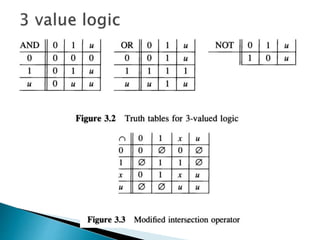
 In Sequential circuit, initialization is required.
 To process the unknown initial state
simulation algorithm uses unknown logic
value ‘u’={0,1}
Also process
control events
such as :
• Display values of
certain signals
• Checks expected
values
 Every gate adds delay to the signal
propagating through it.

 Delay from changes in input to the output response to the
input change.
 The minimum duration in input change necessary for output
to switch the state is called input inertial delay (dI )
 The output inertial delay model specifies that the gate output
can not generate a pulse with duration less than dI.
 Static Hazards:
 Let Q=1, A changes from 0 to 1, B changes
from 1 to 0 in given circuit.
 For short interval
 A=B=1 causes
 Short pulse at Z as
 Momentarily reset
 the latch to ‘0’
 Causes Static Hazard
23
 Fault simulation Problem:
Given
 A circuit
 A sequence of test vectors
 A fault model
Determine
 Fault coverage - fraction (or percentage) of modeled faults
detected by test vectors
 Set of undetected faults
 Motivation
 Determine test quality and in turn product quality
 Find undetected fault targets to improve tests
24
Verified design
netlist
Verification
input stimuli
Fault simulator Test vectors
Modeled
fault list
Test
generator
Test
compactor
Fault
coverage
?
Remove
tested faults
Delete
vectors
Add vectors
Low
Adequate
Stop
25
 Circuit model: mixed-level
 Mostly logic with some switch-level for high-impedance
(Z) and bidirectional signals
 High-level models (memory, etc.) with pin faults
 Signal states: logic
 Two (0, 1) or three (0, 1, X) states for purely Boolean logic
circuits
 Four states (0, 1, X, Z) for sequential MOS circuits
 Timing:
 Zero-delay for combinational and synchronous circuits
 Mostly unit-delay for circuits with feedback
26
 Faults:
 Mostly single stuck-at faults
 Sometimes stuck-open, transition, and path-delay faults;
analog circuit fault simulators are not yet in common use
 Equivalence fault collapsing of single stuck-at faults
 Fault-dropping -- a fault once detected is dropped from
consideration as more vectors are simulated; fault-
dropping may be suppressed for diagnosis
 Fault sampling -- a random sample of faults is simulated
when the circuit is large
VLSI Testing : Logic Simulation Part 1.pptx

VLSI Testing : Logic Simulation Part 1.pptx

  • 1.
    Pg. No. 39to 64 M.Abramovici, M.A. Breuer, A.D. Friedman, “Digital systems testing and testable design”, Jaico Publishing House.
  • 2.
     It isa form of design verification testing that uses a model of the system.
  • 3.
     Logic simulationis used to verify operation of the system is:  Other applications of simulation in the design process are:
  • 4.
     Simulation replacesprototypes with software model with advantages as :
  • 5.
     Problems inSimulation Based Design Verification
  • 6.
     Compiled drivensimulation : ◦ It executes a complied code model ◦ Compiled code is generated by RTL or Functional programming. ◦ It is mainly oriented towards functional verification ◦ It is not concerned with the timing of the circuit.  Event Driven Simulation : ◦ Applicable to asynchronous circuits ◦ Consider timing verification as it is event based. ◦ Can process real time inputs.
  • 8.
     In Sequentialcircuit, initialization is required.  To process the unknown initial state simulation algorithm uses unknown logic value ‘u’={0,1}
  • 14.
    Also process control events suchas : • Display values of certain signals • Checks expected values
  • 15.
     Every gateadds delay to the signal propagating through it. 
  • 16.
     Delay fromchanges in input to the output response to the input change.
  • 17.
     The minimumduration in input change necessary for output to switch the state is called input inertial delay (dI )  The output inertial delay model specifies that the gate output can not generate a pulse with duration less than dI.
  • 18.
     Static Hazards: Let Q=1, A changes from 0 to 1, B changes from 1 to 0 in given circuit.  For short interval  A=B=1 causes  Short pulse at Z as  Momentarily reset  the latch to ‘0’  Causes Static Hazard
  • 23.
    23  Fault simulationProblem: Given  A circuit  A sequence of test vectors  A fault model Determine  Fault coverage - fraction (or percentage) of modeled faults detected by test vectors  Set of undetected faults  Motivation  Determine test quality and in turn product quality  Find undetected fault targets to improve tests
  • 24.
    24 Verified design netlist Verification input stimuli Faultsimulator Test vectors Modeled fault list Test generator Test compactor Fault coverage ? Remove tested faults Delete vectors Add vectors Low Adequate Stop
  • 25.
    25  Circuit model:mixed-level  Mostly logic with some switch-level for high-impedance (Z) and bidirectional signals  High-level models (memory, etc.) with pin faults  Signal states: logic  Two (0, 1) or three (0, 1, X) states for purely Boolean logic circuits  Four states (0, 1, X, Z) for sequential MOS circuits  Timing:  Zero-delay for combinational and synchronous circuits  Mostly unit-delay for circuits with feedback
  • 26.
    26  Faults:  Mostlysingle stuck-at faults  Sometimes stuck-open, transition, and path-delay faults; analog circuit fault simulators are not yet in common use  Equivalence fault collapsing of single stuck-at faults  Fault-dropping -- a fault once detected is dropped from consideration as more vectors are simulated; fault- dropping may be suppressed for diagnosis  Fault sampling -- a random sample of faults is simulated when the circuit is large