MODULE IV
Digital signal processor: Digital signal processor and its design
issues, evolving architecture of DSP, next generation DSP.
Customizable processors: Customizable
processors and processor customization, A
benefit analysis of processor customization,
use of microprocessor cores in SOC design,
benefits of microprocessor extensibility.
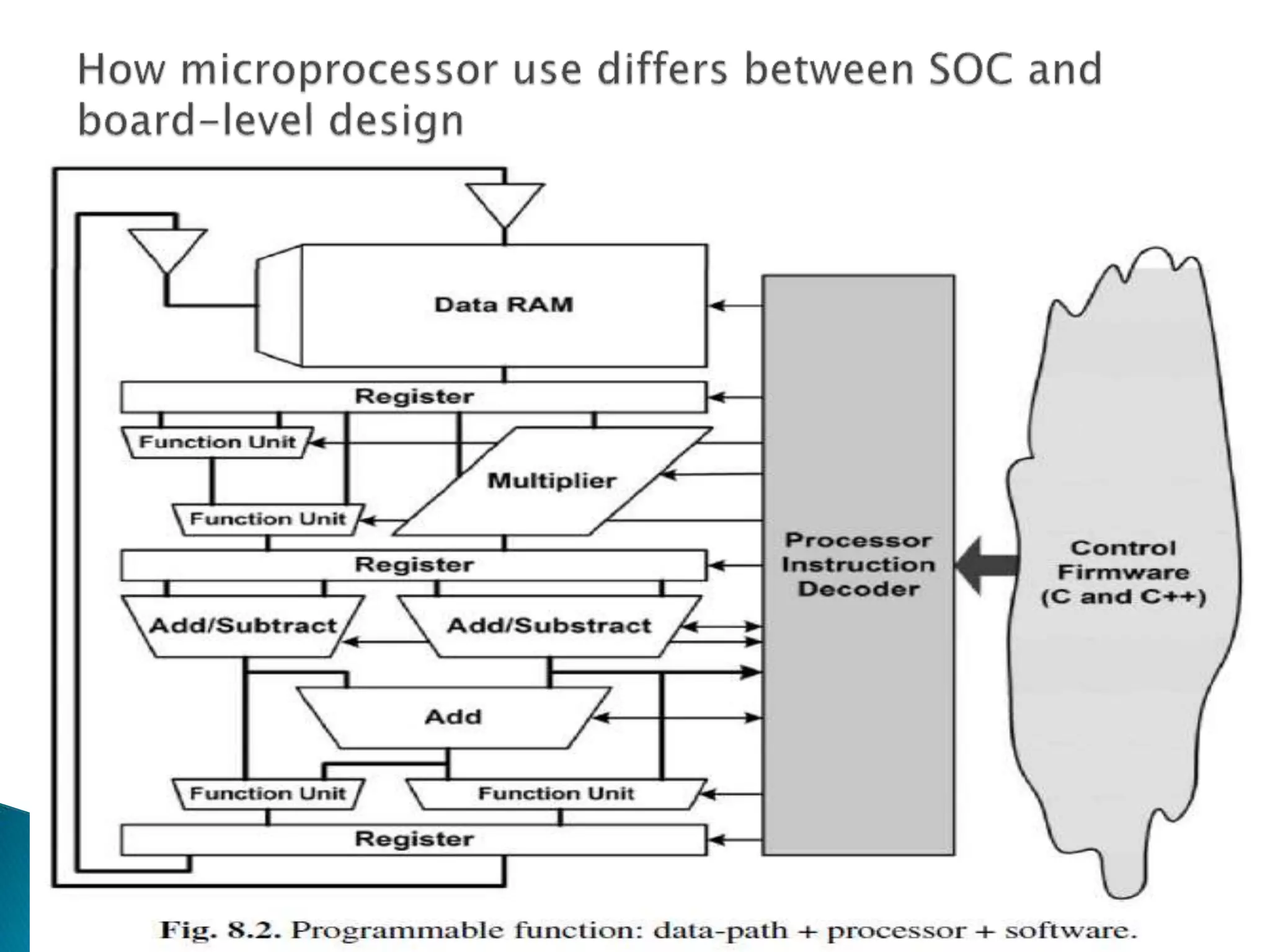
 Customized processors incorporate task-specific
registers and task-specific hardware acceleration in
the processor’s execution pipeline instead of
employing accelerators external to the processor.
 This move brings the acceleration hardware into
intimate contact with the processor’s registers,
register files, memory-management hardware, and
memory interfaces.
 Which greatly improves the efficiency and throughput
of data movement into and out of the accelerators.
 The added task-specific hardware greatly improves
the processor’s efficiency (measured in clock count)
on the task’s computations.
 Design effort:
◦ Silicon capacity and design-automation tools:
 Past, 100K gates to Blocks of 500K gates
 Recently, many millions of gates
 Verification difficulty:
◦ internal complexity of a typical logic block
◦ 90% of development effort on verification
 Cost of fixing bugs:
◦ The cost of fixing an SOC design bug is rising.
◦ Higher staff costs caused by growing design teams,
bigger NRE fees, and lost profitability and market
share make show-stopper design bugs intolerable.
 Late hardware/software integration:
◦ overall program delays
 Complexity and change in standards:
◦ Standard communication protocols are growing
rapidly in complexity.
 To develop system designs with
significantly fewer resources by making it
much easier to design the chips in those
systems
 Making SOCs sufficiently flexible so every
new system design doesn’t require a new
SOC design.
 Solution : Using microprocessor cores in
SOC design
◦ Single processor challenges
◦ Preferable Multi core
 A fully featured configurable and extensible
processor consists of a processor design and
a design-tool environment.
 Adding major processor functions, thus
tuning the processor core to specific
application requirements is possible.
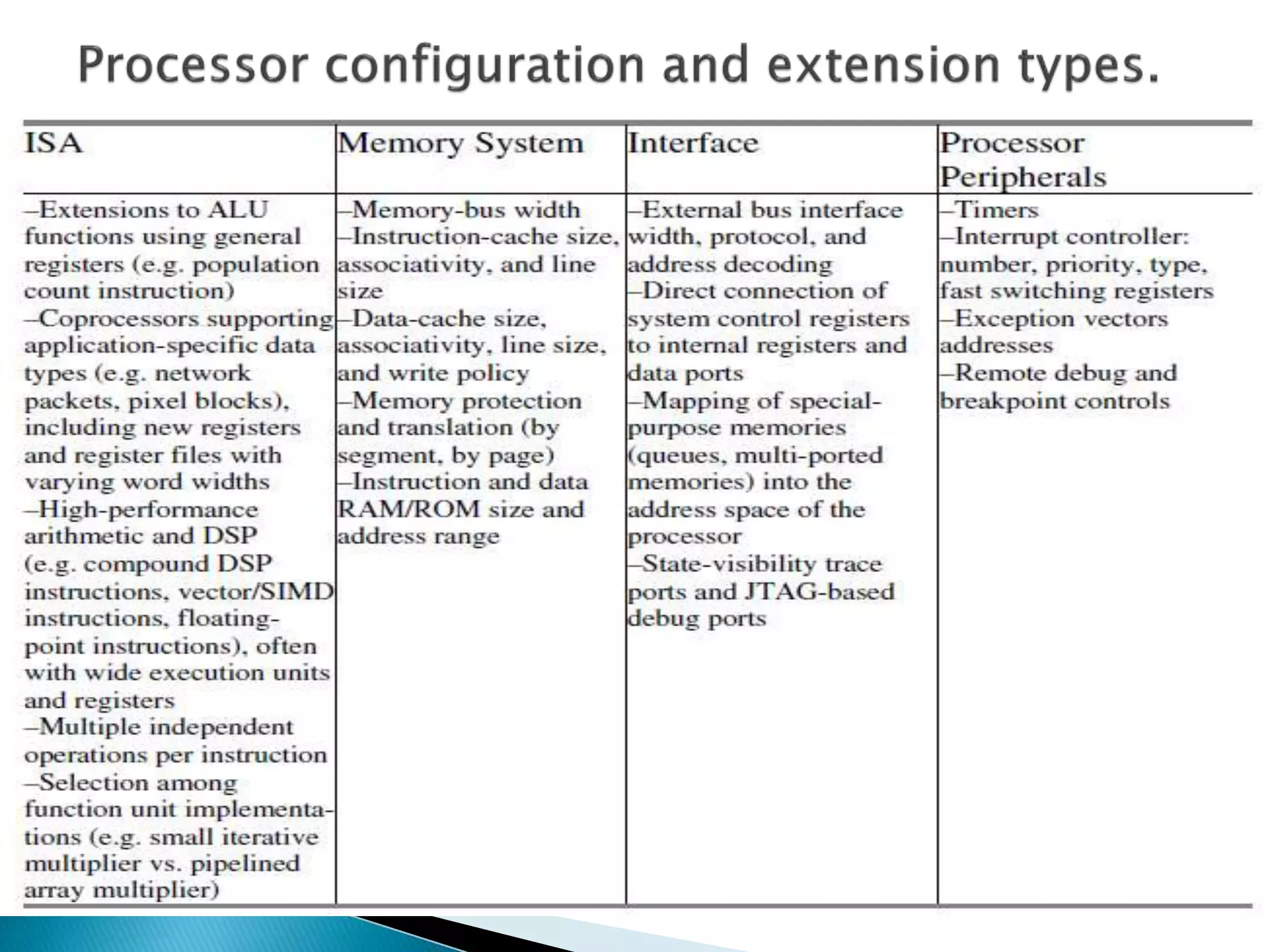
 Extensible processor
 Additions, deletions, and modifications to
memories,
 To external bus widths and handshake
protocols, and
 To commonly used processor peripherals.
 Changing the processor’s instruction set,
memories and interfaces can significantly
improve the core’s efficiency and
performance, particularly for the data-
intensive applications
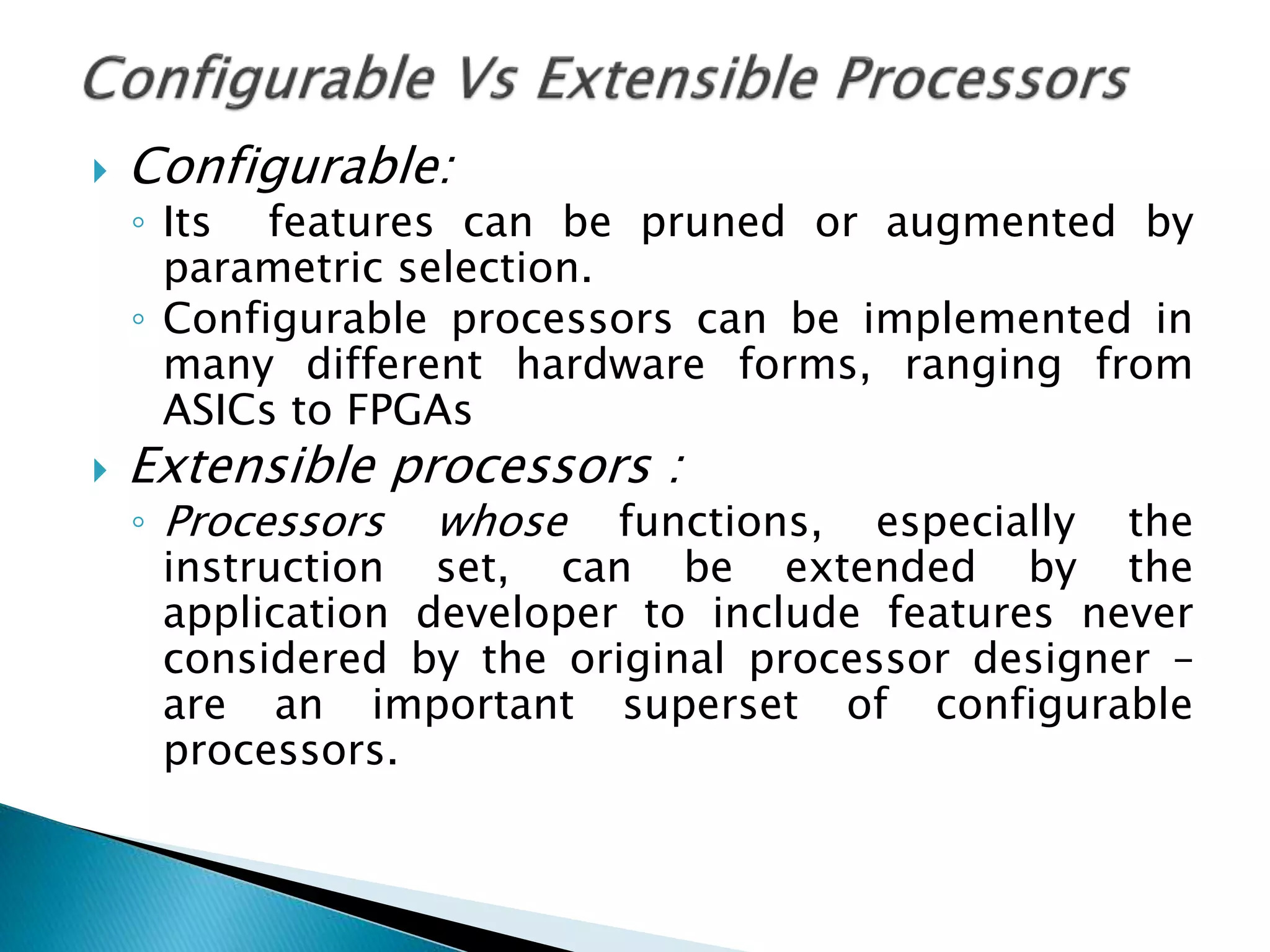
 Configurable:
◦ Its features can be pruned or augmented by
parametric selection.
◦ Configurable processors can be implemented in
many different hardware forms, ranging from
ASICs to FPGAs
 Extensible processors :
◦ Processors whose functions, especially the
instruction set, can be extended by the
application developer to include features never
considered by the original processor designer –
are an important superset of configurable
processors.
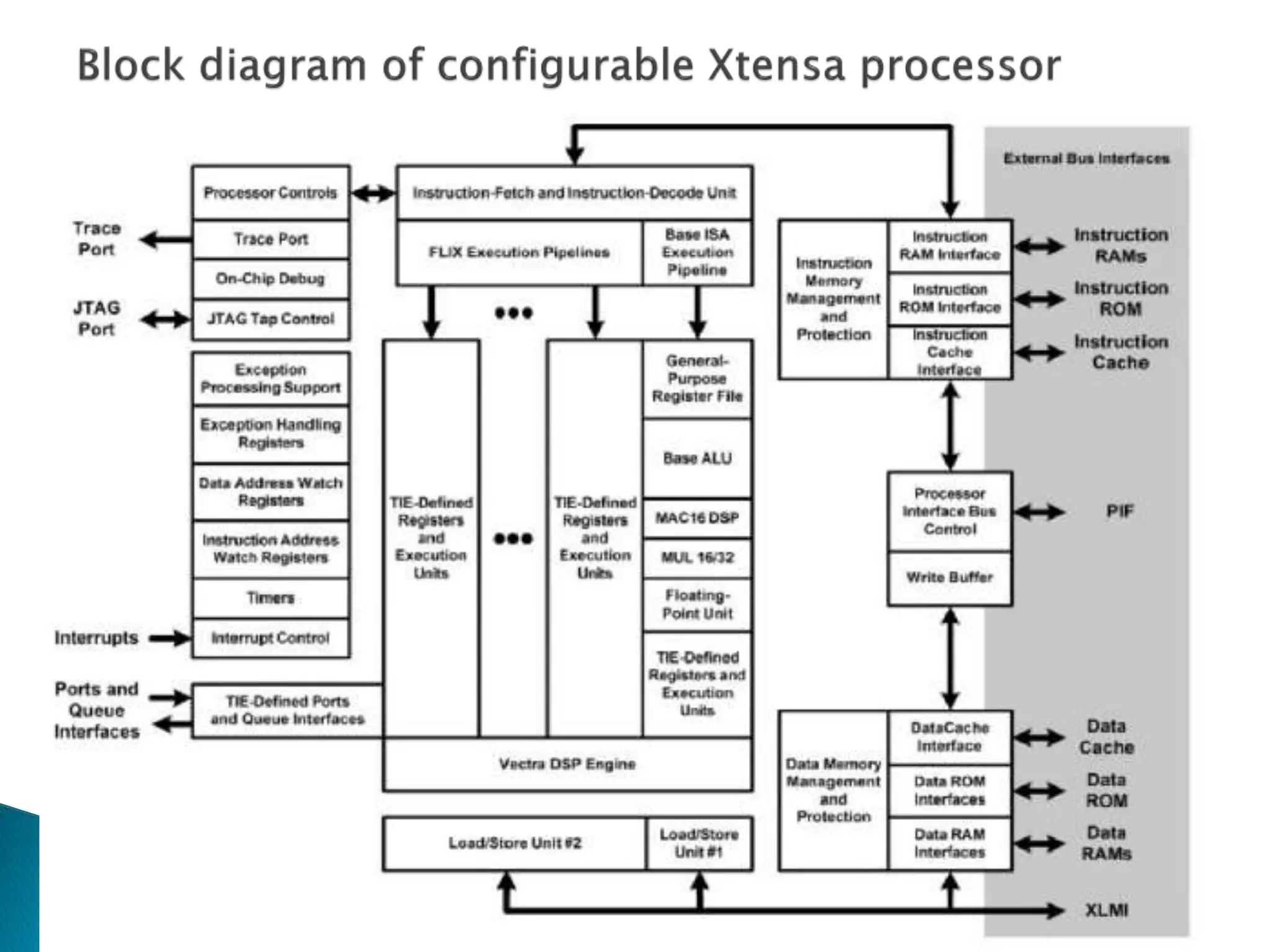
 Contents of architecture
◦ baseline ISA features,
◦ scalable register files,
◦ memories and interfaces,
◦ optional and configurable processor peripherals,
◦ selectable DSP coprocessors,
◦ and facilities to integrate user defined
◦ instruction-set extensions.
 The design migration from hardwired state
machine to firmware program control has
important implications:
◦ Flexibility: Chip developers, system builders, and end-
users (when appropriate) can change the block’s
function just by changing the firmware. The need for
silicon re spins is greatly reduced.
◦ Firmware-based development: Developers can use
sophisticated, low cost software-development methods
for implementing most chip features.
◦ Faster, more complete system modeling: RTL simulation
is slow.
 Unification of control and data: No modern system
consists solely of hardwired logic. There is always a
processor and some software. Moving functions previously
handled by RTL into a processor removes the artificial
distinction between control and data processing.
 Time-to-market: Moving critical functions from RTL to
application specific processors simplifies the SOC design,
accelerates system modeling, and pulls in finalization of
hardware. Firmware-based state machines easily
accommodate changes to standards.
 Designer productivity: Most importantly, migration from
RTL-based design to the use of application-specific
processor cores

Lect4_ customizable.pptx

  • 1.
    MODULE IV Digital signalprocessor: Digital signal processor and its design issues, evolving architecture of DSP, next generation DSP. Customizable processors: Customizable processors and processor customization, A benefit analysis of processor customization, use of microprocessor cores in SOC design, benefits of microprocessor extensibility.
  • 2.
     Customized processorsincorporate task-specific registers and task-specific hardware acceleration in the processor’s execution pipeline instead of employing accelerators external to the processor.  This move brings the acceleration hardware into intimate contact with the processor’s registers, register files, memory-management hardware, and memory interfaces.  Which greatly improves the efficiency and throughput of data movement into and out of the accelerators.  The added task-specific hardware greatly improves the processor’s efficiency (measured in clock count) on the task’s computations.
  • 3.
     Design effort: ◦Silicon capacity and design-automation tools:  Past, 100K gates to Blocks of 500K gates  Recently, many millions of gates  Verification difficulty: ◦ internal complexity of a typical logic block ◦ 90% of development effort on verification
  • 4.
     Cost offixing bugs: ◦ The cost of fixing an SOC design bug is rising. ◦ Higher staff costs caused by growing design teams, bigger NRE fees, and lost profitability and market share make show-stopper design bugs intolerable.
  • 5.
     Late hardware/softwareintegration: ◦ overall program delays  Complexity and change in standards: ◦ Standard communication protocols are growing rapidly in complexity.
  • 6.
     To developsystem designs with significantly fewer resources by making it much easier to design the chips in those systems  Making SOCs sufficiently flexible so every new system design doesn’t require a new SOC design.  Solution : Using microprocessor cores in SOC design ◦ Single processor challenges ◦ Preferable Multi core
  • 7.
     A fullyfeatured configurable and extensible processor consists of a processor design and a design-tool environment.  Adding major processor functions, thus tuning the processor core to specific application requirements is possible.
  • 8.
     Extensible processor Additions, deletions, and modifications to memories,  To external bus widths and handshake protocols, and  To commonly used processor peripherals.  Changing the processor’s instruction set, memories and interfaces can significantly improve the core’s efficiency and performance, particularly for the data- intensive applications
  • 9.
     Configurable: ◦ Itsfeatures can be pruned or augmented by parametric selection. ◦ Configurable processors can be implemented in many different hardware forms, ranging from ASICs to FPGAs  Extensible processors : ◦ Processors whose functions, especially the instruction set, can be extended by the application developer to include features never considered by the original processor designer – are an important superset of configurable processors.
  • 12.
     Contents ofarchitecture ◦ baseline ISA features, ◦ scalable register files, ◦ memories and interfaces, ◦ optional and configurable processor peripherals, ◦ selectable DSP coprocessors, ◦ and facilities to integrate user defined ◦ instruction-set extensions.
  • 14.
     The designmigration from hardwired state machine to firmware program control has important implications: ◦ Flexibility: Chip developers, system builders, and end- users (when appropriate) can change the block’s function just by changing the firmware. The need for silicon re spins is greatly reduced. ◦ Firmware-based development: Developers can use sophisticated, low cost software-development methods for implementing most chip features. ◦ Faster, more complete system modeling: RTL simulation is slow.
  • 15.
     Unification ofcontrol and data: No modern system consists solely of hardwired logic. There is always a processor and some software. Moving functions previously handled by RTL into a processor removes the artificial distinction between control and data processing.  Time-to-market: Moving critical functions from RTL to application specific processors simplifies the SOC design, accelerates system modeling, and pulls in finalization of hardware. Firmware-based state machines easily accommodate changes to standards.  Designer productivity: Most importantly, migration from RTL-based design to the use of application-specific processor cores