VITILIGO
- CLINICAL CLASSIFICATION -


               George-Sorin Ţiplica
                Colentina Clinical Hospital
                     Bucharest, Romania
Gregor Johann Mendel


   1822 – 1884
   Czech-German Augustinian
    monk and scientist
   Studied the inheritance of
    certain traits in pea plants
   Founder of genetics
Why classifications are useful?
   Prognosis evaluation

   Treatment options

   Clinical studies, meta-analysis

   Reimbursment, DRG system
Classification: general considerations
   Classification   system   A
   Classification   system   B
   Classification   system   C
   Classification   system   D


                        Validation by
                         Patho-mechanism
                         Treatment
                         Evolution / prognosis


                                  Classification system B
Clinical classification
   What can be observed?
       Objective criteria
            Disease distribution
            Speed of spreading
            Lesion aspect (shape, dimension, color)
       Subjective criteria
            Symptoms
            Quality of life


   Who can observe?
       General practitioner / dermatologist
       Patient
       Computer
Clinical classification: vitiligo
   There is a current lack of consensus in definition and assessment
    methods which makes difficult any classification

   Initial site involvement does not predict future evolution,
    localisation and activity of the disease

   Many attempts to classify the disease

   Several subtypes of vitiligo

   Based on the distribution of lesions
Vitiligo - classification
    Non-segmental vitiligo (type A)
         most common subtype
         widespread macules often symmetrically placed
         frequently involves acral areas, skin surrounding body
          orifices and extensor surfaces


    Segmental vitiligo (type B)
         dermatomal or blaschkolinear distribution


Koga M. Vitiligo: a new classification and therapy. Br J Dermatol. 1977 Sep;97(3):255-61.
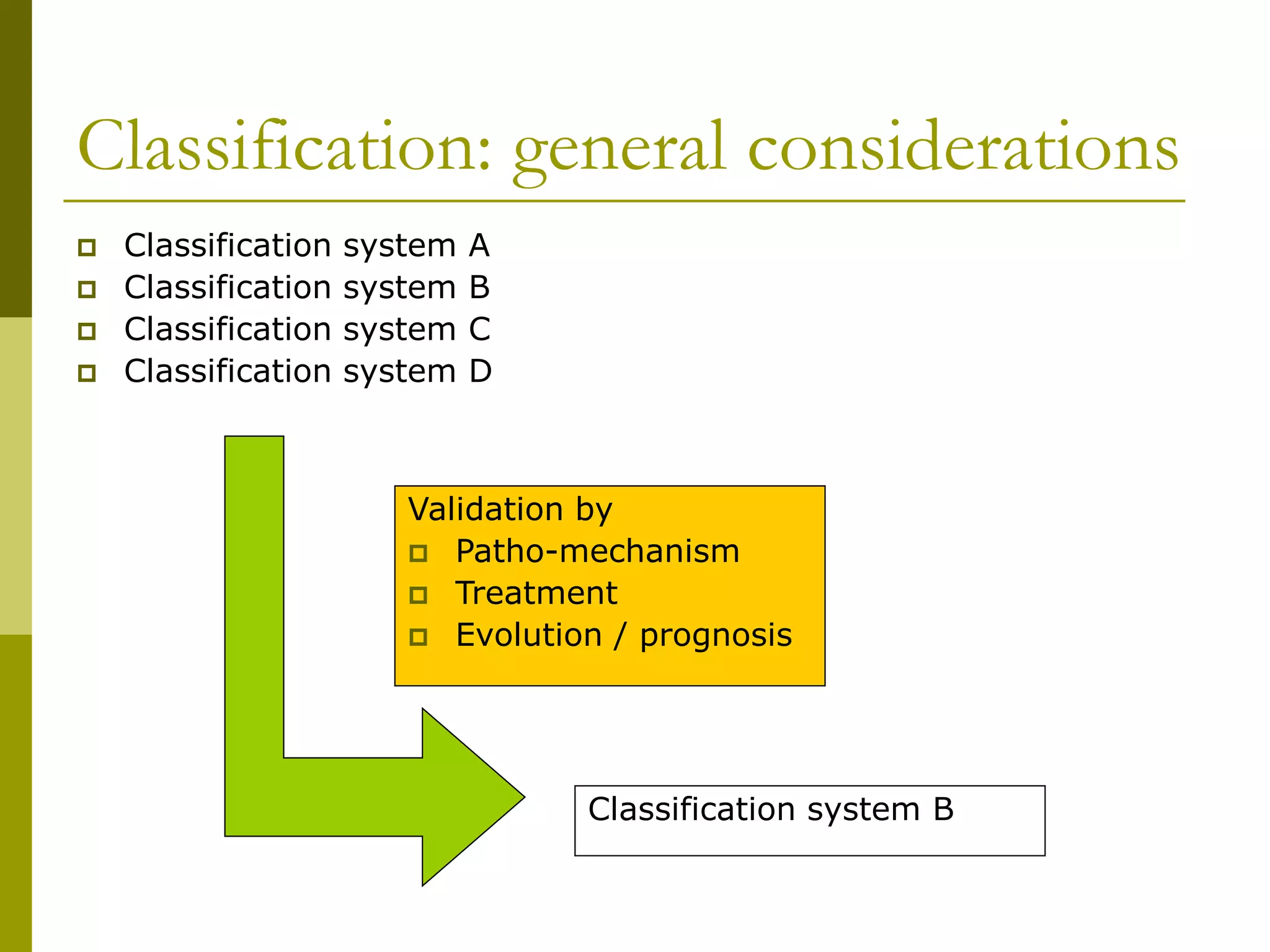
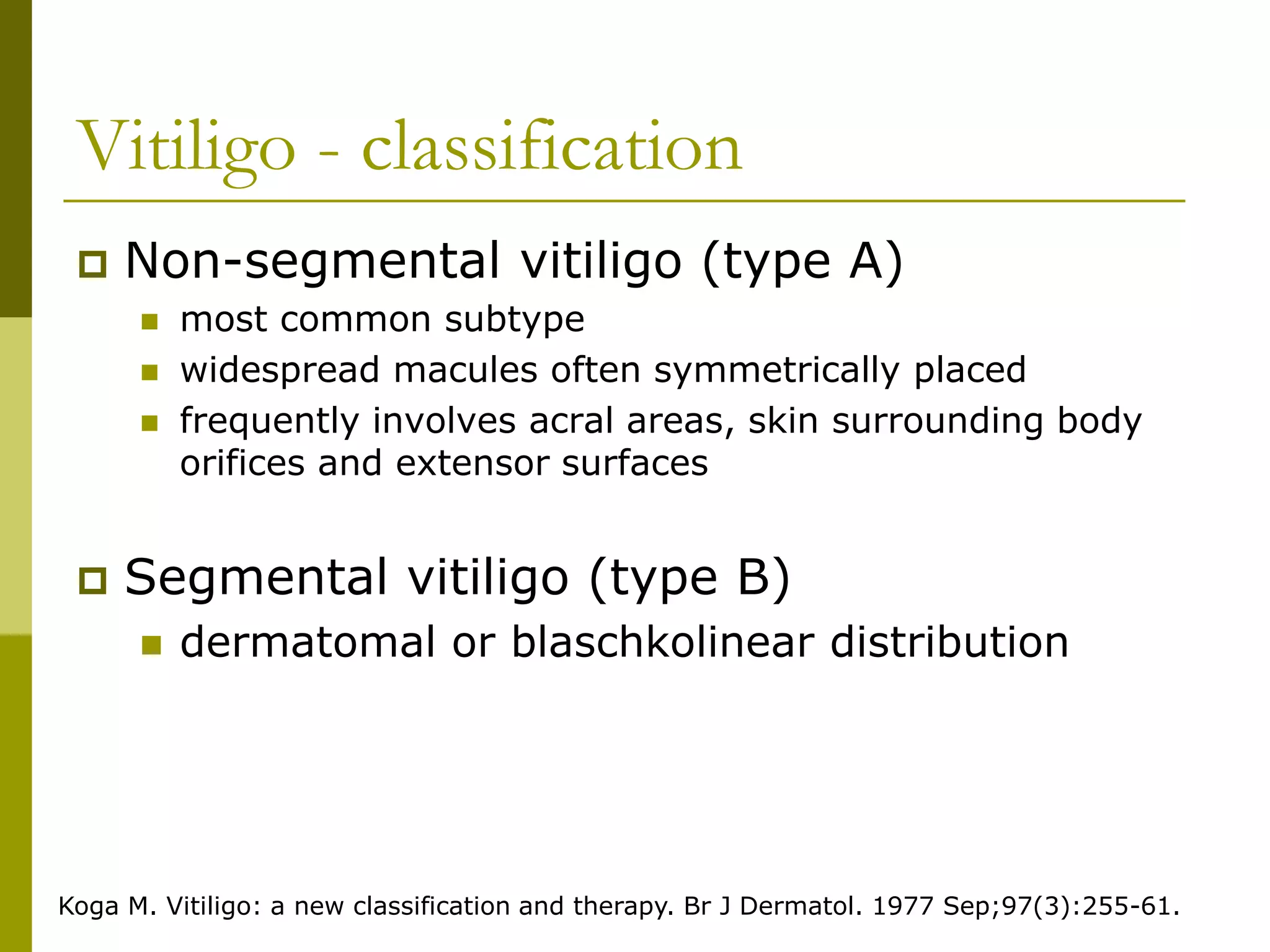
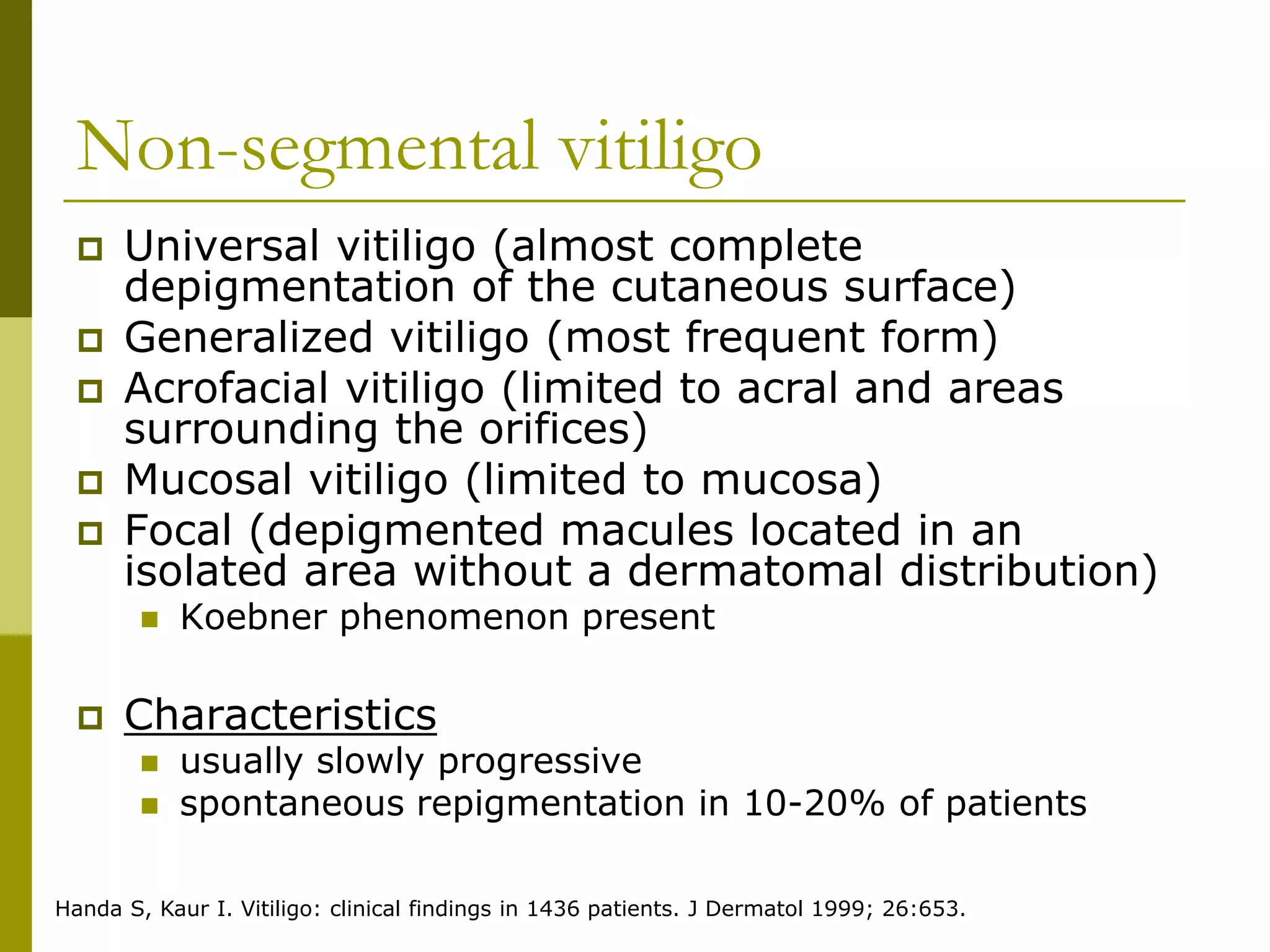
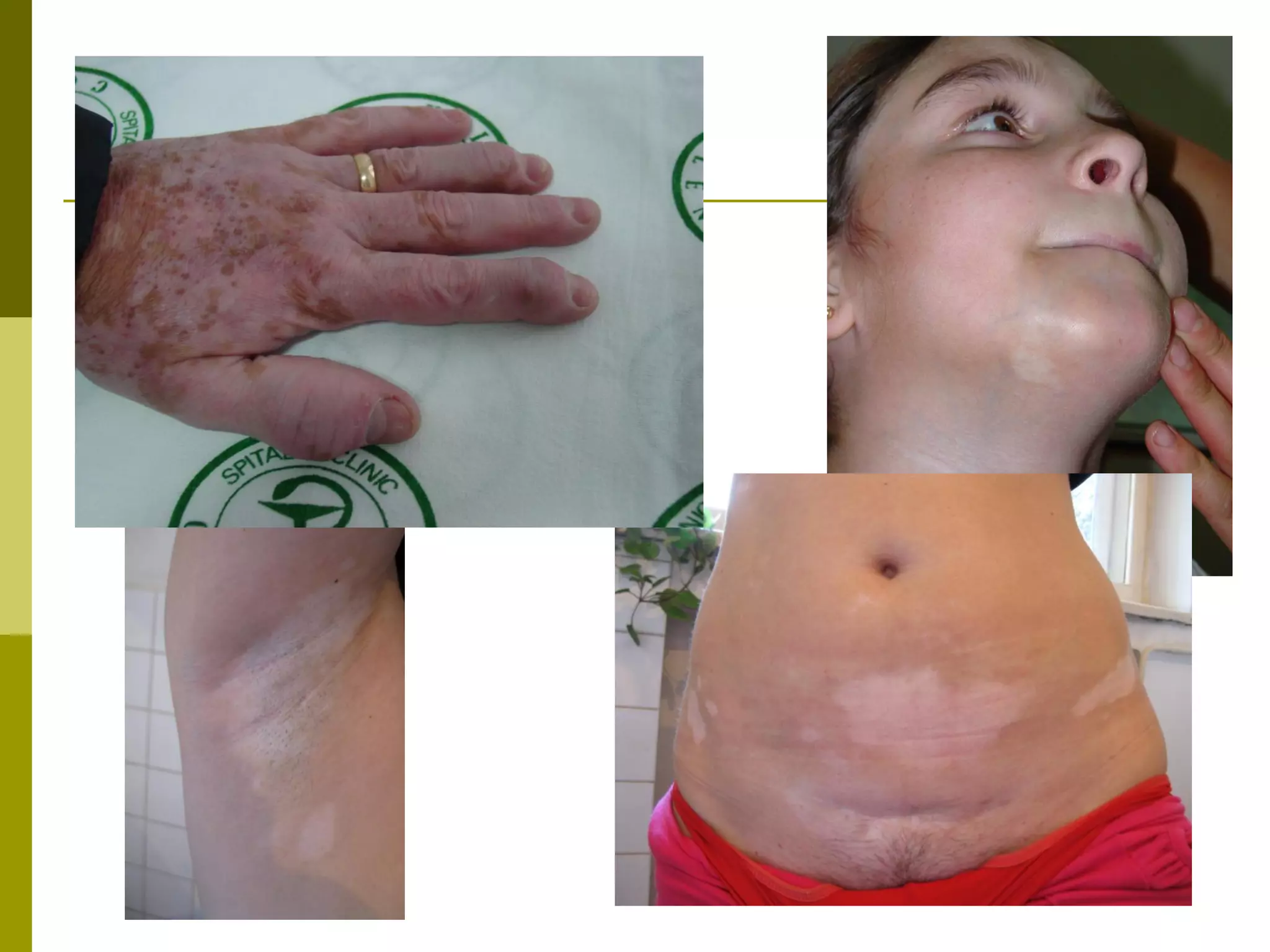
Non-segmental vitiligo
     Universal vitiligo (almost complete
      depigmentation of the cutaneous surface)
     Generalized vitiligo (most frequent form)
     Acrofacial vitiligo (limited to acral and areas
      surrounding the orifices)
     Mucosal vitiligo (limited to mucosa)
     Focal (depigmented macules located in an
      isolated area without a dermatomal distribution)
           Koebner phenomenon present

     Characteristics
           usually slowly progressive
           spontaneous repigmentation in 10-20% of patients

Handa S, Kaur I. Vitiligo: clinical findings in 1436 patients. J Dermatol 1999; 26:653.
Clinical classification


        FOCAL                    GENERALIZED

                            - most common pattern
Most common distribution:
                            - symmetrical distribution
-trigemminal nerve
-neck
-trunck


                                                 Bologna JL, Jorizzo J, Rapini R. Dermatology, 2nd Ed, 2008, p 913-920
                                         Fitzpatrick’s Dermatology in Internal Medicine, 7th Ed. 2008, vol 2, p 616-621
Associated diseases
        Autoimmune origin:
               Thyroid disease (hyperthyroidism, hypothyroidism)
               Addison’s disease
               Pernicious anemia
               Alopecia aerata
               Diabetes mellitus
               Myasthenia gravis
               Halo nevus
               Malignant melanoma


Bologna JL, Jorizzo J, Rapini R. Dermatology, 2nd Ed, 2008, p 913-920
Fitzpatrick’s Dermatology in Internal Medicine, 7th Ed. 2008, vol 2, p 616-621
Burns T, Breathnach S, Cox N, Griffiths C. Rook’s Textbook of Dermatology, 8th Ed, 2010, vol 3, p 58.46-58.49
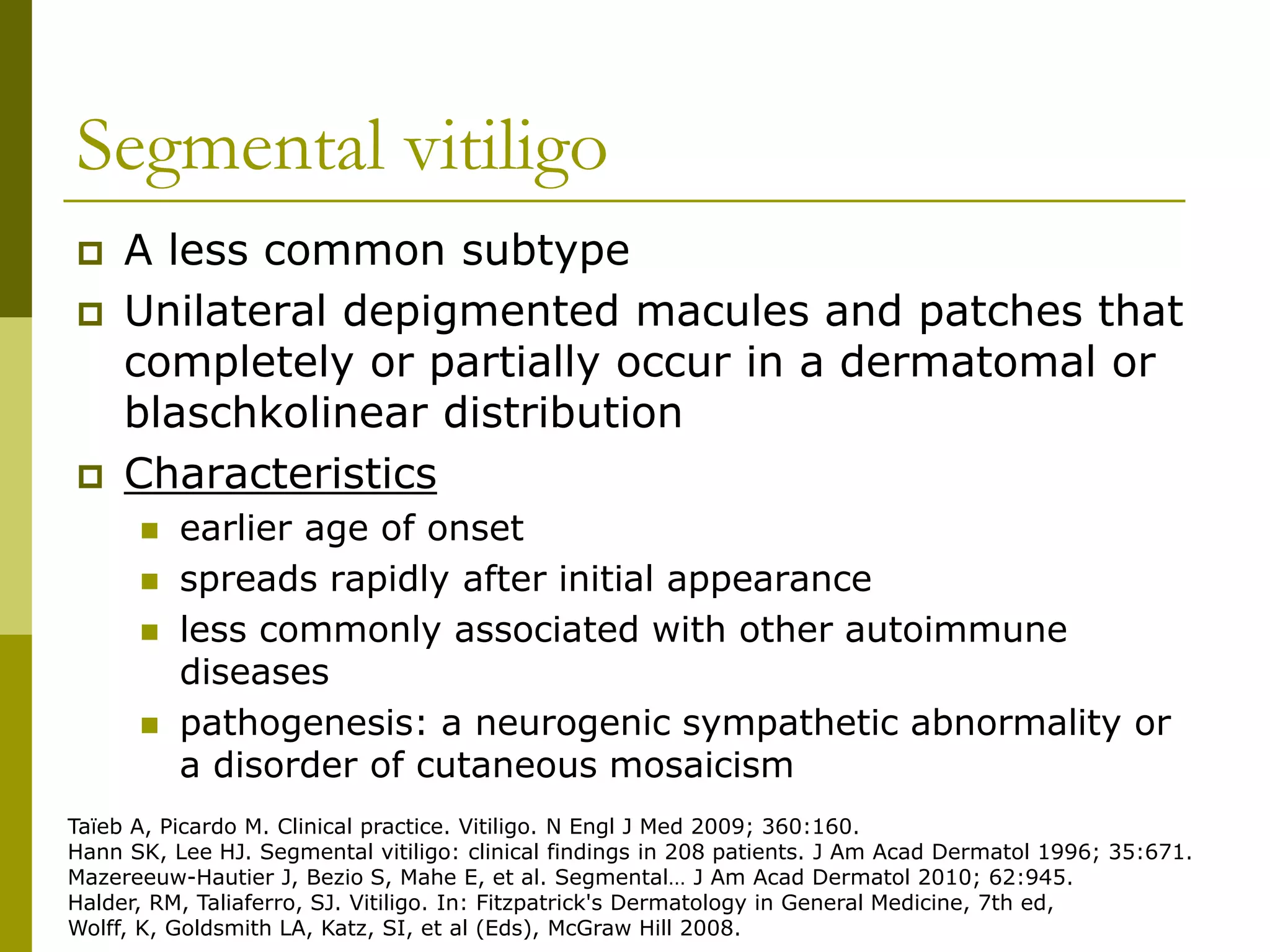
Segmental vitiligo
    A less common subtype
    Unilateral depigmented macules and patches that
     completely or partially occur in a dermatomal or
     blaschkolinear distribution
    Characteristics
         earlier age of onset
         spreads rapidly after initial appearance
         less commonly associated with other autoimmune
          diseases
         pathogenesis: a neurogenic sympathetic abnormality or
          a disorder of cutaneous mosaicism
Taïeb A, Picardo M. Clinical practice. Vitiligo. N Engl J Med 2009; 360:160.
Hann SK, Lee HJ. Segmental vitiligo: clinical findings in 208 patients. J Am Acad Dermatol 1996; 35:671.
Mazereeuw-Hautier J, Bezio S, Mahe E, et al. Segmental… J Am Acad Dermatol 2010; 62:945.
Halder, RM, Taliaferro, SJ. Vitiligo. In: Fitzpatrick's Dermatology in General Medicine, 7th ed,
Wolff, K, Goldsmith LA, Katz, SI, et al (Eds), McGraw Hill 2008.
Clinical classification


                                                    MIXED FORM
          SEGMENTAL                                 – combines segmental,
- does not cross the middle line                    acrofacial and/or
-usually in children                                generalized distribution


                                           Bologna JL, Jorizzo J, Rapini R. Dermatology, 2nd Ed, 2008, p 913-920
                                   Fitzpatrick’s Dermatology in Internal Medicine, 7th Ed. 2008, vol 2, p 616-621
Facial segmental vitiligo
    Not always correspond to dermatomal
     distribution
    Facial SV classification (based on morphological
     similarities in numerous clinical observations)
          Type I-a:mid-level face from the forehead to the lower
           cheek (28,8%)
          Type I-b: forehead and scalp hair
          Type II: lower face and the neck area (16%)
          Type III: lower face and the neck area (14,4%)
          Type IV: mid-level face from the forehead to the lower
           cheek, but selectively appeared on the right side of the
           face and did not cross the midline
          Type V: lesions were distributed mostly around the right
           orbital area

Kim, D.-Y., Oh, S. H., Hann, S.-K. Classification of segmental vitiligo on the face: clues for prognosis.
British Journal of Dermatology; May2011, Vol. 164 Issue 5, p1004-1009.
Clinical variants of vitiligo
        Trichrome vitiligo
           Both depigmented and hypopigmented macules
           Hypopigmented macules become depigmented over time


        Qvadrichrome vitiligo
           Also associates marginal and perifollicular hyperpigmentation
           Darker skin types
           More often in areas of repigmentation


        Pentachrome vitiligo (vary rare)
           Blue-gray hyperpigmentation (dermal melanine incontinence, areas affected by
             postinflammatory hyperpigmentation in which vitiligo develops)

        Confetti type (vitiligo ponctue)
           Very numerous small, discrete hypopigmented macules


        Inflammatory vitiligo
           Erythema of the margins


Bologna JL, Jorizzo J, Rapini R. Dermatology, 2nd Ed, 2008, p 913-920
Fitzpatrick’s Dermatology in Internal Medicine, 7th Ed. 2008, vol 2, p 616-621
Rare syndromes
        Vogt-Koyanagi-Harada Syndrome
               Vitiligo and uveitis, aseptic meningitis, dysacusis, tinnitus,
                poliosis, alopecia
               T-cell mediated autoimmune disease
               Associated with other autoimmune disorders


        Alezzandrini Syndrome
               Facial vitiligo and poliosis, deafness, unilateral retinal
                degeneration


Fitzpatrick’s Dermatology in Internal Medicine, 7th Ed. 2008, vol 2, p 616-621
Vitiligo in children
        very rarely at birth

        descending order of frequency:
               generalized
               focal
               segmental
               acrofacial
               mucosal
               universal


        Halo nevus present – search for vitiligo


Paller A, Mancini A. Hurwitz Clinical Pediatric dermatology, 3rd Ed, 2006, p 226-229
Differential Diagnosis
        According to site

               Face: tinea, pityriasis versicolor, pityriasis alba, post-
                inflammatory hypopigmentation, chemical leucoderma,
                sarcoidosis, piebaldism, hypopigmentation after cosmetic
                procedures

               Hands: chemical leucoderma, scleroderma

               Trunk: scleroderma, pityriasis versicolor, tuberous sclerosis

               Anogenital: lichen sclerosus, lichen atrophicus


Bologna JL, Jorizzo J, Rapini R. Dermatology, 2nd Ed, 2008, p 913-920
Fitzpatrick’s Dermatology in Internal Medicine, 7th Ed. 2008, vol 2, p 616-621
Burns T, Breathnach S, Cox N, Griffiths C. Rook’s Textbook of Dermatology, 8th Ed, 2010, vol 3, p 58.46-58.49
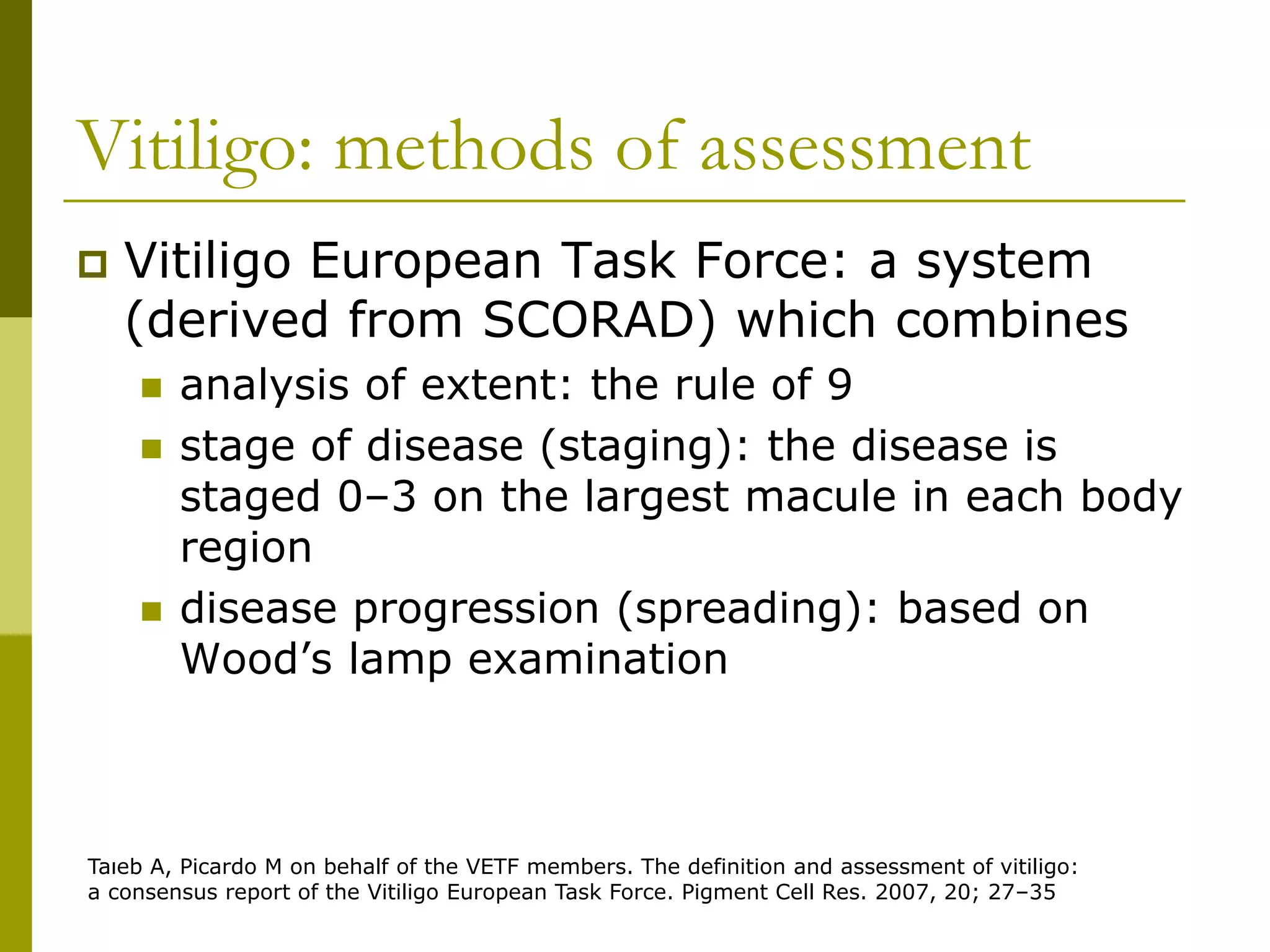
Vitiligo: methods of assessment
   Vitiligo European Task Force: a system
    (derived from SCORAD) which combines
       analysis of extent: the rule of 9
       stage of disease (staging): the disease is
        staged 0–3 on the largest macule in each body
        region
       disease progression (spreading): based on
        Wood’s lamp examination


Taıeb A, Picardo M on behalf of the VETF members. The definition and assessment of vitiligo:
a consensus report of the Vitiligo European Task Force. Pigment Cell Res. 2007, 20; 27–35
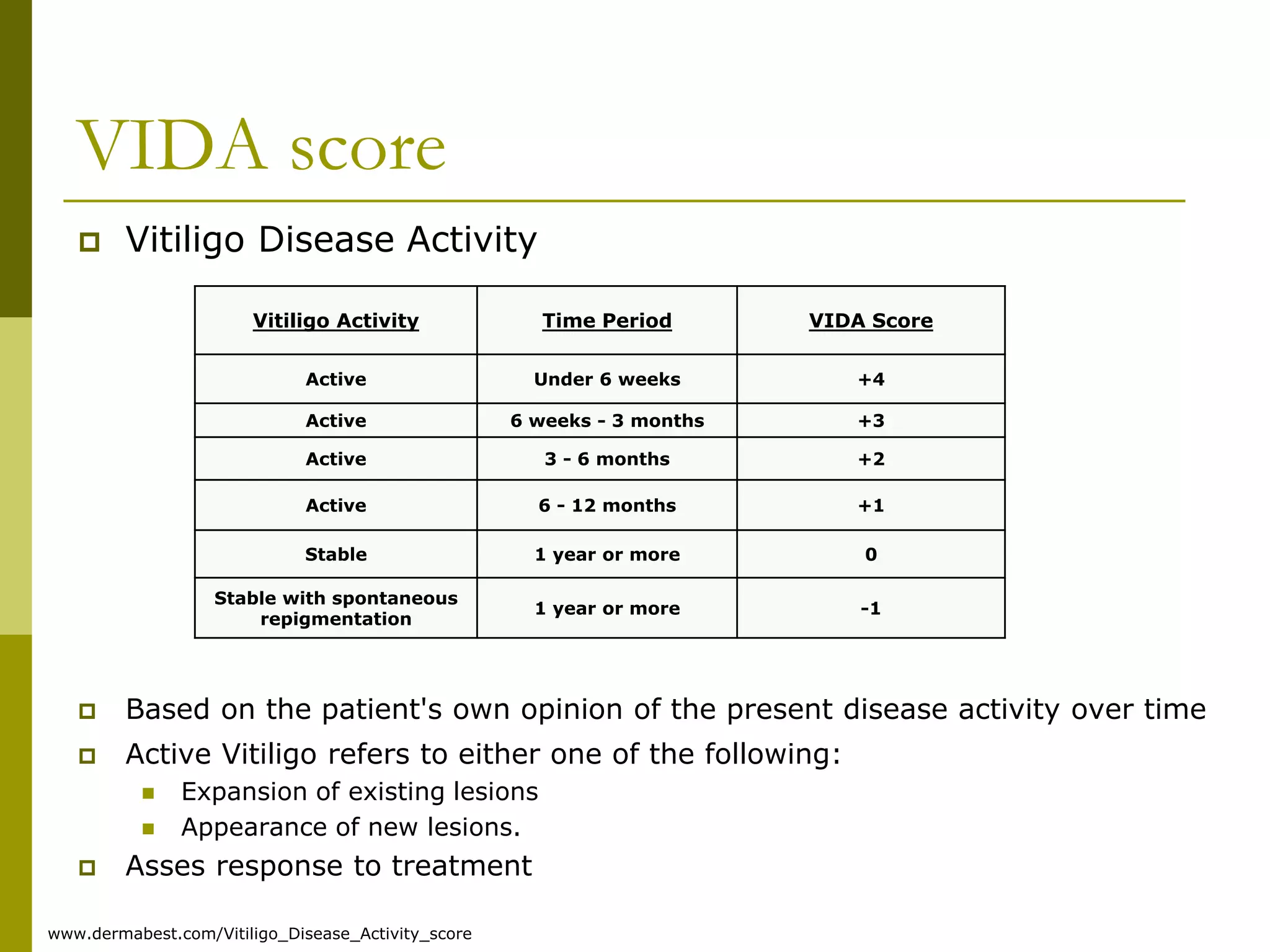
VIDA score
       Vitiligo Disease Activity

                       Vitiligo Activity              Time Period        VIDA Score

                             Active                   Under 6 weeks         +4

                             Active                 6 weeks - 3 months      +3

                             Active                    3 - 6 months         +2

                             Active                   6 - 12 months         +1

                             Stable                   1 year or more         0

                   Stable with spontaneous
                                                      1 year or more         -1
                       repigmentation


       Based on the patient's own opinion of the present disease activity over time
       Active Vitiligo refers to either one of the following:
              Expansion of existing lesions
              Appearance of new lesions.
       Asses response to treatment

www.dermabest.com/Vitiligo_Disease_Activity_score
VASI
   Introduced by Hamzavi et al. in 2004
   A quantitative parametric score
   Derived from the PASI (psoriasis area and severity
    index) score widely used for psoriasis (Fredriksson
    and Pettersson, 1978)

   VASI regions
       hands, upper extremities (excluding hands), trunk, lower
        extremities (excluding the feet) and feet
       the face and neck areas are assessed separately
   VASI = S    (all body sites)(hand   units)·(depigmentation)
Conclusions
   At the moment, impossible to predict future
    evolution, localisation and activity of the disease

   Lack of consensus vitiligo classification and
    assessment methods

   Based on pathogenesis
       Non-segmental vitiligo
       Segmental vitiligo
Thank you!

Vitiligo - clinical classification by Dr. George Tiplica

  • 1.
    VITILIGO - CLINICAL CLASSIFICATION- George-Sorin Ţiplica Colentina Clinical Hospital Bucharest, Romania
  • 2.
    Gregor Johann Mendel  1822 – 1884  Czech-German Augustinian monk and scientist  Studied the inheritance of certain traits in pea plants  Founder of genetics
  • 3.
    Why classifications areuseful?  Prognosis evaluation  Treatment options  Clinical studies, meta-analysis  Reimbursment, DRG system
  • 4.
    Classification: general considerations  Classification system A  Classification system B  Classification system C  Classification system D Validation by  Patho-mechanism  Treatment  Evolution / prognosis Classification system B
  • 5.
    Clinical classification  What can be observed?  Objective criteria  Disease distribution  Speed of spreading  Lesion aspect (shape, dimension, color)  Subjective criteria  Symptoms  Quality of life  Who can observe?  General practitioner / dermatologist  Patient  Computer
  • 6.
    Clinical classification: vitiligo  There is a current lack of consensus in definition and assessment methods which makes difficult any classification  Initial site involvement does not predict future evolution, localisation and activity of the disease  Many attempts to classify the disease  Several subtypes of vitiligo  Based on the distribution of lesions
  • 7.
    Vitiligo - classification  Non-segmental vitiligo (type A)  most common subtype  widespread macules often symmetrically placed  frequently involves acral areas, skin surrounding body orifices and extensor surfaces  Segmental vitiligo (type B)  dermatomal or blaschkolinear distribution Koga M. Vitiligo: a new classification and therapy. Br J Dermatol. 1977 Sep;97(3):255-61.
  • 8.
    Non-segmental vitiligo  Universal vitiligo (almost complete depigmentation of the cutaneous surface)  Generalized vitiligo (most frequent form)  Acrofacial vitiligo (limited to acral and areas surrounding the orifices)  Mucosal vitiligo (limited to mucosa)  Focal (depigmented macules located in an isolated area without a dermatomal distribution)  Koebner phenomenon present  Characteristics  usually slowly progressive  spontaneous repigmentation in 10-20% of patients Handa S, Kaur I. Vitiligo: clinical findings in 1436 patients. J Dermatol 1999; 26:653.
  • 9.
    Clinical classification FOCAL GENERALIZED - most common pattern Most common distribution: - symmetrical distribution -trigemminal nerve -neck -trunck Bologna JL, Jorizzo J, Rapini R. Dermatology, 2nd Ed, 2008, p 913-920 Fitzpatrick’s Dermatology in Internal Medicine, 7th Ed. 2008, vol 2, p 616-621
  • 11.
    Associated diseases  Autoimmune origin:  Thyroid disease (hyperthyroidism, hypothyroidism)  Addison’s disease  Pernicious anemia  Alopecia aerata  Diabetes mellitus  Myasthenia gravis  Halo nevus  Malignant melanoma Bologna JL, Jorizzo J, Rapini R. Dermatology, 2nd Ed, 2008, p 913-920 Fitzpatrick’s Dermatology in Internal Medicine, 7th Ed. 2008, vol 2, p 616-621 Burns T, Breathnach S, Cox N, Griffiths C. Rook’s Textbook of Dermatology, 8th Ed, 2010, vol 3, p 58.46-58.49
  • 12.
    Segmental vitiligo  A less common subtype  Unilateral depigmented macules and patches that completely or partially occur in a dermatomal or blaschkolinear distribution  Characteristics  earlier age of onset  spreads rapidly after initial appearance  less commonly associated with other autoimmune diseases  pathogenesis: a neurogenic sympathetic abnormality or a disorder of cutaneous mosaicism Taïeb A, Picardo M. Clinical practice. Vitiligo. N Engl J Med 2009; 360:160. Hann SK, Lee HJ. Segmental vitiligo: clinical findings in 208 patients. J Am Acad Dermatol 1996; 35:671. Mazereeuw-Hautier J, Bezio S, Mahe E, et al. Segmental… J Am Acad Dermatol 2010; 62:945. Halder, RM, Taliaferro, SJ. Vitiligo. In: Fitzpatrick's Dermatology in General Medicine, 7th ed, Wolff, K, Goldsmith LA, Katz, SI, et al (Eds), McGraw Hill 2008.
  • 13.
    Clinical classification MIXED FORM SEGMENTAL – combines segmental, - does not cross the middle line acrofacial and/or -usually in children generalized distribution Bologna JL, Jorizzo J, Rapini R. Dermatology, 2nd Ed, 2008, p 913-920 Fitzpatrick’s Dermatology in Internal Medicine, 7th Ed. 2008, vol 2, p 616-621
  • 15.
    Facial segmental vitiligo  Not always correspond to dermatomal distribution  Facial SV classification (based on morphological similarities in numerous clinical observations)  Type I-a:mid-level face from the forehead to the lower cheek (28,8%)  Type I-b: forehead and scalp hair  Type II: lower face and the neck area (16%)  Type III: lower face and the neck area (14,4%)  Type IV: mid-level face from the forehead to the lower cheek, but selectively appeared on the right side of the face and did not cross the midline  Type V: lesions were distributed mostly around the right orbital area Kim, D.-Y., Oh, S. H., Hann, S.-K. Classification of segmental vitiligo on the face: clues for prognosis. British Journal of Dermatology; May2011, Vol. 164 Issue 5, p1004-1009.
  • 17.
    Clinical variants ofvitiligo  Trichrome vitiligo  Both depigmented and hypopigmented macules  Hypopigmented macules become depigmented over time  Qvadrichrome vitiligo  Also associates marginal and perifollicular hyperpigmentation  Darker skin types  More often in areas of repigmentation  Pentachrome vitiligo (vary rare)  Blue-gray hyperpigmentation (dermal melanine incontinence, areas affected by postinflammatory hyperpigmentation in which vitiligo develops)  Confetti type (vitiligo ponctue)  Very numerous small, discrete hypopigmented macules  Inflammatory vitiligo  Erythema of the margins Bologna JL, Jorizzo J, Rapini R. Dermatology, 2nd Ed, 2008, p 913-920 Fitzpatrick’s Dermatology in Internal Medicine, 7th Ed. 2008, vol 2, p 616-621
  • 18.
    Rare syndromes  Vogt-Koyanagi-Harada Syndrome  Vitiligo and uveitis, aseptic meningitis, dysacusis, tinnitus, poliosis, alopecia  T-cell mediated autoimmune disease  Associated with other autoimmune disorders  Alezzandrini Syndrome  Facial vitiligo and poliosis, deafness, unilateral retinal degeneration Fitzpatrick’s Dermatology in Internal Medicine, 7th Ed. 2008, vol 2, p 616-621
  • 19.
    Vitiligo in children  very rarely at birth  descending order of frequency:  generalized  focal  segmental  acrofacial  mucosal  universal  Halo nevus present – search for vitiligo Paller A, Mancini A. Hurwitz Clinical Pediatric dermatology, 3rd Ed, 2006, p 226-229
  • 21.
    Differential Diagnosis  According to site  Face: tinea, pityriasis versicolor, pityriasis alba, post- inflammatory hypopigmentation, chemical leucoderma, sarcoidosis, piebaldism, hypopigmentation after cosmetic procedures  Hands: chemical leucoderma, scleroderma  Trunk: scleroderma, pityriasis versicolor, tuberous sclerosis  Anogenital: lichen sclerosus, lichen atrophicus Bologna JL, Jorizzo J, Rapini R. Dermatology, 2nd Ed, 2008, p 913-920 Fitzpatrick’s Dermatology in Internal Medicine, 7th Ed. 2008, vol 2, p 616-621 Burns T, Breathnach S, Cox N, Griffiths C. Rook’s Textbook of Dermatology, 8th Ed, 2010, vol 3, p 58.46-58.49
  • 22.
    Vitiligo: methods ofassessment  Vitiligo European Task Force: a system (derived from SCORAD) which combines  analysis of extent: the rule of 9  stage of disease (staging): the disease is staged 0–3 on the largest macule in each body region  disease progression (spreading): based on Wood’s lamp examination Taıeb A, Picardo M on behalf of the VETF members. The definition and assessment of vitiligo: a consensus report of the Vitiligo European Task Force. Pigment Cell Res. 2007, 20; 27–35
  • 23.
    VIDA score  Vitiligo Disease Activity Vitiligo Activity Time Period VIDA Score Active Under 6 weeks +4 Active 6 weeks - 3 months +3 Active 3 - 6 months +2 Active 6 - 12 months +1 Stable 1 year or more 0 Stable with spontaneous 1 year or more -1 repigmentation  Based on the patient's own opinion of the present disease activity over time  Active Vitiligo refers to either one of the following:  Expansion of existing lesions  Appearance of new lesions.  Asses response to treatment www.dermabest.com/Vitiligo_Disease_Activity_score
  • 24.
    VASI  Introduced by Hamzavi et al. in 2004  A quantitative parametric score  Derived from the PASI (psoriasis area and severity index) score widely used for psoriasis (Fredriksson and Pettersson, 1978)  VASI regions  hands, upper extremities (excluding hands), trunk, lower extremities (excluding the feet) and feet  the face and neck areas are assessed separately  VASI = S (all body sites)(hand units)·(depigmentation)
  • 25.
    Conclusions  At the moment, impossible to predict future evolution, localisation and activity of the disease  Lack of consensus vitiligo classification and assessment methods  Based on pathogenesis  Non-segmental vitiligo  Segmental vitiligo
  • 26.