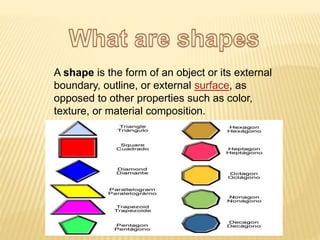
A shape is the form of an object or its external
boundary, outline, or external surface, as
opposed to other properties such as color,
texture, or material composition.
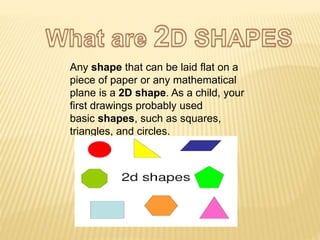
Any shape that can be laid flat on a
piece of paper or any mathematical
plane is a 2D shape. As a child, your
first drawings probably used
basic shapes, such as squares,
triangles, and circles.
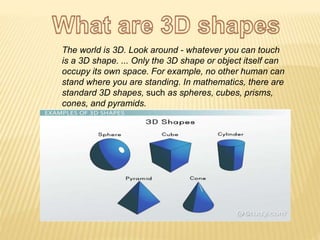
The world is 3D. Look around - whatever you can touch
is a 3D shape. ... Only the 3D shape or object itself can
occupy its own space. For example, no other human can
stand where you are standing. In mathematics, there are
standard 3D shapes, such as spheres, cubes, prisms,
cones, and pyramids.
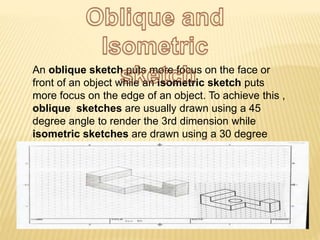
An oblique sketch puts more focus on the face or
front of an object while an isometric sketch puts
more focus on the edge of an object. To achieve this ,
oblique sketches are usually drawn using a 45
degree angle to render the 3rd dimension while
isometric sketches are drawn using a 30 degree
angle.”
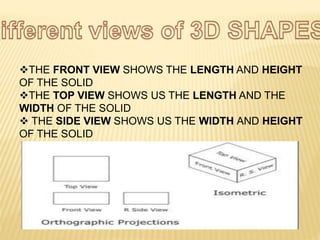
THE FRONT VIEW SHOWS THE LENGTH AND HEIGHT
OF THE SOLID
THE TOP VIEW SHOWS US THE LENGTH AND THE
WIDTH OF THE SOLID
 THE SIDE VIEW SHOWS US THE WIDTH AND HEIGHT
OF THE SOLID
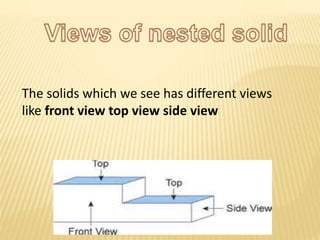
The solids which we see has different views
like front view top view side view
A solid is a 3-D object having length, breadth and thickness and bounded by
surfaces which may be either plane or curved, or combination of the two.
Solids are classified under two main headings
Polyhedron
Solids of revolution
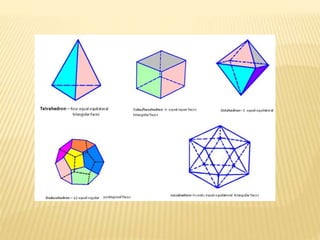
A regular polyhedron is solid bounded only by plane surfaces (faces). Its faces
are formed by regular polygons of same size and all dihedral angles are equal
to one another. when faces of a polyhedron are not formed by equal identical
faces, they may be classified into prisms and pyramids.
Five regular polyhedral are shown in figure 1
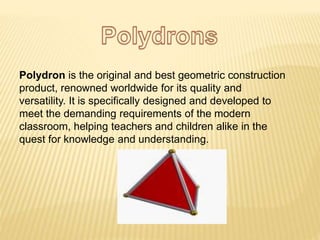
Polydron is the original and best geometric construction
product, renowned worldwide for its quality and
versatility. It is specifically designed and developed to
meet the demanding requirements of the modern
classroom, helping teachers and children alike in the
quest for knowledge and understanding.
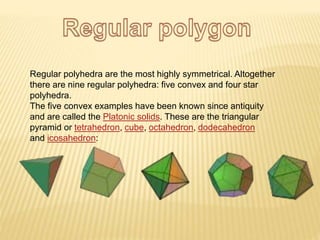
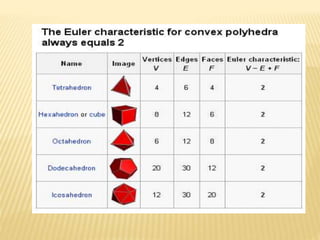
Regular polyhedra are the most highly symmetrical. Altogether
there are nine regular polyhedra: five convex and four star
polyhedra.
The five convex examples have been known since antiquity
and are called the Platonic solids. These are the triangular
pyramid or tetrahedron, cube, octahedron, dodecahedron
and icosahedron:
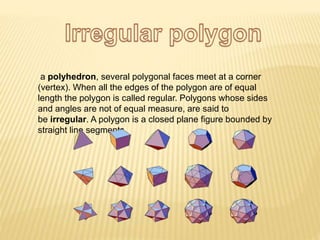
a polyhedron, several polygonal faces meet at a corner
(vertex). When all the edges of the polygon are of equal
length the polygon is called regular. Polygons whose sides
and angles are not of equal measure, are said to
be irregular. A polygon is a closed plane figure bounded by
straight line segments.
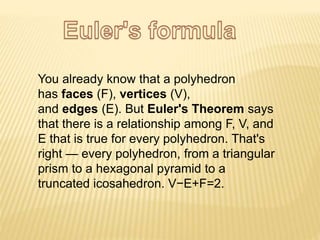
You already know that a polyhedron
has faces (F), vertices (V),
and edges (E). But Euler's Theorem says
that there is a relationship among F, V, and
E that is true for every polyhedron. That's
right — every polyhedron, from a triangular
prism to a hexagonal pyramid to a
truncated icosahedron. V−E+F=2.
Mathematics Geometry - Understanding 2D & 3D shapes -Visualising Solid S hapes.mp4
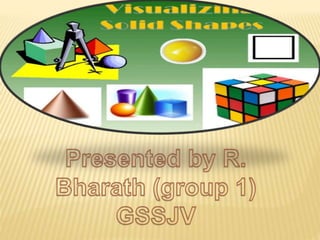
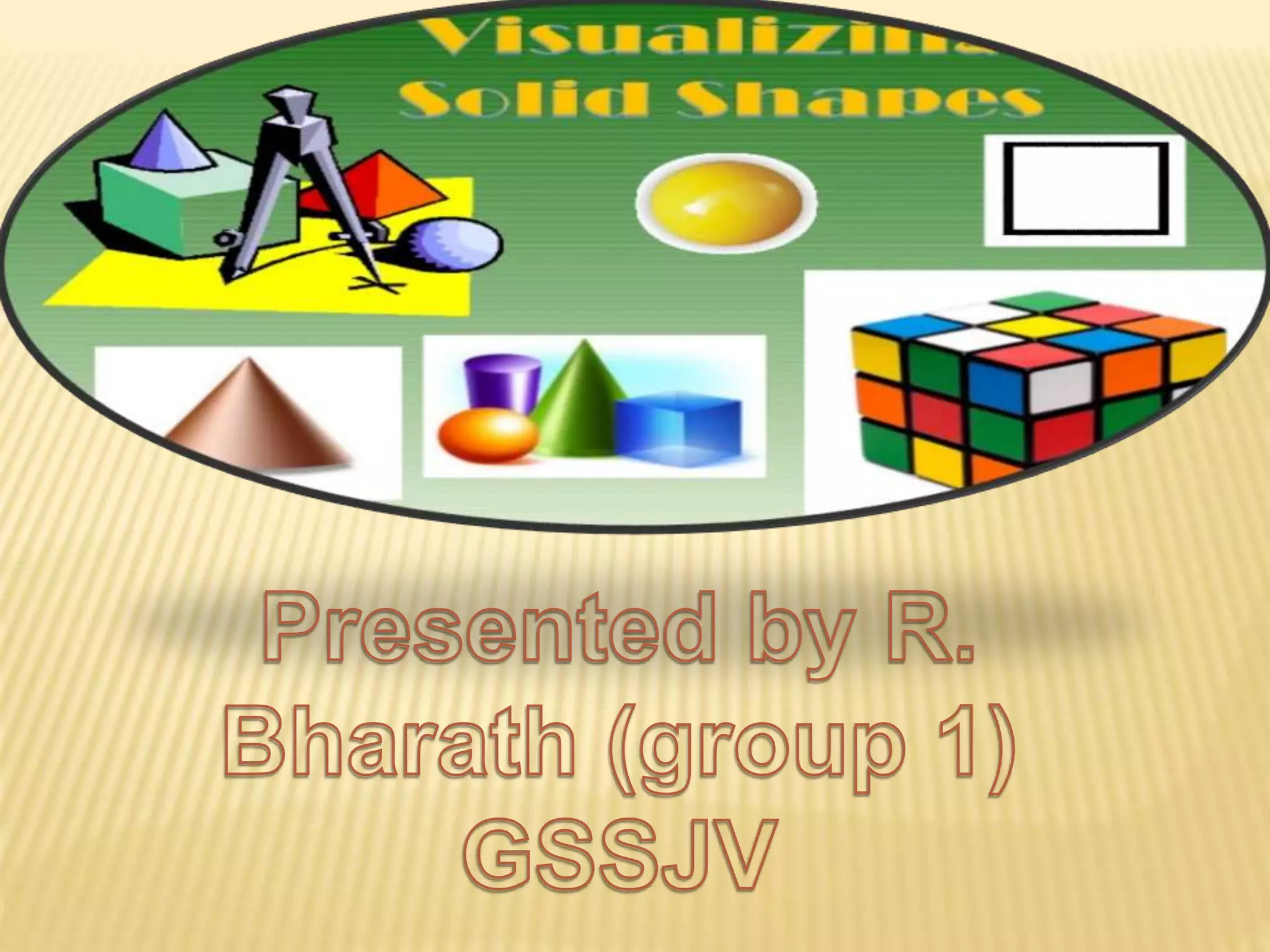
visualising solid shapes

visualising solid shapes

  • 2.
    A shape isthe form of an object or its external boundary, outline, or external surface, as opposed to other properties such as color, texture, or material composition.
  • 3.
    Any shape thatcan be laid flat on a piece of paper or any mathematical plane is a 2D shape. As a child, your first drawings probably used basic shapes, such as squares, triangles, and circles.
  • 4.
    The world is3D. Look around - whatever you can touch is a 3D shape. ... Only the 3D shape or object itself can occupy its own space. For example, no other human can stand where you are standing. In mathematics, there are standard 3D shapes, such as spheres, cubes, prisms, cones, and pyramids.
  • 5.
    An oblique sketchputs more focus on the face or front of an object while an isometric sketch puts more focus on the edge of an object. To achieve this , oblique sketches are usually drawn using a 45 degree angle to render the 3rd dimension while isometric sketches are drawn using a 30 degree angle.”
  • 6.
    THE FRONT VIEWSHOWS THE LENGTH AND HEIGHT OF THE SOLID THE TOP VIEW SHOWS US THE LENGTH AND THE WIDTH OF THE SOLID  THE SIDE VIEW SHOWS US THE WIDTH AND HEIGHT OF THE SOLID
  • 7.
    The solids whichwe see has different views like front view top view side view
  • 8.
    A solid isa 3-D object having length, breadth and thickness and bounded by surfaces which may be either plane or curved, or combination of the two. Solids are classified under two main headings Polyhedron Solids of revolution A regular polyhedron is solid bounded only by plane surfaces (faces). Its faces are formed by regular polygons of same size and all dihedral angles are equal to one another. when faces of a polyhedron are not formed by equal identical faces, they may be classified into prisms and pyramids. Five regular polyhedral are shown in figure 1
  • 10.
    Polydron is theoriginal and best geometric construction product, renowned worldwide for its quality and versatility. It is specifically designed and developed to meet the demanding requirements of the modern classroom, helping teachers and children alike in the quest for knowledge and understanding.
  • 11.
    Regular polyhedra arethe most highly symmetrical. Altogether there are nine regular polyhedra: five convex and four star polyhedra. The five convex examples have been known since antiquity and are called the Platonic solids. These are the triangular pyramid or tetrahedron, cube, octahedron, dodecahedron and icosahedron:
  • 12.
    a polyhedron, severalpolygonal faces meet at a corner (vertex). When all the edges of the polygon are of equal length the polygon is called regular. Polygons whose sides and angles are not of equal measure, are said to be irregular. A polygon is a closed plane figure bounded by straight line segments.
  • 13.
    You already knowthat a polyhedron has faces (F), vertices (V), and edges (E). But Euler's Theorem says that there is a relationship among F, V, and E that is true for every polyhedron. That's right — every polyhedron, from a triangular prism to a hexagonal pyramid to a truncated icosahedron. V−E+F=2.
  • 15.
    Mathematics Geometry -Understanding 2D & 3D shapes -Visualising Solid S hapes.mp4