The document discusses the integration of design thinking and agile methodologies to enhance user-centered design and promote effective solutions. It emphasizes the importance of empathy, collaboration, and iterative processes in both disciplines while highlighting various artifacts and principles that support these approaches. The goal is to prioritize user and business value, ensuring that outcomes are continuously refined and aligned with stakeholder needs.
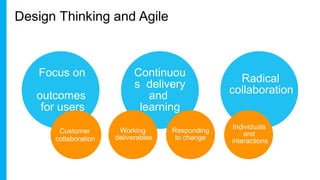
Focus on
outcomes
for users
Continuou
sdelivery
and
learning
Radical
collaboration
Individuals
and
interactions
Working
deliverables
Customer
collaboration
Responding
to change
… becomes theminimum
experience they want
everywhere”
“The last best
experience
anyone has
anywhere…
Bridget van Kraligen
Snr. VP –IBM Global Business Services
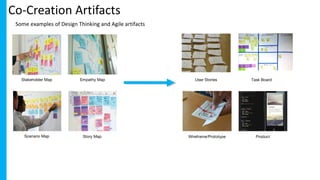
Stakeholder Map EmpathyMap
Scenario Map Wireframe/Prototype Product
User Stories Task Board
Story Map
Some examples of Design Thinking and Agile artifacts
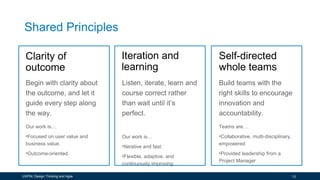
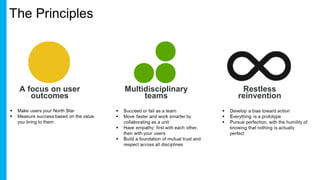
Shared Principles
Begin withclarity about
the outcome, and let it
guide every step along
the way.
Our work is…
•Focused on user value and
business value.
•Outcome-oriented.
Listen, iterate, learn and
course correct rather
than wait until it’s
perfect.
Our work is…
•Iterative and fast.
•Flexible, adaptive, and
continuously improving.
Build teams with the
right skills to encourage
innovation and
accountability.
Teams are…
•Collaborative, multi-disciplinary,
empowered
•Provided leadership from a
Project Manager
Iteration and
learning
Clarity of
outcome
Self-directed
whole teams
13UXPIN: Design Thinking and Agile
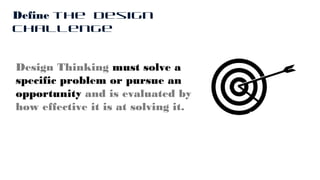
Design Thinking mustsolve a
specific problem or pursue an
opportunity and is evaluated by
how effective it is at solving it.
Define the Design
Challenge
16.
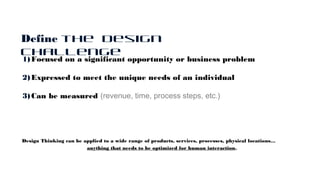
1)Focused on asignificant opportunity or business problem
2)Expressed to meet the unique needs of an individual
3)Can be measured (revenue, time, process steps, etc.)
Design Thinking can be applied to a wide range of products, services, processes, physical locations…
anything that needs to be optimized for human interaction.
Define the Design
Challenge
17.
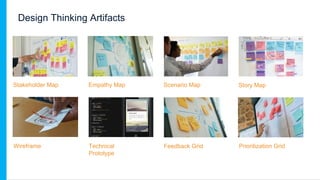
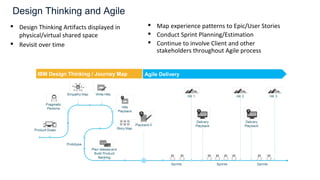
ď‚§ Design ThinkingArtifacts displayed in
physical/virtual shared space
ď‚§ Revisit over time
IBM Design Thinking / Journey Map Agile Delivery
ď‚§ Map experience patterns to Epic/User Stories
ď‚§ Conduct Sprint Planning/Estimation
ď‚§ Continue to involve Client and other
stakeholders throughout Agile process
Design Thinking and Agile
User Centered Design:
Identifyinga specific user problem
or opportunity is the single most
important factor for success.
If you’re addressing the wrong one,
you’re not giving your users what they
need.
Millennials make up50% of workforce and will make up 75% by 2025
Stay Relevant
26.
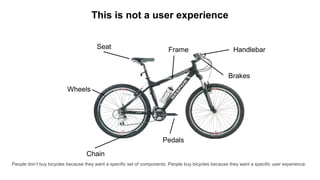
This is nota user experience
Seat
Wheels
Frame Handlebar
Pedals
Chain
Brakes
People don’t buy bicycles because they want a specific set of components. People buy bicycles because they want a specific user experience.
27.
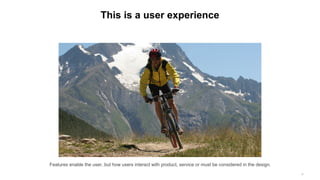
This is auser experience
Features enable the user, but how users interact with product, service or must be considered in the design.
27
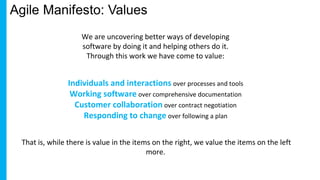
We are uncoveringbetter ways of developing
software by doing it and helping others do it.
Through this work we have come to value:
Individuals and interactions over processes and tools
Working software over comprehensive documentation
Customer collaboration over contract negotiation
Responding to change over following a plan
That is, while there is value in the items on the right, we value the items on the left
more.
34.
34
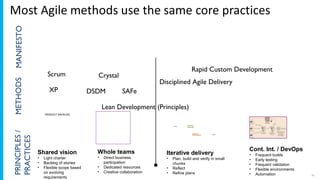
XP
Scrum
Lean Development (Principles)
DSDM
Crystal
PRINCIPLES/
PRACTICES
METHODSMANIFESTO
SAFe
DisciplinedAgile Delivery
Rapid Custom Development
Shared vision
• Light charter
• Backlog of stories
• Flexible scope based
on evolving
requirements
Whole teams
• Direct business
participation
• Dedicated resources
• Creative collaboration
Iterative delivery
• Plan, build and verify in small
chunks
• Reflect
• Refine plans
Cont. Int. / DevOps
• Frequent builds
• Early testing
• Frequent validation
• Flexible environments
• Automation
CLOSE
SOLUTION
DEVELOPMENT
OPEN
SOLUTION
DEFINITION
PRODUCT BACKLOG
35.
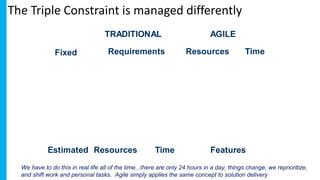
TRADITIONAL AGILE
Fixed
Estimated ResourcesTime Features
Requirements Resources Time
Plan
Driven
Value
Driven
We have to do this in real life all of the time...there are only 24 hours in a day, things change, we reprioritize,
and shift work and personal tasks. Agile simply applies the same concept to solution delivery
36.
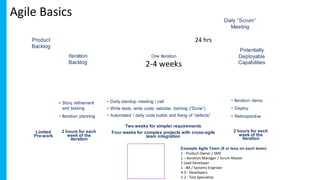
Example Agile Team(9 or less on each team)
1 - Product Owner / SME
1 – Iteration Manager / Scrum Master
1 Lead Developer
1 - BA / Systems Engineer
4-5 - Developers
1-2 - Test Specialists
2-4 weeks
Product
Backlog
Iteration
Backlog
Potentially
Deployable
Capabilities
• Story refinement
and tasking
• Iteration planning
• Daily standup meeting / call
• Write tests, write code, validate, training (“Done”)
• Automated / daily code builds and fixing of “defects”
• Iteration demo
• Deploy
• Retrospective
2 hours for each
week of the
iteration
Two weeks for simpler requirements
Four weeks for complex projects with cross-agile
team integration
2 hours for each
week of the
iteration
Limited
Pre-work
One Iteration
24 hrs
Daily “Scrum”
Meeting
37.
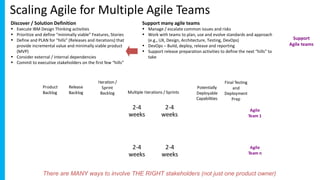
Discover / SolutionDefinition
• Execute IBM Design Thinking activities
• Prioritize and define “minimally viable” Features, Stories
• Define and PLAN for “hills” (Releases and iterations) that
provide incremental value and minimally viable product
(MVP)
• Consider external / internal dependencies
• Commit to executive stakeholders on the first few “hills”
Support many agile teams
• Manage / escalate common issues and risks
• Work with teams to plan, use and evolve standards and approach
(e.g., UX, Design, Architecture, Testing, DevOps)
• DevOps – Build, deploy, release and reporting
• Support release preparation activities to define the next “hills” to
take
Support
Agile teams
2-4
weeks
Product
Backlog
Iteration /
Sprint
Backlog
Potentially
Deployable
Capabilities
Multiple Iterations / Sprints
Agile
Team 1
Agile
Team n
2-4
weeks
2-4
weeks
2-4
weeks
Release
Backlog
Final Testing
and
Deployment
Prep
There are MANY ways to involve THE RIGHT stakeholders (not just one product owner)
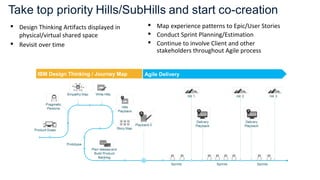
ď‚§ Design ThinkingArtifacts displayed in
physical/virtual shared space
ď‚§ Revisit over time
IBM Design Thinking / Journey Map Agile Delivery
ď‚§ Map experience patterns to Epic/User Stories
ď‚§ Conduct Sprint Planning/Estimation
ď‚§ Continue to involve Client and other
stakeholders throughout Agile process
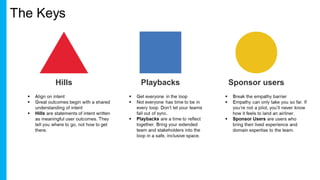
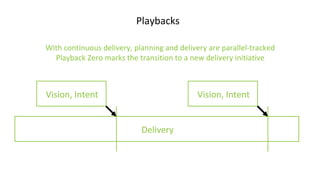
Playbacks
With continuous delivery,planning and delivery are parallel-tracked
Playback Zero marks the transition to a new delivery initiative
Vision, Intent
Delivery
Vision, Intent
44.
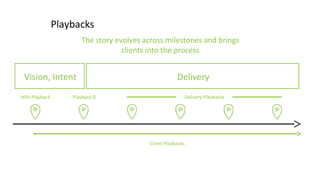
Playbacks
The story evolvesacross milestones and brings
clients into the process
Client Playbacks
Playback 0 Delivery PlaybacksHills Playback
Vision, Intent Delivery
45.
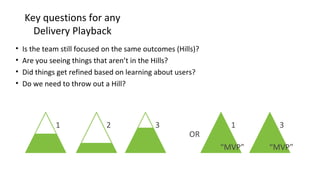
Key questions forany
Delivery Playback
• Is the team still focused on the same outcomes (Hills)?
• Are you seeing things that aren’t in the Hills?
• Did things get refined based on learning about users?
• Do we need to throw out a Hill?
1 2 3
“MVP” “MVP”
1 3
OR
46.
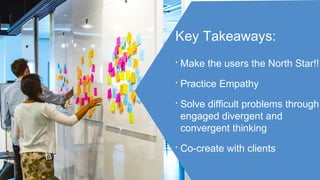
Key Takeaways:
• Makethe users the North Star!!
• Practice Empathy
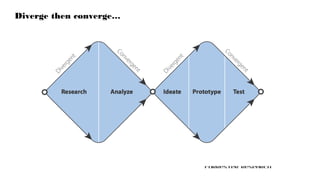
• Solve difficult problems through
engaged divergent and
convergent thinking
• Co-create with clients
47.
Design Thinking andAgile: A Successful
Partnership to Deliver Effective Solutions
to Users!
Editor's Notes
#10Â Advent and ubiquitous presence of Mobile Devices is the great leveler in our digital economy.
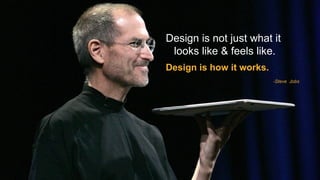
#15 Before we begin, let’s make sure everyone understands what we mean when we say “design”:
Design is the purpose, planning, and intent behind an action, fact, or material object.
In other words:
Design is the intent behind an outcome.
Nothing more, nothing less.
#18Â Map experience patterns to Epic/User Stories
Conduct Sprint Planning/Estimation
Continue to involve Client and other stakeholders through the Agile Sprint process
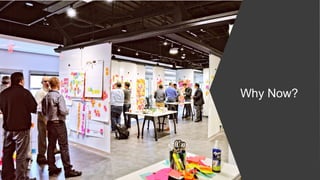
#24Â We use Design Thinking to create solutions for clients by focusing on their users needs, and use strategy andthe hottest technology to accomplish our goal.
Why now?
#27 This is not a user experience. This is a product –a set of features and functions, integrated into a “solution”. But people don’t buy bicycles because they want a specific set of components. People buy bicycles because they want a specific user experience.
#40Â Map experience patterns to Epic/User Stories
Conduct Sprint Planning/Estimation
Continue to involve Client and other stakeholders through the Agile Sprint process
#41 NOTE: You can skip this slide if you like. It was added because people get hung up thinking a Hill is an Epic and it’s not necessarily the case. A Hill can have more than one Epic.
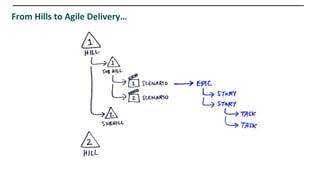
From Hills to Stories…
The work defined in the Product Backlog is informed by the Hills, more specifically, the Scenarios that describe the Hill or Sub-Hills.
While the example above shows a specific breakdown of Scenarios to Epics, it’s possible that a Hill can be an Epic, or a Hill can be a Story - it just depends on the amount of work involved. The thing to remember is that the breakdown of work needs to be clear in order to assign the right amount or Stories and Tasks to each Sprint.
Note: Epics are basically containers of Stories and are too large to be completed in one Sprint. A Story should be small enough to be completed in one Sprint.
http://advancedtopicsinscrum.com/glossary-agile-scrum-terms/epic/
#43Â NOTE: You can skip this slide if you like. It was added empathize that Hills carry forward from the visioning through delivery.
Hills focus the team in the vision phase and force alignment and scope management through delivery.
#44Â If your project follows a continues delivery model, you will be moving from vision to delivery back to vision, and back to delivery. IBM Design Thinking is an excellent framework to support that process.
#45Â This slide shows the transition from Vision to Delivery via Playback 0. At the PB0 EVERYONE must agree to the vision and ability to deliver the project in the planned timeframe.
#46Â Sizings are hard
Agile favors velocity measures
At your playback how is it looking?
What’s your investment allocation?
Can you still make MVP for each Hill?
Better to blow a Hill early than late.
Better to drop a whole Hill than ship some half Hills.
Focus on Integrity of stories.
Docked as much for building stuff that isn't in a Hill as for not building stuff that was asked
#47 We have a very simple formula which is people plus places plus practices equals outcomes. Let’s talk a little about each.