NEW ACQUISITIONS
PAINTINGS, WATERCOLORS,
DRAWINGS AND SCULPTURE
1760 – 1970
SUMMER EXHIBITION
May 26th
through July 17th
, 2015
Exhibition organized by
Robert Kashey, David Wojciechowski
Catalog by Stephanie Hackett
58 East 79th
Street
New York, N. Y. 10075
Tel: 1 212 861 4050
Fax: 1 212 772 1314
ShepherdNY@aol.com
www.shepherdgallery.com
SHEPHERD
W & K
GALLERIES
© Copyright: Robert J. F. Kashey
for Shepherd Gallery, Associates, 2015
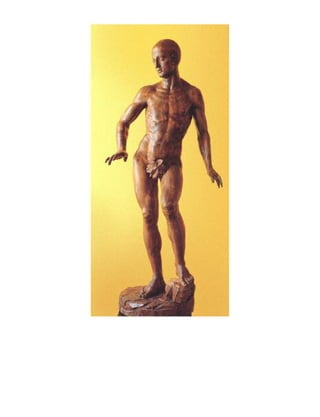
COVER ILLUSTRATIONS: Franz-Xaver Seegen, Academic Male Nude, 1763, cat. no. 1
GRAPHIC DESIGN: Keith Stout
PHOTOGRAPHY: Hisao Oka, Christine de Grancy
TECHNICAL NOTES: All measurements are in inches and in centimeters;
height precedes width. All drawings and paintings are framed. Prices on request. All works subject to
prior sale.
SHEPHERD GALLERY SERVICES has framed, matted, and restored all of the objects in this exhibition,
if required. The Service Department is open to the public by appointment, Tuesday though Saturday
from 10:00 a.m. to 6:00 p.m. Tel: (212) 744 3392; fax (212) 744 1525; e-mail: sgservicesny@aol.com.
ACKNOWLEDGMENTS:
We are grateful to the following contributors of individual catalog entries:
Elizabeth Frasco; Elisabeth Kashey; Monica Steinberg; Leanne Zalewski.
CATALOG
1 SEEGEN, Franz-Xaver 1724 – 1780
Austrian School
ACADEMIC MALE NUDE, 1763
Linden wood. Height: 5’4” (163 cm). Signature and date
on the plinth: Xaverii Seegen 1763.
Ex-collection: Rene Clemencic, Vienna
Note: In 1769 Franz-Xaver Seegen became a mem-
ber of the Vienna Academy, together with Franz
Xaver Messerschmidt (1736-1783). Seegen’s accep-
tance piece was a sculpture of Lot’s Drunkenness. It
is recorded by Wurzbach as being “in metal”,
which could be bronze, lead, or pewter. Most of
Seegen’s later work was executed in stone (and per-
haps plaster). However, during a prolonged period
spent in Slovakia, Seegen carved two extensive
cycles of wood reliefs as well as a wood Crucifixion
(now in the Slovenian National Gallery). The pre-
sent sculpture, together with Seegen’s admission to
the Academy, seems to be a natural outcome of his
wood carving in Slovakia. The nudity and the clas-
sical pose of contrapposto also suggest a close con-
nection to the Academy. A painting by Johann
Zoffany (1733-1810) of the Academicians of the
Royal Academy (1772) shows a life-size figure, simi-
lar to the present one, lined up with classical sculp-
tures for the academicians to draw from.
Our knowledge of Seegen’s life and work
depends mostly on information published during
the time of the Habsburg Empire. Since then, bor-
ders have shifted frequently along with the loca-
tion of Seegen’s works. First, cloisters and
churches were secularized under Emperor Joseph
II (1780-1790) and artworks were moved. Then the
Austro Hungarian Empire was dissolved and bor-
ders were redrawn. The town of Neutra, where
Seegen worked for years, was once Hungarian,
then part of the Habsburg Empire, then
Czechoslovakian, and it is now in Slovakia.
Seegen worked mostly for the church. Some
sources call him a “monk in a holy order”
(Ordensmönch). However, it is not quite conceiv-
able, that he should have been a monk and a trav-
elling sculptor and a member of the Viennese
Academy at the same time. He might have been
close to the order of the Kamaldulensers, an order
of contemplation, attached to other orders, such as
the Benedictines and the Franciscans. He created
thirty-three narrative panels in wood on the Life of
St. Francis in Neutra, and woodcarvings of the Life
of St. Romuald in Majk (later moved to the Greek-
Unionate church in Komarno).
After spending about seven years in Slovakia,
Seegen returned to Vienna, became a member of
the Academy, and continued to work for the cler-
gy. In numerous churches in and near Vienna his
sculptures are in situ to this day. This includes the
Viennese church of St. Ulrich (four stone figures
by Seegen), St. Stephan in Stockerau near Vienna
with figures on the High Altar, a Crucifix for a
Calvary near Linz, and at least six sculptures in the
pilgrim’s church of Kirchbüchl, belonging to the
Cistercian cloister Neukloster in Wiener Neustadt.
Why is so little recorded about Franz-Xaver
Seegen? He might have dedicated himself so
wholeheartedly to the church that he considered
worldly success ignoble. The rumor that he was an
Ordensbruder would tie in with that thought. One
detail, recorded by Maria Pötzl-Malikova, seems
typical of his attitude: when the decoration of the
court church of St. Michael ran in financial trou-
ble, Seegen offered to carve large figures for a price
of 70 fl. as opposed to 200 fl., the asking price of
several Viennese sculptors. Seegen might have
been willing to do the work for God’s glory – but
he did not get the commission.
References:
Nagler, Neues Allgemeines Künstler-Lexikon
(Munich: 1859), Vol. 16, p. 9.
Maria Pötzl-Malikova, Zur Geschichte des Hochal-
tars, available from http://www.michaelerkirche.at/
content/michaelerkirche
Schemper-Sparholz in Wandlungen – Ereignis
Skulptur. Die Sammlung Clemencic. eds. Gunter
Bucher, Lukas Feichtner; photographs, Christine
de Grancy (Vienna: Österreichische Galerie
Belvedere, Oberes Belvedere, 2004).
Constant Wurzbach von Tannenbach,
Biographisches Lexicon des Kaiserthums Österreich
(Vienna: 1855-1899), Vol. 33, p. 305 ff.
Georg Raphael Donner und Bratislava (1693-
1741), Slovakische National Galerie, November
1992-April 1993, p. 115 f, p. 105, p. 106-107.
E.K.
2 POSCH, Leonhard 1750 – 1831
Austrian School
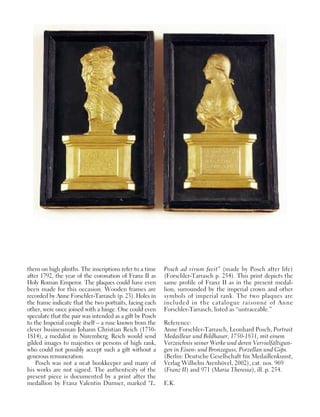
PAIR OF MEDALLIONS, 1792 or after
(A) FRANZ II
Gilded plaster relief plaque on framed wood backing. Size
of plaster: 6” x 3 1/8” (15.2 x 8 cm); size of frame: 7 3/4”
x 4 15/16” (19.2 x 12.5 cm). Raised lettering on the plinth:
Franciscus II/D: G: R: I: S: A: /GER: HIE: / HVUNG: BOH:
/ GAL: REX. (Dei Gracia Romanorum Imperator Semper
AugustusGermaniae,Hierosolimitaniae[Jerusalem],Hun-
gariae, Bohemiae, Galiciae Rex.)
(B) MARIA THERESIA
Gilded plaster relief plaque on framed wood backing. Size
of plaster: 6 5/8” x 3 1/8” (6 x 7.7 cm); size of frame: 7 3/4”
x 4 15/16” (19.2 x 12.5 cm). Raised lettering on plinth:
MARIA/THERESIA/PRINC: V: NEAP: / KOENIG: VON
/ HVUNG: BOEH: / VND GALIZ: &. (Maria Theresia,
Princess of Naples, Queen of Hungary, Bohemia, and
Galicia etc.)
Note: When Leonhard Posch was so sick that he
almost died, Empress Maria Theresia sent her own
doctor and financial support. When the future
Emperor Franz II wanted to learn how to make
portrait medallions from wax, he sent for
Leonhard Posch as an instructor. Leonhard Posch
enjoyed royal patronage all his life, both in Vienna
and in Berlin, but only at the age of sixty-four did
he finally sign a contract that secured him a fixed
income. He made that contract with the Royal
Porcelain Manufacture, the Royal Iron Foundry,
and the Royal Mint in Berlin. He had to teach the
students of these institutions and deliver the origi-
nal molds as well as four plaster casts of his works
in exchange for 500 Taler per year. However, he
was free to portray his own private clients. One
year later, at age sixty-five, he was elected a mem-
ber of the Berlin Academy, which protected his
work with a copyright.
Leonhard Posch was born in Tyrol, studied in
Salzburg, and spent about thirty years in Vienna,
first as a sculptor, assisting his teacher Johann
Baptist Hagenauer (1732-1810), and then as a
medalist. In 1804 he moved to Berlin, where he
died of old age in 1831. He created about 900
works, most of them portrait medallions, includ-
ing those of Mozart, Goethe, and Napoleon, of
generals, scholars, artists and bourgeois citizens,
and of numerous members of the ruling dynasties
in Vienna and Berlin. They were produced in plas-
ter, pewter, porcelain, iron, bronze or brass. Before
the advent of photography, medallions were popu-
lar gifts. They could be issued in copies to be
given to extended family, they were often made of
plaster and thus affordable, and they were easy to
ship.
Leonhard Posch was a quiet, reticent person.
So much more surprising is his engagement with
all kinds of businessmen who utilized Posch’s fas-
cination with automatons. Did he need the
money? (He had ten children, four of whom sur-
vived.) Certainly tinkering was his passion, since
he learned the craft of watch making in his spare
time. In Vienna Count von Deym installed an Art
Cabinet (Kunstkabinett), where he showed real
sculptures (by Georg Raphael Donner and Franz
Xaver Messerschmidt), but also plaster casts,
automatons, life-size wax sculptures (by Posch)
which the count painted and fitted with hair, glass
eyes and uniforms. A rather frightful bust of
Ferdinand IV King of Naples and of Emperor
Leopold II are extant today. Count Deym even
engaged Mozart to write an Andante for one of his
more erotic displays, which Mozart wrote grudg-
ingly when he needed the money.
In Berlin Posch formed a partnership with the
“mechanical artist” Eugen Busch, who took their
display of mechanical clocks to Hamburg. Posch
also opened a Camera Obscura at the Bran-
denburger Tor. Another partnership with Etienne
Gaspard Robert (called Robertson) took him to
Paris. Robertson’s invention of projecting scary
images on scrims, creating movement by moving
the camera obscura, might be seen as a first step
towards film, but Posch remarked dryly that he
“preferred to stick to his art”. Posch’s last inven-
tion had much more to do with his own métier. He
created a “Copir Maschine” which seems to have
functioned along the principles of Achille Collas’
machine of 1836, a mechanical help to reduce or
enlarge the size of sculpture.
The present portraits were most likely among
Posch’s earliest productions, shortly after he had to
give up sculpture due to a severe illness. The author
of the catalogue raisonné, Anne Forschler-Tarrasch,
saw in these “first portraits clearly Posch’s drift
towards sculpture”, mostly in their composition.
Indeed, he created profile busts with a base and put
them on high plinths. The inscriptions refer to a time
after 1792, the year of the coronation of Franz II as
Holy Roman Emperor. The plaques could have even
been made for this occasion. Wooden frames are
recorded by Anne Forschler-Tarrasch (p. 23). Holes in
the frame indicate that the two portraits, facing each
other, were once joined with a hinge. One could even
speculate that the pair was intended as a gift by Posch
to the Imperial couple itself – a ruse known from the
clever businessman Johann Christian Reich (1730-
1814), a medalist in Nuremberg. Reich would send
gilded images to majesties or persons of high rank,
who could not possibly accept such a gift without a
generous remuneration.
Posch was not a neat bookkeeper and many of
his works are not signed. The authenticity of the
present piece is documented by a print after the
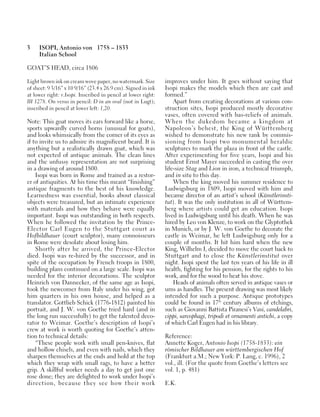
medallion by Franz Valentin Durmer, marked “L.
Posch ad vivum fecit” (made by Posch after life)
(Forschler-Tarrasch p. 254). This print depicts the
same profile of Franz II as in the present medal-
lion, surrounded by the imperial crown and other
symbols of imperial rank. The two plaques are
included in the catalogue raisonné of Anne
Forschler-Tarrasch, listed as “untraceable.”
Reference:
Anne Forschler-Tarrasch, Leonhard Posch, Portrait
Medailleur und Bildhauer, 1750-1831, mit einem
Verzeichnis seiner Werke und deren Vervielfältigun-
gen in Eisen- und Bronzeguss, Porzellan und Gips.
(Berlin: Deutsche Gesellschaft für Medaillenkunst,
Verlag Wilhelm Arenhövel, 2002), cat. nos. 969
(Franz II) and 971 (Maria Theresia), ill. p. 254.
E.K.
3 ISOPI, Antonio von 1758 – 1833
Italian School
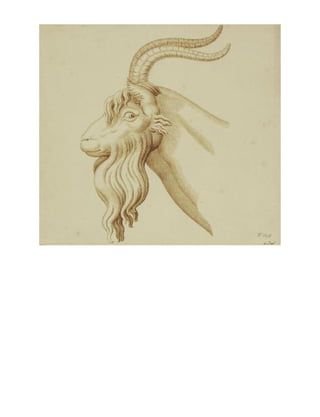
GOAT’S HEAD, circa 1806
Light brown ink on cream wove paper, no watermark. Size
of sheet: 9 3/16” x 10 9/16” (23.4 x 26.9 cm). Signed in ink
at lower right: v.Isopi. Inscribed in pencil at lower right:
III 1278. On verso in pencil: D in an oval (not in Lugt);
inscribed in pencil at lower left: 1,20.
Note: This goat moves its ears forward like a horse,
sports upwardly curved horns (unusual for goats),
and looks whimsically from the corner of its eyes as
if to invite us to admire its magnificent beard. It is
anything but a realistically drawn goat, which was
not expected of antique animals. The clean lines
and the unfussy representation are not surprising
in a drawing of around 1800.
Isopi was born in Rome and trained as a restor-
er of antiquities. At his time this meant “finishing”
antique fragments to the best of his knowledge.
Learnedness was essential, books about classical
objects were treasured, but an intimate experience
with materials and how they behave were equally
important. Isopi was outstanding in both respects.
When he followed the invitation by the Prince-
Elector Carl Eugen to the Stuttgart court as
Hofbildhauer (court sculptor), many connoisseurs
in Rome were desolate about losing him.
Shortly after he arrived, the Prince-Elector
died. Isopi was re-hired by the successor, and in
spite of the occupation by French troops in 1800,
building plans continued on a large scale. Isopi was
needed for the interior decorations. The sculptor
Heinrich von Dannecker, of the same age as Isopi,
took the newcomer from Italy under his wing, got
him quarters in his own house, and helped as a
translator. Gottlieb Schick (1776-1812) painted his
portrait, and J. W. von Goethe tried hard (and in
the long run successfully) to get the talented deco-
rator to Weimar. Goethe’s description of Isopi’s
crew at work is worth quoting for Goethe’s atten-
tion to technical details:
“These people work with small pen-knives, flat
and hollow chisels, and even with nails, which they
sharpen themselves at the ends and hold at the top
which they wrap with small rags, to have a better
grip. A skillful worker needs a day to get just one
rose done; they are delighted to work under Isopi’s
direction, because they see how their work
improves under him. It goes without saying that
Isopi makes the models which then are cast and
formed.”
Apart from creating decorations at various con-
struction sites, Isopi produced mostly decorative
vases, often covered with bas-reliefs of animals.
When the dukedom became a kingdom at
Napoleon’s behest, the King of Württemberg
wished to demonstrate his new rank by commis-
sioning from Isopi two monumental heraldic
sculptures to mark the plaza in front of the castle.
After experimenting for five years, Isopi and his
student Ernst Mayer succeeded in casting the over
life-size Stag and Lion in iron, a technical triumph,
and in situ to this day.
When the king moved his summer residence to
Ludwigsburg in 1809, Isopi moved with him and
became director of an artist’s school (Künstlerinsti-
tut). It was the only institution in all of Württem-
berg where artists could get an education. Isopi
lived in Ludwigsburg until his death. When he was
hired by Leo von Klenze, to work on the Glyptothek
in Munich, or by J. W. von Goethe to decorate the
castle in Weimar, he left Ludwigsburg only for a
couple of months. It hit him hard when the new
King, Wilhelm I, decided to move the court back to
Stuttgart and to close the Künstlerinstitut over
night. Isopi spent the last ten years of his life in ill
health, fighting for his pension, for the rights to his
work, and for the wood to heat his stove.
Heads of animals often served in antique vases or
urns as handles. The present drawing was most likely
intended for such a purpose. Antique prototypes
could be found in 17th
century albums of etchings,
such as Giovanni Battista Piranesi’s Vasi, candelabri,
cippi, sarcophagi, tripodi et ornamenti antichi, a copy
of which Carl Eugen had in his library.
Reference:
Annette Koger, Antonio Isopi (1758-1833): ein
römischer Bildhauer am württembergischen Hof
(Frankfurt a.M.; New York: P. Lang, c. 1996), 2
vol., ill. (For the quote from Goethe’s letters see
vol. 1, p. 481)
E.K.
4 HETSCH, Gustav Friedrich 1788 – 1864
German School
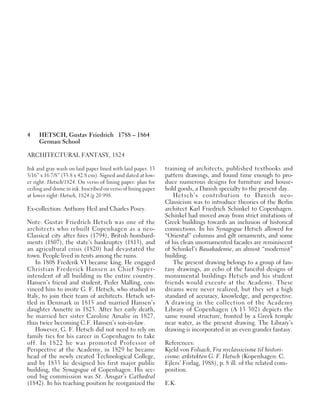
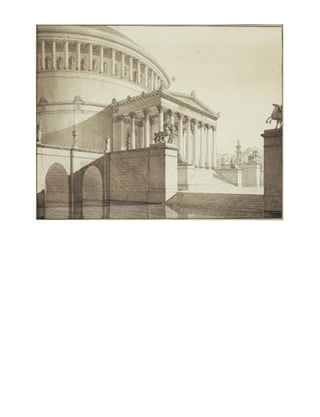
ARCHITECTURAL FANTASY, 1824
Ink and gray wash on laid paper lined with laid paper. 13
5/16” x 16 7/8” (33.8 x 42.8 cm). Signed and dated at low-
er right: Hetsch/1824. On verso of lining paper: plan for
ceiling and dome in ink. Inscribed on verso of lining paper
at lower right: Hetsch, 1824 /g 20 998.
Ex-collection: Anthony Heil and Charles Posey.
Note: Gustav Friedrich Hetsch was one of the
architects who rebuilt Copenhagen as a neo-
Classical city after fires (1794), British bombard-
ments (1807), the state’s bankruptcy (1813), and
an agricultural crisis (1820) had devastated the
town. People lived in tents among the ruins.
In 1808 Frederik VI became king. He engaged
Christian Frederick Hansen as Chief Super-
intendent of all building in the entire country.
Hansen’s friend and student, Peder Malling, con-
vinced him to invite G. F. Hetsch, who studied in
Italy, to join their team of architects. Hetsch set-
tled in Denmark in 1815 and married Hansen’s
daughter Annette in 1823. After her early death,
he married her sister Caroline Amalie in 1827,
thus twice becoming C.F. Hansen’s son-in-law.
However, G. F. Hetsch did not need to rely on
family ties for his career in Copenhagen to take
off. In 1822 he was promoted Professor of
Perspective at the Academy, in 1829 he became
head of the newly created Technological College,
and by 1833 he designed his first major public
building, the Synagogue of Copenhagen. His sec-
ond big commission was St. Ansgar’s Cathedral
(1842). In his teaching position he reorganized the
training of architects, published textbooks and
pattern drawings, and found time enough to pro-
duce numerous designs for furniture and house-
hold goods, a Danish specialty to the present day.
Hetsch’s contribution to Danish neo-
Classicism was to introduce theories of the Berlin
architect Karl Friedrich Schinkel to Copenhagen.
Schinkel had moved away from strict imitations of
Greek buildings towards an inclusion of historical
connections. In his Synagogue Hetsch allowed for
“Oriental” columns and gilt ornaments, and some
of his clean unornamented facades are reminiscent
of Schinkel’s Bauakademie, an almost “modernist”
building.
The present drawing belongs to a group of fan-
tasy drawings, an echo of the fanciful designs of
monumental buildings Hetsch and his student
friends would execute at the Academy. These
dreams were never realized, but they set a high
standard of accuracy, knowledge, and perspective.
A drawing in the collection of the Academy
Library of Copenhagen (A 13 302) depicts the
same round structure, fronted by a Greek temple
near water, as the present drawing. The Library’s
drawing is incorporated in an even grander fantasy.
References:
Kjeld von Folsach, Fra nyclassicisme til histori-
cisme: arkitekten G. F. Hetsch (Kopenhagen: C.
Ejlers’ Forlag, 1988), p. 8 ill. of the related com-
position.
E.K.
5 CANOVA, Antonio 1757 – 1822
Italian School
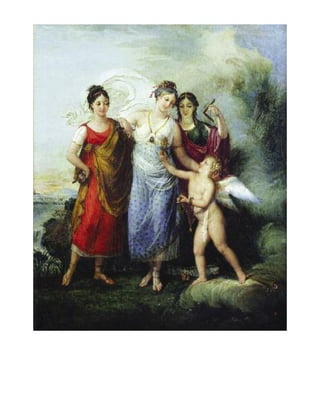
ALLEGORY OF THE ARTS: SCULPTURE,
PAINTING AND ARCHITECTURE, circa 1815
Oil on canvas, relined. 29 1/4” x 24 1/4” (74.3 x 61.6 cm)
Note: Within Antonio Canova’s larger oeuvre of
Neoclassical sculptures is a small group of (primari-
ly oil) paintings. This group includes Venus (pri-
vate collection), Alessandro, Apelle, and Campaspe
(private collection), Triumph of Faith (private col-
lection), Deposition (Correr Museum, Venice), The
Three Graces and Venus Dance Before Mars (1789)
(Possagno), and the present work, Allegory of the
Arts: Sculpture, Painting and Architecture, circa
1815. The present work depicts allegorical figures
of the Fine Arts, Painting at the center, Sculpture
on the left, and Architecture on the right, identi-
fied by the attributes of their field, which they hold
in their hands. A small Cupid stands in the fore-
ground of the painting “distributing gilded laurel
leaf crowns to the three young women.” This
description, as well as the certain attribution of the
painting to Canova, are given by Canova scholar
Gian Lorenzo Mellini in his catalogue raisonné of
the artist: Canova: Saggi di filologia e di ermeneuti-
ca. He states that the atmospheric mood in the
Allegory of the Arts can be found in all of Canova’s
paintings. Certainly, Canova’s sense of composi-
tion with the main figures in the foreground, who
stand in a unifying and stable triangular form
before a classical cityscape, is similar to that in his
painting Alessandro, Apelle, and Campaspe. This
sense of composition, as well as Canova’s use of
gentle light and sfumato to smoothly blend the
eye’s transitions from foreground to background,
and his application of saturated and bright color
reflect Canova’s interest in the stylistic attributes
of Venetian Renaissance art.
As Canova’s sculptures are well known for their
timeless and still quality, his sketches, which are
loosely drawn and expressive, and his paintings,
which are lively and colorful, are initially unexpect-
ed. A comparison between Canova’s wash drawing,
The Three Graces and Venus Dance Before Mars,
and the present work, painted twenty-five years
later, reveals Canova’s ultimate embrace of a looser
and more flexible stylistic sensibility in his paint-
ing. Rather than placing his figures in the frieze-
like composition of antiquity as with the earlier
Three Graces, Canova’s women in Allegory of the
Arts frolic in a sun-filled and breezy landscape.
Interestingly, Canova’s Allegory of the Arts is remi-
niscent of the large tapestry cartoons, created by
Canova’s contemporary Francisco Goya for Charles
III and Charles IV during the years 1775-1791.
Many of Goya’s large paintings, for example Blind
Man’s Bluff (1789), depict fêtes galantes that pay
homage to the Rococo in their subject matter and
use of pastel color, as does the present work.
Reference:
Gian Lorenzo Mellini, Canova: saggi di filologia e
di ermeneutica (Milan: Skira, 1999), ill. p. 9.
S.H.
6 AGRICOLA, Carl Joseph Alois
1779 - 1852
Austrian School
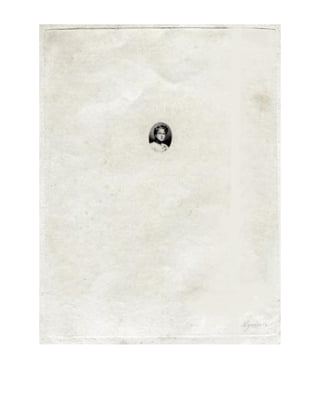
FRANZ DUKE OF REICHSTADT, circa 1830
Mezzotint on wove paper. No watermark. Oval image: 3/8”
(9.5 mm). Plate size: 5 3/4” x 4 1/4” (14.6 x 10.8 cm). Sheet
size: 6 1/4” x 4 3/4” (15.9 x 12.1 cm). Artist’s signature in
graphite at bottom right: Agricola.
Note: This small steel-engraved mezzotint print
is a half-length portrait of Franz Duke of
Reichstadt (1811-1832), shortly before his early
death. The Duke was the son of Napoleon I and
Marie Louise of Austria. Carl Agricola, who
resided in Vienna from 1793 to 1852, painted the
Duke of Reichstadt. He engraved the present
work directly after his own drawing. Andreas
Andresen calls it the smallest intaglio print ever,
and certainly the smallest in Agricola’s body of
work. The portrait of the young Duke was
immensely popular within the elite and wealthy
circle of art lovers who were Agricola’s main
audience. So impressed was the Archduchess
Marie Louise, that she honored the artist with
the gift of a diamond ring. As the oval miniature
was intended to be incorporated into decorative
rings, pins, and buttons, uncut impressions of
the print are not commonly found. One such
intact impression was included in the auction
catalog for the 1907 sale of Prince Clemens von
Metternich’s print collection. Austria’s Foreign
Minister from 1809-48 and Chancellor from
1821-48, Metternich had also been responsible
for arranging the marriage between Napoleon I
and Marie Louise.
Carl Agricola was a painter as well as a prolific
engraver and lithographer. His draftsmanship was
described as “tender”, “delicate” and “soft”; the
intimate scale of the prints combined with the
great care Agricola used in the printmaking process
resulted in works that were exceptionally “pleas-
ing” to the eye. Agricola created prints after his
drawings and paintings as well as after paintings by
other artists, for example: Annibale Carracci,
Nicolas Poussin, Anton Raphael Mengs, and
Raphael. Also, Agricola’s own prints are recorded
as having been copied by contemporary and subse-
quent generations of Austrian artists, including
Ignaz Krepp (1801-1853) and Heinrich Joseph
Mansfeld (1785-1866).
It is important to note that although Agricola
does not seem to have been particularly experi-
mental within the media of engraving and lithog-
raphy, Franz Herzog von Reichstadt is the only
example in the artist’s oeuvre that incorporates the
“black manner” method or mezzotint. This
method involves “pricking [the] entire surface [of
the plate] with innumerable small holes that will
hold ink” and that will produce in the printed work
“soft, subtle gradations of tone.”
References:
Katalog der hervorragenden Kupferstichsammlung
aus dem Besitze des Staatskanzlers Fürsten
Clemens Lothar Metternich (Vienna: Gilhofer &
Ranschburg, 1907).
Andreas Andresen, Die deutschen Maler-Radierer
(peintres-graveurs) des neunzehnten Jahrhunderts,
nach ihren Leben und Werken (Leipzig: Alexander
Danz, 1878) Vol. IV, pp. 1-29.
Meyer, Julius et al., Allgemeines Künstler-Lexikon,
unter Mitwirkung der namhaftesten Fachgelehrten
des In- und Auslandes (Leipzig: Wilhelm Engel-
mann, 1872-1855) Vol. I, pp. 139-141.
S.H.
7 AGRICOLA, Carl Joseph Alois 1779-1852
Austrian School
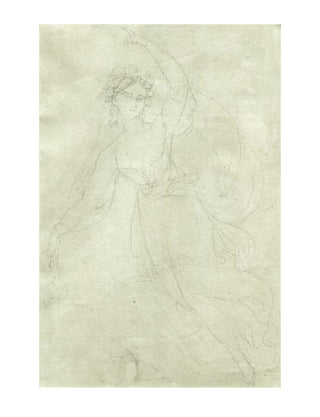
DANCER WITH WREATH AND VEIL
(FANNY ELSSLER), circa 1830
Graphite on medium weight off-white laid paper. No
watermark. On verso squared for transfer. 10 1/2” x 7 5/8”
(26.7 x 19.4 cm).
Note: It seems natural that at the height of his
career, Carl Agricola, at one time “the most
famous painter in Vienna” would paint the
Austrian prima ballerina and rising international
star, Fanny Elssler (1810-1884). The present draw-
ing, which depicts the goddess-like dancer in lilt-
ing and graceful movement, comes from an album
of 79 drawings possibly assembled by the artist
who lived in Vienna from 1793 to 1852. Agricola
maintained a circle of well-to-do clients, including
Friedrich von Gentz, a political writer and politi-
cian. Gentz, a member of the Congress of Vienna
and close advisor and friend to influential politi-
cians, most notably Prince Metternich, became
“consumed” with Fanny Elssler after watching her
perform. He ultimately commissioned a portrait of
Elssler from Agricola at the start of the couple’s
relationship in the early 1830s and accompanied
the young woman to her sittings with the artist on
a regular basis.
As an artist known for his interest in classical
subject matter with a “Baroque touch” and
because of his penchant for depicting young
women draped in veils and flowers, Agricola was
well suited to capture the spirit of Fanny Elssler on
canvas, and he did so on at least three separate
occasions around 1830. The dawning of this partic-
ular decade was pivotal for the young ballerina.
Elssler, the daughter of a sheet music copyist for
Joseph Hayden, was trained as a professional
dancer from a young age. And she was praised for
her extraordinary and prodigious talent from the
time she began appearing before public audiences
at the age of seven. However, it was upon her
return to Vienna at the end of 1829, following a
period of training and performance in Italy, that
Elssler increasingly began to receive great public
acclaim and rave reviews for her principle roles in a
variety of productions. Critics wrote of the nine-
teen-year-old performer’s “terrific bravura and
remarkable assurance,” her diligence, her skillful
acting, and her exquisite beauty.
Fanny Elssler’s star continued to rise following
her first season back in her native country and
through to her retirement from the stage in 1851.
She remained a highly influential and popular fig-
ure; her costumes informed the style and fashion
of women’s every-day dress and her performances
of folk dances, including the Spanish Cachucha,
for which she was well known, inspired a growing
interest in dances of this genre. Elssler’s likeness
was ubiquitous, appearing in painted, printed and
drawn form, and captured by a variety of artists
throughout her lifetime.
References:
Ivor F. Guest, Fanny Elssler (Middletown, CT:
Wesleyan University Press, 1970), pp. 26-48.
Elisabeth Kashey, The Album of Carl Agricola,
1779-1852, Neo-Classical Figures & Early
Romantic Landscapes (New York: Shepherd
Gallery, Associates, Fall 2000).
S.H.
8 INGRES, Jean-Auguste-Dominique
1780-1867
French School
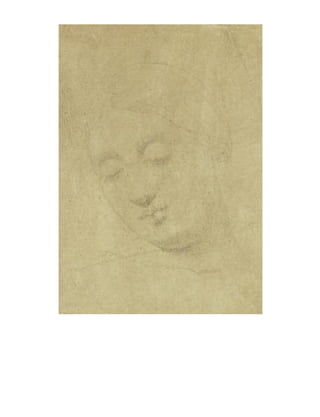
HEAD OF A WOMAN
Graphiteonpapiercalquemountedtobrownish-greenlight-
weight card, 6” x 4 3/8” (15.2 x 11.1 cm). On original mat
attached label: MAISON SPÉCIAL D’ENCADREMENTS.
JOSEPHBILLAULT.32bisBrdHaussmann(PrèslaChaussée
d’Antin).Onlowerrightcutoutfromprintedexhibition/auc-
tion catalog and pasted on label: Ingres. On lower left
inscribed on label in ink: Ingre[s].
Note: Ingres’ subtle drawing captures the demure
character of a young woman through a combina-
tion of pose and modeling. Her head is rounded,
slightly downturned, and drifts quietly to the left;
and her eyes are deeply hooded and downcast. The
understated nature of the pose is reflected in the
young woman’s smoothly sculpted features. Only
suggested shadows and pale tones capture the soft,
rounded shape of the nose; the delicate lines of the
lips subtly curl at the ends in the slightest sugges-
tion of a smile; and the shading beneath the chin
is open and light. The portrait is calm, reserved,
and somewhat coy.
Despite the delicate nature of the face, it dis-
tinctly captures the unique, fleshy quality and tex-
ture-less draftsmanship that connects the
depiction of the young woman to Ingres’ lifelong
fascination with—and near reverence for—the six-
teenth-century Italian Renaissance master,
Raphael. Although Ingres studied in Paris under
Jacques-Louis David, he spent much of his time in
various libraries copying engravings after paintings
of Madonna by Raphael; and Ingres’ move to
Rome in 1806 only increased his admiration for
the Renaissance master. Scholars have long noted
that Ingres’ drawings, such as Head of a Woman,
and finished paintings, such as the 1853 Virgin of
the Host, display a distinct quality of ‘Raphaelism’.
The French artist was deeply indebted to
Raphael’s frequent depiction of the full-bodied
Madonna with a downcast gaze, hooded eyes, and
fleshy face. Ingres’ minimal use of texture, and his
smoothed and blurred style of sketching—à la sfu-
mato—illustrate Ingres’ formal and conceptual
relationship to the Italian master.
While there is no direct correspondence
between Ingres’ study, Head of a Woman, and any
known, finished paintings by either Ingres or
Raphael, the sketch nonetheless reincarnates
Raphael’s formal influences. The position of the
woman’s head, the delicate and full modeling of
the face, texture-less rendering, and the tracing
paper medium, all suggest the composition is a
drawing done in preparation for a larger project.
References:
Andrew Carrington Shelton, Ingres and His Critics
(Cambridge; New York: Cambridge University
Press, 2005).
Portraits by Ingres: Image of an Epoch, eds. Gary
Tinterow and Philip Conisbee (New York:
Metropolitan Museum of Art, 1999).
M.S.
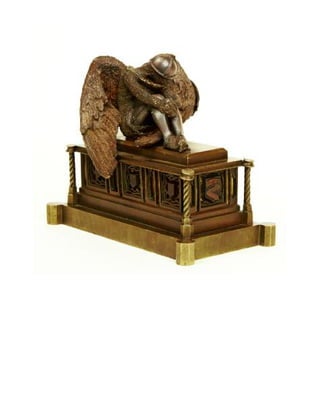
9 FAUVEAU, Félicie de 1801–1886
French School
WINGED KNIGHT OF THE VIGIL OF THE
ETERNAL FLAME, circa 1830
Lost-wax bronze cast by Jean-Honoré Gonon (1780–1850)
with variegated black and brown patina, gold patina on
the face and in the decorative relief panels along the side
of the base, red paint. 6” x 4” x 7 3/8” (15.2 x 10.1 x 18.8
cm). Escutcheon at front and rear of the tomb bears in
red paint the motto: SIC/DONEC.
Note: Born to a family of minor French aristocrats
in Livorno (Tuscany, Italy) in 1801, Félicie de
Fauveau moved to Paris with her family a year or
two after her birth. In 1808, her family lived in the
new quarter on the rue de Hauteville, and Fauveau
was educated at the distinguished school of
Henriette Mendelssohn. Typical for a female artist
of her time, little is know about her artistic train-
ing. Like Henry de Triquetti, she studied with
Louis Hersent and also with Bernard Gaillot, a
minor student of Jacques-Louis David. None of
her teachers account for her deep and precocious
interest in medieval art for which she became a
recognized expert. Famous for her bold, erudite,
and sophisticated character, she was a close
acquaintance of Ary Scheffer and Paul Delaroche,
whom she introduced to the art of sculpture.
At the age of twenty-seven, she exhibited at the
Salon and was praised by such renown critics as
Stendhal and Alexander Dumas as the leader of
the new school of modernity: Romanticism. Her
most celebrated work, The Lamp of Saint Michael,
Archangel (Musée du Louvre, Paris) was exhibited
at the Salon of 1832. This sculpture was commis-
sioned by the famous Swiss banker and collector of
both classical antiquity and medieval and
Renaissance art, James-Alexandre de Pourtales-
Gorgier (1776–1855).
An ardent Royalist, fervent Catholic, and often
categorized as a feminist, she dressed herself in
medieval fashions. A great admirer of the Middle
Ages for its values as much as its art, Fauveau
believed that women were the “custodians” of hero-
ism and loyalty, and that it was their duty to pro-
mote and protect these values, which she did
through her art and politics. After the revolution of
1830 brought Louis Philippe d’Orléans to the
throne of France, she joined the Duchesse de Berry
in Vendée in an unsuccessful revolt opposing the
new regime. As a consequence for her passionate
support for the young Duc de Bordeaux to be the
next Bourbon king, Fauveau was arrested, impris-
oned, and eventually exiled. She chose to relocate
with her family to Florence, where she would live
for the rest of her life.
Recherchée by the international aristocracy, she
became a living legend, producing almost-exclu-
sively unique bronzes and marbles influenced by
the art of the 14th century, an era she studied
extensively a century before art historian Bernard
Berenson (1865–1959) would do the same. In the
years since her death, Fauveau’s name became
obscure, but recent scholarship has brought her
career to light once again. Most recently in 2013,
an extensive exhibition, Félicie de Fauveau, l’ama-
zone de la sculpture, was held at the Historial de la
Vendée museum and at the Musée d’Orsay, the
latter featuring the present object, Winged Knight
of the Vigil of the Eternal Flame. The sculpture was
not included in the catalog due to the fact that it
was only just discovered before the opening of the
exhibition.
Described as a paperweight, this work depicts
one of the four winged knights also represented in
Fauveau’s celebrated The Lamp of Saint Michael.
In the latter work, the Archangel Michael, por-
trayed as a vigilant and fearful warrior, is surround-
ed by four winged knights, whose different
characters are reflected by their wings. Winged
Knight of the Vigil of the Eternal Flame features the
youngest of the four knights; his youth is indicated
by his chubby cheeks and his young sparrow wings,
in contrast to the other knights’ crow or swallow
wings. Both the present object and The Lamp of
Saint Michael date to Fauveau’s Paris period, just
before she would be exiled to Italy. Though she
would spend most of her career in Florence, during
her few years as an artist in Paris Fauveau produced
some of her most significant works.
Fauveau continued to receive commissions
from European supporters of the ancien régime,
and in Italy she became acquainted with Francis
Egerton, First Earl of Ellesmere, a patron of the
arts for whom she sculpted a major work depict-
ing St. George. The present Winged Knight of the
Vigil of the Eternal Flame appears to have once
belonged to Lord Egerton’s collection. His motto
“SIC DONEC,” translated as “as long as” or
“thus until,” is inscribed in red paint in the
artist’s hand on the escutcheons at the front and
rear of the base.
In Fauveau’s archives (Lord Lindsay collection,
National Library of Scotland), a bronze of the
Winged Knight of the Vigil of the Eternal Flame is
documented in a black and white photograph and
inscribed as having been realized around
1829–1831 for the Comtesse du Cayla, the mis-
tress of Louis XVIII. Fauveau is famous for her
extremely limited, usually unique production of
casts, and the photographed bronze for The
Comtesse du Cayla is to date not located among
the countess’s estate at the Château d’Haroué
(Lorraine, France). Given the extreme rarity of
mulptiple casts in Fauveau’s oeuvre, it is quite
likely that the photographed bronze intended for
the Comtesse du Cayla is the very same object
that Lord Egerton owned.
The subject matter found in Winged Knight of
the Vigil of the Eternal Flame reflects Félicie de
Fauveau’s avant-garde interest in the Middle Ages,
but her personal fascination with that time period
foreshadowed the wide-spread interest for a medieval
aesthetic later in the 19th century; this interest
would manifest in the art and Gothic-revival archi-
tecture as well as in the collecting practices of private
individuals. Although Fauveau hardly traveled in
Great Britain, her work was much sought-after by
English and Scottish collectors. Interestingly, her
medieval subject matter and aesthetic portends the
art of the English Pre-Raphaelite Brotherhood of the
mid-19th century. At least a generation younger than
Fauveau, the Pre-Raphaelites also rejected a strictly
Academic style and sought a return to story telling
and an emphasis on medieval art, Christianity, and
sentimentality.
Reference:
Musée d’Orsay, Félicie de Fauveau: l’amazone de la
sculpture, exh. cat. (Musée d’Orsay, 2013), p. 111.
FEUCHÈRE, Jean-Jacques 1807 – 1852
French School
Jean-Jacques Feuchère was born in Paris in 1807.
The son of a “ciseleur”, Feuchère began his career
working for goldsmiths and by chasing and finish-
ing bronzes. Although he studied for a short time
with sculptors Jean-Pierre Cortot (1787-1843) and
Étienne-Jules Ramey (1796-1852), Feuchère was
primarily self-taught and he had an unquenchable
thirst for knowledge: it was said that “he not only
wanted to see everything, and know everything and
possess everything, but he also wanted to try every-
thing”. His lessons involved learning the technical
aspects of a variety of media, including metalwork-
ing, drawing, printmaking and sculpture, and they
also included an extensive study into the history of
art, and specifically the Renaissance. A connoisseur
and self-proclaimed expert of the stylistic attribut-
es of various art historical periods, Feuchère
amassed an extensive and varied collection of art
works and artifacts throughout his life.
Feuchère’s career as a professional sculptor
began when he made his debut at the Paris Salon
in 1831. He produced some large sculptural works,
including a frieze on the Arc de Triomphe (Le Pont
d’Arcole, 1833-35), but he was best known for his
small bronzes and decorative objects made for the
Sèvres porcelain factory. His work was respected
and this was due in part to his large circle of friends
and supporters (especially Charles Baudelaire)
from the artistic and intellectual community.
Feuchère was a highly active and social figure and
many of his friendships were established at the
mind-altering Club des Haschischins, of which he
was a member.
References:
Peter Fusco and H.W. Janson, The Romantics to
Rodin (Los Angeles, CA: Los Angeles County
Museum of Art; New York, N.Y.: George Braziller,
Inc., 1980), pp. 266-269.
Jules Janin, “Jean Feuchère” in Catalogue d’Objets
d’Art et de Curiosité…de M. Feuchère” (Paris:
Typographie Plon Frères, 1853), p. 10.
S.H.
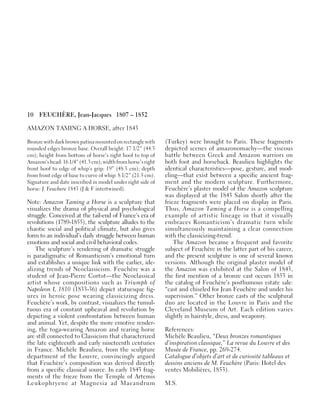
10 FEUCHÈRE, Jean-Jacques 1807 – 1852
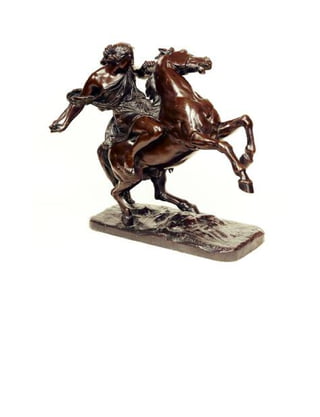
AMAZON TAMING A HORSE, after 1843
Bronze with dark brown patina mounted on rectangle with
rounded edges bronze base. Overall height: 17 1/2” (44.5
cm); height from bottom of horse’s right hoof to top of
Amazon’s head: 16 1/4” (41.3 cm); width from horse’s right
front hoof to edge of whip’s grip: 19” (48.3 cm); depth
from front edge of base to curve of whip: 8 1/2” (21.5 cm).
Signature and date inscribed in model under right side of
horse: J. Feuchere 1843 (J & F intertwined).
Note: Amazon Taming a Horse is a sculpture that
visualizes the drama of physical and psychological
struggle. Conceived at the tail-end of France’s era of
revolutions (1789-1855), the sculpture alludes to the
chaotic social and political climate, but also gives
form to an individual’s daily struggle between human
emotions and social and civil behavioral codes.
The sculpture’s rendering of dramatic struggle
is paradigmatic of Romanticism’s emotional turn
and establishes a unique link with the earlier, ide-
alizing trends of Neoclassicism. Feuchère was a
student of Jean-Pierre Cortot—the Neoclassical
artist whose compositions such as Triumph of
Napoleon I, 1810 (1833-36) depict statuesque fig-
ures in heroic pose wearing classicizing dress.
Feuchère’s work, by contrast, visualizes the tumul-
tuous era of constant upheaval and revolution by
depicting a violent confrontation between human
and animal. Yet, despite the more emotive render-
ing, the toga-wearing Amazon and rearing horse
are still connected to Classicism that characterized
the late eighteenth and early nineteenth centuries
in France. Michèle Beaulieu, from the sculpture
department of the Louvre, convincingly argued
that Feuchère’s composition was derived directly
from a specific classical source. In early 1843 frag-
ments of the frieze from the Temple of Artemis
Leukophryene at Magnesia ad Maeandrum
(Turkey) were brought to Paris. These fragments
depicted scenes of amazonomachy—the viscous
battle between Greek and Amazon warriors on
both foot and horseback. Beaulieu highlights the
identical characteristics—pose, gesture, and mod-
eling—that exist between a specific ancient frag-
ment and the modern sculpture. Furthermore,
Feuchère’s plaster model of the Amazon sculpture
was displayed at the 1843 Salon shortly after the
frieze fragments were placed on display in Paris.
Thus, Amazon Taming a Horse is a compelling
example of artistic lineage in that it visually
embraces Romanticism’s dramatic turn while
simultaneously maintaining a clear connection
with the classicizing-trend.
The Amazon became a frequent and favorite
subject of Feuchère in the latter part of his career,
and the present sculpture is one of several known
versions. Although the original plaster model of
the Amazon was exhibited at the Salon of 1843,
the first mention of a bronze cast occurs 1853 in
the catalog of Feuchère’s posthumous estate sale:
“cast and chiseled for Jean Feuchère and under his
supervision.” Other bronze casts of the sculptural
duo are located in the Louvre in Paris and the
Cleveland Museum of Art. Each edition varies
slightly in hairstyle, dress, and weaponry.
References:
Michèle Beaulieu, “Deux bronzes romantiques
d’inspiration classique,” La revue du Louvre et des
Musée de France, pp. 269-274.
Catalogue d’objets d’art et de curiosité tableaux et
dessins anciens de M. Feuchère (Paris: Hotel des
ventes Mobilières, 1853).
M.S.
11 FEUCHÈRE, Jean-Jacques 1807 – 1852
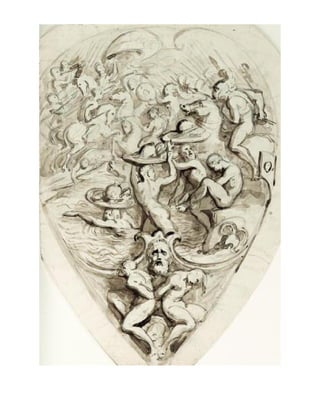
PROJECT FOR A SHIELD IN THE HENRY II
STYLE WITH A ROMAN BATTLE SCENE
Blackcrayonandbrownwashonoff-whitelaidpaper;water-
mark at lower center: D & C Blauw. 24 3/8” x 18 1/8” (61.9
x 20.7 cm).
Note: In response to his fascination with European
art of the sixteenth century, Jean-Jacques Feuchère
began designing Renaissance-style shields, which
were gilded and executed “au repoussé” in a variety
of colored metals by his student and friend Antoine
Vechte (1799-1868). The present work is a design for
a shield in the manner of those made for Henry II of
France (1519-1599). Henry II was the son of Francis I
(1494-1547), who patronized the arts and ushered in
the Renaissance to France. During his reign, Francis
I established a French royal armory, dubbed by later
historians as “the Louvre School”, and he included a
gallery of armor in his (and later his son’s) newly
remodeled home: the Palace of Fontainebleau. After
Francis I’s death, Henry II, who “liked to dazzle with
pageantry and impress upon his subjects the splendor
and the glory of the house of Valois,” continued his
father’s legacy by inviting French, Flemish and
Italian artisans to work in the prestigious armory. The
products from “the Louvre School” were not only
worn and carried by Henry II in grand, ceremonial
processions and parades, but were given as gifts to
the preeminent nobles and royals of Europe, includ-
ing the House of Medici.
As with the Henry II shields, two of which are
in the collections of the Louvre Museum and the
Metropolitan Museum of Art, Feuchère’s design
similarly incorporates a battle scene into the cen-
ter of the composition. Typically, Renaissance
shields depict scenes of “classical mythology and
episodes from Greek and Roman history.” The
inscription (SPQR) at the top of Feuchère’s shield
design indicates that the central scene is Roman in
origin. SPQR is an acronym from the Latin phrase,
“Senatus Populusque Romanus”, which translates
to “The Senate and People of Rome”. Feuchère
also incorporated iconography found specifically in
the shields of Henry II, including the bearded male
face, who symbolizes “chivalrous honor” and the
two, bound, male captives, derived indirectly from
the work of Michelangelo, who are situated below
the central scene. Although the borders and the
top of Feuchère’s shield design were left unfin-
ished, the two extant Henry II shields at the
Louvre Museum and the Metropolitan Museum of
Art provide possibilities for how Feuchère’s draw-
ing might have been completed. In both shields a
female face, also situated between two, bound,
male captives, is placed at the top of the composi-
tion above the central scene while in the borders
“trophies of armor alternating with swags of fruit
occupy the vertical spaces.”
So close in style were Feuchère’s shield designs
to those of the Renaissance originals, that they
were often mistaken as designs produced in “the
Louvre School”. The 1853 catalogue for a sale of
Feuchère’s works, which included a number of
shield designs, gleefully relays the fact that not
even the most “clever and learned of Paris and of
Germany” had been able to tell the difference and
stated that the “masterpieces”, designed, in fact,
by Feuchère, must have been created by a “great”
artist of the Sixteenth Century.
References:
Stephen V. Grancsay, “Royal Armorers: Antwerp
or Paris?” The Metropolitan Museum of Art Bul-
letin (Summer 1959), pp. 1-7.
Stephen V. Grancsay, “A Shield of Henry II of
France,” The Metropolitan Museum of Art Bulletin,
Vol. 29, no. 12, Part I (Dec. 1934), pp. 212-216.
Stephen V. Grancsay, “The Armor of Henry II of
France from the Louvre Museum,” Bulletin of the
Metropolitan Museum of Art, Vol. 11, no. 2 (Octo-
ber 1952), pp. 68-80.
Jules Janin, “Jean Fèuchere” in Catalogue
d’Objets d’Art et de Curiosité…de M. Feuchère
(Paris: Typographie Plon Freres, 1853), pp. 5-26.
S.H.
12 FEUCHÈRE, Jean-Jacques 1807 – 1852
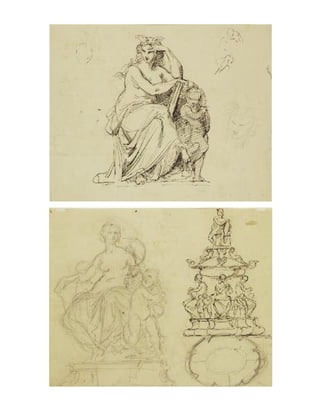
recto:
SKETCH FOR A SCULPTURE PROJECT
WITH WOMAN AND CHILD
verso:
SKETCH OF A SCULPTURAL GROUP WITH
WOMAN AND CHILD AND STUDY FOR A
CENTERPIECE
Pen and brown ink on beige, laid paper; no watermark. 10
x 12 7/8” (25.4 x 32.7 cm).
Note: In the catalog for a sale of Jean-Jacques
Feuchère’s works, immediately following his death
in 1852, French writer and critic, Jules Janin
(1804-1874), wrote of the artist’s technical savvy
in a variety of media. Even at the start of his
career when his job as a chaser and finisher of
bronzes provided him his livelihood, Feuchère was
already becoming equally capable as a sculptor
and designer. The present work includes a variety
of sketches and studies for different objects: two
sculptural groups with a woman and child (recto
and verso) and the design for a centerpiece
(verso). The quality of the draftsmanship reveals
Feuchère’s level of skill and the importance he
placed on the “disegno” as a result of his studies
of the Italian Renaissance. Additionally, the
designs and that of the centerpiece, in particular,
which incorporates separate views of the object
and its base, highlight the artist’s thought and
decision-making process.
It is possible that these drawings were produced
by Feuchère for the Sèvres porcelain factory. Since
1738, the factory had provided elaborate decora-
tive objects and expensive items for the home,
such as coffee and tea services, to members of the
court and the French elite. Throughout the 19th
Century and during the time Feuchère was under
its employ, the factory was known specifically for
its “proclivity to borrow freely from various histori-
cal styles and then to either reinterpret these styles
or combine them in unprecedented ways.”
References:
Jules Janin, “Jean Feuchère” in Catalogue
d’Objets d’Art et de Curiosité…de M. Feuchère
(Paris: Typographie Plon Frères, 1853), pp. 5-26.
Jeffrey Munger, “Sèvres Porcelain in the Nine-
teenth Century” in Heilbrunn Timeline of Art
History (New York: The Metropolitan Museum of
Art, 2000), available from http://www.met
museum.org/toah/hd/sevr/hd_sevr.htm.
S.H.
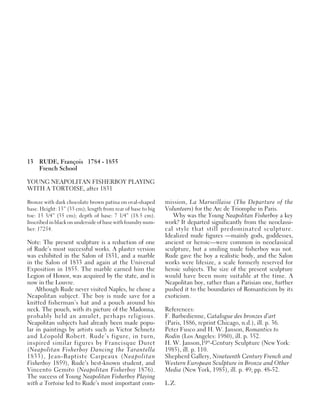
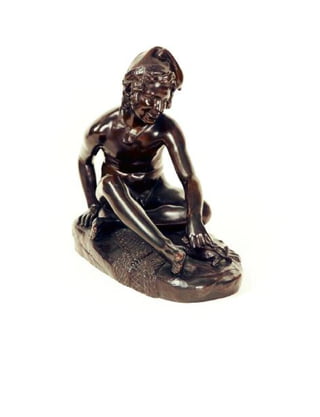
13 RUDE, François 1784 - 1855
French School
YOUNG NEAPOLITAN FISHERBOY PLAYING
WITH A TORTOISE, after 1831
Bronze with dark chocolate brown patina on oval-shaped
base. Height: 13” (33 cm); length from rear of base to big
toe: 13 3/4” (35 cm); depth of base: 7 1/4” (18.5 cm).
Inscribed in black on underside of base with foundry num-
ber: 17254.
Note: The present sculpture is a reduction of one
of Rude’s most successful works. A plaster version
was exhibited in the Salon of 1831, and a marble
in the Salon of 1833 and again at the Universal
Exposition in 1855. The marble earned him the
Legion of Honor, was acquired by the state, and is
now in the Louvre.
Although Rude never visited Naples, he chose a
Neapolitan subject. The boy is nude save for a
knitted fisherman’s hat and a pouch around his
neck. The pouch, with its picture of the Madonna,
probably held an amulet, perhaps religious.
Neapolitan subjects had already been made popu-
lar in paintings by artists such as Victor Schnetz
and Léopold Robert. Rude’s figure, in turn,
inspired similar figures by Francisque Duret
(Neapolitan Fisherboy Dancing the Tarantella
1833), Jean-Baptiste Carpeaux (Neapolitan
Fisherboy 1859), Rude’s best-known student, and
Vincento Gemito (Neapolitan Fisherboy 1876).
The success of Young Neapolitan Fisherboy Playing
with a Tortoise led to Rude’s most important com-
mission, La Marseillaise (The Departure of the
Volunteers) for the Arc de Triomphe in Paris.
Why was the Young Neapolitan Fisherboy a key
work? It departed significantly from the neoclassi-
cal style that still predominated sculpture.
Idealized nude figures —mainly gods, goddesses,
ancient or heroic—were common in neoclassical
sculpture, but a smiling nude fisherboy was not.
Rude gave the boy a realistic body, and the Salon
works were lifesize, a scale formerly reserved for
heroic subjects. The size of the present sculpture
would have been more suitable at the time. A
Neapolitan boy, rather than a Parisian one, further
pushed it to the boundaries of Romanticism by its
exoticism.
References:
F. Barbedienne, Catalogue des bronzes d’art
(Paris, 1886, reprint Chicago, n.d.), ill. p. 36.
Peter Fusco and H. W. Janson, Romantics to
Rodin (Los Angeles: 1980), ill. p. 352.
H. W. Janson,19th
-Century Sculpture (New York:
1985), ill. p. 110.
Shepherd Gallery, Nineteenth Century French and
Western European Sculpture in Bronze and Other
Media (New York, 1985), ill. p. 49; pp. 48-52.
L.Z.
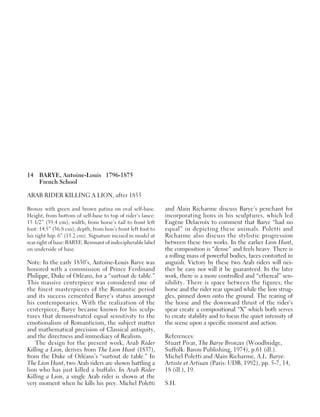
14 BARYE, Antoine-Louis 1796-1875
French School
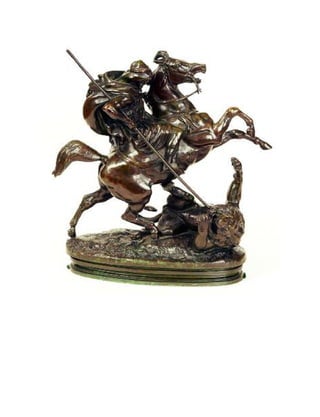
ARAB RIDER KILLING A LION, after 1855
Bronze with green and brown patina on oval self-base.
Height, from bottom of self-base to top of rider’s lance:
15 1/2” (39.4 cm); width, from horse’s tail to front left
foot: 14.5” (36.8 cm); depth, from lion’s front left foot to
his right hip: 6” (15.2 cm). Signature incised in model at
rearrightofbase:BARYE.Remnantofindecipherablelabel
on underside of base.
Note: In the early 1830’s, Antoine-Louis Barye was
honored with a commission of Prince Ferdinand
Philippe, Duke of Orléans, for a “surtout de table.”
This massive centerpiece was considered one of
the finest masterpieces of the Romantic period
and its success cemented Barye’s status amongst
his contemporaries. With the realization of the
centerpiece, Barye became known for his sculp-
tures that demonstrated equal sensitivity to the
emotionalism of Romanticism, the subject matter
and mathematical precision of Classical antiquity,
and the directness and immediacy of Realism.
The design for the present work, Arab Rider
Killing a Lion, derives from The Lion Hunt (1837),
from the Duke of Orléans’s “surtout de table.” In
The Lion Hunt, two Arab riders are shown battling a
lion who has just killed a buffalo. In Arab Rider
Killing a Lion, a single Arab rider is shown at the
very moment when he kills his prey. Michel Poletti
and Alain Richarme discuss Barye’s penchant for
incorporating lions in his sculptures, which led
Eugène Delacroix to comment that Barye “had no
equal” in depicting these animals. Poletti and
Richarme also discuss the stylistic progression
between these two works. In the earlier Lion Hunt,
the composition is “dense” and feels heavy. There is
a rolling mass of powerful bodies, faces contorted in
anguish. Victory by these two Arab riders will nei-
ther be easy nor will it be guaranteed. In the later
work, there is a more controlled and “ethereal” sen-
sibility. There is space between the figures; the
horse and the rider rear upward while the lion strug-
gles, pinned down onto the ground. The rearing of
the horse and the downward thrust of the rider’s
spear create a compositional “X” which both serves
to create stability and to focus the quiet intensity of
the scene upon a specific moment and action.
References:
Stuart Pivar, The Barye Bronzes (Woodbridge,
Suffolk: Baron Publishing, 1974), p.61 (ill.).
Michel Poletti and Alain Richarme, A.L. Barye:
Artiste et Artisan (Paris: UDB, 1992), pp. 5-7, 14,
18 (ill.), 19.
S.H.
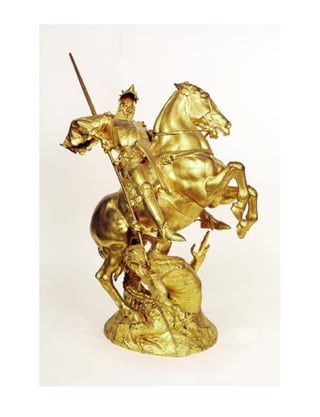
15 FERNKORN, Anton Dominik von
1813 – 1878
German School
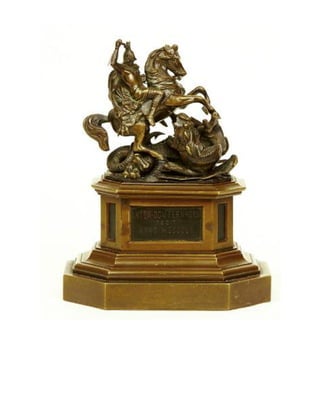
FOUNTAIN OF ST. GEORGE FOR THE
PALAIS MONTENUOVO, VIENNA, 1852
Bronze with dark brown patina on octagonal self-base
mounted to a wider octagonal base. Overall height: 8 1/4”
(21 cm); height from the handle of St. George’s sword to
self-base: 4 1/2” (10.8 cm); width from curve of horse’s tail
to tip of dragon’s left wing: 4 3/4” (12 cm); depth from
dragon’s head to rear edge of self-base: 2 3/4” (7 cm); width
of plinth-like base: 6 1/2” (16.5 cm); depth of plinth-like
base: 4 7/8” (12 cm). Incised on plaque on face of base:
ANTON-DOM-FERNKORN/FECIT/ANNO MDCCLII.
Note: After finishing his education at the Munich
Academy under Ludwig von Schwanthaler, Fernkorn
came to Vienna as an employee in a foundry. It was
a prodigious foundry, directed by Josef Glanz, one of
Christian Daniel Rauch’s major chasers in Berlin,
whom Rauch called “the best German chiseler”.
Nevertheless, it marks Fernkorn as a man who came
to sculpture from a craftsman’s experience. Having
worked in Munich in an iron-casting establishment,
Fernkorn never lost his passion for technical bravura.
The present sculpture is actually a precursor to
Fernkorn’s most extraordinary technical achieve-
ment, the monument to Archduke Carl (the victor
over Napoleon at Aspern) in Vienna’s Heldenplatz.
He mounted the archduke with all his gear on a rear-
ing horse that is only supported by the two points
where the hind legs of the horse touch the ground.
Ever since Leonardo da Vinci (another technical
wizard) attempted and aborted this feat, sculptors
were haunted by the ambition to achieve such a
technical masterpiece. Exactly around the time of
Fernkorn’s commission, Stephen A. Douglas
achieved it by putting Andrew Jackson on a rearing
horse (1853 Washington D.C.), and Auguste de
Montferrand made Nicholas I in St. Petersburg
(1859) almost jump into the Moika river.
The connection of Fernkorn’s St. George with
his monument for Archduke Carl relies on
Fernkorn’s own story (told by Pollak): a staff offi-
cer of Emperor Franz-Josef saw a statuette of
Archduke Carl, originally made for a clock, in the
artist’s studio. The officer got the emperor inter-
ested, Fernkorn was called for, and asked whether
he could “do something like this in very big?”
Fernkorn referred to his St. George Fountain, the
emperor went to see it, and Fernkorn got the com-
mission for Archduke Carl.
Georg Raphael Donner created a prototype for
St. George for the Church of St. Martin in
Bratislava (then Pressburg) in 1733-35. Donner’s
work depicts St. Martin on a rearing horse, cutting
his coat for a beggar at his feet. Since Bratislava is
near Vienna, Fernkorn must have known this com-
position, perhaps he even felt challenged by it. The
different subject – St. Martin’s compassion versus
St. Georges dramatic fight – makes Fernkorn’s
piece unique in its wild energy. The sculpture was
so successful, that orders came in for replicas. One
of them is situated today in Zagreb (then Agram).
The original fountain was incised Anton
Fernkorn inv. Fecit 1853 (Pollak p. 19). It is inter-
esting to note, that the present reduction is dated
1852, which means that reductions were issued
even before the large sculpture was unveiled.
Pollak reports they were sold by the Kunstverein in
a raffle. The precision of the present piece – as e.g.
the miniature face of the saint, the claws and the
tongue of the dragon – is a testimony to the fact
that Fernkorn kept a sharp eye on his chiselers.
Fernkorn had only twenty years to create an
œuvre that left its mark throughout the Habsburg
empire and the Vienna cityscape. Zagreb’s equestri-
an monument to Josip Jelačic displays the liberator
of Croatia on horseback (with its four feet on the
ground). Ljubljana moved the colossal bust of Joseph
Radetzky to the City Museum, and Vienna’s beloved
Danube Nymphs (Donauweibchen) decorate a court-
yard built by the architect Heinrich von Ferstel. By
the time Fernkorn worked on a monument to Prince
Eugene of Savoy as a companion piece for Archduke
Carl on the Heldenplatz, the artist had already suf-
fered several strokes and needed an escort to attend
the unveiling. He entered a private clinic in 1866
and eventually an insane asylum in 1868. His studio
and villa were taken over by Hans Makart in 1869.
References:
Friedrich Pollak, Anton Dominik von Fernkorn.
Ein österreichischer Plastiker. (Vienna: Schworella
und Heik, 1911).
Hans Aurenhammer, Anton Dominik Fernkorn.
(Vienna: Verlag Anton Schroll & Co., 1859.
E.K.
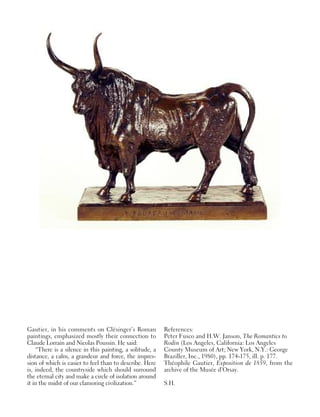
16 BONHEUR, Rosa 1822-1899
French School
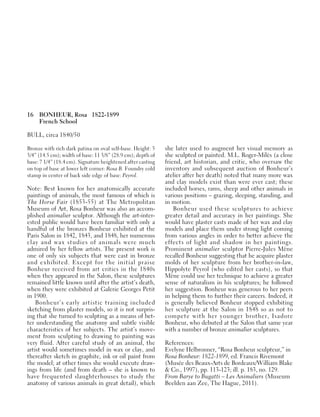
BULL, circa 1840/50
Bronze with rich dark patina on oval self-base. Height: 5
3/4” (14.5 cm); width of base: 11 3/8” (28.9 cm); depth of
base: 7 1/4” (18.4 cm). Signature heightened after casting
on top of base at lower left corner: Rosa B. Foundry cold
stamp in center of back side edge of base: Peyrol.
Note: Best known for her anatomically accurate
paintings of animals, the most famous of which is
The Horse Fair (1853-55) at The Metropolitan
Museum of Art, Rosa Bonheur was also an accom-
plished animalier sculptor. Although the art-inter-
ested public would have been familiar with only a
handful of the bronzes Bonheur exhibited at the
Paris Salon in 1842, 1843, and 1848, her numerous
clay and wax studies of animals were much
admired by her fellow artists. The present work is
one of only six subjects that were cast in bronze
and exhibited. Except for the initial praise
Bonheur received from art critics in the 1840s
when they appeared in the Salon, these sculptures
remained little known until after the artist’s death,
when they were exhibited at Galerie Georges Petit
in 1900.
Bonheur’s early artistic training included
sketching from plaster models, so it is not surpris-
ing that she turned to sculpting as a means of bet-
ter understanding the anatomy and subtle visible
characteristics of her subjects. The artist’s move-
ment from sculpting to drawing to painting was
very fluid. After careful study of an animal, the
artist would sometimes model in wax or clay, and
thereafter sketch in graphite, ink or oil paint from
the model; at other times she would execute draw-
ings from life (and from death – she is known to
have frequented slaughterhouses to study the
anatomy of various animals in great detail), which
she later used to augment her visual memory as
she sculpted or painted. M.L. Roger-Milès (a close
friend, art historian, and critic, who oversaw the
inventory and subsequent auction of Bonheur’s
atelier after her death) noted that many more wax
and clay models exist than were ever cast; these
included horses, rams, sheep and other animals in
various positions – grazing, sleeping, standing, and
in motion.
Bonheur used these sculptures to achieve
greater detail and accuracy in her paintings. She
would have plaster casts made of her wax and clay
models and place them under strong light coming
from various angles in order to better achieve the
effects of light and shadow in her paintings.
Prominent animalier sculptor Pierre-Jules Mène
recalled Bonheur suggesting that he acquire plaster
molds of her sculpture from her brother-in-law,
Hippolyte Peyrol (who edited her casts), so that
Mène could use her technique to achieve a greater
sense of naturalism in his sculptures; he followed
her suggestion. Bonheur was generous to her peers
in helping them to further their careers. Indeed, it
is generally believed Bonheur stopped exhibiting
her sculpture at the Salon in 1848 so as not to
compete with her younger brother, Isadore
Bonheur, who debuted at the Salon that same year
with a number of bronze animalier sculptures.
References:
Evelyne Helbronner, “Rosa Bonheur sculpteur,” in
Rosa Bonheur: 1822-1899, ed. Francis Rivemont
(Musée des Beaux-Arts de Bordeaux/William Blake
& Co., 1997), pp. 113-123; ill. p. 183, no. 129.
From Barye to Bugatti – Les Animaliers (Museum
Beelden aan Zee, The Hague, 2011).
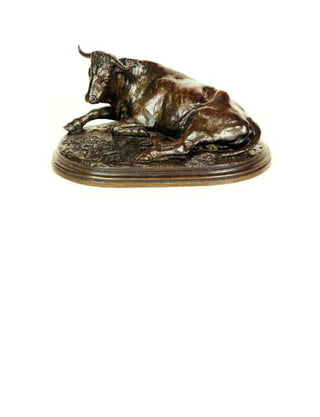
17 CLÉSINGER, Jean-Baptiste, called
Auguste 1814 - 1883
French School
ROMAN BULL, 1857
Bronze with brown patina on rectangular self-base. Height,
from bottom of self-base to tip of left horn: 12 7/8” (32.7
cm); width, from curve of right horn to right edge of self-
base: 15” (38.1 cm); depth, from curve of left horn to rear
of self-base: 6 5/8” (16.8 cm). Title incised in model at
front side of self-base: TAUREAU-ROMAIN. Signature,
inscription and date incised at rear right on top of self-
base: J. CLESINGER. ROME. 1857. Collas slug on rear
side of self-base at right corner: REDUCTION
MÉCANIQUE/ A. COLLAS/ BREVETE.
Note: Born and raised in Besançon in eastern
France, Jean Baptiste Clésinger first received his
artistic training from his father, Georges-Philippe
Clésinger, an academic sculptor and professor of
art. In 1832, Clésinger left his hometown to study
in Rome under Danish artist Bertel Thorvaldsen
(1770-1844). Rome’s “most admired” sculptor fol-
lowing the death of Canova in 1822, Thorvaldsen
was best known for his Neoclassical, Roman
(rather than Greek) inspired works with motifs
from Classical mythology and for his monumental
likenesses of historical figures. Thorvaldsen’s
sculptures and teachings influenced Clésinger
hugely, particularly in the later, post-1856, years of
his career, from which the present work is part. It
was also during Clésinger’s first stay in Rome that
he changed his given name to “Auguste” believing
it a more appropriate name befitting his august
talent. Although the artist was highly praised by
the critics, his contemporaries found him “particu-
larly vain.” Clésinger did not maintain close rela-
tionships with other artists, as ultimately he
believed himself “superior” to them.
After the completion of his education in Rome
and his return to Paris, Clésinger achieved both
personal and professional success. He exhibited at
the Paris Salon from 1843 through 1864, winning
third-class medals in 1846 and 1847 and a first-
class medal in 1848. In 1847, he married novelist
George Sand’s daughter, Solange Dudevant, and
he became father to a daughter, Jeanne, in 1855.
And, in 1849 he was decorated with the cross of
the Légion d’Honneur; he was later elevated to
officer in 1864. However, these successes were fol-
lowed subsequently by both personal and profes-
sional crises. In 1855, Clésinger and Solange
Dudevant divorced and their daughter died shortly
after. In 1856, a work commissioned of the artist
for the Louvre, Francois 1er
à Cheval received harsh
criticism and was quickly removed. The combina-
tion of these discouraging events forced Clésinger
to flee Paris and return to Rome.
In Rome, Clésinger embraced more fully
Neoclassical style and subject matter and created
sculptures that reflected this renewed perspective.
Ironically, it was these later Roman works, “repre-
senting a new aspect of his oeuvre,” that would
lead to Clésinger’s reclamation of fame in Paris,
the city which he had left in despair and to which
he returned in 1859 and where he lived for the rest
of his life. Clesinger’s monumental marble works
became highly collectible in their reduced formats,
produced in bronze by Barbedienne through the
“reduction méchanique” process developed by
Achille Collas. The Taureau Romain was made
available in three sizes: 115 cm, 85 cm, 44 cm, 33
cm (the present work), 23 cm, and 17 cm.
The Taureau Romain was a theme repeated
often by the artist in the later period of his career.
The sculptures, Combat de Taureaux Romains
(1864) and Taureau Romain (1878), were also made
available in various sizes by Barbedienne.
Additionally, the subject matter was repeated in a
series of paintings that Clésinger produced while in
Rome, perhaps “as an antidote for the wounds he
had received as a sculptor”. He later exhibited sever-
al of the Roman landscapes in the Paris Salon of
1859 and received “enthusiastic praise” from critics
including Charles Baudelaire and Théophil Gautier.
In works such as Taureaux dans la Campagne
Romaine (1863) and L’Abreuvoir (The Watering
Hole) (1857), Clésinger depicted groups of noble
cattle in idyllic and peaceful pastoral scenes. While
the “heavy impasto and intensive colors” of the
works reflect the stylistic interests of contemporary
Barbizon artists, including Jules Dupré and
Théodore Rousseau, the serene mood, balanced
composition, and timeless subject matter also
reflect Clésinger’s interest in Classicism. Théophil
Gautier, in his comments on Clésinger’s Roman
paintings, emphasized mostly their connection to
Claude Lorrain and Nicolas Poussin. He said:
“There is a silence in this painting, a solitude, a
distance, a calm, a grandeur and force, the impres-
sion of which is easier to feel than to describe. Here
is, indeed, the countryside which should surround
the eternal city and make a circle of isolation around
it in the midst of our clamoring civilization.”
References:
Peter Fusco and H.W. Janson, The Romantics to
Rodin (Los Angeles, California: Los Angeles
County Museum of Art; New York, N.Y.: George
Braziller, Inc., 1980), pp. 174-175, ill. p. 177.
Théophile Gautier, Exposition de 1859, from the
archive of the Musée d’Orsay.
S.H.
18 FROMENTIN, Eugène 1820 - 1876
French School
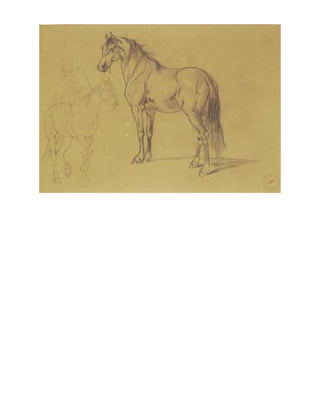
HORSE STUDY WITH STUDY OF
MOUNTED ARAB
Graphite on tan wove paper laid to board. No visible
watermark. 8” x 11 3/16” (20.3 x 28.4 cm). Circular, red
estate stamp on lower right sheet edge (Lugt 957): VENTE/
EUG.FROMENTIN; in center of stamp in dark ink: 282.
Inscribedon back of mounting board: Fromentin. Framer’s
label on old backing: AMSTERDAM ROKIN 105/ A.J. Hei-
jdenrijk Jr. N.V./ Encadrementen-Lijsten/ DEN HAAG
NOORDEINDE 134.
Note: Eugène Fromentin was born in La Rochelle,
France to a wealthy and educated family of lawyers
and doctors. Although Fromentin’s father, a physi-
cian, was also a talented and trained amateur
painter who instructed his own son “in the rudi-
ments of technique,” he nevertheless demanded
that his son follow a “serious” career path in law.
In 1839, Fromentin moved to Paris to study law at
his father’s command and, although successful in
his academic pursuits and in his legal career fol-
lowing the attainment of his degree, circumstance
and the young man’s strong desire directed him
instead to a life in the arts. Fromentin’s childhood
lessons in technique had triggered this desire and
it only grew stronger in adulthood with the artist
reportedly covering all the surfaces of his law office
with his drawings and sketches. Additionally, fol-
lowing a failed love affair, Fromentin withdrew
into seclusion and buried his emotions by reading
and writing essays and literary dramas. Ultimately,
Fromentin achieved prominence both as a writer
and a visual artist. He was published in a variety of
genres including romantic fiction, art criticism and
analysis, and travel literature. His paintings were
successfully shown at several Salons and at the
Universal Exposition of 1867. His work was praised
within academic circles and by his country, the lat-
ter of which named him Commander of the
Legion of Honor in 1869.
Eugène Fromentin has been categorized as a
“Romantic Orientalist” and often compared to
Delacroix for his use of vibrant color, dramatic mood
and exotic subject matter. In 1846, 1847, and again in
1852, Fromentin traveled to Algeria and throughout
Africa. These trips were highly influential not only to
Fromentin’s writing career (he published A Summer
in the Sahara and A Year in Sahel in the late 1850s)
but also resulted in the visual translations of those
writings into paintings. The present work, two sketch-
es, one a more loosely drafted Arab rider on horseback
and the other a more finished portrayal of a horse in
“noble stance” are common figures found in
Fromentin’s larger paintings. In particular, Fromentin
is known for “sweeping landscapes, enlivened by poet-
ic groups of animals and figures”. To Fromentin, the
world outside the confines of his Parisian life offered
infinite creative possibilities. He wrote: “The more I
study nature here, the more convinced I am
that,…the Orient is still waiting to be painted.”
References:
Ingres & Delacroix through Degas & Puvis de Cha-
vannes: The Figure in French Art, 1800-1870 (New
York, N.Y.: Shepherd Gallery, Associates, Inc,
1975), pp. 217-221.
James Thompson and Barbara Wright, La Vie et
l’Oeuvre d’Eugène Fromentin (Courbevoie/Paris:
ACR, 1987).
James Thompson and Barbara Wright, Eugène
Fromentin, 1820-1876: Visions d’Algérie et d’Égyp-
tie (Paris: ACR, 2008).
S.H.
19 MONTICELLI, Adolphe-Joseph-Thomas
1824 - 1886
French School
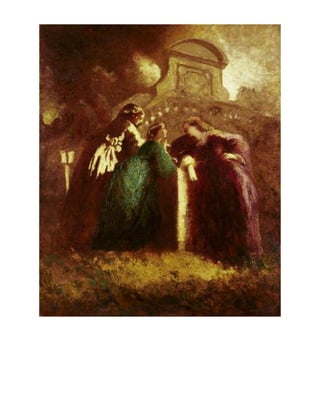
LES DAMES DE LA REINE, circa 1865
Oiloncanvas,relined.251/2”x21”(64.8x53.3cm).Signed
in reddish-brown oil at lower right: Monticelli. On verso
on printed Parrish Art Museum exhibition label: Adolph
Monticelli, Les dames de la Reine, c. 1868 [sic], Courtesy
of Schweitzer Gallery.
Exhibition: William Merritt Chase in the Company
of Friends 5/13/79-7/29/79, Parrish Art Museum,
Southampton, New York.
Note: Of Les Dames de la Reine, Monticelli scholar
Aaron Sheon states that “the painting is an impor-
tant and quite rare image from [Monticelli’s ]
career in Paris, around 1865.” It is “one of [his]
most joyful works from the 1860’s.” Born in
Marseille, Monticelli moved to Paris and worked in
the studio of Delaroche from 1846-47. He copied
old masters in the Louvre and, with his friend,
Narcisse Diaz, he painted in the forest of
Fontainebleau. During the reign of Napoleon III
and Empress Eugénie, when neo-rococo taste flour-
ished, Monticelli was very successful, painting fêtes
galantes and landscapes, for members of the court
and possibly for the Empress herself. Sheon explains
that by the mid-1860’s the artist already had “steady
sales of Rococo inspired paintings of women in cos-
tumes sitting in parks, often with fountains or walls.
There is usually no narrative. The figures seem to
live in moments of pleasure and beauty.”
Les Dames de la Reine depicts a fantastical nar-
rative of ladies-in-waiting conversing in the formal
garden of a noble park. The subject matter reflects
Monticelli’s “admiration of the court of the
Empress”, which promoted and favored the
Rococo of Louis VI as a means to legitimize
Napoleon III and his Spanish wife, Eugénie.
Stylistically, Les Dames de la Reine reflects a gen-
eral shift in focus towards Impressionist experi-
ments in the depictions of light, the manner in
which paint is applied onto the canvas, and the use
of expressionistic color. Aaron Sheon points to
Monticelli’s use of highlight and particularly “the
bright sky reflections on the clothes of the figures”
as specific qualities that also appear in Claude
Monet’s Women in the Garden, 1866. The scum-
bled brushstroke, which reveals the various,
abstracted layers of color, is reminiscent of the
brushstroke utilized by Monticelli’s painting com-
panion, Narcisse Diaz. Also, the dappled quality of
light which results in an overall atmospheric haze
and heightens the sense of fantasy, is similar to
that found in the fêtes galantes of the same period,
painted by Henri Fantin-Latour.
By the time of the Franco-Prussian war in
1870/71, Monticelli was so well known that he was
able to retreat to his hometown, living on the fees
for the commissions of his paintings. His later pic-
tures, heavy with impasto and dazzling in color,
became an important influence on fellow artists,
particularly Paul Cézanne and Vincent van Gogh.
In his last years, after his mother’s death in
1882, Monticelli succumbed to alcohol and died
after several strokes in a nursing home.
References:
Elisabeth Kashey, Nineteenth Century European
Paintings, Watercolors, Drawings and Sculpture
(New York: Shepherd Gallery Associates, Spring
2000), p.19.
Professor Emeritus Aaron Sheon (Department of
the History of Art and Architecture-University of
Pittsburgh), “Authentication of Monticelli Paint-
ing.” Letter to Mary Adair Dockery, May 28,
2012, n.p.
S.H.
20 LEGROS, Alphonse 1837 - 1911
FRENCH SCHOOL
FIGURES WITH A NET IN A STREAM
Oil on carton. Painted wooden strip attached along top of
the painting with backing on reverse. Size including the
extension: 20 1/2” x 30 7/8” (52 x 83.5 cm). Signed in red
oil at lower left: A. Legros. On verso: oil painting, allego-
ry of the Passion.
Note: Alphonse Legros was a prolific and highly
skilled nineteenth century artist with a penchant
for working across an array of artistic media and
subject matter throughout the duration of his
career. He was closely associated with what
Michael Fried called the ‘generation of 1863,’
which describes the group that participated in the
Salon des Refusés in Paris, including Édouard
Manet, Henri Fantin-Latour and James Whistler.
Legros nevertheless stands apart for his persistent
emphasis on technique, his expatriate status and
mentorship of younger artists, and his commit-
ment to a unique style of genre painting punctuat-
ed by elements of stark realism.
While Legros is primarily known for his master-
ful production of etchings, as he completed over
600 plates in his lifetime, he was also a dynamic
portrait and landscape painter. Born into a modest
family in Dijon and apprenticed to a house painter
at the age of eleven, he studied under Lecoq de
Boisbaudran at the École des Beaux-Arts after
finally reaching Paris in 1851. At the drawing
school Legros met Fantin-Latour and, along with
Whistler, they quickly banded together as the
“Group of Three” based on a mutual aversion to
academic art training in France. After working on
theater sets under Charles Antoine-Cambon,
Legros exhibited his famous painting Ex-Voto at
the Paris Salon in 1861 and was given an honor-
able mention.
The artist’s early style in Paris is characterized
by his interest in Northern Renaissance art, the
Spanish Golden Age, and French Romanticism
as well as his practice of copying masterworks at
the Louvre with Fantin-Latour. Thus some of
Legros’ most well known paintings prominently
feature religion, including Ex-Voto, Le Calvaire
at the Louvre, and Femmes en Prière at the Tate.
Though the contemporary style of artists like
Claude Lorraine, Jean-François Millet and
Manet would ultimately supersede the influence
of Holbein, Rembrandt and Dürer on Legros,
paintings like Figures with Net in Stream demon-
strate his continued engagement with both the
pastoral subject matter of the impressionists and
the religious contemplation of the old masters.
(The painting possibly alludes to Christ with his
disciples.)
After first visiting London in 1861 with
Whistler, Legros officially moved to the United
Kingdom in 1863 and became a British citizen in
1881. Tired of the constant financial battles he
faced in Paris, Legros became Professor of Fine Art
at the Slade School in 1876 where he introduced
etching and modeling to the syllabus. Legros fre-
quently exhibited at the Royal Academy in
London and in the 1870s began to work more
heavily on rustic landscape scenes of peasant life
featuring fishermen, craftsmen and the like.
References:
Michael Fried, “Manet in His Generation: The
Face of Painting in the 1860s.” Critical Inquiry
19 (Autumn, 1992), pp. 22-69.
Malcolm C. Salaman, Modern Masters of Etching:
Alphonse Legros (London: The Studio, 1926).
Gary Tinterow and Henri Loyrette, Origins of
Impressionism (New York: Metropolitan Museum
of Art, 1994).
Timothy Wilcox, “Legros, Alphonse
(1837–1911)” in Oxford Dictionary of National
Biography (Oxford: Oxford University, 2004).
E.F.
21 CHAPU, Henri-Michel-Antoine
1833 - 1891
French School
THOUGHT, after 1876
Bronze with brown patina mounted onto L-shaped Rouge
Griotte marble stand. Overall height (including marble
stand): 15 5/8” (39.7 cm); width: 9 1/2” (24.1 cm); depth:
4” (10.2 cm). Signature incised after casting on left side
of base: H. CHAPU. Circular foundry mark, bronze slug
inserted after casting at lower right: THIÉBAUT FRERES/
FONDEUR/ PARIS.
Note: Born in Le Mée, near Melun, the son of a poor
coachman, Chapu was raised by one of his uncles
until he was ten years old. At that time he moved to
Paris with his parents who had become caretakers at
the home of the Marquis de Vogue. When Chapu
turned twelve he was apprenticed to a tapissier,
under whom he learned to draw. Two years later, in
1847, he entered the Petit École to study decorative
arts, but his skill and ambitions led him to enroll in
the École des Beaux-Arts in 1849. He studied under
James Pradier from 1850 until the latter’s death in
1852, when he transferred to the atelier of
Francisque Duret (1804-1865) and Léon Cogniet
(1794-1880). Chapu’s talents won him a second
prize as a medal engraver in 1851, the second grand
prize for sculpture in 1843, and two years later, he
was awarded the prix de Rome for his relief Cleobis
and Biton. The young sculptor passed the following
five years at the French Academy in Rome quietly;
his sobriety and shyness earned him the nickname
“Monsieur l’abbé.” One of his early efforts there, a
relief representing Christ with the Angels (1857), was
criticized when it was exhibited in Paris, but his next
few works were favorably received. In Rome he
carved a marble sculpture, Mercury Inventing the
Caduceus and executed a figure of Tripolème, the
model for his bronze, the Sower (1865, formerly
Paris, Parc Monceau). In 1861 Chapu returned to
Paris penniless, but the State soon purchased
Tripolème for 8,000 francs, which permitted him to
establish himself in the capital. At this time he
began to work as a decorative sculptor, as he would
continue to do throughout his career. His first great
success, the kneeling, meditative Joan of Arc at
Domrémy (plaster model 1870; marble Salon of
1872), became one of the most beloved French
sculptures of the nineteenth century.
At the Salon of 1875 Chapu won high praise
again, and a medal of honor, for his marble
female personification of Youth created for the
Monument to Henri Regnault (Paris, École des
Beaux-Arts). This figure gained such popularity
that the Barbedienne foundry produced bronze
reductions of it in three different sizes. From
this time on he received a series of prestigious
commissions for public memorials, including the
Tomb of the Countess of Agoult (1877), the Tomb
of Jean Reynaud (begun 1877), the funerary
Monument for the Duchess of Orléans (1885),
and shortly before his death, the Monument to
Gustave Flaubert (marble, 1880-1890, Rouen).
Also, although the sculptor specialized in tombs
and public memorials, he additionally headed
three studios which produced decorative sculp-
ture and medallions. In 1872 he was decorated as
an officer in the Legion of Honor. From 1880 on
he taught modeling at the École des Beaux-Arts.
The present work is a bronze reduction of
Chapu’s marble tomb of the Countess of Agoult
(1805-1876) in Division 54 of Père Lachaise
Cemetery. The Countess of Agoult, also known by
her pen name Daniel Stern, was an author best
known for her work in three volumes: Histoire de la
révolution de 1848 (1850-53). Born in Germany to
an aristocratic family, as Marie Catherine Sophie
de Flavigny, the young woman ultimately returned
to France following the fall of Napoleon in 1814.
In 1827, she married Charles Louis Constant
d’Agoult, Count of Agoult, from whom she was
divorced in 1835. Although never again married,
the Countess lived and had children with compos-
er Franz Liszt. Following the dissolution of that
relationship in 1839, the Countess began her pro-
fessional career in earnest and published her first
stories in 1841.
Typical of the period, Chapu usually employed
traditional allegorical themes in his monuments,
as with the figure of Thought depicted in high
relief on the tomb of the Countess of Agoult. In
1921, art historian Chandler Rathfon Post wrote
this regarding Chapu’s depictions of the women
and Thought, in particular:
22 SAINT-GAUDENS, Augustus 1848 - 1907
American School
CHRISTOPHER COLUMBUS
COMMEMORATIVE MEDAL, circa 1893
Bronze medal with brown patina, in original blue velvet
and aluminum box with a decorative floral motif. Diam-
eter: 3” (7.62 cm). Inscribed in the mold at upper right:
PLVS/ VLTRA/ CHRISTOPHER/ COLVMBVS/ OCT XII/
MCCCCXCII; inscribed in the mold at bottom:
AVGVSTVS SAINT-GAUDENS FECIT. On verso, in
raised lettering: WORLD’S COLUMBIAN EXPOSITION/
INCOMMEMORATIONOFTHE/FOURHUNDREDTH
ANNIVERSARY/ OF THE LANDING OF COLUMBUS/
MDCCCXCII MDCCCXCIII/ TO THE AMERICAN/
SUGAR REFINING CO.; incised at bottom: C.E. BAR-
BER FECIT.
Note: Known primarily as a sculptor of public mon-
uments for which he achieved great acclaim,
Augustus Saint-Gaudens also worked on a smaller
scale. Specifically, in the last twenty years of his
life, he designed both commemorative medals and
US coins, the latter at the request of personal
friend and President of the United States,
Theodore Roosevelt. The design for the present
work, an official award medal for the World’s
Columbian Exposition held in Chicago in 1893, for
which Saint-Gaudens was also an advisor for the
sculptural program, was commissioned in 1892 and
completed by the closing of the fair. Recipients,
often financiers of the Exposition, were ultimately
awarded the medals in 1896. This particular medal
was awarded to The American Sugar Refining
Company, who controlled 98% of the U.S. output
of sugar at this time, and who were responsible for
“furnish[ing]” a “complete exhibit of raw and
refined sugars and syrups” at the fair.
The design process of the Christopher
Columbus Medal was a long and contentious one.
The obverse of the work is as Saint-Gaudens had
originally intended it to be; it depicts Christopher
Columbus setting foot onto the “new world” in
1492. (The World’s Columbian Exposition was, in
fact, celebrating the 400th
anniversary of
Columbus’s landing in America.) Behind Columbus
three male figures are disembarking from a partially
visible boat. Above these figures is the Spanish coat
of arms supported by the Pillars of Hercules; the
coat of arms reads as: PLUS ULTRA, or “further
beyond”. The original design of the reverse of the
medal, as conceived by Saint-Gaudens or, as has
been suggested, by his brother Louis Saint-
Gaudens, an assistant to Augustus and a sculptor in
his own right, was rejected outright. The art world
at large supported the design, which featured a
nude male youth representing the “Spirit of
America,” but the United States Quadrocentennial
Committee found the nudity of the youth to be
offensive. And although Augustus Saint-Gaudens
offered alternatives to the offending original design,
the Committee ultimately decided to turn to
Charles E. Barber, Chief Mint Engraver and
“[Chapu] excelled in ideal feminine figures, in
which realism is tempered by a study of the harmony
and repose of ancient art, a restrained degree of spiritu-
al expression is attained, and a healthy sweetness is
coupled with a proper elegance.”
On the original tomb, the figure of Thought is
accompanied by a bust of Johann Wolfgang von
Goethe placed upon a stele; a medallion containing
a profile-view portrait of the Countess is situated
at the top of the monument. In the bronze reduc-
tion, the top of the monument has been removed,
along with the medallion, and the bust of Goethe
has been replaced by a bust of the goddess Athena.
References:
Marie Busco, “Chapu, Henri-Michel-Antoine,”
in Nineteenth Century French and Western
Sculpture in Bronze and Other Media, eds. Elisa-
beth Kashey and Robert Kashey (New York:
Shepherd Gallery, Associates), 1985), pp. 144-
145.
Chandler Rathfon Post, A History of European
and American Sculpture from the Early Christian
Period to the Present Day, (Cambridge: Harvard
University Press, 1921), p. 146.
S.H.
“career-long nemesis” to Augustus Saint-Gaudens,
to create the design of the reverse of the medal as it
now exists. Barber and Saint-Gaudens had originally
met in 1891 when they were both on a committee to
judge the entries for new coinage to be produced by
the US Mint. At that time, Saint-Gaudens had
claimed to be the only American up to the task,
both in terms of skill and creativity, to which Barber
had taken great offense. Therefore, the final selec-
tion of Barber’s design for the reverse of the
Christopher Columbus Medal just a few years later
was for Saint-Gaudens the greatest of insults and
the harshest of judgments against his art.
References:
John H. Dryfhout, The Work of Augustus Saint-
Gaudens (Hanover, N.H.: University Press of New
England, 1982).
Donald Scarinci, “Medals of the 1893 World’s
Fair,” TAMS Journal (January-February, 2010),
pp. 9-11
Thayer Tolles, “Augustus Saint Gaudens in the
Metropolitan Museum of Art,” The Metropolitan
Museum of Art Bulletin, V. 66, no. 4 (Spring,
2009), p. 71.
S.H.
23 FRÉMIET, Emmanuel 1824 – 1910
French School
ST. GEORGE, circa 1891
Gilt bronze on circular self-base. Height from top of lance
to base: 20 1/8” (51.1 cm); width from horse’s left knee to
end of lance: 16” (40.6 cm); depth from dragon’s right claw
to edge of St. George’s left foot: 9” (22.9 cm). Signed on
base below dragon’s right side, heightened after casting:
EFREMIET. Cold-stampedon base belowhorse’stail: 208.
Note: This bronze statuette of St. George is based
on the monumental plaster sculpture Knight
Errant exhibited in the Paris Salon of 1878. The
statuette version of the work was shown at the
Salon of 1891 and the Exhibition Universelle in
1900 as Saint George Subduing the Dragon. It
depicts the medieval Saint George in the midst of
slaying the dragon that resulted in the conversion
of an entire village.
Born in Paris in 1824, Frémiet had the good
fortune to be apprenticed at an early age to his
uncle, the sculptor François Rude. In addition to
working throughout his teenage years in Rude’s
studio, Frémiet also attended the Petite École
and was employed by the naturalist and lithogra-
pher Jacques Vernet at the Jardin des Plantes in
the department of science. It was while working
for Vernet, who paid the young artist to make
highly detailed drawings of animal bones, that
Frémiet made his first three-dimensional work: a
clay sculpture of a fox from life. Subsequent jobs
included assisting the painter and naturalist Jean-
Charles Werner at the Musée National d’Histoire
Naturelle on an anatomical compendium, helping
Dr. Mateo Orfila assemble the specimens for his
anatomical museum and touching up the
embalmed corpses at the Paris morgue – all of
which endowed Frémiet with an exquisite knowl-
edge of anatomy and physiognomy and led him
to remark in 1891 that “science is an absolute aid
in art.”
Frémiet made his formal debut as an animalier
at the Paris Salon of 1843 with a plaster study of a
gazelle and the majority of his works thereafter
feature animals prominently. Though he was deco-
rated with the Legion of Honor in 1860 and took
second medal at the Salon in 1867, Frémiet’s lack
of convention left him somewhat ostracized by the
old vanguard in France. His ambitious and notori-
ous Gorilla Carrying off a Woman was rejected by
the Salon jury in 1859 (he won the medal of honor
for the same subject in 1877). The artist produced
his first equestrian statues for Napoleon III in the
1860s and his first life-size bronze equestrian mon-
uments Napoleon I and Louis d’Orléans in 1866
and 1870, respectively. His lack of commissions
from the French state led him to depend heavily
on commercial reproductions of his work, but his
luck changed in 1874 with the Jeanne d’Arc com-
mission at the Place des Pyramides and later his
succession of Barye as Professor of Animal Design
at the Jardin des Plantes in 1875.
From the mid-1870s onward, the equestrian
theme came to dominate the artist’s oeuvre,
prompting the American art historian T.H.
Bartlett to remark in 1891 that Frémiet was the
only modern sculptor capable of sculpting horses
on par with the Colleoni in Venice, the
Gattamelata in Padua, and the Marcus Aurelius in
Rome. Frémiet made eight large equestrian stat-
ues in his lifetime, six of which were life size, and
more often than not worked from life. He certain-
ly had access to the Emperor’s horses as models
when contemplating the equestrian statues for
Napoleon III and was commissioned by the state
immediately after for a horse sculpture for the
Veterinary School in Alfort in 1868. Though some
critics have argue periodically that Frémiet was
more occupied by the horses than the riders
themselves, the artist proved his abilities with the
heroine Jeanne d’Arc, from which 300 statuettes
were made.
Though St. George represents a Christian leg-
end, the work also builds on Frémiet’s extensive,
empirical experience with equestrian and animal
subjects. While the dragon speared by St. George
appears to be an imaginary creature, in actuality
the dragon’s webbed claws, scaly tale and overt
lack of wings renders it a composite animal based
largely the crocodile. As noted by Louise
Lippincott, nineteenth-century dragons were often
derived from the “dragon-crocodiles” of medieval
bestiaries as well as ‘oriental’ depictions of the
creatures, which featured scales and blue/lavender
coloring. Significantly, Frémiet had previously
sculpted crocodiles on at least two occasions: for
the base he create for r a porphyry table-top at the
Louvre (now disappeared) and for a group of ani-
mals he created for the architect Hector-Martin
Lefuel while Frémiet worked on the seahorses for
the Fontaine de l’Observatoire. The artist also
24 MERCIÉ, Antonin 1845 - 1916
French School
AFTER GÉRÔME’S DANCE OF THE ALMEH
Bronze with golden patina. Mounted on circular golden
patina base. Overall height: 15 3/4” (40 cm); height from
woman’s right foot to top of left hand: 14” (35.6 cm); width
from fold of drapery on woman’s right to her left hand: 7
1/4” (18.4 cm); depth from drapery bundle at rear of
woman’s head to front of left arm: 7” (17.8 cm). Signa-
ture and title engraved on left front of base: A. Mercié
d’après Gerômé. Cold stamp at rear of base: 41.
Note: The present work depicts the central figure of
Jean-Léon Gérôme’s painting Dance of the Almeh
from 1866. By rendering Gérôme’s protagonist in
three dimensions, Mercié not only demonstrated his
skill as a sculptor but also participated in the often
contentious culture of exchange and appropriation
between the media of painting and sculpture that
occurred occasionally in academic art at the time.
As many scholars have noted, both Gérôme’s
Dance of the Almeh and Mercié’s dancing woman
build on the western stereotype of the Middle
Eastern and North African dancer, known as
raqisah (‘dancer’) in Arabic but also referred to as
almeh among other names. These dancers
became known to European audiences through
the travel documents of nineteenth century
artists and writers such as Eugène Delacroix
(1798-1863), Gustave Flaubert (1821-1880),
Gustave Moreau (1826-1898), and later Oscar
Wilde (1854-1900). While these prominent intel-
lectuals were fascinated by the artistry and virtu-
osity of the Eastern dancer, they also fashioned
her as an oriental femme fatale and often exagger-
ated her sexual escapades. As Rihab Kassatly
Bagnole outlines in her dissertation on the topic,
the almeh was a skilled and learned cultural figure
that educated brides through dance on such
taboo topics as love making for example.
Significantly, the term ‘belly dancer’ did not
come into use until 1893, when the politician Sol
Bloom used it to describe the Eastern-style
dancers at the Chicago World’s Fair.
With her sensuous curves, provocative posture
and scant clothing, Mercié’s sculpture epitomizes
the conventions of this sexualized dancer that
were also on display in Gérôme’s painting. Absent
in Mercié’s version, however, is the captivated
male audience surrounding the main figure in
Gérôme’s work. Gérôme emphasized the choreog-
raphy, costuming and presentation entailed by
these performances and he included the accompa-
nying soldiers and musicians (playing a clay drum,
a reed pipe and a stringed instrument).
Mercié became successful at a young age,
unlike his contemporary Auguste Rodin (1840-
1917). He won the grand prize at the École des
Beaux-Arts in 1868 when he was twenty-three
notably sculpted several other fantastical animals,
including centaurs and serpents, and in each case
based the creatures on prototypes from the actual
animal kingdom.
Frémiet’s statuette of St. George thus repre-
sents the artist’s masterful ability to use his scien-
tific and technical background to create narrative
through form. As the medieval era’s archetypical
military saint, St. George has inspired countless
fairy-tales of the handsome knight rescuing a beau-
tiful maiden; here, however, the saint is both hero-
ic and brutal. Frémiet was an expert at capturing
the drama and action of a story while also main-
taining precision, structure and natural proportions
through observation (often with a magnifying
glass). It is no surprise, therefore, that Chevalier
errant was bought by the state in 1878 for sixteen
hundred dollars and sent to the Lille Museum,
while the statuette earned him a grand prize at the
Exposition Universelle in 1900.
References:
T.H. Bartlett, “Emmanuel Frémiet,” American
Architect & Building News 1, III-1, VIII (1891),
pp. 134, 172, 129, 24, 201, 70, 113, 191, 25, 193.
Peter Fusco and H.W. Janson, The Romantics to
Rodin (Los Angeles: Los Angeles County Museum
of Art, 1980).
“Emmanuel Frémiet Dead: A Master in Animal
Sculpture and Officer of Legion of Honor,” New
York Times, September 11, 1910, p. 11.
Louise W. Lippincott, “The Unnatural History of
Dragons,” Philadelphia Museum of art Bulletin 77
(Winter, 1981), pp. 2-24.
R.A.M. Stevenson, “Emmanuel Frémiet,” Art
Journal (May 1891), pp. 128-135.
25 STUCK, Franz von 1863 – 1928
German School
NAUTILUS CUP CENTERPIECE (CUPID
WITH THE NAUTILUS SHELL), after 1891
Britannia metal, silver plated Württembergische Metall-
warenfabrik cast with embossed, engraved and chiseled
decoration. Height, from tip of turtle’s toes to top of put-
to’s head: 18 1/2 “ (47 cm); width, from tip of cupid’s wings
to tip of the nose of female mask motif on nautilus shell:
9 1/2” (24.1 cm); width, from tip of cupid’s left wing to
tip of his right wing: 6” (15.2 cm).
Note: Franz von Stuck, the son of a Bavarian miller,
was one of Germany’s most notorious and popular
painters at the turn of the century. At age fifteen he
began his studies in Munich, at age thirty he was
professor at the Munich Academy (Wassily
Kandinsky, Paul Klee, Joseph Albers were among his
students), four years later he built an enormous
palace for himself and his family in Munich, and at
age forty-three he was ennobled as Ritter von Stuck.
He was the most successful Symbolist painter in
Germany, creating a rich oeuvre of paintings and
some notable sculptures executed before the turn of
the century, such as the Wounded Centaur, The
Amazon, a Female Dancer and The Athlete.
The present work, an early assay in three-
dimensional form, was described by a 1906
Würtemburgische Metallwaren Fabrik (WMF)
catalog as a “flower vase.” WMF, located in
Geislingen, Germany was, by the late nineteenth
century, a prolific source of “stylish, evocative and
elegant designs in commercial continental pewter
and silver plate metal ware.” Although the design
for Stuck’s Nautilus Cup is first recorded in WMF
design books beginning in 1894, the artist had
already visited the subject matter of a small Cupid
holding a nautilus shell in earlier drawings, namely
a drawing for the Allegorien und Embleme portfolio
published by Martin Gerlach and Ferdinand
Schenk in Vienna (1882), as well as for a calendar
illustration (for the month of October) published
in the German Fliegende Blätter (1889). Stuck
exhibited a “nautilus table decoration” in 1891 in
the exhibition of the Munich Kunstverein, along
with a wax statuette of his Wounded Centaur. He
also owned a bronze version of the present work,
which included a real nautilus shell.
Stuck’s Nautilus Cup, with its playful and joyful
Cupid, and its ornate and flowery detail reflects the
artist’s interest in and experimentation with the
Renaissance revival style, also known as the “Makart
years old and was awarded the Cross of the Legion
of Honor six years later. His career is marked by
such popular successes as the war monument
Gloria Victis from 1874, which depicts the allegor-
ical figure of Fame/ Hope carrying a dead French
soldier. When Mercié was commissioned by the
art dealer Adolphe Goupil (1806-1893) to create
the Almeh around the year 1875, Gérôme’s Dance
of the Almeh, which had caused a commotion at
the Salon of 1864, was already a decade old and
was likely less provocative than it had been origi-
nally. Goupil notably owned Dance of the Almeh
and was known for his enterprising practice of
commissioning sculptors to ‘metamorphose,’ in
the words of Florence Rionnet, Gérôme’s paint-
ings into statuettes to make money in the com-
mercial market. Though editions like Mercié’s The
Almeh were part of this scheme and were subject
to Goupil’s exacting requirements, they rarely
resulted in the slavish copying of the original
paintings by Gérôme. Interestingly, Gérôme sud-
denly took up sculpture three years later in 1878.
References:
Rihab Kassatly Bagnole, Imaging the Almeh:
Transformation and Multiculturalization of the
Eastern Dancer in Painting, Theater, and Film,
1850-1950, Ph.D. diss., College of Fine Arts of
Ohio University, 2005.
Michael Dorsch, French sculpture following the
Franco-Prussian War, 1870-1880: Realist
Allegories and the Commemoration of Defeat
(Farnham and Burlington, Vt.: Ashgate, 2010).
Peter Fusco and H. W. Janson, The Romantics to
Rodin: French Nineteenth-Century Sculpture
from North American Collections (Los Angeles:
Los Angeles County Museum of Art, 1980).
H. W. Janson, 19th
Century Sculpture (New York:
Harry N. Abrams, 1985).
Florence Rionnet, “Goupil and Gérôme: Two
Views of the Sculpture Industry,” in Gérôme &
Goupil: Art and Enterprise, Réunion des musées
nationaux, 1999.
E.F.
26 KRUSE, Carl Max 1854 - 1942
German School
THE MESSENGER OF MARATHON, after
1884
(A) Bronze with dark blackish brown patina on self-base
mounted on marble base. Height from bottom of self-base
to tip of leaf: 6 7/8” (16.3 cm); width of self-base: 1 5/8”
(4.1 cm); depth from edge of hand to end of self base:
5 1/4” (13.3 cm).
(B) Bronze with brown-black patina on stepped bronze
base. Height, from bottom of base to top of branch: 13
1/2” (34.3 cm); depth, from curve of hand at right to edge
of base at left: 11 1/4” (28.5 cm); width, across base: 3 1/4”
(8.3 cm). Signature incised at front right of base: Max
Kruse. Foundry mark incised at rear left of base: Aktienge-
sellschaft H. Gladenbeck u Sohn.
(C) Bronze with black-brown patina on stepped bronze
base. Height, from bottom of base to top of branch 211/2“
(54.6cm);widthacrossbase:5”(127cm);depth,fromtwig
in front to edge of base at rear: 18 3/4” (47.5 cm). Signa-
ture incised at proper right of base: Max Kruse. Foundry
markatrearofbase:AKT.GES./GLADENBECKBERLIN.
Note: Max Kruse dropped out of school, was
accepted at the Stuttgart Polytechnikum as a stu-
dent of architecture, moved to Berlin in 1877, and
joined the Academy where he began to study sculp-
ture. The presentation piece for his graduation was
the Marathon Runner. Shown in the Academy
Exhibition in 1881, the sculpture earned the artist
the Rome Prize and a gold medal. The Berlin
National Gallery commissioned a bronze cast in
1884. A life size (195 cm) version of the sculpture
was placed in a public place (the Tiergarten,
Berlin). Another large version was cast in 1894/95
for the roof of the Theater of the West (in situ).
After 1863, following Achille Collas’ invention
of the “réduction méchanique” process, it
became standard practice for foundries to offer
incrementally smaller bronze versions of larger,
mostly marble, sculptures to a wider public.
Collas’ process was extremely successful because
the reductive process was so accurate that no
details were lost and the high standards of the
original work were maintained. Because of the
popularity of Kruse’s Marathon Runner, the
foundry Gladenbeck bought the right to edit the
work as a statuette in different sizes, including
the present examples, which stand at 54.6 cm,
34.3 cm, and 16.3 cm high. Other sizes were also
available for sale; Max Klinger’s Bathing Woman,
1896/97, for example, was offered by Gladenbeck
in at least five different sizes: 24.5 cm, 39 cm, 62
cm, 100 cm, and 150 cm.
Kruse joined the Berlin Secession (1908),
became a member of the Academy (1913), and
continued to create sculpture, mostly busts. He
also patented a copy machine for sculptors and
worked extensively as a set designer. He invented
the curved backdrop, frequently used by Max
Reinhardt. Kruse’s second wife was Käthe Kruse,
the famous designer of dolls. After World War I,
Max Kruse turned to painting landscapes.
Reference:
Berliner Kunst von 1770-1939. Studiensammlung
Waldemar Grzimek (Städtische Museen Heil-
bronn, Heilbronn/Neckar, 1982), ill., cat. no. 82.
E.K. / S.H.
Style,” which was created by Hans Makart in the
1870s in Vienna. A celebrity artist whose style char-
acterized his era, Makart’s style remained influential
after his death, as evidenced by the present work.
References:
O.J. Bierbaum, Franz Stuck (Munich, 1893), p. 79.
Annette Denhardt, Das Metallwarendesign der
Württembergischen Metallwarenfabrik (WMF)
zwischen 1900 und 1930: Historismus, Jugendstil,
Art Deco (Münster: LIT Verlag, 1993) pp. 144-145.
Elisabeth Kashey, “Franz von Stuck: Expulsion
from Paradise,” in Women in Symbolist Art, A
Private Collection (New York, N.Y.: Shepherd
Gallery Associates), n.p., cat. no. 8.
F. v. Ostini, Franz von Stuck (Munich: 1909), p.
322.
“Franz von Stuck-Biographie,” available from
http: //www.villastuck.de/museum/stuck.htm.
WMF Catalogue, 1906, p. 370, item 3.
S.H.
27 GEYGER, Ernst-Moritz 1861 – 1941
German School
HELMETED MALE NUDE STRETCHING
BOW, after 1895
Bronze with black patina on rectangular self-base. Height,
from bottom of self-base to top of bow: 23 3/8” (59.4 cm);
width, from left rear of self-base to tip of arrow: 13 5/8”
(34.6 cm); depth, from front of self-base to tip of arrow:
71/8” (18.1 cm). Signature incised in top back side of self-
base: E.M. GEYGER fec. Foundry mark incised in the
model on rear of self-base: AKT-GES-GLADENBECK-
BERLIN. Cold stamp on rear of self-base: D484.
Note: Geyger was born in Rixdorf and studied
at the Berlin Academy from 1877 to 1882 with
Paul Thumann (1834-1908) and Paul Meyerheim
(1842-1915). Meyerheim was active in many
media including painting, illustration, sculpture
and lithography, and seems to have influenced the
young Geyger to explore all these varied fields. In
1885, Geyger took up etching and engraving,
apparently teaching himself these techniques. He
became famous for a print after Botticelli’s La
Primavera, which took him five years to complete,
and for another curious print depicting apes,
which had Darwinian implications. In 1888 he
completed his first essay in sculpture, a
Hippopotamus Attacked by a Lion. He spent the
years 1890 to 1894 translating this work into
bronze, paying painstaking attention to the finish-
ing and chasing, of which he was very proud. In
1897 he executed a silvered bronze Mirror for the
Empress of Germany. His concern with finishing
asserted itself again, as he sent the model to be
cast in France. The circular back of the round mir-
ror is executed in repousée and it may have been
this method of execution, which required French
workmanship.
In 1895 he executed the colossal figure of the
Archer without the use of previous studies or
smaller models. The present reduction of Ernst-
Moritz Geyger’s colossal figure for the park of Sans
Souci retains the grandeur of its initial concept.
He used no model, and preoccupied with chiseling
and finishing he undoubtedly drew inspiration
from the goldsmith-sculptors of the Renaissance.
The finished bronze was acquired by the Emperor
and was placed in the park of San Souci.
After the success of this work Geyger turned to
decorative objects, jewelry and mirrors as well as
larger works of animals including bears and
grotesque apes. He was appointed a Professor at
the Academy of Dresden in 1893, but resigned the
post five months later and retired to Florence, pre-
ferring an independent existence to the restraints
of the academic life. He received a silver medal for
painting and a bronze medal for engraving at the
Exposition Universelle of 1900 in Paris.
28 VASTAGH, Géza 1866 - 1919
Hungarian School
RECLINING LION, 1909
Pastel on wove brown paper. No watermark. 10” x 19” (25.5
x 48.3 cm). Inscribed at lower right: Vastagh Géza / Berlin
1909. On verso: circular Hungarian export stamp.
Note: Descended from a lineage of Hungarian
artists, Géza Vastagh was renowned as a masterful
genre painter capable of capturing majestic ani-
mals in their natural environments. This pastel
sketch of a reclining lion is characteristic of his
images of exotic animals and indicative of both his
working process and personal fixation on large wild
cats. As the sketch is signed and dated “Berlin
1909,” it was undoubtedly inspired by a visit of the
artist to the Berlin Zoo.
Born in Kolozsvár in 1866, Vastagh spent most
of his life in Hungary while also traveling and
working extensively in Munich, London and Paris.
He began his career under the tutelage of his
father, György Vastagh (1834-1922), who mostly
painted portraits at his studio in Budapest.
Beginning in 1885, Vastagh spent time studying in
Munich with Gabriel von Hackl (1843-1926), who
himself was the son of a surgeon and had a solid
knowledge of anatomy and physiology. Vastagh
also founded a private art studio with his friend,
Simon Hollósy (1857-1918), and exhibited a paint-
ing of two fighting bulls in 1900 at the Paris Salon
and the Exposition Universelle, where he received
an honorable mention.
Vastagh maintained a romantic fascination with
wildlife typical of European painters throughout the
nineteenth century that stemmed from a rational,
positivist drive to describe and classify the natural
world. In 1898, he and his brother György traveled
to Algeria and Tunisia on a state sponsored trip dur-
ing which Géza completed studies en plein air of
animals living in both the desert and the Atlas
Mountains. The artist subsequently made multiple
visits to the great zoos of Northern Europe, where
he painted and drew animals in the tradition of
artists like Eugène Delacroix and Antoine-Louis
Barye at the Jardin des Plantes or Paul Meyerheim
and Adolph Menzel at the Berlin Zoo. Vastagh was
adept at figuring the power and grandiosity of his
lions and lionesses while also portraying their indi-
vidualized facial expressions, prompting an art critic
to describe him as a “keen and sympathetic observer
of these animals” in 1912. The work’s size, medium
and sketchy quality also suggest it may have func-
tioned as a preparatory sketch for a larger oil paint-
ing, which Vastagh would often complete at a later
date in his atelier in Budapest. Vastagh was a popu-
lar artist during his era and many of his works ended
up in collections abroad such as Great Britain and
the United States. In Great Britain, his popularity
culminated in the reproduction of his painting
Repose (1899) of a lion and lioness which was used
by the Pears Soap Company as part of their
Christmas Annual (1891-1912).
References:
19th century European art, Oct. 29, 2012 (New
York: Christie’s Auction House, 2012).
“The Jubilee Exhibition of the Royal Hungarian
Art Society, Budapest,” The Studio, Vol. 55 (Feb.
15, 1912).
Victor Champier, André Saglio, and William
Walto, Paris, Exposition Universelle, 1900
(London: Barrie, 1900).
David Trapnell, Nature in Art: A Celebration of
300 Years of Wildlife Paintings (London: David &
Charles, 1991).
E.F.
29 English School
AN IMPRESSION OF EARLY TWILIGHT,
1883
Oil on beige wove paper, no watermark. 7 1/4” x 8 1/4”
(18.4 x 21 cm). Titled and dated in graphite below image:
An impression/ of early Twilight/ April 17th
1883.
Note: In 1757, author, philosopher, and politician
Edmund Burke wrote the treatise A Philosophical
Enquiry into the Origin of Our Ideas of the Sublime
and Beautiful. In this landmark publication, Burke
discussed “the passion” and “astonishment”
caused by the sublimity of nature, as well as the
“admiration, reverence, and respect” that the nat-
ural landscape in all its forms can evoke in the
viewer. This text was highly influential to 19th
cen-
tury landscape artists of the Romantic Period and
to those who wrote about art, including John
Ruskin, noted British art critic. Ruskin expanded
upon Burke’s original treatise in Modern Painters
(1843-60), when he wrote that “sublimity
is…another word for the effect of greatness upon
the feelings.”
In this intimate oil painting on paper, the light
of dusk, its effects upon the landscape, and the
relationship between humanity and nature, are the
subjects of the work. Glowing, warm light from the
building in the foreground spills out onto an oth-
erwise darkened and quiet landscape. An immense
sky filled with a richly jewel-toned sunset of pur-
ple, grey, and gold stands in contrast to the barren
sparseness of the early Spring landscape below.
The luminous quality of light captured by the
artist during a specific and fleeting moment in
time is intended to elicit from the viewer an emo-
tional response of awe and respect for the power
and sublimity of nature that is simultaneously
warm and cold, beautiful and at times, intimidat-
ing.
An Impression of Early Twilight is reminiscent
of landscapes by English painter Atkinson
Grimshaw (1836-1893). Initially a painter of tech-
nically precise and detailed Pre-Raphaelite land-
scapes, Grimshaw, in response to Ruskin,
ultimately turned away from this objective
approach in order to present a more subjective,
Romantic, and emotive interpretation of nature.
In the 1870’s, Grimshaw began developing his
“moonlight pictures” in which the bare boughs of
dark and shadowy trees act as framing devices for
dramatically atmospheric sky-scapes filled with
clouds and a gleaming full moon.
References:
Edmund Burke, A Philosophical Inquiry into the
Origin of Our Ideas of the Sublime and Beautiful
(Australia: The University of Adelaide 2014), web
edition, np. Sections I, VII.
George P. Landow, The Aesthetic and Critical
Theories of John Ruskin (Princeton, N.J.: Prince-
ton University Press, 1971), web edition, np.
Chapter Three, Section I.
Christopher Wood, Atkinson Grimshaw, 1836-
1893: An Exhibition of Paintings Arranged by
Richard Green and Christopher Wood (London,
England: Richard Green Gallery; Christopher
Wood Gallery, 1990).
S.H.
30 HANSEN, Hans Jacob 1853 - 1947
British School
MUSIC HALL, CHRISTIANIA, circa 1900
Watercolor on paper laid to board (commercially pre-
pared). 6 3/16” x 6 1/4” (15.7 x 15.9 cm). Signed in black
inklowerright:HANS HANSEN.Titledandsignedinblack
ink verso: MUSIC HALL/ Christiania/ by HANS HANSEN
RSW.
Note: Hans Jacob Hansen was born in Copen-
hagen in 1853 and died in Essex, England in 1947.
He was educated at Royal High School in
Edinburgh, Scotland. Hansen began painting
watercolors at the age of thirteen and won a silver
medal in a Salzburg International Exhibition. He
also exhibited with the Royal Academy in London
and he became a member of the Royal Scottish
Society of Painters in Watercolour in 1893.
Hansen traveled frequently throughout his career;
his works in Britain, Spain, Morocco, Russia, Italy
and the Nordic countries are often intimate in
scale and vibrant in color. In these simultaneously
detailed and impressionistic watercolors, Hansen
captured the spirit, movement, sounds, and cama-
raderie of crowd scenes in public places: city
streets and squares, parliament, dark cafes, open-
air markets, and dances.
A Royal Academy exhibition catalog (1905)
lists Hansen’s address as Copenhagen and it
includes the titles of thirteen of his works, of
which at least two are scenes of Christiania (now
Oslo), Norway. Yngvar Nielsen, in Christiania and
its Environs, a guidebook from 1894, states that:
“the people of Christiania are very musical in their
taste.” Within the confines of the city, citizens
and visitors had access to two theaters (the
Christiania Theatre and the Carl Johan Theatre),
several concert halls, and various places of enter-
tainment, including the Christiania Tivoli and the
El Dorado, both of which held musical and variety
shows similar to the one depicted in the present
work.
Hansen’s watercolor reflects the love of musical
entertainment described by Yngvar Nielson. The
woman with a hat at the left foreground of the
watercolor, acts as a repoussoir figure, who draws
in and welcomes the viewer to enter into the space
of the painting. The light from the stage and from
the single chandelier over head, illuminate the per-
formers and highlight the jewel tones in ladies’ fes-
tive hats and the clothing of the well-dressed
audience, who leisurely drink and eat while enjoy-
ing the show.
References:
Algernon Graves, Royal Academy Exhibitors,
1905-1970: A Dictionary of Artists and Their Work
in the Summer Exhibitions of the Royal Academy
of Arts (Wakefield: EP Publishing, 1973), Volume
II, p. 377.
Lesley Nicholl (Secretary, The Royal Scottish
Society of Painters in Watercolour), “Archives.”
E-mail to Stephanie Hackett, March 10, 2015, n.p.
Yngvar Nielsen, Christiania and its Environs:
Illustrated Hand-book for Travellers (Christiania:
Fr. G. Knudtzon & Lars Swanstrom, Proprietors,
1894).
S.H.
31 MEDNYÁNSZKY, László 1852 – 1919
Hungarian School
HEAD OF A YOUNG MAN, circa 1897
Oil on canvas. 27” x 21 3/4” (68.5 x 55.2 cm). Signed at
lower left: Mednyánszky. On verso of canvas Hungarian
export stamp.
Exhibition: Shepherd Gallery, Spring 1996, cat.
no. 3, ill.
Note: Mednyánszky’s oeuvre is without compari-
son in the tradition of Hungarian 19th
century art.
In 1990 Anton Glatz of the National Museum in
Bratislava (Slovakia) wrote, “his work can only be
understood and evaluated in the context of
European movements, especially those in Paris. He
anticipates the development of Hungarian art by
half a century.”
Mednyánszky’s paintings reflect French influ-
ences, from Daubigny and the Barbizon School to
van Gogh and the neo-Impressionists. However,
Mednyánszky’s singular creativity absorbed these
influences and turned them into a style of his own.
A deep, melancholic, intensive sensibility deter-
mined his vision, and a radical perception of what
he saw as essential truth made his paintings unique.
The present Portrait of a Youth is typical of a
series of Head Studies that Mednyánszky executed
around 1895. Using very dark brown and blue col-
ors, these portraits depict social outcasts, tramps,
forlorn street boys, vagabonds, bandits, and alco-
holics. After the Brawl in the National Gallery of
Budapest is one of the best known examples of this
period. Mednyánszky hardly ever dated his paint-
ings. A rough chronology has been established by
following the changes in the artist’s palette. The
decade after the Head Studies is characterized by
lighter colors, especially bright greens and yellows.
In the years after 1900 the artist studied
Theosophy and Buddhism, and it is believed that a
new philosophical attitude motivated him to cre-
ate pictures of “a relatively settled outlook” by
about 1910. This short respite was soon to be
clouded by the outbreak of World War I in 1914.
Mednyánszky’s empathy with human suffering
defined his whole life. Born of an aristocratic family
in Hungary, Mednyánszky received a circumspect
education, with the Viennese artist Thomas Ender
sending plaster casts to the remote family castle for
the eleven year old boy to draw from. His parents
took him to Italy, sent him to school in
Switzerland, to the Academy in Munich (1872),
and eventually to the École des Beaux-Arts in Paris
(1873-76). He studied with Isidore Pils, mixed with
the Barbizon artists, became friends with Odilon
Rédon, established a studio on Montmartre, exhib-
ited at the Salon (1877), and returned to Budapest
and Vienna in the 1880’s. From 1884 on he partici-
pated regularly in exhibitions in Budapest and
other European cities, and in 1897 he mounted a
one-man show of 60 works at the Gallery Georges
Petit in Paris. Eventually he maintained a studio in
Paris, one in Vienna, and one at his family’s castle
in Nagyör (today Strázky, Slovakia). All his life he
lived as poorly as his models. He shared whatever
he received from his family and from the sale of his
paintings with destitute people and supported
numerous charities. His studios were usually occu-
pied by stranded people, and when there was a dis-
aster, such as the flood in Szeged in 1879, he
hurried to the site to help. He caught pneumonia
while tending to the sick, he almost burnt at the
eruption of Mount Etna, and was wounded at the
Italian front during World War I, while drawing
the soldiers in the trenches. Sick unto death,
Mednyánszky left his sister’s house in 1919, went to
Vienna and died there alone, in 1919.
References:
Nora Arádi, Mednyánszky László (Budapest: 1983.
Zoltan Farkás, “Ladislas Mednyánszky,” Nouvelle
Revue de Hongrie (Jan. 1938), pp. 53-56.
A.C. Glatz, Ladislav Mednyánszky a Strázky
(Bratislava: 1900).
Ernest Kállai, “László Mednyánsky” The Hungari-
an Quarterly, Vol. VI, no. 2 (Summer 1940), pp.
306-313.
Ilona Pataky-Brestyánszky, Mednyánsky
(Budapest: 1963).
Julia Szabó, Painting in 19th
Century Hungary
(1988), p. 301 ill. of After the Brawl.
E.K.
32 BOLDINI, Giovanni 1842-1931
Italian School
SUZY, circa 1925
Pen and ink on linen-structured stationary paper, no water-
mark. Sheet size: 7 7/8” x 5 5/8” (20.1 x 14.2 cm). Hotel let-
terhead on verso: Hotel Victoria/ P. Walsdorff PRE DIRR/
RUE DU CERCLE NAUTIQUE & RUE D’ANTIBES/
CANNESA.M./[Emblemofatreeatopahillsideoverlooking
the sea]/ TELEPH. 628/ RC CANNES 3370.
Note: At the height of his career, Giovanni Boldini
was the favored portraitist of Parisian high society
and, because of his dynamic and captivating por-
traits of women in particular, he was known as the
“connoisseur of the female soul.” Born in the
northern Italian city of Ferrara in 1842, Boldini first
received his artistic training from his father, a
painter and restorer. Boldini arrived in Florence in
1862 to seek professional training at the Academy.
However the artist’s attempts to become an acade-
mic painter were futile as his interests took him out
of the confines of the school and into the company
of the Macchiaioli: a group of painters who, like
their Impressionist contemporaries in France, were
desirous of breaking from convention and tradition,
both in regards to subject matter and style. With
the Macchiaioli, Boldini honed his interests in
rhythmic composition and vibrant color. He sought
the freedom that could be obtained from drawing
from life both in the studio and en plein air. While
in Florence, Boldini also developed a love of society
and wealth, and it was this love combined with his
talent that led to his ultimate departure from Italy
in 1871 for opportunities in Paris where he would
remain for the majority of his career. While friend-
ly with and compared to many of the leading artists
of the day including John Singer Sargent, James
Abbot McNeill Whistler, and especially Edgar
Degas, Boldini never identified himself or has been
categorized as belonging to a particular movement,
such as Impressionism. Rather, his energies were
involved in establishing himself within the ranks of
society he hoped to portray in his works.
Although primarily known as a painter,
Giovanni Boldini also produced thousands of draw-
ings throughout his career, most of which were
independent works rather than preliminary sketch-
es for paintings. Because drawing is often consid-
ered a more intimate form of expression than
painting, Boldini’s drawings have been described as
works that reveal most clearly the artist’s individu-
ality and sense of expression. Dynamic in quality
and small in scale, they capture scenes of the
artist’s daily life. While his quest to capture fleet-
ing time in a work of art is a quality present in con-
temporary Impressionist art, Boldini scholars also
remark that Boldini’s ability to depict movement,
and his forceful application of paint upon canvas or
pen upon paper also predate and introduce the
aims of early twentieth century Futurist artists.
The present work, drawn with pen and ink upon
hotel stationary paper, depicts Suzy Lecornie, an
artist’s model who lived and traveled with Boldini in
Cannes in 1926. It is believed that Boldini originally
met Lecornie in Brittany and invited the young
woman to join him in the sunny climes of the French
Riviera so that she could recover from tuberculosis.
The fondness Boldini felt for Lecornie is expressed in
a letter the artist wrote to his brother in 1926 in
which he enclosed a photograph of himself and the
model captioned: “Here is a picture of Mr. and Mrs.
Boldini in Cannes waiting for spring.” This fondness
is similarly expressed in the handful of drawings
from this period that depict Suzy Lecornie from var-
ious angles, perspectives and levels of scrutiny.
Sketched quickly and focused on the sitter’s expres-
sive facial features, Boldini attempted to capture and
reveal a sense of his muse’s psychology and vibrancy
of life. Looking out at the viewer, who is also Boldini,
Suzy Lecornie appears inviting, comfortable and
open. It seems that Boldini ultimately gave Lecornie
all the sketches he had done of her. All of them,
including the present work can be traced back to
having been in her personal collection.
References:
Andrea Buzzoni and Marcello Toffanello, Museo
Giovanni Boldini: Catalogo Generale Completa-
mente Illustrato (Ferrara, Italy: Civiche gallerie
d’arte moderna e contemporanea, 1997).
Francesca Dini and Piero Dini, Giovanni Boldini,
1842-1931: Catalogo Ragionato (Torini: U.
Allemandi, 2002), Vol. I, p. 314-315.
Bianca Doria, I Disegni di Giovanni Boldini,
Catalogo Generale; Disegni dagli Archivi Boldini
(Milano: Skira, 2011), Vol. I, ill., no. 2870.
Sarah Lees, Giovanni Boldini in Impressionist
Paris (Ferrara, Italy: Ferrara Arte; Williamstown,
MA: Sterling and Francine Clark Art Institute;
New Haven, CT: distributed by Yale University
Press, 2009), p. 69.
Gary A. Reynolds, Giovanni Boldini and Society
Portraiture, 1880-1920 (New York, N.Y.: Grey Art
Gallery & Study Center, 1984), pp. 8-11.
S.H.
BOUTET DE MONVEL, Bernard 1881 - 1949
French School
In 1921, La France: An American Magazine, pub-
lished a rave review of Bernard Boutet de Monvel as
an artist and human being. Of his paintings, etch-
ings, and drawings, the article states that Boutet de
Monvel is “highly gifted” and a “master of the ele-
gant”; “he has learned the effectiveness and distinc-
tion of great simplicity”. Of the man himself, the
article praises Boutet de Monvel for his humility
and his solid character; additionally, he is “a hand-
some fellow”, known throughout Paris as the best
dressed man, and a “brave” veteran of WWI.
Born in Paris in 1881 to a “family of cultivated
artists and of the Paris bourgeoisie”, Bernard Boutet
de Monvel was primed at a young age for a life of
success. Eager to commence his professional career,
his artistic training under his father, painter and
children’s book illustrator Maurice Boutet de
Monvel (1850-1914), painter Luc Olivier Merson
(1846-1920), and sculptor Jean Auguste Dampt
(1854-1945), was short-lived although critical.
During this time, Boutet de Monvel was introduced
to the medium of color etching and specifically the
“au repérage method” in which a separate plate is
utilized for each color. In short time, Boutet de
Monvel became the “undisputed master of this
technique” and impressions of his works were prized
both for their aesthetic value and their scarcity.
Beginning in 1905, the young artist was regular-
ly exhibiting his paintings, mainly portraits, in the
highly publicized shows of the Société Nationale
des Beaux-Arts, the Salon d’Automne, and the
Salon des Indépendents. His works, which hung
alongside those of his contemporaries, including
Matisse, Braque, Derain, Rousseau and others, dur-
ing this important and pivotal period in the devel-
opment of modern art, received great praise. By
1907, in the United States, the artist’s works were
included often in shows at the Carnegie Institute
at Pittsburgh and in 1910, a lengthy traveling exhi-
bition was organized to introduce the American
public to one hundred of Boutet de Monvel’s color
etchings. Boutet de Monvel became known specifi-
cally for his geometric style of draftsmanship, in
both his paintings and graphic works, and he was
praised for his diplomatic sensitivity and respect to
his artistic heritage as well as his acceptance of and
open-mindedness toward modern stylistic trends.
World War I brought a temporary hiatus to his
artistic career although certainly not to the level of
acclaim he had reached in Paris. An aviator who
was wounded several times throughout the war,
Boutet de Monvel was decorated with various hon-
ors, including Chevalier of the Légion d’Honneur.
During the last years of his service, from 1917-
1919, Boutet resided in Morocco and became a
prolific painter of Fez and Marrakesh.
Upon his return to Paris, Bernard Boutet de
Monvel took up his career again in earnest, resum-
ing his work in oil and etching. His portraits were
much sought after and he agreed to only paint a
few a year, as he needed to take ample time to cre-
ate works that properly revealed “the soul and
mind of his sitter.” Additionally, since the begin-
ning of his career, Boutet de Monvel had worked
in the profitable publishing and fashion industries,
creating vignettes for magazines and books.
Ultimately, from 1926 to 1933, the artist was
exclusively contracted to Harper’s Bazaar. Also in
1926, Boutet de Monvel began traveling regularly
to the United States and specifically New York,
where he was commissioned to paint the portraits
of the city’s most wealthy: Frick, Astor, and
Vanderbilt, to name a few. The dawning of the
Great Depression did nothing to slow the artist
down; as commissions for portraits waned, he
turned instead to painting cityscapes; his “por-
traits” of New York’s famous skyscrapers have
been likened to the precisionist paintings of
Charles Sheeler.
Bernard Boutet de Monvel died in 1949 at the
age of 68 when, during one of his frequent transat-
lantic flights, his plane crashed on São Miguel
Island in the Azores. The most recent retrospective
of Boutet de Monvel’s work was held in 2001 at the
Mona Bismarck Foundation in Paris; the retrospec-
tive was organized by Boutet de Monvel scholar,
Stéphane-Jacques Addade.
References:
Stéphane-Jacques Addade, Bernard Boutet de
Monvel (Paris: 2001).
Stéphane-Jacques Addade, “Bernard Boutet de
Monvel.” E-mail to Stephanie Hackett, March 10,
2015, n.p.
“Biographie, Bernard Boutet de Monvel, 1881-
1949”, available from http://www.stephane-
jacques-addade.com/fr/bernard-boutet-de-monvel
/biographie.
Stéphane-Jacques Addade, “Bernard Boutet de
Monvel.” E-mail to Stephanie Hackett, March 30,
2015, n.p.
Charles Brinton, “Bernard Boutet de Monvel”, in
Exhibition of Color-Etchings by Bernard Boutet de
Monvel, The Art Institute of Chicago from April 2
to April 28, 1912 (Chicago: The Art Institute of
Chicago, 1912), n.p.
Louis Thomas, “Bernard Boutet de Monvel: Dis-
tinguished Scion of a Distinguished Family of
Artists,” La France: An American Magazine, Vol. 5
(January, 1921), pp. 149-150.
S.H.
33 BOUTET DE MONVEL, Bernard
1881 - 1949
CARRIAGES APPROACHING HORIZON
(STUDY AFTER LE RETOUR DU MARCHÉ),
circa 1920/25
Graphite on beige, medium weight off-white card. 9 7/8”
x 14” (25 x 35.6 cm). Artist’s monogram in graphite low-
er left: [Reversed B]MB; inscribed in artist’s hand in
graphite below image: À l’horizon accourraient force car-
rioles chargées de villageois (country carriages full of vil-
lagers approaching the horizon).
Note: The present work is a study after an earlier
oil painting, Le Retour du Marché, 1911. It is
believed that this pencil drawing was to be used as
a magazine illustration. For commercial work,
Boutet de Monvel often revisited his paintings and
prints.
Reference:
Stéphane-Jacques Addade, “Bernard Boutet de
Monvel.” E-mail to Stephanie Hackett, March 10,
2015, n.p.
S.H.
34 BOUTET DE MONVEL, Bernard
1881 - 1949
THE ARTIST’S HOUSE, circa 1920/25
Graphiteonbeige,mediumweightoff-whitecard.133/16”
x 17 3/4” (33.5 x 45.1 cm). Artist’s monogram in graphite
lower right: [Reversed B]MB; inscribed in artist’s hand in
graphite below image: notre maison située sur le bord d’un
canal où les bateaux marchands se suivent (our house sit-
uated on the bank of a canal where the shipping boats fol-
low each other).
Note: In the archive of the artist’s works, papers,
and personal memorabilia, is a photograph taken
by the artist of this exact view. It is possible that
this drawing, produced from the photograph, was
to be included in an article about the artist’s life,
which was published in the 1920’s.
Reference:
Stéphane-Jacques Addade, “Bernard Boutet de Monv-
el.” E-mail to Stephanie Hackett, March 30, 2015, n.p.
S.H.
35 BOUTET DE MONVEL, Bernard
1881 - 1949
THEN A CANDLE IS LIT, circa 1920/25
Graphiteonmediumweightoff-whitecard;ExtraFineBris-
tol monogram stamp embossed at lower right. 12 3/8” x
18 7/8” (31.45 x 47.95 cm). Artist’s monogram in graphite
lower right: [Reversed B]MB; inscribed in artist’s hand in
graphite below image: Ensuite on allume un cierge (Then
a candle is lit).
Note: According to Boutet de Monvel scholar,
Stéphane-Jacques Addade, the specific geometric
nature of this drawing and the inclusion of the
artist’s monogram is typical of Boutet de Monvel’s
works from the early to mid-1920s. Additionally,
the inclusion of the caption indicates its probable
use as a magazine illustration. From 1926-1933,
Boutet de Monvel had an exclusive contract with
Harper’s Bazaar.
References:
Stéphane-Jacques Addade, “Bernard Boutet de Monv-
el.” E-mail to Stephanie Hackett, March 10, 2015, n.p.
“Biographie, Bernard Boutet de Monvel, 1881-
1949”, available from http://www.stephane-
jacques-addade.com/fr/bernard-boutet-de-
monvel/biographie.
S.H.
36 SUDEIKIN, Sergei Yurievich 1882 - 1946
Russian School
PORTRAIT OF LEONIDE MASSINE
Oil on canvas. 24” x 19 3/4” (61 x 50.2 cm). Signed at low-
er right: Soudeikine. On label on verso: Portrait of Léonide
Massine.
Note: This striking portrait by the Russian painter
and set designer Serge Sudeikin from his American
period is an example of the artist’s dynamic use of
composition and chiaroscuro. Ostensibly a candid
portrait of the Russian ballet dancer and choreog-
rapher Léonide Massine, the work is also represen-
tative of the network of intercontinental artistic
exchange characterizing the theater and ballet
worlds during the interwar years. Completed by
Sudeikin between 1928 and 1930, when both the
artist and his subject were primarily living in New
York City, this portrait exemplifies the extensive
influence of Serge Diaghilev and the Ballet Russes
at this time, and is also demonstrative of the
artist’s stylistic trajectory.
Sudeikin and Massine likely first interacted in
Paris during the early years of the Ballet Russes, as
Sudeikin created the décor for Diaghilev’s produc-
tion of La tragédie de Salomé in Paris in 1913 –
one year before Massine joined the company.
Though both personalities remained only inter-
mittently involved with the group during the
1920s (Massine left the company in 1920 and
Sudeikin moved permanently to the U.S. in
1923), the vast group of actors, dancers and artists
connected to Diaghilev would continue to influ-
ence their artistic lives. While Massine formed
the Ballets Russes de Monte Carlo in 1932 after
Diaghilev’s death, Sudeikin became a founder and
decorator for the Cave of Fallen Angels, a
Manhattan nightclub patronized by Russian
artists and nobility alike until Prohibition in 1926.
From 1928 to 1930, Massine choreographed for
the famous Roxy Theater in New York while
Sudeikin designed sets for productions of the
Metropolitan Opera, including Igor Stravinky’s
Les Noces.
A major figure in the Russian Symbolist group
the Blue Rose, which held one prominent exhibi-
tion in 1907, Sudeikin transitioned from an early
graphic and linear style towards Primitivism during
World War I, and ultimately settled on an expres-
sive vocabulary of realism in the 1930s. This work
therefore represents a key period in the artist’s evo-
lution when he hadn’t yet fully committed to the
austere Realism that defined his art after 1930.
Sudeikin’s paintings and drawings in 1935, for
example, exhibit the stark, striated shadows and
highlights typical of Social Realism in the
Americas during this period, and reflect the artist’s
increased involvement with socially conscious pro-
jects including a commission to design the sets for
the original operatic production of Porgy and Bess
by the Metropolitan Opera that year.
Moreover, the melancholic and monotonous
tone of this painting also suggests the artist’s
memories of the Ballet Russes. While Sudeikin’s
wife Vera de Bosset left him in 1921 for one of the
group’s major figures, the composer Stravinsky,
the artist also forfeited his young male lover, Boris
Kochno, to Diaghilev at the very same time.
Though these romantic entanglements were quite
common to the circle of the Ballet Russes, even a
proponent of free love like Sudeikin was suffering
in this milieu. The loss of Vera was a devastating
blow to the artist, who spent his remaining years in
the United States plagued by a debilitating illness,
far away from his home country.
Certificate of authenticity by Dr. Tamara A.
Galeeva (Dean of Art History and Cultural Studies
Department, Ural State University, Yekaterinburg,
Russia).
References:
John E. Bowlt, “The Blue Rose: Russian Symbol-
ism in Art,” The Burlington Magazine, 118
(Aug., 1976), pp. 566-575.
John E. Bowlt, “Art in Exile: The Russian Avant-
Garde and the Emigration,” Art Journal 41
(Autumn, 1981), pp. 215-221.
D. Z. Kogan, “Sergei Iur’evich Sudeikin, 1882-
1946,” Review by John E. Bowlt, Slavic Review, 35
(Mar., 1976), pp. 189-190.
Sjeng Scheijen, Diaghilev: A Life, trans. Jane
Hedley-Prole and S. J. Leinbach (Oxford: Oxford
University, 2009).
E.F.
DOBSON, Frank 1886 - 1963
British School
In the chronology of twentieth century British sculp-
ture, Frank Dobson has been described as the “most
consistently advanced sculptor working in Britain in
the 1920s.” He was the “transitional” yet inextricable
link between Vorticism, which championed the aes-
thetic ideals of Cubism and Futurism in pre-World
War I London, and the works of Henry Moore and
Barbara Hepworth, who embraced organic and pure
abstraction beginning in the 1930s. Like his succes-
sors, Dobson promoted the development of sculp-
ture in which artists strove for purity of form and
respect for the intrinsic nature of the material with
which they were working. He maintained that figural
representation was not a necessity in modern sculp-
ture. However, throughout his career, Dobson was
drawn to the human figure, believing it to be the
most beautiful of natural forms; the celebration of
the female form, specifically, is the focus of Dobson’s
sculptures, drawings, and paintings.
Frank Dobson was born in London in 1886. His
father, a commercial artist who specialized in bird
and flower studies, was Dobson’s first teacher.
From a young age, Dobson, who continued his edu-
cation at the Leyton Technical School and
the Hastings School of Art (in England) and the
Hospitalfield Art Institute (in Scotland), was deter-
mined not to follow in his father’s footsteps as he
desired to create “fine art”. Although initially a
painter, Dobson ultimately turned to sculpture for
which he is best known. He was first introduced to
the medium during a year and a half long appren-
ticeship with sculptor Sir William Reynolds-
Stephens (1862-1943). A subsequent trip to Europe
exposed Dobson to the drawings of the Old
Masters. Dobson scholar Jason Neville explains that
these drawings were particularly influential to the
young artist as they demonstrated to him the way
that “form was created” and his exploration into
shape and volume through his own copies of these
drawings “[laid] the foundations for his future
development as a sculptor.” Finally, in late 1910,
Dobson saw and was highly inspired by both
African art and the art of the French avant-garde
displayed in a British landmark exhibition Manet
and the Post-Impressionists. This exhibition was the
impetus that led to Dobson’s decision to carve
rather than model his early sculptures. Additionally,
Dobson’s love for French avant-garde art, in partic-
ular, led him to travel to France throughout his life;
the classically inspired, post-WWI, “return to
order” sculptures of Pablo Picasso (1881-1973) and
Aristide Maillol (1861-1944) were his favorites.
A turning point in Frank Dobson’s career as a
sculptor was his participation in the Group X exhi-
bition organized by Wyndham Lewis in 1920 as an
attempt to revive the earlier Vorticist movement.
This exhibition established Dobson as an artist to
watch and as a result he received and would con-
tinue to receive high praise from notable British
critics Clive Bell and Roger Fry. Dobson’s initial
sculptural success led him to become much sought
after as a sculptor of public commissions and por-
trait busts throughout his career.
Despite his professional success, a series of
both personal and professional issues plagued
Dobson’s life and career. A 1933 accident left him
with limited use in his left arm. He suffered loss
and destruction of his London studio during the
Blitz of World War II. Unfortunately, a variation
of this destruction occurred yet again when, fol-
lowing his death in 1963, his second wife, Mary
Dobson, destroyed many of her husband’s sexual-
ly explicit models and drawings, reminiscent of
those by the artist’s friend Eric Gill (1882-1940).
Also, in the waning years of his career, Dobson’s
achievements began to be overshadowed by his
successors. However, many of these artists, most
notably sculptor Henry Moore (1898-1986), con-
tinued to fervently champion their artistic prede-
cessor. At the suggestion of Henry Moore, Frank
Dobson was appointed head of sculpture at the
Royal College of Art, London, where he taught
from 1946-1953. Finally, Frank Dobson’s achieve-
ments were recognized officially by his country
when he was made Commander of the British
Empire in 1947.
References:
Carving Mountains: Modern Stone Sculpture in Eng-
land 1907-37: Frank Dobson, Jacob Epstein, Henri
Gaudier-Brzeska, Eric Gill, Barbara Hepworth, Hen-
ry Moore, Ben Nicholson, John Skeaping (Cam-
bridge, England: Kettle’s Yard, 1998), pp.14-15.
Neville Jason in Frank Dobson: Sculptor 1886-1963
(London: Fine Art Society in association with
Gillian Jason, 2012).
Neville Jason and Lisa Thompson-Pharoah, The
Sculpture of Frank Dobson (London: Henry Moore
Foundation in association with Lund Humphries,
1994).
S.H.
37 DOBSON, Frank 1886 - 1963
recto:
THE STEERING WHEEL, circa 1930
verso:
STUDIES FOR THE SCULPTURE WOMAN
WITH FISH, circa 1951
Watercolor, graphite, and ink on cream wove paper, no
watermark. 7” x 10” (17.8 x 25.4 cm).
Note: Almost from the time of its invention in
1886, the automobile was incorporated in art.
Modernist artists were intrigued with the automo-
bile, in general, as a symbol of technological
advancement. Many of these artists were fascinat-
ed by the aesthetic and creative possibilities
offered by the view seen through a car’s wind-
shield. This view, which captures a singular
moment framed by the interior structure of the
car, emphasizes and echoes a painting’s traditional
role as a window through which its viewer encoun-
ters the illusion of three-dimensional reality, creat-
ed on a two-dimensional surface.
One such early work, which places the viewer in
the interior of a car looking out, is Henri Matisse’s
The Windshield (Le Pare-brise: Sur la route de
Villacoublay). Matisse painted the work in 1917
while his son was driving him to an airport outside
of Paris. That Frank Dobson’s The Steering Wheel,
circa 1930, evokes Matisse’s earlier work in its
compositional structure, use of bright, saturated
color, and a flattening of space through patterning
and a simplification of form, is no coincidence.
Dobson was an admirer of the French avant-garde
as early as 1910 when he attended the British exhi-
bition Manet and the Post-Impressionists. Dobson
scholar Neville Jason states that during Dobson’s
honeymoon trip, for his second marriage, in Paris
in 1926 the artist was shown many works by the
Fauves, including Matisse, whose sculptures and
paintings he admired, and André Derain, whose
studio he visited. In 1930, Dobson’s sculpture was
exhibited alongside lithographs by Matisse and
others at the Leicester Galleries in London.
On the verso of The Steering Wheel are two pen-
cil sketches reminiscent of a late work by Frank
Dobson: Woman with Fish, circa 1951. The sketch-
es, which show the woman both at a recline and in
almost a fully upright position, make visible the
artist’s process of decision making that is part of the
creative endeavor. The original cement sculpture
(ciment fondu), which also functioned as a foun-
tain, was acquired by the London County Council
in 1963 and installed on a square (now known as
“Frank Dobson Square”) on the Cleveland Estate.
Over the years, the sculpture was the target of van-
dalism and was destroyed completely in 1985. A
bronze replica of Dobson’s original work is located
in Millwall Park, Isle of Dogs, London.
References:
Sara Danius, The Senses of Modernism: Technolo-
gy, Perception, and Aesthetics (New York: Cornell
University Press, 2002).
Neville Jason and Lisa Thompson-Pharoah, The
Sculpture of Frank Dobson (London: Henry
Moore Foundation in association with Lund
Humphries, 1994).
Gregory Votolato, Transport Design: A Travel His-
tory (London, England: Reaktion Books Ltd.,
2007).
S.H.
38 DOBSON, Frank 1886 - 1963
FEMALE TORSOS, 1943
Gouache and ink on brownish-grey wove paper, no water-
mark. 16 3/8” x 15 1/8” (41.6 cm x 38.4 cm). Signed and
dated in charcoal lower left: Frank/ Dobson/ 43.
Note: In a 1932 interview in Artists at Work, Frank
Dobson explained his process of creating sculp-
ture. After several months of thinking, an idea
would “crystallize” in his mind. He would then
construct a small maquette in clay or wax. Before
ultimately “attack[ing]” a large block of stone
from which the sculpture would finally emerge,
Dobson would draw from a dozen to two hundred
sketches after life models posed in the attitude of
his original maquette. This act of drawing was cru-
cial to Dobson’s creative process; he states: “I
[made] drawings of the model and of every aspect
that relates to my projected figure…As the draw-
ings are made new shapes suggest themselves.”
Although primarily a sculptor, Frank Dobson
began his career as a painter, exhibiting both his
paintings and drawings in galleries in London. In
1934, Dobson exhibited seven drawings, all nudes,
at London’s The Redfern Gallery. Drawings were
not always a means to a sculptural end for Frank
Dobson, but were also independent and complete
works in and of themselves. Nevertheless, the pre-
sent work, which depicts the front and rear views
of a female torso also closely resembles Dobson’s
Kneeling Torso of 1928 which exists in plaster, ter-
racotta and bronze versions. The focus of this
work, as with the present drawing, is on the lilting
and graceful movement of the female form and
the effect of light and shadow on its curves.
For Dobson, the human figure, and the female
figure specifically, was the most beautiful of natural
forms. He believed that his depictions of the
female body were vessels through which he was
able to express “indefinable emotion” and to reflect
both the timelessness and the changeability of an
organic structure like the human body. In 1933,
Frank Dobson spoke about the ideal sculpture:
“All the finest works of sculpture which I have
seen have a peculiar still quality, which I call
static. Underlying this, the forms…or the mul-
tiple of them, are assembled in a such a fashion
that one is aware of a continuous and beautiful
movement within the whole which I like to call
rhythm.”
References:
Carving Mountains: Modern Stone Sculpture in
England 1907-37: Frank Dobson, Jacob Epstein,
Henri Gaudier-Brzeska, Eric Gill, Barbara Hep-
worth, Henry Moore, Ben Nicholson, John Skeaping
(Cambridge, England: Kettle’s Yard, 1998),
pp.14-15.
Watercolours and Drawings by Paul Nash, Frank
Dobson, P.H. Jowett, Adrian Allinson, Isabel Nico-
las (London: Redfern Gallery, 1934).
S.H.
39 RICE PEREIRA, Irene 1902 - 1971
American School
MERCURIUS, 1961
Gouache and watercolor on black, commercially surfaced
white wove paper, no watermark. 24” x 18” (60.9 x 45.7
cm). Titled in white gouache at lower right: Mercurius.
Dated in white gouache lower right: 8/1/61. On verso
stamped numerous times: Tru-Tone 300.
Ex-collection: Olga Lengyel, New York.
Note: Irene Rice Pereira was born in 1902 in
Chelsea, Massachusetts. Shortly after her father’s
death in 1918, the Rice family moved to Brooklyn,
New York. Rice Pereira received her arts training
primarily in New York, mainly at the Art Students
League, although she also traveled to Europe and
studied in Paris at the Académie Moderne for the
duration of 1931. Achieving immediate commer-
cial and critical success upon her return to the
United States, Rice Pereira was an active partici-
pant in the modernist community at large until
her death in 1971 from emphysema. An avid writer
of books and articles, teacher (including at the
Bauhaus-esque Design Lab that she helped found
in NYC in 1936), and exhibitor at various galleries,
she was also one of the first women to receive a
retrospective of her work at a New York museum
with the exhibition: Loren MacIver, I. Rice Pereira:
A Retrospective Exhibition (Whitney Museum of
American Art, 1953).
In Irene Rice Pereira’s Mercurius, a fluid and
abstracted representation of the eponymous figure
floats in and glides through an indeterminable
void. Painterly in style and abstracted in form, the
gouache and watercolor reflects Rice Pereira’s par-
ticipation in the movement of American Abstract
Expressionism in the mid-20th
century and her
training by and friendships with artists who both
preceded and were involved in mid-century mod-
ernism, including Hans Hofmann, Arshile Gorky,
and David Smith. The subject of the work, which
at its most basic level references the ancient
Roman god, Mercury, is a complex and multi-lay-
ered one; in fact, it is in many ways a self-portrait.
Rice Pereira scholar, Karen A. Bearor, in Irene Rice
Pereira: Her Paintings and Philosophy, emphasizes
the importance of a focus on the artist’s biography
in order to gain a more nuanced appreciation of
Rice Pereira’s works. An avid writer and artist who
“self-conscious[ly] shap[ed]…her archive” and her
public identity through her works, Rice visually
addressed her general interest of Jungian psycholo-
gy in Mercurius, a theme that spoke to her profes-
sionally and personally and one that she repeated
at various times throughout her career. Through
this creative process, Rice Pereira could attempt to
“adjust psychologically” to certain events in her
life and aspects of her being that she struggled
with and with which she hoped to come to terms.
In 1943, Rice Pereira was diagnosed with breast
cancer: surgery “disfigured” her body. Her sister
Dorothy had died of the same disease only one
year earlier. Five years later in 1948, Rice Pereira
began Jungian psychoanalysis; although she had
always been interested in psychology, it was Carl
Jung’s writings that “open[ed] the possibility for
women to empower themselves in contemporary
society.” In particular, Rice Pereira was interested
in Jung’s description of Mercurius in The
Integration of the Personality (1939) as a hermaph-
roditic and androgynous figure who represents the
“ideal physical state”: the perfect and “primitive
unity” of male and female into a whole and wholly
transformed single entity. As a female artist
attempting to make her way in a male dominated
field, as a survivor of a life threatening disease that
had altered her physically and as a thrice married
woman (to artist Humberto Pereira, naval archi-
tect George Wellington Brown, and poet George
Reavey) who identified as bisexual, Rice Pereira
identified with Mercurius whose strength derives
from the perfect integration of male and female
attributes and the erasure of the archetypes and
attributes of “feminine” and “masculine”. This
quest to be seen as an individual rather than as a
series of gender specific attributes is emphasized
by the manner in which Rice Pereira signed her
works: “I. Rice Pereira.” The neutrality of the sig-
nature reflects Rice Pereira’s desire that her art
neither be judged nor criticized on the basis of her
gender and as a means to supersede the concept of
gender entirely.
References:
Karen A. Bearor, Irene Rice Pereira: Her Paintings
and Philosophy (Austin, TX: University of Texas
Press, 1993).
Karen A. Bearor, “Subjectivity, (Auto)biography,
and the ‘Artist Named Pereira,’” in Singular
Women: Writing the Artist, eds. Kristen Freder-
ickson & Sarah E. Webb (Berkeley, Los Angeles,
London: University of California Press, 2003),
pp.179-199.
S.H.
40 KUDISCH-ZUBA, Elisabeth 1902 - 1994
Austrian School
OFFERING CANDLES, circa 1950
Opferkerzen
Black ballpoint ink on white, lightweight wove paper
mounted by artist on grey wove paper, no watermark.
7 3/8” x 5 1/2” (18.74 x 13.97 cm). Estate stamp in green
ink on backing paper at lower right: ELISABETH KUD-
ISCH-ZUBA/ 1902-1994/ NACHLASS. Inscribed in artist’s
hand on backing paper: Elisabeth Zuba/ [115] 0 Witzels-
bergerg5/8/ Tel. 92 19 093/ 1. “Opferkerzen”/ kugelschreiber/
S 500.
Note: The present work, Offering Candles, is typi-
cal of the artist’s mid-century drawing style: the
draftsmanship is sketchy and loose, the subject
matter is expressionistic and symbolic and the
composition is presented in an abstracted manner
that never loses its representational qualities.
These stylistic attributes reflect Kudisch-Zuba’s
artistic lineage and the influences she was exposed
to as an artist in early twentieth century Vienna
and as an artistic heir of European modernism.
Although little is known about Kudisch-Zuba’s
personal life, her training has been documented:
she was a student of painter Franz Cizek as a
youth at the Vienna School of Applied Arts
(Universität für angewandte Kunst Wien). Later,
Kudisch-Zuba also worked as a teacher of painting
at the same institution, which was founded in
1867 on the principle of dedication to “the mod-
ern”. Kudisch-Zuba’s teacher, Franz Cizek (1865-
1946) was an Austrian painter who had trained at
the Academy of Fine Arts in Vienna where he was
friends with members of the Vienna Secession, as
well as a member of the Secession himself. Cizek
became increasingly interested in children’s draw-
ings (as did many contemporary Post-
Impressionist and Expressionist painters) and the
combination of naïveté and complete freedom of
feeling he found to exist in these works.
Encouraged by his artist friends, Cizek accepted a
position of chief of the Department of
Experimentation and Research at the Vienna
School of Applied Arts and, in 1904, he founded
his highly successful Juvenile Art Classes, which
Kudisch-Zuba attended. Cizek only accepted stu-
dents up to age fourteen, as he believed that at
this age the intellect awoke and creativity came to
a halt. His method, which was influenced by his
interests in psychology and, in turn, has been
embraced by present day art therapists, was to
encourage “children to present, in visual form,
their personal reactions to happenings in their
lives.” He hoped to develop the “creative power
that he found in all children” through free, “spon-
taneous” expression in classes where children were
invited “to draw what they felt like drawing.”
Cizek explained: “You must take the child serious-
ly…We should give significance to the child and
to the work he creates…[it’s] as beautiful as Van
Gogh or Gauguin.”
Although Offering Candles is from a later peri-
od of Kudisch-Zuba’s career, its qualities reflect
those influential lessons of her childhood, in which
a work of art served a dual purpose of both repre-
senting reality and reflecting internal psychology
through the use of symbol and metaphor. Much
has been made of the depiction of candles in works
of art throughout art history, as for example in the
Expressionist portraits of Vincent Van Gogh where
the candle takes the place of the sitter. Candles are
both sacred and profane. A lit candle represents an
artist’s genius, while the phallic shape of the can-
dle, made particularly evident in Kudisch-Zuba’s
drawing, represents male strength and virility.
Perhaps, through this drawing, Kudisch-Zuba is
subverting specifically male visual tropes and is
offering to the viewer a symbol of her own strength
and artistic power.
References:
Arthur C. Danto, “The Seat of the Soul: Three
Chairs” in Grand Street, Vol. 6, no 4 (1987), p.
159.
Donna Darling Kelly, Uncovering the History of
Children’s Drawing and Art (Westport, CT:
Praeger Publishers, 2004), pp. 81-92.
Wilhelm Viola, Talks with Cizek (London: Uni-
versity of London Press, 1948), pp. 35ff.
S.H.
41 SALK, Lawrence Michael (“Larry”)
1936-2004
American School
PURE CLEAN, 1967
Collage laid to artist’s board with printing instructions.
Female image in pencil, watercolor and white heighten-
ing. Image: 17” x 13 1/2”. (43.2 x 34.3 cm). Overall: 18
1/4” x 14 7/8” (46.4 x 37.8 cm). Signed in marker on low-
erleft:L.Salk.Inscribedatlowerrightingraphite:KNIGHT
#4 p. 8. On verso of artist’s board: “BROWNIE BOARD”/
Cold Pressed/ DUNCAN, VAIL Co./ LOS ANGELES.
Note: In 1962, Knight–the Magazine for the Adult
Male, presented its first volume. Published in Los
Angeles, the bimonthly magazine offered the read-
er a selection of material including the centerfold
as well as articles covering current events and cul-
ture. In the January 1968 issue (Vol. 6, No. 4),
“The Call Wives of Long Island” tells the salacious
and news worthy tale of an infamous group of
housewives who ran a prostitution ring in the
“bedroom communities” of New York from 1962-
1964. The essay is accompanied by Larry Salk’s
vibrant title page illustration of a modern day iter-
ation of Venus. However, unlike Botticelli’s Birth
of Venus (1483-85) in which the eponymous nude
figure gazes chastely to the side, covers herself
modestly, and is accompanied by characters from
classical myth, Salk’s naked “Venus” gazes out at
the viewer and both holds and is surrounded by
the attributes of the 1960s housewife: cleaning
supplies, home cooked meals, coupon books.
While it seems that Larry Salk was not a regular
contributor to Knight, he certainly was no stranger
to popular culture or to the conflation of commer-
cial and fine art in his own works. A native of
Chicago, Salk and his family relocated to Los
Angeles in 1949 for the fashion industry. Salk
attended Chouinard Art Institute (now California
Institute of the Arts), UCLA, and Art Center
School, where he studied both advertising and
fashion art. Concurrently, he worked from 1960-62
as an illustrator for The Broadway, a chain of Los
Angeles department stores, before deciding to
become a freelance artist.
There is no doubt, that Salk’s illustration for
Knight reflects the larger Pop Art movement ush-
ered in by British artist, Richard Hamilton, with
works like his notable 1956 collage Just what is it
that makes today’s homes so different, so appealing?
1960s Los Angeles, in particular, was a hot bed of
creativity for young artists working within this
movement; they were exploring modern excess,
mass production, popular culture and advertising
in the post-WWII era and they were erasing the
boundary between commercial and fine art. Salk’s
collage, both in idea and practice, is similar to the
works of his contemporaries in California during
the mid-1960s: John Baldessari’s 1963 photographs
of the back of cargo trucks and fellow Chouinard
student, Edward Ruscha’s paintings and prints of
Standard Oil Stations. To this day, the art that was
created in Los Angeles during the 1960s has
remained pivotal and influential to the generations
of artists that have followed. Cal Arts graduate
Gregg Segal’s photography series 7 Days of
Garbage (2014), in which the subjects are pho-
tographed lying in their trash accumulated over a
week, owes a great deal to the earlier Pop Art
movement. And, in composition, theme, and
mood, these photographs bear a striking resem-
blance to Salk’s collage.
Salk’s collage is also similar to those works by
fellow (Northern) California artist and contempo-
rary Mel Ramos who is best known for his vibrant
paintings of pin-up style, female nudes. Salk’s work
is particularly reminiscent of Ramos’s lithographic
cutout construction: Candy, 1968. Created for a 6-
issue art journal published by William Copley and
Dmitri Petrov and printed in an edition of 2000,
Ramos likewise juxtaposes the nude female with
the products available for purchase, in this case,
the Baby Ruth candy bar. To further emphasize
this juxtaposition of objectification and consump-
tion, the nude woman is presented to the viewer or
“consumer” of Ramos’s work as a paper doll who
can be cut out and placed in the wrapping of the
Baby Ruth.
Perhaps because of the darkness and seediness
of the article which Salk’s illustration accompa-
nies, the pornographic context in which it appears,
and the confrontational nature of his female fig-
ure, his work also reflects a parallel movement to
Pop Art: No! Art. Like Pop, No! emerged in the
1960s, mainly in New York City, and it also
addressed issues related to current events and pop-
ular culture. However, No! Art was a much more
critical and arguably a more combative and dark
art form, emphasizing politics, sexuality, and the
failures of humanity, in a way that was intended to
shock its viewer. Often utilizing photography and
collaged “montages cut out of magazines and
newspapers,” No! artists wanted to reveal and con-
front the “narcotisized detachment” they saw per-
vading society in general and the art world,
specifically. In a 1974 review of No!, and with
42 MAN RAY 1890 - 1976
American School
LA VIERGE, 1973
Color lithograph on off-white mediumweight wove paper,
mounted to colored laid paper. No watermark. Image size:
12” x 10” (30.5 x 25.5 cm). At lower left in graphite: EA
[Artist’s proof]; Monogrammed at lower right in graphite:
MR. On verso of colored laid paper: green and brown
gouache drawing of two female nudes and lines, cut from
a larger sheet.
Ex-collection: Juliet Man Ray; Elsa Combe Martin.
Note: John P. Jacob, in Atelier Man Ray:
Unconcerned But Not Indifferent, writes that begin-
ning in the late 1960’s, high demand for Man Ray’s
art works led the artist to create lithographs and
replicas of his earlier paintings and objects.
Printmaking had become an increasingly popular
medium both for artists and collectors in the
United States beginning in the late 19th
century
and it held a particular interest for Man Ray who
was “rather skeptical about the ‘aura’ of art
objects”. He believed that the concept behind the
work of art was equally if not more important than
the singular object or product, and therefore print-
making was the perfect medium to facilitate the
widespread dissemination of the artist’s concept.
The present work is the artist’s proof for an edi-
tion of 80 lithographs; Man Ray often mounted his
artist’s proofs on colored construction paper, the
verso of which reveals a gouache line drawing of
two female nudes. Although it is not certain that
this particular lithograph was created specifically
after an earlier painting, the subject matter of a
nude woman lying on her back, her legs spread and
genitals exposed in a manner both to titillate and
shock the viewer, was certainly one that Man Ray
had used before, for example, in a similar drawing,
La Vierge from 1952. Man Ray’s close friend,
Marcel Duchamp (1887-1968), tackled the same
subject matter in his final work, Given: 1. The
Waterfall, 2. The Illuminating Gas…(Étant donnés:
1 la chute d’eau, 2 le gaz d’éclairage…), 1946-1966.
In this “three dimensional environmental
tableau”, the viewer peers through two holes in a
wooden door and is confronted by the image of a
nude woman whose face is obscured. She is lying
on her back and her legs are spread open towards
the viewer. In this last major work, Duchamp was
directly paying homage to Gustave Courbet (1819-
1877) who, one hundred years earlier, shocked
audiences with his provocative and explicit The
Origin of the World (L’Origine du monde), 1866.
The present work was given to Elsa Combe
Martin by Juliet Man Ray. A close friend of Man
Ray and his wife, Juliet, Combe Martin received a
collection of works by the artist over a period of
nearly fifty years.
References:
Luciano Anselmino and Bianca Pilat, Man Ray,
opera grafica (Torino: 1973, 1984, 2 Vol.), no. 55.
Atelier Man Ray (Man Ray Trust, 2008), ill. pp.
276-77.
S.H.
words which could likewise be applied to Salk’s col-
lage for Knight, critic Harold Rosenberg wrote: “the
message boils down to the assertion that while
pornography…[is a] fact of life, [it] has not hither-
to been found in art galleries. But lot worse things
are prevalent in galleries and are considered highly
respectable. No art reflects the mixture of crap and
crime with which the mass media floods the mind
of our time. It attacks this mixture through repro-
ducing it in concentrated images. It is Pop with
venom added.”
From 1968 until his death in 2004, Larry Salk
worked as a very successful artist in Hollywood. In
the same year that he was elected to be President
of the Society of Illustrators, Salk also designed his
first movie poster for Sweet Charity. He ultimately
would design and illustrate 150 film posters, as well
as covers of record albums, portraits for the TV
Guide, and box cover art for children’s toys. One of
his last, oft-reproduced, works was his painting
Cosmo Kramer created for episode 38 of Seinfeld in
1992.
References:
Knight, The Magazine for the Adult Male (Los
Angeles: Sirkay Publishing Company, 1968),
Vol. 6, no. 4 (Jan 1968), ill. p.8.
Harold Rosenberg, “Bull by the Horns” (1974),
available from http: //text.no-art.info/en/
rosenberg_bull.html.
Frederick A. Sharf and Susan Ward, Larry Salk:
California Dreaming and the Evolution of Ameri-
can Fashion Art, 1945-1965 (Newbury, MA: New-
buryport Press, 2007).
S.H.
INDEX OF ARTISTS REPRESENTED IN THE EXHIBITION
AGRICOLA, Carl Joseph Alois (1779-1852), cat. nos. 6, 7
BARYE, Antoine-Louis (1796-1875), cat. no. 14
BOLDINI, Giovanni (1842-1931), cat. no. 32
BONHEUR, Rosa (1822-1899), cat. no. 16
BOUTET DE MONVEL, Bernard (1881-1949), cat. nos. 33, 34, 35
CANOVA, Antonio (1757-1822), cat. no. 5
CHAPU, Henri-Michel-Antoine (1833-1891), cat. no. 21
CLÉSINGER, Jean-Baptiste, called Auguste (1814-1883), cat. no. 17
DOBSON, Frank (1886-1963), cat. nos. 37, 38
ENGLISH SCHOOL, 1883, cat. no. 29
FAUVEAU, Félicie de (1801-1886), cat. no. 9
FERNKORN, Anton Dominik von (1813-1878), cat. no. 15
FEUCHÈRE, Jean-Jacques (1807-1852), cat. nos. 10, 11, 12
FRÉMIET, Emmanuel (1824-1910), cat. no. 23
FROMENTIN, Eugène (1820-1876), cat. no. 18
GEYGER, Ernst-Moritz (1861-1941), cat. no. 27
HANSEN, Hans Jacob (1853-1947), cat. no. 30
HETSCH, Gustav Friedrich (1788-1864), cat. no. 4
INGRES, Jean-Auguste-Dominique (1780-1867), cat. no. 8
ISOPI, Antonio von (1758-1833), cat. no. 3
KRUSE, Carl Max (1854-1942), cat. no. 26
KUDISCH-ZUBA, Elisabeth (1902-1994), cat. no. 40
LEGROS, Alphonse (1837-1911), cat. no. 20
MAN RAY (1890-1976), cat. no. 42
MEDNYÁNSZKY, László (1852-1919), cat. no. 31
MERCIÉ, Antonin (1845-1916), cat. no. 24
MONTICELLI, Adolphe-Joseph-Thomas (1824-1886), cat. no. 19
PEREIRA, Irene Rice (1902-1971), cat. no. 39
POSCH, Leonhard (1750-1831), cat. no. 2
RUDE, François (1784-1855), cat. no. 13
SAINT-GAUDENS, Augustus (1848-1907), cat. no. 22
SALK, Lawrence Michael (“Larry”) (1936-2004), cat. no. 41
SEEGEN, Franz-Xaver (1724-1780), cat. no. 1
STUCK, Franz von (1863-1928), cat. no. 25
SUDEIKIN, Sergei Yurievich (1882-1946), cat. no. 36
VASTAGH, Géza (1866-1919), cat. no. 28

CATALOG-15-Spring-2

  • 1.
    NEW ACQUISITIONS PAINTINGS, WATERCOLORS, DRAWINGSAND SCULPTURE 1760 – 1970 SUMMER EXHIBITION May 26th through July 17th , 2015 Exhibition organized by Robert Kashey, David Wojciechowski Catalog by Stephanie Hackett 58 East 79th Street New York, N. Y. 10075 Tel: 1 212 861 4050 Fax: 1 212 772 1314 ShepherdNY@aol.com www.shepherdgallery.com SHEPHERD W & K GALLERIES
  • 2.
    © Copyright: RobertJ. F. Kashey for Shepherd Gallery, Associates, 2015 COVER ILLUSTRATIONS: Franz-Xaver Seegen, Academic Male Nude, 1763, cat. no. 1 GRAPHIC DESIGN: Keith Stout PHOTOGRAPHY: Hisao Oka, Christine de Grancy TECHNICAL NOTES: All measurements are in inches and in centimeters; height precedes width. All drawings and paintings are framed. Prices on request. All works subject to prior sale. SHEPHERD GALLERY SERVICES has framed, matted, and restored all of the objects in this exhibition, if required. The Service Department is open to the public by appointment, Tuesday though Saturday from 10:00 a.m. to 6:00 p.m. Tel: (212) 744 3392; fax (212) 744 1525; e-mail: sgservicesny@aol.com. ACKNOWLEDGMENTS: We are grateful to the following contributors of individual catalog entries: Elizabeth Frasco; Elisabeth Kashey; Monica Steinberg; Leanne Zalewski.
  • 3.
  • 4.
    1 SEEGEN, Franz-Xaver1724 – 1780 Austrian School ACADEMIC MALE NUDE, 1763 Linden wood. Height: 5’4” (163 cm). Signature and date on the plinth: Xaverii Seegen 1763. Ex-collection: Rene Clemencic, Vienna Note: In 1769 Franz-Xaver Seegen became a mem- ber of the Vienna Academy, together with Franz Xaver Messerschmidt (1736-1783). Seegen’s accep- tance piece was a sculpture of Lot’s Drunkenness. It is recorded by Wurzbach as being “in metal”, which could be bronze, lead, or pewter. Most of Seegen’s later work was executed in stone (and per- haps plaster). However, during a prolonged period spent in Slovakia, Seegen carved two extensive cycles of wood reliefs as well as a wood Crucifixion (now in the Slovenian National Gallery). The pre- sent sculpture, together with Seegen’s admission to the Academy, seems to be a natural outcome of his wood carving in Slovakia. The nudity and the clas- sical pose of contrapposto also suggest a close con- nection to the Academy. A painting by Johann Zoffany (1733-1810) of the Academicians of the Royal Academy (1772) shows a life-size figure, simi- lar to the present one, lined up with classical sculp- tures for the academicians to draw from. Our knowledge of Seegen’s life and work depends mostly on information published during the time of the Habsburg Empire. Since then, bor- ders have shifted frequently along with the loca- tion of Seegen’s works. First, cloisters and churches were secularized under Emperor Joseph II (1780-1790) and artworks were moved. Then the Austro Hungarian Empire was dissolved and bor- ders were redrawn. The town of Neutra, where Seegen worked for years, was once Hungarian, then part of the Habsburg Empire, then Czechoslovakian, and it is now in Slovakia. Seegen worked mostly for the church. Some sources call him a “monk in a holy order” (Ordensmönch). However, it is not quite conceiv- able, that he should have been a monk and a trav- elling sculptor and a member of the Viennese Academy at the same time. He might have been close to the order of the Kamaldulensers, an order of contemplation, attached to other orders, such as the Benedictines and the Franciscans. He created thirty-three narrative panels in wood on the Life of St. Francis in Neutra, and woodcarvings of the Life of St. Romuald in Majk (later moved to the Greek- Unionate church in Komarno). After spending about seven years in Slovakia, Seegen returned to Vienna, became a member of the Academy, and continued to work for the cler- gy. In numerous churches in and near Vienna his sculptures are in situ to this day. This includes the Viennese church of St. Ulrich (four stone figures by Seegen), St. Stephan in Stockerau near Vienna with figures on the High Altar, a Crucifix for a Calvary near Linz, and at least six sculptures in the pilgrim’s church of Kirchbüchl, belonging to the Cistercian cloister Neukloster in Wiener Neustadt. Why is so little recorded about Franz-Xaver Seegen? He might have dedicated himself so wholeheartedly to the church that he considered worldly success ignoble. The rumor that he was an Ordensbruder would tie in with that thought. One detail, recorded by Maria Pötzl-Malikova, seems typical of his attitude: when the decoration of the court church of St. Michael ran in financial trou- ble, Seegen offered to carve large figures for a price of 70 fl. as opposed to 200 fl., the asking price of several Viennese sculptors. Seegen might have been willing to do the work for God’s glory – but he did not get the commission. References: Nagler, Neues Allgemeines Künstler-Lexikon (Munich: 1859), Vol. 16, p. 9. Maria Pötzl-Malikova, Zur Geschichte des Hochal- tars, available from http://www.michaelerkirche.at/ content/michaelerkirche Schemper-Sparholz in Wandlungen – Ereignis Skulptur. Die Sammlung Clemencic. eds. Gunter Bucher, Lukas Feichtner; photographs, Christine de Grancy (Vienna: Österreichische Galerie Belvedere, Oberes Belvedere, 2004). Constant Wurzbach von Tannenbach, Biographisches Lexicon des Kaiserthums Österreich (Vienna: 1855-1899), Vol. 33, p. 305 ff. Georg Raphael Donner und Bratislava (1693- 1741), Slovakische National Galerie, November 1992-April 1993, p. 115 f, p. 105, p. 106-107. E.K.
  • 6.
    2 POSCH, Leonhard1750 – 1831 Austrian School PAIR OF MEDALLIONS, 1792 or after (A) FRANZ II Gilded plaster relief plaque on framed wood backing. Size of plaster: 6” x 3 1/8” (15.2 x 8 cm); size of frame: 7 3/4” x 4 15/16” (19.2 x 12.5 cm). Raised lettering on the plinth: Franciscus II/D: G: R: I: S: A: /GER: HIE: / HVUNG: BOH: / GAL: REX. (Dei Gracia Romanorum Imperator Semper AugustusGermaniae,Hierosolimitaniae[Jerusalem],Hun- gariae, Bohemiae, Galiciae Rex.) (B) MARIA THERESIA Gilded plaster relief plaque on framed wood backing. Size of plaster: 6 5/8” x 3 1/8” (6 x 7.7 cm); size of frame: 7 3/4” x 4 15/16” (19.2 x 12.5 cm). Raised lettering on plinth: MARIA/THERESIA/PRINC: V: NEAP: / KOENIG: VON / HVUNG: BOEH: / VND GALIZ: &. (Maria Theresia, Princess of Naples, Queen of Hungary, Bohemia, and Galicia etc.) Note: When Leonhard Posch was so sick that he almost died, Empress Maria Theresia sent her own doctor and financial support. When the future Emperor Franz II wanted to learn how to make portrait medallions from wax, he sent for Leonhard Posch as an instructor. Leonhard Posch enjoyed royal patronage all his life, both in Vienna and in Berlin, but only at the age of sixty-four did he finally sign a contract that secured him a fixed income. He made that contract with the Royal Porcelain Manufacture, the Royal Iron Foundry, and the Royal Mint in Berlin. He had to teach the students of these institutions and deliver the origi- nal molds as well as four plaster casts of his works in exchange for 500 Taler per year. However, he was free to portray his own private clients. One year later, at age sixty-five, he was elected a mem- ber of the Berlin Academy, which protected his work with a copyright. Leonhard Posch was born in Tyrol, studied in Salzburg, and spent about thirty years in Vienna, first as a sculptor, assisting his teacher Johann Baptist Hagenauer (1732-1810), and then as a medalist. In 1804 he moved to Berlin, where he died of old age in 1831. He created about 900 works, most of them portrait medallions, includ- ing those of Mozart, Goethe, and Napoleon, of generals, scholars, artists and bourgeois citizens, and of numerous members of the ruling dynasties in Vienna and Berlin. They were produced in plas- ter, pewter, porcelain, iron, bronze or brass. Before the advent of photography, medallions were popu- lar gifts. They could be issued in copies to be given to extended family, they were often made of plaster and thus affordable, and they were easy to ship. Leonhard Posch was a quiet, reticent person. So much more surprising is his engagement with all kinds of businessmen who utilized Posch’s fas- cination with automatons. Did he need the money? (He had ten children, four of whom sur- vived.) Certainly tinkering was his passion, since he learned the craft of watch making in his spare time. In Vienna Count von Deym installed an Art Cabinet (Kunstkabinett), where he showed real sculptures (by Georg Raphael Donner and Franz Xaver Messerschmidt), but also plaster casts, automatons, life-size wax sculptures (by Posch) which the count painted and fitted with hair, glass eyes and uniforms. A rather frightful bust of Ferdinand IV King of Naples and of Emperor Leopold II are extant today. Count Deym even engaged Mozart to write an Andante for one of his more erotic displays, which Mozart wrote grudg- ingly when he needed the money. In Berlin Posch formed a partnership with the “mechanical artist” Eugen Busch, who took their display of mechanical clocks to Hamburg. Posch also opened a Camera Obscura at the Bran- denburger Tor. Another partnership with Etienne Gaspard Robert (called Robertson) took him to Paris. Robertson’s invention of projecting scary images on scrims, creating movement by moving the camera obscura, might be seen as a first step towards film, but Posch remarked dryly that he “preferred to stick to his art”. Posch’s last inven- tion had much more to do with his own métier. He created a “Copir Maschine” which seems to have functioned along the principles of Achille Collas’ machine of 1836, a mechanical help to reduce or enlarge the size of sculpture. The present portraits were most likely among Posch’s earliest productions, shortly after he had to give up sculpture due to a severe illness. The author of the catalogue raisonné, Anne Forschler-Tarrasch, saw in these “first portraits clearly Posch’s drift towards sculpture”, mostly in their composition. Indeed, he created profile busts with a base and put
  • 7.
    them on highplinths. The inscriptions refer to a time after 1792, the year of the coronation of Franz II as Holy Roman Emperor. The plaques could have even been made for this occasion. Wooden frames are recorded by Anne Forschler-Tarrasch (p. 23). Holes in the frame indicate that the two portraits, facing each other, were once joined with a hinge. One could even speculate that the pair was intended as a gift by Posch to the Imperial couple itself – a ruse known from the clever businessman Johann Christian Reich (1730- 1814), a medalist in Nuremberg. Reich would send gilded images to majesties or persons of high rank, who could not possibly accept such a gift without a generous remuneration. Posch was not a neat bookkeeper and many of his works are not signed. The authenticity of the present piece is documented by a print after the medallion by Franz Valentin Durmer, marked “L. Posch ad vivum fecit” (made by Posch after life) (Forschler-Tarrasch p. 254). This print depicts the same profile of Franz II as in the present medal- lion, surrounded by the imperial crown and other symbols of imperial rank. The two plaques are included in the catalogue raisonné of Anne Forschler-Tarrasch, listed as “untraceable.” Reference: Anne Forschler-Tarrasch, Leonhard Posch, Portrait Medailleur und Bildhauer, 1750-1831, mit einem Verzeichnis seiner Werke und deren Vervielfältigun- gen in Eisen- und Bronzeguss, Porzellan und Gips. (Berlin: Deutsche Gesellschaft für Medaillenkunst, Verlag Wilhelm Arenhövel, 2002), cat. nos. 969 (Franz II) and 971 (Maria Theresia), ill. p. 254. E.K.
  • 8.
    3 ISOPI, Antoniovon 1758 – 1833 Italian School GOAT’S HEAD, circa 1806 Light brown ink on cream wove paper, no watermark. Size of sheet: 9 3/16” x 10 9/16” (23.4 x 26.9 cm). Signed in ink at lower right: v.Isopi. Inscribed in pencil at lower right: III 1278. On verso in pencil: D in an oval (not in Lugt); inscribed in pencil at lower left: 1,20. Note: This goat moves its ears forward like a horse, sports upwardly curved horns (unusual for goats), and looks whimsically from the corner of its eyes as if to invite us to admire its magnificent beard. It is anything but a realistically drawn goat, which was not expected of antique animals. The clean lines and the unfussy representation are not surprising in a drawing of around 1800. Isopi was born in Rome and trained as a restor- er of antiquities. At his time this meant “finishing” antique fragments to the best of his knowledge. Learnedness was essential, books about classical objects were treasured, but an intimate experience with materials and how they behave were equally important. Isopi was outstanding in both respects. When he followed the invitation by the Prince- Elector Carl Eugen to the Stuttgart court as Hofbildhauer (court sculptor), many connoisseurs in Rome were desolate about losing him. Shortly after he arrived, the Prince-Elector died. Isopi was re-hired by the successor, and in spite of the occupation by French troops in 1800, building plans continued on a large scale. Isopi was needed for the interior decorations. The sculptor Heinrich von Dannecker, of the same age as Isopi, took the newcomer from Italy under his wing, got him quarters in his own house, and helped as a translator. Gottlieb Schick (1776-1812) painted his portrait, and J. W. von Goethe tried hard (and in the long run successfully) to get the talented deco- rator to Weimar. Goethe’s description of Isopi’s crew at work is worth quoting for Goethe’s atten- tion to technical details: “These people work with small pen-knives, flat and hollow chisels, and even with nails, which they sharpen themselves at the ends and hold at the top which they wrap with small rags, to have a better grip. A skillful worker needs a day to get just one rose done; they are delighted to work under Isopi’s direction, because they see how their work improves under him. It goes without saying that Isopi makes the models which then are cast and formed.” Apart from creating decorations at various con- struction sites, Isopi produced mostly decorative vases, often covered with bas-reliefs of animals. When the dukedom became a kingdom at Napoleon’s behest, the King of Württemberg wished to demonstrate his new rank by commis- sioning from Isopi two monumental heraldic sculptures to mark the plaza in front of the castle. After experimenting for five years, Isopi and his student Ernst Mayer succeeded in casting the over life-size Stag and Lion in iron, a technical triumph, and in situ to this day. When the king moved his summer residence to Ludwigsburg in 1809, Isopi moved with him and became director of an artist’s school (Künstlerinsti- tut). It was the only institution in all of Württem- berg where artists could get an education. Isopi lived in Ludwigsburg until his death. When he was hired by Leo von Klenze, to work on the Glyptothek in Munich, or by J. W. von Goethe to decorate the castle in Weimar, he left Ludwigsburg only for a couple of months. It hit him hard when the new King, Wilhelm I, decided to move the court back to Stuttgart and to close the Künstlerinstitut over night. Isopi spent the last ten years of his life in ill health, fighting for his pension, for the rights to his work, and for the wood to heat his stove. Heads of animals often served in antique vases or urns as handles. The present drawing was most likely intended for such a purpose. Antique prototypes could be found in 17th century albums of etchings, such as Giovanni Battista Piranesi’s Vasi, candelabri, cippi, sarcophagi, tripodi et ornamenti antichi, a copy of which Carl Eugen had in his library. Reference: Annette Koger, Antonio Isopi (1758-1833): ein römischer Bildhauer am württembergischen Hof (Frankfurt a.M.; New York: P. Lang, c. 1996), 2 vol., ill. (For the quote from Goethe’s letters see vol. 1, p. 481) E.K.
  • 10.
    4 HETSCH, GustavFriedrich 1788 – 1864 German School ARCHITECTURAL FANTASY, 1824 Ink and gray wash on laid paper lined with laid paper. 13 5/16” x 16 7/8” (33.8 x 42.8 cm). Signed and dated at low- er right: Hetsch/1824. On verso of lining paper: plan for ceiling and dome in ink. Inscribed on verso of lining paper at lower right: Hetsch, 1824 /g 20 998. Ex-collection: Anthony Heil and Charles Posey. Note: Gustav Friedrich Hetsch was one of the architects who rebuilt Copenhagen as a neo- Classical city after fires (1794), British bombard- ments (1807), the state’s bankruptcy (1813), and an agricultural crisis (1820) had devastated the town. People lived in tents among the ruins. In 1808 Frederik VI became king. He engaged Christian Frederick Hansen as Chief Super- intendent of all building in the entire country. Hansen’s friend and student, Peder Malling, con- vinced him to invite G. F. Hetsch, who studied in Italy, to join their team of architects. Hetsch set- tled in Denmark in 1815 and married Hansen’s daughter Annette in 1823. After her early death, he married her sister Caroline Amalie in 1827, thus twice becoming C.F. Hansen’s son-in-law. However, G. F. Hetsch did not need to rely on family ties for his career in Copenhagen to take off. In 1822 he was promoted Professor of Perspective at the Academy, in 1829 he became head of the newly created Technological College, and by 1833 he designed his first major public building, the Synagogue of Copenhagen. His sec- ond big commission was St. Ansgar’s Cathedral (1842). In his teaching position he reorganized the training of architects, published textbooks and pattern drawings, and found time enough to pro- duce numerous designs for furniture and house- hold goods, a Danish specialty to the present day. Hetsch’s contribution to Danish neo- Classicism was to introduce theories of the Berlin architect Karl Friedrich Schinkel to Copenhagen. Schinkel had moved away from strict imitations of Greek buildings towards an inclusion of historical connections. In his Synagogue Hetsch allowed for “Oriental” columns and gilt ornaments, and some of his clean unornamented facades are reminiscent of Schinkel’s Bauakademie, an almost “modernist” building. The present drawing belongs to a group of fan- tasy drawings, an echo of the fanciful designs of monumental buildings Hetsch and his student friends would execute at the Academy. These dreams were never realized, but they set a high standard of accuracy, knowledge, and perspective. A drawing in the collection of the Academy Library of Copenhagen (A 13 302) depicts the same round structure, fronted by a Greek temple near water, as the present drawing. The Library’s drawing is incorporated in an even grander fantasy. References: Kjeld von Folsach, Fra nyclassicisme til histori- cisme: arkitekten G. F. Hetsch (Kopenhagen: C. Ejlers’ Forlag, 1988), p. 8 ill. of the related com- position. E.K.
  • 12.
    5 CANOVA, Antonio1757 – 1822 Italian School ALLEGORY OF THE ARTS: SCULPTURE, PAINTING AND ARCHITECTURE, circa 1815 Oil on canvas, relined. 29 1/4” x 24 1/4” (74.3 x 61.6 cm) Note: Within Antonio Canova’s larger oeuvre of Neoclassical sculptures is a small group of (primari- ly oil) paintings. This group includes Venus (pri- vate collection), Alessandro, Apelle, and Campaspe (private collection), Triumph of Faith (private col- lection), Deposition (Correr Museum, Venice), The Three Graces and Venus Dance Before Mars (1789) (Possagno), and the present work, Allegory of the Arts: Sculpture, Painting and Architecture, circa 1815. The present work depicts allegorical figures of the Fine Arts, Painting at the center, Sculpture on the left, and Architecture on the right, identi- fied by the attributes of their field, which they hold in their hands. A small Cupid stands in the fore- ground of the painting “distributing gilded laurel leaf crowns to the three young women.” This description, as well as the certain attribution of the painting to Canova, are given by Canova scholar Gian Lorenzo Mellini in his catalogue raisonné of the artist: Canova: Saggi di filologia e di ermeneuti- ca. He states that the atmospheric mood in the Allegory of the Arts can be found in all of Canova’s paintings. Certainly, Canova’s sense of composi- tion with the main figures in the foreground, who stand in a unifying and stable triangular form before a classical cityscape, is similar to that in his painting Alessandro, Apelle, and Campaspe. This sense of composition, as well as Canova’s use of gentle light and sfumato to smoothly blend the eye’s transitions from foreground to background, and his application of saturated and bright color reflect Canova’s interest in the stylistic attributes of Venetian Renaissance art. As Canova’s sculptures are well known for their timeless and still quality, his sketches, which are loosely drawn and expressive, and his paintings, which are lively and colorful, are initially unexpect- ed. A comparison between Canova’s wash drawing, The Three Graces and Venus Dance Before Mars, and the present work, painted twenty-five years later, reveals Canova’s ultimate embrace of a looser and more flexible stylistic sensibility in his paint- ing. Rather than placing his figures in the frieze- like composition of antiquity as with the earlier Three Graces, Canova’s women in Allegory of the Arts frolic in a sun-filled and breezy landscape. Interestingly, Canova’s Allegory of the Arts is remi- niscent of the large tapestry cartoons, created by Canova’s contemporary Francisco Goya for Charles III and Charles IV during the years 1775-1791. Many of Goya’s large paintings, for example Blind Man’s Bluff (1789), depict fêtes galantes that pay homage to the Rococo in their subject matter and use of pastel color, as does the present work. Reference: Gian Lorenzo Mellini, Canova: saggi di filologia e di ermeneutica (Milan: Skira, 1999), ill. p. 9. S.H.
  • 14.
    6 AGRICOLA, CarlJoseph Alois 1779 - 1852 Austrian School FRANZ DUKE OF REICHSTADT, circa 1830 Mezzotint on wove paper. No watermark. Oval image: 3/8” (9.5 mm). Plate size: 5 3/4” x 4 1/4” (14.6 x 10.8 cm). Sheet size: 6 1/4” x 4 3/4” (15.9 x 12.1 cm). Artist’s signature in graphite at bottom right: Agricola. Note: This small steel-engraved mezzotint print is a half-length portrait of Franz Duke of Reichstadt (1811-1832), shortly before his early death. The Duke was the son of Napoleon I and Marie Louise of Austria. Carl Agricola, who resided in Vienna from 1793 to 1852, painted the Duke of Reichstadt. He engraved the present work directly after his own drawing. Andreas Andresen calls it the smallest intaglio print ever, and certainly the smallest in Agricola’s body of work. The portrait of the young Duke was immensely popular within the elite and wealthy circle of art lovers who were Agricola’s main audience. So impressed was the Archduchess Marie Louise, that she honored the artist with the gift of a diamond ring. As the oval miniature was intended to be incorporated into decorative rings, pins, and buttons, uncut impressions of the print are not commonly found. One such intact impression was included in the auction catalog for the 1907 sale of Prince Clemens von Metternich’s print collection. Austria’s Foreign Minister from 1809-48 and Chancellor from 1821-48, Metternich had also been responsible for arranging the marriage between Napoleon I and Marie Louise. Carl Agricola was a painter as well as a prolific engraver and lithographer. His draftsmanship was described as “tender”, “delicate” and “soft”; the intimate scale of the prints combined with the great care Agricola used in the printmaking process resulted in works that were exceptionally “pleas- ing” to the eye. Agricola created prints after his drawings and paintings as well as after paintings by other artists, for example: Annibale Carracci, Nicolas Poussin, Anton Raphael Mengs, and Raphael. Also, Agricola’s own prints are recorded as having been copied by contemporary and subse- quent generations of Austrian artists, including Ignaz Krepp (1801-1853) and Heinrich Joseph Mansfeld (1785-1866). It is important to note that although Agricola does not seem to have been particularly experi- mental within the media of engraving and lithog- raphy, Franz Herzog von Reichstadt is the only example in the artist’s oeuvre that incorporates the “black manner” method or mezzotint. This method involves “pricking [the] entire surface [of the plate] with innumerable small holes that will hold ink” and that will produce in the printed work “soft, subtle gradations of tone.” References: Katalog der hervorragenden Kupferstichsammlung aus dem Besitze des Staatskanzlers Fürsten Clemens Lothar Metternich (Vienna: Gilhofer & Ranschburg, 1907). Andreas Andresen, Die deutschen Maler-Radierer (peintres-graveurs) des neunzehnten Jahrhunderts, nach ihren Leben und Werken (Leipzig: Alexander Danz, 1878) Vol. IV, pp. 1-29. Meyer, Julius et al., Allgemeines Künstler-Lexikon, unter Mitwirkung der namhaftesten Fachgelehrten des In- und Auslandes (Leipzig: Wilhelm Engel- mann, 1872-1855) Vol. I, pp. 139-141. S.H.
  • 16.
    7 AGRICOLA, CarlJoseph Alois 1779-1852 Austrian School DANCER WITH WREATH AND VEIL (FANNY ELSSLER), circa 1830 Graphite on medium weight off-white laid paper. No watermark. On verso squared for transfer. 10 1/2” x 7 5/8” (26.7 x 19.4 cm). Note: It seems natural that at the height of his career, Carl Agricola, at one time “the most famous painter in Vienna” would paint the Austrian prima ballerina and rising international star, Fanny Elssler (1810-1884). The present draw- ing, which depicts the goddess-like dancer in lilt- ing and graceful movement, comes from an album of 79 drawings possibly assembled by the artist who lived in Vienna from 1793 to 1852. Agricola maintained a circle of well-to-do clients, including Friedrich von Gentz, a political writer and politi- cian. Gentz, a member of the Congress of Vienna and close advisor and friend to influential politi- cians, most notably Prince Metternich, became “consumed” with Fanny Elssler after watching her perform. He ultimately commissioned a portrait of Elssler from Agricola at the start of the couple’s relationship in the early 1830s and accompanied the young woman to her sittings with the artist on a regular basis. As an artist known for his interest in classical subject matter with a “Baroque touch” and because of his penchant for depicting young women draped in veils and flowers, Agricola was well suited to capture the spirit of Fanny Elssler on canvas, and he did so on at least three separate occasions around 1830. The dawning of this partic- ular decade was pivotal for the young ballerina. Elssler, the daughter of a sheet music copyist for Joseph Hayden, was trained as a professional dancer from a young age. And she was praised for her extraordinary and prodigious talent from the time she began appearing before public audiences at the age of seven. However, it was upon her return to Vienna at the end of 1829, following a period of training and performance in Italy, that Elssler increasingly began to receive great public acclaim and rave reviews for her principle roles in a variety of productions. Critics wrote of the nine- teen-year-old performer’s “terrific bravura and remarkable assurance,” her diligence, her skillful acting, and her exquisite beauty. Fanny Elssler’s star continued to rise following her first season back in her native country and through to her retirement from the stage in 1851. She remained a highly influential and popular fig- ure; her costumes informed the style and fashion of women’s every-day dress and her performances of folk dances, including the Spanish Cachucha, for which she was well known, inspired a growing interest in dances of this genre. Elssler’s likeness was ubiquitous, appearing in painted, printed and drawn form, and captured by a variety of artists throughout her lifetime. References: Ivor F. Guest, Fanny Elssler (Middletown, CT: Wesleyan University Press, 1970), pp. 26-48. Elisabeth Kashey, The Album of Carl Agricola, 1779-1852, Neo-Classical Figures & Early Romantic Landscapes (New York: Shepherd Gallery, Associates, Fall 2000). S.H.
  • 18.
    8 INGRES, Jean-Auguste-Dominique 1780-1867 FrenchSchool HEAD OF A WOMAN Graphiteonpapiercalquemountedtobrownish-greenlight- weight card, 6” x 4 3/8” (15.2 x 11.1 cm). On original mat attached label: MAISON SPÉCIAL D’ENCADREMENTS. JOSEPHBILLAULT.32bisBrdHaussmann(PrèslaChaussée d’Antin).Onlowerrightcutoutfromprintedexhibition/auc- tion catalog and pasted on label: Ingres. On lower left inscribed on label in ink: Ingre[s]. Note: Ingres’ subtle drawing captures the demure character of a young woman through a combina- tion of pose and modeling. Her head is rounded, slightly downturned, and drifts quietly to the left; and her eyes are deeply hooded and downcast. The understated nature of the pose is reflected in the young woman’s smoothly sculpted features. Only suggested shadows and pale tones capture the soft, rounded shape of the nose; the delicate lines of the lips subtly curl at the ends in the slightest sugges- tion of a smile; and the shading beneath the chin is open and light. The portrait is calm, reserved, and somewhat coy. Despite the delicate nature of the face, it dis- tinctly captures the unique, fleshy quality and tex- ture-less draftsmanship that connects the depiction of the young woman to Ingres’ lifelong fascination with—and near reverence for—the six- teenth-century Italian Renaissance master, Raphael. Although Ingres studied in Paris under Jacques-Louis David, he spent much of his time in various libraries copying engravings after paintings of Madonna by Raphael; and Ingres’ move to Rome in 1806 only increased his admiration for the Renaissance master. Scholars have long noted that Ingres’ drawings, such as Head of a Woman, and finished paintings, such as the 1853 Virgin of the Host, display a distinct quality of ‘Raphaelism’. The French artist was deeply indebted to Raphael’s frequent depiction of the full-bodied Madonna with a downcast gaze, hooded eyes, and fleshy face. Ingres’ minimal use of texture, and his smoothed and blurred style of sketching—à la sfu- mato—illustrate Ingres’ formal and conceptual relationship to the Italian master. While there is no direct correspondence between Ingres’ study, Head of a Woman, and any known, finished paintings by either Ingres or Raphael, the sketch nonetheless reincarnates Raphael’s formal influences. The position of the woman’s head, the delicate and full modeling of the face, texture-less rendering, and the tracing paper medium, all suggest the composition is a drawing done in preparation for a larger project. References: Andrew Carrington Shelton, Ingres and His Critics (Cambridge; New York: Cambridge University Press, 2005). Portraits by Ingres: Image of an Epoch, eds. Gary Tinterow and Philip Conisbee (New York: Metropolitan Museum of Art, 1999). M.S.
  • 20.
    9 FAUVEAU, Féliciede 1801–1886 French School WINGED KNIGHT OF THE VIGIL OF THE ETERNAL FLAME, circa 1830 Lost-wax bronze cast by Jean-Honoré Gonon (1780–1850) with variegated black and brown patina, gold patina on the face and in the decorative relief panels along the side of the base, red paint. 6” x 4” x 7 3/8” (15.2 x 10.1 x 18.8 cm). Escutcheon at front and rear of the tomb bears in red paint the motto: SIC/DONEC. Note: Born to a family of minor French aristocrats in Livorno (Tuscany, Italy) in 1801, Félicie de Fauveau moved to Paris with her family a year or two after her birth. In 1808, her family lived in the new quarter on the rue de Hauteville, and Fauveau was educated at the distinguished school of Henriette Mendelssohn. Typical for a female artist of her time, little is know about her artistic train- ing. Like Henry de Triquetti, she studied with Louis Hersent and also with Bernard Gaillot, a minor student of Jacques-Louis David. None of her teachers account for her deep and precocious interest in medieval art for which she became a recognized expert. Famous for her bold, erudite, and sophisticated character, she was a close acquaintance of Ary Scheffer and Paul Delaroche, whom she introduced to the art of sculpture. At the age of twenty-seven, she exhibited at the Salon and was praised by such renown critics as Stendhal and Alexander Dumas as the leader of the new school of modernity: Romanticism. Her most celebrated work, The Lamp of Saint Michael, Archangel (Musée du Louvre, Paris) was exhibited at the Salon of 1832. This sculpture was commis- sioned by the famous Swiss banker and collector of both classical antiquity and medieval and Renaissance art, James-Alexandre de Pourtales- Gorgier (1776–1855). An ardent Royalist, fervent Catholic, and often categorized as a feminist, she dressed herself in medieval fashions. A great admirer of the Middle Ages for its values as much as its art, Fauveau believed that women were the “custodians” of hero- ism and loyalty, and that it was their duty to pro- mote and protect these values, which she did through her art and politics. After the revolution of 1830 brought Louis Philippe d’Orléans to the throne of France, she joined the Duchesse de Berry in Vendée in an unsuccessful revolt opposing the new regime. As a consequence for her passionate support for the young Duc de Bordeaux to be the next Bourbon king, Fauveau was arrested, impris- oned, and eventually exiled. She chose to relocate with her family to Florence, where she would live for the rest of her life. Recherchée by the international aristocracy, she became a living legend, producing almost-exclu- sively unique bronzes and marbles influenced by the art of the 14th century, an era she studied extensively a century before art historian Bernard Berenson (1865–1959) would do the same. In the years since her death, Fauveau’s name became obscure, but recent scholarship has brought her career to light once again. Most recently in 2013, an extensive exhibition, Félicie de Fauveau, l’ama- zone de la sculpture, was held at the Historial de la Vendée museum and at the Musée d’Orsay, the latter featuring the present object, Winged Knight of the Vigil of the Eternal Flame. The sculpture was not included in the catalog due to the fact that it was only just discovered before the opening of the exhibition. Described as a paperweight, this work depicts one of the four winged knights also represented in Fauveau’s celebrated The Lamp of Saint Michael. In the latter work, the Archangel Michael, por- trayed as a vigilant and fearful warrior, is surround- ed by four winged knights, whose different characters are reflected by their wings. Winged Knight of the Vigil of the Eternal Flame features the youngest of the four knights; his youth is indicated by his chubby cheeks and his young sparrow wings, in contrast to the other knights’ crow or swallow wings. Both the present object and The Lamp of Saint Michael date to Fauveau’s Paris period, just before she would be exiled to Italy. Though she would spend most of her career in Florence, during her few years as an artist in Paris Fauveau produced some of her most significant works. Fauveau continued to receive commissions from European supporters of the ancien régime, and in Italy she became acquainted with Francis Egerton, First Earl of Ellesmere, a patron of the arts for whom she sculpted a major work depict- ing St. George. The present Winged Knight of the Vigil of the Eternal Flame appears to have once belonged to Lord Egerton’s collection. His motto “SIC DONEC,” translated as “as long as” or “thus until,” is inscribed in red paint in the
  • 22.
    artist’s hand onthe escutcheons at the front and rear of the base. In Fauveau’s archives (Lord Lindsay collection, National Library of Scotland), a bronze of the Winged Knight of the Vigil of the Eternal Flame is documented in a black and white photograph and inscribed as having been realized around 1829–1831 for the Comtesse du Cayla, the mis- tress of Louis XVIII. Fauveau is famous for her extremely limited, usually unique production of casts, and the photographed bronze for The Comtesse du Cayla is to date not located among the countess’s estate at the Château d’Haroué (Lorraine, France). Given the extreme rarity of mulptiple casts in Fauveau’s oeuvre, it is quite likely that the photographed bronze intended for the Comtesse du Cayla is the very same object that Lord Egerton owned. The subject matter found in Winged Knight of the Vigil of the Eternal Flame reflects Félicie de Fauveau’s avant-garde interest in the Middle Ages, but her personal fascination with that time period foreshadowed the wide-spread interest for a medieval aesthetic later in the 19th century; this interest would manifest in the art and Gothic-revival archi- tecture as well as in the collecting practices of private individuals. Although Fauveau hardly traveled in Great Britain, her work was much sought-after by English and Scottish collectors. Interestingly, her medieval subject matter and aesthetic portends the art of the English Pre-Raphaelite Brotherhood of the mid-19th century. At least a generation younger than Fauveau, the Pre-Raphaelites also rejected a strictly Academic style and sought a return to story telling and an emphasis on medieval art, Christianity, and sentimentality. Reference: Musée d’Orsay, Félicie de Fauveau: l’amazone de la sculpture, exh. cat. (Musée d’Orsay, 2013), p. 111.
  • 23.
    FEUCHÈRE, Jean-Jacques 1807– 1852 French School Jean-Jacques Feuchère was born in Paris in 1807. The son of a “ciseleur”, Feuchère began his career working for goldsmiths and by chasing and finish- ing bronzes. Although he studied for a short time with sculptors Jean-Pierre Cortot (1787-1843) and Étienne-Jules Ramey (1796-1852), Feuchère was primarily self-taught and he had an unquenchable thirst for knowledge: it was said that “he not only wanted to see everything, and know everything and possess everything, but he also wanted to try every- thing”. His lessons involved learning the technical aspects of a variety of media, including metalwork- ing, drawing, printmaking and sculpture, and they also included an extensive study into the history of art, and specifically the Renaissance. A connoisseur and self-proclaimed expert of the stylistic attribut- es of various art historical periods, Feuchère amassed an extensive and varied collection of art works and artifacts throughout his life. Feuchère’s career as a professional sculptor began when he made his debut at the Paris Salon in 1831. He produced some large sculptural works, including a frieze on the Arc de Triomphe (Le Pont d’Arcole, 1833-35), but he was best known for his small bronzes and decorative objects made for the Sèvres porcelain factory. His work was respected and this was due in part to his large circle of friends and supporters (especially Charles Baudelaire) from the artistic and intellectual community. Feuchère was a highly active and social figure and many of his friendships were established at the mind-altering Club des Haschischins, of which he was a member. References: Peter Fusco and H.W. Janson, The Romantics to Rodin (Los Angeles, CA: Los Angeles County Museum of Art; New York, N.Y.: George Braziller, Inc., 1980), pp. 266-269. Jules Janin, “Jean Feuchère” in Catalogue d’Objets d’Art et de Curiosité…de M. Feuchère” (Paris: Typographie Plon Frères, 1853), p. 10. S.H.
  • 24.
    10 FEUCHÈRE, Jean-Jacques1807 – 1852 AMAZON TAMING A HORSE, after 1843 Bronze with dark brown patina mounted on rectangle with rounded edges bronze base. Overall height: 17 1/2” (44.5 cm); height from bottom of horse’s right hoof to top of Amazon’s head: 16 1/4” (41.3 cm); width from horse’s right front hoof to edge of whip’s grip: 19” (48.3 cm); depth from front edge of base to curve of whip: 8 1/2” (21.5 cm). Signature and date inscribed in model under right side of horse: J. Feuchere 1843 (J & F intertwined). Note: Amazon Taming a Horse is a sculpture that visualizes the drama of physical and psychological struggle. Conceived at the tail-end of France’s era of revolutions (1789-1855), the sculpture alludes to the chaotic social and political climate, but also gives form to an individual’s daily struggle between human emotions and social and civil behavioral codes. The sculpture’s rendering of dramatic struggle is paradigmatic of Romanticism’s emotional turn and establishes a unique link with the earlier, ide- alizing trends of Neoclassicism. Feuchère was a student of Jean-Pierre Cortot—the Neoclassical artist whose compositions such as Triumph of Napoleon I, 1810 (1833-36) depict statuesque fig- ures in heroic pose wearing classicizing dress. Feuchère’s work, by contrast, visualizes the tumul- tuous era of constant upheaval and revolution by depicting a violent confrontation between human and animal. Yet, despite the more emotive render- ing, the toga-wearing Amazon and rearing horse are still connected to Classicism that characterized the late eighteenth and early nineteenth centuries in France. Michèle Beaulieu, from the sculpture department of the Louvre, convincingly argued that Feuchère’s composition was derived directly from a specific classical source. In early 1843 frag- ments of the frieze from the Temple of Artemis Leukophryene at Magnesia ad Maeandrum (Turkey) were brought to Paris. These fragments depicted scenes of amazonomachy—the viscous battle between Greek and Amazon warriors on both foot and horseback. Beaulieu highlights the identical characteristics—pose, gesture, and mod- eling—that exist between a specific ancient frag- ment and the modern sculpture. Furthermore, Feuchère’s plaster model of the Amazon sculpture was displayed at the 1843 Salon shortly after the frieze fragments were placed on display in Paris. Thus, Amazon Taming a Horse is a compelling example of artistic lineage in that it visually embraces Romanticism’s dramatic turn while simultaneously maintaining a clear connection with the classicizing-trend. The Amazon became a frequent and favorite subject of Feuchère in the latter part of his career, and the present sculpture is one of several known versions. Although the original plaster model of the Amazon was exhibited at the Salon of 1843, the first mention of a bronze cast occurs 1853 in the catalog of Feuchère’s posthumous estate sale: “cast and chiseled for Jean Feuchère and under his supervision.” Other bronze casts of the sculptural duo are located in the Louvre in Paris and the Cleveland Museum of Art. Each edition varies slightly in hairstyle, dress, and weaponry. References: Michèle Beaulieu, “Deux bronzes romantiques d’inspiration classique,” La revue du Louvre et des Musée de France, pp. 269-274. Catalogue d’objets d’art et de curiosité tableaux et dessins anciens de M. Feuchère (Paris: Hotel des ventes Mobilières, 1853). M.S.
  • 26.
    11 FEUCHÈRE, Jean-Jacques1807 – 1852 PROJECT FOR A SHIELD IN THE HENRY II STYLE WITH A ROMAN BATTLE SCENE Blackcrayonandbrownwashonoff-whitelaidpaper;water- mark at lower center: D & C Blauw. 24 3/8” x 18 1/8” (61.9 x 20.7 cm). Note: In response to his fascination with European art of the sixteenth century, Jean-Jacques Feuchère began designing Renaissance-style shields, which were gilded and executed “au repoussé” in a variety of colored metals by his student and friend Antoine Vechte (1799-1868). The present work is a design for a shield in the manner of those made for Henry II of France (1519-1599). Henry II was the son of Francis I (1494-1547), who patronized the arts and ushered in the Renaissance to France. During his reign, Francis I established a French royal armory, dubbed by later historians as “the Louvre School”, and he included a gallery of armor in his (and later his son’s) newly remodeled home: the Palace of Fontainebleau. After Francis I’s death, Henry II, who “liked to dazzle with pageantry and impress upon his subjects the splendor and the glory of the house of Valois,” continued his father’s legacy by inviting French, Flemish and Italian artisans to work in the prestigious armory. The products from “the Louvre School” were not only worn and carried by Henry II in grand, ceremonial processions and parades, but were given as gifts to the preeminent nobles and royals of Europe, includ- ing the House of Medici. As with the Henry II shields, two of which are in the collections of the Louvre Museum and the Metropolitan Museum of Art, Feuchère’s design similarly incorporates a battle scene into the cen- ter of the composition. Typically, Renaissance shields depict scenes of “classical mythology and episodes from Greek and Roman history.” The inscription (SPQR) at the top of Feuchère’s shield design indicates that the central scene is Roman in origin. SPQR is an acronym from the Latin phrase, “Senatus Populusque Romanus”, which translates to “The Senate and People of Rome”. Feuchère also incorporated iconography found specifically in the shields of Henry II, including the bearded male face, who symbolizes “chivalrous honor” and the two, bound, male captives, derived indirectly from the work of Michelangelo, who are situated below the central scene. Although the borders and the top of Feuchère’s shield design were left unfin- ished, the two extant Henry II shields at the Louvre Museum and the Metropolitan Museum of Art provide possibilities for how Feuchère’s draw- ing might have been completed. In both shields a female face, also situated between two, bound, male captives, is placed at the top of the composi- tion above the central scene while in the borders “trophies of armor alternating with swags of fruit occupy the vertical spaces.” So close in style were Feuchère’s shield designs to those of the Renaissance originals, that they were often mistaken as designs produced in “the Louvre School”. The 1853 catalogue for a sale of Feuchère’s works, which included a number of shield designs, gleefully relays the fact that not even the most “clever and learned of Paris and of Germany” had been able to tell the difference and stated that the “masterpieces”, designed, in fact, by Feuchère, must have been created by a “great” artist of the Sixteenth Century. References: Stephen V. Grancsay, “Royal Armorers: Antwerp or Paris?” The Metropolitan Museum of Art Bul- letin (Summer 1959), pp. 1-7. Stephen V. Grancsay, “A Shield of Henry II of France,” The Metropolitan Museum of Art Bulletin, Vol. 29, no. 12, Part I (Dec. 1934), pp. 212-216. Stephen V. Grancsay, “The Armor of Henry II of France from the Louvre Museum,” Bulletin of the Metropolitan Museum of Art, Vol. 11, no. 2 (Octo- ber 1952), pp. 68-80. Jules Janin, “Jean Fèuchere” in Catalogue d’Objets d’Art et de Curiosité…de M. Feuchère (Paris: Typographie Plon Freres, 1853), pp. 5-26. S.H.
  • 28.
    12 FEUCHÈRE, Jean-Jacques1807 – 1852 recto: SKETCH FOR A SCULPTURE PROJECT WITH WOMAN AND CHILD verso: SKETCH OF A SCULPTURAL GROUP WITH WOMAN AND CHILD AND STUDY FOR A CENTERPIECE Pen and brown ink on beige, laid paper; no watermark. 10 x 12 7/8” (25.4 x 32.7 cm). Note: In the catalog for a sale of Jean-Jacques Feuchère’s works, immediately following his death in 1852, French writer and critic, Jules Janin (1804-1874), wrote of the artist’s technical savvy in a variety of media. Even at the start of his career when his job as a chaser and finisher of bronzes provided him his livelihood, Feuchère was already becoming equally capable as a sculptor and designer. The present work includes a variety of sketches and studies for different objects: two sculptural groups with a woman and child (recto and verso) and the design for a centerpiece (verso). The quality of the draftsmanship reveals Feuchère’s level of skill and the importance he placed on the “disegno” as a result of his studies of the Italian Renaissance. Additionally, the designs and that of the centerpiece, in particular, which incorporates separate views of the object and its base, highlight the artist’s thought and decision-making process. It is possible that these drawings were produced by Feuchère for the Sèvres porcelain factory. Since 1738, the factory had provided elaborate decora- tive objects and expensive items for the home, such as coffee and tea services, to members of the court and the French elite. Throughout the 19th Century and during the time Feuchère was under its employ, the factory was known specifically for its “proclivity to borrow freely from various histori- cal styles and then to either reinterpret these styles or combine them in unprecedented ways.” References: Jules Janin, “Jean Feuchère” in Catalogue d’Objets d’Art et de Curiosité…de M. Feuchère (Paris: Typographie Plon Frères, 1853), pp. 5-26. Jeffrey Munger, “Sèvres Porcelain in the Nine- teenth Century” in Heilbrunn Timeline of Art History (New York: The Metropolitan Museum of Art, 2000), available from http://www.met museum.org/toah/hd/sevr/hd_sevr.htm. S.H.
  • 30.
    13 RUDE, François1784 - 1855 French School YOUNG NEAPOLITAN FISHERBOY PLAYING WITH A TORTOISE, after 1831 Bronze with dark chocolate brown patina on oval-shaped base. Height: 13” (33 cm); length from rear of base to big toe: 13 3/4” (35 cm); depth of base: 7 1/4” (18.5 cm). Inscribed in black on underside of base with foundry num- ber: 17254. Note: The present sculpture is a reduction of one of Rude’s most successful works. A plaster version was exhibited in the Salon of 1831, and a marble in the Salon of 1833 and again at the Universal Exposition in 1855. The marble earned him the Legion of Honor, was acquired by the state, and is now in the Louvre. Although Rude never visited Naples, he chose a Neapolitan subject. The boy is nude save for a knitted fisherman’s hat and a pouch around his neck. The pouch, with its picture of the Madonna, probably held an amulet, perhaps religious. Neapolitan subjects had already been made popu- lar in paintings by artists such as Victor Schnetz and Léopold Robert. Rude’s figure, in turn, inspired similar figures by Francisque Duret (Neapolitan Fisherboy Dancing the Tarantella 1833), Jean-Baptiste Carpeaux (Neapolitan Fisherboy 1859), Rude’s best-known student, and Vincento Gemito (Neapolitan Fisherboy 1876). The success of Young Neapolitan Fisherboy Playing with a Tortoise led to Rude’s most important com- mission, La Marseillaise (The Departure of the Volunteers) for the Arc de Triomphe in Paris. Why was the Young Neapolitan Fisherboy a key work? It departed significantly from the neoclassi- cal style that still predominated sculpture. Idealized nude figures —mainly gods, goddesses, ancient or heroic—were common in neoclassical sculpture, but a smiling nude fisherboy was not. Rude gave the boy a realistic body, and the Salon works were lifesize, a scale formerly reserved for heroic subjects. The size of the present sculpture would have been more suitable at the time. A Neapolitan boy, rather than a Parisian one, further pushed it to the boundaries of Romanticism by its exoticism. References: F. Barbedienne, Catalogue des bronzes d’art (Paris, 1886, reprint Chicago, n.d.), ill. p. 36. Peter Fusco and H. W. Janson, Romantics to Rodin (Los Angeles: 1980), ill. p. 352. H. W. Janson,19th -Century Sculpture (New York: 1985), ill. p. 110. Shepherd Gallery, Nineteenth Century French and Western European Sculpture in Bronze and Other Media (New York, 1985), ill. p. 49; pp. 48-52. L.Z.
  • 32.
    14 BARYE, Antoine-Louis1796-1875 French School ARAB RIDER KILLING A LION, after 1855 Bronze with green and brown patina on oval self-base. Height, from bottom of self-base to top of rider’s lance: 15 1/2” (39.4 cm); width, from horse’s tail to front left foot: 14.5” (36.8 cm); depth, from lion’s front left foot to his right hip: 6” (15.2 cm). Signature incised in model at rearrightofbase:BARYE.Remnantofindecipherablelabel on underside of base. Note: In the early 1830’s, Antoine-Louis Barye was honored with a commission of Prince Ferdinand Philippe, Duke of Orléans, for a “surtout de table.” This massive centerpiece was considered one of the finest masterpieces of the Romantic period and its success cemented Barye’s status amongst his contemporaries. With the realization of the centerpiece, Barye became known for his sculp- tures that demonstrated equal sensitivity to the emotionalism of Romanticism, the subject matter and mathematical precision of Classical antiquity, and the directness and immediacy of Realism. The design for the present work, Arab Rider Killing a Lion, derives from The Lion Hunt (1837), from the Duke of Orléans’s “surtout de table.” In The Lion Hunt, two Arab riders are shown battling a lion who has just killed a buffalo. In Arab Rider Killing a Lion, a single Arab rider is shown at the very moment when he kills his prey. Michel Poletti and Alain Richarme discuss Barye’s penchant for incorporating lions in his sculptures, which led Eugène Delacroix to comment that Barye “had no equal” in depicting these animals. Poletti and Richarme also discuss the stylistic progression between these two works. In the earlier Lion Hunt, the composition is “dense” and feels heavy. There is a rolling mass of powerful bodies, faces contorted in anguish. Victory by these two Arab riders will nei- ther be easy nor will it be guaranteed. In the later work, there is a more controlled and “ethereal” sen- sibility. There is space between the figures; the horse and the rider rear upward while the lion strug- gles, pinned down onto the ground. The rearing of the horse and the downward thrust of the rider’s spear create a compositional “X” which both serves to create stability and to focus the quiet intensity of the scene upon a specific moment and action. References: Stuart Pivar, The Barye Bronzes (Woodbridge, Suffolk: Baron Publishing, 1974), p.61 (ill.). Michel Poletti and Alain Richarme, A.L. Barye: Artiste et Artisan (Paris: UDB, 1992), pp. 5-7, 14, 18 (ill.), 19. S.H.
  • 34.
    15 FERNKORN, AntonDominik von 1813 – 1878 German School FOUNTAIN OF ST. GEORGE FOR THE PALAIS MONTENUOVO, VIENNA, 1852 Bronze with dark brown patina on octagonal self-base mounted to a wider octagonal base. Overall height: 8 1/4” (21 cm); height from the handle of St. George’s sword to self-base: 4 1/2” (10.8 cm); width from curve of horse’s tail to tip of dragon’s left wing: 4 3/4” (12 cm); depth from dragon’s head to rear edge of self-base: 2 3/4” (7 cm); width of plinth-like base: 6 1/2” (16.5 cm); depth of plinth-like base: 4 7/8” (12 cm). Incised on plaque on face of base: ANTON-DOM-FERNKORN/FECIT/ANNO MDCCLII. Note: After finishing his education at the Munich Academy under Ludwig von Schwanthaler, Fernkorn came to Vienna as an employee in a foundry. It was a prodigious foundry, directed by Josef Glanz, one of Christian Daniel Rauch’s major chasers in Berlin, whom Rauch called “the best German chiseler”. Nevertheless, it marks Fernkorn as a man who came to sculpture from a craftsman’s experience. Having worked in Munich in an iron-casting establishment, Fernkorn never lost his passion for technical bravura. The present sculpture is actually a precursor to Fernkorn’s most extraordinary technical achieve- ment, the monument to Archduke Carl (the victor over Napoleon at Aspern) in Vienna’s Heldenplatz. He mounted the archduke with all his gear on a rear- ing horse that is only supported by the two points where the hind legs of the horse touch the ground. Ever since Leonardo da Vinci (another technical wizard) attempted and aborted this feat, sculptors were haunted by the ambition to achieve such a technical masterpiece. Exactly around the time of Fernkorn’s commission, Stephen A. Douglas achieved it by putting Andrew Jackson on a rearing horse (1853 Washington D.C.), and Auguste de Montferrand made Nicholas I in St. Petersburg (1859) almost jump into the Moika river. The connection of Fernkorn’s St. George with his monument for Archduke Carl relies on Fernkorn’s own story (told by Pollak): a staff offi- cer of Emperor Franz-Josef saw a statuette of Archduke Carl, originally made for a clock, in the artist’s studio. The officer got the emperor inter- ested, Fernkorn was called for, and asked whether he could “do something like this in very big?” Fernkorn referred to his St. George Fountain, the emperor went to see it, and Fernkorn got the com- mission for Archduke Carl. Georg Raphael Donner created a prototype for St. George for the Church of St. Martin in Bratislava (then Pressburg) in 1733-35. Donner’s work depicts St. Martin on a rearing horse, cutting his coat for a beggar at his feet. Since Bratislava is near Vienna, Fernkorn must have known this com- position, perhaps he even felt challenged by it. The different subject – St. Martin’s compassion versus St. Georges dramatic fight – makes Fernkorn’s piece unique in its wild energy. The sculpture was so successful, that orders came in for replicas. One of them is situated today in Zagreb (then Agram). The original fountain was incised Anton Fernkorn inv. Fecit 1853 (Pollak p. 19). It is inter- esting to note, that the present reduction is dated 1852, which means that reductions were issued even before the large sculpture was unveiled. Pollak reports they were sold by the Kunstverein in a raffle. The precision of the present piece – as e.g. the miniature face of the saint, the claws and the tongue of the dragon – is a testimony to the fact that Fernkorn kept a sharp eye on his chiselers. Fernkorn had only twenty years to create an œuvre that left its mark throughout the Habsburg empire and the Vienna cityscape. Zagreb’s equestri- an monument to Josip Jelačic displays the liberator of Croatia on horseback (with its four feet on the ground). Ljubljana moved the colossal bust of Joseph Radetzky to the City Museum, and Vienna’s beloved Danube Nymphs (Donauweibchen) decorate a court- yard built by the architect Heinrich von Ferstel. By the time Fernkorn worked on a monument to Prince Eugene of Savoy as a companion piece for Archduke Carl on the Heldenplatz, the artist had already suf- fered several strokes and needed an escort to attend the unveiling. He entered a private clinic in 1866 and eventually an insane asylum in 1868. His studio and villa were taken over by Hans Makart in 1869. References: Friedrich Pollak, Anton Dominik von Fernkorn. Ein österreichischer Plastiker. (Vienna: Schworella und Heik, 1911). Hans Aurenhammer, Anton Dominik Fernkorn. (Vienna: Verlag Anton Schroll & Co., 1859. E.K.
  • 36.
    16 BONHEUR, Rosa1822-1899 French School BULL, circa 1840/50 Bronze with rich dark patina on oval self-base. Height: 5 3/4” (14.5 cm); width of base: 11 3/8” (28.9 cm); depth of base: 7 1/4” (18.4 cm). Signature heightened after casting on top of base at lower left corner: Rosa B. Foundry cold stamp in center of back side edge of base: Peyrol. Note: Best known for her anatomically accurate paintings of animals, the most famous of which is The Horse Fair (1853-55) at The Metropolitan Museum of Art, Rosa Bonheur was also an accom- plished animalier sculptor. Although the art-inter- ested public would have been familiar with only a handful of the bronzes Bonheur exhibited at the Paris Salon in 1842, 1843, and 1848, her numerous clay and wax studies of animals were much admired by her fellow artists. The present work is one of only six subjects that were cast in bronze and exhibited. Except for the initial praise Bonheur received from art critics in the 1840s when they appeared in the Salon, these sculptures remained little known until after the artist’s death, when they were exhibited at Galerie Georges Petit in 1900. Bonheur’s early artistic training included sketching from plaster models, so it is not surpris- ing that she turned to sculpting as a means of bet- ter understanding the anatomy and subtle visible characteristics of her subjects. The artist’s move- ment from sculpting to drawing to painting was very fluid. After careful study of an animal, the artist would sometimes model in wax or clay, and thereafter sketch in graphite, ink or oil paint from the model; at other times she would execute draw- ings from life (and from death – she is known to have frequented slaughterhouses to study the anatomy of various animals in great detail), which she later used to augment her visual memory as she sculpted or painted. M.L. Roger-Milès (a close friend, art historian, and critic, who oversaw the inventory and subsequent auction of Bonheur’s atelier after her death) noted that many more wax and clay models exist than were ever cast; these included horses, rams, sheep and other animals in various positions – grazing, sleeping, standing, and in motion. Bonheur used these sculptures to achieve greater detail and accuracy in her paintings. She would have plaster casts made of her wax and clay models and place them under strong light coming from various angles in order to better achieve the effects of light and shadow in her paintings. Prominent animalier sculptor Pierre-Jules Mène recalled Bonheur suggesting that he acquire plaster molds of her sculpture from her brother-in-law, Hippolyte Peyrol (who edited her casts), so that Mène could use her technique to achieve a greater sense of naturalism in his sculptures; he followed her suggestion. Bonheur was generous to her peers in helping them to further their careers. Indeed, it is generally believed Bonheur stopped exhibiting her sculpture at the Salon in 1848 so as not to compete with her younger brother, Isadore Bonheur, who debuted at the Salon that same year with a number of bronze animalier sculptures. References: Evelyne Helbronner, “Rosa Bonheur sculpteur,” in Rosa Bonheur: 1822-1899, ed. Francis Rivemont (Musée des Beaux-Arts de Bordeaux/William Blake & Co., 1997), pp. 113-123; ill. p. 183, no. 129. From Barye to Bugatti – Les Animaliers (Museum Beelden aan Zee, The Hague, 2011).
  • 38.
    17 CLÉSINGER, Jean-Baptiste,called Auguste 1814 - 1883 French School ROMAN BULL, 1857 Bronze with brown patina on rectangular self-base. Height, from bottom of self-base to tip of left horn: 12 7/8” (32.7 cm); width, from curve of right horn to right edge of self- base: 15” (38.1 cm); depth, from curve of left horn to rear of self-base: 6 5/8” (16.8 cm). Title incised in model at front side of self-base: TAUREAU-ROMAIN. Signature, inscription and date incised at rear right on top of self- base: J. CLESINGER. ROME. 1857. Collas slug on rear side of self-base at right corner: REDUCTION MÉCANIQUE/ A. COLLAS/ BREVETE. Note: Born and raised in Besançon in eastern France, Jean Baptiste Clésinger first received his artistic training from his father, Georges-Philippe Clésinger, an academic sculptor and professor of art. In 1832, Clésinger left his hometown to study in Rome under Danish artist Bertel Thorvaldsen (1770-1844). Rome’s “most admired” sculptor fol- lowing the death of Canova in 1822, Thorvaldsen was best known for his Neoclassical, Roman (rather than Greek) inspired works with motifs from Classical mythology and for his monumental likenesses of historical figures. Thorvaldsen’s sculptures and teachings influenced Clésinger hugely, particularly in the later, post-1856, years of his career, from which the present work is part. It was also during Clésinger’s first stay in Rome that he changed his given name to “Auguste” believing it a more appropriate name befitting his august talent. Although the artist was highly praised by the critics, his contemporaries found him “particu- larly vain.” Clésinger did not maintain close rela- tionships with other artists, as ultimately he believed himself “superior” to them. After the completion of his education in Rome and his return to Paris, Clésinger achieved both personal and professional success. He exhibited at the Paris Salon from 1843 through 1864, winning third-class medals in 1846 and 1847 and a first- class medal in 1848. In 1847, he married novelist George Sand’s daughter, Solange Dudevant, and he became father to a daughter, Jeanne, in 1855. And, in 1849 he was decorated with the cross of the Légion d’Honneur; he was later elevated to officer in 1864. However, these successes were fol- lowed subsequently by both personal and profes- sional crises. In 1855, Clésinger and Solange Dudevant divorced and their daughter died shortly after. In 1856, a work commissioned of the artist for the Louvre, Francois 1er à Cheval received harsh criticism and was quickly removed. The combina- tion of these discouraging events forced Clésinger to flee Paris and return to Rome. In Rome, Clésinger embraced more fully Neoclassical style and subject matter and created sculptures that reflected this renewed perspective. Ironically, it was these later Roman works, “repre- senting a new aspect of his oeuvre,” that would lead to Clésinger’s reclamation of fame in Paris, the city which he had left in despair and to which he returned in 1859 and where he lived for the rest of his life. Clesinger’s monumental marble works became highly collectible in their reduced formats, produced in bronze by Barbedienne through the “reduction méchanique” process developed by Achille Collas. The Taureau Romain was made available in three sizes: 115 cm, 85 cm, 44 cm, 33 cm (the present work), 23 cm, and 17 cm. The Taureau Romain was a theme repeated often by the artist in the later period of his career. The sculptures, Combat de Taureaux Romains (1864) and Taureau Romain (1878), were also made available in various sizes by Barbedienne. Additionally, the subject matter was repeated in a series of paintings that Clésinger produced while in Rome, perhaps “as an antidote for the wounds he had received as a sculptor”. He later exhibited sever- al of the Roman landscapes in the Paris Salon of 1859 and received “enthusiastic praise” from critics including Charles Baudelaire and Théophil Gautier. In works such as Taureaux dans la Campagne Romaine (1863) and L’Abreuvoir (The Watering Hole) (1857), Clésinger depicted groups of noble cattle in idyllic and peaceful pastoral scenes. While the “heavy impasto and intensive colors” of the works reflect the stylistic interests of contemporary Barbizon artists, including Jules Dupré and Théodore Rousseau, the serene mood, balanced composition, and timeless subject matter also reflect Clésinger’s interest in Classicism. Théophil
  • 39.
    Gautier, in hiscomments on Clésinger’s Roman paintings, emphasized mostly their connection to Claude Lorrain and Nicolas Poussin. He said: “There is a silence in this painting, a solitude, a distance, a calm, a grandeur and force, the impres- sion of which is easier to feel than to describe. Here is, indeed, the countryside which should surround the eternal city and make a circle of isolation around it in the midst of our clamoring civilization.” References: Peter Fusco and H.W. Janson, The Romantics to Rodin (Los Angeles, California: Los Angeles County Museum of Art; New York, N.Y.: George Braziller, Inc., 1980), pp. 174-175, ill. p. 177. Théophile Gautier, Exposition de 1859, from the archive of the Musée d’Orsay. S.H.
  • 40.
    18 FROMENTIN, Eugène1820 - 1876 French School HORSE STUDY WITH STUDY OF MOUNTED ARAB Graphite on tan wove paper laid to board. No visible watermark. 8” x 11 3/16” (20.3 x 28.4 cm). Circular, red estate stamp on lower right sheet edge (Lugt 957): VENTE/ EUG.FROMENTIN; in center of stamp in dark ink: 282. Inscribedon back of mounting board: Fromentin. Framer’s label on old backing: AMSTERDAM ROKIN 105/ A.J. Hei- jdenrijk Jr. N.V./ Encadrementen-Lijsten/ DEN HAAG NOORDEINDE 134. Note: Eugène Fromentin was born in La Rochelle, France to a wealthy and educated family of lawyers and doctors. Although Fromentin’s father, a physi- cian, was also a talented and trained amateur painter who instructed his own son “in the rudi- ments of technique,” he nevertheless demanded that his son follow a “serious” career path in law. In 1839, Fromentin moved to Paris to study law at his father’s command and, although successful in his academic pursuits and in his legal career fol- lowing the attainment of his degree, circumstance and the young man’s strong desire directed him instead to a life in the arts. Fromentin’s childhood lessons in technique had triggered this desire and it only grew stronger in adulthood with the artist reportedly covering all the surfaces of his law office with his drawings and sketches. Additionally, fol- lowing a failed love affair, Fromentin withdrew into seclusion and buried his emotions by reading and writing essays and literary dramas. Ultimately, Fromentin achieved prominence both as a writer and a visual artist. He was published in a variety of genres including romantic fiction, art criticism and analysis, and travel literature. His paintings were successfully shown at several Salons and at the Universal Exposition of 1867. His work was praised within academic circles and by his country, the lat- ter of which named him Commander of the Legion of Honor in 1869. Eugène Fromentin has been categorized as a “Romantic Orientalist” and often compared to Delacroix for his use of vibrant color, dramatic mood and exotic subject matter. In 1846, 1847, and again in 1852, Fromentin traveled to Algeria and throughout Africa. These trips were highly influential not only to Fromentin’s writing career (he published A Summer in the Sahara and A Year in Sahel in the late 1850s) but also resulted in the visual translations of those writings into paintings. The present work, two sketch- es, one a more loosely drafted Arab rider on horseback and the other a more finished portrayal of a horse in “noble stance” are common figures found in Fromentin’s larger paintings. In particular, Fromentin is known for “sweeping landscapes, enlivened by poet- ic groups of animals and figures”. To Fromentin, the world outside the confines of his Parisian life offered infinite creative possibilities. He wrote: “The more I study nature here, the more convinced I am that,…the Orient is still waiting to be painted.” References: Ingres & Delacroix through Degas & Puvis de Cha- vannes: The Figure in French Art, 1800-1870 (New York, N.Y.: Shepherd Gallery, Associates, Inc, 1975), pp. 217-221. James Thompson and Barbara Wright, La Vie et l’Oeuvre d’Eugène Fromentin (Courbevoie/Paris: ACR, 1987). James Thompson and Barbara Wright, Eugène Fromentin, 1820-1876: Visions d’Algérie et d’Égyp- tie (Paris: ACR, 2008). S.H.
  • 42.
    19 MONTICELLI, Adolphe-Joseph-Thomas 1824- 1886 French School LES DAMES DE LA REINE, circa 1865 Oiloncanvas,relined.251/2”x21”(64.8x53.3cm).Signed in reddish-brown oil at lower right: Monticelli. On verso on printed Parrish Art Museum exhibition label: Adolph Monticelli, Les dames de la Reine, c. 1868 [sic], Courtesy of Schweitzer Gallery. Exhibition: William Merritt Chase in the Company of Friends 5/13/79-7/29/79, Parrish Art Museum, Southampton, New York. Note: Of Les Dames de la Reine, Monticelli scholar Aaron Sheon states that “the painting is an impor- tant and quite rare image from [Monticelli’s ] career in Paris, around 1865.” It is “one of [his] most joyful works from the 1860’s.” Born in Marseille, Monticelli moved to Paris and worked in the studio of Delaroche from 1846-47. He copied old masters in the Louvre and, with his friend, Narcisse Diaz, he painted in the forest of Fontainebleau. During the reign of Napoleon III and Empress Eugénie, when neo-rococo taste flour- ished, Monticelli was very successful, painting fêtes galantes and landscapes, for members of the court and possibly for the Empress herself. Sheon explains that by the mid-1860’s the artist already had “steady sales of Rococo inspired paintings of women in cos- tumes sitting in parks, often with fountains or walls. There is usually no narrative. The figures seem to live in moments of pleasure and beauty.” Les Dames de la Reine depicts a fantastical nar- rative of ladies-in-waiting conversing in the formal garden of a noble park. The subject matter reflects Monticelli’s “admiration of the court of the Empress”, which promoted and favored the Rococo of Louis VI as a means to legitimize Napoleon III and his Spanish wife, Eugénie. Stylistically, Les Dames de la Reine reflects a gen- eral shift in focus towards Impressionist experi- ments in the depictions of light, the manner in which paint is applied onto the canvas, and the use of expressionistic color. Aaron Sheon points to Monticelli’s use of highlight and particularly “the bright sky reflections on the clothes of the figures” as specific qualities that also appear in Claude Monet’s Women in the Garden, 1866. The scum- bled brushstroke, which reveals the various, abstracted layers of color, is reminiscent of the brushstroke utilized by Monticelli’s painting com- panion, Narcisse Diaz. Also, the dappled quality of light which results in an overall atmospheric haze and heightens the sense of fantasy, is similar to that found in the fêtes galantes of the same period, painted by Henri Fantin-Latour. By the time of the Franco-Prussian war in 1870/71, Monticelli was so well known that he was able to retreat to his hometown, living on the fees for the commissions of his paintings. His later pic- tures, heavy with impasto and dazzling in color, became an important influence on fellow artists, particularly Paul Cézanne and Vincent van Gogh. In his last years, after his mother’s death in 1882, Monticelli succumbed to alcohol and died after several strokes in a nursing home. References: Elisabeth Kashey, Nineteenth Century European Paintings, Watercolors, Drawings and Sculpture (New York: Shepherd Gallery Associates, Spring 2000), p.19. Professor Emeritus Aaron Sheon (Department of the History of Art and Architecture-University of Pittsburgh), “Authentication of Monticelli Paint- ing.” Letter to Mary Adair Dockery, May 28, 2012, n.p. S.H.
  • 44.
    20 LEGROS, Alphonse1837 - 1911 FRENCH SCHOOL FIGURES WITH A NET IN A STREAM Oil on carton. Painted wooden strip attached along top of the painting with backing on reverse. Size including the extension: 20 1/2” x 30 7/8” (52 x 83.5 cm). Signed in red oil at lower left: A. Legros. On verso: oil painting, allego- ry of the Passion. Note: Alphonse Legros was a prolific and highly skilled nineteenth century artist with a penchant for working across an array of artistic media and subject matter throughout the duration of his career. He was closely associated with what Michael Fried called the ‘generation of 1863,’ which describes the group that participated in the Salon des Refusés in Paris, including Édouard Manet, Henri Fantin-Latour and James Whistler. Legros nevertheless stands apart for his persistent emphasis on technique, his expatriate status and mentorship of younger artists, and his commit- ment to a unique style of genre painting punctuat- ed by elements of stark realism. While Legros is primarily known for his master- ful production of etchings, as he completed over 600 plates in his lifetime, he was also a dynamic portrait and landscape painter. Born into a modest family in Dijon and apprenticed to a house painter at the age of eleven, he studied under Lecoq de Boisbaudran at the École des Beaux-Arts after finally reaching Paris in 1851. At the drawing school Legros met Fantin-Latour and, along with Whistler, they quickly banded together as the “Group of Three” based on a mutual aversion to academic art training in France. After working on theater sets under Charles Antoine-Cambon, Legros exhibited his famous painting Ex-Voto at the Paris Salon in 1861 and was given an honor- able mention. The artist’s early style in Paris is characterized by his interest in Northern Renaissance art, the Spanish Golden Age, and French Romanticism as well as his practice of copying masterworks at the Louvre with Fantin-Latour. Thus some of Legros’ most well known paintings prominently feature religion, including Ex-Voto, Le Calvaire at the Louvre, and Femmes en Prière at the Tate. Though the contemporary style of artists like Claude Lorraine, Jean-François Millet and Manet would ultimately supersede the influence of Holbein, Rembrandt and Dürer on Legros, paintings like Figures with Net in Stream demon- strate his continued engagement with both the pastoral subject matter of the impressionists and the religious contemplation of the old masters. (The painting possibly alludes to Christ with his disciples.) After first visiting London in 1861 with Whistler, Legros officially moved to the United Kingdom in 1863 and became a British citizen in 1881. Tired of the constant financial battles he faced in Paris, Legros became Professor of Fine Art at the Slade School in 1876 where he introduced etching and modeling to the syllabus. Legros fre- quently exhibited at the Royal Academy in London and in the 1870s began to work more heavily on rustic landscape scenes of peasant life featuring fishermen, craftsmen and the like. References: Michael Fried, “Manet in His Generation: The Face of Painting in the 1860s.” Critical Inquiry 19 (Autumn, 1992), pp. 22-69. Malcolm C. Salaman, Modern Masters of Etching: Alphonse Legros (London: The Studio, 1926). Gary Tinterow and Henri Loyrette, Origins of Impressionism (New York: Metropolitan Museum of Art, 1994). Timothy Wilcox, “Legros, Alphonse (1837–1911)” in Oxford Dictionary of National Biography (Oxford: Oxford University, 2004). E.F.
  • 46.
    21 CHAPU, Henri-Michel-Antoine 1833- 1891 French School THOUGHT, after 1876 Bronze with brown patina mounted onto L-shaped Rouge Griotte marble stand. Overall height (including marble stand): 15 5/8” (39.7 cm); width: 9 1/2” (24.1 cm); depth: 4” (10.2 cm). Signature incised after casting on left side of base: H. CHAPU. Circular foundry mark, bronze slug inserted after casting at lower right: THIÉBAUT FRERES/ FONDEUR/ PARIS. Note: Born in Le Mée, near Melun, the son of a poor coachman, Chapu was raised by one of his uncles until he was ten years old. At that time he moved to Paris with his parents who had become caretakers at the home of the Marquis de Vogue. When Chapu turned twelve he was apprenticed to a tapissier, under whom he learned to draw. Two years later, in 1847, he entered the Petit École to study decorative arts, but his skill and ambitions led him to enroll in the École des Beaux-Arts in 1849. He studied under James Pradier from 1850 until the latter’s death in 1852, when he transferred to the atelier of Francisque Duret (1804-1865) and Léon Cogniet (1794-1880). Chapu’s talents won him a second prize as a medal engraver in 1851, the second grand prize for sculpture in 1843, and two years later, he was awarded the prix de Rome for his relief Cleobis and Biton. The young sculptor passed the following five years at the French Academy in Rome quietly; his sobriety and shyness earned him the nickname “Monsieur l’abbé.” One of his early efforts there, a relief representing Christ with the Angels (1857), was criticized when it was exhibited in Paris, but his next few works were favorably received. In Rome he carved a marble sculpture, Mercury Inventing the Caduceus and executed a figure of Tripolème, the model for his bronze, the Sower (1865, formerly Paris, Parc Monceau). In 1861 Chapu returned to Paris penniless, but the State soon purchased Tripolème for 8,000 francs, which permitted him to establish himself in the capital. At this time he began to work as a decorative sculptor, as he would continue to do throughout his career. His first great success, the kneeling, meditative Joan of Arc at Domrémy (plaster model 1870; marble Salon of 1872), became one of the most beloved French sculptures of the nineteenth century. At the Salon of 1875 Chapu won high praise again, and a medal of honor, for his marble female personification of Youth created for the Monument to Henri Regnault (Paris, École des Beaux-Arts). This figure gained such popularity that the Barbedienne foundry produced bronze reductions of it in three different sizes. From this time on he received a series of prestigious commissions for public memorials, including the Tomb of the Countess of Agoult (1877), the Tomb of Jean Reynaud (begun 1877), the funerary Monument for the Duchess of Orléans (1885), and shortly before his death, the Monument to Gustave Flaubert (marble, 1880-1890, Rouen). Also, although the sculptor specialized in tombs and public memorials, he additionally headed three studios which produced decorative sculp- ture and medallions. In 1872 he was decorated as an officer in the Legion of Honor. From 1880 on he taught modeling at the École des Beaux-Arts. The present work is a bronze reduction of Chapu’s marble tomb of the Countess of Agoult (1805-1876) in Division 54 of Père Lachaise Cemetery. The Countess of Agoult, also known by her pen name Daniel Stern, was an author best known for her work in three volumes: Histoire de la révolution de 1848 (1850-53). Born in Germany to an aristocratic family, as Marie Catherine Sophie de Flavigny, the young woman ultimately returned to France following the fall of Napoleon in 1814. In 1827, she married Charles Louis Constant d’Agoult, Count of Agoult, from whom she was divorced in 1835. Although never again married, the Countess lived and had children with compos- er Franz Liszt. Following the dissolution of that relationship in 1839, the Countess began her pro- fessional career in earnest and published her first stories in 1841. Typical of the period, Chapu usually employed traditional allegorical themes in his monuments, as with the figure of Thought depicted in high relief on the tomb of the Countess of Agoult. In 1921, art historian Chandler Rathfon Post wrote this regarding Chapu’s depictions of the women and Thought, in particular:
  • 48.
    22 SAINT-GAUDENS, Augustus1848 - 1907 American School CHRISTOPHER COLUMBUS COMMEMORATIVE MEDAL, circa 1893 Bronze medal with brown patina, in original blue velvet and aluminum box with a decorative floral motif. Diam- eter: 3” (7.62 cm). Inscribed in the mold at upper right: PLVS/ VLTRA/ CHRISTOPHER/ COLVMBVS/ OCT XII/ MCCCCXCII; inscribed in the mold at bottom: AVGVSTVS SAINT-GAUDENS FECIT. On verso, in raised lettering: WORLD’S COLUMBIAN EXPOSITION/ INCOMMEMORATIONOFTHE/FOURHUNDREDTH ANNIVERSARY/ OF THE LANDING OF COLUMBUS/ MDCCCXCII MDCCCXCIII/ TO THE AMERICAN/ SUGAR REFINING CO.; incised at bottom: C.E. BAR- BER FECIT. Note: Known primarily as a sculptor of public mon- uments for which he achieved great acclaim, Augustus Saint-Gaudens also worked on a smaller scale. Specifically, in the last twenty years of his life, he designed both commemorative medals and US coins, the latter at the request of personal friend and President of the United States, Theodore Roosevelt. The design for the present work, an official award medal for the World’s Columbian Exposition held in Chicago in 1893, for which Saint-Gaudens was also an advisor for the sculptural program, was commissioned in 1892 and completed by the closing of the fair. Recipients, often financiers of the Exposition, were ultimately awarded the medals in 1896. This particular medal was awarded to The American Sugar Refining Company, who controlled 98% of the U.S. output of sugar at this time, and who were responsible for “furnish[ing]” a “complete exhibit of raw and refined sugars and syrups” at the fair. The design process of the Christopher Columbus Medal was a long and contentious one. The obverse of the work is as Saint-Gaudens had originally intended it to be; it depicts Christopher Columbus setting foot onto the “new world” in 1492. (The World’s Columbian Exposition was, in fact, celebrating the 400th anniversary of Columbus’s landing in America.) Behind Columbus three male figures are disembarking from a partially visible boat. Above these figures is the Spanish coat of arms supported by the Pillars of Hercules; the coat of arms reads as: PLUS ULTRA, or “further beyond”. The original design of the reverse of the medal, as conceived by Saint-Gaudens or, as has been suggested, by his brother Louis Saint- Gaudens, an assistant to Augustus and a sculptor in his own right, was rejected outright. The art world at large supported the design, which featured a nude male youth representing the “Spirit of America,” but the United States Quadrocentennial Committee found the nudity of the youth to be offensive. And although Augustus Saint-Gaudens offered alternatives to the offending original design, the Committee ultimately decided to turn to Charles E. Barber, Chief Mint Engraver and “[Chapu] excelled in ideal feminine figures, in which realism is tempered by a study of the harmony and repose of ancient art, a restrained degree of spiritu- al expression is attained, and a healthy sweetness is coupled with a proper elegance.” On the original tomb, the figure of Thought is accompanied by a bust of Johann Wolfgang von Goethe placed upon a stele; a medallion containing a profile-view portrait of the Countess is situated at the top of the monument. In the bronze reduc- tion, the top of the monument has been removed, along with the medallion, and the bust of Goethe has been replaced by a bust of the goddess Athena. References: Marie Busco, “Chapu, Henri-Michel-Antoine,” in Nineteenth Century French and Western Sculpture in Bronze and Other Media, eds. Elisa- beth Kashey and Robert Kashey (New York: Shepherd Gallery, Associates), 1985), pp. 144- 145. Chandler Rathfon Post, A History of European and American Sculpture from the Early Christian Period to the Present Day, (Cambridge: Harvard University Press, 1921), p. 146. S.H.
  • 49.
    “career-long nemesis” toAugustus Saint-Gaudens, to create the design of the reverse of the medal as it now exists. Barber and Saint-Gaudens had originally met in 1891 when they were both on a committee to judge the entries for new coinage to be produced by the US Mint. At that time, Saint-Gaudens had claimed to be the only American up to the task, both in terms of skill and creativity, to which Barber had taken great offense. Therefore, the final selec- tion of Barber’s design for the reverse of the Christopher Columbus Medal just a few years later was for Saint-Gaudens the greatest of insults and the harshest of judgments against his art. References: John H. Dryfhout, The Work of Augustus Saint- Gaudens (Hanover, N.H.: University Press of New England, 1982). Donald Scarinci, “Medals of the 1893 World’s Fair,” TAMS Journal (January-February, 2010), pp. 9-11 Thayer Tolles, “Augustus Saint Gaudens in the Metropolitan Museum of Art,” The Metropolitan Museum of Art Bulletin, V. 66, no. 4 (Spring, 2009), p. 71. S.H.
  • 50.
    23 FRÉMIET, Emmanuel1824 – 1910 French School ST. GEORGE, circa 1891 Gilt bronze on circular self-base. Height from top of lance to base: 20 1/8” (51.1 cm); width from horse’s left knee to end of lance: 16” (40.6 cm); depth from dragon’s right claw to edge of St. George’s left foot: 9” (22.9 cm). Signed on base below dragon’s right side, heightened after casting: EFREMIET. Cold-stampedon base belowhorse’stail: 208. Note: This bronze statuette of St. George is based on the monumental plaster sculpture Knight Errant exhibited in the Paris Salon of 1878. The statuette version of the work was shown at the Salon of 1891 and the Exhibition Universelle in 1900 as Saint George Subduing the Dragon. It depicts the medieval Saint George in the midst of slaying the dragon that resulted in the conversion of an entire village. Born in Paris in 1824, Frémiet had the good fortune to be apprenticed at an early age to his uncle, the sculptor François Rude. In addition to working throughout his teenage years in Rude’s studio, Frémiet also attended the Petite École and was employed by the naturalist and lithogra- pher Jacques Vernet at the Jardin des Plantes in the department of science. It was while working for Vernet, who paid the young artist to make highly detailed drawings of animal bones, that Frémiet made his first three-dimensional work: a clay sculpture of a fox from life. Subsequent jobs included assisting the painter and naturalist Jean- Charles Werner at the Musée National d’Histoire Naturelle on an anatomical compendium, helping Dr. Mateo Orfila assemble the specimens for his anatomical museum and touching up the embalmed corpses at the Paris morgue – all of which endowed Frémiet with an exquisite knowl- edge of anatomy and physiognomy and led him to remark in 1891 that “science is an absolute aid in art.” Frémiet made his formal debut as an animalier at the Paris Salon of 1843 with a plaster study of a gazelle and the majority of his works thereafter feature animals prominently. Though he was deco- rated with the Legion of Honor in 1860 and took second medal at the Salon in 1867, Frémiet’s lack of convention left him somewhat ostracized by the old vanguard in France. His ambitious and notori- ous Gorilla Carrying off a Woman was rejected by the Salon jury in 1859 (he won the medal of honor for the same subject in 1877). The artist produced his first equestrian statues for Napoleon III in the 1860s and his first life-size bronze equestrian mon- uments Napoleon I and Louis d’Orléans in 1866 and 1870, respectively. His lack of commissions from the French state led him to depend heavily on commercial reproductions of his work, but his luck changed in 1874 with the Jeanne d’Arc com- mission at the Place des Pyramides and later his succession of Barye as Professor of Animal Design at the Jardin des Plantes in 1875. From the mid-1870s onward, the equestrian theme came to dominate the artist’s oeuvre, prompting the American art historian T.H. Bartlett to remark in 1891 that Frémiet was the only modern sculptor capable of sculpting horses on par with the Colleoni in Venice, the Gattamelata in Padua, and the Marcus Aurelius in Rome. Frémiet made eight large equestrian stat- ues in his lifetime, six of which were life size, and more often than not worked from life. He certain- ly had access to the Emperor’s horses as models when contemplating the equestrian statues for Napoleon III and was commissioned by the state immediately after for a horse sculpture for the Veterinary School in Alfort in 1868. Though some critics have argue periodically that Frémiet was more occupied by the horses than the riders themselves, the artist proved his abilities with the heroine Jeanne d’Arc, from which 300 statuettes were made. Though St. George represents a Christian leg- end, the work also builds on Frémiet’s extensive, empirical experience with equestrian and animal subjects. While the dragon speared by St. George appears to be an imaginary creature, in actuality the dragon’s webbed claws, scaly tale and overt lack of wings renders it a composite animal based largely the crocodile. As noted by Louise Lippincott, nineteenth-century dragons were often derived from the “dragon-crocodiles” of medieval bestiaries as well as ‘oriental’ depictions of the creatures, which featured scales and blue/lavender coloring. Significantly, Frémiet had previously sculpted crocodiles on at least two occasions: for the base he create for r a porphyry table-top at the Louvre (now disappeared) and for a group of ani- mals he created for the architect Hector-Martin Lefuel while Frémiet worked on the seahorses for the Fontaine de l’Observatoire. The artist also
  • 52.
    24 MERCIÉ, Antonin1845 - 1916 French School AFTER GÉRÔME’S DANCE OF THE ALMEH Bronze with golden patina. Mounted on circular golden patina base. Overall height: 15 3/4” (40 cm); height from woman’s right foot to top of left hand: 14” (35.6 cm); width from fold of drapery on woman’s right to her left hand: 7 1/4” (18.4 cm); depth from drapery bundle at rear of woman’s head to front of left arm: 7” (17.8 cm). Signa- ture and title engraved on left front of base: A. Mercié d’après Gerômé. Cold stamp at rear of base: 41. Note: The present work depicts the central figure of Jean-Léon Gérôme’s painting Dance of the Almeh from 1866. By rendering Gérôme’s protagonist in three dimensions, Mercié not only demonstrated his skill as a sculptor but also participated in the often contentious culture of exchange and appropriation between the media of painting and sculpture that occurred occasionally in academic art at the time. As many scholars have noted, both Gérôme’s Dance of the Almeh and Mercié’s dancing woman build on the western stereotype of the Middle Eastern and North African dancer, known as raqisah (‘dancer’) in Arabic but also referred to as almeh among other names. These dancers became known to European audiences through the travel documents of nineteenth century artists and writers such as Eugène Delacroix (1798-1863), Gustave Flaubert (1821-1880), Gustave Moreau (1826-1898), and later Oscar Wilde (1854-1900). While these prominent intel- lectuals were fascinated by the artistry and virtu- osity of the Eastern dancer, they also fashioned her as an oriental femme fatale and often exagger- ated her sexual escapades. As Rihab Kassatly Bagnole outlines in her dissertation on the topic, the almeh was a skilled and learned cultural figure that educated brides through dance on such taboo topics as love making for example. Significantly, the term ‘belly dancer’ did not come into use until 1893, when the politician Sol Bloom used it to describe the Eastern-style dancers at the Chicago World’s Fair. With her sensuous curves, provocative posture and scant clothing, Mercié’s sculpture epitomizes the conventions of this sexualized dancer that were also on display in Gérôme’s painting. Absent in Mercié’s version, however, is the captivated male audience surrounding the main figure in Gérôme’s work. Gérôme emphasized the choreog- raphy, costuming and presentation entailed by these performances and he included the accompa- nying soldiers and musicians (playing a clay drum, a reed pipe and a stringed instrument). Mercié became successful at a young age, unlike his contemporary Auguste Rodin (1840- 1917). He won the grand prize at the École des Beaux-Arts in 1868 when he was twenty-three notably sculpted several other fantastical animals, including centaurs and serpents, and in each case based the creatures on prototypes from the actual animal kingdom. Frémiet’s statuette of St. George thus repre- sents the artist’s masterful ability to use his scien- tific and technical background to create narrative through form. As the medieval era’s archetypical military saint, St. George has inspired countless fairy-tales of the handsome knight rescuing a beau- tiful maiden; here, however, the saint is both hero- ic and brutal. Frémiet was an expert at capturing the drama and action of a story while also main- taining precision, structure and natural proportions through observation (often with a magnifying glass). It is no surprise, therefore, that Chevalier errant was bought by the state in 1878 for sixteen hundred dollars and sent to the Lille Museum, while the statuette earned him a grand prize at the Exposition Universelle in 1900. References: T.H. Bartlett, “Emmanuel Frémiet,” American Architect & Building News 1, III-1, VIII (1891), pp. 134, 172, 129, 24, 201, 70, 113, 191, 25, 193. Peter Fusco and H.W. Janson, The Romantics to Rodin (Los Angeles: Los Angeles County Museum of Art, 1980). “Emmanuel Frémiet Dead: A Master in Animal Sculpture and Officer of Legion of Honor,” New York Times, September 11, 1910, p. 11. Louise W. Lippincott, “The Unnatural History of Dragons,” Philadelphia Museum of art Bulletin 77 (Winter, 1981), pp. 2-24. R.A.M. Stevenson, “Emmanuel Frémiet,” Art Journal (May 1891), pp. 128-135.
  • 54.
    25 STUCK, Franzvon 1863 – 1928 German School NAUTILUS CUP CENTERPIECE (CUPID WITH THE NAUTILUS SHELL), after 1891 Britannia metal, silver plated Württembergische Metall- warenfabrik cast with embossed, engraved and chiseled decoration. Height, from tip of turtle’s toes to top of put- to’s head: 18 1/2 “ (47 cm); width, from tip of cupid’s wings to tip of the nose of female mask motif on nautilus shell: 9 1/2” (24.1 cm); width, from tip of cupid’s left wing to tip of his right wing: 6” (15.2 cm). Note: Franz von Stuck, the son of a Bavarian miller, was one of Germany’s most notorious and popular painters at the turn of the century. At age fifteen he began his studies in Munich, at age thirty he was professor at the Munich Academy (Wassily Kandinsky, Paul Klee, Joseph Albers were among his students), four years later he built an enormous palace for himself and his family in Munich, and at age forty-three he was ennobled as Ritter von Stuck. He was the most successful Symbolist painter in Germany, creating a rich oeuvre of paintings and some notable sculptures executed before the turn of the century, such as the Wounded Centaur, The Amazon, a Female Dancer and The Athlete. The present work, an early assay in three- dimensional form, was described by a 1906 Würtemburgische Metallwaren Fabrik (WMF) catalog as a “flower vase.” WMF, located in Geislingen, Germany was, by the late nineteenth century, a prolific source of “stylish, evocative and elegant designs in commercial continental pewter and silver plate metal ware.” Although the design for Stuck’s Nautilus Cup is first recorded in WMF design books beginning in 1894, the artist had already visited the subject matter of a small Cupid holding a nautilus shell in earlier drawings, namely a drawing for the Allegorien und Embleme portfolio published by Martin Gerlach and Ferdinand Schenk in Vienna (1882), as well as for a calendar illustration (for the month of October) published in the German Fliegende Blätter (1889). Stuck exhibited a “nautilus table decoration” in 1891 in the exhibition of the Munich Kunstverein, along with a wax statuette of his Wounded Centaur. He also owned a bronze version of the present work, which included a real nautilus shell. Stuck’s Nautilus Cup, with its playful and joyful Cupid, and its ornate and flowery detail reflects the artist’s interest in and experimentation with the Renaissance revival style, also known as the “Makart years old and was awarded the Cross of the Legion of Honor six years later. His career is marked by such popular successes as the war monument Gloria Victis from 1874, which depicts the allegor- ical figure of Fame/ Hope carrying a dead French soldier. When Mercié was commissioned by the art dealer Adolphe Goupil (1806-1893) to create the Almeh around the year 1875, Gérôme’s Dance of the Almeh, which had caused a commotion at the Salon of 1864, was already a decade old and was likely less provocative than it had been origi- nally. Goupil notably owned Dance of the Almeh and was known for his enterprising practice of commissioning sculptors to ‘metamorphose,’ in the words of Florence Rionnet, Gérôme’s paint- ings into statuettes to make money in the com- mercial market. Though editions like Mercié’s The Almeh were part of this scheme and were subject to Goupil’s exacting requirements, they rarely resulted in the slavish copying of the original paintings by Gérôme. Interestingly, Gérôme sud- denly took up sculpture three years later in 1878. References: Rihab Kassatly Bagnole, Imaging the Almeh: Transformation and Multiculturalization of the Eastern Dancer in Painting, Theater, and Film, 1850-1950, Ph.D. diss., College of Fine Arts of Ohio University, 2005. Michael Dorsch, French sculpture following the Franco-Prussian War, 1870-1880: Realist Allegories and the Commemoration of Defeat (Farnham and Burlington, Vt.: Ashgate, 2010). Peter Fusco and H. W. Janson, The Romantics to Rodin: French Nineteenth-Century Sculpture from North American Collections (Los Angeles: Los Angeles County Museum of Art, 1980). H. W. Janson, 19th Century Sculpture (New York: Harry N. Abrams, 1985). Florence Rionnet, “Goupil and Gérôme: Two Views of the Sculpture Industry,” in Gérôme & Goupil: Art and Enterprise, Réunion des musées nationaux, 1999. E.F.
  • 56.
    26 KRUSE, CarlMax 1854 - 1942 German School THE MESSENGER OF MARATHON, after 1884 (A) Bronze with dark blackish brown patina on self-base mounted on marble base. Height from bottom of self-base to tip of leaf: 6 7/8” (16.3 cm); width of self-base: 1 5/8” (4.1 cm); depth from edge of hand to end of self base: 5 1/4” (13.3 cm). (B) Bronze with brown-black patina on stepped bronze base. Height, from bottom of base to top of branch: 13 1/2” (34.3 cm); depth, from curve of hand at right to edge of base at left: 11 1/4” (28.5 cm); width, across base: 3 1/4” (8.3 cm). Signature incised at front right of base: Max Kruse. Foundry mark incised at rear left of base: Aktienge- sellschaft H. Gladenbeck u Sohn. (C) Bronze with black-brown patina on stepped bronze base. Height, from bottom of base to top of branch 211/2“ (54.6cm);widthacrossbase:5”(127cm);depth,fromtwig in front to edge of base at rear: 18 3/4” (47.5 cm). Signa- ture incised at proper right of base: Max Kruse. Foundry markatrearofbase:AKT.GES./GLADENBECKBERLIN. Note: Max Kruse dropped out of school, was accepted at the Stuttgart Polytechnikum as a stu- dent of architecture, moved to Berlin in 1877, and joined the Academy where he began to study sculp- ture. The presentation piece for his graduation was the Marathon Runner. Shown in the Academy Exhibition in 1881, the sculpture earned the artist the Rome Prize and a gold medal. The Berlin National Gallery commissioned a bronze cast in 1884. A life size (195 cm) version of the sculpture was placed in a public place (the Tiergarten, Berlin). Another large version was cast in 1894/95 for the roof of the Theater of the West (in situ). After 1863, following Achille Collas’ invention of the “réduction méchanique” process, it became standard practice for foundries to offer incrementally smaller bronze versions of larger, mostly marble, sculptures to a wider public. Collas’ process was extremely successful because the reductive process was so accurate that no details were lost and the high standards of the original work were maintained. Because of the popularity of Kruse’s Marathon Runner, the foundry Gladenbeck bought the right to edit the work as a statuette in different sizes, including the present examples, which stand at 54.6 cm, 34.3 cm, and 16.3 cm high. Other sizes were also available for sale; Max Klinger’s Bathing Woman, 1896/97, for example, was offered by Gladenbeck in at least five different sizes: 24.5 cm, 39 cm, 62 cm, 100 cm, and 150 cm. Kruse joined the Berlin Secession (1908), became a member of the Academy (1913), and continued to create sculpture, mostly busts. He also patented a copy machine for sculptors and worked extensively as a set designer. He invented the curved backdrop, frequently used by Max Reinhardt. Kruse’s second wife was Käthe Kruse, the famous designer of dolls. After World War I, Max Kruse turned to painting landscapes. Reference: Berliner Kunst von 1770-1939. Studiensammlung Waldemar Grzimek (Städtische Museen Heil- bronn, Heilbronn/Neckar, 1982), ill., cat. no. 82. E.K. / S.H. Style,” which was created by Hans Makart in the 1870s in Vienna. A celebrity artist whose style char- acterized his era, Makart’s style remained influential after his death, as evidenced by the present work. References: O.J. Bierbaum, Franz Stuck (Munich, 1893), p. 79. Annette Denhardt, Das Metallwarendesign der Württembergischen Metallwarenfabrik (WMF) zwischen 1900 und 1930: Historismus, Jugendstil, Art Deco (Münster: LIT Verlag, 1993) pp. 144-145. Elisabeth Kashey, “Franz von Stuck: Expulsion from Paradise,” in Women in Symbolist Art, A Private Collection (New York, N.Y.: Shepherd Gallery Associates), n.p., cat. no. 8. F. v. Ostini, Franz von Stuck (Munich: 1909), p. 322. “Franz von Stuck-Biographie,” available from http: //www.villastuck.de/museum/stuck.htm. WMF Catalogue, 1906, p. 370, item 3. S.H.
  • 58.
    27 GEYGER, Ernst-Moritz1861 – 1941 German School HELMETED MALE NUDE STRETCHING BOW, after 1895 Bronze with black patina on rectangular self-base. Height, from bottom of self-base to top of bow: 23 3/8” (59.4 cm); width, from left rear of self-base to tip of arrow: 13 5/8” (34.6 cm); depth, from front of self-base to tip of arrow: 71/8” (18.1 cm). Signature incised in top back side of self- base: E.M. GEYGER fec. Foundry mark incised in the model on rear of self-base: AKT-GES-GLADENBECK- BERLIN. Cold stamp on rear of self-base: D484. Note: Geyger was born in Rixdorf and studied at the Berlin Academy from 1877 to 1882 with Paul Thumann (1834-1908) and Paul Meyerheim (1842-1915). Meyerheim was active in many media including painting, illustration, sculpture and lithography, and seems to have influenced the young Geyger to explore all these varied fields. In 1885, Geyger took up etching and engraving, apparently teaching himself these techniques. He became famous for a print after Botticelli’s La Primavera, which took him five years to complete, and for another curious print depicting apes, which had Darwinian implications. In 1888 he completed his first essay in sculpture, a Hippopotamus Attacked by a Lion. He spent the years 1890 to 1894 translating this work into bronze, paying painstaking attention to the finish- ing and chasing, of which he was very proud. In 1897 he executed a silvered bronze Mirror for the Empress of Germany. His concern with finishing asserted itself again, as he sent the model to be cast in France. The circular back of the round mir- ror is executed in repousée and it may have been this method of execution, which required French workmanship. In 1895 he executed the colossal figure of the Archer without the use of previous studies or smaller models. The present reduction of Ernst- Moritz Geyger’s colossal figure for the park of Sans Souci retains the grandeur of its initial concept. He used no model, and preoccupied with chiseling and finishing he undoubtedly drew inspiration from the goldsmith-sculptors of the Renaissance. The finished bronze was acquired by the Emperor and was placed in the park of San Souci. After the success of this work Geyger turned to decorative objects, jewelry and mirrors as well as larger works of animals including bears and grotesque apes. He was appointed a Professor at the Academy of Dresden in 1893, but resigned the post five months later and retired to Florence, pre- ferring an independent existence to the restraints of the academic life. He received a silver medal for painting and a bronze medal for engraving at the Exposition Universelle of 1900 in Paris.
  • 60.
    28 VASTAGH, Géza1866 - 1919 Hungarian School RECLINING LION, 1909 Pastel on wove brown paper. No watermark. 10” x 19” (25.5 x 48.3 cm). Inscribed at lower right: Vastagh Géza / Berlin 1909. On verso: circular Hungarian export stamp. Note: Descended from a lineage of Hungarian artists, Géza Vastagh was renowned as a masterful genre painter capable of capturing majestic ani- mals in their natural environments. This pastel sketch of a reclining lion is characteristic of his images of exotic animals and indicative of both his working process and personal fixation on large wild cats. As the sketch is signed and dated “Berlin 1909,” it was undoubtedly inspired by a visit of the artist to the Berlin Zoo. Born in Kolozsvár in 1866, Vastagh spent most of his life in Hungary while also traveling and working extensively in Munich, London and Paris. He began his career under the tutelage of his father, György Vastagh (1834-1922), who mostly painted portraits at his studio in Budapest. Beginning in 1885, Vastagh spent time studying in Munich with Gabriel von Hackl (1843-1926), who himself was the son of a surgeon and had a solid knowledge of anatomy and physiology. Vastagh also founded a private art studio with his friend, Simon Hollósy (1857-1918), and exhibited a paint- ing of two fighting bulls in 1900 at the Paris Salon and the Exposition Universelle, where he received an honorable mention. Vastagh maintained a romantic fascination with wildlife typical of European painters throughout the nineteenth century that stemmed from a rational, positivist drive to describe and classify the natural world. In 1898, he and his brother György traveled to Algeria and Tunisia on a state sponsored trip dur- ing which Géza completed studies en plein air of animals living in both the desert and the Atlas Mountains. The artist subsequently made multiple visits to the great zoos of Northern Europe, where he painted and drew animals in the tradition of artists like Eugène Delacroix and Antoine-Louis Barye at the Jardin des Plantes or Paul Meyerheim and Adolph Menzel at the Berlin Zoo. Vastagh was adept at figuring the power and grandiosity of his lions and lionesses while also portraying their indi- vidualized facial expressions, prompting an art critic to describe him as a “keen and sympathetic observer of these animals” in 1912. The work’s size, medium and sketchy quality also suggest it may have func- tioned as a preparatory sketch for a larger oil paint- ing, which Vastagh would often complete at a later date in his atelier in Budapest. Vastagh was a popu- lar artist during his era and many of his works ended up in collections abroad such as Great Britain and the United States. In Great Britain, his popularity culminated in the reproduction of his painting Repose (1899) of a lion and lioness which was used by the Pears Soap Company as part of their Christmas Annual (1891-1912). References: 19th century European art, Oct. 29, 2012 (New York: Christie’s Auction House, 2012). “The Jubilee Exhibition of the Royal Hungarian Art Society, Budapest,” The Studio, Vol. 55 (Feb. 15, 1912). Victor Champier, André Saglio, and William Walto, Paris, Exposition Universelle, 1900 (London: Barrie, 1900). David Trapnell, Nature in Art: A Celebration of 300 Years of Wildlife Paintings (London: David & Charles, 1991). E.F.
  • 62.
    29 English School ANIMPRESSION OF EARLY TWILIGHT, 1883 Oil on beige wove paper, no watermark. 7 1/4” x 8 1/4” (18.4 x 21 cm). Titled and dated in graphite below image: An impression/ of early Twilight/ April 17th 1883. Note: In 1757, author, philosopher, and politician Edmund Burke wrote the treatise A Philosophical Enquiry into the Origin of Our Ideas of the Sublime and Beautiful. In this landmark publication, Burke discussed “the passion” and “astonishment” caused by the sublimity of nature, as well as the “admiration, reverence, and respect” that the nat- ural landscape in all its forms can evoke in the viewer. This text was highly influential to 19th cen- tury landscape artists of the Romantic Period and to those who wrote about art, including John Ruskin, noted British art critic. Ruskin expanded upon Burke’s original treatise in Modern Painters (1843-60), when he wrote that “sublimity is…another word for the effect of greatness upon the feelings.” In this intimate oil painting on paper, the light of dusk, its effects upon the landscape, and the relationship between humanity and nature, are the subjects of the work. Glowing, warm light from the building in the foreground spills out onto an oth- erwise darkened and quiet landscape. An immense sky filled with a richly jewel-toned sunset of pur- ple, grey, and gold stands in contrast to the barren sparseness of the early Spring landscape below. The luminous quality of light captured by the artist during a specific and fleeting moment in time is intended to elicit from the viewer an emo- tional response of awe and respect for the power and sublimity of nature that is simultaneously warm and cold, beautiful and at times, intimidat- ing. An Impression of Early Twilight is reminiscent of landscapes by English painter Atkinson Grimshaw (1836-1893). Initially a painter of tech- nically precise and detailed Pre-Raphaelite land- scapes, Grimshaw, in response to Ruskin, ultimately turned away from this objective approach in order to present a more subjective, Romantic, and emotive interpretation of nature. In the 1870’s, Grimshaw began developing his “moonlight pictures” in which the bare boughs of dark and shadowy trees act as framing devices for dramatically atmospheric sky-scapes filled with clouds and a gleaming full moon. References: Edmund Burke, A Philosophical Inquiry into the Origin of Our Ideas of the Sublime and Beautiful (Australia: The University of Adelaide 2014), web edition, np. Sections I, VII. George P. Landow, The Aesthetic and Critical Theories of John Ruskin (Princeton, N.J.: Prince- ton University Press, 1971), web edition, np. Chapter Three, Section I. Christopher Wood, Atkinson Grimshaw, 1836- 1893: An Exhibition of Paintings Arranged by Richard Green and Christopher Wood (London, England: Richard Green Gallery; Christopher Wood Gallery, 1990). S.H.
  • 64.
    30 HANSEN, HansJacob 1853 - 1947 British School MUSIC HALL, CHRISTIANIA, circa 1900 Watercolor on paper laid to board (commercially pre- pared). 6 3/16” x 6 1/4” (15.7 x 15.9 cm). Signed in black inklowerright:HANS HANSEN.Titledandsignedinblack ink verso: MUSIC HALL/ Christiania/ by HANS HANSEN RSW. Note: Hans Jacob Hansen was born in Copen- hagen in 1853 and died in Essex, England in 1947. He was educated at Royal High School in Edinburgh, Scotland. Hansen began painting watercolors at the age of thirteen and won a silver medal in a Salzburg International Exhibition. He also exhibited with the Royal Academy in London and he became a member of the Royal Scottish Society of Painters in Watercolour in 1893. Hansen traveled frequently throughout his career; his works in Britain, Spain, Morocco, Russia, Italy and the Nordic countries are often intimate in scale and vibrant in color. In these simultaneously detailed and impressionistic watercolors, Hansen captured the spirit, movement, sounds, and cama- raderie of crowd scenes in public places: city streets and squares, parliament, dark cafes, open- air markets, and dances. A Royal Academy exhibition catalog (1905) lists Hansen’s address as Copenhagen and it includes the titles of thirteen of his works, of which at least two are scenes of Christiania (now Oslo), Norway. Yngvar Nielsen, in Christiania and its Environs, a guidebook from 1894, states that: “the people of Christiania are very musical in their taste.” Within the confines of the city, citizens and visitors had access to two theaters (the Christiania Theatre and the Carl Johan Theatre), several concert halls, and various places of enter- tainment, including the Christiania Tivoli and the El Dorado, both of which held musical and variety shows similar to the one depicted in the present work. Hansen’s watercolor reflects the love of musical entertainment described by Yngvar Nielson. The woman with a hat at the left foreground of the watercolor, acts as a repoussoir figure, who draws in and welcomes the viewer to enter into the space of the painting. The light from the stage and from the single chandelier over head, illuminate the per- formers and highlight the jewel tones in ladies’ fes- tive hats and the clothing of the well-dressed audience, who leisurely drink and eat while enjoy- ing the show. References: Algernon Graves, Royal Academy Exhibitors, 1905-1970: A Dictionary of Artists and Their Work in the Summer Exhibitions of the Royal Academy of Arts (Wakefield: EP Publishing, 1973), Volume II, p. 377. Lesley Nicholl (Secretary, The Royal Scottish Society of Painters in Watercolour), “Archives.” E-mail to Stephanie Hackett, March 10, 2015, n.p. Yngvar Nielsen, Christiania and its Environs: Illustrated Hand-book for Travellers (Christiania: Fr. G. Knudtzon & Lars Swanstrom, Proprietors, 1894). S.H.
  • 66.
    31 MEDNYÁNSZKY, László1852 – 1919 Hungarian School HEAD OF A YOUNG MAN, circa 1897 Oil on canvas. 27” x 21 3/4” (68.5 x 55.2 cm). Signed at lower left: Mednyánszky. On verso of canvas Hungarian export stamp. Exhibition: Shepherd Gallery, Spring 1996, cat. no. 3, ill. Note: Mednyánszky’s oeuvre is without compari- son in the tradition of Hungarian 19th century art. In 1990 Anton Glatz of the National Museum in Bratislava (Slovakia) wrote, “his work can only be understood and evaluated in the context of European movements, especially those in Paris. He anticipates the development of Hungarian art by half a century.” Mednyánszky’s paintings reflect French influ- ences, from Daubigny and the Barbizon School to van Gogh and the neo-Impressionists. However, Mednyánszky’s singular creativity absorbed these influences and turned them into a style of his own. A deep, melancholic, intensive sensibility deter- mined his vision, and a radical perception of what he saw as essential truth made his paintings unique. The present Portrait of a Youth is typical of a series of Head Studies that Mednyánszky executed around 1895. Using very dark brown and blue col- ors, these portraits depict social outcasts, tramps, forlorn street boys, vagabonds, bandits, and alco- holics. After the Brawl in the National Gallery of Budapest is one of the best known examples of this period. Mednyánszky hardly ever dated his paint- ings. A rough chronology has been established by following the changes in the artist’s palette. The decade after the Head Studies is characterized by lighter colors, especially bright greens and yellows. In the years after 1900 the artist studied Theosophy and Buddhism, and it is believed that a new philosophical attitude motivated him to cre- ate pictures of “a relatively settled outlook” by about 1910. This short respite was soon to be clouded by the outbreak of World War I in 1914. Mednyánszky’s empathy with human suffering defined his whole life. Born of an aristocratic family in Hungary, Mednyánszky received a circumspect education, with the Viennese artist Thomas Ender sending plaster casts to the remote family castle for the eleven year old boy to draw from. His parents took him to Italy, sent him to school in Switzerland, to the Academy in Munich (1872), and eventually to the École des Beaux-Arts in Paris (1873-76). He studied with Isidore Pils, mixed with the Barbizon artists, became friends with Odilon Rédon, established a studio on Montmartre, exhib- ited at the Salon (1877), and returned to Budapest and Vienna in the 1880’s. From 1884 on he partici- pated regularly in exhibitions in Budapest and other European cities, and in 1897 he mounted a one-man show of 60 works at the Gallery Georges Petit in Paris. Eventually he maintained a studio in Paris, one in Vienna, and one at his family’s castle in Nagyör (today Strázky, Slovakia). All his life he lived as poorly as his models. He shared whatever he received from his family and from the sale of his paintings with destitute people and supported numerous charities. His studios were usually occu- pied by stranded people, and when there was a dis- aster, such as the flood in Szeged in 1879, he hurried to the site to help. He caught pneumonia while tending to the sick, he almost burnt at the eruption of Mount Etna, and was wounded at the Italian front during World War I, while drawing the soldiers in the trenches. Sick unto death, Mednyánszky left his sister’s house in 1919, went to Vienna and died there alone, in 1919. References: Nora Arádi, Mednyánszky László (Budapest: 1983. Zoltan Farkás, “Ladislas Mednyánszky,” Nouvelle Revue de Hongrie (Jan. 1938), pp. 53-56. A.C. Glatz, Ladislav Mednyánszky a Strázky (Bratislava: 1900). Ernest Kállai, “László Mednyánsky” The Hungari- an Quarterly, Vol. VI, no. 2 (Summer 1940), pp. 306-313. Ilona Pataky-Brestyánszky, Mednyánsky (Budapest: 1963). Julia Szabó, Painting in 19th Century Hungary (1988), p. 301 ill. of After the Brawl. E.K.
  • 68.
    32 BOLDINI, Giovanni1842-1931 Italian School SUZY, circa 1925 Pen and ink on linen-structured stationary paper, no water- mark. Sheet size: 7 7/8” x 5 5/8” (20.1 x 14.2 cm). Hotel let- terhead on verso: Hotel Victoria/ P. Walsdorff PRE DIRR/ RUE DU CERCLE NAUTIQUE & RUE D’ANTIBES/ CANNESA.M./[Emblemofatreeatopahillsideoverlooking the sea]/ TELEPH. 628/ RC CANNES 3370. Note: At the height of his career, Giovanni Boldini was the favored portraitist of Parisian high society and, because of his dynamic and captivating por- traits of women in particular, he was known as the “connoisseur of the female soul.” Born in the northern Italian city of Ferrara in 1842, Boldini first received his artistic training from his father, a painter and restorer. Boldini arrived in Florence in 1862 to seek professional training at the Academy. However the artist’s attempts to become an acade- mic painter were futile as his interests took him out of the confines of the school and into the company of the Macchiaioli: a group of painters who, like their Impressionist contemporaries in France, were desirous of breaking from convention and tradition, both in regards to subject matter and style. With the Macchiaioli, Boldini honed his interests in rhythmic composition and vibrant color. He sought the freedom that could be obtained from drawing from life both in the studio and en plein air. While in Florence, Boldini also developed a love of society and wealth, and it was this love combined with his talent that led to his ultimate departure from Italy in 1871 for opportunities in Paris where he would remain for the majority of his career. While friend- ly with and compared to many of the leading artists of the day including John Singer Sargent, James Abbot McNeill Whistler, and especially Edgar Degas, Boldini never identified himself or has been categorized as belonging to a particular movement, such as Impressionism. Rather, his energies were involved in establishing himself within the ranks of society he hoped to portray in his works. Although primarily known as a painter, Giovanni Boldini also produced thousands of draw- ings throughout his career, most of which were independent works rather than preliminary sketch- es for paintings. Because drawing is often consid- ered a more intimate form of expression than painting, Boldini’s drawings have been described as works that reveal most clearly the artist’s individu- ality and sense of expression. Dynamic in quality and small in scale, they capture scenes of the artist’s daily life. While his quest to capture fleet- ing time in a work of art is a quality present in con- temporary Impressionist art, Boldini scholars also remark that Boldini’s ability to depict movement, and his forceful application of paint upon canvas or pen upon paper also predate and introduce the aims of early twentieth century Futurist artists. The present work, drawn with pen and ink upon hotel stationary paper, depicts Suzy Lecornie, an artist’s model who lived and traveled with Boldini in Cannes in 1926. It is believed that Boldini originally met Lecornie in Brittany and invited the young woman to join him in the sunny climes of the French Riviera so that she could recover from tuberculosis. The fondness Boldini felt for Lecornie is expressed in a letter the artist wrote to his brother in 1926 in which he enclosed a photograph of himself and the model captioned: “Here is a picture of Mr. and Mrs. Boldini in Cannes waiting for spring.” This fondness is similarly expressed in the handful of drawings from this period that depict Suzy Lecornie from var- ious angles, perspectives and levels of scrutiny. Sketched quickly and focused on the sitter’s expres- sive facial features, Boldini attempted to capture and reveal a sense of his muse’s psychology and vibrancy of life. Looking out at the viewer, who is also Boldini, Suzy Lecornie appears inviting, comfortable and open. It seems that Boldini ultimately gave Lecornie all the sketches he had done of her. All of them, including the present work can be traced back to having been in her personal collection. References: Andrea Buzzoni and Marcello Toffanello, Museo Giovanni Boldini: Catalogo Generale Completa- mente Illustrato (Ferrara, Italy: Civiche gallerie d’arte moderna e contemporanea, 1997). Francesca Dini and Piero Dini, Giovanni Boldini, 1842-1931: Catalogo Ragionato (Torini: U. Allemandi, 2002), Vol. I, p. 314-315. Bianca Doria, I Disegni di Giovanni Boldini, Catalogo Generale; Disegni dagli Archivi Boldini (Milano: Skira, 2011), Vol. I, ill., no. 2870. Sarah Lees, Giovanni Boldini in Impressionist Paris (Ferrara, Italy: Ferrara Arte; Williamstown, MA: Sterling and Francine Clark Art Institute; New Haven, CT: distributed by Yale University Press, 2009), p. 69. Gary A. Reynolds, Giovanni Boldini and Society Portraiture, 1880-1920 (New York, N.Y.: Grey Art Gallery & Study Center, 1984), pp. 8-11. S.H.
  • 70.
    BOUTET DE MONVEL,Bernard 1881 - 1949 French School In 1921, La France: An American Magazine, pub- lished a rave review of Bernard Boutet de Monvel as an artist and human being. Of his paintings, etch- ings, and drawings, the article states that Boutet de Monvel is “highly gifted” and a “master of the ele- gant”; “he has learned the effectiveness and distinc- tion of great simplicity”. Of the man himself, the article praises Boutet de Monvel for his humility and his solid character; additionally, he is “a hand- some fellow”, known throughout Paris as the best dressed man, and a “brave” veteran of WWI. Born in Paris in 1881 to a “family of cultivated artists and of the Paris bourgeoisie”, Bernard Boutet de Monvel was primed at a young age for a life of success. Eager to commence his professional career, his artistic training under his father, painter and children’s book illustrator Maurice Boutet de Monvel (1850-1914), painter Luc Olivier Merson (1846-1920), and sculptor Jean Auguste Dampt (1854-1945), was short-lived although critical. During this time, Boutet de Monvel was introduced to the medium of color etching and specifically the “au repérage method” in which a separate plate is utilized for each color. In short time, Boutet de Monvel became the “undisputed master of this technique” and impressions of his works were prized both for their aesthetic value and their scarcity. Beginning in 1905, the young artist was regular- ly exhibiting his paintings, mainly portraits, in the highly publicized shows of the Société Nationale des Beaux-Arts, the Salon d’Automne, and the Salon des Indépendents. His works, which hung alongside those of his contemporaries, including Matisse, Braque, Derain, Rousseau and others, dur- ing this important and pivotal period in the devel- opment of modern art, received great praise. By 1907, in the United States, the artist’s works were included often in shows at the Carnegie Institute at Pittsburgh and in 1910, a lengthy traveling exhi- bition was organized to introduce the American public to one hundred of Boutet de Monvel’s color etchings. Boutet de Monvel became known specifi- cally for his geometric style of draftsmanship, in both his paintings and graphic works, and he was praised for his diplomatic sensitivity and respect to his artistic heritage as well as his acceptance of and open-mindedness toward modern stylistic trends. World War I brought a temporary hiatus to his artistic career although certainly not to the level of acclaim he had reached in Paris. An aviator who was wounded several times throughout the war, Boutet de Monvel was decorated with various hon- ors, including Chevalier of the Légion d’Honneur. During the last years of his service, from 1917- 1919, Boutet resided in Morocco and became a prolific painter of Fez and Marrakesh.
  • 71.
    Upon his returnto Paris, Bernard Boutet de Monvel took up his career again in earnest, resum- ing his work in oil and etching. His portraits were much sought after and he agreed to only paint a few a year, as he needed to take ample time to cre- ate works that properly revealed “the soul and mind of his sitter.” Additionally, since the begin- ning of his career, Boutet de Monvel had worked in the profitable publishing and fashion industries, creating vignettes for magazines and books. Ultimately, from 1926 to 1933, the artist was exclusively contracted to Harper’s Bazaar. Also in 1926, Boutet de Monvel began traveling regularly to the United States and specifically New York, where he was commissioned to paint the portraits of the city’s most wealthy: Frick, Astor, and Vanderbilt, to name a few. The dawning of the Great Depression did nothing to slow the artist down; as commissions for portraits waned, he turned instead to painting cityscapes; his “por- traits” of New York’s famous skyscrapers have been likened to the precisionist paintings of Charles Sheeler. Bernard Boutet de Monvel died in 1949 at the age of 68 when, during one of his frequent transat- lantic flights, his plane crashed on São Miguel Island in the Azores. The most recent retrospective of Boutet de Monvel’s work was held in 2001 at the Mona Bismarck Foundation in Paris; the retrospec- tive was organized by Boutet de Monvel scholar, Stéphane-Jacques Addade. References: Stéphane-Jacques Addade, Bernard Boutet de Monvel (Paris: 2001). Stéphane-Jacques Addade, “Bernard Boutet de Monvel.” E-mail to Stephanie Hackett, March 10, 2015, n.p. “Biographie, Bernard Boutet de Monvel, 1881- 1949”, available from http://www.stephane- jacques-addade.com/fr/bernard-boutet-de-monvel /biographie. Stéphane-Jacques Addade, “Bernard Boutet de Monvel.” E-mail to Stephanie Hackett, March 30, 2015, n.p. Charles Brinton, “Bernard Boutet de Monvel”, in Exhibition of Color-Etchings by Bernard Boutet de Monvel, The Art Institute of Chicago from April 2 to April 28, 1912 (Chicago: The Art Institute of Chicago, 1912), n.p. Louis Thomas, “Bernard Boutet de Monvel: Dis- tinguished Scion of a Distinguished Family of Artists,” La France: An American Magazine, Vol. 5 (January, 1921), pp. 149-150. S.H.
  • 72.
    33 BOUTET DEMONVEL, Bernard 1881 - 1949 CARRIAGES APPROACHING HORIZON (STUDY AFTER LE RETOUR DU MARCHÉ), circa 1920/25 Graphite on beige, medium weight off-white card. 9 7/8” x 14” (25 x 35.6 cm). Artist’s monogram in graphite low- er left: [Reversed B]MB; inscribed in artist’s hand in graphite below image: À l’horizon accourraient force car- rioles chargées de villageois (country carriages full of vil- lagers approaching the horizon). Note: The present work is a study after an earlier oil painting, Le Retour du Marché, 1911. It is believed that this pencil drawing was to be used as a magazine illustration. For commercial work, Boutet de Monvel often revisited his paintings and prints. Reference: Stéphane-Jacques Addade, “Bernard Boutet de Monvel.” E-mail to Stephanie Hackett, March 10, 2015, n.p. S.H.
  • 74.
    34 BOUTET DEMONVEL, Bernard 1881 - 1949 THE ARTIST’S HOUSE, circa 1920/25 Graphiteonbeige,mediumweightoff-whitecard.133/16” x 17 3/4” (33.5 x 45.1 cm). Artist’s monogram in graphite lower right: [Reversed B]MB; inscribed in artist’s hand in graphite below image: notre maison située sur le bord d’un canal où les bateaux marchands se suivent (our house sit- uated on the bank of a canal where the shipping boats fol- low each other). Note: In the archive of the artist’s works, papers, and personal memorabilia, is a photograph taken by the artist of this exact view. It is possible that this drawing, produced from the photograph, was to be included in an article about the artist’s life, which was published in the 1920’s. Reference: Stéphane-Jacques Addade, “Bernard Boutet de Monv- el.” E-mail to Stephanie Hackett, March 30, 2015, n.p. S.H.
  • 76.
    35 BOUTET DEMONVEL, Bernard 1881 - 1949 THEN A CANDLE IS LIT, circa 1920/25 Graphiteonmediumweightoff-whitecard;ExtraFineBris- tol monogram stamp embossed at lower right. 12 3/8” x 18 7/8” (31.45 x 47.95 cm). Artist’s monogram in graphite lower right: [Reversed B]MB; inscribed in artist’s hand in graphite below image: Ensuite on allume un cierge (Then a candle is lit). Note: According to Boutet de Monvel scholar, Stéphane-Jacques Addade, the specific geometric nature of this drawing and the inclusion of the artist’s monogram is typical of Boutet de Monvel’s works from the early to mid-1920s. Additionally, the inclusion of the caption indicates its probable use as a magazine illustration. From 1926-1933, Boutet de Monvel had an exclusive contract with Harper’s Bazaar. References: Stéphane-Jacques Addade, “Bernard Boutet de Monv- el.” E-mail to Stephanie Hackett, March 10, 2015, n.p. “Biographie, Bernard Boutet de Monvel, 1881- 1949”, available from http://www.stephane- jacques-addade.com/fr/bernard-boutet-de- monvel/biographie. S.H.
  • 78.
    36 SUDEIKIN, SergeiYurievich 1882 - 1946 Russian School PORTRAIT OF LEONIDE MASSINE Oil on canvas. 24” x 19 3/4” (61 x 50.2 cm). Signed at low- er right: Soudeikine. On label on verso: Portrait of Léonide Massine. Note: This striking portrait by the Russian painter and set designer Serge Sudeikin from his American period is an example of the artist’s dynamic use of composition and chiaroscuro. Ostensibly a candid portrait of the Russian ballet dancer and choreog- rapher Léonide Massine, the work is also represen- tative of the network of intercontinental artistic exchange characterizing the theater and ballet worlds during the interwar years. Completed by Sudeikin between 1928 and 1930, when both the artist and his subject were primarily living in New York City, this portrait exemplifies the extensive influence of Serge Diaghilev and the Ballet Russes at this time, and is also demonstrative of the artist’s stylistic trajectory. Sudeikin and Massine likely first interacted in Paris during the early years of the Ballet Russes, as Sudeikin created the décor for Diaghilev’s produc- tion of La tragédie de Salomé in Paris in 1913 – one year before Massine joined the company. Though both personalities remained only inter- mittently involved with the group during the 1920s (Massine left the company in 1920 and Sudeikin moved permanently to the U.S. in 1923), the vast group of actors, dancers and artists connected to Diaghilev would continue to influ- ence their artistic lives. While Massine formed the Ballets Russes de Monte Carlo in 1932 after Diaghilev’s death, Sudeikin became a founder and decorator for the Cave of Fallen Angels, a Manhattan nightclub patronized by Russian artists and nobility alike until Prohibition in 1926. From 1928 to 1930, Massine choreographed for the famous Roxy Theater in New York while Sudeikin designed sets for productions of the Metropolitan Opera, including Igor Stravinky’s Les Noces. A major figure in the Russian Symbolist group the Blue Rose, which held one prominent exhibi- tion in 1907, Sudeikin transitioned from an early graphic and linear style towards Primitivism during World War I, and ultimately settled on an expres- sive vocabulary of realism in the 1930s. This work therefore represents a key period in the artist’s evo- lution when he hadn’t yet fully committed to the austere Realism that defined his art after 1930. Sudeikin’s paintings and drawings in 1935, for example, exhibit the stark, striated shadows and highlights typical of Social Realism in the Americas during this period, and reflect the artist’s increased involvement with socially conscious pro- jects including a commission to design the sets for the original operatic production of Porgy and Bess by the Metropolitan Opera that year. Moreover, the melancholic and monotonous tone of this painting also suggests the artist’s memories of the Ballet Russes. While Sudeikin’s wife Vera de Bosset left him in 1921 for one of the group’s major figures, the composer Stravinsky, the artist also forfeited his young male lover, Boris Kochno, to Diaghilev at the very same time. Though these romantic entanglements were quite common to the circle of the Ballet Russes, even a proponent of free love like Sudeikin was suffering in this milieu. The loss of Vera was a devastating blow to the artist, who spent his remaining years in the United States plagued by a debilitating illness, far away from his home country. Certificate of authenticity by Dr. Tamara A. Galeeva (Dean of Art History and Cultural Studies Department, Ural State University, Yekaterinburg, Russia). References: John E. Bowlt, “The Blue Rose: Russian Symbol- ism in Art,” The Burlington Magazine, 118 (Aug., 1976), pp. 566-575. John E. Bowlt, “Art in Exile: The Russian Avant- Garde and the Emigration,” Art Journal 41 (Autumn, 1981), pp. 215-221. D. Z. Kogan, “Sergei Iur’evich Sudeikin, 1882- 1946,” Review by John E. Bowlt, Slavic Review, 35 (Mar., 1976), pp. 189-190. Sjeng Scheijen, Diaghilev: A Life, trans. Jane Hedley-Prole and S. J. Leinbach (Oxford: Oxford University, 2009). E.F.
  • 80.
    DOBSON, Frank 1886- 1963 British School In the chronology of twentieth century British sculp- ture, Frank Dobson has been described as the “most consistently advanced sculptor working in Britain in the 1920s.” He was the “transitional” yet inextricable link between Vorticism, which championed the aes- thetic ideals of Cubism and Futurism in pre-World War I London, and the works of Henry Moore and Barbara Hepworth, who embraced organic and pure abstraction beginning in the 1930s. Like his succes- sors, Dobson promoted the development of sculp- ture in which artists strove for purity of form and respect for the intrinsic nature of the material with which they were working. He maintained that figural representation was not a necessity in modern sculp- ture. However, throughout his career, Dobson was drawn to the human figure, believing it to be the most beautiful of natural forms; the celebration of the female form, specifically, is the focus of Dobson’s sculptures, drawings, and paintings. Frank Dobson was born in London in 1886. His father, a commercial artist who specialized in bird and flower studies, was Dobson’s first teacher. From a young age, Dobson, who continued his edu- cation at the Leyton Technical School and the Hastings School of Art (in England) and the Hospitalfield Art Institute (in Scotland), was deter- mined not to follow in his father’s footsteps as he desired to create “fine art”. Although initially a painter, Dobson ultimately turned to sculpture for which he is best known. He was first introduced to the medium during a year and a half long appren- ticeship with sculptor Sir William Reynolds- Stephens (1862-1943). A subsequent trip to Europe exposed Dobson to the drawings of the Old Masters. Dobson scholar Jason Neville explains that these drawings were particularly influential to the young artist as they demonstrated to him the way that “form was created” and his exploration into shape and volume through his own copies of these drawings “[laid] the foundations for his future development as a sculptor.” Finally, in late 1910, Dobson saw and was highly inspired by both African art and the art of the French avant-garde displayed in a British landmark exhibition Manet and the Post-Impressionists. This exhibition was the impetus that led to Dobson’s decision to carve rather than model his early sculptures. Additionally, Dobson’s love for French avant-garde art, in partic- ular, led him to travel to France throughout his life; the classically inspired, post-WWI, “return to order” sculptures of Pablo Picasso (1881-1973) and Aristide Maillol (1861-1944) were his favorites.
  • 81.
    A turning pointin Frank Dobson’s career as a sculptor was his participation in the Group X exhi- bition organized by Wyndham Lewis in 1920 as an attempt to revive the earlier Vorticist movement. This exhibition established Dobson as an artist to watch and as a result he received and would con- tinue to receive high praise from notable British critics Clive Bell and Roger Fry. Dobson’s initial sculptural success led him to become much sought after as a sculptor of public commissions and por- trait busts throughout his career. Despite his professional success, a series of both personal and professional issues plagued Dobson’s life and career. A 1933 accident left him with limited use in his left arm. He suffered loss and destruction of his London studio during the Blitz of World War II. Unfortunately, a variation of this destruction occurred yet again when, fol- lowing his death in 1963, his second wife, Mary Dobson, destroyed many of her husband’s sexual- ly explicit models and drawings, reminiscent of those by the artist’s friend Eric Gill (1882-1940). Also, in the waning years of his career, Dobson’s achievements began to be overshadowed by his successors. However, many of these artists, most notably sculptor Henry Moore (1898-1986), con- tinued to fervently champion their artistic prede- cessor. At the suggestion of Henry Moore, Frank Dobson was appointed head of sculpture at the Royal College of Art, London, where he taught from 1946-1953. Finally, Frank Dobson’s achieve- ments were recognized officially by his country when he was made Commander of the British Empire in 1947. References: Carving Mountains: Modern Stone Sculpture in Eng- land 1907-37: Frank Dobson, Jacob Epstein, Henri Gaudier-Brzeska, Eric Gill, Barbara Hepworth, Hen- ry Moore, Ben Nicholson, John Skeaping (Cam- bridge, England: Kettle’s Yard, 1998), pp.14-15. Neville Jason in Frank Dobson: Sculptor 1886-1963 (London: Fine Art Society in association with Gillian Jason, 2012). Neville Jason and Lisa Thompson-Pharoah, The Sculpture of Frank Dobson (London: Henry Moore Foundation in association with Lund Humphries, 1994). S.H.
  • 82.
    37 DOBSON, Frank1886 - 1963 recto: THE STEERING WHEEL, circa 1930 verso: STUDIES FOR THE SCULPTURE WOMAN WITH FISH, circa 1951 Watercolor, graphite, and ink on cream wove paper, no watermark. 7” x 10” (17.8 x 25.4 cm). Note: Almost from the time of its invention in 1886, the automobile was incorporated in art. Modernist artists were intrigued with the automo- bile, in general, as a symbol of technological advancement. Many of these artists were fascinat- ed by the aesthetic and creative possibilities offered by the view seen through a car’s wind- shield. This view, which captures a singular moment framed by the interior structure of the car, emphasizes and echoes a painting’s traditional role as a window through which its viewer encoun- ters the illusion of three-dimensional reality, creat- ed on a two-dimensional surface. One such early work, which places the viewer in the interior of a car looking out, is Henri Matisse’s The Windshield (Le Pare-brise: Sur la route de Villacoublay). Matisse painted the work in 1917 while his son was driving him to an airport outside of Paris. That Frank Dobson’s The Steering Wheel, circa 1930, evokes Matisse’s earlier work in its compositional structure, use of bright, saturated color, and a flattening of space through patterning and a simplification of form, is no coincidence. Dobson was an admirer of the French avant-garde as early as 1910 when he attended the British exhi- bition Manet and the Post-Impressionists. Dobson scholar Neville Jason states that during Dobson’s honeymoon trip, for his second marriage, in Paris in 1926 the artist was shown many works by the Fauves, including Matisse, whose sculptures and paintings he admired, and André Derain, whose studio he visited. In 1930, Dobson’s sculpture was exhibited alongside lithographs by Matisse and others at the Leicester Galleries in London. On the verso of The Steering Wheel are two pen- cil sketches reminiscent of a late work by Frank Dobson: Woman with Fish, circa 1951. The sketch- es, which show the woman both at a recline and in almost a fully upright position, make visible the artist’s process of decision making that is part of the creative endeavor. The original cement sculpture (ciment fondu), which also functioned as a foun- tain, was acquired by the London County Council in 1963 and installed on a square (now known as “Frank Dobson Square”) on the Cleveland Estate. Over the years, the sculpture was the target of van- dalism and was destroyed completely in 1985. A bronze replica of Dobson’s original work is located in Millwall Park, Isle of Dogs, London. References: Sara Danius, The Senses of Modernism: Technolo- gy, Perception, and Aesthetics (New York: Cornell University Press, 2002). Neville Jason and Lisa Thompson-Pharoah, The Sculpture of Frank Dobson (London: Henry Moore Foundation in association with Lund Humphries, 1994). Gregory Votolato, Transport Design: A Travel His- tory (London, England: Reaktion Books Ltd., 2007). S.H.
  • 84.
    38 DOBSON, Frank1886 - 1963 FEMALE TORSOS, 1943 Gouache and ink on brownish-grey wove paper, no water- mark. 16 3/8” x 15 1/8” (41.6 cm x 38.4 cm). Signed and dated in charcoal lower left: Frank/ Dobson/ 43. Note: In a 1932 interview in Artists at Work, Frank Dobson explained his process of creating sculp- ture. After several months of thinking, an idea would “crystallize” in his mind. He would then construct a small maquette in clay or wax. Before ultimately “attack[ing]” a large block of stone from which the sculpture would finally emerge, Dobson would draw from a dozen to two hundred sketches after life models posed in the attitude of his original maquette. This act of drawing was cru- cial to Dobson’s creative process; he states: “I [made] drawings of the model and of every aspect that relates to my projected figure…As the draw- ings are made new shapes suggest themselves.” Although primarily a sculptor, Frank Dobson began his career as a painter, exhibiting both his paintings and drawings in galleries in London. In 1934, Dobson exhibited seven drawings, all nudes, at London’s The Redfern Gallery. Drawings were not always a means to a sculptural end for Frank Dobson, but were also independent and complete works in and of themselves. Nevertheless, the pre- sent work, which depicts the front and rear views of a female torso also closely resembles Dobson’s Kneeling Torso of 1928 which exists in plaster, ter- racotta and bronze versions. The focus of this work, as with the present drawing, is on the lilting and graceful movement of the female form and the effect of light and shadow on its curves. For Dobson, the human figure, and the female figure specifically, was the most beautiful of natural forms. He believed that his depictions of the female body were vessels through which he was able to express “indefinable emotion” and to reflect both the timelessness and the changeability of an organic structure like the human body. In 1933, Frank Dobson spoke about the ideal sculpture: “All the finest works of sculpture which I have seen have a peculiar still quality, which I call static. Underlying this, the forms…or the mul- tiple of them, are assembled in a such a fashion that one is aware of a continuous and beautiful movement within the whole which I like to call rhythm.” References: Carving Mountains: Modern Stone Sculpture in England 1907-37: Frank Dobson, Jacob Epstein, Henri Gaudier-Brzeska, Eric Gill, Barbara Hep- worth, Henry Moore, Ben Nicholson, John Skeaping (Cambridge, England: Kettle’s Yard, 1998), pp.14-15. Watercolours and Drawings by Paul Nash, Frank Dobson, P.H. Jowett, Adrian Allinson, Isabel Nico- las (London: Redfern Gallery, 1934). S.H.
  • 86.
    39 RICE PEREIRA,Irene 1902 - 1971 American School MERCURIUS, 1961 Gouache and watercolor on black, commercially surfaced white wove paper, no watermark. 24” x 18” (60.9 x 45.7 cm). Titled in white gouache at lower right: Mercurius. Dated in white gouache lower right: 8/1/61. On verso stamped numerous times: Tru-Tone 300. Ex-collection: Olga Lengyel, New York. Note: Irene Rice Pereira was born in 1902 in Chelsea, Massachusetts. Shortly after her father’s death in 1918, the Rice family moved to Brooklyn, New York. Rice Pereira received her arts training primarily in New York, mainly at the Art Students League, although she also traveled to Europe and studied in Paris at the Académie Moderne for the duration of 1931. Achieving immediate commer- cial and critical success upon her return to the United States, Rice Pereira was an active partici- pant in the modernist community at large until her death in 1971 from emphysema. An avid writer of books and articles, teacher (including at the Bauhaus-esque Design Lab that she helped found in NYC in 1936), and exhibitor at various galleries, she was also one of the first women to receive a retrospective of her work at a New York museum with the exhibition: Loren MacIver, I. Rice Pereira: A Retrospective Exhibition (Whitney Museum of American Art, 1953). In Irene Rice Pereira’s Mercurius, a fluid and abstracted representation of the eponymous figure floats in and glides through an indeterminable void. Painterly in style and abstracted in form, the gouache and watercolor reflects Rice Pereira’s par- ticipation in the movement of American Abstract Expressionism in the mid-20th century and her training by and friendships with artists who both preceded and were involved in mid-century mod- ernism, including Hans Hofmann, Arshile Gorky, and David Smith. The subject of the work, which at its most basic level references the ancient Roman god, Mercury, is a complex and multi-lay- ered one; in fact, it is in many ways a self-portrait. Rice Pereira scholar, Karen A. Bearor, in Irene Rice Pereira: Her Paintings and Philosophy, emphasizes the importance of a focus on the artist’s biography in order to gain a more nuanced appreciation of Rice Pereira’s works. An avid writer and artist who “self-conscious[ly] shap[ed]…her archive” and her public identity through her works, Rice visually addressed her general interest of Jungian psycholo- gy in Mercurius, a theme that spoke to her profes- sionally and personally and one that she repeated at various times throughout her career. Through this creative process, Rice Pereira could attempt to “adjust psychologically” to certain events in her life and aspects of her being that she struggled with and with which she hoped to come to terms. In 1943, Rice Pereira was diagnosed with breast cancer: surgery “disfigured” her body. Her sister Dorothy had died of the same disease only one year earlier. Five years later in 1948, Rice Pereira began Jungian psychoanalysis; although she had always been interested in psychology, it was Carl Jung’s writings that “open[ed] the possibility for women to empower themselves in contemporary society.” In particular, Rice Pereira was interested in Jung’s description of Mercurius in The Integration of the Personality (1939) as a hermaph- roditic and androgynous figure who represents the “ideal physical state”: the perfect and “primitive unity” of male and female into a whole and wholly transformed single entity. As a female artist attempting to make her way in a male dominated field, as a survivor of a life threatening disease that had altered her physically and as a thrice married woman (to artist Humberto Pereira, naval archi- tect George Wellington Brown, and poet George Reavey) who identified as bisexual, Rice Pereira identified with Mercurius whose strength derives from the perfect integration of male and female attributes and the erasure of the archetypes and attributes of “feminine” and “masculine”. This quest to be seen as an individual rather than as a series of gender specific attributes is emphasized by the manner in which Rice Pereira signed her works: “I. Rice Pereira.” The neutrality of the sig- nature reflects Rice Pereira’s desire that her art neither be judged nor criticized on the basis of her gender and as a means to supersede the concept of gender entirely. References: Karen A. Bearor, Irene Rice Pereira: Her Paintings and Philosophy (Austin, TX: University of Texas Press, 1993). Karen A. Bearor, “Subjectivity, (Auto)biography, and the ‘Artist Named Pereira,’” in Singular Women: Writing the Artist, eds. Kristen Freder- ickson & Sarah E. Webb (Berkeley, Los Angeles, London: University of California Press, 2003), pp.179-199. S.H.
  • 88.
    40 KUDISCH-ZUBA, Elisabeth1902 - 1994 Austrian School OFFERING CANDLES, circa 1950 Opferkerzen Black ballpoint ink on white, lightweight wove paper mounted by artist on grey wove paper, no watermark. 7 3/8” x 5 1/2” (18.74 x 13.97 cm). Estate stamp in green ink on backing paper at lower right: ELISABETH KUD- ISCH-ZUBA/ 1902-1994/ NACHLASS. Inscribed in artist’s hand on backing paper: Elisabeth Zuba/ [115] 0 Witzels- bergerg5/8/ Tel. 92 19 093/ 1. “Opferkerzen”/ kugelschreiber/ S 500. Note: The present work, Offering Candles, is typi- cal of the artist’s mid-century drawing style: the draftsmanship is sketchy and loose, the subject matter is expressionistic and symbolic and the composition is presented in an abstracted manner that never loses its representational qualities. These stylistic attributes reflect Kudisch-Zuba’s artistic lineage and the influences she was exposed to as an artist in early twentieth century Vienna and as an artistic heir of European modernism. Although little is known about Kudisch-Zuba’s personal life, her training has been documented: she was a student of painter Franz Cizek as a youth at the Vienna School of Applied Arts (Universität für angewandte Kunst Wien). Later, Kudisch-Zuba also worked as a teacher of painting at the same institution, which was founded in 1867 on the principle of dedication to “the mod- ern”. Kudisch-Zuba’s teacher, Franz Cizek (1865- 1946) was an Austrian painter who had trained at the Academy of Fine Arts in Vienna where he was friends with members of the Vienna Secession, as well as a member of the Secession himself. Cizek became increasingly interested in children’s draw- ings (as did many contemporary Post- Impressionist and Expressionist painters) and the combination of naïveté and complete freedom of feeling he found to exist in these works. Encouraged by his artist friends, Cizek accepted a position of chief of the Department of Experimentation and Research at the Vienna School of Applied Arts and, in 1904, he founded his highly successful Juvenile Art Classes, which Kudisch-Zuba attended. Cizek only accepted stu- dents up to age fourteen, as he believed that at this age the intellect awoke and creativity came to a halt. His method, which was influenced by his interests in psychology and, in turn, has been embraced by present day art therapists, was to encourage “children to present, in visual form, their personal reactions to happenings in their lives.” He hoped to develop the “creative power that he found in all children” through free, “spon- taneous” expression in classes where children were invited “to draw what they felt like drawing.” Cizek explained: “You must take the child serious- ly…We should give significance to the child and to the work he creates…[it’s] as beautiful as Van Gogh or Gauguin.” Although Offering Candles is from a later peri- od of Kudisch-Zuba’s career, its qualities reflect those influential lessons of her childhood, in which a work of art served a dual purpose of both repre- senting reality and reflecting internal psychology through the use of symbol and metaphor. Much has been made of the depiction of candles in works of art throughout art history, as for example in the Expressionist portraits of Vincent Van Gogh where the candle takes the place of the sitter. Candles are both sacred and profane. A lit candle represents an artist’s genius, while the phallic shape of the can- dle, made particularly evident in Kudisch-Zuba’s drawing, represents male strength and virility. Perhaps, through this drawing, Kudisch-Zuba is subverting specifically male visual tropes and is offering to the viewer a symbol of her own strength and artistic power. References: Arthur C. Danto, “The Seat of the Soul: Three Chairs” in Grand Street, Vol. 6, no 4 (1987), p. 159. Donna Darling Kelly, Uncovering the History of Children’s Drawing and Art (Westport, CT: Praeger Publishers, 2004), pp. 81-92. Wilhelm Viola, Talks with Cizek (London: Uni- versity of London Press, 1948), pp. 35ff. S.H.
  • 90.
    41 SALK, LawrenceMichael (“Larry”) 1936-2004 American School PURE CLEAN, 1967 Collage laid to artist’s board with printing instructions. Female image in pencil, watercolor and white heighten- ing. Image: 17” x 13 1/2”. (43.2 x 34.3 cm). Overall: 18 1/4” x 14 7/8” (46.4 x 37.8 cm). Signed in marker on low- erleft:L.Salk.Inscribedatlowerrightingraphite:KNIGHT #4 p. 8. On verso of artist’s board: “BROWNIE BOARD”/ Cold Pressed/ DUNCAN, VAIL Co./ LOS ANGELES. Note: In 1962, Knight–the Magazine for the Adult Male, presented its first volume. Published in Los Angeles, the bimonthly magazine offered the read- er a selection of material including the centerfold as well as articles covering current events and cul- ture. In the January 1968 issue (Vol. 6, No. 4), “The Call Wives of Long Island” tells the salacious and news worthy tale of an infamous group of housewives who ran a prostitution ring in the “bedroom communities” of New York from 1962- 1964. The essay is accompanied by Larry Salk’s vibrant title page illustration of a modern day iter- ation of Venus. However, unlike Botticelli’s Birth of Venus (1483-85) in which the eponymous nude figure gazes chastely to the side, covers herself modestly, and is accompanied by characters from classical myth, Salk’s naked “Venus” gazes out at the viewer and both holds and is surrounded by the attributes of the 1960s housewife: cleaning supplies, home cooked meals, coupon books. While it seems that Larry Salk was not a regular contributor to Knight, he certainly was no stranger to popular culture or to the conflation of commer- cial and fine art in his own works. A native of Chicago, Salk and his family relocated to Los Angeles in 1949 for the fashion industry. Salk attended Chouinard Art Institute (now California Institute of the Arts), UCLA, and Art Center School, where he studied both advertising and fashion art. Concurrently, he worked from 1960-62 as an illustrator for The Broadway, a chain of Los Angeles department stores, before deciding to become a freelance artist. There is no doubt, that Salk’s illustration for Knight reflects the larger Pop Art movement ush- ered in by British artist, Richard Hamilton, with works like his notable 1956 collage Just what is it that makes today’s homes so different, so appealing? 1960s Los Angeles, in particular, was a hot bed of creativity for young artists working within this movement; they were exploring modern excess, mass production, popular culture and advertising in the post-WWII era and they were erasing the boundary between commercial and fine art. Salk’s collage, both in idea and practice, is similar to the works of his contemporaries in California during the mid-1960s: John Baldessari’s 1963 photographs of the back of cargo trucks and fellow Chouinard student, Edward Ruscha’s paintings and prints of Standard Oil Stations. To this day, the art that was created in Los Angeles during the 1960s has remained pivotal and influential to the generations of artists that have followed. Cal Arts graduate Gregg Segal’s photography series 7 Days of Garbage (2014), in which the subjects are pho- tographed lying in their trash accumulated over a week, owes a great deal to the earlier Pop Art movement. And, in composition, theme, and mood, these photographs bear a striking resem- blance to Salk’s collage. Salk’s collage is also similar to those works by fellow (Northern) California artist and contempo- rary Mel Ramos who is best known for his vibrant paintings of pin-up style, female nudes. Salk’s work is particularly reminiscent of Ramos’s lithographic cutout construction: Candy, 1968. Created for a 6- issue art journal published by William Copley and Dmitri Petrov and printed in an edition of 2000, Ramos likewise juxtaposes the nude female with the products available for purchase, in this case, the Baby Ruth candy bar. To further emphasize this juxtaposition of objectification and consump- tion, the nude woman is presented to the viewer or “consumer” of Ramos’s work as a paper doll who can be cut out and placed in the wrapping of the Baby Ruth. Perhaps because of the darkness and seediness of the article which Salk’s illustration accompa- nies, the pornographic context in which it appears, and the confrontational nature of his female fig- ure, his work also reflects a parallel movement to Pop Art: No! Art. Like Pop, No! emerged in the 1960s, mainly in New York City, and it also addressed issues related to current events and pop- ular culture. However, No! Art was a much more critical and arguably a more combative and dark art form, emphasizing politics, sexuality, and the failures of humanity, in a way that was intended to shock its viewer. Often utilizing photography and collaged “montages cut out of magazines and newspapers,” No! artists wanted to reveal and con- front the “narcotisized detachment” they saw per- vading society in general and the art world, specifically. In a 1974 review of No!, and with
  • 92.
    42 MAN RAY1890 - 1976 American School LA VIERGE, 1973 Color lithograph on off-white mediumweight wove paper, mounted to colored laid paper. No watermark. Image size: 12” x 10” (30.5 x 25.5 cm). At lower left in graphite: EA [Artist’s proof]; Monogrammed at lower right in graphite: MR. On verso of colored laid paper: green and brown gouache drawing of two female nudes and lines, cut from a larger sheet. Ex-collection: Juliet Man Ray; Elsa Combe Martin. Note: John P. Jacob, in Atelier Man Ray: Unconcerned But Not Indifferent, writes that begin- ning in the late 1960’s, high demand for Man Ray’s art works led the artist to create lithographs and replicas of his earlier paintings and objects. Printmaking had become an increasingly popular medium both for artists and collectors in the United States beginning in the late 19th century and it held a particular interest for Man Ray who was “rather skeptical about the ‘aura’ of art objects”. He believed that the concept behind the work of art was equally if not more important than the singular object or product, and therefore print- making was the perfect medium to facilitate the widespread dissemination of the artist’s concept. The present work is the artist’s proof for an edi- tion of 80 lithographs; Man Ray often mounted his artist’s proofs on colored construction paper, the verso of which reveals a gouache line drawing of two female nudes. Although it is not certain that this particular lithograph was created specifically after an earlier painting, the subject matter of a nude woman lying on her back, her legs spread and genitals exposed in a manner both to titillate and shock the viewer, was certainly one that Man Ray had used before, for example, in a similar drawing, La Vierge from 1952. Man Ray’s close friend, Marcel Duchamp (1887-1968), tackled the same subject matter in his final work, Given: 1. The Waterfall, 2. The Illuminating Gas…(Étant donnés: 1 la chute d’eau, 2 le gaz d’éclairage…), 1946-1966. In this “three dimensional environmental tableau”, the viewer peers through two holes in a wooden door and is confronted by the image of a nude woman whose face is obscured. She is lying on her back and her legs are spread open towards the viewer. In this last major work, Duchamp was directly paying homage to Gustave Courbet (1819- 1877) who, one hundred years earlier, shocked audiences with his provocative and explicit The Origin of the World (L’Origine du monde), 1866. The present work was given to Elsa Combe Martin by Juliet Man Ray. A close friend of Man Ray and his wife, Juliet, Combe Martin received a collection of works by the artist over a period of nearly fifty years. References: Luciano Anselmino and Bianca Pilat, Man Ray, opera grafica (Torino: 1973, 1984, 2 Vol.), no. 55. Atelier Man Ray (Man Ray Trust, 2008), ill. pp. 276-77. S.H. words which could likewise be applied to Salk’s col- lage for Knight, critic Harold Rosenberg wrote: “the message boils down to the assertion that while pornography…[is a] fact of life, [it] has not hither- to been found in art galleries. But lot worse things are prevalent in galleries and are considered highly respectable. No art reflects the mixture of crap and crime with which the mass media floods the mind of our time. It attacks this mixture through repro- ducing it in concentrated images. It is Pop with venom added.” From 1968 until his death in 2004, Larry Salk worked as a very successful artist in Hollywood. In the same year that he was elected to be President of the Society of Illustrators, Salk also designed his first movie poster for Sweet Charity. He ultimately would design and illustrate 150 film posters, as well as covers of record albums, portraits for the TV Guide, and box cover art for children’s toys. One of his last, oft-reproduced, works was his painting Cosmo Kramer created for episode 38 of Seinfeld in 1992. References: Knight, The Magazine for the Adult Male (Los Angeles: Sirkay Publishing Company, 1968), Vol. 6, no. 4 (Jan 1968), ill. p.8. Harold Rosenberg, “Bull by the Horns” (1974), available from http: //text.no-art.info/en/ rosenberg_bull.html. Frederick A. Sharf and Susan Ward, Larry Salk: California Dreaming and the Evolution of Ameri- can Fashion Art, 1945-1965 (Newbury, MA: New- buryport Press, 2007). S.H.
  • 94.
    INDEX OF ARTISTSREPRESENTED IN THE EXHIBITION AGRICOLA, Carl Joseph Alois (1779-1852), cat. nos. 6, 7 BARYE, Antoine-Louis (1796-1875), cat. no. 14 BOLDINI, Giovanni (1842-1931), cat. no. 32 BONHEUR, Rosa (1822-1899), cat. no. 16 BOUTET DE MONVEL, Bernard (1881-1949), cat. nos. 33, 34, 35 CANOVA, Antonio (1757-1822), cat. no. 5 CHAPU, Henri-Michel-Antoine (1833-1891), cat. no. 21 CLÉSINGER, Jean-Baptiste, called Auguste (1814-1883), cat. no. 17 DOBSON, Frank (1886-1963), cat. nos. 37, 38 ENGLISH SCHOOL, 1883, cat. no. 29 FAUVEAU, Félicie de (1801-1886), cat. no. 9 FERNKORN, Anton Dominik von (1813-1878), cat. no. 15 FEUCHÈRE, Jean-Jacques (1807-1852), cat. nos. 10, 11, 12 FRÉMIET, Emmanuel (1824-1910), cat. no. 23 FROMENTIN, Eugène (1820-1876), cat. no. 18 GEYGER, Ernst-Moritz (1861-1941), cat. no. 27 HANSEN, Hans Jacob (1853-1947), cat. no. 30 HETSCH, Gustav Friedrich (1788-1864), cat. no. 4 INGRES, Jean-Auguste-Dominique (1780-1867), cat. no. 8 ISOPI, Antonio von (1758-1833), cat. no. 3 KRUSE, Carl Max (1854-1942), cat. no. 26 KUDISCH-ZUBA, Elisabeth (1902-1994), cat. no. 40 LEGROS, Alphonse (1837-1911), cat. no. 20 MAN RAY (1890-1976), cat. no. 42 MEDNYÁNSZKY, László (1852-1919), cat. no. 31 MERCIÉ, Antonin (1845-1916), cat. no. 24 MONTICELLI, Adolphe-Joseph-Thomas (1824-1886), cat. no. 19 PEREIRA, Irene Rice (1902-1971), cat. no. 39 POSCH, Leonhard (1750-1831), cat. no. 2 RUDE, François (1784-1855), cat. no. 13 SAINT-GAUDENS, Augustus (1848-1907), cat. no. 22 SALK, Lawrence Michael (“Larry”) (1936-2004), cat. no. 41 SEEGEN, Franz-Xaver (1724-1780), cat. no. 1 STUCK, Franz von (1863-1928), cat. no. 25 SUDEIKIN, Sergei Yurievich (1882-1946), cat. no. 36 VASTAGH, Géza (1866-1919), cat. no. 28