KALINGA POT
DANCE
Banga
Introduction
 The Kalingas are the indigenous
people in the province of Kalinga
in the Gran Cordillera of northern
Luzon.
 They are known for their good
looks, colorful costumes and
beautiful dances, making them
the “peacocks of the north”
 They are generally known to be
tall, dark complexioned and
lissome with high bridged noses.
 Physically, they are very sturdy
and well built so that their ancient
war-like characteristics make
them more like fierce warriors.
 The name Kalinga is believed to
have come from Ibanag
"Kalingaa" and Gaddang
"Kalinga" which both mean
headhunter , due to their practice
of headhunting (kayaw) done
during the tribal wars.
 The budong is the most admirable
and efficient Kalinga institution.
 It is a peace pact or treaty
between two tribes, wherein
the pagta (laws) on inter-tribal
relations are made.
 The budong is also the Magna
Carta of the Kalinga.
 The gathering of tribes during the
budong is a social occasion where
music-making and dancing is
held.
 One outstanding dance
commonly performed is the
Banga, a dance which illustrates
the languid grace of a tribe.
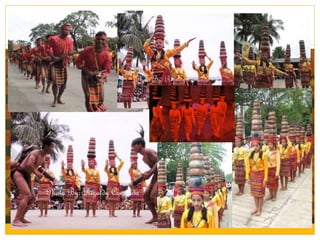
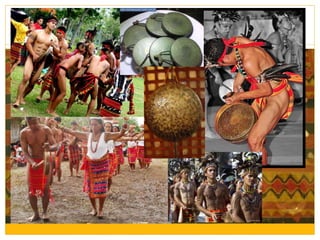
 Heavy clay pots, as many as seven
or eight at a time, are balanced on
the heads of maidens as they
trudge to the beat of the gongs or
wind chimes, displaying their
stamina and strength as they
portray their daily task of fetching
water and balancing .
 The dance is performed to the an
ensemble of flat gongs called
gangsa, which are beaten by the
men who also participate in the
dancing.
 The Banga is a contemporary
performance of the Kalinga .
Etymology
 "Banga" literally means
clay pots, thus the dance
came to be known as the
“clay pot dance”
Dance Properties
 Dance Culture – Highland
Cordillera
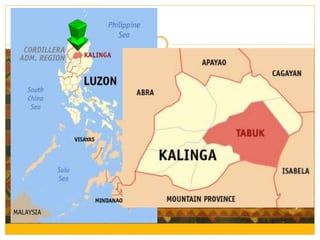
 Place of Origin – Kalinga
 Ethnolinguistic Group – Kalinga
(Northern and Southern)
 Classification - Festival
 Props – Pile of clay pots
(banga)of graduated sizes
 Mood – jovial
 Stance – erect
 Performers – all girls; male
musicians
 Formation – circle, line,
column
 Music – Pattong played by an
ensemble of 6 Gangsa (flat
gong), each played by a musician
who joins in the dance
 Time Signature – 4/4
Costume
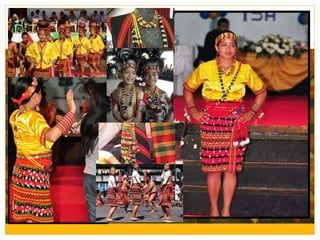
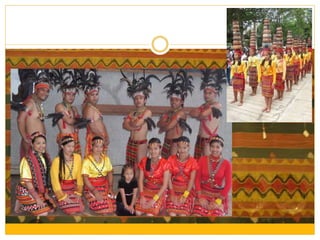
 North Kalinga
 G:
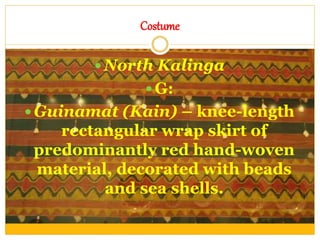
 Guinamat (Kain) – knee-length
rectangular wrap skirt of
predominantly red hand-woven
material, decorated with beads
and sea shells.
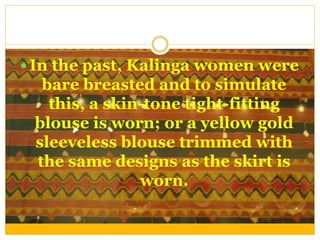
 In the past, Kalinga women were
bare breasted and to simulate
this, a skin-tone tight-fitting
blouse is worn; or a yellow gold
sleeveless blouse trimmed with
the same designs as the skirt is
worn.
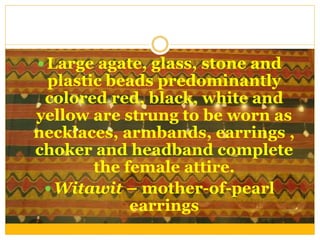
 Large agate, glass, stone and
plastic beads predominantly
colored red, black, white and
yellow are strung to be worn as
necklaces, armbands, earrings ,
choker and headband complete
the female attire.
 Witawit – mother-of-pearl
earrings
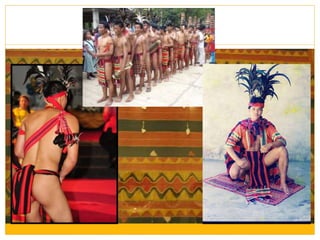
 B:
 Baag – G-string of black cloth
with ends accented with red,
green, yellow and white checks,
designs, fringes and pompoms
 Lamma – short open-fronted
shirt with short sleeves
 Strings of large beads are worn as
chokers and necklaces
 Sipat – wristband made of bronze
 Red triangular headcloth
accented with bunches of rooster
tail feathers.
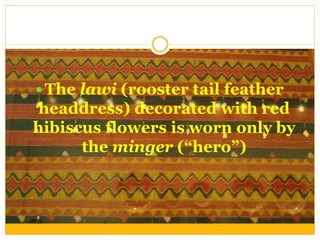
 The lawi (rooster tail feather
headdress) decorated with red
hibiscus flowers is worn only by
the minger (“hero”)
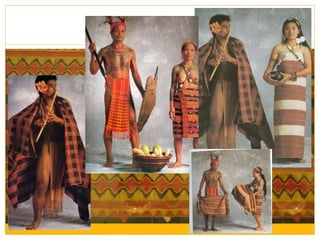
 Southern Kalinga
 The Kalingas of the south do not
wear upper garments but are
heavily tattooed (in the past);
instead they wear blankets
(lilabey) like a shawl
Gestures and Steps
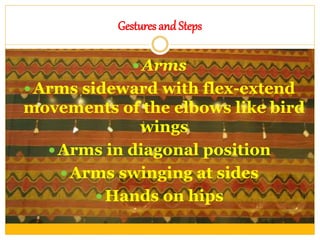
 Arms
 Arms sideward with flex-extend
movements of the elbows like bird
wings
 Arms in diagonal position
 Arms swinging at sides
 Hands on hips
 Steps
 Light springy steps (leap bounce)
 Foot dragging (the other foot
stamps )
 Jumps
Dance Sequence (Suggested)
 The Kalingas do not have codified
sequence of the dance nor specific
duration and formations
followed.
 The musicians make their own
column, separate from the girls’
column
 Figure 1 – Diagonal Entrance
 G:
 8M – slow walk to formation, one
step per measure; both hands
holding pots on head
 8M – springy walk (R and L per
measure)
 Figure 2
 G:
 16M – springy walk moving in
circle CW
 B:
 One line behind G circle
 Figure 3
 G:
 4M – feet in 2nd; spring both
knees; lean sideward R; diagonal
arms
 4M – lean sideward L
 8M – repeat
 B: line formation
 Figure 4
 G:
 16M – springy walk in two
column, moving in circle
 B:
 One column between G columns
 End – three columns
 Figure 5
 G:
 4M – springy walk forward; arms
diagonally upward
 4M – springy walk backward
 8M – repeat
 B: Feet in 2nd; springing on both
knees
 Figure 6
 G:
 8M – springy walk to partner’s
place passing R to R
 8M – repeat to return
 B:
 Move back to line at back of girls
 Figure 7
 G:
 16M – springy walk moving in
two circles, ending to one
column; arms sideward
 B: stay at back line
 Figure 8
 G:
 16M – springy walk; arms
swinging at sides
 B:
 One line
 Figure 9
 B follows G
 8M – spring walk moving in circle
CW
 8M – feet in 2nd; diagonal arms
 16M – exit; B line leading
Source
PFDS Sayaw
Volume 7
pp. 16-18
Researcher – Jaime B. Pumakis

Banga (Philippine Folk Dance)

  • 1.
  • 4.
    Introduction  The Kalingasare the indigenous people in the province of Kalinga in the Gran Cordillera of northern Luzon.  They are known for their good looks, colorful costumes and beautiful dances, making them the “peacocks of the north”
  • 5.
     They aregenerally known to be tall, dark complexioned and lissome with high bridged noses.  Physically, they are very sturdy and well built so that their ancient war-like characteristics make them more like fierce warriors.
  • 6.
     The nameKalinga is believed to have come from Ibanag "Kalingaa" and Gaddang "Kalinga" which both mean headhunter , due to their practice of headhunting (kayaw) done during the tribal wars.
  • 7.
     The budongis the most admirable and efficient Kalinga institution.  It is a peace pact or treaty between two tribes, wherein the pagta (laws) on inter-tribal relations are made.  The budong is also the Magna Carta of the Kalinga.
  • 8.
     The gatheringof tribes during the budong is a social occasion where music-making and dancing is held.  One outstanding dance commonly performed is the Banga, a dance which illustrates the languid grace of a tribe.
  • 9.
     Heavy claypots, as many as seven or eight at a time, are balanced on the heads of maidens as they trudge to the beat of the gongs or wind chimes, displaying their stamina and strength as they portray their daily task of fetching water and balancing .
  • 10.
     The danceis performed to the an ensemble of flat gongs called gangsa, which are beaten by the men who also participate in the dancing.  The Banga is a contemporary performance of the Kalinga .
  • 11.
    Etymology  "Banga" literallymeans clay pots, thus the dance came to be known as the “clay pot dance”
  • 12.
    Dance Properties  DanceCulture – Highland Cordillera  Place of Origin – Kalinga  Ethnolinguistic Group – Kalinga (Northern and Southern)  Classification - Festival
  • 14.
     Props –Pile of clay pots (banga)of graduated sizes  Mood – jovial  Stance – erect  Performers – all girls; male musicians  Formation – circle, line, column
  • 15.
     Music –Pattong played by an ensemble of 6 Gangsa (flat gong), each played by a musician who joins in the dance  Time Signature – 4/4
  • 17.
    Costume  North Kalinga G:  Guinamat (Kain) – knee-length rectangular wrap skirt of predominantly red hand-woven material, decorated with beads and sea shells.
  • 18.
     In thepast, Kalinga women were bare breasted and to simulate this, a skin-tone tight-fitting blouse is worn; or a yellow gold sleeveless blouse trimmed with the same designs as the skirt is worn.
  • 19.
     Large agate,glass, stone and plastic beads predominantly colored red, black, white and yellow are strung to be worn as necklaces, armbands, earrings , choker and headband complete the female attire.  Witawit – mother-of-pearl earrings
  • 21.
     B:  Baag– G-string of black cloth with ends accented with red, green, yellow and white checks, designs, fringes and pompoms  Lamma – short open-fronted shirt with short sleeves
  • 22.
     Strings oflarge beads are worn as chokers and necklaces  Sipat – wristband made of bronze  Red triangular headcloth accented with bunches of rooster tail feathers.
  • 23.
     The lawi(rooster tail feather headdress) decorated with red hibiscus flowers is worn only by the minger (“hero”)
  • 26.
     Southern Kalinga The Kalingas of the south do not wear upper garments but are heavily tattooed (in the past); instead they wear blankets (lilabey) like a shawl
  • 28.
    Gestures and Steps Arms  Arms sideward with flex-extend movements of the elbows like bird wings  Arms in diagonal position  Arms swinging at sides  Hands on hips
  • 29.
     Steps  Lightspringy steps (leap bounce)  Foot dragging (the other foot stamps )  Jumps
  • 30.
    Dance Sequence (Suggested) The Kalingas do not have codified sequence of the dance nor specific duration and formations followed.  The musicians make their own column, separate from the girls’ column
  • 31.
     Figure 1– Diagonal Entrance  G:  8M – slow walk to formation, one step per measure; both hands holding pots on head  8M – springy walk (R and L per measure)
  • 32.
     Figure 2 G:  16M – springy walk moving in circle CW  B:  One line behind G circle
  • 33.
     Figure 3 G:  4M – feet in 2nd; spring both knees; lean sideward R; diagonal arms  4M – lean sideward L  8M – repeat  B: line formation
  • 34.
     Figure 4 G:  16M – springy walk in two column, moving in circle  B:  One column between G columns  End – three columns
  • 35.
     Figure 5 G:  4M – springy walk forward; arms diagonally upward  4M – springy walk backward  8M – repeat  B: Feet in 2nd; springing on both knees
  • 36.
     Figure 6 G:  8M – springy walk to partner’s place passing R to R  8M – repeat to return  B:  Move back to line at back of girls
  • 37.
     Figure 7 G:  16M – springy walk moving in two circles, ending to one column; arms sideward  B: stay at back line
  • 38.
     Figure 8 G:  16M – springy walk; arms swinging at sides  B:  One line
  • 39.
     Figure 9 B follows G  8M – spring walk moving in circle CW  8M – feet in 2nd; diagonal arms  16M – exit; B line leading
  • 41.
    Source PFDS Sayaw Volume 7 pp.16-18 Researcher – Jaime B. Pumakis