VIRUSES
Dr Tafadzwa Dube -
Zvirikuzhe
What are viruses
• A virus is a small infectious agent that replicates only inside the living cells
of other organisms.
• Viruses can infect all types of life forms, from animals and plants to
microorganisms
• Viruses were first discovered by Dmitri Ivanovsky, a Russian botanist in
1892
• About 5,000 virus species have been described in detail, although there
are millions of different types.
• Viruses are found in almost every ecosystem on Earth and are the most
abundant type of biological entity.
• The study of viruses is known as virology
Are viruses alive ?
• Viruses are considered by some to be a life form, because they carry
genetic material, reproduce
• But they lack key characteristics (such as cell structure) that are
generally considered necessary to count as life. Because they possess
some but not all such qualities, viruses have been described as
"organisms at the edge of life".
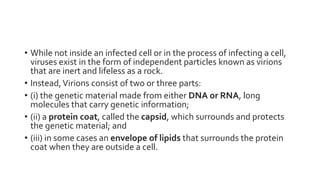
• While not inside an infected cell or in the process of infecting a cell,
viruses exist in the form of independent particles known as virions
that are inert and lifeless as a rock.
• Instead,Virions consist of two or three parts:
• (i) the genetic material made from either DNA or RNA, long
molecules that carry genetic information;
• (ii) a protein coat, called the capsid, which surrounds and protects
the genetic material; and
• (iii) in some cases an envelope of lipids that surrounds the protein
coat when they are outside a cell.
• Most virus species have virions that are too small to be seen with an optical
microscope.The average virion is about one one-hundredth the size of the
average bacterium.
• Since they are not alive and do not have cells, they are not classified into
any of the five life kingdoms
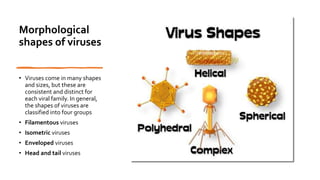
Morphological
shapes of viruses
• Viruses come in many shapes
and sizes, but these are
consistent and distinct for
each viral family. In general,
the shapes of viruses are
classified into four groups
• Filamentous viruses
• Isometric viruses
• Enveloped viruses
• Head and tail viruses
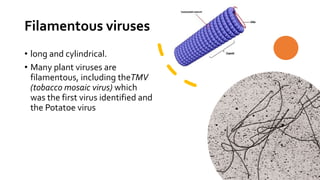
Filamentous viruses
• long and cylindrical.
• Many plant viruses are
filamentous, including theTMV
(tobacco mosaic virus) which
was the first virus identified and
the Potatoe virus
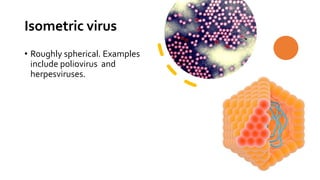
Isometric virus
• Roughly spherical. Examples
include poliovirus and
herpesviruses.
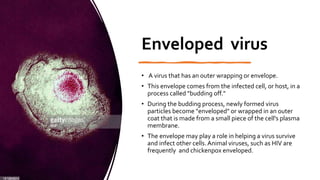
Enveloped virus
• A virus that has an outer wrapping or envelope.
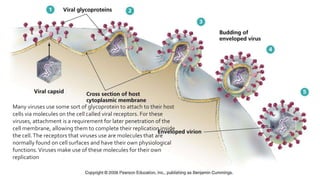
• This envelope comes from the infected cell, or host, in a
process called "budding off."
• During the budding process, newly formed virus
particles become "enveloped" or wrapped in an outer
coat that is made from a small piece of the cell's plasma
membrane.
• The envelope may play a role in helping a virus survive
and infect other cells.Animal viruses, such as HIV are
frequently and chickenpox enveloped.
Many viruses use some sort of glycoprotein to attach to their host
cells via molecules on the cell called viral receptors. For these
viruses, attachment is a requirement for later penetration of the
cell membrane, allowing them to complete their replication inside
the cell.The receptors that viruses use are molecules that are
normally found on cell surfaces and have their own physiological
functions.Viruses make use of these molecules for their own
replication
Head and
tail viruses
• Infect bacteria.
• They have a head that is similar to icosahedral viruses and a
tail shape like filamentous viruses. Here are the three families
based on like shape and other characteristics: Myoviridae,
Podoviridae, and Siphoviridae
Vaccines
• https://youtu.be/-muIoWofsCE
PROTECT INDIVIDUALS
FROM DISEASE
PROTECT THE
COMMUNITY
HELP ERADICATE
DISEASE
HELP TO MANAGE
DISEASE LEVELS
PROTECT THOSE
WHO CANNOT
HAVE VACCINES
DUE TO A WEAK
IMMUNE SYSTEM
How Viruses replicate
• https://youtu.be/Pqnm_vuIlpE
How do viruses replicate?
Virus/phage
Eradication–
getting rid of the virus
on a world wide scale
Factors that make eradication difficult
Rejection of vaccines – non-compliance
Mutations and resistance
Diseases with multiple hosts
Governmental support
Financial support
Rash
causing
viruses
Measles
Rash
causing
viruses
Homework
• Create a poster, presentation or
a spoken piece on 3 of the
following disease
Cover their:
• Form of infection
• Symptoms
• Prevention
• Cholera
• Herpes
• HIV/AIDS
• Mumps
• Poliomyelitis
• Meningitis (viral)
• Hepatitis
• Dengue
Polio
Cholera
HIV/AIDS
COMMON COLD
• Respiratory illness
• A lot of viruses:
• Rhinovirus
• Respiratory syncytial virus
• Parainfluenza
• Coronavirus
• Plus many more!!!
• Less severe
• Runny/stuffy nose
INFLUENZA
• Respiratory illness
• Caused by the influenza virus
• Many strains of this virus – hence
yearly flu jabs
• More severe – can lead to
complications such as
pneumonia, ARDS
• Tend to have a drier cough
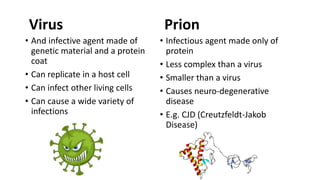
Virus
• And infective agent made of
genetic material and a protein
coat
• Can replicate in a host cell
• Can infect other living cells
• Can cause a wide variety of
infections
Prion
• Infectious agent made only of
protein
• Less complex than a virus
• Smaller than a virus
• Causes neuro-degenerative
disease
• E.g. CJD (Creutzfeldt-Jakob
Disease)
Homework! – Do one of the following:
1. Give a brief report about a viral pandemic and the impact it had/is
having on the world.
2. Create a skit, multimedia presentation, or other interactive display
that informs a 3rd world audience to the danger of one or more of
these viruses and gives them training in how to combat or control
the virus.
3. Have an aid/relief worker give a talk or presentation about
epidemics and virus control in third-world countries. Raise money
as a group to support aid relief in the country the worker tells you
about.
How do we keep safe
• ?
The END

Viruses Honor

  • 1.
  • 2.
    What are viruses •A virus is a small infectious agent that replicates only inside the living cells of other organisms. • Viruses can infect all types of life forms, from animals and plants to microorganisms • Viruses were first discovered by Dmitri Ivanovsky, a Russian botanist in 1892 • About 5,000 virus species have been described in detail, although there are millions of different types. • Viruses are found in almost every ecosystem on Earth and are the most abundant type of biological entity. • The study of viruses is known as virology
  • 3.
    Are viruses alive? • Viruses are considered by some to be a life form, because they carry genetic material, reproduce • But they lack key characteristics (such as cell structure) that are generally considered necessary to count as life. Because they possess some but not all such qualities, viruses have been described as "organisms at the edge of life".
  • 4.
    • While notinside an infected cell or in the process of infecting a cell, viruses exist in the form of independent particles known as virions that are inert and lifeless as a rock. • Instead,Virions consist of two or three parts: • (i) the genetic material made from either DNA or RNA, long molecules that carry genetic information; • (ii) a protein coat, called the capsid, which surrounds and protects the genetic material; and • (iii) in some cases an envelope of lipids that surrounds the protein coat when they are outside a cell.
  • 6.
    • Most virusspecies have virions that are too small to be seen with an optical microscope.The average virion is about one one-hundredth the size of the average bacterium. • Since they are not alive and do not have cells, they are not classified into any of the five life kingdoms
  • 7.
    Morphological shapes of viruses •Viruses come in many shapes and sizes, but these are consistent and distinct for each viral family. In general, the shapes of viruses are classified into four groups • Filamentous viruses • Isometric viruses • Enveloped viruses • Head and tail viruses
  • 8.
    Filamentous viruses • longand cylindrical. • Many plant viruses are filamentous, including theTMV (tobacco mosaic virus) which was the first virus identified and the Potatoe virus
  • 9.
    Isometric virus • Roughlyspherical. Examples include poliovirus and herpesviruses.
  • 10.
    Enveloped virus • Avirus that has an outer wrapping or envelope. • This envelope comes from the infected cell, or host, in a process called "budding off." • During the budding process, newly formed virus particles become "enveloped" or wrapped in an outer coat that is made from a small piece of the cell's plasma membrane. • The envelope may play a role in helping a virus survive and infect other cells.Animal viruses, such as HIV are frequently and chickenpox enveloped.
  • 11.
    Many viruses usesome sort of glycoprotein to attach to their host cells via molecules on the cell called viral receptors. For these viruses, attachment is a requirement for later penetration of the cell membrane, allowing them to complete their replication inside the cell.The receptors that viruses use are molecules that are normally found on cell surfaces and have their own physiological functions.Viruses make use of these molecules for their own replication
  • 12.
    Head and tail viruses •Infect bacteria. • They have a head that is similar to icosahedral viruses and a tail shape like filamentous viruses. Here are the three families based on like shape and other characteristics: Myoviridae, Podoviridae, and Siphoviridae
  • 13.
  • 14.
    PROTECT INDIVIDUALS FROM DISEASE PROTECTTHE COMMUNITY HELP ERADICATE DISEASE HELP TO MANAGE DISEASE LEVELS PROTECT THOSE WHO CANNOT HAVE VACCINES DUE TO A WEAK IMMUNE SYSTEM
  • 15.
    How Viruses replicate •https://youtu.be/Pqnm_vuIlpE
  • 16.
    How do virusesreplicate? Virus/phage
  • 17.
    Eradication– getting rid ofthe virus on a world wide scale Factors that make eradication difficult Rejection of vaccines – non-compliance Mutations and resistance Diseases with multiple hosts Governmental support Financial support
  • 18.
  • 20.
  • 21.
  • 22.
    Homework • Create aposter, presentation or a spoken piece on 3 of the following disease Cover their: • Form of infection • Symptoms • Prevention • Cholera • Herpes • HIV/AIDS • Mumps • Poliomyelitis • Meningitis (viral) • Hepatitis • Dengue
  • 23.
  • 24.
  • 25.
  • 26.
    COMMON COLD • Respiratoryillness • A lot of viruses: • Rhinovirus • Respiratory syncytial virus • Parainfluenza • Coronavirus • Plus many more!!! • Less severe • Runny/stuffy nose INFLUENZA • Respiratory illness • Caused by the influenza virus • Many strains of this virus – hence yearly flu jabs • More severe – can lead to complications such as pneumonia, ARDS • Tend to have a drier cough
  • 27.
    Virus • And infectiveagent made of genetic material and a protein coat • Can replicate in a host cell • Can infect other living cells • Can cause a wide variety of infections Prion • Infectious agent made only of protein • Less complex than a virus • Smaller than a virus • Causes neuro-degenerative disease • E.g. CJD (Creutzfeldt-Jakob Disease)
  • 28.
    Homework! – Doone of the following: 1. Give a brief report about a viral pandemic and the impact it had/is having on the world. 2. Create a skit, multimedia presentation, or other interactive display that informs a 3rd world audience to the danger of one or more of these viruses and gives them training in how to combat or control the virus. 3. Have an aid/relief worker give a talk or presentation about epidemics and virus control in third-world countries. Raise money as a group to support aid relief in the country the worker tells you about.
  • 29.
    How do wekeep safe • ?
  • 30.