Title slide ESRC seminar: social learning in virtual worlds  City University, London 14th March 2008 Dr Steven Warburton, King’s College London and Prism(lab) http://www.prism-lab.org   virtual worlds and radical pedagogy: exploring educational possibilities
MUVEnation  ( www. muvenation .org ) - EU funded, 2 years LLL3D  ( www.lll3d.org ) - EU funded, 2 years (Open)Habitat  ( www. openhabitat .org ) – JISC funded, 15 months these projects  aim  to: examine: good practices; what works and what does not; contexts; development and testing of specific learning scenarios target: different educational sectors; disciplines; specific educational issues e.g. motivation; specific target groups e.g. socially disadvantaged learners project areas
MUVE affordances Facilitating  social interaction  (death of distance) , social presence  and cooperation Visualisation Contextualisation Relation  to  doing  in the physical world (e.g. designing, building and scripting) Informal learning  opportunities e.g. language based communities Affective nature  of  immersion ,  empathy  and related  motivational  aspects Simulation  and  experiential learning   Roleplay  or taking on ‘new’ roles Strong virtual  communities  and identity formation (coherence around groups, sub-cultures and geography) Identity play Ownership  of learning - opportunities for  content production  that are both  individual  and  owned
 
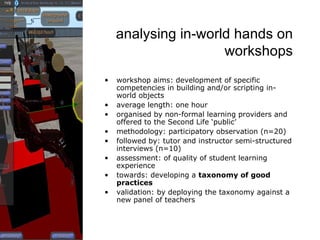
analysing in-world hands on workshops workshop aims: development of specific competencies in building and/or scripting in-world objects average length: one hour organised by non-formal learning providers and offered to the Second Life ‘public’ methodology: participatory observation (n=20) followed by: tutor and instructor semi-structured interviews (n=10) assessment: of quality of student learning experience towards: developing a  taxonomy of good practices validation: by deploying the taxonomy against a new panel of teachers
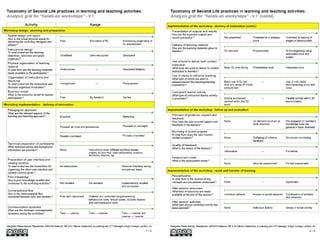
taxonomy of Second Life practices
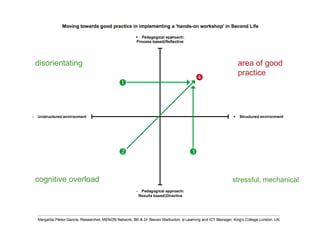
Mapping control of the environment against pedagogy   disorientating stressful, mechanical area of good practice cognitive overload
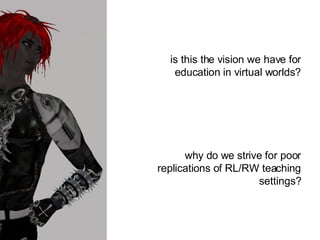
is this the vision we have for education in virtual worlds? why do we strive for poor replications of RL/RW teaching settings?
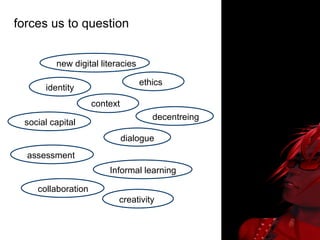
forces us to question context social capital ethics dialogue identity assessment Informal learning collaboration creativity decentreing new digital literacies
rethinking teaching approaches for virtual worlds
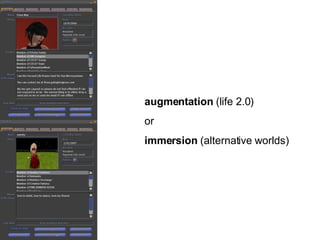
augmentation  (life 2.0) or  immersion  (alternative worlds)
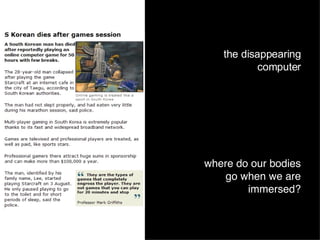
where do our bodies go when we are immersed? the disappearing computer
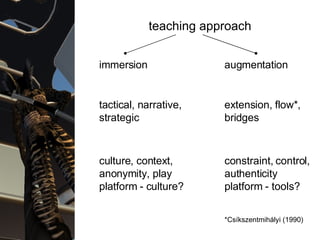
Teaching approaches teaching approach immersion augmentation tactical, narrative, strategic culture, context, anonymity, play platform - culture? constraint, control, authenticity platform - tools? extension, flow*, bridges *Csíkszentmihályi (1990)
how do we break the monotony of augmentationlist approaches?
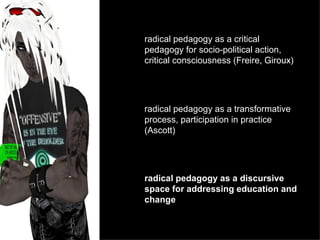
radical pedagogy as a critical pedagogy for socio-political action, critical consciousness (Freire,  Giroux) radical pedagogy as a transformative process, participation in practice (Ascott) radical pedagogy as a discursive space for addressing education and change
 
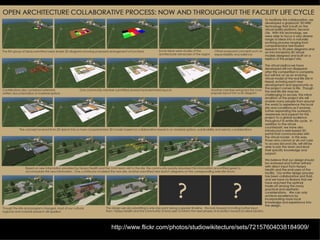
Open architecture project http://www.flickr.com/photos/studiowikitecture/sets/72157604038184909/
art and design approaches dialogical transformative participation in practice perspectivalism revisability intuition creativity, inventiveness and innovation indeterminacy and improvisation instability and uncertainty interrogative disposition self-construction, self-realisation (Danvers, 2003)
towards a radical pedagogy when designing our teaching approaches addressing the dichotomy of augmentation versus immersion provides a valuable filter for reappraising understandings of the possible augmentation approaches question different issues such as platform choice and the affordance of in-world tool sets immersionsist approaches question the richness of the culture and the seamlessness of activity, be it movement or narrative based discursive acts virtual worlds challenge traditional notions of pedagogy and offer new challenges and opportunities and that might be addressed by appropriating the notions of radical pedagogy to provide a  discursive space  for tackling education and change
Final slide Dr Steven Warburton School of Law King's College London Email: steven.warburton@kcl.ac.uk Prism(lab) at http://www.prismlab.org Liquid Learning at http://www.liquidlearning.org Second Life:  StevenW Bohm

Virtuals worlds and radical pedagogy

  • 1.
    Title slide ESRCseminar: social learning in virtual worlds City University, London 14th March 2008 Dr Steven Warburton, King’s College London and Prism(lab) http://www.prism-lab.org virtual worlds and radical pedagogy: exploring educational possibilities
  • 2.
    MUVEnation (www. muvenation .org ) - EU funded, 2 years LLL3D ( www.lll3d.org ) - EU funded, 2 years (Open)Habitat ( www. openhabitat .org ) – JISC funded, 15 months these projects aim to: examine: good practices; what works and what does not; contexts; development and testing of specific learning scenarios target: different educational sectors; disciplines; specific educational issues e.g. motivation; specific target groups e.g. socially disadvantaged learners project areas
  • 3.
    MUVE affordances Facilitating social interaction (death of distance) , social presence and cooperation Visualisation Contextualisation Relation to doing in the physical world (e.g. designing, building and scripting) Informal learning opportunities e.g. language based communities Affective nature of immersion , empathy and related motivational aspects Simulation and experiential learning Roleplay or taking on ‘new’ roles Strong virtual communities and identity formation (coherence around groups, sub-cultures and geography) Identity play Ownership of learning - opportunities for content production that are both individual and owned
  • 4.
  • 5.
    analysing in-world handson workshops workshop aims: development of specific competencies in building and/or scripting in-world objects average length: one hour organised by non-formal learning providers and offered to the Second Life ‘public’ methodology: participatory observation (n=20) followed by: tutor and instructor semi-structured interviews (n=10) assessment: of quality of student learning experience towards: developing a taxonomy of good practices validation: by deploying the taxonomy against a new panel of teachers
  • 6.
    taxonomy of SecondLife practices
  • 7.
    Mapping control ofthe environment against pedagogy disorientating stressful, mechanical area of good practice cognitive overload
  • 8.
    is this thevision we have for education in virtual worlds? why do we strive for poor replications of RL/RW teaching settings?
  • 9.
    forces us toquestion context social capital ethics dialogue identity assessment Informal learning collaboration creativity decentreing new digital literacies
  • 10.
  • 11.
    augmentation (life2.0) or immersion (alternative worlds)
  • 12.
    where do ourbodies go when we are immersed? the disappearing computer
  • 13.
    Teaching approaches teachingapproach immersion augmentation tactical, narrative, strategic culture, context, anonymity, play platform - culture? constraint, control, authenticity platform - tools? extension, flow*, bridges *Csíkszentmihályi (1990)
  • 14.
    how do webreak the monotony of augmentationlist approaches?
  • 15.
    radical pedagogy asa critical pedagogy for socio-political action, critical consciousness (Freire, Giroux) radical pedagogy as a transformative process, participation in practice (Ascott) radical pedagogy as a discursive space for addressing education and change
  • 16.
  • 17.
    Open architecture projecthttp://www.flickr.com/photos/studiowikitecture/sets/72157604038184909/
  • 18.
    art and designapproaches dialogical transformative participation in practice perspectivalism revisability intuition creativity, inventiveness and innovation indeterminacy and improvisation instability and uncertainty interrogative disposition self-construction, self-realisation (Danvers, 2003)
  • 19.
    towards a radicalpedagogy when designing our teaching approaches addressing the dichotomy of augmentation versus immersion provides a valuable filter for reappraising understandings of the possible augmentation approaches question different issues such as platform choice and the affordance of in-world tool sets immersionsist approaches question the richness of the culture and the seamlessness of activity, be it movement or narrative based discursive acts virtual worlds challenge traditional notions of pedagogy and offer new challenges and opportunities and that might be addressed by appropriating the notions of radical pedagogy to provide a discursive space for tackling education and change
  • 20.
    Final slide DrSteven Warburton School of Law King's College London Email: steven.warburton@kcl.ac.uk Prism(lab) at http://www.prismlab.org Liquid Learning at http://www.liquidlearning.org Second Life: StevenW Bohm