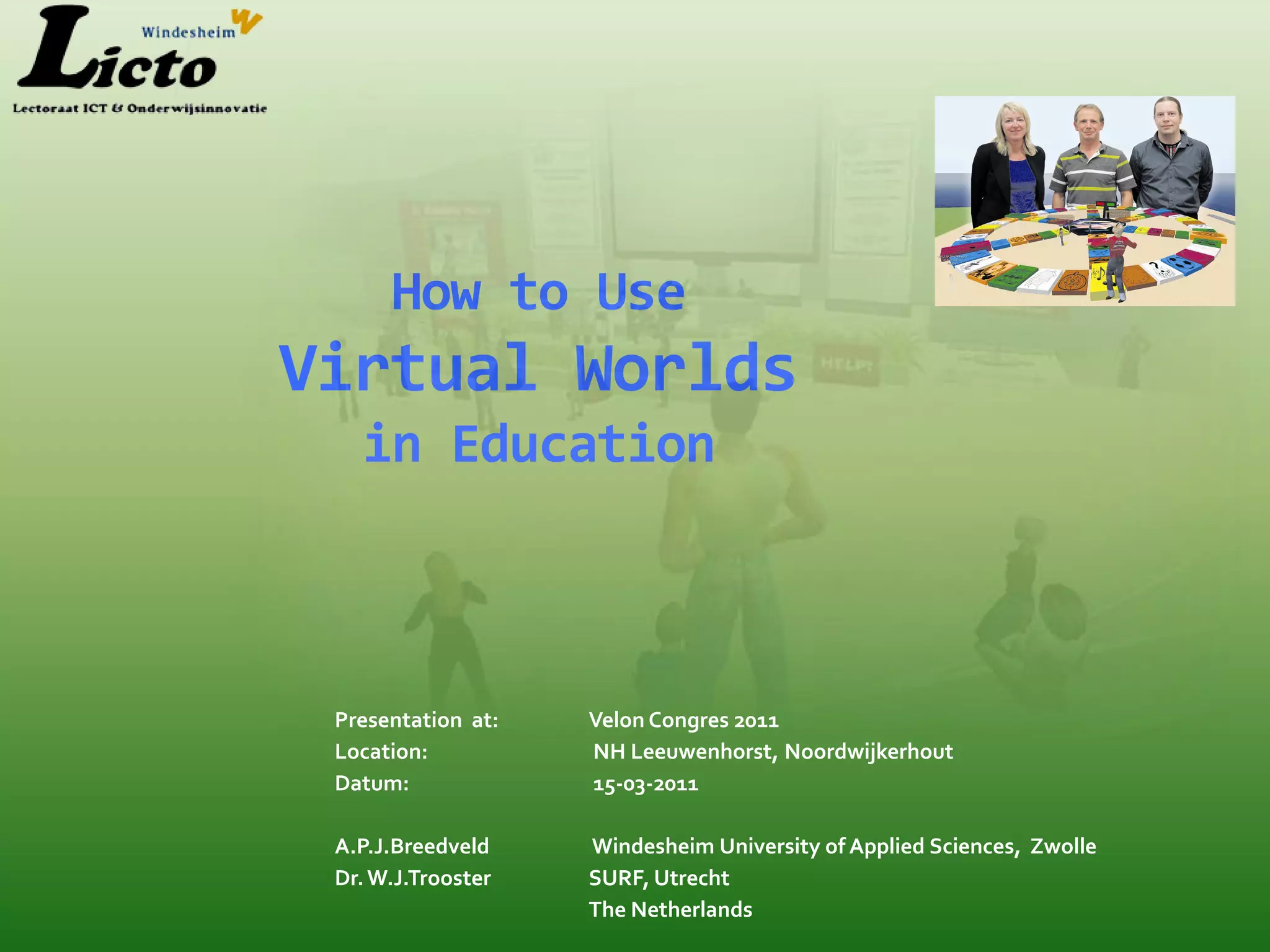
How to Use
Virtual Worlds
   in Education


 Presentation at:   Velon Congres 2011
 Location:          NH Leeuwenhorst, Noordwijkerhout
 Datum:             15-03-2011

 A.P.J.Breedveld    Windesheim University of Applied Sciences, Zwolle
 Dr. W.J.Trooster   SURF, Utrecht
                    The Netherlands
Program

 Survey
 Use of Virtual Worlds (in Education)


 Demonstration
 Use of Second Life in Education


 Discussion
Definition Virtual World
   (3D) persistent and audiovisual (online)
    environment
   Where several users “are” simultaneously
   Using a (3D) representation of a character/
    avatar
   Building this environment to some extent
    Bartle R. (2003) Designing Virtual Worlds,. Thousand Oaks California,
    New Riders Publishing
3 Impressions:
              What are Virtual Worlds?

 Virtual Hospital in Future:
   “Public Awareness Health Reform”
 Virtual Education Nurses:
   “Emergency Room”
 AOC Helicon:
   “Horse Care”
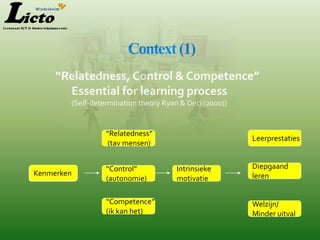
Context (1)
     “Relatedness, Control & Competence”
       Essential for learning process
        (Self-determination theory Ryan & Deci (2000))


                  “Relatedness”
                                                         Leerprestaties
                  (tav mensen)


                  “Control”            Intrinsieke       Diepgaand
Kenmerken
 Features                                                leren
                  (autonomie)          motivatie

                  “Competence”                           Welzijn/
                  (ik kan het)                           Minder uitval
Context (2)
Why are Virtual Worlds relevant for Education?

 Intrinsic motivation is essential f0r learning

 Prerequisite for intrinsic motivation are
  Relatedness, Control, Competence

 Relatedness / Presence is problem in present
  Electronic Platforms for Collaborative Learning

 Virtual Worlds offer Relatedness, Control,
  Competence
Context (3)
What is known about Virtual Worlds in Education?
   Survey of various types of virtual worlds & their present use
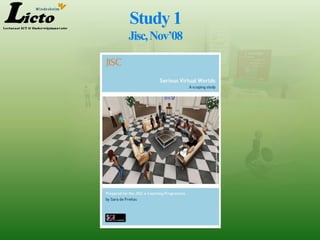
      (Study Jisc, de Freitas (Nov. 2008)

   Which ideas, motives and assumptions play a role before
    considering (not) to use Second Life in Education
     (Study Kennisnet, van Schie (Nov. 2008))

   Consideration of potential added value of specified learning
    activities in SL
    (Study Kennisnet/SURFnet, van Dulm (Jan. 2009) )


   Not yet:
     “Evidence” for Added Value of SL in Education
      (and conditional factors) from Experiences
      in Universities & Sec. Vocational Education
Study 1
Jisc, Nov’08
5 Types of
 Virtual Worlds


 Role Play Worlds
 Social Worlds
 Working Worlds
 Training Worlds
 Mirror Worlds
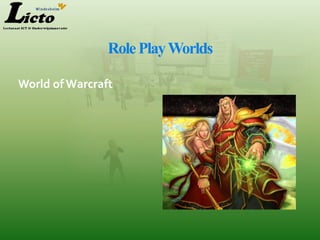
Role Play Worlds

World of Warcraft
Social Worlds
  Second Life
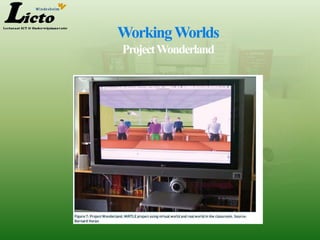
Working Worlds
Project Wonderland
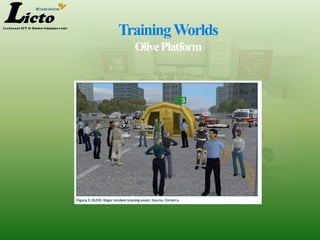
Training Worlds
  Olive Platform
Mirror Worlds

Google Earth
Study 2
Kennisnet, Nov. ‘08
Subject
Which ideas,motives,presumptions
            play a role
   when choosing (not) to use
          Second Life?
Study 3
Kennisnet/SURFnet, Jan ‘09
Subject
       Where in the curriculum
       Teachers (MBO/VO, NL)
Think they can use the potential of SL
Review Hew & Cheung (2010)
 Hew, K.F. & Cheung, W.S. (2010). Use of three-dimensional (3-D) immersive virtual
    worldsin K-12 and higher education settings. A review of the research.British
                   Journal of Educational Technology 41(1), 33–55.


470 papers on the use of Virtual Worlds
 455: opinions, conceptual descriptions, non-
  emperical descriptions of program
  implementations, reviews, or not related to
  Education
 15 on single cases (micro level)
Problem
 Missing, at this moment:
  A survey of - and insight in
    best practices/bad practices
    on the use of virtual worlds in Education


 Risk:
  Knowledge in this field is reinvented
   (over & again)
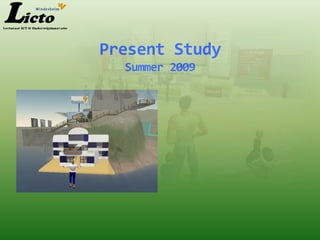
Present Study
  Summer 2009
Objective of present Study

To create new Knowledge :

 For Teachers and their Managers
 To make Adequate Decisions
 To Use (or not to use) Virtual Worlds for
  Educational Purposes
Topics under Study
 What is the (didactic) added value of SL
  compared to other media?

 Which factors (didactic/organisational)
  determine optimal (sustainable) use of SL
Methods (1)
Selection of 7 learning activities with
  potential added value (on the basis of prior
  studies)

Cooperation & Participation: Co-creation = development &
  presenting + results
1. Practicing skills (eg in simulations, role play/iexploring identities)
2. Viewing learning content (eg the medium SL, interaction by
    avatars, simulations/visualisations)
3. Building activities
4. Organizing Events
5. Organizing/building Exhibitions
   *SL compared with other media like: RL, Blackboard, MSN, e-mail
Methods (1)
Selection of 7 learning activities with
  potential added value (on the basis of
  prior studies)

Social networking & using “learning-communities”
6.     Meeting people as a trigger for learning experiences
            (eg: learning a foreign language in SL by meeting native speakers)
7.     Coaching students (Intervision, Supervision, Coaching the Course of
       the Study)

     *SL compared with other media like: RL, Blackboard, MSN, e-mail
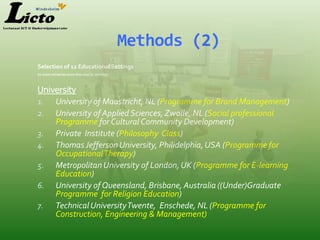
Methods (2)
Selection of 12 Educational Settings
(in most initiatives more than one SL-activity)


University
1. University of Maastricht, NL (Programme for Brand Management)
2. University of Applied Sciences, Zwolle, NL (Social professional
    Programme for Cultural Community Development)
3. Private Institute (Philosophy Class)
4. Thomas Jefferson University, Philidelphia, USA (Programme for
    OccupationalTherapy)
5. Metropolitan University of London, UK (Programme for E-learning
    Education)
6. University of Queensland, Brisbane, Australia ((Under)Graduate
    Programme for Religion Education)
7. Technical UniversityTwente, Enschede, NL (Programme for
    Construction, Engineering & Management)
Methods (2)
Selection of 11 Educational Settings
(in most initiatives more than one SL-activity)


Secondary Vocational Education
9. Davinci College, Dordrecht, NL (IT-Academy)
10. Deltion College, Zwolle, NL (Programme for Interactive Media
    Design)
11. AOC Helicon, Boxtel, NL (Programme for Equestrian Education)
12. Alfa College, Groningen, NL (Programme for Multimedia Design)
Methods (3)
 Questionnaire with items on:
      Added Value
      Didactic factors
      Organisational Factors


 Use of Questionnaire:
      In live interview (6x)
      In Skype interview (2x)
      By e-mail (4x)
Conclusions (1)


All SL-activities showed clear added value in (at least) 1 initiative
Conclusions (2)
Grounds of added value:

 SL motivates students intrinsically
   SL facilitates social interaction
   Student can direct his/her own learning activities
   (?Competence?)

 Students achieve better learning results:
  o   more profound learning,
  o   more transfer to practice,
  o   more efficiency (less costs),
  o   more pleasure/well-being students
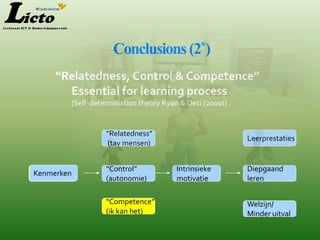
Conclusions (2*)
     “Relatedness, Control & Competence”
       Essential for learning process
        (Self-determination theory Ryan & Deci (2000))


                  “Relatedness”
                                                         Leerprestaties
                  (tav mensen)


                  “Control”            Intrinsieke       Diepgaand
Kenmerken
 Features
                  (autonomie)          motivatie         leren

                  “Competence”                           Welzijn/
                  (ik kan het)                           Minder uitval
Conclusions (3a)
(Nb: te generaliseren)


Didactische factoren:
 Keuze onderwijsactiviteiten in SL (met duidelijke
  meerwaarde voor (sociale interactie in) SL)
 Keuze geschikte doelgroep voor SL
 Investering in adequate didactiek die aansluit bij de
  onderwijsdoelen (met goede opdrachten, begeleiding,
  toetsing)
 Inrichting SL-omgeving aansluitend bij didactisch ontwerp,
  met periodieke kwaliteitszorg
 Hantering gedragsregels.
Conclusions (3b)


Organisatorische factoren:
 Aansluiting bij het beleid
 Creatie draagvlak bij management, docenten,en
  ICT-ondersteuners
 Beperking van gevreesde risico’s van gebruik van SL
  (o.a. tijdsinvestering)
 Investering in deskundigheidsbevordering
 Afspraken over manier van werken bij de SL-
  activiteit
Conclusions (4)
2 underlying parameters discriminating for success

  1.    Choose activities where SL really has strong/
        undeniable added value compared to other media
        (eg the 7 selected activities in this study)
  2.    Create commitment (for teachers, students and
        management (eg PR)
       a.   Make connection to policies
       b.   Choose subgroups of students apt to working with SL
       c.   Minimize risks foreseen with the Use of SL
       d.   Reduce the fear that working with SL is time-consuming
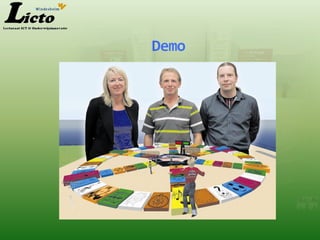
Demo
Discussie

 Welke toepassingsmogelijkheden van een virtuele wereld
  ziet u in de eigen onderwijspraktijk?
 Is er meerwaarde voor de virtuele wereld daar?
 Zijn deze toepassingen eenvoudig realiseerbaar binnen de
  virtuele wereld?
 Hoe moet didactisch en organisatorisch invulling gegeven
  worden aan deze toepassingen?

Virtual Worlds in Education Velon 15.03.2011

  • 1.
    How to Use VirtualWorlds in Education Presentation at: Velon Congres 2011 Location: NH Leeuwenhorst, Noordwijkerhout Datum: 15-03-2011 A.P.J.Breedveld Windesheim University of Applied Sciences, Zwolle Dr. W.J.Trooster SURF, Utrecht The Netherlands
  • 2.
    Program  Survey Useof Virtual Worlds (in Education)  Demonstration Use of Second Life in Education  Discussion
  • 3.
    Definition Virtual World  (3D) persistent and audiovisual (online) environment  Where several users “are” simultaneously  Using a (3D) representation of a character/ avatar  Building this environment to some extent Bartle R. (2003) Designing Virtual Worlds,. Thousand Oaks California, New Riders Publishing
  • 4.
    3 Impressions: What are Virtual Worlds?  Virtual Hospital in Future: “Public Awareness Health Reform”  Virtual Education Nurses: “Emergency Room”  AOC Helicon: “Horse Care”
  • 5.
    Context (1) “Relatedness, Control & Competence” Essential for learning process (Self-determination theory Ryan & Deci (2000)) “Relatedness” Leerprestaties (tav mensen) “Control” Intrinsieke Diepgaand Kenmerken Features leren (autonomie) motivatie “Competence” Welzijn/ (ik kan het) Minder uitval
  • 6.
    Context (2) Why areVirtual Worlds relevant for Education?  Intrinsic motivation is essential f0r learning  Prerequisite for intrinsic motivation are Relatedness, Control, Competence  Relatedness / Presence is problem in present Electronic Platforms for Collaborative Learning  Virtual Worlds offer Relatedness, Control, Competence
  • 7.
    Context (3) What isknown about Virtual Worlds in Education?  Survey of various types of virtual worlds & their present use (Study Jisc, de Freitas (Nov. 2008)  Which ideas, motives and assumptions play a role before considering (not) to use Second Life in Education (Study Kennisnet, van Schie (Nov. 2008))  Consideration of potential added value of specified learning activities in SL (Study Kennisnet/SURFnet, van Dulm (Jan. 2009) )  Not yet: “Evidence” for Added Value of SL in Education (and conditional factors) from Experiences in Universities & Sec. Vocational Education
  • 8.
  • 9.
    5 Types of Virtual Worlds  Role Play Worlds  Social Worlds  Working Worlds  Training Worlds  Mirror Worlds
  • 10.
  • 11.
    Social Worlds Second Life
  • 12.
  • 13.
    Training Worlds Olive Platform
  • 14.
  • 15.
  • 16.
    Subject Which ideas,motives,presumptions play a role when choosing (not) to use Second Life?
  • 17.
  • 18.
    Subject Where in the curriculum Teachers (MBO/VO, NL) Think they can use the potential of SL
  • 20.
    Review Hew &Cheung (2010) Hew, K.F. & Cheung, W.S. (2010). Use of three-dimensional (3-D) immersive virtual worldsin K-12 and higher education settings. A review of the research.British Journal of Educational Technology 41(1), 33–55. 470 papers on the use of Virtual Worlds  455: opinions, conceptual descriptions, non- emperical descriptions of program implementations, reviews, or not related to Education  15 on single cases (micro level)
  • 21.
    Problem  Missing, atthis moment: A survey of - and insight in best practices/bad practices on the use of virtual worlds in Education  Risk: Knowledge in this field is reinvented (over & again)
  • 22.
    Present Study Summer 2009
  • 23.
    Objective of presentStudy To create new Knowledge :  For Teachers and their Managers  To make Adequate Decisions  To Use (or not to use) Virtual Worlds for Educational Purposes
  • 24.
    Topics under Study What is the (didactic) added value of SL compared to other media?  Which factors (didactic/organisational) determine optimal (sustainable) use of SL
  • 25.
    Methods (1) Selection of7 learning activities with potential added value (on the basis of prior studies) Cooperation & Participation: Co-creation = development & presenting + results 1. Practicing skills (eg in simulations, role play/iexploring identities) 2. Viewing learning content (eg the medium SL, interaction by avatars, simulations/visualisations) 3. Building activities 4. Organizing Events 5. Organizing/building Exhibitions *SL compared with other media like: RL, Blackboard, MSN, e-mail
  • 26.
    Methods (1) Selection of7 learning activities with potential added value (on the basis of prior studies) Social networking & using “learning-communities” 6. Meeting people as a trigger for learning experiences (eg: learning a foreign language in SL by meeting native speakers) 7. Coaching students (Intervision, Supervision, Coaching the Course of the Study) *SL compared with other media like: RL, Blackboard, MSN, e-mail
  • 27.
    Methods (2) Selection of12 Educational Settings (in most initiatives more than one SL-activity) University 1. University of Maastricht, NL (Programme for Brand Management) 2. University of Applied Sciences, Zwolle, NL (Social professional Programme for Cultural Community Development) 3. Private Institute (Philosophy Class) 4. Thomas Jefferson University, Philidelphia, USA (Programme for OccupationalTherapy) 5. Metropolitan University of London, UK (Programme for E-learning Education) 6. University of Queensland, Brisbane, Australia ((Under)Graduate Programme for Religion Education) 7. Technical UniversityTwente, Enschede, NL (Programme for Construction, Engineering & Management)
  • 28.
    Methods (2) Selection of11 Educational Settings (in most initiatives more than one SL-activity) Secondary Vocational Education 9. Davinci College, Dordrecht, NL (IT-Academy) 10. Deltion College, Zwolle, NL (Programme for Interactive Media Design) 11. AOC Helicon, Boxtel, NL (Programme for Equestrian Education) 12. Alfa College, Groningen, NL (Programme for Multimedia Design)
  • 29.
    Methods (3)  Questionnairewith items on:  Added Value  Didactic factors  Organisational Factors  Use of Questionnaire:  In live interview (6x)  In Skype interview (2x)  By e-mail (4x)
  • 30.
    Conclusions (1) All SL-activitiesshowed clear added value in (at least) 1 initiative
  • 31.
    Conclusions (2) Grounds ofadded value:  SL motivates students intrinsically  SL facilitates social interaction  Student can direct his/her own learning activities  (?Competence?)  Students achieve better learning results: o more profound learning, o more transfer to practice, o more efficiency (less costs), o more pleasure/well-being students
  • 32.
    Conclusions (2*) “Relatedness, Control & Competence” Essential for learning process (Self-determination theory Ryan & Deci (2000)) “Relatedness” Leerprestaties (tav mensen) “Control” Intrinsieke Diepgaand Kenmerken Features (autonomie) motivatie leren “Competence” Welzijn/ (ik kan het) Minder uitval
  • 33.
    Conclusions (3a) (Nb: tegeneraliseren) Didactische factoren:  Keuze onderwijsactiviteiten in SL (met duidelijke meerwaarde voor (sociale interactie in) SL)  Keuze geschikte doelgroep voor SL  Investering in adequate didactiek die aansluit bij de onderwijsdoelen (met goede opdrachten, begeleiding, toetsing)  Inrichting SL-omgeving aansluitend bij didactisch ontwerp, met periodieke kwaliteitszorg  Hantering gedragsregels.
  • 34.
    Conclusions (3b) Organisatorische factoren: Aansluiting bij het beleid  Creatie draagvlak bij management, docenten,en ICT-ondersteuners  Beperking van gevreesde risico’s van gebruik van SL (o.a. tijdsinvestering)  Investering in deskundigheidsbevordering  Afspraken over manier van werken bij de SL- activiteit
  • 35.
    Conclusions (4) 2 underlyingparameters discriminating for success 1. Choose activities where SL really has strong/ undeniable added value compared to other media (eg the 7 selected activities in this study) 2. Create commitment (for teachers, students and management (eg PR) a. Make connection to policies b. Choose subgroups of students apt to working with SL c. Minimize risks foreseen with the Use of SL d. Reduce the fear that working with SL is time-consuming
  • 36.
  • 37.
    Discussie  Welke toepassingsmogelijkhedenvan een virtuele wereld ziet u in de eigen onderwijspraktijk?  Is er meerwaarde voor de virtuele wereld daar?  Zijn deze toepassingen eenvoudig realiseerbaar binnen de virtuele wereld?  Hoe moet didactisch en organisatorisch invulling gegeven worden aan deze toepassingen?