WHAT IS VIRTUAL REALITY?
• “Virtual Reality is a way for humans to
visualize, manipulate and interact with
computers and extremely complex data.”
• Virtual reality is often sometimes called as
Synthetic Environment, Cyberspaces Artificial
Reality, Simulators Technology, etc.
VIRTUAL REALITY: STEPS OF
DEVELOPMENT
1. HMD—helmets
2. BOOM—BinocularOmni-Orientation Monitor
3. CAVE—CAVE Automatic Virtual Environment
4. 3D VIDEO Eyewear
5. Input devise, Output Devise
6. Hardware
7. Software
 Immersive
 Non - immersive
 Augmented
 Text-based
 Desktop (Window on a World)
 Video Mapping
Telepresence
Mixed Reality
Applications
 Entertainment
– More vivid
– Move exciting
– More attractive
5
Applications (Cont’d)
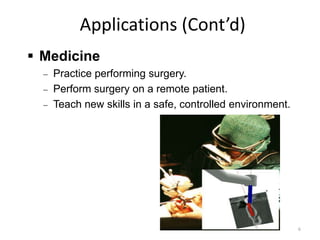
 Medicine
Practice performing surgery.
Perform surgery on a remote patient.
Teach new skills in a safe, controlled environment.
6
Applications (Cont’d)
 Manufacturing
– Easy to modify
– Low cost
– High efficient
7
Applications (Cont’d)
 Education & Training
– Driving simulators.
– Flight simulators.
– Ship simulators.
– Tank simulators.
8
Early Uses
Late 1960’s (the main players
in history)
• U.S. military radar system
& NASA
• Ivan Sutherland’s
“Sketchpad” for designers
• Flight simulators
• That cool headgear returns!
Current Uses
• Virtual reality war
zone stress reliever
• VR treatment with
kids
• Movie
entertainment
• Video game
entertainment
• Training
– Military
• Microsoft flight sim?
– Scholarly
– Medical
– Construction
– Law Enforcement
– Lots more….
 Interaction with the environment.
 User interface.
 user can see and even feel the shaped surface under
his/her fingertips.
 Flight simulators and games.
 CAD/CAE
 Biomedical Engineering the projects mentioned are
use of virtual reality for viewing of X-RAY's and MRI‘s.
 Rendering and 3-D lighting, modeling for resource
management.
New technologies have also revealed new problems.
VR in medical treatment is going through some growing
pains.
There are limitations with VR devices as well in regards
to usability.
lack of standardization of hardware and protocols
Most troublesome are the side effects it can induce, like
disorientation, dizziness and nausea.
People often find navigating in 3-D spaces and
performing actions in free space extremely difficult.
practical problems in spatial cognition research
Future of VR?
• Future only bound by technological advance
– Nanotechnology?
– Implants?
• U. Washington already researching:
– Retina image screening
– Nervous system implanting (EEG and EMG)
• Unmanned Flight
– Gulf War…
Summary
 Visualization of complicated, large data is helpful
for understanding and analysis.
 VR offers us a new way to interact with
computer.
 VR enables us to experience the virtual world
that is impossible in real world.
 VR is changing our life, eventually VR will
increasingly become a part of our life.
15
Virtual reality
Virtual reality

Virtual reality

  • 2.
    WHAT IS VIRTUALREALITY? • “Virtual Reality is a way for humans to visualize, manipulate and interact with computers and extremely complex data.” • Virtual reality is often sometimes called as Synthetic Environment, Cyberspaces Artificial Reality, Simulators Technology, etc.
  • 3.
    VIRTUAL REALITY: STEPSOF DEVELOPMENT 1. HMD—helmets 2. BOOM—BinocularOmni-Orientation Monitor 3. CAVE—CAVE Automatic Virtual Environment 4. 3D VIDEO Eyewear 5. Input devise, Output Devise 6. Hardware 7. Software
  • 4.
     Immersive  Non- immersive  Augmented  Text-based  Desktop (Window on a World)  Video Mapping Telepresence Mixed Reality
  • 5.
    Applications  Entertainment – Morevivid – Move exciting – More attractive 5
  • 6.
    Applications (Cont’d)  Medicine Practiceperforming surgery. Perform surgery on a remote patient. Teach new skills in a safe, controlled environment. 6
  • 7.
    Applications (Cont’d)  Manufacturing –Easy to modify – Low cost – High efficient 7
  • 8.
    Applications (Cont’d)  Education& Training – Driving simulators. – Flight simulators. – Ship simulators. – Tank simulators. 8
  • 9.
    Early Uses Late 1960’s(the main players in history) • U.S. military radar system & NASA • Ivan Sutherland’s “Sketchpad” for designers • Flight simulators • That cool headgear returns!
  • 10.
    Current Uses • Virtualreality war zone stress reliever • VR treatment with kids • Movie entertainment • Video game entertainment
  • 11.
    • Training – Military •Microsoft flight sim? – Scholarly – Medical – Construction – Law Enforcement – Lots more….
  • 12.
     Interaction withthe environment.  User interface.  user can see and even feel the shaped surface under his/her fingertips.  Flight simulators and games.  CAD/CAE  Biomedical Engineering the projects mentioned are use of virtual reality for viewing of X-RAY's and MRI‘s.  Rendering and 3-D lighting, modeling for resource management.
  • 13.
    New technologies havealso revealed new problems. VR in medical treatment is going through some growing pains. There are limitations with VR devices as well in regards to usability. lack of standardization of hardware and protocols Most troublesome are the side effects it can induce, like disorientation, dizziness and nausea. People often find navigating in 3-D spaces and performing actions in free space extremely difficult. practical problems in spatial cognition research
  • 14.
    Future of VR? •Future only bound by technological advance – Nanotechnology? – Implants? • U. Washington already researching: – Retina image screening – Nervous system implanting (EEG and EMG) • Unmanned Flight – Gulf War…
  • 15.
    Summary  Visualization ofcomplicated, large data is helpful for understanding and analysis.  VR offers us a new way to interact with computer.  VR enables us to experience the virtual world that is impossible in real world.  VR is changing our life, eventually VR will increasingly become a part of our life. 15