Virtual Machine
• Not technically part of Web Applications
• Necessary so we can administer the machine
• VirtualBox
• LL46 installed
• Personal machine -> www.virtualbox.org/wiki/Downloads
• CentOS 7 (RHEL 7)
• www.centos.org
• I:shamblinFall_2016CS_4143CentOS-7-x66_64-Minimal-1511.iso
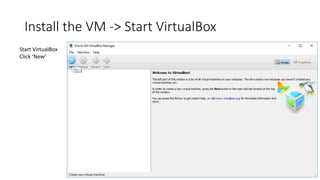
Install the VM -> Start VirtualBox
Start VirtualBox
Click ‘New’
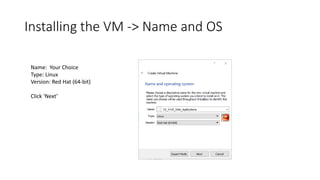
Installing the VM -> Name and OS
Name: Your Choice
Type: Linux
Version: Red Hat (64-bit)
Click ‘Next’
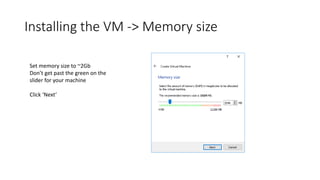
Installing the VM -> Memory size
Set memory size to ~2Gb
Don’t get past the green on the
slider for your machine
Click ‘Next’
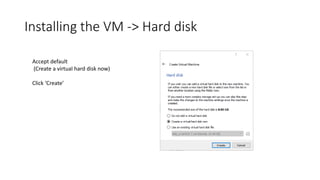
Installing the VM -> Hard disk
Accept default
(Create a virtual hard disk now)
Click ‘Create’
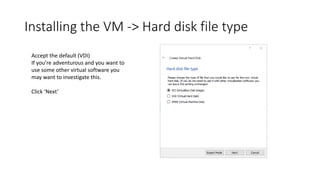
Installing the VM -> Hard disk file type
Accept the default (VDI)
If you’re adventurous and you want to
use some other virtual software you
may want to investigate this.
Click ‘Next’
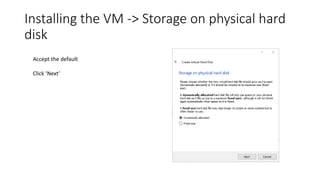
Installing the VM -> Storage on physical hard
disk
Accept the default
Click ‘Next’
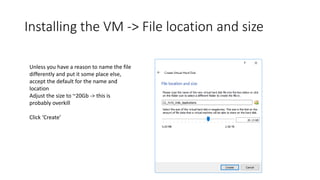
Installing the VM -> File location and size
Unless you have a reason to name the file
differently and put it some place else,
accept the default for the name and
location
Adjust the size to ~20Gb -> this is
probably overkill
Click ‘Create’
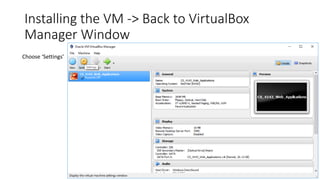
Installing the VM -> Back to VirtualBox
Manager Window
Choose ‘Settings’
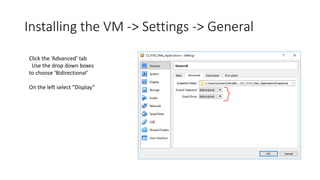
Installing the VM -> Settings -> General
Click the ‘Advanced’ tab
Use the drop down boxes
to choose ‘Bidirectional’
On the left select “Display”
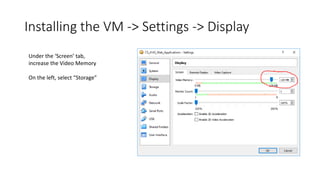
Installing the VM -> Settings -> Display
Under the ‘Screen’ tab,
increase the Video Memory
On the left, select “Storage”
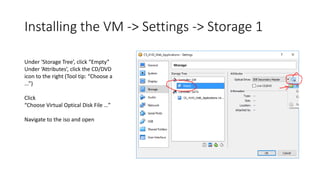
Installing the VM -> Settings -> Storage 1
Under ‘Storage Tree’, click “Empty”
Under ‘Attributes’, click the CD/DVD
icon to the right (Tool tip: “Choose a
...”)
Click
“Choose Virtual Optical Disk File …”
Navigate to the iso and open
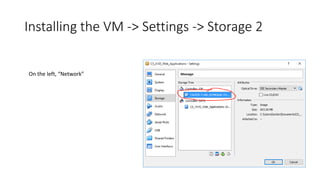
Installing the VM -> Settings -> Storage 2
On the left, “Network”
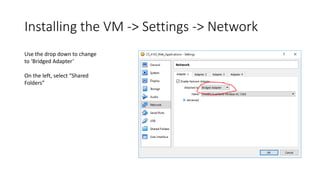
Installing the VM -> Settings -> Network
Use the drop down to change
to ‘Bridged Adapter’
On the left, select “Shared
Folders”
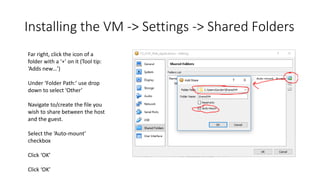
Installing the VM -> Settings -> Shared Folders
Far right, click the icon of a
folder with a ‘+’ on it (Tool tip:
‘Adds new…’)
Under ‘Folder Path:’ use drop
down to select ‘Other’
Navigate to/create the file you
wish to share between the host
and the guest.
Select the ‘Auto-mount’
checkbox
Click ‘OK’
Click ‘OK’
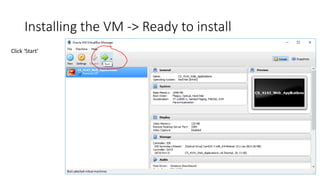
Installing the VM -> Ready to install
Click ‘Start’
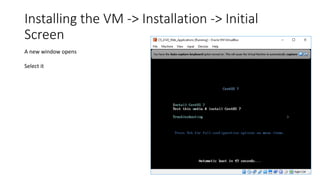
Installing the VM -> Installation -> Initial
Screen
A new window opens
Select it
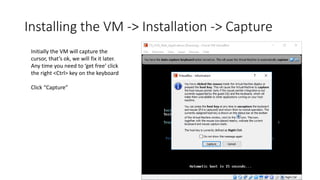
Installing the VM -> Installation -> Capture
Initially the VM will capture the
cursor, that’s ok, we will fix it later.
Any time you need to ‘get free’ click
the right <Ctrl> key on the keyboard
Click “Capture”
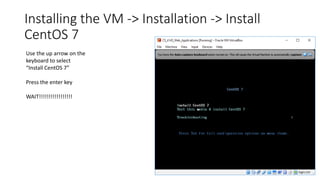
Installing the VM -> Installation -> Install
CentOS 7
Use the up arrow on the
keyboard to select
“Install CentOS 7”
Press the enter key
WAIT!!!!!!!!!!!!!!!!!
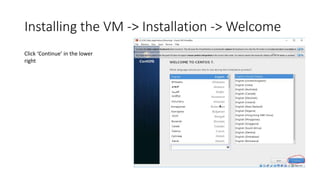
Installing the VM -> Installation -> Welcome
Click ‘Continue’ in the lower
right
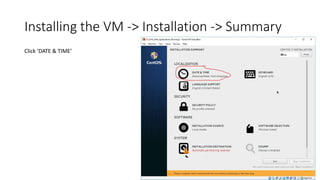
Installing the VM -> Installation -> Summary
Click ‘DATE & TIME’
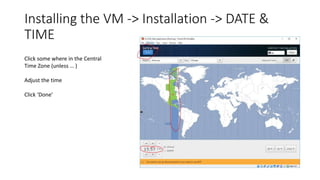
Installing the VM -> Installation -> DATE &
TIME
Click some where in the Central
Time Zone (unless … )
Adjust the time
Click ‘Done’
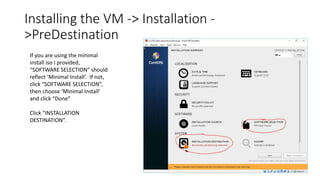
Installing the VM -> Installation -
>PreDestination
If you are using the minimal
install iso I provided,
“SOFTWARE SELECTION” should
reflect ‘Minimal Install’. If not,
click “SOFTWARE SELECTION”,
then choose ‘Minimal Install’
and click “Done”
Click “INSTALLATION
DESTINATION”.
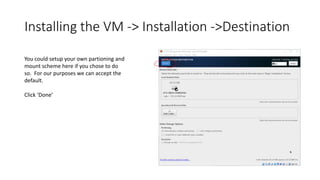
Installing the VM -> Installation ->Destination
You could setup your own partioning and
mount scheme here if you chose to do
so. For our purposes we can accept the
default.
Click ‘Done’
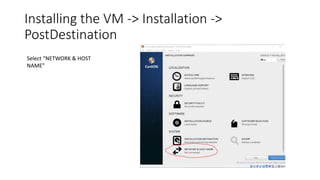
Installing the VM -> Installation ->
PostDestination
Select “NETWORK & HOST
NAME”
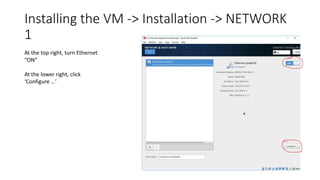
Installing the VM -> Installation -> NETWORK
1
At the top right, turn Ethernet
“ON”
At the lower right, click
‘Configure …’
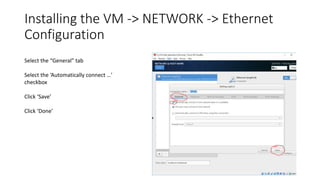
Installing the VM -> NETWORK -> Ethernet
Configuration
Select the “General” tab
Select the ‘Automatically connect …’
checkbox
Click ‘Save’
Click ‘Done’
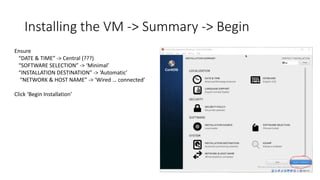
Installing the VM -> Summary -> Begin
Ensure
“DATE & TIME” -> Central (???)
“SOFTWARE SELECTION” -> ‘Minimal’
“INSTALLATION DESTINATION” -> ‘Automatic’
“NETWORK & HOST NAME” -> ‘Wired … connected’
Click ‘Begin Installation’
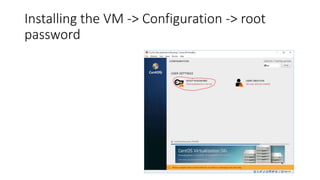
Installing the VM -> Configuration -> root
password
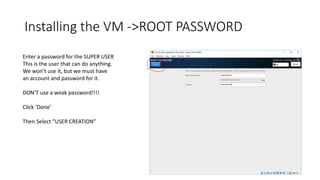
Installing the VM ->ROOT PASSWORD
Enter a password for the SUPER USER
This is the user that can do anything.
We won’t use it, but we must have
an account and password for it.
DON’T use a weak password!!!!
Click ‘Done’
Then Select “USER CREATION”
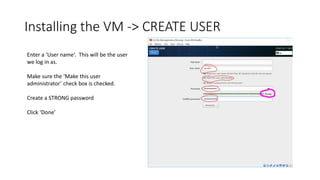
Installing the VM -> CREATE USER
Enter a ‘User name’. This will be the user
we log in as.
Make sure the ‘Make this user
administrator’ check box is checked.
Create a STRONG password
Click ‘Done’
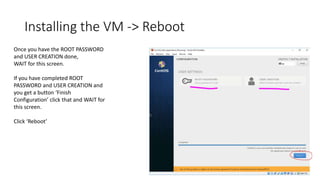
Installing the VM -> Reboot
Once you have the ROOT PASSWORD
and USER CREATION done,
WAIT for this screen.
If you have completed ROOT
PASSWORD and USER CREATION and
you get a button ‘Finish
Configuration’ click that and WAIT for
this screen.
Click ‘Reboot’
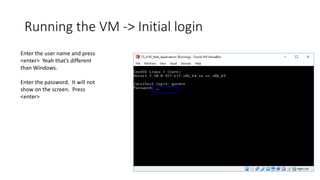
Running the VM -> Initial login
Enter the user name and press
<enter> Yeah that’s different
than Windows.
Enter the password. It will not
show on the screen. Press
<enter>
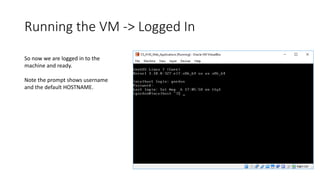
Running the VM -> Logged In
So now we are logged in to the
machine and ready.
Note the prompt shows username
and the default HOSTNAME.
Running the VM -> Update
Enter the command:
sudo yum update<enter>
Since this will be the first time you
have used sudo, it will print a
message and ask for your user
password. Enter it.
Respond with y when asked
“Is this ok [y/d/N]”
and when asked again
WAIT!
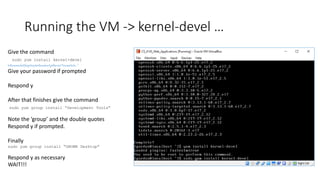
Running the VM -> kernel-devel …
Give the command
sudo yum install kernel-devel
InthescreenshotIforgottoputinthesudosoIgottheerror“Youneedtobe…“
Give your password if prompted
Respond y
After that finishes give the command
sudo yum group install “Development Tools”
Note the ‘group’ and the double quotes
Respond y if prompted.
Finally
sudo yum group install “GNOME Desktop”
Respond y as necessary
WAIT!!!
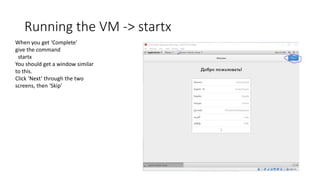
Running the VM -> startx
When you get ‘Complete’
give the command
startx
You should get a window similar
to this.
Click ‘Next’ through the two
screens, then ‘Skip’
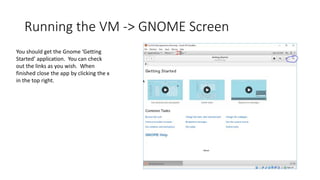
Running the VM -> GNOME Screen
You should get the Gnome ‘Getting
Started’ application. You can check
out the links as you wish. When
finished close the app by clicking the x
in the top right.
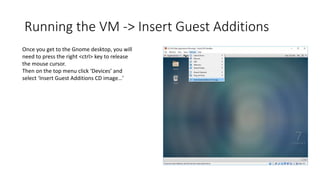
Running the VM -> Insert Guest Additions
Once you get to the Gnome desktop, you will
need to press the right <ctrl> key to release
the mouse cursor.
Then on the top menu click ‘Devices’ and
select ‘Insert Guest Additions CD image…’
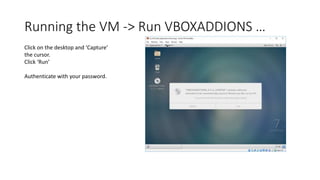
Running the VM -> Run VBOXADDIONS …
Click on the desktop and ‘Capture’
the cursor.
Click ‘Run’
Authenticate with your password.
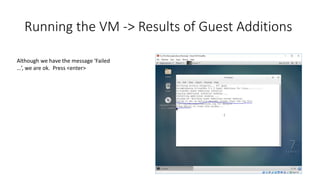
Running the VM -> Results of Guest Additions
Although we have the message ‘Failed
…’, we are ok. Press <enter>
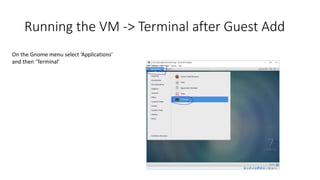
Running the VM -> Terminal after Guest Add
On the Gnome menu select ‘Applications’
and then ‘Terminal’
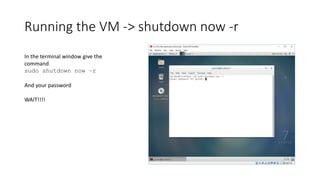
Running the VM -> shutdown now -r
In the terminal window give the
command
sudo shutdown now –r
And your password
WAIT!!!!
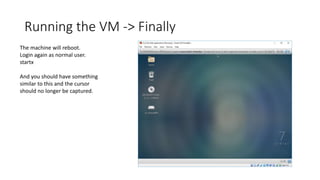
Running the VM -> Finally
The machine will reboot.
Login again as normal user.
startx
And you should have something
similar to this and the cursor
should no longer be captured.
Running the VM -> Post Initial Setup
• The virtual machine should now be ready for us to use.
• Some things you will need to use later:
• login
• startx
• start a terminal
• shutdown now –r (to restart the vm)
• shutdown now –h ( to halt/shutdown the vm)

Virtual machine

  • 1.
    Virtual Machine • Nottechnically part of Web Applications • Necessary so we can administer the machine • VirtualBox • LL46 installed • Personal machine -> www.virtualbox.org/wiki/Downloads • CentOS 7 (RHEL 7) • www.centos.org • I:shamblinFall_2016CS_4143CentOS-7-x66_64-Minimal-1511.iso
  • 2.
    Install the VM-> Start VirtualBox Start VirtualBox Click ‘New’
  • 3.
    Installing the VM-> Name and OS Name: Your Choice Type: Linux Version: Red Hat (64-bit) Click ‘Next’
  • 4.
    Installing the VM-> Memory size Set memory size to ~2Gb Don’t get past the green on the slider for your machine Click ‘Next’
  • 5.
    Installing the VM-> Hard disk Accept default (Create a virtual hard disk now) Click ‘Create’
  • 6.
    Installing the VM-> Hard disk file type Accept the default (VDI) If you’re adventurous and you want to use some other virtual software you may want to investigate this. Click ‘Next’
  • 7.
    Installing the VM-> Storage on physical hard disk Accept the default Click ‘Next’
  • 8.
    Installing the VM-> File location and size Unless you have a reason to name the file differently and put it some place else, accept the default for the name and location Adjust the size to ~20Gb -> this is probably overkill Click ‘Create’
  • 9.
    Installing the VM-> Back to VirtualBox Manager Window Choose ‘Settings’
  • 10.
    Installing the VM-> Settings -> General Click the ‘Advanced’ tab Use the drop down boxes to choose ‘Bidirectional’ On the left select “Display”
  • 11.
    Installing the VM-> Settings -> Display Under the ‘Screen’ tab, increase the Video Memory On the left, select “Storage”
  • 12.
    Installing the VM-> Settings -> Storage 1 Under ‘Storage Tree’, click “Empty” Under ‘Attributes’, click the CD/DVD icon to the right (Tool tip: “Choose a ...”) Click “Choose Virtual Optical Disk File …” Navigate to the iso and open
  • 13.
    Installing the VM-> Settings -> Storage 2 On the left, “Network”
  • 14.
    Installing the VM-> Settings -> Network Use the drop down to change to ‘Bridged Adapter’ On the left, select “Shared Folders”
  • 15.
    Installing the VM-> Settings -> Shared Folders Far right, click the icon of a folder with a ‘+’ on it (Tool tip: ‘Adds new…’) Under ‘Folder Path:’ use drop down to select ‘Other’ Navigate to/create the file you wish to share between the host and the guest. Select the ‘Auto-mount’ checkbox Click ‘OK’ Click ‘OK’
  • 16.
    Installing the VM-> Ready to install Click ‘Start’
  • 17.
    Installing the VM-> Installation -> Initial Screen A new window opens Select it
  • 18.
    Installing the VM-> Installation -> Capture Initially the VM will capture the cursor, that’s ok, we will fix it later. Any time you need to ‘get free’ click the right <Ctrl> key on the keyboard Click “Capture”
  • 19.
    Installing the VM-> Installation -> Install CentOS 7 Use the up arrow on the keyboard to select “Install CentOS 7” Press the enter key WAIT!!!!!!!!!!!!!!!!!
  • 20.
    Installing the VM-> Installation -> Welcome Click ‘Continue’ in the lower right
  • 21.
    Installing the VM-> Installation -> Summary Click ‘DATE & TIME’
  • 22.
    Installing the VM-> Installation -> DATE & TIME Click some where in the Central Time Zone (unless … ) Adjust the time Click ‘Done’
  • 23.
    Installing the VM-> Installation - >PreDestination If you are using the minimal install iso I provided, “SOFTWARE SELECTION” should reflect ‘Minimal Install’. If not, click “SOFTWARE SELECTION”, then choose ‘Minimal Install’ and click “Done” Click “INSTALLATION DESTINATION”.
  • 24.
    Installing the VM-> Installation ->Destination You could setup your own partioning and mount scheme here if you chose to do so. For our purposes we can accept the default. Click ‘Done’
  • 25.
    Installing the VM-> Installation -> PostDestination Select “NETWORK & HOST NAME”
  • 26.
    Installing the VM-> Installation -> NETWORK 1 At the top right, turn Ethernet “ON” At the lower right, click ‘Configure …’
  • 27.
    Installing the VM-> NETWORK -> Ethernet Configuration Select the “General” tab Select the ‘Automatically connect …’ checkbox Click ‘Save’ Click ‘Done’
  • 28.
    Installing the VM-> Summary -> Begin Ensure “DATE & TIME” -> Central (???) “SOFTWARE SELECTION” -> ‘Minimal’ “INSTALLATION DESTINATION” -> ‘Automatic’ “NETWORK & HOST NAME” -> ‘Wired … connected’ Click ‘Begin Installation’
  • 29.
    Installing the VM-> Configuration -> root password
  • 30.
    Installing the VM->ROOT PASSWORD Enter a password for the SUPER USER This is the user that can do anything. We won’t use it, but we must have an account and password for it. DON’T use a weak password!!!! Click ‘Done’ Then Select “USER CREATION”
  • 31.
    Installing the VM-> CREATE USER Enter a ‘User name’. This will be the user we log in as. Make sure the ‘Make this user administrator’ check box is checked. Create a STRONG password Click ‘Done’
  • 32.
    Installing the VM-> Reboot Once you have the ROOT PASSWORD and USER CREATION done, WAIT for this screen. If you have completed ROOT PASSWORD and USER CREATION and you get a button ‘Finish Configuration’ click that and WAIT for this screen. Click ‘Reboot’
  • 33.
    Running the VM-> Initial login Enter the user name and press <enter> Yeah that’s different than Windows. Enter the password. It will not show on the screen. Press <enter>
  • 34.
    Running the VM-> Logged In So now we are logged in to the machine and ready. Note the prompt shows username and the default HOSTNAME.
  • 35.
    Running the VM-> Update Enter the command: sudo yum update<enter> Since this will be the first time you have used sudo, it will print a message and ask for your user password. Enter it. Respond with y when asked “Is this ok [y/d/N]” and when asked again WAIT!
  • 36.
    Running the VM-> kernel-devel … Give the command sudo yum install kernel-devel InthescreenshotIforgottoputinthesudosoIgottheerror“Youneedtobe…“ Give your password if prompted Respond y After that finishes give the command sudo yum group install “Development Tools” Note the ‘group’ and the double quotes Respond y if prompted. Finally sudo yum group install “GNOME Desktop” Respond y as necessary WAIT!!!
  • 37.
    Running the VM-> startx When you get ‘Complete’ give the command startx You should get a window similar to this. Click ‘Next’ through the two screens, then ‘Skip’
  • 38.
    Running the VM-> GNOME Screen You should get the Gnome ‘Getting Started’ application. You can check out the links as you wish. When finished close the app by clicking the x in the top right.
  • 39.
    Running the VM-> Insert Guest Additions Once you get to the Gnome desktop, you will need to press the right <ctrl> key to release the mouse cursor. Then on the top menu click ‘Devices’ and select ‘Insert Guest Additions CD image…’
  • 40.
    Running the VM-> Run VBOXADDIONS … Click on the desktop and ‘Capture’ the cursor. Click ‘Run’ Authenticate with your password.
  • 41.
    Running the VM-> Results of Guest Additions Although we have the message ‘Failed …’, we are ok. Press <enter>
  • 42.
    Running the VM-> Terminal after Guest Add On the Gnome menu select ‘Applications’ and then ‘Terminal’
  • 43.
    Running the VM-> shutdown now -r In the terminal window give the command sudo shutdown now –r And your password WAIT!!!!
  • 44.
    Running the VM-> Finally The machine will reboot. Login again as normal user. startx And you should have something similar to this and the cursor should no longer be captured.
  • 45.
    Running the VM-> Post Initial Setup • The virtual machine should now be ready for us to use. • Some things you will need to use later: • login • startx • start a terminal • shutdown now –r (to restart the vm) • shutdown now –h ( to halt/shutdown the vm)