
Virtual Communities at Work Challenges & Strategies for enterprise adoption of Web 2.0  (Enterprise 2.0) Jose Luis Lopez August 2007 “ Web 2.0 is the latest moniker in an endless effort to reignite the dot-com mania of the late 1990s.”  John C. Dvorak
The Long Tail of Work The Office of 2007… Multi-tasking Enriched jobs, several roles Broad span of control, flat organizations Tons of emails daily Calendar overloaded of meetings and teleconferences 2-digits number of direct internal contacts People located around the world Multi-language, multi-cultures Phone, email, instant messaging, virtual meetings, etc. (twitter?) Did I mention face-2-face (occasionally)? Only 24 hours at day…..
Fundamental Shifts on Organizations Increased cost on organizations: Cost of complexity.  Work is more complex  Richer roles and responsibilities Multi tasking Cost of connectivity Multiple way of communication Synchronous / a-synchronous Teleconference: more information, less communication Cost of storage of huge knowledge. Information has exploded Cost of Globalization.  Multi cultural, multi-language
Fundamental Shifts on Organizations More virtual, few human interaction Communities requires face-to-face meetings Micro formats of knowledge PowerPoint slides, no longer reports  Tragedy of knowledge common sense
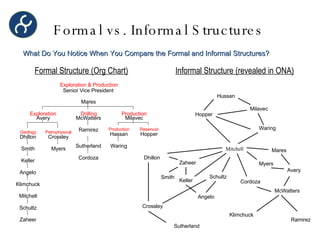
Formal Structure (Org Chart) Informal Structure (revealed in ONA) Formal vs. Informal Structures Mitchell Hussan Milavec Hopper Waring Mares Avery McWatters Ramirez Myers Cordoza Klimchuck Smith Dhillon Zaheer Angelo Schultz Keller Crossley Sutherland What Do You Notice When You Compare the Formal and Informal Structures? Exploration & Production Zaheer Schultz Mitchell Klimchuck Angelo Keller Smith Geology Dhillon Myers Petrophysical Crossley Exploration Avery Cordoza Sutherland Ramirez Drilling McWatters Waring Production Hassan Reservoir Hopper Production Milavec Senior Vice President Mares
ENTERPRISE 2.0
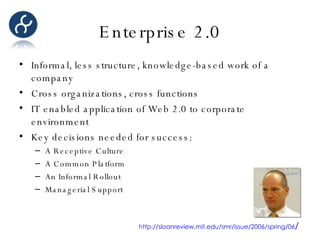
Enterprise 2.0 Informal, less structure, knowledge-based work of a company Cross organizations, cross functions IT enabled application of Web 2.0 to corporate environment Key decisions needed for success: A Receptive Culture A Common Platform An Informal Rollout Managerial Support http://sloanreview.mit.edu/smr/issue/2006/spring/06 /
Enterprise 2.0 Six components (SLATES): S earch  for any information platform to be valuable users must be able to find what they are looking for L inks  are an excellent guide to what’s important and provide structure to online content A uthoring .  People is willing to contribute  Internet blogs and Wikipedia have shown that many people have a desire to author T ags .  Categorization of content The categorization system that emerges from tagging is called a Folksonomy (a categorization system developed overt time by folks) E xtensions .  Smart categorization and pattern matching Algorithms to say to users, “if you liked that, then by extension you’ll like this.” Includes recommendations, popular items, similar topics S ignals . Notification to users when new content of interest appears (email alerts, syndication).  Aggregators periodically queries sites of interest for new notices, downloads them, put them in order and display their headlines. http://sloanreview.mit.edu/smr/issue/2006/spring/06 /
Enterprise 2.0 Technology Enterprise 2.0 is the use of emergent social software platforms within companies, or between companies and their partners or customers Social software  enables people to rendezvous, connect or collaborate through computer-mediated communication and to form online communities. (Wikipedia's definition). Platforms  are digital environments in which contributions and interactions are globally visible and persistent over time. Emergent  means that the software is freeform, and that it contains mechanisms to let the patterns and structure inherent in people's interactions become visible over time. Freeform  means that the software is most or all of the following: Optional  Free of up-front workflow  Egalitarian, or indifferent to formal organizational identities  Accepting of many types of data
Enterprise 2.0 IS End-user generated content Social Software applied in a corporate environment Truly collaborative tools: openly visible and persistent over time IS-NOT Social networks: Wikipedia, YouTube, Flickr, MySpace, etc Most corporate Intranets today Groupware and information portals Email and 'classic' instant messaging  transmissions aren't globally visible or persistent
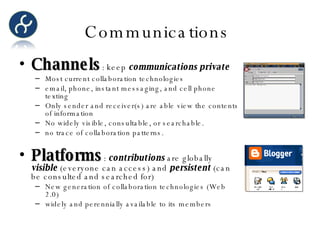
Communications  Channels : keep  communications private Most current collaboration technologies email, phone, instant messaging, and cell phone texting Only sender and receiver(s) are able view the contents of information No widely visible, consultable, or searchable.  no trace of collaboration patterns. Platforms :  contributions  are globally  visible  (everyone can access) and  persistent  (can be consulted and searched for) New generation of collaboration technologies (Web 2.0) widely and perennially available to its members
Enterprise Communities  To Consider Interconnect Security Transparency Ownership Shared  purpose or passion Invent means to share Create a very simple structure for sharing Tips Start simple Simple way to enroll / start Access for everything RSS for everything Promote reuse of information
COMMUNITIES AT WORK
Community at the Enterprise Community ( Own Definition ) Group of people with different agendas, collaborating in a dynamic environment to achieve specific results under defined rules
Community at the Enterprise Corollary Individuals with a different level of involvement each member may have different objectives and grades of interest at the Community  there is a core group at the Community that shares common objectives ( Community Office: Leader + Champions ) The Community is an evolving entity, continuously changing Ultimate goals and intended results are guided by the community leaders Collaboration is beyond a virtual workspace or electronic tools; it is the combination of people, leadership and tools. Basic rules to collaborate are defined and accepted by members Formal and informal communication means and methods coexist
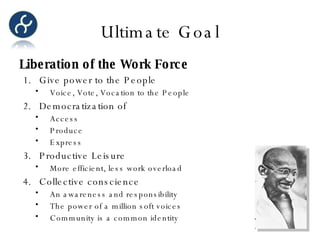
Ultimate Goal Liberation of the Work Force Give power to the People Voice, Vote, Vocation to the People Democratization of  Access Produce Express Productive Leisure More efficient, less work overload Collective conscience An awareness and responsibility The power of a million soft voices Community is a common identity
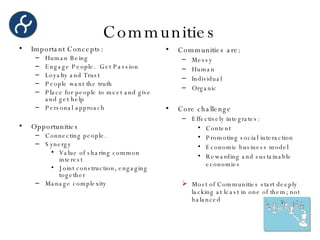
Communities Important Concepts: Human Being Engage People.  Get Passion Loyalty and Trust People want the truth Place for people to meet and give and get help Personal approach Opportunities Connecting people. Synergy Value of sharing common interest Joint construction, engaging together Manage complexity Communities are: Messy Human Individual Organic Core challenge Effectively integrates: Content Promoting social interaction Economic business model Rewarding and sustainable economies Most of Communities start deeply lacking at least in one of them; not balanced
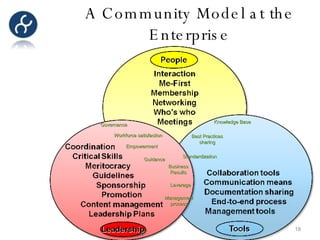
A Community Model at the Enterprise Business Results Knowledge Base Workforce satisfaction Guidance Empowerment Governance Leverage Best Practices sharing Standardization Management process
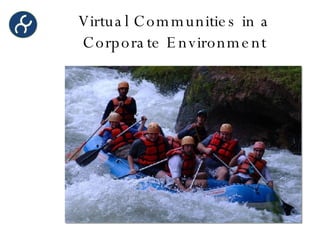
Virtual Communities in a Corporate Environment
More Information…
Licensing

Virtual Communities at Work

  • 1.
    Virtual Communities atWork Challenges & Strategies for enterprise adoption of Web 2.0 (Enterprise 2.0) Jose Luis Lopez August 2007 “ Web 2.0 is the latest moniker in an endless effort to reignite the dot-com mania of the late 1990s.” John C. Dvorak
  • 2.
    The Long Tailof Work The Office of 2007… Multi-tasking Enriched jobs, several roles Broad span of control, flat organizations Tons of emails daily Calendar overloaded of meetings and teleconferences 2-digits number of direct internal contacts People located around the world Multi-language, multi-cultures Phone, email, instant messaging, virtual meetings, etc. (twitter?) Did I mention face-2-face (occasionally)? Only 24 hours at day…..
  • 3.
    Fundamental Shifts onOrganizations Increased cost on organizations: Cost of complexity. Work is more complex Richer roles and responsibilities Multi tasking Cost of connectivity Multiple way of communication Synchronous / a-synchronous Teleconference: more information, less communication Cost of storage of huge knowledge. Information has exploded Cost of Globalization. Multi cultural, multi-language
  • 4.
    Fundamental Shifts onOrganizations More virtual, few human interaction Communities requires face-to-face meetings Micro formats of knowledge PowerPoint slides, no longer reports Tragedy of knowledge common sense
  • 5.
    Formal Structure (OrgChart) Informal Structure (revealed in ONA) Formal vs. Informal Structures Mitchell Hussan Milavec Hopper Waring Mares Avery McWatters Ramirez Myers Cordoza Klimchuck Smith Dhillon Zaheer Angelo Schultz Keller Crossley Sutherland What Do You Notice When You Compare the Formal and Informal Structures? Exploration & Production Zaheer Schultz Mitchell Klimchuck Angelo Keller Smith Geology Dhillon Myers Petrophysical Crossley Exploration Avery Cordoza Sutherland Ramirez Drilling McWatters Waring Production Hassan Reservoir Hopper Production Milavec Senior Vice President Mares
  • 6.
  • 7.
    Enterprise 2.0 Informal,less structure, knowledge-based work of a company Cross organizations, cross functions IT enabled application of Web 2.0 to corporate environment Key decisions needed for success: A Receptive Culture A Common Platform An Informal Rollout Managerial Support http://sloanreview.mit.edu/smr/issue/2006/spring/06 /
  • 8.
    Enterprise 2.0 Sixcomponents (SLATES): S earch for any information platform to be valuable users must be able to find what they are looking for L inks are an excellent guide to what’s important and provide structure to online content A uthoring . People is willing to contribute Internet blogs and Wikipedia have shown that many people have a desire to author T ags . Categorization of content The categorization system that emerges from tagging is called a Folksonomy (a categorization system developed overt time by folks) E xtensions . Smart categorization and pattern matching Algorithms to say to users, “if you liked that, then by extension you’ll like this.” Includes recommendations, popular items, similar topics S ignals . Notification to users when new content of interest appears (email alerts, syndication). Aggregators periodically queries sites of interest for new notices, downloads them, put them in order and display their headlines. http://sloanreview.mit.edu/smr/issue/2006/spring/06 /
  • 9.
    Enterprise 2.0 TechnologyEnterprise 2.0 is the use of emergent social software platforms within companies, or between companies and their partners or customers Social software enables people to rendezvous, connect or collaborate through computer-mediated communication and to form online communities. (Wikipedia's definition). Platforms are digital environments in which contributions and interactions are globally visible and persistent over time. Emergent means that the software is freeform, and that it contains mechanisms to let the patterns and structure inherent in people's interactions become visible over time. Freeform means that the software is most or all of the following: Optional Free of up-front workflow Egalitarian, or indifferent to formal organizational identities Accepting of many types of data
  • 10.
    Enterprise 2.0 ISEnd-user generated content Social Software applied in a corporate environment Truly collaborative tools: openly visible and persistent over time IS-NOT Social networks: Wikipedia, YouTube, Flickr, MySpace, etc Most corporate Intranets today Groupware and information portals Email and 'classic' instant messaging transmissions aren't globally visible or persistent
  • 11.
    Communications Channels: keep communications private Most current collaboration technologies email, phone, instant messaging, and cell phone texting Only sender and receiver(s) are able view the contents of information No widely visible, consultable, or searchable. no trace of collaboration patterns. Platforms : contributions are globally visible (everyone can access) and persistent (can be consulted and searched for) New generation of collaboration technologies (Web 2.0) widely and perennially available to its members
  • 12.
    Enterprise Communities To Consider Interconnect Security Transparency Ownership Shared purpose or passion Invent means to share Create a very simple structure for sharing Tips Start simple Simple way to enroll / start Access for everything RSS for everything Promote reuse of information
  • 13.
  • 14.
    Community at theEnterprise Community ( Own Definition ) Group of people with different agendas, collaborating in a dynamic environment to achieve specific results under defined rules
  • 15.
    Community at theEnterprise Corollary Individuals with a different level of involvement each member may have different objectives and grades of interest at the Community there is a core group at the Community that shares common objectives ( Community Office: Leader + Champions ) The Community is an evolving entity, continuously changing Ultimate goals and intended results are guided by the community leaders Collaboration is beyond a virtual workspace or electronic tools; it is the combination of people, leadership and tools. Basic rules to collaborate are defined and accepted by members Formal and informal communication means and methods coexist
  • 16.
    Ultimate Goal Liberationof the Work Force Give power to the People Voice, Vote, Vocation to the People Democratization of Access Produce Express Productive Leisure More efficient, less work overload Collective conscience An awareness and responsibility The power of a million soft voices Community is a common identity
  • 17.
    Communities Important Concepts:Human Being Engage People. Get Passion Loyalty and Trust People want the truth Place for people to meet and give and get help Personal approach Opportunities Connecting people. Synergy Value of sharing common interest Joint construction, engaging together Manage complexity Communities are: Messy Human Individual Organic Core challenge Effectively integrates: Content Promoting social interaction Economic business model Rewarding and sustainable economies Most of Communities start deeply lacking at least in one of them; not balanced
  • 18.
    A Community Modelat the Enterprise Business Results Knowledge Base Workforce satisfaction Guidance Empowerment Governance Leverage Best Practices sharing Standardization Management process
  • 19.
    Virtual Communities ina Corporate Environment
  • 20.
  • 21.