 What is virtual reality?
 History
 Types of virtual reality?
 Hardware used in virtual reality?
 Application of virtual reality?
 Advantages or disadvantages
 Virtual reality means feeling the
imaginary(virtual)world.
 Virtual reality is the term used for computer
generated 3D environment that allow the user
to enter and interact with altemete realistic.
 The definition of ‘virtual is near and ‘reality’ is
what we experience as human being.
 In 1950s, flight simulators were built by US Air
Force to train student pilots.
 In 1965, a research program for computer
graphics called “The Ultimate Display” was laid
out.
 In 1988, commercial development of VR
began.
 In 1991, first commercial entertainment VR
system "Virtuality" was released.
Virtual reality is need because complex scenarios cause
serious issues. Like complex brain surgery, Flying
aircraft tanning etc.For these kind of dangerous
scenarios simulated environment is created to
overcome the loss jand and also create less cost as
compare to original.
Types of Virtual Reality
 Immersive Virtual Reality
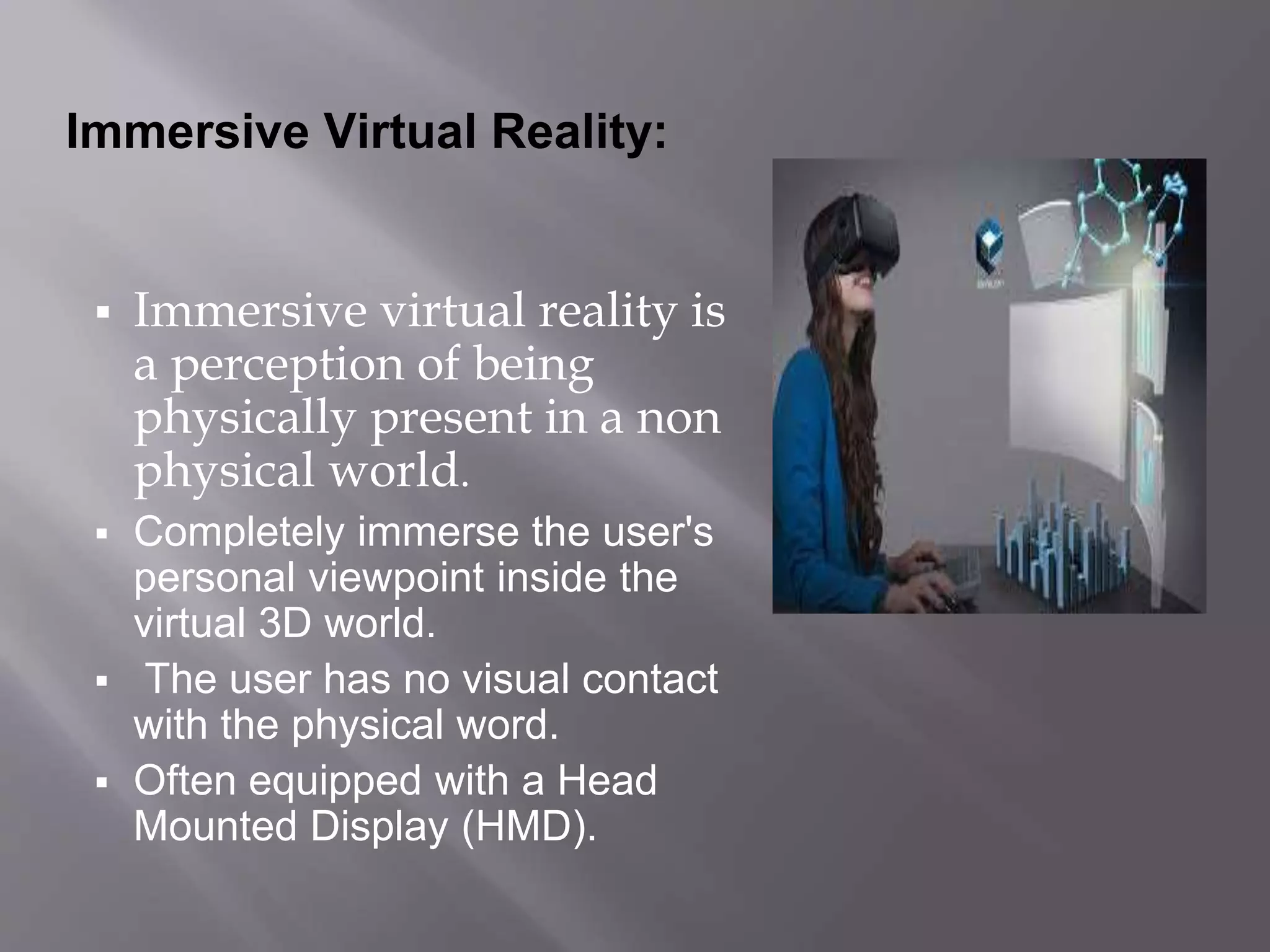
 Non-Immersive Virtual Reality
 Window to window Virtual Reality
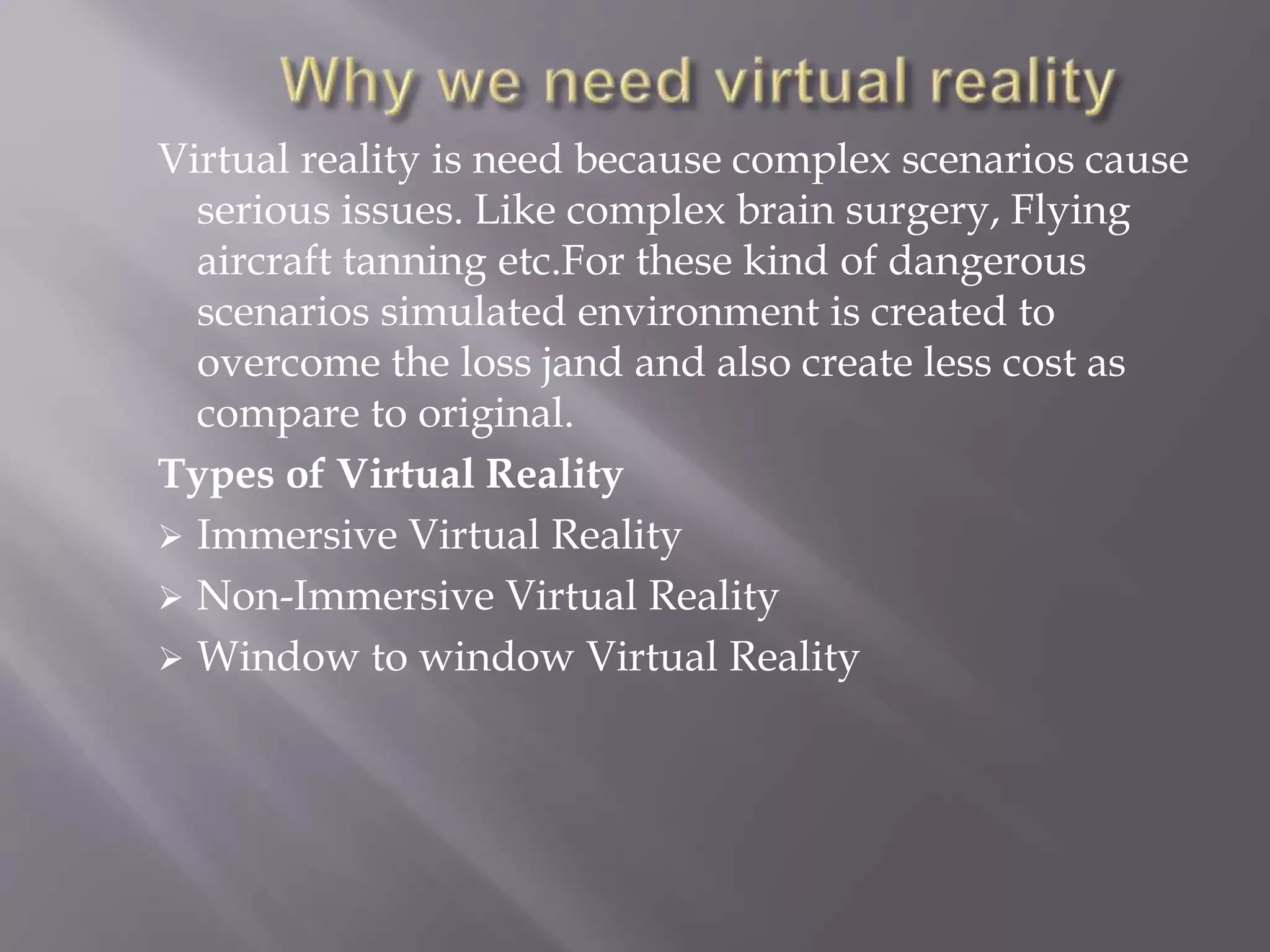
Immersive Virtual Reality:
 Immersive virtual reality is
a perception of being
physically present in a non
physical world.
 Completely immerse the user's
personal viewpoint inside the
virtual 3D world.
 The user has no visual contact
with the physical word.
 Often equipped with a Head
Mounted Display (HMD).
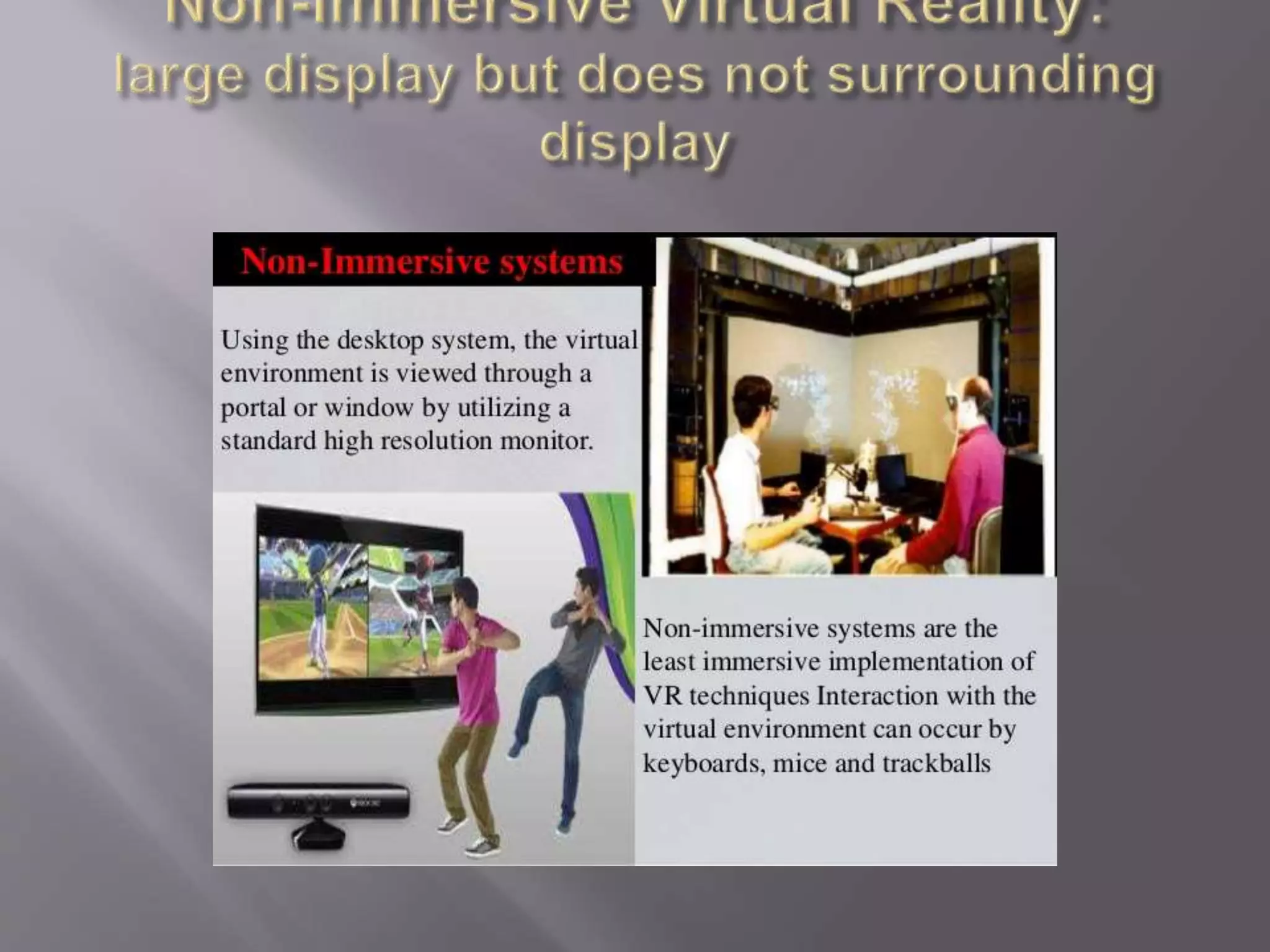
Windows on World(WoW)
Desktop based
virtual memory
involves displaying a
3 dimensional virtual
or regular desktop
display without use
of any specialized
movement tracking
environment
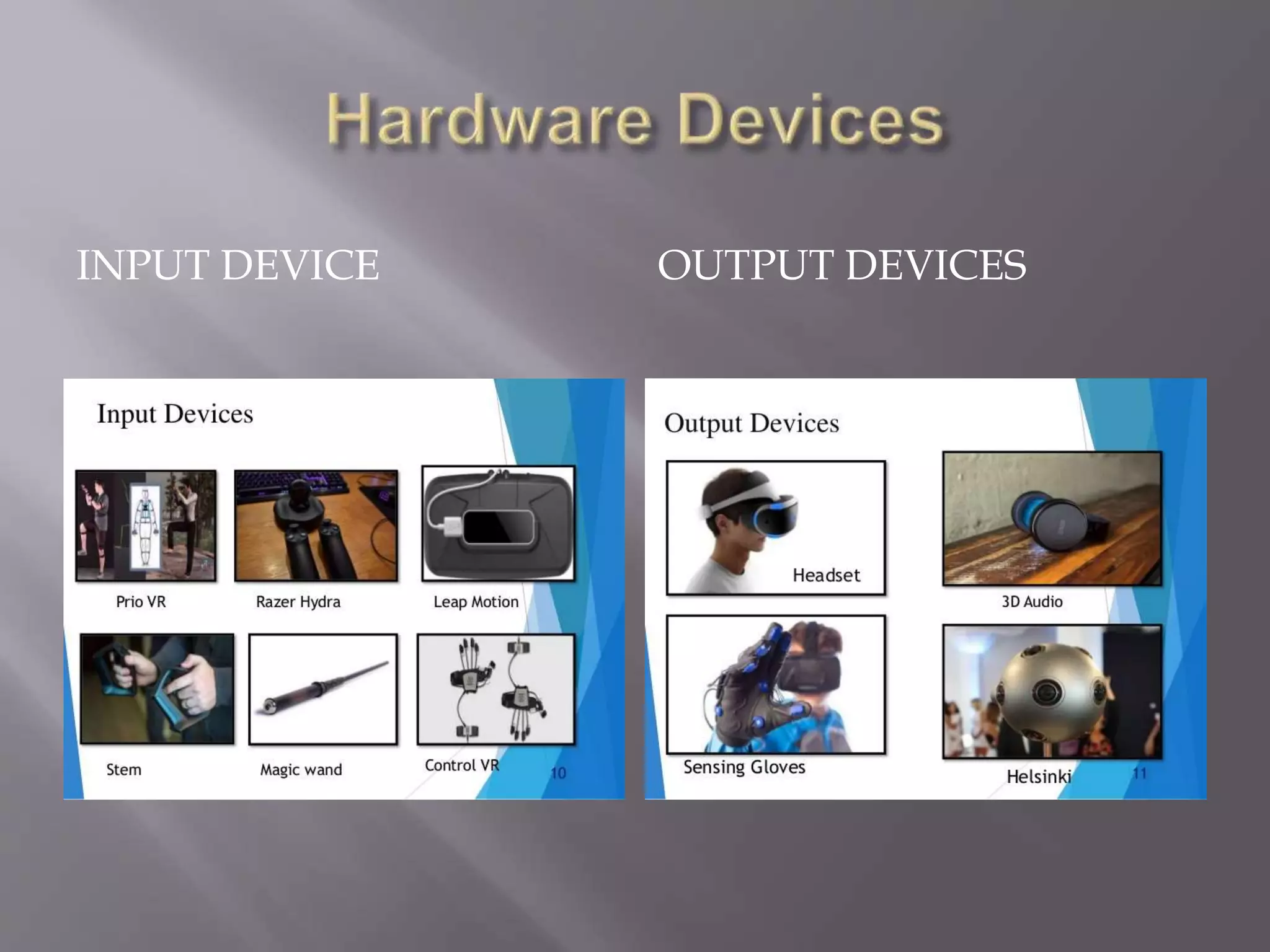
INPUT DEVICE OUTPUT DEVICES
 Virtual reality in the military
 Virtual reality in the health care
 Virtual reality and education
 Scientific visualization
 Virtual reality in entertainment
 Engineering and designee
 Tranning
 E Commerance
 As Virtual Reality software becomes more
powerful and its hardware more sophisticated, not
to mention more affordable, there will be a number
of challenges that the industry must face head-on.
 But the focus should remain on the positive
contributions this technology can make to society.
From better healthcare training and education, to
active rather than sedentary gaming, there are a
number of clear benefits to embracing the exciting
developments being made in the world of VR.
 A combination of real scene viewed by a user and
a virtual scene generated by computer that
augments the scene with additional information
 Augmented reality (AR) is a t reality-based display
environment that takes the capabilities of
computer generated display, sound, text and
effects to enhance the user's real-world experience.
 Augmented reality is technology that combines
virtual reality with the real world in the form of
live video imagery that is digitally enhanced with
computer-generated graphics.
 To enhance the persons performance and
perception of the world
 Create a system such that user can not tell the
difference between the real world and
augmentation of it
 Pick a real world scene
 Add your virtual objects in it
 Delete real world object
 Not virtual reality since environment real
 There are three component needed to make
augmented reality system work
 Display
 Tracking system
 Mobile computing power
Display
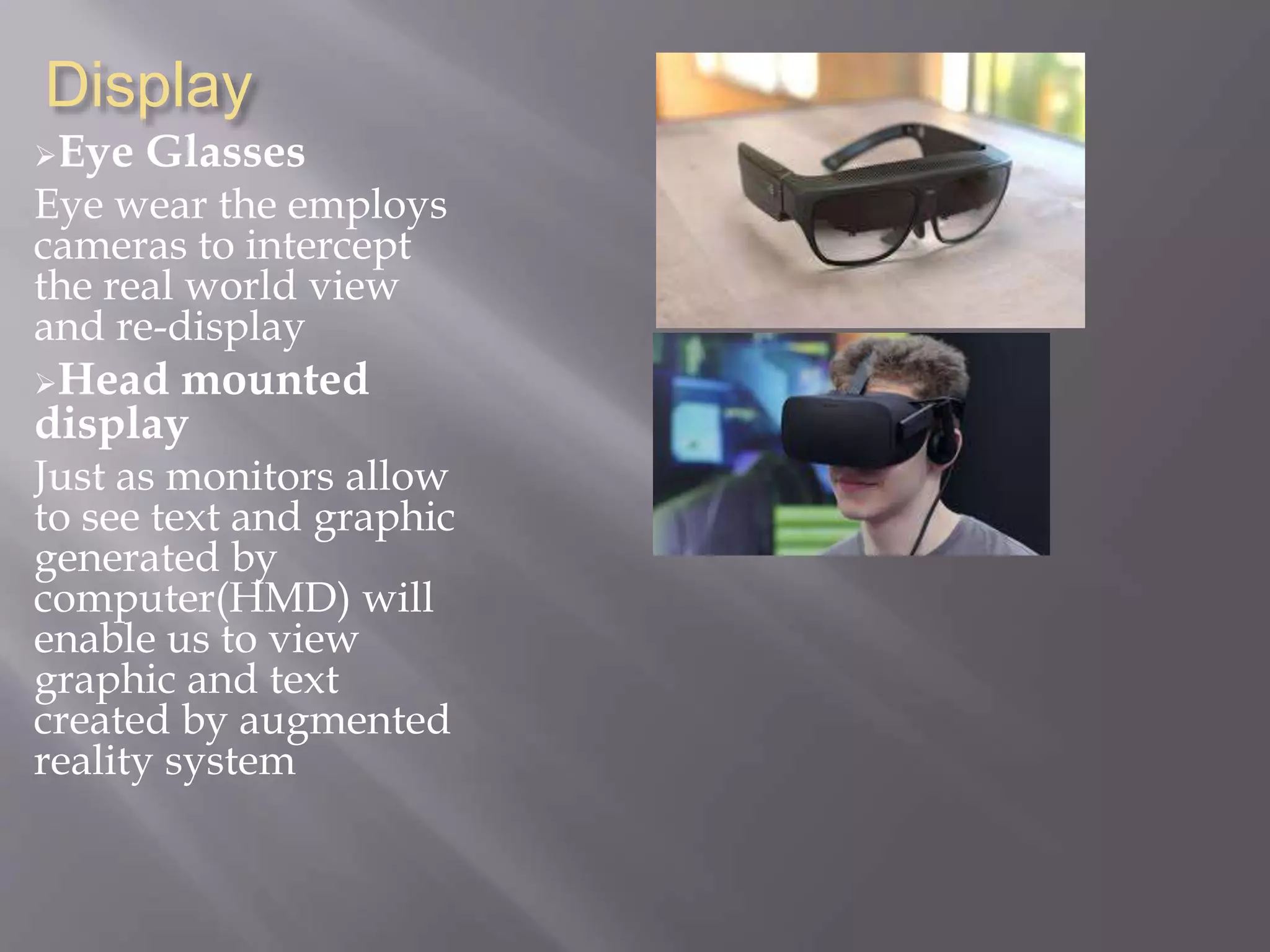
Eye Glasses
Eye wear the employs
cameras to intercept
the real world view
and re-display
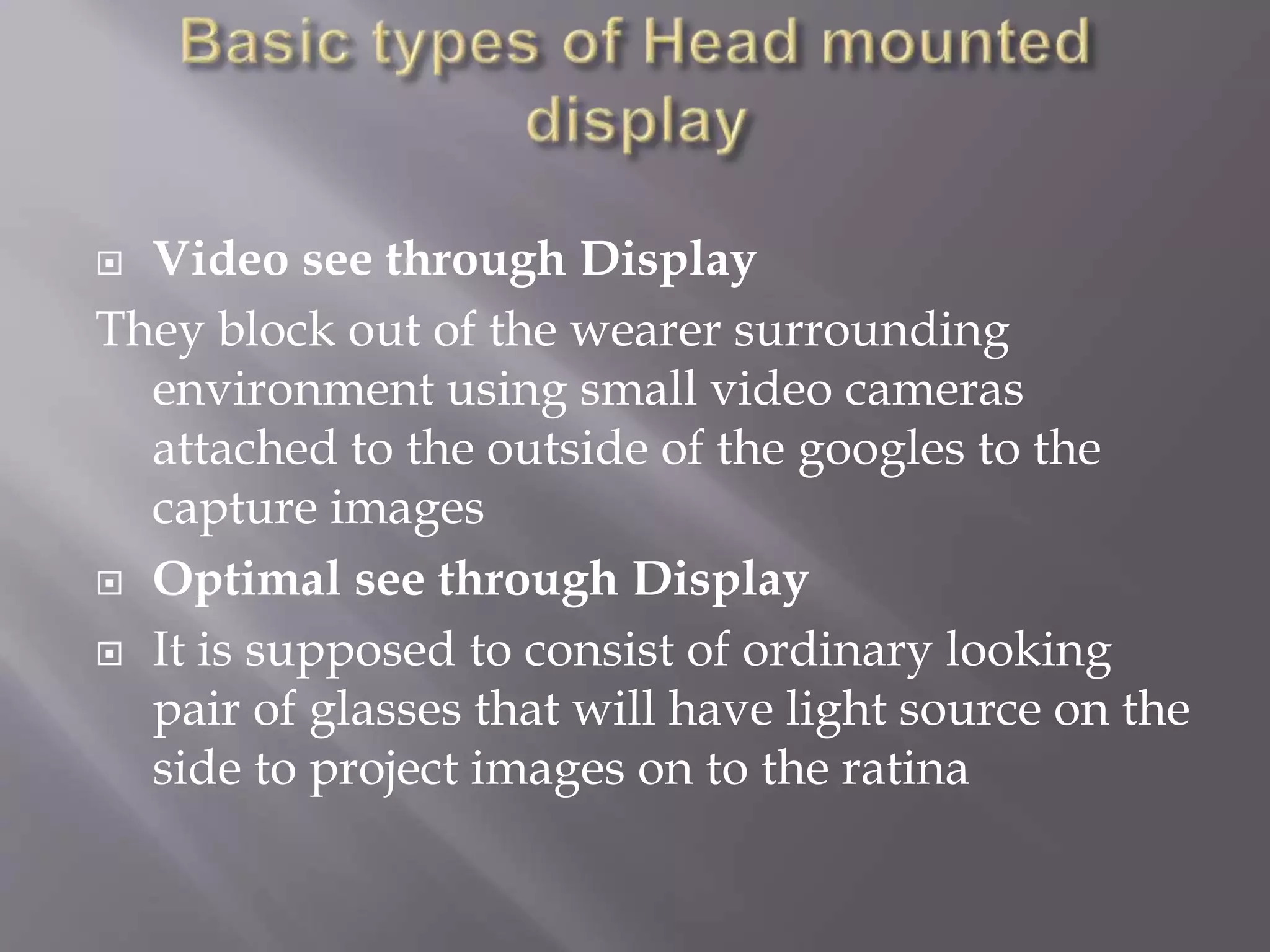
Head mounted
display
Just as monitors allow
to see text and graphic
generated by
computer(HMD) will
enable us to view
graphic and text
created by augmented
reality system
 Video see through Display
They block out of the wearer surrounding
environment using small video cameras
attached to the outside of the googles to the
capture images
 Optimal see through Display
 It is supposed to consist of ordinary looking
pair of glasses that will have light source on the
side to project images on to the ratina
 Education
 Medical Field
 Military
 Instant information
 Gamming
 Accurate tracking and orientation
 For wearable augmented reality system, there
are still enough computing power to create
stereo 3D graphics
 The size of AR systems is yet another problem.
 Replacement of cell phones: eye dialing,
insertion of information directly into
environment.
 Virtual conferences in "holodeck" style .
 Examples might be a virtual wall clock, a to-do
list for the day docked by your bed for you to
look at first thing in the morning, etc.

Virtual and augumented reality system

  • 2.
     What isvirtual reality?  History  Types of virtual reality?  Hardware used in virtual reality?  Application of virtual reality?  Advantages or disadvantages
  • 3.
     Virtual realitymeans feeling the imaginary(virtual)world.  Virtual reality is the term used for computer generated 3D environment that allow the user to enter and interact with altemete realistic.  The definition of ‘virtual is near and ‘reality’ is what we experience as human being.
  • 4.
     In 1950s,flight simulators were built by US Air Force to train student pilots.  In 1965, a research program for computer graphics called “The Ultimate Display” was laid out.  In 1988, commercial development of VR began.  In 1991, first commercial entertainment VR system "Virtuality" was released.
  • 5.
    Virtual reality isneed because complex scenarios cause serious issues. Like complex brain surgery, Flying aircraft tanning etc.For these kind of dangerous scenarios simulated environment is created to overcome the loss jand and also create less cost as compare to original. Types of Virtual Reality  Immersive Virtual Reality  Non-Immersive Virtual Reality  Window to window Virtual Reality
  • 6.
    Immersive Virtual Reality: Immersive virtual reality is a perception of being physically present in a non physical world.  Completely immerse the user's personal viewpoint inside the virtual 3D world.  The user has no visual contact with the physical word.  Often equipped with a Head Mounted Display (HMD).
  • 8.
    Windows on World(WoW) Desktopbased virtual memory involves displaying a 3 dimensional virtual or regular desktop display without use of any specialized movement tracking environment
  • 9.
  • 10.
     Virtual realityin the military  Virtual reality in the health care  Virtual reality and education  Scientific visualization  Virtual reality in entertainment  Engineering and designee  Tranning  E Commerance
  • 12.
     As VirtualReality software becomes more powerful and its hardware more sophisticated, not to mention more affordable, there will be a number of challenges that the industry must face head-on.  But the focus should remain on the positive contributions this technology can make to society. From better healthcare training and education, to active rather than sedentary gaming, there are a number of clear benefits to embracing the exciting developments being made in the world of VR.
  • 13.
     A combinationof real scene viewed by a user and a virtual scene generated by computer that augments the scene with additional information  Augmented reality (AR) is a t reality-based display environment that takes the capabilities of computer generated display, sound, text and effects to enhance the user's real-world experience.  Augmented reality is technology that combines virtual reality with the real world in the form of live video imagery that is digitally enhanced with computer-generated graphics.
  • 14.
     To enhancethe persons performance and perception of the world  Create a system such that user can not tell the difference between the real world and augmentation of it
  • 15.
     Pick areal world scene  Add your virtual objects in it  Delete real world object  Not virtual reality since environment real
  • 17.
     There arethree component needed to make augmented reality system work  Display  Tracking system  Mobile computing power
  • 18.
    Display Eye Glasses Eye wearthe employs cameras to intercept the real world view and re-display Head mounted display Just as monitors allow to see text and graphic generated by computer(HMD) will enable us to view graphic and text created by augmented reality system
  • 19.
     Video seethrough Display They block out of the wearer surrounding environment using small video cameras attached to the outside of the googles to the capture images  Optimal see through Display  It is supposed to consist of ordinary looking pair of glasses that will have light source on the side to project images on to the ratina
  • 20.
     Education  MedicalField  Military  Instant information  Gamming
  • 21.
     Accurate trackingand orientation  For wearable augmented reality system, there are still enough computing power to create stereo 3D graphics  The size of AR systems is yet another problem.
  • 22.
     Replacement ofcell phones: eye dialing, insertion of information directly into environment.  Virtual conferences in "holodeck" style .  Examples might be a virtual wall clock, a to-do list for the day docked by your bed for you to look at first thing in the morning, etc.