UCI Applied Innovation
January 15, 2016 “Lunch and Learn”
© 2016 Virginia A. Suveiu, Esq. All Rights Reserved.
The information provided or communicated in this seminar, whether written or oral, should not be relied upon as legal
advice or opinion regarding any specific matter. All attendees and readers should contact professional legal counsel to
obtain advice on projects or issues. This informational presentation is provided with the understanding that the information
contained herein and any oral statements made by the presenter are for educational purposes only.
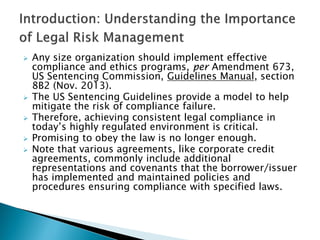
 Any size organization should implement effective
compliance and ethics programs, per Amendment 673,
US Sentencing Commission, Guidelines Manual, section
8B2 (Nov. 2013).
 The US Sentencing Guidelines provide a model to help
mitigate the risk of compliance failure.
 Therefore, achieving consistent legal compliance in
today’s highly regulated environment is critical.
 Promising to obey the law is no longer enough.
 Note that various agreements, like corporate credit
agreements, commonly include additional
representations and covenants that the borrower/issuer
has implemented and maintained policies and
procedures ensuring compliance with specified laws.
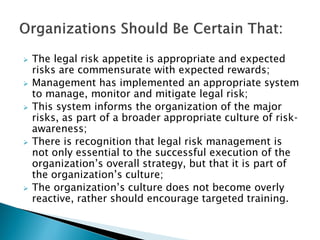
 The legal risk appetite is appropriate and expected
risks are commensurate with expected rewards;
 Management has implemented an appropriate system
to manage, monitor and mitigate legal risk;
 This system informs the organization of the major
risks, as part of a broader appropriate culture of risk-
awareness;
 There is recognition that legal risk management is
not only essential to the successful execution of the
organization’s overall strategy, but that it is part of
the organization’s culture;
 The organization’s culture does not become overly
reactive, rather should encourage targeted training.
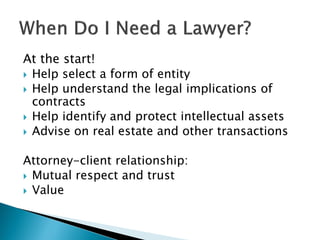
At the start!
 Help select a form of entity
 Help understand the legal implications of
contracts
 Help identify and protect intellectual assets
 Advise on real estate and other transactions
Attorney-client relationship:
 Mutual respect and trust
 Value
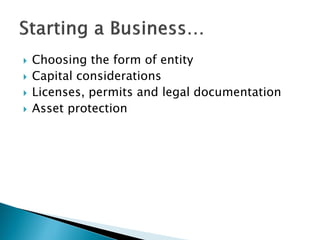
 Choosing the form of entity
 Capital considerations
 Licenses, permits and legal documentation
 Asset protection
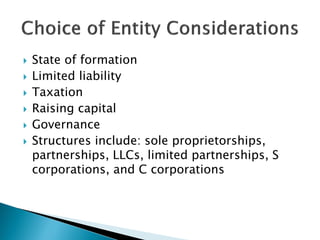
 State of formation
 Limited liability
 Taxation
 Raising capital
 Governance
 Structures include: sole proprietorships,
partnerships, LLCs, limited partnerships, S
corporations, and C corporations
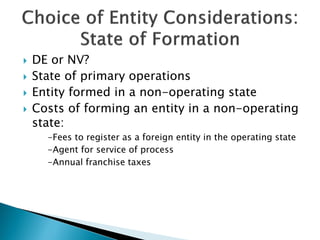
 DE or NV?
 State of primary operations
 Entity formed in a non-operating state
 Costs of forming an entity in a non-operating
state:
-Fees to register as a foreign entity in the operating state
-Agent for service of process
-Annual franchise taxes
 Continual income deriving source
 Sale of the business
 IPO
 How much capitalization is sufficient:
-Self funded
-Outside investors
 Founders’ stock-price, common v. preferred
 Securities law compliance
 Periodic Valuation of Stock
 Promissory notes
 Convertible notes
 Debentures
 Common stock
 Preferred stock
 Options
 Warrants (issued directly by the company)
 Federal, State, City and/or County licenses
and permits
 Employer ID numbers
 Export/import licenses
 Right to use the chosen entity name
 Contracts
-Purchase/sale agreements
-Services agreements
-Terms and Conditions
-IP agreements
-Employment/independent contractor agreements
-Employment manual
 Essential elements: offer, acceptance, consideration
 State partnership act
 General and limited
 Legal formalities
 Content:
 How managed
 How profits and losses are allocated &
distributed
 Avoid boilerplate!
 Identification of IP Assets
-Patents
-Trade secrets
-Copyright
-Trademarks
 Re-cap of aforementioned concepts
 Enterprise Risk Management
 ISO 31000
 New way of viewing legal risk management
 What about the lean business model canvas?
 Risk and Insurance Management Society (RIMS) Risk
Maturity Model for ERM, is an umbrella framework of
content and methodology which details requirements
for sustainable and effective ERM, with seven attributes
creating ERM’s value and utility in an organization: 1)
ERM-based approach; 2) ERM process management; 3)
risk appetite management; 4) root cause discipline; 5)
uncovering risks; 6) performance management; and 7)
business resiliency and sustainability.
 Criticism of ERM: completely misses entity-threatening
risks, missing the fundamental point of formalized risk
management, which is to increase certainty that
objectives are achieved with a tolerable level of risk to
senior management and the board.
 Definition of risk: effect of uncertainty on objectives
(source: ISO 31000:2009, ISO/IEC Guide 73:2009).
 Risk only arises when an organization sets out to
achieve something.
 Risk arises from those internal and external factors and
influences that the organization does not completely
control but that may cause it to fail to achieve its
objectives or may cause delay.
 Such factors and influences can also lead to those
objectives being obtained early or even exceeded.
 Risk is neither positive nor negative, but the
consequences that the organization experiences may
vary from loss/detriment to gain/benefit.
 Managing risk is a process of optimization that makes
the achievement of objectives more likely.
 Depending on the organization, effective
regulatory compliance and legal risk
management (while overall goals for most all
organizations) can have varying structures
and dimensions.
 Scope: a) as a project: there are defined
objectives with scope being progressively
elaborated throughout the project life cycle;
and b) as a program: generally larger in scope
than a project and provides more significant
benefits.
 Officers and directors, D & O insurance
 Employment law issues:
-compliance with wage & hour laws, OSHA and other
applicable state and federal laws
-employees v. consultants & independent contractors
 Bank account, business license, sales tax
resale number/account, general liability
insurance
 Life insurance
 Set risk tolerance, identify potential risks,
prioritize risk tolerance, manage & mitigate
risk
 See the connections
 Develop risk management mentality
 Look ahead
 Manage regulation by rethinking
 Focus on insight
 ISO 31000 framework
 Legal Property Rights: a) given to companies & individuals to protect
certain creations (primary motivation to take risks); b) can be:
patents, copyrights, trademarks.
 Understand product life cycle, which is determined by: a) rate of
technological change; and b) fads/trends.
 Challenge is for the organization to tap into the creativity of the
individual employee.
 Organizational culture not only must support creativity to make
intrapreneurship possible, but also understand how to handle that
creativity.
 Managing & Promoting Innovation includes coordination of creative
minds in project management, as well as other cross-functional team
members.
 New Venture Division: completely independent division that is given
a complete set of support functions to manage a project start to
finish and bring a new product/service to market.
 Joint Venture: allows 2 organizations to pool resources to take on a
risky R&D project with costs, risks and eventual profits shared.
 Educate yourself on various aspects of starting a business.
 Seek relevant professional advice BEFORE starting a business.
 Always factor in the proposed exit strategy in making
significant business decisions.
 Identify and appropriately protect assets.
 Do you due diligence BEFOREHAND!
 Do NOT use a name/logo without the attorney conducting a
trademark search.
 Do NOT ignore your long-term goals when choosing form of
entity.
 Do NOT sign up for anything that is not researched.
 Do NOT sign a contract unless you have sought professional
legal advice.

Main Legal Risk Issues Facing Entrepreneurs | Virginia Suveiu | Lunch & Learn

  • 1.
    UCI Applied Innovation January15, 2016 “Lunch and Learn” © 2016 Virginia A. Suveiu, Esq. All Rights Reserved. The information provided or communicated in this seminar, whether written or oral, should not be relied upon as legal advice or opinion regarding any specific matter. All attendees and readers should contact professional legal counsel to obtain advice on projects or issues. This informational presentation is provided with the understanding that the information contained herein and any oral statements made by the presenter are for educational purposes only.
  • 2.
     Any sizeorganization should implement effective compliance and ethics programs, per Amendment 673, US Sentencing Commission, Guidelines Manual, section 8B2 (Nov. 2013).  The US Sentencing Guidelines provide a model to help mitigate the risk of compliance failure.  Therefore, achieving consistent legal compliance in today’s highly regulated environment is critical.  Promising to obey the law is no longer enough.  Note that various agreements, like corporate credit agreements, commonly include additional representations and covenants that the borrower/issuer has implemented and maintained policies and procedures ensuring compliance with specified laws.
  • 3.
     The legalrisk appetite is appropriate and expected risks are commensurate with expected rewards;  Management has implemented an appropriate system to manage, monitor and mitigate legal risk;  This system informs the organization of the major risks, as part of a broader appropriate culture of risk- awareness;  There is recognition that legal risk management is not only essential to the successful execution of the organization’s overall strategy, but that it is part of the organization’s culture;  The organization’s culture does not become overly reactive, rather should encourage targeted training.
  • 4.
    At the start! Help select a form of entity  Help understand the legal implications of contracts  Help identify and protect intellectual assets  Advise on real estate and other transactions Attorney-client relationship:  Mutual respect and trust  Value
  • 5.
     Choosing theform of entity  Capital considerations  Licenses, permits and legal documentation  Asset protection
  • 6.
     State offormation  Limited liability  Taxation  Raising capital  Governance  Structures include: sole proprietorships, partnerships, LLCs, limited partnerships, S corporations, and C corporations
  • 7.
     DE orNV?  State of primary operations  Entity formed in a non-operating state  Costs of forming an entity in a non-operating state: -Fees to register as a foreign entity in the operating state -Agent for service of process -Annual franchise taxes
  • 8.
     Continual incomederiving source  Sale of the business  IPO
  • 9.
     How muchcapitalization is sufficient: -Self funded -Outside investors  Founders’ stock-price, common v. preferred  Securities law compliance  Periodic Valuation of Stock
  • 10.
     Promissory notes Convertible notes  Debentures  Common stock  Preferred stock  Options  Warrants (issued directly by the company)
  • 11.
     Federal, State,City and/or County licenses and permits  Employer ID numbers  Export/import licenses  Right to use the chosen entity name
  • 12.
     Contracts -Purchase/sale agreements -Servicesagreements -Terms and Conditions -IP agreements -Employment/independent contractor agreements -Employment manual  Essential elements: offer, acceptance, consideration
  • 13.
     State partnershipact  General and limited  Legal formalities  Content:  How managed  How profits and losses are allocated & distributed  Avoid boilerplate!
  • 14.
     Identification ofIP Assets -Patents -Trade secrets -Copyright -Trademarks
  • 15.
     Re-cap ofaforementioned concepts  Enterprise Risk Management  ISO 31000  New way of viewing legal risk management  What about the lean business model canvas?
  • 16.
     Risk andInsurance Management Society (RIMS) Risk Maturity Model for ERM, is an umbrella framework of content and methodology which details requirements for sustainable and effective ERM, with seven attributes creating ERM’s value and utility in an organization: 1) ERM-based approach; 2) ERM process management; 3) risk appetite management; 4) root cause discipline; 5) uncovering risks; 6) performance management; and 7) business resiliency and sustainability.  Criticism of ERM: completely misses entity-threatening risks, missing the fundamental point of formalized risk management, which is to increase certainty that objectives are achieved with a tolerable level of risk to senior management and the board.
  • 17.
     Definition ofrisk: effect of uncertainty on objectives (source: ISO 31000:2009, ISO/IEC Guide 73:2009).  Risk only arises when an organization sets out to achieve something.  Risk arises from those internal and external factors and influences that the organization does not completely control but that may cause it to fail to achieve its objectives or may cause delay.  Such factors and influences can also lead to those objectives being obtained early or even exceeded.  Risk is neither positive nor negative, but the consequences that the organization experiences may vary from loss/detriment to gain/benefit.  Managing risk is a process of optimization that makes the achievement of objectives more likely.
  • 18.
     Depending onthe organization, effective regulatory compliance and legal risk management (while overall goals for most all organizations) can have varying structures and dimensions.  Scope: a) as a project: there are defined objectives with scope being progressively elaborated throughout the project life cycle; and b) as a program: generally larger in scope than a project and provides more significant benefits.
  • 19.
     Officers anddirectors, D & O insurance  Employment law issues: -compliance with wage & hour laws, OSHA and other applicable state and federal laws -employees v. consultants & independent contractors  Bank account, business license, sales tax resale number/account, general liability insurance  Life insurance
  • 20.
     Set risktolerance, identify potential risks, prioritize risk tolerance, manage & mitigate risk  See the connections  Develop risk management mentality  Look ahead  Manage regulation by rethinking  Focus on insight  ISO 31000 framework
  • 21.
     Legal PropertyRights: a) given to companies & individuals to protect certain creations (primary motivation to take risks); b) can be: patents, copyrights, trademarks.  Understand product life cycle, which is determined by: a) rate of technological change; and b) fads/trends.  Challenge is for the organization to tap into the creativity of the individual employee.  Organizational culture not only must support creativity to make intrapreneurship possible, but also understand how to handle that creativity.  Managing & Promoting Innovation includes coordination of creative minds in project management, as well as other cross-functional team members.  New Venture Division: completely independent division that is given a complete set of support functions to manage a project start to finish and bring a new product/service to market.  Joint Venture: allows 2 organizations to pool resources to take on a risky R&D project with costs, risks and eventual profits shared.
  • 22.
     Educate yourselfon various aspects of starting a business.  Seek relevant professional advice BEFORE starting a business.  Always factor in the proposed exit strategy in making significant business decisions.  Identify and appropriately protect assets.  Do you due diligence BEFOREHAND!  Do NOT use a name/logo without the attorney conducting a trademark search.  Do NOT ignore your long-term goals when choosing form of entity.  Do NOT sign up for anything that is not researched.  Do NOT sign a contract unless you have sought professional legal advice.