• 1:1 Consulting
• Personalized
• Business start, development & growth
• Help businesses get “investor-ready”
• High-tech, high-growth, scalable
• Life Science & Technology Sectors
• UCI Resources
• No Cost
SBDC - Small Business Development Center
A Resource for Ventures from Idea to Exit
• General Business Consulting
• Funding/Pitching
• Term Sheets
• Equity & Debt Funding
• SBIR/STTR
• Technology Commercialization
• Sales & Marketing Strategy
• Board of Directors/Advisory Board Assistance
• Hiring and Staffing
SBDC Services and Expertise
Start
Grow
Finance your business
SBA.gov
Located next to “The Beach” @ the Cove
julie.cranston@uci.edu
SBDCtech.com
*example rendering. Not actual plan
BUILD TRUST - FOSTER INNOVATION
Learn how to create a fearless, thriving organization that fosters
a culture of innovation
Presented by: Leila Entezam, LMFT, MBA
Journey
*example rendering. Not actual plan
• Intro
• Brain Basics
• Biases
• “Corporate Caring”+
• Bridging the Gap
• Tools
• Questions
Quick Intro
*example rendering. Not actual plan
“Feel stuff to do stuff..”
“Maximize impact”
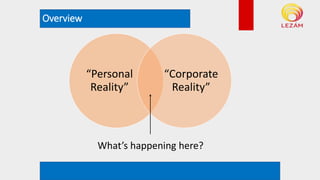
Overview
*example rendering. Not actual plan
“Personal
Reality”
“Corporate
Reality”
What’s happening here?
Starts with the brain…
*example rendering. Not actual plan
• Emotion before logic – emotions drive action
• 1/3 Brain – visual processing – what you SEE matters/influences you
– news source, social media, etc.
• Priming (and tied to “1/3 brain visual…”)
• Brain remembers stories
• References/History/Triggers – Personal Associations – ex: cow head
• Culture, gender, ethnicity..it all matters
• Most processing is subconscious
Biases
*example rendering. Not actual plan
• Confirmation Bias - We all favor ideas that confirm our existing beliefs and what we think we
know. Likewise, when we conduct research, we all suffer from trying to find sources that justify
what we believe about the subject. (“See, I’m right!”)
• Fundamental Attribution Error - we look for contextual excuses for our failures, but generally
blame other people or their characteristics for their failures. also we make judgments based
only on the information we have available at hand. (“Bad driver, woman, bad driver because
she’s a woman.”)
• In-Group Bias - we have a tendency to be kinder to ourselves when making judgments about
our successes and failures. This extends to those we hold near and dear, those who we
perceive as similar and those who we consider part of our ‘group’. Simply, In-Group Bias refers
to the unfair favoring of someone from one’s own group. (“Us vs. Them”)
https://www.psychologytoday.com/us/blog/thoughts-thinking/201809/12-common-biases-affect-how-we-make-everyday-decisions
Corporate Promise
*example rendering. Not actual plan
Business Roundtable (association of CEOs) recently announced the
release of a new Statement on the Purpose of a Corporation signed
by 181 CEOs who commit to lead their companies for the benefit of
all stakeholders – customers, employees, suppliers, communities and
shareholders.
Part of the commitment included, “Investing in our employees. This
starts with compensating them fairly and providing important
benefits. It also includes supporting them through training and
education that help develop new skills for a rapidly changing world.
We foster diversity and inclusion, dignity and respect.”
YES!
Meanwhile…
*example rendering. Not actual plan
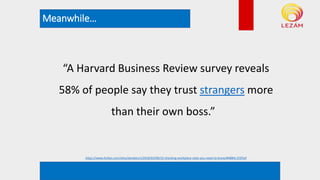
“A Harvard Business Review survey reveals
58% of people say they trust strangers more
than their own boss.”
https://www.forbes.com/sites/davidsturt/2018/03/08/10-shocking-workplace-stats-you-need-to-know/#4884c155f3af
And…
*example rendering. Not actual plan
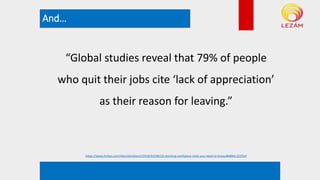
“Global studies reveal that 79% of people
who quit their jobs cite ‘lack of appreciation’
as their reason for leaving.”
https://www.forbes.com/sites/davidsturt/2018/03/08/10-shocking-workplace-stats-you-need-to-know/#4884c155f3af
And…
*example rendering. Not actual plan
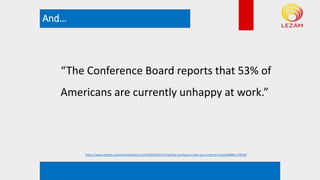
“The Conference Board reports that 53% of
Americans are currently unhappy at work.”
https://www.forbes.com/sites/davidsturt/2018/03/08/10-shocking-workplace-stats-you-need-to-know/#4884c155f3af
Sooo…
*example rendering. Not actual plan
WTH??
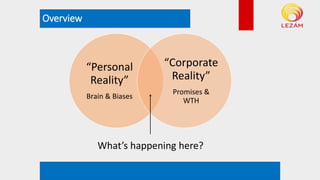
Overview
*example rendering. Not actual plan
“Personal
Reality”
Brain & Biases
“Corporate
Reality”
Promises &
WTH
What’s happening here?
Consequence?
*example rendering. Not actual plan
• Innovation
• Creativity
• Trust
• Agility
• And so on..
Consequence?
*example rendering. Not actual plan
Does this sound familiar?
(I’m sure its not you!)
Bridging the Gap
*example rendering. Not actual plan
Psychological Safety
• Harvard Professor Amy Edmondson
• Team climate characterized by interpersonal trust and mutual
respect in which people are comfortable being themselves
• Allows for risk-taking, speaking up, creativity, trust, and not fearing
repercussions
https://hbr.org/2017/08/high-performing-teams-need-psychological-safety-heres-how-to-create-it
Google
*example rendering. Not actual plan
• Major study done by Google in 2012
• 180 teams across the company
• Key component of building high performance teams
• What really mattered…how the team worked together.
• Fostered by an environment of “psychological safety.”
https://www.nytimes.com/2016/02/28/magazine/what-google-learned-from-its-quest-to-build-the-perfect-team.html
What About You?
*example rendering. Not actual plan
What does this mean to you?
What do you think?
(benefits?, challenges?, etc.)
How?
*example rendering. Not actual plan
• Create “Common Language”
• Embrace PS as an organizational culture (top down)
• Implement tools for PS
How? - Individual
*example rendering. Not actual plan
• Ownership & Emotional Intelligence
• Don’t Take Things Personally & “Google Searching”
• Get Uncomfortable
• Be Respectfully Curious
How? - Team
*example rendering. Not actual plan
• Listen First
• Foster Trust
• Celebrate Diversity
• Healthy Conflict
How? – Organization & Leadership
*example rendering. Not actual plan
• Create Consistency
• Commitment to Purpose & Values
• Appreciation
• Growth
Questions
*example rendering. Not actual plan
Questions?
How can I help?
*example rendering. Not actual plan
• Deep Dive Executive Leadership Coaching
• Workshops (Culture, Communication, etc.)
• Board Retreats
• Psychological Safety
• Team Coaching
• Public Speaking
Subscribe at www.lezam.it
See you soon!
*example rendering. Not actual plan
Thank you!

Build Trust, Foster Innovation

  • 2.
    • 1:1 Consulting •Personalized • Business start, development & growth • Help businesses get “investor-ready” • High-tech, high-growth, scalable • Life Science & Technology Sectors • UCI Resources • No Cost SBDC - Small Business Development Center A Resource for Ventures from Idea to Exit
  • 3.
    • General BusinessConsulting • Funding/Pitching • Term Sheets • Equity & Debt Funding • SBIR/STTR • Technology Commercialization • Sales & Marketing Strategy • Board of Directors/Advisory Board Assistance • Hiring and Staffing SBDC Services and Expertise
  • 4.
  • 5.
    Located next to“The Beach” @ the Cove julie.cranston@uci.edu SBDCtech.com
  • 6.
    *example rendering. Notactual plan BUILD TRUST - FOSTER INNOVATION Learn how to create a fearless, thriving organization that fosters a culture of innovation Presented by: Leila Entezam, LMFT, MBA
  • 7.
    Journey *example rendering. Notactual plan • Intro • Brain Basics • Biases • “Corporate Caring”+ • Bridging the Gap • Tools • Questions
  • 8.
    Quick Intro *example rendering.Not actual plan “Feel stuff to do stuff..” “Maximize impact”
  • 9.
    Overview *example rendering. Notactual plan “Personal Reality” “Corporate Reality” What’s happening here?
  • 10.
    Starts with thebrain… *example rendering. Not actual plan • Emotion before logic – emotions drive action • 1/3 Brain – visual processing – what you SEE matters/influences you – news source, social media, etc. • Priming (and tied to “1/3 brain visual…”) • Brain remembers stories • References/History/Triggers – Personal Associations – ex: cow head • Culture, gender, ethnicity..it all matters • Most processing is subconscious
  • 11.
    Biases *example rendering. Notactual plan • Confirmation Bias - We all favor ideas that confirm our existing beliefs and what we think we know. Likewise, when we conduct research, we all suffer from trying to find sources that justify what we believe about the subject. (“See, I’m right!”) • Fundamental Attribution Error - we look for contextual excuses for our failures, but generally blame other people or their characteristics for their failures. also we make judgments based only on the information we have available at hand. (“Bad driver, woman, bad driver because she’s a woman.”) • In-Group Bias - we have a tendency to be kinder to ourselves when making judgments about our successes and failures. This extends to those we hold near and dear, those who we perceive as similar and those who we consider part of our ‘group’. Simply, In-Group Bias refers to the unfair favoring of someone from one’s own group. (“Us vs. Them”) https://www.psychologytoday.com/us/blog/thoughts-thinking/201809/12-common-biases-affect-how-we-make-everyday-decisions
  • 12.
    Corporate Promise *example rendering.Not actual plan Business Roundtable (association of CEOs) recently announced the release of a new Statement on the Purpose of a Corporation signed by 181 CEOs who commit to lead their companies for the benefit of all stakeholders – customers, employees, suppliers, communities and shareholders. Part of the commitment included, “Investing in our employees. This starts with compensating them fairly and providing important benefits. It also includes supporting them through training and education that help develop new skills for a rapidly changing world. We foster diversity and inclusion, dignity and respect.” YES!
  • 13.
    Meanwhile… *example rendering. Notactual plan “A Harvard Business Review survey reveals 58% of people say they trust strangers more than their own boss.” https://www.forbes.com/sites/davidsturt/2018/03/08/10-shocking-workplace-stats-you-need-to-know/#4884c155f3af
  • 14.
    And… *example rendering. Notactual plan “Global studies reveal that 79% of people who quit their jobs cite ‘lack of appreciation’ as their reason for leaving.” https://www.forbes.com/sites/davidsturt/2018/03/08/10-shocking-workplace-stats-you-need-to-know/#4884c155f3af
  • 15.
    And… *example rendering. Notactual plan “The Conference Board reports that 53% of Americans are currently unhappy at work.” https://www.forbes.com/sites/davidsturt/2018/03/08/10-shocking-workplace-stats-you-need-to-know/#4884c155f3af
  • 16.
  • 17.
    Overview *example rendering. Notactual plan “Personal Reality” Brain & Biases “Corporate Reality” Promises & WTH What’s happening here?
  • 18.
    Consequence? *example rendering. Notactual plan • Innovation • Creativity • Trust • Agility • And so on..
  • 19.
    Consequence? *example rendering. Notactual plan Does this sound familiar? (I’m sure its not you!)
  • 20.
    Bridging the Gap *examplerendering. Not actual plan Psychological Safety • Harvard Professor Amy Edmondson • Team climate characterized by interpersonal trust and mutual respect in which people are comfortable being themselves • Allows for risk-taking, speaking up, creativity, trust, and not fearing repercussions https://hbr.org/2017/08/high-performing-teams-need-psychological-safety-heres-how-to-create-it
  • 21.
    Google *example rendering. Notactual plan • Major study done by Google in 2012 • 180 teams across the company • Key component of building high performance teams • What really mattered…how the team worked together. • Fostered by an environment of “psychological safety.” https://www.nytimes.com/2016/02/28/magazine/what-google-learned-from-its-quest-to-build-the-perfect-team.html
  • 22.
    What About You? *examplerendering. Not actual plan What does this mean to you? What do you think? (benefits?, challenges?, etc.)
  • 23.
    How? *example rendering. Notactual plan • Create “Common Language” • Embrace PS as an organizational culture (top down) • Implement tools for PS
  • 24.
    How? - Individual *examplerendering. Not actual plan • Ownership & Emotional Intelligence • Don’t Take Things Personally & “Google Searching” • Get Uncomfortable • Be Respectfully Curious
  • 25.
    How? - Team *examplerendering. Not actual plan • Listen First • Foster Trust • Celebrate Diversity • Healthy Conflict
  • 26.
    How? – Organization& Leadership *example rendering. Not actual plan • Create Consistency • Commitment to Purpose & Values • Appreciation • Growth
  • 27.
    Questions *example rendering. Notactual plan Questions?
  • 28.
    How can Ihelp? *example rendering. Not actual plan • Deep Dive Executive Leadership Coaching • Workshops (Culture, Communication, etc.) • Board Retreats • Psychological Safety • Team Coaching • Public Speaking Subscribe at www.lezam.it
  • 29.
    See you soon! *examplerendering. Not actual plan Thank you!