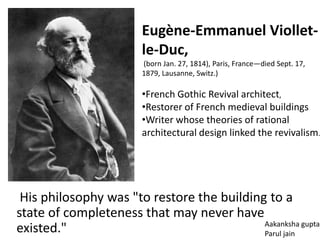
Eugène-Emmanuel Violletle-Duc,
(born Jan. 27, 1814), Paris, France—died Sept. 17,
1879, Lausanne, Switz.)

•French Gothic Revival architect,
•Restorer of French medieval buildings
•Writer whose theories of rational
architectural design linked the revivalism.

His philosophy was "to restore the building to a
state of completeness that may never have
Aakanksha gupta
existed."
Parul jain
Inspiration
• August Ferret was inspired by his ideas and steadfastly clung
to them throughout his life.
•Frank Lloyd Wright continually acknowledged his debt to the
great restorer.
•Mies van der Rohe even has admitted his influence. And if his
ideas might seem more closely related to the steel and glass
building of this architect.
•Russian constructivist El Lissitsky who found his stimulus in
Viollet-le-Duc's L' A rt Russe—it is as well to remember that his
theories have not been inimical to the creation of such works
as the Sagrada Familia in Barcelona and the chapel at
Ronchamps.
•Antonio Gaudi's highly original architecture was directly
inspired by the writings of Viollet-le-Duc.
Architectural restorer
Viollet-le-Duc was a pupil of Achille Leclère but was inspired in his
career by the architect Henri Labrouste. In 1836 he traveled to Italy,
where he spent 16 months studying architecture. Back in France he
was drawn irrevocably to Gothic art. J.-B. Lassus first trained Violletle-Duc as a medieval archaeologist on the restoration of SaintGermain-l’Auxerrois (1838)
Main restorations
•Vezelay Abbay, France
•Holy Chapell, Paris
•Notre Dame, Paris
•City wall of Carcassone, France
•Pierrefonds castel, France.
(Reconstruction for Napoleon III) Viollet le Duc let
his imagination run to rebuild this castel near in the
north of Paris.
Viollet-le-Duc has concerned itself with the modern
political circumstances that surrounded the formation of a theory and practice of
national monument preservation.

Historians of medieval architecture, in particular, have long decried the heavy
hand of Viollet-le-Duc's restoration, at times involving such a thorough changing
of the confused palimpsests of the passage of time to achieve his famous
paradoxical dictum that "to

restore an edifice is not to maintain it,
repair or remake it, it is to re-establish it in a complete state
that may never have existed at any given moment in the
past."
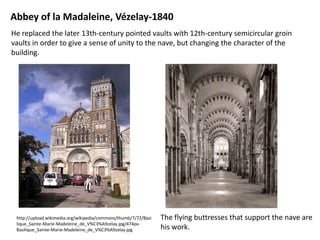
Abbey of la Madaleine, Vézelay-1840
He replaced the later 13th-century pointed vaults with 12th-century semicircular groin
vaults in order to give a sense of unity to the nave, but changing the character of the
building.

http://upload.wikimedia.org/wikipedia/commons/thumb/7/72/Basi
lique_Sainte-Marie-Madeleine_de_V%C3%A9zelay.jpg/474pxBasilique_Sainte-Marie-Madeleine_de_V%C3%A9zelay.jpg

The flying buttresses that support the nave are
his work.
http://upload.wikimedia.org/wikipedia/commons/thumb/1/1d/Vezelay
DB145.jpg/799px-VezelayDB145.jpg

Floor plan of Vézelay shows the adjustment in vaulting between the choir and the
new nave.
After the Revolution, Vézelay stood in danger of collapse. In 1834 the newly
appointed French inspector of historical monuments, Prosper Mérimée (more
familiar as the author of Carmen), warned that it was about to collapse, and on his
recommendation the young architect Eugène Viollet-le-Duc was appointed to
supervise a massive and successful restoration, undertaken in several stages between
1840 and 1861, during which his team replaced a great deal of the weathered and
vandalized sculpture.
Lobrichon argued that Viollet-le-Duc's view of Vézelay as a key transitional
monument between the Romanesque and the Gothic, and thus between a
feudal/monastic and an emerging civic culture, colored his entire
restoration, leading Viollet-le-Duc to underscore elements that pointed to the
future in this pioneering historical restoration!

Lobrichon showed that despite its
small size and remote location, the
picturesque hilltop town of Vézelay,
dominated by its pilgrimage church,
loomed large in the relationship
between the emergence of a secular
town culture and individual religious
experience, all factors, moreover,
that resonate in Viollet-le-Duc's own
nationalist history of gothic
architecture, in which Vézelay and its
citizens played a role.
www.gsinai.com
La Sainte Chapelle
Sainte Chapelle suffered from several fires (1630, 1777) and one flood. Nor did the
French Revolution spare it: the outside ornamentation was damaged, especially the
spire.

http://architecture.relig.free.fr/images/sainte_chapelle/ext_entier.jpg

Restorations were made in the second part of the 19th century.A new spire was built
(1853) And Restoration of the inside ornamentation was almost complete.
Interestingly, the chapel incorporated a form of iron
reinforcement, with two ‘chains’ of hooked bars encircling the
upper chapel, the main part of the structure. Further, there
were iron stabilisers across the nave (with a vertical tension
bar).

http://upload.wikimedia.org/wikipedia/commons/8/89/Ste_Chapelle_Basse_s.jpg

Two meters' worth of glass was removed to facilitate working light and destroyed or put
on the market. Its well-documented restoration, completed under the direction
of Eugène Viollet-le-Duc in 1855, was regarded as exemplary by contemporaries and is
faithful to the original drawings and descriptions of the chapel that survive.
Completed in 1855 under the direction of
Viollet-le-Duc, the project was considered
exemplary by contemporaries. Much of the
chapel as it appears today dates from this 19th
century recreation of what restores at the time
thought it might have looked in the 13th century.

http://online.wsj.com/news/articles/SB10001424127887323308504579082991871355218
Notre Dame at Dijon
In analysing
Notre Dame at Dijon he
showed a section of the nave
not only with timber
buttresses but with thin
columns of cast-iron. This was
the kindling spark of thought
that he struck for the future.

http://www.frenchmoments.eu/notredame-cathedral/

He showed how new materials
might be used in accord with
Gothic structural principles to
arrive at a new architecture.
But, though the new
architecture was to be rooted
in the past, there was to be no
question of revivalism:
scientific analysis and
independent synthesis were
the keys to his doctrine.
1844 -Notre-Dame de Paris
The restoration of the Cathedral of NotreDame in Paris was undertaken by J.B.A.
Lassus and Eugene Emmanuel Viollet-leDuc in 1845 and continued by Viollet-leDuc after the death of Lassus in 1857.
He designed a new Chapter House for the
the Cathedral of Notre-Dame in 1847.
The restoration lasted twenty five years
and included a taller reconstruction of
the flèche (a type of spire) which was
destroyed during the French revolution.
As well as the addition of the chimeras on
the Galerie des Chimères.
Gargoyles on the cathedral of
Notre-Dame de Paris, added by
restoration architect E.-E. Viollet-leDuc, 1845–64.

Gargoyles-The monstrous animals
with their fantastic or diabolical
pictures set on the top of the
cathedral’s western tower to serve
as gutters were designed by
eugene emmanuel le duc during
the lengthy restoration. Viollet le
Duc always signed his work with a
bat, the wing structure of which
most resembles the Gothic vault.
In a number of plans, drawings and
sketches, Viollet-le-Duc also made
an attempt to revive gothic fittings.
Several objects at Notre-Dame de
Paris received this treatment
including the pulpit, the banc
d’oeuvre (now removed), the
chapel altars and the choir highaltar, the baptismal fonts, the crown
of light, the lustres, candelabra and
chandeliers, as well as a number of
pieces of liturgical silverwork that
can be seen in the cathedral
Treasury.

Nave to east

Choir to west
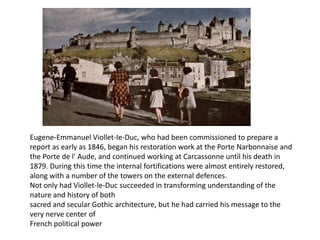
City of Carcassonne

http://whc.unesco.org/uploads/thumbs/site_0345_0006-500-334-20090506135520.jpg

Carcassonne is also of exceptional importance because of the lengthy
restoration campaign undertaken in the latter half of the 19th century by
Eugène-Emmanuel Viollet-le-Duc, one of the founders of the modern science
of conservation.
Eugene-Emmanuel Viollet-Ie-Duc, who had been commissioned to prepare a
report as early as 1846, began his restoration work at the Porte Narbonnaise and
the Porte de l' Aude, and continued working at Carcassonne until his death in
1879. During this time the internal fortifications were almost entirely restored,
along with a number of the towers on the external defences.
Not only had Viollet-le-Duc succeeded in transforming understanding of the
nature and history of both
sacred and secular Gothic architecture, but he had carried his message to the
very nerve center of
French political power
Architectural theory
Viollet-le-Duc is considered by many to be the first theorist of modern
architecture. Sir John Summerson wrote that "there have been two supremely
eminent theorists in the history of European architecture - Leon Battista
Albertiand Eugène Viollet-le-Duc.

His architectural theory was largely based on finding
the ideal forms for specific materials, and using these
forms to create buildings. His writings centered on the
idea that materials should be used 'honestly'.
He believed that the outward appearance of a
building should reflect the rational
construction of the building.

The Art Nouveau Style: A Comprehensive Guide with 264 Illustrations
Two books made Viollet le Duc famous:
•‘’Dictionnaire raisonné de l'architecture française du XI au XVe siècle" (1854-1868) In
English: Dictionnary of French architecture from 11th to 15th century.

•"Dictionnaire raisonné du mobilier français de l'époque Carolingienne à la
Rennaissance (1858-1870). Dictionnary of French furniture.
In those two books, he gave up the idea of
a revival to study rigourosly the shapes of
gothic arts in order to establish a set of
principles for the 19th century architecture.
He proponed the use of
contemporary materials such as iron.
Summary

•It is easy to mock Viollet-le-Duc and disparage his theories, and the
knowledge they were based upon, but it is as well to remember his aims
and his influence on the modern movement of architecture.
•For what he was ultimately concerned to prove was that architecture
was a precise, studied affair, whose every form and detail should be
thought out in accordance with a rational ideal.
•His method was to isolate the ideal wherever it occurred and to uphold
it so that it might inspire an architecture of the nineteenth century that
was good—or at least capable of being good. Nor did he flinch from the
task of indicating how his rational principles might be applied using the
materials and serving the needs of the age.
REFERENCES
•
•
•
•
•
•
•
•
•
•

http://architecture.relig.free.fr/chapelle_en.htm
http://artnouveau.pagesperso-orange.fr/en/artistes/vld.htm
Neoclassicism and Romanticism By Silvestra Bietoletti
http://archive.thetablet.co.uk/article/5th-june-1965/9/viollet-le-duc
http://whc.unesco.org/n/list/345
http://www.dictionaryofarthistorians.org/violletleduce.htm
http://www.dictionaryofarthhttp://www.britannica.com/EBchecked/topic/629711
/Eugene-Emmanuel-Viollet-le-Duc
historians.org/violletleduce.htm
http://www.dictionaryofarthistorians.org/violletleduce.htm
http://www.h-france.net/vol1reviews/vol1no46bergdoll.pdf

Viollet le duc

  • 1.
    Eugène-Emmanuel Violletle-Duc, (born Jan.27, 1814), Paris, France—died Sept. 17, 1879, Lausanne, Switz.) •French Gothic Revival architect, •Restorer of French medieval buildings •Writer whose theories of rational architectural design linked the revivalism. His philosophy was "to restore the building to a state of completeness that may never have Aakanksha gupta existed." Parul jain
  • 2.
    Inspiration • August Ferretwas inspired by his ideas and steadfastly clung to them throughout his life. •Frank Lloyd Wright continually acknowledged his debt to the great restorer. •Mies van der Rohe even has admitted his influence. And if his ideas might seem more closely related to the steel and glass building of this architect. •Russian constructivist El Lissitsky who found his stimulus in Viollet-le-Duc's L' A rt Russe—it is as well to remember that his theories have not been inimical to the creation of such works as the Sagrada Familia in Barcelona and the chapel at Ronchamps. •Antonio Gaudi's highly original architecture was directly inspired by the writings of Viollet-le-Duc.
  • 3.
    Architectural restorer Viollet-le-Duc wasa pupil of Achille Leclère but was inspired in his career by the architect Henri Labrouste. In 1836 he traveled to Italy, where he spent 16 months studying architecture. Back in France he was drawn irrevocably to Gothic art. J.-B. Lassus first trained Violletle-Duc as a medieval archaeologist on the restoration of SaintGermain-l’Auxerrois (1838) Main restorations •Vezelay Abbay, France •Holy Chapell, Paris •Notre Dame, Paris •City wall of Carcassone, France •Pierrefonds castel, France. (Reconstruction for Napoleon III) Viollet le Duc let his imagination run to rebuild this castel near in the north of Paris.
  • 4.
    Viollet-le-Duc has concerneditself with the modern political circumstances that surrounded the formation of a theory and practice of national monument preservation. Historians of medieval architecture, in particular, have long decried the heavy hand of Viollet-le-Duc's restoration, at times involving such a thorough changing of the confused palimpsests of the passage of time to achieve his famous paradoxical dictum that "to restore an edifice is not to maintain it, repair or remake it, it is to re-establish it in a complete state that may never have existed at any given moment in the past."
  • 5.
    Abbey of laMadaleine, Vézelay-1840 He replaced the later 13th-century pointed vaults with 12th-century semicircular groin vaults in order to give a sense of unity to the nave, but changing the character of the building. http://upload.wikimedia.org/wikipedia/commons/thumb/7/72/Basi lique_Sainte-Marie-Madeleine_de_V%C3%A9zelay.jpg/474pxBasilique_Sainte-Marie-Madeleine_de_V%C3%A9zelay.jpg The flying buttresses that support the nave are his work.
  • 6.
    http://upload.wikimedia.org/wikipedia/commons/thumb/1/1d/Vezelay DB145.jpg/799px-VezelayDB145.jpg Floor plan ofVézelay shows the adjustment in vaulting between the choir and the new nave. After the Revolution, Vézelay stood in danger of collapse. In 1834 the newly appointed French inspector of historical monuments, Prosper Mérimée (more familiar as the author of Carmen), warned that it was about to collapse, and on his recommendation the young architect Eugène Viollet-le-Duc was appointed to supervise a massive and successful restoration, undertaken in several stages between 1840 and 1861, during which his team replaced a great deal of the weathered and vandalized sculpture.
  • 7.
    Lobrichon argued thatViollet-le-Duc's view of Vézelay as a key transitional monument between the Romanesque and the Gothic, and thus between a feudal/monastic and an emerging civic culture, colored his entire restoration, leading Viollet-le-Duc to underscore elements that pointed to the future in this pioneering historical restoration! Lobrichon showed that despite its small size and remote location, the picturesque hilltop town of Vézelay, dominated by its pilgrimage church, loomed large in the relationship between the emergence of a secular town culture and individual religious experience, all factors, moreover, that resonate in Viollet-le-Duc's own nationalist history of gothic architecture, in which Vézelay and its citizens played a role. www.gsinai.com
  • 8.
    La Sainte Chapelle SainteChapelle suffered from several fires (1630, 1777) and one flood. Nor did the French Revolution spare it: the outside ornamentation was damaged, especially the spire. http://architecture.relig.free.fr/images/sainte_chapelle/ext_entier.jpg Restorations were made in the second part of the 19th century.A new spire was built (1853) And Restoration of the inside ornamentation was almost complete.
  • 9.
    Interestingly, the chapelincorporated a form of iron reinforcement, with two ‘chains’ of hooked bars encircling the upper chapel, the main part of the structure. Further, there were iron stabilisers across the nave (with a vertical tension bar). http://upload.wikimedia.org/wikipedia/commons/8/89/Ste_Chapelle_Basse_s.jpg Two meters' worth of glass was removed to facilitate working light and destroyed or put on the market. Its well-documented restoration, completed under the direction of Eugène Viollet-le-Duc in 1855, was regarded as exemplary by contemporaries and is faithful to the original drawings and descriptions of the chapel that survive.
  • 10.
    Completed in 1855under the direction of Viollet-le-Duc, the project was considered exemplary by contemporaries. Much of the chapel as it appears today dates from this 19th century recreation of what restores at the time thought it might have looked in the 13th century. http://online.wsj.com/news/articles/SB10001424127887323308504579082991871355218
  • 11.
    Notre Dame atDijon In analysing Notre Dame at Dijon he showed a section of the nave not only with timber buttresses but with thin columns of cast-iron. This was the kindling spark of thought that he struck for the future. http://www.frenchmoments.eu/notredame-cathedral/ He showed how new materials might be used in accord with Gothic structural principles to arrive at a new architecture. But, though the new architecture was to be rooted in the past, there was to be no question of revivalism: scientific analysis and independent synthesis were the keys to his doctrine.
  • 12.
    1844 -Notre-Dame deParis The restoration of the Cathedral of NotreDame in Paris was undertaken by J.B.A. Lassus and Eugene Emmanuel Viollet-leDuc in 1845 and continued by Viollet-leDuc after the death of Lassus in 1857. He designed a new Chapter House for the the Cathedral of Notre-Dame in 1847. The restoration lasted twenty five years and included a taller reconstruction of the flèche (a type of spire) which was destroyed during the French revolution. As well as the addition of the chimeras on the Galerie des Chimères.
  • 13.
    Gargoyles on thecathedral of Notre-Dame de Paris, added by restoration architect E.-E. Viollet-leDuc, 1845–64. Gargoyles-The monstrous animals with their fantastic or diabolical pictures set on the top of the cathedral’s western tower to serve as gutters were designed by eugene emmanuel le duc during the lengthy restoration. Viollet le Duc always signed his work with a bat, the wing structure of which most resembles the Gothic vault.
  • 14.
    In a numberof plans, drawings and sketches, Viollet-le-Duc also made an attempt to revive gothic fittings. Several objects at Notre-Dame de Paris received this treatment including the pulpit, the banc d’oeuvre (now removed), the chapel altars and the choir highaltar, the baptismal fonts, the crown of light, the lustres, candelabra and chandeliers, as well as a number of pieces of liturgical silverwork that can be seen in the cathedral Treasury. Nave to east Choir to west
  • 15.
    City of Carcassonne http://whc.unesco.org/uploads/thumbs/site_0345_0006-500-334-20090506135520.jpg Carcassonneis also of exceptional importance because of the lengthy restoration campaign undertaken in the latter half of the 19th century by Eugène-Emmanuel Viollet-le-Duc, one of the founders of the modern science of conservation.
  • 16.
    Eugene-Emmanuel Viollet-Ie-Duc, whohad been commissioned to prepare a report as early as 1846, began his restoration work at the Porte Narbonnaise and the Porte de l' Aude, and continued working at Carcassonne until his death in 1879. During this time the internal fortifications were almost entirely restored, along with a number of the towers on the external defences. Not only had Viollet-le-Duc succeeded in transforming understanding of the nature and history of both sacred and secular Gothic architecture, but he had carried his message to the very nerve center of French political power
  • 17.
    Architectural theory Viollet-le-Duc isconsidered by many to be the first theorist of modern architecture. Sir John Summerson wrote that "there have been two supremely eminent theorists in the history of European architecture - Leon Battista Albertiand Eugène Viollet-le-Duc. His architectural theory was largely based on finding the ideal forms for specific materials, and using these forms to create buildings. His writings centered on the idea that materials should be used 'honestly'. He believed that the outward appearance of a building should reflect the rational construction of the building. The Art Nouveau Style: A Comprehensive Guide with 264 Illustrations
  • 18.
    Two books madeViollet le Duc famous: •‘’Dictionnaire raisonné de l'architecture française du XI au XVe siècle" (1854-1868) In English: Dictionnary of French architecture from 11th to 15th century. •"Dictionnaire raisonné du mobilier français de l'époque Carolingienne à la Rennaissance (1858-1870). Dictionnary of French furniture. In those two books, he gave up the idea of a revival to study rigourosly the shapes of gothic arts in order to establish a set of principles for the 19th century architecture. He proponed the use of contemporary materials such as iron.
  • 19.
    Summary •It is easyto mock Viollet-le-Duc and disparage his theories, and the knowledge they were based upon, but it is as well to remember his aims and his influence on the modern movement of architecture. •For what he was ultimately concerned to prove was that architecture was a precise, studied affair, whose every form and detail should be thought out in accordance with a rational ideal. •His method was to isolate the ideal wherever it occurred and to uphold it so that it might inspire an architecture of the nineteenth century that was good—or at least capable of being good. Nor did he flinch from the task of indicating how his rational principles might be applied using the materials and serving the needs of the age.
  • 20.
    REFERENCES • • • • • • • • • • http://architecture.relig.free.fr/chapelle_en.htm http://artnouveau.pagesperso-orange.fr/en/artistes/vld.htm Neoclassicism and RomanticismBy Silvestra Bietoletti http://archive.thetablet.co.uk/article/5th-june-1965/9/viollet-le-duc http://whc.unesco.org/n/list/345 http://www.dictionaryofarthistorians.org/violletleduce.htm http://www.dictionaryofarthhttp://www.britannica.com/EBchecked/topic/629711 /Eugene-Emmanuel-Viollet-le-Duc historians.org/violletleduce.htm http://www.dictionaryofarthistorians.org/violletleduce.htm http://www.h-france.net/vol1reviews/vol1no46bergdoll.pdf

Editor's Notes

  • #13 . Tombs and stained glass windows were destroyed. The north and south rose windows were spared this fate, however.1853 photo by Charles Nègre of Henri Le Secqnext to le Stryge in the then-new Gallery ofChimeras.In 1793, during the French Revolution, the cathedral was rededicated to the Cult of Reason, and then to the Cult of the Supreme Being. During this time, many of the treasures of the cathedral were either destroyed or plundered. The statues of biblical kings of Judah (erroneously thought to be kings of France), located on a ledge on the facade of the cathedral were beheaded.[8] Many of the heads were found during a 1977 excavation nearby and are on display at the Musée de Cluny. For a time, Lady Liberty replaced the Virgin Mary on several altars. The cathedral's great bells managed to avoid being melted down. The cathedral came to be used as a warehouse for the storage of food.[8]