THEORY OF ARCHITECTURE
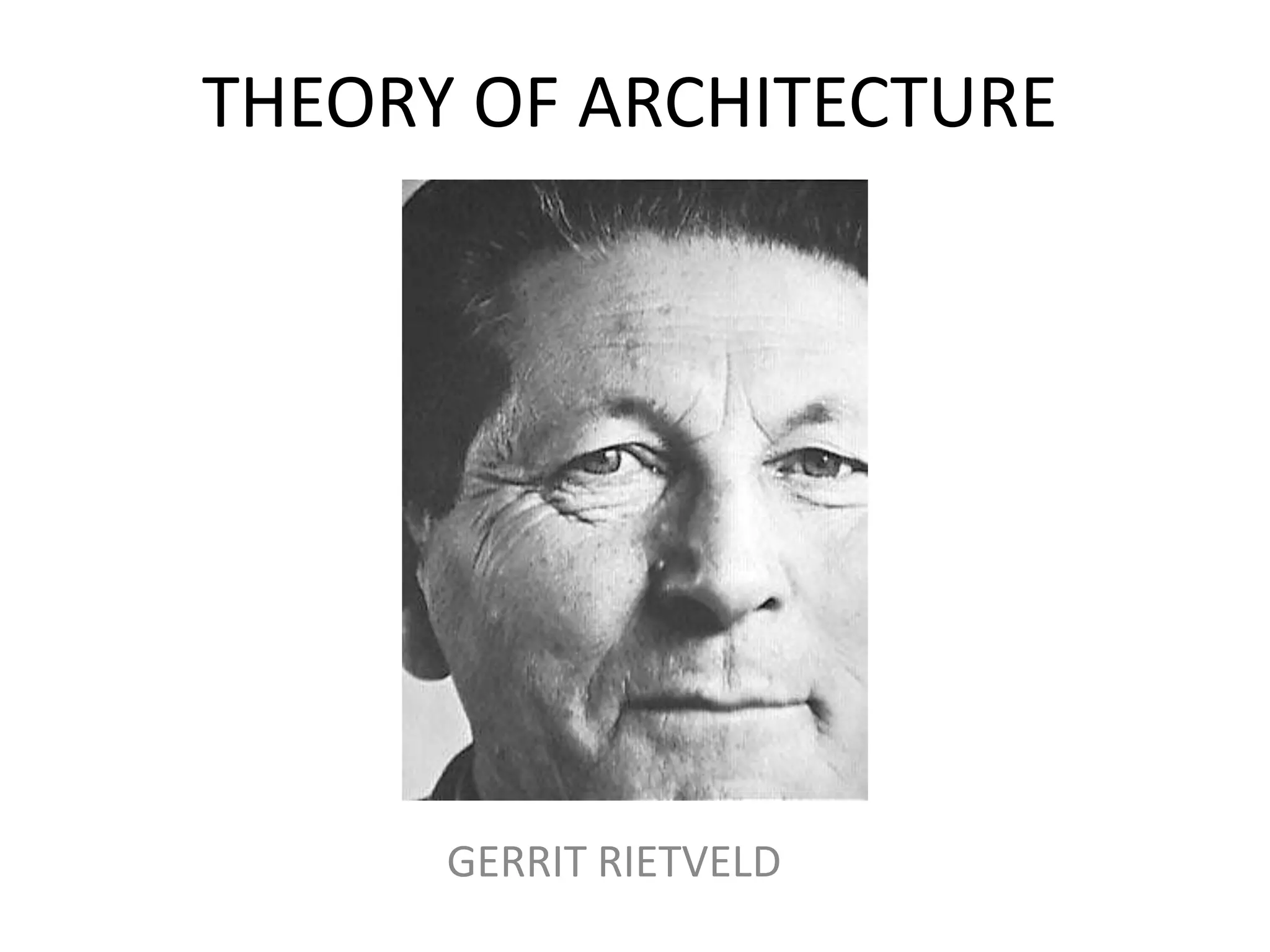
GERRIT RIETVELD
Introduction
• Name – Gerard(Gerrit) Thomas Rietveld or Gerrit Rietveld
• Born – 24 June 1888-1964
• Place- Utrecht, Netherlands
• Famous as – Furniture Designer and Architect
• He was one of the most important designers and architects of
the 20th century.
• Rietveld taught himself Drawing, Painting and model making.
• At a point of time he also became a furniture maker.
• He became an architect in 1919,the year in which he joined
De Stijl movement.
IDEOLOGY OF GERRIT RIETVELD
• His ideology was clearly seen in his work, what he wanted to
convey to the world and other architects and designers.
• Rietveld aimed for simplicity in his furniture and all the
construction work that he did in his life time.
• All the work that he did he emphasized on using primary
colors(Red, Blue and Yellow) and grey & black color.
• He also tried to work towards Inexpensive construction and
production methods, new materials, prefabrication technique
and standardization.
• In 1930s he started working with prefabricated concrete slabs
which was very unusual at that time
• From 1920s he was concerned with social housing and the
result was seen in 1950s in his housing projects in Utrecht and
Reeuwijk.
Contribution to the Art World
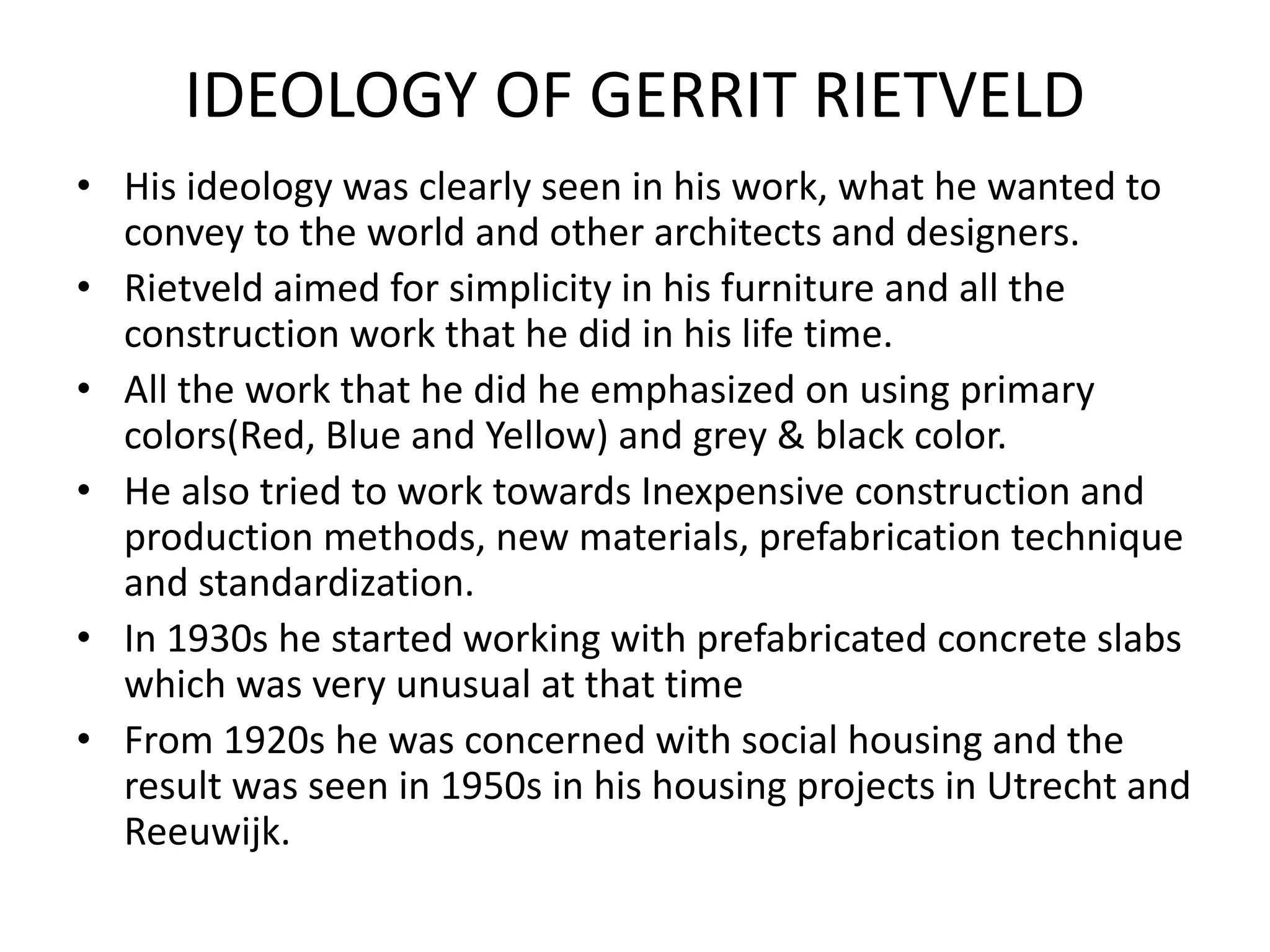
• He was One of the principle members of dutch artistic
movement called De Stijl along with Theo van Doesburg and
Piet Mondrian in 1919.
• Rietveld famous furniture
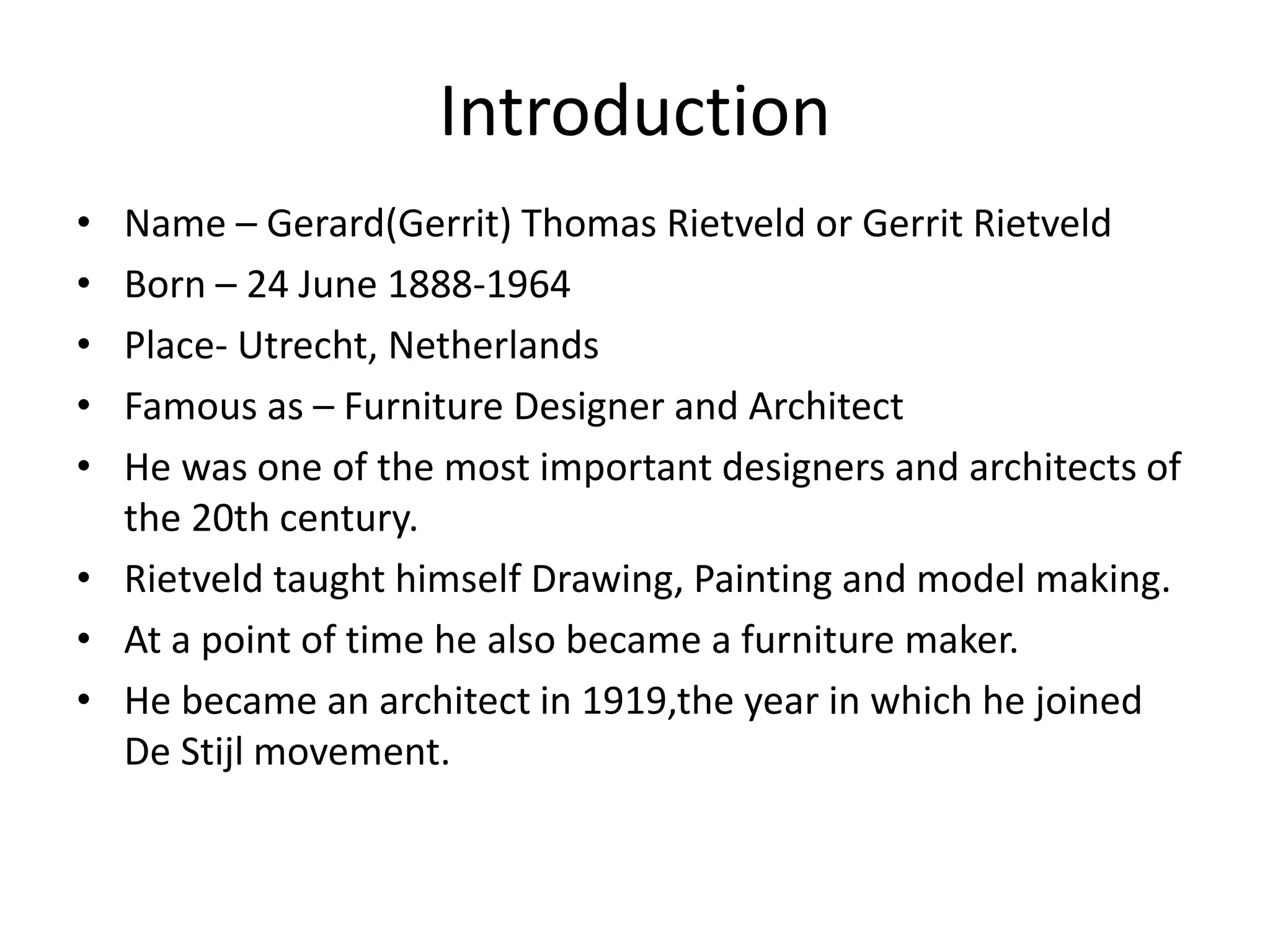
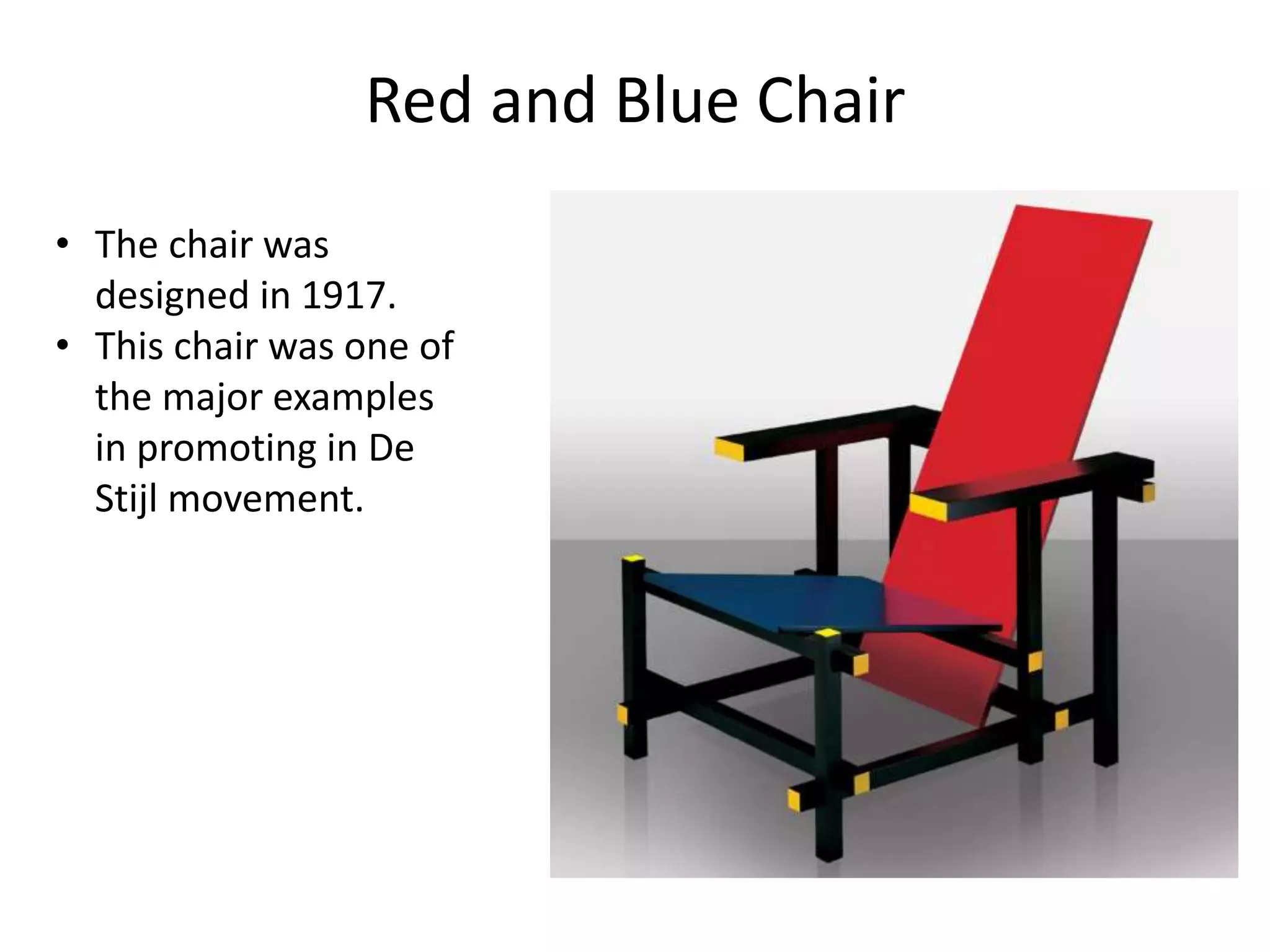
– Red and Blue chair
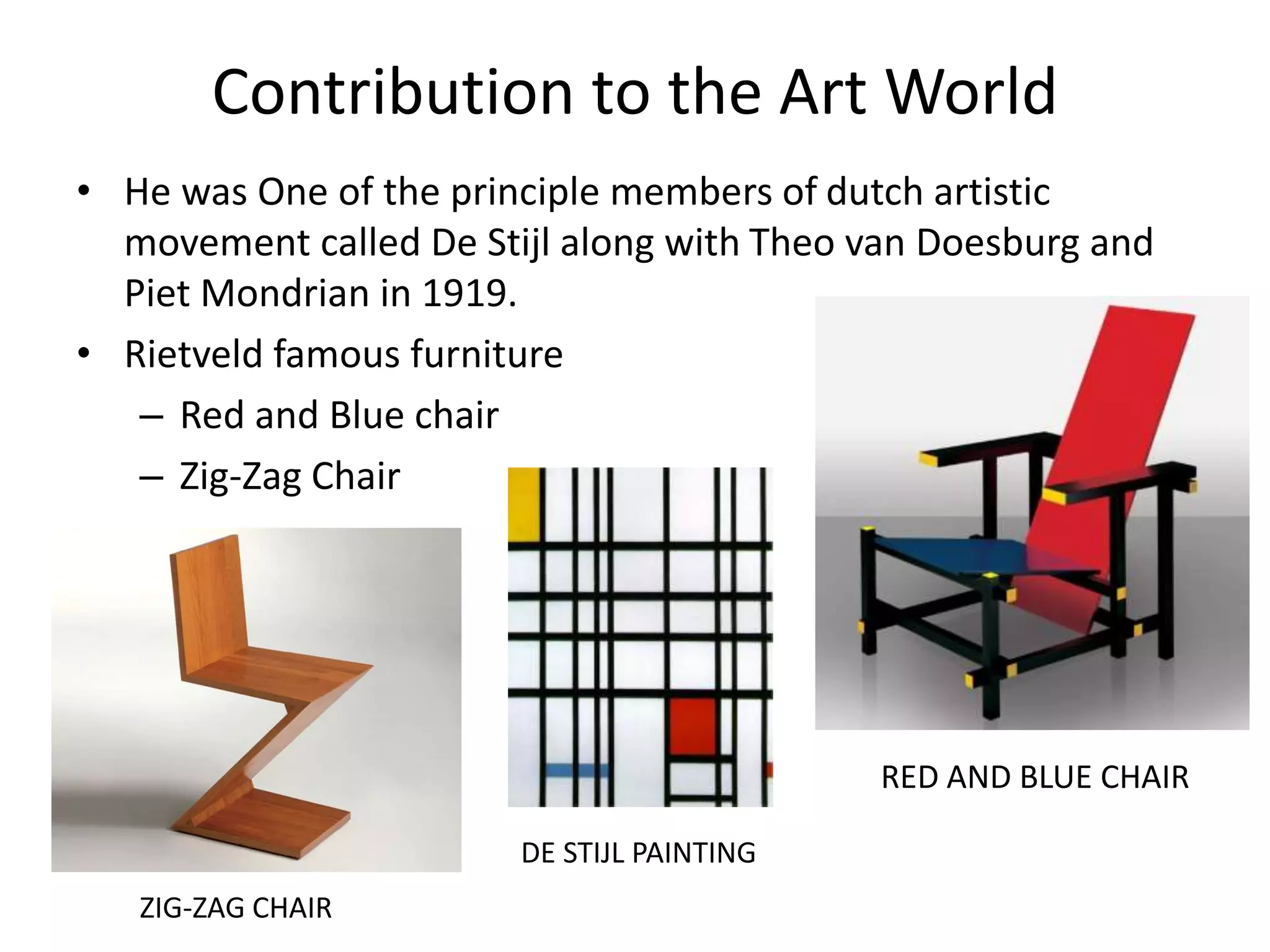
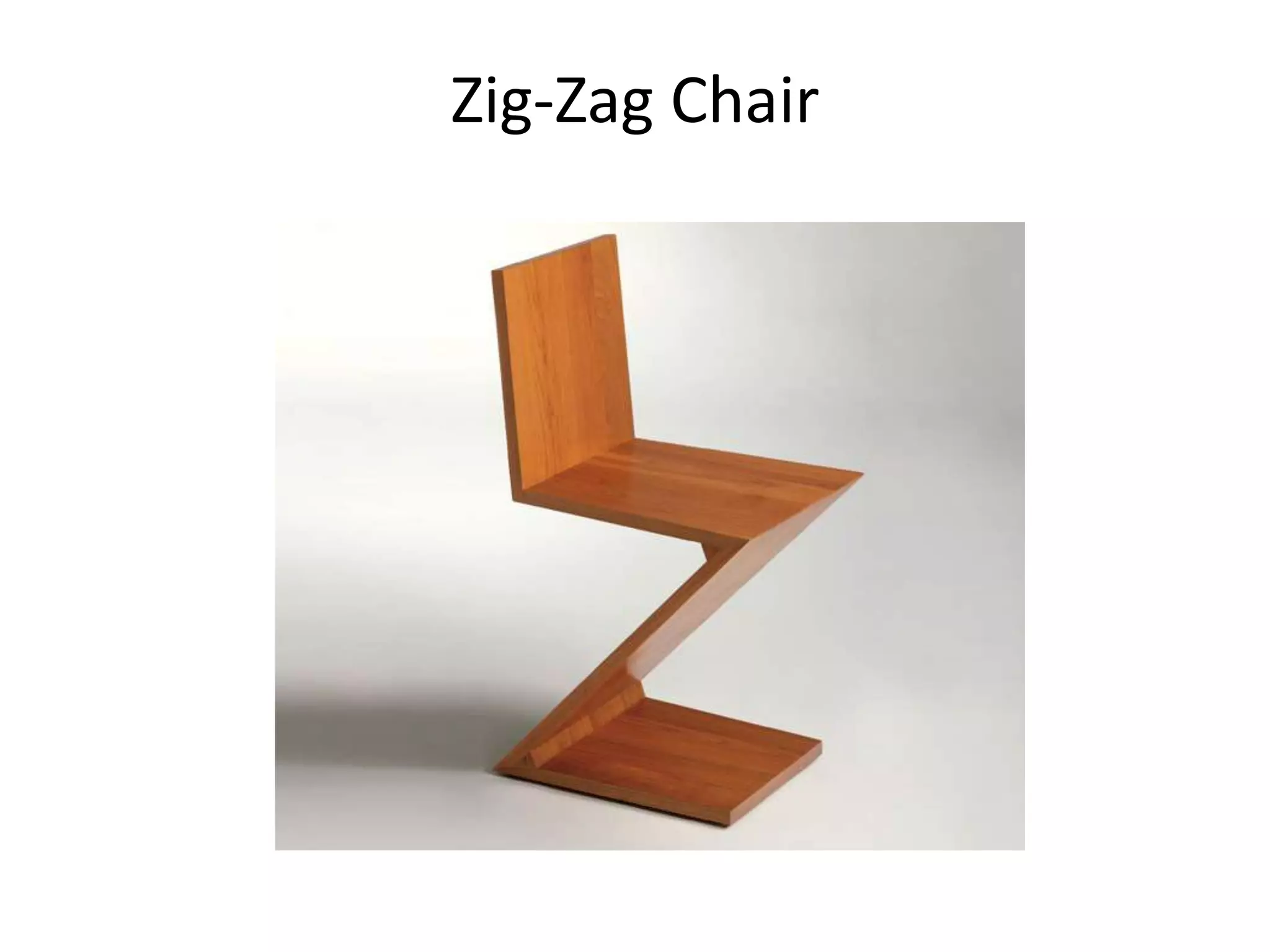
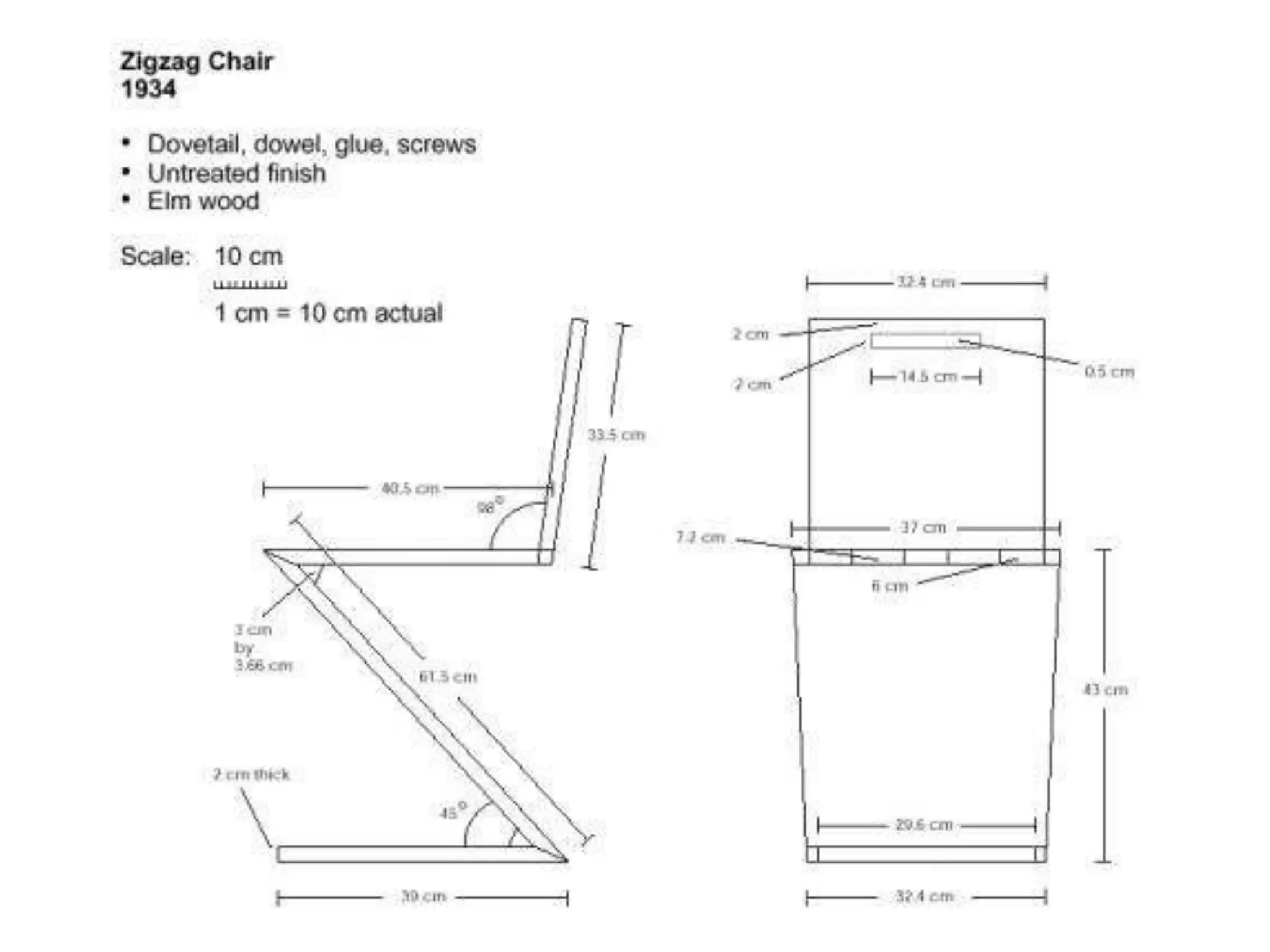
– Zig-Zag Chair
RED AND BLUE CHAIR
DE STIJL PAINTING
ZIG-ZAG CHAIR
• Famous Buildings
– The row houses at Utrecht
– The Dutch pavilion
– The sculptor pavilion in the Rijksmuseum Kroller muller
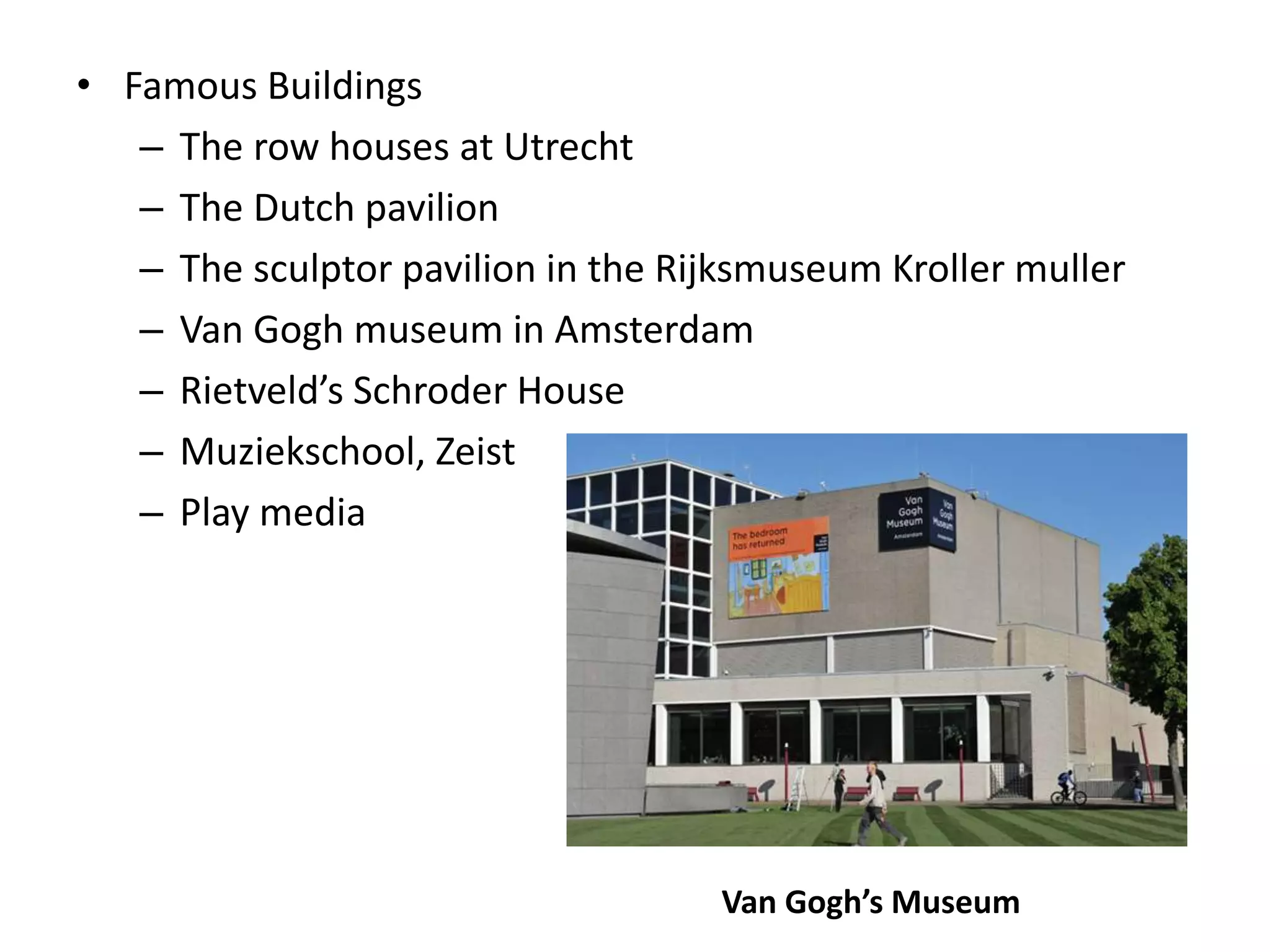
– Van Gogh museum in Amsterdam
– Rietveld’s Schroder House
– Muziekschool, Zeist
– Play media
Van Gogh’s Museum
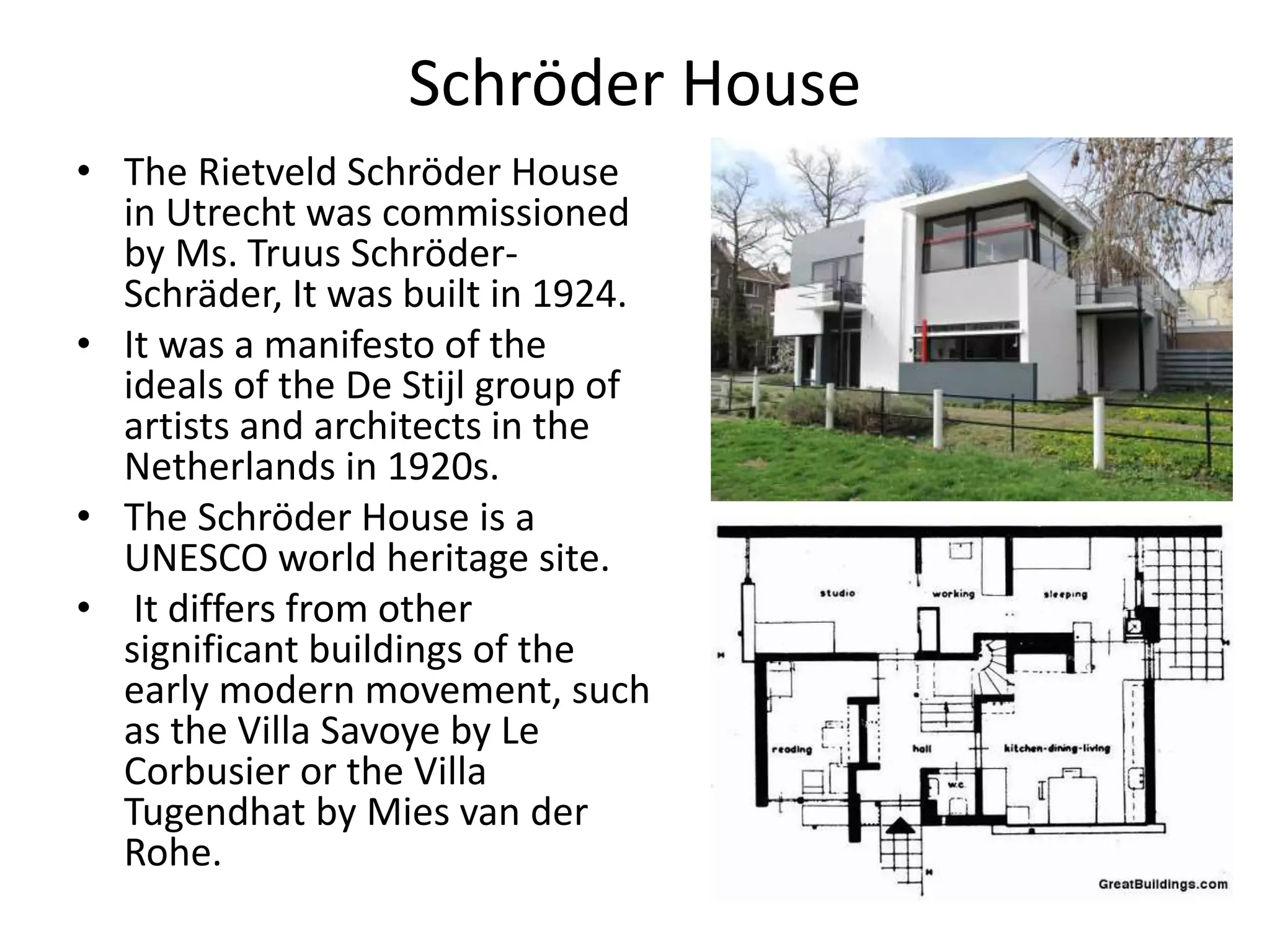
Schröder House
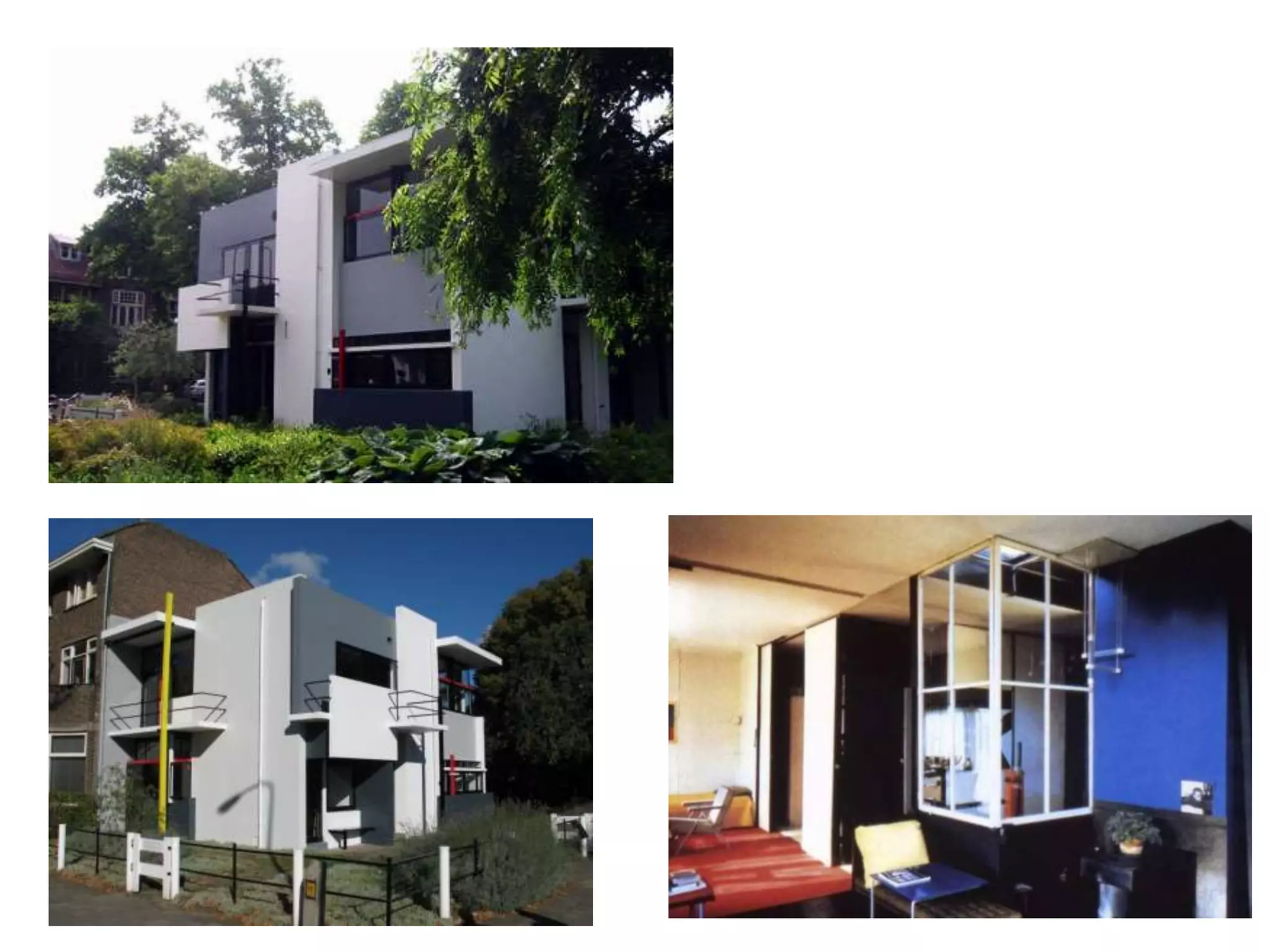
• The Rietveld Schröder House
in Utrecht was commissioned
by Ms. Truus Schröder-
Schräder, It was built in 1924.
• It was a manifesto of the
ideals of the De Stijl group of
artists and architects in the
Netherlands in 1920s.
• The Schröder House is a
UNESCO world heritage site.
• It differs from other
significant buildings of the
early modern movement, such
as the Villa Savoye by Le
Corbusier or the Villa
Tugendhat by Mies van der
Rohe.
About Schröder House’s Architecture
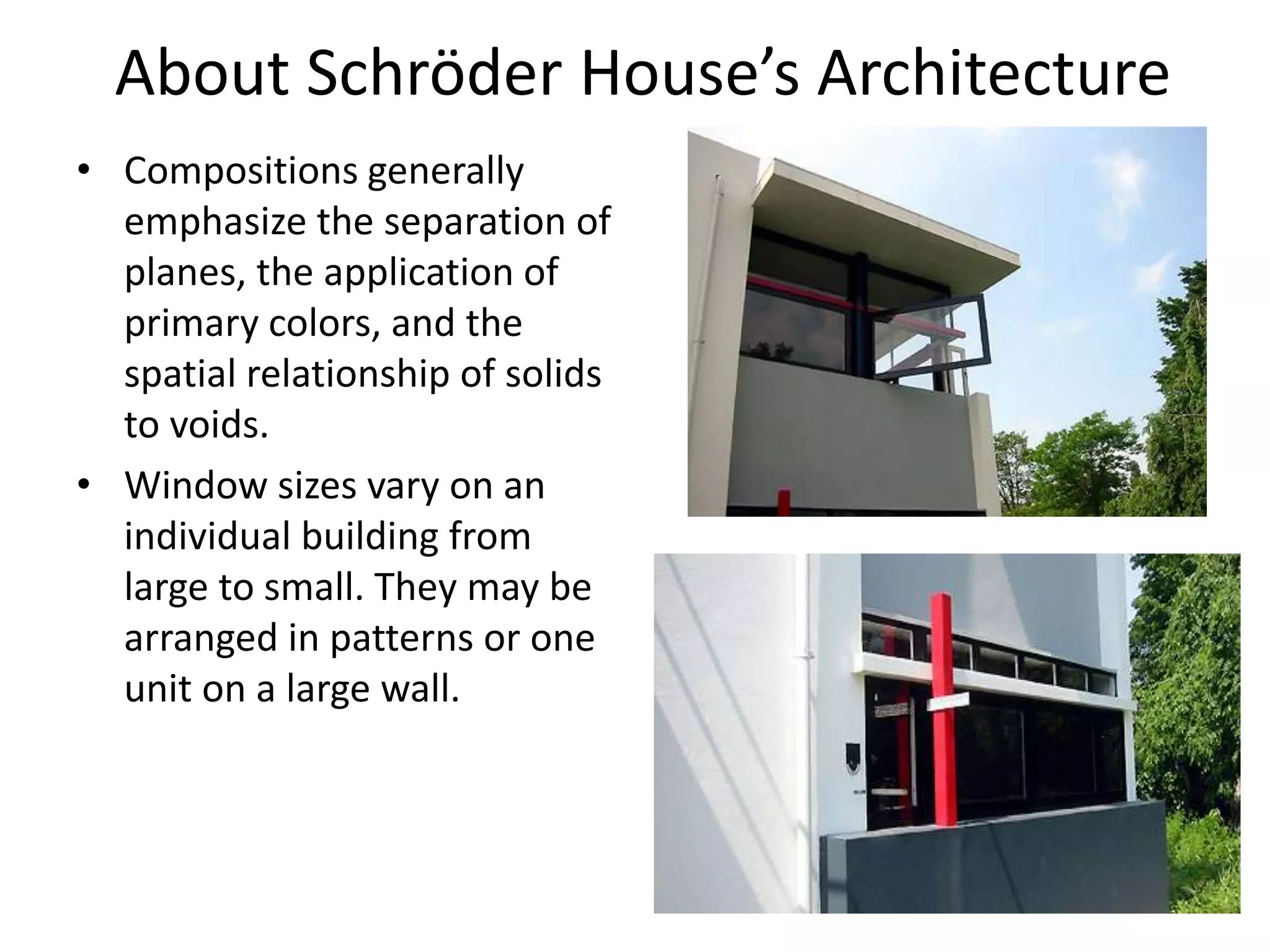
• Compositions generally
emphasize the separation of
planes, the application of
primary colors, and the
spatial relationship of solids
to voids.
• Window sizes vary on an
individual building from
large to small. They may be
arranged in patterns or one
unit on a large wall.
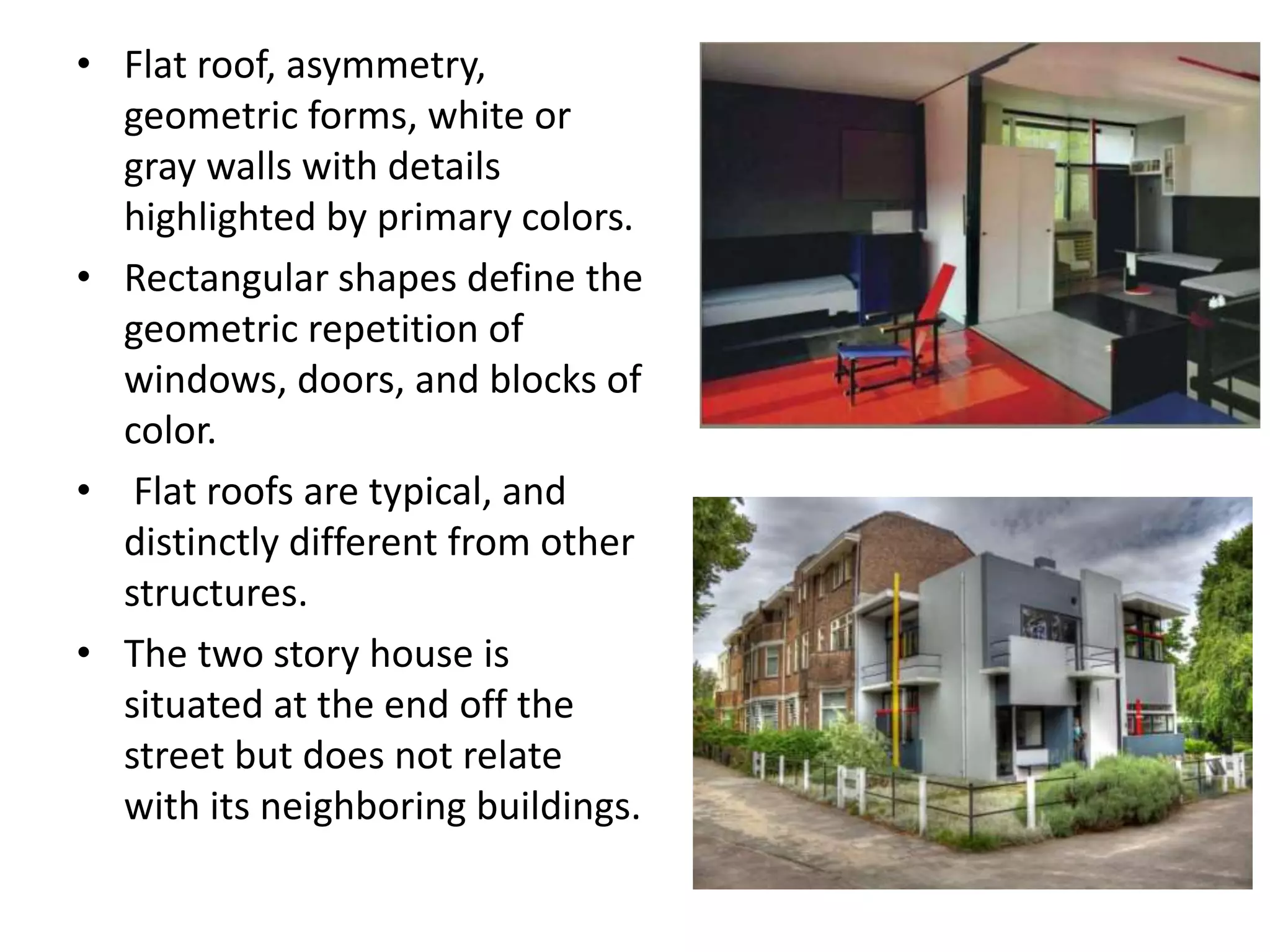
• Flat roof, asymmetry,
geometric forms, white or
gray walls with details
highlighted by primary colors.
• Rectangular shapes define the
geometric repetition of
windows, doors, and blocks of
color.
• Flat roofs are typical, and
distinctly different from other
structures.
• The two story house is
situated at the end off the
street but does not relate
with its neighboring buildings.
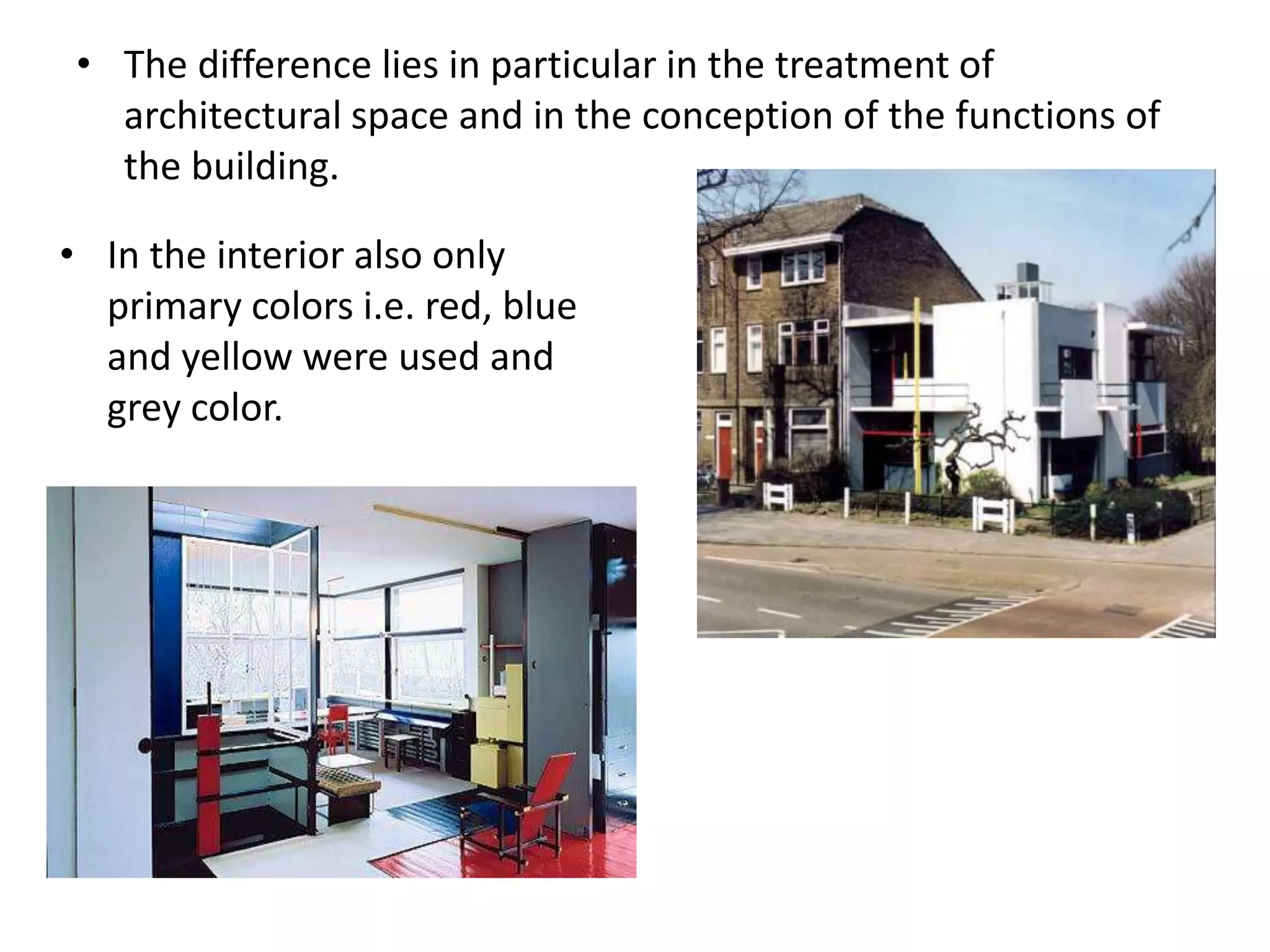
• The difference lies in particular in the treatment of
architectural space and in the conception of the functions of
the building.
• In the interior also only
primary colors i.e. red, blue
and yellow were used and
grey color.
Van Gogh Museum
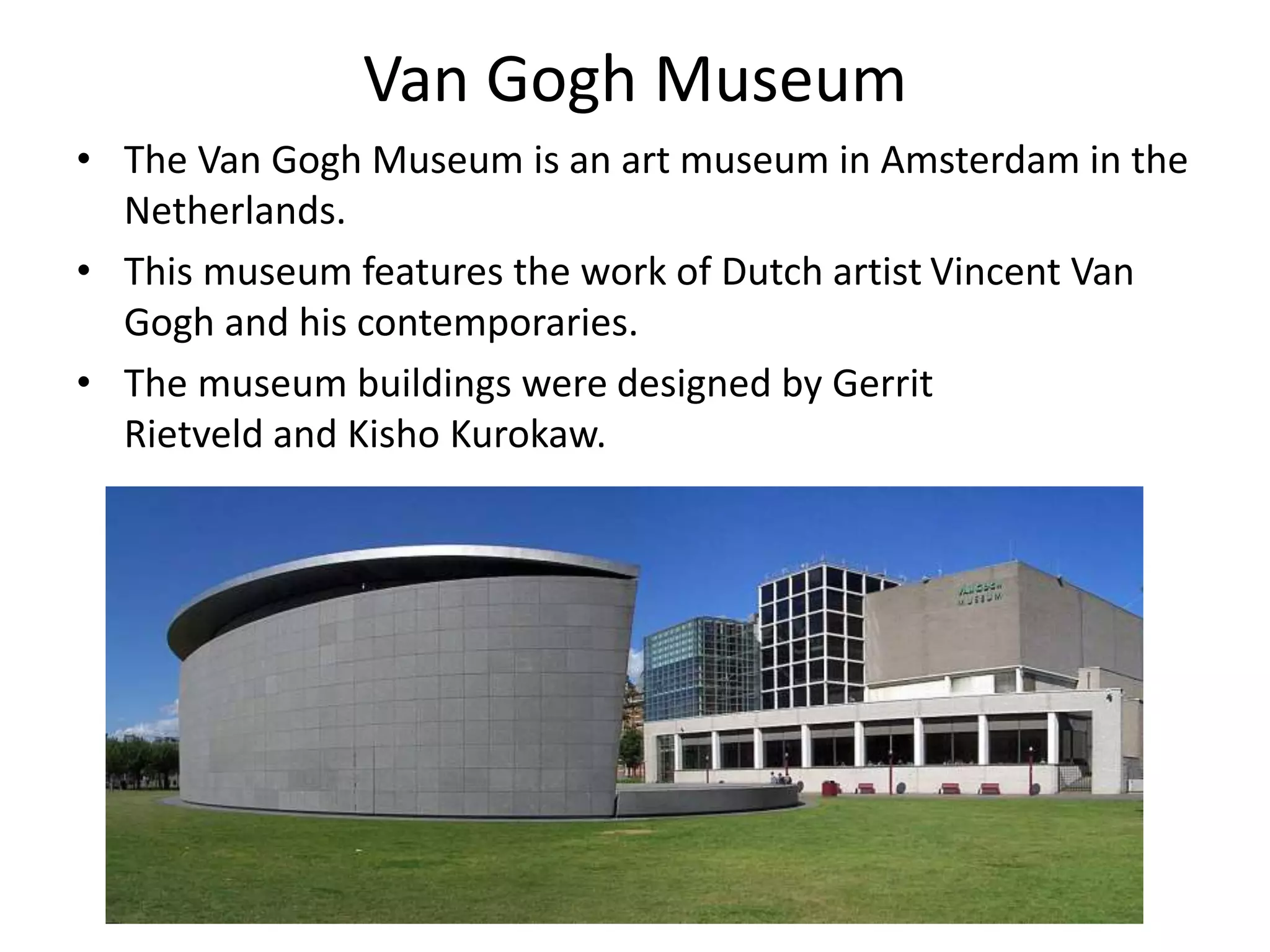
• The Van Gogh Museum is an art museum in Amsterdam in the
Netherlands.
• This museum features the work of Dutch artist Vincent Van
Gogh and his contemporaries.
• The museum buildings were designed by Gerrit
Rietveld and Kisho Kurokaw.
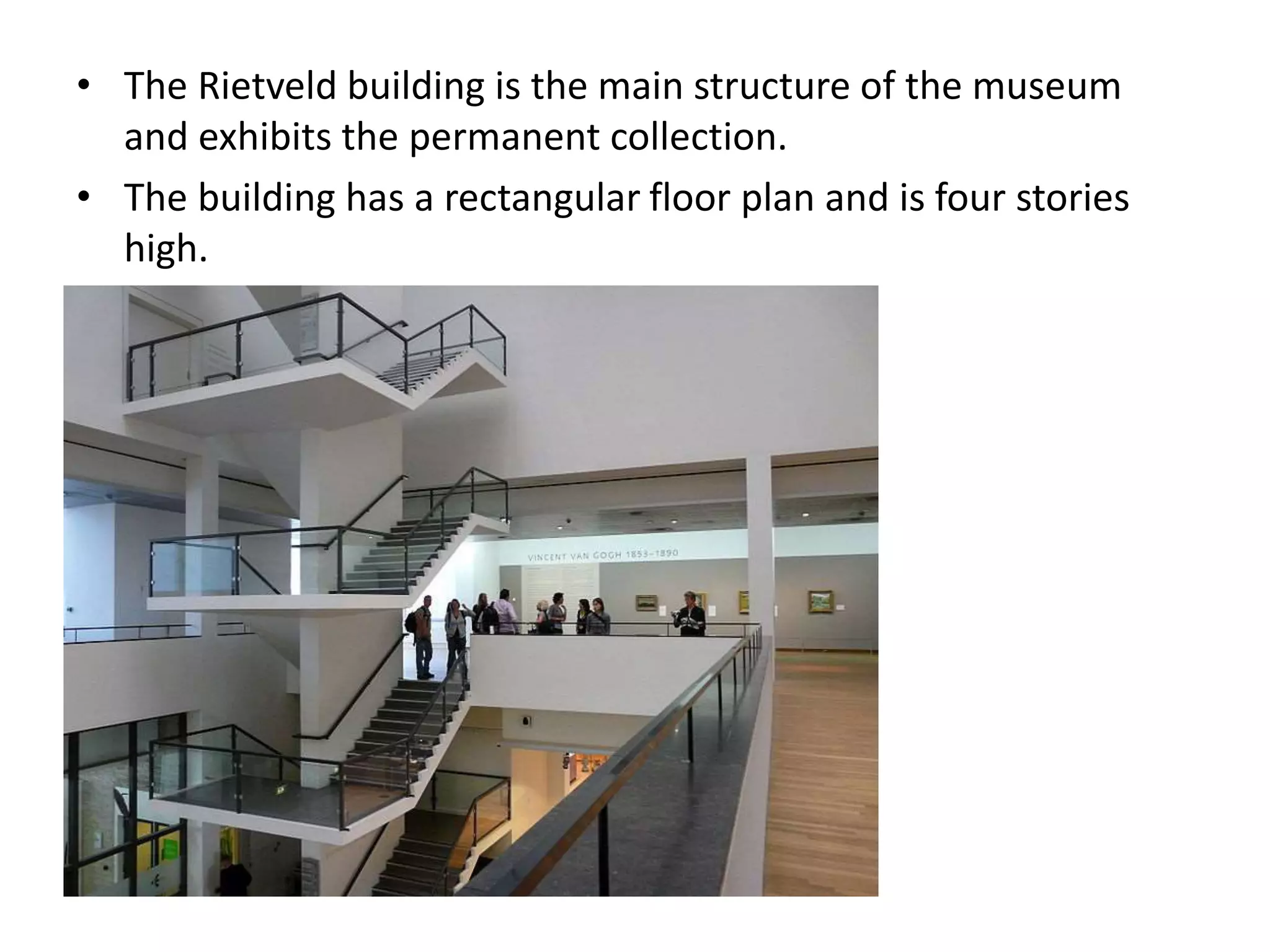
• The Rietveld building is the main structure of the museum
and exhibits the permanent collection.
• The building has a rectangular floor plan and is four stories
high.
Red and Blue Chair
• The chair was
designed in 1917.
• This chair was one of
the major examples
in promoting in De
Stijl movement.
Zig-Zag Chair
Theory of Architecture-Gerrit Rietveld

Theory of Architecture-Gerrit Rietveld

  • 1.
  • 2.
    Introduction • Name –Gerard(Gerrit) Thomas Rietveld or Gerrit Rietveld • Born – 24 June 1888-1964 • Place- Utrecht, Netherlands • Famous as – Furniture Designer and Architect • He was one of the most important designers and architects of the 20th century. • Rietveld taught himself Drawing, Painting and model making. • At a point of time he also became a furniture maker. • He became an architect in 1919,the year in which he joined De Stijl movement.
  • 3.
    IDEOLOGY OF GERRITRIETVELD • His ideology was clearly seen in his work, what he wanted to convey to the world and other architects and designers. • Rietveld aimed for simplicity in his furniture and all the construction work that he did in his life time. • All the work that he did he emphasized on using primary colors(Red, Blue and Yellow) and grey & black color. • He also tried to work towards Inexpensive construction and production methods, new materials, prefabrication technique and standardization. • In 1930s he started working with prefabricated concrete slabs which was very unusual at that time • From 1920s he was concerned with social housing and the result was seen in 1950s in his housing projects in Utrecht and Reeuwijk.
  • 4.
    Contribution to theArt World • He was One of the principle members of dutch artistic movement called De Stijl along with Theo van Doesburg and Piet Mondrian in 1919. • Rietveld famous furniture – Red and Blue chair – Zig-Zag Chair RED AND BLUE CHAIR DE STIJL PAINTING ZIG-ZAG CHAIR
  • 5.
    • Famous Buildings –The row houses at Utrecht – The Dutch pavilion – The sculptor pavilion in the Rijksmuseum Kroller muller – Van Gogh museum in Amsterdam – Rietveld’s Schroder House – Muziekschool, Zeist – Play media Van Gogh’s Museum
  • 6.
    Schröder House • TheRietveld Schröder House in Utrecht was commissioned by Ms. Truus Schröder- Schräder, It was built in 1924. • It was a manifesto of the ideals of the De Stijl group of artists and architects in the Netherlands in 1920s. • The Schröder House is a UNESCO world heritage site. • It differs from other significant buildings of the early modern movement, such as the Villa Savoye by Le Corbusier or the Villa Tugendhat by Mies van der Rohe.
  • 7.
    About Schröder House’sArchitecture • Compositions generally emphasize the separation of planes, the application of primary colors, and the spatial relationship of solids to voids. • Window sizes vary on an individual building from large to small. They may be arranged in patterns or one unit on a large wall.
  • 8.
    • Flat roof,asymmetry, geometric forms, white or gray walls with details highlighted by primary colors. • Rectangular shapes define the geometric repetition of windows, doors, and blocks of color. • Flat roofs are typical, and distinctly different from other structures. • The two story house is situated at the end off the street but does not relate with its neighboring buildings.
  • 10.
    • The differencelies in particular in the treatment of architectural space and in the conception of the functions of the building. • In the interior also only primary colors i.e. red, blue and yellow were used and grey color.
  • 11.
    Van Gogh Museum •The Van Gogh Museum is an art museum in Amsterdam in the Netherlands. • This museum features the work of Dutch artist Vincent Van Gogh and his contemporaries. • The museum buildings were designed by Gerrit Rietveld and Kisho Kurokaw.
  • 12.
    • The Rietveldbuilding is the main structure of the museum and exhibits the permanent collection. • The building has a rectangular floor plan and is four stories high.
  • 13.
    Red and BlueChair • The chair was designed in 1917. • This chair was one of the major examples in promoting in De Stijl movement.
  • 14.