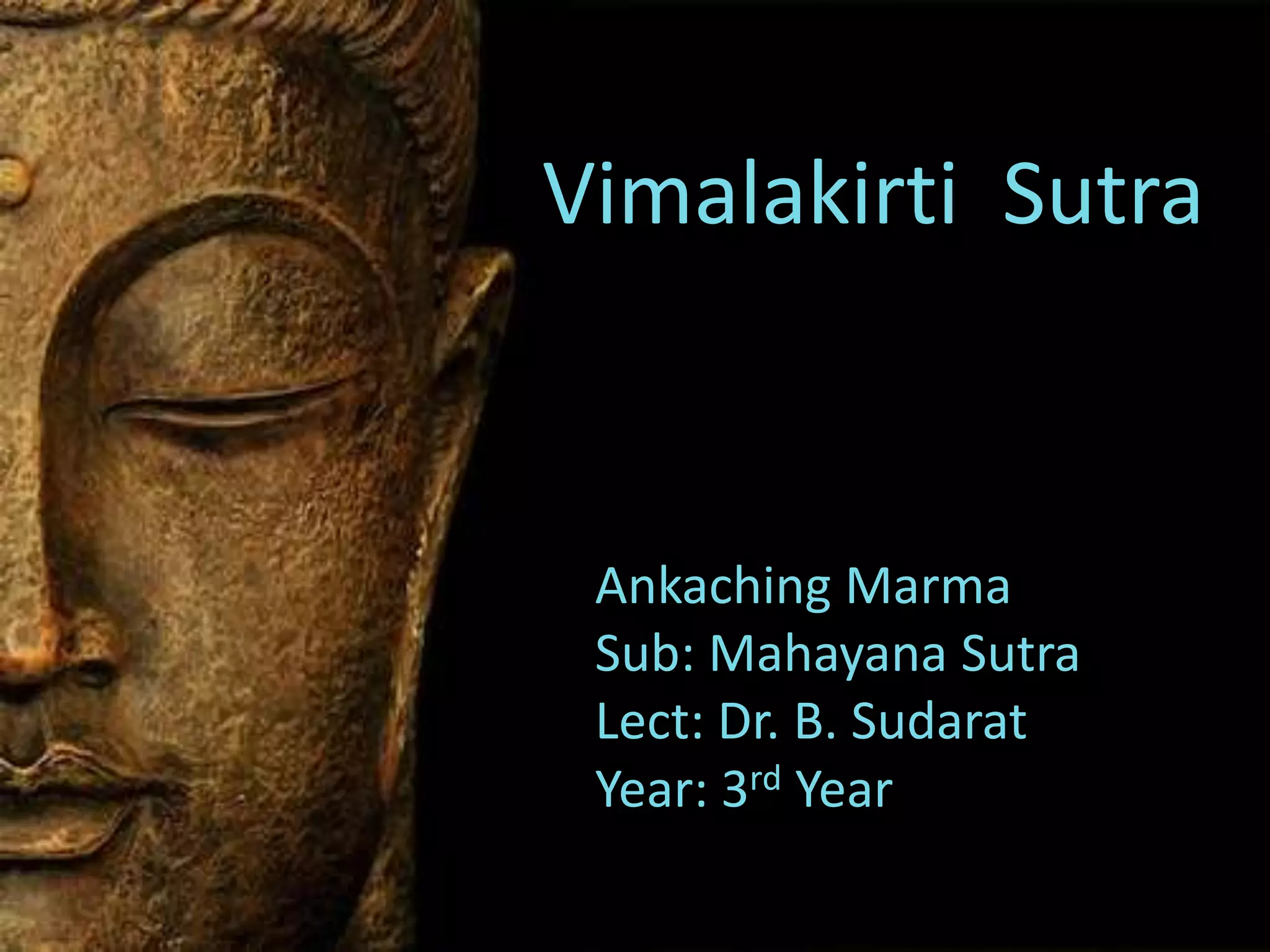

Vimalakirti Sutra
Ankaching Marma
Sub: Mahayana Sutra
Lect: Dr. B. Sudarat
Year: 3rd Year
Contents
• Introduction – Author, Date, Theme,
• Story overview
• Chapter I – Buddha/Pure Land
• Chapter II - Skillful Means
• Chapter III – Reluctance of the Disciples
• Chapter IV – Reluctance of the Bodhisattvas
• Chapter V – Manjuri’s Visit to Vimalakirti
• Chapter VI - Inconceivable Liberation
• Chapter VII – Viewing Sentient Beings
Introduction
• About the text:
• The text contains fourteen
chapters.
• The text is composed in dialogue
forms with many characters.
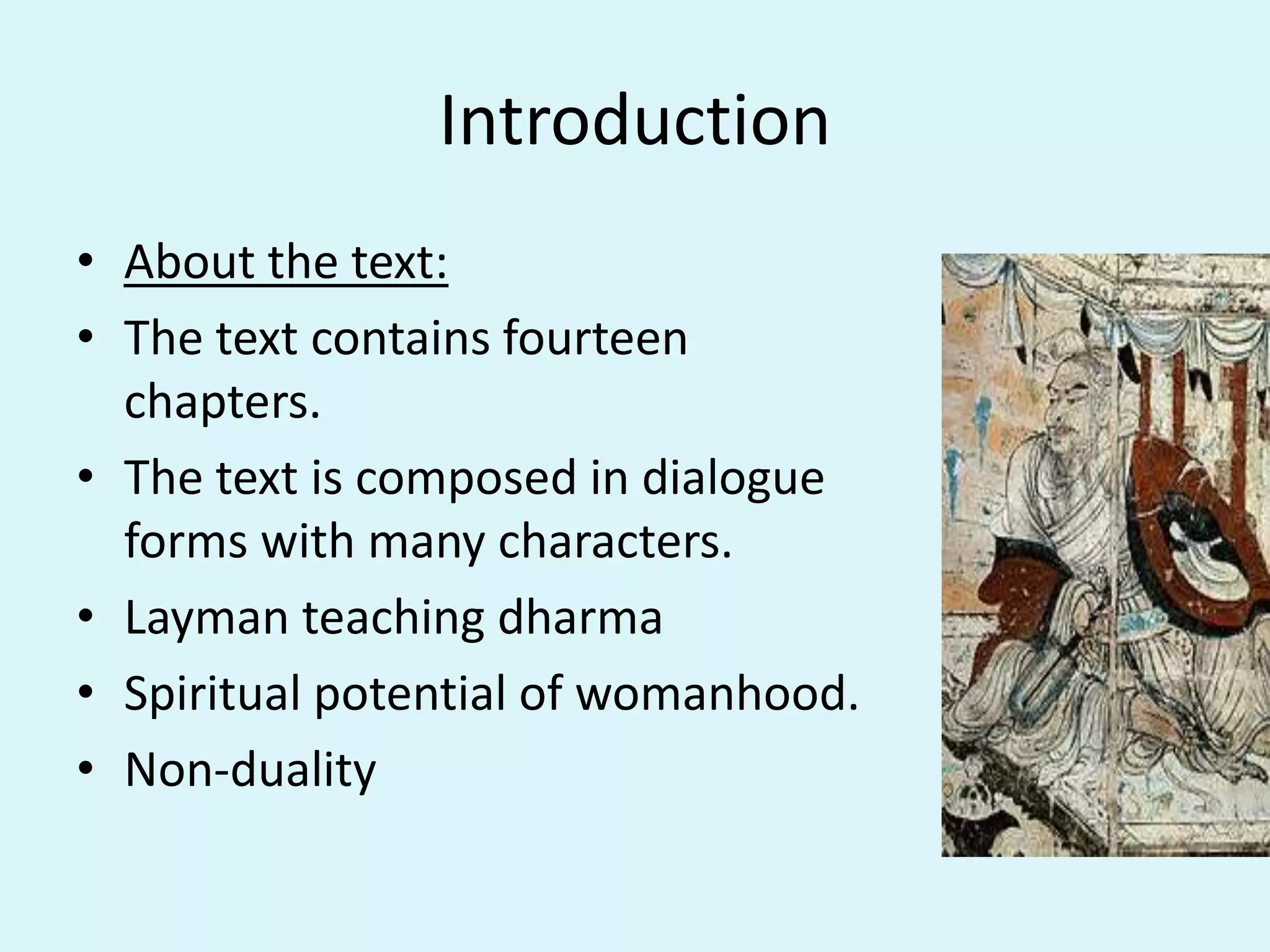
• Layman teaching dharma
• Spiritual potential of womanhood.
• Non-duality
• Date:
• The sutra was probably composed during 100 CE.
• 188 CE by Kuṣāṇa monk Lokakṣema from
Gnadhara to China but lost
• Six times in translations to Chinese
• And later around 406 CE , translated by
Kumarajiva to Chinese Yao Quin Dynasty.
• Theme:
• The philosophical aspect of this sutra: Non-duality and
emptiness.
• Non-duality philosophy teaches no judgment of
things, characteristic etc.
- Good and bad is duality, no generation of good and bad
is non-duality.
- Self and non-self
- Wisdom and ignorance…
- Even itself duality and non-duality
• “Duality is constituted by perceptual
manifestation. Nonduality is objectlessness.
Therefore, nongrasping and nonrejection is
the entrance into nonduality.”
Story Overview
• Vaisali- Buddha and Vimalakirti
• Pretended to be sick
• Buddha’s requests to disciples and
Bodhisattva
• Reluctant because unparallel knowledge of
Vimalakirti.
• Manjusri discussion on non-duality chance
from pretension.
Chapter 1 – Buddha/Pure Land
• The venue of scenario begins with monks and
Boddhisattvas in the garden of Amrapali near Vaisali.
• Licchavi Ratnakara uttered verses in praise of the
Buddha.
• The Buddha preached on the purity of the Buddha land
requested by Ratnakara.
• Bodhisattva’s pure land; Profound mind, Six
perfections, Four Brahmaviharas, Four means of
attractions, Skillful means, Thirty-seven factors of
enlightenment, etc.
• Buddha and Brahma Sikhin clearing doubts of ven.
Sariputta.
• The Buddha said “Sariputra, this buddha-field is always thus
pure, but the Tathagata makes it appear to be spoiled by
many faults, in order to bring about the maturity of the
inferior living beings.”
• Example of nectar in Trayastimsa heaven(taste according
their degree of merits) viewing the Buddha-land.
• “We cannot see it as a pure land because our minds are
impure. When our minds are impure, even paradise may
seem like hell.” – Robert Thurman, commentary
Chapter II - Skillful Means
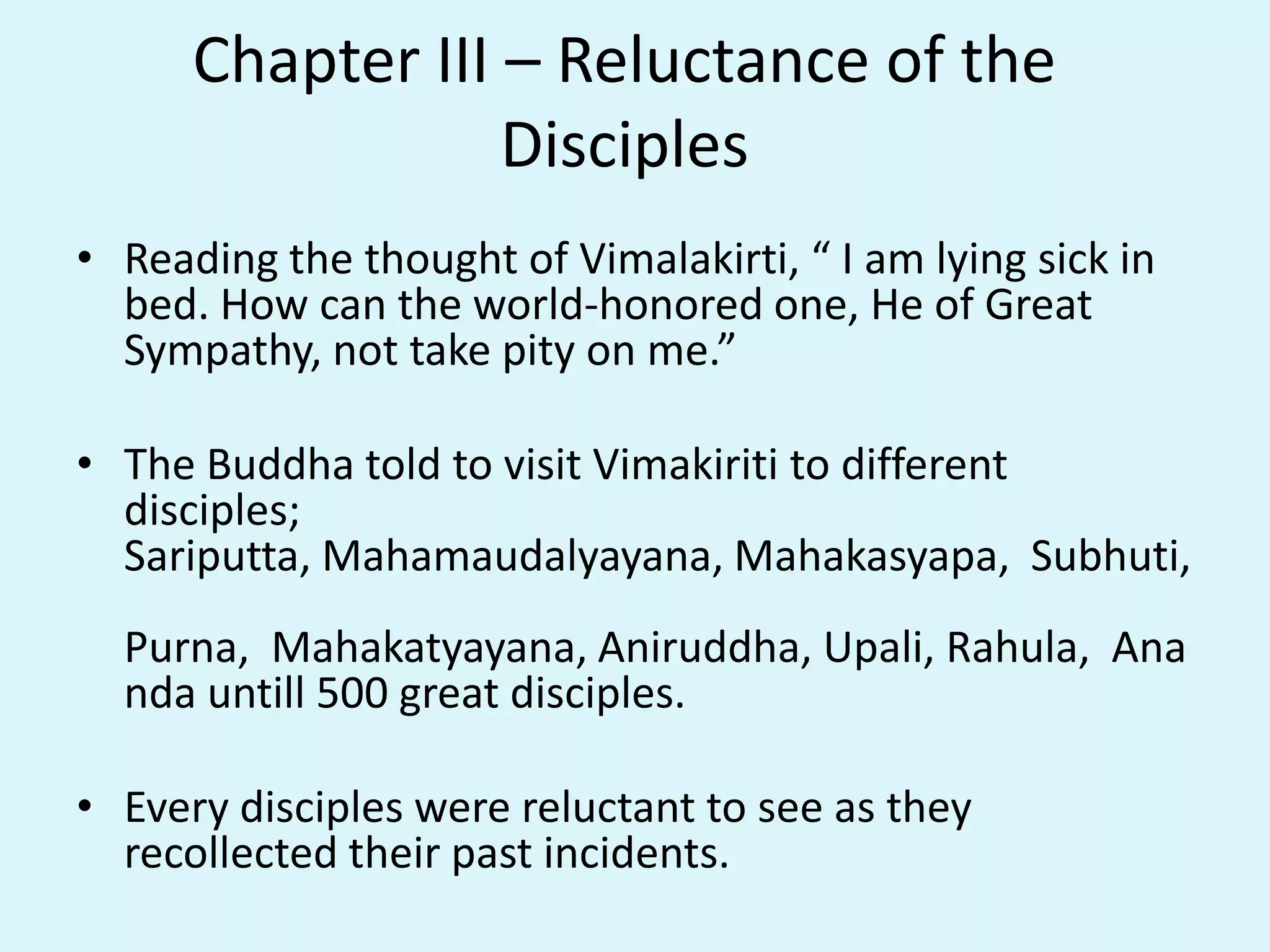
• Vimalakirti was a lay
Bodhisattva, lived for the sake of
others.
• He pretended to be sick as means
of skillful means to teach dharma
to others.
• The body of the Nirmanakaya(for
ordinary) is subject to suffering.
• Therefore, Vimalakirti urged to
gain the body of the Buddha and
Dharma.
Chapter III – Reluctance of the
Disciples
• Reading the thought of Vimalakirti, “ I am lying sick in
bed. How can the world-honored one, He of Great
Sympathy, not take pity on me.”
• The Buddha told to visit Vimakiriti to different
disciples;
Sariputta, Mahamaudalyayana, Mahakasyapa, Subhuti,
Purna, Mahakatyayana, Aniruddha, Upali, Rahula, Ana
nda untill 500 great disciples.
• Every disciples were reluctant to see as they
recollected their past incidents.
• Vimalakirti attacked with words to experts of specific
field i.e
• “ O Katyayana, do not explain the Dharma of the true
characteristic using mental process of the generation
and extinction.”
-“ Katyayana, the dharmas are ultimately neither
generated nor extinguished: this is the meaning of
impermanence.”
-“The five skandhas are empty throughout, with no
arising: this is the meaning of suffering.”
- “The dharmas ultimately does not exist: this is the
meaning of emptiness.”
- “There is no self in self, yet no duality: this is meaning of
non-self.”
Chapter IV – Reluctance of the
Bodhisattvas
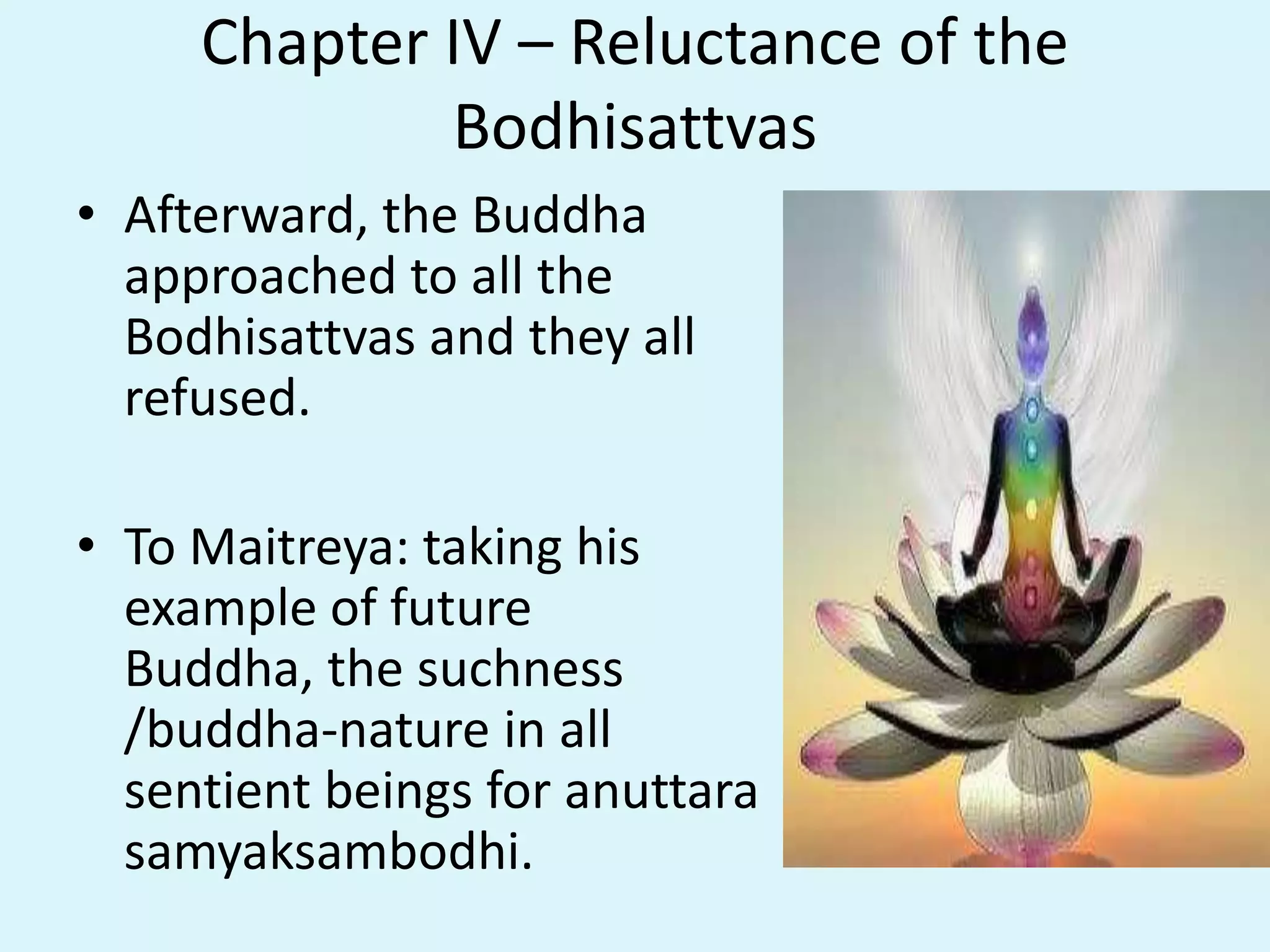
• Afterward, the Buddha
approached to all the
Bodhisattvas and they all
refused.
• To Maitreya: taking his
example of future
Buddha, the suchness
/buddha-nature in all
sentient beings for anuttara
samyaksambodhi.
• To Jagatimdhara: and mara women
- “Sisters, a single lamp may light
hundreds of thousands of lamps
without itself being diminished.
Likewise, sisters, a single bodhisattva
may establish many hundreds of
thousands of living beings in
enlightenment without his mindfulness
being diminished.”
• Woman spiritual potentialities in
higlight
• To Suddatta: the greatest gift of dharma
than the material wealth.
Chapter V – Manjuri’s Visit to
Vimalakirti
• Manjusri a accepted the Buddha’s request to visit
Vimalakirti.
• Vimalakirti answered the questions of Manjusri
as way of preaching.
- What is the cause from which this illness arise?
Has it been affecting you long? How will it be
extinguished?
- Stupidity, and extinguished of all sentient beings.
Chapter VI - Inconceivable Liberation
• By reading the thought of Sariputta, Vimalakirti
preached “ inconceivable liberation”
• “ O Sariputta, in the seeking the dharma one
should not be attached to the Buddha in
seeking, nor be attached to the dharma in
seeking….”
• Explaining about the dharma and its way of
practice.
• The inconceivable emancipation of bodhisattvas;
Sumera mountain into mustard seed without any
changes, four great oceans into one pore,
• “ A bodhisattva who resides in inconceivable
emancipation can take the sentient beings of a
buddha land in the right palm and fly to all ten
directions…..”
• Thus description is in such mystical and magical.
• Therefore it is “ inconceivable”
Chapter VII – Viewing Sentient Beings
• This chapter interestingly defining some buddhist
terms in a philosophical manner.
• Vimalakirti answered to the question of Manjusri
.
• “ How should the bodhisattva view sentient
beings?”
- like moon in the water, image in the mirror, sixth
skandhas etc…
• How should practice sympathy to sentient
beings?
- Practice sympathy of peace and joy, because
of causing to attain the joy of Buddhahood.
• What is compassion?
- “ the merits achieved by the bodhisattva.
• What is the fundamental basis of body
- Desire
Thank you !

Vimalakititsutra[1] (1)

  • 1.
    Vimalakirti Sutra Ankaching Marma Sub:Mahayana Sutra Lect: Dr. B. Sudarat Year: 3rd Year
  • 2.
    Contents • Introduction –Author, Date, Theme, • Story overview • Chapter I – Buddha/Pure Land • Chapter II - Skillful Means • Chapter III – Reluctance of the Disciples • Chapter IV – Reluctance of the Bodhisattvas • Chapter V – Manjuri’s Visit to Vimalakirti • Chapter VI - Inconceivable Liberation • Chapter VII – Viewing Sentient Beings
  • 3.
    Introduction • About thetext: • The text contains fourteen chapters. • The text is composed in dialogue forms with many characters. • Layman teaching dharma • Spiritual potential of womanhood. • Non-duality
  • 4.
    • Date: • Thesutra was probably composed during 100 CE. • 188 CE by Kuṣāṇa monk Lokakṣema from Gnadhara to China but lost • Six times in translations to Chinese • And later around 406 CE , translated by Kumarajiva to Chinese Yao Quin Dynasty.
  • 5.
    • Theme: • Thephilosophical aspect of this sutra: Non-duality and emptiness. • Non-duality philosophy teaches no judgment of things, characteristic etc. - Good and bad is duality, no generation of good and bad is non-duality. - Self and non-self - Wisdom and ignorance… - Even itself duality and non-duality
  • 6.
    • “Duality isconstituted by perceptual manifestation. Nonduality is objectlessness. Therefore, nongrasping and nonrejection is the entrance into nonduality.”
  • 7.
    Story Overview • Vaisali-Buddha and Vimalakirti • Pretended to be sick • Buddha’s requests to disciples and Bodhisattva • Reluctant because unparallel knowledge of Vimalakirti. • Manjusri discussion on non-duality chance from pretension.
  • 8.
    Chapter 1 –Buddha/Pure Land • The venue of scenario begins with monks and Boddhisattvas in the garden of Amrapali near Vaisali. • Licchavi Ratnakara uttered verses in praise of the Buddha. • The Buddha preached on the purity of the Buddha land requested by Ratnakara. • Bodhisattva’s pure land; Profound mind, Six perfections, Four Brahmaviharas, Four means of attractions, Skillful means, Thirty-seven factors of enlightenment, etc.
  • 9.
    • Buddha andBrahma Sikhin clearing doubts of ven. Sariputta. • The Buddha said “Sariputra, this buddha-field is always thus pure, but the Tathagata makes it appear to be spoiled by many faults, in order to bring about the maturity of the inferior living beings.” • Example of nectar in Trayastimsa heaven(taste according their degree of merits) viewing the Buddha-land. • “We cannot see it as a pure land because our minds are impure. When our minds are impure, even paradise may seem like hell.” – Robert Thurman, commentary
  • 10.
    Chapter II -Skillful Means • Vimalakirti was a lay Bodhisattva, lived for the sake of others. • He pretended to be sick as means of skillful means to teach dharma to others. • The body of the Nirmanakaya(for ordinary) is subject to suffering. • Therefore, Vimalakirti urged to gain the body of the Buddha and Dharma.
  • 11.
    Chapter III –Reluctance of the Disciples • Reading the thought of Vimalakirti, “ I am lying sick in bed. How can the world-honored one, He of Great Sympathy, not take pity on me.” • The Buddha told to visit Vimakiriti to different disciples; Sariputta, Mahamaudalyayana, Mahakasyapa, Subhuti, Purna, Mahakatyayana, Aniruddha, Upali, Rahula, Ana nda untill 500 great disciples. • Every disciples were reluctant to see as they recollected their past incidents.
  • 12.
    • Vimalakirti attackedwith words to experts of specific field i.e • “ O Katyayana, do not explain the Dharma of the true characteristic using mental process of the generation and extinction.” -“ Katyayana, the dharmas are ultimately neither generated nor extinguished: this is the meaning of impermanence.” -“The five skandhas are empty throughout, with no arising: this is the meaning of suffering.” - “The dharmas ultimately does not exist: this is the meaning of emptiness.” - “There is no self in self, yet no duality: this is meaning of non-self.”
  • 13.
    Chapter IV –Reluctance of the Bodhisattvas • Afterward, the Buddha approached to all the Bodhisattvas and they all refused. • To Maitreya: taking his example of future Buddha, the suchness /buddha-nature in all sentient beings for anuttara samyaksambodhi.
  • 14.
    • To Jagatimdhara:and mara women - “Sisters, a single lamp may light hundreds of thousands of lamps without itself being diminished. Likewise, sisters, a single bodhisattva may establish many hundreds of thousands of living beings in enlightenment without his mindfulness being diminished.” • Woman spiritual potentialities in higlight • To Suddatta: the greatest gift of dharma than the material wealth.
  • 15.
    Chapter V –Manjuri’s Visit to Vimalakirti • Manjusri a accepted the Buddha’s request to visit Vimalakirti. • Vimalakirti answered the questions of Manjusri as way of preaching. - What is the cause from which this illness arise? Has it been affecting you long? How will it be extinguished? - Stupidity, and extinguished of all sentient beings.
  • 16.
    Chapter VI -Inconceivable Liberation • By reading the thought of Sariputta, Vimalakirti preached “ inconceivable liberation” • “ O Sariputta, in the seeking the dharma one should not be attached to the Buddha in seeking, nor be attached to the dharma in seeking….” • Explaining about the dharma and its way of practice.
  • 17.
    • The inconceivableemancipation of bodhisattvas; Sumera mountain into mustard seed without any changes, four great oceans into one pore, • “ A bodhisattva who resides in inconceivable emancipation can take the sentient beings of a buddha land in the right palm and fly to all ten directions…..” • Thus description is in such mystical and magical. • Therefore it is “ inconceivable”
  • 18.
    Chapter VII –Viewing Sentient Beings • This chapter interestingly defining some buddhist terms in a philosophical manner. • Vimalakirti answered to the question of Manjusri . • “ How should the bodhisattva view sentient beings?” - like moon in the water, image in the mirror, sixth skandhas etc…
  • 19.
    • How shouldpractice sympathy to sentient beings? - Practice sympathy of peace and joy, because of causing to attain the joy of Buddhahood. • What is compassion? - “ the merits achieved by the bodhisattva. • What is the fundamental basis of body - Desire
  • 20.