ISKCON’s
4 MOVEMENTS
 “The Complete Mission”
 Author : HH RP Bhakti Raghava Swami
 E-Mail : Bhakti.Raghava.Swami@pamho.net
 Date Produced : 2015
 Editor: Sriman Prafullakumar Seelam
 Serial No: 1 of 54
ABSTRACT
“ISKCON’S 4 Movements” connects Srila Prabhupada’s expressed
vision for spreading Krishna Consciousness as written in 1949 and in
1956 with what he implemented in the West when first coming to
America in 1965 and then returning to India in 1967 & 1971.
The presentation highlights the key words used by Srila Prabhupada in
describing four distinct phases or “movements”.
This presentation is also available as a documentary film called
“ISKCON’s Four Waves” produced by Varnasrama Media Productions
(VMP), a department of the ISKCON Daiva Varnasrama Ministry (IDVM-
India).
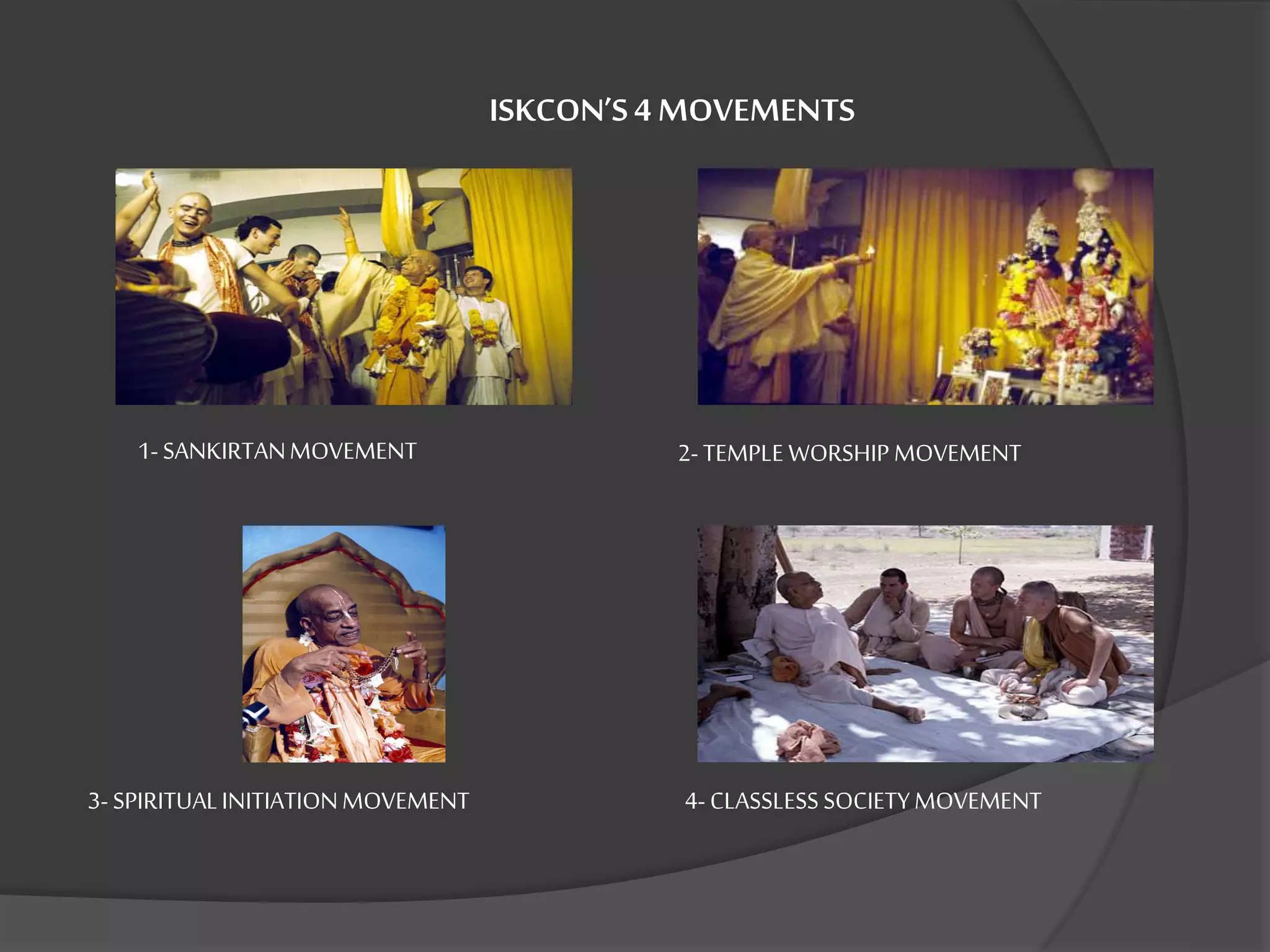
ISKCON’S4 MOVEMENTS
1-SANKIRTANMOVEMENT 2-TEMPLE WORSHIP MOVEMENT
3-SPIRITUALINITIATIONMOVEMENT 4-CLASSLESSSOCIETYMOVEMENT
Sankirtan
Temple
Worship
Spiritual
Initiation
Classless
Society
Books and
Harinam
Deity
Worship
Congregation
Varnasrama
Essay on Gita Nagari Within ISKCON Today
ISKCON’s current activities have similarities with
Srila Prabhupada’s Essay called “Gita Nagari”
Books are
the Basis
Purity is the
Force
Preaching is
the Essence
Utility is the
Principle
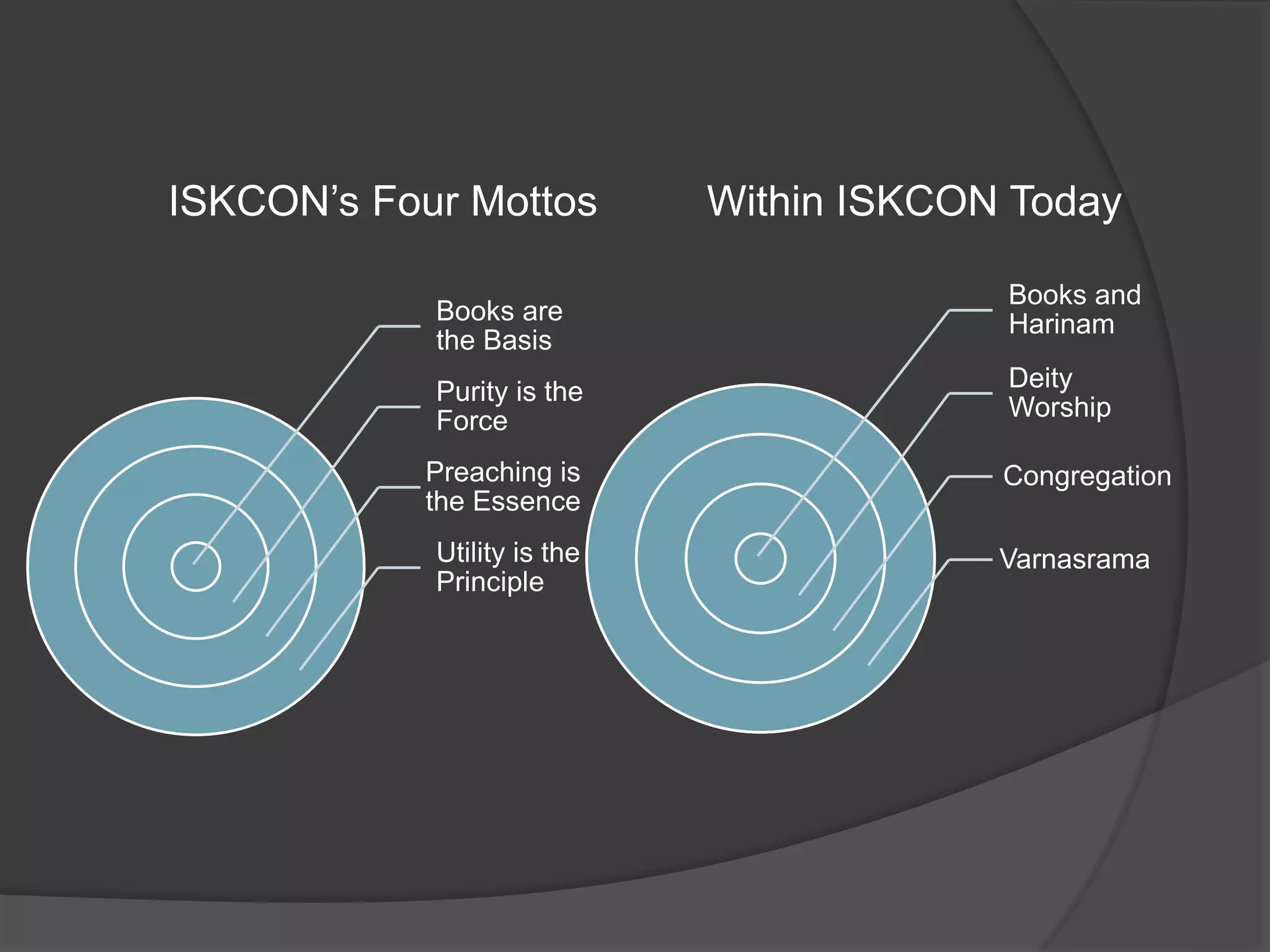
ISKCON’s FOUR MOTTOS
Books are
the Basis
Purity is the
Force
Preaching is
the Essence
Utility is the
Principle
Books and
Harinam
Deity
Worship
Congregation
Varnasrama
ISKCON’s Four Mottos Within ISKCON Today
1
SANKIRTAN MOVEMENT
1949Letter toHon.SardarDr.VallavbhajeePatel
Deputy PrimeMinister, GovernmentofIndia.
 1. In the midst of his multifarious duties, Gandhiji never missed to attend to his
Ram Dhun kirtan meeting. This is one of the soundest methods for the culture of
devotion to God. In the opinion of Srimad-Bhagavatam, one who is imbibed with
the devotion of Godhead is also endowed with all the good qualities of the gods.
But one who is not a devotee of Godhead, has not any value for his good qualities
becauseheutilizes hissocalledgoodqualities forulteriorpurposes.
SANKIRTAN MOVEMENT
1949Letter toHon.SardarDr.VallavbhajeePatel
Deputy PrimeMinister, GovernmentofIndia(cont’d).
 As such the easy way to raise the moral standard of people in general, is
to make this sankirtana movement more popular all over the world by
philosophicaldiscoursesbasedonreasoningandmoralandethicalcodes.
The Vaisnava acaryas especially Lord Caitanya and his six Gosvami
disciples give us ample opportunity and scope for this work. Lord
Caitanya first inaugurated the sankirtana or randhun movement and the
later Gosvamis supported it by scholarly philosophical synthesis. The six
sandarbhas bySrilaJivaGoswamiaremarvelousinthis respect.
SANKIRTAN MOVEMENT
1956 ESSAY ON GITA NAGARI
 Leaders and politicians may take lessons from the life of Mahatma
Gandhi, who was undoubtedly a great and busy politician, with respect to
his daily evening prayer meeting and regular recitation of the text of
Bhagavad-gita. He followed this principle of life most faithfully, even up
to the last moment of his lamented life. People in general, and the leaders
in particular, may follow the footprints of Mahatma Gandhi, if they at all
want to do some good to their followers. Such regular habit of reciting the
reading of the Bhagavad-gita makes one able to get rid of the demoniac
way of life and gradually rise up to the plane of pure devotional life of the
gods.
SANKIRTAN MOVEMENT
1956 ESSAY ON GITA NAGARI (cont’d)
 When such devotional life is enriched by recitation of Bhagavad-gita, all
the good qualities of the gods automatically overcome the reciter without
any extraneous effort on his part. And a person, however qualified he
maybe in the mundane sense of the term, if he is devoid of the principles
of devotional life as abovementioned, he shall surely hover in the mental
plane of uncertainty and, as such, will always fail to enter into the
numinous existence of life. Those who have developed such noumenon
existence of life, generally known as spiritual life, are called mahatmas in
the language of Bhagavad-gita. The definition of real mahatmas is given
in the book.
SANKIRTAN MOVEMENT
• Lord Caitanya’s beginning of Hari
Nam Sankirtan in the streets of
Navadwipa Dham with mrdanga
and karatals.
* The extended stage of Nama
Sankirtan, the writings of the six
Goswamis of Vrndavana.
* Srila Prabhupada’s beginning of
Hari Nam Sankirtan in the streets of
NewYork City with mrdanga and
karatals.
* The extended stage of Nama
Sankirtan, Srila Prabhupada’s books,
the BRHAT-MRDANGA.
SANKIRTAN MOVEMENT
S U M M A R Y
 JAPA KIRTAN – Japa Meditation
 MRDANGA KIRTAN –Kirtan in Public
 BRHAT-MRDANGA KIRTAN –Book Distribution
 BHAKTIVEDANTA BOOK TRUST (BBT)
 BHAKTIVEDANTA INSTITUTE– Scientific preaching
 GURUKULAS (Sri Mayapur and Sri Vrindavan)
 VIHE in SRI VRNDAVAN DHAM
 Mayapur Institute (MI) in SRI MAYAPUR DHAM
 BHAKTIVEDANTA COLLEGE in RADHADESH
 VARNASRAMA COLLEGE (India – Hungary)
SANKIRTAN MOVEMENT
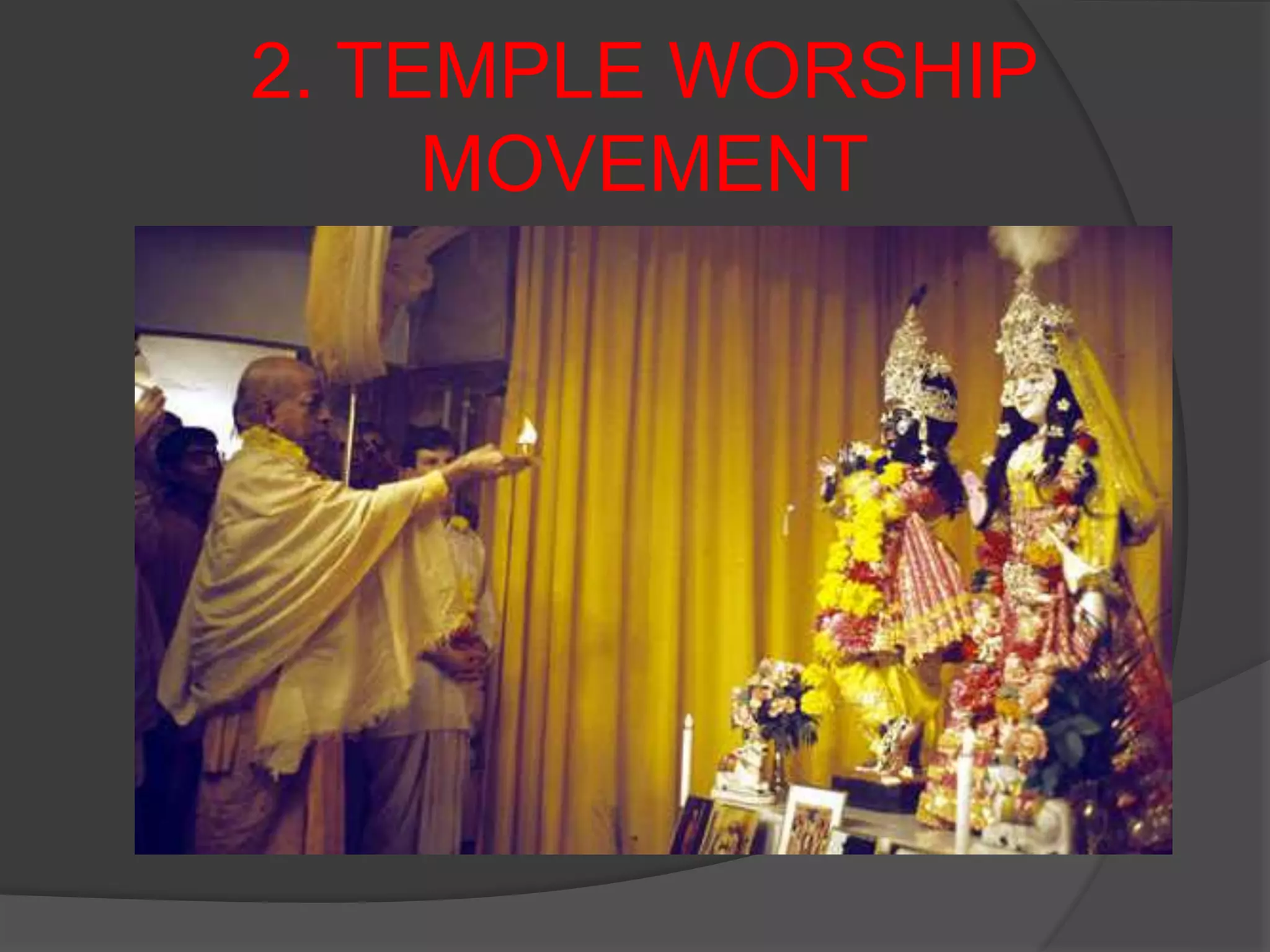
2. TEMPLE WORSHIP
MOVEMENT
1949Letter toHon.SardarDr.VallavbhajeePatel
Deputy PrimeMinister, GovernmentofIndia.
 The second item is to take up the temple entry or temple worship
movement. This is, in the real sense, a theistic cultural movement and
the facility or opportunity shall be open to every one whatsoever he may
be. All thepast Acaryasaccepted everyone who desires to offer his respect
to God inspired by transcendental love and devotion. We can support this
movement of Gandhiji on the authority of sastras. There are thousands
and lakhs of temples all over India but they are not always properly
managed.
TEMPLE WORSHIP MOVEMENT
1949Letter toHon.SardarDr.VallavbhajeePatel
Deputy PrimeMinister, GovernmentofIndia(cont’d).
 Some of them have become the positive dens for undesirable activities
and most of the owners or trustees of such temples do not know how to
utilize these sacred buildings. Neither modernized gentlemen have any
interest for these neglected theistic institutions. Originally the aim of
these temples was to diffuse spiritual culture in every quarter. These
temples or theistic institutions should therefore be reorganized as the
centre of spiritual culture according to authentic principles as laid
down in the scriptures like Bhagavad-gita.
TEMPLE WORSHIP MOVEMENT
1956 ESSAY ONGITA NAGARI
 The temple entry movement of Mahatma Gandhi is another attempt to
deliver people in general from spiritual degradation, and by such
movement, the mass of people can be saved from gliding down to the
lowest status of demoniac life. Even when he was at Noakhali during the
dark hours of the partition days, he never hesitated to reinstall the deities
of Radha and Krishna, and by such examples, he had done immense
good for the people in general. Leaders and politicians may take lessons
from this particular incidence of his life. It may be said in this connection
that there arethousands and thousands of Vishnutemples all overIndia.
TEMPLE WORSHIP MOVEMENT
1956 ESSAY ONGITA NAGARI (cont’d)
 And these temples were originally meant for enlightening the mass of
people in spiritual values so that they can live in peace and harmony with
higher aim of life. At the present moment in most cases, these spiritual
educational centers have been rendered into rendezvous of demoniac
dance for want of the culture of Bhagavad-gita. They have become on the
contrary, so many plague spots for preaching atheism and advancement
of demoniac principles, for want of regular propagation of spiritual
education under able leadership.
TEMPLE WORSHIP MOVEMENT
1956 ESSAY ONGITA NAGARI (cont’d)
 The mission of Gita Nagari must have its aim amongst others, to rectify the anomalies
that have entered into the life of these centers of spiritual education and regenerate
them to the sense of spiritual education through the exemplary life of devotees that may
be created from the practical life of the members of the Gita Nagari. The Bhagavad-gita
encouragesusin such spiritualcultureasfollows:
 yänti deva-vratä devän pitèn yänti pitå-vratäù
bhütäni yänti bhütejyä yänti mad-yäjino ’pi mäm
“Those who worship the demigods will take birth among the demigods;
those who worship the ancestors go to the ancestors; those who worship
ghosts and spirits will take birth among such beings; and those who
worship Me will live with Me.” [Bg. 9.25]
TEMPLE WORSHIP MOVEMENT
 Lord Caitanya Mahaprabhu
** Temples of Vrindavan
 Srila Bhaktivinoda Thakura
** Yoga Pith in Sri Mayapur
 Srila Bhaktisiddanta Sarasvari
Thakura
** 64 Gaudhiya Maths in India
 Srila Prabhupada
** USA– Firstin NewYork
** INDIA – First3: Mayapur Vrindavana
& Mumbai
** WORLD – 108 Temples Worldwide
** Sri Sri Radha Krishna Deity Worship –
Highest Standard
TEMPLE WORSHIP MOVEMENT
3. SPIRITUAL INITIATION
MOVEMENT
1949Letter toHon.SardarDr.VallavbhajeePatel
Deputy PrimeMinister, GovernmentofIndia
 The third item is to take up the Harijana movement. This movement is,
in the real sense, a spiritual initiation movement and this should be
organized in such a manner that people all over the world may take
interest in it. The harijana is a word which shall not be used neglectfully
as it is done now but attempt should be made to make everybody a
harijana. Harijana means the recognized man of Hari, the Personality of
Godhead, and thus he (the harijana) is as important a man as the knight
of the king. So harijana movement should be strengthened more
scientifically to turn everyperson who is now mayajana intoaharijana.
SPIRITUAL INITIATION MOVEMENT
1949Letter toHon.SardarDr.VallavbhajeePatel
Deputy PrimeMinister. GovernmentofIndia(cont’d).
 The mayajana is a word which is applicable to a person who is ordinarily
engaged in the service of materialistic pursuits, whereas the harijana is
the person whose main business is to attain perfection of human life, as
Mahatma Gandhi did, by spiritualistic realization. This movement should
therefore be conducted under strict disciplinary methods as
prescribed by the mahajana or the harijana of accredited merit. In such a
movement we shall have full co-operation of the sadhu community in
India.
SPIRITUAL INITIATION MOVEMENT
1956 ESSAY ON GITA NAGARI
 Mahatma Gandhi started the Harijana movement in order to raise the status of
the fallen people either by social injustice or otherwise. But such pious
movement may not be restricted only amongst the Bhangis and Chamars who
are proclaimed as such for their unclean habits or in some cases by social
injustice, but such movement may be extended amongst those also who are
passing in the society as brahmanas and ksatriyas etc., but in practice their
mentality is more degraded than the lowest of the Bhangis and Chamars.
Harijanameans the associate of God Himself.
SPIRITUAL INITIATION MOVEMENT
1956 ESSAY ON GITA NAGARI (cont’d)
 Chamars and Bhangis, or for that matter, people who are of the mentality
of Chamars and Bhangis both in habit and dealings can never be
promoted to the position of Harijanas unless and until such persons are
helped to go up to the place of the Harijanas by the approved method of
rules made by actual Harijanas such as Arjuna, Prahlada, Dhruva
Maharaja, Yamaraja, Bhisma, Janaka, Narada, etc.
SPIRITUAL INITIATION MOVEMENT
1956 ESSAY ONGITA NAGARI (cont’d)
 There is no bar for any one to rise up to the
position of Harijana, and this is confirmed in the
Bhagavad-gétä:
 mäà hi pärtha vyapäçritya ye ’pi syuù päpa-yonayaù
striyo vaiçyäs tathä çüdras te ’pi yänti paräà gatim
“O son of Påthä, those who take shelter in Me,
though they be of lower birth—women, vaiçyas
[merchants] and çüdras [workers]—can attain the
supreme destination.” [Bg. 9.32]
SPIRITUAL INITIATION MOVEMENT
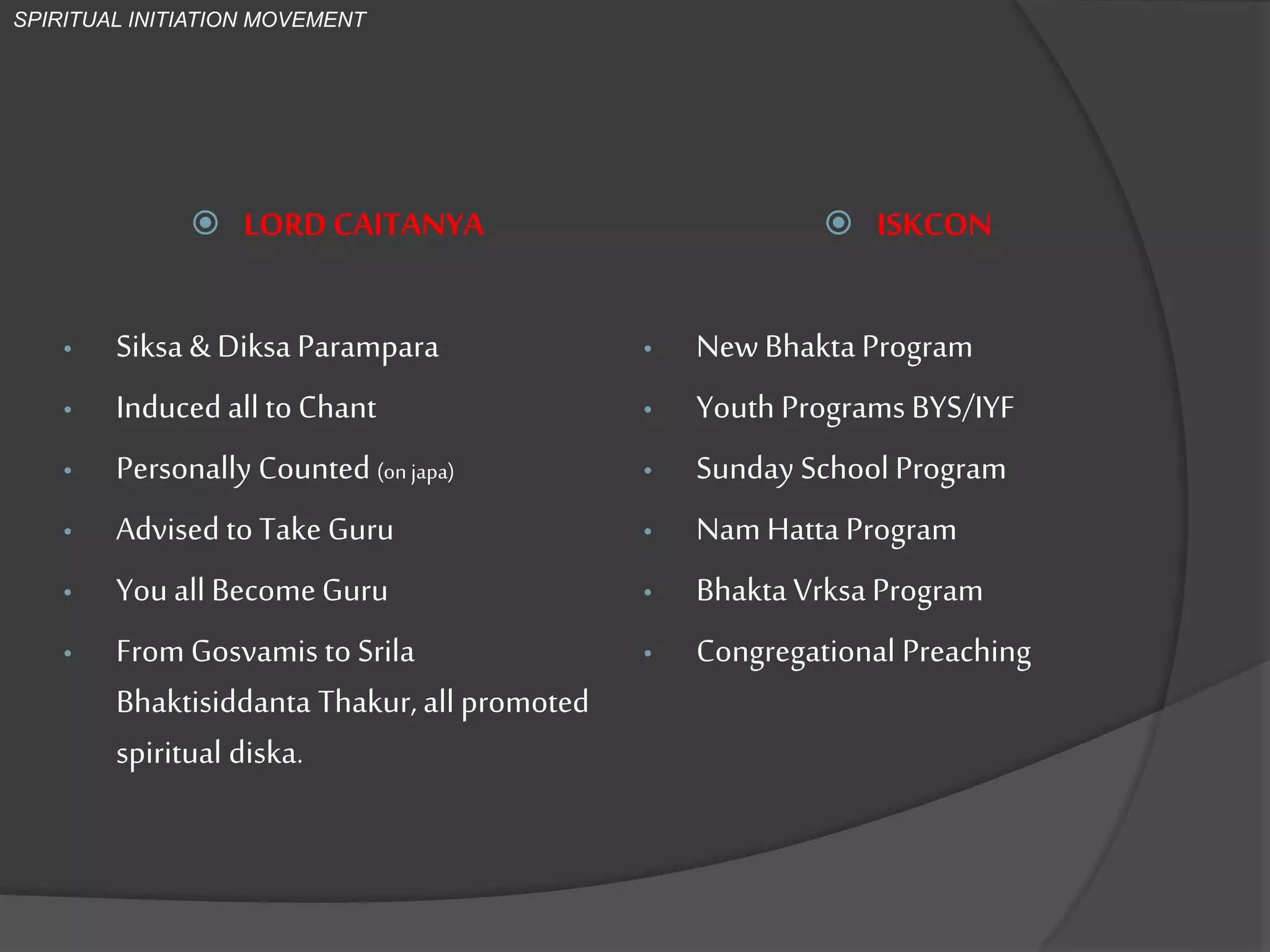
 LORD CAITANYA
• Siksa & Diksa Parampara
• Induced all to Chant
• Personally Counted (on japa)
• Advised to Take Guru
• You all BecomeGuru
• From Gosvamis to Srila
Bhaktisiddanta Thakur, all promoted
spiritual diksa.
 ISKCON
• NewBhakta Program
• Youth Programs BYS/IYF
• Sunday School Program
• Nam Hatta Program
• Bhakta Vrksa Program
• Congregational Preaching
SPIRITUAL INITIATION MOVEMENT
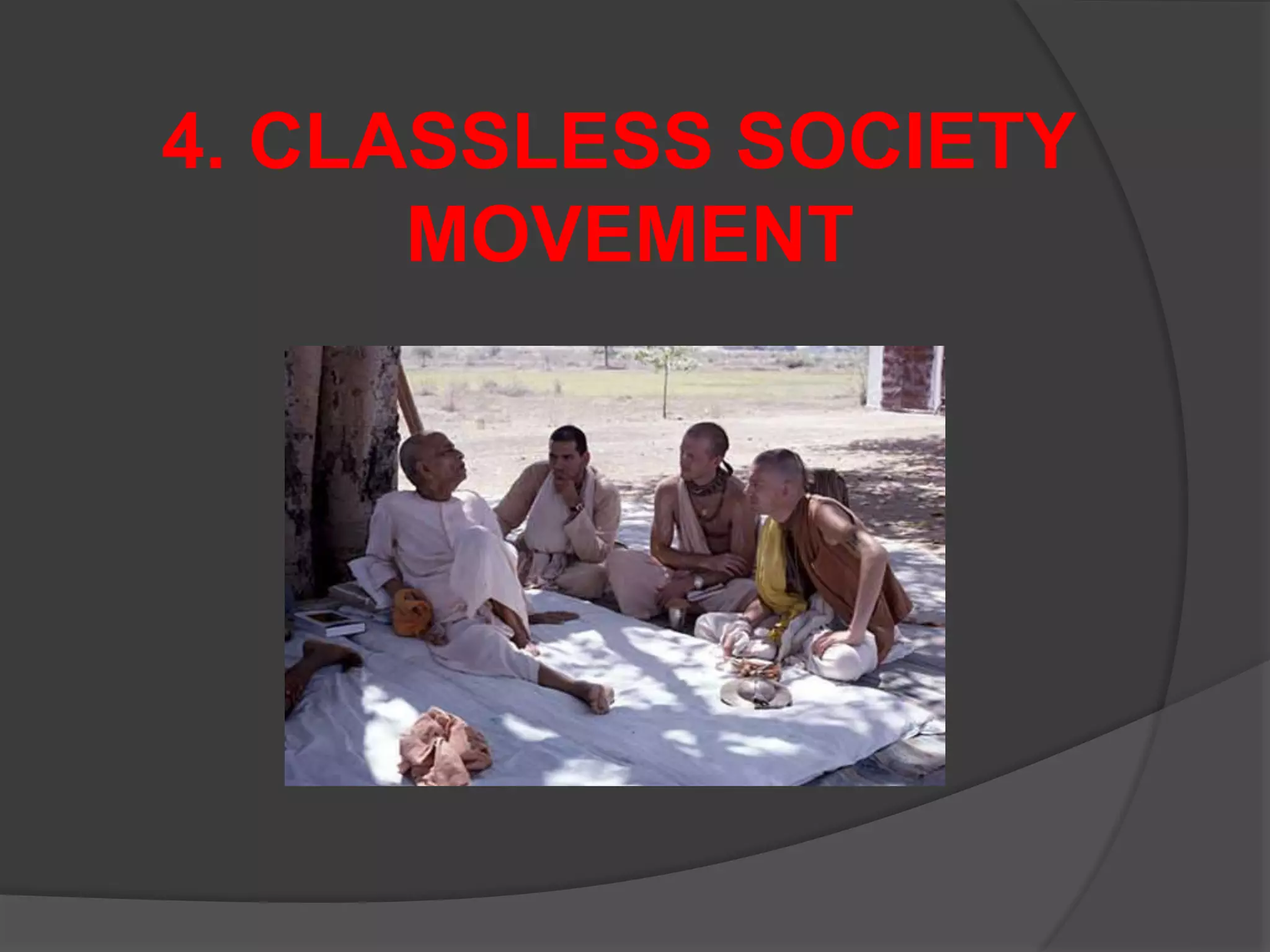
4. CLASSLESS SOCIETY
MOVEMENT
1949Letter toHon.SardarDr.VallavbhajeePatel
Deputy PrimeMinister. GovernmentofIndia
 The fourth item is to organize the much discussed caste system as a
solution of natural division of the human beings all over the world.
Nationalistic division of human races is artificial but scientific division
of the caste system as envisaged in the Bhagavad-gita is natural. We
shall have to pick up brahmanas and others not only from the Indian
people but from the peoples of all over the world. The vitiated caste
system of present India is never sanctioned by the scriptures. But the
caste system is made by God according to quality and work of the subject
and it was neverdesigned for the benefit of accidental birthright.
CLASSLESS SOCIETY MOVEMENT
1949Letter to Hon. SardarDr.Vallavbhajee Patel
Deputy PrimeMinister. Government of India(cont’d).
 Thus whatever is made by God cannot be destroyed by man. Destruction of the
caste system, as contemplated by some exponents, is therefore out of question.
By the modes of nature different persons are imbued with different qualities and
the scientific way of division of human society, from the qualitative aspect, by
the caste system is quite natural. But the basic principle of such caste system is
to serve the plan of Godhead and by doing so the four orders of caste system
make headway by the co-operative method. When such spiritual progress is
definitely made, the materialistic progress is automatically effected as a matter
of course. Thatmakesarealclasslesssociety.
CLASSLESS SOCIETY MOVEMENT
1956 ESSAY ONGITA NAGARI
 Mahatma Gandhi did not approve of the system of birthright castes as prevailing
in India, and there is ample support for this movement of casteless society in
the Bhagavad-gata in its own way. Casteless society does not mean that there will
be no section or subsection of social division. Without such division of social
order no living society can be conceived but there may not be any such section or
subsection simply for the matter of birthright accidence. A brahmana’s son has
the right to become a brahmana provided he has the rightful qualifications of a
brahmana otherwise he cannot be placed in the exhaled position of a brahmana.
That is the verdict of all revealedscriptures.
CLASSLESS SOCIETY MOVEMENT
1956 ESSAY ON GITA NAGARI (cont’d)
 There are three modes of Nature working all over the world and they are called the mode
of goodness, the mode of passion, and the mode of ignorance. Every man or every animal
is under the influence of either of the above modes of nature. As such, it is wrong to
calculate that the modes of Nature are working only within the boundaries of India. On
the contrary the fact is that nature is working all over the universe and therefore in other
parts of the world also. In the human society, undoubtedly, there are men of different
modes of nature as above mentioned. Persons who are under the influence of modes of
goodness, may be classified as brahmanas, similarly those who are under the influence of
the modes of passion may be called as the ksatriyasand so on as they are described in the
approved sastras.
CLASSLESS SOCIETY MOVEMENT
1956 ESSAY ON GITA NAGARI (cont’d)
 The modes of ignorance as it goes down by degrees,
produces men of such lower and lower qualities and
they are designated as Yavanas, Mlecchas, Kirätas,
Hüëas, Ändhras, Pulindas, Pulkaças, Aviras,
Çumbhas, Khasadayas, etc., and there are four lakhs
of men of different qualities all over the universe
influenced by the above mentioned modes of nature.
From the Gétä-nagaré this universal Truth must be
propagated systematically, so that REAL HUMAN
SOCIETY may be established for the benefit of all,
dividing the categories of men according to natural
modes of nature. Such social order on the basis of the
Bhagavad-gétä all over the world may be called the
institution of natural caste system or the casteless
society.
CLASSLESS SOCIETY MOVEMENT
1956 ESSAY ONGITA NAGARI (cont’d)
 In that institution of natural caste system all divisions of men will be
engaged in one transcendental business of spiritual community with
equal status of life and with equal importance of co-operative value as
much as the different parts of the one whole body have different
functions only but qualitatively they are one and the same. In that
institution of spiritual social order every one will have equal right to
promote himself to the higher status of life without any malicious
competition and as such education and culture will be open door for all
concerned as much as the varsity [university] of all state is open for all
with equal status of educational right.
CLASSLESS SOCIETY MOVEMENT
1956 ESSAY ONGITA NAGARI (cont’d)
 Casteless society will, of course, never allow to place on the same
category of a high court judge and the laborer unless such society will
have gone in to madness of culture. On the contrary by establishment of
such casteless society as it is stated in the Bhagavad-gita nobody will be
grudging if any one is recognized as the qualified brahmana on the value
of merit only and not on the basis of birthright claim. Such casteless
society is reasonable andacceptable by one andall in the world.
CLASSLESS SOCIETY MOVEMENT
 In a letter addressing his son as “Sarasvati”,
Srila Bhaktivinoda Thakura writes:
“People of this world who are proud of their own
aristocratic birth cannot attain real aristocracy.
Therefore they attack the pure Vaisnavas,
saying, ‘They have taken birth in low-class
families because of their sins.’ Thus they commit
offenses. The solution to this problem is to
establish the order of daivi-varnasrama dharma -
something you have started doing; you should
know that to be the real service to the
Vaisnavas.”
CLASSLESS SOCIETY MOVEMENT
 First Varnasrama Community in USA, New
Vrindavan: www.newvrindaban.com
 ISKCON Ministry of Cow Protection and
Agriculture: www.iskcon.com
 ISKCON Daiva Varnasrama Ministry
Promoting Rural Development in India
www.iskconvarnasrama.com
 OM Sri Surabhi Campaign
www.srisurabhi.org
References
ABOUT THE AUTHOR
 Name HH RP Bhakti Raghava Swami
 Age and Gender 70, Male
 Country/Province of Origin Canada, Ontario
 Educational Degree and Year B.A, 1968, M.Ed., 2004
 Educational Institution State University of Yogyakarta
 Professional Work/Experience Social Worker/Counselor
 Affiliation with ISKCON Since 1974
 Present Service in ISKCON Minister, IDVM-India
ISKCON's 4 movements

ISKCON's 4 movements

  • 2.
    ISKCON’s 4 MOVEMENTS  “TheComplete Mission”  Author : HH RP Bhakti Raghava Swami  E-Mail : Bhakti.Raghava.Swami@pamho.net  Date Produced : 2015  Editor: Sriman Prafullakumar Seelam  Serial No: 1 of 54
  • 3.
    ABSTRACT “ISKCON’S 4 Movements”connects Srila Prabhupada’s expressed vision for spreading Krishna Consciousness as written in 1949 and in 1956 with what he implemented in the West when first coming to America in 1965 and then returning to India in 1967 & 1971. The presentation highlights the key words used by Srila Prabhupada in describing four distinct phases or “movements”. This presentation is also available as a documentary film called “ISKCON’s Four Waves” produced by Varnasrama Media Productions (VMP), a department of the ISKCON Daiva Varnasrama Ministry (IDVM- India).
  • 4.
    ISKCON’S4 MOVEMENTS 1-SANKIRTANMOVEMENT 2-TEMPLEWORSHIP MOVEMENT 3-SPIRITUALINITIATIONMOVEMENT 4-CLASSLESSSOCIETYMOVEMENT
  • 5.
    Sankirtan Temple Worship Spiritual Initiation Classless Society Books and Harinam Deity Worship Congregation Varnasrama Essay onGita Nagari Within ISKCON Today ISKCON’s current activities have similarities with Srila Prabhupada’s Essay called “Gita Nagari”
  • 6.
    Books are the Basis Purityis the Force Preaching is the Essence Utility is the Principle ISKCON’s FOUR MOTTOS
  • 7.
    Books are the Basis Purityis the Force Preaching is the Essence Utility is the Principle Books and Harinam Deity Worship Congregation Varnasrama ISKCON’s Four Mottos Within ISKCON Today
  • 8.
  • 9.
    1949Letter toHon.SardarDr.VallavbhajeePatel Deputy PrimeMinister,GovernmentofIndia.  1. In the midst of his multifarious duties, Gandhiji never missed to attend to his Ram Dhun kirtan meeting. This is one of the soundest methods for the culture of devotion to God. In the opinion of Srimad-Bhagavatam, one who is imbibed with the devotion of Godhead is also endowed with all the good qualities of the gods. But one who is not a devotee of Godhead, has not any value for his good qualities becauseheutilizes hissocalledgoodqualities forulteriorpurposes. SANKIRTAN MOVEMENT
  • 10.
    1949Letter toHon.SardarDr.VallavbhajeePatel Deputy PrimeMinister,GovernmentofIndia(cont’d).  As such the easy way to raise the moral standard of people in general, is to make this sankirtana movement more popular all over the world by philosophicaldiscoursesbasedonreasoningandmoralandethicalcodes. The Vaisnava acaryas especially Lord Caitanya and his six Gosvami disciples give us ample opportunity and scope for this work. Lord Caitanya first inaugurated the sankirtana or randhun movement and the later Gosvamis supported it by scholarly philosophical synthesis. The six sandarbhas bySrilaJivaGoswamiaremarvelousinthis respect. SANKIRTAN MOVEMENT
  • 11.
    1956 ESSAY ONGITA NAGARI  Leaders and politicians may take lessons from the life of Mahatma Gandhi, who was undoubtedly a great and busy politician, with respect to his daily evening prayer meeting and regular recitation of the text of Bhagavad-gita. He followed this principle of life most faithfully, even up to the last moment of his lamented life. People in general, and the leaders in particular, may follow the footprints of Mahatma Gandhi, if they at all want to do some good to their followers. Such regular habit of reciting the reading of the Bhagavad-gita makes one able to get rid of the demoniac way of life and gradually rise up to the plane of pure devotional life of the gods. SANKIRTAN MOVEMENT
  • 12.
    1956 ESSAY ONGITA NAGARI (cont’d)  When such devotional life is enriched by recitation of Bhagavad-gita, all the good qualities of the gods automatically overcome the reciter without any extraneous effort on his part. And a person, however qualified he maybe in the mundane sense of the term, if he is devoid of the principles of devotional life as abovementioned, he shall surely hover in the mental plane of uncertainty and, as such, will always fail to enter into the numinous existence of life. Those who have developed such noumenon existence of life, generally known as spiritual life, are called mahatmas in the language of Bhagavad-gita. The definition of real mahatmas is given in the book. SANKIRTAN MOVEMENT
  • 13.
    • Lord Caitanya’sbeginning of Hari Nam Sankirtan in the streets of Navadwipa Dham with mrdanga and karatals. * The extended stage of Nama Sankirtan, the writings of the six Goswamis of Vrndavana. * Srila Prabhupada’s beginning of Hari Nam Sankirtan in the streets of NewYork City with mrdanga and karatals. * The extended stage of Nama Sankirtan, Srila Prabhupada’s books, the BRHAT-MRDANGA. SANKIRTAN MOVEMENT
  • 14.
    S U MM A R Y  JAPA KIRTAN – Japa Meditation  MRDANGA KIRTAN –Kirtan in Public  BRHAT-MRDANGA KIRTAN –Book Distribution  BHAKTIVEDANTA BOOK TRUST (BBT)  BHAKTIVEDANTA INSTITUTE– Scientific preaching  GURUKULAS (Sri Mayapur and Sri Vrindavan)  VIHE in SRI VRNDAVAN DHAM  Mayapur Institute (MI) in SRI MAYAPUR DHAM  BHAKTIVEDANTA COLLEGE in RADHADESH  VARNASRAMA COLLEGE (India – Hungary) SANKIRTAN MOVEMENT
  • 15.
  • 16.
    1949Letter toHon.SardarDr.VallavbhajeePatel Deputy PrimeMinister,GovernmentofIndia.  The second item is to take up the temple entry or temple worship movement. This is, in the real sense, a theistic cultural movement and the facility or opportunity shall be open to every one whatsoever he may be. All thepast Acaryasaccepted everyone who desires to offer his respect to God inspired by transcendental love and devotion. We can support this movement of Gandhiji on the authority of sastras. There are thousands and lakhs of temples all over India but they are not always properly managed. TEMPLE WORSHIP MOVEMENT
  • 17.
    1949Letter toHon.SardarDr.VallavbhajeePatel Deputy PrimeMinister,GovernmentofIndia(cont’d).  Some of them have become the positive dens for undesirable activities and most of the owners or trustees of such temples do not know how to utilize these sacred buildings. Neither modernized gentlemen have any interest for these neglected theistic institutions. Originally the aim of these temples was to diffuse spiritual culture in every quarter. These temples or theistic institutions should therefore be reorganized as the centre of spiritual culture according to authentic principles as laid down in the scriptures like Bhagavad-gita. TEMPLE WORSHIP MOVEMENT
  • 18.
    1956 ESSAY ONGITANAGARI  The temple entry movement of Mahatma Gandhi is another attempt to deliver people in general from spiritual degradation, and by such movement, the mass of people can be saved from gliding down to the lowest status of demoniac life. Even when he was at Noakhali during the dark hours of the partition days, he never hesitated to reinstall the deities of Radha and Krishna, and by such examples, he had done immense good for the people in general. Leaders and politicians may take lessons from this particular incidence of his life. It may be said in this connection that there arethousands and thousands of Vishnutemples all overIndia. TEMPLE WORSHIP MOVEMENT
  • 19.
    1956 ESSAY ONGITANAGARI (cont’d)  And these temples were originally meant for enlightening the mass of people in spiritual values so that they can live in peace and harmony with higher aim of life. At the present moment in most cases, these spiritual educational centers have been rendered into rendezvous of demoniac dance for want of the culture of Bhagavad-gita. They have become on the contrary, so many plague spots for preaching atheism and advancement of demoniac principles, for want of regular propagation of spiritual education under able leadership. TEMPLE WORSHIP MOVEMENT
  • 20.
    1956 ESSAY ONGITANAGARI (cont’d)  The mission of Gita Nagari must have its aim amongst others, to rectify the anomalies that have entered into the life of these centers of spiritual education and regenerate them to the sense of spiritual education through the exemplary life of devotees that may be created from the practical life of the members of the Gita Nagari. The Bhagavad-gita encouragesusin such spiritualcultureasfollows:  yänti deva-vratä devän pitèn yänti pitå-vratäù bhütäni yänti bhütejyä yänti mad-yäjino ’pi mäm “Those who worship the demigods will take birth among the demigods; those who worship the ancestors go to the ancestors; those who worship ghosts and spirits will take birth among such beings; and those who worship Me will live with Me.” [Bg. 9.25] TEMPLE WORSHIP MOVEMENT
  • 21.
     Lord CaitanyaMahaprabhu ** Temples of Vrindavan  Srila Bhaktivinoda Thakura ** Yoga Pith in Sri Mayapur  Srila Bhaktisiddanta Sarasvari Thakura ** 64 Gaudhiya Maths in India  Srila Prabhupada ** USA– Firstin NewYork ** INDIA – First3: Mayapur Vrindavana & Mumbai ** WORLD – 108 Temples Worldwide ** Sri Sri Radha Krishna Deity Worship – Highest Standard TEMPLE WORSHIP MOVEMENT
  • 22.
  • 23.
    1949Letter toHon.SardarDr.VallavbhajeePatel Deputy PrimeMinister,GovernmentofIndia  The third item is to take up the Harijana movement. This movement is, in the real sense, a spiritual initiation movement and this should be organized in such a manner that people all over the world may take interest in it. The harijana is a word which shall not be used neglectfully as it is done now but attempt should be made to make everybody a harijana. Harijana means the recognized man of Hari, the Personality of Godhead, and thus he (the harijana) is as important a man as the knight of the king. So harijana movement should be strengthened more scientifically to turn everyperson who is now mayajana intoaharijana. SPIRITUAL INITIATION MOVEMENT
  • 24.
    1949Letter toHon.SardarDr.VallavbhajeePatel Deputy PrimeMinister.GovernmentofIndia(cont’d).  The mayajana is a word which is applicable to a person who is ordinarily engaged in the service of materialistic pursuits, whereas the harijana is the person whose main business is to attain perfection of human life, as Mahatma Gandhi did, by spiritualistic realization. This movement should therefore be conducted under strict disciplinary methods as prescribed by the mahajana or the harijana of accredited merit. In such a movement we shall have full co-operation of the sadhu community in India. SPIRITUAL INITIATION MOVEMENT
  • 25.
    1956 ESSAY ONGITA NAGARI  Mahatma Gandhi started the Harijana movement in order to raise the status of the fallen people either by social injustice or otherwise. But such pious movement may not be restricted only amongst the Bhangis and Chamars who are proclaimed as such for their unclean habits or in some cases by social injustice, but such movement may be extended amongst those also who are passing in the society as brahmanas and ksatriyas etc., but in practice their mentality is more degraded than the lowest of the Bhangis and Chamars. Harijanameans the associate of God Himself. SPIRITUAL INITIATION MOVEMENT
  • 26.
    1956 ESSAY ONGITA NAGARI (cont’d)  Chamars and Bhangis, or for that matter, people who are of the mentality of Chamars and Bhangis both in habit and dealings can never be promoted to the position of Harijanas unless and until such persons are helped to go up to the place of the Harijanas by the approved method of rules made by actual Harijanas such as Arjuna, Prahlada, Dhruva Maharaja, Yamaraja, Bhisma, Janaka, Narada, etc. SPIRITUAL INITIATION MOVEMENT
  • 27.
    1956 ESSAY ONGITANAGARI (cont’d)  There is no bar for any one to rise up to the position of Harijana, and this is confirmed in the Bhagavad-gétä:  mäà hi pärtha vyapäçritya ye ’pi syuù päpa-yonayaù striyo vaiçyäs tathä çüdras te ’pi yänti paräà gatim “O son of Påthä, those who take shelter in Me, though they be of lower birth—women, vaiçyas [merchants] and çüdras [workers]—can attain the supreme destination.” [Bg. 9.32] SPIRITUAL INITIATION MOVEMENT
  • 28.
     LORD CAITANYA •Siksa & Diksa Parampara • Induced all to Chant • Personally Counted (on japa) • Advised to Take Guru • You all BecomeGuru • From Gosvamis to Srila Bhaktisiddanta Thakur, all promoted spiritual diksa.  ISKCON • NewBhakta Program • Youth Programs BYS/IYF • Sunday School Program • Nam Hatta Program • Bhakta Vrksa Program • Congregational Preaching SPIRITUAL INITIATION MOVEMENT
  • 29.
  • 30.
    1949Letter toHon.SardarDr.VallavbhajeePatel Deputy PrimeMinister.GovernmentofIndia  The fourth item is to organize the much discussed caste system as a solution of natural division of the human beings all over the world. Nationalistic division of human races is artificial but scientific division of the caste system as envisaged in the Bhagavad-gita is natural. We shall have to pick up brahmanas and others not only from the Indian people but from the peoples of all over the world. The vitiated caste system of present India is never sanctioned by the scriptures. But the caste system is made by God according to quality and work of the subject and it was neverdesigned for the benefit of accidental birthright. CLASSLESS SOCIETY MOVEMENT
  • 31.
    1949Letter to Hon.SardarDr.Vallavbhajee Patel Deputy PrimeMinister. Government of India(cont’d).  Thus whatever is made by God cannot be destroyed by man. Destruction of the caste system, as contemplated by some exponents, is therefore out of question. By the modes of nature different persons are imbued with different qualities and the scientific way of division of human society, from the qualitative aspect, by the caste system is quite natural. But the basic principle of such caste system is to serve the plan of Godhead and by doing so the four orders of caste system make headway by the co-operative method. When such spiritual progress is definitely made, the materialistic progress is automatically effected as a matter of course. Thatmakesarealclasslesssociety. CLASSLESS SOCIETY MOVEMENT
  • 32.
    1956 ESSAY ONGITANAGARI  Mahatma Gandhi did not approve of the system of birthright castes as prevailing in India, and there is ample support for this movement of casteless society in the Bhagavad-gata in its own way. Casteless society does not mean that there will be no section or subsection of social division. Without such division of social order no living society can be conceived but there may not be any such section or subsection simply for the matter of birthright accidence. A brahmana’s son has the right to become a brahmana provided he has the rightful qualifications of a brahmana otherwise he cannot be placed in the exhaled position of a brahmana. That is the verdict of all revealedscriptures. CLASSLESS SOCIETY MOVEMENT
  • 33.
    1956 ESSAY ONGITA NAGARI (cont’d)  There are three modes of Nature working all over the world and they are called the mode of goodness, the mode of passion, and the mode of ignorance. Every man or every animal is under the influence of either of the above modes of nature. As such, it is wrong to calculate that the modes of Nature are working only within the boundaries of India. On the contrary the fact is that nature is working all over the universe and therefore in other parts of the world also. In the human society, undoubtedly, there are men of different modes of nature as above mentioned. Persons who are under the influence of modes of goodness, may be classified as brahmanas, similarly those who are under the influence of the modes of passion may be called as the ksatriyasand so on as they are described in the approved sastras. CLASSLESS SOCIETY MOVEMENT
  • 34.
    1956 ESSAY ONGITA NAGARI (cont’d)  The modes of ignorance as it goes down by degrees, produces men of such lower and lower qualities and they are designated as Yavanas, Mlecchas, Kirätas, Hüëas, Ändhras, Pulindas, Pulkaças, Aviras, Çumbhas, Khasadayas, etc., and there are four lakhs of men of different qualities all over the universe influenced by the above mentioned modes of nature. From the Gétä-nagaré this universal Truth must be propagated systematically, so that REAL HUMAN SOCIETY may be established for the benefit of all, dividing the categories of men according to natural modes of nature. Such social order on the basis of the Bhagavad-gétä all over the world may be called the institution of natural caste system or the casteless society. CLASSLESS SOCIETY MOVEMENT
  • 35.
    1956 ESSAY ONGITANAGARI (cont’d)  In that institution of natural caste system all divisions of men will be engaged in one transcendental business of spiritual community with equal status of life and with equal importance of co-operative value as much as the different parts of the one whole body have different functions only but qualitatively they are one and the same. In that institution of spiritual social order every one will have equal right to promote himself to the higher status of life without any malicious competition and as such education and culture will be open door for all concerned as much as the varsity [university] of all state is open for all with equal status of educational right. CLASSLESS SOCIETY MOVEMENT
  • 36.
    1956 ESSAY ONGITANAGARI (cont’d)  Casteless society will, of course, never allow to place on the same category of a high court judge and the laborer unless such society will have gone in to madness of culture. On the contrary by establishment of such casteless society as it is stated in the Bhagavad-gita nobody will be grudging if any one is recognized as the qualified brahmana on the value of merit only and not on the basis of birthright claim. Such casteless society is reasonable andacceptable by one andall in the world. CLASSLESS SOCIETY MOVEMENT
  • 37.
     In aletter addressing his son as “Sarasvati”, Srila Bhaktivinoda Thakura writes: “People of this world who are proud of their own aristocratic birth cannot attain real aristocracy. Therefore they attack the pure Vaisnavas, saying, ‘They have taken birth in low-class families because of their sins.’ Thus they commit offenses. The solution to this problem is to establish the order of daivi-varnasrama dharma - something you have started doing; you should know that to be the real service to the Vaisnavas.” CLASSLESS SOCIETY MOVEMENT
  • 38.
     First VarnasramaCommunity in USA, New Vrindavan: www.newvrindaban.com  ISKCON Ministry of Cow Protection and Agriculture: www.iskcon.com  ISKCON Daiva Varnasrama Ministry Promoting Rural Development in India www.iskconvarnasrama.com  OM Sri Surabhi Campaign www.srisurabhi.org References
  • 40.
    ABOUT THE AUTHOR Name HH RP Bhakti Raghava Swami  Age and Gender 70, Male  Country/Province of Origin Canada, Ontario  Educational Degree and Year B.A, 1968, M.Ed., 2004  Educational Institution State University of Yogyakarta  Professional Work/Experience Social Worker/Counselor  Affiliation with ISKCON Since 1974  Present Service in ISKCON Minister, IDVM-India