Buddhism
Module 4
1.Compared to Hinduism and the appeal to gods, goddesses, and/or God for help in this life, what did Buddha say people need to do?
2. By emphasizing the individual’s responsibility for their own enlightenment, which caste of Hindus were most threatened by Buddha and why were they
threatened?
3.According to Buddhism what is called a soul is actually something else--a combination of five mental or physical aggregates: the physical body, feelings,
understanding, will, and consciousness. Buddha thought that since all of these qualities are constantly changing, it’s obvious they aren’t permanent.
How is this concept of Buddha’s ‘anatman’ (no atman) different from Hinduism’s concept of Atman?
4.What are some of the basic differences betweenTheravada and Mahayana Buddhism using these categories:
Theravada Mahayana
Conservatism (closest to the doctrines of the original Buddha)
Who Buddha was
Monks vs. lay people
How a person reaches the goals of religion
3
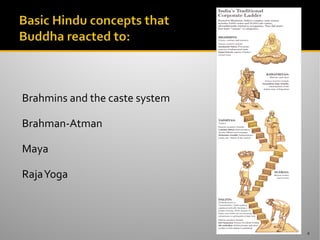
Brahmins and the caste system
Brahman-Atman
Maya
RajaYoga
4
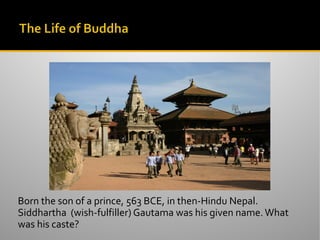
Born the son of a prince, 563 BCE, in then-Hindu Nepal.
Siddhartha (wish-fulfiller) Gautama was his given name.What
was his caste?
Birth scene of Buddha.
As you watch, think about whether his birth story follows
stage one of the monomyth!
 Little Buddha - Birth of Buddha http://www.youtube.com/watch?v=NdF46kQupKQ
6
Little Buddha
The Life of
Buddha
An old man
A sick man
A corpse
A Sannyasin
The Four Passing Sights:
Siddhartha, at 29, renounced wealth and position, left his wife &
baby, shaved his head & put on a coarse robe.
8
Renunciation….
The Life of
Buddha
The Great Going Forth:
Siddhartha leaves the
palace.
He begins extreme
ascetic practices,
but shifts to the middle
way.
What is the
significance of ‘the
middle way?’
10
Life of Buddha
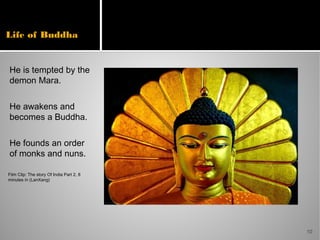
He is tempted by the
demon Mara.
He awakens and
becomes a Buddha.
He founds an order
of monks and nuns.
Film Clip: The story Of India Part 2, 8
minutes in (LanXang)
11
1. To live is to
experience
dukkha.
Dukkha means
a wheel whose
axle is off-center.
Life is askew.
The Four
Noble Truths
12
The Four
Noble Truths
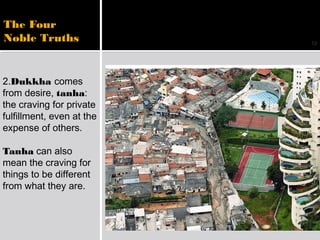
2.Dukkha comes
from desire, tanha:
the craving for private
fulfillment, even at the
expense of others.
Tanha can also
mean the craving for
things to be different
from what they are.
13
3. Craving which
leads to suffering
can
be stopped…
4. Release from
suffering, nirvana,
is possible and
may be attained by
following the Noble
Eightfold Path.
The Four
Noble Truths
The Noble Eightfold Path
 1.Right understanding
 2. Right intention
 3. Right speech
 4. Right action
 5. Right work
 6. Right effort
 7. Right mindfulness
 8. Right contemplation
-Understanding the 4 NobleTruths
-Truly wanting enlightenment.
-Cultivate truth and charity in speaking,
eliminate gossip, chatter,etc.
-Do not kill, steal, lie, be unchaste, drink
or take drugs: do not hurt others.
-Work at jobs that promote life.
-Steady, forward progress on the path.
-“All we are is the result of what we
have thought.” Awareness of actions
thoughts, words.
-Meditation leading to samadhi
(inner peace) and nirvana.
Handout 1
15
Enlightenment
What is enlightenment?
1. Detachment from sense objects and
calming the passions;
2. Non-reasoning and "simple"
concentration”
3. Dispassionate mindfulness and
consciousness, and
4. Pure awareness and peace without
pain, elation, or depression in the here
and now.
TheThree Jewels: the Buddha, the Dharma, the Sangha.
An anti-authority religion; Buddha wanted to break the priests
monopoly: “Do not accept what you hear by report. Be lamps unto
yourselves.”
A religion devoid of ritual: Buddha said Brahmanic rituals were just
superstition, irrelevant to the tough job of ego-reduction.
Non-theistic: The point of life is to work hard to stop suffering, not to
speculate about God.
Anti-tradition: “Do not go by what is handed down…When you
know, ‘These teachings are good or not good,’ only then accept or
reject them.”
Intense self-effort: “There is a path to the end of suffering.Tread
it!”
Rejected the supernatural: “By this you shall know a man is not
my disciple- that he tries to work a miracle.”
17
Buddhism as a Reaction to Hinduism:
Hinduism
Caste-bound
(Which caste on top?)
Authoritative?
Ritualistic?
Theistic (which kind?)
Traditional?
Self effort?
Supernatural?
Buddhism
Buddhism takes a realistic, rational view of existence.
It underscores he impermanence of all things: change.
Anatman: No permanent identity: No permanent
soul or self.
Samsara: Life as never fully satisfying because even pleasure is
fleeting.
Nirvana: enlightenment, freedom from the ego in this life and
rebirth are possible through effort.
How is nirvana different from moksha?
Moksha is union with Brahman, the Atman becomes one with Brahman, the wheel of life after
life (samsara) completely stops…
Buddhism maintains that if we still have delusion, greed, and aversion, and passions are not
extinguished, we generate karma. (‘We’ are the 5 aggregates: body, feeling, understanding,
will & consciousness).
Because we accumulate karma (good and bad), there is a next lifetime in which the karma will
take form.
Nirvana is the state in in which one has attained disinterested wisdom and compassion, but
isn’t the goal at the end of lives; it can happen here and now.
20
Buddhist, Hindu, or Both?
Handout 2: Venn Diagram
22
Theravada
Buddhism
‘The Way of the Elders’
Conservative, philosophical:
emphasizes simplicity,
meditation, detachment.
A monk’s life offers a path to
nirvana.
Meditation and Detachment:
qualities all Buddhists must
cultivate, but Theravada
empasizes it.
23
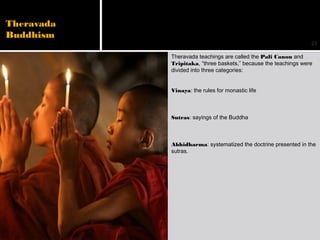
Theravada
Buddhism
Theravada teachings are called the Pali Canon and
Tripitaka, “three baskets,” because the teachings were
divided into three categories:
Vinaya: the rules for monastic life
Sutras: sayings of the Buddha
Abhidharma: systematized the doctrine presented in the
sutras.
Theravada Buddhism in Thailand
The Ten Fetters in Theravada Buddhism
1. Belief in our individuality
2. Doubt about being able to become a Buddha
3. Believing that sacrifice and ritual will save
4. Impure desire
5. Anger
6. Desire for rebirth in a world of form
7. Desire for rebirth in a world without form
8. Arrogance
9. Spiritual pride
10. Ignorance
If these are broken, arahatship and Nirvana are
attained.
“Apart from consciousness, no diverse truths exist. –
Mere sophistry declares this ‘true,’ and that view
‘false.’” from the Sutta-Nipata
26
Buddhism II
Module 6
Homework Questions from the Dhammapada
1.In chapter 3 what does Buddha suggest we do with our minds? What does he compare the mind
to, or what is the nature of the mind, according to Buddha?
2. In Chapter 6, Buddha suggests that we surround ourselves with what kind of people? Why? The
last line, “wise people fashion themselves,’ means what? How is this idea related to having
virtuous people as friends? Do you agree with these thoughts or not?
Homework Questions from the Diamond Sutra
1. What is ordinary perception (or the ordinary way of thinking) about ourselves like according to
Buddha? What is the higher knowledge that a bodhisattva has like? Discuss, in writing, what a
boddhisattva's behavior might be like in some concrete situations like shopping, an emergency,
or an argument. Do you think it is possible to be a bodhisattva or do you think there are
bodhisattvas on earth now?
27
Hinduism speaks with the language of eternality. What does Krishna tell Arjuna about
death? What does Lord Yama tell Nachiketas?
In the philosophical forms of Hinduism (Jnana and Raja Yoga), humans seek a
‘unified vision’ of Brahman, God, through meditation and reflection: at base we are
all Brahman, all one.
Can we ever be separate from Brahman? We might feel that, but it is because we
haven’t worked on our perception. When we become dazzled by the creation and
not working on ‘being one with the creator’ we are trapped in maya.
For humans, the senses can be a trap or be used to reach God.
The karma we generate in our life ‘sticks’ to our atman or soul and is reborn along
with our new body.
We come back again and again until we do the hard work to realize we are at one
with Brahman, or in other words become enlightened..
28
In the original, Theravadan, philosophical form Buddha maintains that there is no eternal soul, no God
within in us; that it is all a mental construction.
Liberation comes from understanding and experiencing that every single thing is impermanent and
changing. There is nothing to hold onto, nothing eternal. All we have is this moment.
If we want to not suffer we must work on liberating ourselves here and now.
Once we truly understand impermanence, we can be detached from the intense ups and downs of life,
and stop craving for things to be other than what they are, stop suffering. Some people might call
this state radical acceptance. The Buddhist term is nirvana—the sense of a separate self or ego is
absolutely gone.
Through the laws of karma our intentions, good and bad, are imprinted on our mind, and these mental
states persist through rebirths– the skandas can be called ‘streams of consciousness’.
29
Though science now confirms that nuerochemical processes produce subjective experiences, and that
people do have brain waves, there is no scientific ‘proof’ that skandas, leftover energy from the dead
person’s consciousness, exist.
In physics, there is a conservation law of energy which says that in any physical process the total energy
before must equal the total energy when the process is concluded– the universe keeps a set of
books that must balance for every energy interaction.
What is ‘void’ or emptiness or sunyatta?
Emptiness is the insight that there is nothing in the universe which exists as an independent entity in it’s
own right, even us. It also refers to a meditative state.
Quantum physics says the results of any observation seems to be determined in part by choices made
by the observer and are linked to what is observed.
All particles show ‘subtle impermanence’ protons and neutrons in the nucleus are constantly exchanging
mesons to hold themselves together, in the outer layers of atoms, electrons are never at a single
location…
30
31
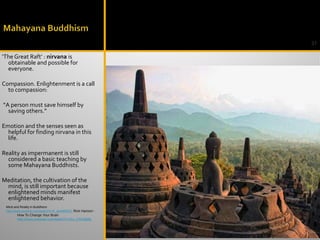
‘The Great Raft’ : nirvana is
obtainable and possible for
everyone.
Compassion. Enlightenment is a call
to compassion:
“A person must save himself by
saving others.”
Emotion and the senses seen as
helpful for finding nirvana in this
life.
Reality as impermanent is still
considered a basic teaching by
some Mahayana Buddhists.
Meditation, the cultivation of the
mind, is still important because
enlightened minds manifest
enlightened behavior.
Mind and Reality in Buddhism
http://www.youtube.com/watch?v=F_ylwNB6R2c Rick Hanson -
How To Change Your Brain
http://www.youtube.com/watch?v=tAv_CWz969g
32
34
Mahayana
Buddhism
Karuna: compassion,
empathy, kindness.
‘May all creatures be well
and happy.'
The bodhisattva:
embodies compassion.
A bodhisattva will refuse to
fully enter nirvana in order
to be reborn on earth to
help others.
Thich Nhat Hanh on Compassionate Listening
http://www.youtube.com/watch?v=lyUxYflkhzo
Thich Nhat Hanh ‘s Four Mantras
http://www.youtube.com/watch?v=UEUxFNkISnU
35
36
Mahayana
Buddhism
36
Triyaka: The three-body
doctrine of Buddha-nature:
1. Cosmic Buddha-nature
permeates all things
2. It is our true nature that we
need to recognize, and
3. All nature is a manifestation
of Dharmakaya, or the sacred
Buddha-nature.
Metta Meditation
Sit comfortably, placing your awareness around your heart. Breathe deeply 4 or 5 times and think of how it feels to experience
unconditional love. Say to yourself:
May I be happy
May I be well
May I be at peace
Think of someone you love. Someone very close to you. Then say ...
May he/she be happy
May he/she be well
May he/she be at peace
Next picture someone you feel neutral about, and say
May he/she be happy
May he/she be well
May he she be at peace
Now picture someone you dislike and say,
May he/she be happy
May he/she be well
May he/she be at peace
Then allow this feeling to radiate out further to anyone in the room with you....
May they be happy
May they be well
May they be at peace
To everyone in your building, city, county or state...
May they be happy
May they be well
May they be at peace
... and finally to everyone and everything in the world
May they be happy
May they be well
May they be at peace
Now just sit and be still for a few minutes. Rest in any feelings of loving-kindness that you feel.
Handout 1: Essay Assignment
You have two possible essay assignment questions. Find 2 other students who chose the same
question. In groups of three discuss and take notes about your ideas.
For example, if you chose #1, tell your group the specific world event you chose, how you see tanha
as having caused this problem, and which steps you will use from the eightfold Path to reduce this
tanha. Ask your group if they have any other ideas you could use.
1. Buddha taught that suffering exists because of tanha, the kind of selfishness that puts 'me' first, at the expense of others, if
necessary. How does tanha apply to contemporary life or world events? Choose one specific world event, ex: ‘The Invasion
of Iraq’ or one contemporary, very focused problem, ex: ‘Homelessness in SF.’ Show how tanha has caused these
problems. Then discuss how one or two of the steps of the eightfold path would be especially useful to reduce the tanha
you discuss in your essay.
 If you chose #2, discuss the philosophical meanings of Atman & Anatman from the 2 religions’
viewpoints and their respective ‘motivational’ perspectives in terms of enlightenment. Ask your
group if they have any other ideas you could use
2. Discuss (compare and contrast) the concepts of Atman (from Hinduism) and Anatman (from Buddhism) using
philosophical and sociological perspectives, i.e. how did the concepts develop philosophically, how does the
concept of Anatman attempt to motivate people to find their own liberation now, while (some say) the concept
of Atman allows people to be ‘lazy’ about seeking enlightenment because it posits that Atman-Brahman are
eternal? Comment on the two concepts from your own philosophical and sociological points of view. (The
personal section should be 2 paragraphs or less!)
Using your notes from the discussion, add details to your paper!
38
39
Mahayana
Buddhism
Major schools:
Shingon
Tendai
Jodo Shin Shu, or
True Pure Land
Nichiren
Zen
Shingon & Tendai Buddhism
Shingon
‘True word’-uses sacred
chants, called mantras.
The Chinese thought magical
effects came from Buddhist
ritual, like security for
rulers, children, & good
weather for crops.
Tendai or ‘Pure land’
Devotional, could be done by
monks or lay people.
Complete devotion to Buddha,
results in the believer’s rebirth in
Amitabha’s Pure Land, the
Western Paradise.
From India it went north, became
popular in Kashmir and Central
Asia
The Pure Land Sutras were brought
from Gandhara region 147 CE
Kushan monk Lokak emaṣ
translated into Chinese
The Pure Land School founded in
China at DonglinTemple
Not centered on nirvana (impossible) but on faith to
Amitabha’s saving power which leads to being born in
the Pure Land (paradise).
Meditation practice is chanting Amitabha’s name: "Namu
Amida Butsu”
Amitabha was a king, then a monk, then reincarnated
many times as a bodhisattva, then finally became a
Buddha.
Once you are born into The Pure Land- never reborn
again: karma diasppears
Other Buddhists critique Pure Land because they think
it is psuedo-Buddhism not The Middle Way of
eliminating ignorance and self-attatchment
“The Easy Path” faith + recitation = enlightenment
Jodo Shinshu & Nichiren
Pure True Land
Shinran taught that human
actions to attain salvation were
unimportant in comparison to
the saving power of the Buddha.
Nichiren
In Japan, Nichiren said the
Lotus Sutra was the essential
religious teaching.
Nichiren uses a chant that
honors this sutra: Namu Myoho
Renge Kyo, meaning “Praise to
the mystic law of the Lotus
Sutra.”
Zen Buddhism
Chan or Zen means ‘meditation.’
Bodhidharma wanted a simple, closer
to the Buddha’s practice, and
focused on meditation.
Enlightement, satori: an awareness of
the unity of oneself with the
universe.
Made popular in the US in the ’50s by
Beat poets & jazz musicians.
What is the sound of one hand
clapping? Koans- direct insight.
How Zen Came to ChinaBodhidharma came from India to Luoyang, China
(Longmen Grottos)
“The Flower Sermon” – Buddha & disciple Ananda
“The subtle Dharma gate does not rest on words or
letters but is a special transmission outside of the
scriptures.”
-Concentrated on direct experiences
-Taught outside of scripture what words could not
explain
First Draft Critique
Handout 2: Critique of Analysis Essay #1
Directions: Please exchange your first draft with another student, read their essay and
answer the following questions. Please do a good job of giving her/him specific feedback!!
Does the writer completely answer one of the following topic questions? If not, write what
s/he missed. Here are the two questions:
Buddha taught that suffering exists because of tanha, the kind of selfishness that puts 'me'
first, at the expense of others, if necessary. How does tanha apply to contemporary life or
world events? Choose a specific world event or one contemporary, very focused problem.
Discuss how tanha has caused this problem, then discuss how one or two of the steps of
the eightfold path would be especially useful to reduce the tanha in the essay.
 
Discuss (compare and contrast) the concepts of Atman (from Hinduism) and Anatman (from
Buddhism) using philosophical and sociological perspectives, i.e. how did the concepts
develop philosophically, how does the concept of Atman reinforce the caste system & how
does the concept of Anatman attempt to reject caste? Comment on the two concepts from
your own philosophical and sociological points of view. (The personal section should be 2
paragraphs or less!)
46
47
Vajrayana
Buddhism
The Diamond/
Thunderboldt Vehicle
The Tantras: the body can
be used for enlightenment.
Uses the imagery and
(rarely) the practice of
sexual union to help attain
enlightenment.
Tibetan, or Vajrayana
Buddhism, contains many
elements of Bon: the
shamanic, animistic, pre-
Buddhist religion in Tibet.
Vajrayana Buddhism’s Ritual Objects
Vajras:
Mantras:
Om mani padme hum!
Hail to the jewel in the heart of
the lotus!
Prayer wheels:
49
Mandalas
On Life and Enlightenment
://www.youtube.com/watch?v=vfLaxxY6TB8
50
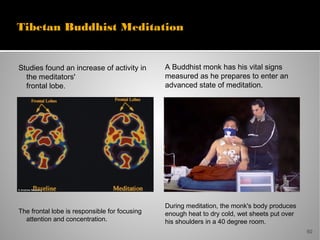
A Buddhist monk has his vital signs
measured as he prepares to enter an
advanced state of meditation.
During meditation, the monk's body produces
enough heat to dry cold, wet sheets put over
his shoulders in a 40 degree room.
Tibetan Buddhist Meditation
Studies found an increase of activity in
the meditators'
frontal lobe.
The frontal lobe is responsible for focusing
attention and concentration.
51
The Dalai Lama
A reincarnation of the
Bodhisattva of Compassion,
Avalokiteshvara.
Until the Chinese invasion of
1959, the Dalai Lama was
the spiritual and temporal
leader of Tibet.
The United Nations
concluded that the
Communist Chinese
committed genocide in
Tibet.
52
The Dalai Lama
The Dalai Lama (and many
Tibetans) were given
refugee status by India.
He lives in India, & travels
the world performing
initiations and giving talks.
With Aung Sun Suu Kyi of
Myanmar (Burma), also a
Nobel Peace Prize winner.
She spent 15 years under
house arrest for being pro-
democracy.
Aung Sun Suu Kyi: The
Choicep://www.youtube.com/watch?v=1_IjNKT_T5o
Dalai Lama Finding Purpose in life
http://www.youtube.com/watch?v=JXdhHn8L65o
53
54
EssentialTeachings of Buddhism
Impermanence
Direct Perception
Anatman
Interdependent Origination
Karma
Reincarnation
Nirvana
MiddleWay
What Is Ultimate Reality?
For most Buddhist sects, ultimate reality is the luminous and
expansive nature of consciousness itself.
Ultimate reality is primarily apprehended by understanding
the nature of the mind, which mediates our experience of
existence. To many Buddhists material reality is simply a
product and projection of the mind.
Many Mahayana and Vajrayana Buddhists would assert that
being born into this world, with all its suffering and strife,
places us in the ideal situation to achieve enlightenment. It is
the very fragility of life that evokes the compassion and
empathy essential to achieving enlightenment.
How Should We Live in This
World?Buddhism’s five precepts are ethical guidelines that seek to minimize
the suffering one inflicts on others as well as oneself. The first three are
concerned with ethical prescriptions that limit the harm we cause
others: not killing, not stealing, and not committing inappropriate sexual
acts. The last two seek to limit the suffering that one inflicts on oneself:
not lying and not imbibing intoxicants.
The other fundamental guide to life is Buddhism’s Eightfold Path. By
advocating neither extreme asceticism nor worldly hedonism, the Noble
Eightfold path charts a middle way. It suggests an integrated way of
living that embraces a balanced cultivation of both the outer and inner
life and is meant to optimize fully the expansion of consciousness and
evolutionary development.
58
59

Buddhism lecture

  • 1.
  • 3.
    1.Compared to Hinduismand the appeal to gods, goddesses, and/or God for help in this life, what did Buddha say people need to do? 2. By emphasizing the individual’s responsibility for their own enlightenment, which caste of Hindus were most threatened by Buddha and why were they threatened? 3.According to Buddhism what is called a soul is actually something else--a combination of five mental or physical aggregates: the physical body, feelings, understanding, will, and consciousness. Buddha thought that since all of these qualities are constantly changing, it’s obvious they aren’t permanent. How is this concept of Buddha’s ‘anatman’ (no atman) different from Hinduism’s concept of Atman? 4.What are some of the basic differences betweenTheravada and Mahayana Buddhism using these categories: Theravada Mahayana Conservatism (closest to the doctrines of the original Buddha) Who Buddha was Monks vs. lay people How a person reaches the goals of religion 3
  • 4.
    Brahmins and thecaste system Brahman-Atman Maya RajaYoga 4
  • 5.
    Born the sonof a prince, 563 BCE, in then-Hindu Nepal. Siddhartha (wish-fulfiller) Gautama was his given name.What was his caste?
  • 6.
    Birth scene ofBuddha. As you watch, think about whether his birth story follows stage one of the monomyth!  Little Buddha - Birth of Buddha http://www.youtube.com/watch?v=NdF46kQupKQ 6 Little Buddha
  • 7.
    The Life of Buddha Anold man A sick man A corpse A Sannyasin The Four Passing Sights:
  • 8.
    Siddhartha, at 29,renounced wealth and position, left his wife & baby, shaved his head & put on a coarse robe. 8 Renunciation….
  • 9.
    The Life of Buddha TheGreat Going Forth: Siddhartha leaves the palace. He begins extreme ascetic practices, but shifts to the middle way. What is the significance of ‘the middle way?’
  • 10.
    10 Life of Buddha Heis tempted by the demon Mara. He awakens and becomes a Buddha. He founds an order of monks and nuns. Film Clip: The story Of India Part 2, 8 minutes in (LanXang)
  • 11.
    11 1. To liveis to experience dukkha. Dukkha means a wheel whose axle is off-center. Life is askew. The Four Noble Truths
  • 12.
    12 The Four Noble Truths 2.Dukkhacomes from desire, tanha: the craving for private fulfillment, even at the expense of others. Tanha can also mean the craving for things to be different from what they are.
  • 13.
    13 3. Craving which leadsto suffering can be stopped… 4. Release from suffering, nirvana, is possible and may be attained by following the Noble Eightfold Path. The Four Noble Truths
  • 14.
    The Noble EightfoldPath  1.Right understanding  2. Right intention  3. Right speech  4. Right action  5. Right work  6. Right effort  7. Right mindfulness  8. Right contemplation -Understanding the 4 NobleTruths -Truly wanting enlightenment. -Cultivate truth and charity in speaking, eliminate gossip, chatter,etc. -Do not kill, steal, lie, be unchaste, drink or take drugs: do not hurt others. -Work at jobs that promote life. -Steady, forward progress on the path. -“All we are is the result of what we have thought.” Awareness of actions thoughts, words. -Meditation leading to samadhi (inner peace) and nirvana. Handout 1
  • 15.
    15 Enlightenment What is enlightenment? 1.Detachment from sense objects and calming the passions; 2. Non-reasoning and "simple" concentration” 3. Dispassionate mindfulness and consciousness, and 4. Pure awareness and peace without pain, elation, or depression in the here and now.
  • 16.
    TheThree Jewels: theBuddha, the Dharma, the Sangha. An anti-authority religion; Buddha wanted to break the priests monopoly: “Do not accept what you hear by report. Be lamps unto yourselves.” A religion devoid of ritual: Buddha said Brahmanic rituals were just superstition, irrelevant to the tough job of ego-reduction. Non-theistic: The point of life is to work hard to stop suffering, not to speculate about God.
  • 17.
    Anti-tradition: “Do notgo by what is handed down…When you know, ‘These teachings are good or not good,’ only then accept or reject them.” Intense self-effort: “There is a path to the end of suffering.Tread it!” Rejected the supernatural: “By this you shall know a man is not my disciple- that he tries to work a miracle.” 17
  • 18.
    Buddhism as aReaction to Hinduism: Hinduism Caste-bound (Which caste on top?) Authoritative? Ritualistic? Theistic (which kind?) Traditional? Self effort? Supernatural? Buddhism
  • 19.
    Buddhism takes arealistic, rational view of existence. It underscores he impermanence of all things: change. Anatman: No permanent identity: No permanent soul or self. Samsara: Life as never fully satisfying because even pleasure is fleeting. Nirvana: enlightenment, freedom from the ego in this life and rebirth are possible through effort.
  • 20.
    How is nirvanadifferent from moksha? Moksha is union with Brahman, the Atman becomes one with Brahman, the wheel of life after life (samsara) completely stops… Buddhism maintains that if we still have delusion, greed, and aversion, and passions are not extinguished, we generate karma. (‘We’ are the 5 aggregates: body, feeling, understanding, will & consciousness). Because we accumulate karma (good and bad), there is a next lifetime in which the karma will take form. Nirvana is the state in in which one has attained disinterested wisdom and compassion, but isn’t the goal at the end of lives; it can happen here and now. 20
  • 21.
    Buddhist, Hindu, orBoth? Handout 2: Venn Diagram
  • 22.
    22 Theravada Buddhism ‘The Way ofthe Elders’ Conservative, philosophical: emphasizes simplicity, meditation, detachment. A monk’s life offers a path to nirvana. Meditation and Detachment: qualities all Buddhists must cultivate, but Theravada empasizes it.
  • 23.
    23 Theravada Buddhism Theravada teachings arecalled the Pali Canon and Tripitaka, “three baskets,” because the teachings were divided into three categories: Vinaya: the rules for monastic life Sutras: sayings of the Buddha Abhidharma: systematized the doctrine presented in the sutras.
  • 24.
  • 25.
    The Ten Fettersin Theravada Buddhism 1. Belief in our individuality 2. Doubt about being able to become a Buddha 3. Believing that sacrifice and ritual will save 4. Impure desire 5. Anger 6. Desire for rebirth in a world of form 7. Desire for rebirth in a world without form 8. Arrogance 9. Spiritual pride 10. Ignorance If these are broken, arahatship and Nirvana are attained. “Apart from consciousness, no diverse truths exist. – Mere sophistry declares this ‘true,’ and that view ‘false.’” from the Sutta-Nipata
  • 26.
  • 27.
    Homework Questions fromthe Dhammapada 1.In chapter 3 what does Buddha suggest we do with our minds? What does he compare the mind to, or what is the nature of the mind, according to Buddha? 2. In Chapter 6, Buddha suggests that we surround ourselves with what kind of people? Why? The last line, “wise people fashion themselves,’ means what? How is this idea related to having virtuous people as friends? Do you agree with these thoughts or not? Homework Questions from the Diamond Sutra 1. What is ordinary perception (or the ordinary way of thinking) about ourselves like according to Buddha? What is the higher knowledge that a bodhisattva has like? Discuss, in writing, what a boddhisattva's behavior might be like in some concrete situations like shopping, an emergency, or an argument. Do you think it is possible to be a bodhisattva or do you think there are bodhisattvas on earth now? 27
  • 28.
    Hinduism speaks withthe language of eternality. What does Krishna tell Arjuna about death? What does Lord Yama tell Nachiketas? In the philosophical forms of Hinduism (Jnana and Raja Yoga), humans seek a ‘unified vision’ of Brahman, God, through meditation and reflection: at base we are all Brahman, all one. Can we ever be separate from Brahman? We might feel that, but it is because we haven’t worked on our perception. When we become dazzled by the creation and not working on ‘being one with the creator’ we are trapped in maya. For humans, the senses can be a trap or be used to reach God. The karma we generate in our life ‘sticks’ to our atman or soul and is reborn along with our new body. We come back again and again until we do the hard work to realize we are at one with Brahman, or in other words become enlightened.. 28
  • 29.
    In the original,Theravadan, philosophical form Buddha maintains that there is no eternal soul, no God within in us; that it is all a mental construction. Liberation comes from understanding and experiencing that every single thing is impermanent and changing. There is nothing to hold onto, nothing eternal. All we have is this moment. If we want to not suffer we must work on liberating ourselves here and now. Once we truly understand impermanence, we can be detached from the intense ups and downs of life, and stop craving for things to be other than what they are, stop suffering. Some people might call this state radical acceptance. The Buddhist term is nirvana—the sense of a separate self or ego is absolutely gone. Through the laws of karma our intentions, good and bad, are imprinted on our mind, and these mental states persist through rebirths– the skandas can be called ‘streams of consciousness’. 29
  • 30.
    Though science nowconfirms that nuerochemical processes produce subjective experiences, and that people do have brain waves, there is no scientific ‘proof’ that skandas, leftover energy from the dead person’s consciousness, exist. In physics, there is a conservation law of energy which says that in any physical process the total energy before must equal the total energy when the process is concluded– the universe keeps a set of books that must balance for every energy interaction. What is ‘void’ or emptiness or sunyatta? Emptiness is the insight that there is nothing in the universe which exists as an independent entity in it’s own right, even us. It also refers to a meditative state. Quantum physics says the results of any observation seems to be determined in part by choices made by the observer and are linked to what is observed. All particles show ‘subtle impermanence’ protons and neutrons in the nucleus are constantly exchanging mesons to hold themselves together, in the outer layers of atoms, electrons are never at a single location… 30
  • 31.
    31 ‘The Great Raft’: nirvana is obtainable and possible for everyone. Compassion. Enlightenment is a call to compassion: “A person must save himself by saving others.” Emotion and the senses seen as helpful for finding nirvana in this life. Reality as impermanent is still considered a basic teaching by some Mahayana Buddhists. Meditation, the cultivation of the mind, is still important because enlightened minds manifest enlightened behavior. Mind and Reality in Buddhism http://www.youtube.com/watch?v=F_ylwNB6R2c Rick Hanson - How To Change Your Brain http://www.youtube.com/watch?v=tAv_CWz969g
  • 32.
  • 34.
    34 Mahayana Buddhism Karuna: compassion, empathy, kindness. ‘Mayall creatures be well and happy.' The bodhisattva: embodies compassion. A bodhisattva will refuse to fully enter nirvana in order to be reborn on earth to help others. Thich Nhat Hanh on Compassionate Listening http://www.youtube.com/watch?v=lyUxYflkhzo Thich Nhat Hanh ‘s Four Mantras http://www.youtube.com/watch?v=UEUxFNkISnU
  • 35.
  • 36.
    36 Mahayana Buddhism 36 Triyaka: The three-body doctrineof Buddha-nature: 1. Cosmic Buddha-nature permeates all things 2. It is our true nature that we need to recognize, and 3. All nature is a manifestation of Dharmakaya, or the sacred Buddha-nature.
  • 37.
    Metta Meditation Sit comfortably,placing your awareness around your heart. Breathe deeply 4 or 5 times and think of how it feels to experience unconditional love. Say to yourself: May I be happy May I be well May I be at peace Think of someone you love. Someone very close to you. Then say ... May he/she be happy May he/she be well May he/she be at peace Next picture someone you feel neutral about, and say May he/she be happy May he/she be well May he she be at peace Now picture someone you dislike and say, May he/she be happy May he/she be well May he/she be at peace Then allow this feeling to radiate out further to anyone in the room with you.... May they be happy May they be well May they be at peace To everyone in your building, city, county or state... May they be happy May they be well May they be at peace ... and finally to everyone and everything in the world May they be happy May they be well May they be at peace Now just sit and be still for a few minutes. Rest in any feelings of loving-kindness that you feel.
  • 38.
    Handout 1: EssayAssignment You have two possible essay assignment questions. Find 2 other students who chose the same question. In groups of three discuss and take notes about your ideas. For example, if you chose #1, tell your group the specific world event you chose, how you see tanha as having caused this problem, and which steps you will use from the eightfold Path to reduce this tanha. Ask your group if they have any other ideas you could use. 1. Buddha taught that suffering exists because of tanha, the kind of selfishness that puts 'me' first, at the expense of others, if necessary. How does tanha apply to contemporary life or world events? Choose one specific world event, ex: ‘The Invasion of Iraq’ or one contemporary, very focused problem, ex: ‘Homelessness in SF.’ Show how tanha has caused these problems. Then discuss how one or two of the steps of the eightfold path would be especially useful to reduce the tanha you discuss in your essay.  If you chose #2, discuss the philosophical meanings of Atman & Anatman from the 2 religions’ viewpoints and their respective ‘motivational’ perspectives in terms of enlightenment. Ask your group if they have any other ideas you could use 2. Discuss (compare and contrast) the concepts of Atman (from Hinduism) and Anatman (from Buddhism) using philosophical and sociological perspectives, i.e. how did the concepts develop philosophically, how does the concept of Anatman attempt to motivate people to find their own liberation now, while (some say) the concept of Atman allows people to be ‘lazy’ about seeking enlightenment because it posits that Atman-Brahman are eternal? Comment on the two concepts from your own philosophical and sociological points of view. (The personal section should be 2 paragraphs or less!) Using your notes from the discussion, add details to your paper! 38
  • 39.
  • 40.
    Shingon & TendaiBuddhism Shingon ‘True word’-uses sacred chants, called mantras. The Chinese thought magical effects came from Buddhist ritual, like security for rulers, children, & good weather for crops. Tendai or ‘Pure land’ Devotional, could be done by monks or lay people. Complete devotion to Buddha, results in the believer’s rebirth in Amitabha’s Pure Land, the Western Paradise.
  • 41.
    From India itwent north, became popular in Kashmir and Central Asia The Pure Land Sutras were brought from Gandhara region 147 CE Kushan monk Lokak emaṣ translated into Chinese The Pure Land School founded in China at DonglinTemple
  • 42.
    Not centered onnirvana (impossible) but on faith to Amitabha’s saving power which leads to being born in the Pure Land (paradise). Meditation practice is chanting Amitabha’s name: "Namu Amida Butsu” Amitabha was a king, then a monk, then reincarnated many times as a bodhisattva, then finally became a Buddha. Once you are born into The Pure Land- never reborn again: karma diasppears Other Buddhists critique Pure Land because they think it is psuedo-Buddhism not The Middle Way of eliminating ignorance and self-attatchment “The Easy Path” faith + recitation = enlightenment
  • 43.
    Jodo Shinshu &Nichiren Pure True Land Shinran taught that human actions to attain salvation were unimportant in comparison to the saving power of the Buddha. Nichiren In Japan, Nichiren said the Lotus Sutra was the essential religious teaching. Nichiren uses a chant that honors this sutra: Namu Myoho Renge Kyo, meaning “Praise to the mystic law of the Lotus Sutra.”
  • 44.
    Zen Buddhism Chan orZen means ‘meditation.’ Bodhidharma wanted a simple, closer to the Buddha’s practice, and focused on meditation. Enlightement, satori: an awareness of the unity of oneself with the universe. Made popular in the US in the ’50s by Beat poets & jazz musicians. What is the sound of one hand clapping? Koans- direct insight.
  • 45.
    How Zen Cameto ChinaBodhidharma came from India to Luoyang, China (Longmen Grottos) “The Flower Sermon” – Buddha & disciple Ananda “The subtle Dharma gate does not rest on words or letters but is a special transmission outside of the scriptures.” -Concentrated on direct experiences -Taught outside of scripture what words could not explain
  • 46.
    First Draft Critique Handout2: Critique of Analysis Essay #1 Directions: Please exchange your first draft with another student, read their essay and answer the following questions. Please do a good job of giving her/him specific feedback!! Does the writer completely answer one of the following topic questions? If not, write what s/he missed. Here are the two questions: Buddha taught that suffering exists because of tanha, the kind of selfishness that puts 'me' first, at the expense of others, if necessary. How does tanha apply to contemporary life or world events? Choose a specific world event or one contemporary, very focused problem. Discuss how tanha has caused this problem, then discuss how one or two of the steps of the eightfold path would be especially useful to reduce the tanha in the essay.   Discuss (compare and contrast) the concepts of Atman (from Hinduism) and Anatman (from Buddhism) using philosophical and sociological perspectives, i.e. how did the concepts develop philosophically, how does the concept of Atman reinforce the caste system & how does the concept of Anatman attempt to reject caste? Comment on the two concepts from your own philosophical and sociological points of view. (The personal section should be 2 paragraphs or less!) 46
  • 47.
    47 Vajrayana Buddhism The Diamond/ Thunderboldt Vehicle TheTantras: the body can be used for enlightenment. Uses the imagery and (rarely) the practice of sexual union to help attain enlightenment. Tibetan, or Vajrayana Buddhism, contains many elements of Bon: the shamanic, animistic, pre- Buddhist religion in Tibet.
  • 48.
    Vajrayana Buddhism’s RitualObjects Vajras: Mantras: Om mani padme hum! Hail to the jewel in the heart of the lotus! Prayer wheels:
  • 49.
    49 Mandalas On Life andEnlightenment ://www.youtube.com/watch?v=vfLaxxY6TB8
  • 50.
    50 A Buddhist monkhas his vital signs measured as he prepares to enter an advanced state of meditation. During meditation, the monk's body produces enough heat to dry cold, wet sheets put over his shoulders in a 40 degree room. Tibetan Buddhist Meditation Studies found an increase of activity in the meditators' frontal lobe. The frontal lobe is responsible for focusing attention and concentration.
  • 51.
    51 The Dalai Lama Areincarnation of the Bodhisattva of Compassion, Avalokiteshvara. Until the Chinese invasion of 1959, the Dalai Lama was the spiritual and temporal leader of Tibet. The United Nations concluded that the Communist Chinese committed genocide in Tibet.
  • 52.
    52 The Dalai Lama TheDalai Lama (and many Tibetans) were given refugee status by India. He lives in India, & travels the world performing initiations and giving talks. With Aung Sun Suu Kyi of Myanmar (Burma), also a Nobel Peace Prize winner. She spent 15 years under house arrest for being pro- democracy. Aung Sun Suu Kyi: The Choicep://www.youtube.com/watch?v=1_IjNKT_T5o Dalai Lama Finding Purpose in life http://www.youtube.com/watch?v=JXdhHn8L65o
  • 53.
  • 54.
  • 55.
    EssentialTeachings of Buddhism Impermanence DirectPerception Anatman Interdependent Origination Karma Reincarnation Nirvana MiddleWay
  • 56.
    What Is UltimateReality? For most Buddhist sects, ultimate reality is the luminous and expansive nature of consciousness itself. Ultimate reality is primarily apprehended by understanding the nature of the mind, which mediates our experience of existence. To many Buddhists material reality is simply a product and projection of the mind. Many Mahayana and Vajrayana Buddhists would assert that being born into this world, with all its suffering and strife, places us in the ideal situation to achieve enlightenment. It is the very fragility of life that evokes the compassion and empathy essential to achieving enlightenment.
  • 57.
    How Should WeLive in This World?Buddhism’s five precepts are ethical guidelines that seek to minimize the suffering one inflicts on others as well as oneself. The first three are concerned with ethical prescriptions that limit the harm we cause others: not killing, not stealing, and not committing inappropriate sexual acts. The last two seek to limit the suffering that one inflicts on oneself: not lying and not imbibing intoxicants. The other fundamental guide to life is Buddhism’s Eightfold Path. By advocating neither extreme asceticism nor worldly hedonism, the Noble Eightfold path charts a middle way. It suggests an integrated way of living that embraces a balanced cultivation of both the outer and inner life and is meant to optimize fully the expansion of consciousness and evolutionary development.
  • 58.
  • 59.

Editor's Notes

  • #8 The four
  • #31 translated into English as emptiness, voidness, openness, spaciousness, is a Buddhist concept which has multiple meanings depending on its doctrinal context. In Mahayana Buddhism, it often refers to the absence of inherent essence in all phenomena. In Theravada Buddhism, suññatā often refers to the not-self : anātma)[note 1] nature of the five aggregates of experience and the six sense spheres. Suññatā is also often used to refer to a meditative state or experience.
  • #49 vajra is associated with diamond-hardness, power, and insight. It is held in the right hand and suggests kind action. A bell is held in the left hand and symbolizes wisdom. When used together, one in each hand, they represent the union of wisdom and compassion. The vajra and bell are essential to Tibetan Vajrayana ritual in a way that other religious objects (mentioned in the following paragraphs) are not.