

Department of kayachikitsa
Welcomes u all !!!
THE VIKARA VIGHATA-BHAVA-ABHAVA-
PRATIVISHESHA IN PRAMEHA
Presenter: Guide:
Dr. Meenakshi verma Dr. N.J Trivedi
2nd year PG Scholar
DEPARTMENT OF KAYACHIKITSA
AIM
• To understand the concept of “Vikara
Vighata Bhava Abhava Prativishesha”.
• To understand the influence of Vikara
Vighata Bhava Abhava Prativishesha in
Vyadhi Samprapti.
OBJECTIVES
• To see the inter relation between the
Visheshas and Prativisheshas.
• To critically analyse the mechanism
influencing the Vishesha and Prativishesha.
• To illustrate this concept with certain
hypothetical clinical conditions.
OBJECTIVES
• To define the concept “Vikara Vighata Bhava
Abhava Prativishesha”.
• To define the terms –Vighata Bhava, Vighata
Bhava Abhava, Vishesha, Prativishesha.
• To enlist Visheshas
• To enlist Prativishesha
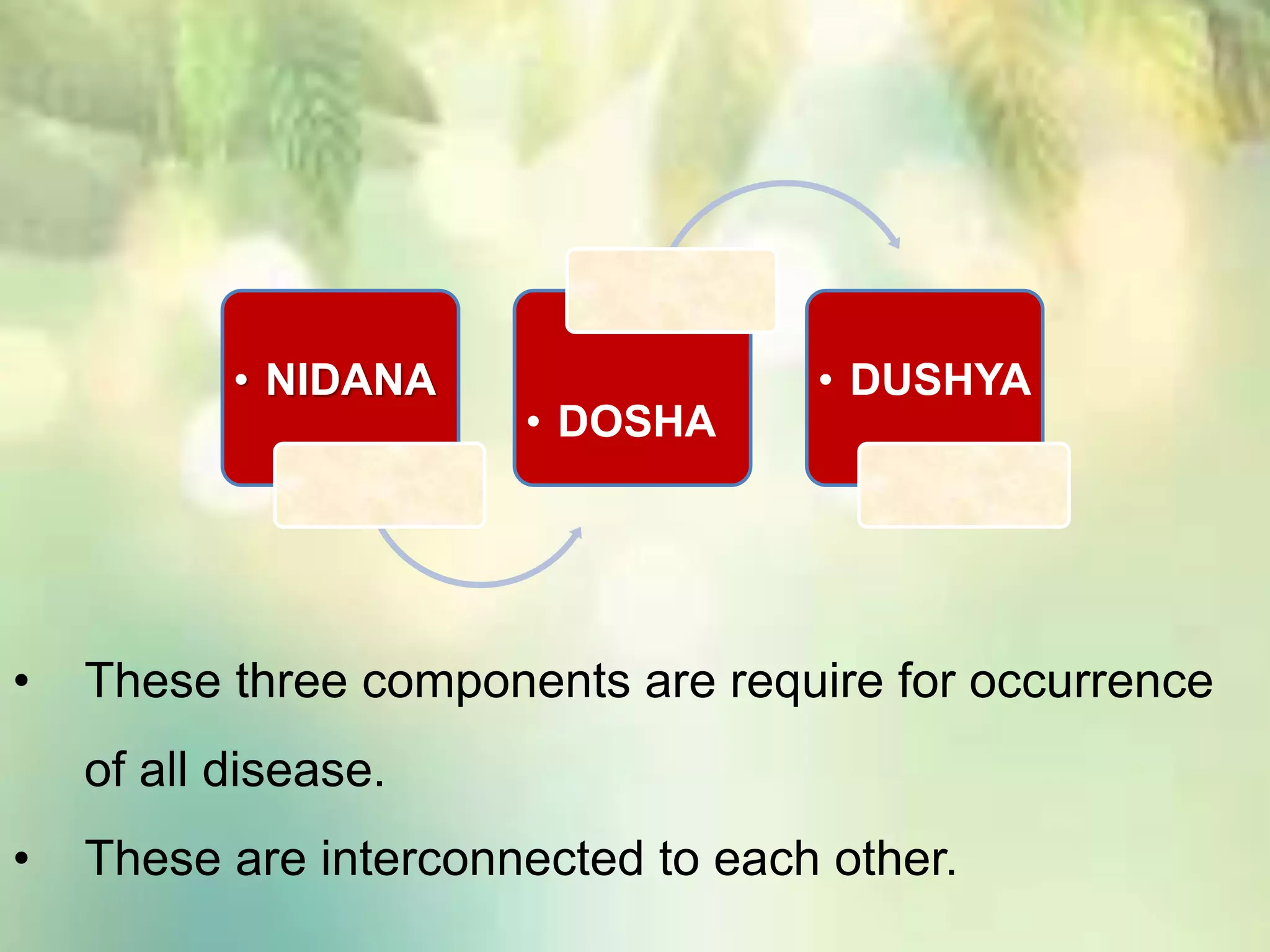
• NIDANA
• DOSHA
• DUSHYA
• These three components are require for occurrence
of all disease.
• These are interconnected to each other.
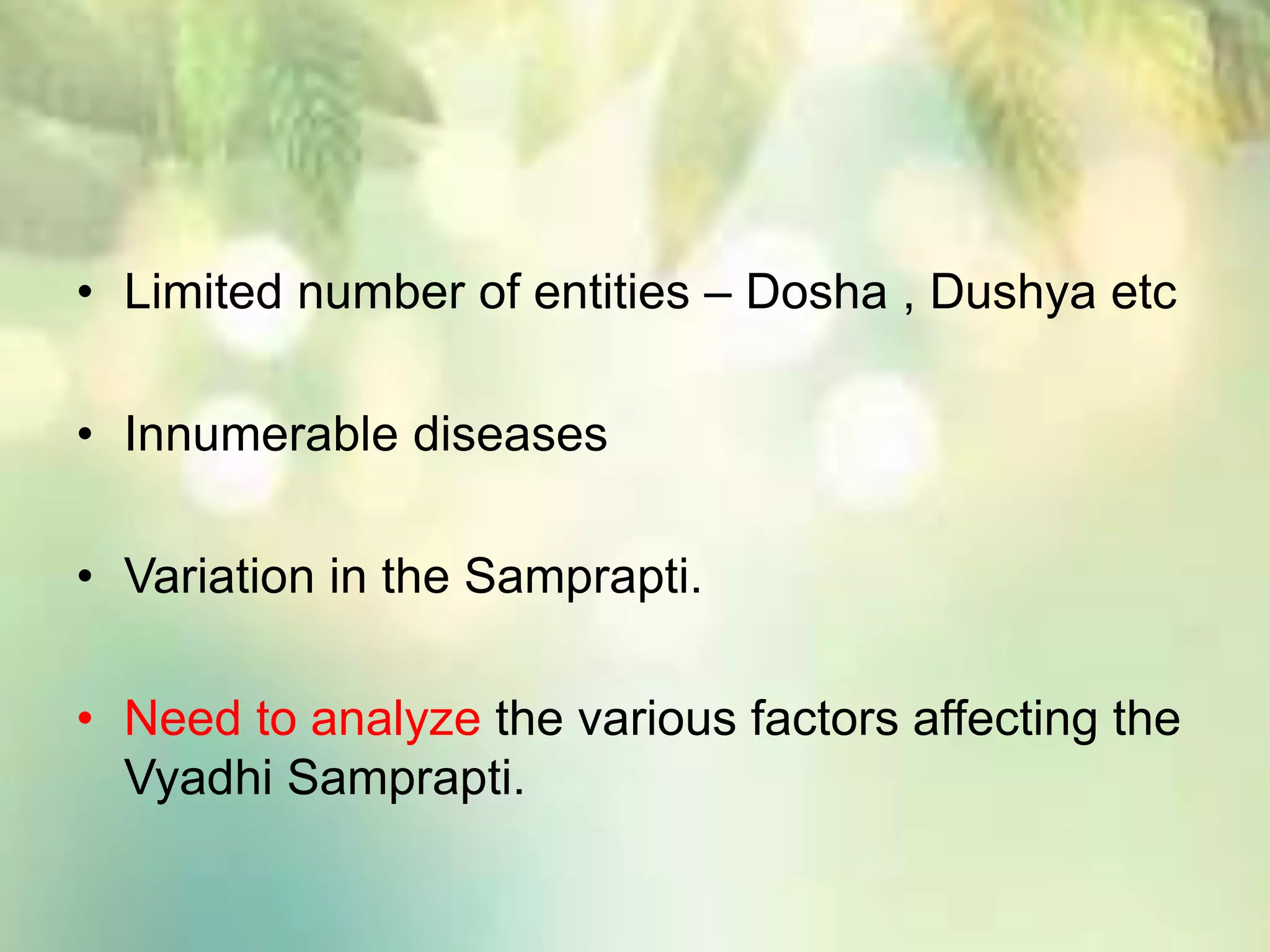
• Limited number of entities – Dosha , Dushya etc
• Innumerable diseases
• Variation in the Samprapti.
• Need to analyze the various factors affecting the
Vyadhi Samprapti.
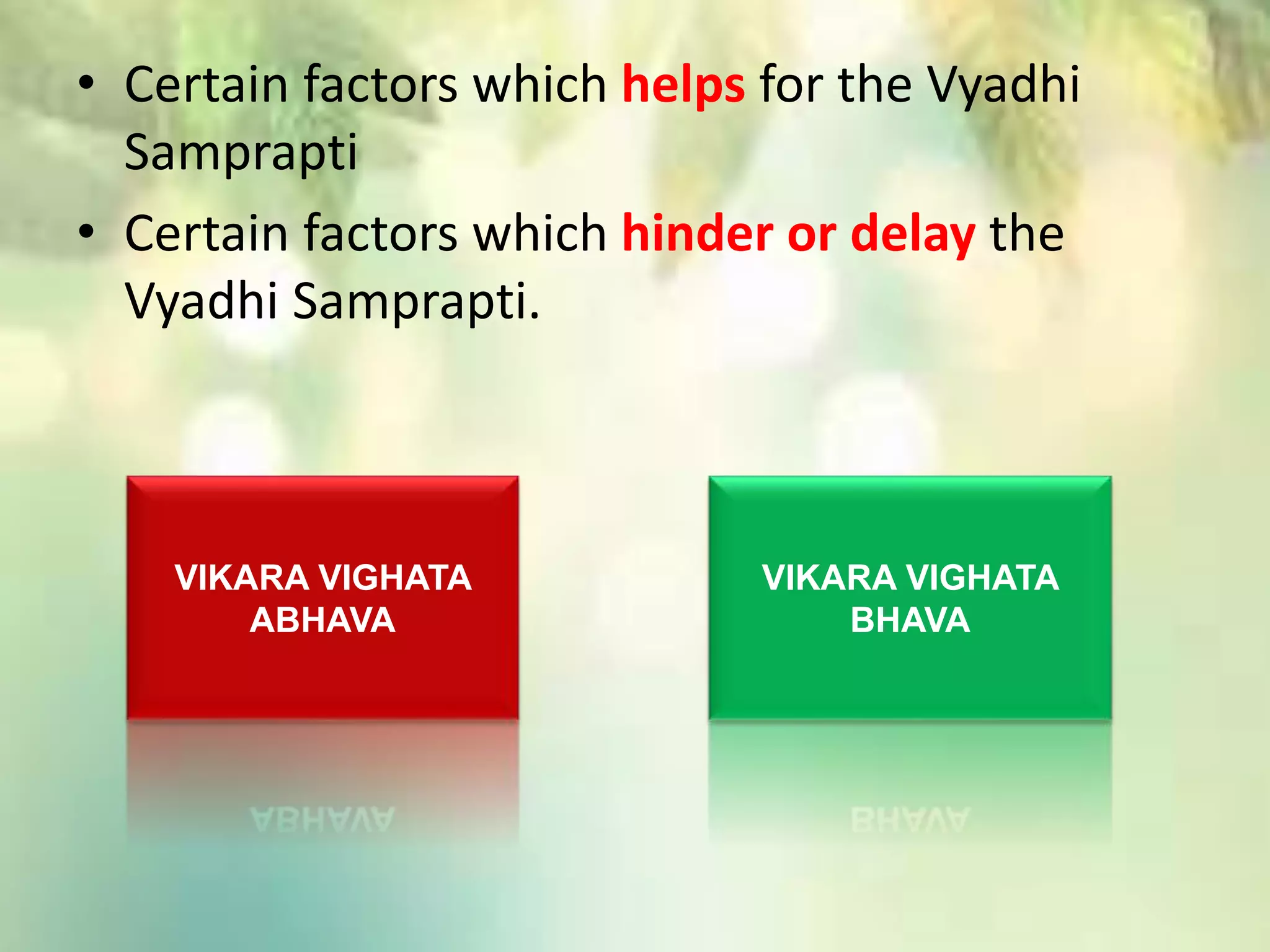
• Certain factors which helps for the Vyadhi
Samprapti
• Certain factors which hinder or delay the
Vyadhi Samprapti.
VIKARA VIGHATA
ABHAVA
VIKARA VIGHATA
BHAVA
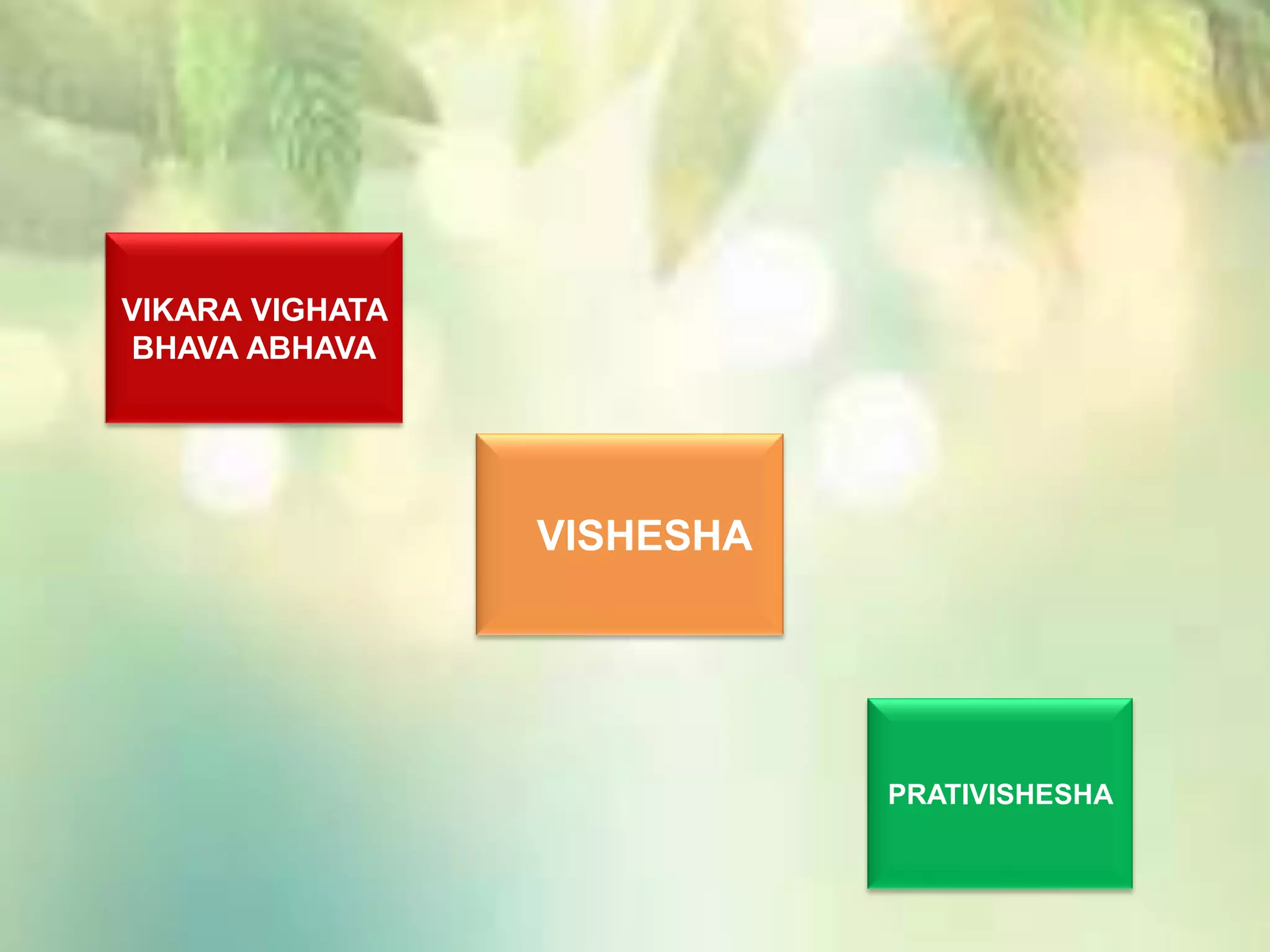
VISHESHA
VIKARA VIGHATA
BHAVA ABHAVA
PRATIVISHESHA
VIKARA VIGHATA BHAVA
विकाराणाां विघातस्य उत्पविप्रततबन्धस्य भािो
विघातभाि:।
(च.ति 4/4 चक्र.)
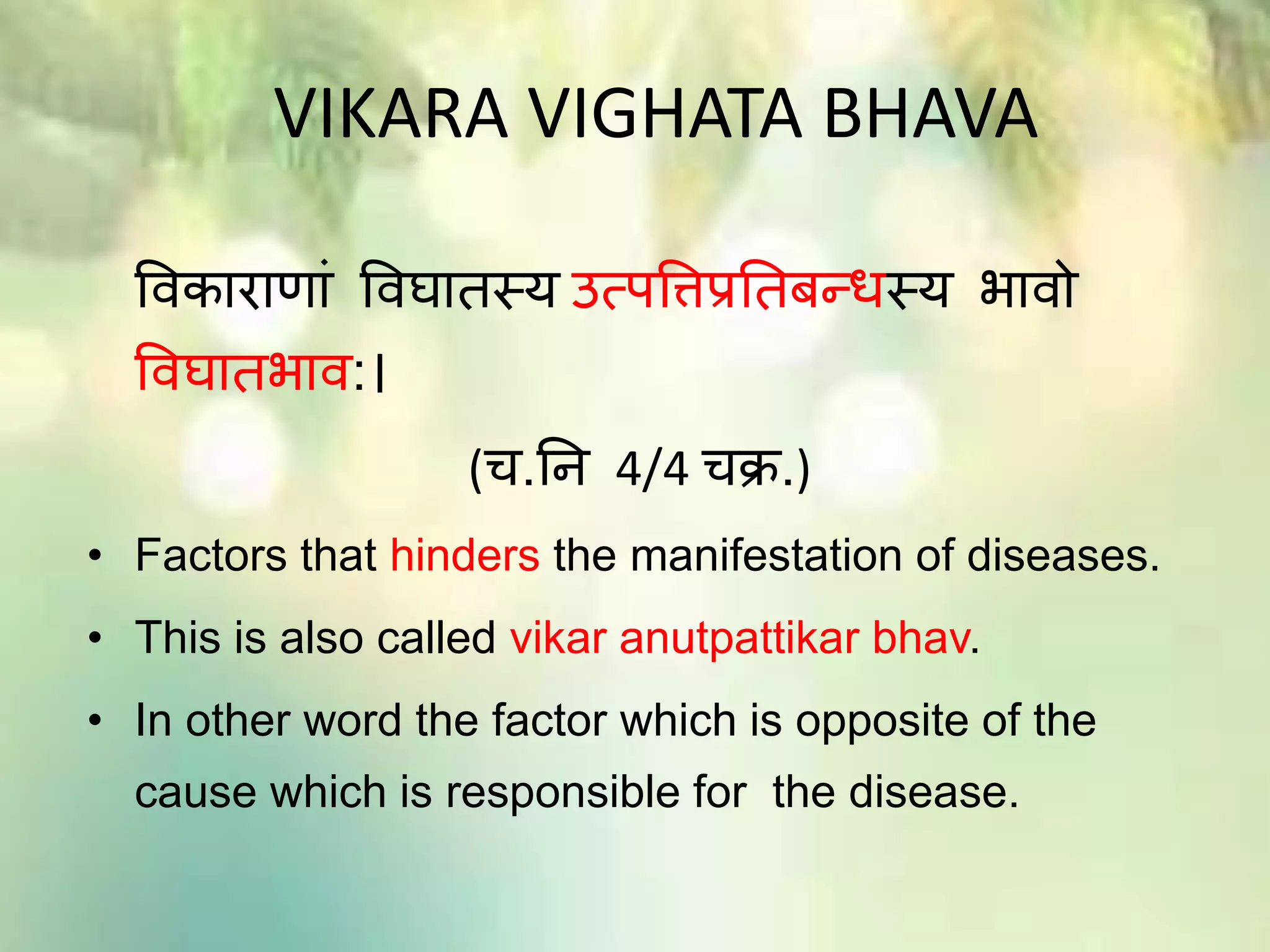
• Factors that hinders the manifestation of diseases.
• This is also called vikar anutpattikar bhav.
• In other word the factor which is opposite of the
cause which is responsible for the disease.
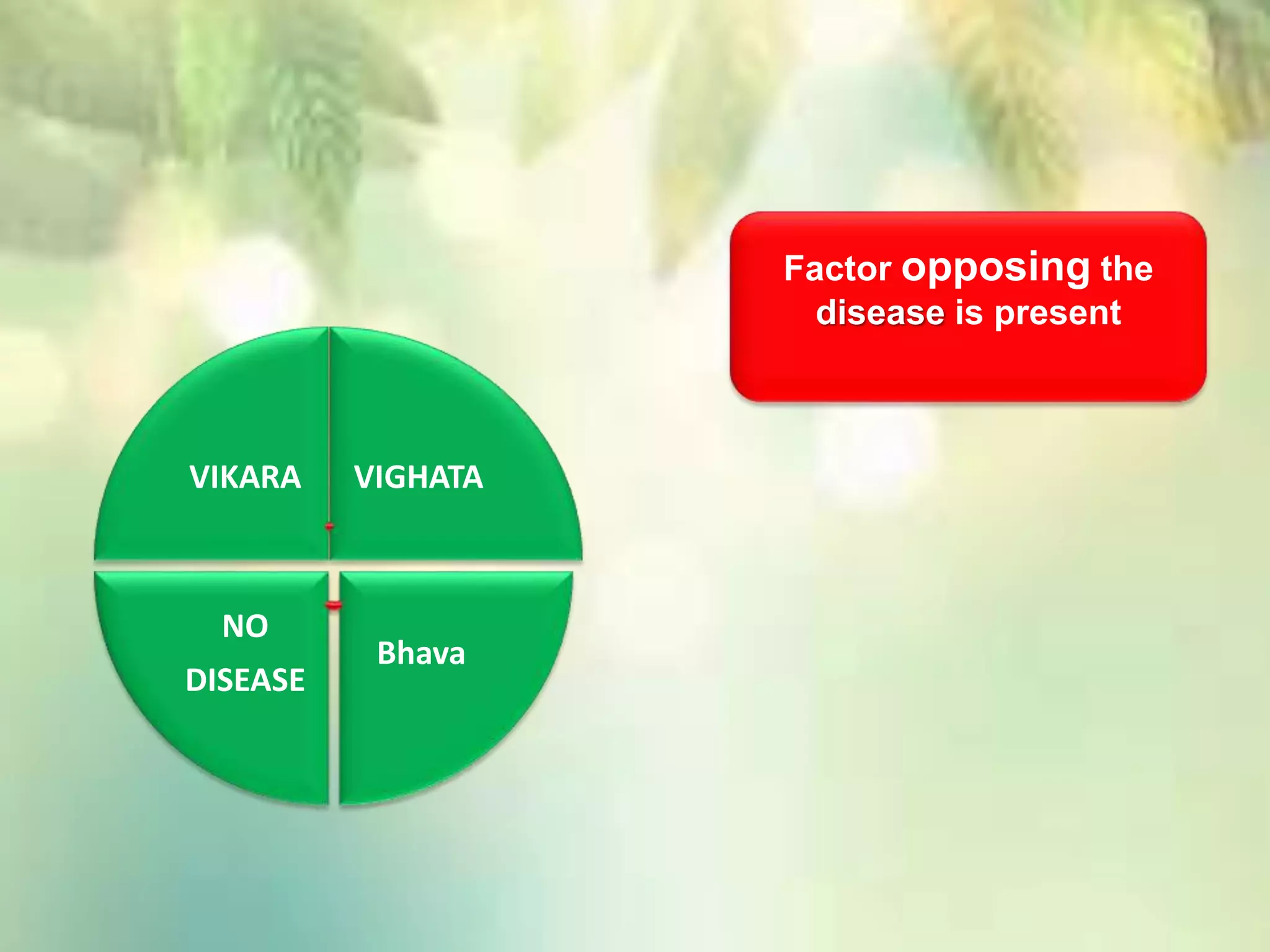
VIKARA VIGHATA
Bhava
NO
DISEASE
Factor opposing the
disease is present
VIKARA VIGHATA ABHAVA
विकाराणाां विघातस्य अभािो विकारजििमितत
विकारविघातभाि अभाि ।
(च.ति 4/4 चक्र.)
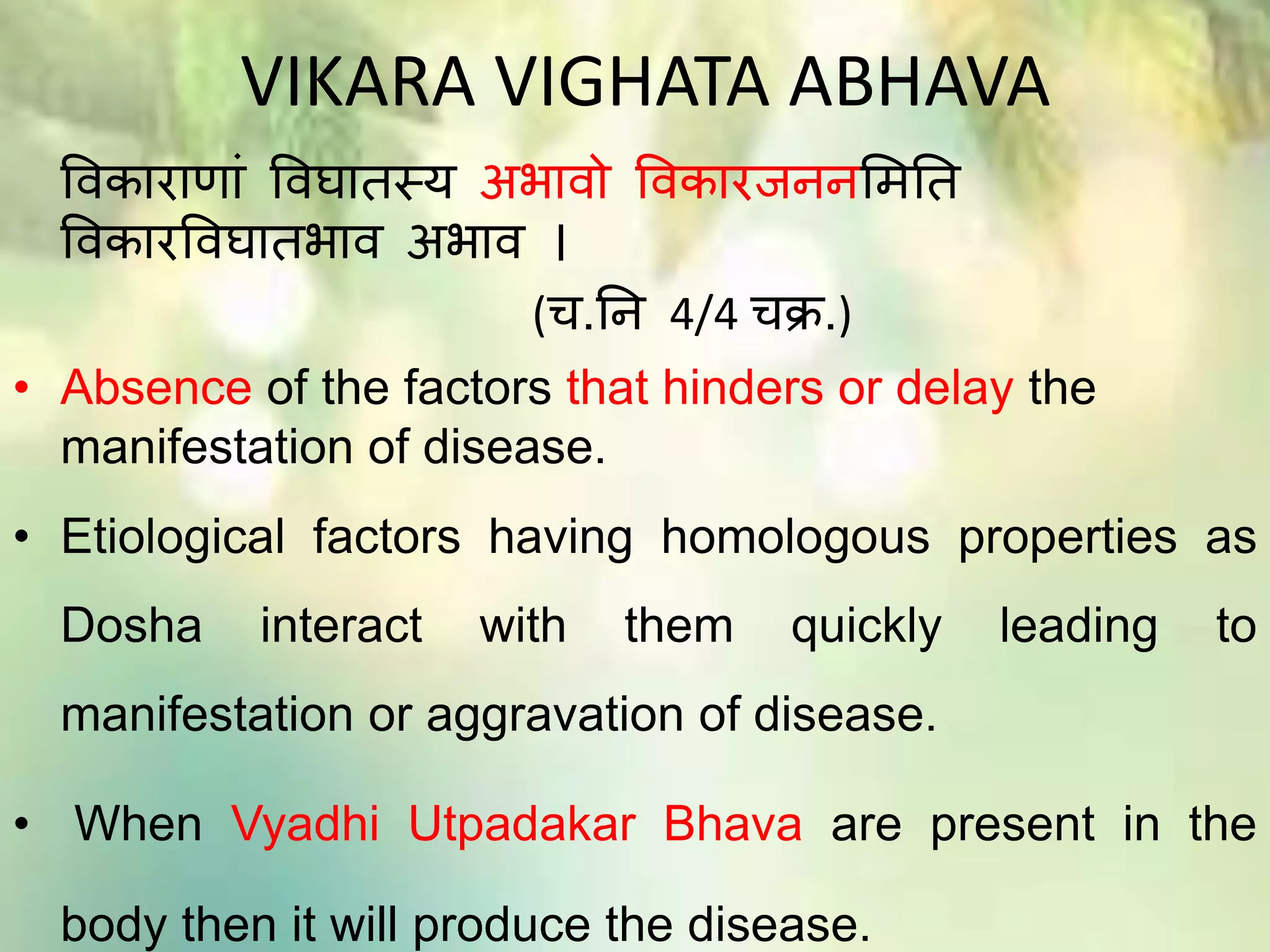
• Absence of the factors that hinders or delay the
manifestation of disease.
• Etiological factors having homologous properties as
Dosha interact with them quickly leading to
manifestation or aggravation of disease.
• When Vyadhi Utpadakar Bhava are present in the
body then it will produce the disease.
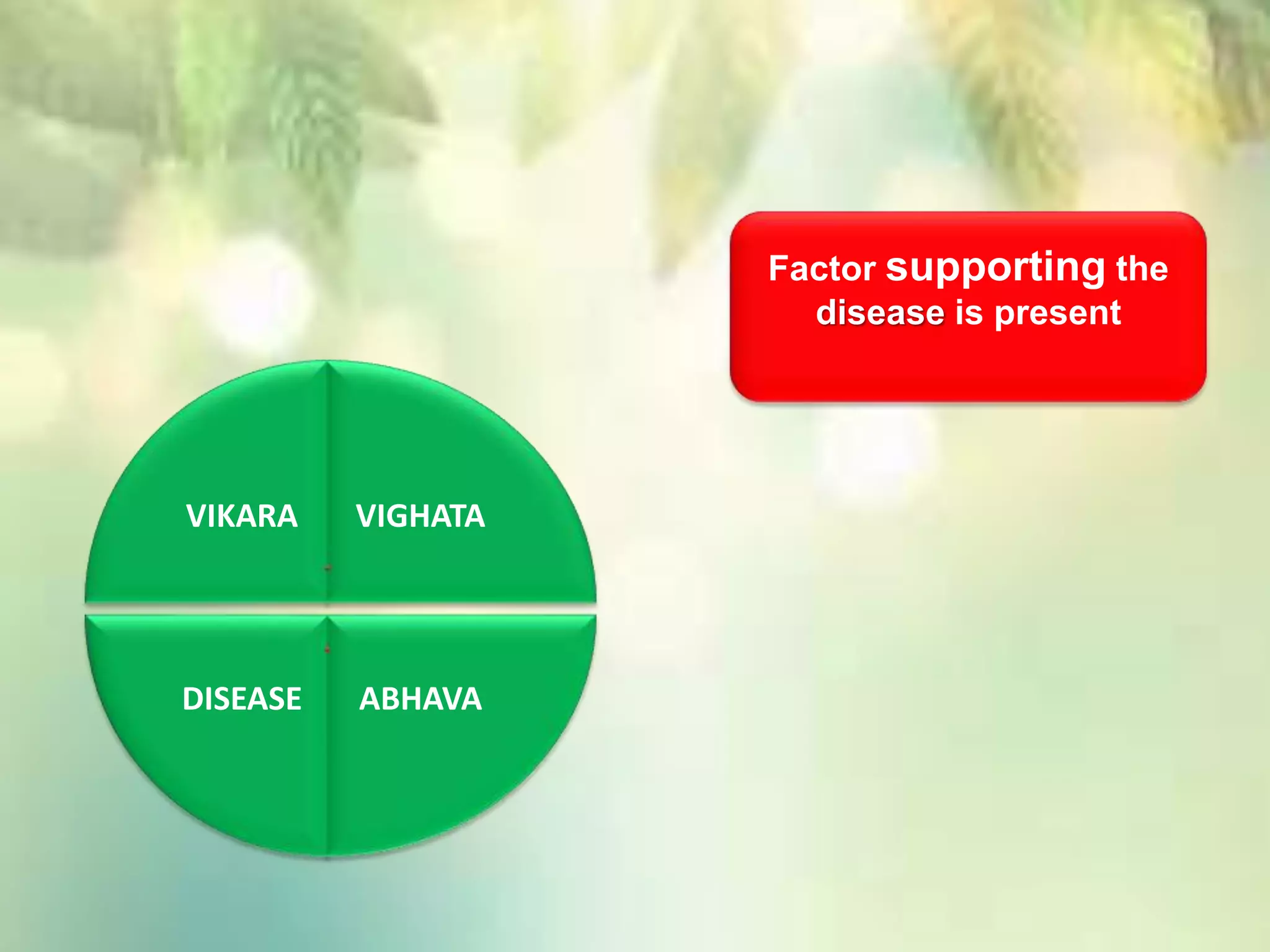
VIKARA VIGHATA
ABHAVADISEASE
Factor supporting the
disease is present
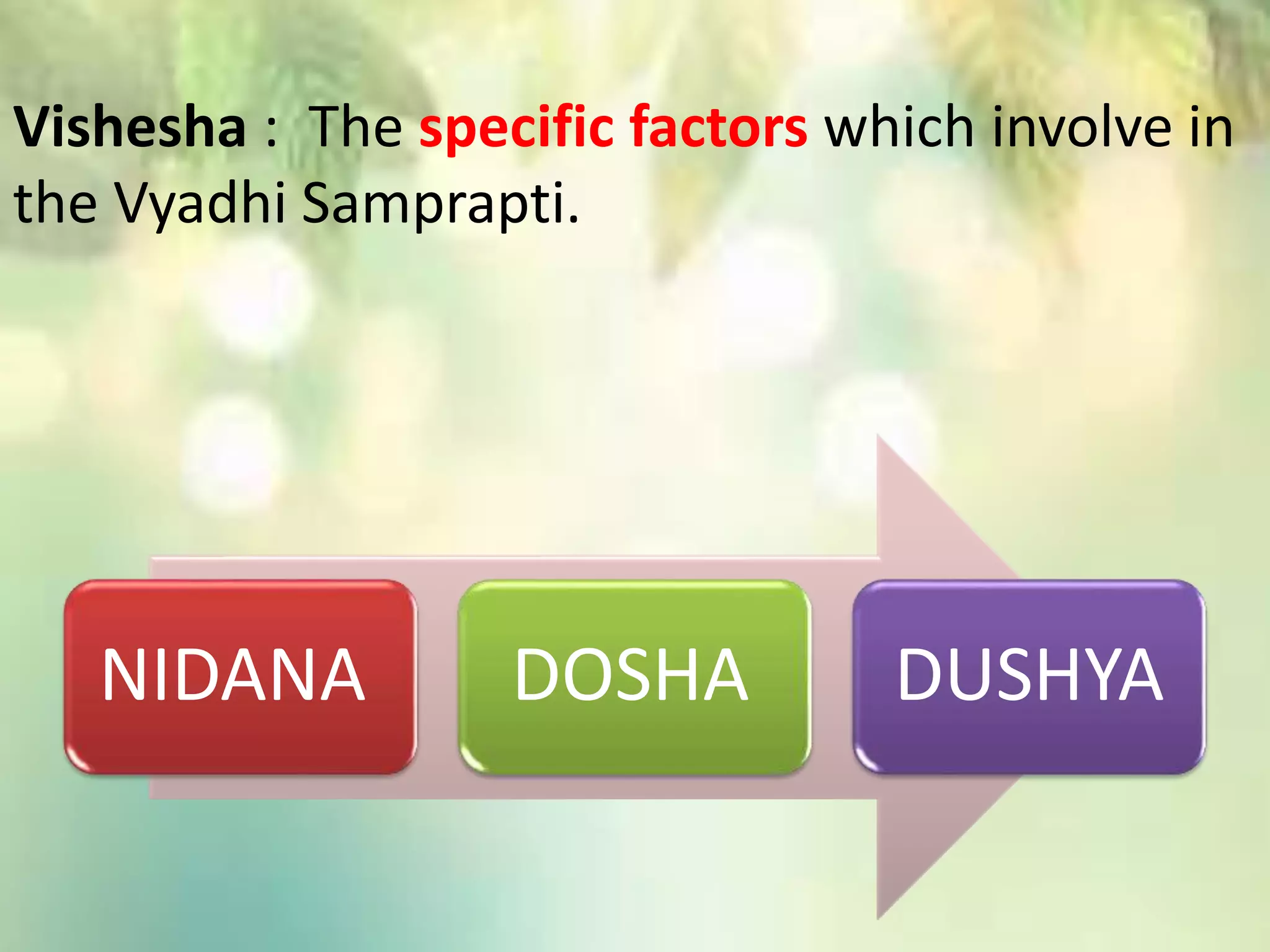
Vishesha : The specific factors which involve in
the Vyadhi Samprapti.
NIDANA DOSHA DUSHYA
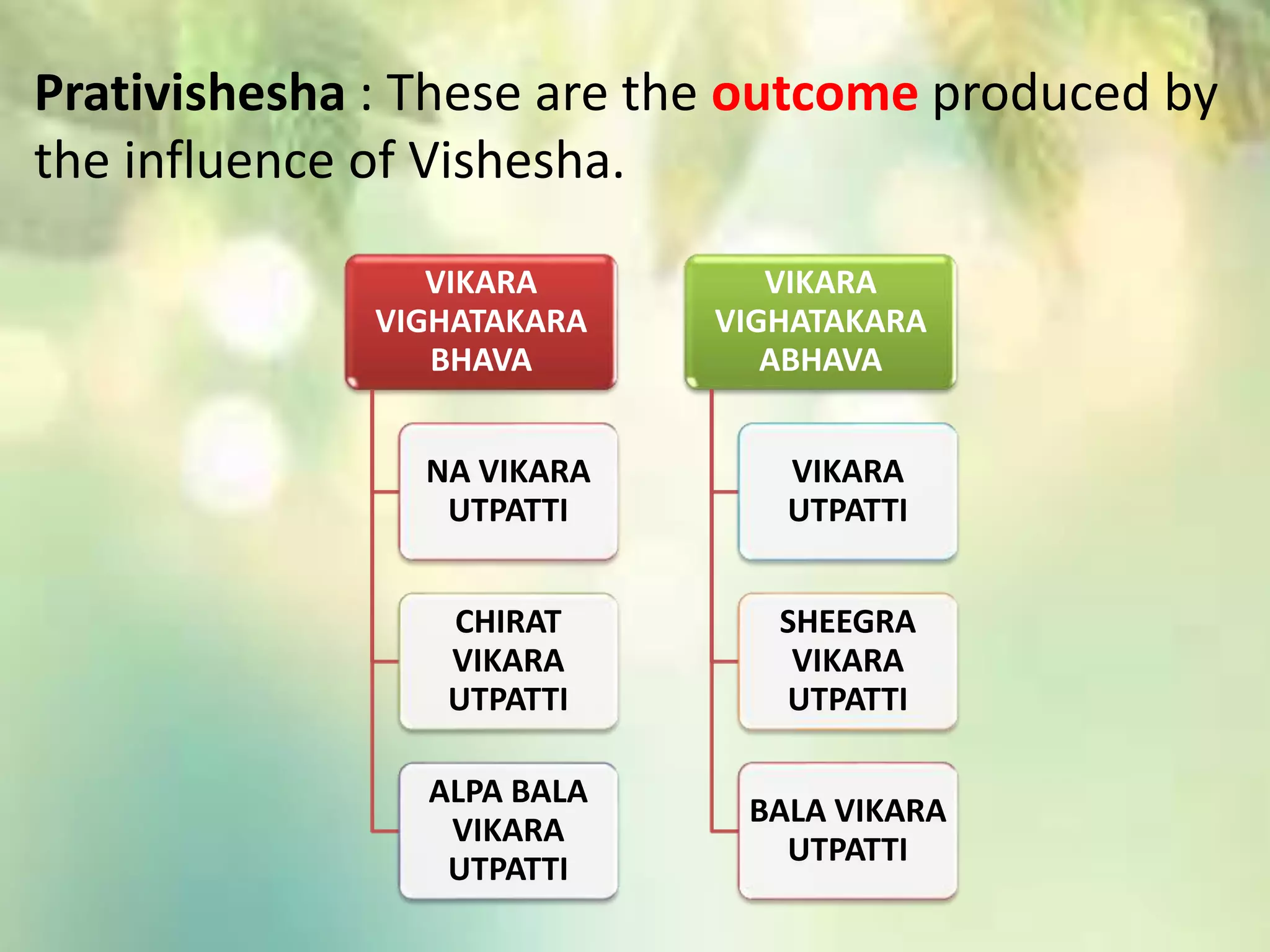
Prativishesha : These are the outcome produced by
the influence of Vishesha.
VIKARA
VIGHATAKARA
BHAVA
NA VIKARA
UTPATTI
CHIRAT
VIKARA
UTPATTI
ALPA BALA
VIKARA
UTPATTI
VIKARA
VIGHATAKARA
ABHAVA
VIKARA
UTPATTI
SHEEGRA
VIKARA
UTPATTI
BALA VIKARA
UTPATTI
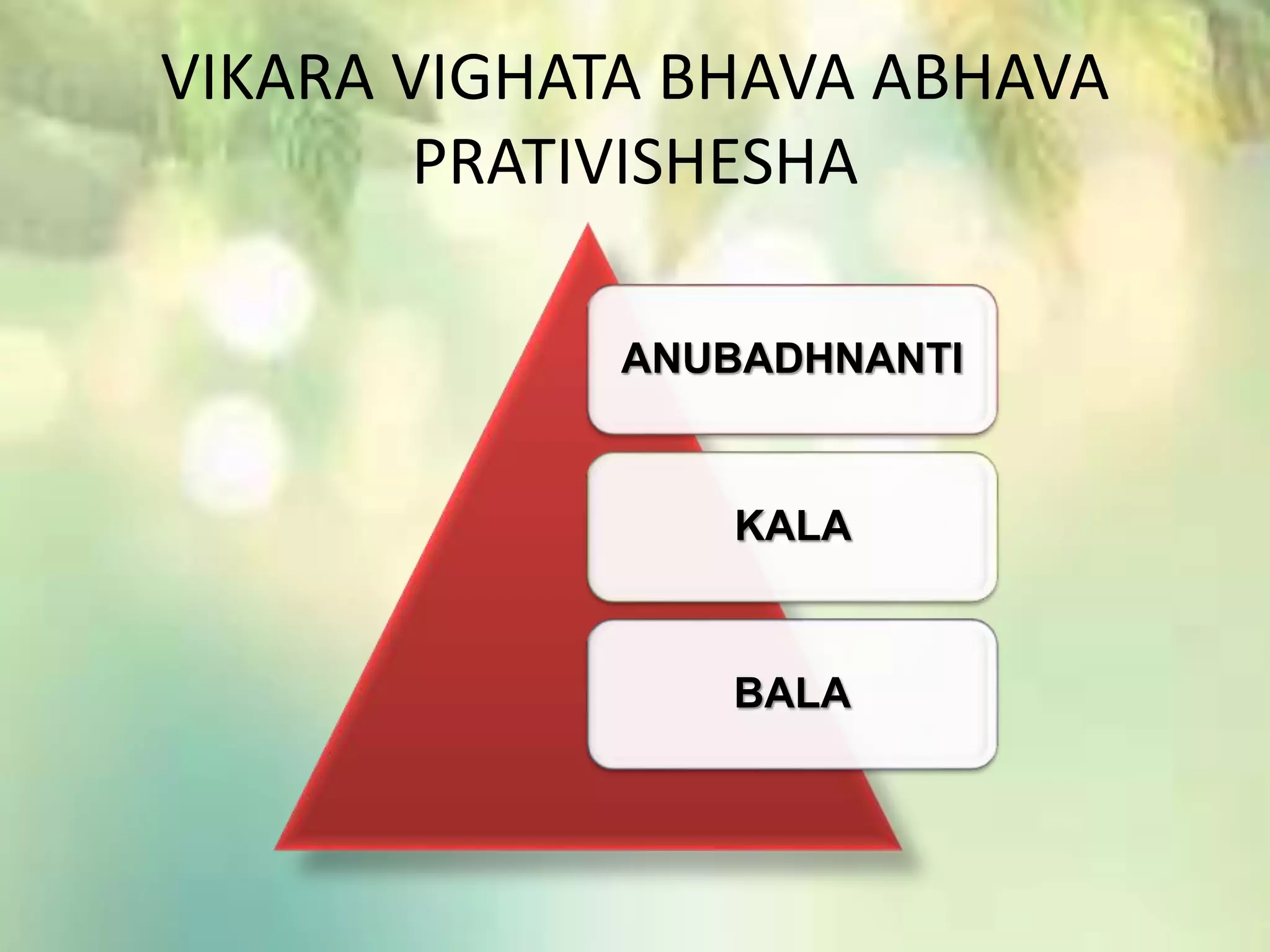
VIKARA VIGHATA BHAVA ABHAVA
PRATIVISHESHA
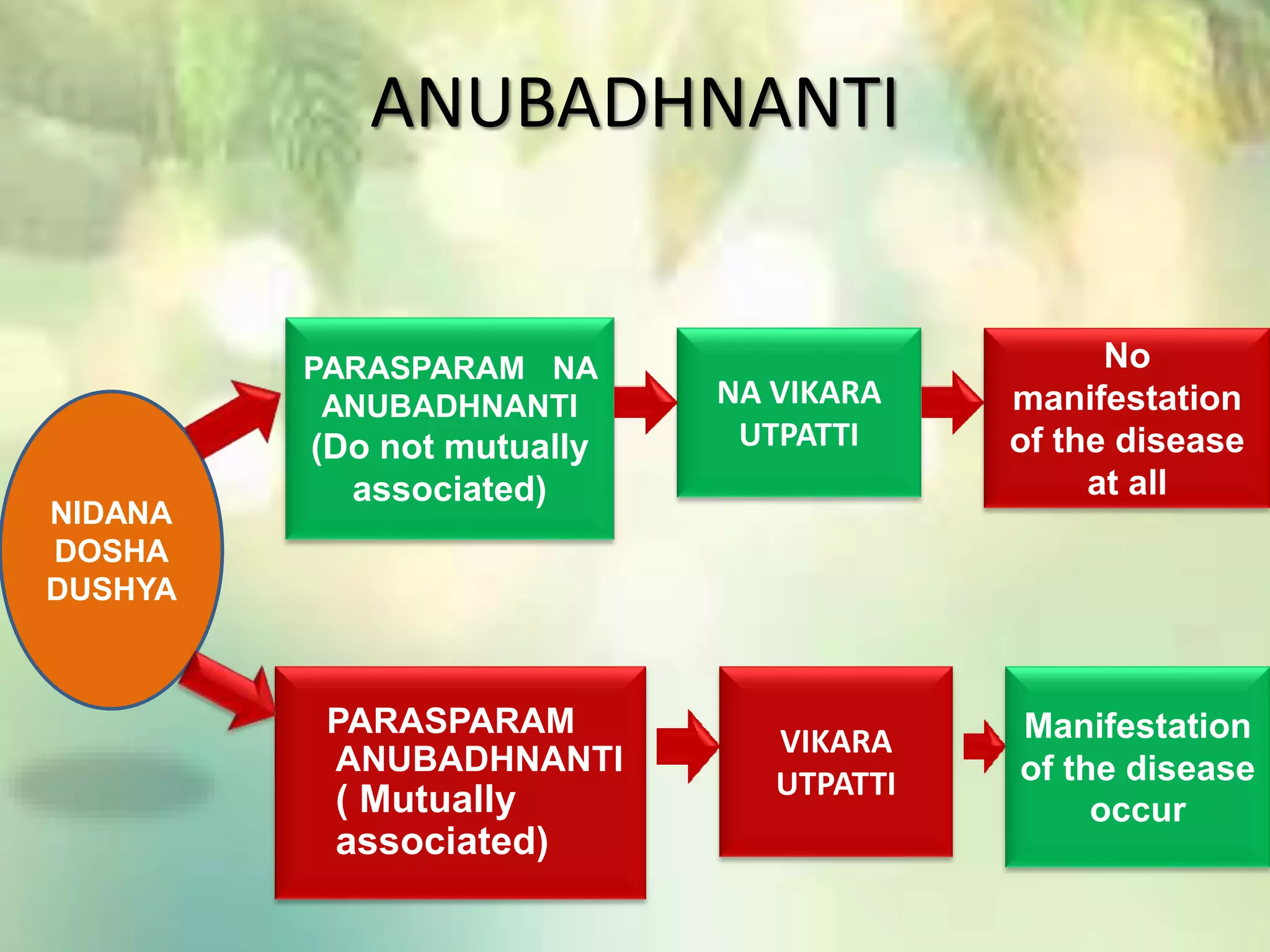
ANUBADHNANTI
KALA
BALA
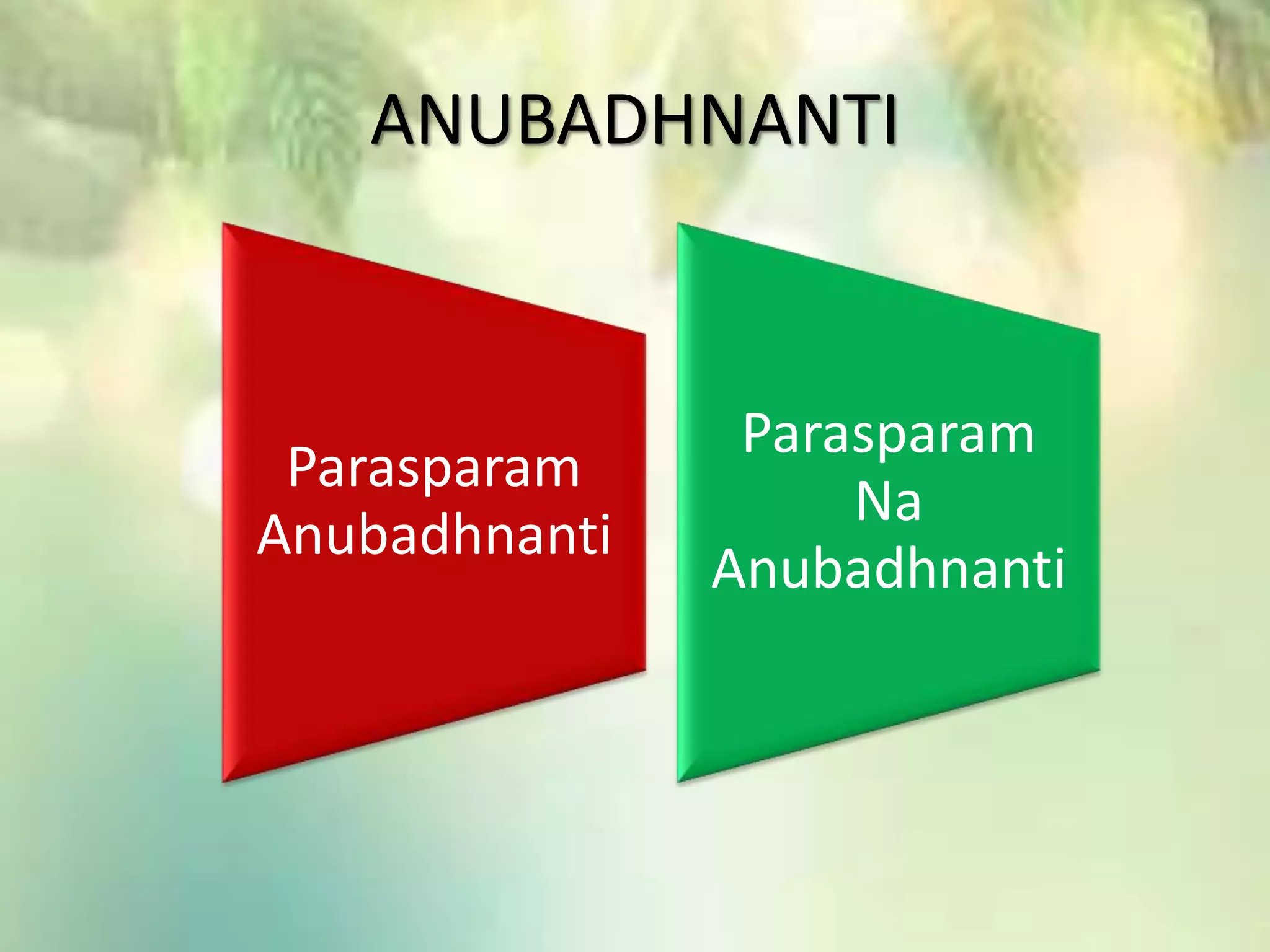
ANUBADHNANTI
Parasparam
Anubadhnanti
Parasparam
Na
Anubadhnanti
ANUBADHNANTI
PARASPARAM
ANUBADHNANTI
( Mutually
associated)
NIDANA
DOSHA
DUSHYA
PARASPARAM NA
ANUBADHNANTI
(Do not mutually
associated)
NA VIKARA
UTPATTI
VIKARA
UTPATTI
No
manifestation
of the disease
at all
Manifestation
of the disease
occur
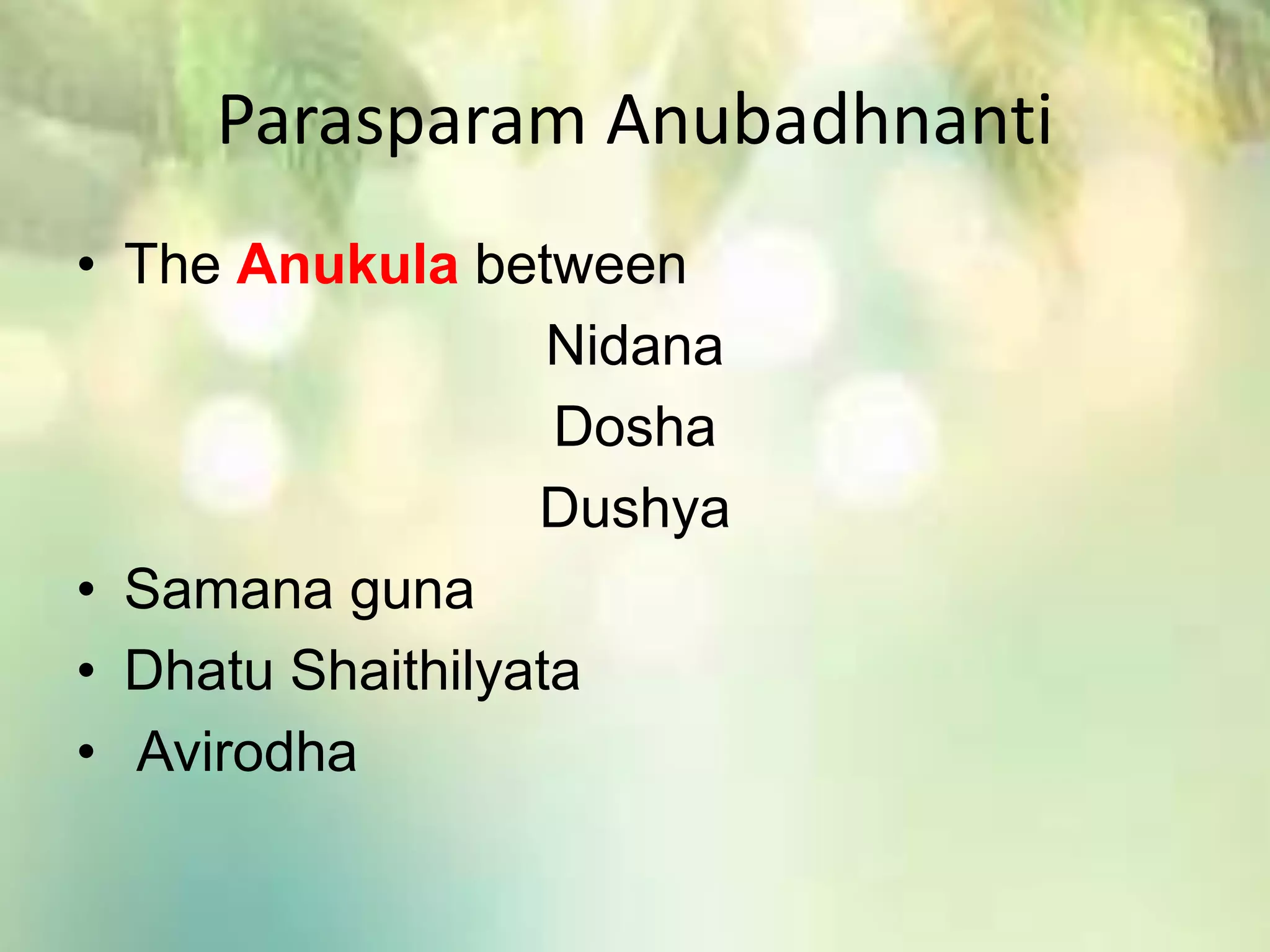
Parasparam Anubadhnanti
• The Anukula between
Nidana
Dosha
Dushya
• Samana guna
• Dhatu Shaithilyata
• Avirodha
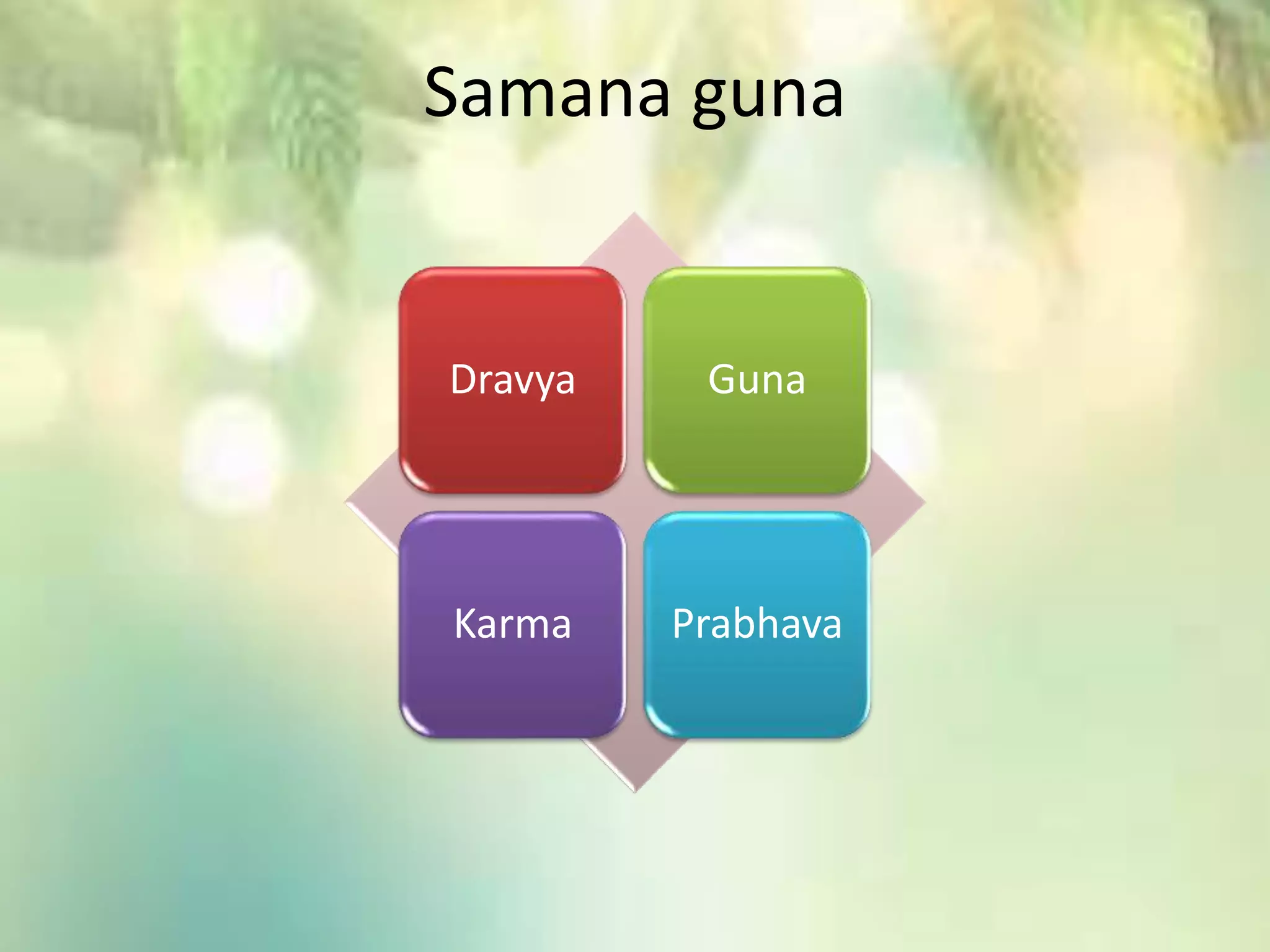
Samana guna
Dravya Guna
Karma Prabhava
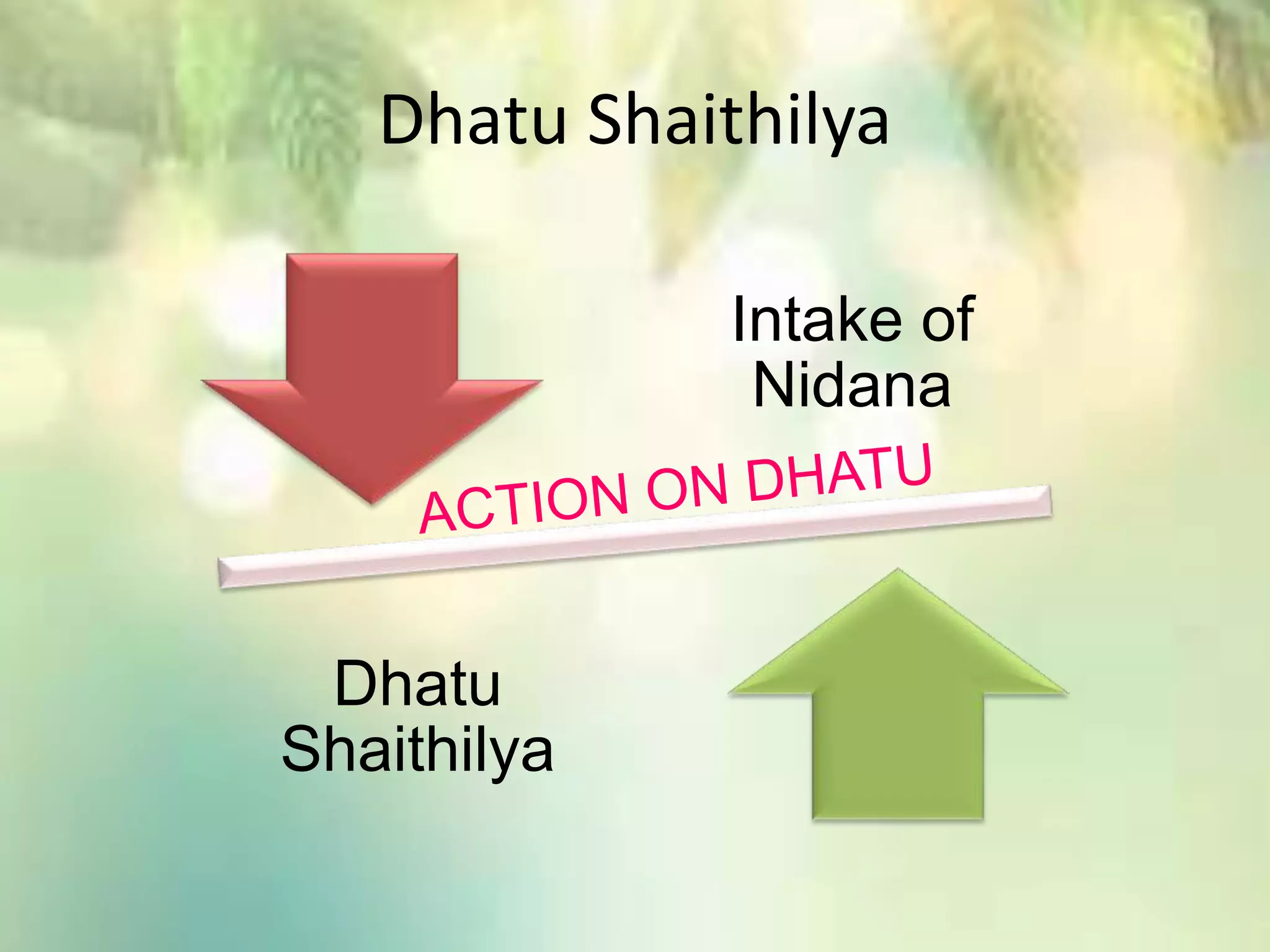
Dhatu Shaithilya
Intake of
Nidana
Dhatu
Shaithilya
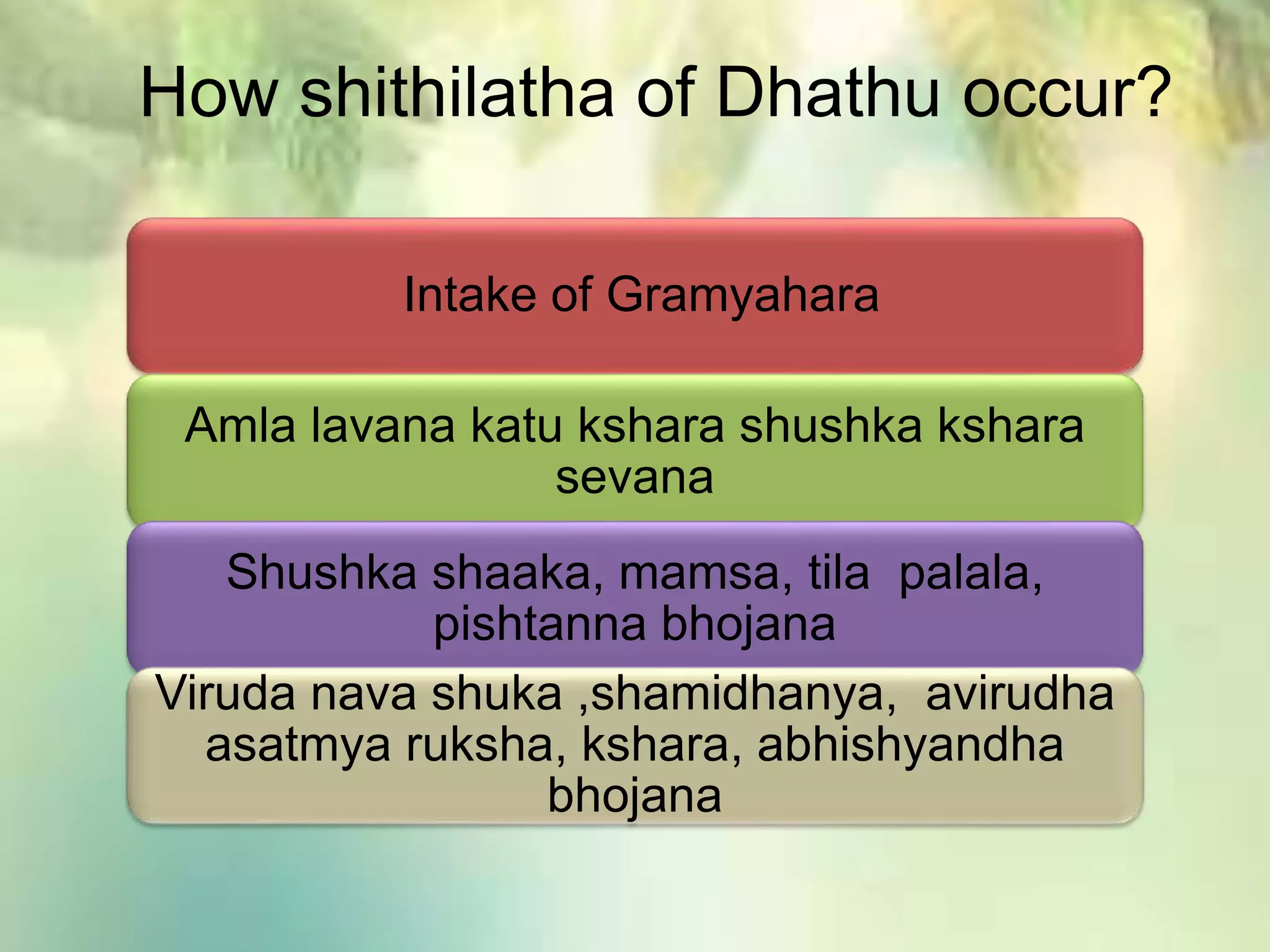
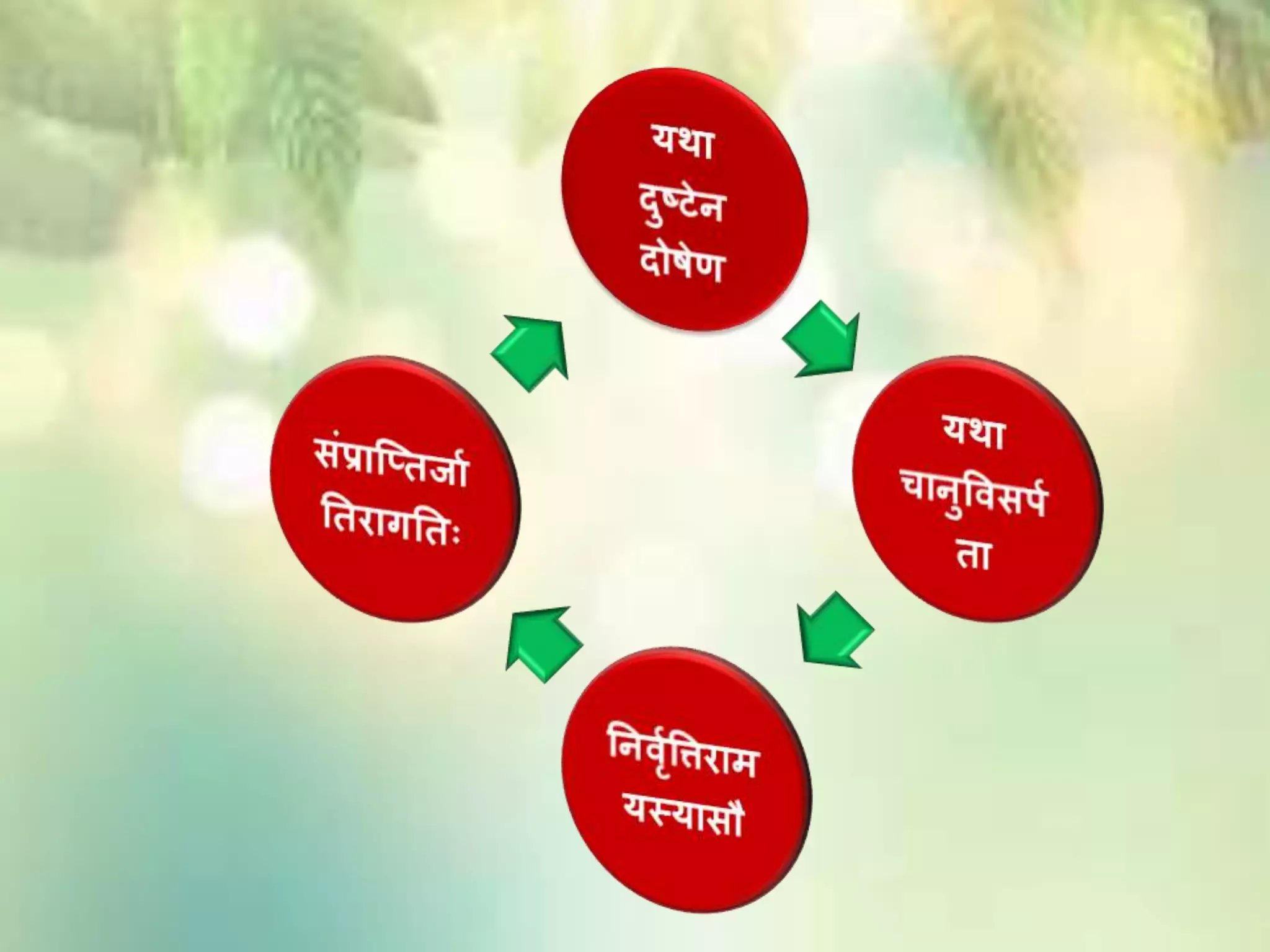
How shithilatha of Dhathu occur?
Intake of Gramyahara
Amla lavana katu kshara shushka kshara
sevana
Shushka shaaka, mamsa, tila palala,
pishtanna bhojana
Viruda nava shuka ,shamidhanya, avirudha
asatmya ruksha, kshara, abhishyandha
bhojana
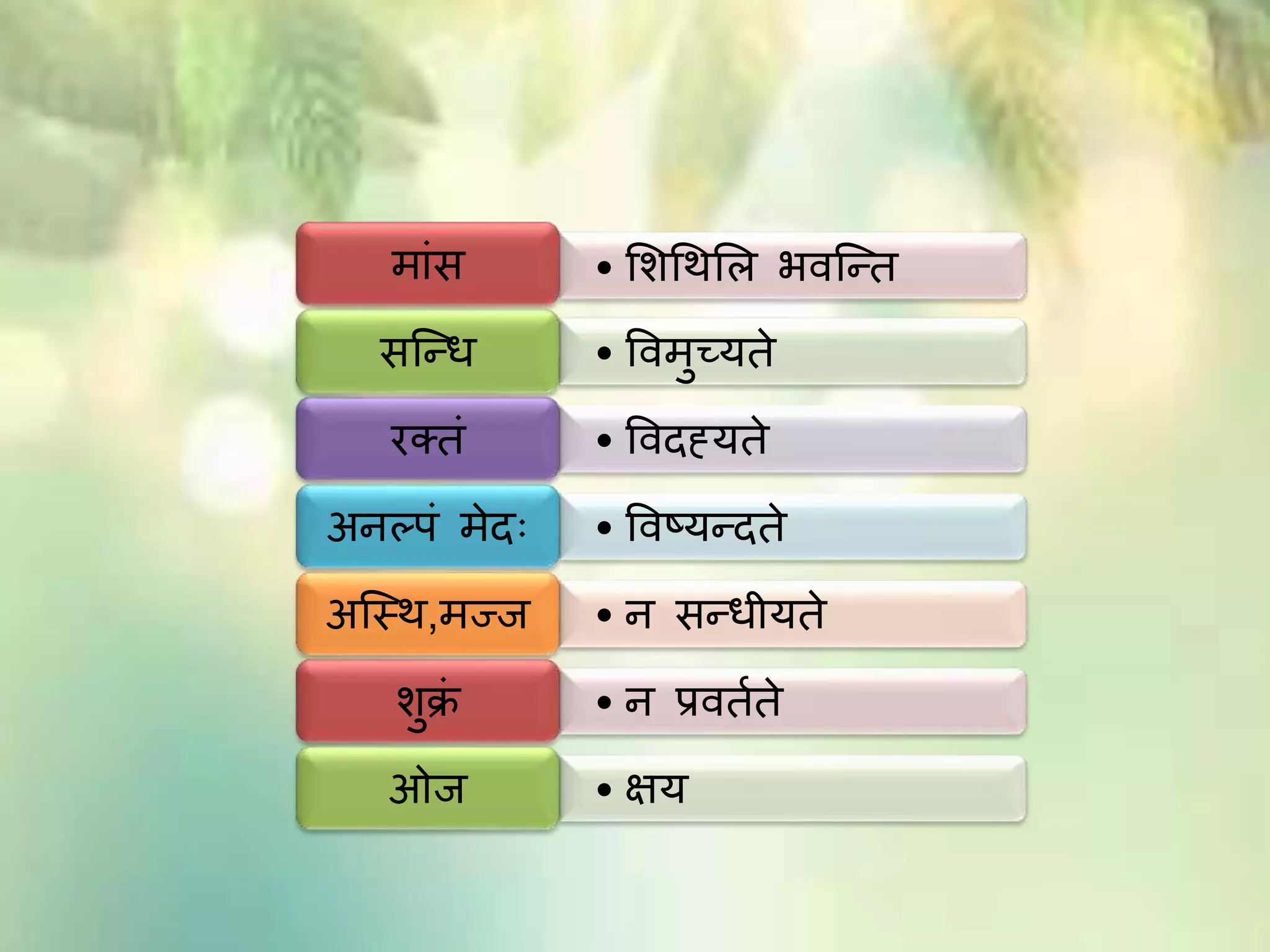
• मिथिमि भिन्न्तिाांस
• वििुच्यतेसन्न्ध
• विदह्यतेरक्तां
• विष्यन्दतेअिल्पां िेदः
• ि सन्धीयतेअन्स्ि,िज्ज
• ि प्रितततेिुक्रां
• क्षयओज
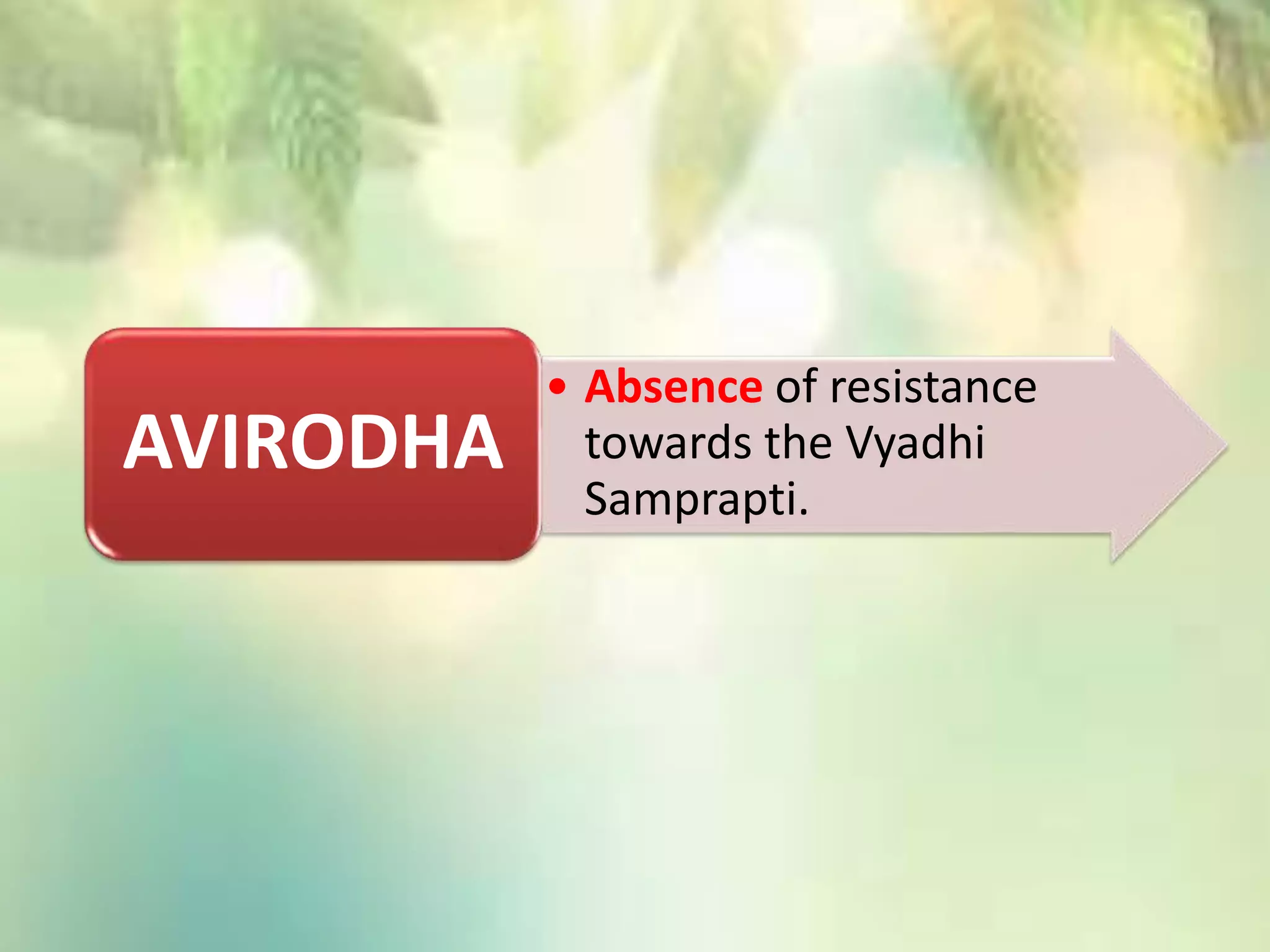
• Absence of resistance
towards the Vyadhi
Samprapti.
AVIRODHA
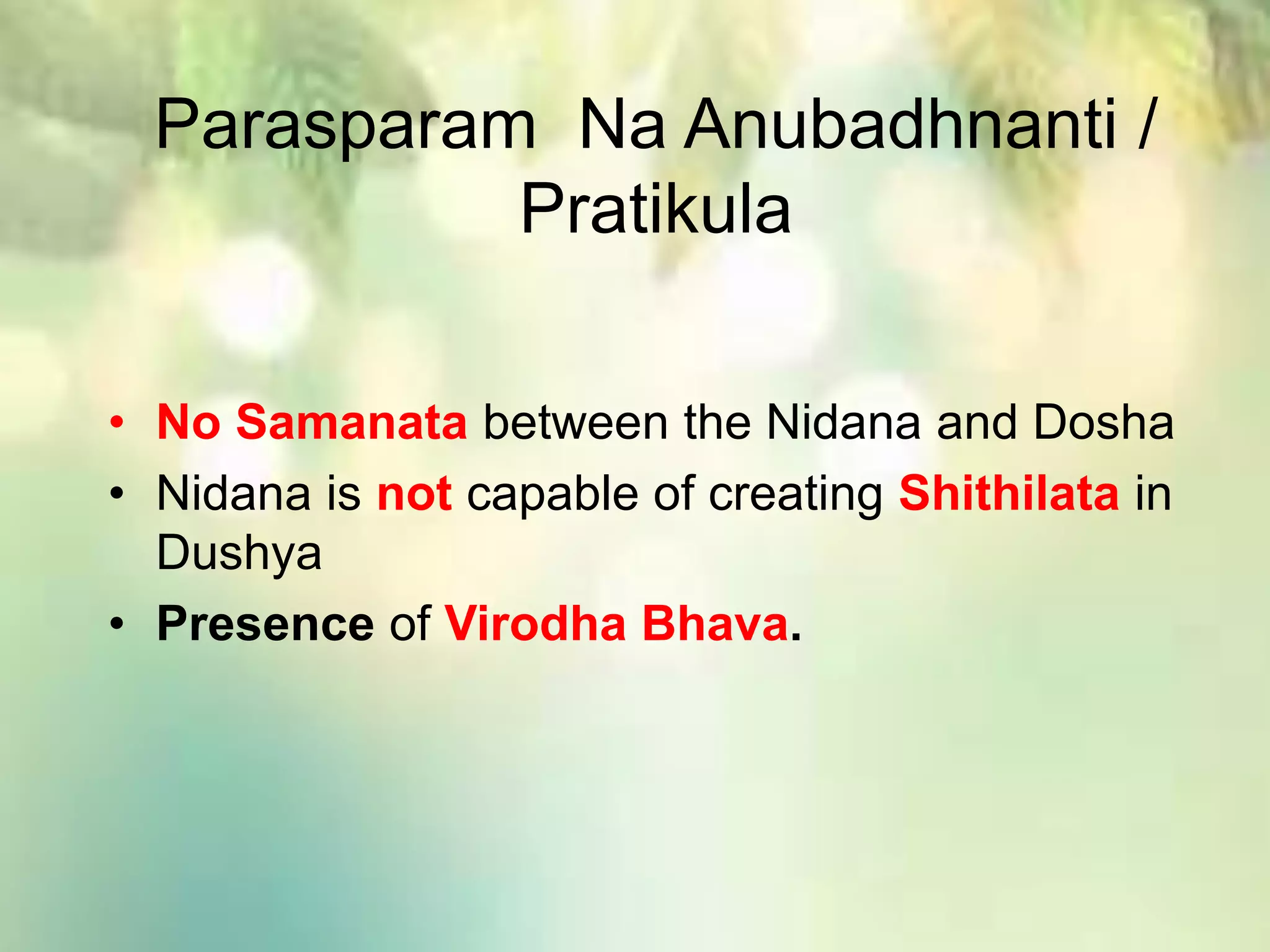
Parasparam Na Anubadhnanti /
Pratikula
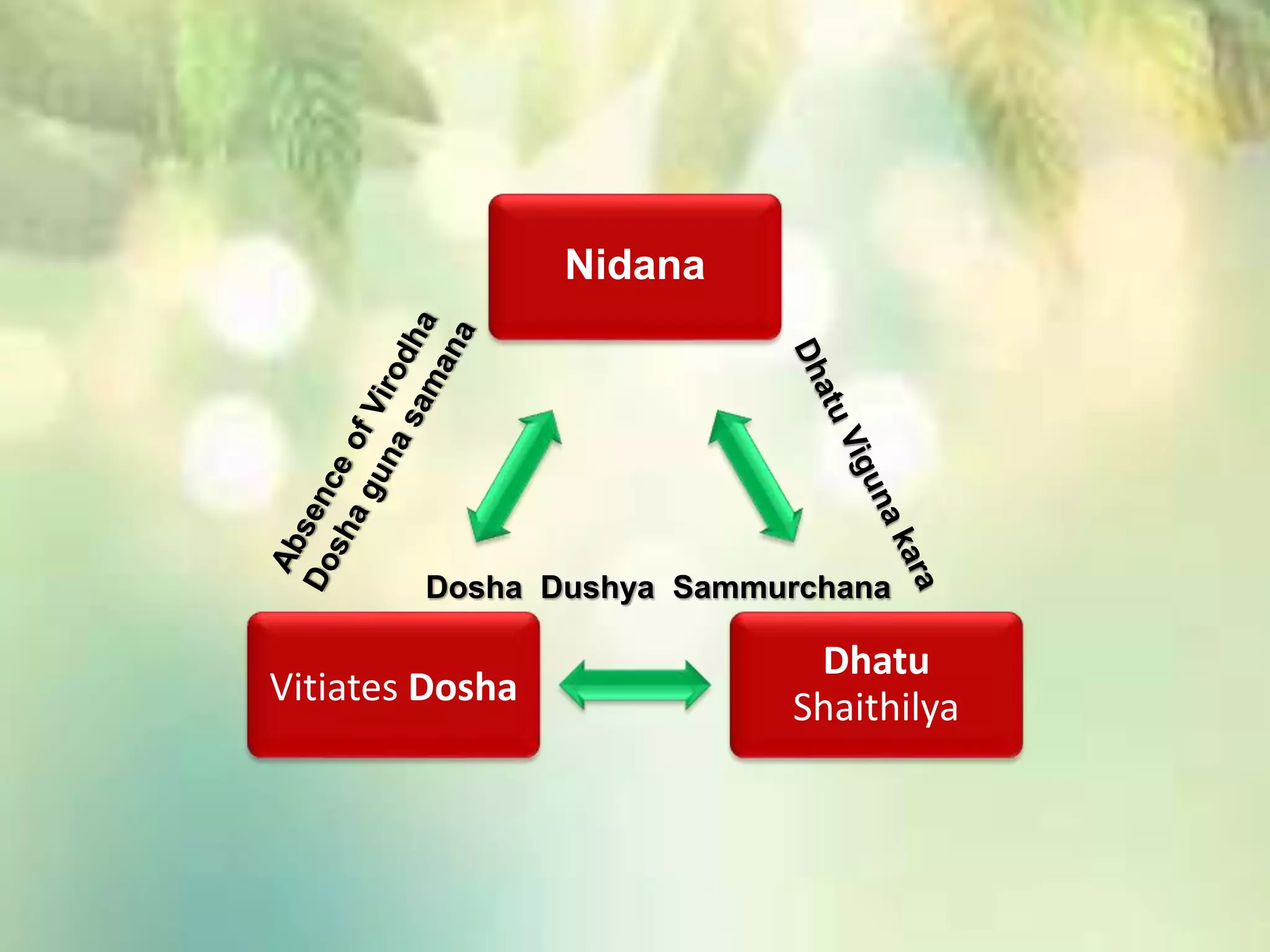
• No Samanata between the Nidana and Dosha
• Nidana is not capable of creating Shithilata in
Dushya
• Presence of Virodha Bhava.
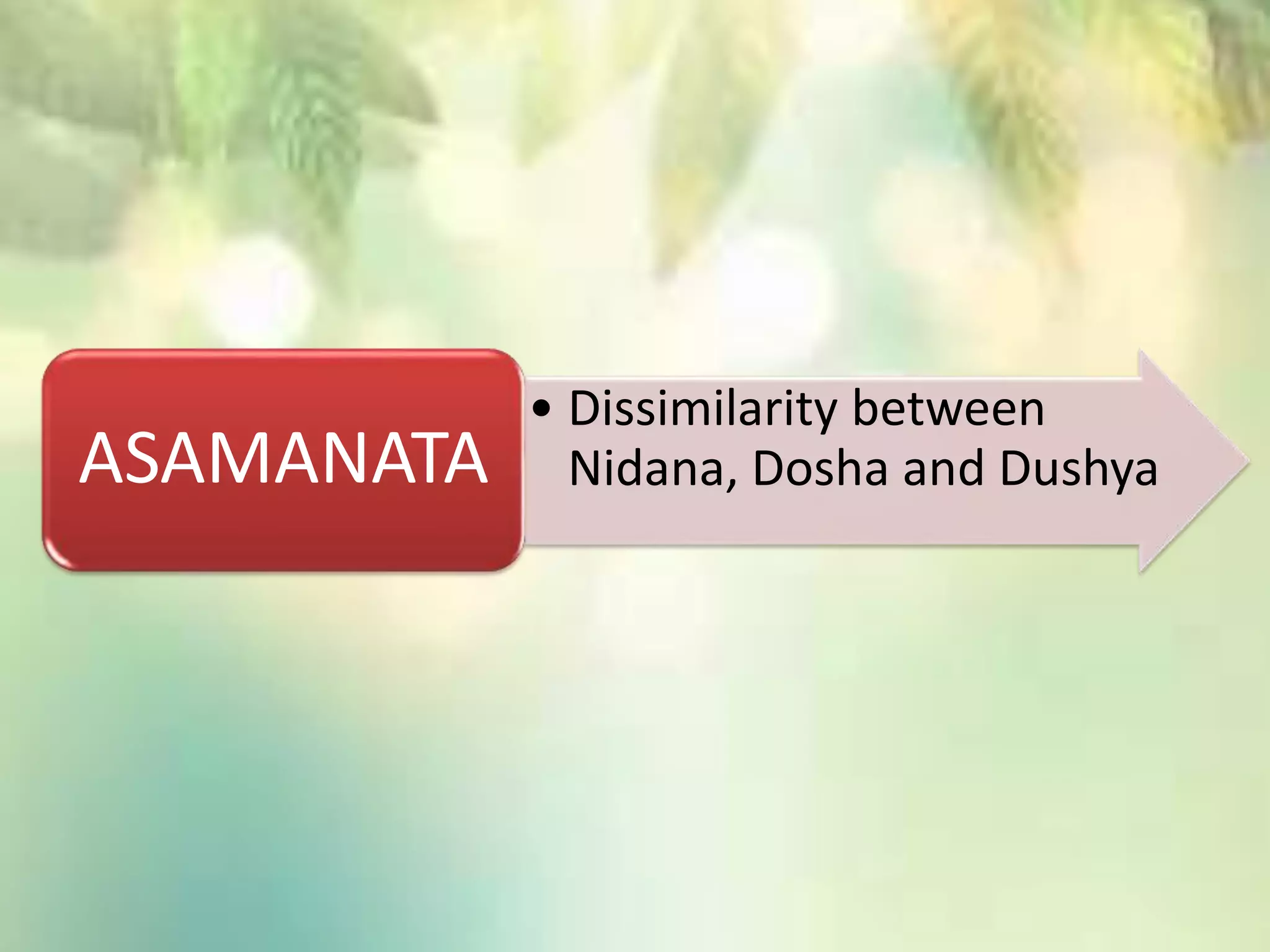
• Dissimilarity between
Nidana, Dosha and DushyaASAMANATA
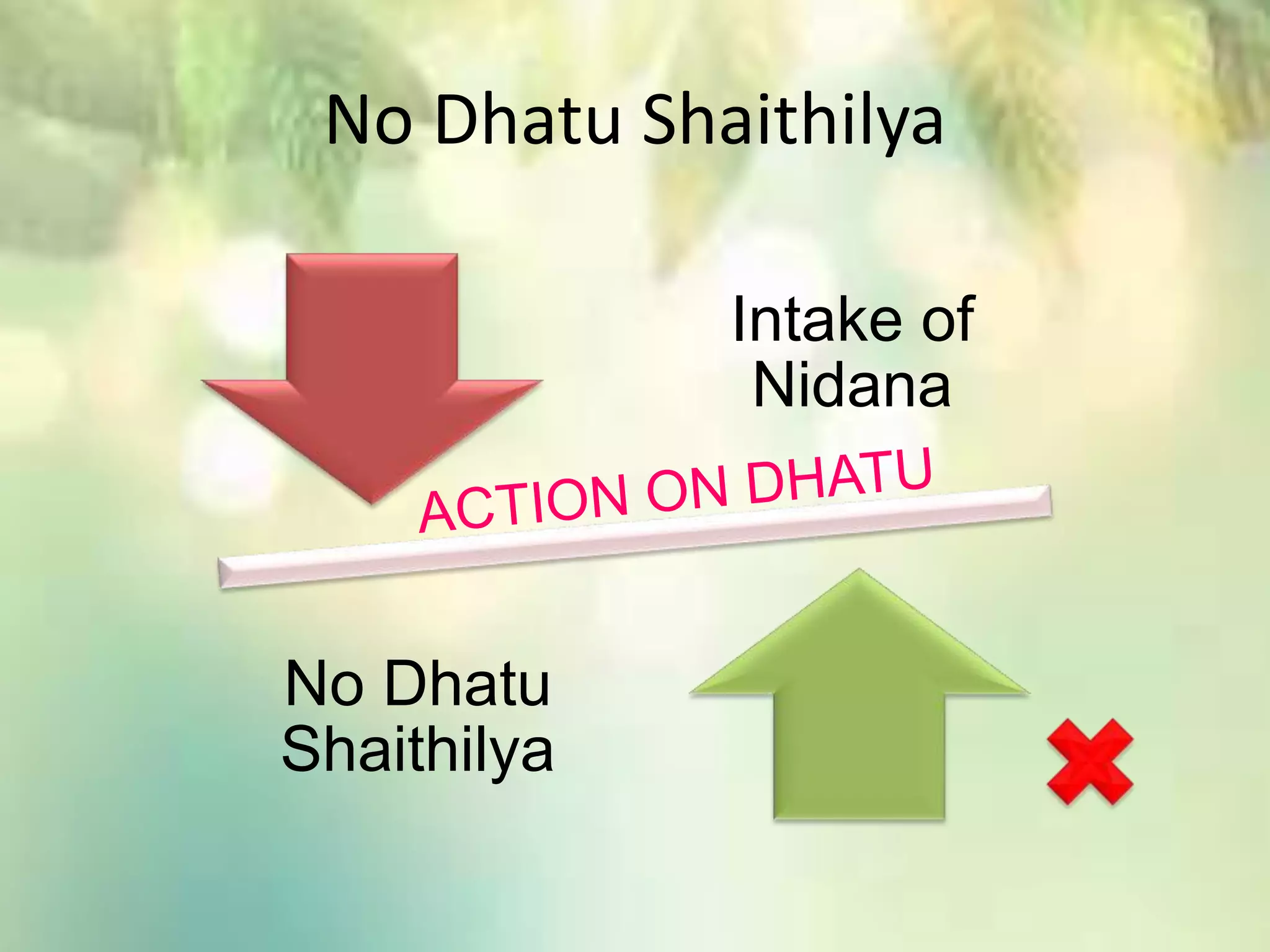
No Dhatu Shaithilya
Intake of
Nidana
No Dhatu
Shaithilya
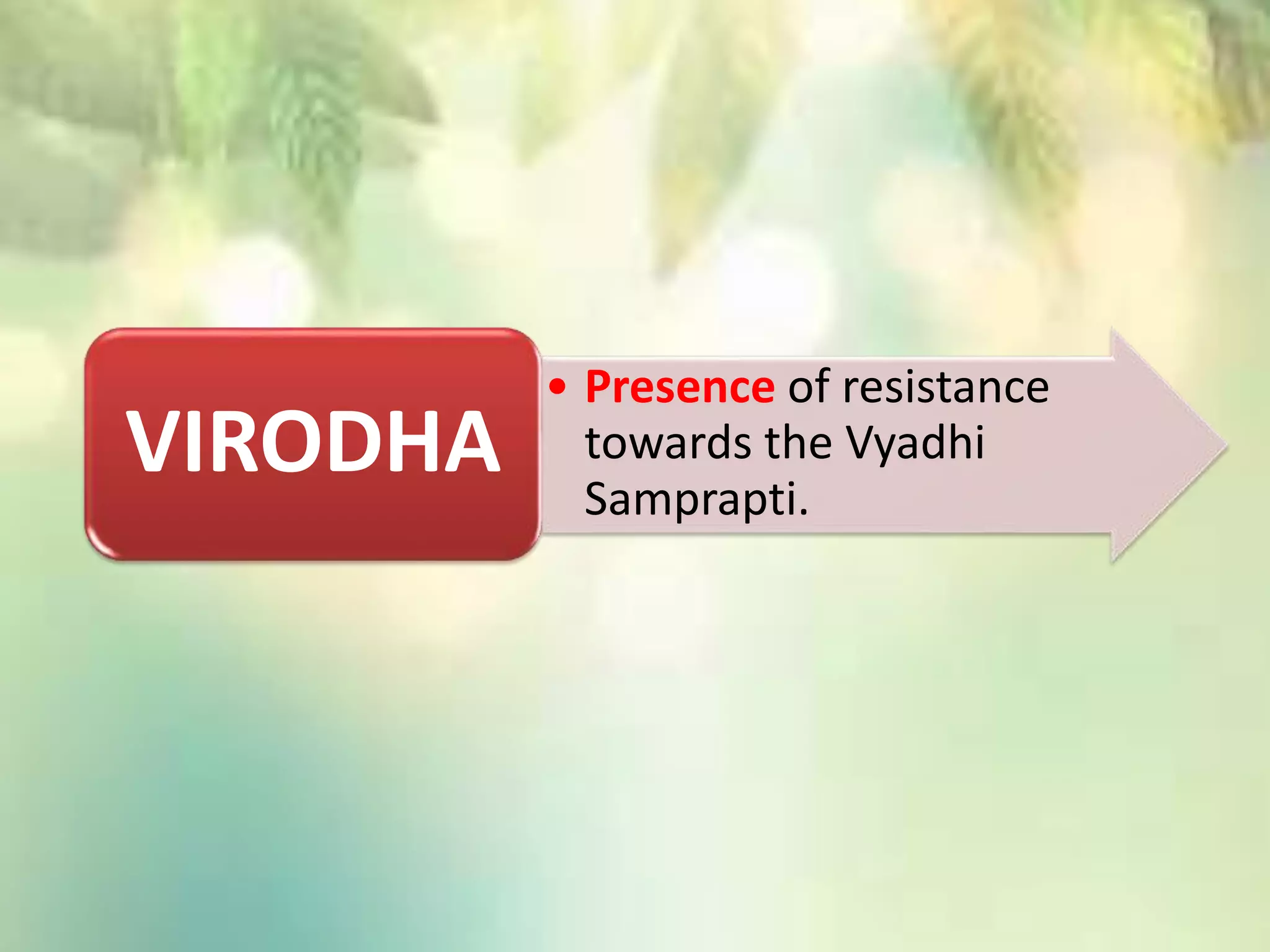
• Presence of resistance
towards the Vyadhi
Samprapti.
VIRODHA
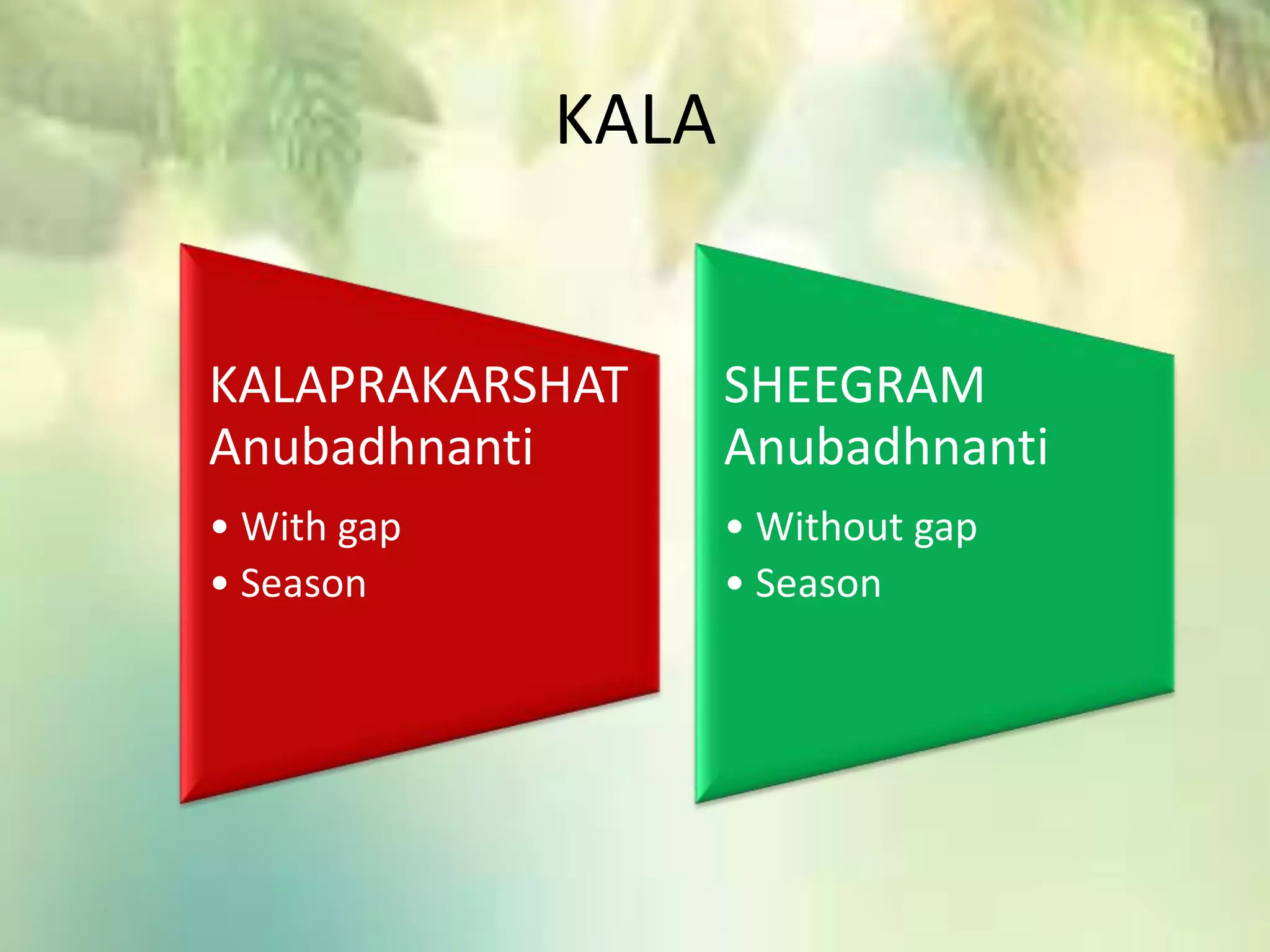
KALA
KALAPRAKARSHAT
Anubadhnanti
• With gap
• Season
SHEEGRAM
Anubadhnanti
• Without gap
• Season
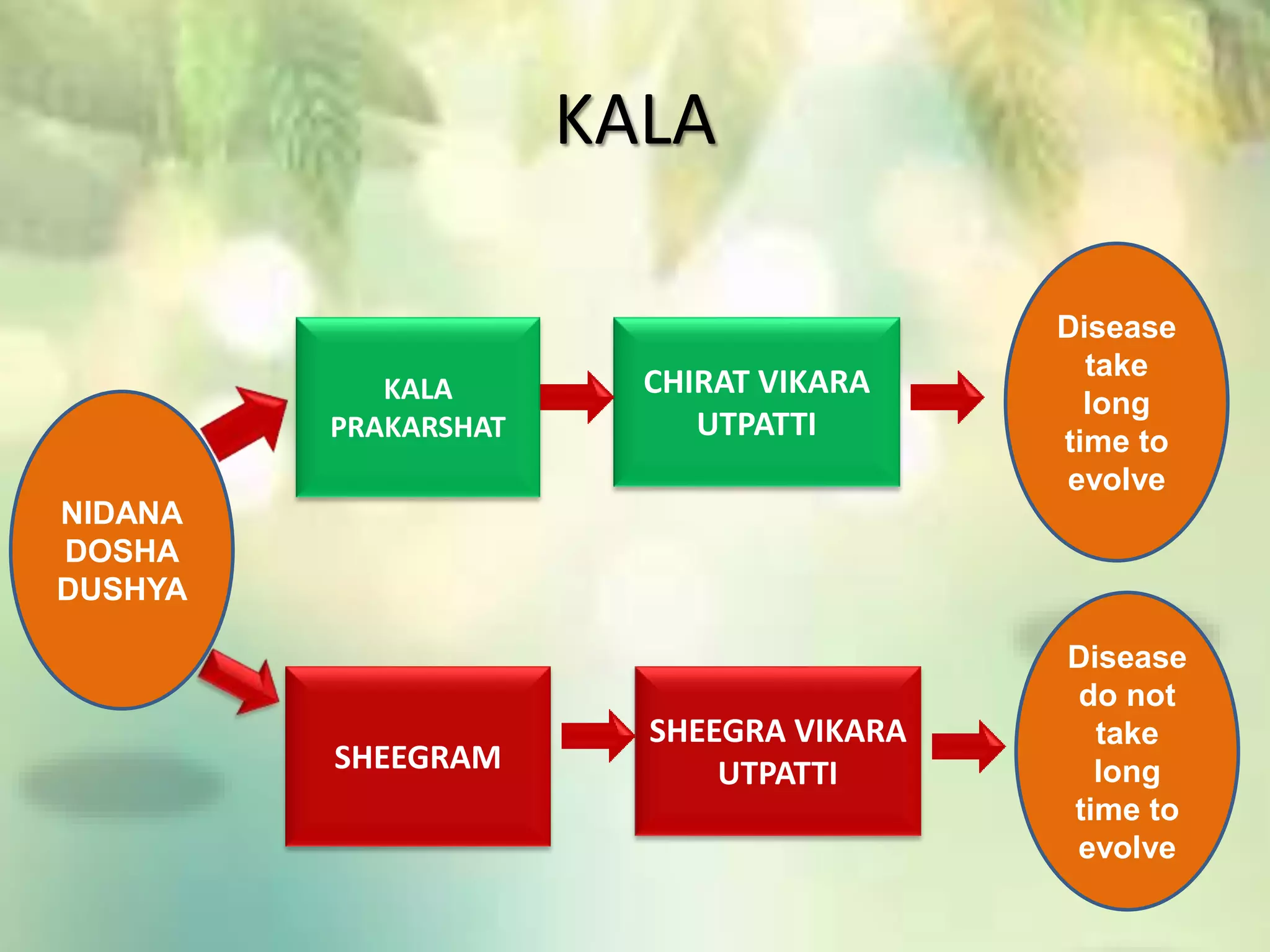
KALA
SHEEGRAM
NIDANA
DOSHA
DUSHYA
KALA
PRAKARSHAT
CHIRAT VIKARA
UTPATTI
SHEEGRA VIKARA
UTPATTI
Disease
take
long
time to
evolve
Disease
do not
take
long
time to
evolve
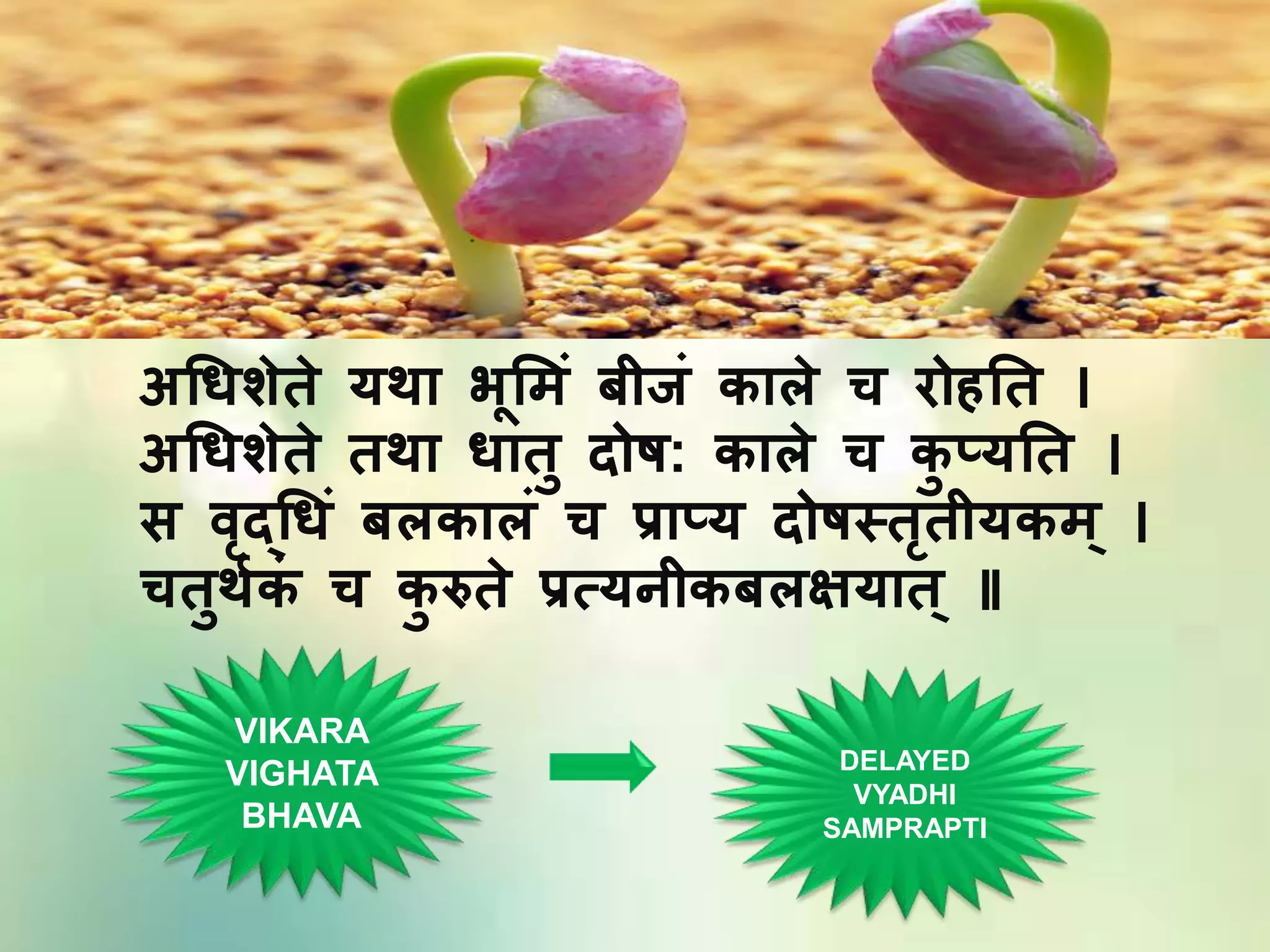
Kaalaprakarshat Anubadhnanti
Nidana when consumed at different gaps then it will lead to
delayed manifestation of disease
Eg: Chardi Vegadarana leading to Kushta.
VIKARA
VIGHATA
BHAVA
DELAYED
VYADHI
SAMPRAPTI
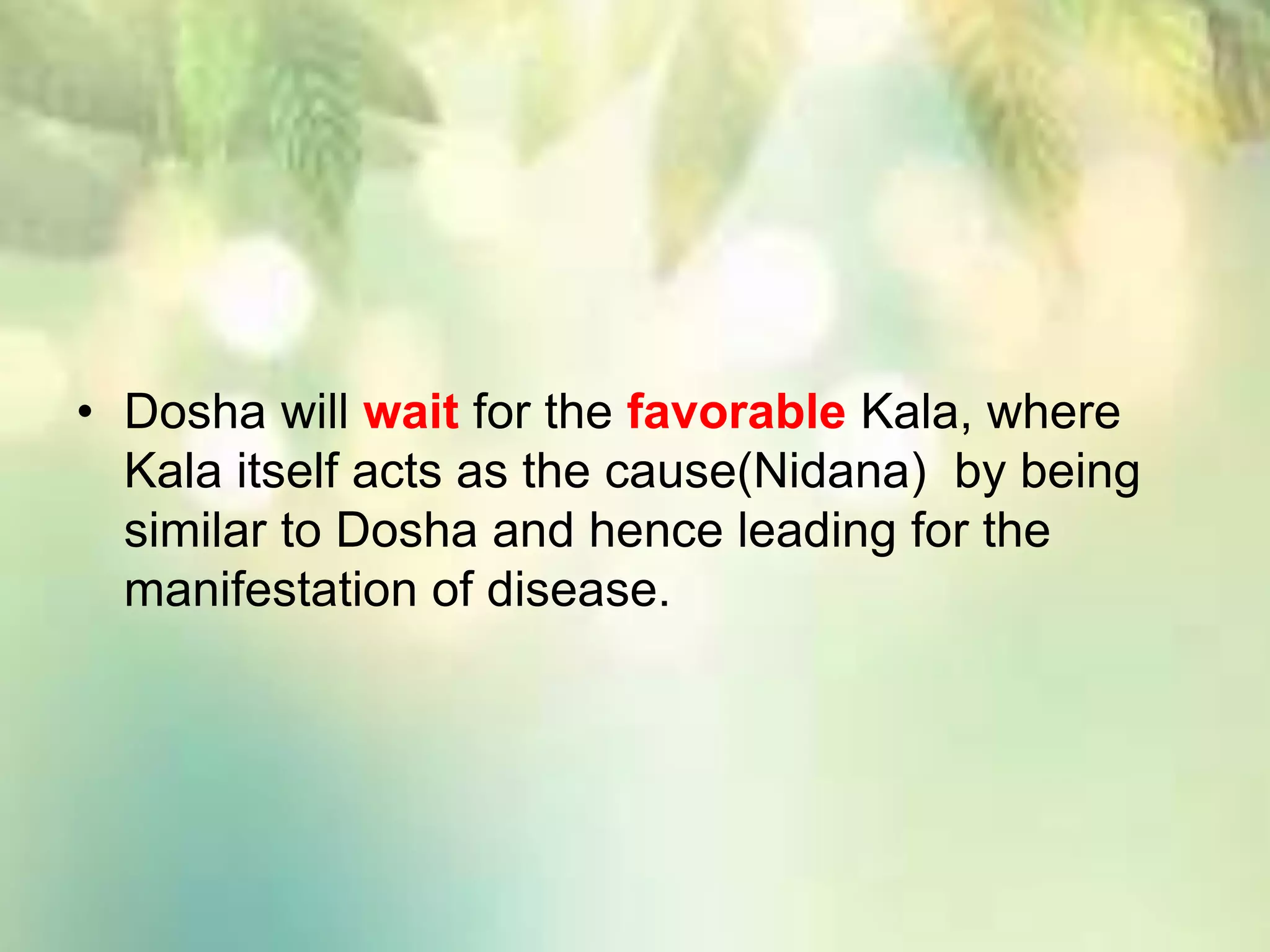
• Dosha will wait for the favorable Kala, where
Kala itself acts as the cause(Nidana) by being
similar to Dosha and hence leading for the
manifestation of disease.
अधिशेते यथा भूम िं बीजिं काले च रोहतत ।
अधिशेते तथा िातु दोष: काले च कु प्यतत ।
स वृदधििं बलकालिं च प्राप्य दोषस्तृतीयक ।
चतुथथकिं च कु रुते प्रत्यनीकबलक्षयात ॥
VIKARA
VIGHATA
BHAVA
DELAYED
VYADHI
SAMPRAPTI
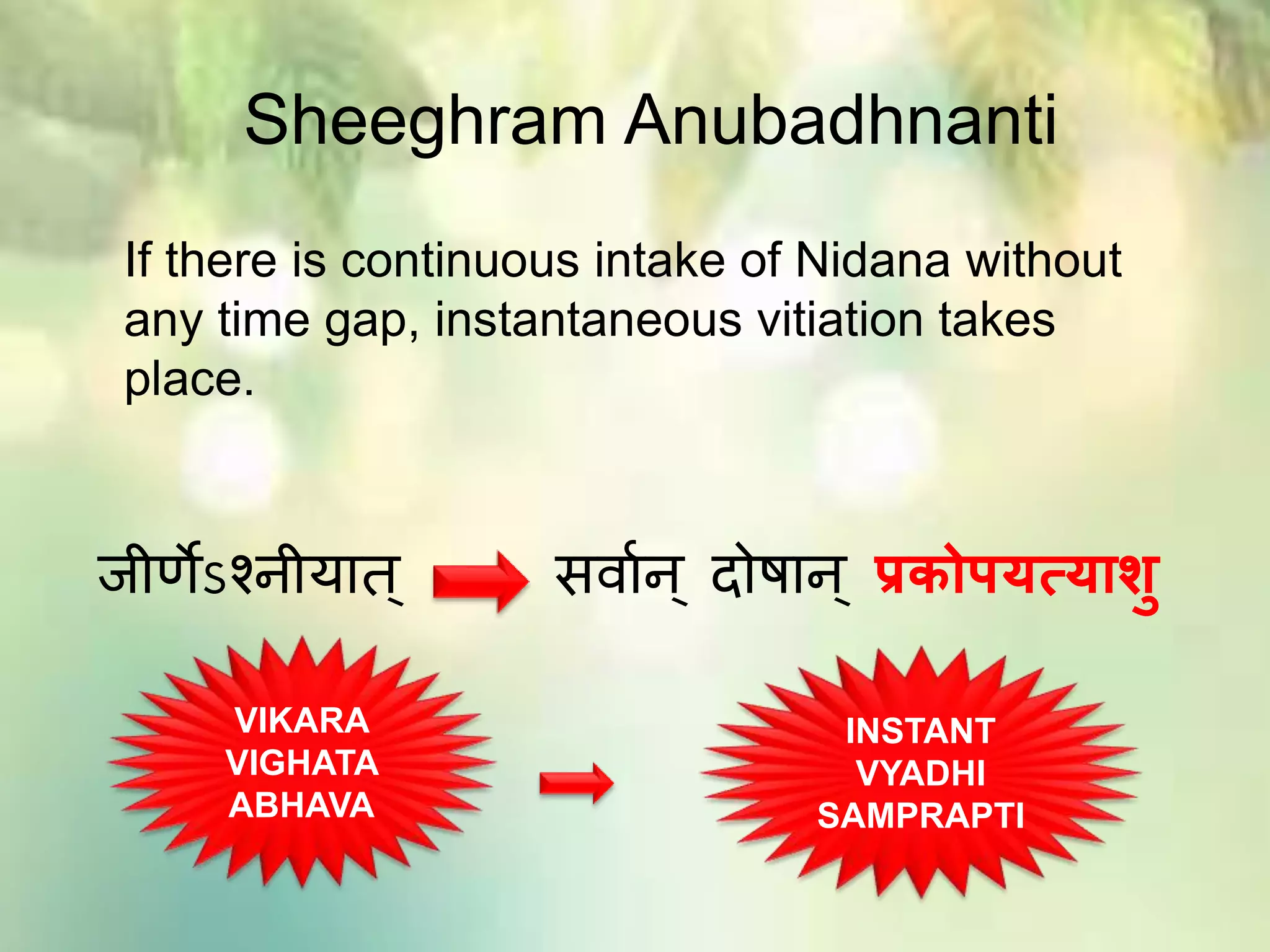
Sheeghram Anubadhnanti
If there is continuous intake of Nidana without
any time gap, instantaneous vitiation takes
place.
जीणेऽश्िीयात् सिाति् दोषाि् प्रकोतयत्याशु
VIKARA
VIGHATA
ABHAVA
INSTANT
VYADHI
SAMPRAPTI
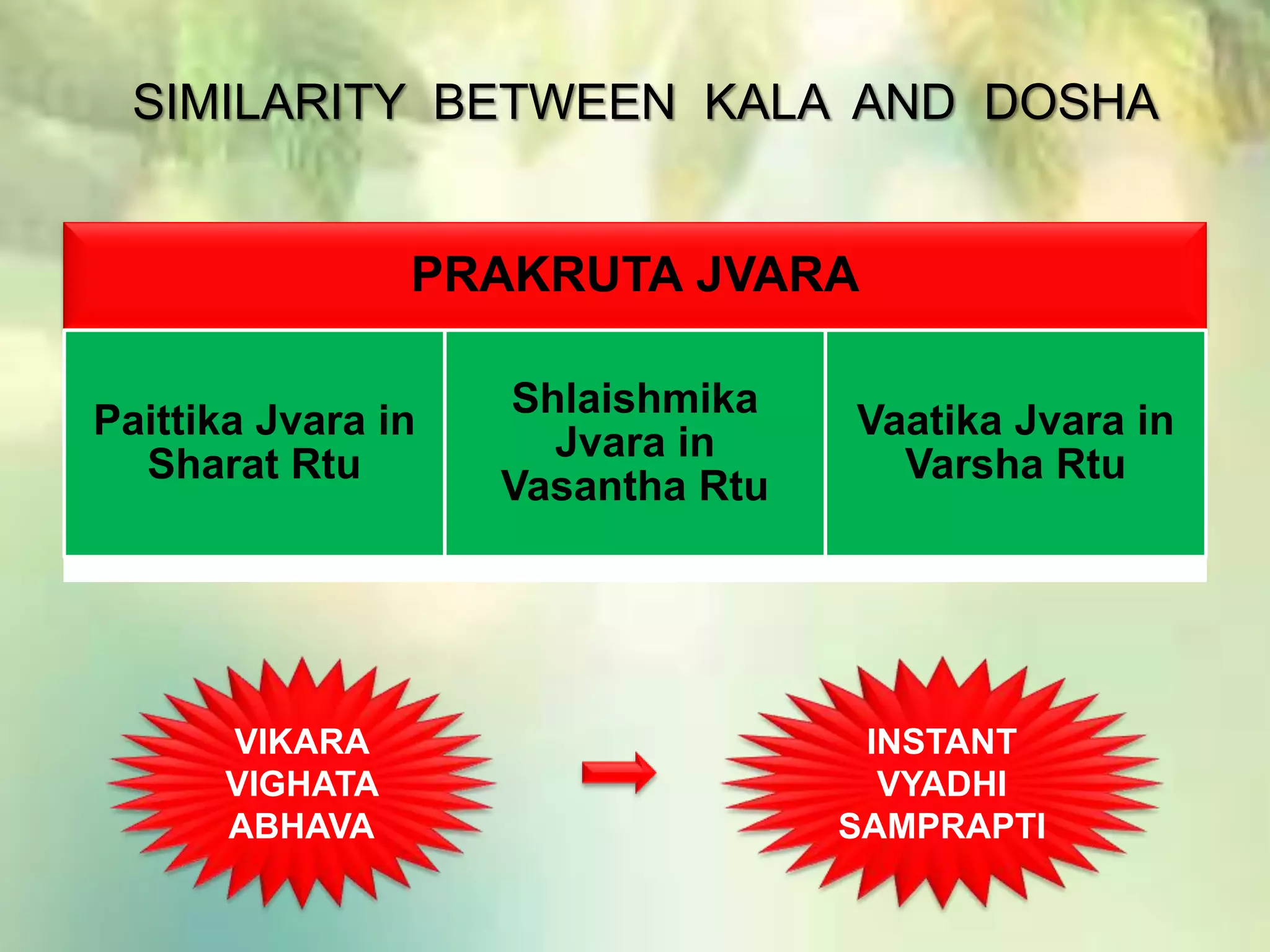
SIMILARITY BETWEEN KALA AND DOSHA
PRAKRUTA JVARA
Paittika Jvara in
Sharat Rtu
Shlaishmika
Jvara in
Vasantha Rtu
Vaatika Jvara in
Varsha Rtu
VIKARA
VIGHATA
ABHAVA
INSTANT
VYADHI
SAMPRAPTI
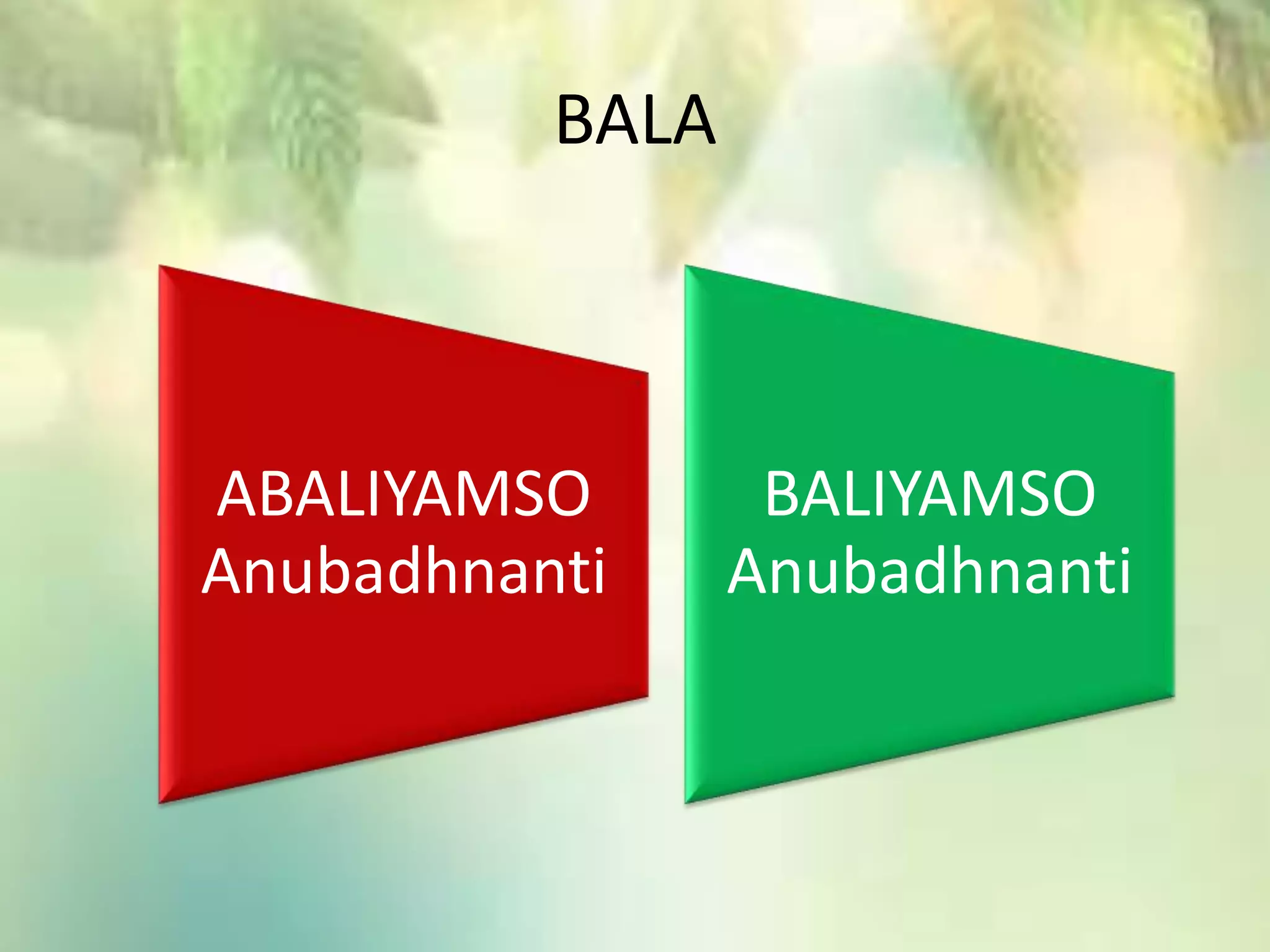
BALA
ABALIYAMSO
Anubadhnanti
BALIYAMSO
Anubadhnanti
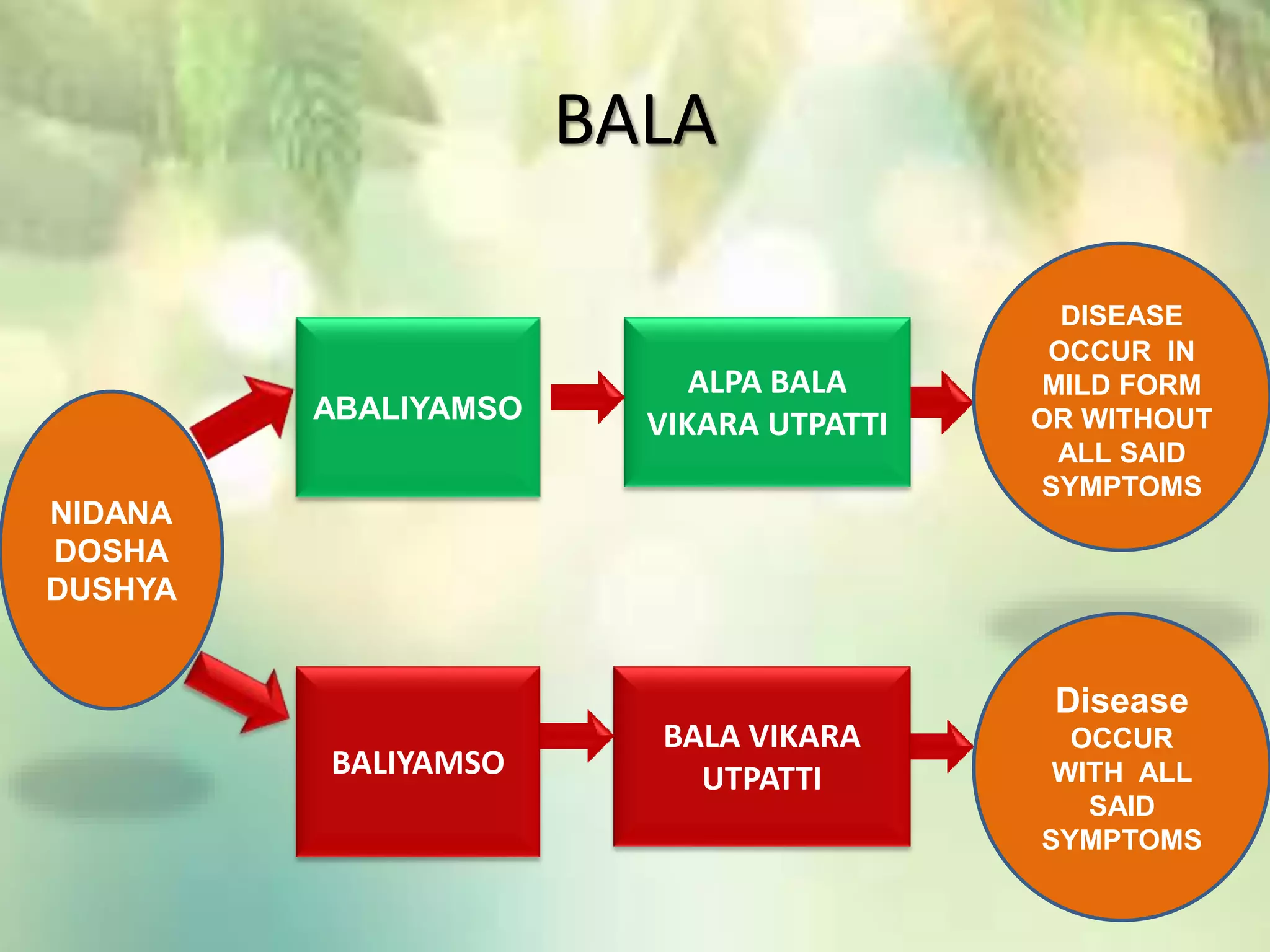
BALA
BALIYAMSO
NIDANA
DOSHA
DUSHYA
ABALIYAMSO
ALPA BALA
VIKARA UTPATTI
BALA VIKARA
UTPATTI
DISEASE
OCCUR IN
MILD FORM
OR WITHOUT
ALL SAID
SYMPTOMS
Disease
OCCUR
WITH ALL
SAID
SYMPTOMS
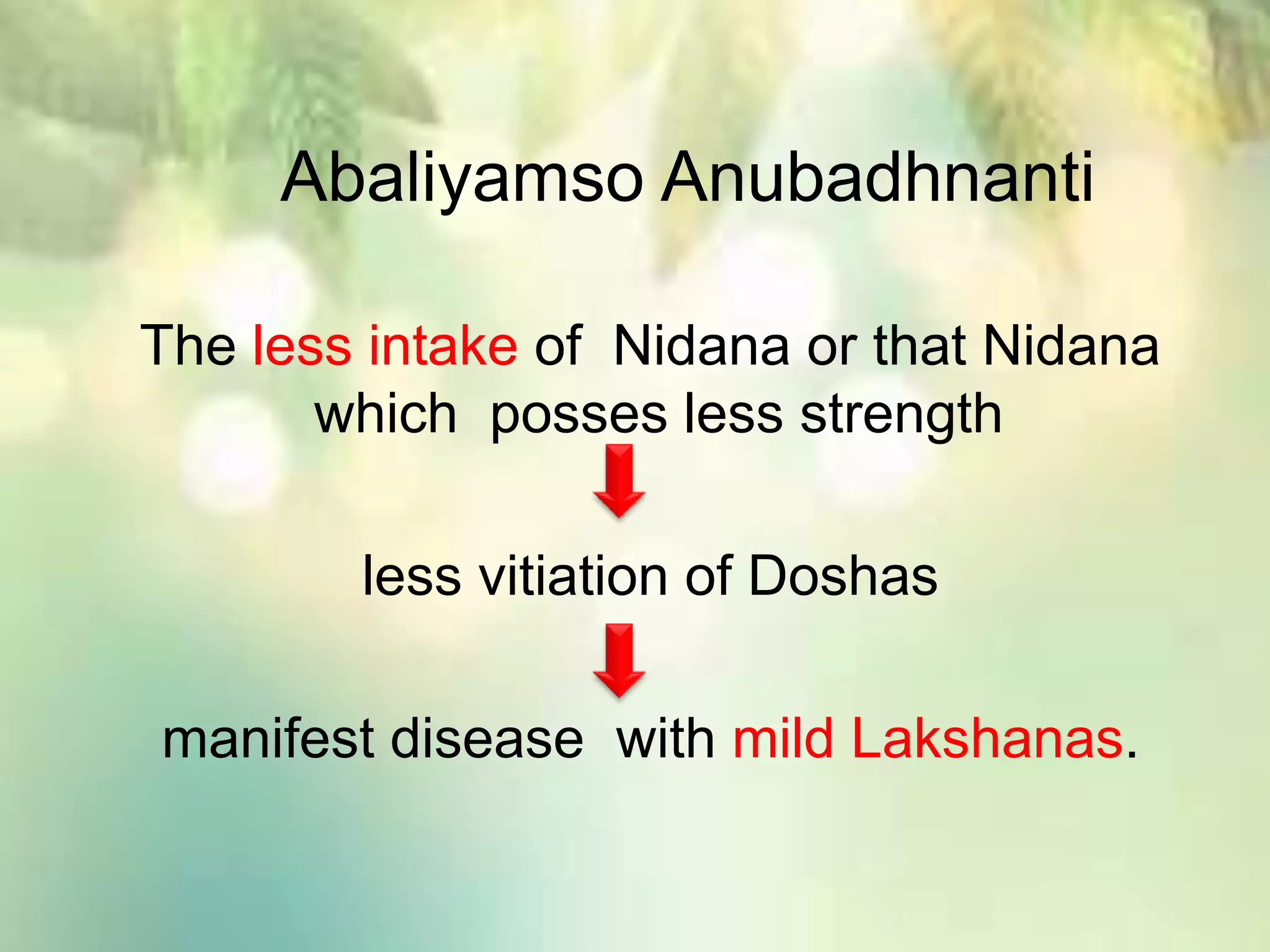
Abaliyamso Anubadhnanti
The less intake of Nidana or that Nidana
which posses less strength
less vitiation of Doshas
manifest disease with mild Lakshanas.
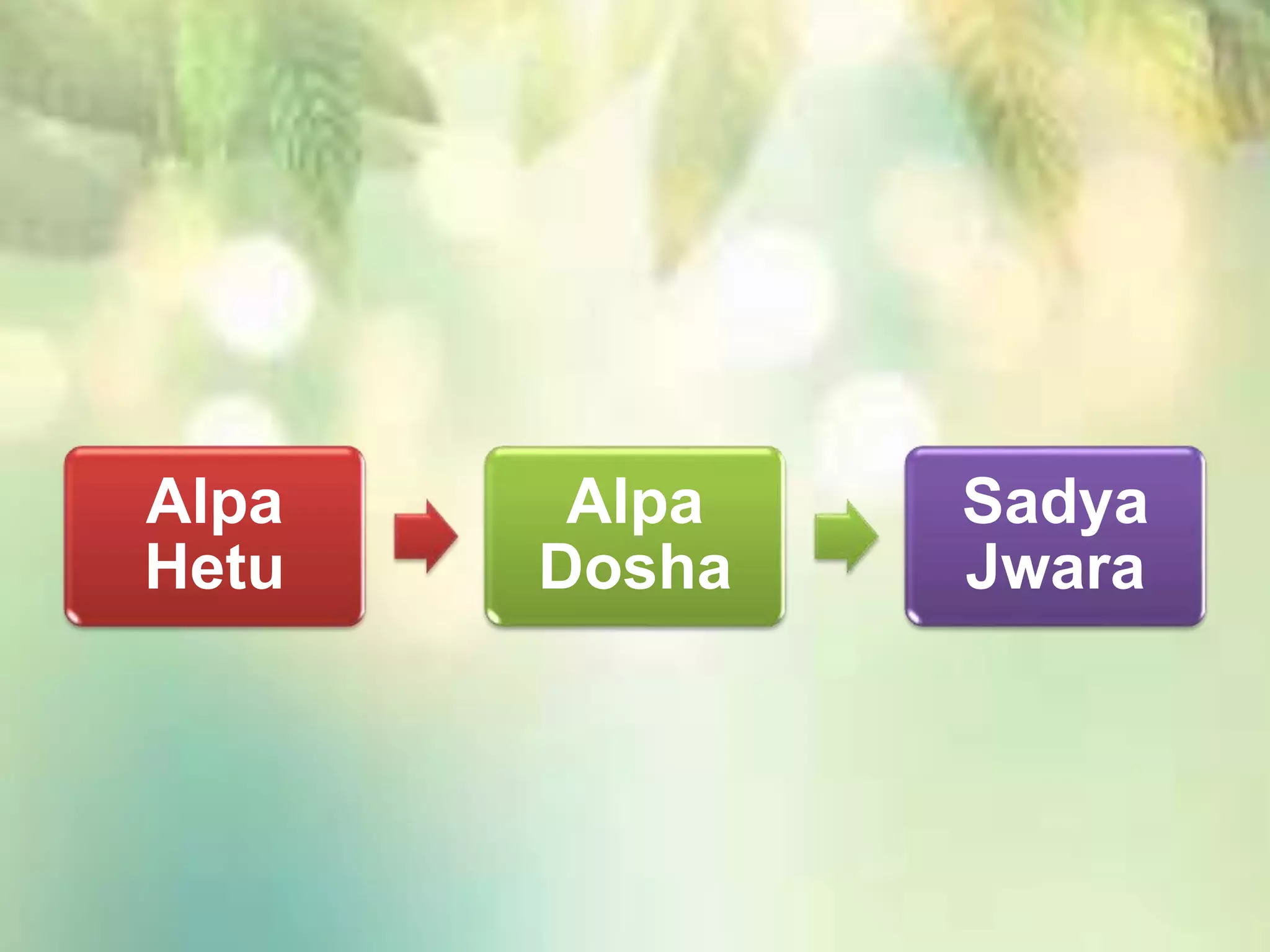
Alpa
Hetu
Alpa
Dosha
Sadya
Jwara
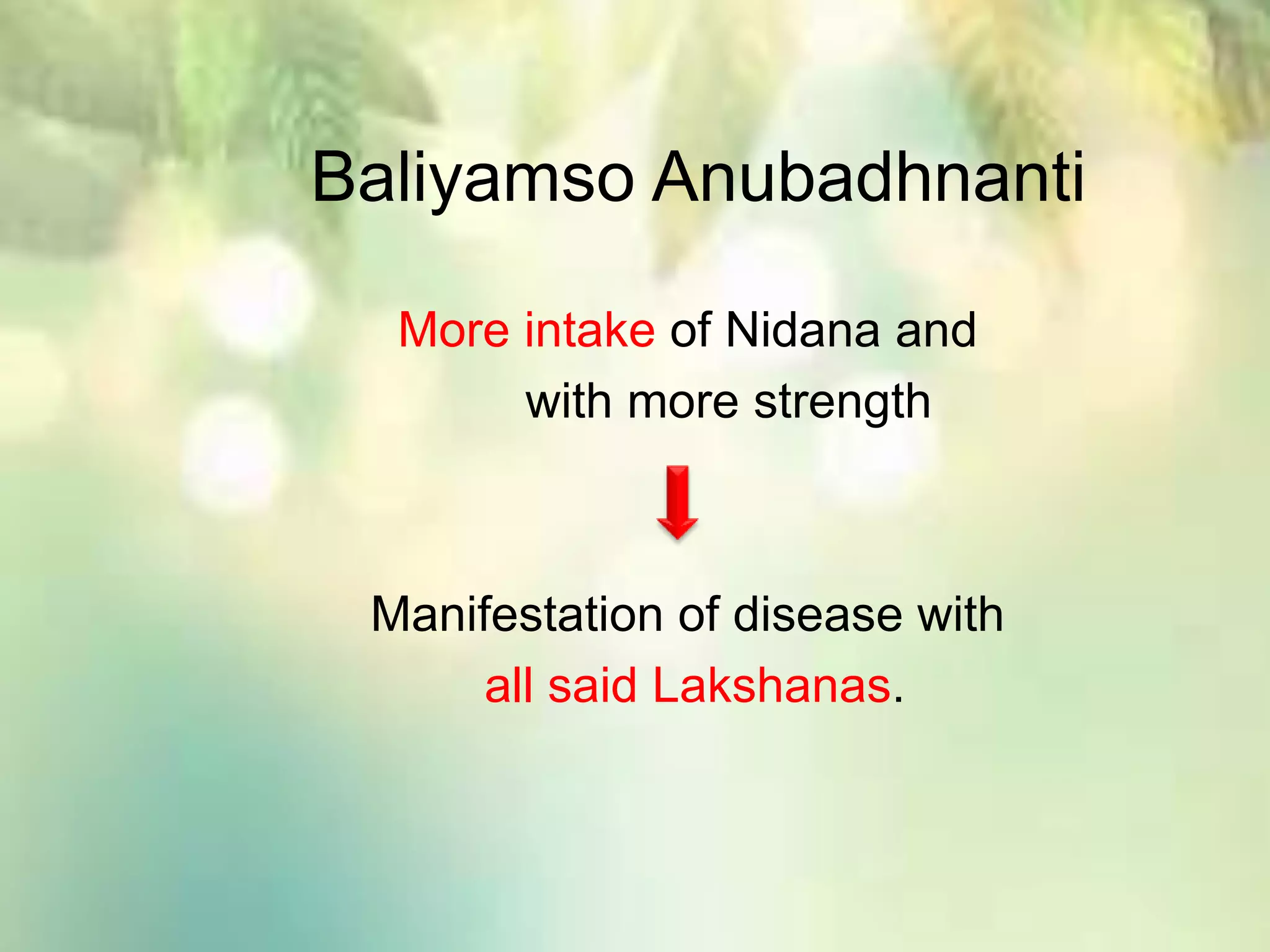
Baliyamso Anubadhnanti
More intake of Nidana and
with more strength
Manifestation of disease with
all said Lakshanas.
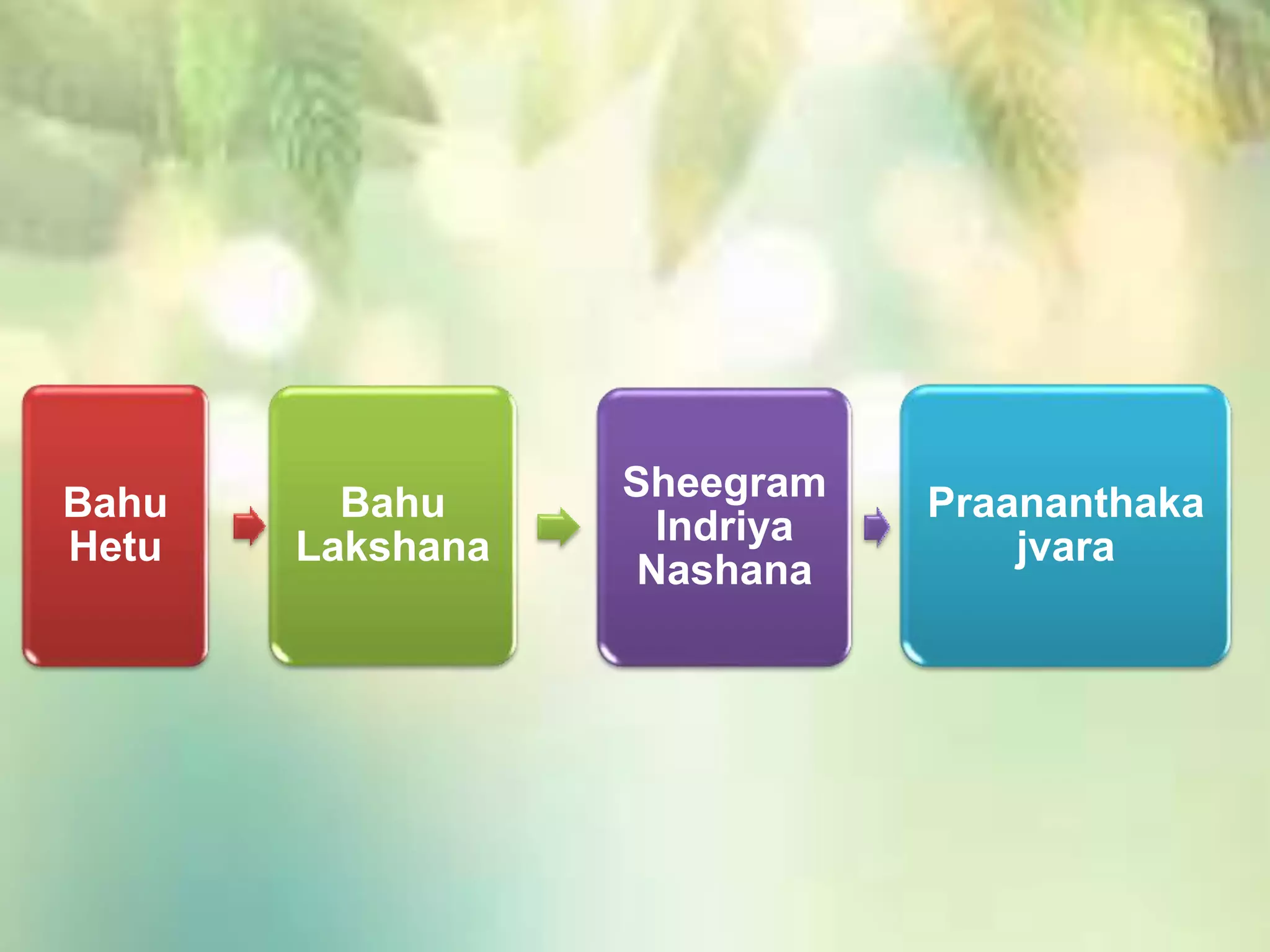
Bahu
Hetu
Bahu
Lakshana
Sheegram
Indriya
Nashana
Praananthaka
jvara
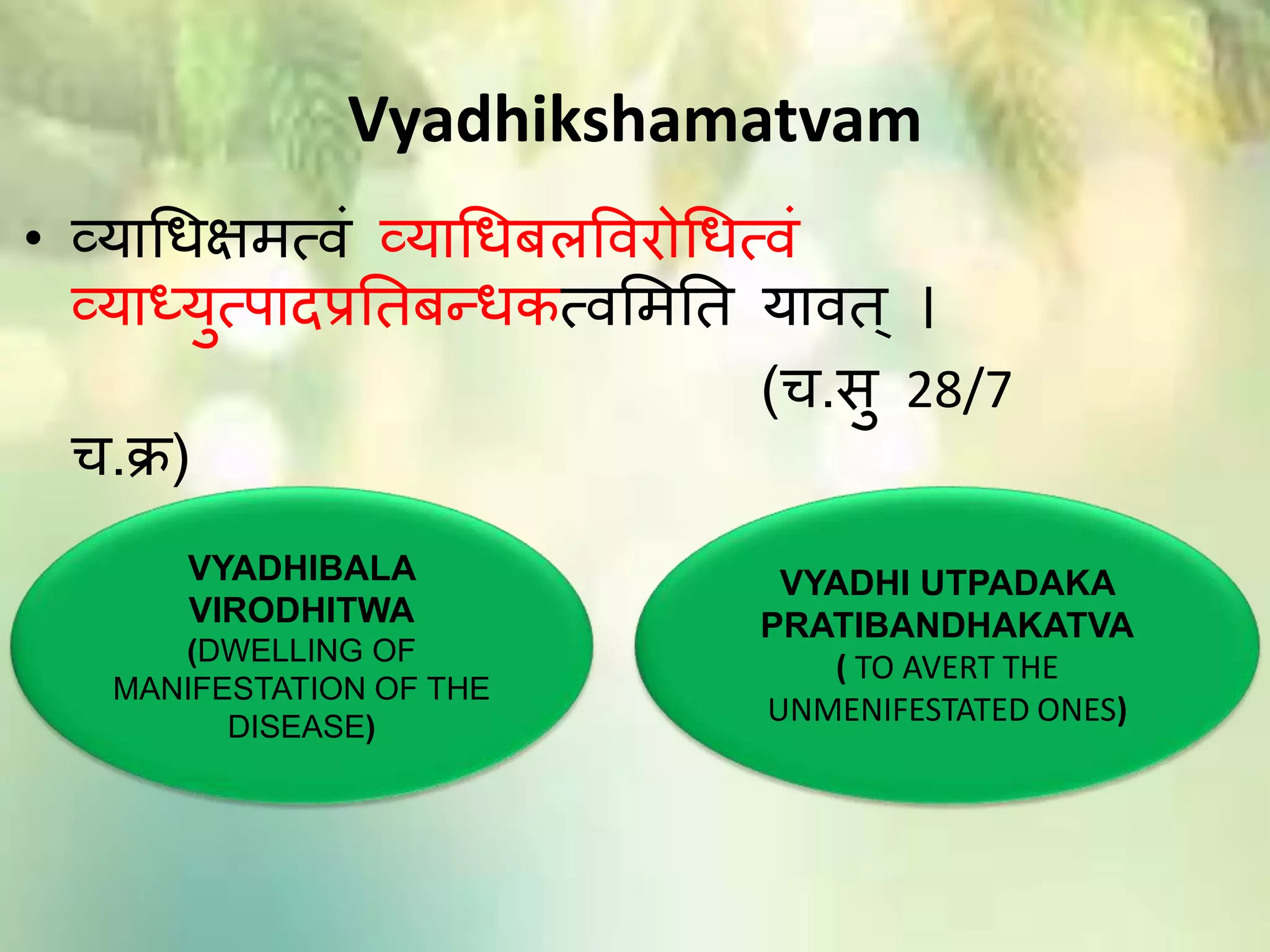
Vyadhikshamatvam
• व्याथधक्षित्िां व्याथधबिविरोथधत्िां
व्याध्युत्पादप्रततबन्धकत्िमितत याित् ।
(च.सु 28/7
च.क्र)
VYADHIBALA
VIRODHITWA
(DWELLING OF
MANIFESTATION OF THE
DISEASE)
VYADHI UTPADAKA
PRATIBANDHAKATVA
( TO AVERT THE
UNMENIFESTATED ONES)
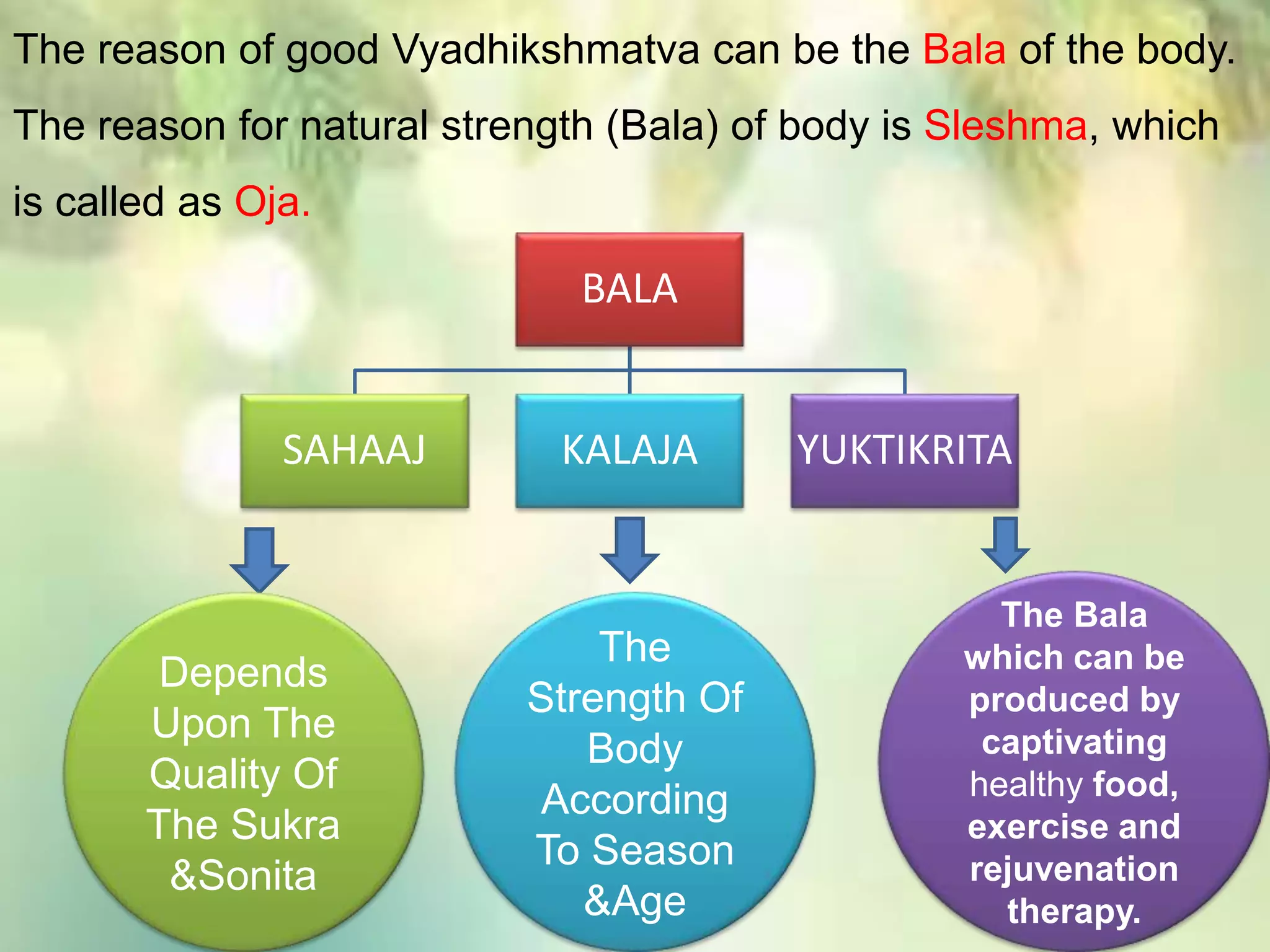
BALA
SAHAAJ KALAJA YUKTIKRITA
Depends
Upon The
Quality Of
The Sukra
&Sonita
The
Strength Of
Body
According
To Season
&Age
The Bala
which can be
produced by
captivating
healthy food,
exercise and
rejuvenation
therapy.
The reason of good Vyadhikshmatva can be the Bala of the body.
The reason for natural strength (Bala) of body is Sleshma, which
is called as Oja.
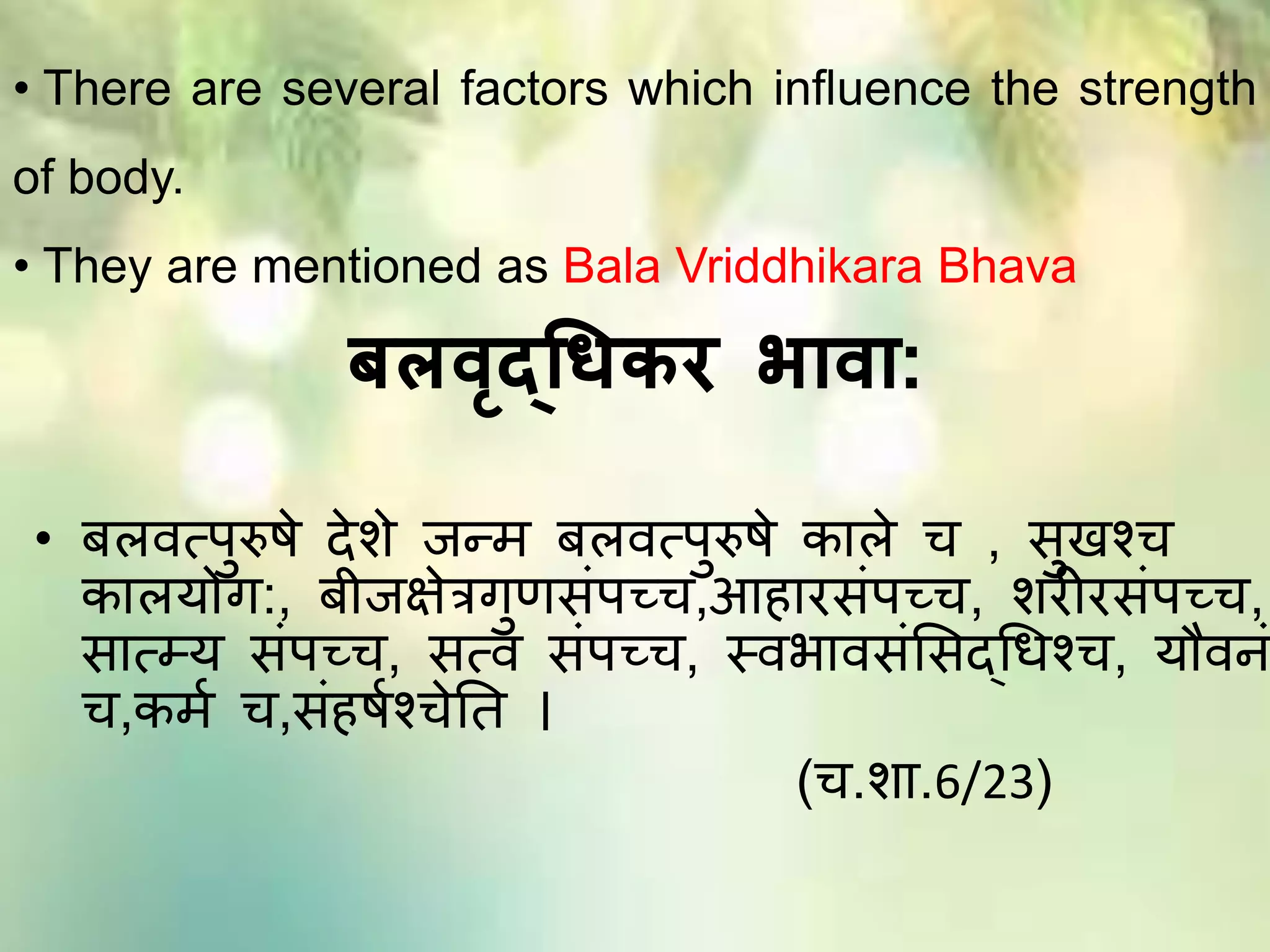
बलवृदधिकर भावा:
• बिित्पुरुषे देिे जन्ि बिित्पुरुषे कािे च , सुखश्च
काियोग:, बीजक्षेत्रगुणसांपच्च,आहारसांपच्च, िरीरसांपच्च,
सात््य सांपच्च, सत्ि सांपच्च, स्िभािसांमसद्थधश्च, यौिि
च,कित च,सांहषतश्चेतत ।
(च.िा.6/23)
• There are several factors which influence the strength
of body.
• They are mentioned as Bala Vriddhikara Bhava
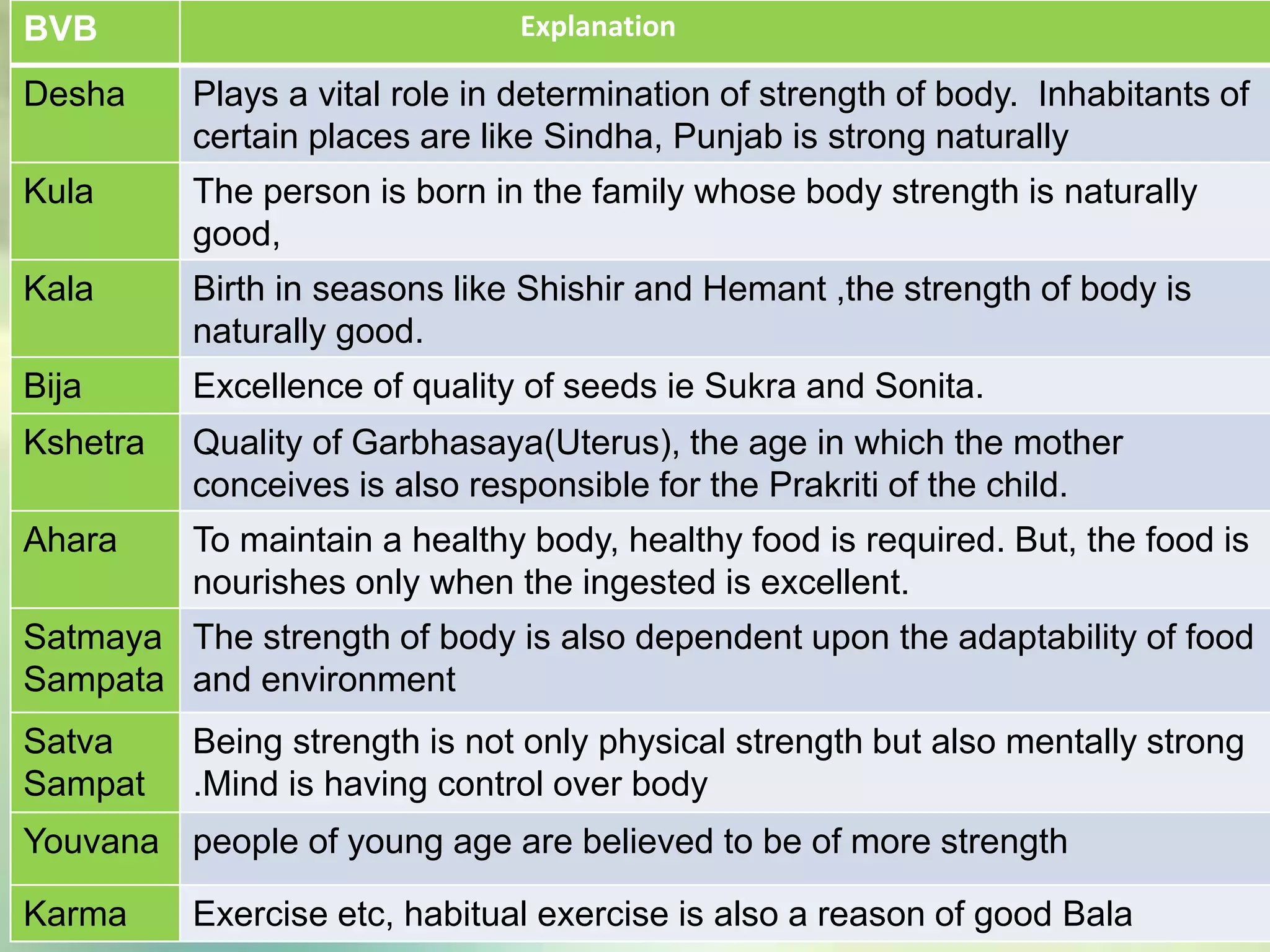
BVB Explanation
Desha Plays a vital role in determination of strength of body. Inhabitants of
certain places are like Sindha, Punjab is strong naturally
Kula The person is born in the family whose body strength is naturally
good,
Kala Birth in seasons like Shishir and Hemant ,the strength of body is
naturally good.
Bija Excellence of quality of seeds ie Sukra and Sonita.
Kshetra Quality of Garbhasaya(Uterus), the age in which the mother
conceives is also responsible for the Prakriti of the child.
Ahara To maintain a healthy body, healthy food is required. But, the food is
nourishes only when the ingested is excellent.
Satmaya
Sampata
The strength of body is also dependent upon the adaptability of food
and environment
Satva
Sampat
Being strength is not only physical strength but also mentally strong
.Mind is having control over body
Youvana people of young age are believed to be of more strength
Karma Exercise etc, habitual exercise is also a reason of good Bala
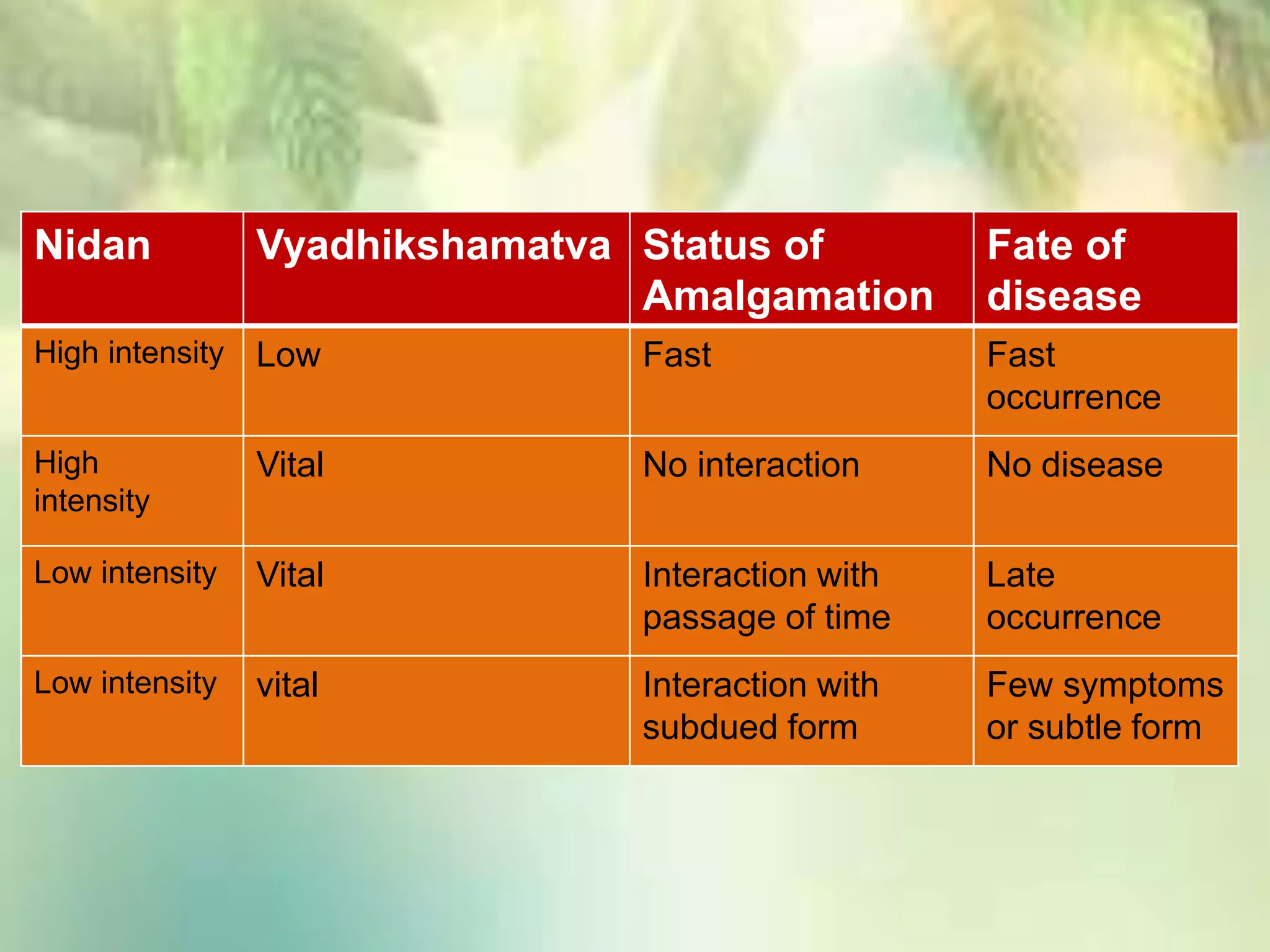
Nidan Vyadhikshamatva Status of
Amalgamation
Fate of
disease
High intensity Low Fast Fast
occurrence
High
intensity
Vital No interaction No disease
Low intensity Vital Interaction with
passage of time
Late
occurrence
Low intensity vital Interaction with
subdued form
Few symptoms
or subtle form
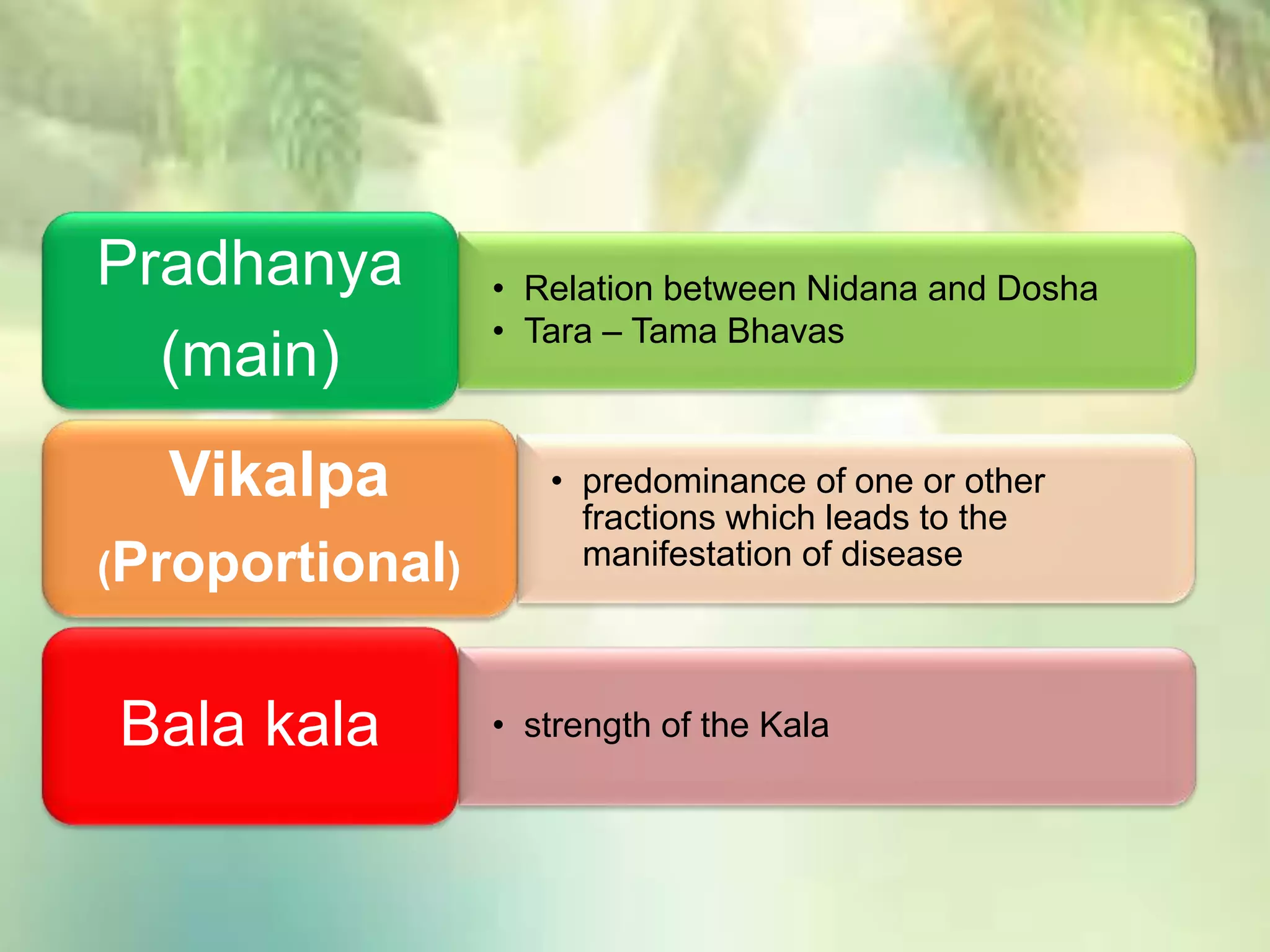
• Relation between Nidana and Dosha
• Tara – Tama Bhavas
Pradhanya
(main)
• predominance of one or other
fractions which leads to the
manifestation of disease
Vikalpa
(Proportional)
• strength of the KalaBala kala
Nidana
Dhatu
ShaithilyaVitiates Dosha
Dosha Dushya Sammurchana
SOME HYPOTHETICAL CLINICAL
CONDITIONS
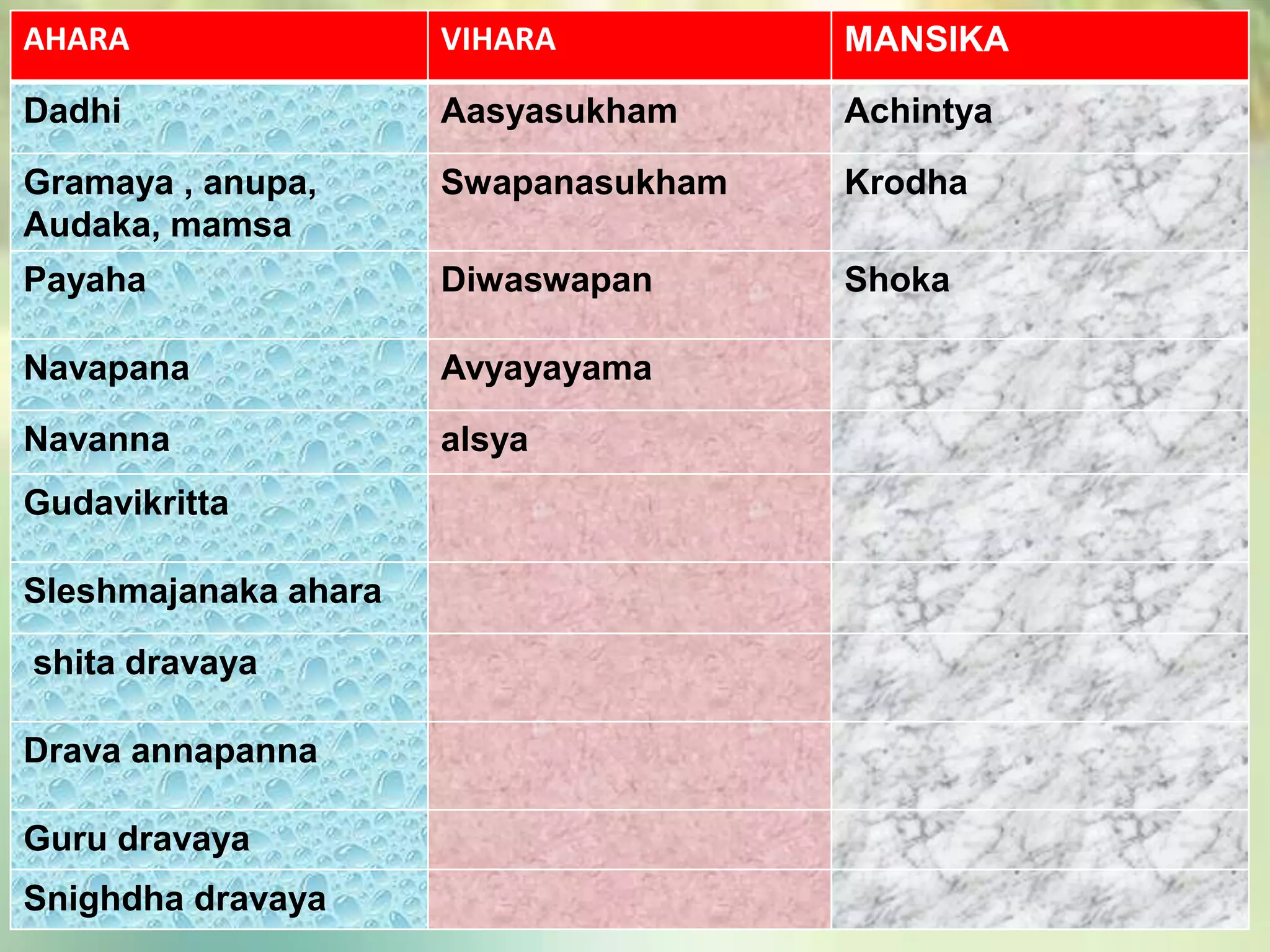
AHARA VIHARA MANSIKA
Dadhi Aasyasukham Achintya
Gramaya , anupa,
Audaka, mamsa
Swapanasukham Krodha
Payaha Diwaswapan Shoka
Navapana Avyayayama
Navanna alsya
Gudavikritta
Sleshmajanaka ahara
shita dravaya
Drava annapanna
Guru dravaya
Snighdha dravaya
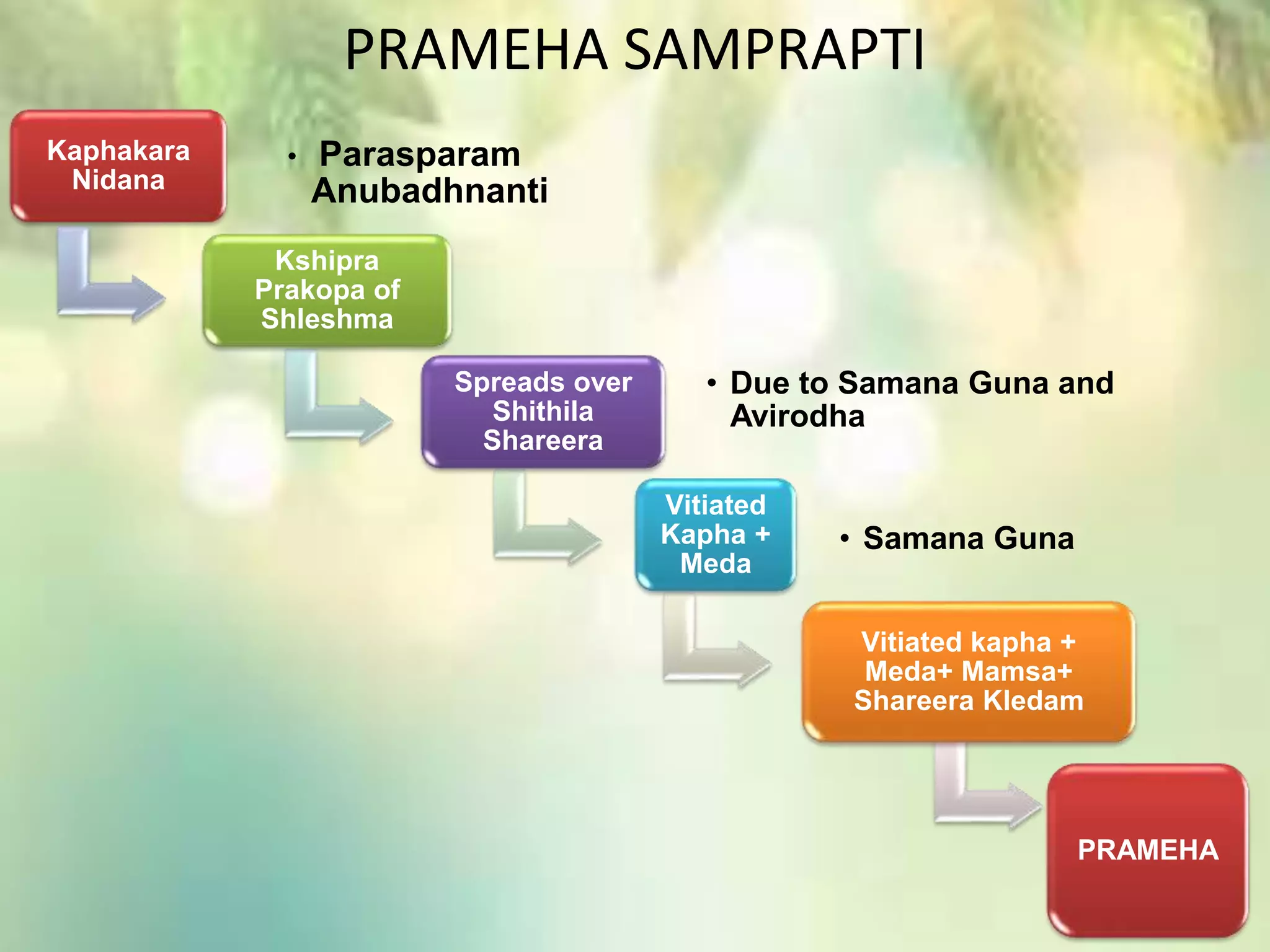
PRAMEHA SAMPRAPTI
Kaphakara
Nidana
• Parasparam
Anubadhnanti
Kshipra
Prakopa of
Shleshma
Spreads over
Shithila
Shareera
• Due to Samana Guna and
Avirodha
Vitiated
Kapha +
Meda
• Samana Guna
Vitiated kapha +
Meda+ Mamsa+
Shareera Kledam
PRAMEHA
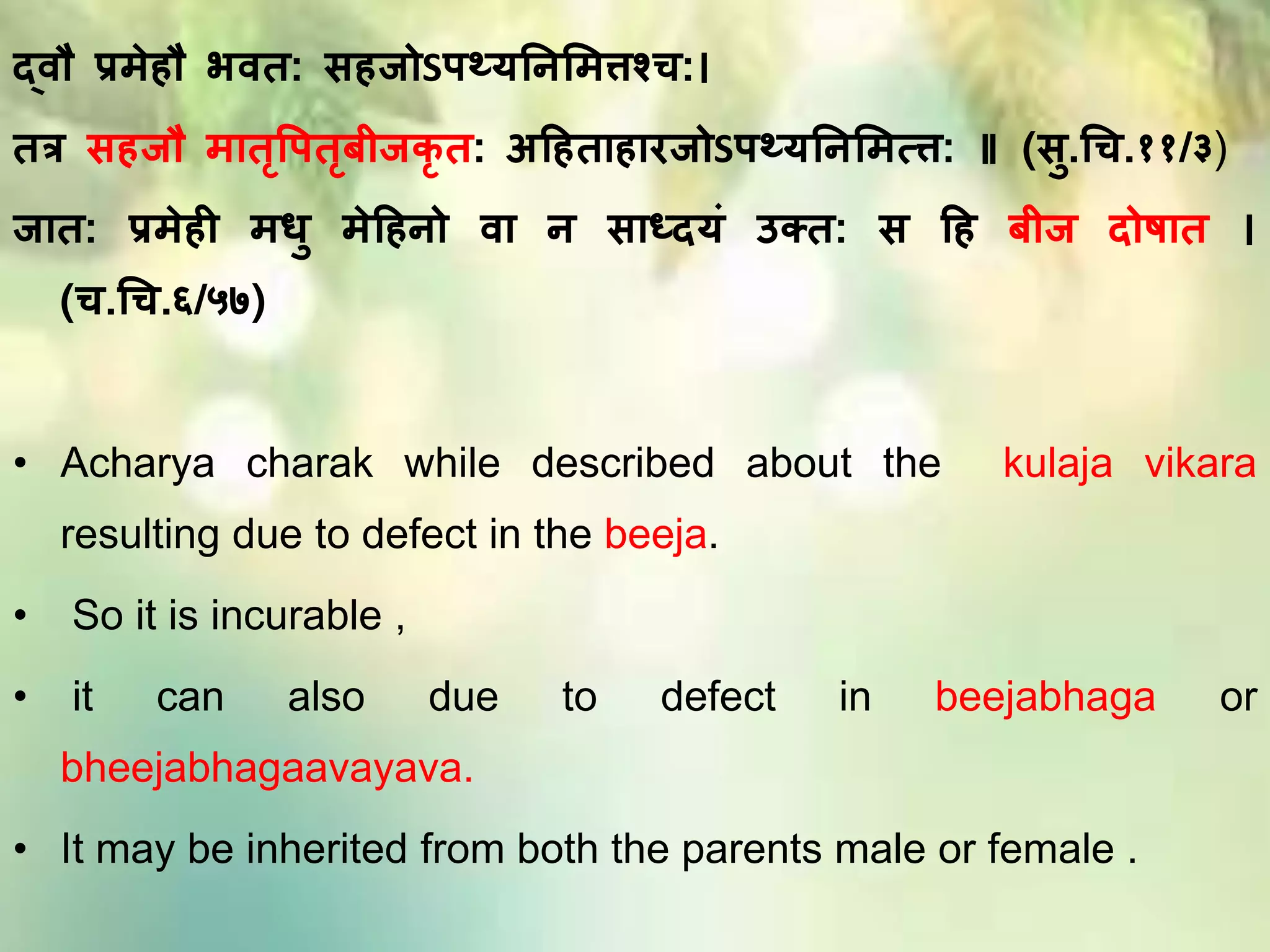
दवौ प्र ेहौ भवत: सहजोSतथ्यतनम त्तश्च:।
तत्र सहजौ ातृपततृबीजकृ त: अहहताहारजोSतथ्यतनम त्त्त: ॥ (सु.धच.११/३)
जात: प्र ेही िु ेहहनो वा न साध्दयिं उक्त: स हह बीज दोषात ।
(च.धच.६/५७)
• Acharya charak while described about the kulaja vikara
resulting due to defect in the beeja.
• So it is incurable ,
• it can also due to defect in beejabhaga or
bheejabhagaavayava.
• It may be inherited from both the parents male or female .
CONCLUSION
• Nidana, Dosha, Dushya possessing Samana Guna
and in the presence of Avirodha Bhava will allow the
Vyadhi Samprapti to progress.
• Nidana, Dosha, Dushya possessing Asamana Guna
and in the presence of Virodha Bhava will hinder the
process of Vyadhi Samprapti.
• Intake of Nidana with time gap, will lead to delay in
Vyadhi Samprapti and vice versa.
• Bala of the Vishesha will decide the
manifestation of mild or severe disease.
• Vishesha along with the Prativishesha are
responsible for the variations in the Vyadhi
Samprapti in terms of onset, progress and
severity.
PREVIOUS RESEARCH WORK
• Nidana Dosha Dooshya Visheshyebhyo
Vikara- Vighata Bhavaabhava
Prativishesha Bhavanti – ke pariprekshya
mein avasada roga ka adhyayana.
Sharma.N.N – Jaipur- 1995.
REFERENCES
• Acharya JT. Charaka Samhita of Agnivesa, Reprint ed. Varanasi:
Chaukhamba Surbharati Prakashan; 2011.p.10.
• Acharya JT. Charaka Samhita of Agnivesa, Reprint ed. Varanasi:
Chaukhamba Surbharati Prakashan; 2011.p.178.
• Acharya JT. Charaka Samhita of Agnivesa, Reprint ed. Varanasi:
Chaukhamba Surbharati Prakashan; 2011.p.212.
• Acharya JT. Charaka Samhita of Agnivesa, Reprint ed. Varanasi:
Chaukhamba Surbharati Prakashan; 2011.p.228.
• Acharya JT. Susruta Samhita of Susruta, Nibandhasangraha of
Dalhana, Reprint ed. Varanasi: Chaukhambha Surbharati
prakashan; 2012.p.823.
Vikara vikatha Bhava Abhava(OCCURRENCE AND NON-OCCURRENCE OF DISEASE)

Vikara vikatha Bhava Abhava(OCCURRENCE AND NON-OCCURRENCE OF DISEASE)

  • 1.
  • 2.
    THE VIKARA VIGHATA-BHAVA-ABHAVA- PRATIVISHESHAIN PRAMEHA Presenter: Guide: Dr. Meenakshi verma Dr. N.J Trivedi 2nd year PG Scholar DEPARTMENT OF KAYACHIKITSA
  • 3.
    AIM • To understandthe concept of “Vikara Vighata Bhava Abhava Prativishesha”. • To understand the influence of Vikara Vighata Bhava Abhava Prativishesha in Vyadhi Samprapti.
  • 4.
    OBJECTIVES • To seethe inter relation between the Visheshas and Prativisheshas. • To critically analyse the mechanism influencing the Vishesha and Prativishesha. • To illustrate this concept with certain hypothetical clinical conditions.
  • 5.
    OBJECTIVES • To definethe concept “Vikara Vighata Bhava Abhava Prativishesha”. • To define the terms –Vighata Bhava, Vighata Bhava Abhava, Vishesha, Prativishesha. • To enlist Visheshas • To enlist Prativishesha
  • 6.
    • NIDANA • DOSHA •DUSHYA • These three components are require for occurrence of all disease. • These are interconnected to each other.
  • 7.
    • Limited numberof entities – Dosha , Dushya etc • Innumerable diseases • Variation in the Samprapti. • Need to analyze the various factors affecting the Vyadhi Samprapti.
  • 8.
    • Certain factorswhich helps for the Vyadhi Samprapti • Certain factors which hinder or delay the Vyadhi Samprapti. VIKARA VIGHATA ABHAVA VIKARA VIGHATA BHAVA
  • 9.
  • 10.
    VIKARA VIGHATA BHAVA विकाराणाांविघातस्य उत्पविप्रततबन्धस्य भािो विघातभाि:। (च.ति 4/4 चक्र.) • Factors that hinders the manifestation of diseases. • This is also called vikar anutpattikar bhav. • In other word the factor which is opposite of the cause which is responsible for the disease.
  • 11.
  • 12.
    VIKARA VIGHATA ABHAVA विकाराणाांविघातस्य अभािो विकारजििमितत विकारविघातभाि अभाि । (च.ति 4/4 चक्र.) • Absence of the factors that hinders or delay the manifestation of disease. • Etiological factors having homologous properties as Dosha interact with them quickly leading to manifestation or aggravation of disease. • When Vyadhi Utpadakar Bhava are present in the body then it will produce the disease.
  • 13.
  • 14.
    Vishesha : Thespecific factors which involve in the Vyadhi Samprapti. NIDANA DOSHA DUSHYA
  • 15.
    Prativishesha : Theseare the outcome produced by the influence of Vishesha. VIKARA VIGHATAKARA BHAVA NA VIKARA UTPATTI CHIRAT VIKARA UTPATTI ALPA BALA VIKARA UTPATTI VIKARA VIGHATAKARA ABHAVA VIKARA UTPATTI SHEEGRA VIKARA UTPATTI BALA VIKARA UTPATTI
  • 16.
    VIKARA VIGHATA BHAVAABHAVA PRATIVISHESHA ANUBADHNANTI KALA BALA
  • 17.
  • 18.
    ANUBADHNANTI PARASPARAM ANUBADHNANTI ( Mutually associated) NIDANA DOSHA DUSHYA PARASPARAM NA ANUBADHNANTI (Donot mutually associated) NA VIKARA UTPATTI VIKARA UTPATTI No manifestation of the disease at all Manifestation of the disease occur
  • 19.
    Parasparam Anubadhnanti • TheAnukula between Nidana Dosha Dushya • Samana guna • Dhatu Shaithilyata • Avirodha
  • 20.
  • 21.
  • 22.
    How shithilatha ofDhathu occur? Intake of Gramyahara Amla lavana katu kshara shushka kshara sevana Shushka shaaka, mamsa, tila palala, pishtanna bhojana Viruda nava shuka ,shamidhanya, avirudha asatmya ruksha, kshara, abhishyandha bhojana
  • 23.
    • मिथिमि भिन्न्तिाांस •वििुच्यतेसन्न्ध • विदह्यतेरक्तां • विष्यन्दतेअिल्पां िेदः • ि सन्धीयतेअन्स्ि,िज्ज • ि प्रितततेिुक्रां • क्षयओज
  • 24.
    • Absence ofresistance towards the Vyadhi Samprapti. AVIRODHA
  • 25.
    Parasparam Na Anubadhnanti/ Pratikula • No Samanata between the Nidana and Dosha • Nidana is not capable of creating Shithilata in Dushya • Presence of Virodha Bhava.
  • 26.
    • Dissimilarity between Nidana,Dosha and DushyaASAMANATA
  • 27.
    No Dhatu Shaithilya Intakeof Nidana No Dhatu Shaithilya
  • 28.
    • Presence ofresistance towards the Vyadhi Samprapti. VIRODHA
  • 29.
    KALA KALAPRAKARSHAT Anubadhnanti • With gap •Season SHEEGRAM Anubadhnanti • Without gap • Season
  • 30.
  • 31.
    Kaalaprakarshat Anubadhnanti Nidana whenconsumed at different gaps then it will lead to delayed manifestation of disease Eg: Chardi Vegadarana leading to Kushta. VIKARA VIGHATA BHAVA DELAYED VYADHI SAMPRAPTI
  • 32.
    • Dosha willwait for the favorable Kala, where Kala itself acts as the cause(Nidana) by being similar to Dosha and hence leading for the manifestation of disease.
  • 33.
    अधिशेते यथा भूमिं बीजिं काले च रोहतत । अधिशेते तथा िातु दोष: काले च कु प्यतत । स वृदधििं बलकालिं च प्राप्य दोषस्तृतीयक । चतुथथकिं च कु रुते प्रत्यनीकबलक्षयात ॥ VIKARA VIGHATA BHAVA DELAYED VYADHI SAMPRAPTI
  • 34.
    Sheeghram Anubadhnanti If thereis continuous intake of Nidana without any time gap, instantaneous vitiation takes place. जीणेऽश्िीयात् सिाति् दोषाि् प्रकोतयत्याशु VIKARA VIGHATA ABHAVA INSTANT VYADHI SAMPRAPTI
  • 35.
    SIMILARITY BETWEEN KALAAND DOSHA PRAKRUTA JVARA Paittika Jvara in Sharat Rtu Shlaishmika Jvara in Vasantha Rtu Vaatika Jvara in Varsha Rtu VIKARA VIGHATA ABHAVA INSTANT VYADHI SAMPRAPTI
  • 36.
  • 37.
    BALA BALIYAMSO NIDANA DOSHA DUSHYA ABALIYAMSO ALPA BALA VIKARA UTPATTI BALAVIKARA UTPATTI DISEASE OCCUR IN MILD FORM OR WITHOUT ALL SAID SYMPTOMS Disease OCCUR WITH ALL SAID SYMPTOMS
  • 38.
    Abaliyamso Anubadhnanti The lessintake of Nidana or that Nidana which posses less strength less vitiation of Doshas manifest disease with mild Lakshanas.
  • 39.
  • 40.
    Baliyamso Anubadhnanti More intakeof Nidana and with more strength Manifestation of disease with all said Lakshanas.
  • 41.
  • 42.
    Vyadhikshamatvam • व्याथधक्षित्िां व्याथधबिविरोथधत्िां व्याध्युत्पादप्रततबन्धकत्िमिततयाित् । (च.सु 28/7 च.क्र) VYADHIBALA VIRODHITWA (DWELLING OF MANIFESTATION OF THE DISEASE) VYADHI UTPADAKA PRATIBANDHAKATVA ( TO AVERT THE UNMENIFESTATED ONES)
  • 43.
    BALA SAHAAJ KALAJA YUKTIKRITA Depends UponThe Quality Of The Sukra &Sonita The Strength Of Body According To Season &Age The Bala which can be produced by captivating healthy food, exercise and rejuvenation therapy. The reason of good Vyadhikshmatva can be the Bala of the body. The reason for natural strength (Bala) of body is Sleshma, which is called as Oja.
  • 44.
    बलवृदधिकर भावा: • बिित्पुरुषेदेिे जन्ि बिित्पुरुषे कािे च , सुखश्च काियोग:, बीजक्षेत्रगुणसांपच्च,आहारसांपच्च, िरीरसांपच्च, सात््य सांपच्च, सत्ि सांपच्च, स्िभािसांमसद्थधश्च, यौिि च,कित च,सांहषतश्चेतत । (च.िा.6/23) • There are several factors which influence the strength of body. • They are mentioned as Bala Vriddhikara Bhava
  • 45.
    BVB Explanation Desha Playsa vital role in determination of strength of body. Inhabitants of certain places are like Sindha, Punjab is strong naturally Kula The person is born in the family whose body strength is naturally good, Kala Birth in seasons like Shishir and Hemant ,the strength of body is naturally good. Bija Excellence of quality of seeds ie Sukra and Sonita. Kshetra Quality of Garbhasaya(Uterus), the age in which the mother conceives is also responsible for the Prakriti of the child. Ahara To maintain a healthy body, healthy food is required. But, the food is nourishes only when the ingested is excellent. Satmaya Sampata The strength of body is also dependent upon the adaptability of food and environment Satva Sampat Being strength is not only physical strength but also mentally strong .Mind is having control over body Youvana people of young age are believed to be of more strength Karma Exercise etc, habitual exercise is also a reason of good Bala
  • 46.
    Nidan Vyadhikshamatva Statusof Amalgamation Fate of disease High intensity Low Fast Fast occurrence High intensity Vital No interaction No disease Low intensity Vital Interaction with passage of time Late occurrence Low intensity vital Interaction with subdued form Few symptoms or subtle form
  • 48.
    • Relation betweenNidana and Dosha • Tara – Tama Bhavas Pradhanya (main) • predominance of one or other fractions which leads to the manifestation of disease Vikalpa (Proportional) • strength of the KalaBala kala
  • 49.
  • 50.
  • 52.
    AHARA VIHARA MANSIKA DadhiAasyasukham Achintya Gramaya , anupa, Audaka, mamsa Swapanasukham Krodha Payaha Diwaswapan Shoka Navapana Avyayayama Navanna alsya Gudavikritta Sleshmajanaka ahara shita dravaya Drava annapanna Guru dravaya Snighdha dravaya
  • 53.
    PRAMEHA SAMPRAPTI Kaphakara Nidana • Parasparam Anubadhnanti Kshipra Prakopaof Shleshma Spreads over Shithila Shareera • Due to Samana Guna and Avirodha Vitiated Kapha + Meda • Samana Guna Vitiated kapha + Meda+ Mamsa+ Shareera Kledam PRAMEHA
  • 54.
    दवौ प्र ेहौभवत: सहजोSतथ्यतनम त्तश्च:। तत्र सहजौ ातृपततृबीजकृ त: अहहताहारजोSतथ्यतनम त्त्त: ॥ (सु.धच.११/३) जात: प्र ेही िु ेहहनो वा न साध्दयिं उक्त: स हह बीज दोषात । (च.धच.६/५७) • Acharya charak while described about the kulaja vikara resulting due to defect in the beeja. • So it is incurable , • it can also due to defect in beejabhaga or bheejabhagaavayava. • It may be inherited from both the parents male or female .
  • 55.
    CONCLUSION • Nidana, Dosha,Dushya possessing Samana Guna and in the presence of Avirodha Bhava will allow the Vyadhi Samprapti to progress. • Nidana, Dosha, Dushya possessing Asamana Guna and in the presence of Virodha Bhava will hinder the process of Vyadhi Samprapti. • Intake of Nidana with time gap, will lead to delay in Vyadhi Samprapti and vice versa.
  • 56.
    • Bala ofthe Vishesha will decide the manifestation of mild or severe disease. • Vishesha along with the Prativishesha are responsible for the variations in the Vyadhi Samprapti in terms of onset, progress and severity.
  • 57.
    PREVIOUS RESEARCH WORK •Nidana Dosha Dooshya Visheshyebhyo Vikara- Vighata Bhavaabhava Prativishesha Bhavanti – ke pariprekshya mein avasada roga ka adhyayana. Sharma.N.N – Jaipur- 1995.
  • 58.
    REFERENCES • Acharya JT.Charaka Samhita of Agnivesa, Reprint ed. Varanasi: Chaukhamba Surbharati Prakashan; 2011.p.10. • Acharya JT. Charaka Samhita of Agnivesa, Reprint ed. Varanasi: Chaukhamba Surbharati Prakashan; 2011.p.178. • Acharya JT. Charaka Samhita of Agnivesa, Reprint ed. Varanasi: Chaukhamba Surbharati Prakashan; 2011.p.212. • Acharya JT. Charaka Samhita of Agnivesa, Reprint ed. Varanasi: Chaukhamba Surbharati Prakashan; 2011.p.228. • Acharya JT. Susruta Samhita of Susruta, Nibandhasangraha of Dalhana, Reprint ed. Varanasi: Chaukhambha Surbharati prakashan; 2012.p.823.

Editor's Notes

  • #35 the immature rasa gets mixed up with the product of food taken afterwards, resulting in the provocation of all Doshas instantaneously.(