BOARD OF
DIRECTORS,
INDEPENDENT
DIRECTORS, AND
MEETINGS
BY CA ABHISHEK
MURALI
Independent Directors
Background of Corporate
Governance
 Ideal corporate governance is characterized
by a firm commitment to ethical practices by
the entire organisation in all of its dealings with
a wide group of stakeholders encompassing
employees, customers, vendors, regulators
and all shareholders
 Corporate governance rests on four pillars
 Transparency
 Full disclosure
 Independent Monitoring
 Fairness to all stakeholders
Independent Directors –
Evolution
 Independent Directors is a concept
which has been in existence for a few
decades now
 Gained prominence in 1993 when the
Cadbury Report was published by the
committee set up by the London
Stock Exchange
Independent Directors – Evolution
– Cadbury Report (1993)
 Cadbury Report‟s recommendations:
Majority of non-executive directors
should be independent of
management
Specified terms for non-exec
directors
Executive remuneration should be
subject to a remuneration
committee
Audit committee with 3 non-
Independent Directors – Evolution
– Greenbury Report (1995)
 Greenbury Report then followed this
in 1995 and it addressed the growing
concern of Director Remuneration
 It was suggested that the role of
Independent Directors be enhanced
to tackle the issues relating to
Executive Remuneration
Independent Directors – Evolution
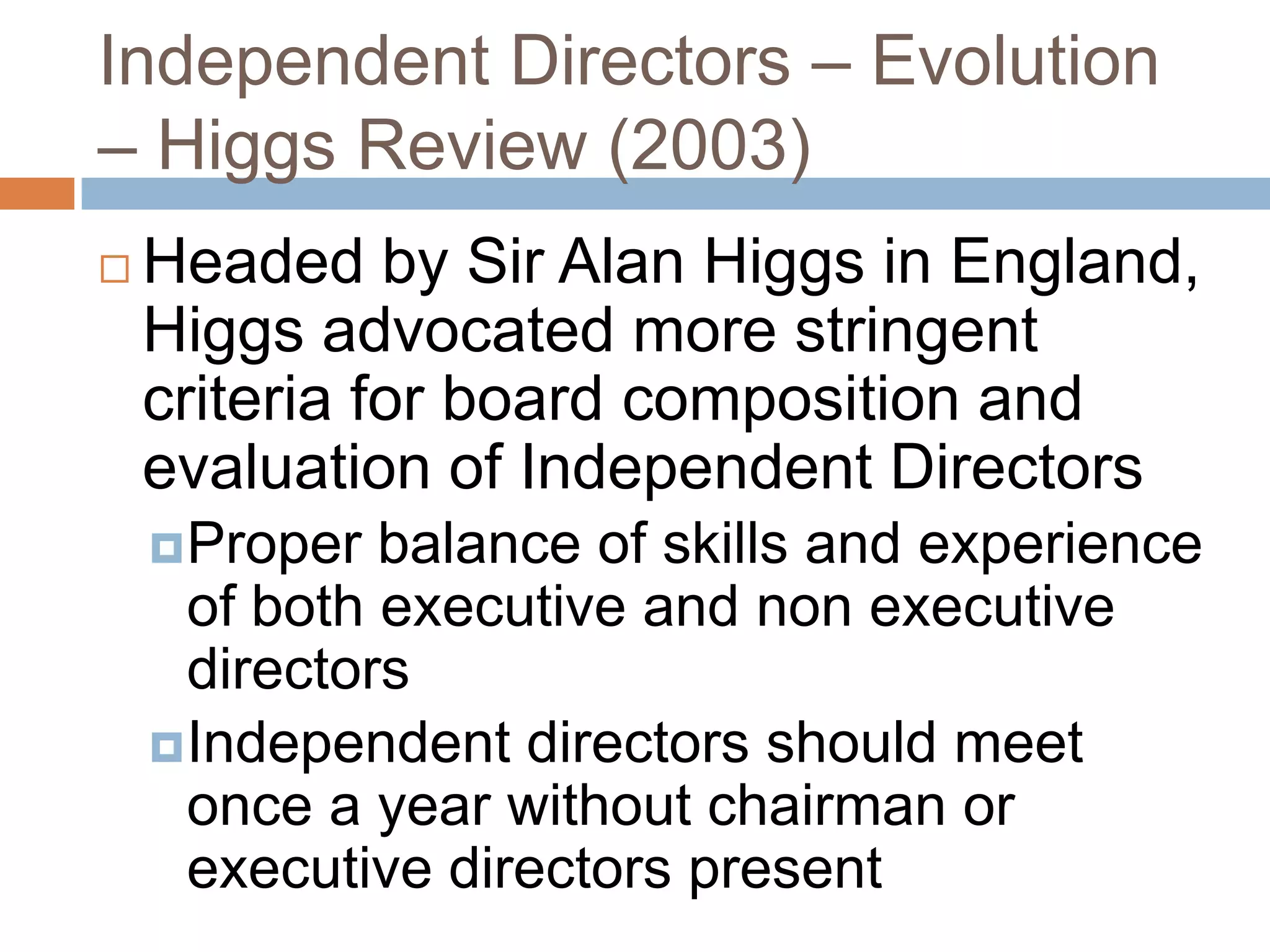
– Higgs Review (2003)
 Headed by Sir Alan Higgs in England,
Higgs advocated more stringent
criteria for board composition and
evaluation of Independent Directors
Proper balance of skills and experience
of both executive and non executive
directors
Independent directors should meet
once a year without chairman or
executive directors present
Independent Directors – Evolution
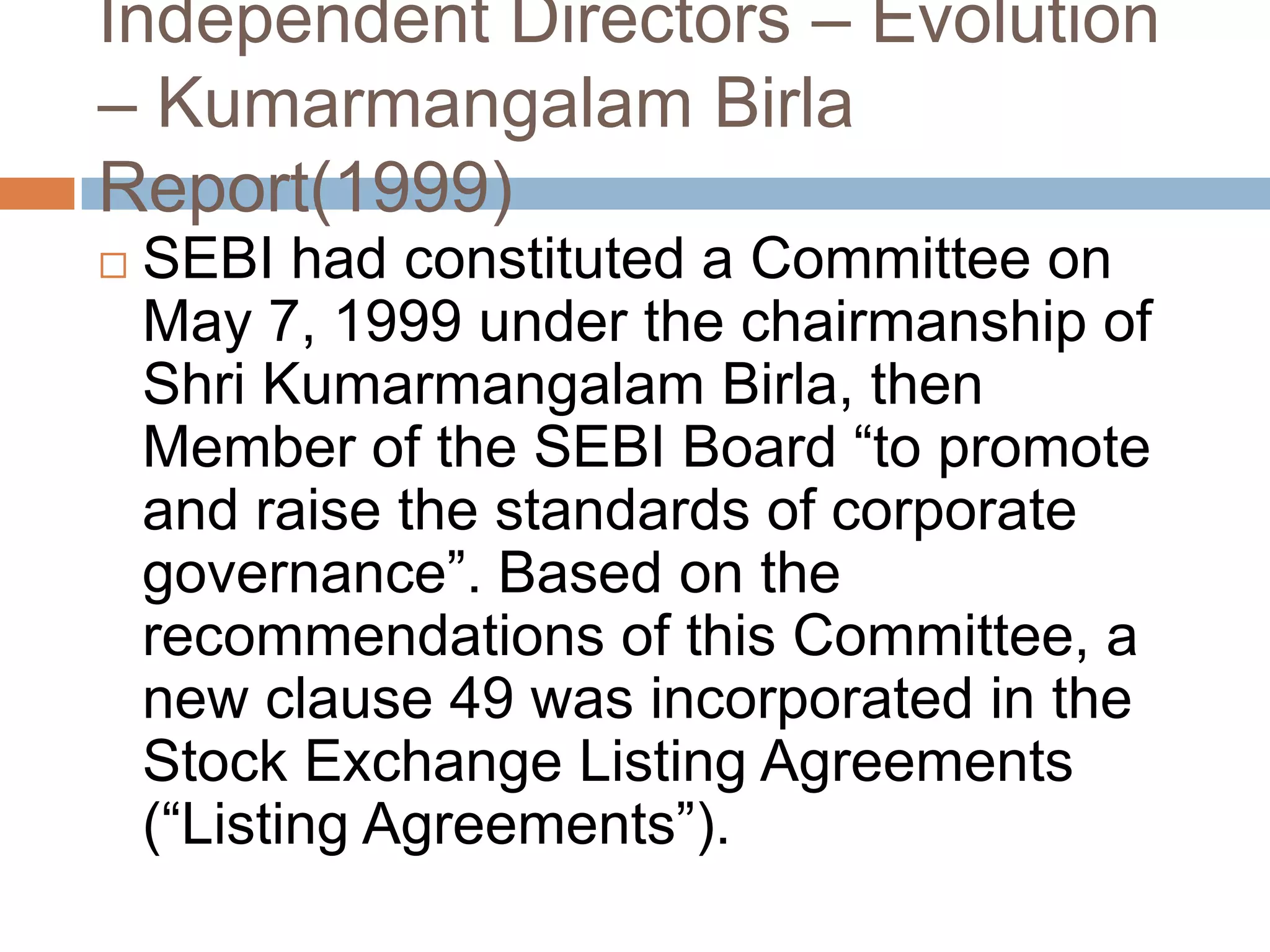
– Kumarmangalam Birla
Report(1999)
 SEBI had constituted a Committee on
May 7, 1999 under the chairmanship of
Shri Kumarmangalam Birla, then
Member of the SEBI Board “to promote
and raise the standards of corporate
governance”. Based on the
recommendations of this Committee, a
new clause 49 was incorporated in the
Stock Exchange Listing Agreements
(“Listing Agreements”).
Independent Directors – Evolution
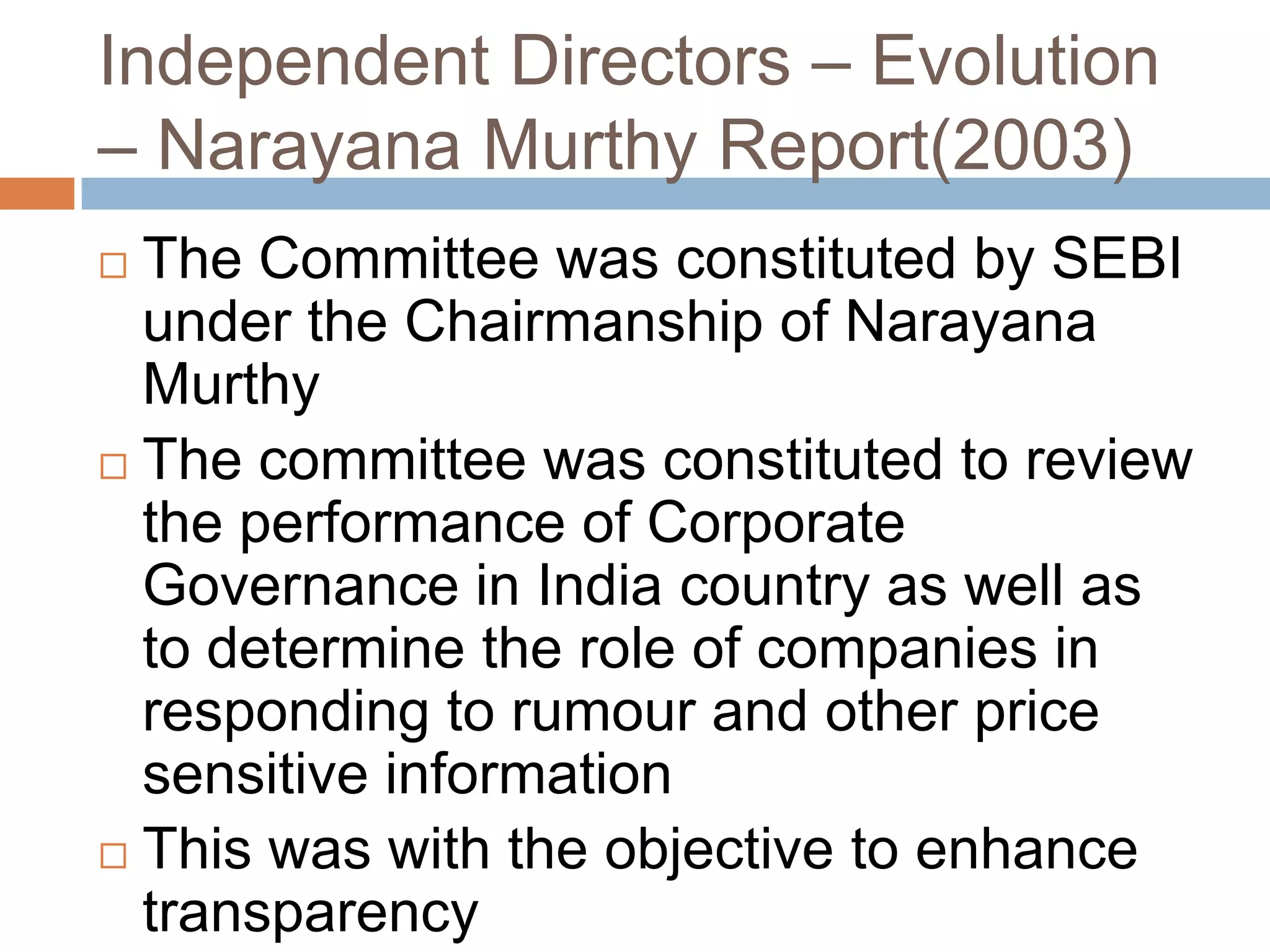
– Narayana Murthy Report(2003)
 The Committee was constituted by SEBI
under the Chairmanship of Narayana
Murthy
 The committee was constituted to review
the performance of Corporate
Governance in India country as well as
to determine the role of companies in
responding to rumour and other price
sensitive information
 This was with the objective to enhance
transparency
Independent Directors – Evolution
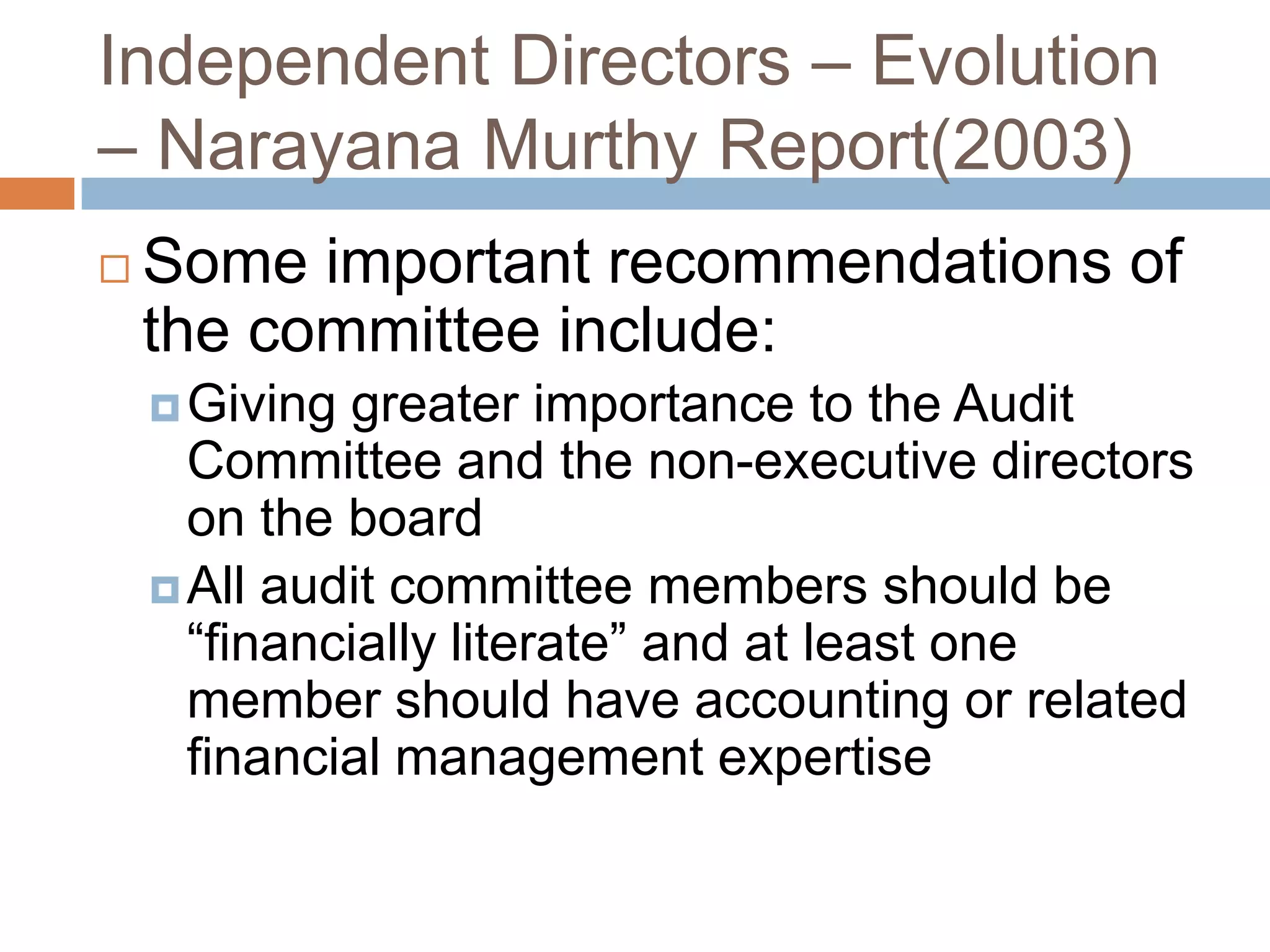
– Narayana Murthy Report(2003)
 Some important recommendations of
the committee include:
Giving greater importance to the Audit
Committee and the non-executive directors
on the board
All audit committee members should be
“financially literate” and at least one
member should have accounting or related
financial management expertise
Role of an Independent Director
 Independent directors bring in an outside
perspective while evaluating the board and
management decisions thus creating a
balance in the interest of the shareholders
 Including executive remuneration,
succession planning, changes in corporate
control, takeovers and acquisitions and the
audit
 Today independent directors are a core
resource in delivering the good governance
processes that shareholders expect.
Role of an Independent Director
 Independent directors primarily
provide inputs to all key decisions
such as strategies, performance
evaluation and risk evaluation
affecting the company
 Independent Directors are also part
of Committees and are often
Chairmen of Committees, thereby
empowering their judgements and
decisions
Responsibilities of an Independent
Director
 Thorough preparation for the meeting
 Free and frank expression of
opinions.
 Being the conscience of the Board
 Up-to-date information on laws and
regulations governing the company
 Last but not the least, responsibility to
act in the larger interest of true
growth and development of the
company
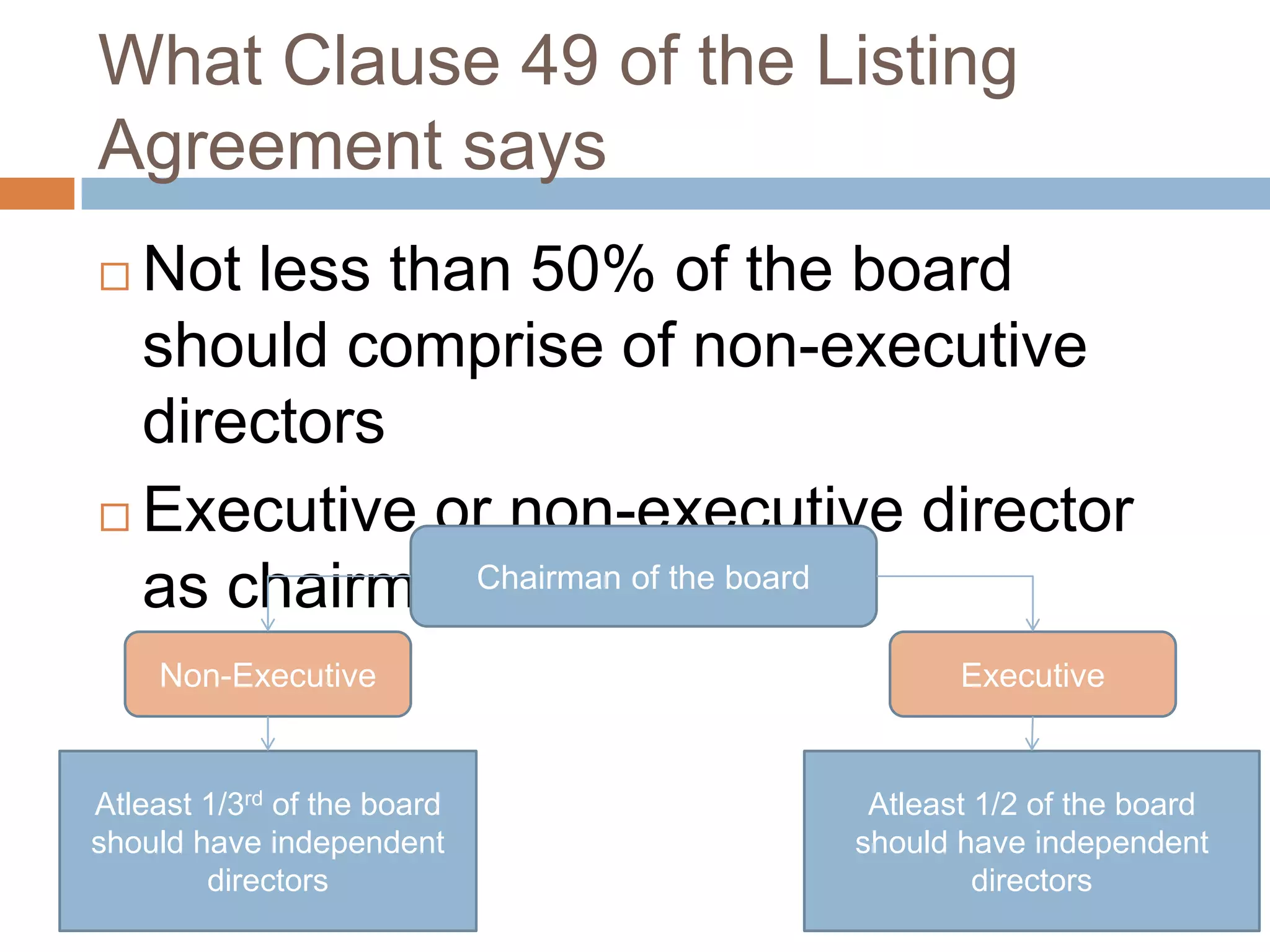
What Clause 49 of the Listing
Agreement says
 Not less than 50% of the board
should comprise of non-executive
directors
 Executive or non-executive director
as chairman:Chairman of the board
Non-Executive Executive
Atleast 1/3rd of the board
should have independent
directors
Atleast 1/2 of the board
should have independent
directors
What the New Companies Act
says
 Every listed company will have atleast one-
third of total number of directors as
independent directors, with any fraction to be
rounded off as one – Sec 149(4)
 Nothing regarding 50% of independent
directors if Executive Director is chairman
 Now the Central Government has the power to
prescribe minimum number of independent
directors in other class of public companies
Definition of Independent
Director
 The New Companies Act also defines the term
„Independent Director‟. Some significant additional
criteria as per the new act are:
 Should be a person of integrity and possess relevant
expertise and experience
 Should not have pecuniary relationship/transactions
with the company, its promoters, its directors. This
should not have existed in the current FY or preceding
2 FYs.
 Central Government may prescribe additional
qualifications for appointment of independent director
 Nominee Director is not considered an Independent
Director
Appointment, Remuneration and
Role
Independent Directors -
Appointment
 The Independent Directors appointed should give
a declaration of independence annexed to the
Financial Statement laid before a company in a
General Meeting –149(6)
 Term of Independent Directors is now 5 years and
can be reappointed for another term of 5 years,
but no more than 2 consecutive terms – Sec
149(10)
 Eligible for reappointment after 3 years of expiry
of last term – Sec 149(11)
 Retirement provisions not applicable to
Independent Directors
Independent Directors -
Selection
 A company notified by the Central Government
will maintain a database containing the names,
addresses and qualifications of the persons
eligible and willing to act as Independent
Directors – Sec 150
Independent Directors -
Remuneration
 An independent director will NOT be entitled to
any stock option(ESOP) and may receive
remuneration by way of fee
 reimbursement of expenses for participation in
the Board and other meetings and profit
related commission as may be approved by
the members
Role in Committees and
Evaluation
 The Audit Committee should consist of a minimum
of three directors with independent directors
forming a majority
 Nomination and Remuneration Committee
consisting of three or more non-executive
directors out of which not less than one-half
should be independent directors
 Annual evaluation of all directors should be
undertaken by the Board to evaluate its
performance
 Independent Directors will evaluate the
performance of other directors in their roles
Liability
 Shall be liabile only in respect of such acts of
omission and commission by the company
which had occurred with his knowledge,
attributable through Board processes and with
his consent on connivance or where he had
not acted diligently
Directors
Directors - Appointment and
Qualification
 Chapter XI, and XII cover Directors & Meetings;
Chapter XIII covers Managerial Personnel
 All cos. minimum one director who stayed in India
for at least 182 days in the previous calendar
year – Sec 149(3)
 Prescribed class of companies - at least one
woman director on the board – Sec 149(1)
 Any public company with Share capital > Rs.5
crores or 1000 or more shareholders; may have a
director elected by small shareholders. Did not
exist before – Sec 151Prescribed class of companies:
i) All listed companies – 1 year transition time
ii) Other public cos paid up capital > Rs.100
crores; or turnover > Rs.300 crores – 3 years
Directors - Appointment and
Qualification
 Public co. or subsidiary of public co. can now
have upto 15 directors on the board. Previously it
was 12. An extension beyond this will require a
special resolution at the general meeting
 Directors can now hold Directorships in upto 20
cos.; increased from the cap of 15 cos. However,
not more than 10 public cos (including
subsidary/holding of a public co.)
 Every person appointed as a Director should
furnish his DIN and a declaration that he is not
disqualified from acting as a Director – Sec 152(4)
Directors - Appointment and
Qualification
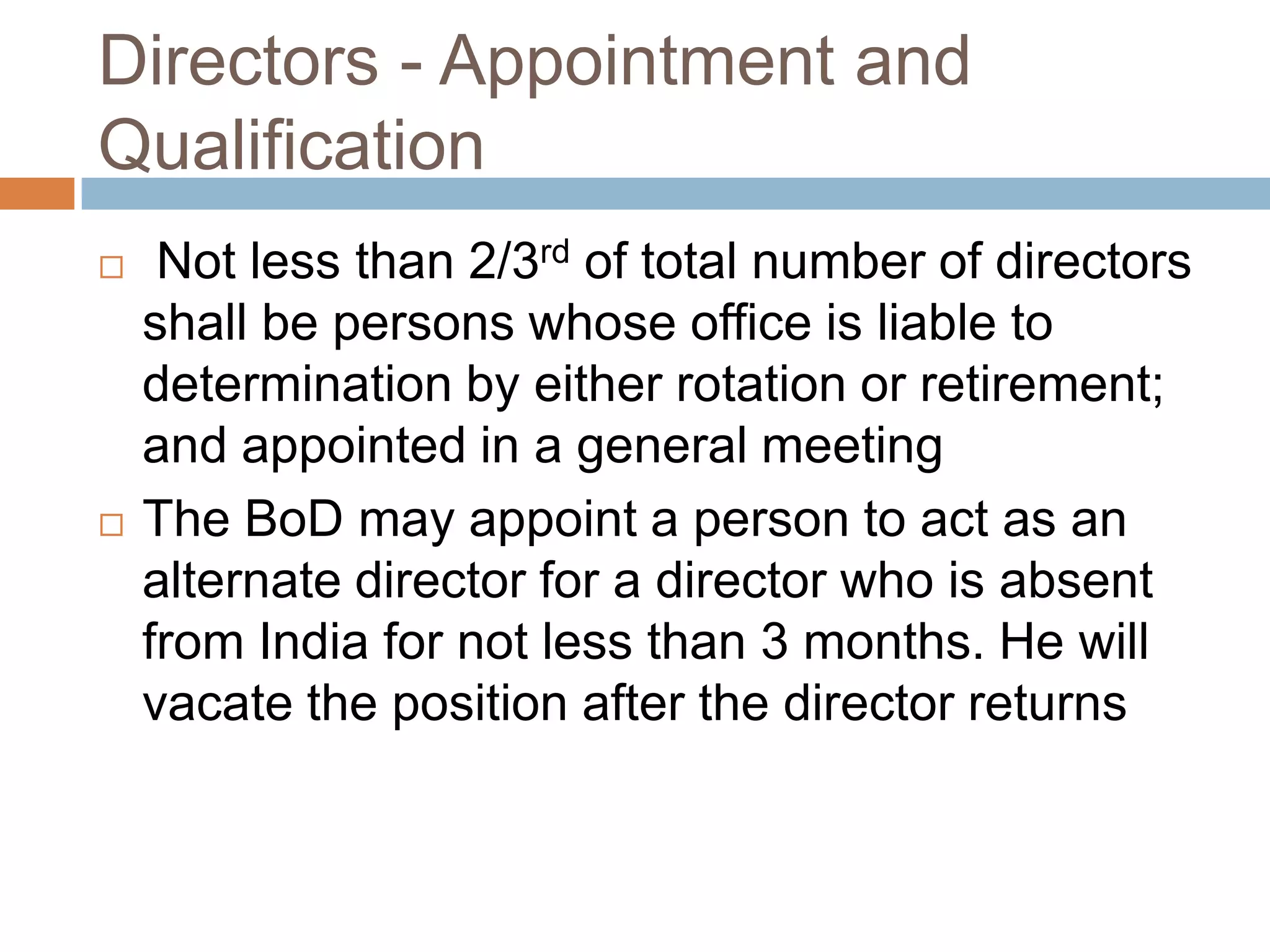
 Not less than 2/3rd of total number of directors
shall be persons whose office is liable to
determination by either rotation or retirement;
and appointed in a general meeting
 The BoD may appoint a person to act as an
alternate director for a director who is absent
from India for not less than 3 months. He will
vacate the position after the director returns
Directors – Resignation and
Removal
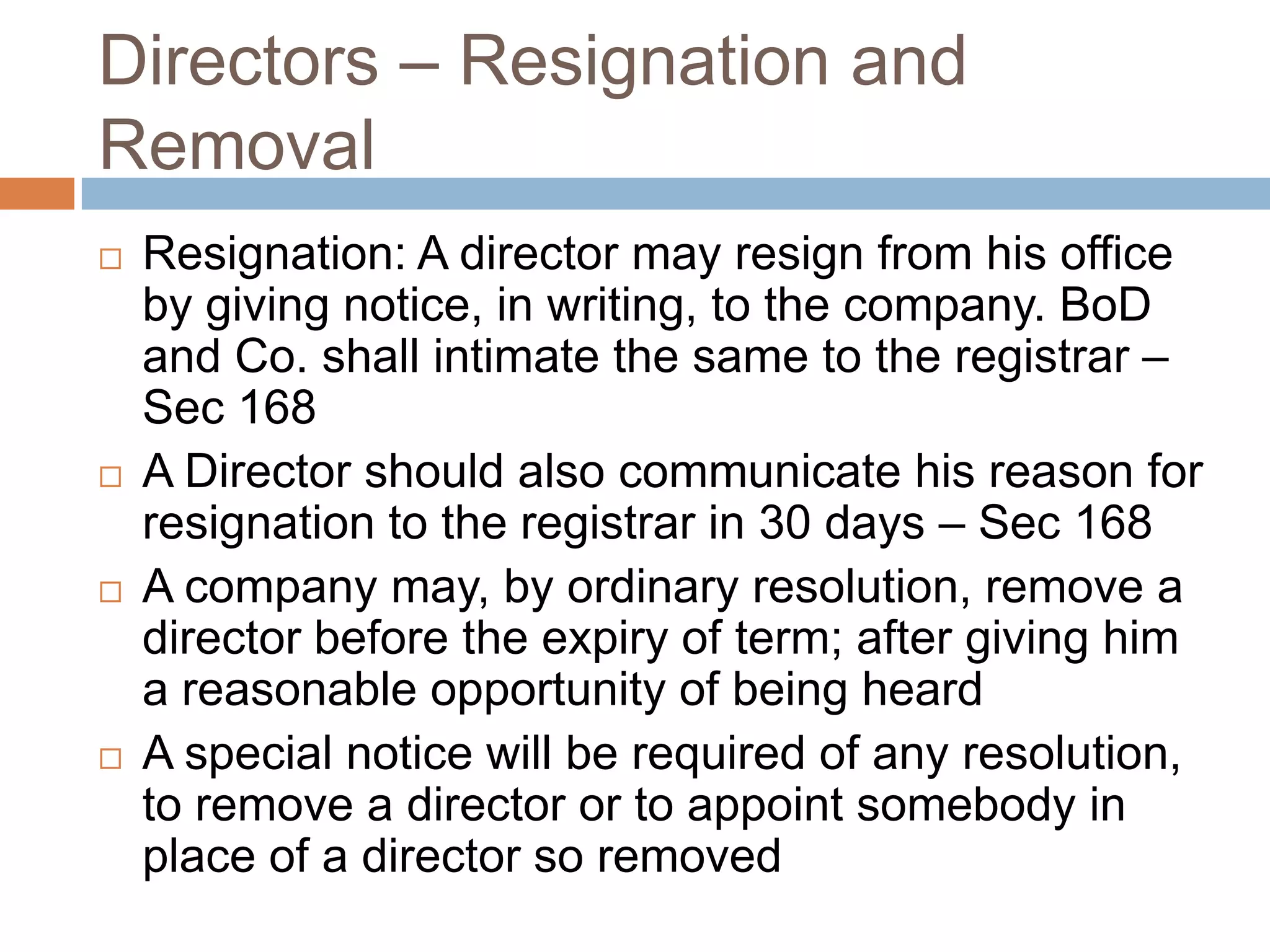
 Resignation: A director may resign from his office
by giving notice, in writing, to the company. BoD
and Co. shall intimate the same to the registrar –
Sec 168
 A Director should also communicate his reason for
resignation to the registrar in 30 days – Sec 168
 A company may, by ordinary resolution, remove a
director before the expiry of term; after giving him
a reasonable opportunity of being heard
 A special notice will be required of any resolution,
to remove a director or to appoint somebody in
place of a director so removed
Directors – Disqualification – Sec
164
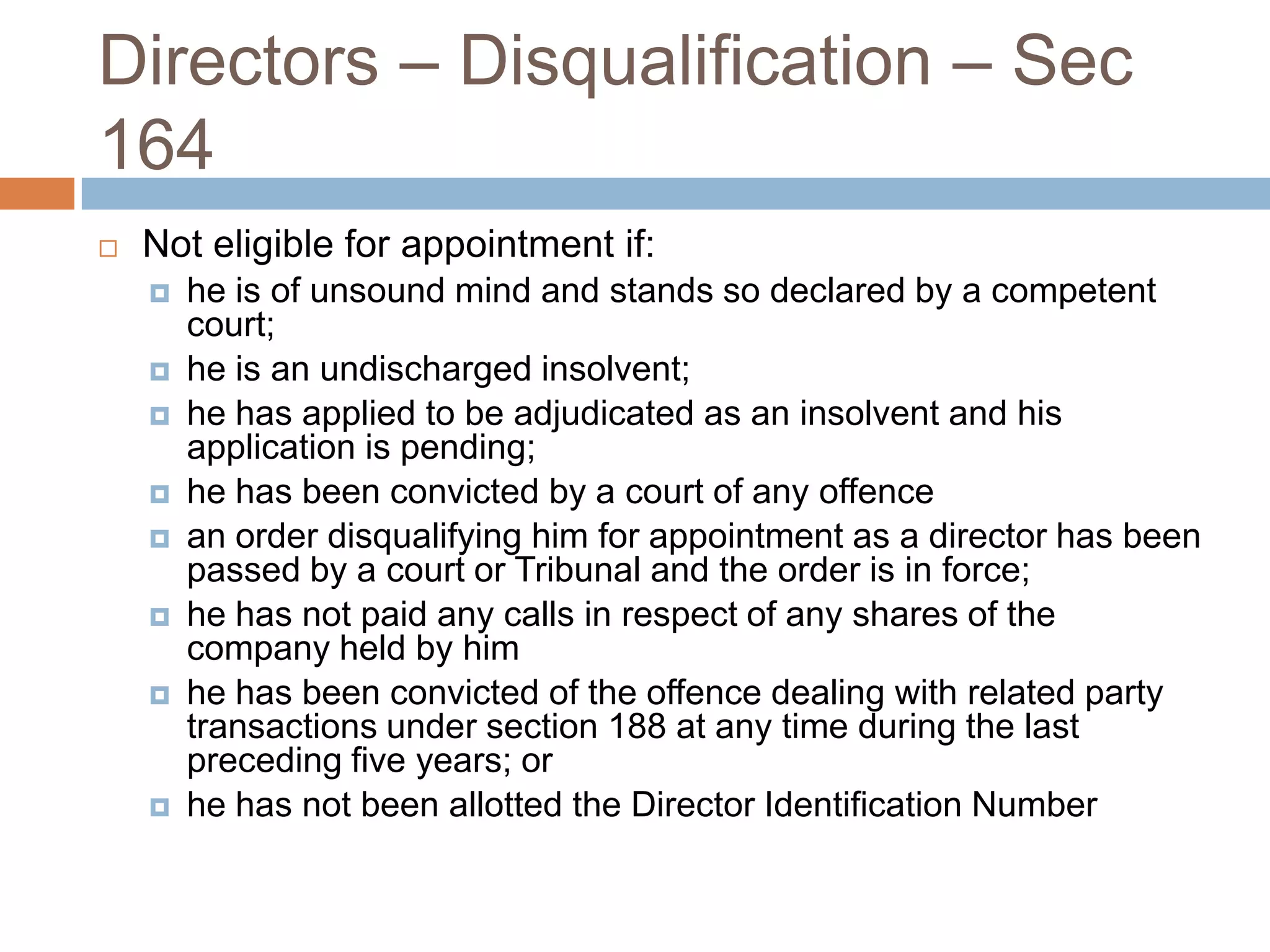
 Not eligible for appointment if:
 he is of unsound mind and stands so declared by a competent
court;
 he is an undischarged insolvent;
 he has applied to be adjudicated as an insolvent and his
application is pending;
 he has been convicted by a court of any offence
 an order disqualifying him for appointment as a director has been
passed by a court or Tribunal and the order is in force;
 he has not paid any calls in respect of any shares of the
company held by him
 he has been convicted of the offence dealing with related party
transactions under section 188 at any time during the last
preceding five years; or
 he has not been allotted the Director Identification Number
Can the Companies Act prescribe
the duties of Directors? – Sec 166
A director will :
 Act in accordance with the articles of the
company
 Act in good faith to promote the objects of the
company
 Exercise duty with care, skill and diligence
 Not enter into situations with conflict of interest
 Not achieve or attempt to achieve undue gain
or advantage for him or
relatives/partners/associates
 Not assign his office
Meetings of the Board
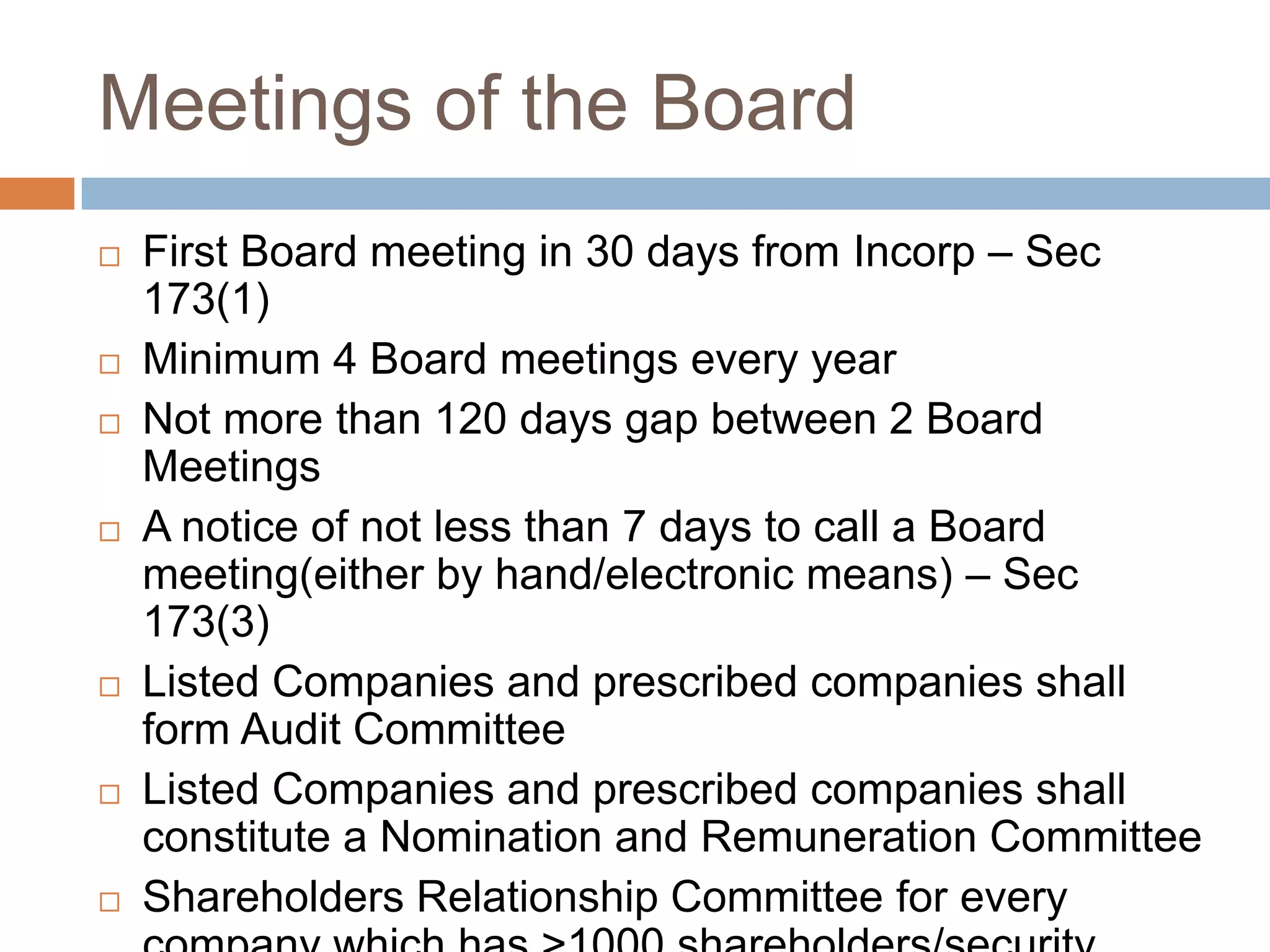
 First Board meeting in 30 days from Incorp – Sec
173(1)
 Minimum 4 Board meetings every year
 Not more than 120 days gap between 2 Board
Meetings
 A notice of not less than 7 days to call a Board
meeting(either by hand/electronic means) – Sec
173(3)
 Listed Companies and prescribed companies shall
form Audit Committee
 Listed Companies and prescribed companies shall
constitute a Nomination and Remuneration Committee
 Shareholders Relationship Committee for every
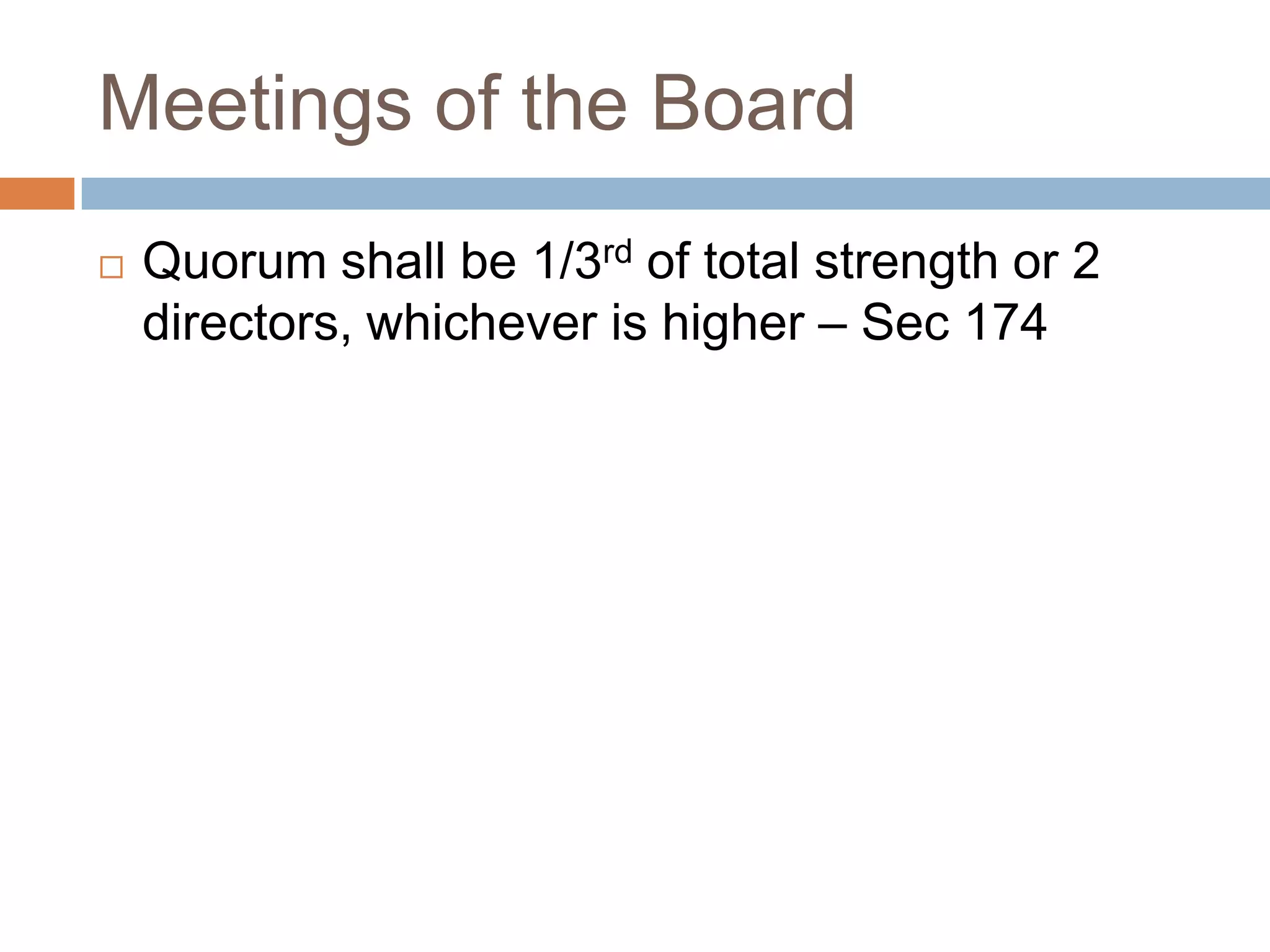
Meetings of the Board
 Quorum shall be 1/3rd of total strength or 2
directors, whichever is higher – Sec 174
Other Sections
 Political contribution limit has been raised from
5% to 7.5% of average net profits for the
preceding 3 financial years
 Defects in appointment of directors will not
invalidate the actions taken by him as a
director
 Restrictions on loans to Directors – Now
applicable to both Private and Public
Companies (Unless company gives loans in
ordinary course or business and is as per rate
declared by the RBI)
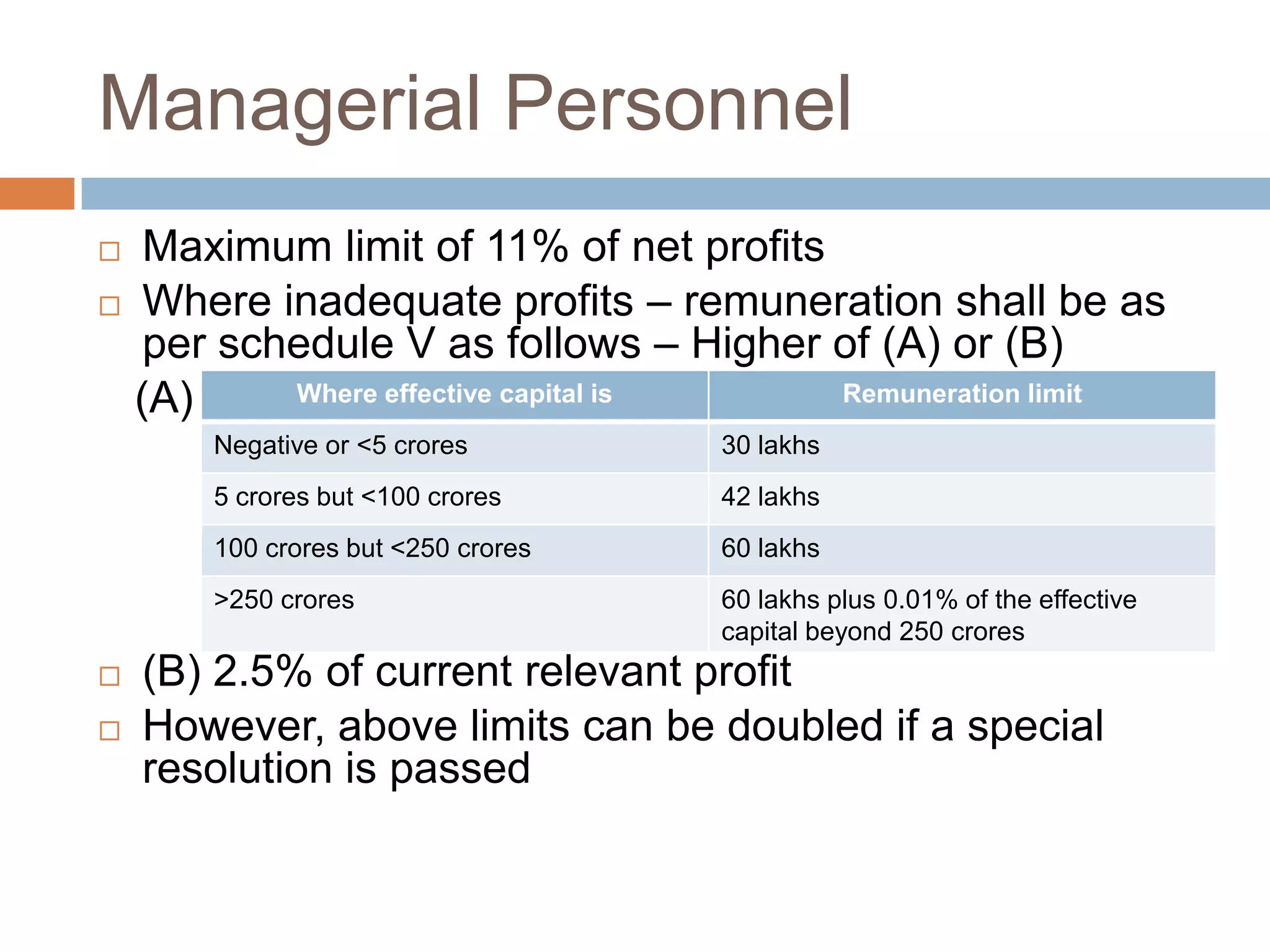
Managerial Personnel
 Maximum limit of 11% of net profits
 Where inadequate profits – remuneration shall be as
per schedule V as follows – Higher of (A) or (B)
(A)
 (B) 2.5% of current relevant profit
 However, above limits can be doubled if a special
resolution is passed
Where effective capital is Remuneration limit
Negative or <5 crores 30 lakhs
5 crores but <100 crores 42 lakhs
100 crores but <250 crores 60 lakhs
>250 crores 60 lakhs plus 0.01% of the effective
capital beyond 250 crores
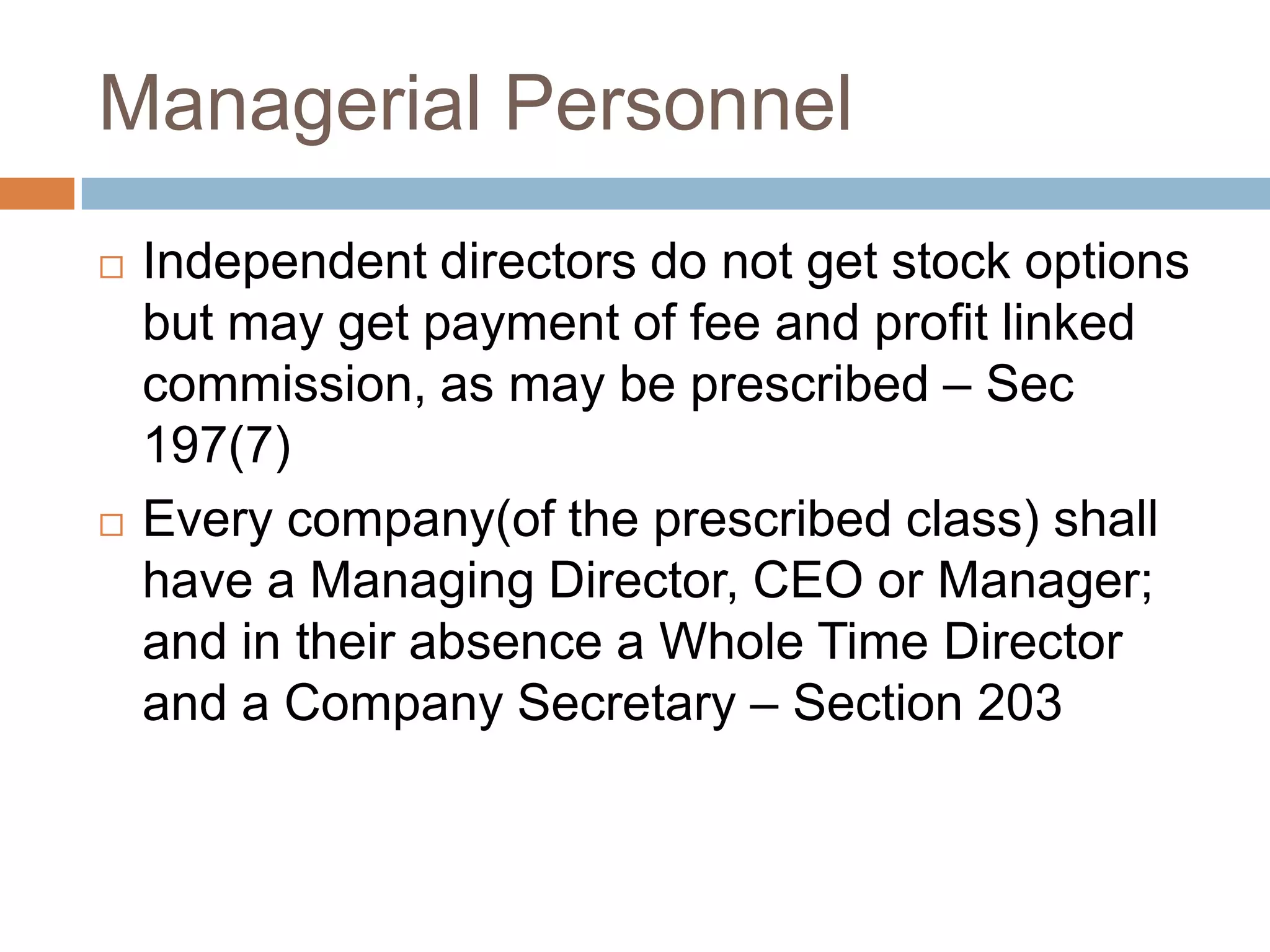
Managerial Personnel
 Independent directors do not get stock options
but may get payment of fee and profit linked
commission, as may be prescribed – Sec
197(7)
 Every company(of the prescribed class) shall
have a Managing Director, CEO or Manager;
and in their absence a Whole Time Director
and a Company Secretary – Section 203

Companies Act 2013 - Directors, Independent Directors and Meetings

  • 1.
  • 2.
  • 3.
    Background of Corporate Governance Ideal corporate governance is characterized by a firm commitment to ethical practices by the entire organisation in all of its dealings with a wide group of stakeholders encompassing employees, customers, vendors, regulators and all shareholders  Corporate governance rests on four pillars  Transparency  Full disclosure  Independent Monitoring  Fairness to all stakeholders
  • 4.
    Independent Directors – Evolution Independent Directors is a concept which has been in existence for a few decades now  Gained prominence in 1993 when the Cadbury Report was published by the committee set up by the London Stock Exchange
  • 5.
    Independent Directors –Evolution – Cadbury Report (1993)  Cadbury Report‟s recommendations: Majority of non-executive directors should be independent of management Specified terms for non-exec directors Executive remuneration should be subject to a remuneration committee Audit committee with 3 non-
  • 6.
    Independent Directors –Evolution – Greenbury Report (1995)  Greenbury Report then followed this in 1995 and it addressed the growing concern of Director Remuneration  It was suggested that the role of Independent Directors be enhanced to tackle the issues relating to Executive Remuneration
  • 7.
    Independent Directors –Evolution – Higgs Review (2003)  Headed by Sir Alan Higgs in England, Higgs advocated more stringent criteria for board composition and evaluation of Independent Directors Proper balance of skills and experience of both executive and non executive directors Independent directors should meet once a year without chairman or executive directors present
  • 8.
    Independent Directors –Evolution – Kumarmangalam Birla Report(1999)  SEBI had constituted a Committee on May 7, 1999 under the chairmanship of Shri Kumarmangalam Birla, then Member of the SEBI Board “to promote and raise the standards of corporate governance”. Based on the recommendations of this Committee, a new clause 49 was incorporated in the Stock Exchange Listing Agreements (“Listing Agreements”).
  • 9.
    Independent Directors –Evolution – Narayana Murthy Report(2003)  The Committee was constituted by SEBI under the Chairmanship of Narayana Murthy  The committee was constituted to review the performance of Corporate Governance in India country as well as to determine the role of companies in responding to rumour and other price sensitive information  This was with the objective to enhance transparency
  • 10.
    Independent Directors –Evolution – Narayana Murthy Report(2003)  Some important recommendations of the committee include: Giving greater importance to the Audit Committee and the non-executive directors on the board All audit committee members should be “financially literate” and at least one member should have accounting or related financial management expertise
  • 11.
    Role of anIndependent Director  Independent directors bring in an outside perspective while evaluating the board and management decisions thus creating a balance in the interest of the shareholders  Including executive remuneration, succession planning, changes in corporate control, takeovers and acquisitions and the audit  Today independent directors are a core resource in delivering the good governance processes that shareholders expect.
  • 12.
    Role of anIndependent Director  Independent directors primarily provide inputs to all key decisions such as strategies, performance evaluation and risk evaluation affecting the company  Independent Directors are also part of Committees and are often Chairmen of Committees, thereby empowering their judgements and decisions
  • 13.
    Responsibilities of anIndependent Director  Thorough preparation for the meeting  Free and frank expression of opinions.  Being the conscience of the Board  Up-to-date information on laws and regulations governing the company  Last but not the least, responsibility to act in the larger interest of true growth and development of the company
  • 14.
    What Clause 49of the Listing Agreement says  Not less than 50% of the board should comprise of non-executive directors  Executive or non-executive director as chairman:Chairman of the board Non-Executive Executive Atleast 1/3rd of the board should have independent directors Atleast 1/2 of the board should have independent directors
  • 15.
    What the NewCompanies Act says  Every listed company will have atleast one- third of total number of directors as independent directors, with any fraction to be rounded off as one – Sec 149(4)  Nothing regarding 50% of independent directors if Executive Director is chairman  Now the Central Government has the power to prescribe minimum number of independent directors in other class of public companies
  • 16.
    Definition of Independent Director The New Companies Act also defines the term „Independent Director‟. Some significant additional criteria as per the new act are:  Should be a person of integrity and possess relevant expertise and experience  Should not have pecuniary relationship/transactions with the company, its promoters, its directors. This should not have existed in the current FY or preceding 2 FYs.  Central Government may prescribe additional qualifications for appointment of independent director  Nominee Director is not considered an Independent Director
  • 17.
  • 18.
    Independent Directors - Appointment The Independent Directors appointed should give a declaration of independence annexed to the Financial Statement laid before a company in a General Meeting –149(6)  Term of Independent Directors is now 5 years and can be reappointed for another term of 5 years, but no more than 2 consecutive terms – Sec 149(10)  Eligible for reappointment after 3 years of expiry of last term – Sec 149(11)  Retirement provisions not applicable to Independent Directors
  • 19.
    Independent Directors - Selection A company notified by the Central Government will maintain a database containing the names, addresses and qualifications of the persons eligible and willing to act as Independent Directors – Sec 150
  • 20.
    Independent Directors - Remuneration An independent director will NOT be entitled to any stock option(ESOP) and may receive remuneration by way of fee  reimbursement of expenses for participation in the Board and other meetings and profit related commission as may be approved by the members
  • 21.
    Role in Committeesand Evaluation  The Audit Committee should consist of a minimum of three directors with independent directors forming a majority  Nomination and Remuneration Committee consisting of three or more non-executive directors out of which not less than one-half should be independent directors  Annual evaluation of all directors should be undertaken by the Board to evaluate its performance  Independent Directors will evaluate the performance of other directors in their roles
  • 22.
    Liability  Shall beliabile only in respect of such acts of omission and commission by the company which had occurred with his knowledge, attributable through Board processes and with his consent on connivance or where he had not acted diligently
  • 23.
  • 24.
    Directors - Appointmentand Qualification  Chapter XI, and XII cover Directors & Meetings; Chapter XIII covers Managerial Personnel  All cos. minimum one director who stayed in India for at least 182 days in the previous calendar year – Sec 149(3)  Prescribed class of companies - at least one woman director on the board – Sec 149(1)  Any public company with Share capital > Rs.5 crores or 1000 or more shareholders; may have a director elected by small shareholders. Did not exist before – Sec 151Prescribed class of companies: i) All listed companies – 1 year transition time ii) Other public cos paid up capital > Rs.100 crores; or turnover > Rs.300 crores – 3 years
  • 25.
    Directors - Appointmentand Qualification  Public co. or subsidiary of public co. can now have upto 15 directors on the board. Previously it was 12. An extension beyond this will require a special resolution at the general meeting  Directors can now hold Directorships in upto 20 cos.; increased from the cap of 15 cos. However, not more than 10 public cos (including subsidary/holding of a public co.)  Every person appointed as a Director should furnish his DIN and a declaration that he is not disqualified from acting as a Director – Sec 152(4)
  • 26.
    Directors - Appointmentand Qualification  Not less than 2/3rd of total number of directors shall be persons whose office is liable to determination by either rotation or retirement; and appointed in a general meeting  The BoD may appoint a person to act as an alternate director for a director who is absent from India for not less than 3 months. He will vacate the position after the director returns
  • 27.
    Directors – Resignationand Removal  Resignation: A director may resign from his office by giving notice, in writing, to the company. BoD and Co. shall intimate the same to the registrar – Sec 168  A Director should also communicate his reason for resignation to the registrar in 30 days – Sec 168  A company may, by ordinary resolution, remove a director before the expiry of term; after giving him a reasonable opportunity of being heard  A special notice will be required of any resolution, to remove a director or to appoint somebody in place of a director so removed
  • 28.
    Directors – Disqualification– Sec 164  Not eligible for appointment if:  he is of unsound mind and stands so declared by a competent court;  he is an undischarged insolvent;  he has applied to be adjudicated as an insolvent and his application is pending;  he has been convicted by a court of any offence  an order disqualifying him for appointment as a director has been passed by a court or Tribunal and the order is in force;  he has not paid any calls in respect of any shares of the company held by him  he has been convicted of the offence dealing with related party transactions under section 188 at any time during the last preceding five years; or  he has not been allotted the Director Identification Number
  • 29.
    Can the CompaniesAct prescribe the duties of Directors? – Sec 166 A director will :  Act in accordance with the articles of the company  Act in good faith to promote the objects of the company  Exercise duty with care, skill and diligence  Not enter into situations with conflict of interest  Not achieve or attempt to achieve undue gain or advantage for him or relatives/partners/associates  Not assign his office
  • 30.
  • 31.
    Meetings of theBoard  First Board meeting in 30 days from Incorp – Sec 173(1)  Minimum 4 Board meetings every year  Not more than 120 days gap between 2 Board Meetings  A notice of not less than 7 days to call a Board meeting(either by hand/electronic means) – Sec 173(3)  Listed Companies and prescribed companies shall form Audit Committee  Listed Companies and prescribed companies shall constitute a Nomination and Remuneration Committee  Shareholders Relationship Committee for every
  • 32.
    Meetings of theBoard  Quorum shall be 1/3rd of total strength or 2 directors, whichever is higher – Sec 174
  • 33.
    Other Sections  Politicalcontribution limit has been raised from 5% to 7.5% of average net profits for the preceding 3 financial years  Defects in appointment of directors will not invalidate the actions taken by him as a director  Restrictions on loans to Directors – Now applicable to both Private and Public Companies (Unless company gives loans in ordinary course or business and is as per rate declared by the RBI)
  • 34.
  • 35.
    Managerial Personnel  Maximumlimit of 11% of net profits  Where inadequate profits – remuneration shall be as per schedule V as follows – Higher of (A) or (B) (A)  (B) 2.5% of current relevant profit  However, above limits can be doubled if a special resolution is passed Where effective capital is Remuneration limit Negative or <5 crores 30 lakhs 5 crores but <100 crores 42 lakhs 100 crores but <250 crores 60 lakhs >250 crores 60 lakhs plus 0.01% of the effective capital beyond 250 crores
  • 36.
    Managerial Personnel  Independentdirectors do not get stock options but may get payment of fee and profit linked commission, as may be prescribed – Sec 197(7)  Every company(of the prescribed class) shall have a Managing Director, CEO or Manager; and in their absence a Whole Time Director and a Company Secretary – Section 203