Video Assisted Thoracic
Surgery (VATS)
Seminar Presented by
Dr.Dixit Prajapati (MS)
Dr.Neet Chotai (MS)
Introduction
 Video-assisted thoracoscopic surgery
(VATS) is a minimally invasive surgical
procedure, used to diagnose and treat
illness or injury to the lung and other
organs in thorax .
 With controlled pneumothorax, the
concept of thoracoscopy developed.
Jacobeus used the cystoscope in
1910 to first visualize the pleural
cavity.
 In the 1990’s there was a sudden
increase in the use of thoracoscopy.
This happened due to many reasons:
 Miniaturization of video equipment
 Improvement in quality of pictures and
light sources
 Single lung anesthesia improvements to
allow undisturbed examination of the
chest.
 Development of staplers to enable
biopsies and wedge resections.
• Eventually, thoracoscope became part of
the surgical procedure which got named as
Video Assisted Thoracic Surgery ( VATS
).
• In VATS procedures, surgeons operate
through 2 to 4 tiny openings between the
ribs. Each opening is less than one inch in
diameter, whereas 6- to 10-inch incisions
are not uncommon in open thoracic
surgery.
• Patients are placed under general
Anesthesia and are typically positioned
on their sides. Using a trocar, the
surgeon gains access into the chest
cavity through a space between the ribs.
• An endoscope is inserted through the
trocar, giving the surgeon a magnified
view of the patient’s internal organs on a
television monitor.
 VATS operations can be used for all
structures in the chest, and are not
limited to the lungs, pleura and
mediastinum.
 The heart and great vessels, the
esophagus and diaphragm, the spinal
column and nerves can all be
operated on using VATS
Indications
 Diagnostic
 Lung biopsy
 Biopsy of pleural disease
 Biopsy of mediastinal masses
 Excision of indeterminate pulmonary
nodules
 Pericardial biopsy
 Therapeutic
 Pluerodosis of the pleural space for
malignant disease
 Excision of benign pleural lesions
 Excision of benign lung tumors
 Sympathectomy for hyperhidrosis and
upper-extremity pain syndromes
 Stapling of blebs
 Debridement for acute empyema
 Decortication for chronic empyema
 Excision of mediastinal tumors
(thymoma, posterior mediastinal
tumors)
 Volume reduction for bullous lung
disease
 Video-assisted lobectomy
 Esophageal myotomy for achahasia
 Excision of esophageal leiomyoma
 Ligation of thoracic duct for
chylothorax
 Staging lymph nodes in esophageal
cancer
 Treatment of thoracic spine disease
 Minimally invasive valve and coronary
artery procedures
 Ligation of patent ductus (infants)
Pleural Diseases
 Empyema
Empyema loculations
In case of empyema, the lung may
not expand due to two reasons:
1.Multiloculated empyema at the level
of parietal pleura .
2.Thickened granulation tissue over
the visceral pleura.
In the first situation, a Video assisted
debridement if done early (within 2-3
weeks) leads to good results.
In the second situation, a
decortication is needed to get the lung
to expand again.
Pleural Effusion
 Thick, fibninous material that would
not be likely to be completely drained
by even a large-bore chest tube.
 Early thoracoscopic
debridement(VATS) is indicated in
such case.
 In malignant pleural effusion, Video
assisted pleurodosis can be done.
Mechanical AbrasionTalc Slurry
Post-traumatic Hemothorax
 VATS techniques have proven useful
in the management of the organizing
posttraumatic hemothorax in which
chest tube have been unable to
completely drain the fibninous clot and
debris.
Pleural-based tumors
 Pleural-based tumors may be sampled
and even resected using VATS.
Thick pleura excision & biopsy
• Video thoracoscopy also offers an
option in the treatment of malignant
pleural effusions, especially when the
fluid is loculated.
• When tube thoracostomy results in
incomplete drainage or when an attempt
at chemical pleurodesis through a chest
tube fails, many would proceed to
thoracoscopic pleurodesis(VATS).
PARENCHYMAL DISEASE
 VATS wedge lung biopsy represents a
significant advance. It offers the
advantage of excellent visualization of
and access to the entire lung
(impossible through a small
thoracotomy), allowing biopsies of
areas appearing abnormal and likely
increasing diagnostic yield.
• Video-assisted techniques have also
used the management of spontaneous
pneumothorax in patient with apical blebs
.
• Video assisted stapling of apical blebs
can be done in such case.
• Giant bullae in case of bullous
emphysema can be treated by
thoracoscopic ablation of bullae by laser.
•Bronchopleural fistulae can sometimes
be sutured thoracoscopically
Bronchopleural fistula
Sutured with vicryl
Pulmonary Nodule
 VATS is used to obtain solitary
pulmonary nodule for
histophathological examination for
reliable diagnosis .
Nodule picked up
Stapler applied
Specimen removal
Mediastinum
 Primary lesions of the mediastinum
are ideal for VATS management. All
locations of the mediastinum are
accessible, and whether sampling or
excision is the intent, video-assisted
techniques save many patients from
having to undergo thoracotomy or
median sternotomy.
 Video-assisted thoracoscopic (VATS)
thymectomy, excision of parathyroid
adenoma.
• VATS allows biopsy, and complete
resection, of almost all tumor mass of the
mediastinum to be performed.
•Most cystic massae, such as pericardiac
cysts, bronchogenic cysts, thymic cysts
can be suitably treated by
videothoracoscopy.
• Some solid, mainly posterior, tumors
of nervous origin such as neurinomas
and Schwannomas can be totally
resected by VATS.
ENDOSCOPIC THORACIC
SYMPATHECTOMY
 Most common indication is
hyperhidrosis of hands.
 Other indications :
 Occasionally facial sweating or
blushing,
 Raynaud’s disease – in severe cases.
 Axillary sweating,
Esophageal Surgery
 Video-assisted thoracoscopy (VATS)
to mobilize the thoracic esophagus in
combination with a standard open
laparotomy to complete the
esophagectomy.
 Surgery for achalasia cardia by
thoracoscopy has now been
completely replaced by the
laparoscopic approach. Excision of
leiomyoma is done at few centres by
VATS.
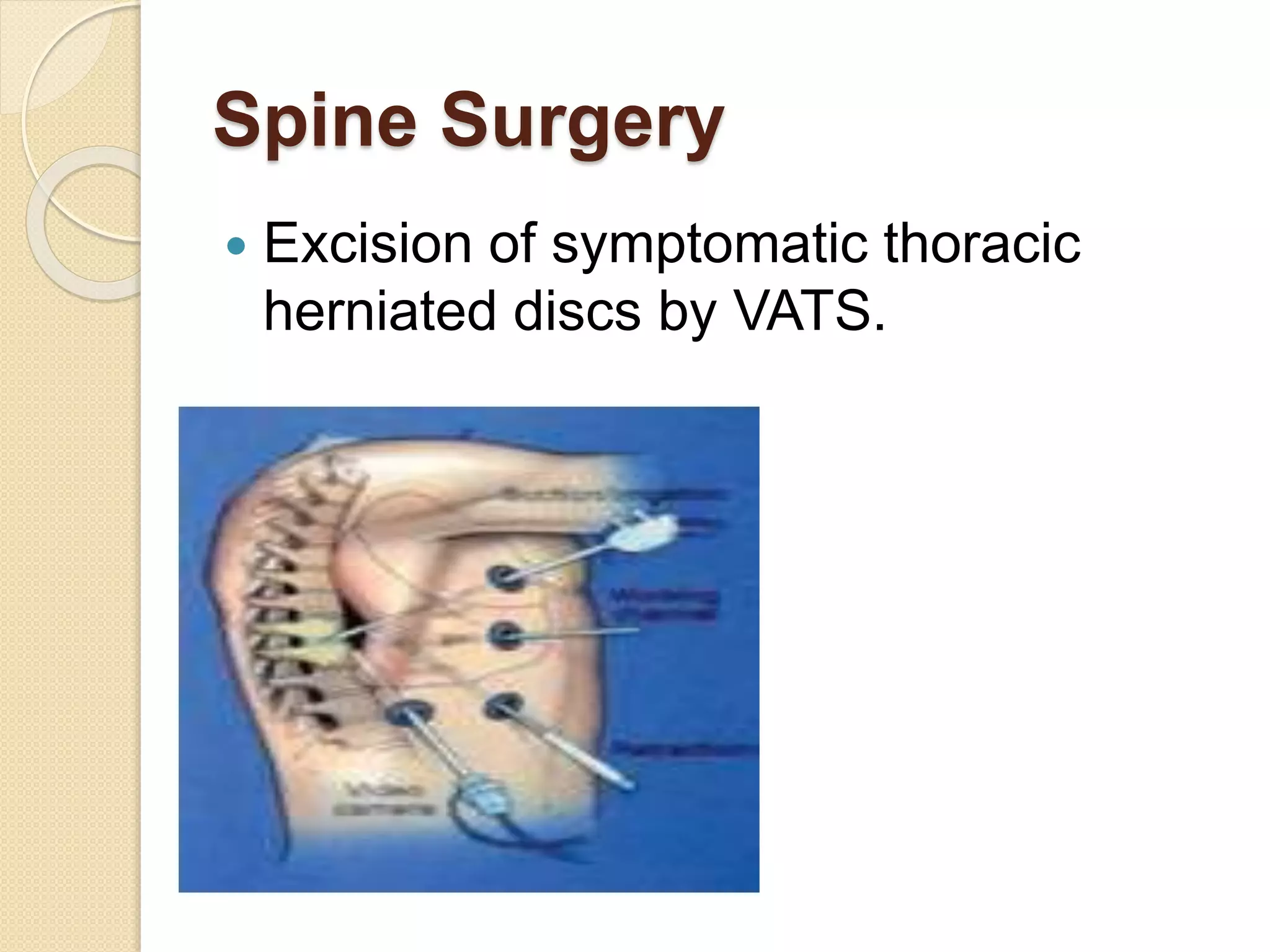
Spine Surgery
 Excision of symptomatic thoracic
herniated discs by VATS.
• The anterior release of stiff thoracic
scoliotic deformities can be done video
assisted nowadays
• Drainage of paraspinal abscess due to
tuberculosis can potentially become a very
common indication of thoracoscopy in
india .
Thoracic disc
space
Pus aspiration
Pus drainage
ADVANTAGES OF VATS
OVER THORACOTMY
 Post operative pain is less compare to
thoracotomy
 Duration for taking analgesics is lesser in
VATS
 Blood loss is less
 Chest tube duration less 1-3 days
 Less post-operative shoulder dysfunction
Especially when compared to latissimus
dividing thoracotomy
• Shorter hospital stay

Video assisted thoracic surgery (VATS) seminar

  • 1.
    Video Assisted Thoracic Surgery(VATS) Seminar Presented by Dr.Dixit Prajapati (MS) Dr.Neet Chotai (MS)
  • 2.
    Introduction  Video-assisted thoracoscopicsurgery (VATS) is a minimally invasive surgical procedure, used to diagnose and treat illness or injury to the lung and other organs in thorax .  With controlled pneumothorax, the concept of thoracoscopy developed. Jacobeus used the cystoscope in 1910 to first visualize the pleural cavity.
  • 3.
     In the1990’s there was a sudden increase in the use of thoracoscopy. This happened due to many reasons:  Miniaturization of video equipment  Improvement in quality of pictures and light sources  Single lung anesthesia improvements to allow undisturbed examination of the chest.  Development of staplers to enable biopsies and wedge resections.
  • 4.
    • Eventually, thoracoscopebecame part of the surgical procedure which got named as Video Assisted Thoracic Surgery ( VATS ). • In VATS procedures, surgeons operate through 2 to 4 tiny openings between the ribs. Each opening is less than one inch in diameter, whereas 6- to 10-inch incisions are not uncommon in open thoracic surgery.
  • 5.
    • Patients areplaced under general Anesthesia and are typically positioned on their sides. Using a trocar, the surgeon gains access into the chest cavity through a space between the ribs. • An endoscope is inserted through the trocar, giving the surgeon a magnified view of the patient’s internal organs on a television monitor.
  • 7.
     VATS operationscan be used for all structures in the chest, and are not limited to the lungs, pleura and mediastinum.  The heart and great vessels, the esophagus and diaphragm, the spinal column and nerves can all be operated on using VATS
  • 8.
    Indications  Diagnostic  Lungbiopsy  Biopsy of pleural disease  Biopsy of mediastinal masses  Excision of indeterminate pulmonary nodules  Pericardial biopsy
  • 9.
     Therapeutic  Pluerodosisof the pleural space for malignant disease  Excision of benign pleural lesions  Excision of benign lung tumors  Sympathectomy for hyperhidrosis and upper-extremity pain syndromes
  • 10.
     Stapling ofblebs  Debridement for acute empyema  Decortication for chronic empyema  Excision of mediastinal tumors (thymoma, posterior mediastinal tumors)  Volume reduction for bullous lung disease
  • 11.
     Video-assisted lobectomy Esophageal myotomy for achahasia  Excision of esophageal leiomyoma  Ligation of thoracic duct for chylothorax  Staging lymph nodes in esophageal cancer  Treatment of thoracic spine disease
  • 12.
     Minimally invasivevalve and coronary artery procedures  Ligation of patent ductus (infants)
  • 13.
  • 14.
    In case ofempyema, the lung may not expand due to two reasons: 1.Multiloculated empyema at the level of parietal pleura . 2.Thickened granulation tissue over the visceral pleura.
  • 15.
    In the firstsituation, a Video assisted debridement if done early (within 2-3 weeks) leads to good results. In the second situation, a decortication is needed to get the lung to expand again.
  • 16.
    Pleural Effusion  Thick,fibninous material that would not be likely to be completely drained by even a large-bore chest tube.  Early thoracoscopic debridement(VATS) is indicated in such case.
  • 17.
     In malignantpleural effusion, Video assisted pleurodosis can be done. Mechanical AbrasionTalc Slurry
  • 18.
    Post-traumatic Hemothorax  VATStechniques have proven useful in the management of the organizing posttraumatic hemothorax in which chest tube have been unable to completely drain the fibninous clot and debris.
  • 19.
    Pleural-based tumors  Pleural-basedtumors may be sampled and even resected using VATS. Thick pleura excision & biopsy
  • 20.
    • Video thoracoscopyalso offers an option in the treatment of malignant pleural effusions, especially when the fluid is loculated. • When tube thoracostomy results in incomplete drainage or when an attempt at chemical pleurodesis through a chest tube fails, many would proceed to thoracoscopic pleurodesis(VATS).
  • 21.
    PARENCHYMAL DISEASE  VATSwedge lung biopsy represents a significant advance. It offers the advantage of excellent visualization of and access to the entire lung (impossible through a small thoracotomy), allowing biopsies of areas appearing abnormal and likely increasing diagnostic yield.
  • 22.
    • Video-assisted techniqueshave also used the management of spontaneous pneumothorax in patient with apical blebs . • Video assisted stapling of apical blebs can be done in such case.
  • 23.
    • Giant bullaein case of bullous emphysema can be treated by thoracoscopic ablation of bullae by laser. •Bronchopleural fistulae can sometimes be sutured thoracoscopically
  • 24.
  • 25.
    Pulmonary Nodule  VATSis used to obtain solitary pulmonary nodule for histophathological examination for reliable diagnosis . Nodule picked up
  • 26.
  • 27.
    Mediastinum  Primary lesionsof the mediastinum are ideal for VATS management. All locations of the mediastinum are accessible, and whether sampling or excision is the intent, video-assisted techniques save many patients from having to undergo thoracotomy or median sternotomy.  Video-assisted thoracoscopic (VATS) thymectomy, excision of parathyroid adenoma.
  • 28.
    • VATS allowsbiopsy, and complete resection, of almost all tumor mass of the mediastinum to be performed. •Most cystic massae, such as pericardiac cysts, bronchogenic cysts, thymic cysts can be suitably treated by videothoracoscopy.
  • 29.
    • Some solid,mainly posterior, tumors of nervous origin such as neurinomas and Schwannomas can be totally resected by VATS.
  • 30.
    ENDOSCOPIC THORACIC SYMPATHECTOMY  Mostcommon indication is hyperhidrosis of hands.
  • 31.
     Other indications:  Occasionally facial sweating or blushing,  Raynaud’s disease – in severe cases.  Axillary sweating,
  • 32.
    Esophageal Surgery  Video-assistedthoracoscopy (VATS) to mobilize the thoracic esophagus in combination with a standard open laparotomy to complete the esophagectomy.  Surgery for achalasia cardia by thoracoscopy has now been completely replaced by the laparoscopic approach. Excision of leiomyoma is done at few centres by VATS.
  • 33.
    Spine Surgery  Excisionof symptomatic thoracic herniated discs by VATS.
  • 34.
    • The anteriorrelease of stiff thoracic scoliotic deformities can be done video assisted nowadays • Drainage of paraspinal abscess due to tuberculosis can potentially become a very common indication of thoracoscopy in india .
  • 35.
  • 36.
    ADVANTAGES OF VATS OVERTHORACOTMY  Post operative pain is less compare to thoracotomy  Duration for taking analgesics is lesser in VATS  Blood loss is less  Chest tube duration less 1-3 days  Less post-operative shoulder dysfunction Especially when compared to latissimus dividing thoracotomy • Shorter hospital stay

Editor's Notes

  • #24 Video-assisted techniques have also influenced the management of spontaneous pneumothorax both in the young patient with apical blebs