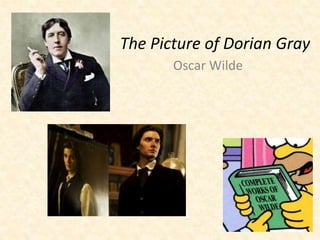
The Picture of Dorian Gray
Oscar Wilde
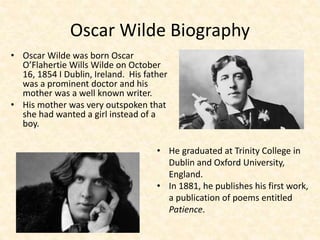
Oscar Wilde Biography
• Oscar Wilde was born Oscar
O’Flahertie Wills Wilde on October
16, 1854 I Dublin, Ireland. His father
was a prominent doctor and his
mother was a well known writer.
• His mother was very outspoken that
she had wanted a girl instead of a
boy.
• He graduated at Trinity College in
Dublin and Oxford University,
England.
• In 1881, he publishes his first work,
a publication of poems entitled
Patience.
Oscar Wilde Biography Continued…
• In 1882, he tours the United
States, with a sense of lectures.
During this time, he meets Walt
Whitman.
• In 1884, he marries Constance
Lloyd, the wealthy daughter of an
English lawyer. They move to
London.
• Their first son, Cyril is born in
1885, and their second son Vivian
is born in 1886.
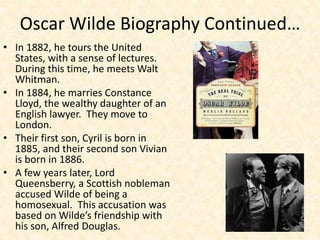
• A few years later, Lord
Queensberry, a Scottish nobleman
accused Wilde of being a
homosexual. This accusation was
based on Wilde’s friendship with
his son, Alfred Douglas.
Biography Part III
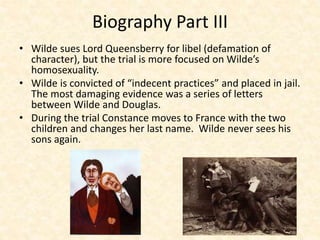
• Wilde sues Lord Queensberry for libel (defamation of
character), but the trial is more focused on Wilde’s
homosexuality.
• Wilde is convicted of “indecent practices” and placed in jail.
The most damaging evidence was a series of letters
between Wilde and Douglas.
• During the trial Constance moves to France with the two
children and changes her last name. Wilde never sees his
sons again.
Biography Part IV
• After his release from jail, Wilde
moves to France and spends the
rest of his life in exile.
• He dies in 1900, but not before a
deathbed conversion and return
to Catholicism.
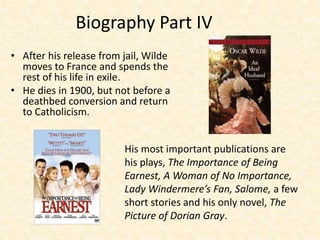
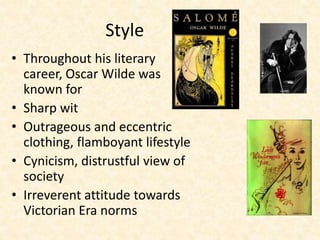
His most important publications are
his plays, The Importance of Being
Earnest, A Woman of No Importance,
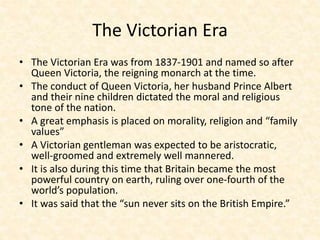
Lady Windermere’s Fan, Salome, a few
short stories and his only novel, The
Picture of Dorian Gray.
Style
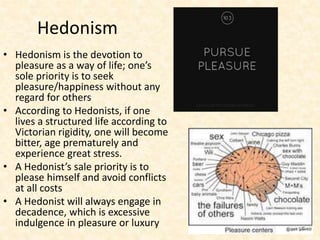
• Throughout his literary
career, Oscar Wilde was
known for
• Sharp wit
• Outrageous and eccentric
clothing, flamboyant lifestyle
• Cynicism, distrustful view of
society
• Irreverent attitude towards
Victorian Era norms
The Victorian Era
• The Victorian Era was from 1837-1901 and named so after
Queen Victoria, the reigning monarch at the time.
• The conduct of Queen Victoria, her husband Prince Albert
and their nine children dictated the moral and religious
tone of the nation.
• A great emphasis is placed on morality, religion and “family
values”
• A Victorian gentleman was expected to be aristocratic,
well-groomed and extremely well mannered.
• It is also during this time that Britain became the most
powerful country on earth, ruling over one-fourth of the
world’s population.
• It was said that the “sun never sits on the British Empire.”
Hedonism
• Hedonism is the devotion to
pleasure as a way of life; one’s
sole priority is to seek
pleasure/happiness without any
regard for others
• According to Hedonists, if one
lives a structured life according to
Victorian rigidity, one will become
bitter, age prematurely and
experience great stress.
• A Hedonist’s sale priority is to
please himself and avoid conflicts
at all costs
• A Hedonist will always engage in
decadence, which is excessive
indulgence in pleasure or luxury
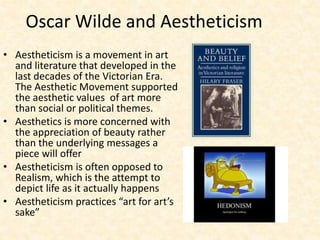
Oscar Wilde and Aestheticism
• Aestheticism is a movement in art
and literature that developed in the
last decades of the Victorian Era.
The Aesthetic Movement supported
the aesthetic values of art more
than social or political themes.
• Aesthetics is more concerned with
the appreciation of beauty rather
than the underlying messages a
piece will offer
• Aestheticism is often opposed to
Realism, which is the attempt to
depict life as it actually happens
• Aestheticism practices “art for art’s
sake”
Id, Ego, Superego
As we read through the novel, watch for the presence of the
following:
• Id: Freud believed that the Id is based on our pleasure
principle. The Id wants whatever feels good at the time,
with no consideration for the reality of the situation.
• Ego: The Ego is based on the reality principle. The Ego
understands that other people have needs and desires, that
sometimes impulsive or selfish can hurt us or others in the
long run
• Superego: The Superego is based on the moral principle.
Moral and ethical restraints placed on us by our
environment. Many equate the Superego with the
conscience as it dictates our beliefs of right and wrong.
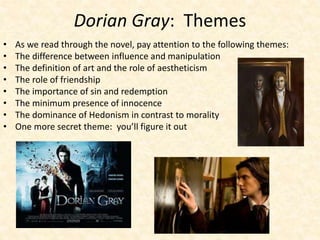
Dorian Gray: Themes
• As we read through the novel, pay attention to the following themes:
• The difference between influence and manipulation
• The definition of art and the role of aestheticism
• The role of friendship
• The importance of sin and redemption
• The minimum presence of innocence
• The dominance of Hedonism in contrast to morality
• One more secret theme: you’ll figure it out
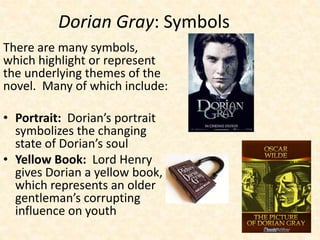
Dorian Gray: Symbols
There are many symbols,
which highlight or represent
the underlying themes of the
novel. Many of which include:
• Portrait: Dorian’s portrait
symbolizes the changing
state of Dorian’s soul
• Yellow Book: Lord Henry
gives Dorian a yellow book,
which represents an older
gentleman’s corrupting
influence on youth
Dorian Gray: Symbols II
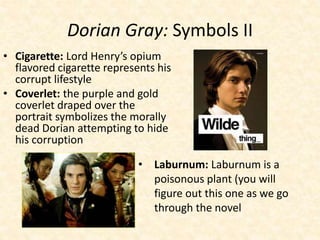
• Cigarette: Lord Henry’s opium
flavored cigarette represents his
corrupt lifestyle
• Coverlet: the purple and gold
coverlet draped over the
portrait symbolizes the morally
dead Dorian attempting to hide
his corruption
• Laburnum: Laburnum is a
poisonous plant (you will
figure out this one as we go
through the novel
The Picture of Dorian Gray
• The Picture of Dorian Gray is Oscar
Wilde’s first and only novel. It was
published in 1891 and incurred much
criticism. It was immediately
denounced as scandalous and
immoral.
• In response to this, Wilde revised the
novel the following year by adding a
preface in which he answered the
critics’ claims by arguing that art is
beautiful and worthy, but serves no
other purpose
• In the preface, Wilde cautions the
readers against finding meanings
behind the art
Dorian Gray
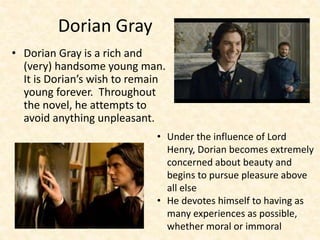
• Dorian Gray is a rich and
(very) handsome young man.
It is Dorian’s wish to remain
young forever. Throughout
the novel, he attempts to
avoid anything unpleasant.
• Under the influence of Lord
Henry, Dorian becomes extremely
concerned about beauty and
begins to pursue pleasure above
all else
• He devotes himself to having as
many experiences as possible,
whether moral or immoral
Lord Henry Wotton
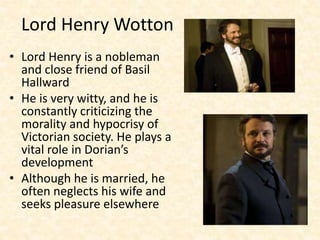
• Lord Henry is a nobleman
and close friend of Basil
Hallward
• He is very witty, and he is
constantly criticizing the
morality and hypocrisy of
Victorian society. He plays a
vital role in Dorian’s
development
• Although he is married, he
often neglects his wife and
seeks pleasure elsewhere
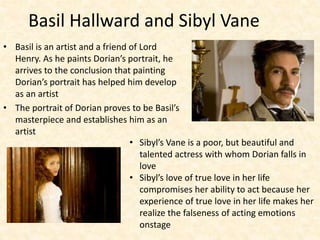
Basil Hallward and Sibyl Vane
• Basil is an artist and a friend of Lord
Henry. As he paints Dorian’s portrait, he
arrives to the conclusion that painting
Dorian’s portrait has helped him develop
as an artist
• The portrait of Dorian proves to be Basil’s
masterpiece and establishes him as an
artist
• Sibyl’s Vane is a poor, but beautiful and
talented actress with whom Dorian falls in
love
• Sibyl’s love of true love in her life
compromises her ability to act because her
experience of true love in her life makes her
realize the falseness of acting emotions
onstage
Dorian Gray Syndrome
• Dorian Gray Syndrome is a
psychological condition in
which a person takes extreme
pride in his or her own
appearances; this is
accompanied by difficulties
coping with the aging process
as well as the maturation
journey
• Sufferers of Dorian Gray
Syndrome may be users of
cosmetic medical procedures in
an attempt to preserve their
youth
Oscar Wilde: Famous Quotes
• “True friends stab you in the front”.
• “Some cause happiness wherever they go; others do so
whenever they go.”
• “The only difference between a saint and a sinner is that
every saint has a past, and every sinner has a future.”
• “Children begin by loving their parents; after a time they
judge them; rarely, if ever, do they forgive them.”
• “I am so clever that sometimes I don’t understand a single
word of what I am saying”
• “Experience is simply the name we give our mistakes.”
• “Women are made to be loved, not understood.”
Quotes II
• “When I was young, I thought that money was
the most important thing in the life; now that I
am old, I know that it is.”
• “Men always want to be a woman’s first love—
women like to be a man’s last romance”
• “I can resist anything but temptation”
• “One should always be in love. That is the reason
one should never marry.”
• “There is only one thing in life worse than being
talked about, and that is not being talked about.”
Quotes III
• “When men love women, they give a little of
their lives; when women love, they give
everything.”
• “A man can be happy with any woman, as long as
he does not love her.”
• “It is absurd to divide people into good and bad.
People are either charming or tedious.”
• “Work is the curse of the drinking classes.”
• “There is nothing in the world like the devotion of
a married woman. It is a thing no married man
knows anything about.”

Dorian Gray.pptx

  • 1.
    The Picture ofDorian Gray Oscar Wilde
  • 2.
    Oscar Wilde Biography •Oscar Wilde was born Oscar O’Flahertie Wills Wilde on October 16, 1854 I Dublin, Ireland. His father was a prominent doctor and his mother was a well known writer. • His mother was very outspoken that she had wanted a girl instead of a boy. • He graduated at Trinity College in Dublin and Oxford University, England. • In 1881, he publishes his first work, a publication of poems entitled Patience.
  • 3.
    Oscar Wilde BiographyContinued… • In 1882, he tours the United States, with a sense of lectures. During this time, he meets Walt Whitman. • In 1884, he marries Constance Lloyd, the wealthy daughter of an English lawyer. They move to London. • Their first son, Cyril is born in 1885, and their second son Vivian is born in 1886. • A few years later, Lord Queensberry, a Scottish nobleman accused Wilde of being a homosexual. This accusation was based on Wilde’s friendship with his son, Alfred Douglas.
  • 4.
    Biography Part III •Wilde sues Lord Queensberry for libel (defamation of character), but the trial is more focused on Wilde’s homosexuality. • Wilde is convicted of “indecent practices” and placed in jail. The most damaging evidence was a series of letters between Wilde and Douglas. • During the trial Constance moves to France with the two children and changes her last name. Wilde never sees his sons again.
  • 5.
    Biography Part IV •After his release from jail, Wilde moves to France and spends the rest of his life in exile. • He dies in 1900, but not before a deathbed conversion and return to Catholicism. His most important publications are his plays, The Importance of Being Earnest, A Woman of No Importance, Lady Windermere’s Fan, Salome, a few short stories and his only novel, The Picture of Dorian Gray.
  • 6.
    Style • Throughout hisliterary career, Oscar Wilde was known for • Sharp wit • Outrageous and eccentric clothing, flamboyant lifestyle • Cynicism, distrustful view of society • Irreverent attitude towards Victorian Era norms
  • 7.
    The Victorian Era •The Victorian Era was from 1837-1901 and named so after Queen Victoria, the reigning monarch at the time. • The conduct of Queen Victoria, her husband Prince Albert and their nine children dictated the moral and religious tone of the nation. • A great emphasis is placed on morality, religion and “family values” • A Victorian gentleman was expected to be aristocratic, well-groomed and extremely well mannered. • It is also during this time that Britain became the most powerful country on earth, ruling over one-fourth of the world’s population. • It was said that the “sun never sits on the British Empire.”
  • 8.
    Hedonism • Hedonism isthe devotion to pleasure as a way of life; one’s sole priority is to seek pleasure/happiness without any regard for others • According to Hedonists, if one lives a structured life according to Victorian rigidity, one will become bitter, age prematurely and experience great stress. • A Hedonist’s sale priority is to please himself and avoid conflicts at all costs • A Hedonist will always engage in decadence, which is excessive indulgence in pleasure or luxury
  • 9.
    Oscar Wilde andAestheticism • Aestheticism is a movement in art and literature that developed in the last decades of the Victorian Era. The Aesthetic Movement supported the aesthetic values of art more than social or political themes. • Aesthetics is more concerned with the appreciation of beauty rather than the underlying messages a piece will offer • Aestheticism is often opposed to Realism, which is the attempt to depict life as it actually happens • Aestheticism practices “art for art’s sake”
  • 10.
    Id, Ego, Superego Aswe read through the novel, watch for the presence of the following: • Id: Freud believed that the Id is based on our pleasure principle. The Id wants whatever feels good at the time, with no consideration for the reality of the situation. • Ego: The Ego is based on the reality principle. The Ego understands that other people have needs and desires, that sometimes impulsive or selfish can hurt us or others in the long run • Superego: The Superego is based on the moral principle. Moral and ethical restraints placed on us by our environment. Many equate the Superego with the conscience as it dictates our beliefs of right and wrong.
  • 11.
    Dorian Gray: Themes •As we read through the novel, pay attention to the following themes: • The difference between influence and manipulation • The definition of art and the role of aestheticism • The role of friendship • The importance of sin and redemption • The minimum presence of innocence • The dominance of Hedonism in contrast to morality • One more secret theme: you’ll figure it out
  • 12.
    Dorian Gray: Symbols Thereare many symbols, which highlight or represent the underlying themes of the novel. Many of which include: • Portrait: Dorian’s portrait symbolizes the changing state of Dorian’s soul • Yellow Book: Lord Henry gives Dorian a yellow book, which represents an older gentleman’s corrupting influence on youth
  • 13.
    Dorian Gray: SymbolsII • Cigarette: Lord Henry’s opium flavored cigarette represents his corrupt lifestyle • Coverlet: the purple and gold coverlet draped over the portrait symbolizes the morally dead Dorian attempting to hide his corruption • Laburnum: Laburnum is a poisonous plant (you will figure out this one as we go through the novel
  • 14.
    The Picture ofDorian Gray • The Picture of Dorian Gray is Oscar Wilde’s first and only novel. It was published in 1891 and incurred much criticism. It was immediately denounced as scandalous and immoral. • In response to this, Wilde revised the novel the following year by adding a preface in which he answered the critics’ claims by arguing that art is beautiful and worthy, but serves no other purpose • In the preface, Wilde cautions the readers against finding meanings behind the art
  • 15.
    Dorian Gray • DorianGray is a rich and (very) handsome young man. It is Dorian’s wish to remain young forever. Throughout the novel, he attempts to avoid anything unpleasant. • Under the influence of Lord Henry, Dorian becomes extremely concerned about beauty and begins to pursue pleasure above all else • He devotes himself to having as many experiences as possible, whether moral or immoral
  • 16.
    Lord Henry Wotton •Lord Henry is a nobleman and close friend of Basil Hallward • He is very witty, and he is constantly criticizing the morality and hypocrisy of Victorian society. He plays a vital role in Dorian’s development • Although he is married, he often neglects his wife and seeks pleasure elsewhere
  • 17.
    Basil Hallward andSibyl Vane • Basil is an artist and a friend of Lord Henry. As he paints Dorian’s portrait, he arrives to the conclusion that painting Dorian’s portrait has helped him develop as an artist • The portrait of Dorian proves to be Basil’s masterpiece and establishes him as an artist • Sibyl’s Vane is a poor, but beautiful and talented actress with whom Dorian falls in love • Sibyl’s love of true love in her life compromises her ability to act because her experience of true love in her life makes her realize the falseness of acting emotions onstage
  • 18.
    Dorian Gray Syndrome •Dorian Gray Syndrome is a psychological condition in which a person takes extreme pride in his or her own appearances; this is accompanied by difficulties coping with the aging process as well as the maturation journey • Sufferers of Dorian Gray Syndrome may be users of cosmetic medical procedures in an attempt to preserve their youth
  • 19.
    Oscar Wilde: FamousQuotes • “True friends stab you in the front”. • “Some cause happiness wherever they go; others do so whenever they go.” • “The only difference between a saint and a sinner is that every saint has a past, and every sinner has a future.” • “Children begin by loving their parents; after a time they judge them; rarely, if ever, do they forgive them.” • “I am so clever that sometimes I don’t understand a single word of what I am saying” • “Experience is simply the name we give our mistakes.” • “Women are made to be loved, not understood.”
  • 20.
    Quotes II • “WhenI was young, I thought that money was the most important thing in the life; now that I am old, I know that it is.” • “Men always want to be a woman’s first love— women like to be a man’s last romance” • “I can resist anything but temptation” • “One should always be in love. That is the reason one should never marry.” • “There is only one thing in life worse than being talked about, and that is not being talked about.”
  • 21.
    Quotes III • “Whenmen love women, they give a little of their lives; when women love, they give everything.” • “A man can be happy with any woman, as long as he does not love her.” • “It is absurd to divide people into good and bad. People are either charming or tedious.” • “Work is the curse of the drinking classes.” • “There is nothing in the world like the devotion of a married woman. It is a thing no married man knows anything about.”