VicHealth Innovation 
Challenge 
ALCOHOL 
#VHinnov 
IDEAS JAM
WELCOME 
Julian Waters-­‐Lynch 
DOING SOMETHING GOOD 
#VHinnov @jwaterslynch
welcome 
DAVID HOOD 
@DavidAHood 
JULIAN WATERS-­‐LYNCH 
@jwaterslynch 
join the conversa<on on twi=er with 
@VicHealth 
@DoingSomeGood 
#VHinnov 
doing 
something good
SCHEDULE 
morning a(ernoon 
9:30 AM Welcome 1:20 PM Rapid Prototype Team Challenge 
9:50 AM Shaping Good Ideas 2:10 PM Pitch Design 
10:00 AM Understanding Context -­‐ includes 
review of Discovery & Insights Forum 
2:25 PM AFTERNOON TEA 
10:40 AM MORNING TEA 2:45 PM Pitch Delivery 
11:00 AM Intro to Human-­‐centred Design 3:10 PM Intro to Lean Startup 
11:15 AM GeVng to Know Your Audience 3:25 PM IdenYfying AssumpYons & Designing 
Lean Experiments 
12:10 PM Engaging Your Target Audience 3:50 PM Wrap up & What’s Next 
12:35 PM LUNCH 4:00 PM CLOSE
WELCOME 
David Hood 
DOING SOMETHING GOOD 
#VHinnov @DavidAHood
why the innovaCon challenge? 
VicHealth wants to see a be=er drinking culture in Victoria. One where 
people can say no to a drink when they feel like stopping, where drinking 
to get drunk isn’t seen as acceptable or normal. 
> Almost half (46%) of all Victorians drink in a way that increases their 
risk of injury, with this rising to two-­‐thirds (67%) for young people aged 
16-­‐29. 
> Alcohol-­‐related harms requiring police or medical a=enRon appear to 
be increasing in Victoria, with hospitalisaRons involving alcohol up by 
33% 
> Alcohol is one of the top 10 avoidable causes of disease and death in 
Victoria.
what is the innovaCon challenge? 
The VicHealth InnovaRon Challenge is looking for innovaRve 
ideas to help change this drinking culture by either: 
• Reducing the amount Victorians drink, parRcularly those 
who drink a lot, o[en, or; 
• Increasing the acceptability of saying no to a drink, or 
drinking a bit less. 
There’s a pool of up to $300,000 available in start up funding 
for bold new ideas to change the way Victorians drink.
creaCng the condiCons to 
spark great ideas
where do good ideas come from? 
“Chance favours the connected mind.” 
Steven B Johnson
http://dthsg.com/what-is-design-thinking/
“If I had an hour to 
solve a problem I'd 
spend 55 minutes 
thinking about the 
problem and five 
minutes thinking 
about solu?ons.”
human-centred 
design
http://www.nitibhan.com/2013/01/reflections-on-design-thinking-for.html
http://uxthink.wordpress.com/2010/01/10/apple-design-proces/
creaCve jammin’ principles 
1. Be present. 
Focus on what you’re doing right now and pay 
a=enRon to every aspect of what you’re doing: to your 
body, your senses, your thoughts. 
2. Accept everything as an offer. 
Receive thoughts, ideas, quesRons or comments of 
others as a gi[. 
3. There are no mistakes. 
Only invitaRons into a new level of creaRvity: breaking 
pa=erns and allowing new ones to emerge. 
4. Make everyone else look good. 
You do not have to defend or jusRfy yourself or your 
posiRon -­‐ others will do that for you and you do that 
for others. 
5. Be changed by what is said. 
Accept your reacRon as an opportunity to take a new 
or expanded perspecRve to inspire new ideas. 
6. Keep the energy going. 
No ma=er what is given, or what happens, accept it 
and keep moving. 
7. Serve the good of the whole. 
Always carry the quesRon, "How can I best serve this 
situaRon?" 
8. Yes and ... 
Fully accept what is happening and what is being 
offered, and add a NEW piece of informaRon -­‐ that is 
what allows it to be adapRve, move forward and stay 
generaRve. 
Inspired by 7 Basic Improv Principles with thanks to Michelle James (crea<veemergence.com)
What brought you here?
What brought you here? 
What are you currently 
working on in relaRon to 
alcohol consumpRon?
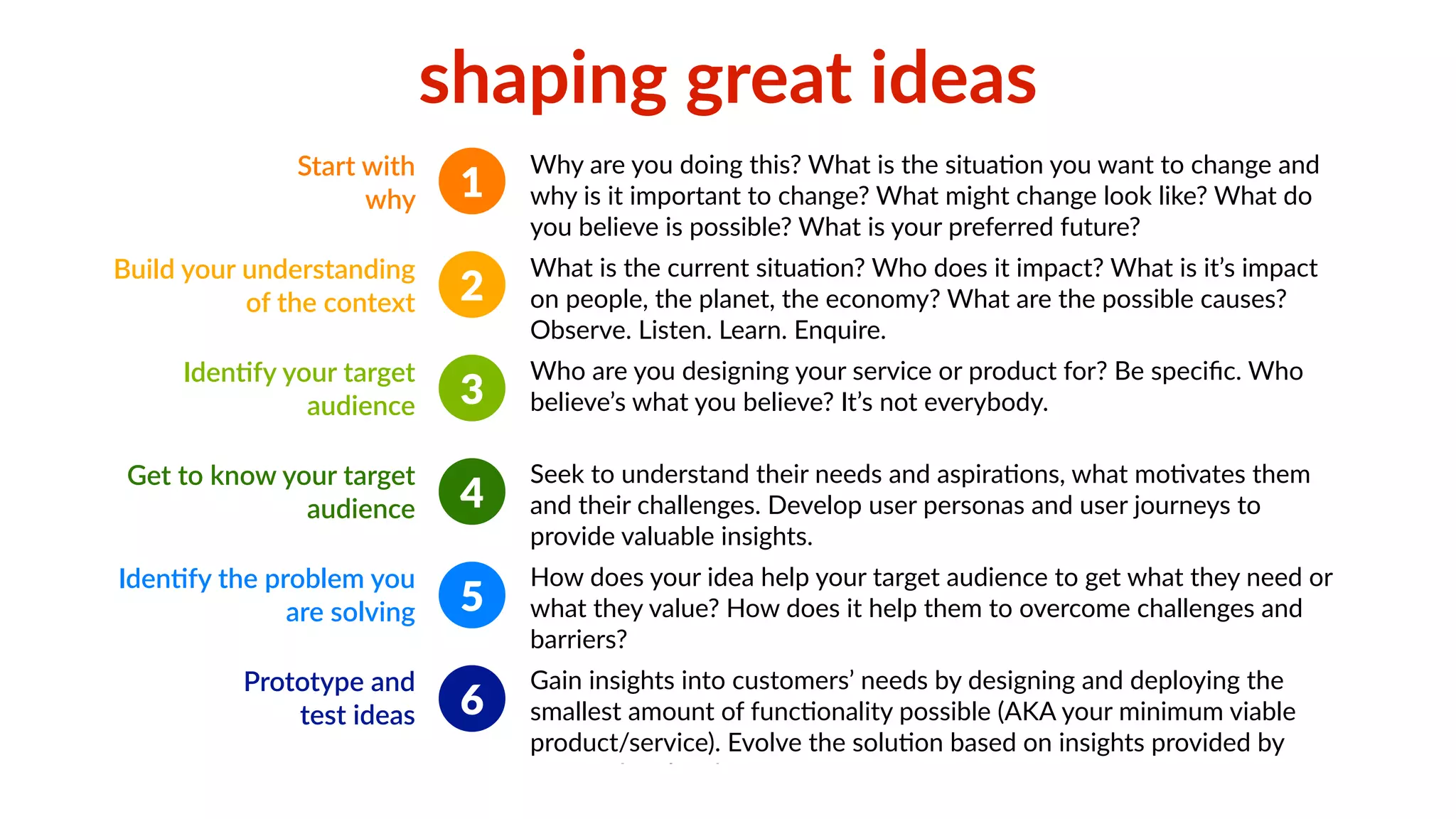
shaping great ideas 
Start with 
why 
Why are you doing this? What is the situaRon you want to change and 
why is it important to change? What might change look like? What do 
you believe is possible? What is your preferred future? 
of the context 1 What is the current situaRon? Who does it impact? What is it’s impact 
Build your understanding 
on people, the planet, the economy? What are the possible causes? 
Observe. Listen. Learn. Enquire. 
IdenYfy your target 
audience 
Who are you designing your service or product for? Be specific. Who 
believe’s what you believe? It’s not everybody. 
audience 3 Seek to understand their needs and aspiraRons, what moRvates them 
Get to know your target 
and their challenges. Develop user personas and user journeys to 
provide valuable insights. 
IdenYfy the problem you 
are solving 
How does your idea help your target audience to get what they need or 
what they value? How does it help them to overcome challenges and 
barriers? 
Prototype and 
test ideas 
Gain insights into customers’ needs by designing and deploying the 
smallest amount of funcRonality possible (AKA your minimum viable 
product/service). Evolve the soluRon based on insights provided by 
engaged early adopters. 
1 
2 
3 
4 
5 
6
shaping great ideas 
Start with 
why 
Why are you doing this? What is the situaRon you want to change and 
why is it important to change? What might change look like? What do 
you believe is possible? What is your preferred future? 
of the context 1 What is the current situaRon? Who does it impact? What is it’s impact 
Build your understanding 
on people, the planet, the economy? What are the possible causes? 
Observe. Listen. Learn. Enquire. 
IdenYfy your target 
audience 
Who are you designing your service or product for? Be specific. Who 
believe’s what you believe? It’s not everybody. 
audience 3 Seek to understand their needs and aspiraRons, what moRvates them 
Get to know your target 
and their challenges. Develop user personas and user journeys to 
provide valuable insights. 
IdenYfy the problem you 
are solving 
How does your idea help your target audience to get what they need or 
what they value? How does it help them to overcome challenges and 
barriers? 
Prototype and 
test ideas 
Gain insights into customers’ needs by designing and deploying the 
smallest amount of funcRonality possible (AKA your minimum viable 
product/service). Evolve the soluRon based on insights provided by 
engaged early adopters. 
1 
2 
3 
4 
5 
6
START 
WITH WHY
People don’t buy what you do they 
buy why you do it. ~ Simon Sinek
Excessive alcohol consump?on creates 
mul?ple social and health problems for 
individuals and society, and is one of the 
top 10 avoidable causes of disease and 
death in Victoria.
The social cost of alcohol-­‐related harm in 
2007–08 in Victoria was $4.3 billion. This 
includes direct costs associated with, for 
example, road accidents, health care, 
crime and violence, and indirect costs 
such as loss of workforce labour and for 
educa?on and research resources.
While most of us (78% of Australians) 
agree that we have a problem with 
alcohol, only 25% of drinkers believe 
that their drinking behaviour is cause 
for concern.
shaping great ideas 
Start with 
why 
Why are you doing this? What is the situaRon you want to change and 
why is it important to change? What might change look like? What do 
you believe is possible? What is your preferred future? 
of the context 1 What is the current situaRon? Who does it impact? What is it’s impact 
Build your understanding 
on people, the planet, the economy? What are the possible causes? 
Observe. Listen. Learn. Enquire. 
IdenYfy your target 
audience 
Who are you designing your service or product for? Be specific. Who 
believe’s what you believe? It’s not everybody. 
audience 3 Seek to understand their needs and aspiraRons, what moRvates them 
Get to know your target 
and their challenges. Develop user personas and user journeys to 
provide valuable insights. 
IdenYfy the problem you 
are solving 
How does your idea help your target audience to get what they need or 
what they value? How does it help them to overcome challenges and 
barriers? 
Prototype and 
test ideas 
Gain insights into customers’ needs by designing and deploying the 
smallest amount of funcRonality possible (AKA your minimum viable 
product/service). Evolve the soluRon based on insights provided by 
engaged early adopters. 
1 
2 
3 
4 
5 
6
what are VicHealth looking for? 
Ideas that address the following criteria: 
1. Enable a beVer drinking culture: by geong heavy drinkers to drink a li=le 
less, or by increasing the acceptability of non and moderate drinking. 
2. Point of difference: be clever, Rmely and unique. 
3. Equity: reach the hard to reach and move the hard to move. 
4. Scalability: able to be expanded, upscaled or transferred 
5. Sustainability: will be able to stand on its own two feet. 
6. Partners: recruited a project team that brings a unique perspecRve 
7. Sharable: documented your project so we can share it online 
8. Ready to roll!: must be able to test within 12 months
review 
vichealth innovation challenge: 
discovery & insights forum Alcohol
Alcohol in Australia: 
Key trends and recent developments 
Michael Livingston
Historical*consump/on*data* 
14" 
12" 
10" 
8" 
6" 
4" 
2" 
0" 
Alcohol" Spirits" 
Wine" Beer"
Consumption 
Risky drinking by young adults 
60 
50 
40 
30 
20 
10 
0 
18-24 year olds 25-29 year olds 
2001 2004 2007 2010 2013
Consumption 
But... 
60 
50 
40 
30 
20 
10 
0 
18-24 year olds 25-29 year olds 40-49 year olds 50-59 year olds 60-69 year olds 
2001 2004 2007 2010 2013
Harm trends 
Generally increasing harm rates over the past decade 
(although road injuries and deaths are steady) 
70 
60 
50 
40 
30 
20 
10 
0 
Hospital admissions Ambulance attendances Treatment episodes 
Assault Family incidents Emergency Department 
2003/04 2004/05 2005/06 2006/07 2007/08 2008/09 2009/10 2010/11 2011/12 2012/13
Conclusions 
Victorian and Australian alcohol trend data provides a 
confusing picture: 
- Reasonable evidence of harm increases 
– Generally stable levels of consumption, which obscure: 
• Major reductions in teenage drinking 
• Declines in risky drinking, particularly among young adults 
• Some slight increases in drinking among older people 
– Big shifts in attitudes towards alcohol 
Little evidence to explain these changes 
– Increased public health presence in media coverage of 
alcohol may be driving or reflecting changes in public attitudes
Alcohol 
Discovery 
& Insights 
Forum 
Drinking Related Lifestyles 
Study 
Don’t Wag Your 
Finger At Me! 
Mike Reid, RMIT University 
Tony Worsley, Deakin University 
Francis Farrelly, RMIT University 
Tim Fry, RMIT University 
Lisa Farell, RMIT University 
Alcohol Discovery & Insights Forum
Alcohol 
Discovery & 
Insights Forum 
The spectrum of 
acceptable behaviour 
Typical 
Drinking 
normal 
behaviour 
Consumption of alcohol 
Abstaining 
extreme, odd & 
infrequent 
behaviour 
Alcohol Discovery & Insights Forum 
Getting Drunk 
common practice 
Binge 
Drinking 
extreme & " 
“a youth issue” 
Acceptable behaviour 
Only abstinence from alcohol and binge drinking are seen as extreme 
behaviours
Alcohol 
Discovery & 
Insights Forum 
The Initiator 
• Outgoing and the ‘life of the party’! 
• Loves to have a drink and let loose! 
• Drinks to have fun! 
• Gregarious and outgoing and loves 
to make things happen – often 
encourages others to drink! 
• Likes to be a source of information 
on alcohol brands, types of drinks 
and places to go out! 
The Protector 
Alcohol Discovery & Insights Forum 
The Moderator 
! 
The Follower 
• Fun, social and easy-going! 
• Influenced by social and cultural 
pressures! 
• Tends to join in and go with the 
flow! 
• Gets swept up in the moment and 
enjoyment of social situations 
Drinking 
Identities & 
Characteristics
Alcohol 
Discovery & 
Insights Forum 
What drives the Initiators? 
Mavenism / Ego 
Seeking Self Enhancement 
Social expectations 
Alcohol Discovery & Insights Forum 
Hedonism 
Brand loyalty 
Coping with Depression 
Easy access to alcohol 
Cheap Prices 
Building Confidence 
Question: How can I create fun without using Alcohol as a starting point?
Alcohol 
Discovery & 
Insights Forum 
What drives the Followers? 
Achievement Values 
Cheap Prices 
Seeking Self Enhancement 
Mavenism / Ego 
Alcohol Discovery & Insights Forum 
Hedonism 
Easy access 
Brand loyalty 
Question: How can I join in but not be lead astray so easily?
Alcohol: 
Discovery and Insights 
Forum 
Acting Inspector Dale HUNTINGTON 
Melbourne East Local Area Commander
PRESENT: 
Large Crowds - Ticketed event – VRC 
Small numbers of drunk arrests- media / standards set by VRC / 
safe beverage containers- Licensee / Fosters-CUB/ other events 
Fights in the crowd- beverage purchasing management controls. 
Lack of organising security – expectations/duties – Full support 
by VRC - Vicpol 
Patron standards of behaviour - High 
- World event. Branding of Melbourne 
Liquor licensing Controls lax – Stringent bar and point of sale 
management structures / RSA officers / Nil BYO
Young adults in Melbourne 
talking about their ideal state of 
intoxication 
Sarah MacLean1&2 
1 Centre for Heath Equity, University of Melbourne, 
Melbourne, Victoria, Australia 
2 Centre for Alcohol Policy Research, Turning Point, 
Melbourne, Victoria, Australia
Most people monitored how they were feeling 
to assess how drunk they were 
• I get head spins and then like I feel like I’m 
gonna throw up. But I don’t throw up then, I 
just stop [drinking] (Kara, 19, female, high risk drinker). 
• I can sort of just see if I’m starting to feel a bit 
more tired. And then I’m like ‘Nah there’s no 
point’. I’m not really enjoying [drinking] 
anymore so …that’s it (Dragan, 22 male, HRD). 
• Sometimes the taste, the taste kind of gets to 
me … The taste starts tasting a bit funny for 
me. So yeah, I go ‘Oh shit, I’ve drunk too 
much now’ (Paul, 23 male).
Image&machines.& 
& 
Interplay&between&people,&devices,&cultural&spaces&and&digital& 
networks.&& 
& 
Nicholas&Carah,&University&of&Queensland.& 
@nnniccc& 
n.carah@uq.edu.au&
Algorithm.& 
AcCvaCon.& 
Cultural&intermediary.& 
Gender&and&idenCty.&
VicHealth Innovation Challenge 
Using legislation to change 
behaviour: What more is needed? 
Liquor Licensing in Victoria 
Ms Paula O’Brien, Melbourne Law School 
21 October 2014
CHANGING THE WAY WE 
SELL 
ALCOHOL 
TO MINIMISE ALCOHOL-RELATED 
HARM
!!!!!!! Social'Marke,ng'Approaches' 
' 
Alcohol!Culture!Change!Project! 
! 
!!! 
Sarah'Saunders' 
VicHealth'Campaigns'Manager' 
20'October'2014'
No'Excuse'Needed'Campaign'
GIVE THEM LOLLIPOPS
Healthy clubs. 
Strong communities. 
Good$Sports$ 
Innova&on'Challenge:'Alcohol' 
Discovery'and'Insights'Forum'' 
' 
20'October'2014! 
Community 
programs 
! 
Mark'Stone' 
Project(Officer(–(Good(Sports( 
Bill'Karametos' 
Victoria(Regional(Manager(–(Good(Sports( 
(
Community 
programs 
!!!!!!!!!!!!13
+ =
Framing Kings Cross as 
a music festival
my Hello Sunday Morning 
experience! 
Nicole!Cliff!
Open Space 
Session topics included: 
• designing a campaign for drinking in moderaRon 
• a Human-­‐centred Design approach to influencing behaviour 
• social markeRng and behaviour change alcohol educaRon programs 
• how brands design spaces to influence behaviour 
• developing a parenRng pack to educate kids about the risks of drinking
your 
IDEA?
designing for the 
future
WORLD CAFÉ
WORLD CAFÉ 
Think about behaviour change 
iniRaRves that have helped 
influence our culture for the be=er.
WORLD CAFÉ 
Think about behaviour change iniRaRves that 
have helped influence our culture for the 
be=er. 
1. Which ones were your favourite? 
2. What were the qualiRes or characterisRcs 
you liked about it? Why?
MORNING 
TEA
human-centred 
design
http://www.nitibhan.com/2013/01/reflections-on-design-thinking-for.html
https://dschool.stanford.edu/
the five phases of 
design thinking 
http://thinkingofdesign.blogspot.com.au/
http://uxthink.wordpress.com/2010/01/10/apple-design-proces/
http://hci.stanford.edu/dschool/resources/design-process/readable.html
design thinking 
Getting to know 
your audience
“Understanding what drives binge drinking is 
important, but arguably just as crucial is 
understanding the deeper rela?onship Victorians 
have with alcohol. The public discussion about 
alcohol needs to be inclusive, realis?c, empathe?c 
and relevant to a broad audience.”
Within the present cultural context, drinking less 
appears to be difficult for most people to do. There are 
very few effec?ve incen?ves for individuals to opt for a 
more moderate approach toward alcohol. Ra?onally, 
many are able to see the benefits of drinking less, such 
as improved health, more money and greater 
produc?vity at work. Yet the promise of these benefits 
does liXle to reduce drinking. A key factor undermining 
the power of these incen?ves to drink less is the lack of 
socially acceptable ‘excuses’ to drink less.
Our society’s inherent and deeply embedded 
drinking culture makes most people feel they need a 
specific reason not to drink, rather than a reason to 
drink. People need to be armed with a specific 
reason for not drinking, or for drinking less, when 
out 
with friends. Unfortunately, only a few reasons, 
such as a medical condi?on, pregnancy or driving, 
are socially accepted.
Presently, liXle or no posi?ve reinforcement (or culturally 
accepted alterna?ve to alcohol) exists for those who 
decide not to drink or want to drink less. Modifying 
drinking behaviour is hard because our society and culture 
provide individuals with very few ‘tools’ and strategies to 
enable this behavioural change. Fundraising events such 
as Febfast, Dry July and Ocsober, and innova?ons such as 
Hello Sunday Morning and Say When, encourage people 
to learn more about their drinking, and they support 
changes to drinking behaviours.
The research suggests an opportunity to promote 
and build on these, and to develop alterna?ves to 
drinking that are relevant, realis?c and 
acknowledge the present culture of drinking in 
Victoria.
Empathy 
is not just about walking 
in another's shoes. 
First you must 
remove your own.
what are personas? 
Personas are ficRonal representaRons of your target 
audience that help you to understand them be=er. Well 
thought out and well researched personas make it easier for 
you to design and deliver services that meet your target 
audience’s specific needs and expectaRons, while addressing 
their unique challenges and communicaRng in their language. 
The strongest personas are based on market research in 
combinaRon with insights gathered through conversaRons, 
surveys and interviews with your target audience.
developing user personas 
•To ensure your personas are accurate representaRons of your users and have the 
support of your stakeholders throughout the process, you should: 
•Conduct user research: Answer the following quesRons: Who are your users and 
why are they using the system? What behaviors, assumpRons, and expectaRons 
color their view of the system? 
•Condense the research: Look for themes/characterisRcs that are specific, 
relevant, and universal to the system and its users. 
•Brainstorm: Organize elements into persona groups that represent your target 
users. Name or classify each group. 
•Refine: Combine and prioriRze the rough personas. Separate them into primary, 
secondary, and, if necessary, complementary categories. You should have roughly 
3-­‐5 personas and their idenRfied characterisRcs. 
•Make them realisRc: Develop the appropriate descripRons of each personas 
background, moRvaRons, and expectaRons. Do not include a lot of personal 
informaRon. Be relevant and serious; humor is not appropriate.
Market Segment 
Name 
Gender 
Age 
Nationality 
Location 
Relationship Status 
Children 
Employer 
Position 
Income 
Background Routine & Behaviour 
Goals & Motivations Challenges & Constraints 
Ideal Experience 
Persona Creator powered by UsabilityTools 1
What’s their history in 
relaRonship to drinking? 
Who and what has shaped 
their current behaviour? 
What’s their rouRne in 
relaRon to socialising and 
drinking? Daily, weekly, 
monthly, annually? 
What are their personal 
goals around health, 
wellbeing and happiness? 
What moRvates them? 
What are the challenges 
they face to changing their 
drinking behaviour? What are 
the constraints/barriers? 
What sort of experience are 
they looking for? What sort 
of interacRon do they want 
to have with others/you? 
What sort of thing might 
you expect them to say 
about their ideal experience 
and why they love it?
EMPATHY MAP 
Persona: Scenario: 
How do I feel? 
What do I think? 
What do I see? 
What do I hear? 
What do I say and do? 
Pain Gain 
Fears | Frustrations | Obstacles Wants/Needs | Measures of Success
EMPATHY MAP 
How do I feel? 
What do I see? 
What do I hear? 
What do I say and do? 
Pain Gain 
Fears | FrustraRons | Obstacles Wants/Needs | Measures of Success 
Persona: Angela Schwindt (Sidelined Sporster)
SCENARIO 
Persona: Scenario: 
getting ready arrive depart fall asleep 
POINT OF 
DECISION 
ENABLING 
CONDITION 
POTENTIALH 
URDLE
“The key is help them take baby steps” 
grind it 
out 
tiny 
habits 
http://www.behaviormodel.org/
tiny habit 
Formula 
A[er I [exis?ng habit] 
I will [new ?ny behaviour] 
And then [celebrate] 
http://tinyhabits.com/
COMMUNICATIONS & 
COMMUNITY ENGAGEMENT
start with ‘why’
People don’t buy what you do they 
buy why you do it. ~ Simon Sinek
‣ why: belief, moRvaRon or 
purpose 
‣ how: experience or process 
‣ what: details of product of 
service
the opportunity 
• raise awareness of issue 
• build profile of 
organisaRon or project 
• engage community 
• a=ract supporters 
• a=ract funding 
• crowd-­‐source content and 
ideas 
• find allies 
• engage influencers 
• build networks 
• collaborate 
• coordinate collecRve 
acRon 
• scale impact
developing an integrated strategy 
Social 
Media 
Strategy 
OrganisaYonal 
Strategy 
Alignment of: 
•Vision 
•Mission 
•ObjecRves 
CommunicaCons 
Strategy
what goes in to a good strategy? 
1. An inspiring Vision statement 
2. An engaging Mission statement. 
3. Having clear objecRves. Make them SMART. 
4. Knowing who your target audience is and understanding 
what they value. 
5. Knowing where your target audience is (which channels 
they are on). 
6. Clear and consistent messaging.
what’s your strategy? 
1. What is your organisaRon’s Vision? 
What does the world look like if you’re successful? How does 
it reflect what you believe? How does it include others -­‐ will 
your target audience and other organisa?ons want to help 
you achieve it? (This is the ‘why’.) 
2. What is your organisaRon’s Mission? 
How are you working toward your Vision? What do you offer? 
What problem are you solving with your work, and who are 
you solving it for?
vision statements 
Kiva: We envision a world where all people – even in the most remote 
areas of the globe – hold the power to create opportunity for 
themselves and others. (26) 
Save the Children: Our vision is a world in which every child a=ains the 
right to survival, protecRon, development and parRcipaRon. (18) 
Goodwill: Every person has the opportunity to achieve his/her fullest 
potenRal and parRcipate in and contribute to all aspects of life. (21) 
Teach for America: One day, all children in this naRon will have the 
opportunity to a=ain an excellent educaRon. (16) 
Make-­‐A-­‐Wish: Our vision is that people everywhere will share the power 
of a wish (13)
mission statements 
Special Olympics: To transform communiRes by inspiring 
people throughout the world to open their minds, accept and 
include people with intellectual disabiliRes and thereby 
anyone who is perceived as different.
belief/theory of change 
charity: water believes that we can end the water crisis in 
our lifeRme by ensuring that every person on the planet has 
access to life’s most basic need — clean drinking water.
what’s your strategy? 
3. What are your objecRves? 
Make them SMART -­‐ Specific, Measurable, Achievable, Relevant, 
Time-­‐bound! Develop 3-­‐5 clear objec?ves for each of your 
strategies -­‐ organisa?onal, communica?ons and social media. 
4. Who's your audience? 
Be more specific than people of a specific gender or age, in a 
par?cular loca?on or profession, or with certain interests. Think 
psychographics profiles rather than just demographic. What do 
your audience value (ends values)? What are they talking about? 
What are they searching for? Consider developing personas.
what’s your strategy? 
5. Where are your target audience? 
Which channels are they on and why? Where are they most 
likely to get value from interac?ng with you? 
6. What acRons (have mulRple) can they take with you? 
What's in it for them? Think about what they value. Just 
because it's compelling for you doesn't mean it will inspire 
them to ac?on. How does the ac?on help us to move toward 
a shared vision and how is does it reflect their values and 
aspira?ons? Frame as an invita?on. eg. “Join us…”
what’s your strategy? 
7.What are your key messages? 
1.Why is this issue important? Highlight with memorable and 
repeatable facts, figures and metaphors. (Wrap them up in 
personal stories and a broader narra?ve that reflects your 
vision and values.) 
2.What ac?on are you invi?ng people to take? How will it 
contribute toward your vision and objec?ves? This should 
be included in EVERY piece of communica?on.
MESSAGING
KEY MESSAGES 
• come up with three top line messages: 
• the current situaRon and it’s impact 
• your belief that it can change and how 
• call to acRon for people to take 
• have up to three supporRng messages 
• keep them simple 
• use language that the audience understands and listens/ 
looks out for
KEY MESSAGES 
• do you have any killer facts and figures? 
• do you have an anecdote or story? 
• are there any metaphors or analogies you can use? 
• do you have any images you can use?
MESSAGING 
The Why: 
1. What’s the need? What’s the current situaRon and its 
impact. -­‐> Do you have a killer fact? 
2. What do you believe? What is the vision you’re working 
toward? What supporRng evidence do you have that this is 
possible? -­‐ Either research or an example.
MESSAGING 
The How: 
3. What exactly are you doing to work toward your Vision? 
i.e. your Mission. 
4. What are the results or impact you’re seeing and 
experiencing from your work (or of others doing similar 
work)? 
5. Use a story or metaphor to illustrate what you’re doing 
and its impact.
MESSAGING 
The What: 
6. What acRon/s are you inviRng people to take? How can 
their acRon/contribuRon/parRcipaRon help you work 
toward your vision?
FINDABLE
SHAREABLE
MEASURABLE
MANAGEABLE
steps to success with social media 
1. Watch and learn from those who know what they’re doing
steps to success with social media 
1. Watch and learn from those who know what they’re doing 
2. Develop an integrated strategy
steps to success with social media 
1. Watch and learn from those who know what they’re doing 
2. Develop an integrated strategy 
1. Be clear about your purpose
steps to success with social media 
1. Watch and learn from those who know what they’re doing 
2. Develop an integrated strategy 
1. Be clear about your purpose and objecRves
steps to success with social media 
1. Watch and learn from those who know what they’re doing 
2. Develop an integrated strategy 
1. Be clear about your purpose and objecRves 
2. IdenRfy your target audience
steps to success with social media 
1. Watch and learn from those who know what they’re doing 
2. Develop an integrated strategy 
1. Be clear about your purpose and objecRves 
2. IdenRfy your target audience 
3. Decide on the best channels for you
steps to success with social media 
1. Watch and learn from those who know what they’re doing 
2. Develop an integrated strategy 
1. Be clear about your purpose and objecRves 
2. IdenRfy your target audience 
3. Decide on the best channels for you 
4. Be clear with your messaging
steps to success with social media 
1. Watch and learn from those who know what they’re doing 
2. Develop an integrated strategy 
1. Be clear about your purpose and objecRves 
2. IdenRfy your target audience 
3. Decide on the best channels for you 
4. Be clear with your messaging 
3. Create a content plan
steps to success with social media 
1. Watch and learn from those who know what they’re doing 
2. Develop an integrated strategy 
1. Be clear about your purpose and objecRves 
2. IdenRfy your target audience 
3. Decide on the best channels for you 
4. Be clear with your messaging 
3. Create a content plan 
4. Develop systems for content curaRon, producRon & 
posRng
steps to success with social media 
1. Watch and learn from those who know what they’re doing 
2. Develop an integrated strategy 
1. Be clear about your purpose and objecRves 
2. IdenRfy your target audience 
3. Decide on the best channels for you 
4. Be clear with your messaging 
3. Create a content plan 
4. Develop systems for content curaRon, producRon & posRng 
5. Do and Review (and keep learning)
LUNCH
rapid 
prototyping
developing prototypes 
A prototype is: 
• a simple simulaRon of the experience of a new product or service that a user 
can interact with 
• a mockup that makes an idea tangible and real 
Prototyping: 
• serves to provide specificaRons for a real, working system rather than a 
theoreRcal one 
• provides a way to help surface quesRons about the desirability, usability, and 
feasibility of your idea 
• helps to spot problems 
• allows designers to fail early (rather than a product or service to fail later) 
• saves money and Rme
Iteratively making 
and testing a series 
of prototypes can 
help you gain a 
deeper 
understanding of 
your users and help 
you refine your 
solutions.
why rapid prototyping? 
• design and test concepts (MVP) quickly and effecRvely 
• taps into knowledge, skills and insights of whole team and 
larger groups 
• builds capability to work openly and collaboraRvely 
• forces creaRvity with constraints 
• straigh|orward 
• dynamic 
• fun
rapid 
PROTOTYPing 
1ST 
DESIGN 
Start with 
the basics 
1ST 
TEST 
Test your 
concept 
with others 
2ND 
DESIGN 
Refine your 
concept 
2ND 
TEST 
Test your 
final 
concept 
15 
min 
10 
min 
10 
min 
10 
min 
10 
min 
pitch 
design 
Prepare 
your pitch 
Workshop design inspired by the good work of Pete Williams (@rexster) 
and team, Deloi=e Centre for The Edge (@c4Edge), Melbourne
how might we 
get more victorians 
to adopt less harmful 
drinking habits?
the design challenge 
• How might we challenge social acceptability of drinking to 
excess? 
• How might we focus on the cultural posiRves of moderate 
(e.g. enjoying every moment) drinking rather than the 
negaRve (e.g. missing out)? 
• How might we challenge social pressures that make others 
drink? 
• How might we support people who want to drink less?
applying for the innovaCon challenge? 
Think about: 
1. How will your idea prevent harm from alcohol? 
2. How is it different to anything else out there? 
3. How are you taking advantage of market trends? 
4. Who will you recruit to be on your project team? 
5. How will your project be sustainable in Rme?
rapid 
PROTOTYPing 
1ST 
DESIGN 
Start with 
the basics 
1ST 
TEST 
Test your 
concept 
with others 
2ND 
DESIGN 
Refine your 
concept 
2ND 
TEST 
Test your 
final 
concept 
15 
min 
10 
min 
10 
min 
10 
min 
10 
min 
pitch 
design 
Prepare 
your pitch 
Workshop design inspired by the good work of Pete Williams (@rexster) 
and team, Deloi=e Centre for The Edge (@c4Edge), Melbourne
round one: design 15 
min 
1. KEEP IT SIMPLE 
2. You don’t have to think of everything. 
3. Focus on your market segment and the insights from your 
persona. 
4. What problem are you solving for them and what value is 
your idea to them. 
5. Be able to explain your idea quickly and simply. 
6. Assign roles. Who’s the scribe? The designer? The user? 
7. Test internally as you go…
30 
SECONDS 
LEFT
round one: test 10 
min 
1. You have 10 minutes to explain your idea to 
members of other teams. 
2. Your team mates will split up and go to other tables 
and hear about the idea they’ve come up with. 
Things to consider: 
1. Is the idea engaging? Can you see where it would create 
value for the target audience? 
2. Is it easy to get? What was hard to understand? 
3. What smart things have other teams done that you can 
steal?
30 
SECONDS 
LEFT
round two: design 10 
min 
1. Incorporate feedback and ideas from people 
who came to your table. Share it with your team 
mates. 
2. Incorporate what your team mates have learned from 
other teams. 
3. Start to refine and develop different elements 
of your idea. How do people access your product 
or service? How do they find out about it? How does 
your persona feel when they use it? What do they love 
about it?
30 
SECONDS 
LEFT
round two: test 10 
min 
1. You have another 10 minutes to explain your 
idea to members of other teams. 
2. Your team mates will split up again and go to other tables 
and see how other the team’s ideas have developed. 
Things to consider: 
1. How will your idea prevent harm from alcohol? 
2. How is it different to anything else out there? 
3. How are they taking advantage of market trends? 
4. How will this project be sustainable in Rme?
30 
SECONDS 
LEFT
the 
pitch
pitch design 10 
1. Your pitch is allowed to be up to 2 minutes long. 
2. Decide on a name for your product/service/ 
campaign. 
3. IdenRfy the problem you’re solving. 
4. IdenRfy your target audience and the value you’re creaRng for 
them (why they’re going to love it). 
5. Explain how it works -­‐ your target audience and other key 
stakeholders need to understand. 
6. Decide on the format. A standard sales pitch, a demonstraRon 
or a story board of your user journey? 
min
what makes a great pitch? 
1. Start with why. 
1. What’s the problem you’re solving.? 
2. Why is it important? 
3. What’s the impact? Use memorable facts, figures, anecdotes and 
metaphors. 
2. What’s your soluRon? 
3. Who’s your audience? 
4. What do they value? 
5. How is your idea different from others out there?
what makes a great pitch? 
6. Who are you partnering with? 
7. What are you building on that already exists? 
8. Where are you in the stage of implemenRng your idea? 
9. What do you need to take the next step? 
10. How can we help you get there? What would you like us to do? 
11. Share your passion. 
12. Finish with your tagline.
what’s your 
elevator 
pitch?
the 30 second pitch 
[We/my organisation/project] is 
developing a [defined offering] to 
help [target audience] to 
[solve a problem] with 
[secret sauce]. 
http://techcrunch.com/2010/11/03/madlibs-pitch-adeo-ressi-founder-institute/
AFTERNOON 
TEA
the 
pitch
"Lean Startup" is a system for developing 
a business, product or service in the 
most efficient way possible to reduce the 
risk of failure. 
It is an approach that treats all ideas as 
having assumpRons (or hypotheses) that 
must be validated by rapid 
experimentaRon in the marketplace. The 
approach relies on scienRfic 
experimentaRon, iteraRve product 
releases, and customers feedback to 
generate validated learning.
The key is to idenRfy 
assumpRons -­‐ would 
people actually buy or do 
this? Not by building the 
whole product, but by 
building a Minimum 
Viable Product (MVP). 
The MVP is the most basic 
version of your product 
that is valuable to your 
user, that will enable you to 
test and learn.
1. LANDING PAGE
designing your MVP
2. A BLOG POST
3. EMAIL
4. SURVEYS
3. BASIC 
PROTOTYPE
5. EXPLAINER 
VIDEOS
6. BASIC 
PROTOTYPE
7. WIZARD OF OZ
8. CONCIERGE
9. PIECEMEAL
10. CROWDFUNDING
“By the ?me that product is ready to be 
distributed widely, it will already have 
established customers.”
BMC Iteration Assumption Testing 
Experiment Design 
Hypothesis Participants 
Approach & Activities Expected Data 
& Actual Data 
Learning Goals & 
Outcomes 
Decision 
Lean Startup Experiments
What are your assumpCons?
What experiments could you do to 
test your assumpCons?
Assumption Testing 
Experiment Design 
Hypothesis Participants 
Approach & Activities 
Expected Data 
& Actual Data 
Learning Goals & 
Outcomes 
Decision
what are VicHealth looking for? 
Ideas that address the following criteria: 
1. Enable a beVer drinking culture: by geong heavy drinkers to drink a li=le 
less, or by increasing the acceptability of non and moderate drinking. 
2. Point of difference: be clever, Rmely and unique. 
3. Equity: reach the hard to reach and move the hard to move. 
4. Scalability: able to be expanded, upscaled or transferred 
5. Sustainability: will be able to stand on its own two feet. 
6. Partners: recruited a project team that brings a unique perspecRve 
7. Sharable: documented your project so we can share it online 
8. Ready to roll!: must be able to test within 12 months
applying for the innovaCon challenge 
Think about: 
1. How will your idea prevent harm from alcohol? 
2. How is it different to anything else out there? 
3. How are you taking advantage of market trends? 
4. Who will you recruit to be on your project team? 
5. How will your project be sustainable in Rme?
applying for the innovaCon challenge 
Stage 1: Produce and submit your video pitch 
Two minute pitch videos to be submi=ed by Friday 21 November. 
Videos will be reviewed by a VicHealth shortlisRng commi=ee. 
Stage 2: Shortlisted pitches will develop a business plan 
Pitches to be shortlisted (week of) Monday 24 November. 
If your idea is shortlisted, you will be asked to develop a simple business plan to 
explore your idea in more detail (week of) Monday 1 December. 
Stage 3: Present to an Assessment Panel 
Shortlisted applicants will then be invited to present to an assessment panel on 
Monday 12 January 2015. 
http://challenge.vichealth.vic.gov.au/about.html
applying for the innovaCon challenge 
• Don’t worry about the quality of your video, VicHealth will 
be assessing the quality of the idea, not the quality of the 
footage. 
• VicHealth do not expect you to develop professional 
quality videos. Make it cheap and cheerful. Just talk to a 
camera. You can even record yourself on your smart phone! 
challenge.vichealth.vic.gov.au
thank you 
DAVID HOOD 
@DavidAHood 
JULIAN WATERS-­‐LYNCH 
@jwaterslynch 
join the conversa<on on twi=er with 
@VicHealth 
@DoingSomeGood 
#VHinnov 
doing 
something good

VicHealth Innovation Challenge - Alcohol: Ideas Jam 2014

  • 1.
    VicHealth Innovation Challenge ALCOHOL #VHinnov IDEAS JAM
  • 2.
    WELCOME Julian Waters-­‐Lynch DOING SOMETHING GOOD #VHinnov @jwaterslynch
  • 3.
    welcome DAVID HOOD @DavidAHood JULIAN WATERS-­‐LYNCH @jwaterslynch join the conversa<on on twi=er with @VicHealth @DoingSomeGood #VHinnov doing something good
  • 4.
    SCHEDULE morning a(ernoon 9:30 AM Welcome 1:20 PM Rapid Prototype Team Challenge 9:50 AM Shaping Good Ideas 2:10 PM Pitch Design 10:00 AM Understanding Context -­‐ includes review of Discovery & Insights Forum 2:25 PM AFTERNOON TEA 10:40 AM MORNING TEA 2:45 PM Pitch Delivery 11:00 AM Intro to Human-­‐centred Design 3:10 PM Intro to Lean Startup 11:15 AM GeVng to Know Your Audience 3:25 PM IdenYfying AssumpYons & Designing Lean Experiments 12:10 PM Engaging Your Target Audience 3:50 PM Wrap up & What’s Next 12:35 PM LUNCH 4:00 PM CLOSE
  • 5.
    WELCOME David Hood DOING SOMETHING GOOD #VHinnov @DavidAHood
  • 7.
    why the innovaConchallenge? VicHealth wants to see a be=er drinking culture in Victoria. One where people can say no to a drink when they feel like stopping, where drinking to get drunk isn’t seen as acceptable or normal. > Almost half (46%) of all Victorians drink in a way that increases their risk of injury, with this rising to two-­‐thirds (67%) for young people aged 16-­‐29. > Alcohol-­‐related harms requiring police or medical a=enRon appear to be increasing in Victoria, with hospitalisaRons involving alcohol up by 33% > Alcohol is one of the top 10 avoidable causes of disease and death in Victoria.
  • 8.
    what is theinnovaCon challenge? The VicHealth InnovaRon Challenge is looking for innovaRve ideas to help change this drinking culture by either: • Reducing the amount Victorians drink, parRcularly those who drink a lot, o[en, or; • Increasing the acceptability of saying no to a drink, or drinking a bit less. There’s a pool of up to $300,000 available in start up funding for bold new ideas to change the way Victorians drink.
  • 9.
    creaCng the condiConsto spark great ideas
  • 10.
    where do goodideas come from? “Chance favours the connected mind.” Steven B Johnson
  • 12.
  • 13.
    “If I hadan hour to solve a problem I'd spend 55 minutes thinking about the problem and five minutes thinking about solu?ons.”
  • 14.
  • 15.
  • 16.
  • 18.
    creaCve jammin’ principles 1. Be present. Focus on what you’re doing right now and pay a=enRon to every aspect of what you’re doing: to your body, your senses, your thoughts. 2. Accept everything as an offer. Receive thoughts, ideas, quesRons or comments of others as a gi[. 3. There are no mistakes. Only invitaRons into a new level of creaRvity: breaking pa=erns and allowing new ones to emerge. 4. Make everyone else look good. You do not have to defend or jusRfy yourself or your posiRon -­‐ others will do that for you and you do that for others. 5. Be changed by what is said. Accept your reacRon as an opportunity to take a new or expanded perspecRve to inspire new ideas. 6. Keep the energy going. No ma=er what is given, or what happens, accept it and keep moving. 7. Serve the good of the whole. Always carry the quesRon, "How can I best serve this situaRon?" 8. Yes and ... Fully accept what is happening and what is being offered, and add a NEW piece of informaRon -­‐ that is what allows it to be adapRve, move forward and stay generaRve. Inspired by 7 Basic Improv Principles with thanks to Michelle James (crea<veemergence.com)
  • 19.
  • 20.
    What brought youhere? What are you currently working on in relaRon to alcohol consumpRon?
  • 21.
    shaping great ideas Start with why Why are you doing this? What is the situaRon you want to change and why is it important to change? What might change look like? What do you believe is possible? What is your preferred future? of the context 1 What is the current situaRon? Who does it impact? What is it’s impact Build your understanding on people, the planet, the economy? What are the possible causes? Observe. Listen. Learn. Enquire. IdenYfy your target audience Who are you designing your service or product for? Be specific. Who believe’s what you believe? It’s not everybody. audience 3 Seek to understand their needs and aspiraRons, what moRvates them Get to know your target and their challenges. Develop user personas and user journeys to provide valuable insights. IdenYfy the problem you are solving How does your idea help your target audience to get what they need or what they value? How does it help them to overcome challenges and barriers? Prototype and test ideas Gain insights into customers’ needs by designing and deploying the smallest amount of funcRonality possible (AKA your minimum viable product/service). Evolve the soluRon based on insights provided by engaged early adopters. 1 2 3 4 5 6
  • 23.
    shaping great ideas Start with why Why are you doing this? What is the situaRon you want to change and why is it important to change? What might change look like? What do you believe is possible? What is your preferred future? of the context 1 What is the current situaRon? Who does it impact? What is it’s impact Build your understanding on people, the planet, the economy? What are the possible causes? Observe. Listen. Learn. Enquire. IdenYfy your target audience Who are you designing your service or product for? Be specific. Who believe’s what you believe? It’s not everybody. audience 3 Seek to understand their needs and aspiraRons, what moRvates them Get to know your target and their challenges. Develop user personas and user journeys to provide valuable insights. IdenYfy the problem you are solving How does your idea help your target audience to get what they need or what they value? How does it help them to overcome challenges and barriers? Prototype and test ideas Gain insights into customers’ needs by designing and deploying the smallest amount of funcRonality possible (AKA your minimum viable product/service). Evolve the soluRon based on insights provided by engaged early adopters. 1 2 3 4 5 6
  • 24.
  • 25.
    People don’t buywhat you do they buy why you do it. ~ Simon Sinek
  • 26.
    Excessive alcohol consump?oncreates mul?ple social and health problems for individuals and society, and is one of the top 10 avoidable causes of disease and death in Victoria.
  • 27.
    The social costof alcohol-­‐related harm in 2007–08 in Victoria was $4.3 billion. This includes direct costs associated with, for example, road accidents, health care, crime and violence, and indirect costs such as loss of workforce labour and for educa?on and research resources.
  • 28.
    While most ofus (78% of Australians) agree that we have a problem with alcohol, only 25% of drinkers believe that their drinking behaviour is cause for concern.
  • 29.
    shaping great ideas Start with why Why are you doing this? What is the situaRon you want to change and why is it important to change? What might change look like? What do you believe is possible? What is your preferred future? of the context 1 What is the current situaRon? Who does it impact? What is it’s impact Build your understanding on people, the planet, the economy? What are the possible causes? Observe. Listen. Learn. Enquire. IdenYfy your target audience Who are you designing your service or product for? Be specific. Who believe’s what you believe? It’s not everybody. audience 3 Seek to understand their needs and aspiraRons, what moRvates them Get to know your target and their challenges. Develop user personas and user journeys to provide valuable insights. IdenYfy the problem you are solving How does your idea help your target audience to get what they need or what they value? How does it help them to overcome challenges and barriers? Prototype and test ideas Gain insights into customers’ needs by designing and deploying the smallest amount of funcRonality possible (AKA your minimum viable product/service). Evolve the soluRon based on insights provided by engaged early adopters. 1 2 3 4 5 6
  • 30.
    what are VicHealthlooking for? Ideas that address the following criteria: 1. Enable a beVer drinking culture: by geong heavy drinkers to drink a li=le less, or by increasing the acceptability of non and moderate drinking. 2. Point of difference: be clever, Rmely and unique. 3. Equity: reach the hard to reach and move the hard to move. 4. Scalability: able to be expanded, upscaled or transferred 5. Sustainability: will be able to stand on its own two feet. 6. Partners: recruited a project team that brings a unique perspecRve 7. Sharable: documented your project so we can share it online 8. Ready to roll!: must be able to test within 12 months
  • 31.
    review vichealth innovationchallenge: discovery & insights forum Alcohol
  • 32.
    Alcohol in Australia: Key trends and recent developments Michael Livingston
  • 33.
    Historical*consump/on*data* 14" 12" 10" 8" 6" 4" 2" 0" Alcohol" Spirits" Wine" Beer"
  • 34.
    Consumption Risky drinkingby young adults 60 50 40 30 20 10 0 18-24 year olds 25-29 year olds 2001 2004 2007 2010 2013
  • 35.
    Consumption But... 60 50 40 30 20 10 0 18-24 year olds 25-29 year olds 40-49 year olds 50-59 year olds 60-69 year olds 2001 2004 2007 2010 2013
  • 36.
    Harm trends Generallyincreasing harm rates over the past decade (although road injuries and deaths are steady) 70 60 50 40 30 20 10 0 Hospital admissions Ambulance attendances Treatment episodes Assault Family incidents Emergency Department 2003/04 2004/05 2005/06 2006/07 2007/08 2008/09 2009/10 2010/11 2011/12 2012/13
  • 37.
    Conclusions Victorian andAustralian alcohol trend data provides a confusing picture: - Reasonable evidence of harm increases – Generally stable levels of consumption, which obscure: • Major reductions in teenage drinking • Declines in risky drinking, particularly among young adults • Some slight increases in drinking among older people – Big shifts in attitudes towards alcohol Little evidence to explain these changes – Increased public health presence in media coverage of alcohol may be driving or reflecting changes in public attitudes
  • 38.
    Alcohol Discovery &Insights Forum Drinking Related Lifestyles Study Don’t Wag Your Finger At Me! Mike Reid, RMIT University Tony Worsley, Deakin University Francis Farrelly, RMIT University Tim Fry, RMIT University Lisa Farell, RMIT University Alcohol Discovery & Insights Forum
  • 39.
    Alcohol Discovery & Insights Forum The spectrum of acceptable behaviour Typical Drinking normal behaviour Consumption of alcohol Abstaining extreme, odd & infrequent behaviour Alcohol Discovery & Insights Forum Getting Drunk common practice Binge Drinking extreme & " “a youth issue” Acceptable behaviour Only abstinence from alcohol and binge drinking are seen as extreme behaviours
  • 40.
    Alcohol Discovery & Insights Forum The Initiator • Outgoing and the ‘life of the party’! • Loves to have a drink and let loose! • Drinks to have fun! • Gregarious and outgoing and loves to make things happen – often encourages others to drink! • Likes to be a source of information on alcohol brands, types of drinks and places to go out! The Protector Alcohol Discovery & Insights Forum The Moderator ! The Follower • Fun, social and easy-going! • Influenced by social and cultural pressures! • Tends to join in and go with the flow! • Gets swept up in the moment and enjoyment of social situations Drinking Identities & Characteristics
  • 41.
    Alcohol Discovery & Insights Forum What drives the Initiators? Mavenism / Ego Seeking Self Enhancement Social expectations Alcohol Discovery & Insights Forum Hedonism Brand loyalty Coping with Depression Easy access to alcohol Cheap Prices Building Confidence Question: How can I create fun without using Alcohol as a starting point?
  • 42.
    Alcohol Discovery & Insights Forum What drives the Followers? Achievement Values Cheap Prices Seeking Self Enhancement Mavenism / Ego Alcohol Discovery & Insights Forum Hedonism Easy access Brand loyalty Question: How can I join in but not be lead astray so easily?
  • 43.
    Alcohol: Discovery andInsights Forum Acting Inspector Dale HUNTINGTON Melbourne East Local Area Commander
  • 44.
    PRESENT: Large Crowds- Ticketed event – VRC Small numbers of drunk arrests- media / standards set by VRC / safe beverage containers- Licensee / Fosters-CUB/ other events Fights in the crowd- beverage purchasing management controls. Lack of organising security – expectations/duties – Full support by VRC - Vicpol Patron standards of behaviour - High - World event. Branding of Melbourne Liquor licensing Controls lax – Stringent bar and point of sale management structures / RSA officers / Nil BYO
  • 45.
    Young adults inMelbourne talking about their ideal state of intoxication Sarah MacLean1&2 1 Centre for Heath Equity, University of Melbourne, Melbourne, Victoria, Australia 2 Centre for Alcohol Policy Research, Turning Point, Melbourne, Victoria, Australia
  • 46.
    Most people monitoredhow they were feeling to assess how drunk they were • I get head spins and then like I feel like I’m gonna throw up. But I don’t throw up then, I just stop [drinking] (Kara, 19, female, high risk drinker). • I can sort of just see if I’m starting to feel a bit more tired. And then I’m like ‘Nah there’s no point’. I’m not really enjoying [drinking] anymore so …that’s it (Dragan, 22 male, HRD). • Sometimes the taste, the taste kind of gets to me … The taste starts tasting a bit funny for me. So yeah, I go ‘Oh shit, I’ve drunk too much now’ (Paul, 23 male).
  • 47.
    Image&machines.& & Interplay&between&people,&devices,&cultural&spaces&and&digital& networks.&& & Nicholas&Carah,&University&of&Queensland.& @nnniccc& n.carah@uq.edu.au&
  • 48.
  • 49.
    VicHealth Innovation Challenge Using legislation to change behaviour: What more is needed? Liquor Licensing in Victoria Ms Paula O’Brien, Melbourne Law School 21 October 2014
  • 50.
    CHANGING THE WAYWE SELL ALCOHOL TO MINIMISE ALCOHOL-RELATED HARM
  • 51.
    !!!!!!! Social'Marke,ng'Approaches' ' Alcohol!Culture!Change!Project! ! !!! Sarah'Saunders' VicHealth'Campaigns'Manager' 20'October'2014'
  • 52.
  • 53.
  • 54.
    Healthy clubs. Strongcommunities. Good$Sports$ Innova&on'Challenge:'Alcohol' Discovery'and'Insights'Forum'' ' 20'October'2014! Community programs ! Mark'Stone' Project(Officer(–(Good(Sports( Bill'Karametos' Victoria(Regional(Manager(–(Good(Sports( (
  • 55.
  • 56.
  • 57.
    Framing Kings Crossas a music festival
  • 58.
    my Hello SundayMorning experience! Nicole!Cliff!
  • 59.
    Open Space Sessiontopics included: • designing a campaign for drinking in moderaRon • a Human-­‐centred Design approach to influencing behaviour • social markeRng and behaviour change alcohol educaRon programs • how brands design spaces to influence behaviour • developing a parenRng pack to educate kids about the risks of drinking
  • 60.
  • 61.
  • 62.
  • 63.
    WORLD CAFÉ Thinkabout behaviour change iniRaRves that have helped influence our culture for the be=er.
  • 70.
    WORLD CAFÉ Thinkabout behaviour change iniRaRves that have helped influence our culture for the be=er. 1. Which ones were your favourite? 2. What were the qualiRes or characterisRcs you liked about it? Why?
  • 71.
  • 73.
  • 74.
  • 75.
  • 76.
    the five phasesof design thinking http://thinkingofdesign.blogspot.com.au/
  • 77.
  • 78.
  • 79.
    design thinking Gettingto know your audience
  • 81.
    “Understanding what drivesbinge drinking is important, but arguably just as crucial is understanding the deeper rela?onship Victorians have with alcohol. The public discussion about alcohol needs to be inclusive, realis?c, empathe?c and relevant to a broad audience.”
  • 82.
    Within the presentcultural context, drinking less appears to be difficult for most people to do. There are very few effec?ve incen?ves for individuals to opt for a more moderate approach toward alcohol. Ra?onally, many are able to see the benefits of drinking less, such as improved health, more money and greater produc?vity at work. Yet the promise of these benefits does liXle to reduce drinking. A key factor undermining the power of these incen?ves to drink less is the lack of socially acceptable ‘excuses’ to drink less.
  • 83.
    Our society’s inherentand deeply embedded drinking culture makes most people feel they need a specific reason not to drink, rather than a reason to drink. People need to be armed with a specific reason for not drinking, or for drinking less, when out with friends. Unfortunately, only a few reasons, such as a medical condi?on, pregnancy or driving, are socially accepted.
  • 84.
    Presently, liXle orno posi?ve reinforcement (or culturally accepted alterna?ve to alcohol) exists for those who decide not to drink or want to drink less. Modifying drinking behaviour is hard because our society and culture provide individuals with very few ‘tools’ and strategies to enable this behavioural change. Fundraising events such as Febfast, Dry July and Ocsober, and innova?ons such as Hello Sunday Morning and Say When, encourage people to learn more about their drinking, and they support changes to drinking behaviours.
  • 85.
    The research suggestsan opportunity to promote and build on these, and to develop alterna?ves to drinking that are relevant, realis?c and acknowledge the present culture of drinking in Victoria.
  • 87.
    Empathy is notjust about walking in another's shoes. First you must remove your own.
  • 88.
    what are personas? Personas are ficRonal representaRons of your target audience that help you to understand them be=er. Well thought out and well researched personas make it easier for you to design and deliver services that meet your target audience’s specific needs and expectaRons, while addressing their unique challenges and communicaRng in their language. The strongest personas are based on market research in combinaRon with insights gathered through conversaRons, surveys and interviews with your target audience.
  • 89.
    developing user personas •To ensure your personas are accurate representaRons of your users and have the support of your stakeholders throughout the process, you should: •Conduct user research: Answer the following quesRons: Who are your users and why are they using the system? What behaviors, assumpRons, and expectaRons color their view of the system? •Condense the research: Look for themes/characterisRcs that are specific, relevant, and universal to the system and its users. •Brainstorm: Organize elements into persona groups that represent your target users. Name or classify each group. •Refine: Combine and prioriRze the rough personas. Separate them into primary, secondary, and, if necessary, complementary categories. You should have roughly 3-­‐5 personas and their idenRfied characterisRcs. •Make them realisRc: Develop the appropriate descripRons of each personas background, moRvaRons, and expectaRons. Do not include a lot of personal informaRon. Be relevant and serious; humor is not appropriate.
  • 90.
    Market Segment Name Gender Age Nationality Location Relationship Status Children Employer Position Income Background Routine & Behaviour Goals & Motivations Challenges & Constraints Ideal Experience Persona Creator powered by UsabilityTools 1
  • 92.
    What’s their historyin relaRonship to drinking? Who and what has shaped their current behaviour? What’s their rouRne in relaRon to socialising and drinking? Daily, weekly, monthly, annually? What are their personal goals around health, wellbeing and happiness? What moRvates them? What are the challenges they face to changing their drinking behaviour? What are the constraints/barriers? What sort of experience are they looking for? What sort of interacRon do they want to have with others/you? What sort of thing might you expect them to say about their ideal experience and why they love it?
  • 93.
    EMPATHY MAP Persona:Scenario: How do I feel? What do I think? What do I see? What do I hear? What do I say and do? Pain Gain Fears | Frustrations | Obstacles Wants/Needs | Measures of Success
  • 94.
    EMPATHY MAP Howdo I feel? What do I see? What do I hear? What do I say and do? Pain Gain Fears | FrustraRons | Obstacles Wants/Needs | Measures of Success Persona: Angela Schwindt (Sidelined Sporster)
  • 95.
    SCENARIO Persona: Scenario: getting ready arrive depart fall asleep POINT OF DECISION ENABLING CONDITION POTENTIALH URDLE
  • 96.
    “The key ishelp them take baby steps” grind it out tiny habits http://www.behaviormodel.org/
  • 97.
    tiny habit Formula A[er I [exis?ng habit] I will [new ?ny behaviour] And then [celebrate] http://tinyhabits.com/
  • 98.
  • 99.
  • 100.
    People don’t buywhat you do they buy why you do it. ~ Simon Sinek
  • 101.
    ‣ why: belief,moRvaRon or purpose ‣ how: experience or process ‣ what: details of product of service
  • 103.
    the opportunity •raise awareness of issue • build profile of organisaRon or project • engage community • a=ract supporters • a=ract funding • crowd-­‐source content and ideas • find allies • engage influencers • build networks • collaborate • coordinate collecRve acRon • scale impact
  • 104.
    developing an integratedstrategy Social Media Strategy OrganisaYonal Strategy Alignment of: •Vision •Mission •ObjecRves CommunicaCons Strategy
  • 105.
    what goes into a good strategy? 1. An inspiring Vision statement 2. An engaging Mission statement. 3. Having clear objecRves. Make them SMART. 4. Knowing who your target audience is and understanding what they value. 5. Knowing where your target audience is (which channels they are on). 6. Clear and consistent messaging.
  • 106.
    what’s your strategy? 1. What is your organisaRon’s Vision? What does the world look like if you’re successful? How does it reflect what you believe? How does it include others -­‐ will your target audience and other organisa?ons want to help you achieve it? (This is the ‘why’.) 2. What is your organisaRon’s Mission? How are you working toward your Vision? What do you offer? What problem are you solving with your work, and who are you solving it for?
  • 107.
    vision statements Kiva:We envision a world where all people – even in the most remote areas of the globe – hold the power to create opportunity for themselves and others. (26) Save the Children: Our vision is a world in which every child a=ains the right to survival, protecRon, development and parRcipaRon. (18) Goodwill: Every person has the opportunity to achieve his/her fullest potenRal and parRcipate in and contribute to all aspects of life. (21) Teach for America: One day, all children in this naRon will have the opportunity to a=ain an excellent educaRon. (16) Make-­‐A-­‐Wish: Our vision is that people everywhere will share the power of a wish (13)
  • 108.
    mission statements SpecialOlympics: To transform communiRes by inspiring people throughout the world to open their minds, accept and include people with intellectual disabiliRes and thereby anyone who is perceived as different.
  • 109.
    belief/theory of change charity: water believes that we can end the water crisis in our lifeRme by ensuring that every person on the planet has access to life’s most basic need — clean drinking water.
  • 110.
    what’s your strategy? 3. What are your objecRves? Make them SMART -­‐ Specific, Measurable, Achievable, Relevant, Time-­‐bound! Develop 3-­‐5 clear objec?ves for each of your strategies -­‐ organisa?onal, communica?ons and social media. 4. Who's your audience? Be more specific than people of a specific gender or age, in a par?cular loca?on or profession, or with certain interests. Think psychographics profiles rather than just demographic. What do your audience value (ends values)? What are they talking about? What are they searching for? Consider developing personas.
  • 111.
    what’s your strategy? 5. Where are your target audience? Which channels are they on and why? Where are they most likely to get value from interac?ng with you? 6. What acRons (have mulRple) can they take with you? What's in it for them? Think about what they value. Just because it's compelling for you doesn't mean it will inspire them to ac?on. How does the ac?on help us to move toward a shared vision and how is does it reflect their values and aspira?ons? Frame as an invita?on. eg. “Join us…”
  • 112.
    what’s your strategy? 7.What are your key messages? 1.Why is this issue important? Highlight with memorable and repeatable facts, figures and metaphors. (Wrap them up in personal stories and a broader narra?ve that reflects your vision and values.) 2.What ac?on are you invi?ng people to take? How will it contribute toward your vision and objec?ves? This should be included in EVERY piece of communica?on.
  • 113.
  • 114.
    KEY MESSAGES •come up with three top line messages: • the current situaRon and it’s impact • your belief that it can change and how • call to acRon for people to take • have up to three supporRng messages • keep them simple • use language that the audience understands and listens/ looks out for
  • 115.
    KEY MESSAGES •do you have any killer facts and figures? • do you have an anecdote or story? • are there any metaphors or analogies you can use? • do you have any images you can use?
  • 116.
    MESSAGING The Why: 1. What’s the need? What’s the current situaRon and its impact. -­‐> Do you have a killer fact? 2. What do you believe? What is the vision you’re working toward? What supporRng evidence do you have that this is possible? -­‐ Either research or an example.
  • 117.
    MESSAGING The How: 3. What exactly are you doing to work toward your Vision? i.e. your Mission. 4. What are the results or impact you’re seeing and experiencing from your work (or of others doing similar work)? 5. Use a story or metaphor to illustrate what you’re doing and its impact.
  • 118.
    MESSAGING The What: 6. What acRon/s are you inviRng people to take? How can their acRon/contribuRon/parRcipaRon help you work toward your vision?
  • 119.
  • 120.
  • 121.
  • 122.
  • 123.
    steps to successwith social media 1. Watch and learn from those who know what they’re doing
  • 124.
    steps to successwith social media 1. Watch and learn from those who know what they’re doing 2. Develop an integrated strategy
  • 125.
    steps to successwith social media 1. Watch and learn from those who know what they’re doing 2. Develop an integrated strategy 1. Be clear about your purpose
  • 126.
    steps to successwith social media 1. Watch and learn from those who know what they’re doing 2. Develop an integrated strategy 1. Be clear about your purpose and objecRves
  • 127.
    steps to successwith social media 1. Watch and learn from those who know what they’re doing 2. Develop an integrated strategy 1. Be clear about your purpose and objecRves 2. IdenRfy your target audience
  • 128.
    steps to successwith social media 1. Watch and learn from those who know what they’re doing 2. Develop an integrated strategy 1. Be clear about your purpose and objecRves 2. IdenRfy your target audience 3. Decide on the best channels for you
  • 129.
    steps to successwith social media 1. Watch and learn from those who know what they’re doing 2. Develop an integrated strategy 1. Be clear about your purpose and objecRves 2. IdenRfy your target audience 3. Decide on the best channels for you 4. Be clear with your messaging
  • 130.
    steps to successwith social media 1. Watch and learn from those who know what they’re doing 2. Develop an integrated strategy 1. Be clear about your purpose and objecRves 2. IdenRfy your target audience 3. Decide on the best channels for you 4. Be clear with your messaging 3. Create a content plan
  • 131.
    steps to successwith social media 1. Watch and learn from those who know what they’re doing 2. Develop an integrated strategy 1. Be clear about your purpose and objecRves 2. IdenRfy your target audience 3. Decide on the best channels for you 4. Be clear with your messaging 3. Create a content plan 4. Develop systems for content curaRon, producRon & posRng
  • 132.
    steps to successwith social media 1. Watch and learn from those who know what they’re doing 2. Develop an integrated strategy 1. Be clear about your purpose and objecRves 2. IdenRfy your target audience 3. Decide on the best channels for you 4. Be clear with your messaging 3. Create a content plan 4. Develop systems for content curaRon, producRon & posRng 5. Do and Review (and keep learning)
  • 133.
  • 134.
  • 135.
    developing prototypes Aprototype is: • a simple simulaRon of the experience of a new product or service that a user can interact with • a mockup that makes an idea tangible and real Prototyping: • serves to provide specificaRons for a real, working system rather than a theoreRcal one • provides a way to help surface quesRons about the desirability, usability, and feasibility of your idea • helps to spot problems • allows designers to fail early (rather than a product or service to fail later) • saves money and Rme
  • 136.
    Iteratively making andtesting a series of prototypes can help you gain a deeper understanding of your users and help you refine your solutions.
  • 137.
    why rapid prototyping? • design and test concepts (MVP) quickly and effecRvely • taps into knowledge, skills and insights of whole team and larger groups • builds capability to work openly and collaboraRvely • forces creaRvity with constraints • straigh|orward • dynamic • fun
  • 138.
    rapid PROTOTYPing 1ST DESIGN Start with the basics 1ST TEST Test your concept with others 2ND DESIGN Refine your concept 2ND TEST Test your final concept 15 min 10 min 10 min 10 min 10 min pitch design Prepare your pitch Workshop design inspired by the good work of Pete Williams (@rexster) and team, Deloi=e Centre for The Edge (@c4Edge), Melbourne
  • 140.
    how might we get more victorians to adopt less harmful drinking habits?
  • 141.
    the design challenge • How might we challenge social acceptability of drinking to excess? • How might we focus on the cultural posiRves of moderate (e.g. enjoying every moment) drinking rather than the negaRve (e.g. missing out)? • How might we challenge social pressures that make others drink? • How might we support people who want to drink less?
  • 142.
    applying for theinnovaCon challenge? Think about: 1. How will your idea prevent harm from alcohol? 2. How is it different to anything else out there? 3. How are you taking advantage of market trends? 4. Who will you recruit to be on your project team? 5. How will your project be sustainable in Rme?
  • 143.
    rapid PROTOTYPing 1ST DESIGN Start with the basics 1ST TEST Test your concept with others 2ND DESIGN Refine your concept 2ND TEST Test your final concept 15 min 10 min 10 min 10 min 10 min pitch design Prepare your pitch Workshop design inspired by the good work of Pete Williams (@rexster) and team, Deloi=e Centre for The Edge (@c4Edge), Melbourne
  • 144.
    round one: design15 min 1. KEEP IT SIMPLE 2. You don’t have to think of everything. 3. Focus on your market segment and the insights from your persona. 4. What problem are you solving for them and what value is your idea to them. 5. Be able to explain your idea quickly and simply. 6. Assign roles. Who’s the scribe? The designer? The user? 7. Test internally as you go…
  • 145.
  • 146.
    round one: test10 min 1. You have 10 minutes to explain your idea to members of other teams. 2. Your team mates will split up and go to other tables and hear about the idea they’ve come up with. Things to consider: 1. Is the idea engaging? Can you see where it would create value for the target audience? 2. Is it easy to get? What was hard to understand? 3. What smart things have other teams done that you can steal?
  • 147.
  • 148.
    round two: design10 min 1. Incorporate feedback and ideas from people who came to your table. Share it with your team mates. 2. Incorporate what your team mates have learned from other teams. 3. Start to refine and develop different elements of your idea. How do people access your product or service? How do they find out about it? How does your persona feel when they use it? What do they love about it?
  • 149.
  • 150.
    round two: test10 min 1. You have another 10 minutes to explain your idea to members of other teams. 2. Your team mates will split up again and go to other tables and see how other the team’s ideas have developed. Things to consider: 1. How will your idea prevent harm from alcohol? 2. How is it different to anything else out there? 3. How are they taking advantage of market trends? 4. How will this project be sustainable in Rme?
  • 151.
  • 152.
  • 153.
    pitch design 10 1. Your pitch is allowed to be up to 2 minutes long. 2. Decide on a name for your product/service/ campaign. 3. IdenRfy the problem you’re solving. 4. IdenRfy your target audience and the value you’re creaRng for them (why they’re going to love it). 5. Explain how it works -­‐ your target audience and other key stakeholders need to understand. 6. Decide on the format. A standard sales pitch, a demonstraRon or a story board of your user journey? min
  • 155.
    what makes agreat pitch? 1. Start with why. 1. What’s the problem you’re solving.? 2. Why is it important? 3. What’s the impact? Use memorable facts, figures, anecdotes and metaphors. 2. What’s your soluRon? 3. Who’s your audience? 4. What do they value? 5. How is your idea different from others out there?
  • 156.
    what makes agreat pitch? 6. Who are you partnering with? 7. What are you building on that already exists? 8. Where are you in the stage of implemenRng your idea? 9. What do you need to take the next step? 10. How can we help you get there? What would you like us to do? 11. Share your passion. 12. Finish with your tagline.
  • 157.
  • 158.
    the 30 secondpitch [We/my organisation/project] is developing a [defined offering] to help [target audience] to [solve a problem] with [secret sauce]. http://techcrunch.com/2010/11/03/madlibs-pitch-adeo-ressi-founder-institute/
  • 159.
  • 160.
  • 161.
    "Lean Startup" isa system for developing a business, product or service in the most efficient way possible to reduce the risk of failure. It is an approach that treats all ideas as having assumpRons (or hypotheses) that must be validated by rapid experimentaRon in the marketplace. The approach relies on scienRfic experimentaRon, iteraRve product releases, and customers feedback to generate validated learning.
  • 162.
    The key isto idenRfy assumpRons -­‐ would people actually buy or do this? Not by building the whole product, but by building a Minimum Viable Product (MVP). The MVP is the most basic version of your product that is valuable to your user, that will enable you to test and learn.
  • 163.
  • 164.
  • 166.
  • 168.
  • 170.
  • 171.
  • 172.
  • 175.
  • 177.
  • 179.
  • 181.
  • 183.
  • 185.
    “By the ?methat product is ready to be distributed widely, it will already have established customers.”
  • 186.
    BMC Iteration AssumptionTesting Experiment Design Hypothesis Participants Approach & Activities Expected Data & Actual Data Learning Goals & Outcomes Decision Lean Startup Experiments
  • 187.
    What are yourassumpCons?
  • 188.
    What experiments couldyou do to test your assumpCons?
  • 189.
    Assumption Testing ExperimentDesign Hypothesis Participants Approach & Activities Expected Data & Actual Data Learning Goals & Outcomes Decision
  • 191.
    what are VicHealthlooking for? Ideas that address the following criteria: 1. Enable a beVer drinking culture: by geong heavy drinkers to drink a li=le less, or by increasing the acceptability of non and moderate drinking. 2. Point of difference: be clever, Rmely and unique. 3. Equity: reach the hard to reach and move the hard to move. 4. Scalability: able to be expanded, upscaled or transferred 5. Sustainability: will be able to stand on its own two feet. 6. Partners: recruited a project team that brings a unique perspecRve 7. Sharable: documented your project so we can share it online 8. Ready to roll!: must be able to test within 12 months
  • 192.
    applying for theinnovaCon challenge Think about: 1. How will your idea prevent harm from alcohol? 2. How is it different to anything else out there? 3. How are you taking advantage of market trends? 4. Who will you recruit to be on your project team? 5. How will your project be sustainable in Rme?
  • 193.
    applying for theinnovaCon challenge Stage 1: Produce and submit your video pitch Two minute pitch videos to be submi=ed by Friday 21 November. Videos will be reviewed by a VicHealth shortlisRng commi=ee. Stage 2: Shortlisted pitches will develop a business plan Pitches to be shortlisted (week of) Monday 24 November. If your idea is shortlisted, you will be asked to develop a simple business plan to explore your idea in more detail (week of) Monday 1 December. Stage 3: Present to an Assessment Panel Shortlisted applicants will then be invited to present to an assessment panel on Monday 12 January 2015. http://challenge.vichealth.vic.gov.au/about.html
  • 194.
    applying for theinnovaCon challenge • Don’t worry about the quality of your video, VicHealth will be assessing the quality of the idea, not the quality of the footage. • VicHealth do not expect you to develop professional quality videos. Make it cheap and cheerful. Just talk to a camera. You can even record yourself on your smart phone! challenge.vichealth.vic.gov.au
  • 195.
    thank you DAVIDHOOD @DavidAHood JULIAN WATERS-­‐LYNCH @jwaterslynch join the conversa<on on twi=er with @VicHealth @DoingSomeGood #VHinnov doing something good