
In The Name Of God

large
1
Kazem Taghandiky
University of Isfahan
Taghandiky@gmail.com
Mobile:09335816144
1. Introduction
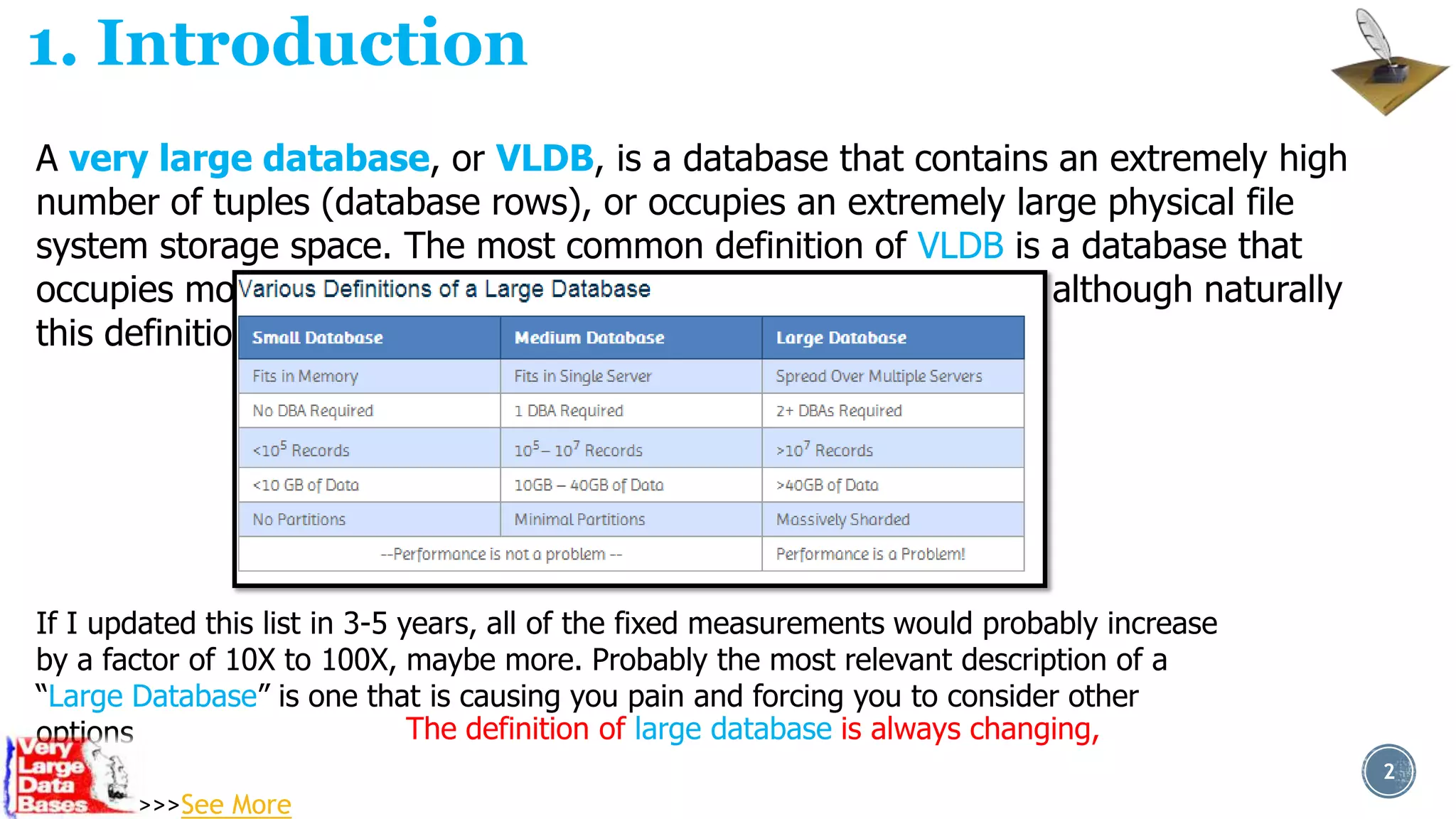
A very large database, or VLDB, is a database that contains an extremely high
number of tuples (database rows), or occupies an extremely large physical file
system storage space. The most common definition of VLDB is a database that
occupies more than 1 terabyte or contains several billion rows, although naturally
this definition changes over time

If I updated this list in 3-5 years, all of the fixed measurements would probably increase
by a factor of 10X to 100X, maybe more. Probably the most relevant description of a
“Large Database” is one that is causing you pain and forcing you to consider other
The definition of large database is always changing,
options
2

>>>See More
1. Introduction
Importan
ce

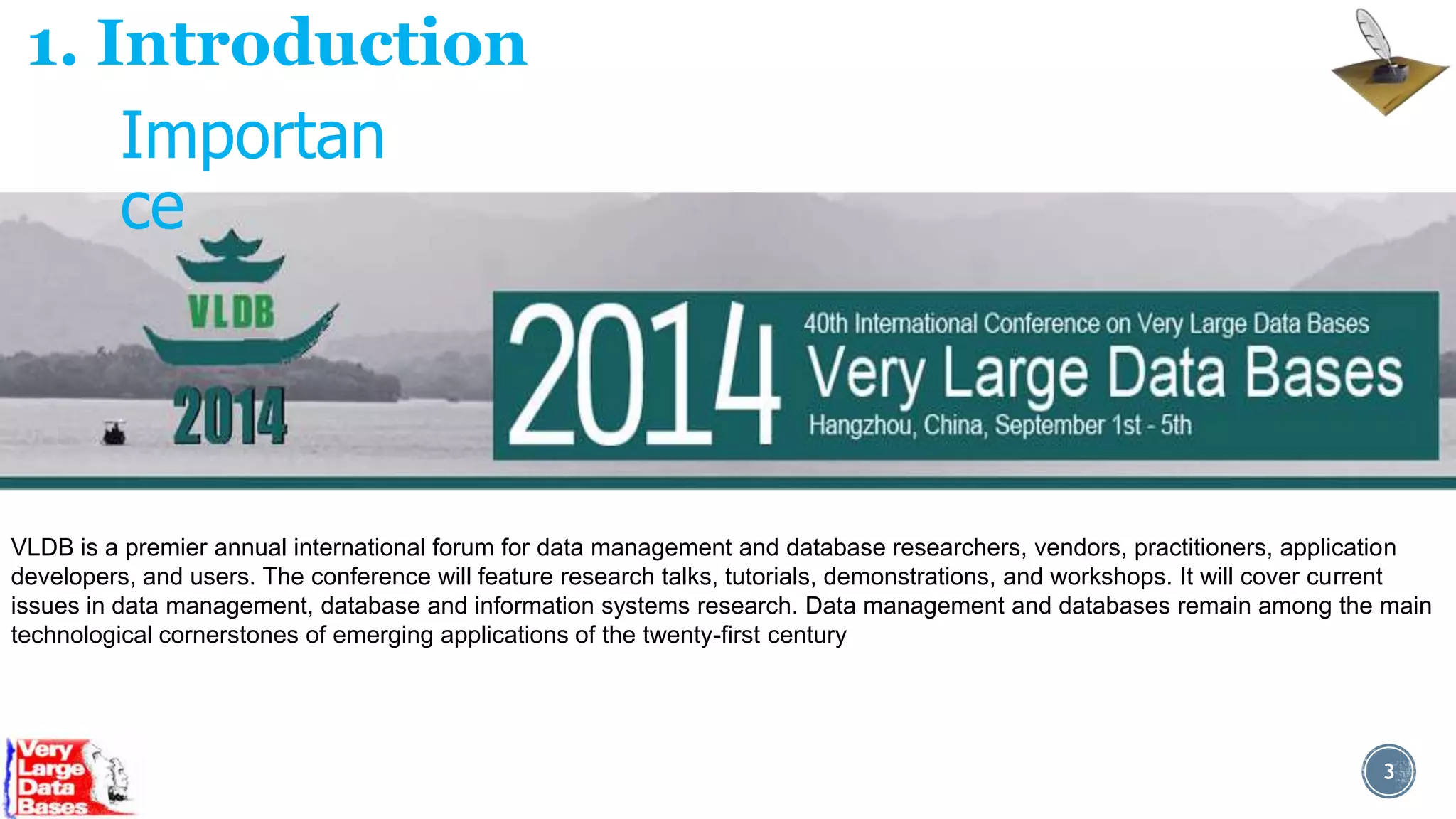
VLDB is a premier annual international forum for data management and database researchers, vendors, practitioners, application
developers, and users. The conference will feature research talks, tutorials, demonstrations, and workshops. It will cover current
issues in data management, database and information systems research. Data management and databases remain among the main
technological cornerstones of emerging applications of the twenty-first century

3
1. Introduction
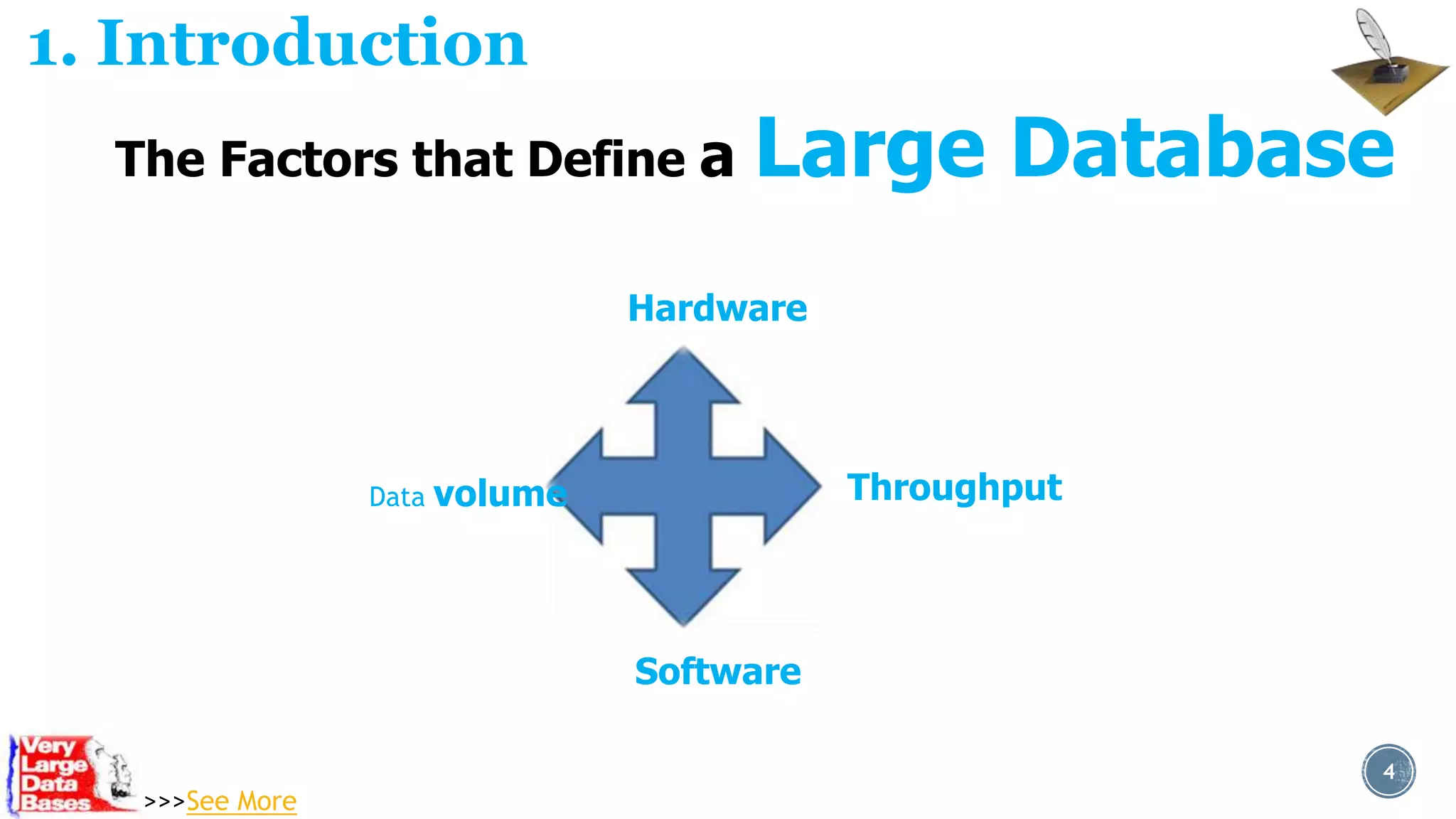
The Factors that Define a

Large Database

Hardware

Throughput

Data volume

Software
4

>>>See More
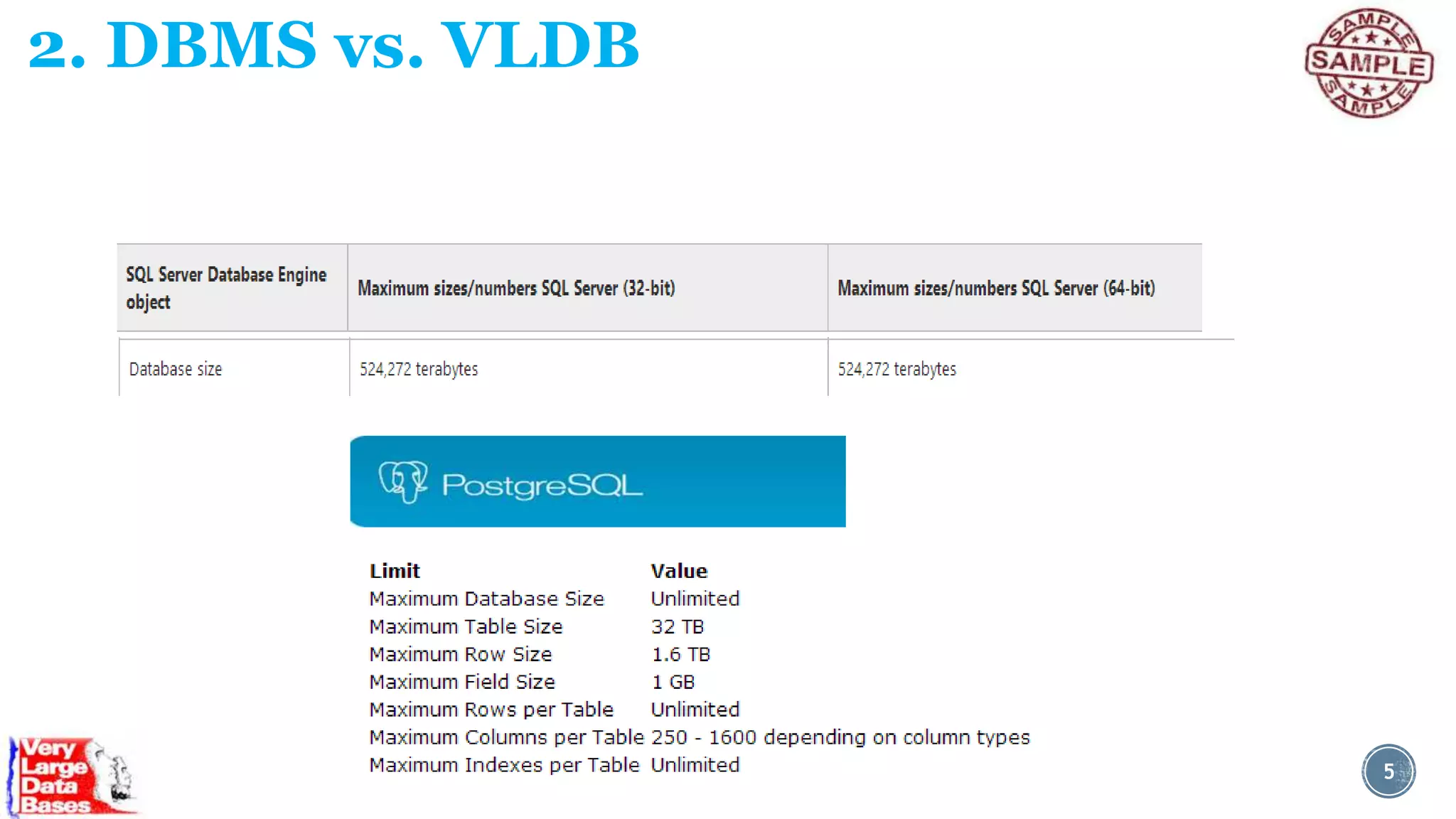
2. DBMS vs. VLDB

5
2-1. Examples of VLDB

6
3. Challenges
Some of the top
challenges I hear:

 Loading a big database for a takes a long time.
 Adding rows to an existing database is slow.
 Adding or removing a column takes my table offline
for a long time.
 Adding an index takes my table offline long time.
 Backup is difficult. (Not in this talk.)
These activities are painless for small data, but can be
painful for big data.

7
3-1. Techniques for challenge
Partitioning
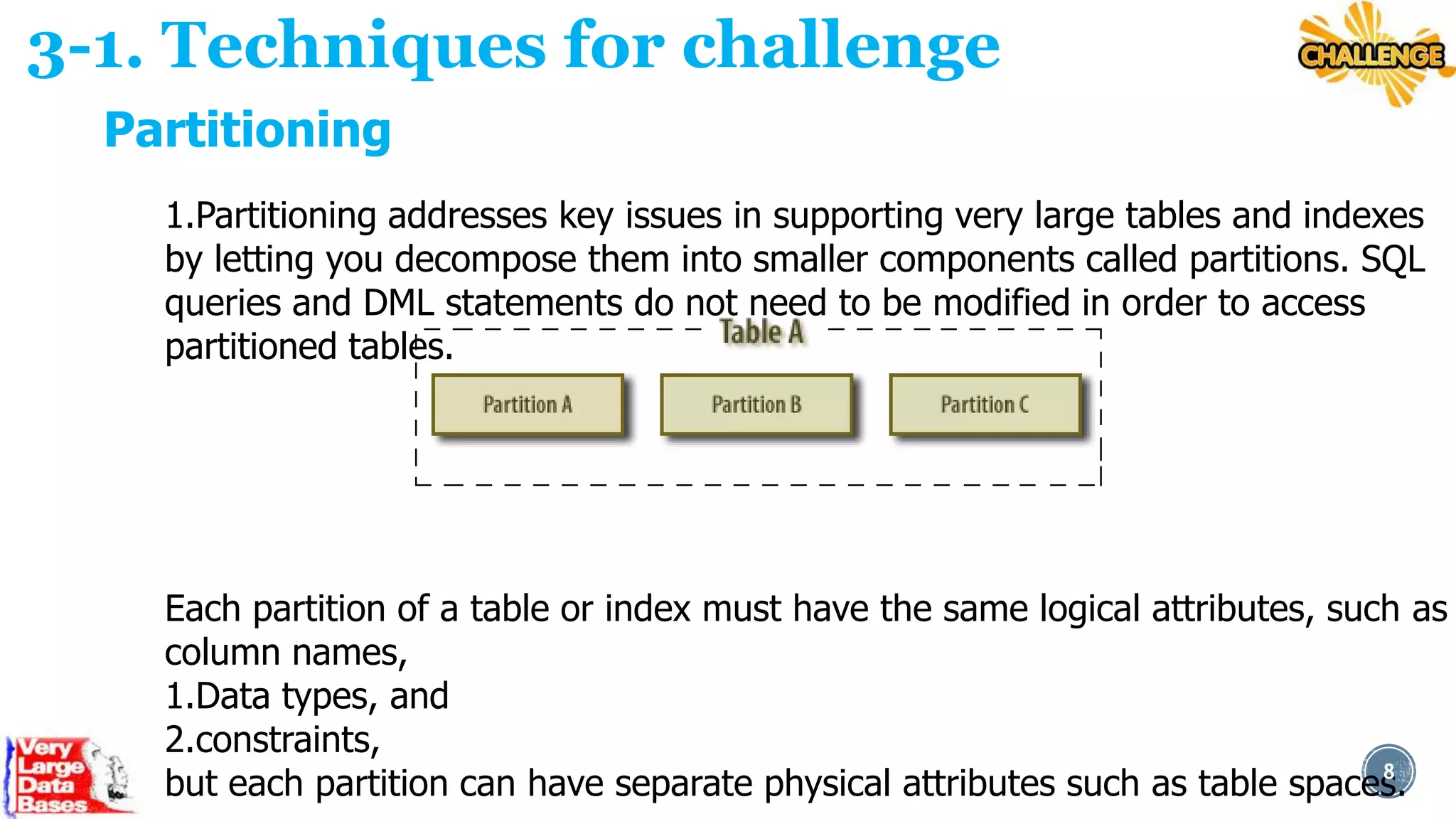
1.Partitioning addresses key issues in supporting very large tables and indexes
by letting you decompose them into smaller components called partitions. SQL
queries and DML statements do not need to be modified in order to access
partitioned tables.

Each partition of a table or index must have the same logical attributes, such as
column names,
1.Data types, and
2.constraints,
8
but each partition can have separate physical attributes such as table spaces.
3-1. Techniques for challenge
Overview of Partitioning Methods

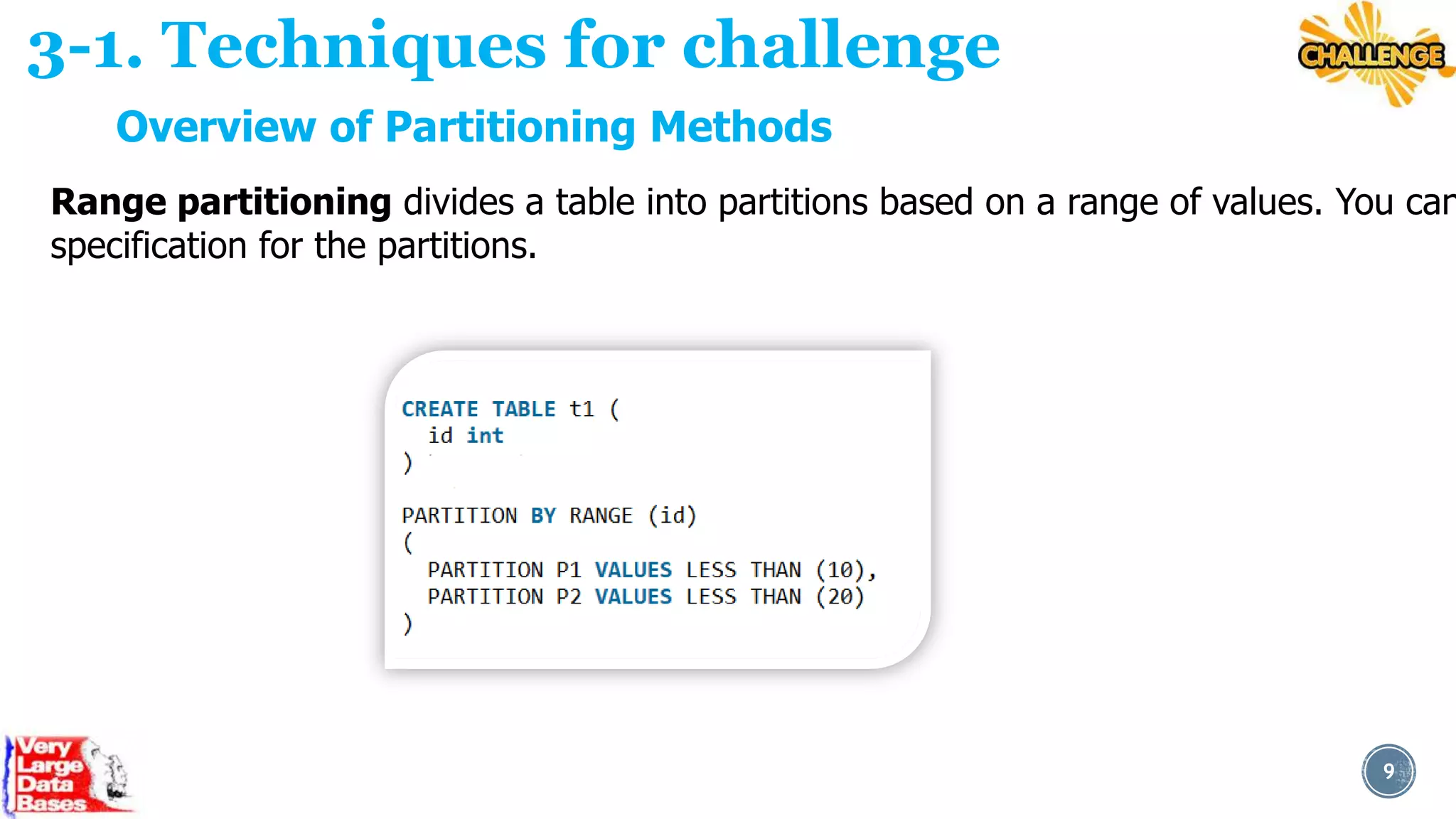
Range partitioning divides a table into partitions based on a range of values. You can
specification for the partitions.

9
3-1. Techniques for challenge
Overview of Partitioning Methods
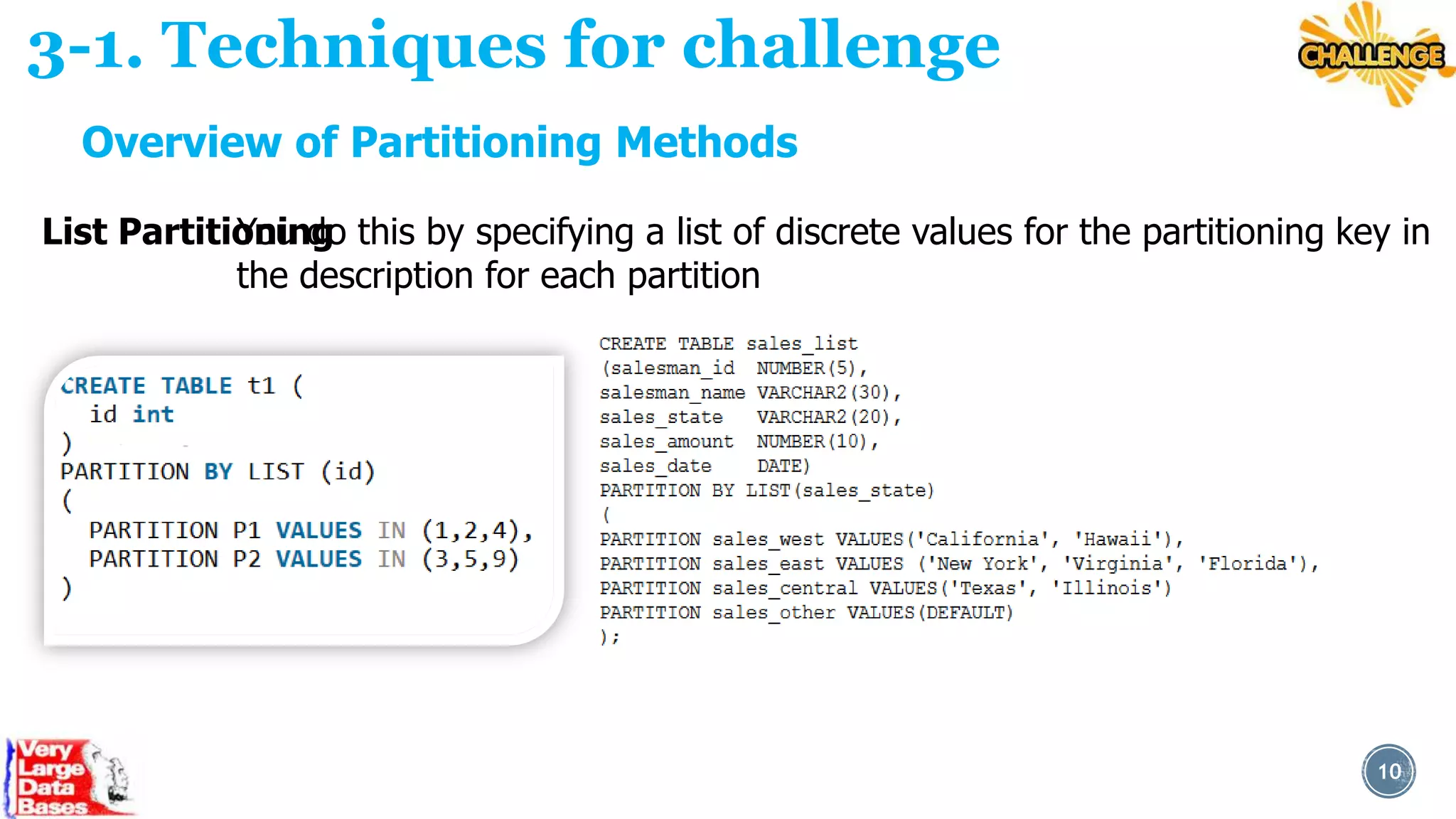
List Partitioning this by specifying a list of discrete values for the partitioning key in
You do
the description for each partition

10
3-1. Techniques for challenge
Overview of Partitioning Methods

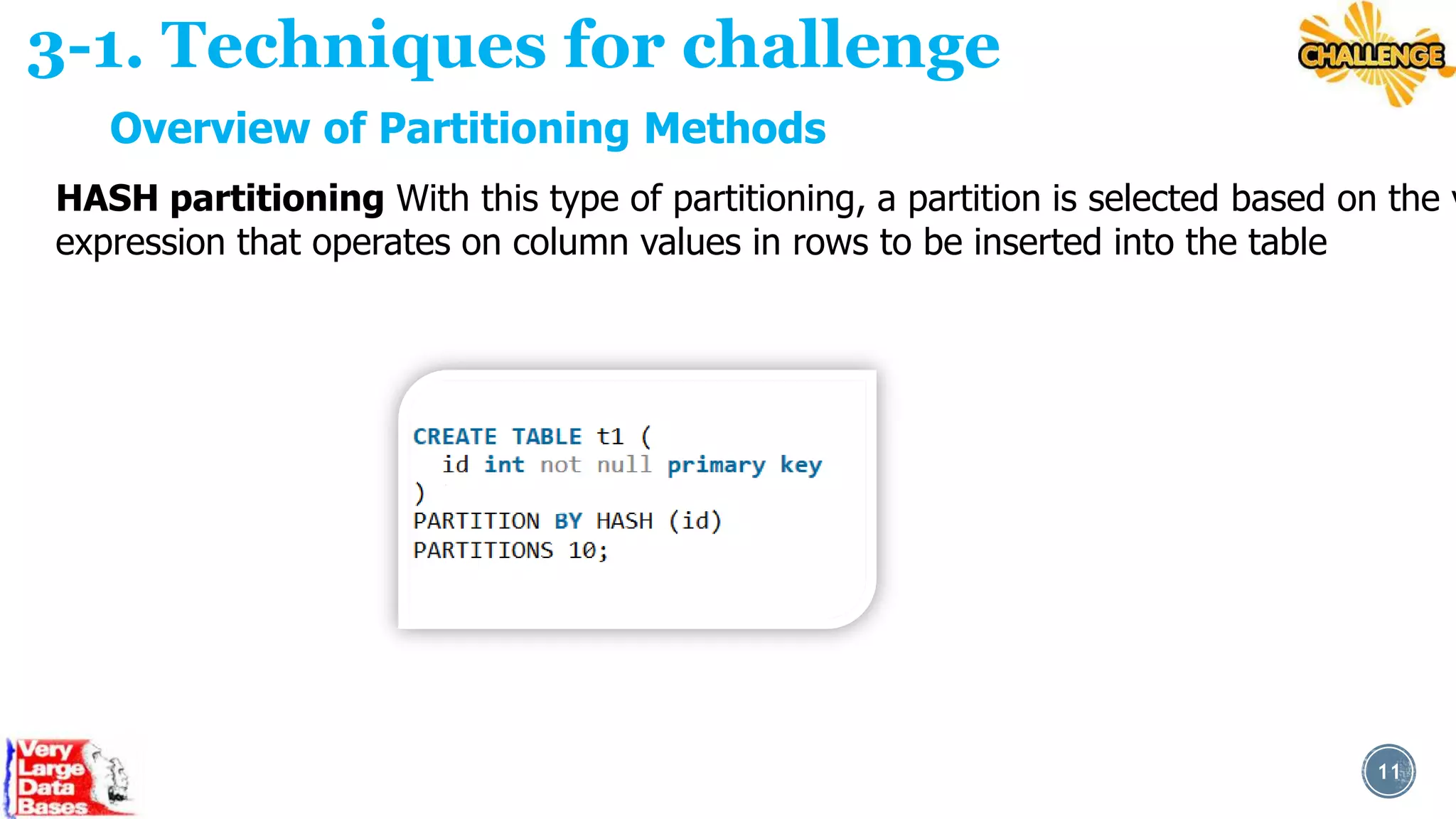
HASH partitioning With this type of partitioning, a partition is selected based on the v
expression that operates on column values in rows to be inserted into the table

11
3-1. Techniques for challenge
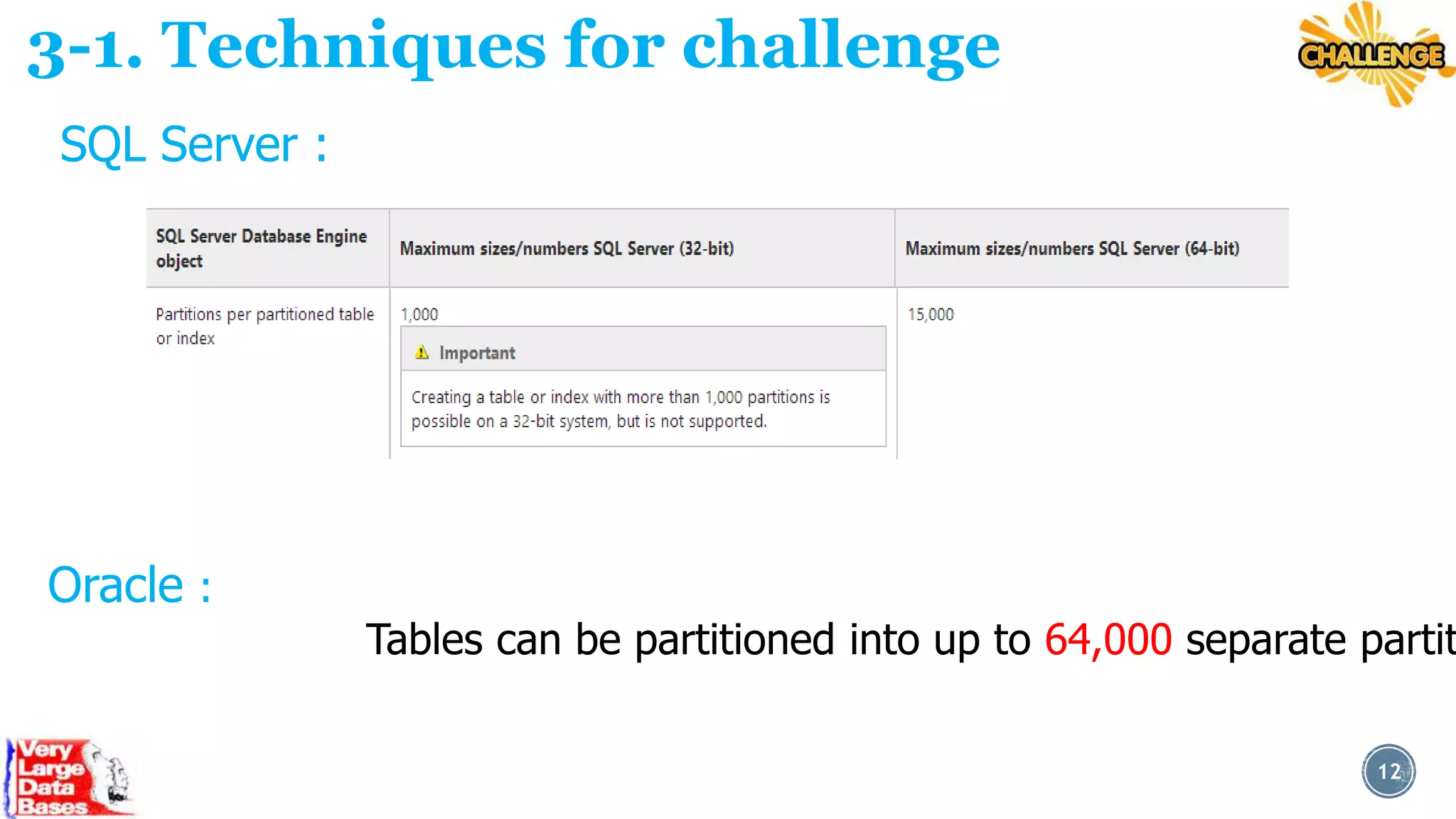
SQL Server :

Oracle :

Tables can be partitioned into up to 64,000 separate partit
12
3-1. Techniques for challenge
Table partitioning delivers advantages in three main areas

• performance
• maintenance
• availability.
13

>>>See More
3-1. Techniques for challenge
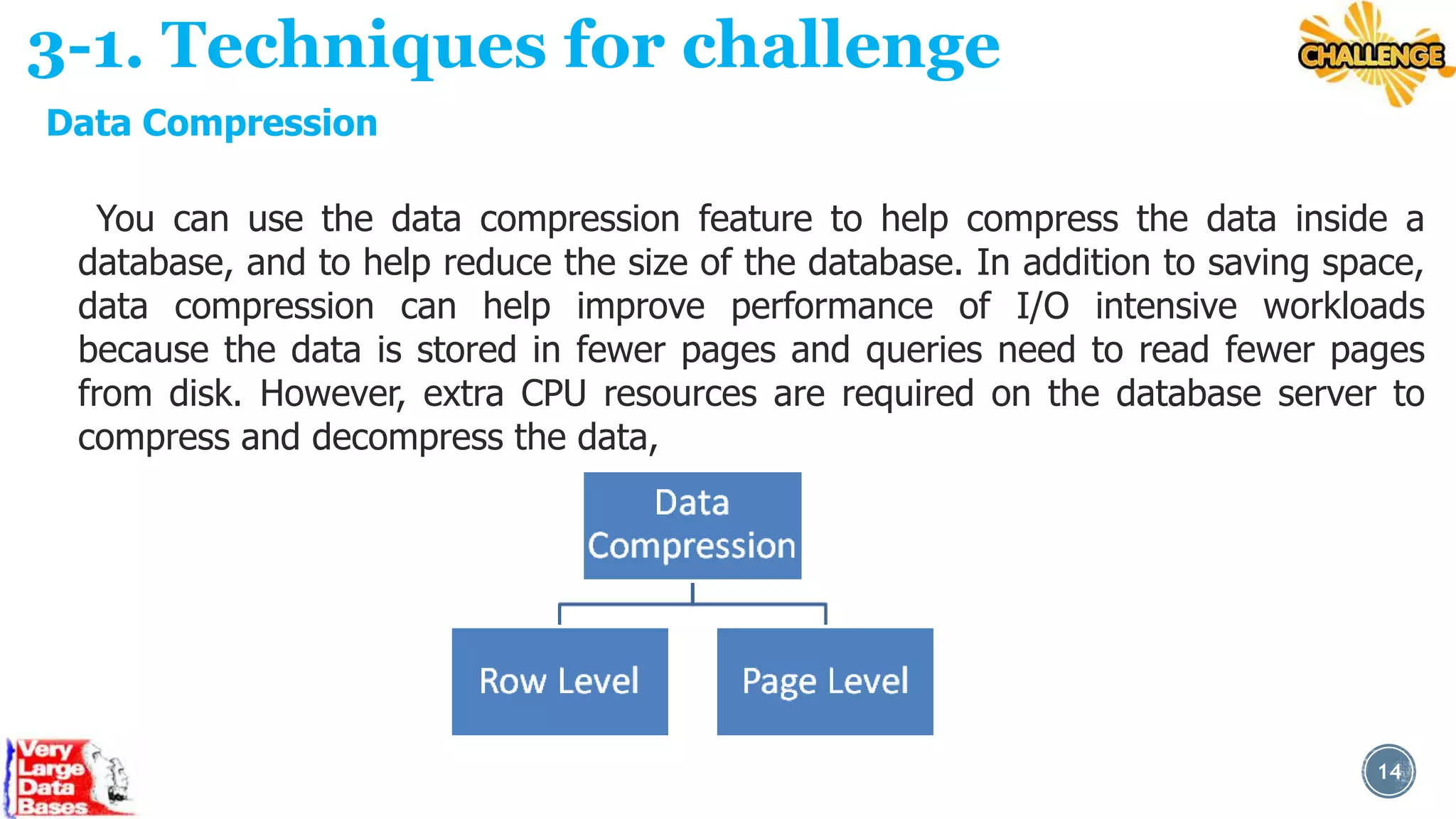
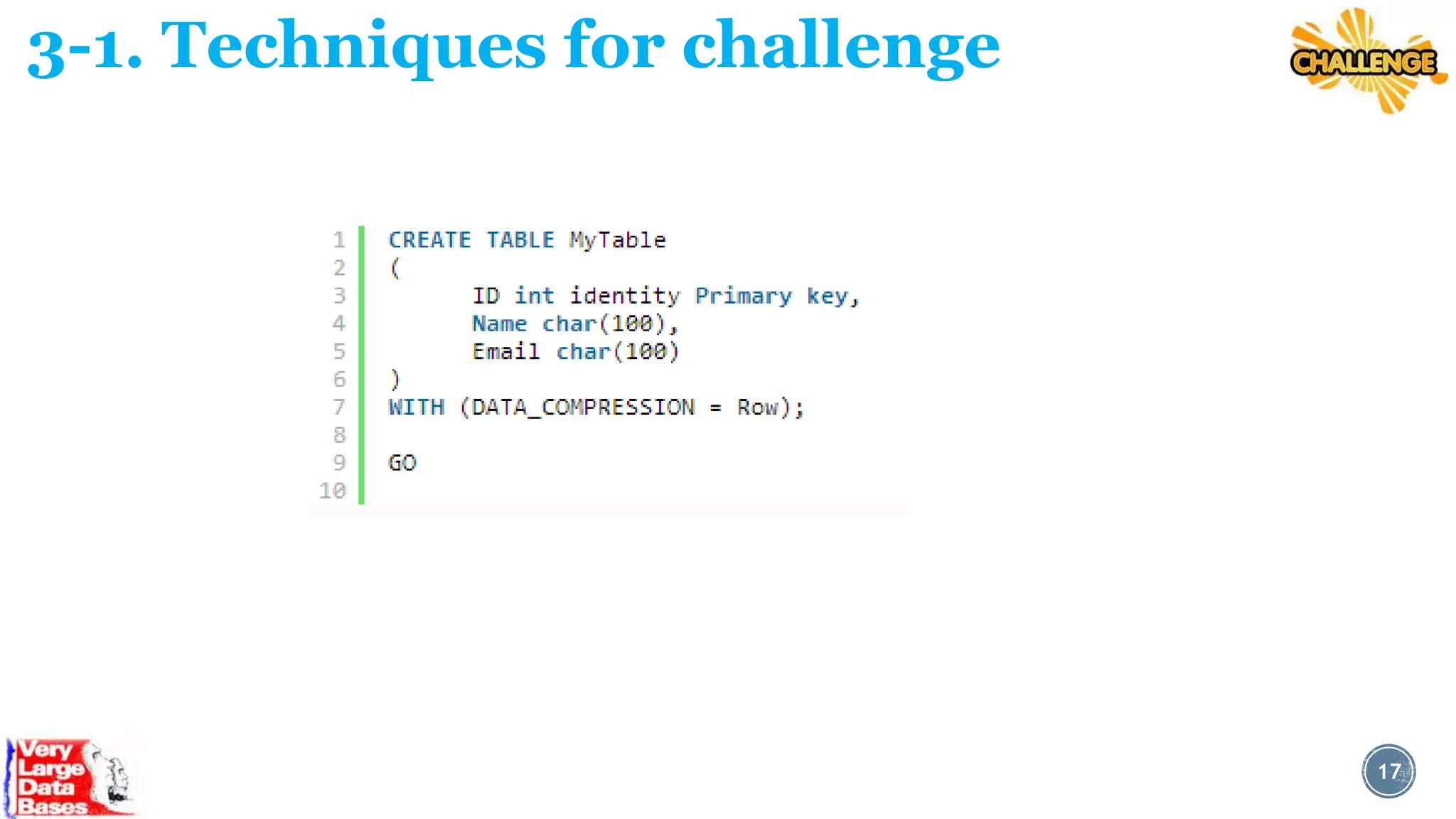
Data Compression
You can use the data compression feature to help compress the data inside a
database, and to help reduce the size of the database. In addition to saving space,
data compression can help improve performance of I/O intensive workloads
because the data is stored in fewer pages and queries need to read fewer pages
from disk. However, extra CPU resources are required on the database server to
compress and decompress the data,

14
3-1. Techniques for challenge
Implementation
Row Compression

•It reduces the metadata overhead that is associated with the
record. This metadata is information about columns, their lengths
and offsets. In some cases, the metadata overhead might be larger
than the old storage format.
•It uses variable-length storage format for numeric types (for
example integer, decimal, and float) and the types that are
based on numeric (for example date time and money).
•It stores fixed character strings by using variable-length format by
not storing the blank characters

15
3-1. Techniques for challenge
Implementation
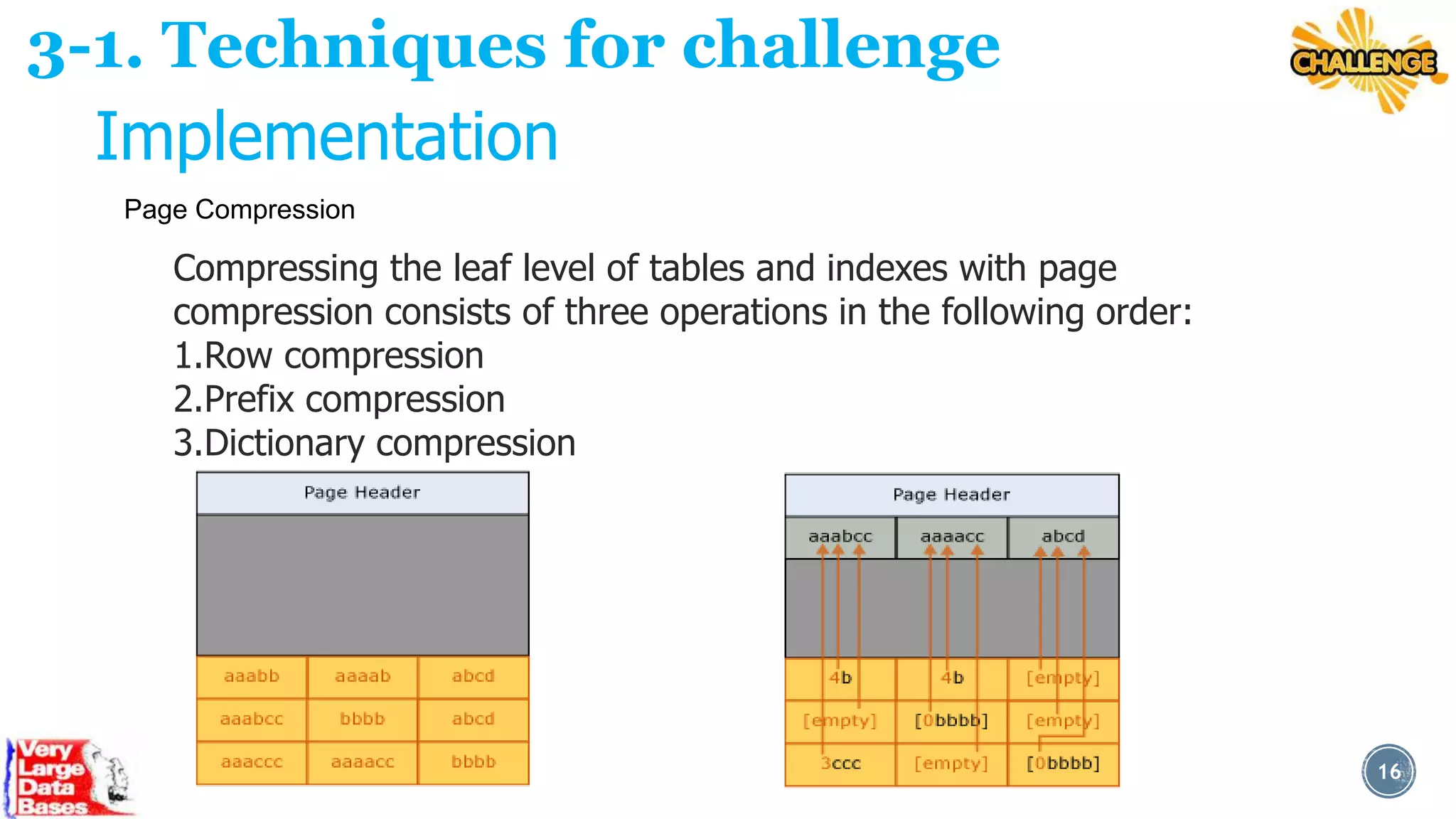
Page Compression

Compressing the leaf level of tables and indexes with page
compression consists of three operations in the following order:
1.Row compression
2.Prefix compression
3.Dictionary compression

16
3-1. Techniques for challenge

17
4. Practical

18

>>>See More
4. Practical

19

>>>See More
4. Practical

20

>>>See More
Thank You For Your Attention

21

very large database

  • 1.
    In The NameOf God large 1 Kazem Taghandiky University of Isfahan Taghandiky@gmail.com Mobile:09335816144
  • 2.
    1. Introduction A verylarge database, or VLDB, is a database that contains an extremely high number of tuples (database rows), or occupies an extremely large physical file system storage space. The most common definition of VLDB is a database that occupies more than 1 terabyte or contains several billion rows, although naturally this definition changes over time If I updated this list in 3-5 years, all of the fixed measurements would probably increase by a factor of 10X to 100X, maybe more. Probably the most relevant description of a “Large Database” is one that is causing you pain and forcing you to consider other The definition of large database is always changing, options 2 >>>See More
  • 3.
    1. Introduction Importan ce VLDB isa premier annual international forum for data management and database researchers, vendors, practitioners, application developers, and users. The conference will feature research talks, tutorials, demonstrations, and workshops. It will cover current issues in data management, database and information systems research. Data management and databases remain among the main technological cornerstones of emerging applications of the twenty-first century 3
  • 4.
    1. Introduction The Factorsthat Define a Large Database Hardware Throughput Data volume Software 4 >>>See More
  • 5.
  • 6.
  • 7.
    3. Challenges Some ofthe top challenges I hear:  Loading a big database for a takes a long time.  Adding rows to an existing database is slow.  Adding or removing a column takes my table offline for a long time.  Adding an index takes my table offline long time.  Backup is difficult. (Not in this talk.) These activities are painless for small data, but can be painful for big data. 7
  • 8.
    3-1. Techniques forchallenge Partitioning 1.Partitioning addresses key issues in supporting very large tables and indexes by letting you decompose them into smaller components called partitions. SQL queries and DML statements do not need to be modified in order to access partitioned tables. Each partition of a table or index must have the same logical attributes, such as column names, 1.Data types, and 2.constraints, 8 but each partition can have separate physical attributes such as table spaces.
  • 9.
    3-1. Techniques forchallenge Overview of Partitioning Methods Range partitioning divides a table into partitions based on a range of values. You can specification for the partitions. 9
  • 10.
    3-1. Techniques forchallenge Overview of Partitioning Methods List Partitioning this by specifying a list of discrete values for the partitioning key in You do the description for each partition 10
  • 11.
    3-1. Techniques forchallenge Overview of Partitioning Methods HASH partitioning With this type of partitioning, a partition is selected based on the v expression that operates on column values in rows to be inserted into the table 11
  • 12.
    3-1. Techniques forchallenge SQL Server : Oracle : Tables can be partitioned into up to 64,000 separate partit 12
  • 13.
    3-1. Techniques forchallenge Table partitioning delivers advantages in three main areas • performance • maintenance • availability. 13 >>>See More
  • 14.
    3-1. Techniques forchallenge Data Compression You can use the data compression feature to help compress the data inside a database, and to help reduce the size of the database. In addition to saving space, data compression can help improve performance of I/O intensive workloads because the data is stored in fewer pages and queries need to read fewer pages from disk. However, extra CPU resources are required on the database server to compress and decompress the data, 14
  • 15.
    3-1. Techniques forchallenge Implementation Row Compression •It reduces the metadata overhead that is associated with the record. This metadata is information about columns, their lengths and offsets. In some cases, the metadata overhead might be larger than the old storage format. •It uses variable-length storage format for numeric types (for example integer, decimal, and float) and the types that are based on numeric (for example date time and money). •It stores fixed character strings by using variable-length format by not storing the blank characters 15
  • 16.
    3-1. Techniques forchallenge Implementation Page Compression Compressing the leaf level of tables and indexes with page compression consists of three operations in the following order: 1.Row compression 2.Prefix compression 3.Dictionary compression 16
  • 17.
    3-1. Techniques forchallenge 17
  • 18.
  • 19.
  • 20.
  • 21.
    Thank You ForYour Attention 21