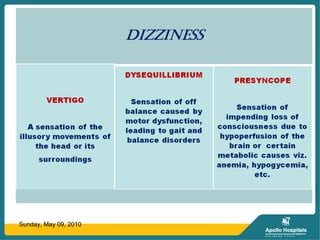
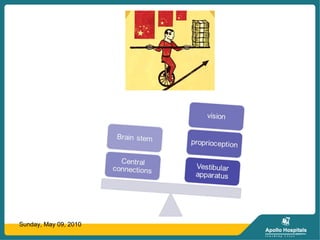
DIZZINESS $
VERTIGO
DR.SUSHMITA PAL
Sunday, May 09, 2010
ORIGIN :
from Latin word
“vertÖ”
“A spinning or whirling
sensation”
Sunday, May 09, 2010
DEFINITIONS :
• A sensation of swaying or tilting
• A sense of spinning or motion of the environment
• A type of dizziness
• A symptom of illusory movement
Sunday, May 09, 2010
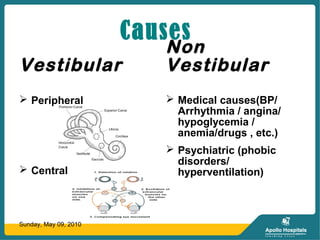
Causes
Vestibular
 Peripheral
 Central
Sunday, May 09, 2010
 Medical causes(BP/
Arrhythmia / angina/
hypoglycemia /
anemia/drugs , etc.)
 Psychiatric (phobic
disorders/
hyperventilation)
Non
Vestibular
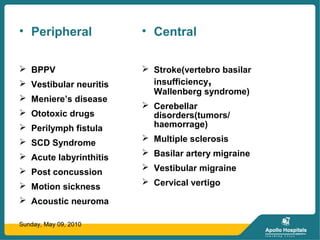
• Peripheral
 BPPV
 Vestibular neuritis
 Meniere’s disease
 Ototoxic drugs
 Perilymph fistula
 SCD Syndrome
 Acute labyrinthitis
 Post concussion
 Motion sickness
 Acoustic neuroma
• Central
 Stroke(vertebro basilar
insufficiency,
Wallenberg syndrome)
 Cerebellar
disorders(tumors/
haemorrage)
 Multiple sclerosis
 Basilar artery migraine
 Vestibular migraine
 Cervical vertigo
Sunday, May 09, 2010
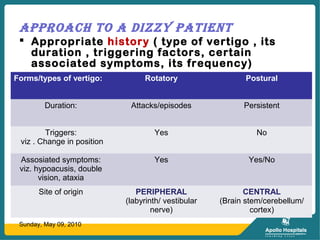
APPROACH TO A DIZZY PATIENT
 Appropriate history ( type of vertigo , its
duration , triggering factors, certain
associated symptoms, its frequency)
Sunday, May 09, 2010
Forms/types of vertigo: Rotatory Postural
Duration: Attacks/episodes Persistent
Triggers:
viz . Change in position
Yes No
Assosiated symptoms:
viz. hypoacusis, double
vision, ataxia
Yes Yes/No
Site of origin PERIPHERAL
(labyrinth/ vestibular
nerve)
CENTRAL
(Brain stem/cerebellum/
cortex)
General medical examination:
BP (for hypo and hypertension)
Cardiac examination : for arrhythmia , murmurs
and bruit.
Neurological examination : for cerebellar
integrity and CN examination.
Ophthalmological examination: for
papilloedema , nystagmus saccades/smooth
pursuit.
Audio vestibular examination : inspection of TM ,
TFT with or without Pure tone audiometry.
And an array of vestibular tests.
Sunday, May 09, 2010
VEsTIbulAR AssEssmE NT
CliniCal tests
 Spontaneous
nystagmus
 Halmygi’s head thrust
test
 Fistula tests
 Past pointing/Gait
 Romberg’s test
 Positional test (Dix-
Hallpike maneuver)
laboratory tests
 Caloric tests
 Cold caloric/modified
Kobrak
 Fitzgerald Hallpike
bithermal caloric test
 Cold air caloric test
 Electronystagmography
 Rotation test
 Posturography
 Optokinetic test
Sunday, May 09, 2010
MANAGEMENT OF VESTIBULAR
DISORDERS
 Physiotherapy : certain vestibular
exercises eg.
Semont’s/Epley’s
maneuver
 Medical management using vestibular
suppressants ( cinnarizine ,
promethazine) , vestibular vasodilators (
betahistine ) , anabolic steroids ,
antibiotics , etc.
 Psychological/psychiatric and
behavioral therapy
 Surgical management ( eg.
Endolymphatic decompression,
Resection of neuroma , etc.)
Sunday, May 09, 2010
Patient with h/o momentory( about 10 sec) rotatory vertigo ,
as soon as he gets up from the bed or goes to bed
Sunday, May 09, 2010
BENIGN POSITIONAL PAROXYSMAL VERTIGO
 Occurs with head movts or head roll
 No numbness/headache/ear symptoms
 Nausea/vomiting/oscillopsia may be +nt.
 Positional test is diagnostic.
Turn the head to Lt (45 degree) while sitting, then make him lie
down towards Rt, shake the head, and w/f nystagmus.
The nystagmus is rotatory / vertical, beating towards the
forehead.
Treatment:
• Liberatory movements : 3 times TID
turn the head to R side(nonaffected) 45 degrees ,
move the patient to lie towards opposite side (L)
again move him 180 degree away to lie on the
opposite side (R)
These movements accentuates the postural imbalance momentarily,
But it is actually beneficial within a span of 3 -4 days.
These movts are done to teach the otoconias in the ear.
Sunday, May 09, 2010
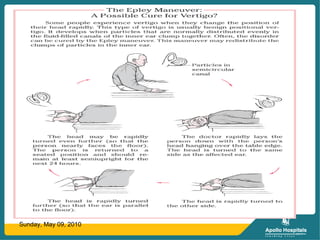
TREATING MANEUVERS
EPLEY’S
Turn the head 45 degree hrztally
towards affected side
Tilt him backwards to horizontal
position, with yet the same
head tilt. Vertigo ppts. Maintain
the same position until vertigo
stops.( debris moves towards
the apex).
Head is turned 90 degree towards
unaffected side,also pt is rolled
towards unaffected side so
that face is towards the floor.
(debris moves back in the
canal, vertigo ppts).
Pt is seated with head down tilt of
30 degree, brings the otoconia
back in the utricle
SEMONT
Turn the head 45 degree hrztally
same towards unaffected side
Tilt 105 degree to make him lie on
affected side , head hanging &
nose pointed upwards(3
min).Debris moves to the apex
of the canal.
Now, moving him 180 degree
from aff to unaff side with nose
pointing downwards.Debris
moves towards the exit of the
canal.
He is slowly seated. Debris gets
back in the vestibule.
Sunday, May 09, 2010
Patient with h/o rotatory vertigo , lasts for an hr to 7
hrs, usually once or twice a week, associated with
heaviness of ear/head & diminished hearing.
MENIERE’S DISEASE
• Tinnitus + aural fullness
• Vertigo lasts minimum for about 20 min.
• Best way to prevent the vertigo is to prevent the
hydrops
• Prophylactic Rx: Betahistine 48 mg TID : 9- 10 mths
Intratympanic injection of gentamycin
Sunday, May 09, 2010
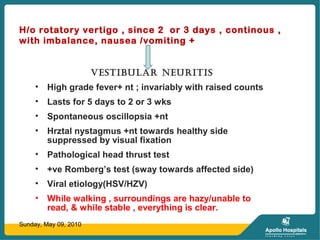
H/o rotatory vertigo , since 2 or 3 days , continous ,
with imbalance, nausea /vomiting +
VESTIBULAR NEURITIS
• High grade fever+ nt ; invariably with raised counts
• Lasts for 5 days to 2 or 3 wks
• Spontaneous oscillopsia +nt
• Hrztal nystagmus +nt towards healthy side
suppressed by visual fixation
• Pathological head thrust test
• +ve Romberg’s test (sway towards affected side)
• Viral etiology(HSV/HZV)
• While walking , surroundings are hazy/unable to
read, & while stable , everything is clear.
Sunday, May 09, 2010
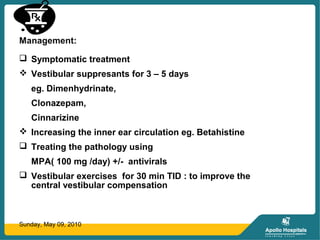
Management:
 Symptomatic treatment
 Vestibular suppresants for 3 – 5 days
eg. Dimenhydrinate,
Clonazepam,
Cinnarizine
 Increasing the inner ear circulation eg. Betahistine
 Treating the pathology using
MPA( 100 mg /day) +/- antivirals
 Vestibular exercises for 30 min TID : to improve the
central vestibular compensation
Sunday, May 09, 2010
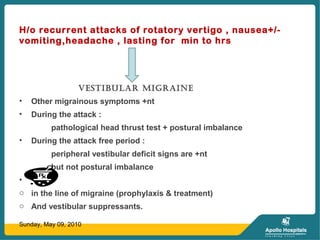
H/o recurrent attacks of rotatory vertigo , nausea+/-
vomiting,headache , lasting for min to hrs
VESTIBULAR MIGRAINE
• Other migrainous symptoms +nt
• During the attack :
pathological head thrust test + postural imbalance
• During the attack free period :
peripheral vestibular deficit signs are +nt
but not postural imbalance
•
o in the line of migraine (prophylaxis & treatment)
o And vestibular suppressants.
Sunday, May 09, 2010
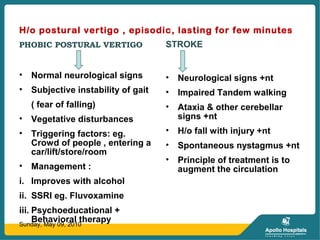
H/o postural vertigo , episodic, lasting for few minutes
PHOBIC POSTURAL VERTIGO
• Normal neurological signs
• Subjective instability of gait
( fear of falling)
• Vegetative disturbances
• Triggering factors: eg.
Crowd of people , entering a
car/lift/store/room
• Management :
i. Improves with alcohol
ii. SSRI eg. Fluvoxamine
iii. Psychoeducational +
Behavioral therapy
STROKE
• Neurological signs +nt
• Impaired Tandem walking
• Ataxia & other cerebellar
signs +nt
• H/o fall with injury +nt
• Spontaneous nystagmus +nt
• Principle of treatment is to
augment the circulation
Sunday, May 09, 2010
• CERVICAL VERTIGO
Postural vertigo , associated with certain neck movements and
it lasts for few minutes , no neurological signs , X ray is
diagnostic in spondylosis.
Management : avoid chiropractic maneuvers
and Betahistine to improve vestibular circulation.
• MOTION SICKNESS
Physiological vertigo
Rotatory vertigo , triggered by motion due to mismatch of two
different stimulus (eye & vestibule) viz. car sickness, space
sickness , sea sickness etc.
• OTOTOXICITY
Due to the vestibulotoxic drugs eg. Streptomycin , gentamycin ,
tobramycin etc.
• BASILAR MIGRAINE :
postural vertigo + dysarthria + diplopia + tinnitus
Sunday, May 09, 2010
THANK YOU

Vertigo sushmita

  • 1.
  • 2.
    ORIGIN : from Latinword “vertÖ” “A spinning or whirling sensation” Sunday, May 09, 2010
  • 3.
    DEFINITIONS : • Asensation of swaying or tilting • A sense of spinning or motion of the environment • A type of dizziness • A symptom of illusory movement Sunday, May 09, 2010
  • 4.
  • 5.
  • 6.
    Causes Vestibular  Peripheral  Central Sunday,May 09, 2010  Medical causes(BP/ Arrhythmia / angina/ hypoglycemia / anemia/drugs , etc.)  Psychiatric (phobic disorders/ hyperventilation) Non Vestibular
  • 7.
    • Peripheral  BPPV Vestibular neuritis  Meniere’s disease  Ototoxic drugs  Perilymph fistula  SCD Syndrome  Acute labyrinthitis  Post concussion  Motion sickness  Acoustic neuroma • Central  Stroke(vertebro basilar insufficiency, Wallenberg syndrome)  Cerebellar disorders(tumors/ haemorrage)  Multiple sclerosis  Basilar artery migraine  Vestibular migraine  Cervical vertigo Sunday, May 09, 2010
  • 8.
    APPROACH TO ADIZZY PATIENT  Appropriate history ( type of vertigo , its duration , triggering factors, certain associated symptoms, its frequency) Sunday, May 09, 2010 Forms/types of vertigo: Rotatory Postural Duration: Attacks/episodes Persistent Triggers: viz . Change in position Yes No Assosiated symptoms: viz. hypoacusis, double vision, ataxia Yes Yes/No Site of origin PERIPHERAL (labyrinth/ vestibular nerve) CENTRAL (Brain stem/cerebellum/ cortex)
  • 9.
    General medical examination: BP(for hypo and hypertension) Cardiac examination : for arrhythmia , murmurs and bruit. Neurological examination : for cerebellar integrity and CN examination. Ophthalmological examination: for papilloedema , nystagmus saccades/smooth pursuit. Audio vestibular examination : inspection of TM , TFT with or without Pure tone audiometry. And an array of vestibular tests. Sunday, May 09, 2010
  • 10.
    VEsTIbulAR AssEssmE NT CliniCaltests  Spontaneous nystagmus  Halmygi’s head thrust test  Fistula tests  Past pointing/Gait  Romberg’s test  Positional test (Dix- Hallpike maneuver) laboratory tests  Caloric tests  Cold caloric/modified Kobrak  Fitzgerald Hallpike bithermal caloric test  Cold air caloric test  Electronystagmography  Rotation test  Posturography  Optokinetic test Sunday, May 09, 2010
  • 11.
    MANAGEMENT OF VESTIBULAR DISORDERS Physiotherapy : certain vestibular exercises eg. Semont’s/Epley’s maneuver  Medical management using vestibular suppressants ( cinnarizine , promethazine) , vestibular vasodilators ( betahistine ) , anabolic steroids , antibiotics , etc.  Psychological/psychiatric and behavioral therapy  Surgical management ( eg. Endolymphatic decompression, Resection of neuroma , etc.) Sunday, May 09, 2010
  • 12.
    Patient with h/omomentory( about 10 sec) rotatory vertigo , as soon as he gets up from the bed or goes to bed Sunday, May 09, 2010 BENIGN POSITIONAL PAROXYSMAL VERTIGO  Occurs with head movts or head roll  No numbness/headache/ear symptoms  Nausea/vomiting/oscillopsia may be +nt.  Positional test is diagnostic. Turn the head to Lt (45 degree) while sitting, then make him lie down towards Rt, shake the head, and w/f nystagmus. The nystagmus is rotatory / vertical, beating towards the forehead.
  • 13.
    Treatment: • Liberatory movements: 3 times TID turn the head to R side(nonaffected) 45 degrees , move the patient to lie towards opposite side (L) again move him 180 degree away to lie on the opposite side (R) These movements accentuates the postural imbalance momentarily, But it is actually beneficial within a span of 3 -4 days. These movts are done to teach the otoconias in the ear. Sunday, May 09, 2010
  • 14.
    TREATING MANEUVERS EPLEY’S Turn thehead 45 degree hrztally towards affected side Tilt him backwards to horizontal position, with yet the same head tilt. Vertigo ppts. Maintain the same position until vertigo stops.( debris moves towards the apex). Head is turned 90 degree towards unaffected side,also pt is rolled towards unaffected side so that face is towards the floor. (debris moves back in the canal, vertigo ppts). Pt is seated with head down tilt of 30 degree, brings the otoconia back in the utricle SEMONT Turn the head 45 degree hrztally same towards unaffected side Tilt 105 degree to make him lie on affected side , head hanging & nose pointed upwards(3 min).Debris moves to the apex of the canal. Now, moving him 180 degree from aff to unaff side with nose pointing downwards.Debris moves towards the exit of the canal. He is slowly seated. Debris gets back in the vestibule. Sunday, May 09, 2010
  • 15.
  • 16.
    Patient with h/orotatory vertigo , lasts for an hr to 7 hrs, usually once or twice a week, associated with heaviness of ear/head & diminished hearing. MENIERE’S DISEASE • Tinnitus + aural fullness • Vertigo lasts minimum for about 20 min. • Best way to prevent the vertigo is to prevent the hydrops • Prophylactic Rx: Betahistine 48 mg TID : 9- 10 mths Intratympanic injection of gentamycin Sunday, May 09, 2010
  • 17.
    H/o rotatory vertigo, since 2 or 3 days , continous , with imbalance, nausea /vomiting + VESTIBULAR NEURITIS • High grade fever+ nt ; invariably with raised counts • Lasts for 5 days to 2 or 3 wks • Spontaneous oscillopsia +nt • Hrztal nystagmus +nt towards healthy side suppressed by visual fixation • Pathological head thrust test • +ve Romberg’s test (sway towards affected side) • Viral etiology(HSV/HZV) • While walking , surroundings are hazy/unable to read, & while stable , everything is clear. Sunday, May 09, 2010
  • 18.
    Management:  Symptomatic treatment Vestibular suppresants for 3 – 5 days eg. Dimenhydrinate, Clonazepam, Cinnarizine  Increasing the inner ear circulation eg. Betahistine  Treating the pathology using MPA( 100 mg /day) +/- antivirals  Vestibular exercises for 30 min TID : to improve the central vestibular compensation Sunday, May 09, 2010
  • 19.
    H/o recurrent attacksof rotatory vertigo , nausea+/- vomiting,headache , lasting for min to hrs VESTIBULAR MIGRAINE • Other migrainous symptoms +nt • During the attack : pathological head thrust test + postural imbalance • During the attack free period : peripheral vestibular deficit signs are +nt but not postural imbalance • o in the line of migraine (prophylaxis & treatment) o And vestibular suppressants. Sunday, May 09, 2010
  • 20.
    H/o postural vertigo, episodic, lasting for few minutes PHOBIC POSTURAL VERTIGO • Normal neurological signs • Subjective instability of gait ( fear of falling) • Vegetative disturbances • Triggering factors: eg. Crowd of people , entering a car/lift/store/room • Management : i. Improves with alcohol ii. SSRI eg. Fluvoxamine iii. Psychoeducational + Behavioral therapy STROKE • Neurological signs +nt • Impaired Tandem walking • Ataxia & other cerebellar signs +nt • H/o fall with injury +nt • Spontaneous nystagmus +nt • Principle of treatment is to augment the circulation Sunday, May 09, 2010
  • 21.
    • CERVICAL VERTIGO Posturalvertigo , associated with certain neck movements and it lasts for few minutes , no neurological signs , X ray is diagnostic in spondylosis. Management : avoid chiropractic maneuvers and Betahistine to improve vestibular circulation. • MOTION SICKNESS Physiological vertigo Rotatory vertigo , triggered by motion due to mismatch of two different stimulus (eye & vestibule) viz. car sickness, space sickness , sea sickness etc. • OTOTOXICITY Due to the vestibulotoxic drugs eg. Streptomycin , gentamycin , tobramycin etc. • BASILAR MIGRAINE : postural vertigo + dysarthria + diplopia + tinnitus Sunday, May 09, 2010
  • 22.
    Sunday, May 09,2010 THANK YOU