Vertigo
Dr
. Abdulrahman
Alsanosi Associate
professor
Otolaryngology
consultant
Otologist ,
Neurotologist
&SkuII Base Surgeon
Head of Otology / Neurotology
Unit Director of cochlear implant
program King Abdulaziz
University Hospital
Importance
• Can be a sign of serious diseases
• Can be seen in other specialties
• Hard to diagnose because it integrates
several organs and systems together and the
underlying cause is not clear.
• Very common, but hard to deal with.
INTRODUCTION
• Diiness’sacoœmonsyœptoœtkataccounTedforro st
n36
nJloncïicvi LntheUn4edS Y
e
s
What are the components of balance system
• Inner ear (3 semicicular canals and otolith organ ): divided into 2
parts: hearing (cochlea) and vestibular (semicircular canals ,
otolith organ)
• Cerebellum ; engine behind coordination , creating muscle
movement and
keeping balance
• Vision (Vestibular Ocular Reflex): it is a reference between the eye
and the inner ear. it controls both eye movements and keeps them
focused on the same object. I.e If there is misalignment between
one of the retinas on a particular object it will lead to a sense of an
“illusion” causing
dizziness
• Proprioception: sensation in the sole of the foot. People need hard
surfaces to get the full eXect of their proprioception or it will feel like
they are walking on sand “shaky grounds”.
• 1 stimulus that leads to more than one response when it comes to
maintaining balance. Being pushed from behind will lead to all the
previous systems to work together to maintain balance.
How does balance system
work ?
Physiology
Function of vestibular
system:
• “Input” resulting from a stimulus that needs to be corrected through the
vestibular system such as falling down. An “output” results from
responses of the vestibular system to the input such as the eyes,
cerebellum .. Etc.
• The physical stimulus (input) will be transformed into a biological
stimulas in the brain stem which will in turn be sent afterwards to the
corresponding areas in the vestibular system.
• Transform of the forces associate with head acceleration and gravity into a
biological signals that the brain can use to develop subjective awareness of
head position in space (orientation)
• produce motor reflexes that will maintain posture and ocular stability to
prevent the
feeling of dizziness.
• If there is a defect in the input and output processes the patient will
present with vertigo, defects in the gait or ocular distortions.
It is not surprisingly that vestibular lesion
cause:
• Imbalance
• posture and gait
imbalance
• visual distortion (oscillopsia
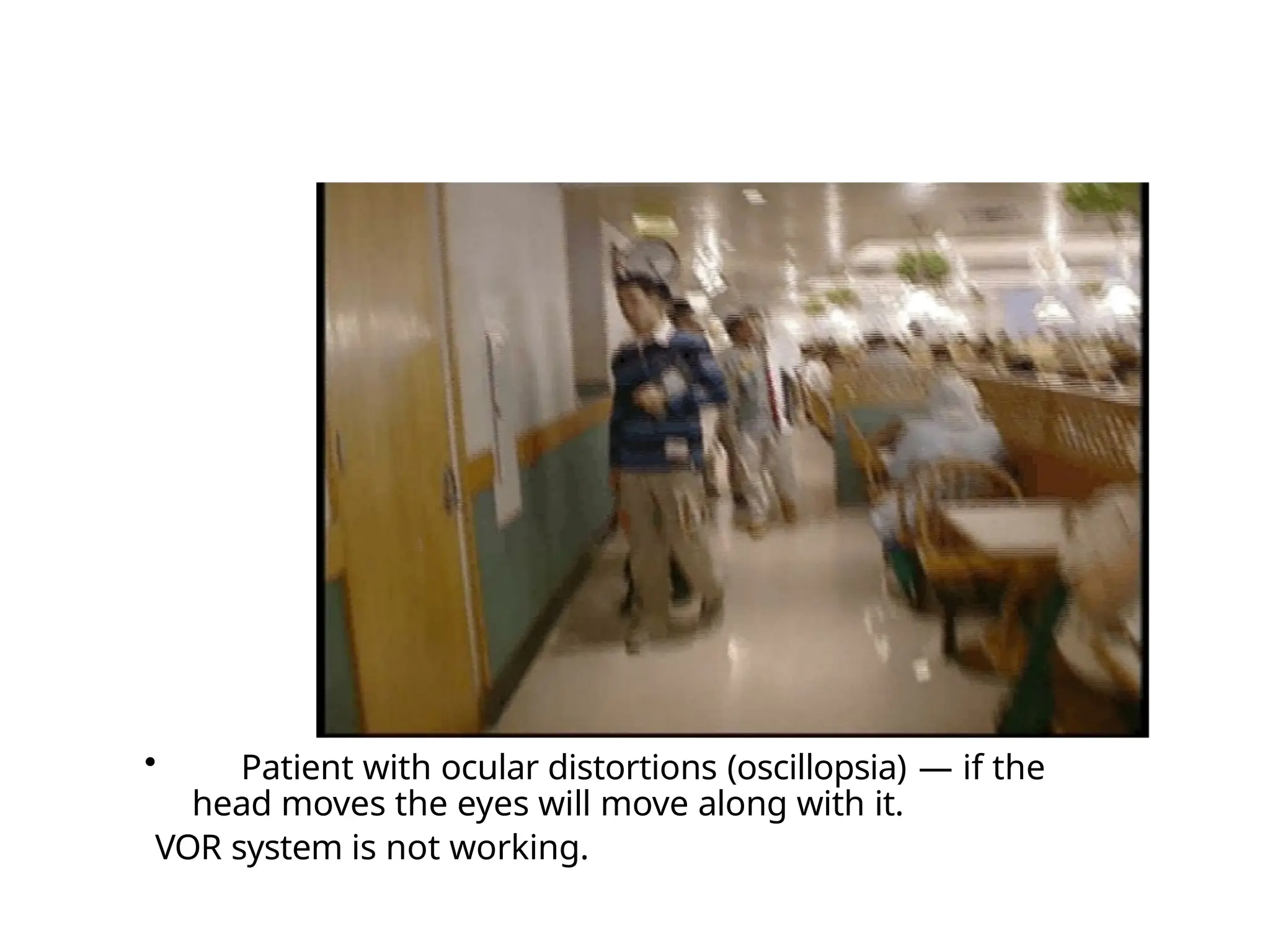
• Patient with ocular distortions (oscillopsia) — if the
head moves the eyes will move along with it.
VOR system is not working.
What is
vertigo?
VERTI
• The word "vertigo" comes from the
Latin "vertere", to turn + the su0ix "-
igo", a condition = a condition of
turning about).
• It is an allusion of being moving or
the world is moving too.
What are the questions to ask in history ?
• Onset (acute/chronic)
• Frequency — how often
• Duration
• Associated auditory symptoms
• Aggravating and relieving factors
• Ear disease or ear surgery — tinnitus?
• Trauma
• Migraine
• Ototoxic drug intake — (chemotherapy,
aminoglycosides, methotrexate)
• Family history
• Motion sickness
Differential diagnosis
A) peripheral vestibular loss — up to the
vestibular
nerve.
B) central vestibular loss —above the level of
the vestibular nerve and towards the brain.
What are the causes of
peripheral vestibular
loss ?
peripheral vestibular
loss
• Vestibular neuritis
• Benign paroxysmal positional vertigo ( BPPV)
• Meneires disease (Endolymphatic hydrop )
Vestibuiar Neuritis
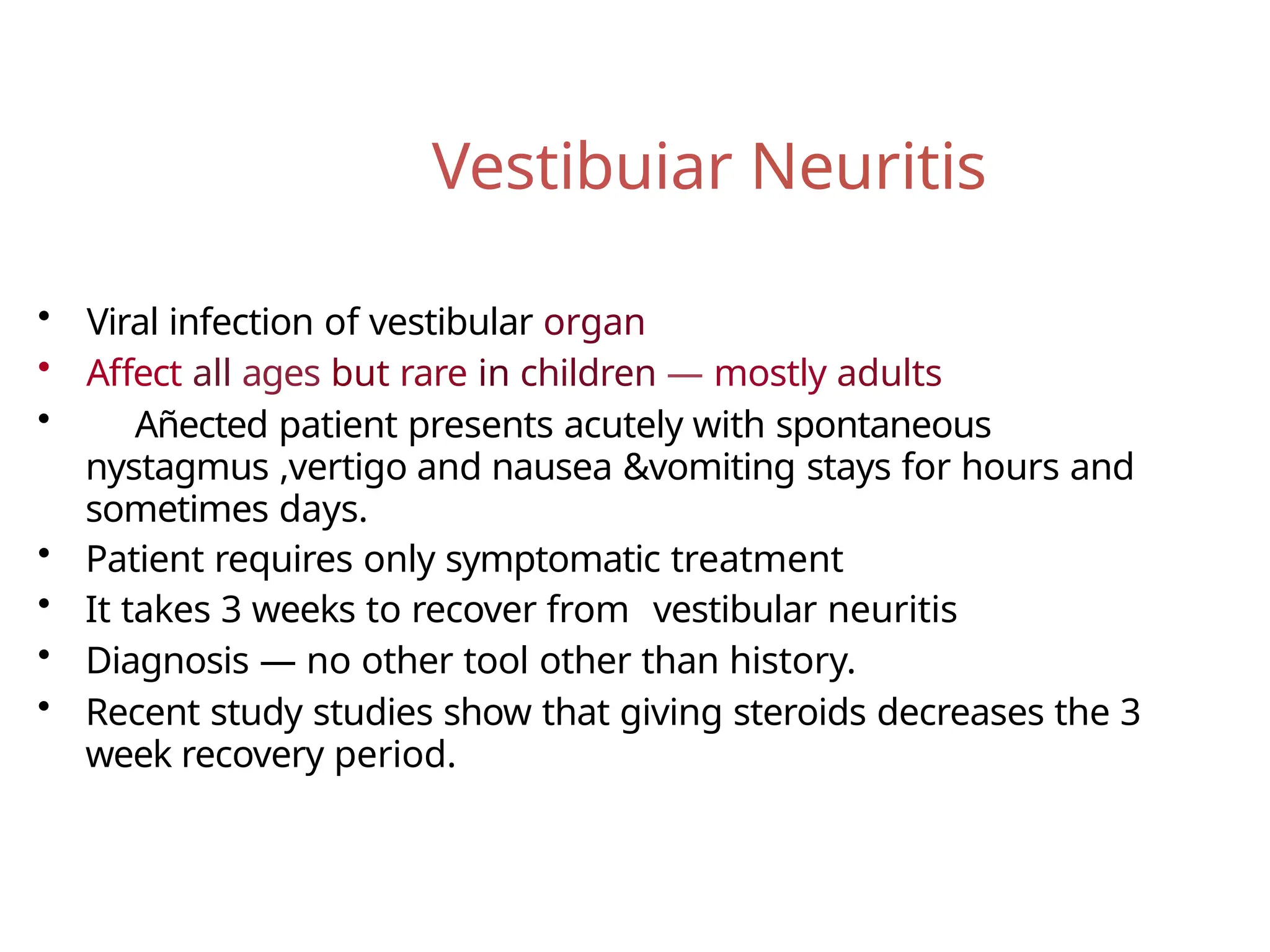
• Viral infection of vestibular organ
• Affect all ages but rare in children — mostly adults
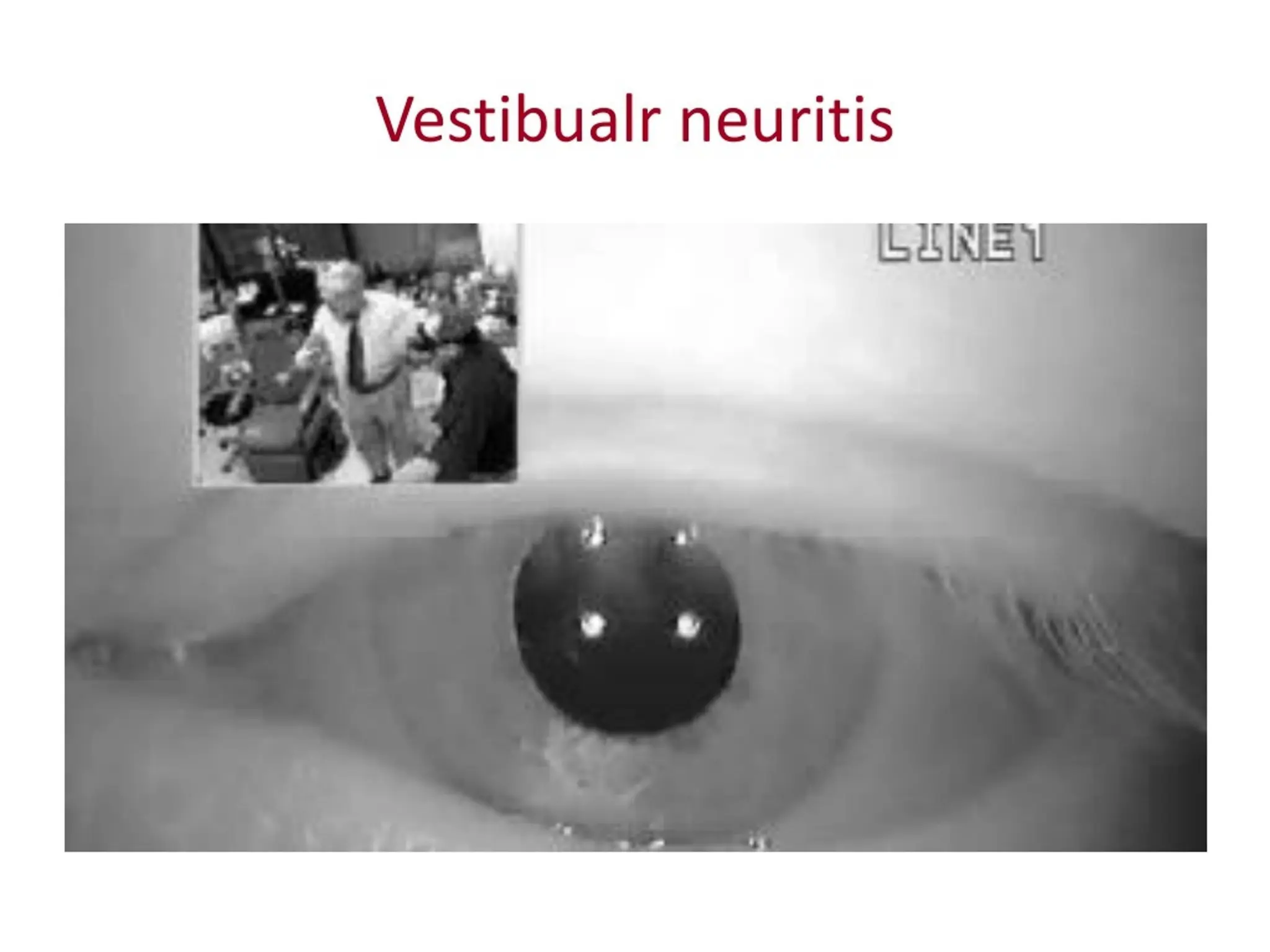
• Añected patient presents acutely with spontaneous
nystagmus ,vertigo and nausea &vomiting stays for hours and
sometimes days.
• Patient requires only symptomatic treatment
• It takes 3 weeks to recover from vestibular neuritis
• Diagnosis — no other tool other than history.
• Recent study studies show that giving steroids decreases the 3
week recovery period.
BPPV( benign
paroxysmal
positional vertigo
• Its provoked by certain positions.
• Pathophysiology:
• Calcium carbonate particles shear oñ and enter the canal
leading to brief episodes of vertigo.
C*n
M
Canalithiasi
s Cupulolithiasis
Vestibulithiasls
BPPV
• The most common cause of vertigo in
patient >
40 years
• Repeated attacks of vertigo usually of
short duration less than a minute .
• Provoked by certain positions (rolling in
beds, looking up ,and head rotations)
• Not associated with any hearing
impairment
BPPV
Diagnosis
• History
• Dix-HaIpike maneuver : putting the patient in a
certain position to stimulate the arack, and to look at
the eye (causes nystagmus) to see which canal is mostly
aFected by trying to push the particles inside the canal
and inducing the sense of dizziness.
• Treatment: repositioning of the head to get particles
out of the canal (Epley or particle repositioning
maneuver) . No medical or surgical treatment needed.
• Epley's maneuver could even be done at home.
Endolymphatic
hydrop (Meneire's
disease)
• vertigo (minutes to hours )
• Low frequency fluctuating SNHL
• Tinnitus and fullness in the ear.
• In 10 - 20% of cases the disease
later
involves the opposite ear
Endolymphatic
hydrop (Meneire's
disease)
• vertigo (minutes to hours )
• Low frequency fluctuating SNHL
• Tinnitus and fullness in the ear.
• In 10 - 20% of cases the disease
later
involves the opposite ear
Meniere'
s
iseas
e
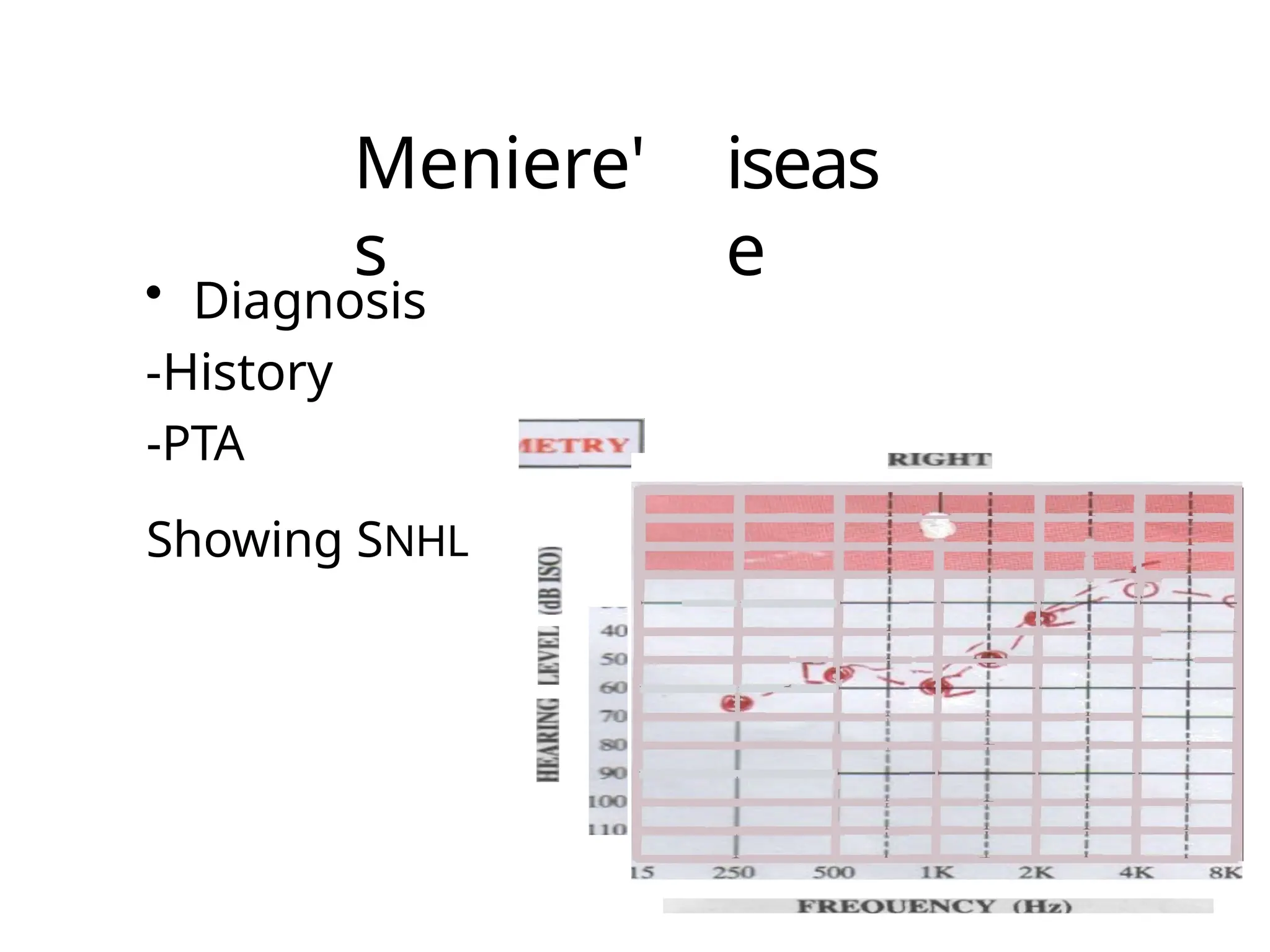
• Diagnosis
-History
-PTA
Showing SNHL
Meneire'
s
iseas
e
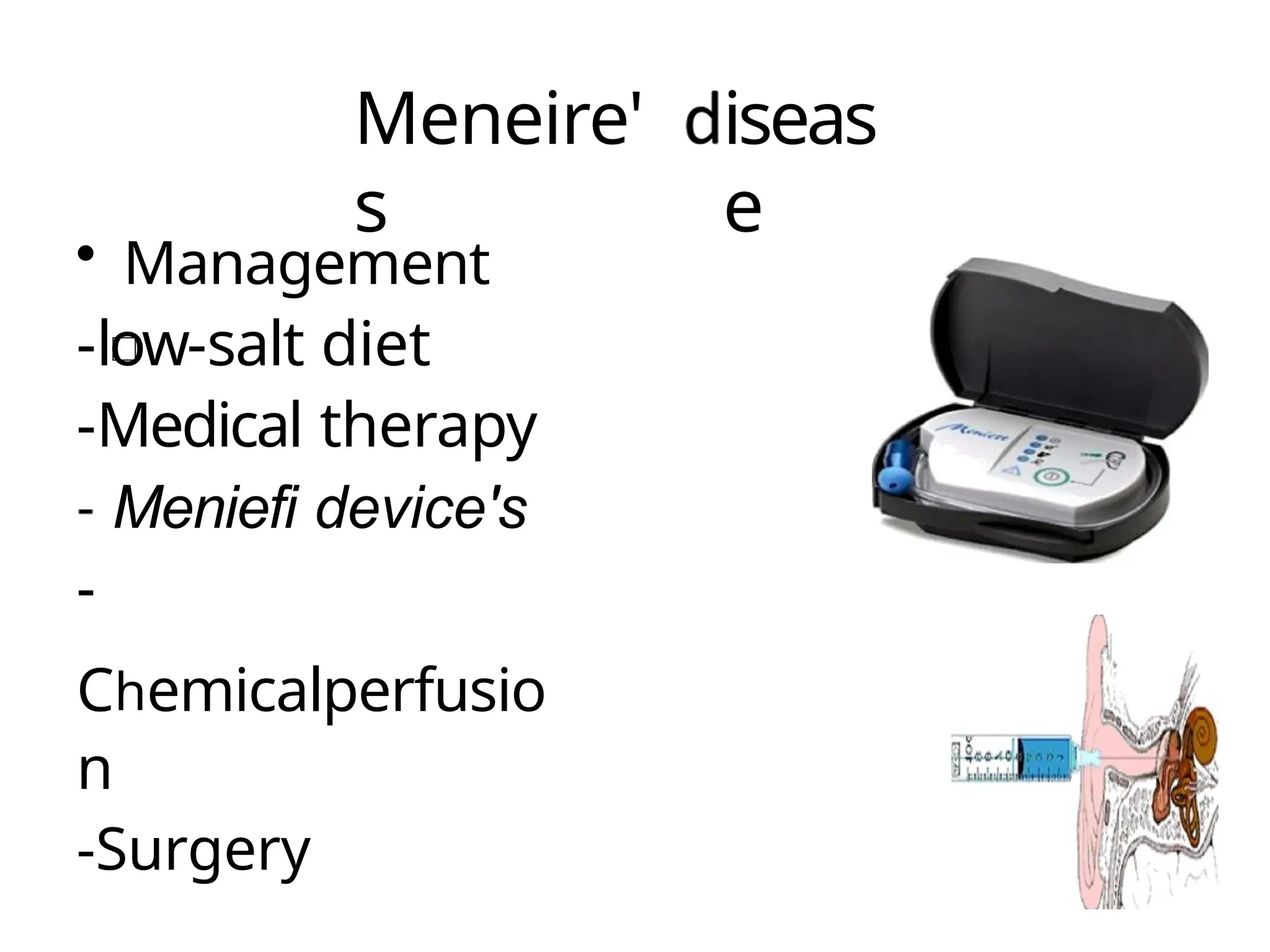
• Management
-low-salt diet
-Medical therapy
Meniefi device's
-
Chemicalperfusio
n
-Surgery
I
I
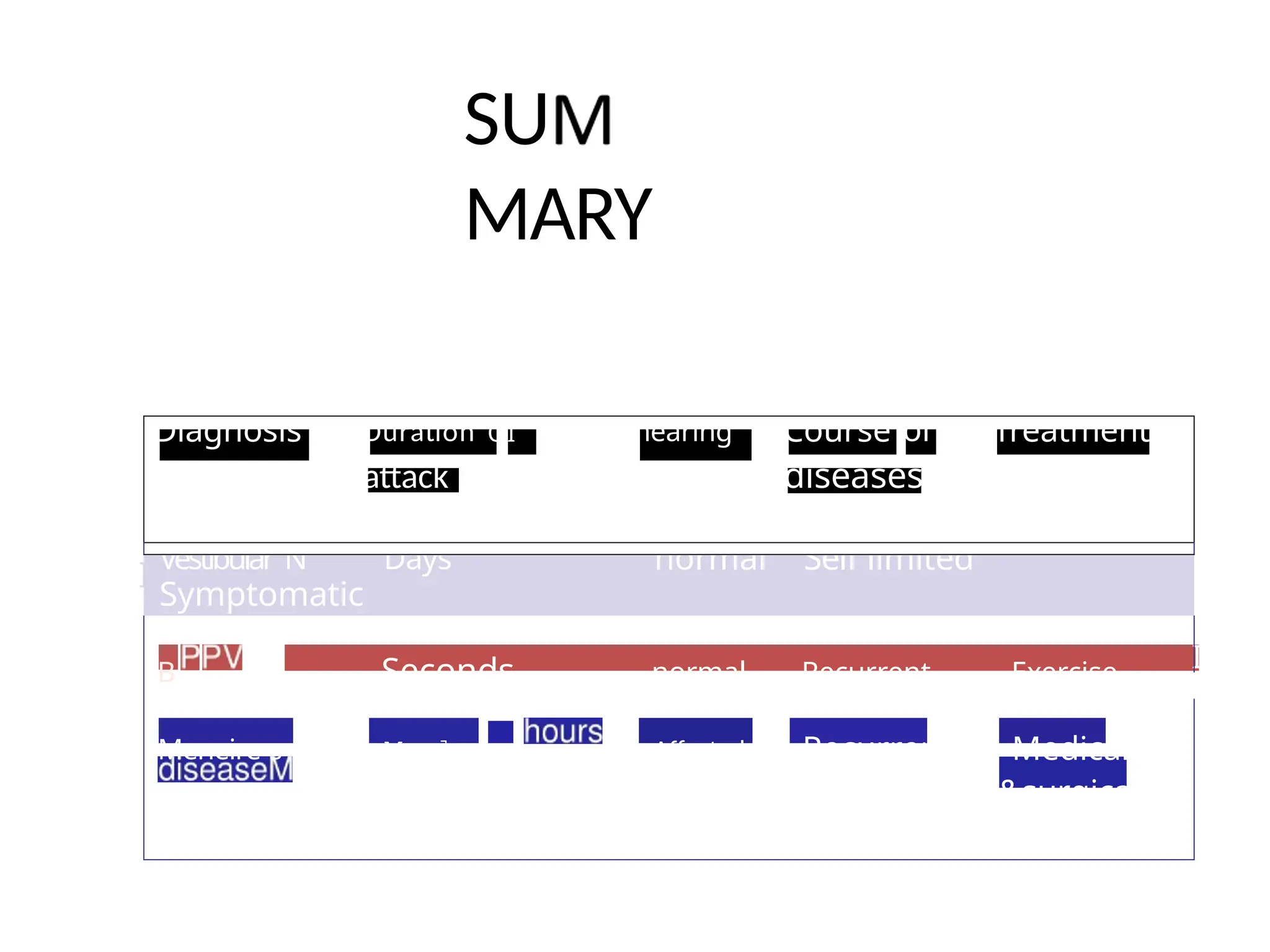
Diagnosis Duration OÎ hearing Course of Treatment
attack diseases
Vestibular N Days normal Self limited
Symptomatic
B Seconds normal Recurrent Exercise
Meneire s M;‹les IO Affected Recurrent Medicaï
&surgical
SU
MARY
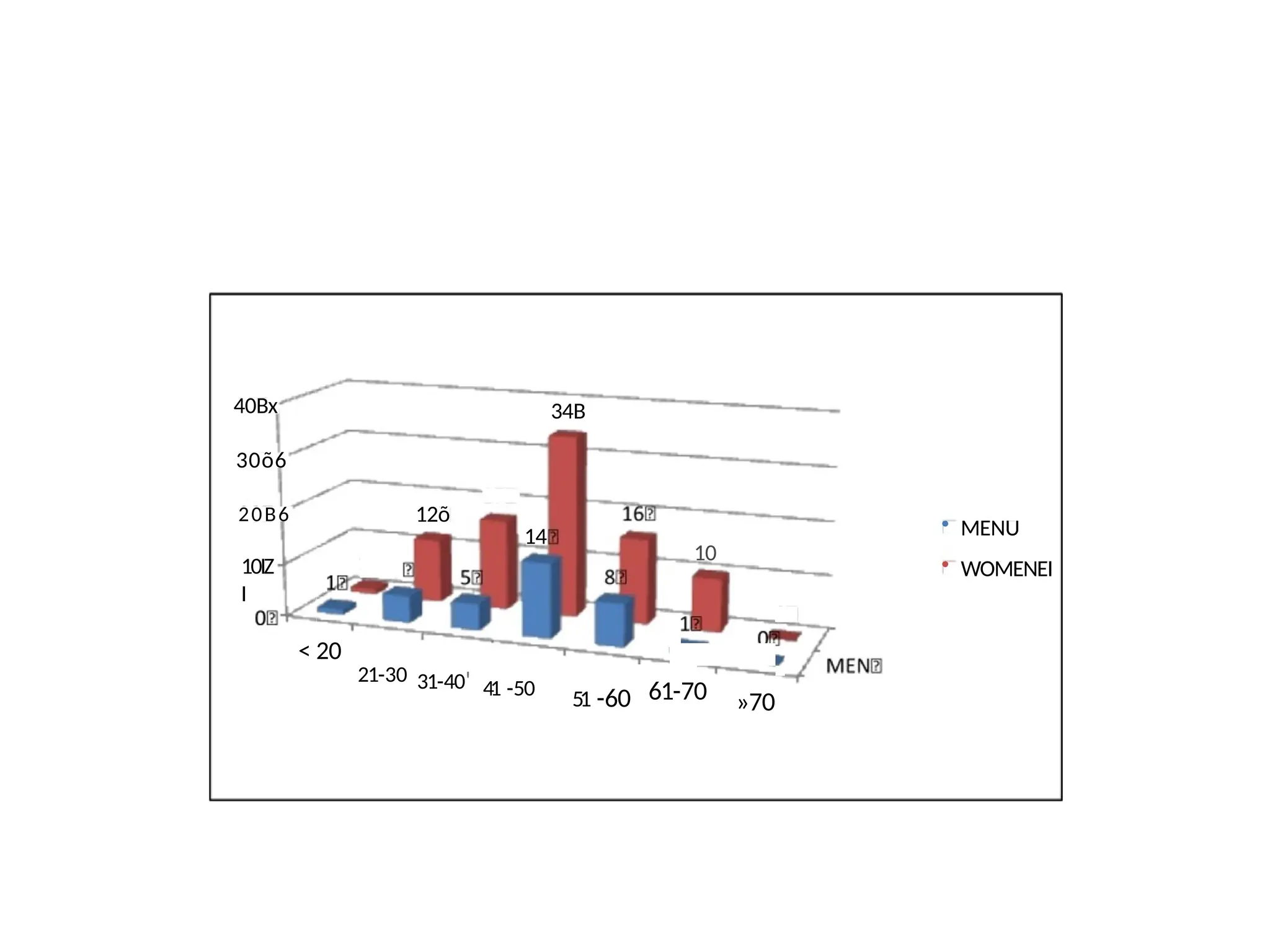
40Bx
30õ6
20B6
10IZ
I
12õ
< 20
34B
14
10
21-30 31-40' 41 -50 51 -60 61-70 »70
• MENU
• WOMENEI
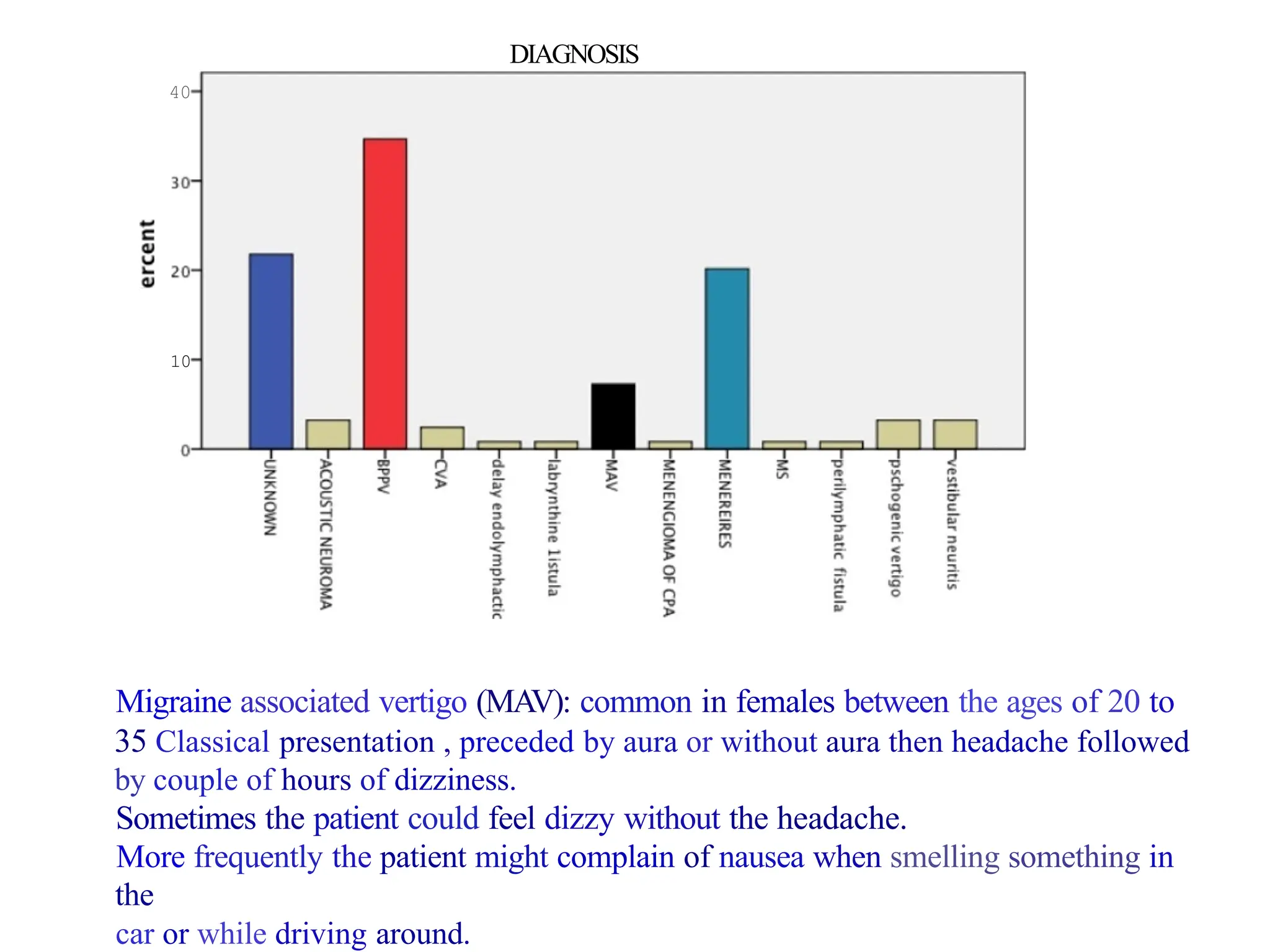
40
10
DIAGNOSIS
Migraine associated vertigo (MAV): common in females between the ages of 20 to
35 Classical presentation , preceded by aura or without aura then headache followed
by couple of hours of dizziness.
Sometimes the patient could feel dizzy without the headache.
More frequently the patient might complain of nausea when smelling something in
the
car or while driving around.
What are the causes of
central ?
Central
• CVA (Cerebro vascular accident)-
most
common
• Brain tumor ( acoustic neuroma )
• Multiple sclerosis
CV
A
• Elderly patient with chronic
disease like (DM ,HTN) with
sudden attack of vertigo
+neuroiogicaI symptoms
Acoustic
tumor
• Benign tumor
• Arise from vestibular division of
VIII Clinical presentation:
• Unilateral tinnitus
• Hearing loss
• Dizziness
• The only way to differentiate between
Meniere's
disease and the Acoustic tumor is by MRI.
Acoustic neuroma
Diagnosis .
• History
• PTA ( Unilateral
SNHL )
• Radiology
diagnosis
History is the most
important
key to diagnosis for a
dizzy
patient .
Investiagtions
• PT
A
• Vestibular
testing
• CT SCAN
• MRI
A dizzy patient may fit into one of the
following scenarios
Scenario #
1
The patient who is having a first
ever attack of acute spontaneous
vertigo.
• Acute vestibular neuritis
• cerebellar infarction.
How to differentiate ?
- Clinically ( General appearance of patient
/nystagmus/head impulse test)
- Radiology
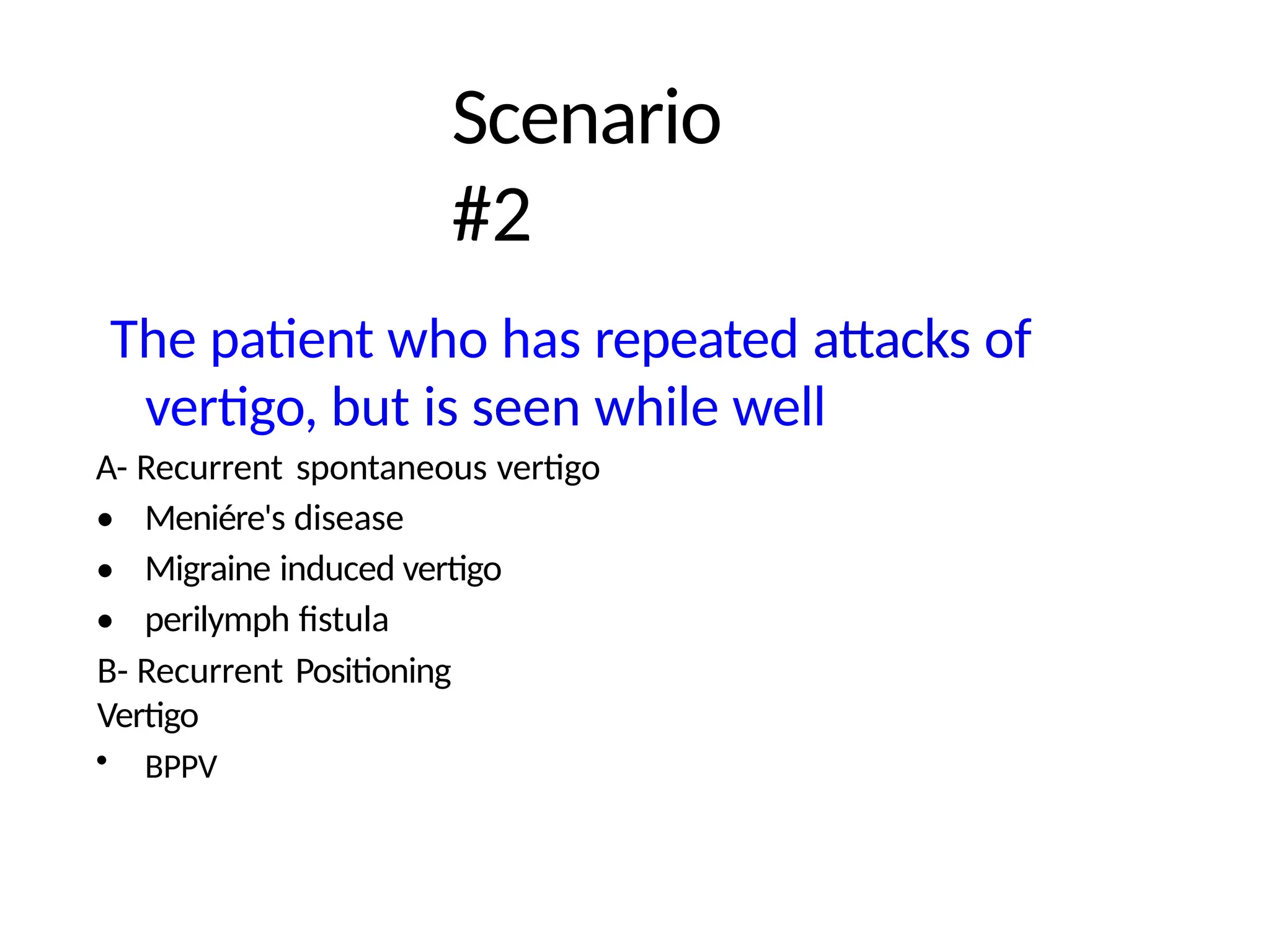
Scenario
#2
The patient who has repeated attacks of
vertigo, but is seen while well
A- Recurrent spontaneous vertigo
•
•
•
Meniére's disease
Migraine induced vertigo
perilymph fistula
B- Recurrent Positioning
Vertigo
• BPPV
Scenario
#3
The patient who is off balance
• Bilateral vestibulopathy — could be
due to streptomycin
• posterior fossa tumour
Take away message
Vertigo and it's mechanism, pathophysiology

Vertigo and it's mechanism, pathophysiology

  • 1.
    Vertigo Dr . Abdulrahman Alsanosi Associate professor Otolaryngology consultant Otologist, Neurotologist &SkuII Base Surgeon Head of Otology / Neurotology Unit Director of cochlear implant program King Abdulaziz University Hospital
  • 2.
    Importance • Can bea sign of serious diseases • Can be seen in other specialties • Hard to diagnose because it integrates several organs and systems together and the underlying cause is not clear. • Very common, but hard to deal with.
  • 3.
  • 4.
    What are thecomponents of balance system
  • 5.
    • Inner ear(3 semicicular canals and otolith organ ): divided into 2 parts: hearing (cochlea) and vestibular (semicircular canals , otolith organ) • Cerebellum ; engine behind coordination , creating muscle movement and keeping balance • Vision (Vestibular Ocular Reflex): it is a reference between the eye and the inner ear. it controls both eye movements and keeps them focused on the same object. I.e If there is misalignment between one of the retinas on a particular object it will lead to a sense of an “illusion” causing dizziness • Proprioception: sensation in the sole of the foot. People need hard surfaces to get the full eXect of their proprioception or it will feel like they are walking on sand “shaky grounds”. • 1 stimulus that leads to more than one response when it comes to maintaining balance. Being pushed from behind will lead to all the previous systems to work together to maintain balance.
  • 6.
    How does balancesystem work ?
  • 7.
    Physiology Function of vestibular system: •“Input” resulting from a stimulus that needs to be corrected through the vestibular system such as falling down. An “output” results from responses of the vestibular system to the input such as the eyes, cerebellum .. Etc. • The physical stimulus (input) will be transformed into a biological stimulas in the brain stem which will in turn be sent afterwards to the corresponding areas in the vestibular system. • Transform of the forces associate with head acceleration and gravity into a biological signals that the brain can use to develop subjective awareness of head position in space (orientation) • produce motor reflexes that will maintain posture and ocular stability to prevent the feeling of dizziness. • If there is a defect in the input and output processes the patient will present with vertigo, defects in the gait or ocular distortions.
  • 8.
    It is notsurprisingly that vestibular lesion cause: • Imbalance • posture and gait imbalance • visual distortion (oscillopsia
  • 9.
    • Patient withocular distortions (oscillopsia) — if the head moves the eyes will move along with it. VOR system is not working.
  • 10.
  • 11.
    VERTI • The word"vertigo" comes from the Latin "vertere", to turn + the su0ix "- igo", a condition = a condition of turning about). • It is an allusion of being moving or the world is moving too.
  • 12.
    What are thequestions to ask in history ? • Onset (acute/chronic) • Frequency — how often • Duration • Associated auditory symptoms • Aggravating and relieving factors • Ear disease or ear surgery — tinnitus? • Trauma • Migraine • Ototoxic drug intake — (chemotherapy, aminoglycosides, methotrexate) • Family history • Motion sickness
  • 13.
    Differential diagnosis A) peripheralvestibular loss — up to the vestibular nerve. B) central vestibular loss —above the level of the vestibular nerve and towards the brain.
  • 14.
    What are thecauses of peripheral vestibular loss ?
  • 15.
    peripheral vestibular loss • Vestibularneuritis • Benign paroxysmal positional vertigo ( BPPV) • Meneires disease (Endolymphatic hydrop )
  • 16.
    Vestibuiar Neuritis • Viralinfection of vestibular organ • Affect all ages but rare in children — mostly adults • Añected patient presents acutely with spontaneous nystagmus ,vertigo and nausea &vomiting stays for hours and sometimes days. • Patient requires only symptomatic treatment • It takes 3 weeks to recover from vestibular neuritis • Diagnosis — no other tool other than history. • Recent study studies show that giving steroids decreases the 3 week recovery period.
  • 18.
    BPPV( benign paroxysmal positional vertigo •Its provoked by certain positions. • Pathophysiology: • Calcium carbonate particles shear oñ and enter the canal leading to brief episodes of vertigo. C*n M Canalithiasi s Cupulolithiasis Vestibulithiasls
  • 19.
    BPPV • The mostcommon cause of vertigo in patient > 40 years • Repeated attacks of vertigo usually of short duration less than a minute . • Provoked by certain positions (rolling in beds, looking up ,and head rotations) • Not associated with any hearing impairment
  • 20.
    BPPV Diagnosis • History • Dix-HaIpikemaneuver : putting the patient in a certain position to stimulate the arack, and to look at the eye (causes nystagmus) to see which canal is mostly aFected by trying to push the particles inside the canal and inducing the sense of dizziness. • Treatment: repositioning of the head to get particles out of the canal (Epley or particle repositioning maneuver) . No medical or surgical treatment needed. • Epley's maneuver could even be done at home.
  • 21.
    Endolymphatic hydrop (Meneire's disease) • vertigo(minutes to hours ) • Low frequency fluctuating SNHL • Tinnitus and fullness in the ear. • In 10 - 20% of cases the disease later involves the opposite ear
  • 22.
    Endolymphatic hydrop (Meneire's disease) • vertigo(minutes to hours ) • Low frequency fluctuating SNHL • Tinnitus and fullness in the ear. • In 10 - 20% of cases the disease later involves the opposite ear
  • 23.
  • 24.
    Meneire' s iseas e • Management -low-salt diet -Medicaltherapy Meniefi device's - Chemicalperfusio n -Surgery
  • 25.
    I I Diagnosis Duration OÎhearing Course of Treatment attack diseases Vestibular N Days normal Self limited Symptomatic B Seconds normal Recurrent Exercise Meneire s M;‹les IO Affected Recurrent Medicaï &surgical SU MARY
  • 26.
    40Bx 30õ6 20B6 10IZ I 12õ < 20 34B 14 10 21-30 31-40'41 -50 51 -60 61-70 »70 • MENU • WOMENEI
  • 27.
    40 10 DIAGNOSIS Migraine associated vertigo(MAV): common in females between the ages of 20 to 35 Classical presentation , preceded by aura or without aura then headache followed by couple of hours of dizziness. Sometimes the patient could feel dizzy without the headache. More frequently the patient might complain of nausea when smelling something in the car or while driving around.
  • 28.
    What are thecauses of central ?
  • 29.
    Central • CVA (Cerebrovascular accident)- most common • Brain tumor ( acoustic neuroma ) • Multiple sclerosis
  • 30.
    CV A • Elderly patientwith chronic disease like (DM ,HTN) with sudden attack of vertigo +neuroiogicaI symptoms
  • 31.
    Acoustic tumor • Benign tumor •Arise from vestibular division of VIII Clinical presentation: • Unilateral tinnitus • Hearing loss • Dizziness • The only way to differentiate between Meniere's disease and the Acoustic tumor is by MRI.
  • 32.
    Acoustic neuroma Diagnosis . •History • PTA ( Unilateral SNHL ) • Radiology
  • 33.
    diagnosis History is themost important key to diagnosis for a dizzy patient .
  • 34.
  • 35.
    A dizzy patientmay fit into one of the following scenarios
  • 36.
    Scenario # 1 The patientwho is having a first ever attack of acute spontaneous vertigo. • Acute vestibular neuritis • cerebellar infarction. How to differentiate ? - Clinically ( General appearance of patient /nystagmus/head impulse test) - Radiology
  • 37.
    Scenario #2 The patient whohas repeated attacks of vertigo, but is seen while well A- Recurrent spontaneous vertigo • • • Meniére's disease Migraine induced vertigo perilymph fistula B- Recurrent Positioning Vertigo • BPPV
  • 38.
    Scenario #3 The patient whois off balance • Bilateral vestibulopathy — could be due to streptomycin • posterior fossa tumour

  • 39.