Vertigo
Lucy Webber
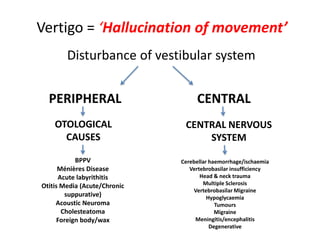
Vertigo = ‘Hallucination of movement’
Disturbance of vestibular system
CENTRALPERIPHERAL
CENTRAL NERVOUS
SYSTEM
OTOLOGICAL
CAUSES
Cerebellar haemorrhage/ischaemia
Vertebrobasilar insufficiency
Head & neck trauma
Multiple Sclerosis
Vertebrobasilar Migraine
Hypoglycaemia
Tumours
Migraine
Meningitis/encephalitis
Degenerative
BPPV
Ménières Disease
Acute labyrithitis
Otitis Media (Acute/Chronic
suppurative)
Acoustic Neuroma
Cholesteatoma
Foreign body/wax
Background
• Common presentation
• Typically rotational
• Illusion of tilting to one side/swaying
• Feeling of imbalance when standing/walking
• Diagnosis relies on accurate hx and examination
• Often described by pts as ‘dizziness’, ‘spinning’,
‘lightheadedness’, ‘unsteadiness’
History
• Onset and duration of first attack
• Associated symptoms:
• Exacerbating/relieving factors – effects of change in
posture, head/neck movements, darkness
• PMHx: Diabetes, CV disease, ear problems, trauma
• DHx
• SHx: ETOH intake, recreational drugs
OTOLOGICAL: Otalgia, otorrhoea, change in hearing, tinnitus
NON-OTOLOGICAL: Nausea & vomiting, fever, systemic upset, preceding viral
illness
Examination
• Full neurological exam incl. cerebellar exam (DANISH)
• Otoscopy, Rinnes/Weber’s Tests
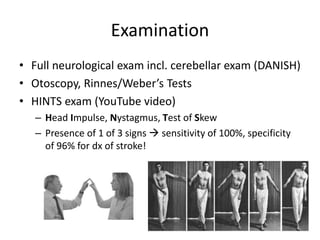
• HINTS exam (YouTube video)
– Head Impulse, Nystagmus, Test of Skew
– Presence of 1 of 3 signs  sensitivity of 100%, specificity
of 96% for dx of stroke!
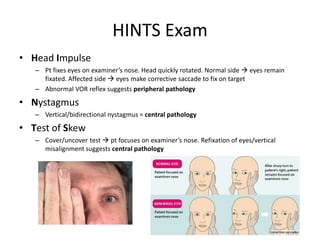
HINTS Exam
• Head Impulse
– Pt fixes eyes on examiner’s nose. Head quickly rotated. Normal side  eyes remain
fixated. Affected side  eyes make corrective saccade to fix on target
– Abnormal VOR reflex suggests peripheral pathology
• Nystagmus
– Vertical/bidirectional nystagmus = central pathology
• Test of Skew
– Cover/uncover test  pt focuses on examiner’s nose. Refixation of eyes/vertical
misalignment suggests central pathology
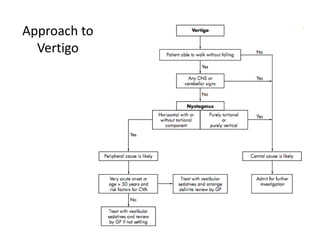
Approach to
Vertigo
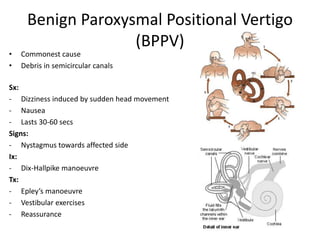
Benign Paroxysmal Positional Vertigo
(BPPV)
• Commonest cause
• Debris in semicircular canals
Sx:
- Dizziness induced by sudden head movement
- Nausea
- Lasts 30-60 secs
Signs:
- Nystagmus towards affected side
Ix:
- Dix-Hallpike manoeuvre
Tx:
- Epley’s manoeuvre
- Vestibular exercises
- Reassurance
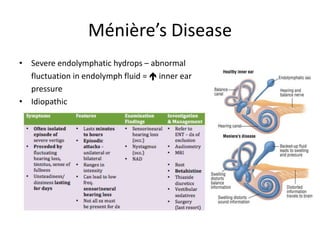
Ménière’s Disease
• Severe endolymphatic hydrops – abnormal
fluctuation in endolymph fluid =  inner ear
pressure
• Idiopathic
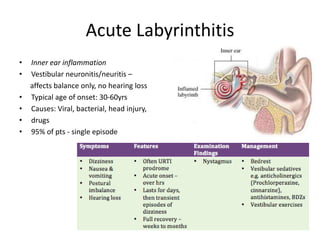
Acute Labyrinthitis
• Inner ear inflammation
• Vestibular neuronitis/neuritis –
affects balance only, no hearing loss
• Typical age of onset: 30-60yrs
• Causes: Viral, bacterial, head injury,
• drugs
• 95% of pts - single episode
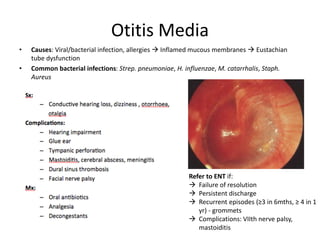
Otitis Media
• Causes: Viral/bacterial infection, allergies  Inflamed mucous membranes  Eustachian
tube dysfunction
• Common bacterial infections: Strep. pneumoniae, H. influenzae, M. catarrhalis, Staph.
Aureus
Refer to ENT if:
 Failure of resolution
 Persistent discharge
 Recurrent episodes (≥3 in 6mths, ≥ 4 in 1
yr) - grommets
 Complications: VIIth nerve palsy,
mastoiditis
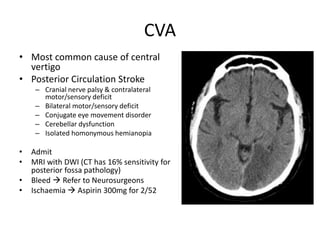
CVA
• Most common cause of central
vertigo
• Posterior Circulation Stroke
– Cranial nerve palsy & contralateral
motor/sensory deficit
– Bilateral motor/sensory deficit
– Conjugate eye movement disorder
– Cerebellar dysfunction
– Isolated homonymous hemianopia
• Admit
• MRI with DWI (CT has 16% sensitivity for
posterior fossa pathology)
• Bleed  Refer to Neurosurgeons
• Ischaemia  Aspirin 300mg for 2/52

Vertigo in the Emergency Department

  • 1.
  • 2.
    Vertigo = ‘Hallucinationof movement’ Disturbance of vestibular system CENTRALPERIPHERAL CENTRAL NERVOUS SYSTEM OTOLOGICAL CAUSES Cerebellar haemorrhage/ischaemia Vertebrobasilar insufficiency Head & neck trauma Multiple Sclerosis Vertebrobasilar Migraine Hypoglycaemia Tumours Migraine Meningitis/encephalitis Degenerative BPPV Ménières Disease Acute labyrithitis Otitis Media (Acute/Chronic suppurative) Acoustic Neuroma Cholesteatoma Foreign body/wax
  • 3.
    Background • Common presentation •Typically rotational • Illusion of tilting to one side/swaying • Feeling of imbalance when standing/walking • Diagnosis relies on accurate hx and examination • Often described by pts as ‘dizziness’, ‘spinning’, ‘lightheadedness’, ‘unsteadiness’
  • 4.
    History • Onset andduration of first attack • Associated symptoms: • Exacerbating/relieving factors – effects of change in posture, head/neck movements, darkness • PMHx: Diabetes, CV disease, ear problems, trauma • DHx • SHx: ETOH intake, recreational drugs OTOLOGICAL: Otalgia, otorrhoea, change in hearing, tinnitus NON-OTOLOGICAL: Nausea & vomiting, fever, systemic upset, preceding viral illness
  • 5.
    Examination • Full neurologicalexam incl. cerebellar exam (DANISH) • Otoscopy, Rinnes/Weber’s Tests • HINTS exam (YouTube video) – Head Impulse, Nystagmus, Test of Skew – Presence of 1 of 3 signs  sensitivity of 100%, specificity of 96% for dx of stroke!
  • 6.
    HINTS Exam • HeadImpulse – Pt fixes eyes on examiner’s nose. Head quickly rotated. Normal side  eyes remain fixated. Affected side  eyes make corrective saccade to fix on target – Abnormal VOR reflex suggests peripheral pathology • Nystagmus – Vertical/bidirectional nystagmus = central pathology • Test of Skew – Cover/uncover test  pt focuses on examiner’s nose. Refixation of eyes/vertical misalignment suggests central pathology
  • 7.
  • 8.
    Benign Paroxysmal PositionalVertigo (BPPV) • Commonest cause • Debris in semicircular canals Sx: - Dizziness induced by sudden head movement - Nausea - Lasts 30-60 secs Signs: - Nystagmus towards affected side Ix: - Dix-Hallpike manoeuvre Tx: - Epley’s manoeuvre - Vestibular exercises - Reassurance
  • 9.
    Ménière’s Disease • Severeendolymphatic hydrops – abnormal fluctuation in endolymph fluid =  inner ear pressure • Idiopathic
  • 10.
    Acute Labyrinthitis • Innerear inflammation • Vestibular neuronitis/neuritis – affects balance only, no hearing loss • Typical age of onset: 30-60yrs • Causes: Viral, bacterial, head injury, • drugs • 95% of pts - single episode
  • 11.
    Otitis Media • Causes:Viral/bacterial infection, allergies  Inflamed mucous membranes  Eustachian tube dysfunction • Common bacterial infections: Strep. pneumoniae, H. influenzae, M. catarrhalis, Staph. Aureus Refer to ENT if:  Failure of resolution  Persistent discharge  Recurrent episodes (≥3 in 6mths, ≥ 4 in 1 yr) - grommets  Complications: VIIth nerve palsy, mastoiditis
  • 12.
    CVA • Most commoncause of central vertigo • Posterior Circulation Stroke – Cranial nerve palsy & contralateral motor/sensory deficit – Bilateral motor/sensory deficit – Conjugate eye movement disorder – Cerebellar dysfunction – Isolated homonymous hemianopia • Admit • MRI with DWI (CT has 16% sensitivity for posterior fossa pathology) • Bleed  Refer to Neurosurgeons • Ischaemia  Aspirin 300mg for 2/52