English grammar
fundamEntals-ii
Course: B.Tech
Sem. II
Subject: ECLS
Unit: Tenses
What is Verb?
• A verb is an action word. It shows the action in
the sentence.
• A verb is the central unit of any sentence of
clause, and all the other words in a sentence take
grammatical form based on how they relate to it.
A verb can express action (run, live, change), or
states of being (is, are) or occurrences (happen,
become). Sentences can have more than one
verb. A clause is a sub-unit of a sentence that has
one verb.
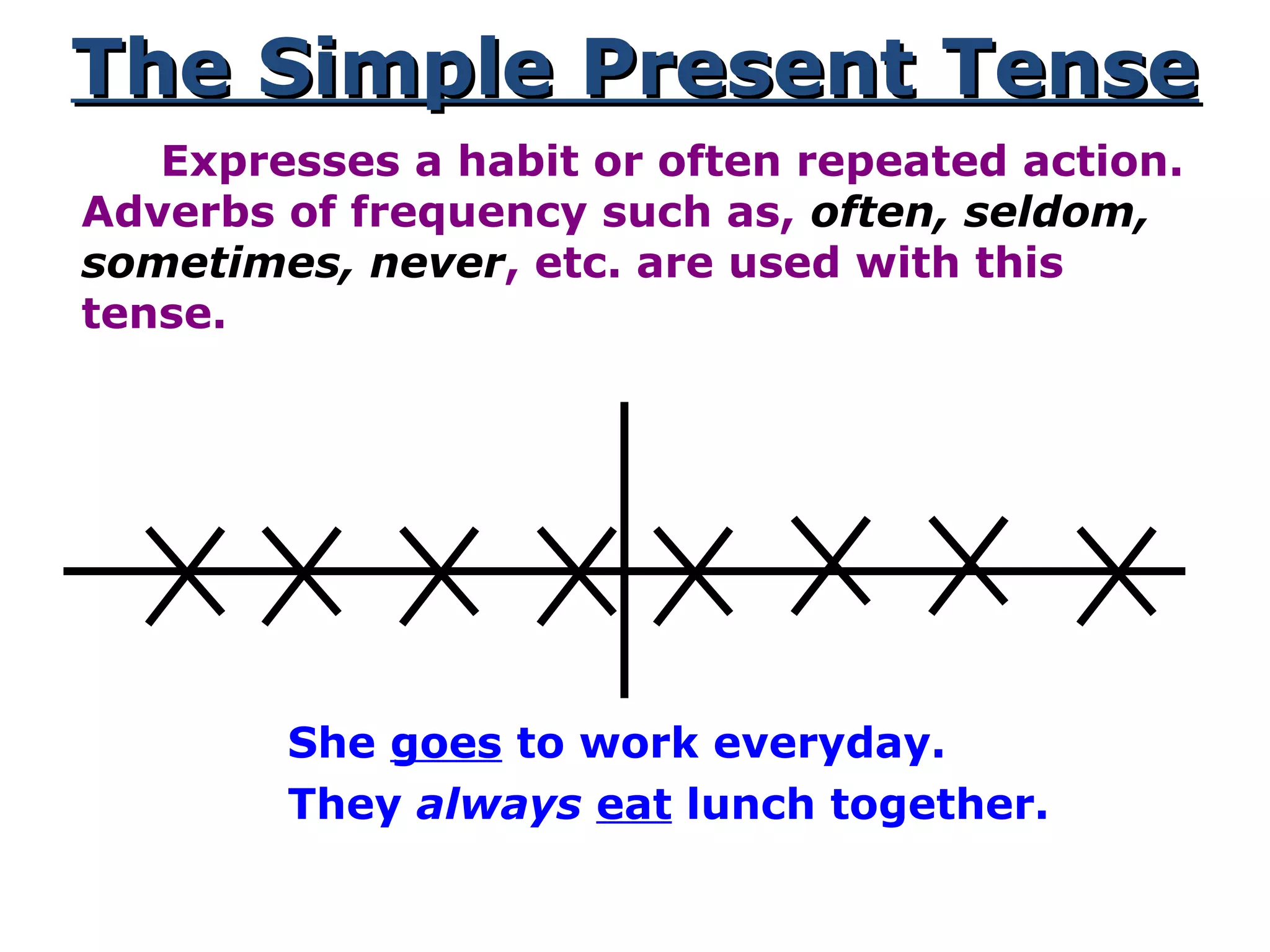
The Simple Present TenseThe Simple Present Tense
Expresses a habit or often repeated action.
Adverbs of frequency such as, often, seldom,
sometimes, never, etc. are used with this
tense.
She goes to work everyday.
They always eat lunch together.
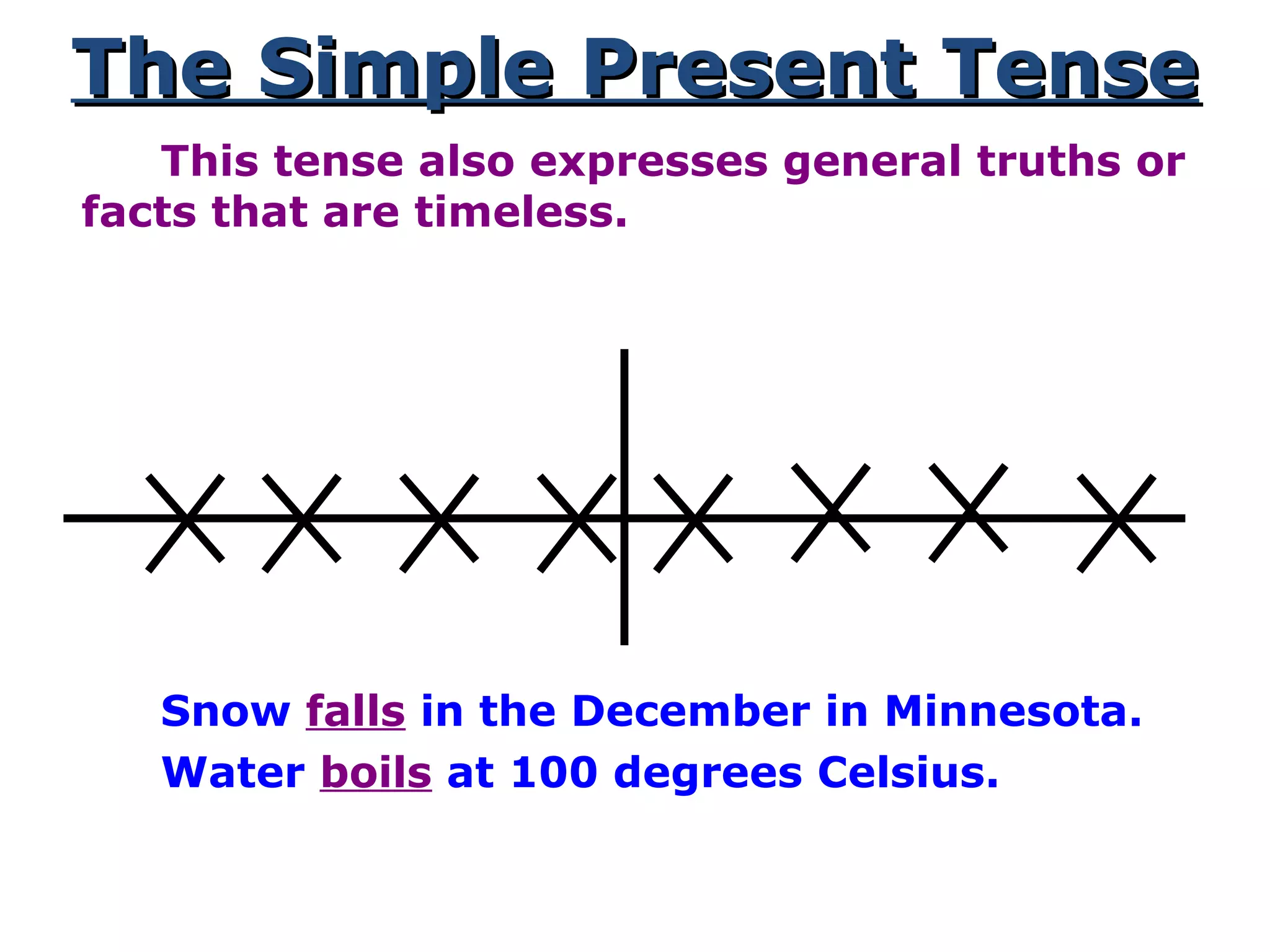
The Simple Present TenseThe Simple Present Tense
This tense also expresses general truths or
facts that are timeless.
Snow falls in the December in Minnesota.
Water boils at 100 degrees Celsius.
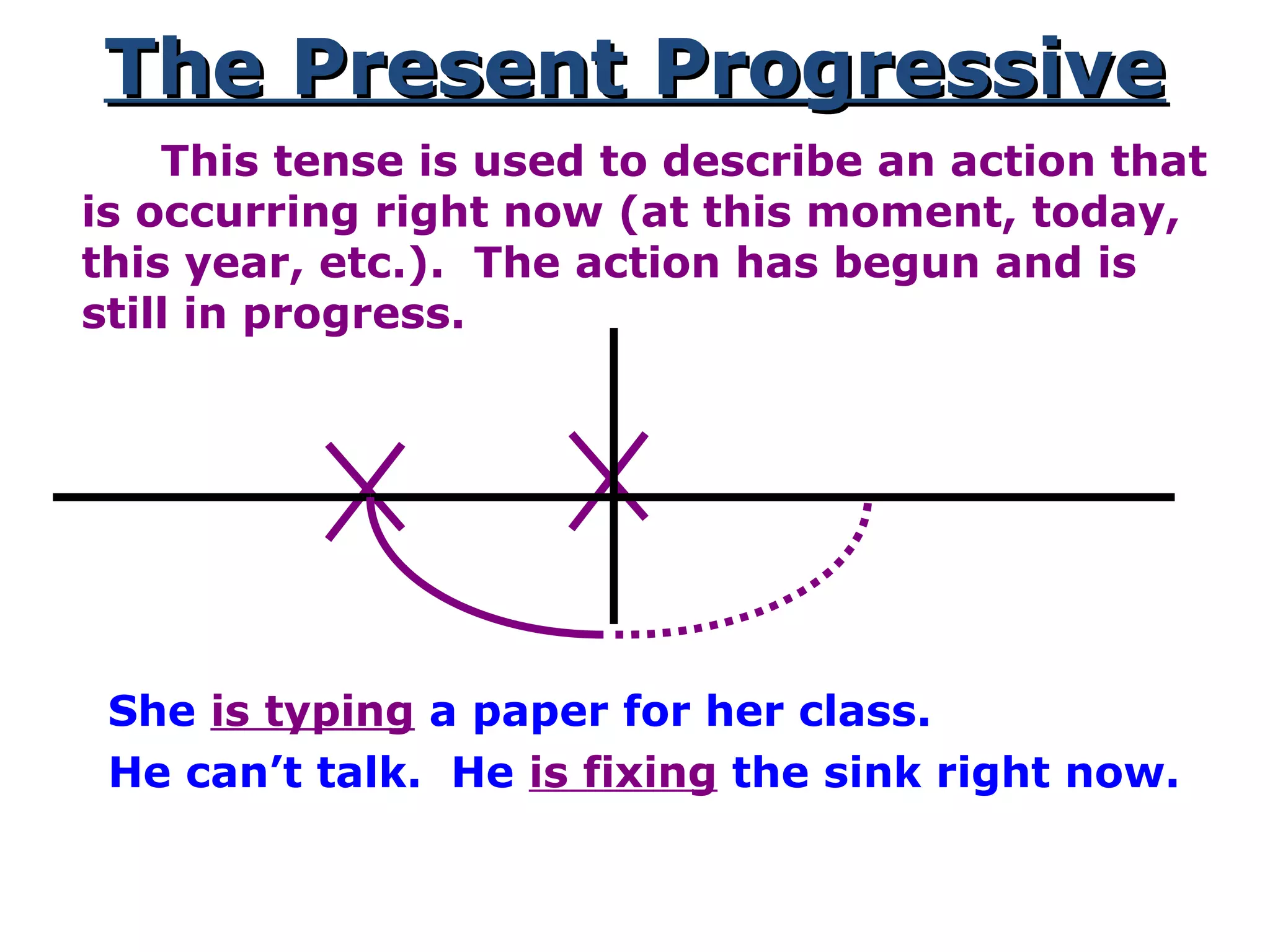
The Present ProgressiveThe Present Progressive
This tense is used to describe an action that
is occurring right now (at this moment, today,
this year, etc.). The action has begun and is
still in progress.
She is typing a paper for her class.
He can’t talk. He is fixing the sink right now.
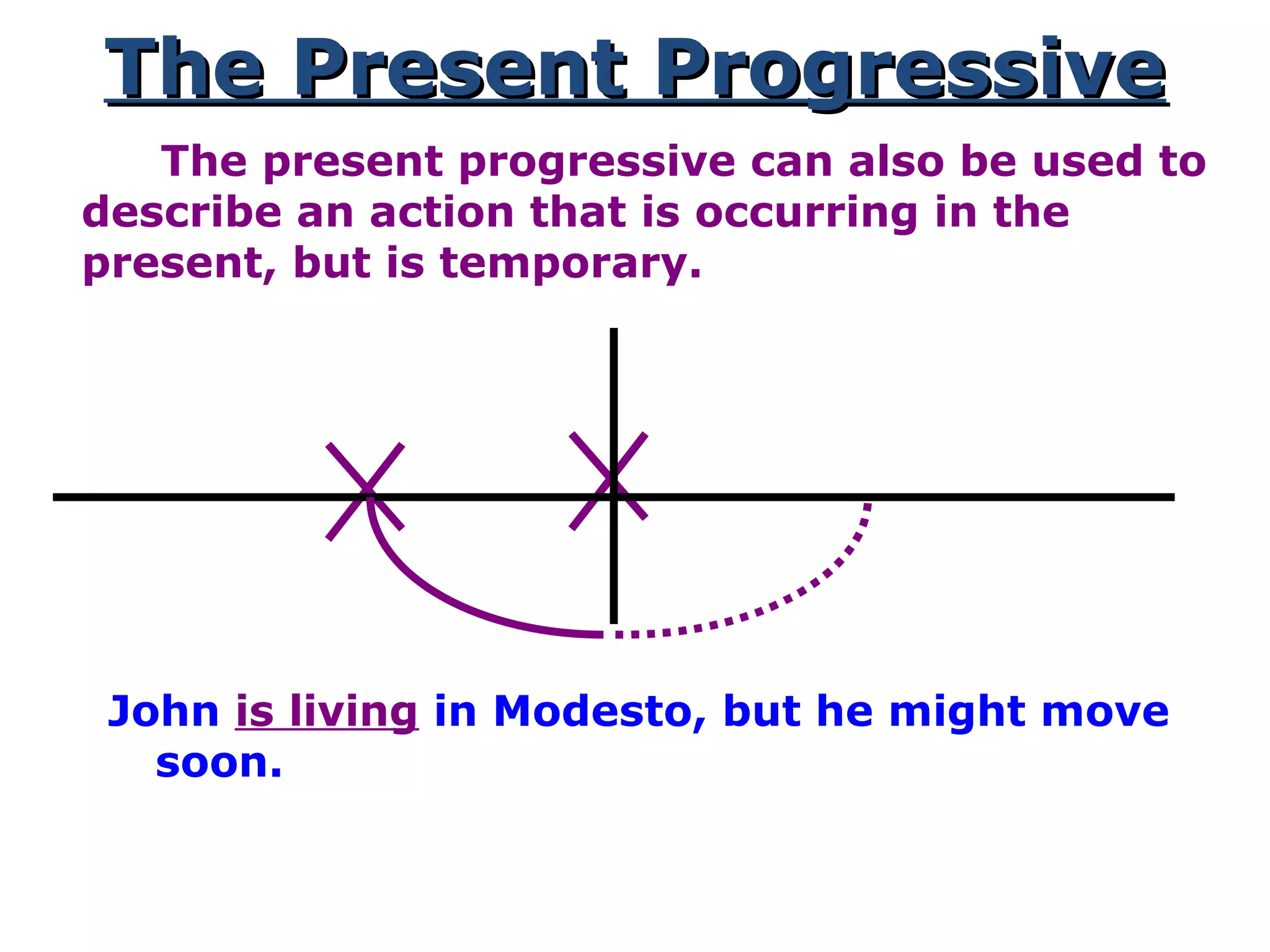
The Present ProgressiveThe Present Progressive
The present progressive can also be used to
describe an action that is occurring in the
present, but is temporary.
John is living in Modesto, but he might move
soon.
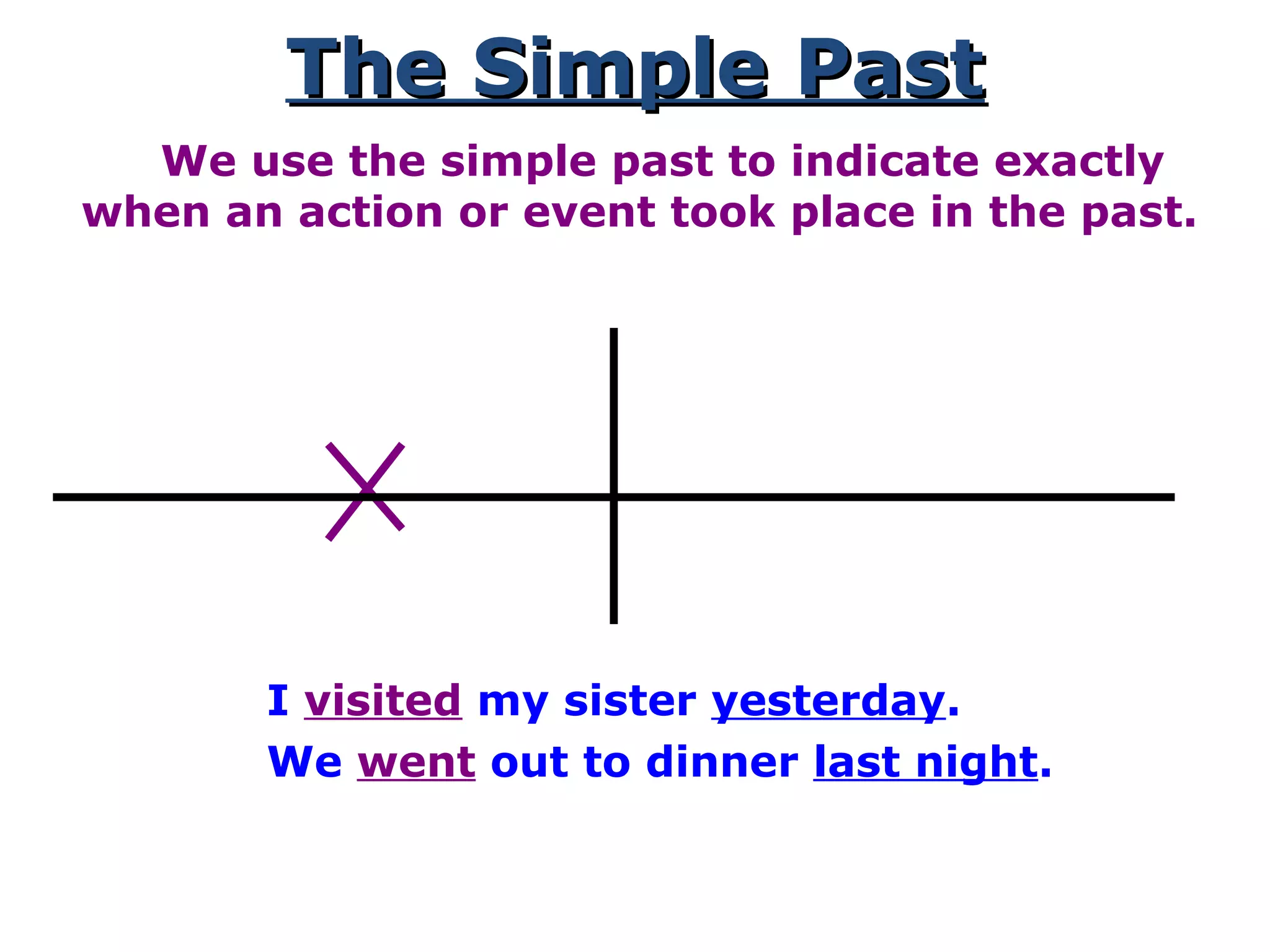
The Simple PastThe Simple Past
We use the simple past to indicate exactly
when an action or event took place in the past.
I visited my sister yesterday.
We went out to dinner last night.
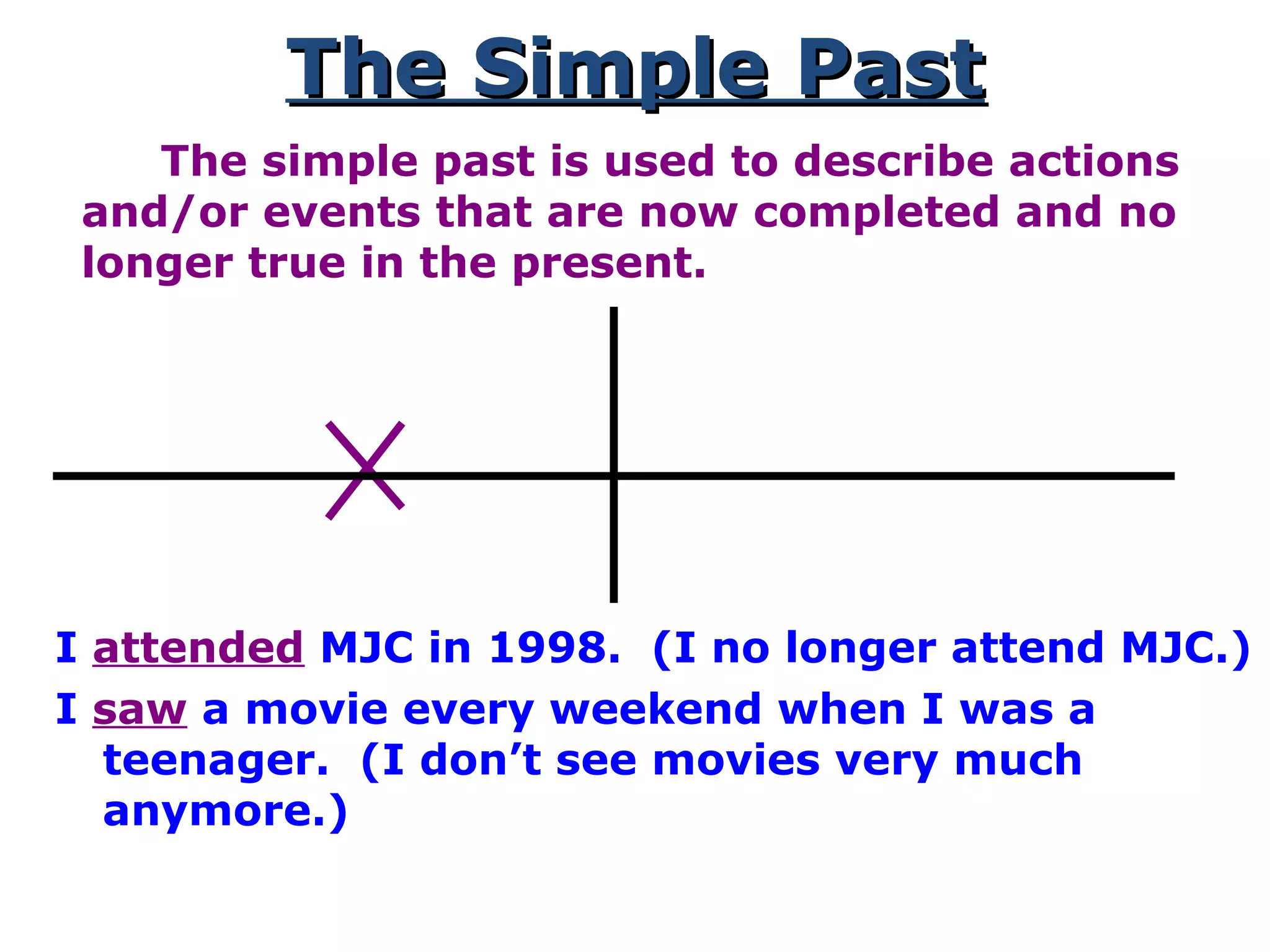
The Simple PastThe Simple Past
The simple past is used to describe actions
and/or events that are now completed and no
longer true in the present.
I attended MJC in 1998. (I no longer attend MJC.)
I saw a movie every weekend when I was a
teenager. (I don’t see movies very much
anymore.)
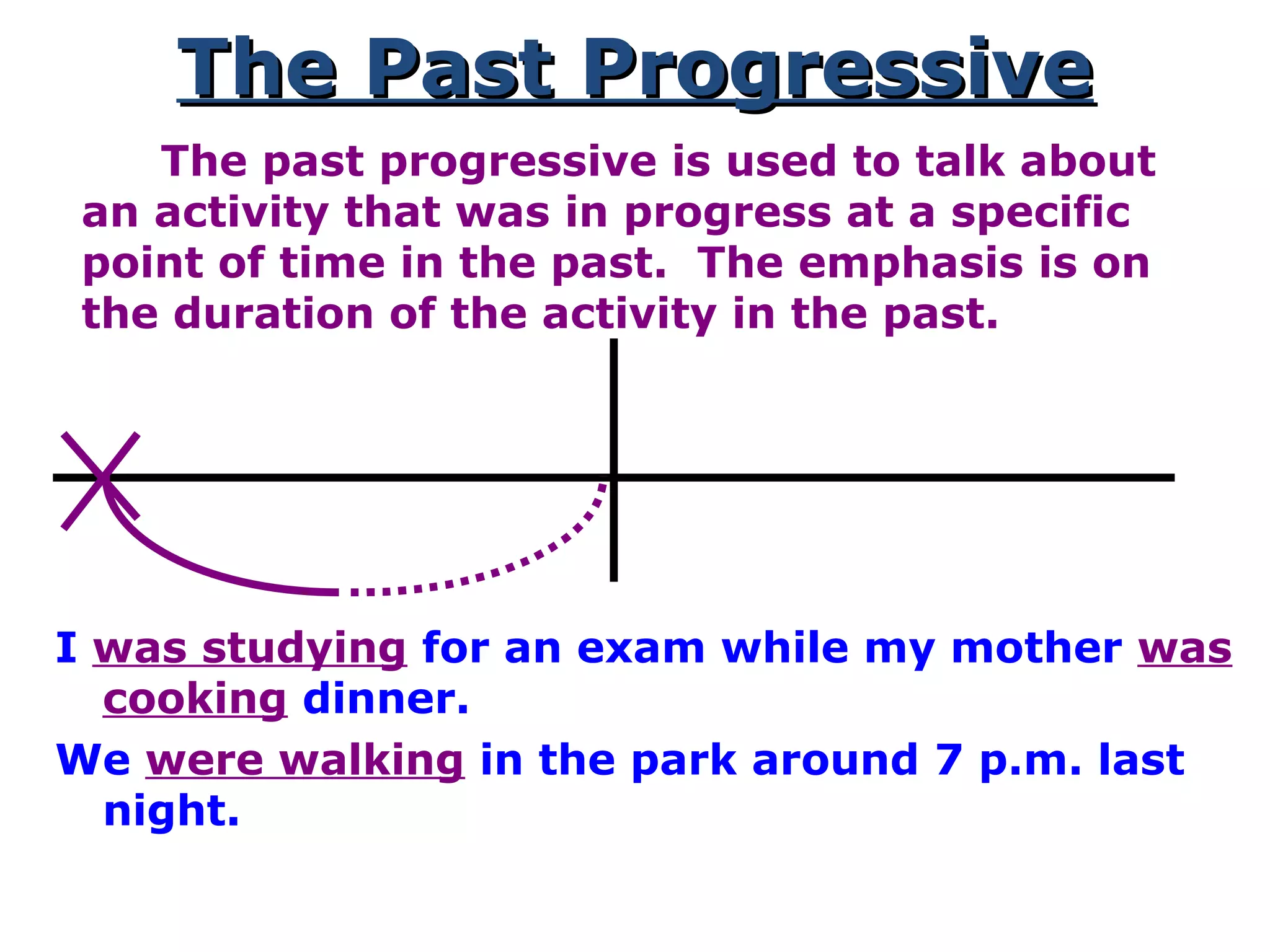
The Past ProgressiveThe Past Progressive
The past progressive is used to talk about
an activity that was in progress at a specific
point of time in the past. The emphasis is on
the duration of the activity in the past.
I was studying for an exam while my mother was
cooking dinner.
We were walking in the park around 7 p.m. last
night.
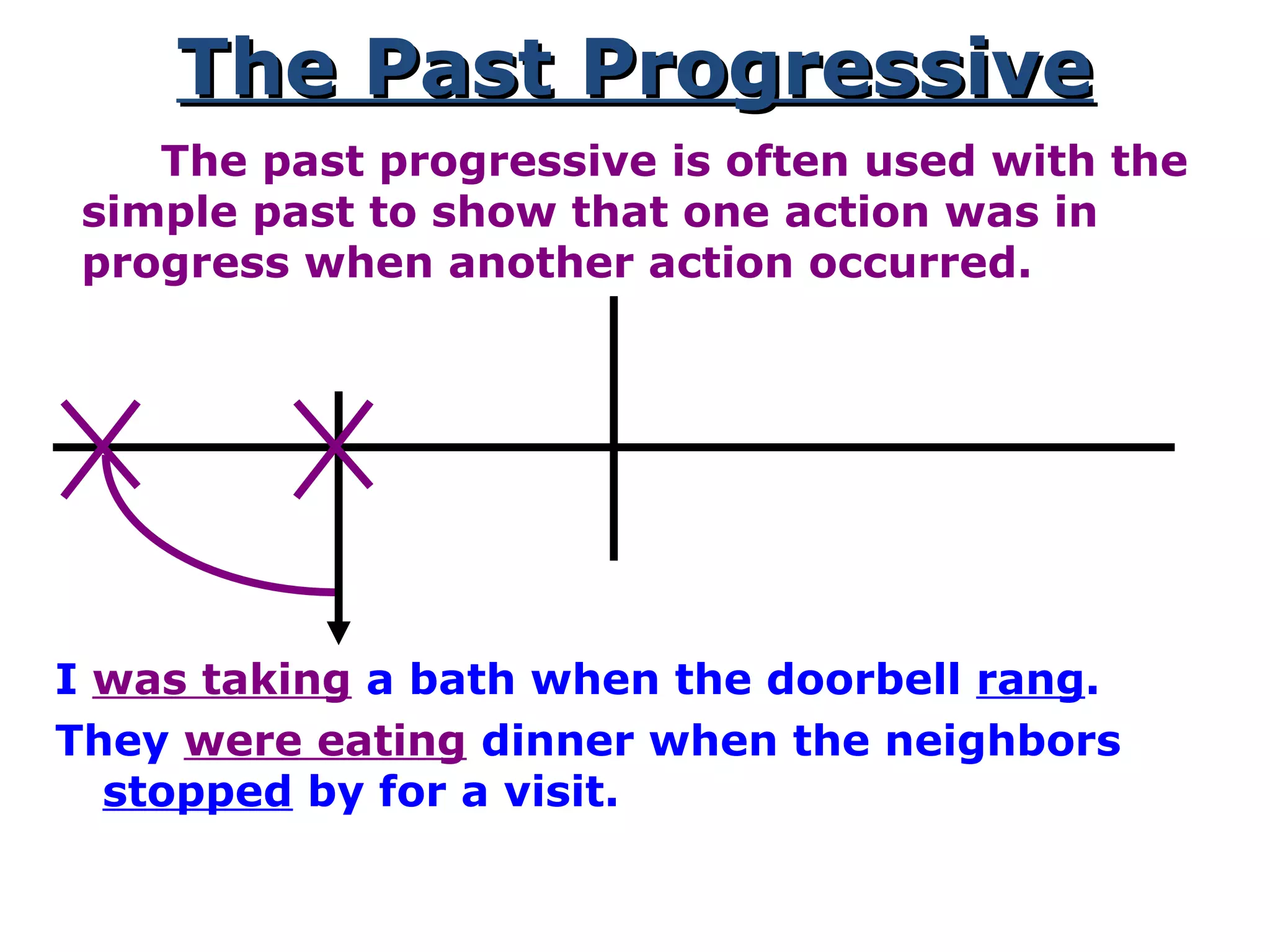
The Past ProgressiveThe Past Progressive
The past progressive is often used with the
simple past to show that one action was in
progress when another action occurred.
I was taking a bath when the doorbell rang.
They were eating dinner when the neighbors
stopped by for a visit.
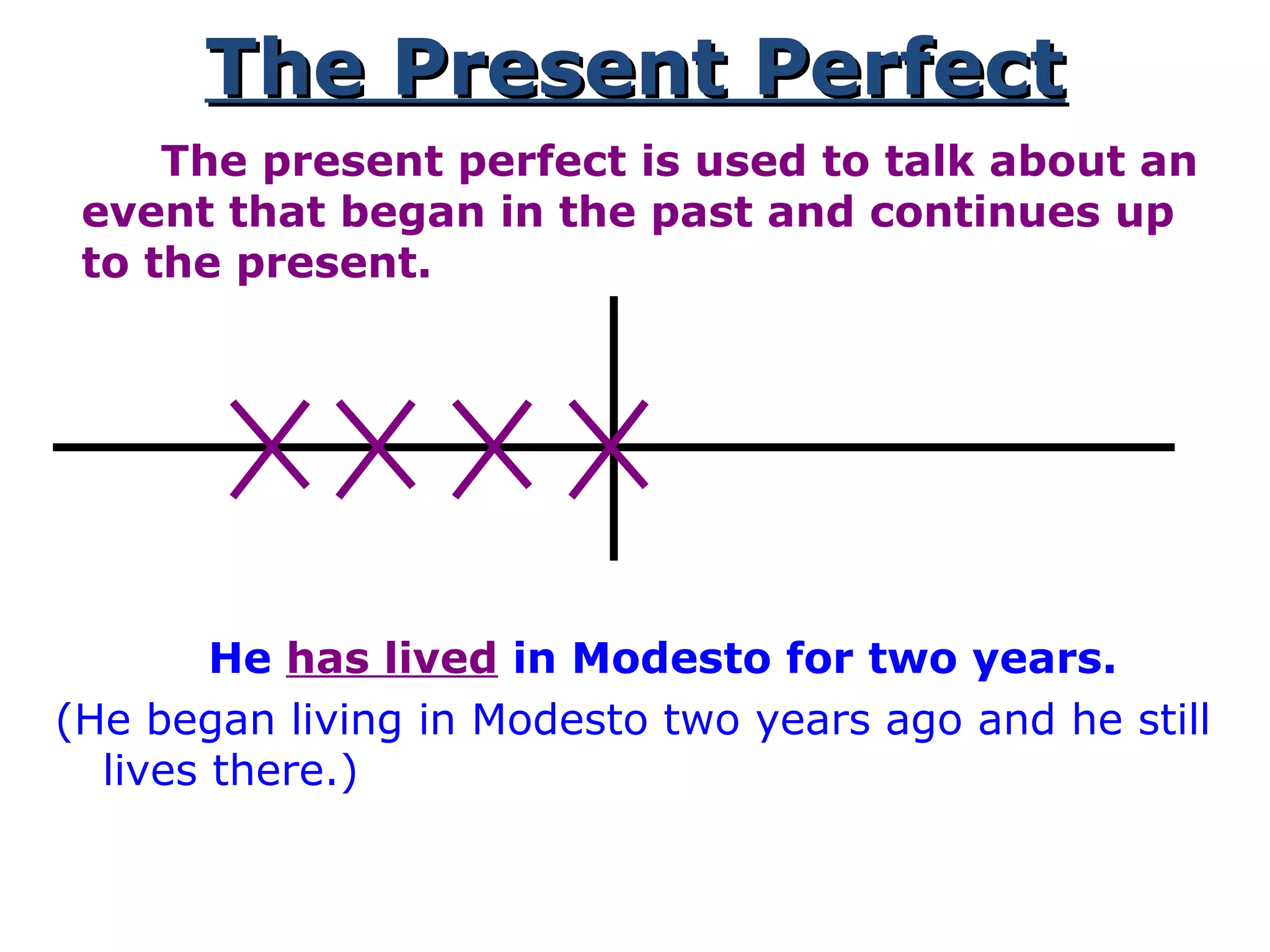
The Present PerfectThe Present Perfect
The present perfect is used to talk about an
event that began in the past and continues up
to the present.
He has lived in Modesto for two years.
(He began living in Modesto two years ago and he still
lives there.)
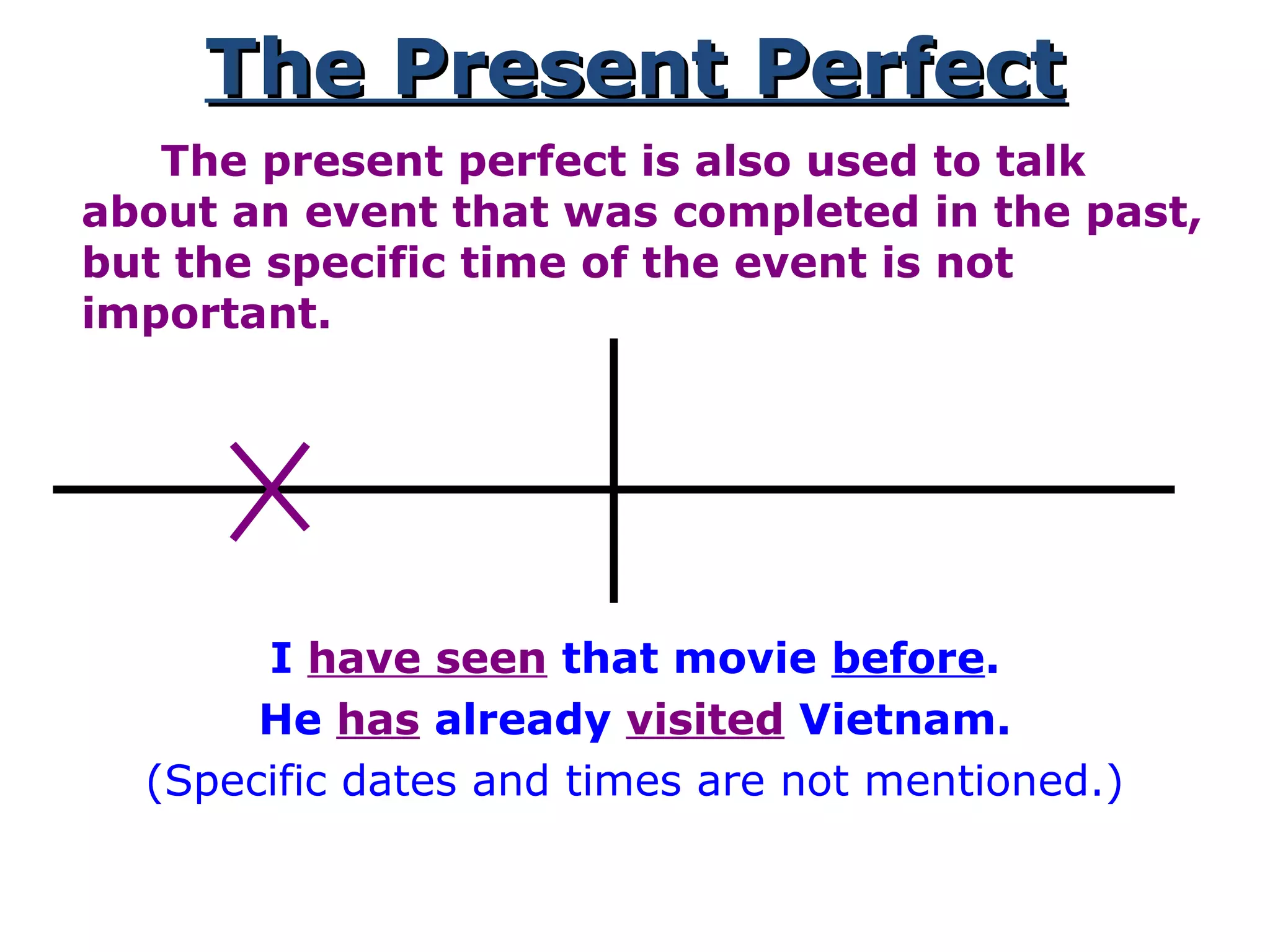
The Present PerfectThe Present Perfect
The present perfect is also used to talk
about an event that was completed in the past,
but the specific time of the event is not
important.
I have seen that movie before.
He has already visited Vietnam.
(Specific dates and times are not mentioned.)
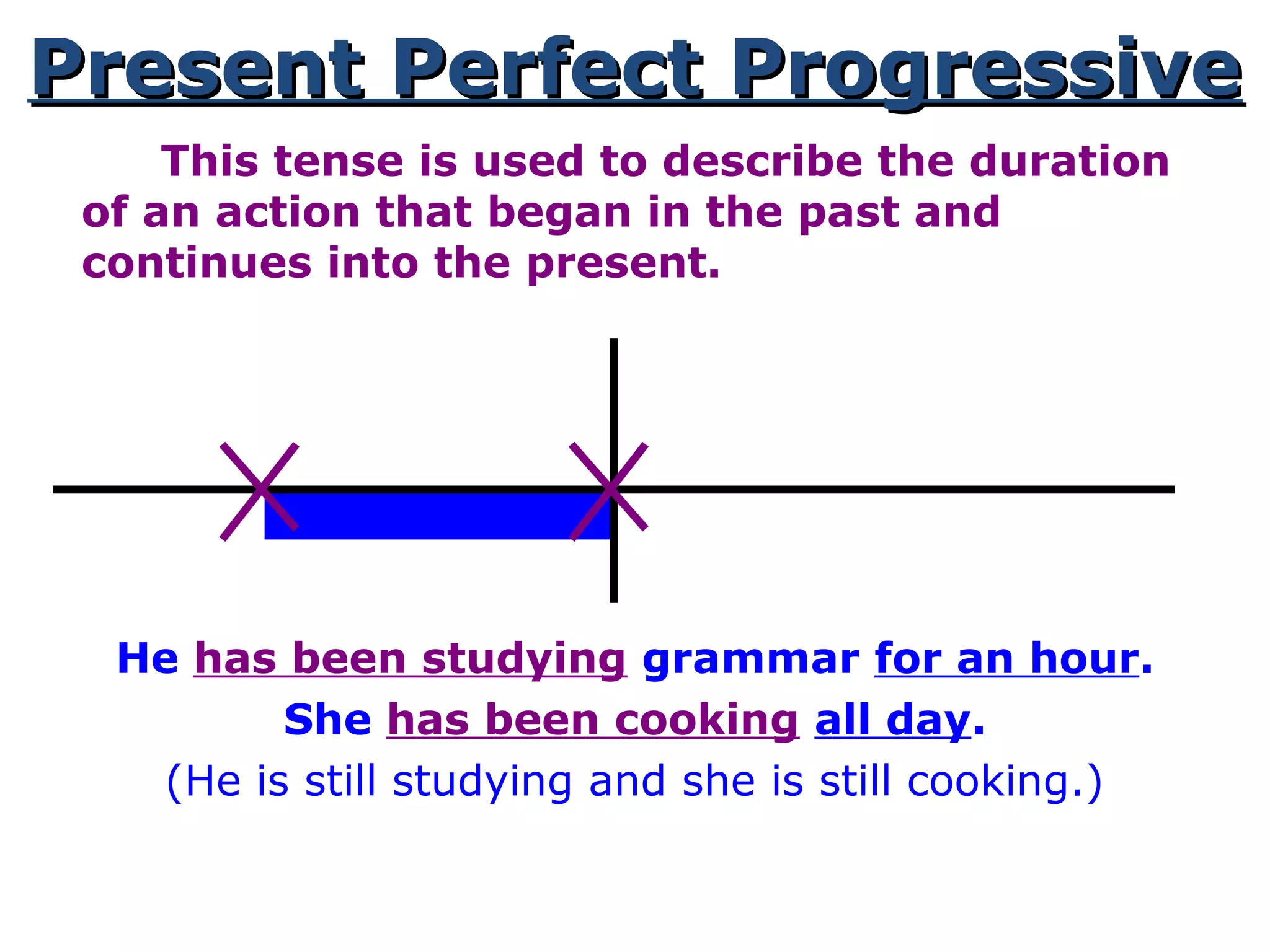
Present Perfect ProgressivePresent Perfect Progressive
This tense is used to describe the duration
of an action that began in the past and
continues into the present.
He has been studying grammar for an hour.
She has been cooking all day.
(He is still studying and she is still cooking.)
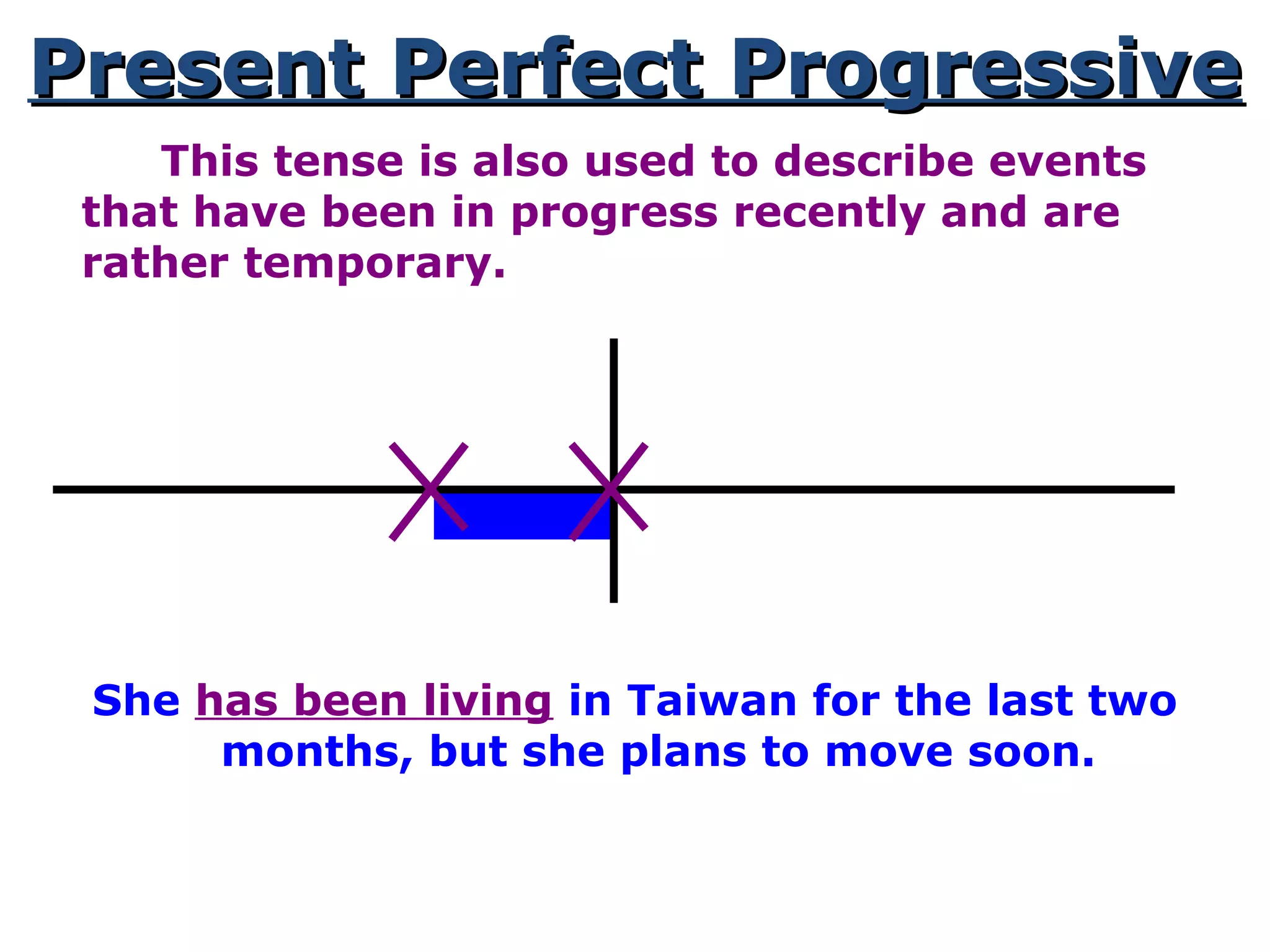
Present Perfect ProgressivePresent Perfect Progressive
This tense is also used to describe events
that have been in progress recently and are
rather temporary.
She has been living in Taiwan for the last two
months, but she plans to move soon.
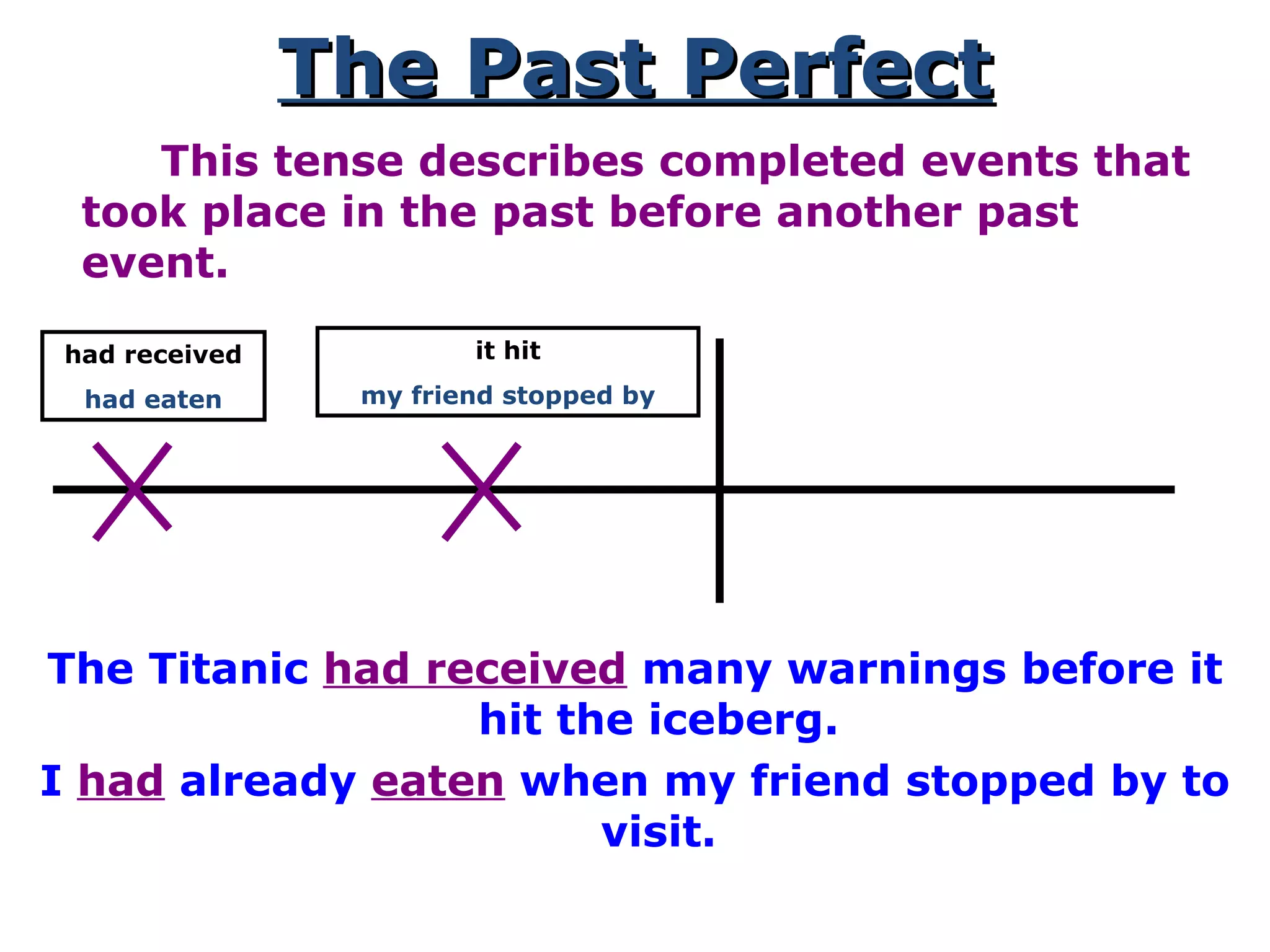
The Past PerfectThe Past Perfect
This tense describes completed events that
took place in the past before another past
event.
The Titanic had received many warnings before it
hit the iceberg.
I had already eaten when my friend stopped by to
visit.
had received
had eaten
it hit
my friend stopped by
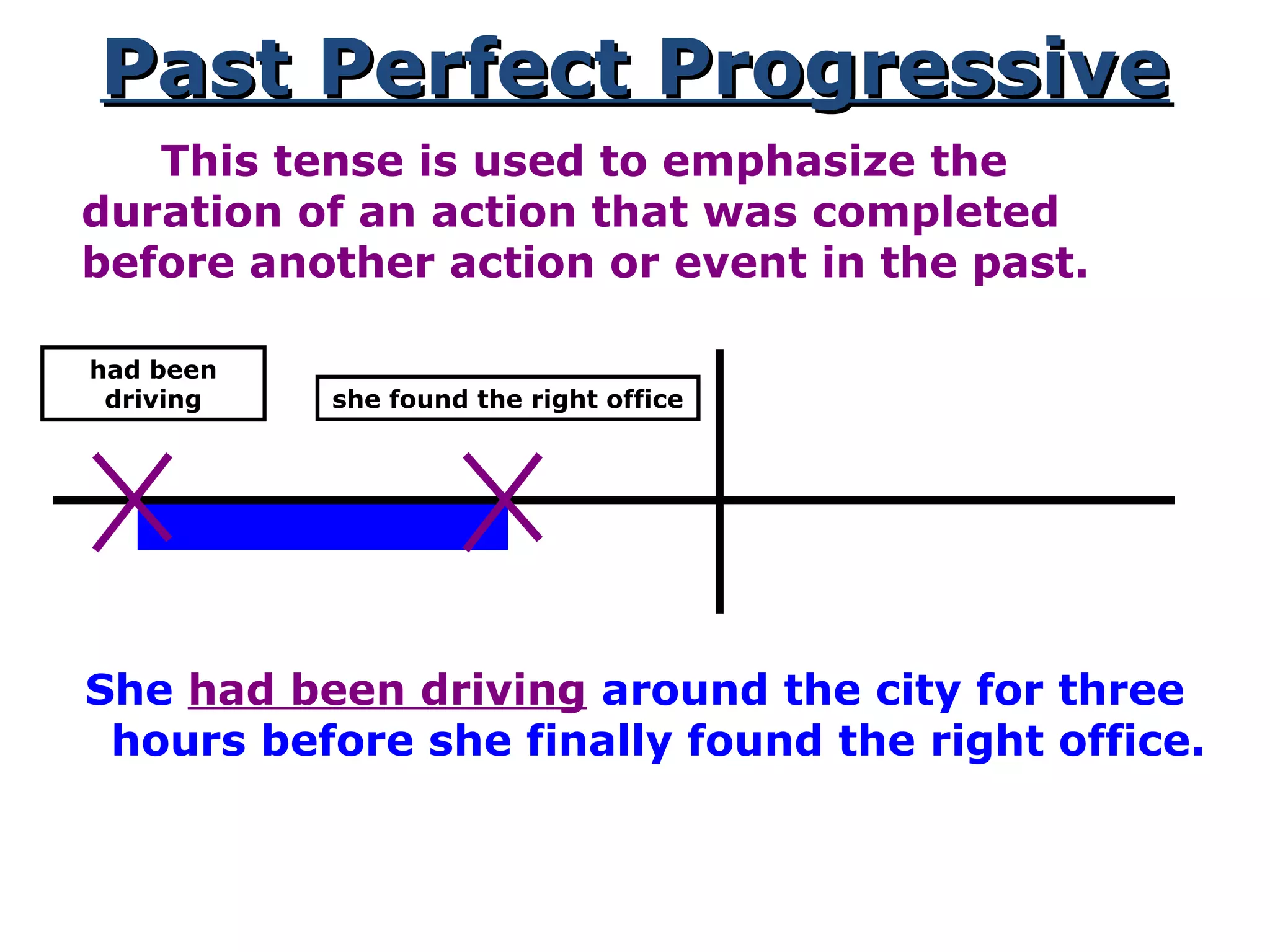
Past Perfect ProgressivePast Perfect Progressive
This tense is used to emphasize the
duration of an action that was completed
before another action or event in the past.
She had been driving around the city for three
hours before she finally found the right office.
had been
driving she found the right office
The FutureThe Future
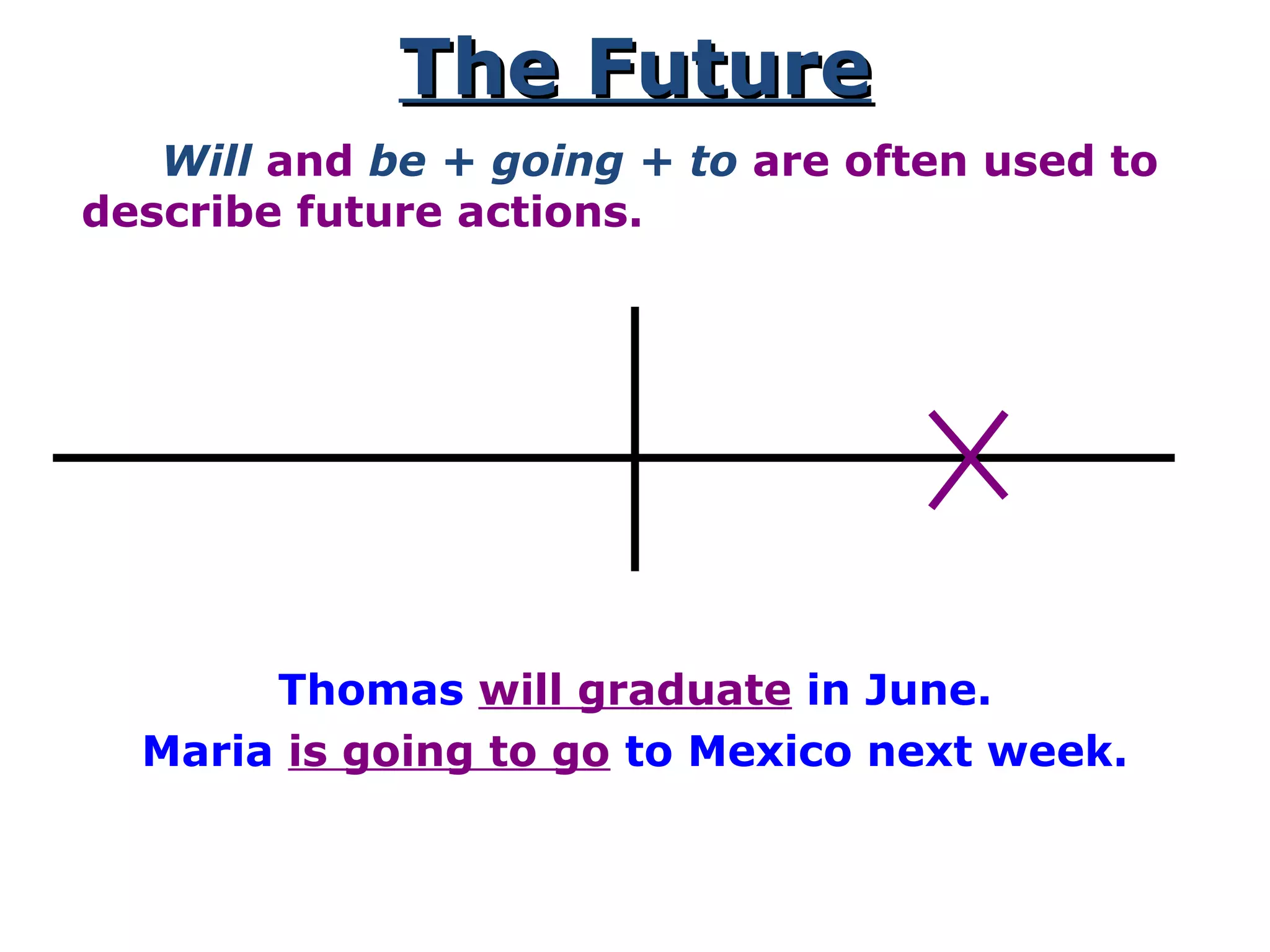
Will and be + going + to are often used to
describe future actions.
Thomas will graduate in June.
Maria is going to go to Mexico next week.
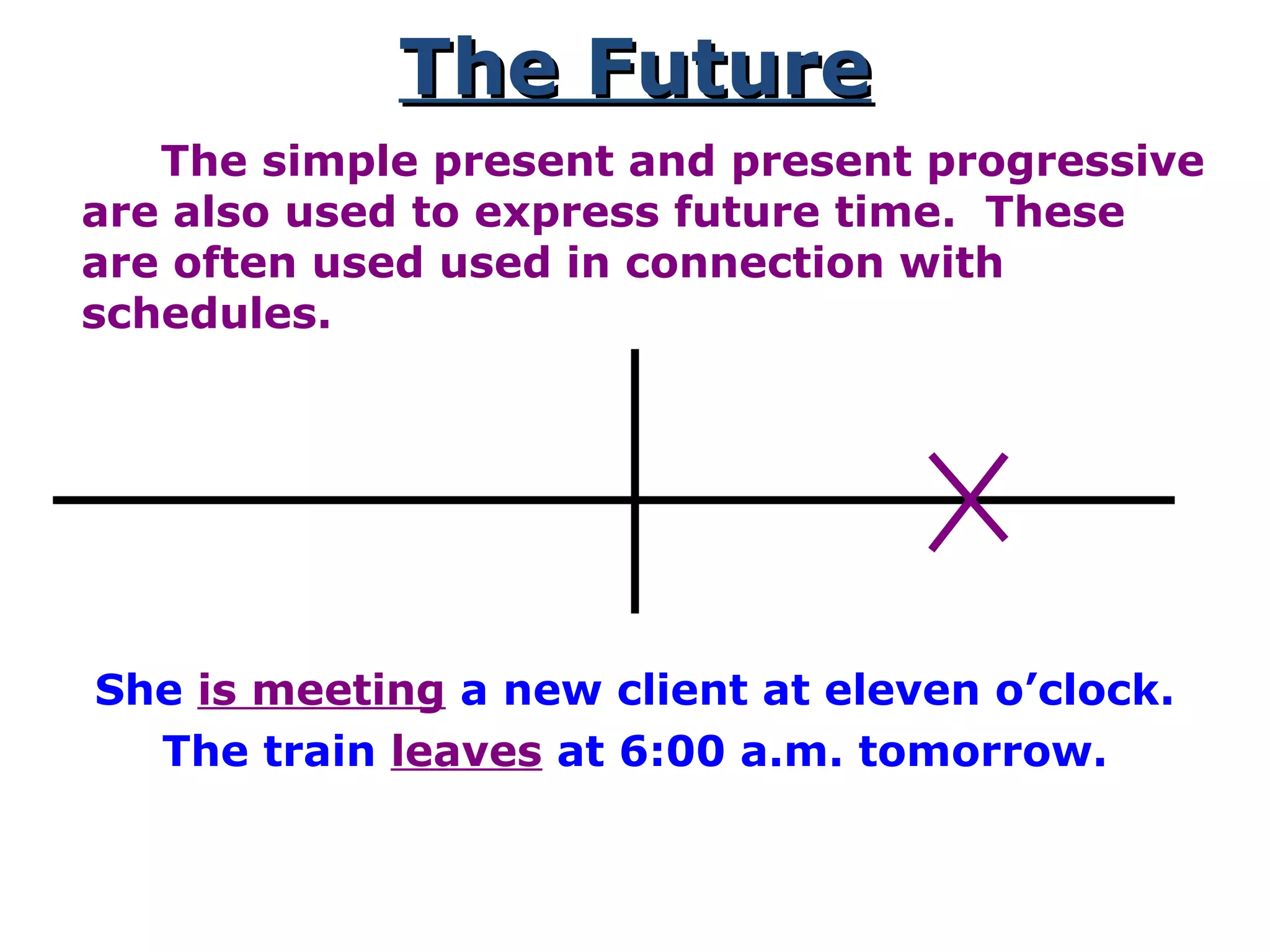
The FutureThe Future
The simple present and present progressive
are also used to express future time. These
are often used used in connection with
schedules.
She is meeting a new client at eleven o’clock.
The train leaves at 6:00 a.m. tomorrow.
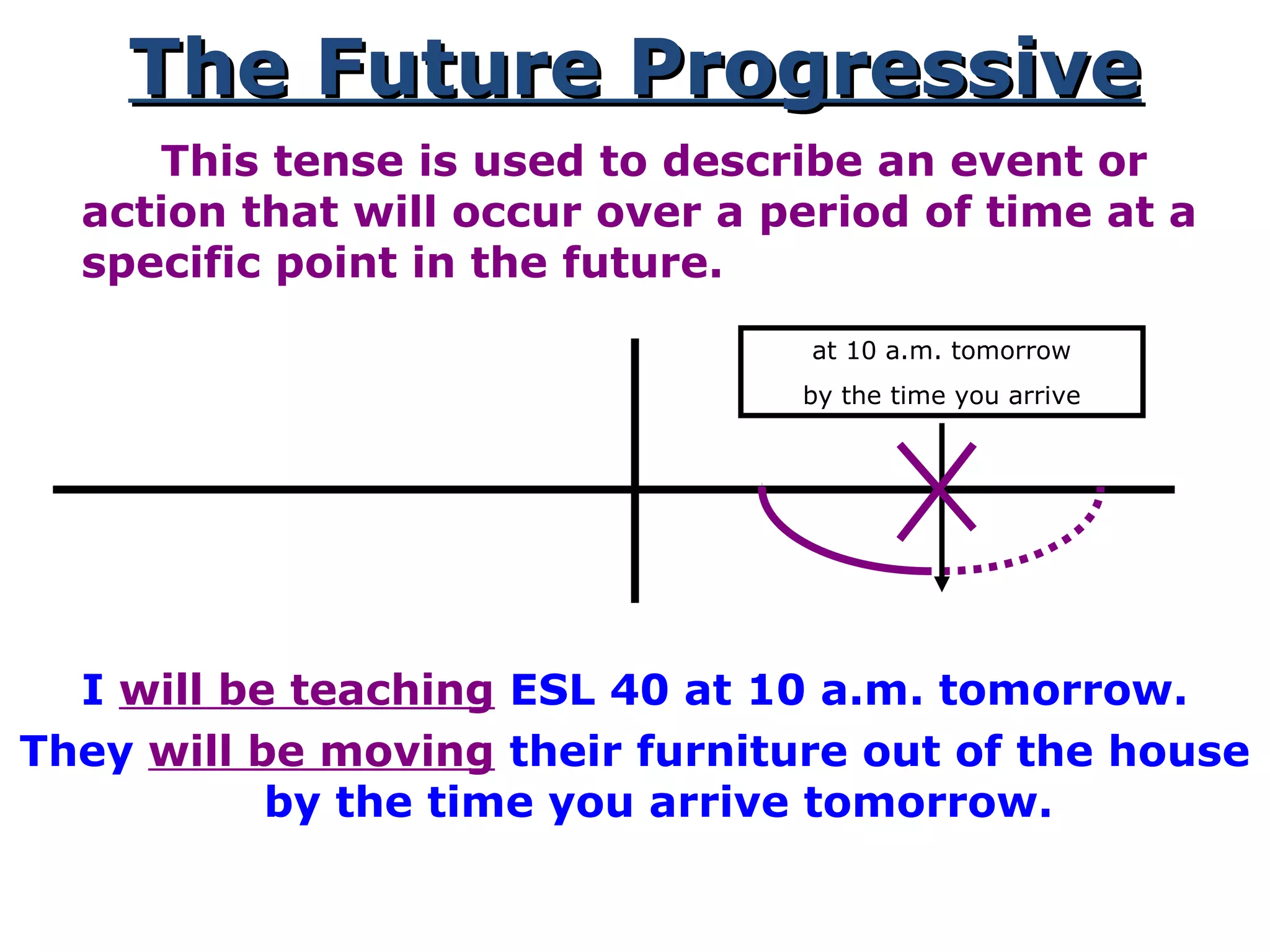
The Future ProgressiveThe Future Progressive
This tense is used to describe an event or
action that will occur over a period of time at a
specific point in the future.
I will be teaching ESL 40 at 10 a.m. tomorrow.
They will be moving their furniture out of the house
by the time you arrive tomorrow.
at 10 a.m. tomorrow
by the time you arrive
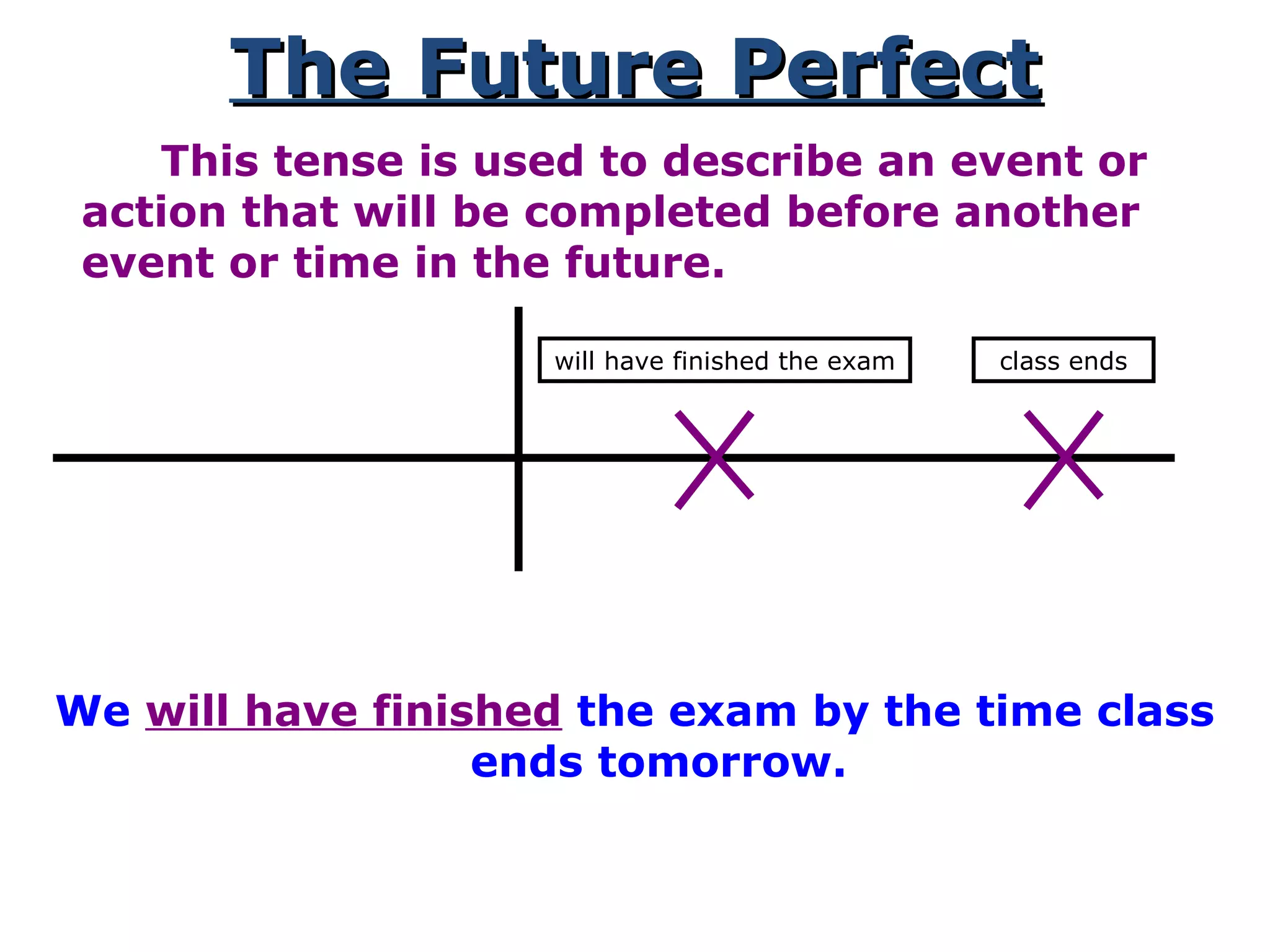
The Future PerfectThe Future Perfect
This tense is used to describe an event or
action that will be completed before another
event or time in the future.
We will have finished the exam by the time class
ends tomorrow.
will have finished the exam class ends
Future Perfect ProgressiveFuture Perfect Progressive
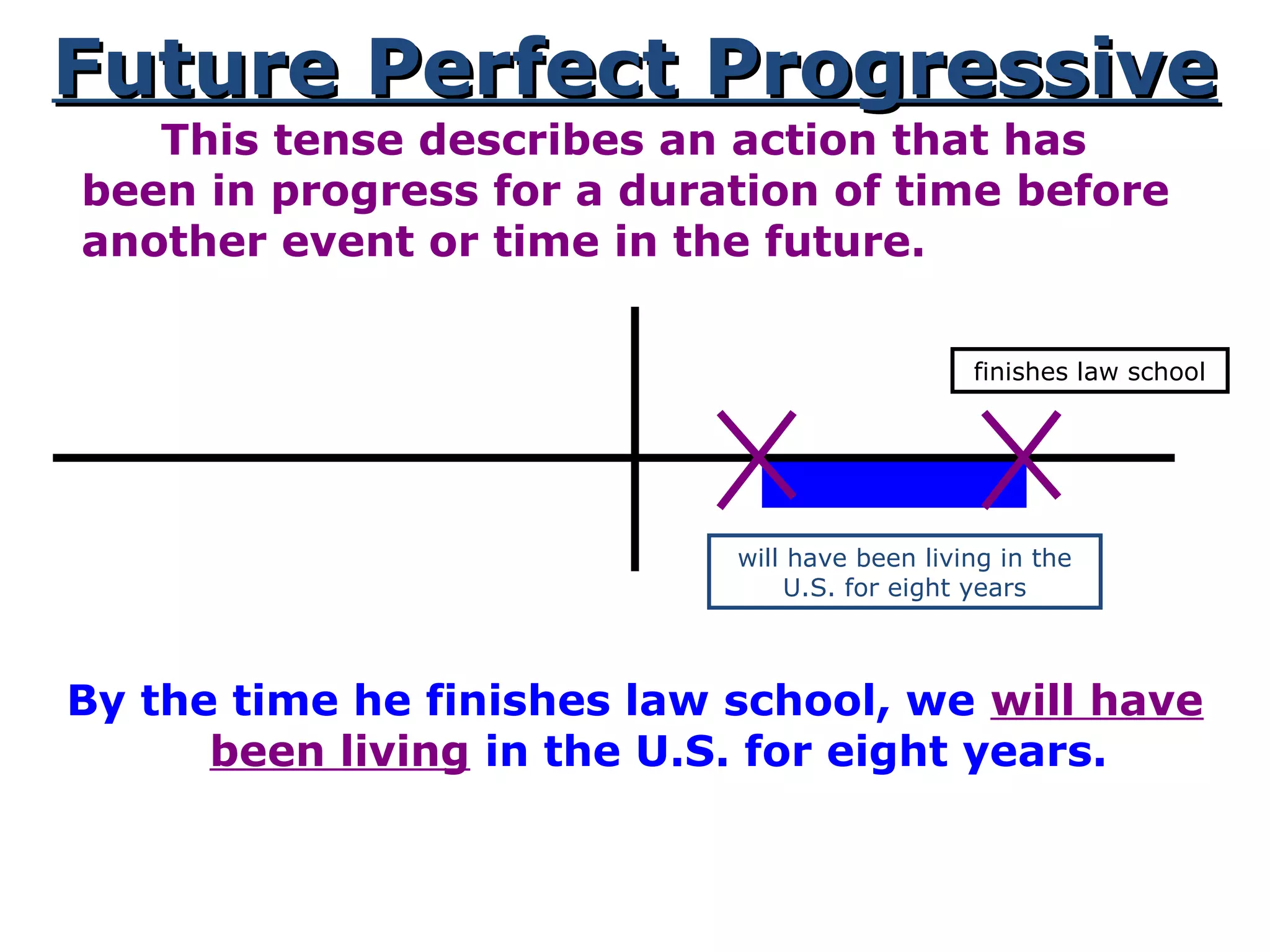
This tense describes an action that has
been in progress for a duration of time before
another event or time in the future.
By the time he finishes law school, we will have
been living in the U.S. for eight years.
finishes law school
will have been living in the
U.S. for eight years
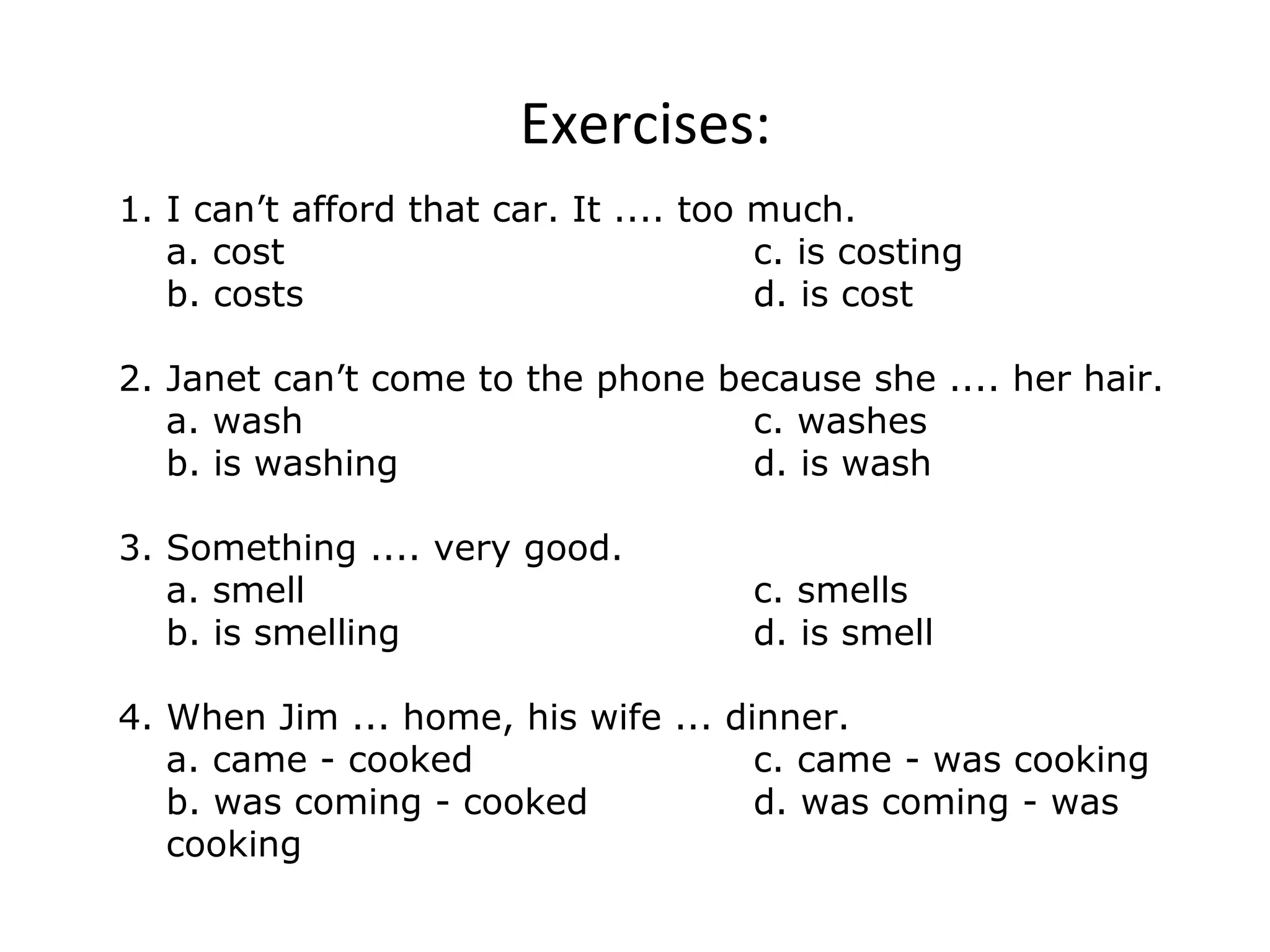
Exercises:
1. I can’t afford that car. It .... too much.
a. cost c. is costing
b. costs d. is cost
2. Janet can’t come to the phone because she .... her hair.
a. wash c. washes
b. is washing d. is wash
3. Something .... very good.
a. smell c. smells
b. is smelling d. is smell
4. When Jim ... home, his wife ... dinner.
a. came - cooked c. came - was cooking
b. was coming - cooked d. was coming - was
cooking
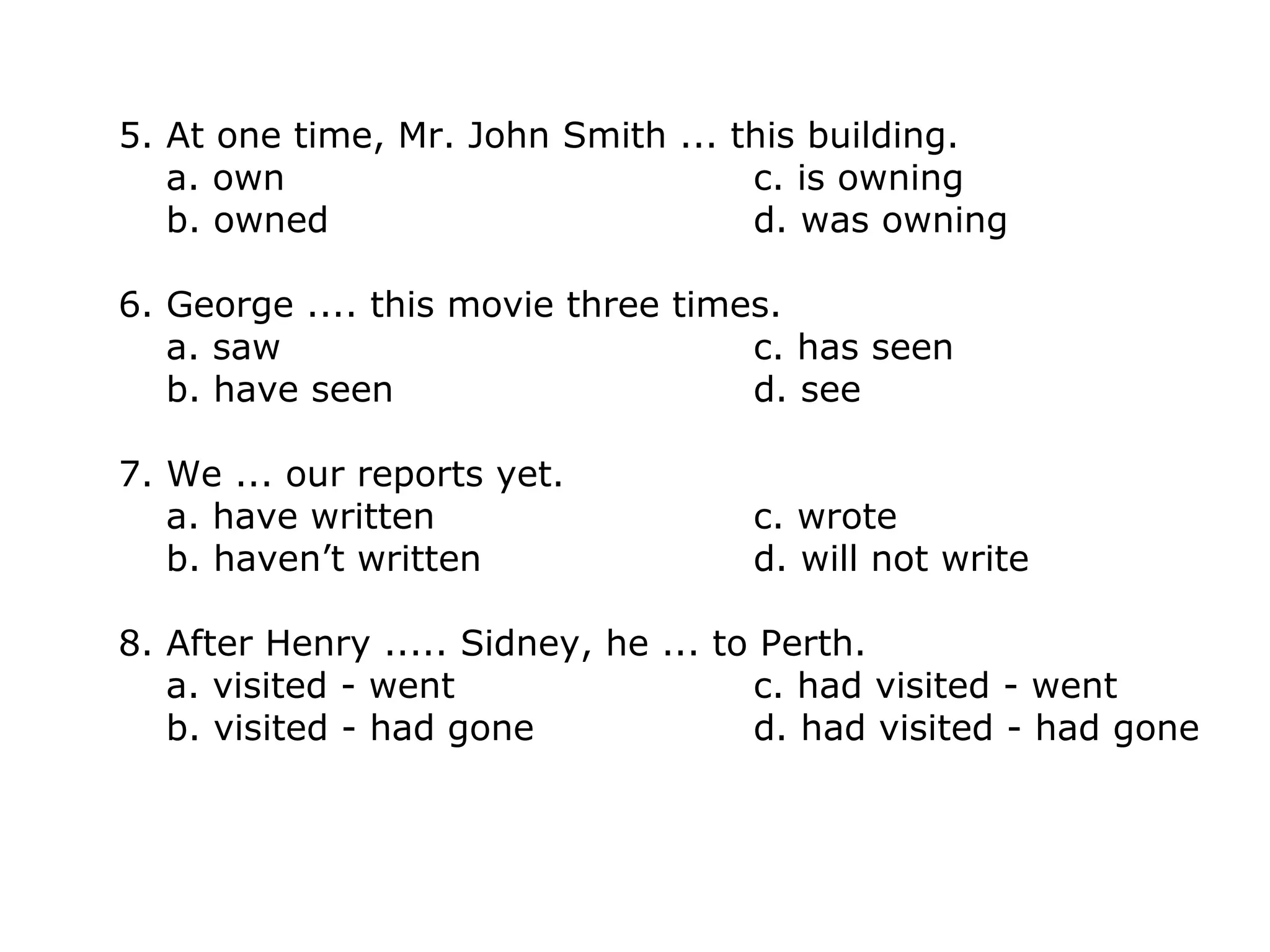
5. At one time, Mr. John Smith ... this building.
a. own c. is owning
b. owned d. was owning
6. George .... this movie three times.
a. saw c. has seen
b. have seen d. see
7. We ... our reports yet.
a. have written c. wrote
b. haven’t written d. will not write
8. After Henry ..... Sidney, he ... to Perth.
a. visited - went c. had visited - went
b. visited - had gone d. had visited - had gone
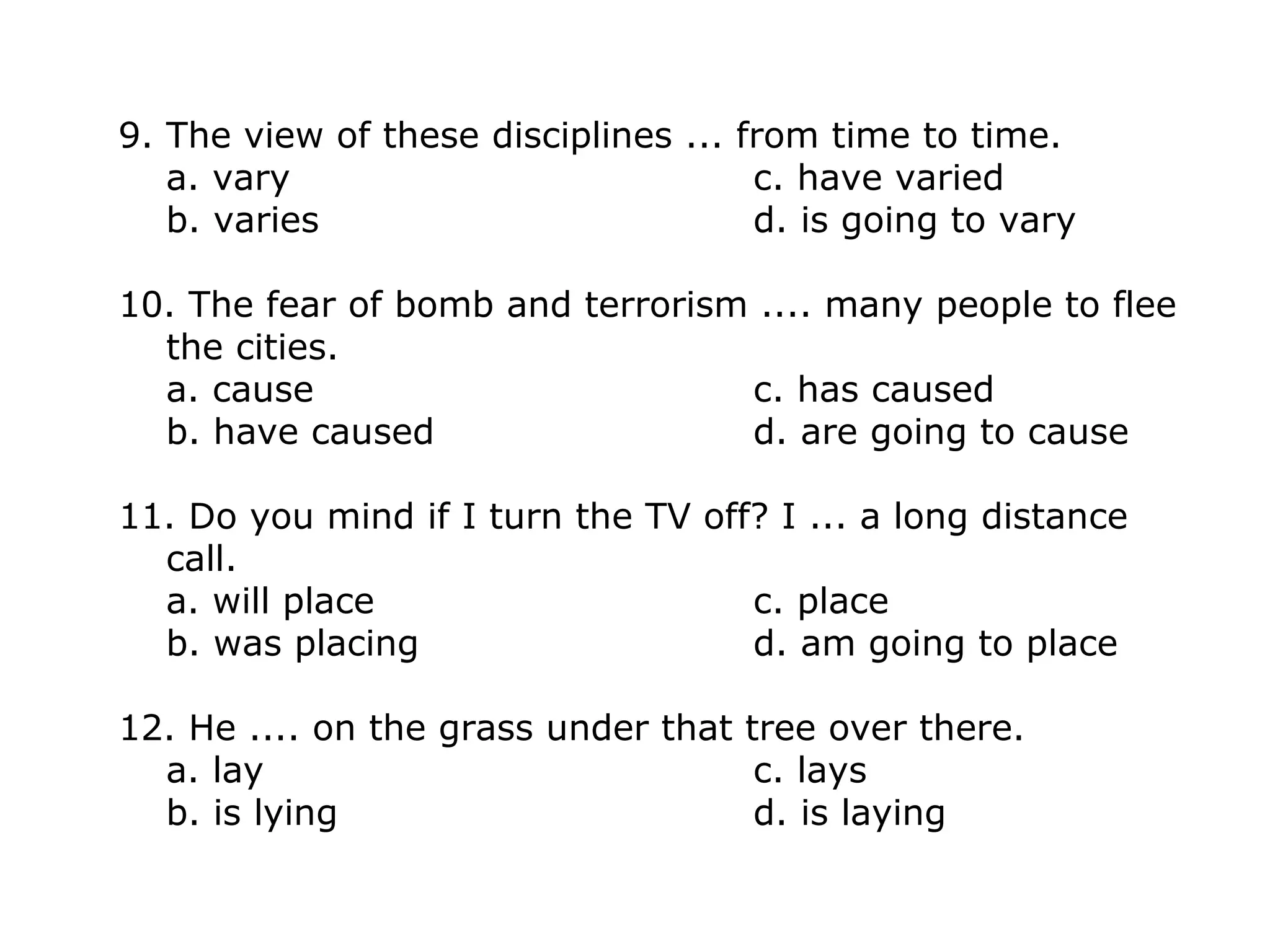
9. The view of these disciplines ... from time to time.
a. vary c. have varied
b. varies d. is going to vary
10. The fear of bomb and terrorism .... many people to flee
the cities.
a. cause c. has caused
b. have caused d. are going to cause
11. Do you mind if I turn the TV off? I ... a long distance
call.
a. will place c. place
b. was placing d. am going to place
12. He .... on the grass under that tree over there.
a. lay c. lays
b. is lying d. is laying
References
• http://www.google.co.in/url?
sa=t&rct=j&q=&esrc=s&source=web&cd=11&ved=0CB0QFjAAOAo&url=http%3A
%2F%2F113.53.232.212%2F~pcc02%2FDoc%2F12%2520Verb
%2520Tenses.ppt&ei=wNmsVNjwL8iNuAT1g4CoAg&usg=AFQjCNGlbHR0XUBK1ReiX
K_TUHM2CzNlmg&sig2=qBQeISQwciUkYQz0lZ7KaA
• http://www.google.co.in/url?
sa=t&rct=j&q=&esrc=s&source=web&cd=6&ved=0CD4QFjAF&url=http%3A%2F
%2Fwww.kwary.net%2Fenglish
%2Ftenses.ppt&ei=GyquVMfKH9WfugS_yYGQDQ&usg=AFQjCNG7UqkMFk3JK_-
fuc8iHSXe2RkDHg&sig2=JdRnzK0C6WqLssaAUZWrQw
• http://www.google.co.in/url?
sa=t&rct=j&q=&esrc=s&source=web&cd=2&ved=0CCIQFjAB&url=http%3A%2F
%2Fwww.wsu.edu%2F~mejia%2FGrammar-1-
Vbs.ppt&ei=3iuuVJnwIPTe7Aakp4HACw&usg=AFQjCNFWYtW471rquStR2LGWRE7hq
s3LJQ&sig2=axdZcs5-_PaJgvkbealA0g

Updated b.tech ii unit i tenses

  • 1.
  • 2.
    What is Verb? •A verb is an action word. It shows the action in the sentence. • A verb is the central unit of any sentence of clause, and all the other words in a sentence take grammatical form based on how they relate to it. A verb can express action (run, live, change), or states of being (is, are) or occurrences (happen, become). Sentences can have more than one verb. A clause is a sub-unit of a sentence that has one verb.
  • 3.
    The Simple PresentTenseThe Simple Present Tense Expresses a habit or often repeated action. Adverbs of frequency such as, often, seldom, sometimes, never, etc. are used with this tense. She goes to work everyday. They always eat lunch together.
  • 4.
    The Simple PresentTenseThe Simple Present Tense This tense also expresses general truths or facts that are timeless. Snow falls in the December in Minnesota. Water boils at 100 degrees Celsius.
  • 5.
    The Present ProgressiveThePresent Progressive This tense is used to describe an action that is occurring right now (at this moment, today, this year, etc.). The action has begun and is still in progress. She is typing a paper for her class. He can’t talk. He is fixing the sink right now.
  • 6.
    The Present ProgressiveThePresent Progressive The present progressive can also be used to describe an action that is occurring in the present, but is temporary. John is living in Modesto, but he might move soon.
  • 7.
    The Simple PastTheSimple Past We use the simple past to indicate exactly when an action or event took place in the past. I visited my sister yesterday. We went out to dinner last night.
  • 8.
    The Simple PastTheSimple Past The simple past is used to describe actions and/or events that are now completed and no longer true in the present. I attended MJC in 1998. (I no longer attend MJC.) I saw a movie every weekend when I was a teenager. (I don’t see movies very much anymore.)
  • 9.
    The Past ProgressiveThePast Progressive The past progressive is used to talk about an activity that was in progress at a specific point of time in the past. The emphasis is on the duration of the activity in the past. I was studying for an exam while my mother was cooking dinner. We were walking in the park around 7 p.m. last night.
  • 10.
    The Past ProgressiveThePast Progressive The past progressive is often used with the simple past to show that one action was in progress when another action occurred. I was taking a bath when the doorbell rang. They were eating dinner when the neighbors stopped by for a visit.
  • 11.
    The Present PerfectThePresent Perfect The present perfect is used to talk about an event that began in the past and continues up to the present. He has lived in Modesto for two years. (He began living in Modesto two years ago and he still lives there.)
  • 12.
    The Present PerfectThePresent Perfect The present perfect is also used to talk about an event that was completed in the past, but the specific time of the event is not important. I have seen that movie before. He has already visited Vietnam. (Specific dates and times are not mentioned.)
  • 13.
    Present Perfect ProgressivePresentPerfect Progressive This tense is used to describe the duration of an action that began in the past and continues into the present. He has been studying grammar for an hour. She has been cooking all day. (He is still studying and she is still cooking.)
  • 14.
    Present Perfect ProgressivePresentPerfect Progressive This tense is also used to describe events that have been in progress recently and are rather temporary. She has been living in Taiwan for the last two months, but she plans to move soon.
  • 15.
    The Past PerfectThePast Perfect This tense describes completed events that took place in the past before another past event. The Titanic had received many warnings before it hit the iceberg. I had already eaten when my friend stopped by to visit. had received had eaten it hit my friend stopped by
  • 16.
    Past Perfect ProgressivePastPerfect Progressive This tense is used to emphasize the duration of an action that was completed before another action or event in the past. She had been driving around the city for three hours before she finally found the right office. had been driving she found the right office
  • 17.
    The FutureThe Future Willand be + going + to are often used to describe future actions. Thomas will graduate in June. Maria is going to go to Mexico next week.
  • 18.
    The FutureThe Future Thesimple present and present progressive are also used to express future time. These are often used used in connection with schedules. She is meeting a new client at eleven o’clock. The train leaves at 6:00 a.m. tomorrow.
  • 19.
    The Future ProgressiveTheFuture Progressive This tense is used to describe an event or action that will occur over a period of time at a specific point in the future. I will be teaching ESL 40 at 10 a.m. tomorrow. They will be moving their furniture out of the house by the time you arrive tomorrow. at 10 a.m. tomorrow by the time you arrive
  • 20.
    The Future PerfectTheFuture Perfect This tense is used to describe an event or action that will be completed before another event or time in the future. We will have finished the exam by the time class ends tomorrow. will have finished the exam class ends
  • 21.
    Future Perfect ProgressiveFuturePerfect Progressive This tense describes an action that has been in progress for a duration of time before another event or time in the future. By the time he finishes law school, we will have been living in the U.S. for eight years. finishes law school will have been living in the U.S. for eight years
  • 22.
    Exercises: 1. I can’tafford that car. It .... too much. a. cost c. is costing b. costs d. is cost 2. Janet can’t come to the phone because she .... her hair. a. wash c. washes b. is washing d. is wash 3. Something .... very good. a. smell c. smells b. is smelling d. is smell 4. When Jim ... home, his wife ... dinner. a. came - cooked c. came - was cooking b. was coming - cooked d. was coming - was cooking
  • 23.
    5. At onetime, Mr. John Smith ... this building. a. own c. is owning b. owned d. was owning 6. George .... this movie three times. a. saw c. has seen b. have seen d. see 7. We ... our reports yet. a. have written c. wrote b. haven’t written d. will not write 8. After Henry ..... Sidney, he ... to Perth. a. visited - went c. had visited - went b. visited - had gone d. had visited - had gone
  • 24.
    9. The viewof these disciplines ... from time to time. a. vary c. have varied b. varies d. is going to vary 10. The fear of bomb and terrorism .... many people to flee the cities. a. cause c. has caused b. have caused d. are going to cause 11. Do you mind if I turn the TV off? I ... a long distance call. a. will place c. place b. was placing d. am going to place 12. He .... on the grass under that tree over there. a. lay c. lays b. is lying d. is laying
  • 25.