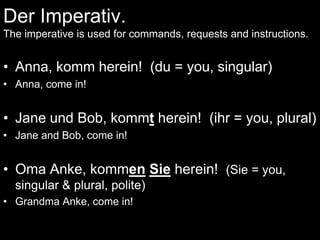
Der Imperativ.The imperative is used for commands, requests and instructions.Anna, komm herein!  (du = you, singular)Anna, come in! Jane und Bob, kommt herein!  (ihr = you, plural)Jane and Bob, come in!OmaAnke, kommenSie herein!  (Sie = you, singular & plural, polite)Grandma Anke, come in!
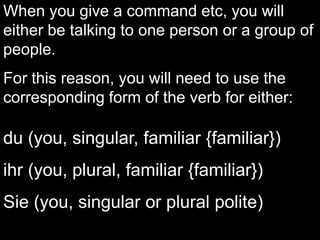
When you give a command etc, you will either be talking to one person or a group of people.For this reason, you will need to use the corresponding form of the verb for either:du (you, singular, familiar {familiar})ihr (you, plural, familiar {familiar})Sie (you, singular or plural polite)
Handout - imperativesRead through the English explanations on this double sided sheet silently and we will discuss it so you understand what is going on...If you finish quickly, reread the passage again...and again... 
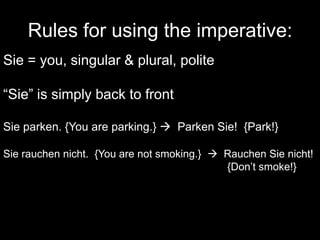
Rules for using the imperative:Sie = you, singular & plural, polite“Sie” is simply back to frontSie parken. {You are parking.}   Parken Sie!  {Park!}Sie rauchen nicht.  {You are not smoking.}    Rauchen Sie nicht! 							{Don’t smoke!}
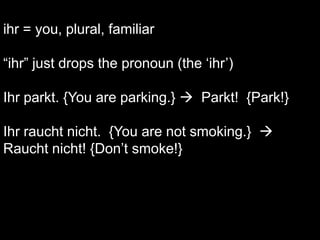
ihr = you, plural, familiar“ihr” just drops the pronoun (the ‘ihr’)Ihr parkt. {You are parking.}   Parkt!  {Park!}Ihr raucht nicht.  {You are not smoking.}    Raucht nicht! {Don’t smoke!}
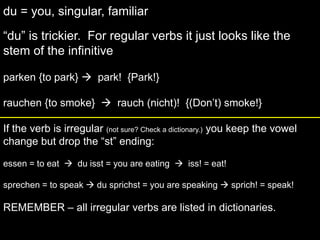
du = you, singular, familiar“du” is trickier.  For regular verbs it just looks like the stem of the infinitiveparken {to park}   park!  {Park!}rauchen {to smoke}    rauch (nicht)!  {(Don’t) smoke!}If the verb is irregular (not sure? Check a dictionary.) you keep the vowel change but drop the “st” ending:essen = to eat    du isst = you are eating    iss! = eat!sprechen = to speak  du sprichst = you are speaking  sprich! = speak!REMEMBER – all irregular verbs are listed in dictionaries.
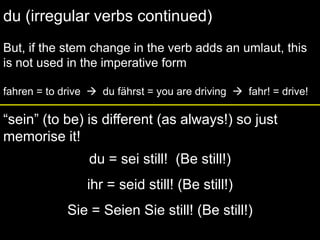
du (irregular verbs continued)But, if the stem change in the verb adds an umlaut, this is not used in the imperative formfahren = to drive    du fährst = you are driving    fahr! = drive!“sein” (to be) is different (as always!) so just memorise it!du = sei still!  (Be still!)ihr = seid still! (Be still!)Sie = Seien Sie still! (Be still!)
Complete the exercise on your “imperatives” handout:Make imperatives out of the phrases given below.  The verb to use is shown in brackets.  Give all 3 forms for each one – the du, the ihr and the Sie.ALSO!  Translate each imperative phrase (follow this example):1.  Platz (nehmen)(du) 	NimmPlatz!(ihr)	NehmtPlatz!(Sie) 	Nehmen Sie Platz!  (English)  Take a seat!Set your answers out in your book like this please.

Der imperativ for wiki 2010

  • 1.
    Der Imperativ.The imperativeis used for commands, requests and instructions.Anna, komm herein! (du = you, singular)Anna, come in! Jane und Bob, kommt herein! (ihr = you, plural)Jane and Bob, come in!OmaAnke, kommenSie herein! (Sie = you, singular & plural, polite)Grandma Anke, come in!
  • 2.
    When you givea command etc, you will either be talking to one person or a group of people.For this reason, you will need to use the corresponding form of the verb for either:du (you, singular, familiar {familiar})ihr (you, plural, familiar {familiar})Sie (you, singular or plural polite)
  • 3.
    Handout - imperativesReadthrough the English explanations on this double sided sheet silently and we will discuss it so you understand what is going on...If you finish quickly, reread the passage again...and again... 
  • 4.
    Rules for usingthe imperative:Sie = you, singular & plural, polite“Sie” is simply back to frontSie parken. {You are parking.}  Parken Sie! {Park!}Sie rauchen nicht. {You are not smoking.}  Rauchen Sie nicht! {Don’t smoke!}
  • 5.
    ihr = you,plural, familiar“ihr” just drops the pronoun (the ‘ihr’)Ihr parkt. {You are parking.}  Parkt! {Park!}Ihr raucht nicht. {You are not smoking.}  Raucht nicht! {Don’t smoke!}
  • 6.
    du = you,singular, familiar“du” is trickier. For regular verbs it just looks like the stem of the infinitiveparken {to park}  park! {Park!}rauchen {to smoke}  rauch (nicht)! {(Don’t) smoke!}If the verb is irregular (not sure? Check a dictionary.) you keep the vowel change but drop the “st” ending:essen = to eat  du isst = you are eating  iss! = eat!sprechen = to speak  du sprichst = you are speaking  sprich! = speak!REMEMBER – all irregular verbs are listed in dictionaries.
  • 7.
    du (irregular verbscontinued)But, if the stem change in the verb adds an umlaut, this is not used in the imperative formfahren = to drive  du fährst = you are driving  fahr! = drive!“sein” (to be) is different (as always!) so just memorise it!du = sei still! (Be still!)ihr = seid still! (Be still!)Sie = Seien Sie still! (Be still!)
  • 8.
    Complete the exerciseon your “imperatives” handout:Make imperatives out of the phrases given below. The verb to use is shown in brackets. Give all 3 forms for each one – the du, the ihr and the Sie.ALSO! Translate each imperative phrase (follow this example):1. Platz (nehmen)(du) NimmPlatz!(ihr) NehmtPlatz!(Sie) Nehmen Sie Platz! (English) Take a seat!Set your answers out in your book like this please.