VENTURE CAPITAL 101: 
What is Venture Capital? 
Venture capital has enabled the United States to support its entrepreneur-ial 
talent and appetite by turning ideas and basic science into products 
and services that are the envy of the world. Venture capital funds and 
builds companies from the simplest form – perhaps just the entrepreneur and 
an idea expressed as a business plan – to freestanding, mature organizations. 
Risk Capital for Business 
Venture capital firms are professional, institutional managers of risk capital that 
enables and supports the most innovative and promising companies. This money 
funds new ideas that could not be financed with traditional bank financing, that 
threaten established products and services in a corporation, and that typically 
require five to eight years to be launched. 
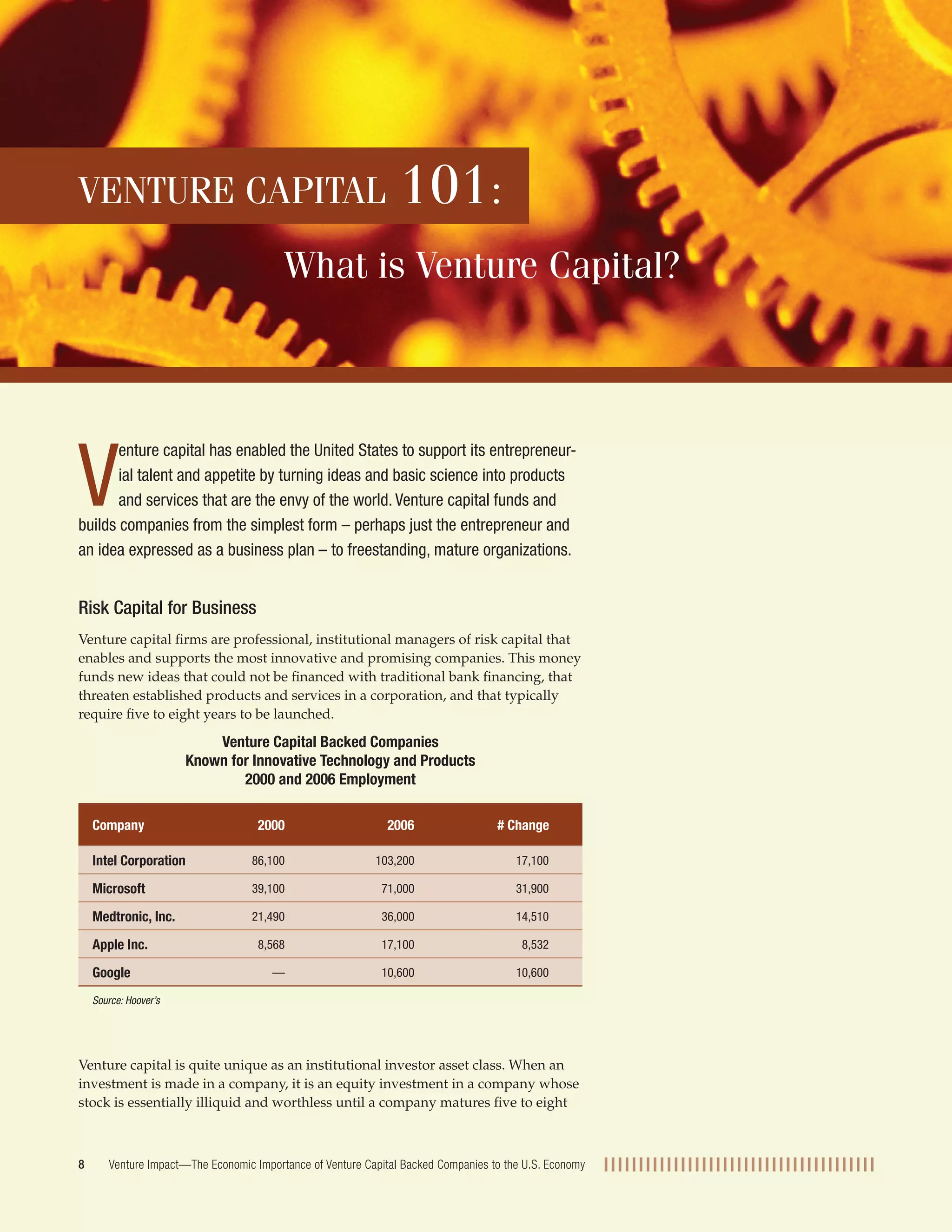
Venture Capital Backed Companies 
Known for Innovative Technology and Products 
2000 and 2006 Employment 
Company 2000 2006 # Change 
Intel Corporation 86,100 103,200 17,100 
Microsoft 39,100 71,000 31,900 
Medtronic, Inc. 21,490 36,000 14,510 
Apple Inc. 8,568 17,100 8,532 
Google — 10,600 10,600 
Source: Hoover’s 
Venture capital is quite unique as an institutional investor asset class. When an 
investment is made in a company, it is an equity investment in a company whose 
stock is essentially illiquid and worthless until a company matures five to eight 
Venture Impact—The Economic Importance of Venture Capital Backed Companies to the U.S. Economy
years down the road. Follow-on investment provides additional funding as the 
company grows. These “rounds,” typically occurring every year or two, are also 
equity investment, with the shares allocated among the investors and manage-ment 
team based on an agreed “valuation.” But, unless a company is acquired or 
goes public, there is little actual value. Venture capital is a long-term investment. 
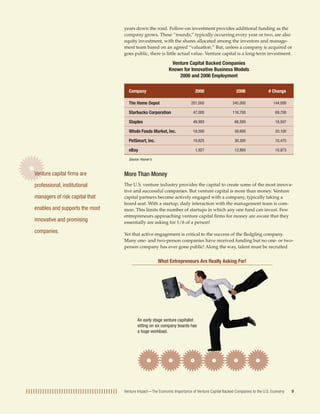
Venture Capital Backed Companies 
Known for Innovative Business Models 
2000 and 2006 Employment 
Company 2000 2006 # Change 
The Home Depot 201,000 345,000 144,000 
Starbucks Corporation 47,000 116,700 69,700 
Staples 49,993 68,500 18,507 
Whole Foods Market, Inc. 18,500 38,600 20,100 
PetSmart, Inc. 19,825 30,300 10,475 
eBay 1,927 12,800 10,873 
Source: Hoover’s 
More Than Money 
The U.S. venture industry provides the capital to create some of the most innova-tive 
and successful companies. But venture capital is more than money. Venture 
capital partners become actively engaged with a company, typically taking a 
board seat. With a startup, daily interaction with the management team is com-mon. 
This limits the number of startups in which any one fund can invest. Few 
entrepreneurs approaching venture capital firms for money are aware that they 
essentially are asking for 1/6 of a person! 
Yet that active engagement is critical to the success of the fledgling company. 
Many one- and two-person companies have received funding but no one- or two-person 
company has ever gone public! Along the way, talent must be recruited 
Venture Impact—The Economic Importance of Venture Capital Backed Companies to the U.S. Economy 
Venture capital firms are 
professional, institutional 
managers of risk capital that 
enables and supports the most 
innovative and promising 
companies. 
What Entrepreneurs Are Really Asking For! 
An early stage venture capitalist 
sitting on six company boards has 
a huge workload.
and the company scaled up. Ask any venture capitalist who has had an ultra-successful 
investment and he or she will tell you that the company that broke 
through the gravity evolved from the original business plan concept with the 
careful input of an experienced hand. 
Deal Flows — Where The Buys Are 
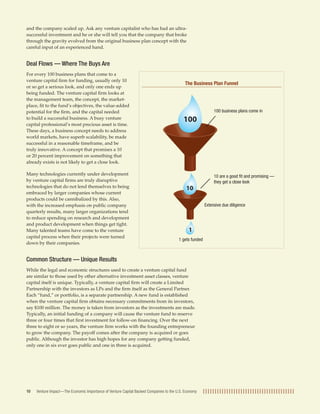
For every 100 business plans that come to a 
venture capital firm for funding, usually only 10 
or so get a serious look, and only one ends up 
being funded. The venture capital firm looks at 
the management team, the concept, the market-place, 
fit to the fund’s objectives, the value-added 
potential for the firm, and the capital needed 
to build a successful business. A busy venture 
capital professional’s most precious asset is time. 
These days, a business concept needs to address 
world markets, have superb scalability, be made 
successful in a reasonable timeframe, and be 
truly innovative. A concept that promises a 10 
or 20 percent improvement on something that 
already exists is not likely to get a close look. 
Many technologies currently under development 
by venture capital firms are truly disruptive 
technologies that do not lend themselves to being 
embraced by larger companies whose current 
products could be cannibalized by this. Also, 
with the increased emphasis on public company 
quarterly results, many larger organizations tend 
to reduce spending on research and development 
and product development when things get tight. 
Many talented teams have come to the venture 
capital process when their projects were turned 
down by their companies. 
The Business Plan Funnel 
100 
10 
1 
Common Structure — Unique Results 
While the legal and economic structures used to create a venture capital fund 
are similar to those used by other alternative investment asset classes, venture 
capital itself is unique. Typically, a venture capital firm will create a Limited 
Partnership with the investors as LPs and the firm itself as the General Partner. 
Each “fund,” or portfolio, is a separate partnership. A new fund is established 
when the venture capital firm obtains necessary commitments from its investors, 
say $100 million. The money is taken from investors as the investments are made. 
Typically, an initial funding of a company will cause the venture fund to reserve 
three or four times that first investment for follow-on financing. Over the next 
three to eight or so years, the venture firm works with the founding entrepreneur 
to grow the company. The payoff comes after the company is acquired or goes 
public. Although the investor has high hopes for any company getting funded, 
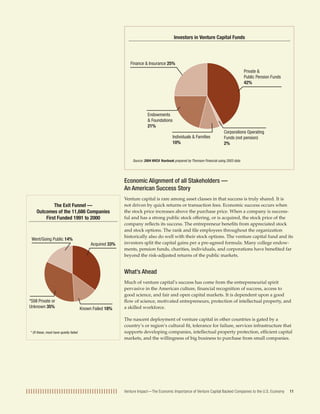
only one in six ever goes public and one in three is acquired. 
Venture Impact—The Economic Importance of Venture Capital Backed Companies 10 to the U.S. Economy 
100 business plans come in 
10 are a good fit and promising — 
they get a close look 
Extensive due diligence 
1 gets funded
Investors in Venture Capital Funds 
Source: 2004 NVCA Yearbook prepared by Thomson Financial using 2003 data 
Economic Alignment of all Stakeholders — 
An American Success Story 
Venture capital is rare among asset classes in that success is truly shared. It is 
not driven by quick returns or transaction fees. Economic success occurs when 
the stock price increases above the purchase price. When a company is success-ful 
and has a strong public stock offering, or is acquired, the stock price of the 
company reflects its success. The entrepreneur benefits from appreciated stock 
and stock options. The rank and file employees throughout the organization 
historically also do well with their stock options. The venture capital fund and its 
investors split the capital gains per a pre-agreed formula. Many college endow-ments, 
pension funds, charities, individuals, and corporations have benefited far 
beyond the risk-adjusted returns of the public markets. 
What’s Ahead 
Much of venture capital’s success has come from the entrepreneurial spirit 
pervasive in the American culture, financial recognition of success, access to 
good science, and fair and open capital markets. It is dependent upon a good 
flow of science, motivated entrepreneurs, protection of intellectual property, and 
a skilled workforce. 
The nascent deployment of venture capital in other countries is gated by a 
country’s or region’s cultural fit, tolerance for failure, services infrastructure that 
supports developing companies, intellectual property protection, efficient capital 
markets, and the willingness of big business to purchase from small companies. 
Venture Impact—The Economic Importance of Venture Capital Backed Companies to the U.S. Economy 11 
The Exit Funnel — 
Outcomes of the 11,686 Companies 
First Funded 1991 to 2000 
Acquired 33% 
Known Failed 18% 
Went/Going Public 14% 
*Still Private or 
Unknown 35% 
* Of these, most have quietly failed 
Private & 
Public Pension Funds 
42% 
Finance & Insurance 25% 
Endowments 
& Foundations 
21% 
Individuals & Families 
10% 
Corporations Operating 
Funds (not pension) 
2%

Venture capital 101

  • 1.
    VENTURE CAPITAL 101: What is Venture Capital? Venture capital has enabled the United States to support its entrepreneur-ial talent and appetite by turning ideas and basic science into products and services that are the envy of the world. Venture capital funds and builds companies from the simplest form – perhaps just the entrepreneur and an idea expressed as a business plan – to freestanding, mature organizations. Risk Capital for Business Venture capital firms are professional, institutional managers of risk capital that enables and supports the most innovative and promising companies. This money funds new ideas that could not be financed with traditional bank financing, that threaten established products and services in a corporation, and that typically require five to eight years to be launched. Venture Capital Backed Companies Known for Innovative Technology and Products 2000 and 2006 Employment Company 2000 2006 # Change Intel Corporation 86,100 103,200 17,100 Microsoft 39,100 71,000 31,900 Medtronic, Inc. 21,490 36,000 14,510 Apple Inc. 8,568 17,100 8,532 Google — 10,600 10,600 Source: Hoover’s Venture capital is quite unique as an institutional investor asset class. When an investment is made in a company, it is an equity investment in a company whose stock is essentially illiquid and worthless until a company matures five to eight Venture Impact—The Economic Importance of Venture Capital Backed Companies to the U.S. Economy
  • 2.
    years down theroad. Follow-on investment provides additional funding as the company grows. These “rounds,” typically occurring every year or two, are also equity investment, with the shares allocated among the investors and manage-ment team based on an agreed “valuation.” But, unless a company is acquired or goes public, there is little actual value. Venture capital is a long-term investment. Venture Capital Backed Companies Known for Innovative Business Models 2000 and 2006 Employment Company 2000 2006 # Change The Home Depot 201,000 345,000 144,000 Starbucks Corporation 47,000 116,700 69,700 Staples 49,993 68,500 18,507 Whole Foods Market, Inc. 18,500 38,600 20,100 PetSmart, Inc. 19,825 30,300 10,475 eBay 1,927 12,800 10,873 Source: Hoover’s More Than Money The U.S. venture industry provides the capital to create some of the most innova-tive and successful companies. But venture capital is more than money. Venture capital partners become actively engaged with a company, typically taking a board seat. With a startup, daily interaction with the management team is com-mon. This limits the number of startups in which any one fund can invest. Few entrepreneurs approaching venture capital firms for money are aware that they essentially are asking for 1/6 of a person! Yet that active engagement is critical to the success of the fledgling company. Many one- and two-person companies have received funding but no one- or two-person company has ever gone public! Along the way, talent must be recruited Venture Impact—The Economic Importance of Venture Capital Backed Companies to the U.S. Economy Venture capital firms are professional, institutional managers of risk capital that enables and supports the most innovative and promising companies. What Entrepreneurs Are Really Asking For! An early stage venture capitalist sitting on six company boards has a huge workload.
  • 3.
    and the companyscaled up. Ask any venture capitalist who has had an ultra-successful investment and he or she will tell you that the company that broke through the gravity evolved from the original business plan concept with the careful input of an experienced hand. Deal Flows — Where The Buys Are For every 100 business plans that come to a venture capital firm for funding, usually only 10 or so get a serious look, and only one ends up being funded. The venture capital firm looks at the management team, the concept, the market-place, fit to the fund’s objectives, the value-added potential for the firm, and the capital needed to build a successful business. A busy venture capital professional’s most precious asset is time. These days, a business concept needs to address world markets, have superb scalability, be made successful in a reasonable timeframe, and be truly innovative. A concept that promises a 10 or 20 percent improvement on something that already exists is not likely to get a close look. Many technologies currently under development by venture capital firms are truly disruptive technologies that do not lend themselves to being embraced by larger companies whose current products could be cannibalized by this. Also, with the increased emphasis on public company quarterly results, many larger organizations tend to reduce spending on research and development and product development when things get tight. Many talented teams have come to the venture capital process when their projects were turned down by their companies. The Business Plan Funnel 100 10 1 Common Structure — Unique Results While the legal and economic structures used to create a venture capital fund are similar to those used by other alternative investment asset classes, venture capital itself is unique. Typically, a venture capital firm will create a Limited Partnership with the investors as LPs and the firm itself as the General Partner. Each “fund,” or portfolio, is a separate partnership. A new fund is established when the venture capital firm obtains necessary commitments from its investors, say $100 million. The money is taken from investors as the investments are made. Typically, an initial funding of a company will cause the venture fund to reserve three or four times that first investment for follow-on financing. Over the next three to eight or so years, the venture firm works with the founding entrepreneur to grow the company. The payoff comes after the company is acquired or goes public. Although the investor has high hopes for any company getting funded, only one in six ever goes public and one in three is acquired. Venture Impact—The Economic Importance of Venture Capital Backed Companies 10 to the U.S. Economy 100 business plans come in 10 are a good fit and promising — they get a close look Extensive due diligence 1 gets funded
  • 4.
    Investors in VentureCapital Funds Source: 2004 NVCA Yearbook prepared by Thomson Financial using 2003 data Economic Alignment of all Stakeholders — An American Success Story Venture capital is rare among asset classes in that success is truly shared. It is not driven by quick returns or transaction fees. Economic success occurs when the stock price increases above the purchase price. When a company is success-ful and has a strong public stock offering, or is acquired, the stock price of the company reflects its success. The entrepreneur benefits from appreciated stock and stock options. The rank and file employees throughout the organization historically also do well with their stock options. The venture capital fund and its investors split the capital gains per a pre-agreed formula. Many college endow-ments, pension funds, charities, individuals, and corporations have benefited far beyond the risk-adjusted returns of the public markets. What’s Ahead Much of venture capital’s success has come from the entrepreneurial spirit pervasive in the American culture, financial recognition of success, access to good science, and fair and open capital markets. It is dependent upon a good flow of science, motivated entrepreneurs, protection of intellectual property, and a skilled workforce. The nascent deployment of venture capital in other countries is gated by a country’s or region’s cultural fit, tolerance for failure, services infrastructure that supports developing companies, intellectual property protection, efficient capital markets, and the willingness of big business to purchase from small companies. Venture Impact—The Economic Importance of Venture Capital Backed Companies to the U.S. Economy 11 The Exit Funnel — Outcomes of the 11,686 Companies First Funded 1991 to 2000 Acquired 33% Known Failed 18% Went/Going Public 14% *Still Private or Unknown 35% * Of these, most have quietly failed Private & Public Pension Funds 42% Finance & Insurance 25% Endowments & Foundations 21% Individuals & Families 10% Corporations Operating Funds (not pension) 2%