TARGETING NEW
ANGIOGENIC
FACTORS IN
RETINOBLASTOMA
JESUS GARCIA
Background


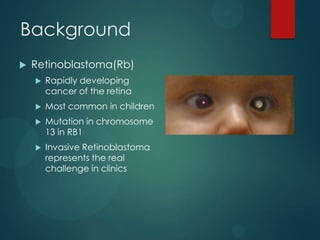
Retinoblastoma(Rb)


Rapidly developing
cancer of the retina



Most common in children



Mutation in chromosome
13 in RB1



Invasive Retinoblastoma
represents the real
challenge in clinics
Background:
Angiogenesis


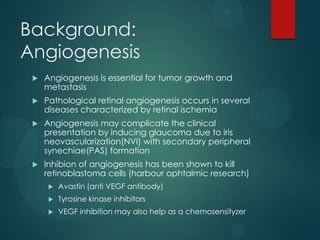
Angiogenesis is essential for tumor growth and
metastasis



Pathological retinal angiogenesis occurs in several
diseases characterized by retinal ischemia



Angiogenesis may complicate the clinical
presentation by inducing glaucoma due to iris
neovascularization(NVI) with secondary peripheral
synechiae(PAS) formation



Inhibion of angiogenesis has been shown to kill
retinoblastoma cells (harbour ophtalmic research)


Avastin (anti VEGF antibody)



Tyrosine kinase inhibitors



VEGF inhibition may also help as a chemosensityzer
Background: VEGF


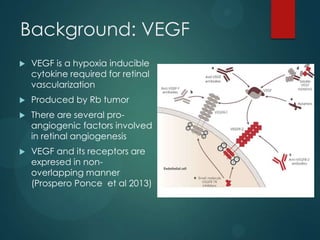
VEGF is a hypoxia inducible
cytokine required for retinal
vascularization



Produced by Rb tumor



There are several proangiogenic factors involved
in retinal angiogenesis



VEGF and its receptors are
expresed in nonoverlapping manner
(Prospero Ponce et al 2013)
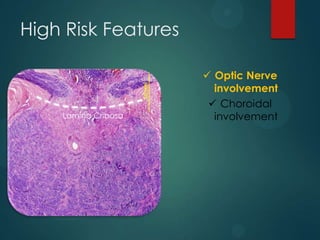
High Risk Features

Lamina Cribosa
Lamina Cribosa

 Optic Nerve
involvement
 Choroidal
involvement
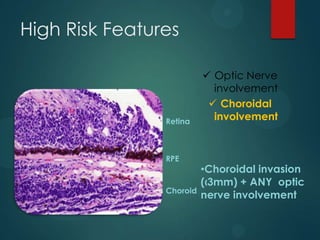
High Risk Features

Retina

RPE

Choroid

 Optic Nerve
involvement
 Choroidal
involvement

•Choroidal invasion
(‹3mm) + ANY optic
nerve involvement
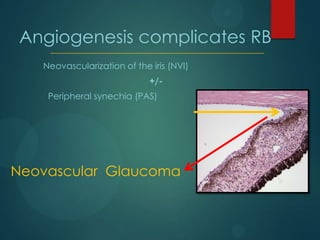
Angiogenesis complicates RB
Neovascularization of the iris (NVI)
+/Peripheral synechia (PAS)

Neovascular Glaucoma
Relevant background


Neovascularization in retinoblastoma is
associated with poorer prognosis and increased
chances of invasion



Neovascularization as well as angiogenesis is
driven by angiogenic factors.



VEGF is the most important and most studied
angiogenic factor



Several anti-VEGF therapies have demonstrated
good results in various types of cancer



No one has studied histopathological behavior of
VEGF in Rb



VEGF is a promising therapy in Retinoblastoma
Hypothesis



HRF tumors will have increased secretion of VEGF
and its receptor VEGFR2
Objective


To analyze the expression of angiogenic factors in
the eye (retina, iris, and tumor ) in
retinoblastoma with high-risk features (HRF) and
non-high risk features (Non-HRF). To correlate the
expression of angiogenic factors in tumors with
HRF and the expression of stem cell marker
Sox2. keep order same throughout. If possible,
use this order when discussing your results as well.
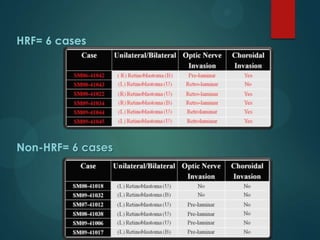
HRF= 6 cases

Non-HRF= 6 cases
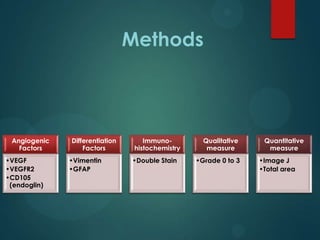
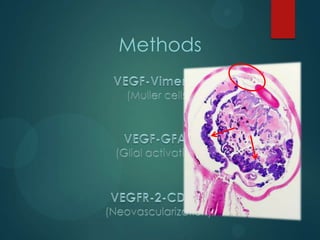
Methods

Angiogenic
Factors
•VEGF
•VEGFR2
•CD105
(endoglin)

Differentiation
Factors
•Vimentin
•GFAP

Immunohistochemistry
•Double Stain

Qualitative
measure
•Grade 0 to 3

Quantitative
measure
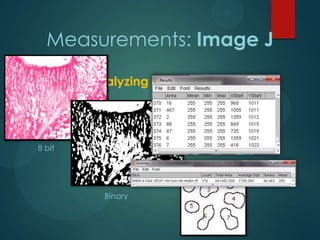
•Image J
•Total area
Methods
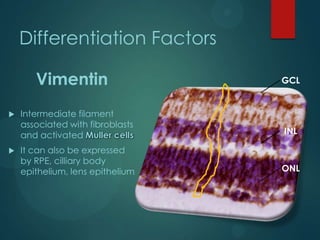
Differentiation Factors
Vimentin




GCL

Intermediate filament
associated with fibroblasts
and activated Muller cells

INL

It can also be expressed
by RPE, cilliary body
epithelium, lens epithelium

ONL
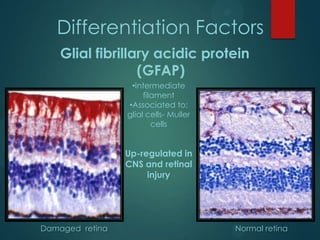
Differentiation Factors
Glial fibrillary acidic protein
(GFAP)
•Intermediate
filament
•Associated to:
glial cells- Muller
cells

Up-regulated in
CNS and retinal
injury

Damaged retina

Normal retina
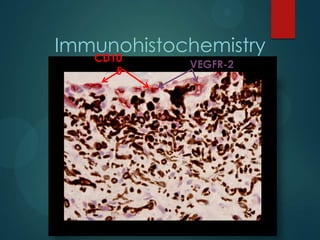
Immunohistochemistry
CD10
5

VEGFR-2

Iris. 40X magnification
Measurements: Image J
Color deconvolution

Stain separation using Ruifrok and Johnston's method1
Vimentin

VEGF

[1] Ruifrok AC, Johnston DA. Quantification of histochemical staining by color deconvolution. Anal
Quant Cytol Histol 23: 291-299, 2001
Measurements: Image J
Analyzing particles

8 bit

Binary
Results
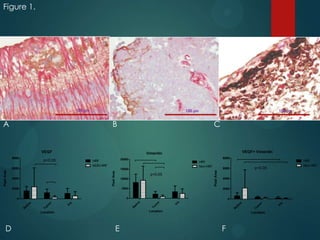
ANGIOGENIC FACTORS AND HRF IN RB
Figure 1.

*

100 μm

100 μm

A

B

C

VEGF
8000

VEGF+ Vimentin

Vimentin

p<0.05

8000

20000

HRF
NON-HRF

6000

HRF
Non-HRF

4000

p<0.05
10000

4000

E

Location

F

Iri
s

Tu
m

a
et
in
R

Tu
m

et
in
R

Tu
m

et
in
R

Iri
s

Location

Location

or

0
Iri
s

0

or

0

a

2000

or

5000

a

2000

D

HRF
Non-HRF

p<0.05

6000

Pixel Area

15000

Pixel Area

Pixel Area

100 μm
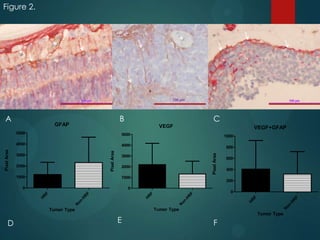
Figure 2.

*

*

100 μm

A

B

GFAP

C
VEGF

VEGF+GFAP

4000

800

2000
1000
0

F

R
F
H

on
-H

H

on
-H

R

R
F

R

N

N

E

N

R
F
H

0

Tumor Type

Tumor Type

D

400
200

F

0

F

1000

600

R

2000

3000

on
-H

3000

Pixel Area

1000

Pixel Area

5000

4000

Pixel Area

5000

Tumor Type

F
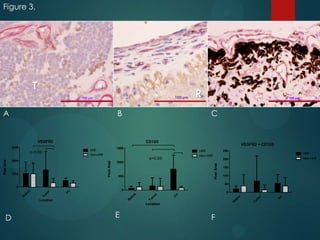
Figure 3.

*
*
*

T

*

*
100 μm

A

B

C

VEGFR2

CD105

3000

VEGFR2 + CD105

1500

HRF
Non-HRF

p<0.05

1000

HRF
Non-HRF

200

1000

Pixel Area

2000

250

HRF
Non-HRF

p<0.05
Pixel Area

Pixel Area

R

500

150
100
50

0

Location

D

E

F

Iri
s

Tu
m
or

R

et
in

a

Iri
s

Tu
m

et
in
R

Location

or

0

a

Iri
s

Tu
m
or

R

et
in

a

0
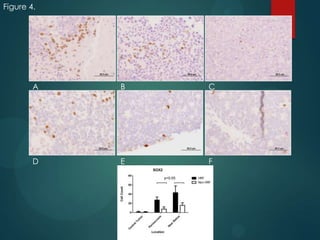
Figure 4.

A

B

C

D

E

F

G
Summary


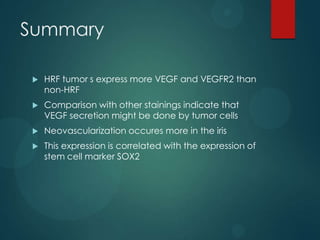
HRF tumor s express more VEGF and VEGFR2 than
non-HRF



Comparison with other stainings indicate that
VEGF secretion might be done by tumor cells



Neovascularization occures more in the iris



This expression is correlated with the expression of
stem cell marker SOX2
Conclusions


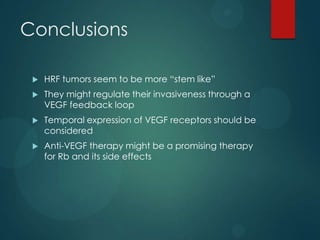
HRF tumors seem to be more “stem like”



They might regulate their invasiveness through a
VEGF feedback loop



Temporal expression of VEGF receptors should be
considered



Anti-VEGF therapy might be a promising therapy
for Rb and its side effects
Acknowledgements


Patricia Chevez-Barrios, MD



Rebecca Penland



Magdalena Arredondo



Claudia M. Prospero, MD

Vegf expression in hrf

Editor's Notes

  • #5 Eyes with HRF show increased expression of VEGF and its receptor VEGFR-2 in both the tumor and the iris. CD105 expression(newly formed vessels) is elevated in tumors but is particularly higher in the iris of HRF eyes. Therefore in HRF eyes, treatments that target cells expressing angiogenic factors and/or the factors alone may be useful to prevent complications such as development of neovascular glaucoma.
  • #21 VEGF expression in the retinawas lower in the non-HRF tumor compared to its expression in the retina of the non-HRF samples  or to the HRF tumor. Its co-expression with the glial marker vimentin and the qualitative interpretation shows that a significant amount of VEGF is probably secreted by tumor cells. The VEGF Receptor 2 is highly expressed in the retina and the HRF tumor, unlike in the non-HRF tumor. The activated endothelial cell marker CD105 shows that the majority of angiogenesis takes place in the iris. Co-expression of VEGFR2 and CD105 seems to be predominant in the vessels of the tumor and the iris neovascular membranes. The neural stem cell marker SOX2 was more highly expressed in the perinecrotic areas of the tumor and the regions closest to the retina. It was also higher in HRFtumors compared to non-HRF tumors. Retina of what? THe HRF, non-HRF? The writing is very non-specific and thus hard to follow...
  • #22  VEGF expression in the retinawas lower in the non-HRF tumor compared to its expression in the retina of the non-HRF samples  or to the HRF tumor. Its co-expression with the glial marker vimentin and the qualitative interpretation shows that a significant amount of VEGF is probably secreted by tumor cells. The VEGF Receptor 2 is highly expressed in the retina and the HRF tumor, unlike in the non-HRF tumor. The activated endothelial cell marker CD105 shows that the majority of angiogenesis takes place in the iris. Co-expression of VEGFR2 and CD105 seems to be predominant in the vessels of the tumor and the iris neovascular membranes. The neural stem cell marker SOX2 was more highly expressed in the perinecrotic areas of the tumor and the regions closest to the retina. It was also higher in HRFtumors compared to non-HRF tumors. Retina of what? THe HRF, non-HRF? The writing is very non-specific and thus hard to follow...
  • #24 VEGF expression in the retinawas lower in the non-HRF tumor compared to its expression in the retina of the non-HRF samples  or to the HRF tumor. Its co-expression with the glial marker vimentin and the qualitative interpretation shows that a significant amount of VEGF is probably secreted by tumor cells. The VEGF Receptor 2 is highly expressed in the retina and the HRF tumor, unlike in the non-HRF tumor. The activated endothelial cell marker CD105 shows that the majority of angiogenesis takes place in the iris. Co-expression of VEGFR2 and CD105 seems to be predominant in the vessels of the tumor and the iris neovascular membranes. The neural stem cell marker SOX2 was more highly expressed in the perinecrotic areas of the tumor and the regions closest to the retina. It was also higher in HRFtumors compared to non-HRF tumors. Retina of what? THe HRF, non-HRF? The writing is very non-specific and thus hard to follow...tumors.
  • #25 Conclusions and Relevance:  Our results, for the first time, show that in HRF retinoblastoma eyes when compared with non-HRF eyes, there is overexpression of VEGFA and VEGFR2in the tumor cells, neovascularization of iris with increased amount of activated endothelial cells, and that overexpression of VEGFA is associated with an increase in SOX2-positive stem/progenitor cells in the tumor. The increasedexpression of angiogenic factors and concomitant increase in stem cells in the HRF tumors may partially explain the aggressiveness of these tumors. Further studies are needed to confirm this association. In non-HRF eyes the pattern of expression of VEGFA and VEGFR2 seems to be comparable to the recognized pattern of response of the non-neoplastic tissuesto injury . The complex interaction of pathways in these tumors, especially in HRF retinoblastoma, indicate that targeting vasculogenic tumor cells, genes, and signaling pathways may be necessary in anti-tumor vasculogenic and metastatic prevention drug development.  ARE THERE CONTROLS?? I did not see them mentioned at any other point in the manuscript.