What is a vegetarian
The Vegetarian Society defines a vegetarian as: "Someone who lives on a diet of
grains, pulses, nuts, seeds, vegetables and fruits with, or without, the use of dairy products and eggs. A
vegetarian does not eat any meat, poultry, game, fish, shellfish* or by-products of slaughter.“
When the vegetarian society say shellfish what they mean is a sea animal that is covered with a shelf for
example crustaceans and most molluscs.

There are a number of different types of vegetarian :

  Pescatarian :                                                      Flexitarian :                                             Lacto – ovo – Vegetarian :
  The word pescatarian is occasionally used to                       Flexitarian is a word coined by the vegetarian            This is the most common type of vegetarianism, if
  describe someone who completely refrains from                      society to describe those who are not actual              you were to think about what a vegetarian is, this
  eating all meats and animal flesh except from                      vegetarians but still enjoy vegetarian diets. There       term would back that up. These are people who
  fish. This word is not so commonly used anymore                    are a large number of people who prefer to eat a          eat no meat or shellfish but will consume eggs
  however, a lot more people are adopting this                       vegetarian diet whilst occasionally still eating          and dairy products . A slight variation of this is
  type of diet. Some for health reasons and others                   meat. Some vegetarians disagree with this                 the Lacto Vegetarian who will not eat eggs but
  use it as a stepping stone to becoming a full                      lifestyle whilst others think it is a step in the right   will consume dairy products.
  vegetarian.                                                        direction.


  Vegan :                                                             Raw Vegan :                                               Macrobiotic :
  Vegans will refuse to eat any sort of meat
                                                                      A raw vegans diet consists of the same things as          The macrobiotic diet is revered by some
  however they differ from vegetarians in the fact
                                                                      a regular vegan diet, however they will not eat           for its healthy healing qualities. The
  that they will also not consume eggs, dairy
                                                                      any unprocessed vegan foods that have been                macrobiotic diet creates an ideal
  products or any processed foods that may
                                                                      heated above 115 degrees Fahrenheit. ‘’Raw                combination of a few of the other sections
  contain animal derived ingredients such as
                                                                      foodists ‘’as they are known believe that if food         of vegetarianism. They eat vegan foods
  gelatin. Many vegans also take a strong standing
                                                                      is cooked above that temperature that it begins           such as whole rains, fruits and vegetables
  on making sure they do not have products that
                                                                      to lose most of its nutritional values. They also         whilst still being allowed to consume fish.
  are made with animal products, despite them
                                                                      believe that it makes the food harmful to he              Sugar and other refined oils are avoided.
  having no animal in the final product, for
                                                                      body. There are a lot of small variations of the          What makes this diet incredibly unique is
  example sugar and some wines. There are some
                                                                      raw Vegan diet such as :- Fruitarianism                   its emphasis on the fact you are allowed to
  items of food that cause debate in the vegan
                                                                      juicearianism, and sproutarianism                         consume Asian vegetables, such as
  society, a commonly debated food item is
                                                                                                                                daikon, and sea vegetables, such as
  honey.
                                                                                                                                seaweed.
Opening quote reference : http://www.vegsoc.org/page.aspx?pid=698
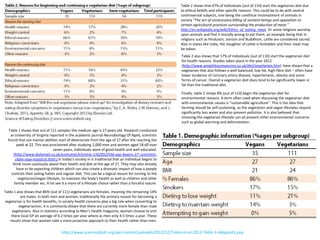
Table 2 shows that 67% of individuals (out of 110) start the vegetarian diet due
                                                                                                      to ethical beliefs and other specific reasons. This could be to do with several
                                                                                                      controversial subjects, one being the unethical mistreatment of animals in
                                                                                                      society “The act of unnecessary killing of sentient beings and opposition to
                                                                                                      certain agricultural practices surrounding the production of meat.”
                                                                                                      http://en.wikipedia.org/wiki/Ethics_of_eating_meat. Or some religions worship
                                                                                                      upon animals and find it morally wrong to eat them, an example being that in
                                                                                                      religions such as Hinduism, Jainism and Buddhism, cattle are considered sacred.
                                                                                                      Also in states like India, the slaughter of cattle is forbidden and their meat may
                                                                                                      be taboo.
                                                                                                      Table 2 also shows that 17% of individuals (out of 110) start the vegetarian diet
                                                                                                      for health reasons. Studies taken place in the year 2012
                                                                                                      (http://www.weightlossresources.co.uk/diet/vegetarian.htm) have shown that a
                                                                                                      vegetarian that also follows a well-balanced, low-fat, high-fibre diet – often have
                                                                                                      lower incidence of coronary artery disease, hypertension, obesity and some
                                                                                                      forms of cancer. Overall a vegetarian diet does tend to be significantly lower in
                                                                                                      fat than the traditional diet.

                                                                                                      Finally, table 2 shows 8% (out of 110) begin the vegetarian diet for
                                                                                                      environmental reasons. A term often used when discussing the vegetarian diet
                                                                                                      with environmental causes is “sustainable agriculture”. This is the idea that
                                                                                                      farming should be self-sustaining, as the vegetation and vegan lifestyles require
                                                                                                      significantly less water and also prevent pollution. It is also believed that
                                                                                                      choosing the vegetarian lifestyle can all prevent other environmental concerns
                                                                                                      such as global warming and deforestation.

  Table 1 shows that out of 111 samples the medium age is 27 years old. Research conducted
    as University of Virginia reported in the academic journal Neurobiology Of Aged, scientists
  found that out mental abilities start of deteriorate from the age of 27 after the reaching the
         peek at 22. This was proclaimed after studying 2,000 men and women aged 18-60 over
                                seven years, individuals were of good health and well educated.
      (http://www.dailymail.co.uk/sciencetech/article-1162052/Old-age-begins-27--scientists-
        claim-new-research.html ) In today’s society in is traditional that an individual begins to
     think more cautiously about their health and diet at the age of 27. They may also already
         have or be expecting children which can also create a dramatic impact of how a people
    controls their eating habits and regular diet. This can be a logical reason for turning to the
          vegetarian/vegan lifestyle, to maintain the body’s health as well as children and other
       family member etc. A lot see it a more of a lifestyle choice rather than a forceful nature.

Table 1 also shows that 86% (out of 111) vegetarians are females, meaning the remaining 14%
          are males. In both men and women, traditionally the primary reason for becoming a
vegetarian is for health benefits, in society health concerns play a big role when converting to
         vegetarianism, it is commonly shown that there are currently more female than male
    vegetarians. Also in statistics according to Men’s Health magazine, women choose to visit
    there local GP an average of 6.2 times per year where as men only 4.5 times a year. These
   results show that women take a more proactive approach to their health rather than men.

                                    http://www.scienceofeds.org/wp-content/uploads/2012/12/Timko-et-al-2012-Table-1-Adapted1.png
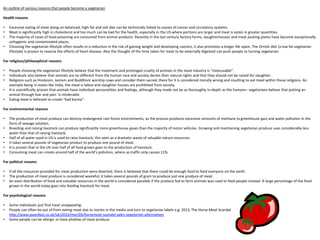
An outline of various reasons that people become a vegetarian

Health reasons

•   Excessive eating of meat along un-balanced, high-fat and salt diet can be technically linked to causes of cancer and circulatory systems.
•   Meat is significantly high in cholesterol and too much can be bad for the health, especially in the US where portions are larger and meat is eaten in greater quantities.
•   The majority of cases of food poisoning are consumed from animal products. Recently in the last century factory farms, slaughterhouses and meat packing plants have become exceptionally
    unhygienic and contaminated places.
•   Choosing the vegetarian lifestyle often results in a reduction in the risk of gaining weight and developing cancers, it also promotes a longer life spam. The Ornish diet (a low fat vegetarian
    lifestyle) is proven to reverse the effects of heart disease. Also the thought of the time taken for meat to be externally digested can push people to turning vegetarian.

For religious/philosophical reasons

•   People choosing the vegetarian lifestyle believe that the treatment and prolonged cruelty of animals in the meat industry is “inexcusable”.
•   Individuals also believe that animals are no different from the human race and society denies their natural rights and that they should not be raised for slaughter.
•   Religions such as Hinduism, Jainism and Buddhism worship cows and consider them sacred, there for it is considered morally wrong and insulting to eat meat within those religions. An
    example being in states like India, the meat is taboo and slaughter houses are prohibited from society.
•   It is scientifically proven that animals have individual personalities and feelings, although they made not be as thoroughly in-depth as the humans– vegetarians believe that putting an
    animal through fear and pain is intolerable.
•   Eating meat is believed to create “bad karma”.

For environmental reasons

•   The production of meat produce can destroy endangered rain forest environments, as the process produces excessive amounts of methane (a greenhouse gas) and water pollution in the
    form of sewage solution.
•   Breeding and raising livestock can produce significantly more greenhouse gases than the majority of motor vehicles. Growing and maintaining vegetarian produce uses considerably less
    water than that of raising livestock.
•   Half of all water used in US is used to raise livestock, this seen as a dramatic waste of valuable nature resources.
•   It takes several pounds of vegetarian product to produce one pound of meat.
•   It is proven that in the UK over half of all food grown goes to the production of livestock.
•   Consuming meat can create around half of the world’s pollution, where as traffic only causes 11%.

For political reasons

•   If all the resources provided for meat production were diverted; there is believed that there could be enough food to feed everyone on the earth.
•   The production of meat produce is considered wasteful; it takes several pounds of grain to produce just one produce of meat.
•   An even distribution of food and valuable resources in the world is considered possible if the produce fed to farm animals was used to feed people instead. A large percentage of the food
    grown in the world today goes into feeding livestock for meat.

For psychological reasons

•   Some individuals just find meat unappealing.
•   People can often be put of from eating meat due to stories in the media and turn to vegetarian labels e.g. 2013, The Horse Meat Scandal.
    http://www.guardian.co.uk/uk/2013/mar/05/horsemeat-scandal-sales-vegetarian-alternatives
•   Some people can be allergic or have phobias of meat produce.
Vegetarian Companies
Quorn :
Quorn are the leading brand in imitation meat mycoprotein in the United Kingdom.
The mycoprotein that Quorn uses to create their product is expanded from a type
of fungus. Quorn is produced as a type of ready meal and as a brand of ingredients.
It is sold as a health food and also as an alternative to meat. Quorn received the
vegetarian seal of approval when they made sure that only free range eggs were
used in their products. Quorn was first introduced into retail in 1994 and was
introduced into the US in 2002. The initial advertising included sports personalities
including Ryan Giggs, Will carling and Sally Gunner.


Redwood :
Redwood are a company that specialise in creating meals that are completely
free from any kind of animal ingredients. They can create animal free
meats, fish and dairy free cheeses. They pride the fact that they create food
products that save not only animals but also help people and the environment.

‘’ What makes our foods special? The fact that they're just that little bit
different. From fish-style fingers and spicy falafel to meat-free ‘bacon', nuggets
and schnitzels, Redwood foods are inspirational, healthy and nutritious and a
great source of protein. We've even picked up a few awards along the way.
And been awarded ethical company status.’’


Vegan Society :
The Vegan society is an educational charity that promotes and support the vegan
way of life. Whilst the Vegan society differs from quorn and redwood in the fact
that it doesn’t directly sell food or produce food for retail it does promote the
lifestyle and give people a lot of avenues to research meals and look up the
nutritional values. The website provides a great outlet for people to discover all of
the facts and information that they need about veganism. There are even support
and help tips on how to make the transition to becoming a vegan.
Vegans and vegetarians are incredibly limited to what they can have at mealtime. Here is a list of foods prohibited from vegans and vegetarians.

Canned Goods and Non-Perishable

Soup base/stock/bouillon: meat or fish fat
Vegetable soup: meat or poultry broth
Worcestershire sauce: anchovies
Lard: solid animal fat
Caesar salad / dressing: anchovies, possibly bacon
Refried beans: lard
Beans in tomato sauce: pork

Bakery, Bread and Crackers
                                                                                                  Gelatin: The protein obtained by boiling
Crackers: may contain animal-derived enzymes                                       skin, tendons, ligaments, and/or bones with water. The substance is
Amino L-cysteine: derived from animal hair or feathers                                   usually obtained from cows or pigs. Gelatin is also used in
Whey protein: a milk product                                                       shampoos, face masks, and other cosmetics; as a thickener for fruit
Omega-3 enriched bread: may contain fish oil                                                      gelatins and puddings (such as Jell-O); in
                                                                                         candies, marshmallows, cakes, ice cream, and yogurts; on
Candy, Desserts and Confectionary                                                  photographic film; in vitamins as a coating and as capsules; and it is
                                                                                               sometimes used to assist in "clearing" wines.
Marshmallows: gelatin (made from animal bones)
Hard / chewy candies like Skittles or Starburst brands: gelatin
Jell-o or gelatin desserts: gelatin
White sugar: filtered using animal bone char
Pie crusts: store-bought and some homemade contain lard and/or butter
Glazed/candied cherries: cochineal/carmine (insect colouring)
Candies made with red food colouring: cochineal/carmine
Candies made with shellac or confectioner's glaze: insect-derived ingredients

Produce

Apples, candy apples: shiny read coating made from beetles (cochineal/carmine)
Caesar salad (pre-packaged): anchovies, possibly bacon

Dairy/Frozen/Refrigerated Products

Frozen hash brown potatoes: some contain lard
Yogurt or sour cream (especially low-fat brands): gelatin
DHA-enriched products (for example; milk, orange juice, margarine, cheese, bread but not omega-3 eggs): gelatin
Cheese: rennet (scraped from the stomachs of cows)
Margarine: gelatin, whey powder, casein
Soy cheese: most contain casein (a milk protein) to help them melt

Beverages                Not all beers and wines are made using animal products.
                          Whether a beverage is made using animal products or
Beer                     not, this information is not listed on the label. No animal
Wine                     ingredients are present in the final product (beer, wine)
                         but some are filtered with animal products like isinglass.

Vegetarian 2

  • 1.
    What is avegetarian The Vegetarian Society defines a vegetarian as: "Someone who lives on a diet of grains, pulses, nuts, seeds, vegetables and fruits with, or without, the use of dairy products and eggs. A vegetarian does not eat any meat, poultry, game, fish, shellfish* or by-products of slaughter.“ When the vegetarian society say shellfish what they mean is a sea animal that is covered with a shelf for example crustaceans and most molluscs. There are a number of different types of vegetarian : Pescatarian : Flexitarian : Lacto – ovo – Vegetarian : The word pescatarian is occasionally used to Flexitarian is a word coined by the vegetarian This is the most common type of vegetarianism, if describe someone who completely refrains from society to describe those who are not actual you were to think about what a vegetarian is, this eating all meats and animal flesh except from vegetarians but still enjoy vegetarian diets. There term would back that up. These are people who fish. This word is not so commonly used anymore are a large number of people who prefer to eat a eat no meat or shellfish but will consume eggs however, a lot more people are adopting this vegetarian diet whilst occasionally still eating and dairy products . A slight variation of this is type of diet. Some for health reasons and others meat. Some vegetarians disagree with this the Lacto Vegetarian who will not eat eggs but use it as a stepping stone to becoming a full lifestyle whilst others think it is a step in the right will consume dairy products. vegetarian. direction. Vegan : Raw Vegan : Macrobiotic : Vegans will refuse to eat any sort of meat A raw vegans diet consists of the same things as The macrobiotic diet is revered by some however they differ from vegetarians in the fact a regular vegan diet, however they will not eat for its healthy healing qualities. The that they will also not consume eggs, dairy any unprocessed vegan foods that have been macrobiotic diet creates an ideal products or any processed foods that may heated above 115 degrees Fahrenheit. ‘’Raw combination of a few of the other sections contain animal derived ingredients such as foodists ‘’as they are known believe that if food of vegetarianism. They eat vegan foods gelatin. Many vegans also take a strong standing is cooked above that temperature that it begins such as whole rains, fruits and vegetables on making sure they do not have products that to lose most of its nutritional values. They also whilst still being allowed to consume fish. are made with animal products, despite them believe that it makes the food harmful to he Sugar and other refined oils are avoided. having no animal in the final product, for body. There are a lot of small variations of the What makes this diet incredibly unique is example sugar and some wines. There are some raw Vegan diet such as :- Fruitarianism its emphasis on the fact you are allowed to items of food that cause debate in the vegan juicearianism, and sproutarianism consume Asian vegetables, such as society, a commonly debated food item is daikon, and sea vegetables, such as honey. seaweed. Opening quote reference : http://www.vegsoc.org/page.aspx?pid=698
  • 2.
    Table 2 showsthat 67% of individuals (out of 110) start the vegetarian diet due to ethical beliefs and other specific reasons. This could be to do with several controversial subjects, one being the unethical mistreatment of animals in society “The act of unnecessary killing of sentient beings and opposition to certain agricultural practices surrounding the production of meat.” http://en.wikipedia.org/wiki/Ethics_of_eating_meat. Or some religions worship upon animals and find it morally wrong to eat them, an example being that in religions such as Hinduism, Jainism and Buddhism, cattle are considered sacred. Also in states like India, the slaughter of cattle is forbidden and their meat may be taboo. Table 2 also shows that 17% of individuals (out of 110) start the vegetarian diet for health reasons. Studies taken place in the year 2012 (http://www.weightlossresources.co.uk/diet/vegetarian.htm) have shown that a vegetarian that also follows a well-balanced, low-fat, high-fibre diet – often have lower incidence of coronary artery disease, hypertension, obesity and some forms of cancer. Overall a vegetarian diet does tend to be significantly lower in fat than the traditional diet. Finally, table 2 shows 8% (out of 110) begin the vegetarian diet for environmental reasons. A term often used when discussing the vegetarian diet with environmental causes is “sustainable agriculture”. This is the idea that farming should be self-sustaining, as the vegetation and vegan lifestyles require significantly less water and also prevent pollution. It is also believed that choosing the vegetarian lifestyle can all prevent other environmental concerns such as global warming and deforestation. Table 1 shows that out of 111 samples the medium age is 27 years old. Research conducted as University of Virginia reported in the academic journal Neurobiology Of Aged, scientists found that out mental abilities start of deteriorate from the age of 27 after the reaching the peek at 22. This was proclaimed after studying 2,000 men and women aged 18-60 over seven years, individuals were of good health and well educated. (http://www.dailymail.co.uk/sciencetech/article-1162052/Old-age-begins-27--scientists- claim-new-research.html ) In today’s society in is traditional that an individual begins to think more cautiously about their health and diet at the age of 27. They may also already have or be expecting children which can also create a dramatic impact of how a people controls their eating habits and regular diet. This can be a logical reason for turning to the vegetarian/vegan lifestyle, to maintain the body’s health as well as children and other family member etc. A lot see it a more of a lifestyle choice rather than a forceful nature. Table 1 also shows that 86% (out of 111) vegetarians are females, meaning the remaining 14% are males. In both men and women, traditionally the primary reason for becoming a vegetarian is for health benefits, in society health concerns play a big role when converting to vegetarianism, it is commonly shown that there are currently more female than male vegetarians. Also in statistics according to Men’s Health magazine, women choose to visit there local GP an average of 6.2 times per year where as men only 4.5 times a year. These results show that women take a more proactive approach to their health rather than men. http://www.scienceofeds.org/wp-content/uploads/2012/12/Timko-et-al-2012-Table-1-Adapted1.png
  • 3.
    An outline ofvarious reasons that people become a vegetarian Health reasons • Excessive eating of meat along un-balanced, high-fat and salt diet can be technically linked to causes of cancer and circulatory systems. • Meat is significantly high in cholesterol and too much can be bad for the health, especially in the US where portions are larger and meat is eaten in greater quantities. • The majority of cases of food poisoning are consumed from animal products. Recently in the last century factory farms, slaughterhouses and meat packing plants have become exceptionally unhygienic and contaminated places. • Choosing the vegetarian lifestyle often results in a reduction in the risk of gaining weight and developing cancers, it also promotes a longer life spam. The Ornish diet (a low fat vegetarian lifestyle) is proven to reverse the effects of heart disease. Also the thought of the time taken for meat to be externally digested can push people to turning vegetarian. For religious/philosophical reasons • People choosing the vegetarian lifestyle believe that the treatment and prolonged cruelty of animals in the meat industry is “inexcusable”. • Individuals also believe that animals are no different from the human race and society denies their natural rights and that they should not be raised for slaughter. • Religions such as Hinduism, Jainism and Buddhism worship cows and consider them sacred, there for it is considered morally wrong and insulting to eat meat within those religions. An example being in states like India, the meat is taboo and slaughter houses are prohibited from society. • It is scientifically proven that animals have individual personalities and feelings, although they made not be as thoroughly in-depth as the humans– vegetarians believe that putting an animal through fear and pain is intolerable. • Eating meat is believed to create “bad karma”. For environmental reasons • The production of meat produce can destroy endangered rain forest environments, as the process produces excessive amounts of methane (a greenhouse gas) and water pollution in the form of sewage solution. • Breeding and raising livestock can produce significantly more greenhouse gases than the majority of motor vehicles. Growing and maintaining vegetarian produce uses considerably less water than that of raising livestock. • Half of all water used in US is used to raise livestock, this seen as a dramatic waste of valuable nature resources. • It takes several pounds of vegetarian product to produce one pound of meat. • It is proven that in the UK over half of all food grown goes to the production of livestock. • Consuming meat can create around half of the world’s pollution, where as traffic only causes 11%. For political reasons • If all the resources provided for meat production were diverted; there is believed that there could be enough food to feed everyone on the earth. • The production of meat produce is considered wasteful; it takes several pounds of grain to produce just one produce of meat. • An even distribution of food and valuable resources in the world is considered possible if the produce fed to farm animals was used to feed people instead. A large percentage of the food grown in the world today goes into feeding livestock for meat. For psychological reasons • Some individuals just find meat unappealing. • People can often be put of from eating meat due to stories in the media and turn to vegetarian labels e.g. 2013, The Horse Meat Scandal. http://www.guardian.co.uk/uk/2013/mar/05/horsemeat-scandal-sales-vegetarian-alternatives • Some people can be allergic or have phobias of meat produce.
  • 4.
    Vegetarian Companies Quorn : Quornare the leading brand in imitation meat mycoprotein in the United Kingdom. The mycoprotein that Quorn uses to create their product is expanded from a type of fungus. Quorn is produced as a type of ready meal and as a brand of ingredients. It is sold as a health food and also as an alternative to meat. Quorn received the vegetarian seal of approval when they made sure that only free range eggs were used in their products. Quorn was first introduced into retail in 1994 and was introduced into the US in 2002. The initial advertising included sports personalities including Ryan Giggs, Will carling and Sally Gunner. Redwood : Redwood are a company that specialise in creating meals that are completely free from any kind of animal ingredients. They can create animal free meats, fish and dairy free cheeses. They pride the fact that they create food products that save not only animals but also help people and the environment. ‘’ What makes our foods special? The fact that they're just that little bit different. From fish-style fingers and spicy falafel to meat-free ‘bacon', nuggets and schnitzels, Redwood foods are inspirational, healthy and nutritious and a great source of protein. We've even picked up a few awards along the way. And been awarded ethical company status.’’ Vegan Society : The Vegan society is an educational charity that promotes and support the vegan way of life. Whilst the Vegan society differs from quorn and redwood in the fact that it doesn’t directly sell food or produce food for retail it does promote the lifestyle and give people a lot of avenues to research meals and look up the nutritional values. The website provides a great outlet for people to discover all of the facts and information that they need about veganism. There are even support and help tips on how to make the transition to becoming a vegan.
  • 5.
    Vegans and vegetariansare incredibly limited to what they can have at mealtime. Here is a list of foods prohibited from vegans and vegetarians. Canned Goods and Non-Perishable Soup base/stock/bouillon: meat or fish fat Vegetable soup: meat or poultry broth Worcestershire sauce: anchovies Lard: solid animal fat Caesar salad / dressing: anchovies, possibly bacon Refried beans: lard Beans in tomato sauce: pork Bakery, Bread and Crackers Gelatin: The protein obtained by boiling Crackers: may contain animal-derived enzymes skin, tendons, ligaments, and/or bones with water. The substance is Amino L-cysteine: derived from animal hair or feathers usually obtained from cows or pigs. Gelatin is also used in Whey protein: a milk product shampoos, face masks, and other cosmetics; as a thickener for fruit Omega-3 enriched bread: may contain fish oil gelatins and puddings (such as Jell-O); in candies, marshmallows, cakes, ice cream, and yogurts; on Candy, Desserts and Confectionary photographic film; in vitamins as a coating and as capsules; and it is sometimes used to assist in "clearing" wines. Marshmallows: gelatin (made from animal bones) Hard / chewy candies like Skittles or Starburst brands: gelatin Jell-o or gelatin desserts: gelatin White sugar: filtered using animal bone char Pie crusts: store-bought and some homemade contain lard and/or butter Glazed/candied cherries: cochineal/carmine (insect colouring) Candies made with red food colouring: cochineal/carmine Candies made with shellac or confectioner's glaze: insect-derived ingredients Produce Apples, candy apples: shiny read coating made from beetles (cochineal/carmine) Caesar salad (pre-packaged): anchovies, possibly bacon Dairy/Frozen/Refrigerated Products Frozen hash brown potatoes: some contain lard Yogurt or sour cream (especially low-fat brands): gelatin DHA-enriched products (for example; milk, orange juice, margarine, cheese, bread but not omega-3 eggs): gelatin Cheese: rennet (scraped from the stomachs of cows) Margarine: gelatin, whey powder, casein Soy cheese: most contain casein (a milk protein) to help them melt Beverages Not all beers and wines are made using animal products. Whether a beverage is made using animal products or Beer not, this information is not listed on the label. No animal Wine ingredients are present in the final product (beer, wine) but some are filtered with animal products like isinglass.