Vegetarian 101
            Dr. Lisa Watson, ND
Vegetarian Terminology
Vegan – consumes NO animal products (including
meat, poultry, fish, eggs, dairy, honey)

Lacto-Ovo Vegetarian – consumes no meat, fish or
poultry but does consume dairy and/or eggs

Pescetarian– consumes no meat or poultry but does
consume fish, dairy and/or eggs

Flexitarian– consumes a predominantly vegetarian
diet but consumes meat or poultry on occasion
Health Benefits
of a Vegetarian Diet
Benefit 1: Decreased risk of diabetes
 Vegetarian diets reduce the risk of developing
 diabetes and are associated with improved insulin
 sensitivity and decreased oxidative stress.

 Vegetarian diets are more
 successful than omnivore
 diets in managing existing
 diabetes.
Benefit 2: Decreased risk of heart
           disease
 Vegetarians have lower incidence of heart
 disease, lower LDL (bad) cholesterol, lower rates of
 obesity and lower rates of hypertension.
Benefit 3: Decreased risk of obesity
 On average, vegetarians have lower BMIs (body
 mass index) than omnivores with vegans having
 even lower BMIs.

 Obesity is the main risk factor
 for a number of chronic conditions
 including hypertension, heart
 disease, diabetes and
 reduced life expenctancy.
Benefit 4: Improved mood

 Vegetarians report less negative mood states than
 omnivores. When omnivores change over to a
 vegetarian diet self reported mood states improve.


 Beezhold BL, Johnston CS. Restriction of meat,
 fish, and poultry in omnivores improves mood:
 a pilot randomized controlled trial. Nutr J. 2012
 Feb 14;11:9.
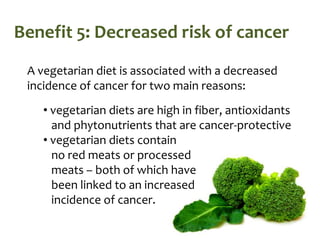
Benefit 5: Decreased risk of cancer
 A vegetarian diet is associated with a decreased
 incidence of cancer for two main reasons:
    • vegetarian diets are high in fiber, antioxidants
      and phytonutrients that are cancer-protective
    • vegetarian diets contain
      no red meats or processed
      meats – both of which have
      been linked to an increased
      incidence of cancer.
Nutritional Needs
  of Vegetarians
But some nutrients are more
       challenging to get…
Vitamin B12
  Necessary for normal functioning of the brain
  and nervous system

  Also required by our body to produce energy
  and utilize fatty acids
Vitamin B12
  Necessary for normal functioning of the brain
  and nervous system

  Also required by our body to produce energy
  and utilize fatty acids
                                    Did you
                                    know?
                                 No plant or animal
                                  can make their
                                    own B12 –
                                 Only bacteria can
                                   synthesize it.
Vitamin B12
  Up to two-thirds of vegans and one-third of
  vegetarians are deficient.
  (Up to one-third of omnivores are also deficient)

                     B12 deficiency can lead to
                     anemia (low red blood cells)
                     and nervous system damage.

                     Because folic acid levels are
                     high in vegans and vegetarians
                     a B12 deficiency can be hidden
                     until it is severe and causing
                     symptoms.
Vitamin B12
  Vegetarian sources of B12:
                  • Eggs
                  • Dairy products
                  •Spirulina
                  •Miso
                  •Tempeh
                  • Nutritional yeast
                  • Fortified cereals, soy/
                    almond/ rice milk
                  • Supplements
                  • Healthy intestinal bacteria
Vegetarian Science Break
    Homocysteine– an amino acid found in the
    blood. High levels are associated with heart
    disease, stroke, dementia and early mortality.

    Elevated homocysteine concentration in plasma was
    observed in 66% of the vegans and about 45-50% of
    the omnivores and vegetarians. Vegan subjects had
    significantly higher mean plasma homocysteine levels
    than omnivores.
                B-vitamin status and concentrations of homocysteine in Austrian omnivores,
                                             vegetarians and vegans. Ann NutrMetab 2006.


    Why?
Vegetarian Science Break
    Deficiency of vitamin B12, folic acid or vitamin
    B6 can all lead to elevated homocysteine levels.

    Folic acid and vitamin B6 levels in vegans are
    usually high compared to omnivores. So B12
    deficiency is the most likely cause of high
    homocysteine in vegans.
Vegetarian Science Break
    In the body methionine (an amino acid) is turned
    into homocysteine. Vitamin B12 is used to turn
    the homocysteine back into methionine.

    If there is not enough vitamin B12, then
    homocysteine levels remain high.

    American vegans consume an average of
    5.6mcg of vitamin B12 through fortified food
    daily. The recommended intake is 100mcg daily.
Vegetarian Science Break
    But don’t vegans have a lower risk of
    cardiovascular disease?
    Vegans have lower cholesterol levels and blood
    pressure than omnivores.

    However, studies looking at the negative effects
    of homocysteine adjusted for cholesterol levels
    and blood pressure and still found an increased
    incidence of heart disease, stroke, dementia and
    death.
Vegetarian Science Break
    Vitamin B12 offers a safe and effective way to
    lower homocysteine levels in vegans with no
    adverse effects.

    ALL vegans (and most vegetarians) should be
    taking a daily B12 supplement.
Riboflavin – Vitamin B2
  Necessary for energy production and
  metabolism

  Used by the body to metabolize
  fats, carbohydrates and proteins
                Riboflavin is water-soluble and is not
                stored in the body. It must be
                consumed daily.

                Riboflavin is bright yellow in colour
                and causes yellowing of the urine
                when taken in supplements.
Riboflavin – Vitamin B2
  Studies suggest that up to 30% of vegans are
  deficient in riboflavin due to inadequate daily
  consumption.
           Symptoms of deficiency include dry,
           cracked lips, mouth ulcers, cracks at
           the corner of the mouth and sore
           throat

           A diverse diet, supplementation or use
           of fortified foods is usually enough for
           most vegetarians and vegans to meet
           their daily needs.
Riboflavin – Vitamin B2
  Vegetarian sources of riboflavin:
            • Milk, cheese
            • Fortified bread and cereals
            • Green leafy vegetables
            • Legumes
            • Yeast
            • Mushrooms
            • Almonds
            • Supplements
Vitamin D
 Produced in the skin from sun exposure.

 In Canada we are unable to produce vitamin D from
 sun rays during the months of October to April.

                   Vitamin D is required for
                   absorption of calcium, for
                   proper functioning of the
                   immune system and
                   decreases the risk of developing
                   over 16 different types of cancer.
Vitamin D
 In Canada all dairy products are fortified with
 vitamin D. Some milk alternatives are also fortified.

 Vitamin D supplements are recommended for ALL
 Canadians – infants, children, teens and adults –
 during the winter months.
Vitamin D
 Vegetarian sources of Vitamin D:
   • Fortified dairy products
   • Fortified soy, almond and rice milks
   • Sun exposure May-September
   • Supplements
Calcium
 Necessary for the function of muscles (including
 the heart), release of neurotransmitters and for
 calcification of the teeth and bones.

 Vitamin D is required for calcium absorption.

                    Consumption of animal proteins
                    increases calcium requirements,
                    so vegans may have lower daily
                    needs.
Calcium
 Dairy is a popular source of calcium, but this
 mineral is found in a wide variety of foods.

 A diverse vegan diet can be rich in calcium.

               Some plants contain oxalates and
 phytates, compounds that can
               inhibit calcium absorption.
               Eating a wide variety of calcium
               rich foods will result in better
               absorption and adequate
               calcium levels.
Calcium
  Vegetarian sources of calcium:
          • Dark green vegetables – kale, bok
          choy, spinach, collards, broccoli
          • Beans
          • Tofu and tempeh
          • Sesame seeds
          • Almonds and almond butter
          • Blackstrap molasses
          • Fortified soy, almond and rice milks
          • Figs
          • Dairy
Iron
 Iron is used by red blood cells to carry oxygen to
 tissues – less iron, less oxygen to our
 organs, muscles, skin and brain

                Iron is also necessary for energy
                production and proper functioning
                of the immune system.
Iron
 Vegetarians typically consume as much iron in
 their diet as omnivores.

 However, the iron in vegetables is less
 bioavailable. It is more difficult to absorb and it is
               more sensitive to inhibitors of iron
               absorption. Inhibitors include:
                     •Phytates
                     • Calcium
                     • Polyphenols – found in
                       coffee, tea and red wine
Science Break - Phytates
                  •Stores phosphorus in plants
                  • Is indigestible by humans
                  • Binds to minerals and makes
                    them unabsorbable
                  • Negatively impacts absorption
                    of iron, zinc and to a lesser
                    extent calcium and
                  magnesium
Science Break - Phytates
                  •Found in nuts, grains, beans
                    and seeds
                  • To decrease the impact of
                  phytates:
                        • Cook your food
                        • Fermentation
                        • Sprouting
                        • Vitamin C – decreases
                          impact of phytates on
                          iron absorption
Iron
 Because of the lower bioavailability of iron from
 a vegetarian diet, the recommended iron
 intakes for vegetarians are 1.8 times that of
 nonvegetarians.

            Position of the American Dietetic Association:
                                         Vegetarian Diets.
                    J Am Diet Assoc. 2009;109: 1266-1282.
Iron
 Vegetarians adapt to lower absorption of iron
 and have the same incidence of anemia as
 non-vegetarians.

             Women, children, teens, pregnant
             and breast feeding mothers
             should be diligent about maintaining
             adequate iron levels and stores.
Iron
  Vegetarian sources of iron:
             • Soy beans and tofu
             • Lentils
             • Spinach and dark green leafy
               vegetables
             • Sesame seeds
             • Chick peas (Garbanzo beans)
             • Lima beans and navy beans
             • Olives
             • Fortified cereals
             • Blackstrap molasses
Iodine
  Necessary for thyroid function and breast
  health.

  Vegans who do not consume table salt or sea
  vegetables are often deficient in iodine because
  plant-based diets are low in iodine.


                 Iodine is added to many foods to
                 ensure sufficient intake:
                    • Table salt
                    • Flour
                    • Milk
Iodine
  The salt used in processed foods is NOT iodized

  Sea salt, pink salt, gray salt, etc are not iodized
  and may not contain adequate amounts of
  iodine.
                       Vegetarian sources of iodine:
                          • Iodized table salt
                          • Sea vegetables (kelp,
                          nori, wakame)
                          • Dairy products
                          • Eggs
Zinc
 Needed for immune functioning, protein
 synthesis, wound healing, DNA synthesis and cell
 division.

 Zinc is of particular importance during periods of
 growth (pregnancy, infancy, childhood, teens) and
 during sexual maturation (teens).

                       Animal products provide
                       the majority of zinc in North
                       American diets.
Zinc
 Zinc may be deficient in vegan diets that are high in
 phytates.

 Zinc must be consumed daily because our bodies
 have no storage for this mineral.

                     Vegetarians need up to 50% more
                     zinc than the recommended
                     daily allowance to compensate
                     for the poor absorption of zinc
                     from plant-based diets.
Zinc
 Vegetarian sources of zinc:
                  • Soy beans and tofu
                  • Lentils
                  • Beans
                  • Grains (especially oats)
                  • Nuts
                  • Pumpkin and sesame seeds
                  • Mushrooms
                  • Cheese and yogurt
Omega 3 Fatty Acids
 The omega 3 fatty acids, docosahexanoic acid
 (DHA) and eicosapentanoic acid (EPA) are
 necessary for cardiovascular health, mental
 health, brain health and eye health.

                  Vegan diets that do not contain
               eggs, fish or abundant amounts of
            algae are often deficient in omega 3s.
Omega 3 Fatty Acids
         Vegan diets are rich in omega 6s (found in
  vegetable oils, canola oil, soybean oil, corn oil and
     sunflower oil) which can prevent utilization of
                                omega 3s by our cells.

      The ideal balance of omega 6s to omega 3s is
            1:1 to 4:1. Omnivores in North American
                              average a ratio of 10:1,
                    vegetarians 16:1 and vegans 20:1.
Omega 3 Fatty Acids
      Omega 6 fatty acids are pro-inflammatory,
          pro-thrombotic and pro-constrictive.

           An imbalance of omega 6 to omega 3
              can contribute to cancer, arthritis,
                inflammation and heart disease.
Omega 3 Fatty Acids
The omega 3 fatty acid found in plants, alpha-linolenic
      acid (ALA) can be converted into EPA and DHA.

         The conversion rate to EPA is typically 5-10%.
     The conversion rate to DHA is even worse (2-5%).


                     Micro-algae can provide a vegan
                      source of DHA and can increase
                        EPA levels as well (through a
                  process known as retroconversion).
Omega 3 Fatty Acids
 Vegan requirements for ALA are DOUBLE that of
 the recommended daily allowance in order to
 compensate for the poor conversion rates.

                Vegetarian sources of Omega 3s
                   • Flaxseeds
                   • Walnuts
                   • Soy
                   • Hempseeds
                   • DHA rich micro-algae
                   • Dark green leafy vegetables
                   • Eggs
Protein & Essential Amino Acids
 Protein provides the body with amino acids which
 are used as a source of energy and as building
 blocks for muscles, skin, hormones, and enzymes.

              Amino acids that can not be made by
              our body are considered essential.
              The essential amino acids are:
                    •Leucine         •Tryptophan
                    •Isoleucine      •Methionine
                    •Valine          • Phenylalanine
                    • Lysine         •Histidine
                    •Threonine
Protein & Essential Amino Acids
 Eating a diverse selection of plant foods will
 ensure you get enough essential amino acids in
 your diet.
               Legumes are high in lysine, but low
               in methionine.
               Grains are high in methionine but
               low in lysine.

              Eating both grains and legumes, as
              well as vegetables and fruits will
              provide all the essential amino acids.
Protein & Essential Amino Acids
   Food Combining:
   It is not necessary to consume both grains and
     legumes in the same meal to meet your need
        for essential amino acids. Eating them over
              the course of a single day is adequate.

               Vegetarians should aim to consume
             1.0g of protein per kg of body weight
                daily to meet their personal needs.
Protein & Essential Amino Acids
 Vegetarian Sources of Protein
              • Soy beans, tofu, tempeh
              • Legumes, lentils, peas
              • Beans (black, white, red, chick peas)
              • Quinoa
              • Nuts and nut butters
              • Seeds
              • Brown rice
              • Spinach
              • Broccoli
              • Eggs
              • Dairy
Don’t Think You Can Get
       Enough Protein?

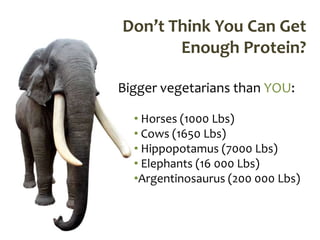
Bigger vegetarians than YOU:

  • Horses (1000 Lbs)
  • Cows (1650 Lbs)
  • Hippopotamus (7000 Lbs)
  • Elephants (16 000 Lbs)
  •Argentinosaurus (200 000 Lbs)
What about SOY?
What about SOY?
  Soy beans (Glycine max) are a legume that are:
               • High in protein
               • High in fat
               • Low in carbohydrates
               • A source of omega 3 ALA
               • A source of isoflavones
What about SOY?

  Isoflavones – The source of the soy controversy

  •Soy contains genistein, daidzein and glycitein
  •Isoflavones are mildly estrogenic – they are
    able to bind to estrogen receptors in the body
  •Isoflavones bind selectively to beta estrogen
    receptors and are classified as natural selective
    estrogen receptor modulators (SERMs)
  • SERMS have estrogen-like effects in some tissues,
    but not in others
What about SOY?

   Soy and Breast Cancer

   In mice studies, genistein can increase the
   growth of estrogen-sensitive tumours

   •The amount used in these studies was 20x normal
   human exposure

   •Mice also lack the ability to detoxify
   isoflavones, causing higher circulating amounts.
   Humans can detoxify isoflavones efficiently and
What about SOY?

  Soy and Breast Cancer

  In human studies soy has been found to NOT
  alter markers of breast cancer risk, including
  breast tissue density and breast cell
  proliferation.

  In fact, post-diagnosis consumption of soy food
  is associated with a better prognosis (measured
  by mortality and tumour recurrence)
What about SOY?

   Soy and Feminization of Boys

   Soy and soyfoods do not alter testosterone
   or dihydrotestosterone levels.

   Clinical studies have also found no impact of
   soy consumption on sperm count or
   motility.
What about SOY?

   Soy and Thyroid Function

   Soy can interfere with absorption of
   Synthroid, as can many other fiber-rich
   foods.

   Soy can worsen hypothyroid symptoms if
   iodine levels are not adequate.
SO… Should I eat soy?

   Yes.
   Soy is safe and is an easy and effective way
   to increase protein and fiber in your diet.

   How much?
   Research suggests 2-3 servings per day is
   enough to reap the benefits of soy. Choose
   less processed soy foods and incorporate
   them into a diverse vegetarian diet.
Vegetarian Diet
In Special
Populations
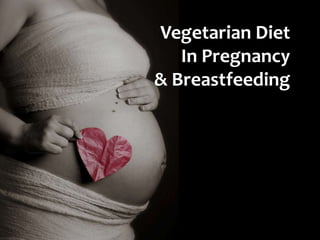
Vegetarian Diet
   In Pregnancy
& Breastfeeding
Nutrient Needs of
Pregnant Vegetarians
  • Increased caloric intake
  • Increased protein
  • Increased iron
  • Increased vitamin B12
  • Increased vitamin D
  • Increased folic acid
  • Increased zinc
  • Increased DHA
  • Increased calcium
  • Increased iodine
Nutrient Needs of
Pregnant Vegetarians
  All of these nutrients can be found in a diverse
  vegetarian diet. Supplements may be
  recommended to ensure adequate levels in
  pregnancy.
Nutrient Needs of
Pregnant Vegetarians
  Iodine
  Vegan women who are pregnant or
  breastfeeding should take an iodine
  supplement to prevent
  hypothyroidism and potential mental
  retardation in their infants.
  Only 30% of prenatal vitamins contain
  adequate amounts of iodine – choose
  carefully
Nutrient Needs of
Pregnant Vegetarians
  Vitamin B12

  Low B12 in pregnancy is associated with an
  increased risk of neural tube defects,
  pre-eclampsia and other pregnancy
  complications.

  Vegans and lacto-ovo vegetarians
  are at risk of deficiency during
  pregnancy.
Nutrient Needs of
Pregnant Vegetarians
  Recommended supplements:
    • Iron (if developing anemia)
    • Folic acid containing prenatal vitamin
    • Vitamin B12
    • Vitamin D (from October to May)
    • Iodine
    • DHA-rich algae
    • Protein supplement and/ or
      calcium supplement (diet
      dependent)
Vegetarian Diet
in Infants and Toddlers
Vegetarian Babies and Toddlers
Breast feeding moms should pay attention
 to getting adequate vitamin B12, vitamin
            D, calcium, zinc, iron and DHA.

  Babies breastfed by vegetarian mothers
         have similar rates of growth and
                development as babies of
                         omnivore moms.
Vegetarian Babies and Toddlers
Protein-rich foods should be among the first
                foods introduced in infancy.

        Pureed tofu, legumes, lentils, peas,
        beans, chick peas, cooked egg yolk,
          goat yogurt, and cottage cheese
                can all be introduced in the
                         first year alongside
              vegetables, fruits and grains.
Vegetarian Babies and Toddlers
Because of the lower digestibility of plant
     protein, daily needs may be higher.

          30% higher up to 2 years of age
                            (1.5g/kg/day)
           20-30% higher for 2-6 year olds
                            (1.3g/kg/day)
               15-20% higher for 6 and up
                           (1.15g/kg/day)
Vegetarian Babies and Toddlers
 DHA is important for nervous system and
 eye development in infants and toddlers.

Preterm infants may not be able to convert
        ALA into EPA and DHA and benefit
             from direct supplementation.
Vegetarian Babies and Toddlers
All breastfed babies (and all Canadian babies
 during the winter) should be supplemented
           with vitamin D regardless of being
                           vegetarian or not.

           Toddlers not consuming fortified
           milk (or fortified alternative milk)
                   products should continue
                    year-round supplements.
Vegetarian Diet
in Children
Vegetarian Kids
  Vegetarian kids have normal growth and
  development from infancy through to
  adulthood.

  Vegan children and teens may be shorter and
  lighter, but are still within the
  range of normal height and weight.
Vegetarian Kids
  Iron is the most common nutrient deficiency
  in childhood (usually associated with
  over-consumption of cows milk).

  Vegetarian kids require more iron to
  compensate for the poor absorption
  of plant-based iron
  (about 1.8x more).
Vegetarian Kids
  Recommended daily iron intake for
  vegetarian kids is:
  Age          Daily Iron Intake
  1-3 years    12mg
  4-8 years    18mg
  9-13 years   14mg

  Supplements may be necessary
  during periods of rapid growth.
Vegetarian Kids
  Calcium intakes in vegan children are often
  below daily recommended intakes.

  Children should consume adequate calcium
  to ensure healthy bone and teeth
  development.

  8 or more servings of
  calcium-rich foods are
  recommended daily.
Vegetarian Diet
      in Teens
Vegetarian Teens
       Teens are one of the fastest growing
                populations of vegetarians.

A well-executed vegetarian diet can provide
        all the calories and nutrients needed
             for the growth and development
                               of adolescents.
Vegetarian Teens
There are concerns that a vegetarian diet
   may mask an eating disorder in teens.

    Education on healthy eating patterns
        is important to ensure a healthy
              vegetarian diet during the
                             teen years.
Vegetarian Teens
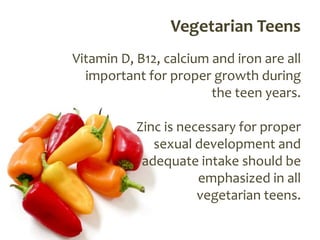
Vitamin D, B12, calcium and iron are all
  important for proper growth during
                        the teen years.

           Zinc is necessary for proper
              sexual development and
            adequate intake should be
                      emphasized in all
                      vegetarian teens.
Vegetarian Teens
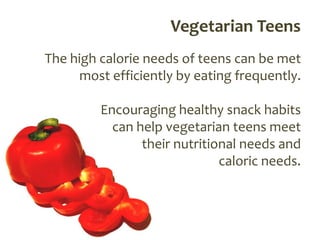
The high calorie needs of teens can be met
      most efficiently by eating frequently.

         Encouraging healthy snack habits
           can help vegetarian teens meet
                their nutritional needs and
                              caloric needs.
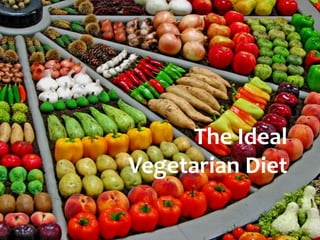
The Ideal
Vegetarian Diet
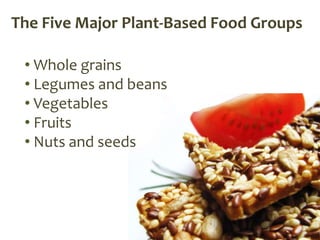
The Five Major Plant-Based Food Groups

 • Whole grains
 • Legumes and beans
 • Vegetables
 • Fruits
 • Nuts and seeds
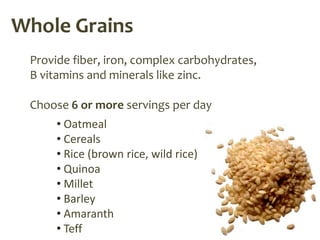
Whole Grains
 Provide fiber, iron, complex carbohydrates,
 B vitamins and minerals like zinc.

 Choose 6 or more servings per day
      • Oatmeal
      • Cereals
      • Rice (brown rice, wild rice)
      • Quinoa
      • Millet
      • Barley
      • Amaranth
      • Teff
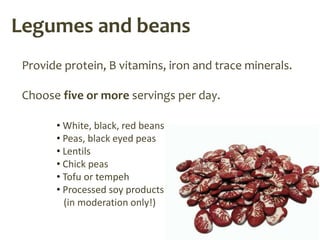
Legumes and beans
 Provide protein, B vitamins, iron and trace minerals.

 Choose five or more servings per day.

       • White, black, red beans
       • Peas, black eyed peas
       • Lentils
       • Chick peas
       • Tofu or tempeh
       • Processed soy products
         (in moderation only!)
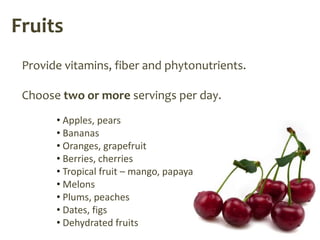
Fruits
 Provide vitamins, fiber and phytonutrients.

 Choose two or more servings per day.
       • Apples, pears
       • Bananas
       • Oranges, grapefruit
       • Berries, cherries
       • Tropical fruit – mango, papaya
       • Melons
       • Plums, peaches
       • Dates, figs
       • Dehydrated fruits
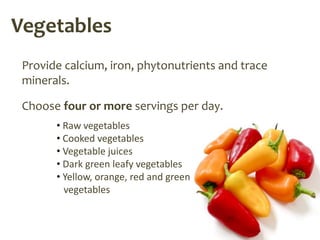
Vegetables
 Provide calcium, iron, phytonutrients and trace
 minerals.

 Choose four or more servings per day.
       • Raw vegetables
       • Cooked vegetables
       • Vegetable juices
       • Dark green leafy vegetables
       • Yellow, orange, red and green
         vegetables
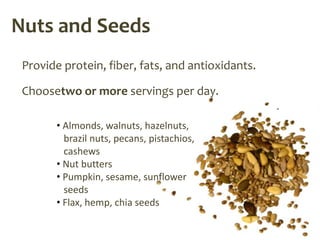
Nuts and Seeds
 Provide protein, fiber, fats, and antioxidants.

 Choosetwo or more servings per day.

       • Almonds, walnuts, hazelnuts,
         brazil nuts, pecans, pistachios,
         cashews
       • Nut butters
       • Pumpkin, sesame, sunflower
         seeds
       • Flax, hemp, chia seeds
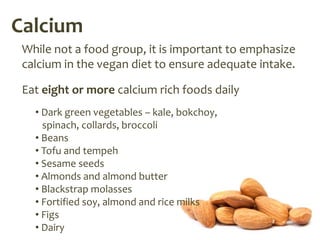
Calcium
 While not a food group, it is important to emphasize
 calcium in the vegan diet to ensure adequate intake.

 Eat eight or more calcium rich foods daily
   • Dark green vegetables – kale, bokchoy,
     spinach, collards, broccoli
   • Beans
   • Tofu and tempeh
   • Sesame seeds
   • Almonds and almond butter
   • Blackstrap molasses
   • Fortified soy, almond and rice milks
   • Figs
   • Dairy
Resources
The Vegetarian Resource Group – www.vrg.org
Toronto Vegetarian Association – www.veg.ca
American Dietetic Association – www.eatright.org
Veg Family Magazine – www.vegfamily.com
References

1.   Van Winckel M, VandeVelde S, De Bruyne R, Van Biervliet S. Clinical practice: vegetarian infant
     and child nutrition. Eur J Pediatr 2011; 170:1489-1494.
2.   Amit M; Canadian Paediatric Society, Community Paediatrics Committee. Vegetarian diets in
     children and adolescents. Paediatr Child Health 20120; 15(5):303-314.
3.    American Dietetic Association. Position of the American Dietetic Association: Vegetarian Diets. J
     Am Diet Assoc 2009; 109(7):1266-1282.
4.   Davis BC, Kris-Etherton PM. Achieving optimal essential fatty acid status in vegetarians: current
     knowledge and practical implications. Am J Clin Nutr 2003;78(suppl):640S–6S.
5.   Hunt, JR. Bioavailability of iron, zinc, and other trace minerals from vegetarian diets. Am J
     ClinNutr 2003; 78(suppl):633S-9S.
6.   Leung AM, LaMar A, He X, Braverman LE, Pearce EN. Iodine status and thyroid function of
     Boston-area vegetarians and vegans. J ClinEndocrinolMetab 2011; 96: E1303-E1307.
7.   Koebnick C, Hoffmann I, Dagnelie PC, Heins UA, et al. Long-term ovo-lacto vegetarian diet
     impairs vitamin B-12 status in pregnant women. J Nutr 2004; 134: 3319-3326.
8.   Appleby PN, Thorogood M, Mann JI, Key TJA. The Oxford Vegetarian Study: an overview. Am J
     ClinNutr 1999; 70(suppl):525S-531S.
9.   Waldmann A, Koschizke JW, Leitzmann C, Hahn A. Dietary iron intake and iron status of German
     female vegans: Results of the German vegan study. Ann NutrMetab 2004; 48:103-108.
References

10. Obeid R, Geisel J, Schorr H, Hubner U, Herrmann W. The impact of vegetarianism on some
    haematologicalparamaters. Eur J Haematol 2002; 69:275-279.
11. Krajcovicova-Kudlackova M, Buckova K, Klimes I, Sebokova E. Iodine deficiency in vegetarians
    and vegans. Ann NutrMetab 2003; 47:183-185.
12. Kim MK, Cho SW, Park YK. Long-term vegetarians have low oxidative stress, body fat, and
    cholesterol levels. Nutr Res Pract 2012; 6(2):155-161.
13. Messina V, Melina V, Mangels AR. A new food guide for North American vegetarians. Can J Diet
    Pract Res. 2003 Summmer; 64(2):82-86.
14. Kniskern MA, Johnston CS. Protein dietary reference intakes may be inadequate for vegetarians
    if low amounts of animal protein are consumed. Nutrition. 2011 Jun; 27(6):727-730.
15. Pribis P, Pencak RC, Grajales T. Beliefs and attitudes toward vegetarian lifestyle across
    generations. Nutrients. 2010 May; 2(5):523-531.
16. Messina M, Messina V. The role of soy in vegetarian diets. Nutrients. 2010 Aug; 2(8):855-888.
17. Jacobs DR, Haddad EH, Lanou AJ, Messina MJ. Food, plant food, and vegetarian diets in the US
    dietary guidelines: conclusions of an expert panel. Am J ClinNutr. 2009 May; 89(5):1549S-1552S.
18. Haddad EH, Sabate J, Whitten CG. Vegetarian food guide pyramid: a conceptual framework. Am
    J ClinNutr. 1999 Sep; 70(3 Suppl):615S-619S.
References

19. Laskowska-Klita T, Chelchowska M, Ambroszkiewicz J, Gajewska J, Klemarczyk W. The effect of
    vegetarian diet on selected essential nutrients in children. Med WiekuRozwoj. 2011; 15(3):318-325.
20. Kawade R. Zinc status and its association with the health of adolescents: a review of studies in
    India. Glob Health Action. 2012; 5:7353.
21. Chiplonkar SA, Tupe R. Development of a diet quality index with special reference to
    micronutrient adequacy for adolescent girls consuming a lacto-vegetarian diet. J Am Diet Assoc.
    2010 Jun; 110(6):926-931.
22. Tupe R, Chiplonkar SA. Diet patterns of lactovegetarian adolescent girls: need for devising
    recipes with high zinc bioavailability. Nutrition. 2010 Apr; 26(4):390-398.
23. Health Canada. Dietary Reference Intake Tables. Available online at:
    http://www.hc-sc.gc.ca/fn-an/nutrition/reference/table/index-eng.php#rvv
24. Lanou AJ, Svenson B. Reduced cancer risk in vegetarians: an analysis of recent reports. Cancer
    Manag Res. 2011; 3:1-8.
25. Tonstad S, Butler T, Fraser GE. Type of vegetarian diet, body weight, and prevalence of Type 2
    diabetes. Diabetes Care. 2009 May; 32(5):791-796.
26. Fraser GE. Vegetarian diets: what do we know of their effects on common chronic diseases? Am J
    ClinNutr 2009 May; 98(5):1607S-1612S.
References

27. Beezhold BL, Johnston CS. Restriction of meat, fish, and poultry in omnivores improves mood: a
    pilot randomized controlled trial. Nutr J. 2012 Feb 14; 11:9.
28. Beezhold BL, Johnston CS, Daigle DR. Vegetarian diets are associated with healthy mood states:
    a cross-sectional study in Seventh Day Adventist adults. Nutr J. 2010; 9:26.
29. Craig WJ. Nutritional concerns and health effects of vegetarian diets. NutrClinPract. 2010 Dec;
    25(6):613-620.
30. Kahleova H, Matoulek M, Malinska H, Oliyarnik O, Kazdova L, Neskudla T, et al. Vegetarian diet
    improves insulin resistance and oxidative stress markers more than conventional diet in subjects
    with Type 2 diabetes. Diabet Med. 2011 May; 28(5):549-559.
31. McEvoy CT, Temple N, Woodside JV. Vegetarian diets, low-meat diets and health: a review. Public
    Health Nutr. 2012 Dec; 15(12):2287-2294.

Vegetarian 101

  • 1.
    Vegetarian 101 Dr. Lisa Watson, ND
  • 2.
  • 3.
    Vegetarian Terminology Vegan –consumes NO animal products (including meat, poultry, fish, eggs, dairy, honey) Lacto-Ovo Vegetarian – consumes no meat, fish or poultry but does consume dairy and/or eggs Pescetarian– consumes no meat or poultry but does consume fish, dairy and/or eggs Flexitarian– consumes a predominantly vegetarian diet but consumes meat or poultry on occasion
  • 4.
    Health Benefits of aVegetarian Diet
  • 5.
    Benefit 1: Decreasedrisk of diabetes Vegetarian diets reduce the risk of developing diabetes and are associated with improved insulin sensitivity and decreased oxidative stress. Vegetarian diets are more successful than omnivore diets in managing existing diabetes.
  • 6.
    Benefit 2: Decreasedrisk of heart disease Vegetarians have lower incidence of heart disease, lower LDL (bad) cholesterol, lower rates of obesity and lower rates of hypertension.
  • 7.
    Benefit 3: Decreasedrisk of obesity On average, vegetarians have lower BMIs (body mass index) than omnivores with vegans having even lower BMIs. Obesity is the main risk factor for a number of chronic conditions including hypertension, heart disease, diabetes and reduced life expenctancy.
  • 8.
    Benefit 4: Improvedmood Vegetarians report less negative mood states than omnivores. When omnivores change over to a vegetarian diet self reported mood states improve. Beezhold BL, Johnston CS. Restriction of meat, fish, and poultry in omnivores improves mood: a pilot randomized controlled trial. Nutr J. 2012 Feb 14;11:9.
  • 9.
    Benefit 5: Decreasedrisk of cancer A vegetarian diet is associated with a decreased incidence of cancer for two main reasons: • vegetarian diets are high in fiber, antioxidants and phytonutrients that are cancer-protective • vegetarian diets contain no red meats or processed meats – both of which have been linked to an increased incidence of cancer.
  • 10.
    Nutritional Needs of Vegetarians
  • 12.
    But some nutrientsare more challenging to get…
  • 13.
    Vitamin B12 Necessary for normal functioning of the brain and nervous system Also required by our body to produce energy and utilize fatty acids
  • 14.
    Vitamin B12 Necessary for normal functioning of the brain and nervous system Also required by our body to produce energy and utilize fatty acids Did you know? No plant or animal can make their own B12 – Only bacteria can synthesize it.
  • 15.
    Vitamin B12 Up to two-thirds of vegans and one-third of vegetarians are deficient. (Up to one-third of omnivores are also deficient) B12 deficiency can lead to anemia (low red blood cells) and nervous system damage. Because folic acid levels are high in vegans and vegetarians a B12 deficiency can be hidden until it is severe and causing symptoms.
  • 16.
    Vitamin B12 Vegetarian sources of B12: • Eggs • Dairy products •Spirulina •Miso •Tempeh • Nutritional yeast • Fortified cereals, soy/ almond/ rice milk • Supplements • Healthy intestinal bacteria
  • 17.
    Vegetarian Science Break Homocysteine– an amino acid found in the blood. High levels are associated with heart disease, stroke, dementia and early mortality. Elevated homocysteine concentration in plasma was observed in 66% of the vegans and about 45-50% of the omnivores and vegetarians. Vegan subjects had significantly higher mean plasma homocysteine levels than omnivores. B-vitamin status and concentrations of homocysteine in Austrian omnivores, vegetarians and vegans. Ann NutrMetab 2006. Why?
  • 18.
    Vegetarian Science Break Deficiency of vitamin B12, folic acid or vitamin B6 can all lead to elevated homocysteine levels. Folic acid and vitamin B6 levels in vegans are usually high compared to omnivores. So B12 deficiency is the most likely cause of high homocysteine in vegans.
  • 19.
    Vegetarian Science Break In the body methionine (an amino acid) is turned into homocysteine. Vitamin B12 is used to turn the homocysteine back into methionine. If there is not enough vitamin B12, then homocysteine levels remain high. American vegans consume an average of 5.6mcg of vitamin B12 through fortified food daily. The recommended intake is 100mcg daily.
  • 20.
    Vegetarian Science Break But don’t vegans have a lower risk of cardiovascular disease? Vegans have lower cholesterol levels and blood pressure than omnivores. However, studies looking at the negative effects of homocysteine adjusted for cholesterol levels and blood pressure and still found an increased incidence of heart disease, stroke, dementia and death.
  • 21.
    Vegetarian Science Break Vitamin B12 offers a safe and effective way to lower homocysteine levels in vegans with no adverse effects. ALL vegans (and most vegetarians) should be taking a daily B12 supplement.
  • 22.
    Riboflavin – VitaminB2 Necessary for energy production and metabolism Used by the body to metabolize fats, carbohydrates and proteins Riboflavin is water-soluble and is not stored in the body. It must be consumed daily. Riboflavin is bright yellow in colour and causes yellowing of the urine when taken in supplements.
  • 23.
    Riboflavin – VitaminB2 Studies suggest that up to 30% of vegans are deficient in riboflavin due to inadequate daily consumption. Symptoms of deficiency include dry, cracked lips, mouth ulcers, cracks at the corner of the mouth and sore throat A diverse diet, supplementation or use of fortified foods is usually enough for most vegetarians and vegans to meet their daily needs.
  • 24.
    Riboflavin – VitaminB2 Vegetarian sources of riboflavin: • Milk, cheese • Fortified bread and cereals • Green leafy vegetables • Legumes • Yeast • Mushrooms • Almonds • Supplements
  • 25.
    Vitamin D Producedin the skin from sun exposure. In Canada we are unable to produce vitamin D from sun rays during the months of October to April. Vitamin D is required for absorption of calcium, for proper functioning of the immune system and decreases the risk of developing over 16 different types of cancer.
  • 26.
    Vitamin D InCanada all dairy products are fortified with vitamin D. Some milk alternatives are also fortified. Vitamin D supplements are recommended for ALL Canadians – infants, children, teens and adults – during the winter months.
  • 27.
    Vitamin D Vegetariansources of Vitamin D: • Fortified dairy products • Fortified soy, almond and rice milks • Sun exposure May-September • Supplements
  • 28.
    Calcium Necessary forthe function of muscles (including the heart), release of neurotransmitters and for calcification of the teeth and bones. Vitamin D is required for calcium absorption. Consumption of animal proteins increases calcium requirements, so vegans may have lower daily needs.
  • 29.
    Calcium Dairy isa popular source of calcium, but this mineral is found in a wide variety of foods. A diverse vegan diet can be rich in calcium. Some plants contain oxalates and phytates, compounds that can inhibit calcium absorption. Eating a wide variety of calcium rich foods will result in better absorption and adequate calcium levels.
  • 30.
    Calcium Vegetariansources of calcium: • Dark green vegetables – kale, bok choy, spinach, collards, broccoli • Beans • Tofu and tempeh • Sesame seeds • Almonds and almond butter • Blackstrap molasses • Fortified soy, almond and rice milks • Figs • Dairy
  • 31.
    Iron Iron isused by red blood cells to carry oxygen to tissues – less iron, less oxygen to our organs, muscles, skin and brain Iron is also necessary for energy production and proper functioning of the immune system.
  • 32.
    Iron Vegetarians typicallyconsume as much iron in their diet as omnivores. However, the iron in vegetables is less bioavailable. It is more difficult to absorb and it is more sensitive to inhibitors of iron absorption. Inhibitors include: •Phytates • Calcium • Polyphenols – found in coffee, tea and red wine
  • 33.
    Science Break -Phytates •Stores phosphorus in plants • Is indigestible by humans • Binds to minerals and makes them unabsorbable • Negatively impacts absorption of iron, zinc and to a lesser extent calcium and magnesium
  • 34.
    Science Break -Phytates •Found in nuts, grains, beans and seeds • To decrease the impact of phytates: • Cook your food • Fermentation • Sprouting • Vitamin C – decreases impact of phytates on iron absorption
  • 35.
    Iron Because ofthe lower bioavailability of iron from a vegetarian diet, the recommended iron intakes for vegetarians are 1.8 times that of nonvegetarians. Position of the American Dietetic Association: Vegetarian Diets. J Am Diet Assoc. 2009;109: 1266-1282.
  • 36.
    Iron Vegetarians adaptto lower absorption of iron and have the same incidence of anemia as non-vegetarians. Women, children, teens, pregnant and breast feeding mothers should be diligent about maintaining adequate iron levels and stores.
  • 37.
    Iron Vegetariansources of iron: • Soy beans and tofu • Lentils • Spinach and dark green leafy vegetables • Sesame seeds • Chick peas (Garbanzo beans) • Lima beans and navy beans • Olives • Fortified cereals • Blackstrap molasses
  • 38.
    Iodine Necessaryfor thyroid function and breast health. Vegans who do not consume table salt or sea vegetables are often deficient in iodine because plant-based diets are low in iodine. Iodine is added to many foods to ensure sufficient intake: • Table salt • Flour • Milk
  • 39.
    Iodine Thesalt used in processed foods is NOT iodized Sea salt, pink salt, gray salt, etc are not iodized and may not contain adequate amounts of iodine. Vegetarian sources of iodine: • Iodized table salt • Sea vegetables (kelp, nori, wakame) • Dairy products • Eggs
  • 40.
    Zinc Needed forimmune functioning, protein synthesis, wound healing, DNA synthesis and cell division. Zinc is of particular importance during periods of growth (pregnancy, infancy, childhood, teens) and during sexual maturation (teens). Animal products provide the majority of zinc in North American diets.
  • 41.
    Zinc Zinc maybe deficient in vegan diets that are high in phytates. Zinc must be consumed daily because our bodies have no storage for this mineral. Vegetarians need up to 50% more zinc than the recommended daily allowance to compensate for the poor absorption of zinc from plant-based diets.
  • 42.
    Zinc Vegetarian sourcesof zinc: • Soy beans and tofu • Lentils • Beans • Grains (especially oats) • Nuts • Pumpkin and sesame seeds • Mushrooms • Cheese and yogurt
  • 43.
    Omega 3 FattyAcids The omega 3 fatty acids, docosahexanoic acid (DHA) and eicosapentanoic acid (EPA) are necessary for cardiovascular health, mental health, brain health and eye health. Vegan diets that do not contain eggs, fish or abundant amounts of algae are often deficient in omega 3s.
  • 44.
    Omega 3 FattyAcids Vegan diets are rich in omega 6s (found in vegetable oils, canola oil, soybean oil, corn oil and sunflower oil) which can prevent utilization of omega 3s by our cells. The ideal balance of omega 6s to omega 3s is 1:1 to 4:1. Omnivores in North American average a ratio of 10:1, vegetarians 16:1 and vegans 20:1.
  • 45.
    Omega 3 FattyAcids Omega 6 fatty acids are pro-inflammatory, pro-thrombotic and pro-constrictive. An imbalance of omega 6 to omega 3 can contribute to cancer, arthritis, inflammation and heart disease.
  • 46.
    Omega 3 FattyAcids The omega 3 fatty acid found in plants, alpha-linolenic acid (ALA) can be converted into EPA and DHA. The conversion rate to EPA is typically 5-10%. The conversion rate to DHA is even worse (2-5%). Micro-algae can provide a vegan source of DHA and can increase EPA levels as well (through a process known as retroconversion).
  • 47.
    Omega 3 FattyAcids Vegan requirements for ALA are DOUBLE that of the recommended daily allowance in order to compensate for the poor conversion rates. Vegetarian sources of Omega 3s • Flaxseeds • Walnuts • Soy • Hempseeds • DHA rich micro-algae • Dark green leafy vegetables • Eggs
  • 48.
    Protein & EssentialAmino Acids Protein provides the body with amino acids which are used as a source of energy and as building blocks for muscles, skin, hormones, and enzymes. Amino acids that can not be made by our body are considered essential. The essential amino acids are: •Leucine •Tryptophan •Isoleucine •Methionine •Valine • Phenylalanine • Lysine •Histidine •Threonine
  • 49.
    Protein & EssentialAmino Acids Eating a diverse selection of plant foods will ensure you get enough essential amino acids in your diet. Legumes are high in lysine, but low in methionine. Grains are high in methionine but low in lysine. Eating both grains and legumes, as well as vegetables and fruits will provide all the essential amino acids.
  • 50.
    Protein & EssentialAmino Acids Food Combining: It is not necessary to consume both grains and legumes in the same meal to meet your need for essential amino acids. Eating them over the course of a single day is adequate. Vegetarians should aim to consume 1.0g of protein per kg of body weight daily to meet their personal needs.
  • 51.
    Protein & EssentialAmino Acids Vegetarian Sources of Protein • Soy beans, tofu, tempeh • Legumes, lentils, peas • Beans (black, white, red, chick peas) • Quinoa • Nuts and nut butters • Seeds • Brown rice • Spinach • Broccoli • Eggs • Dairy
  • 52.
    Don’t Think YouCan Get Enough Protein? Bigger vegetarians than YOU: • Horses (1000 Lbs) • Cows (1650 Lbs) • Hippopotamus (7000 Lbs) • Elephants (16 000 Lbs) •Argentinosaurus (200 000 Lbs)
  • 53.
  • 54.
    What about SOY? Soy beans (Glycine max) are a legume that are: • High in protein • High in fat • Low in carbohydrates • A source of omega 3 ALA • A source of isoflavones
  • 55.
    What about SOY? Isoflavones – The source of the soy controversy •Soy contains genistein, daidzein and glycitein •Isoflavones are mildly estrogenic – they are able to bind to estrogen receptors in the body •Isoflavones bind selectively to beta estrogen receptors and are classified as natural selective estrogen receptor modulators (SERMs) • SERMS have estrogen-like effects in some tissues, but not in others
  • 56.
    What about SOY? Soy and Breast Cancer In mice studies, genistein can increase the growth of estrogen-sensitive tumours •The amount used in these studies was 20x normal human exposure •Mice also lack the ability to detoxify isoflavones, causing higher circulating amounts. Humans can detoxify isoflavones efficiently and
  • 57.
    What about SOY? Soy and Breast Cancer In human studies soy has been found to NOT alter markers of breast cancer risk, including breast tissue density and breast cell proliferation. In fact, post-diagnosis consumption of soy food is associated with a better prognosis (measured by mortality and tumour recurrence)
  • 58.
    What about SOY? Soy and Feminization of Boys Soy and soyfoods do not alter testosterone or dihydrotestosterone levels. Clinical studies have also found no impact of soy consumption on sperm count or motility.
  • 59.
    What about SOY? Soy and Thyroid Function Soy can interfere with absorption of Synthroid, as can many other fiber-rich foods. Soy can worsen hypothyroid symptoms if iodine levels are not adequate.
  • 60.
    SO… Should Ieat soy? Yes. Soy is safe and is an easy and effective way to increase protein and fiber in your diet. How much? Research suggests 2-3 servings per day is enough to reap the benefits of soy. Choose less processed soy foods and incorporate them into a diverse vegetarian diet.
  • 61.
  • 62.
    Vegetarian Diet In Pregnancy & Breastfeeding
  • 63.
    Nutrient Needs of PregnantVegetarians • Increased caloric intake • Increased protein • Increased iron • Increased vitamin B12 • Increased vitamin D • Increased folic acid • Increased zinc • Increased DHA • Increased calcium • Increased iodine
  • 64.
    Nutrient Needs of PregnantVegetarians All of these nutrients can be found in a diverse vegetarian diet. Supplements may be recommended to ensure adequate levels in pregnancy.
  • 65.
    Nutrient Needs of PregnantVegetarians Iodine Vegan women who are pregnant or breastfeeding should take an iodine supplement to prevent hypothyroidism and potential mental retardation in their infants. Only 30% of prenatal vitamins contain adequate amounts of iodine – choose carefully
  • 66.
    Nutrient Needs of PregnantVegetarians Vitamin B12 Low B12 in pregnancy is associated with an increased risk of neural tube defects, pre-eclampsia and other pregnancy complications. Vegans and lacto-ovo vegetarians are at risk of deficiency during pregnancy.
  • 67.
    Nutrient Needs of PregnantVegetarians Recommended supplements: • Iron (if developing anemia) • Folic acid containing prenatal vitamin • Vitamin B12 • Vitamin D (from October to May) • Iodine • DHA-rich algae • Protein supplement and/ or calcium supplement (diet dependent)
  • 68.
  • 69.
    Vegetarian Babies andToddlers Breast feeding moms should pay attention to getting adequate vitamin B12, vitamin D, calcium, zinc, iron and DHA. Babies breastfed by vegetarian mothers have similar rates of growth and development as babies of omnivore moms.
  • 70.
    Vegetarian Babies andToddlers Protein-rich foods should be among the first foods introduced in infancy. Pureed tofu, legumes, lentils, peas, beans, chick peas, cooked egg yolk, goat yogurt, and cottage cheese can all be introduced in the first year alongside vegetables, fruits and grains.
  • 71.
    Vegetarian Babies andToddlers Because of the lower digestibility of plant protein, daily needs may be higher. 30% higher up to 2 years of age (1.5g/kg/day) 20-30% higher for 2-6 year olds (1.3g/kg/day) 15-20% higher for 6 and up (1.15g/kg/day)
  • 72.
    Vegetarian Babies andToddlers DHA is important for nervous system and eye development in infants and toddlers. Preterm infants may not be able to convert ALA into EPA and DHA and benefit from direct supplementation.
  • 73.
    Vegetarian Babies andToddlers All breastfed babies (and all Canadian babies during the winter) should be supplemented with vitamin D regardless of being vegetarian or not. Toddlers not consuming fortified milk (or fortified alternative milk) products should continue year-round supplements.
  • 74.
  • 75.
    Vegetarian Kids Vegetarian kids have normal growth and development from infancy through to adulthood. Vegan children and teens may be shorter and lighter, but are still within the range of normal height and weight.
  • 76.
    Vegetarian Kids Iron is the most common nutrient deficiency in childhood (usually associated with over-consumption of cows milk). Vegetarian kids require more iron to compensate for the poor absorption of plant-based iron (about 1.8x more).
  • 77.
    Vegetarian Kids Recommended daily iron intake for vegetarian kids is: Age Daily Iron Intake 1-3 years 12mg 4-8 years 18mg 9-13 years 14mg Supplements may be necessary during periods of rapid growth.
  • 78.
    Vegetarian Kids Calcium intakes in vegan children are often below daily recommended intakes. Children should consume adequate calcium to ensure healthy bone and teeth development. 8 or more servings of calcium-rich foods are recommended daily.
  • 79.
  • 80.
    Vegetarian Teens Teens are one of the fastest growing populations of vegetarians. A well-executed vegetarian diet can provide all the calories and nutrients needed for the growth and development of adolescents.
  • 81.
    Vegetarian Teens There areconcerns that a vegetarian diet may mask an eating disorder in teens. Education on healthy eating patterns is important to ensure a healthy vegetarian diet during the teen years.
  • 82.
    Vegetarian Teens Vitamin D,B12, calcium and iron are all important for proper growth during the teen years. Zinc is necessary for proper sexual development and adequate intake should be emphasized in all vegetarian teens.
  • 83.
    Vegetarian Teens The highcalorie needs of teens can be met most efficiently by eating frequently. Encouraging healthy snack habits can help vegetarian teens meet their nutritional needs and caloric needs.
  • 84.
  • 85.
    The Five MajorPlant-Based Food Groups • Whole grains • Legumes and beans • Vegetables • Fruits • Nuts and seeds
  • 86.
    Whole Grains Providefiber, iron, complex carbohydrates, B vitamins and minerals like zinc. Choose 6 or more servings per day • Oatmeal • Cereals • Rice (brown rice, wild rice) • Quinoa • Millet • Barley • Amaranth • Teff
  • 87.
    Legumes and beans Provide protein, B vitamins, iron and trace minerals. Choose five or more servings per day. • White, black, red beans • Peas, black eyed peas • Lentils • Chick peas • Tofu or tempeh • Processed soy products (in moderation only!)
  • 88.
    Fruits Provide vitamins,fiber and phytonutrients. Choose two or more servings per day. • Apples, pears • Bananas • Oranges, grapefruit • Berries, cherries • Tropical fruit – mango, papaya • Melons • Plums, peaches • Dates, figs • Dehydrated fruits
  • 89.
    Vegetables Provide calcium,iron, phytonutrients and trace minerals. Choose four or more servings per day. • Raw vegetables • Cooked vegetables • Vegetable juices • Dark green leafy vegetables • Yellow, orange, red and green vegetables
  • 90.
    Nuts and Seeds Provide protein, fiber, fats, and antioxidants. Choosetwo or more servings per day. • Almonds, walnuts, hazelnuts, brazil nuts, pecans, pistachios, cashews • Nut butters • Pumpkin, sesame, sunflower seeds • Flax, hemp, chia seeds
  • 91.
    Calcium While nota food group, it is important to emphasize calcium in the vegan diet to ensure adequate intake. Eat eight or more calcium rich foods daily • Dark green vegetables – kale, bokchoy, spinach, collards, broccoli • Beans • Tofu and tempeh • Sesame seeds • Almonds and almond butter • Blackstrap molasses • Fortified soy, almond and rice milks • Figs • Dairy
  • 92.
  • 93.
    The Vegetarian ResourceGroup – www.vrg.org Toronto Vegetarian Association – www.veg.ca American Dietetic Association – www.eatright.org Veg Family Magazine – www.vegfamily.com
  • 94.
    References 1. Van Winckel M, VandeVelde S, De Bruyne R, Van Biervliet S. Clinical practice: vegetarian infant and child nutrition. Eur J Pediatr 2011; 170:1489-1494. 2. Amit M; Canadian Paediatric Society, Community Paediatrics Committee. Vegetarian diets in children and adolescents. Paediatr Child Health 20120; 15(5):303-314. 3. American Dietetic Association. Position of the American Dietetic Association: Vegetarian Diets. J Am Diet Assoc 2009; 109(7):1266-1282. 4. Davis BC, Kris-Etherton PM. Achieving optimal essential fatty acid status in vegetarians: current knowledge and practical implications. Am J Clin Nutr 2003;78(suppl):640S–6S. 5. Hunt, JR. Bioavailability of iron, zinc, and other trace minerals from vegetarian diets. Am J ClinNutr 2003; 78(suppl):633S-9S. 6. Leung AM, LaMar A, He X, Braverman LE, Pearce EN. Iodine status and thyroid function of Boston-area vegetarians and vegans. J ClinEndocrinolMetab 2011; 96: E1303-E1307. 7. Koebnick C, Hoffmann I, Dagnelie PC, Heins UA, et al. Long-term ovo-lacto vegetarian diet impairs vitamin B-12 status in pregnant women. J Nutr 2004; 134: 3319-3326. 8. Appleby PN, Thorogood M, Mann JI, Key TJA. The Oxford Vegetarian Study: an overview. Am J ClinNutr 1999; 70(suppl):525S-531S. 9. Waldmann A, Koschizke JW, Leitzmann C, Hahn A. Dietary iron intake and iron status of German female vegans: Results of the German vegan study. Ann NutrMetab 2004; 48:103-108.
  • 95.
    References 10. Obeid R,Geisel J, Schorr H, Hubner U, Herrmann W. The impact of vegetarianism on some haematologicalparamaters. Eur J Haematol 2002; 69:275-279. 11. Krajcovicova-Kudlackova M, Buckova K, Klimes I, Sebokova E. Iodine deficiency in vegetarians and vegans. Ann NutrMetab 2003; 47:183-185. 12. Kim MK, Cho SW, Park YK. Long-term vegetarians have low oxidative stress, body fat, and cholesterol levels. Nutr Res Pract 2012; 6(2):155-161. 13. Messina V, Melina V, Mangels AR. A new food guide for North American vegetarians. Can J Diet Pract Res. 2003 Summmer; 64(2):82-86. 14. Kniskern MA, Johnston CS. Protein dietary reference intakes may be inadequate for vegetarians if low amounts of animal protein are consumed. Nutrition. 2011 Jun; 27(6):727-730. 15. Pribis P, Pencak RC, Grajales T. Beliefs and attitudes toward vegetarian lifestyle across generations. Nutrients. 2010 May; 2(5):523-531. 16. Messina M, Messina V. The role of soy in vegetarian diets. Nutrients. 2010 Aug; 2(8):855-888. 17. Jacobs DR, Haddad EH, Lanou AJ, Messina MJ. Food, plant food, and vegetarian diets in the US dietary guidelines: conclusions of an expert panel. Am J ClinNutr. 2009 May; 89(5):1549S-1552S. 18. Haddad EH, Sabate J, Whitten CG. Vegetarian food guide pyramid: a conceptual framework. Am J ClinNutr. 1999 Sep; 70(3 Suppl):615S-619S.
  • 96.
    References 19. Laskowska-Klita T,Chelchowska M, Ambroszkiewicz J, Gajewska J, Klemarczyk W. The effect of vegetarian diet on selected essential nutrients in children. Med WiekuRozwoj. 2011; 15(3):318-325. 20. Kawade R. Zinc status and its association with the health of adolescents: a review of studies in India. Glob Health Action. 2012; 5:7353. 21. Chiplonkar SA, Tupe R. Development of a diet quality index with special reference to micronutrient adequacy for adolescent girls consuming a lacto-vegetarian diet. J Am Diet Assoc. 2010 Jun; 110(6):926-931. 22. Tupe R, Chiplonkar SA. Diet patterns of lactovegetarian adolescent girls: need for devising recipes with high zinc bioavailability. Nutrition. 2010 Apr; 26(4):390-398. 23. Health Canada. Dietary Reference Intake Tables. Available online at: http://www.hc-sc.gc.ca/fn-an/nutrition/reference/table/index-eng.php#rvv 24. Lanou AJ, Svenson B. Reduced cancer risk in vegetarians: an analysis of recent reports. Cancer Manag Res. 2011; 3:1-8. 25. Tonstad S, Butler T, Fraser GE. Type of vegetarian diet, body weight, and prevalence of Type 2 diabetes. Diabetes Care. 2009 May; 32(5):791-796. 26. Fraser GE. Vegetarian diets: what do we know of their effects on common chronic diseases? Am J ClinNutr 2009 May; 98(5):1607S-1612S.
  • 97.
    References 27. Beezhold BL,Johnston CS. Restriction of meat, fish, and poultry in omnivores improves mood: a pilot randomized controlled trial. Nutr J. 2012 Feb 14; 11:9. 28. Beezhold BL, Johnston CS, Daigle DR. Vegetarian diets are associated with healthy mood states: a cross-sectional study in Seventh Day Adventist adults. Nutr J. 2010; 9:26. 29. Craig WJ. Nutritional concerns and health effects of vegetarian diets. NutrClinPract. 2010 Dec; 25(6):613-620. 30. Kahleova H, Matoulek M, Malinska H, Oliyarnik O, Kazdova L, Neskudla T, et al. Vegetarian diet improves insulin resistance and oxidative stress markers more than conventional diet in subjects with Type 2 diabetes. Diabet Med. 2011 May; 28(5):549-559. 31. McEvoy CT, Temple N, Woodside JV. Vegetarian diets, low-meat diets and health: a review. Public Health Nutr. 2012 Dec; 15(12):2287-2294.

Editor's Notes

  • #36 Heme iron is 15-40% absorbed. Non-heme iron is 1-15% absorbed.