© Boardworks Ltd 20131 of 24
This icon indicates the slide contains activities created in Flash. These activities are not editable.
For more detailed instructions, see the Getting Started presentation.
This icon indicates an accompanying worksheet.
This icon indicates teacher’s notes in the
Notes field.
© Boardworks Ltd 20132 of 24
© Boardworks Ltd 20133 of 24
Rounding
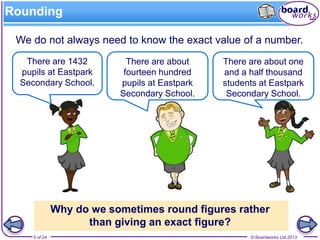
We do not always need to know the exact value of a number.
There are about
fourteen hundred
pupils at Eastpark
Secondary School.
There are 1432
pupils at Eastpark
Secondary School.
There are about one
and a half thousand
students at Eastpark
Secondary School.
Why do we sometimes round figures rather
than giving an exact figure?
© Boardworks Ltd 20134 of 24
Rounding
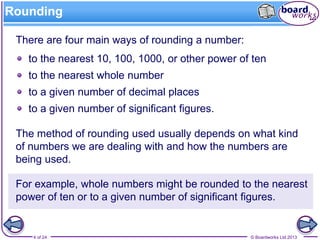
There are four main ways of rounding a number:
The method of rounding used usually depends on what kind
of numbers we are dealing with and how the numbers are
being used.
For example, whole numbers might be rounded to the nearest
power of ten or to a given number of significant figures.
to the nearest 10, 100, 1000, or other power of ten
to the nearest whole number
to a given number of decimal places
to a given number of significant figures.
© Boardworks Ltd 20135 of 24
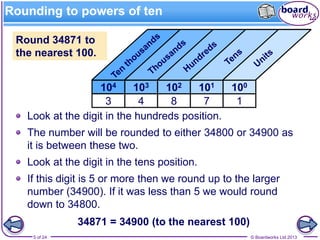
Round 34871 to
the nearest 100.
Look at the digit in the hundreds position.
The number will be rounded to either 34800 or 34900 as
it is between these two.
Look at the digit in the tens position.
If this digit is 5 or more then we round up to the larger
number (34900). If it was less than 5 we would round
down to 34800.
34871 = 34900 (to the nearest 100)
Rounding to powers of ten
100101102103104
17843
© Boardworks Ltd 20136 of 24
Rounding to powers of ten
© Boardworks Ltd 20137 of 24
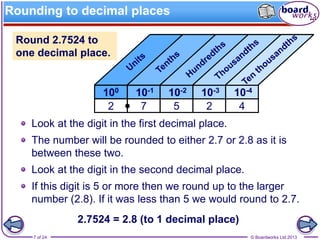
Round 2.7524 to
one decimal place.
Look at the digit in the first decimal place.
The number will be rounded to either 2.7 or 2.8 as it is
between these two.
Look at the digit in the second decimal place.
If this digit is 5 or more then we round up to the larger
number (2.8). If it was less than 5 we would round to 2.7.
2.7524 = 2.8 (to 1 decimal place)
Rounding to decimal places
10-410-310-210-1100
42572
© Boardworks Ltd 20138 of 24
Rounding to decimal places
© Boardworks Ltd 20139 of 24
Rounding to significant figures
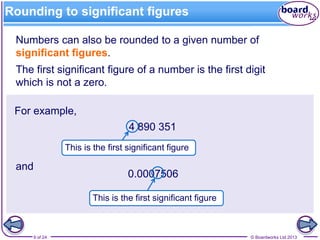
Numbers can also be rounded to a given number of
significant figures.
The first significant figure of a number is the first digit
which is not a zero.
For example,
4 890 351
and
0.0007506
This is the first significant figure
© Boardworks Ltd 201310 of 24
Rounding to significant figures
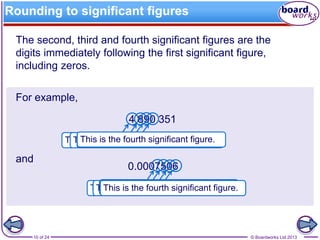
The second, third and fourth significant figures are the
digits immediately following the first significant figure,
including zeros.
For example,
4 890 351
and
0.0007506
This is the first significant figure.This is the second significant figure.This is the third significant figure.This is the fourth significant figure.
© Boardworks Ltd 201311 of 24
Rounding to significant figures
© Boardworks Ltd 201312 of 24
© Boardworks Ltd 201313 of 24
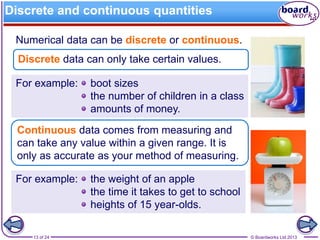
Discrete and continuous quantities
Numerical data can be discrete or continuous.
Discrete data can only take certain values.
Continuous data comes from measuring and
can take any value within a given range. It is
only as accurate as your method of measuring.
For example: boot sizes
the number of children in a class
amounts of money.
For example: the weight of an apple
the time it takes to get to school
heights of 15 year-olds.
© Boardworks Ltd 201314 of 24
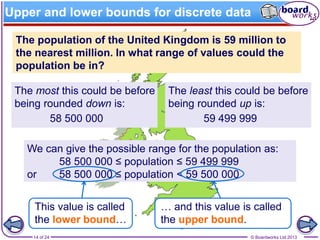
The most this could be before
being rounded down is:
Upper and lower bounds for discrete data
The population of the United Kingdom is 59 million to
the nearest million. In what range of values could the
population be in?
The least this could be before
being rounded up is:
58 500 000 59 499 999
We can give the possible range for the population as:
58 500 000 ≤ population ≤ 59 499 999
or 58 500 000 ≤ population < 59 500 000
This value is called
the lower bound…
… and this value is called
the upper bound.
© Boardworks Ltd 201315 of 24
Upper and lower bounds for discrete data
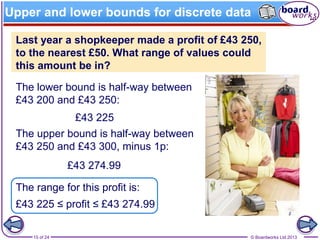
Last year a shopkeeper made a profit of £43 250,
to the nearest £50. What range of values could
this amount be in?
The lower bound is half-way between
£43 200 and £43 250:
£43 225
The upper bound is half-way between
£43 250 and £43 300, minus 1p:
£43 274.99
£43 225 ≤ profit ≤ £43 274.99
The range for this profit is:
© Boardworks Ltd 201316 of 24
Upper and lower bounds for discrete data
© Boardworks Ltd 201317 of 24
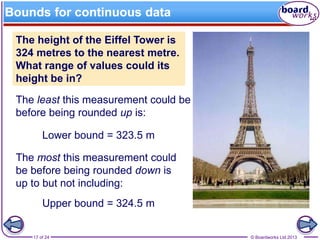
Bounds for continuous data
The height of the Eiffel Tower is
324 metres to the nearest metre.
What range of values could its
height be in?
The least this measurement could be
before being rounded up is:
Lower bound = 323.5 m
The most this measurement could
be before being rounded down is
up to but not including:
Upper bound = 324.5 m
© Boardworks Ltd 201318 of 24
Bounds for continuous data
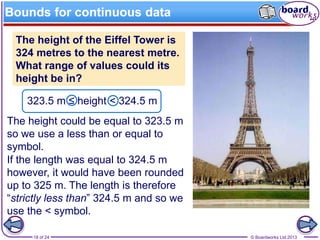
323.5 m ≤ height < 324.5 m
The height could be equal to 323.5 m
so we use a less than or equal to
symbol.
If the length was equal to 324.5 m
however, it would have been rounded
up to 325 m. The length is therefore
“strictly less than” 324.5 m and so we
use the < symbol.
The height of the Eiffel Tower is
324 metres to the nearest metre.
What range of values could its
height be in?
© Boardworks Ltd 201319 of 24
Upper and lower bounds
© Boardworks Ltd 201320 of 24
© Boardworks Ltd 201321 of 24
Village signs
© Boardworks Ltd 201322 of 24
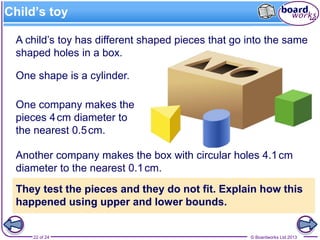
A child’s toy has different shaped pieces that go into the same
shaped holes in a box.
Child’s toy
Another company makes the box with circular holes 4.1cm
diameter to the nearest 0.1cm.
They test the pieces and they do not fit. Explain how this
happened using upper and lower bounds.
One company makes the
pieces 4cm diameter to
the nearest 0.5cm.
One shape is a cylinder.
© Boardworks Ltd 201323 of 24
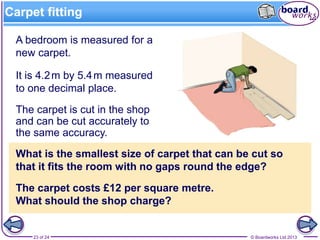
Carpet fitting
What is the smallest size of carpet that can be cut so
that it fits the room with no gaps round the edge?
The carpet is cut in the shop
and can be cut accurately to
the same accuracy.
The carpet costs £12 per square metre.
What should the shop charge?
A bedroom is measured for a
new carpet.
It is 4.2m by 5.4m measured
to one decimal place.
© Boardworks Ltd 201324 of 24
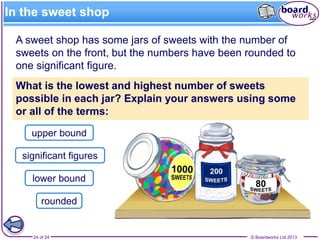
In the sweet shop
upper bound
lower bound
significant figures
rounded
A sweet shop has some jars of sweets with the number of
sweets on the front, but the numbers have been rounded to
one significant figure.
What is the lowest and highest number of sweets
possible in each jar? Explain your answers using some
or all of the terms:

Approximation and estimation

  • 1.
    © Boardworks Ltd20131 of 24 This icon indicates the slide contains activities created in Flash. These activities are not editable. For more detailed instructions, see the Getting Started presentation. This icon indicates an accompanying worksheet. This icon indicates teacher’s notes in the Notes field.
  • 2.
    © Boardworks Ltd20132 of 24
  • 3.
    © Boardworks Ltd20133 of 24 Rounding We do not always need to know the exact value of a number. There are about fourteen hundred pupils at Eastpark Secondary School. There are 1432 pupils at Eastpark Secondary School. There are about one and a half thousand students at Eastpark Secondary School. Why do we sometimes round figures rather than giving an exact figure?
  • 4.
    © Boardworks Ltd20134 of 24 Rounding There are four main ways of rounding a number: The method of rounding used usually depends on what kind of numbers we are dealing with and how the numbers are being used. For example, whole numbers might be rounded to the nearest power of ten or to a given number of significant figures. to the nearest 10, 100, 1000, or other power of ten to the nearest whole number to a given number of decimal places to a given number of significant figures.
  • 5.
    © Boardworks Ltd20135 of 24 Round 34871 to the nearest 100. Look at the digit in the hundreds position. The number will be rounded to either 34800 or 34900 as it is between these two. Look at the digit in the tens position. If this digit is 5 or more then we round up to the larger number (34900). If it was less than 5 we would round down to 34800. 34871 = 34900 (to the nearest 100) Rounding to powers of ten 100101102103104 17843
  • 6.
    © Boardworks Ltd20136 of 24 Rounding to powers of ten
  • 7.
    © Boardworks Ltd20137 of 24 Round 2.7524 to one decimal place. Look at the digit in the first decimal place. The number will be rounded to either 2.7 or 2.8 as it is between these two. Look at the digit in the second decimal place. If this digit is 5 or more then we round up to the larger number (2.8). If it was less than 5 we would round to 2.7. 2.7524 = 2.8 (to 1 decimal place) Rounding to decimal places 10-410-310-210-1100 42572
  • 8.
    © Boardworks Ltd20138 of 24 Rounding to decimal places
  • 9.
    © Boardworks Ltd20139 of 24 Rounding to significant figures Numbers can also be rounded to a given number of significant figures. The first significant figure of a number is the first digit which is not a zero. For example, 4 890 351 and 0.0007506 This is the first significant figure This is the first significant figure
  • 10.
    © Boardworks Ltd201310 of 24 Rounding to significant figures The second, third and fourth significant figures are the digits immediately following the first significant figure, including zeros. For example, 4 890 351 and 0.0007506 This is the first significant figure.This is the second significant figure.This is the third significant figure.This is the fourth significant figure. This is the first significant figure.This is the second significant figure.This is the third significant figure.This is the fourth significant figure.
  • 11.
    © Boardworks Ltd201311 of 24 Rounding to significant figures
  • 12.
    © Boardworks Ltd201312 of 24
  • 13.
    © Boardworks Ltd201313 of 24 Discrete and continuous quantities Numerical data can be discrete or continuous. Discrete data can only take certain values. Continuous data comes from measuring and can take any value within a given range. It is only as accurate as your method of measuring. For example: boot sizes the number of children in a class amounts of money. For example: the weight of an apple the time it takes to get to school heights of 15 year-olds.
  • 14.
    © Boardworks Ltd201314 of 24 The most this could be before being rounded down is: Upper and lower bounds for discrete data The population of the United Kingdom is 59 million to the nearest million. In what range of values could the population be in? The least this could be before being rounded up is: 58 500 000 59 499 999 We can give the possible range for the population as: 58 500 000 ≤ population ≤ 59 499 999 or 58 500 000 ≤ population < 59 500 000 This value is called the lower bound… … and this value is called the upper bound.
  • 15.
    © Boardworks Ltd201315 of 24 Upper and lower bounds for discrete data Last year a shopkeeper made a profit of £43 250, to the nearest £50. What range of values could this amount be in? The lower bound is half-way between £43 200 and £43 250: £43 225 The upper bound is half-way between £43 250 and £43 300, minus 1p: £43 274.99 £43 225 ≤ profit ≤ £43 274.99 The range for this profit is:
  • 16.
    © Boardworks Ltd201316 of 24 Upper and lower bounds for discrete data
  • 17.
    © Boardworks Ltd201317 of 24 Bounds for continuous data The height of the Eiffel Tower is 324 metres to the nearest metre. What range of values could its height be in? The least this measurement could be before being rounded up is: Lower bound = 323.5 m The most this measurement could be before being rounded down is up to but not including: Upper bound = 324.5 m
  • 18.
    © Boardworks Ltd201318 of 24 Bounds for continuous data 323.5 m ≤ height < 324.5 m The height could be equal to 323.5 m so we use a less than or equal to symbol. If the length was equal to 324.5 m however, it would have been rounded up to 325 m. The length is therefore “strictly less than” 324.5 m and so we use the < symbol. The height of the Eiffel Tower is 324 metres to the nearest metre. What range of values could its height be in?
  • 19.
    © Boardworks Ltd201319 of 24 Upper and lower bounds
  • 20.
    © Boardworks Ltd201320 of 24
  • 21.
    © Boardworks Ltd201321 of 24 Village signs
  • 22.
    © Boardworks Ltd201322 of 24 A child’s toy has different shaped pieces that go into the same shaped holes in a box. Child’s toy Another company makes the box with circular holes 4.1cm diameter to the nearest 0.1cm. They test the pieces and they do not fit. Explain how this happened using upper and lower bounds. One company makes the pieces 4cm diameter to the nearest 0.5cm. One shape is a cylinder.
  • 23.
    © Boardworks Ltd201323 of 24 Carpet fitting What is the smallest size of carpet that can be cut so that it fits the room with no gaps round the edge? The carpet is cut in the shop and can be cut accurately to the same accuracy. The carpet costs £12 per square metre. What should the shop charge? A bedroom is measured for a new carpet. It is 4.2m by 5.4m measured to one decimal place.
  • 24.
    © Boardworks Ltd201324 of 24 In the sweet shop upper bound lower bound significant figures rounded A sweet shop has some jars of sweets with the number of sweets on the front, but the numbers have been rounded to one significant figure. What is the lowest and highest number of sweets possible in each jar? Explain your answers using some or all of the terms: