Multivariable Calculus With Theory Lecture Notes Prof Christine Breiner
Multivariable Calculus With Theory Lecture Notes Prof Christine Breiner
Multivariable Calculus With Theory Lecture Notes Prof Christine Breiner
Multivariable Calculus With Theory Lecture Notes Prof Christine Breiner
Multivariable Calculus With Theory Lecture Notes Prof Christine Breiner
1.
Multivariable Calculus WithTheory Lecture Notes
Prof Christine Breiner download
https://ebookbell.com/product/multivariable-calculus-with-theory-
lecture-notes-prof-christine-breiner-51795002
Explore and download more ebooks at ebookbell.com
2.
Here are somerecommended products that we believe you will be
interested in. You can click the link to download.
Multivariable Calculus With Matlab With Applications To Geometry And
Physics 1st Ronald L Lipsman
https://ebookbell.com/product/multivariable-calculus-with-matlab-with-
applications-to-geometry-and-physics-1st-ronald-l-lipsman-6806494
Multivariable Calculus With Applications 1st Ed 2017 Peter D Lax
https://ebookbell.com/product/multivariable-calculus-with-
applications-1st-ed-2017-peter-d-lax-6986188
Multivariable Calculus Concepts And Contexts With Tools For Enriching
Calculus Interactive Video Skillbuilder Cdrom And Ilrn Homework
Personal Tutor 3rd Edition James Stewart
https://ebookbell.com/product/multivariable-calculus-concepts-and-
contexts-with-tools-for-enriching-calculus-interactive-video-
skillbuilder-cdrom-and-ilrn-homework-personal-tutor-3rd-edition-james-
stewart-2410822
Calclabs With Mathematica For Stewarts Multivariable Calculus 6th
Edition Selwyn Hollis
https://ebookbell.com/product/calclabs-with-mathematica-for-stewarts-
multivariable-calculus-6th-edition-selwyn-hollis-44169002
3.
Multivariable Calculus 8Ed Lopez Robertstewart James
https://ebookbell.com/product/multivariable-calculus-8-ed-lopez-
robertstewart-james-21355016
Multivariable Calculus 2 Edition Arnold Ostebee Paul Zorn
https://ebookbell.com/product/multivariable-calculus-2-edition-arnold-
ostebee-paul-zorn-2332250
Multivariable Calculus 1st Edition Soo T Tan
https://ebookbell.com/product/multivariable-calculus-1st-edition-soo-
t-tan-2372240
Multivariable Calculus Fifth Edition 5th Hughes Hallett Gleason
Mccallum
https://ebookbell.com/product/multivariable-calculus-fifth-
edition-5th-hughes-hallett-gleason-mccallum-2420288
Multivariable Calculus Early Transcendentals 6th Edition 6th Edition
James Stewart
https://ebookbell.com/product/multivariable-calculus-early-
transcendentals-6th-edition-6th-edition-james-stewart-2473040
5.
Linear Spaces
we haveseen (12.1-12.3 of Apostol) that n-tuple space
has the following properties:
V
,
Addition:
1. (Commutativity) A + B = B + A.
2. (Associativity) A + (B+c) = (A+B) + C.
3. (Existence of zero) There is an element -
0
such 'that A + -
0 = A for all A.
4. (Existence of negatives) Given A, there is a
B such that A + B = -
0.
Scalar multiplication:
5. (Associativity) c (dA) = (cd)A.
6. (Distributivity) (c+d)A = cA + dA,
c(A+B) = cA + cB.
7. (Multiplication by unity) 1A = A.
Definition. More generally, let V be any set of objects
(which we call vectors). And suppose there are two operations on
V, as follows: The first is an operation (denoted +) that
assigns to each pair A, B of vectors, a vector denoted A + B.
The second is an operation that assigns to each real number c
and each vector A, a vector denoted cA. Suppose also that the
seven preceding properties hold. Then V, with these two opera-
tions, is called a linear space (or a vector space). The seven
properties are called the axioms - -
for a linear space.
6.
There are manyexamples of linear spaces besides n--tuplespace
i '
n
The study of linear spaces and their properties is dealt with in a subject called
Linear Algebra. W
E
!shall treat only those aspects of linear algebra needed
for calculus. Therefore we will be concerned only with n-tuple space
and with certain of its subsets called "linear subspaces" :
Vn
-
Definition. Let W be a non-empty subset of Vn ; suppose W
is closed under vector addition and scalar multiplication. Then W is
called a linear subspace of V n (or sometimes simply a subspace of Vn .)
To say W is closed under vector addition and scalar multiplication
means that for every pair A, B of vectors of W, and every scalar c,
the vectors A + B a ~ dcA belong to W. Note that it is automatic that
the zero vector Q belongs to W, since for any A I W, we have Q = OA.
Furthermore, for each A in W, the vector - A is also in W. This means
(as you can readily check) that W is a linear space in its own right (i.e.,
f
. it satisfies all the axioms for a linear,space).
S~bspaces
of m y be specified in many different ways, as we shall
Vn
see.
Example 1. The subset of Vn consisting of the 9-tuple
alone i s a subspace of it is ths "smallest possible" sub-
Vn;
space. Pad of course V
, i s by d e f i n i t i o n a subspace of Vn;
it i s the " l a r g e s t possible" subspace.
W;ample 2
. Let A be a fixed non-zero vector, The subset of Vn
consisting of all vectors X of the form X = cA is a subspace of .
'
n
It is called the subspace spanned by A
. In the case n = 2 or 3, it can
be pictured as consisting of all vectors lying on a line through the origin.
7.
Example 3
. LetA and B be given non-zero vectors that are not
1 parallel. The subset of Vn consisting of all vectors of the form
is a subspace of V It is called the subspace spanned by A and
no B.
In the case n = 3, it can be pictured as consisting of all vectors lying
in the plane through the origin that contains A and B.
- - - A /
We generalize the construction given in the preceding
examples as follows:
Definition. Let S = $A?, ... abe a set of vectors in Vn .
A vector X of Vn of the form
X = c A +
1 1 ... +*
is called a linear combination of the vectors Alr...,A,c . The set W of
all such vectors X is a subspace of Vn, as we will see; it is said to be
the subspace spanned by the vectors Al,...,% . It is also called the
linear span of Al, ...,+ and denoted by L(S).
Let us show that W is a subspace of V
n
. If X and Y
belong to W, then
8.
X = clAl+ - * and Y = d A + * * *
+ =kAk 1 1 + dkAkf
I
for soma scalars ci and di. We compute
X.+ Y = (cl+dl)A1 f * * * + (ck+dk)Akr
ax = (ac ) A + * * * + (ack)Akf
1 1
so both X + Y and ax belong to W by definition. Thus W
is a subspace of Vn. -
Giving a spanning set for W is one standard way of specifying W
.
Different spanning sets can of course give the same subspace. Fcr example,
it is intuitively clear that, for the plane through the origin in Example 3,
any_ two non-zero vectors C and D that are not parallel and lie in this
plane will span it. We shall give a proof of this fact shortly.
Example 4. The n-tuple space Vn has a natural spanning set,
namely the vectors
(0,0,0,.
I
En = ..,1).
These are often called the unit
-coordinate vectors in It
Vn.
is easy to see that they span Vn, for i f .X = (xl,...,x ) is
n
an element of V
,
, then
9.
In the casewhere n = 2, we often denote the unit
I
?
coordinate vectors El and E2 in V2 by I and 3 ,
respectively. In the case where n = 3, we often denote El,
t t
E2, and- E3 by 1, I and respectively. They are pic-
tured as in the accompanying figure.
Example 5. The subset W of V3 consisting of all vectors of
the form (a,b,O) is a subspace of V3. For if X and y
are 3-tuples whose third component is 0, so are X + Y and
cX. It is easy to see that W is the linear span of (1,0,0)
I and (O,l,O).
Example 6. The subset of V3 consisting of all vectors of the
form X = (3a+2b,a-b,a+7b) is a subspace of V3. It consists
of all vectors of the form
X = a(3,1,1) + b(2,-1,7),
so it is the linear span of 3 1 , and (2,-1,7).
Example 1
, The set W of all tuples (x1,x2,x3.x4) svch that
10.
i
s a subspaceof Vq . as you can check. Solving this equation for x4 , WE see
I that a 4-tuple belongs to W if and only if it has the form
x = (xl,X2, x3, -3x1 + X. - 5 ~ ~ ) .
2
where xl acd x
, and x3 are arbitrary. This element can be written in the form
L
It follaris that (1,O.O.-3) and (OtlrOtl) and (O,Ofl,-5) sy:an W.
Exercises
1
. Show that the subset of V3 specified in Example 5 is a subspace
of V-. Do the same for the subset of V4 s~ecifiedin Example 7
. What can
3
you say about the set'ofall x ,...x such that alxl+ ... + a x = 0
n n n
in general? (Herewe assume A = (al.
...,a ) is not the zero vector.) Csn you
n
give a geometric interpretation?
2. In each of the following, let W denote the set of
I
I all vectors (x,y,z) in Vj satisfying the condition given.
(Here we use (x,y,z) instead of (xl,x2,x3) for the general
element of V3.) Determine whether W is a subspace of Vj.
If it is, draw a picture of it or describe it geometrically,
and find a spanning set for W.
(a) x = 0. (e) x = y or 2 x = z .
(b) x + y = O .
( f ) x2 - y2 = 0.
(c) X + y = 1. 2
( 4 ) X 2 + * = 0 -
(dl x = y and 2x = 2.
3. Consider the set F of all real-valued functions
defined on the interval [arb].
11.
(a) Show thatF is a linear space if f + g
denotes the usual sum of functions and cf denotes the usual
product of a function by a real number. What is the zero
vector?
(b) Which of the following are subspaces of F?
(i) All continuous functions.
(ii) All integrable functions.
(iii) All piecewise-monotonic functions.
(iv) All differentiable functions.
(v) All functions f such that f(a) = 0.
(vi) All polynomial functions.
Ljnear independence
-
Dc?finition. We say that the set S = I A ~ ,
...,q; of vectors of vn
spans the vector X if X belongs to L(S), that is, if
X = c A + ...+ ck+
1 1
for some scalars ci. If S spans the vector X, we say that S spans X
uniquely if the equations
X = ciAi and
i=l
imply that ci = di for all i.
It is easy to check the following:
Theorem 1
,Let S = < A ~ ,
... be a set of vectors of Vn; let
X be a vector in L(S). Then S spans X uniquely if and only if S spans
i the zero vector 2 uniquely.
12.
Proof. Mte that-
0 = 2OAi . This means that S spans the zero
i
vector uniquely if and only if the equation
implies that ci = 0 for all i
.
Stippose S syms 2 uniquely. To show S spans X uniquely, suppose
k
X = c.A. and X = 2 dilli.
1=1 1 1
i=l
Subtracting, we see that
whence ci - d. = 0, or c = di , for all i.
1 i
Conversely, suppose S spans X uniquely. Then
for some (unique) scalars x Now if
i'
it follows that
Since S spans X uniquely, we must have xi = x + ci , or c = 0, for all 1
. 0
i i
This theorem implies that if S spans one vector of L(S) uniquely,
then it spans the zero vector uniquely, whence it spans every vector of L(S)
uniquely. This condition is important enough to be given a special name:
Definition. The set S = ZA],...,%J of vectors of V is said to
n
be linearly independent (or simply, independent) if it spans the zero vector
I
uniquely. The vectors themselves are also said to be independent in this
13.
situation.
If a setis not independent, it is said to be dependent.
Banple 8
. If a subset T of a set S is dependent, then S itself
is dependent. For if T spns Q ncn-trivially, so does S
. (Just add on the
additional vectors with zero coefficients.)
This statement is equivalent to the statement that if S is independent,
then so is any subset of S.
Example 9
. Any set containing the zero vector Q is dependent. For
example, if S = A ~ , . . . , a
r
i
d A1 = 0, then
Example The unit coordinate vectors E1,...,En in Vn span Q
uniquely, so they are independent.
Pample & Let S = A , .
i .. . If the vectors Ai are non-zero
and mutually orthogonal, then S is independent. For suppose
Taking the dot product of both sides of this equation with A1 gives the equation
0 = C1 AlOA1
(since A.*A1= 0 for i # 1) . NGW A1
1
# Q by hypothesis, whence A1*A1# 0,
whence cl = 0. Similarly, taking the dot product with Ai for the fixed index
2
j shows that c = 0
.
j
Scmetimes it is convenient to replace the vectors by the vectors
Ai
Bi = A ~ / ~ I A ~ ~ . Then the vectors B1,...,Bk are of & length and are mutually
orthogonal. Such a set of vectors is called an orthonormal set. The coordinate
vectors E l form such a set.
n
B.mple A set ccnsisting of a single vector A is independent
14.
if A #Q. A set consisting of two non-zero vectors ARB is independent if and
I
only if the vectors are not parallel. More generally, one has the following result:
Theorem 2- The set S = { A ~,...,I is independent if and only if none
of the vectors Aj can be written as a linear combination of the others.
Proof. Suppose first that one of the vectors equals a linear
combination 06 the others. For instance, suppose that
Al = c2A2 + * * * + ckAk:
then the following non-trivial linear combination equals zero:
...... Conversely, if
where not all the ci are equal to zero, we can choose m so
that cm # 0, and obtain the equation
where the sum on the right extends over all indices different
from m.
Given a subspace W of Vnr there is a very important relation that
holds between spanning sets for W and independent sets in W :
Theorem 21 Let W be a subspace of Vn that is spanned by the k
vectors A1, ..., . Then any independent set of vectors in W contains at most
k vectors.
i
15.
Proof. Let B,...,B be a set of vectors of W; let m 2 k. We
wish to show that these vectors are dependent. That is, we wish to find
scalars xl,...,xm ' ---
n
c
;
t all zero, such that
Since each vector B belongs to W, we can write it as a linear combination of
the vectors Ai .
j
We do so, using a "double-indexing" notation for the coefficents,
as follows:
Multiplying the equation by x and summing over j, and collecting terms, we
j
have the equation
In order for <x .B to equal 2 , it will suffice if we can choose the x
j j
so that coefficient of each vector Ai in this equation equals 0. Ncw the
are given, so that finding the x. is just a matter of solving a
numbers aij 3
(homogeneous)system consisting of k equations in m unknowns. Since m > k,
there are more unknowns than equations. In this case the system always has a non-trivial
solution X (i.e., one different from the zero vector). This is a standard fact
about linear equations, which we now prove. a
First, we need a definition.
Definition. Given a homogeneous system of linear equations, as in (*)
following, a solution of the system is a vector (xl,
...,x ) that satisfies
n
each equation of the system. The set of all solutions is a linear subspace of
V (as you can check). It is called the solution space of the system.
n
/
16.
It is easyto see that the solution set is a subspace. If we let
be the n-tuple whose components are the coefficerts appearing in the
jth equation of the system, then the solution set consists of those X
~ u c h
that A . * X = 0 for all j. If X and Y are two solutions, then
J
and
Thus X + Y and cX are also solutions, as claimed.
Theorem 4. Given a bornogeneous system of k linear equations
I in n utlknow~ls. If k is less than n, then the solution space con-
tains some vector other t2ian 0.
I'ronf.. We are concer~tcd
here only vith proving the existence of some
solutioli otlicr tJta110, not with nctt~nlly
fitidirtg such a solution it1 practice,
nor wit11 finditig all possildd solutiot~s.(We 11-illstudy the practical prob-
lem in nnuch greater rlctail in a later scctioti.)
We start with a system of lc ecluatio~is
in ?t uriknowns:
Our procedure 11411 1)c to reduce tlic size of this system step-by-step by
elimitit~tingfirst XI,tlleri x2, and so on. After k - 1 steps, we mil1 be re-
duced to solvitig just one cqttatio~~
and this will be easy. But a certain
nmount, of care is ticeded it1 the dcscriptiorl-for instance, if all = . . =
akl = 0, it is nonset~seto spcak of "elirninnting" XI, since all its coefi-
cierits are zero. Ve I~ave
to allo~i~
for this possibility.
'L'obegirt then, if all the cocflicic~tts
of st are zero, you may verify that
the vector (fro,. . . ,0) is n solution of the system which is different from
0, and you nre done. Othcr~risc,
at Icast one of the coefiicielits of s
t is
nonzero, attd 1t.e rncly s~tj~posc
for cortvetlier~cethat the equations have
beerr arranged so that this happetls ill the first ec~uation,
with the result
that 011 +0. We rnultiply the first crlt~ation
1)ythe scalar azl/afl and then
suhtract it from the second, eli~nitiat~itlg
tgheXI-term from the second
et~uatiori.Si~rtilarly,we elirninatc the xl-term in each of the remaining
1
equations. 'I'he result is a ttcw system of liriear equatioris of the form
17.
Now any soltttiolrof this 11c1vssystoc~n
of cqttntiol~s
is also a solution of the
old system (*), because we cat1 recover the old system from the new one: .
we merely multiply the first erlttatiorl of tlre systcm (**) by the same
scalars we used before, aild.then tve add it to the corresponding later
equations of this system.
The crucial ttlirig about what n c hnve done is contained in the follorvirlg
statement: Ifthe smaller system etlclosed in the box above has a solution
other than the zero vector, tlictr thc Ia>rgcrsystem (**) also has a solution
other than the zcro ~ c c t o r[so tJ1lnt the origitinl system (*) tve started
wit21llns a solutio~l
otl~cr
than the zcro vcctor). $Ire prove this as follows:
Sr~ppose(d2, . . . , d.,) is a solutiolr of t l ~ o
stna1.llersystem, different from
, . . . ,. We su1)stitutc itito tllc first equation and solve for XI,thereby
obtailiirlg the follo~vingvector,
w1ricI1yo11 may verify is a sol~~t~ion
of t,hc Iargcr systcm (**).
In this vay we havc rc!clnc:e~ltlio sixo of our problcrn; we now tlccd only
to prove otir ttlcorcrn for a sysf,ernof Ic - 1ecluntions in n - 1unknowns.
If ~ v c
apply this reductio~l
n scct)~~ci
tilnc, tve reduce the prol~lem
to prov-
ing the theorem for a systern of k - 2 ccl~tatiol~s
in n - 2 unkno~v~rs.
Con-
tinuing in this way, after lc - 1 eIimiriation steps it1
+
all, we will be down
to a system cot~sistitig
of orlly one ecll~nt,ion,
it1 n - k 1unlrno~vns.Now
n - Ic +1 2 2, because IVC ass~trned
ns our hypothesis that n > Ic; thus
our problem retluccs to proving the follo~trillg
ststemcrrt: a "system" con-
sistitig of otze li~icnr
hornogcneous ccluntion it1two or ntore unkno~vrls
always
has a solutioll other than 0.
WE!leave it to you to show that this statement holds.(Be sure you
ccnsider the case where one or more or all of the coefficents are zero.) a
-
E2ample 13. We have already noted that the vectors El,...,E span all
n
of Vn. It. follows, for example, that any three vectors in V2 are dependent,
that is, one of them equals a linear combination of the others. The same holds
for any four vectors in The accompanying picture ~ k e s
these facts plausible.
Vj.
I
18.
Similarly, since thevectors Elt..-,E are independent, any spanning
n
set of Vn must contain at least n vectors. Thus no two vectors can span
V3'
and no set of three vectors can span v4.
Theorem 5. Let W be a subspace of Vn that does not consist of
-
0 alone. Then:
(a) The space W has a linearly indepehdent spanning set.
(b) Any two linearly independent spanning sets for W have the same
>
number k of elements; k < n unless W is all of Vn.
--
Proof. (a) Choose A1 # -
0 in W. Then the set {
A
1
> is independent.
In general, suppose A l .A is an independent set of vectors of W. If
this set spans W, we are finished. Otherwise, we can choose a vector Ai+l
of W that is not in L(Alr.. .,A.) . Then the set 1A1,...,A A~+~] is
1 i'
independent: For suppose that
for some scalars c not all zero. If c ~ + ~
= 0 , this equation contradicts
i
independecce of A , ..A r while if c ~ + ~
# 0, we can solve this equation
for A contradicting the fact that Ai+l does not belong to L(Alt....A,).
1
Cc~ntinuingthe process just described, we can find larger and larger
independent sets of vectors in W
. The process stops only when the set we obtain
spans W. Does it ever stop? Yes, for W is contained in Vn, ar;d V contains
n
19.
i
no more thann independent vectors. Sc, the process cannot be repeated
indefinitely!
(b) Suppose S = IA~,
... and T = B ... B are two
ljnearly independent spanning sets for W. Because S is independent and T
spans W, we must have k <_ j , by the preceding theorem. Because S sy:ans
W and T is independent, we must have k z j . Thus k = j.
N
c
l
w Vn contains no more than n independent vectors; therefore we
must have k 5 n. Suppose that W is not all of Vn. Then we can choose
a vector 2$+1 of Vn that is not in W. By the argument just given, the
set A ...+ is independent. It follows that W1 < n, so that k i
n. 0
Definition. Given a subspace W of Vn that does not consist of Q
alone, it has a linearly independent spanning set. Any such set is called a
) basis for W, and the number of elements in this set is called the dimension of W
.
We make the convention that if W consists of -
0 alone, then the dimension of
W
: is zero.
Example 1
4
. The space Vn has a "naturalnbasis consisting of the
vectors E1,...,E . It follows that Vn has dimension n
. (Surprise!) There
n
are many other bases for Vn., For instance, the vectors
form a basis for V
,
, as you can check.
I
I
20.
~xercises
1 1. Considerthe subspaces of V3 listed in Exercise 2, p
. A6. Find bases for
each of these subspaces, and f
i
r
i
d spanning sets for them that are -
not bases.
2. Check the details of Example 1
4
.
3
. Suppose W has dimension k. (a) Show that any independent set in
w consisting of k vectors spans W. (b) Show that any spanning set for W
consisting of k vectors is independent.
4. Let S = I A ~ ,
...,A > be a spanning set for W. Show that S
m
contains a basis for W. [Hint: Use the argument of Theorem 5.1
5. Let IA;,
...,G be an independent set in Vn . Show that this
set can be extended to a basis for Vn . [Hint: Use the argument of Theorem 5.1
6 . If V acd W are suSspaces of Vn and Vk, respectively, a
function T : V + W is called a linear transformation if it satisfes the usual
linearity properties:
i T
(
X + Y) = T(X) + T
(
Y
)
,
If T is one-to-one and carries V onto W, it is called dl: linear.
isomorphism of vector spaces.
Stippose All.. .,
A
,
, is a basis for V; let B1p.afBk be arbitrary
vectors of W. (a) Slim? there exists a linear transformation T : V + W
such that T(Ai) = Bi fc>rall i. (b) Show this linear transformation is unique.
7. L e t W be a subspace of V
n
: let Al,...,% be a basis for W
.
Let X, Y be vectors of W
. Then X = 2xjAi and Y = 2 yiAi for unique
scalars xi
- m d y.. These scalars are called the camponents of X and Y,
1
respectively, relative to the basis Aif...f.
(a) Note that and Conclude
that the function T : Vk --) W defia~dby T(xl,...,%) = 'fxiAi is a
1inear isomorphism .
21.
A17
(b) Suppose thatthe basis A ,. is an orthonormal basis. Show
that X*Y = 2xiYi . Conclude that the isomorphism T of (a) preserves the
dot product, that is, T(x).T(Y) = X*y .
8
. Prove the following:
. b e 7
Theorem. If W is a subspace
'Lof Vn, then W has an orthonormal basis.
Froof. Step 1
. Let B1,...,B be mutually orthogonal non-zero vectors
m
in Vn ; be a vector not in L
(
B l,...,B ). Given scalars
let Am+l m
cl,...,c let
m '
-
- A ~ + ~
+ C1B1 + " CmBm
B
n
t
+
l
+
Show that Bmcl is different from 2 and that L(B1,. ..,B ,B
m m+l) =
L(B~,
...,B ,A ) - Then show that the ci m
m
y be so chosen that Bm+l is
m m+l
orthogonal to each of B ..,
B
, .
Steep2
. Show that if W is a subspace of Vn of positive dimension.
then W has a basis consisting of vectors that are mutually orthogonal.
i [Hint: Proceed by induction on the dimension of W
.
]
Step 3
. Prove the theorem.
Gauss-Jordan elimination
If W is a subspace of Vn, specified by giving a spanning set for
W, we have at present no constructive process for determining the dimension
of W nor of finding a basis for W, although we bow these exist. There
is a simple procedure for carrying out this process; we describe it nw.
~efinitfon. The rectangular a r r G of numbers
22.
is called amatrix of size k by n. The number a is
! ij
th
called the entry of A in the i
- row and j-th column.
Suppose we let Ai. be the vector
for i = 1,. ..lc. Theh Ai is just the ith row of the matrix A. The
subspace of Vn spanned by the vectors All...,% is called the row space
of the matrix A.
WE now describe a procedure for determining the dimension of this space.
It involves applying operations to the matrix A, of the following types:
(1) Interchange two rows of A
.
(2) Replace row i of A by itself plus a scalar multiple of another row,
say rcm m.
(3) Multiply row i of A by a non-zero scalar.
These operations are called theelcmentary & operations. Their usefulness cclmes
from the following fact:
Theorem 6. Suppose B is the matrix obtained by applying a sequence
of elementary row operations to A,successively. Then the row spaces of
A =d . B are the same.
--
Proof. It suffices to consider the case where B is obtained by
applying a single row operation to A. Let All...,% be the rows of A,
and let BI, ...,Bk be the rows of 8.
If the operation is of t y p ( I ) , these two sets of vectors are the
same (only their order is changed), so the spaces they span are the same.
If the operation is of type (3), then
B i = c A i and B = A for j # i.
j j
23.
Clearly, any linearcombination of
B1,...,Bk can be written as a linear
combination of Al....,+ Because c # 0 , the converse is also true.
Finally, suppose the operation is of type (2). Then
Bi = Ai + dAm m d B i = A for j f i .
J j
Again, any linear combination of Bl,...,Bk can be written as a linear
combination of Al....,+ Because
and
A. = B
3 j for j # i ,
the converse is also true. a
The Gauss-Jordan procedure consists of applying elementary row operations
to the matrix A until it is brought into a form where the dimension of its
row space is obvious. It is the following:
-
I G a u s s J o r d a n elimination. Examine the first column of your matrix.
I (I) If this column consists entirely of zeros, nothing needs to ba I
done. Restrict your attention now to the matrix obtained by deleting the
first column, and begin again.
% (11) If this column has a non-zero entry, exchange rows if necessary
to bring it to the top row. Then add multiplesof the top row to the lower
rows so as to make all remaining entries in the first column into zeros.
Restrict your attention now to the matrix obtained by deleting the first
column and first row, and begin again.
The procedure stops when the matrix remaining has only one row.
k t us illustrate the procedure with an example.
24.
Pr-oblem.Find the dimensionof the row space of the matrix
Solution. First
-step. Alternative (a) applies. Exchange rows (1)
and ( 2 ) , obtaining
,!
Replace row (3) by row (3) + row ( 1) ; then replace (4)by (4)+ 2 times ( I) .
Second step.
- Restrict attention to the matrix in the box. (11) applies.
Replace row (4) by row (4)- row (2) , obtaining
Third
-step.
L
_
.
Restrict attention to the matrix in the box. (I) applies,
so nothing needs be done. One obtains the matrix
25.
Fourth
- -
step. Restrictattention to the matrix in the box. (11) applies.
Replace row (4) by row (4)- 7
7row (3) , obtaining
The procedure is now finished. The matrix we end up with is in what i
s called
__3
echelon or "stair-stepUfom. The entries beneath the steps are zero. And
the entries -1, 1, and 3 that appear at the "inside cornerst1
of the stairsteps
i
are non-zero. These entries that appear at the "inside cornersw of the stairsteps
are often called the pivots in the echelon form.
Yclu can check readily that the non-zero rows of the matrix B are
independent. (We shall prove this fact later.) It follows that the non-zero rows
of the matrix B form a basis for the row space of B, and hence a basis for
the row space of the original matrix A. Thus this row space has dimension 3.
The same result holds in general. If by elementary operations you
reduce the matrix A to the echelon form B, then the non-zero rows are B
are independent, so they form a basis for the row space of B, and hence a
b~.sis
for the row space of A.
Now we discuss how one can continue to apply elementary operations to
1 reduce the matrix B to an even nicer form. The procedure is this:
26.
Begin by consideringthe last non-zero row. By adding multiples of this row
to each row above itr one can bring the matrix to the form where each entry lying
above the pivot in this row is zero. Then continue the process, working now
with the next-to-last non-zero row. Because all the entries above the last
pivot are already zero, they remain zero as you add multiples of the next-to-
last non-zero row to the rows above it. Similarly one continues. Eventually
the matrix reaches the form where all the entries that are directly above the
pivots are zero. (Note that the stairsteps do not change during this process,
nor do the pivots themselves.)
Applying this procedure in the example considered earlier, one brings
the matrix B into the form
Note that up to this point in the reduction process , we have used only
elementary row operations of types (1) and (2). It has not been necessary to
multiply a row by a non-zero scalar. This fact will be important later on.
WE?are not yet finished. The final step is to multiply each non-zero
row by an appropriate non-zero scalar, chosen so as to make the pivot entry
into 1
. This we can do, because the pivots are non-zero. At the end of
this process, the matrix is in what is called reduced echelon form.
The reduced echelon form of the matrix C above is the matrix
27.
As we haveindicated, the importancs of this process comes from the
'
!
following theorem:
Theorem 7
. Let A be a matrix; let W be its row space. Suppose
we transform A by elementary row operations into the echelon matrix B,
or into the reduced echelon matrix D. Then the non-zero rows of B
are a basis for W, m d so are the non-zero rows of D.
--
Pr-oof. The rows of B span W, as we noted before; and so d
o the
rows of D. It is easy to see that no non-trivial linear combination of the
rmn-zero rows of D equals the zero vector , because each of these rows
has an entry of 1 in a position where the others all have entries of 0.
Thus the dimension of W equals the number r of non-zero rows of D.
This is the same as the number of non-zero rows of B . If the rows of B
ifrenot independent, thon one would equal a linear combination of the others.
Piis would imply that the row space of B could be spanned by fewer than
r rcws, which would imply that its dimension is less than r.
Exercises
I. Find bases for the row spaces of the following matrices:
2. Reduce the matrices in Exercise 1 to reduced echelon form.
28.
*3. Prove thefollowing:
P~eorern. The reduced echelon form of a matrix is unique.
Proof. Let D and D 1 be two reduced echelon matrices, w5ose
rows span the same subspace W of Vn. We show that D = D'.
Let R be the non-zero rows of D ; and suppose that the
pivots (first non-zero entries) in these rows occur in columns jl,...,j
k t
respectively.
(a) =ow that the pivots of D1 wrur in the colwols jl,...,jk.
[Hint: Lst R be a row of Dl; suppose its pivot occurs in column p. We
have R = c R + ... + c
& for some scalars ci . (Why?) Show that
1 1
c = 0 if ji< p. Derive a contradiction if p is not equal to any of
i
(b) If R is a row of D1whose pivot occurs in columr.~.jm , show
that R = Rm. [Hint: We have R = c
.
R +
1 1 ... + c k s for some scalars ci g
Show that ci = 0 for i Z m, and c = 1
.
1
m
29.
parametric equations -
oflines -
and planes -
in Vn
Given n-tuples P and A, with A # Q, the -
line
through P determined -
by A is defined to be the set of all
points X such that
for some scalar t. It is denoted by
L ( P ; A ) . The vector A is called a direction vector for the
line. Note that if P = 2, then L is simply the 1-dimensional subspace
of Vn spanned by A.
,
, '
The equation ( * ) is often called a parametric equation
for the line, and t is called the parameter in this equation.
As t ranges over all real numbers, the corresponding point X
ranges over all points of the line L. When t = 0, then X = P; when
t = 1, then X = P + A; when t = $, then X = P + %A; and so on. All
these are points of L
.
Occasionally, one writesthe vector equation out in scalar
form as follows:
30.
A26
where P =p , , p n and A = (al,...,a ) . These are called
-
n
the scalar parametric equations for the line.
Of course, there is no uniqueness here: a given line can
2
be represented by many different parametric equations. The
following theorem makes this result precise:
Theorem 8. --
The lines L(P;A) -
and L(Q:B) -
are equal
-
if
-
and only -
if they - -
have a point -
in common -
and A -
is parallel
-
to B.
--
Proof. If L(P;A) = L(Q;B), then the lines obviously have a point
in comn. Since P and P + A lie on the first line they also lie on
the second line, so that
for distinct scalars ti and t2. Subtracting,we have A = (t2-tl)B, so
A is parallel to B
.
Conversely, suppose the lines intersect in a point R, and suppose
A and B are parallel. We are given that -
for some scalars tl ard t2, and that A = cE for some c # 0. We can
solve these equations for P in terms of Q and B
:
P = Q + t 2 B - tlA = Q + (t2-tl&JB.
Now, given any point X = P + tA of the line L(P;A), WE can write
X = P + tA = Q + (t2-tlc)B+ tcB.
Thus X belongs to the line L(Q;B).
Thus every point of L(P;
A) belongs to L(Q:B) . The
symmetry of the argument shows that the reverse holds as well. O
Definition. It follows from the preceding theorem that
given a line, its direction vector is uniquely determined up to
a non-zero scalar multiple. We define two lines to be parallel
31.
if t he i r d i r e c t i o n v e c t o r s a r e p a r a l l e l .
I
Corollary 9
. D i s t i n c t p a r a l l e l l i n e s cannot i n t e r s e c t ,
Corollary 1
0
-
. Given - -
a l i n e L - -
and a p o i n t Q, t h e r e -
is
e x a c t l y --
one l i n e containing Q --
t h a t i s p a r a l l e l -
t o L.
Proof. Suppose L is t h e l i n e L ( P ; A ) . Then t h e l i n e
L(Q;A) contains Q and i s p a r a l l e l t o L. By Theorem 8 , any
o t h e r l i n e containing Q and p a r a l l e l t o L i s equal t o t h i s
one. 0
Theorem -
11. Given -
two d i s t i n c t p o i n t s P -
and Q,
t h e r e -
i s e x a c t l y --
one l i n e containing -
them.
Proof. L e t A = Q - P; then A # -
0. The l i n e L(P;A)
contains both P ( s i n c e P = P + OA) and Q ( s i n c e
Q = P + LA).
Now suppose L ( R ; B ) i s some o t h e r l i n e containing P
and Q. Then
f o r d i s t i n c t scalars tl and t2. It follows t h a t
s o t h a t the v e c t o r A = Q - P i s p a r a l l e l t o B. I t follows
from Theorem ' 8 t h a t
Now we.study planes i n V
,
.
32.
Definition. I fP i s a point of Vn and if. A and
B a r e independent vectors of Vnr w e def ine the plane through
P determined 2 A
-
and B t o be the s e t of a l l points X of
the form
where s and t run through a l l r e a l numbers. W
e denote t h i s
plane by M(P;A,B).
The equation ( * ) i s c a l l e d a parametric equation f o r the
plane, and s and t a r e c a l l e d the parameters i n t h i s equa-
tion. I t may be written out a s n s c a l a r equations, i f desired.
W
h
e
n s = t = 0, then X = P; when s = 1 and t = 0, then X = P + A; when
s = 0 and t = 1, then X = P + B; and SO on.
,
/
1
/
Ncte that if P = 2, then t h i s plane is just the 2-dimensional subspace
of Vn span&: by A and B.
Just as f o r l i n e s , a plane has many d i f f e r e n t parametric
representations. More precisely, one has t h e following theorem:
Theorem 12. -
The planes M(P;A,B) -
and M(Q:C,D) -
are
equal --
i f and only -
i f they --
have a point -
i n common and the l i n e a r
span of A -
and B equals -
the l i n e a r span -
of C -
and D.
-
Proof. I f t h e planes a r e equal, they obviously have a
33.
A29
point in comn.Fcrthermore, since P and P + A ard P + B all lie
on the first plane, they lie on the second plane as well. Then
P + B = Q + s3c + tp,
are some scalars s ar-d t Subtracting, we see that
i i'
A = (sZ-sl)C + (t2-tl)Df
B (s3-s1)C + (t3-tl)D.
Thus A and B lie in the linear span of C and D. Symmetry shows that
C and D lie in the linear span of A and B as well. Thus these linear
spans are the same.
Conversely, suppose t h a t the planes i n t e r s e c t i n a point
R and t h a t L(A,B) = L(C,D). Then
P + s l A + t B = R = Q+s2C+t2D
1
for some scalars si ard ti. We can solve this equation for P as follows:
P = Q + (linear combination of A,B,C,D).
Then if X is any point of the first plane M(P;A,B), we have
X = P + s A + t B for some scalars s and t,
= Q + (linear combination of A,B,C,D) + sA + tB
= Q + (linear combination of CID),
since A and B belong t o L(c,D),
Thus X belongs to M (Q;C1D) .
Symmetry of t h e argument shows t h a t every point of
M(Q;C,D) belongs t o M(P;A,B) a s w e l l . 0
Definition. Given a plane M = M(P;AtB), the vectors
A and B a r e not uniquely determined by M, but t h e i r l i n e a r
span is. W e say t h e planes M(P;A,B) and M(Q;C,D) a r e .
p a r a l l e l i f L(A,B) = L(C,D).
34.
Corollary 1
3
. TKOdistinct parallel planes cannot intersect.
corollary -
14. Given -
a plane M - -
and a point Q, there -
is
exactly one
-plane containinq Q --
that is parallel -
to M.
Proof. Suppose M = M(P;A,B) . Then M(Q;A,B) is a
plane that contains Q and is parallel to M. By Theorem 12
any other plane containing Q parallel to M is equal to
this one.
Definition. WE'say three points P,Q,R are collinear if they lie
on a line.
Lemma 1
5
. The points P,Q,R are collinear if and only if the vectdrs
Q-P =d R-P are dependent (i.e., parallel).
Proof. The line L(P; Q-P) is the one containing P and Q, and
theliae; L(P;R-P) istheonecontaining P and R. If Q-P m d R-P
are parallel, these lines are the same, by Theorem .8,so P, Q,and R
i
are collinear. Conversely, if 'P,Q, and R are collinear, these lines must
be the same, so that Q--P and ' R-P must be parallel. a,
Theorem 16-
-. .
' Given three -
non-collinear points P, Q, R,
there -
is exactly -
one plane containing -
them.
Proof. Let A = Q - P and B = R - P; then
A and B are independent. The plane M(P; A,B) cGntains P and P + A = Q
and P + B = R *
Now suppose M(S;C,D) is 'another plane containing P,
Q, and R. Then
35.
for some scalarss
'I and ti
i
. Subtracting,we see that the vectors
Q - P = A and R - P = B belong to the linear span ~f f
2and D. By
symmetry, C and D belong to the linear span of A ad B. Then Theorem
12 implies that these two planes are equal.
Exercises
1. We say the line L is parallel to the plane
M = M(P;A,B) if the direction vector of L belongs to L(A,B).
Show that if L is parallel to M and intersects M, then L
is contained in M.
2. Show that two vectors Al and A2 in Vn are
linearly dependent if and only if they lie on a line through
the origin.
3. Show that three vectors All A2, A3 in Vn are
linearly dependent if and only if they lie on some plane through
the origin.
Let A = 1 - 1 0 B = (2,0,1).
(a) Find parametric equations for the line through P and Q, and
for the line through R with direction vector A. Do these lines intersect?
(b) Find parametric equations for the plane through PI Q, and
R. and for the plane through P determined by A and B.
5 . Let L be the line in Vj through the points P = (1.0.2) and
Q = (1,13). Let L1 be the line through 2 parallel to the vector
A = ( 3 - 1 ) Find parametric equations for the line that intersects both L
I
and Lf and is orthogonal to both of them.
36.
432
Parametric equations fork-planes Vn.
Following t h e p a t t e r n f o r l i n e s and planes, one can d e f i n e , more
generally, a k-plane i n Vn a s follows:
D e f i n i t i o n . Given a p o i n t P of Vn and a set
A ~ , . . . , A ~ of k independent v e c t o r s i n V,, we d e f i n e t h e
k-plane through P determined & Al, ....Ak t o be t h e set of
a l l vectors X of t h e form
f o r some s c a l a r s ti. W e denote t h i s set of p o i n t s by
M(P;A1,.. ., A k ) .
Said d i f f e r e n t l y . X i s i n t h e k-plane M (P;Al,...,Ak'
i f and only i f X - P i s i n t h e l i n e a r span of A1, ...,Ak. -
Note that if P = 2, then t h i s k-plane is just the k- dimensional
1
linear subspace of Vn s p ~ e d
by A1, ...,%.
J u s t as with t h e c a s e of l i n e s (1-planes) and planes
(2-planes), one has t h e following r e s u l t s :
Theorem 1
2
, Let MI = M(P;A and 3 = M ( Q ; B ~ '
1 * * * 1 ~1
k
be two k-planes in Vn. Then M1 = M2 if and only if they have a point in
commn and the linear span of AII...I% equals the linesr span of B1, ...,Bk.
Definition. W
e say that the k-planes M1 and M2 of this theorem
are parallel if the linear span of AII..-I% equals the linear span of
B1?...,Bk.
Theorem 18. Given k-plane M Vn 5 p o i n t
Q, t h e r e -
is e x a c t l y -
one k-plane -
i n V, c o n t a i n i n g Q
p a r a l l e l - .
t o .
.
-
M
.
.
4
--
Lemma 19. Given points POt..,Pk in Vn, they are contained in
a plane of dimension less than k if and only if the vectors
37.
I
P1 - Po,...,Pk- Po are dependent.
Theorem 2Q. Given k+l distinct points Po,...,Pk in Vn.
If these points.do not lie in any plane of dimension less than k, tten
there i
s exactly onek-plane containing them; it is the k-plane
More generally, we make the following definition:
-
Definition. If M1 = M(P:Al, ...,$) is a k-plane, and
M2 = M(Q;B~
,...,B ) is an m-plane, in Vn , and if k s m, we say
m
MI is parallel to M2 if the linear span of Al,...,% is contained
in the linear span of B1,...,B
, .
-
Brercises
1. Prove Theorems 1
7 and 18.
2. Prove Theorems 1
9 and 20.
3
. Given the line L = L(Q;A) in Vj . where A = (1.-1,2).
Find parametric equations for a 24lane containing the point P = (1,1,1)
that is parallel to L. Is it unique? C m you find such a plane containing
both the point P and the point Q = (-1,0,2)?
4
. Given the 2-plane MI. in V4 containing the points P = (1,-I, 2,-1)
and Q = (O.l,l,O)wd R = (lrl,0,3).Find parametric equations for a 3-plane
in Vq that containsthe point S = (l,l,l.) and is parallel to MI.
Is it unique? Can you find such a 3-plane thatcontains both S and the
point T = (0,1,0,2)?
Matrices
We have alreadydefined what we mean by a matrix. In this section,
we introduce algebraic operations into the set of matrices.
Definition. If A and B are two matrices of the same size, say
k by n, we define A t B to be the k by n matrix obtained by adding
the corresponding entries of A and B, m d we define cA to be the matrix
obtained from A by multiplying each entry of A by c. That is, if aij
and bij
are the entries of A and B, respectively, in row i and column
j , then the entries of A + B and of cA in row i and column j are
aij bij
and caij '
respectively.
P
J
o
t
? that for fixed 1: ar:d n , the set of all k by n matrices
satisfies all the properties of a linear space. This fact is hardly
surprising, for a k by n matrix is very much like a Ic-n tuple;
that only difference is that the components are written in a rectangular array
instead of a linear array.
Unlike tuples, however, matrices have a further operation, a product
operation. It is defined as follows:
Cefinition. If A is a k by n mtrix, and B is an n by
p matrix, we define the product D = A * B of A and B to be the matrix
of size k by p whose entry dij in row i and column j is given by
the formula
n
Here i = k and j = I,...,p.
41.
The entry
dij iscomputed, roughly speaking, by tak-
ing the "dot product" of the 1
-
'th row of A with the j-th
column of B. Schematically,
This definition seems rather strange, but it is in fact e,xtremely
useful. Motivation will come later! One important justification for this
definition is the fact that this product operation satisfies some of the familar
"laws of algebra" :
Theorem '1. Matrix
-multiplication has the following properties: k t
--
A, B, C ,-D be matrices.
(1) (Distributivihy) If A-(B + C) is defined, then
- - -
Similarly; .
-
if (B + C). D is
-defined, then
.
-
(El + C)* D = B * D + C.D.
(2) (Homogeneity) If
- A * B -
is defined, then
(3) (Associativity) -
If A * B -
and B6C are
-defined,then
.
-
42.
(4) (Existence ofidentities) Fcr
- -
each m, there i
s an m by m
matrix s ~ c h
that for
- I m . -- - matrices A and B, we have
- - -
I .A = A and B *Im = B
l
i
'
i
whenever these products are defined.
--. -
Proof. We verify the first distributivity formula. In order for
B + C to be defined, B and C must have the same size, say n by p.
m e n in order for A-(B+ C) to be defined, A must have n columns. Suppose
A has size 'x by n. .Then A - B and A - C aredefinedand have size k
by p; thus their sum is also defined. The distributivity formula now follows
from the equation
n n n
1 a ( b . + c ) = I a b + I a c
s=l is SJ sj
s=l is sj s=l is sj'
The other distributivity formula and the homogeneity formula are proved similarly.
We leave them as exercises.
Now let us verify associativity.
- .
If A is k by n and B is n by p, then
A B is k by p. The product (AeB) C is thus defined
provided C has size p by q. The product A (B*C) is
defined in precisely the same circumstances. Proof of equality
I (
is an exercise in summation symbols: The entry in row i and
column j of (A*B) C is
and the corresponding entry of A ( B = C ) is
43.
These t wo expressions are equal.
Finally, we define matrices
I* that act as identity elements.
Given m, let Im be the m by r
n matrix whose general entry is 4j,
where & = 1 if i = j and 6: = 0 if i # j. The matrix Im is a square
1j lj
matrix that has 1's down the "main diagonal" and 0's elsewhere. For instance,
I4 is the matrix
Now the product Im*A is defined in the case where A has m rows. In
this case, the general entry of the product C = - A is given by the equation
Im
Let i and j be fixed. Then as s ranges from 1 to m, a1.l but one
of the terms of this sunanation vanish. The only one that does not vanish
is the one for which s = i, and in that case &. = 1. We conclude that
1
s
c = 0+...+ 0 + TiQ l j + O+ . . a + 0= Q5.
ij
Ar, entirely similar proof shows that B * I = B if B has rn columns.
m
Remark. I f A B is d e f i n e d , t h e n B A need not be
defined. And even i f it i s d e f i n e d , t h e two prcducts need n o t
b e equal. For example,
44.
Remark. A naturalqestion to ask at this point concerns the existence
of multiplicative inverses in the set of matrices. WE'shall study the answer
to this question in a later section.
Exercises
1. Verify the other half of distributivity.
2. Verify homogeneity of matrix multiplication.
3. Show the identity element is unique. [Hint: If I and I
;
are two possible choices for the identity element of size m by m, compute
1
; I
; , I
4
. Find a non-zero 2 by 2 matrix A such that A * A is the zero
matrix. Conclude that there is no matrix B such that B O A = 12.
5. Consider the set of m by m matrices; it is closed under addition
and multiplication. Which of the field axioms (the algebraic axioms that the
real numbers satisfy) hold for this set? (Such an algebraic object is called
in modem algebra a "ring with identity.I!)
45.
Systems -
of linearequations
Given numbers a for i = 1 . k and j = l , - - = , n ,
ij
and given numbers c
l
,
,
c
k , we wish to study the following, which is called
a system of k linear equations 9 n unknowns:
A solution of this system is a vector X = (xl,
...,x ) that satisfies each
n
equation. The solution -
set of the system consists of all such vectors; it is
a subset of Vn .
We wish to determine whether this systemhas a solution, and if so, what
the nature of the general solution is. Note that we are not assuming anything
about the relative size of k and n; they may be equal, or one may be larger
than the other.
Let
aij
Matrix notation is convenient for
A denote the k by n matrix whose
Let X and C denote the matrices
dealing with this systemof equations.
entry in rcw i a
r
?
d column j is
46.
B7
These are matriceswith only one column; accordingly, they are called column
matrices . The system of equations ( * ) can now be written in matrix form as
A solution of this matrix equation is now, strictly speaking, a column matrix
rather than an n-tuple. However, one has a natural correspondence
between n-tuples and column matrices of size n by 1. It is a one-to-one
correspondence, and even the vector space operations correspond. What this means is
that we can identify Vn with the space of all n by 1 matrices if we wish;
all this amounts to is a change of notation.
Representing elements of Vn as column matrices is so convenient that
we will adopt it as a convention throughout this section, whenever we wish.
Example 1. Consider the system
[Here we use x, y, z for the unknowns instead of xl, x2,
X 3 r
for convenience.] This system has no solution, since
the sum of the first two equations contradicts the third
equation.
47.
D-ample2. Consider thesystem
-
2 x + y + z = l
This system has a solution; in fact, it has mora than one solution. In
solving this sytem, we can ignore the third equation, since it is the sum of the
first two. Then we can assign a value to y arbitrarily, say y = t, and solve
-
* -
the first two equations for x and z
. We obtain the result
The solution set consists of all matrices of the form
Shifting back to tuple notation, we can say that the solution set consists of
all vectors X such that
This expression shows that the solution set is a line in
V3, and in "solvingt1
the system, we have written the equation of this line in parametric form.
Now we tackle the general problem. We shall prove the following
result:
Sbppose one is given a system of k linear equations in n unknowns.
Then the solution set is either (1) empty, or (2) it consists of a single point,
or (3) it consists of the points of an m-plane in Vn, for some m7O.
In case (11, we say the system is inconsistent, meaning that it has no solution.
48.
In case (2 ) , the solution is unique. in case ( 3 ) , the system has infinitely
I many solutions.
F;C shall apply Gauss-Jordan elimination to prove these facts. The
crucial result we shall need is stated in the following theorem:
Tlieorem 2, Consider the system of equations A'X = C, where A is
a k by' n matrix and C is a k by 1 matrix. Let B be the matrix obtained by
applying an elementary row operation to A, a
r
r
d let C' be the matrix obtained
by applying the same elementary row operation to C. Then the solution set
of the system B-X= C' is the same as the solution.setofthe system A'X = C.
Proof. Exchanging rows i and j of both matrices has the effect of
simply exchanging equations i and j of the system. Replacing row i by itself
plus c times row j has the effect of replacing the ith equation by itself
plus c times the jth equation. And multiplying rcw i by a non-zero scalar
d has the effect of multiplying both sides of the ith equation by d. Thus each
solution of the first system is also a solution of the second system.
Nc~wwe recall that the elementary operations are invertible.
Thus the system A'X = C can be obtained by applying an elementary operation to
both sides of the equation BwX= C1. It follows that every solution of the
second system is a solution of the first system.
Thus the two solution sets are identical. a
WE*consider first the case of a homogeneous system of equations, that is,
a system whose matrix equation has the form
AGX = 9 .
In this case, the system obviously has at least one solution, namely the trivial
solution X = -
0 . Furthermore, we know that the set of solutions is a
linear subspace of Vn , that is, an m-plane through the origin for some m.
We wish to determine the dimension of this solution space, and to find a basis
for it.
49.
Dflfinition. Let Abe a matrix of size k by n. Let W be the row
space of A; let r be the dimension of W. Then r equals the number of non-zero
rows in the echelon form of A. It follows at once that r k. It is also
true that r 5 n, because W is a subspace of Vn . The number r is called
the rank of A (or sometimes the row rank of A).
--
Theorem 3. Let A be a matrix of size k by n. Let r be the rank
-
of A. Then the solution space of the system of equations A0X = 2 is
a subspace of Vn of dimension n - r.
Proof. The preceding theorem tells us that we can apply elementary
operations to both the matrices A and 0 without changing the solution set.
-
Applying elementary operations t
c
r 0 leaves it unchanged, of course.
-
So let us apply elementary operations to A so as to bring A into
reduced echelon form D, and consider the system D-X= Q . The number of
non-zero rows of D equals the dimension of the row space of A, which is r.
Now for a zero row of D, the corresponding equation is automatically satisfied, no
matter what X we choose. Orily the first r equations are relevant.
Suppose that the pivots of D appear in columns jl,...,j Let J
r'
denote the set of indices l
j ,...,jr and let K consist of the remaining indices
from the set {I,. ..,
n
)
. Each unknown x for which j is in J appears with a
j
non-zero coefficient in only one of the equations of the system D-X= 0.
- -
Therefore, we can Itsolveufor each of these unknowns in terms of the remaining
unknowns xk , for k in K. Substituting these expressions for x , ..., x
jl jr
into the n-tuple X = (xl,
...,x ), we see that the general solution of the
n
system can be written as a vector of which each component is a linear combination
of the xk , for k in K. (Of course, if k is in K, then the linear
cathination that appears in the kth component consists merely of the single
term 9! )
50.
k!t us pauseto consider an example.
-
EJ-ample
3 . Let A be the 4 by 5 matrix given on p.A20. The
-
equation A'X = 0 represents a system of 4 equations in 5 unknowns. Nc~w A
-
reduces by row operations to the reduced echelon matrix
Here the pivots appear in columns 1,2 and 4; thus J is the set 11,2.4] and
K is the set f3.53 . The unknowns xl.x2, and x4 each appear in only
one equation of the system. We solve for theese unknowns in terms of the others
as follows:
3
X1 = 8x + 3x5
X* = -4x3 -
2x5
x
, = 0.
The general solution can thus be written (using tuple notation for convenience)
The solution space is thus spanned by two vectors (8,-4.1,O.O) and (3,-2,0.0,1).
-
The same procedure we followed in this example can be followed in
general. Once we write X as a vector of which each component is alinear combination
of the xk , then we can write it as a sum of vectors each of which involves
only one of the unknowns 5 , and then finally as a linear combination, with
coefficients %I of vectors in Vn . There are of course n - r of the
51.
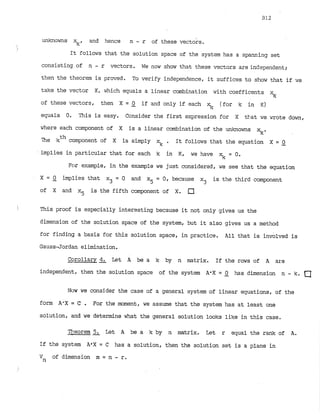
unknowns , andhence n - r of these vectok.
It follows that the solution space of the system has a spanning set
consisting of n - r vectors. We now show that these v~ctorsare independent;
then the theorem is proved.. To verify independence, it suffices to shox? that if xe
take the vector X, which equals a linear combination with coefficents
%
of these vectors, then X = 0 if and only if each % (for k in K)
-
equals 0. This is easy. Consider the first expression for X tkat we wrote down,
where each component of X is a linear combination of the unknowns
rc-
The kth component of X is simply 5 . It follows that the equation X = 2
implies in particular that for each k in K, we have % = 0
.
For example, in the example we just considered, we see that the equation
X = -
0 implies that x3 = 0 and x = 0 , because x
.
. is the third component
5 3
of X and x5 is the fifth component of X.
This proof is especially interesting because it not only gives us the
dimension of the solution space of the system, but it also gives us a method
for finding a basis for this solution space, in practice. All that is involved is
Gauss-Jordan elimination.
Corollary& Let A be a k by n matrix. If the rows of A are
independent, then the solution space of the system A-X = 0 has dimension n - k. a
-
Now we consider the case of a general system of linear equations, of the
form A'X = C . For the moment, we assume that the system has at least one
solution, and we determine what the general solution looks like in this case.
Theorem 5. Let A be a k by n matrix. Let r equal the rank of A.
-
If the system A*X = C has a solution, then the solution set is a plane in
Vn of dimension m = n - r.
52.
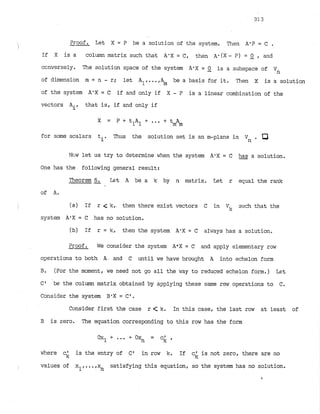
Proof. Let X= P be a solution of the system. Then A-P = C .
If X is a column matrix such that A'X = C, then A.(X - ?) = 2 , and
ccnversely. The solution space of the system A'X = 0 is a subspace of
- '
n
of dimension m = n - r; let All
...,A be a basis for it. Then X is a solution
m
of the system A'X = C if and only if X - P is a linear combination of the
vectors Air that is, if and only if
X = P + t A t...
1 1 + tmAm
for some scalars ti. Thus the solution set is an m-plane in Vn a
Nciw let us try to determine when the system A'X = C has a solution.
One has the follow in^ general result:
Theorem 6. k t A be a k by n matrix. Let r equal the rank
of A
'
(a) If r 4 k , then there exist vectors C in Vlc such that the
system A
'
X = C has no solution.
(b) If r = k, tl~enthe system A-X= C al~~ays
has a solution.
Proof. We consider the system A
'
X = C and apply elementary row
operations to both A . and C until we have brought A into echelon form
. (For the moment, we need not yo all the hay to reduced echelon form.) Let
C ' be the column matrix obtained by applying these same row operations to C.
Consider the system B'X = C r .
Consider first the case r < k. In this case, the last row at least of
3 is zero. The equation corresponding to this row has the form
where c' is the entry of C 1 in row k. If c' is not zero, there are no
k k
values of xl,...,x satisfying this equation, so the system has no solution.
n
#
53.
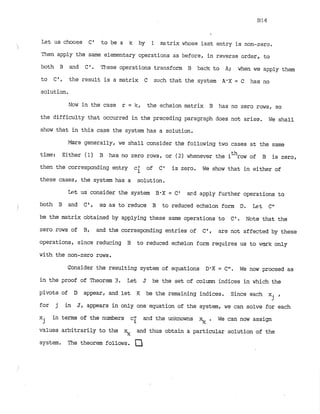
Let us chooseC * to be a k by 1 mstrix whose last entry is non-zero.
Then apply the same elementary operations as before, in reverse order, to
both B and C*. These operations transform B back to A; when we apply them
to C*, the result is a matrix C such that the system A
'
X = C has no
solution.
Now in the case r = k, the echelon matrix B has no zero rows, so
the difficulty that occurred in the preceding paragraph does not arise. We shall
show that in this case the system has a solution.
More generally, we shall consider the following two cases at the same
time: Either ( 1) B has no zero rows, or (2) whenever the ithrow of B is zero,
then the corresponding entry c* of C' is zero. We show that in either of
i
these cases, the system has a solution.
Let US consider the system B-X = C 1 ard apply further operations to
both B and C', so as to reduce B to reduced echelon form D. Let C"
be the matrix obtained by applying these same operations to C'. Note that the
zero rows of B, and the corresponding entries of C', are not affected by these
operations, since reducing B to reduced echelon form requires us to work only
with the non-zero rows.
Consider the resulting system of equations D'X = Ctt. We now proceed as
in the proof of Theorem 3. Let J be the set of column indices in which the
pivots of D appear, and let K be the remaining indices. Since each xi ,
2
for j in J, appears in only one equation of the system, we can solve for each
x in terms of the numbers c; a d the unknowns . We can now assign
j
values arbitrarily to the and thus obtain a particular solution of the
system. The theorem follows.
54.
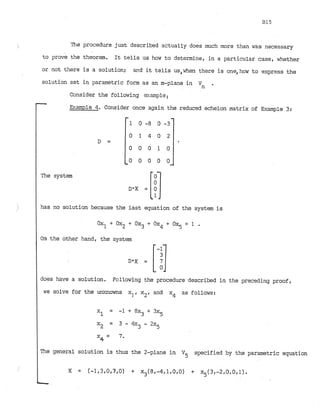
The procedure justdescribed actually does much more than was necessary
to prove the theorem. It tells us how to determine, in a particular case, whether
or not there is a solution; and it tells us,when there is one,how to express the
solution set in parametric form as an m-plane in
'
n .
Ccnsider the following example:
- E2:ample 4
. Consider once again the reduced echelon matrix of Example 3:
The system
has no solution because the last equation of the system is
On the other hand, the system
does have,asolution. Fc~llowingthe procedure described in the preceding proof,
we solve for the unknowns xl,x2, and x4 as follows:
The general solution is thus the 2-plane in V5 specified by the parametric equation
on my grounds,and I saw him laugh when the brute kicked Bruiser.
I can manage him, anyway."
There was no afternoon performance at the circus except on
Wednesday and Saturday, and Robert and his friend Charlie Davis
were at leisure.
"Let's go on a tramp, Charlie," said Robert, after they had eaten
dinner.
"I'm with you," said Charlie. "Where shall we go?"
"Oh, well, we'll go across the fields. Perhaps we'll go into the
woods. Anything for fun."
The two boys set out about two o'clock, and after reaching the
borders of the village took a path across the fields.
"I wish nuts were ripe, Rob," said Charlie. "We'd have a nice
time knocking them off the trees. Do you remember last fall up in
Maine?"
"Yes, but it's June now, and we can't have any fun of that kind.
However, we can have a good time. Do you see those bars?"
"Yes."
"I'm going to vault over them."
"All right. I'll follow."
Robert ran swiftly, and cleared the bars without touching them.
Charlie followed, but, being a shorter boy, felt obliged to let his hand
rest on the upper bar. They were accustomed to springing from the
ring upon the backs of horses, and practice had made that easy to
them which was difficult for ordinary boys.
"I say, Charlie," said Robert, thoughtfully, as they subsided into a
walk, "what are you going to do when you are a man?"
"Ride, I suppose."
"In the circus?"
57.
"Of course."
"I don'tthink I shall."
"Why not?"
"I don't want to be a circus rider all my life."
"I should think you would. Ain't you the Boy Wonder?"
"I shan't be the Boy Wonder when I'm twenty-five years old."
"You can't make so much money any other way."
"Perhaps not; but money isn't everything I think of. I would like
to get a better education and settle down to some regular business."
"There's more fun in circus riding," said Charlie, who was not as
thoughtful a boy as his companion.
"I don't see much fun in it," said Robert. "It is exciting, I know,
but it's dangerous. Any day, if your nerves are not steady, you are
likely to fall and break a limb, and then good-by to your riding."
"There's no use in thinking about that."
"I think there is. What could we do if we had to give up riding?"
"Oh, something would turn up," said Charlie, who was of an
easy disposition. "We might take tickets or keep the candy stand."
"That wouldn't be very good employment for a man. No, Charlie,
I think this will be my last season at circus riding."
"What will you do?"
"I am saving money so that, at the end of the season, I can
have something to keep me while I am looking round."
"You don't say so, Rob! How much have you saved up?"
"I've got about two hundred dollars saved up already."
Charlie whistled.
58.
"I had noidea you were so rich," he said. "Why, I haven't got
five dollars."
"You might have. You are paid enough."
"Oh, it goes some way. I guess I'll begin to save, too."
"I wish you would. Then if you want to leave the circus at the
end of the season we'll go somewhere together, and look for a
different kind of work. We can take a room together in Boston or
New York, eat at the restaurants, and look for something."
"I don't know but I should like going to New York," said Charlie.
By this time they had reached the edge of the woods, and were
probably a mile or more from the town. There was no underbrush,
but the trees rose clear and erect, and presented a cool and
pleasant prospect to the boys, who had become warm with walking.
So far as they knew, they were alone, but in this they were
mistaken. Mr. Tarbox had some wood-land near by, and he had gone
out to look at it, when, alike to his surprise and gratification, his eyes
rested on the two boys, whom he at once recognized as belonging
to the circus, having seen them ride the evening before. He didn't
care particularly for Charlie Davis, but Robert Rudd had been with
Anak when he inflicted upon him so mortifying personal
chastisement, and he looked upon the boy as an accomplice of the
man.
"That's the very boy I wanted to see," said Tarbox to himself,
with a cruel smile. "I can't manage that overgrown brute, but I can
manage him. I'll give the boy a lesson, and that'll be better than
nothing."
Tarbox was naturally a tyrant and a bully, and, like most men of
his character, was delighted when he could get hold of a person of
inferior strength.
"Oh ho!" he said to himself, "the boy can't escape me now."
"Look here, boy," he said, in an impatient tone.
R
CHAPTER X.
TRAPPED.
OBERT foresawthat trouble was in store for him, as he had seen
enough of the farmer to understand his disposition. However, the
boy was not easily startled, nor was he of a nervous temperament.
He looked calmly at Tarbox and said: "Very well, sir, what do you
want of me?"
"What do I want of you? I shouldn't think you'd need to be told.
You remember me, don't you?"
"Perfectly well," answered Robert.
"Perhaps you can remember where you saw me last?"
"In the circus last evening."
"No, I don't mean that—before that."
"In your own field, trying to whip a poor boy who was going to
call the doctor for his sick mother."
"Look here, boy," said Tarbox, reddening; "none of your
impudence!"
"Did I tell the truth?" asked Robert quietly.
"Never mind whether you did or not. I ain't going to stand any of
your impudence. Where's that big brute Enoch?"
"If you mean Anak, I left him in the tent."
"He needn't think he can go round insulting and committing
assault and battery on his betters," said Tarbox.
"You can tell him that if you like, sir; I am not responsible for
him."
61.
"No, but youare responsible for trespassin' on my grounds."
"I would do it again if I saw you trying to flog a defenceless
boy," said Robert, independently.
"You would, hey?" sneered Tarbox. "Well, now, you may change
your opinion on that subject before we part company."
"Come, Rob, let's be going," said Charlie Davis, who didn't find
this conversation interesting.
"You can go," said Tarbox; "I hav'nt anything ag'inst you; but
this boy's got to stay."
"What for?" asked Charlie.
"What for? He'll find out what for."
"If you touch him, I'll send Anak after you," said Charlie.
"You will, hey? So you are impudent, too. Well, I'll have to give
you a lesson, too."
Tarbox felt that it was time to commence business, and made a
grab for Robert's collar, but the boy was agile, and quickly dodging
ran to one side.
Charlie Davis laughed, which further annoyed and provoked Mr.
Tarbox, but the wrath of the farmer was chiefly directed against
Robert, who had witnessed his discomfiture at the hands of the
Norwegian giant. He therefore set out to catch the young circus-
rider, but Robert was fleet-footed, and led him a fruitless chase
around trees, and Tarbox was not able to get his hand on him. What
annoyed the farmer especially was that the boy did not seem at all
frightened, and it appeared to be no particular effort to him to elude
his grasp.
Tarbox was of a dogged, determined disposition, and the more
difficult he found it to carry out his purpose the more resolved he
was to accomplish it. It would never do to yield to two boys, who
both together had less strength than he. It was different from
encountering Anak, who was a match for three ordinary men.
62.
But Tarbox, inspite of his anger, and in spite of his superior
strength, was destined to come to grief.
He had not paid any special attention to the younger boy, being
intent upon capturing Robert. Charlie, taking advantage of this,
picked up a stout stick, which had apparently been cut for a cane
and then thrown aside, and took it up first with the intention of
defending himself, if necessary. But as Tarbox dashed by without
noticing him, a new idea came to Charlie, and thrusting out the stick
so that it passed between the legs of the pursuer, Tarbox was
thrown violently to the ground, on which he lay for a moment
prostrate and bewildered.
"Climb that tree, Rob!" called out Charlie quickly.
Robert accepted the suggestion. He saw that no time was to be
lost, and with the quickness of a trained athlete made his way up
the trunk and into the branches of a tall tree near at hand, while
Charlie with equal quickness took refuge on another.
Tarbox fell with such violence that he was jarred and could not
immediately recover from the shock of his fall. When he did rise he
was more angry than ever. He looked for the two boys and saw what
had become of them. By this time Robert was at least twenty-five
feet from the ground.
"Come down here, you, sir!" said the farmer, his voice shaking
with passion.
"Thank you, sir," answered Robert coolly; "but at present I find it
more agreeable up here."
"Come down here, and I'll give you the worst thrashing you ever
had!"
"Your intentions are very kind, but the inducement isn't
sufficient."
"If I hadn't fallen just as I did, I'd have had you by this time."
63.
"That's just whatI thought when I put the stick between your
legs," called out Charlie Davis from another tree.
It may seem singular, but until then Tarbox had not understood
how he came to fall. He had an idea that he had tripped over the
root of a tree.
"Did you do that?" he asked wrathfully, turning to the smaller
boy.
"Yes, I did."
"If I could catch you, you wouldn't get out of this wood alive."
"Then I'm glad you can't get me," said Charlie, looking
unconcernedly down upon his stalwart enemy.
"You're two of the worst boys I ever saw," proceeded the farmer,
wrathfully.
"And I'm sure you're the worst man I ever saw."
"What's your name?" asked Tarbox, abruptly.
"Charlie Davis; I'm sorry I haven't got my card with me, or I'd
throw it down to you."
"I'd like to have the bringing up of you."
"All right! Perhaps I'll appoint you my guardian."
"You're more impudent than the other one, though you ain't so
big."
"Are you comin' down?" he inquired of Robert.
"Not at present."
"I won't stir from here till you do, if I have to stay all night."
This was not a cheerful reflection, for the two boys were
expected to be present and ride in the evening, and their absence
would be regretted, not only by the manager, but also by the public,
with whom they were favorites.
64.
"I say, Rob,"called out Charlie, "how fond he is of our
company!"
"So it seems!" responded Robert, who was quite cool but rather
annoyed by the farmer's persistence.
"I only wish Bruiser were alive!" said Tarbox. "Then I'd know
what to do."
"What would you do?" asked Charlie.
"I'd leave him to guard you, and then I'd go home and get my
gun."
"What for?"
"I'd soon bring you down if I had that," answered the farmer,
grimly.
"If that's what you would do I'm glad old Bruiser's kicked the
bucket," said Charlie.
"I never shall get such another dog!" said Tarbox, half to himself,
in a mournful voice. "Nobody dared to go across my ground when he
was alive."
"Was that the dog that Anak killed?" asked Charlie.
"Yes," answered Robert, briefly. "He was a vicious-looking brute
and deserved to die."
At that moment Tarbox chanced to notice the stick which had
produced his downfall, and a new idea came to him.
He picked it up, and breaking it in two seized one piece and
flung it with all his force at Robert.
The latter caught and flung it back, knocking off the farmer's
hat.
Tarbox was naturally incensed, and began again to hurl the
missile, but anger disturbed his aim so that this time it went wide of
the mark.
65.
"I say, Robert,"said Charlie, "this is interesting."
"I'm glad you find it so," answered Robert. "I can't say I enjoy
it."
"You may just as well come down and take your thrashing now,"
said Tarbox, "for you're sure to get it."
"If you're in a hurry to get home to supper, perhaps we'll wait for
you here," suggested Charlie, politely.
"Shut up, you saucebox! You won't have much appetite for
supper!" retorted Tarbox.
He sat down where he could have a full view of both trees, when
presently he heard Charlie call out in a terrified tone, "Rob, look
there! The tiger's got loose! See him coming this way! Can he climb
trees?"
Tarbox stopped to hear no more. He sprang to his feet, and
without waiting to bid the boys good-by he took to his heels and fled
from the wood, feeling that his life was in peril.
66.
R
CHAPTER XI.
DISMAY ATTHE HOME OF TARBOX.
OBERT quickly understood that Tarbox was the victim of a
practical joke, and did his best to help it along. He had amused
himself during his connection with the circus in imitating the cries of
wild beasts, and now from his perch in the tree reproduced the howl
of a wolf so naturally that Tarbox, hearing it, and knowing no better,
thought it proceeded from the throat of the tiger. Of course he
increased his speed, expecting every moment that the dangerous
animal would spring upon him and tear him to pieces.
"If I only had my gun with me," he reflected in his dismay, "I
might be able to defend myself."
He lost his hat somewhere on the road, and breathless and
hatless entered his own back door, shutting and bolting it after him,
and with disordered look entered the sitting-room where his wife
was seated, in a comfortable chat with Mrs. Dunlap, a neighbor.
Tarbox sank into a rocking-chair, and, gasping, stared at the two
ladies.
"Good gracious, Nathan!" exclaimed his wife, in a flutter; "what
on earth has happened?"
"Was anything chasin' ye?" asked Mrs. Dunlap, unconsciously
hitting the mark.
"Yes," answered Tarbox, in a hollow voice.
"Was it the Norwegian giant?" inquired Mrs. Tarbox,
apprehensively.
"Worse!" answered Tarbox, sententiously.
67.
"Worse! Do tell.Good gracious, Nathan, I shall go into a fit if
you don't tell me right off what it was."
"It was a tiger!" answered her husband, impressively.
"A tiger!" exclaimed both ladies, startled and affrighted.
"Yes, I've had a narrow escape of my life."
"But where did he come from?" asked Mrs. Dunlap.
"Come from? Where should he come from except from the
circus? He broke loose and now he's prowling round, seeking whom
he may devour.
"O heavens," exclaimed Mrs. Dunlap, terror-stricken, "and my
innocent children are out picking berries in the pasture."
"Tigers are fond of children," said Tarbox, whose hard nature
found pleasure in the dismay of the unhappy mother.
"I must go right home and send for the children," said the
mother, in an agony of apprehension.
"You may never live to get home," said Tarbox.
"Oh what shall I do?" said Mrs. Dunlap, wringing her hands.
"Won't you go home with me, Mr. Tarbox? I can't stay here with my
poor children in peril."
"No, I thank you. My life is worth something."
"You might take your gun, Nathan," said Mrs. Tarbox, who was
stirred by the grief of her friend.
"Oh yes," said Tarbox, sarcastically; "you're very ready to have
your husband's life exposed. You'd like to be a widow. Maybe you
think I've left you all my property."
"You know, Nathan, I never thought of that. I only thought of
poor Mrs. Dunlap. Think how sad it would be if Jimmy and Florence
Ann were torn to pieces by the terrible tiger."
68.
There was afresh outburst of grief from the stricken mother at
the heart-rending thought, but Mr. Tarbox was not moved.
"Mrs. Tarbox," said he, "if you want to see Mrs. Dunlap home
you can take the gun."
"Oh, I shouldn't das't to," said Mrs. Tarbox, hastily. "I—I
shouldn't know how to fire it."
"I think you'd be more likely to shoot Mrs. Dunlap than the
tiger," said her husband, derisively.
"Where did you come across the—the monster, Nathan?" asked
Mrs. Tarbox, shuddering.
"In the woods. I heard him roar. I ran from there as fast as I
could come, expecting every minute he would spring upon me."
"Was there any one else in the wood?"
"Yes," answered Tarbox, smiling grimly. "There's two circus boys
there. They clumb into trees. I don't know whether tigers can climb
or not. If they can they've probably made mincemeat of the boys by
this time."
"It's terrible!" said Mrs. Dunlap, shuddering. "Perhaps my
innocent darlings are in the clutches of the monster at this very
moment."
And the unhappy lady went into a fit of hysterics, from which
she was brought to by a strong bottle of hartshorn held to her nose.
It so happened (happily for her) that her husband at this
moment knocked at the door. He had gone home to find something,
and failing had come to the house of his neighbor to inquire of his
wife its whereabouts. Great was his amazement to find his wife in
such agitation.
"What's the matter?" he asked, looking about him.
"O Thomas, have you heard the terrible news?" said his wife.
69.
"I haven't heardany terrible news," was the bewildered reply. "Is
anybody dead?"
"Our two poor innocent darlings may be dead by this time,"
sobbed his wife.
"What does it all mean? Where are they?"
"Out in the berry pasture. The tiger may have caught them by
this time."
"What tiger?"
"The one that's broken loose from the show."
"I just came from the tent, and they don't know anything there
of any tigers breaking loose. Who told you about it?"
"Mr. Tarbox. The tiger chased him all the way home from the
woods."
"That is strange. Did you see him, Mr. Tarbox?"
"I heard him roar," answered Tarbox, "and he was close behind
me all the way."
"Are you sure it was a tiger?"
"No; it may have been a lion. Anyhow, it was some wild critter."
"O husband, do go after our poor children. And take Mr. Tarbox's
gun. I am sure he will lend it to you."
"I may need it myself," said Tarbox, doubtfully.
"Give me a stout stick, and I'll manage," said Mr. Dunlap, who
was a more courageous man than his neighbor. "Come along, wife."
"I—I hope, Mrs. Tarbox, we shall meet again," said Mrs. Dunlap,
as she kissed her friend a tearful good-by. "I don't feel sure, for we
may meet the terrible beasts."
"If you do," said Mrs. Tarbox, with tearful emotion, "I'll come to
your funeral."
70.
Somehow this didn'tseem to comfort Mrs. Dunlap much, for
when they were fairly out of the house she observed sharply, "That
woman's a fool!"
"You seem to like to call on her, Lucinda."
"That's only being neighborly. She has no heart or she wouldn't
allude so coolly to my funeral. But do let us be getting home as soon
as you can."
"I tell you what, Lucinda, I don't take any stock in this cock-and-
bull story of a tiger being loose. I heard nothing of it at the tent."
"But Mr. Tarbox said it chased him."
"Tarbox is a coward. But here are two boys coming; they belong
to the circus. I will ask them."
Robert and Charlie Davis were coming up the road. No sooner
had their enemy fled than they descended from the trees in whose
branches they had taken refuge, and started on their way home,
laughing heartily at the farmer's fright.
"I say, boys," said Mr. Dunlap, "don't you two boys belong to the
circus?"
"Yes, sir," answered Robert.
"What's this story I hear about a tiger having escaped from his
cage?"
"Who told you?" asked Robert.
"Mr. Tarbox."
"Did he see him?"
"He said the tiger chased him all the way home."
Both boys burst into a fit of laughter, rather to the amazement of
Mr. Dunlap and his wife. Then they explained how the farmer had
been humbugged, and Mr. Dunlap shouted with merriment, for
Tarbox was very unpopular in that town, and no one would feel
troubled at any deception practised upon him.
71.
"Then the childrenare safe?" said Mrs. Dunlap, with a sigh of
relief. "Don't you think I ought to go and tell Mr. Tarbox?"
"No; let Tarbox stay in the house, like a coward that he is, for
fear of the tiger. It's a good joke at his expense. That was a pretty
smart trick, boys."
"Old Tarbox will feel like murdering us if he ever finds out the
truth," said Charlie.
"He feels so now, so far as I am concerned," said Robert. "I am
not afraid of him."
72.
W
CHAPTER XII.
THE CANVASMAN.
HEN Mr. Tarbox came to understand how he had been hoaxed
by the boys he was furious, but his anger was ineffectual, for
there seemed no way in which he could retaliate. He had had his
opportunity in the woods, but that had passed, and was not likely to
come again. Meanwhile he found it hard to bear the jocose inquiries
of his neighbors touching his encounter with the "tiger."
For instance, the next day he met the constable in the street.
"How are you, Mr. Tarbox?" inquired Spriggins, smiling.
"Well enough," growled Tarbox, quickening his pace.
"I hear you had an adventure with a tiger yesterday," said the
constable, with a waggish smile.
"Suppose I did!" he snapped.
"Ho, ho! Were you very much frightened?" continued the
constable.
"I wasn't half so much scared as you were when I wanted you to
arrest the giant."
It was the constable's turn to look embarrassed. "Who said I was
afraid?"
"It was enough to look at you," said Tarbox.
"Well, maybe I was a little flustered," admitted Spriggins. "Who
wouldn't be afraid of a man ten feet high? They do say, Tarbox, that
you did some pretty tall running, and there wasn't no tiger loose
after all."
73.
And Mr. Constableindulged in a chuckle which irritated the
farmer intensely. He resolved to retaliate.
"Do you know where I am goin', Spriggins?" he asked.
"No."
"Then I'll tell you," answered Tarbox, with a malicious smile. "I'm
goin' to Squire Price to get another warrant for the arrest of Anak—
I've found out that that's his name—and I'm goin' to get you to
serve it."
The constable's countenance changed. "Don't be foolish, Mr.
Tarbox," he said.
"I understand my business, Spriggins, and I shall expect you to
do yours. I'll see you again in half an hour."
"I may not be at home; I expect I've got to go over to Medville."
"Then put it off. Your duty to the State is ahead of all private
business."
He went on his way leaving Mr. Spriggins in a very uneasy frame
of mind. When he went home to supper, he said to his wife: "Mrs. S.,
after supper I'm going up into the attic, and if Nathan Tarbox comes
round and asks for me, you say that I'm out of town."
"But it wouldn't be true, Spriggins," replied his wife.
"I know it won't; but he wants me to arrest the giant, and it's as
much as my life is worth," answered the constable, desperately. "I
don't think I'm a coward, but I ain't a match for a giant."
The farmer, however, did not come round. He had only made the
statement to frighten Spriggins, and retaliate upon him for his joke
about the tiger.
In the afternoon Robert, while out for a walk, fell in with one of
the canvas men, a rough-looking fellow, named, or at least he called
himself, Carden. Canvas men, as may be inferred from the name,
are employed in putting up and taking down the circus tent, and are
74.
generally an inferiorset of men, not differing much from the
professional tramp. Robert, who, in spite of his asseverations, had
considerable self-respect and proper pride, never mingled much with
them, and for that reason was looked upon as "putting on airs." His
friend, Charlie Davis, was much more popular with them.
"Hallo, Robert," said Carden, familiarly.
The canvas man was smoking a short, dirty clay pipe, and would
have made an admirable model for a picture of a tramp.
"Hello, Carden!" said Robert, coolly.
"Walkin' for your health?" asked the canvas man, in the same
disagreeably familiar tone.
"Partly."
Carden was walking by his side, and Robert did not like the
familiarity which this would seem to imply.
"Pretty good town, this!" continued Carden, socially.
"Yes."
"Sorry I haven't another pipe to offer you, Robert, my boy."
"Thank you; I shouldn't use it."
"Don't mean to say you don't smoke, eh, Bob?"
"I don't smoke."
"That is, not a pipe—I dare say you wouldn't mind a cigar or
cigarette, now."
"I don't smoke at all now. I did once, but found it was injuring
me, and gave it up."
"Oh, it won't hurt you. I've smoked since I was a chap so
high"—indicating a point about three feet from the ground—"and I
ain't dead yet."
Robert did not reply to this, but looked around anxiously for
some pretext to leave his unwelcome companion.
75.
Just then theypassed a wayside saloon.
"Come in, Bob, and have a drink!" said Carden, laying his hand
upon the boy's shoulder. "It'll do you good to whet your whistle."
"No, thank you," said Robert, shrinking from the man's touch.
"Oh, don't be foolish. A little whiskey'll do you good."
"Thank you, I would rather not."
Meantime Carden was searching in his pocket for a silver coin,
but his search was fruitless.
"I say, Bob, I am out of tin. Come in and treat?"
"You must excuse me, Mr. Carden," said Robert, coldly.
"Come, don't be stingy! You get good pay, and can afford to
stand treat. We poor canvas men only have $15 a month."
"If this will do you any good," said Robert, producing a silver
quarter, "you are welcome to it."
"Thank you; you'd better come in, too."
Robert sacrificed the coin to regain his freedom, as Carden's
entering the saloon seemed to offer the only mode of release.
"What a stuck-up young jackanapes!" muttered Carden, as he
entered the saloon. "He thinks a deal of himself, and don't want to
have nought to do with me because I'm a poor canvas man. I doubt
he's got a good deal of money hid away somewhere, for he don't
spend much. I heard Charlie Davis say the other day Bob had $200."
Carden's eyes glittered with cupidity as the thought passed
through his mind.
"I'd like to get hold of it," he muttered to himself. "It would be a
fortune for a poor canvas man, and he wouldn't miss it, for he could
soon gain as much more. I wonder where he keeps it."
"It's the worst of the life I lead," said Robert to himself, as he
walked on, "that I am thrown into the company of such men as that.
76.
It isn't becausethey are poor that I object to them, for I am not rich
myself; but a man needn't be low because he is poor and earning
small pay. I suppose Carden and the other canvas men think I am
proud because I don't seek their company, but they are mistaken. I
have nothing in common with them, except that we are all in the
employ of the same manager. Besides, I do talk with Madigan. He is
a canvas man, but he has had a good education and is fitted for
something better, and only takes up with this rather than be idle."
Half an hour after, Charlie Davis joined him.
"Rob," said Charlie, "I met Carden, just now. He was half drunk,
and pitching into you."
"He ought not, for I had just lent him a quarter."
"He said you were too proud to drink with him."
"That is true, though I wouldn't drink with one I had more
respect for."
"He asked me where you kept your money. You'd better look out
for him."
"I shall. I have no doubt he is capable of robbing me, and I
would rather spend my own money myself."
"I'm not afraid of his robbing me," said Charlie.
"No, I suppose not; but I wish you would save some of your
money, so as to have something worth stealing."
"Oh, I'll begin to save sometime."
It was perhaps the thought of this conversation that led Robert
in the evening after the entertainment was over, or rather after his
part of it was over, to walk round to one of the circus wagons, in
which, in a small closet, he kept some of his clothing and the whole
of his money.
As he came up he saw in the darkness the crouching figure of a
man trying the lock of his compartment with one of a bunch of keys
"W
CHAPTER XIII.
CATCHING ATHIEF.
HAT are you doing here?" demanded Robert, in a quick,
imperious tone.
The man, like all who are engaged in a disreputable deed,
started suddenly and half rose from his crouching position, still
holding the keys in his hand. He did not answer immediately,
probably because it was rather difficult to decide what to say.
"What are you doing here?" demanded Robert, once more.
"None of your business!" answered the man, whose temper got
the better of his prudence.
"I should think it was my business, as you were trying to get at
my property."
"That's a lie!" said the man, sullenly.
As he spoke he stepped out of the wagon, and Robert
recognized him as the canvas man, Carden, introduced in the last
chapter.
"It's the truth," said Robert firmly. "I know you, Carden, and I
am not much surprised. It won't do to try it again."
"I've a great mind to thrash you for your impudence!" growled
Carden.
"I can defend myself," returned Robert, coolly, who had plenty of
courage.
Carden laughed derisively.
"What can you do?" he said. "You'd be like a baby in my grasp."
79.
"I am notafraid of you," said Robert, with composure. "Don't
come around here again."
"I shall go where I please," said Carden, with the addition of an
oath. "And don't you go to telling tales of me, or I'll wring your
neck."
Robert did not answer, but when Carden had slunk away, opened
the locker himself, and took out a wallet filled with bills.
"It is imprudent to leave so much money here," he reflected. "If
I hadn't come up just as I did, Carden would have got hold of it.
What shall I do with it?"
Robert felt that it would not do to carry it round with him, as
that would be about as imprudent as to leave it in the locker. He
decided after a little reflection upon leaving it with the manager of
the circus, in whom he had every confidence, and deservedly. He
accordingly sought Mr. Coleman after the entertainment was over.
"Well, Robert, what is it?" asked the manager, kindly.
"I have a favor to ask of you, sir."
"Very well; what is it?"
"I came near losing all my savings to-night. Will you take charge
of this wallet for me? I don't feel safe with it in my possession."
"Certainly, Robert. How much money have you here?"
"Two hundred dollars."
"Whew! You are rich. You say you came near losing it?"
"Yes, to-night."
"How was that?"
Robert detailed his visit to his locker, and his discovery of the
canvas man attempting to open it, but he mentioned no names.
"Which of the canvas men was it?" asked Mr. Coleman.
Robert hesitated.
80.
"I don't wantto get the man into trouble," he said.
"That does you credit, but if we have a thief with us it is
important that we should know it, for there are others whom he may
try to rob."
From what he knew of Carden, Robert felt that the apprehension
was very well founded, and he saw that it was his duty to mention
the name of the thief.
"It was Carden," he answered.
"The very man I suspected," said the manager. "The other men
are rough, but he looks like a scoundrel. He came to me and begged
for work, and I engaged him, though I knew nothing about him. I
shall see him in the morning, and discharge him."
The manager did not forget. The next morning he summoned
Carden, and said, quietly, "Carden, you are no longer in my employ.
I will pay you to the end of the week, but I want you to leave now."
"What's that for?" growled the canvas man, looking ugly.
"It's on account of what happened last night," said the manager.
"Has that young fool been blabbing about me?"
"I have said nothing about any one."
"No, but I know Robert Rudd's been telling tales about me."
"He answered my questions, but said he didn't want to get you
into trouble."
"Of course not!" sneered Carden. "He's a nice boy, he is; the
young liar."
"You seem to know what he said," observed the manager, eying
the man keenly.
"I s'pose he said I was tryin' to rob him."
"He did, and I believed him."
81.
"Then he lied!"said the man, fiercely. "He'll repent the day he
told tales about me."
"That will do, Carden," said the manager, quietly. "Here's your
money."
Carden went off swearing. As he was leaving the grounds of the
circus he met Robert.
"You've been blabbing about me. I'll fix you," he said.
Robert made no reply, for he did not care to get into a dispute
with such a man.
82.
W
CHAPTER XIV.
CHESTNUTWOOD.
E mustnow change the scene to a fine estate in the interior of
New York State, near one of the beautiful lakes which give
such a charm to the surrounding landscape.
The estate was a large one, laid out in the English style, with a
fine mansion centrally located and elegantly furnished. Surely the
owner of this fine domain was worthy of envy, and ought to have
been happy.
Let us enter the breakfast room and make acquaintance with
him.
There he sits in an easy-chair, a white-haired, shrunken old man,
his face deeply lined, and wearing a weary expression as if the world
afforded him little satisfaction.
It was the same old man whom we last saw in the circus at
Crampton. He had gone home with his nephew at once, having
become weary of travel. It was wise, perhaps; for he was old, and to
the old rest is welcome.
His nephew sat near by with a daily paper in his hand, from
which he appeared to have been reading to his uncle.
"That will do, Hugo," said the old man. "I—I don't find any
interest in the paper this morning."
"How are you feeling, uncle—as well as usual?"
"Well in health—that is, as well as I can expect to feel, but my
life is empty. I have nothing to live for."
83.
Welcome to ourwebsite – the perfect destination for book lovers and
knowledge seekers. We believe that every book holds a new world,
offering opportunities for learning, discovery, and personal growth.
That’s why we are dedicated to bringing you a diverse collection of
books, ranging from classic literature and specialized publications to
self-development guides and children's books.
More than just a book-buying platform, we strive to be a bridge
connecting you with timeless cultural and intellectual values. With an
elegant, user-friendly interface and a smart search system, you can
quickly find the books that best suit your interests. Additionally,
our special promotions and home delivery services help you save time
and fully enjoy the joy of reading.
Join us on a journey of knowledge exploration, passion nurturing, and
personal growth every day!
ebookbell.com



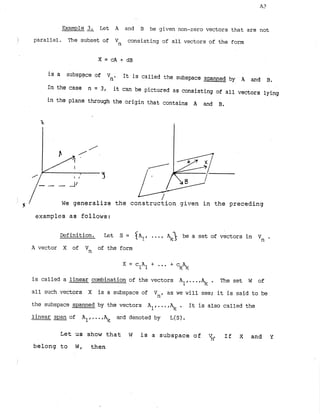
![i
s a subspace of Vq . as you can check. Solving this equation for x4 , WE see
I that a 4-tuple belongs to W if and only if it has the form
x = (xl,X2, x3, -3x1 + X. - 5 ~ ~ ) .
2
where xl acd x
, and x3 are arbitrary. This element can be written in the form
L
It follaris that (1,O.O.-3) and (OtlrOtl) and (O,Ofl,-5) sy:an W.
Exercises
1
. Show that the subset of V3 specified in Example 5 is a subspace
of V-. Do the same for the subset of V4 s~ecifiedin Example 7
. What can
3
you say about the set'ofall x ,...x such that alxl+ ... + a x = 0
n n n
in general? (Herewe assume A = (al.
...,a ) is not the zero vector.) Csn you
n
give a geometric interpretation?
2. In each of the following, let W denote the set of
I
I all vectors (x,y,z) in Vj satisfying the condition given.
(Here we use (x,y,z) instead of (xl,x2,x3) for the general
element of V3.) Determine whether W is a subspace of Vj.
If it is, draw a picture of it or describe it geometrically,
and find a spanning set for W.
(a) x = 0. (e) x = y or 2 x = z .
(b) x + y = O .
( f ) x2 - y2 = 0.
(c) X + y = 1. 2
( 4 ) X 2 + * = 0 -
(dl x = y and 2x = 2.
3. Consider the set F of all real-valued functions
defined on the interval [arb].](https://image.slidesharecdn.com/25897501-250514102145-b7ec7dbc/85/Multivariable-Calculus-With-Theory-Lecture-Notes-Prof-Christine-Breiner-10-320.jpg)
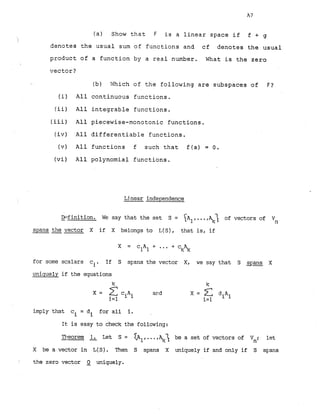
![Proof. Mte that -
0 = 2OAi . This means that S spans the zero
i
vector uniquely if and only if the equation
implies that ci = 0 for all i
.
Stippose S syms 2 uniquely. To show S spans X uniquely, suppose
k
X = c.A. and X = 2 dilli.
1=1 1 1
i=l
Subtracting, we see that
whence ci - d. = 0, or c = di , for all i.
1 i
Conversely, suppose S spans X uniquely. Then
for some (unique) scalars x Now if
i'
it follows that
Since S spans X uniquely, we must have xi = x + ci , or c = 0, for all 1
. 0
i i
This theorem implies that if S spans one vector of L(S) uniquely,
then it spans the zero vector uniquely, whence it spans every vector of L(S)
uniquely. This condition is important enough to be given a special name:
Definition. The set S = ZA],...,%J of vectors of V is said to
n
be linearly independent (or simply, independent) if it spans the zero vector
I
uniquely. The vectors themselves are also said to be independent in this](https://image.slidesharecdn.com/25897501-250514102145-b7ec7dbc/85/Multivariable-Calculus-With-Theory-Lecture-Notes-Prof-Christine-Breiner-12-320.jpg)
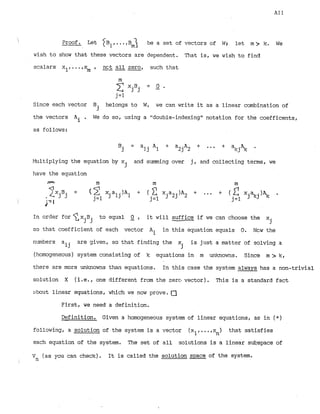
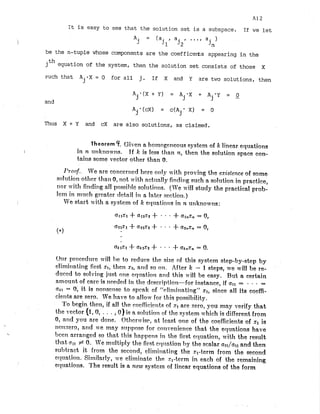
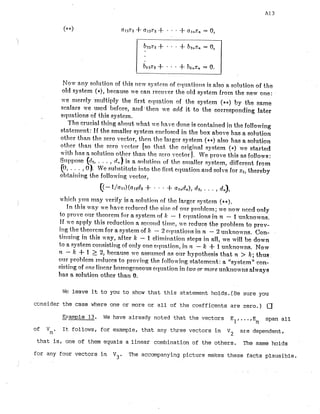
![Similarly, since the vectors Elt..-,E are independent, any spanning
n
set of Vn must contain at least n vectors. Thus no two vectors can span
V3'
and no set of three vectors can span v4.
Theorem 5. Let W be a subspace of Vn that does not consist of
-
0 alone. Then:
(a) The space W has a linearly indepehdent spanning set.
(b) Any two linearly independent spanning sets for W have the same
>
number k of elements; k < n unless W is all of Vn.
--
Proof. (a) Choose A1 # -
0 in W. Then the set {
A
1
> is independent.
In general, suppose A l .A is an independent set of vectors of W. If
this set spans W, we are finished. Otherwise, we can choose a vector Ai+l
of W that is not in L(Alr.. .,A.) . Then the set 1A1,...,A A~+~] is
1 i'
independent: For suppose that
for some scalars c not all zero. If c ~ + ~
= 0 , this equation contradicts
i
independecce of A , ..A r while if c ~ + ~
# 0, we can solve this equation
for A contradicting the fact that Ai+l does not belong to L(Alt....A,).
1
Cc~ntinuingthe process just described, we can find larger and larger
independent sets of vectors in W
. The process stops only when the set we obtain
spans W. Does it ever stop? Yes, for W is contained in Vn, ar;d V contains
n](https://image.slidesharecdn.com/25897501-250514102145-b7ec7dbc/85/Multivariable-Calculus-With-Theory-Lecture-Notes-Prof-Christine-Breiner-18-320.jpg)
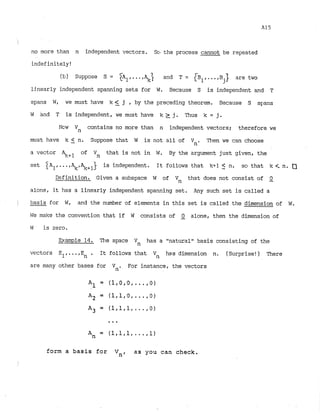
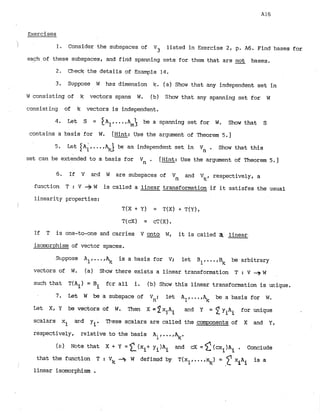
![A17
(b) Suppose that the basis A ,. is an orthonormal basis. Show
that X*Y = 2xiYi . Conclude that the isomorphism T of (a) preserves the
dot product, that is, T(x).T(Y) = X*y .
8
. Prove the following:
. b e 7
Theorem. If W is a subspace
'Lof Vn, then W has an orthonormal basis.
Froof. Step 1
. Let B1,...,B be mutually orthogonal non-zero vectors
m
in Vn ; be a vector not in L
(
B l,...,B ). Given scalars
let Am+l m
cl,...,c let
m '
-
- A ~ + ~
+ C1B1 + " CmBm
B
n
t
+
l
+
Show that Bmcl is different from 2 and that L(B1,. ..,B ,B
m m+l) =
L(B~,
...,B ,A ) - Then show that the ci m
m
y be so chosen that Bm+l is
m m+l
orthogonal to each of B ..,
B
, .
Steep2
. Show that if W is a subspace of Vn of positive dimension.
then W has a basis consisting of vectors that are mutually orthogonal.
i [Hint: Proceed by induction on the dimension of W
.
]
Step 3
. Prove the theorem.
Gauss-Jordan elimination
If W is a subspace of Vn, specified by giving a spanning set for
W, we have at present no constructive process for determining the dimension
of W nor of finding a basis for W, although we bow these exist. There
is a simple procedure for carrying out this process; we describe it nw.
~efinitfon. The rectangular a r r G of numbers](https://image.slidesharecdn.com/25897501-250514102145-b7ec7dbc/85/Multivariable-Calculus-With-Theory-Lecture-Notes-Prof-Christine-Breiner-21-320.jpg)
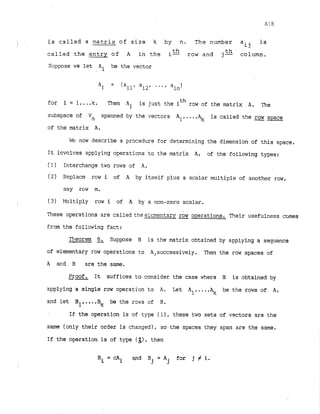
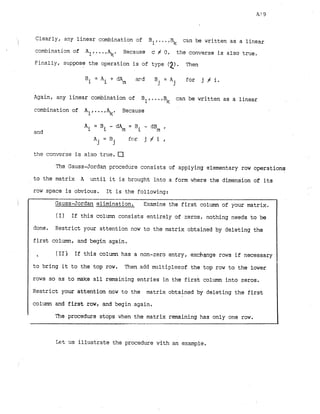
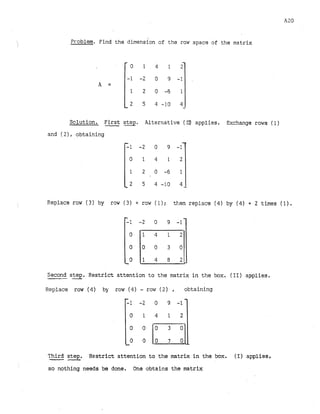
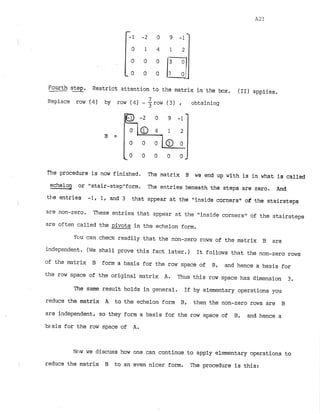
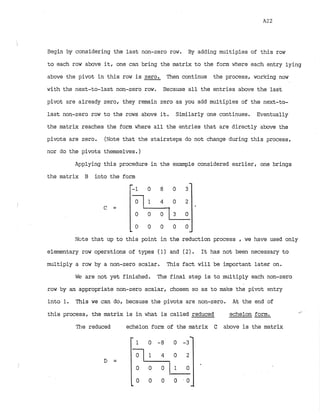
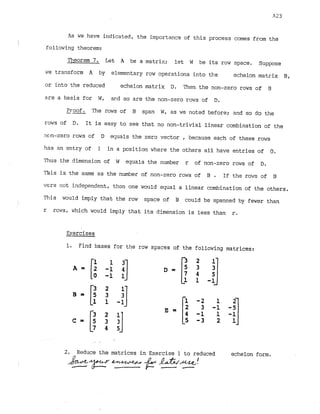
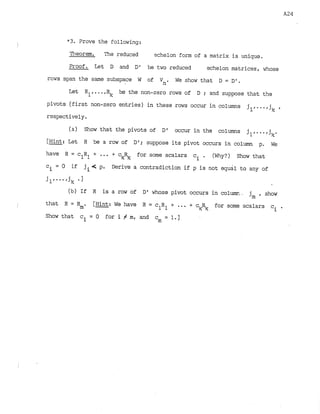
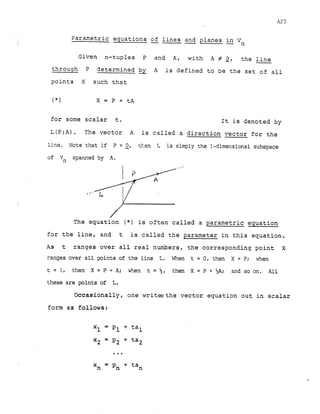
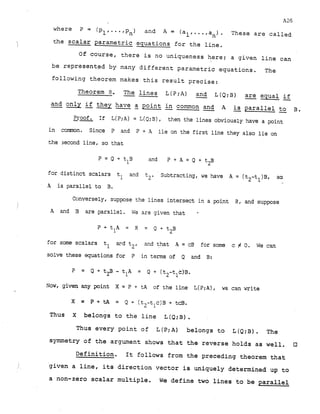
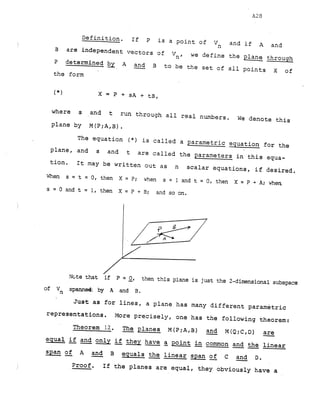
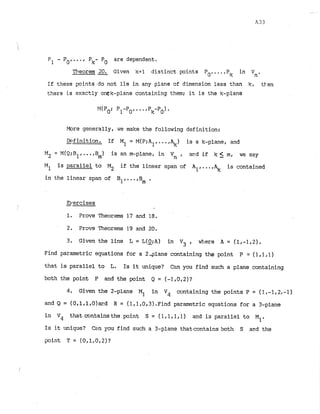

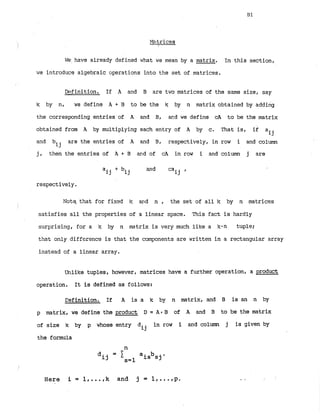
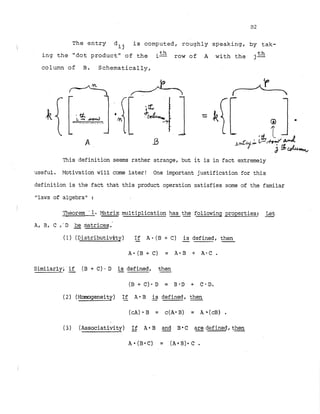
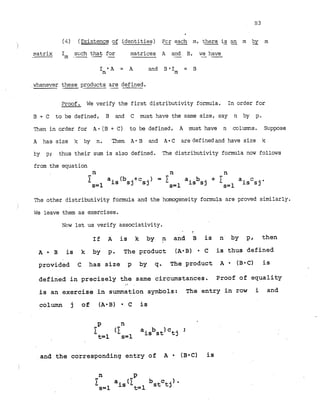
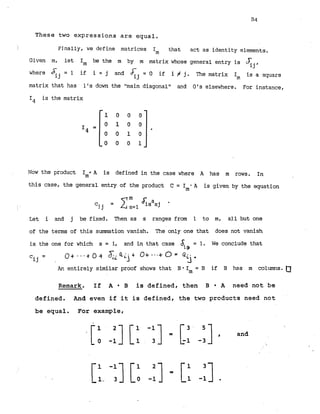
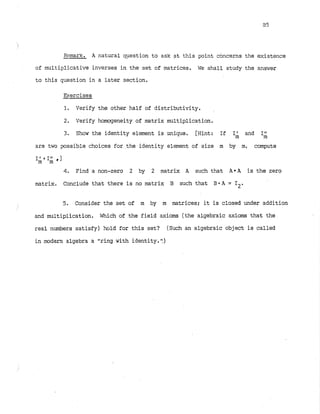
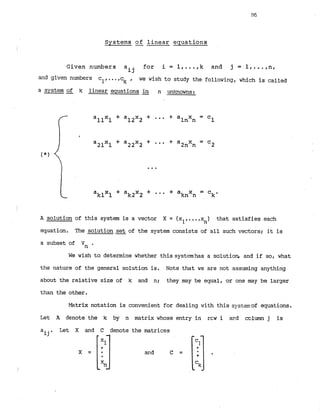
![B7
These are matrices with only one column; accordingly, they are called column
matrices . The system of equations ( * ) can now be written in matrix form as
A solution of this matrix equation is now, strictly speaking, a column matrix
rather than an n-tuple. However, one has a natural correspondence
between n-tuples and column matrices of size n by 1. It is a one-to-one
correspondence, and even the vector space operations correspond. What this means is
that we can identify Vn with the space of all n by 1 matrices if we wish;
all this amounts to is a change of notation.
Representing elements of Vn as column matrices is so convenient that
we will adopt it as a convention throughout this section, whenever we wish.
Example 1. Consider the system
[Here we use x, y, z for the unknowns instead of xl, x2,
X 3 r
for convenience.] This system has no solution, since
the sum of the first two equations contradicts the third
equation.](https://image.slidesharecdn.com/25897501-250514102145-b7ec7dbc/85/Multivariable-Calculus-With-Theory-Lecture-Notes-Prof-Christine-Breiner-46-320.jpg)
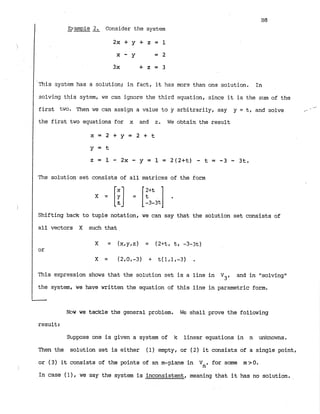
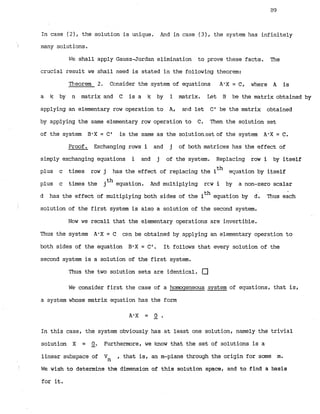
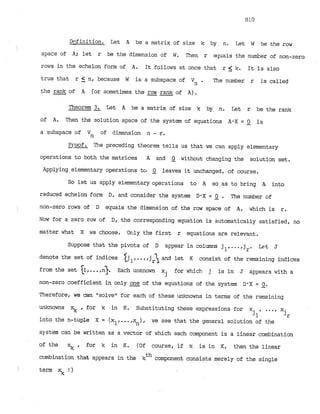
![k!t us pause to consider an example.
-
EJ-ample
3 . Let A be the 4 by 5 matrix given on p.A20. The
-
equation A'X = 0 represents a system of 4 equations in 5 unknowns. Nc~w A
-
reduces by row operations to the reduced echelon matrix
Here the pivots appear in columns 1,2 and 4; thus J is the set 11,2.4] and
K is the set f3.53 . The unknowns xl.x2, and x4 each appear in only
one equation of the system. We solve for theese unknowns in terms of the others
as follows:
3
X1 = 8x + 3x5
X* = -4x3 -
2x5
x
, = 0.
The general solution can thus be written (using tuple notation for convenience)
The solution space is thus spanned by two vectors (8,-4.1,O.O) and (3,-2,0.0,1).
-
The same procedure we followed in this example can be followed in
general. Once we write X as a vector of which each component is alinear combination
of the xk , then we can write it as a sum of vectors each of which involves
only one of the unknowns 5 , and then finally as a linear combination, with
coefficients %I of vectors in Vn . There are of course n - r of the](https://image.slidesharecdn.com/25897501-250514102145-b7ec7dbc/85/Multivariable-Calculus-With-Theory-Lecture-Notes-Prof-Christine-Breiner-50-320.jpg)