Game Design Workshop Performances are actions.  Performance studies take actions seriously in 4 ways: 1. Behaviour is the ‘object of study’ with a focus on what people do in the activity of their doing it 2. Artistic practice is part of the study and the relationship between studying and doing performance is integral 3. Fieldwork as ‘participant observation’ is a much prized method adapted from anthropology and put to new uses 4. By being actively involved in social practices and advocacies
Game Design Workshop Schechner’s Approaches to Play STRUCTURE Relationships among events within play act, each act consists sub acts, distinct behaviour units to make up coherent whole, I.e. the gameplay gestalt Synchronic acts i.e. they happen at the same time
Game Design Workshop Schechner’s Approaches to Play 2. PROCESS How play acts are generated and what are their phases of development Diachronic acts i.e. a change over time
Game Design Workshop Schechner’s Approaches to Play 3. EXPERIENCE What are the feelings and moods of the players and observers? How do these affect playing? What are different experiences? How do they change over time? How is it “good” or not?
Game Design Workshop Schechner’s Approaches to Play 4. FUNCTION What purpose do play acts serve? How do they affect learning, growth, creativity, aggression, values, or other “uses” of play.
Game Design Workshop Schechner’s Approaches to Play 5. EVOLUTIONARY, SPECIES AND INDIVIDUAL DEVELOPMENT What is relationship of human to animal play? What is the difference between child & adult play? What is relationship between play and creativity? Play and culture?
Game Design Workshop Schechner’s Approaches to Play 6. IDEOLOGY Play enacts, affirms & subverts values. What specific political, social & personal values does play enunciate, propagate or criticize. Are these values the same for all players?
Game Design Workshop Schechner’s Approaches to Play 7. FRAME How do players know when play begins? Is taking place and is over? ERVING GOFFMAN
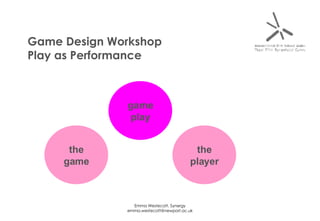
Game Design Workshop Play as Performance the game the player game play
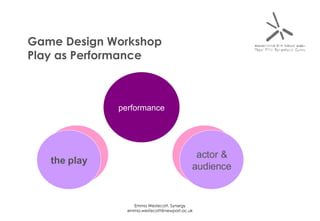
Game Design Workshop Play as Performance the game the player game play the play actor & audience performance
Game Design Workshop Tuesday’s Exercise Teach the group how to play a game you used to play as a child. Don’t theorize but convey only what is required to play the game. After playing, discuss the structure of the game. Does it have a beginning, middle and end? How do you know when to stop? Are the rules stable? Or are they obscure and subject to change? What signals are used to send the message “this is play”? Did the group find the game enjoyable? Why or why not?
Game Design Workshop Wednesday’s Reading Chapter 4, Play The Joker in the Deck Performance Studies: An Introduction Richard Schechner

Schechner's performance studies frame

  • 1.
    Game Design WorkshopPerformances are actions. Performance studies take actions seriously in 4 ways: 1. Behaviour is the ‘object of study’ with a focus on what people do in the activity of their doing it 2. Artistic practice is part of the study and the relationship between studying and doing performance is integral 3. Fieldwork as ‘participant observation’ is a much prized method adapted from anthropology and put to new uses 4. By being actively involved in social practices and advocacies
  • 2.
    Game Design WorkshopSchechner’s Approaches to Play STRUCTURE Relationships among events within play act, each act consists sub acts, distinct behaviour units to make up coherent whole, I.e. the gameplay gestalt Synchronic acts i.e. they happen at the same time
  • 3.
    Game Design WorkshopSchechner’s Approaches to Play 2. PROCESS How play acts are generated and what are their phases of development Diachronic acts i.e. a change over time
  • 4.
    Game Design WorkshopSchechner’s Approaches to Play 3. EXPERIENCE What are the feelings and moods of the players and observers? How do these affect playing? What are different experiences? How do they change over time? How is it “good” or not?
  • 5.
    Game Design WorkshopSchechner’s Approaches to Play 4. FUNCTION What purpose do play acts serve? How do they affect learning, growth, creativity, aggression, values, or other “uses” of play.
  • 6.
    Game Design WorkshopSchechner’s Approaches to Play 5. EVOLUTIONARY, SPECIES AND INDIVIDUAL DEVELOPMENT What is relationship of human to animal play? What is the difference between child & adult play? What is relationship between play and creativity? Play and culture?
  • 7.
    Game Design WorkshopSchechner’s Approaches to Play 6. IDEOLOGY Play enacts, affirms & subverts values. What specific political, social & personal values does play enunciate, propagate or criticize. Are these values the same for all players?
  • 8.
    Game Design WorkshopSchechner’s Approaches to Play 7. FRAME How do players know when play begins? Is taking place and is over? ERVING GOFFMAN
  • 9.
    Game Design WorkshopPlay as Performance the game the player game play
  • 10.
    Game Design WorkshopPlay as Performance the game the player game play the play actor & audience performance
  • 11.
    Game Design WorkshopTuesday’s Exercise Teach the group how to play a game you used to play as a child. Don’t theorize but convey only what is required to play the game. After playing, discuss the structure of the game. Does it have a beginning, middle and end? How do you know when to stop? Are the rules stable? Or are they obscure and subject to change? What signals are used to send the message “this is play”? Did the group find the game enjoyable? Why or why not?
  • 12.
    Game Design WorkshopWednesday’s Reading Chapter 4, Play The Joker in the Deck Performance Studies: An Introduction Richard Schechner