Nurul Syazlin bt Anuar
Nur Amirah bt Hazalan Haffiz
LET 104
GRAMMAR FALLACIES
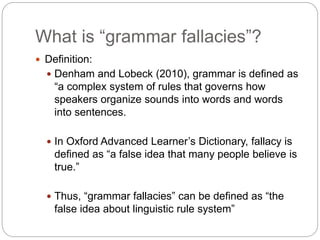
What is “grammar fallacies”?
 Definition:
 Denham and Lobeck (2010), grammar is defined as
“a complex system of rules that governs how
speakers organize sounds into words and words
into sentences.
 In Oxford Advanced Learner’s Dictionary, fallacy is
defined as “a false idea that many people believe is
true.”
 Thus, “grammar fallacies” can be defined as “the
false idea about linguistic rule system”
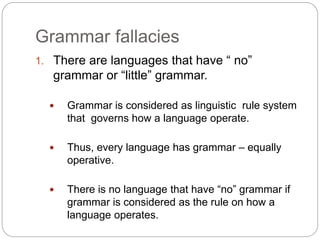
Grammar fallacies
1. There are languages that have “ no”
grammar or “little” grammar.
 Grammar is considered as linguistic rule system
that governs how a language operate.
 Thus, every language has grammar – equally
operative.
 There is no language that have “no” grammar if
grammar is considered as the rule on how a
language operates.
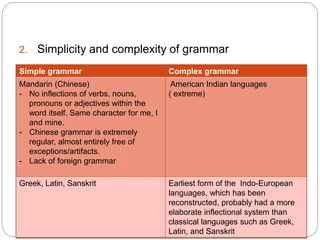
2. Simplicity and complexity of grammar
Simple grammar Complex grammar
Mandarin (Chinese)
- No inflections of verbs, nouns,
pronouns or adjectives within the
word itself. Same character for me, I
and mine.
- Chinese grammar is extremely
regular, almost entirely free of
exceptions/artifacts.
- Lack of foreign grammar
American Indian languages
( extreme)
Greek, Latin, Sanskrit Earliest form of the Indo-European
languages, which has been
reconstructed, probably had a more
elaborate inflectional system than
classical languages such as Greek,
Latin, and Sanskrit
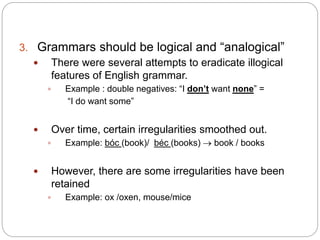
3. Grammars should be logical and “analogical”
 There were several attempts to eradicate illogical
features of English grammar.
 Example : double negatives: “I don’t want none” =
“I do want some”
 Over time, certain irregularities smoothed out.
 Example: bóc (book)/ béc (books)  book / books
 However, there are some irregularities have been
retained
 Example: ox /oxen, mouse/mice
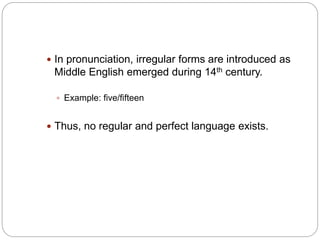
 In pronunciation, irregular forms are introduced as
Middle English emerged during 14th century.
 Example: five/fifteen
 Thus, no regular and perfect language exists.
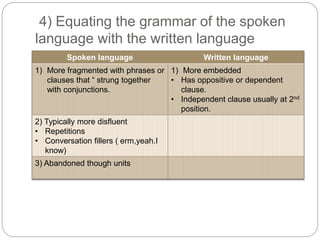
4) Equating the grammar of the spoken
language with the written language
Spoken language Written language
1) More fragmented with phrases or
clauses that “ strung together
with conjunctions.
1) More embedded
• Has oppositive or dependent
clause.
• Independent clause usually at 2nd
position.
2) Typically more disfluent
• Repetitions
• Conversation fillers ( erm,yeah.I
know)
3) Abandoned though units
References
 https://www.quora.com/Which-language-has-the-
easiest-grammar
 http://www.grammarmudge.cityslide.com/articles/
article/426348/2731.htm
 Denham, K. & Lobeck, A. (2010). Linguistics for
Everyone : An Introduction. Cengage Learning:
Wadsworth.

Various fallacies concerning English Grammar

  • 1.
    Nurul Syazlin btAnuar Nur Amirah bt Hazalan Haffiz LET 104 GRAMMAR FALLACIES
  • 2.
    What is “grammarfallacies”?  Definition:  Denham and Lobeck (2010), grammar is defined as “a complex system of rules that governs how speakers organize sounds into words and words into sentences.  In Oxford Advanced Learner’s Dictionary, fallacy is defined as “a false idea that many people believe is true.”  Thus, “grammar fallacies” can be defined as “the false idea about linguistic rule system”
  • 3.
    Grammar fallacies 1. Thereare languages that have “ no” grammar or “little” grammar.  Grammar is considered as linguistic rule system that governs how a language operate.  Thus, every language has grammar – equally operative.  There is no language that have “no” grammar if grammar is considered as the rule on how a language operates.
  • 4.
    2. Simplicity andcomplexity of grammar Simple grammar Complex grammar Mandarin (Chinese) - No inflections of verbs, nouns, pronouns or adjectives within the word itself. Same character for me, I and mine. - Chinese grammar is extremely regular, almost entirely free of exceptions/artifacts. - Lack of foreign grammar American Indian languages ( extreme) Greek, Latin, Sanskrit Earliest form of the Indo-European languages, which has been reconstructed, probably had a more elaborate inflectional system than classical languages such as Greek, Latin, and Sanskrit
  • 5.
    3. Grammars shouldbe logical and “analogical”  There were several attempts to eradicate illogical features of English grammar.  Example : double negatives: “I don’t want none” = “I do want some”  Over time, certain irregularities smoothed out.  Example: bóc (book)/ béc (books)  book / books  However, there are some irregularities have been retained  Example: ox /oxen, mouse/mice
  • 6.
     In pronunciation,irregular forms are introduced as Middle English emerged during 14th century.  Example: five/fifteen  Thus, no regular and perfect language exists.
  • 7.
    4) Equating thegrammar of the spoken language with the written language Spoken language Written language 1) More fragmented with phrases or clauses that “ strung together with conjunctions. 1) More embedded • Has oppositive or dependent clause. • Independent clause usually at 2nd position. 2) Typically more disfluent • Repetitions • Conversation fillers ( erm,yeah.I know) 3) Abandoned though units
  • 8.
    References  https://www.quora.com/Which-language-has-the- easiest-grammar  http://www.grammarmudge.cityslide.com/articles/ article/426348/2731.htm Denham, K. & Lobeck, A. (2010). Linguistics for Everyone : An Introduction. Cengage Learning: Wadsworth.