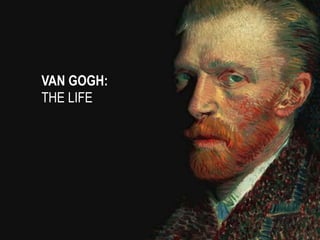
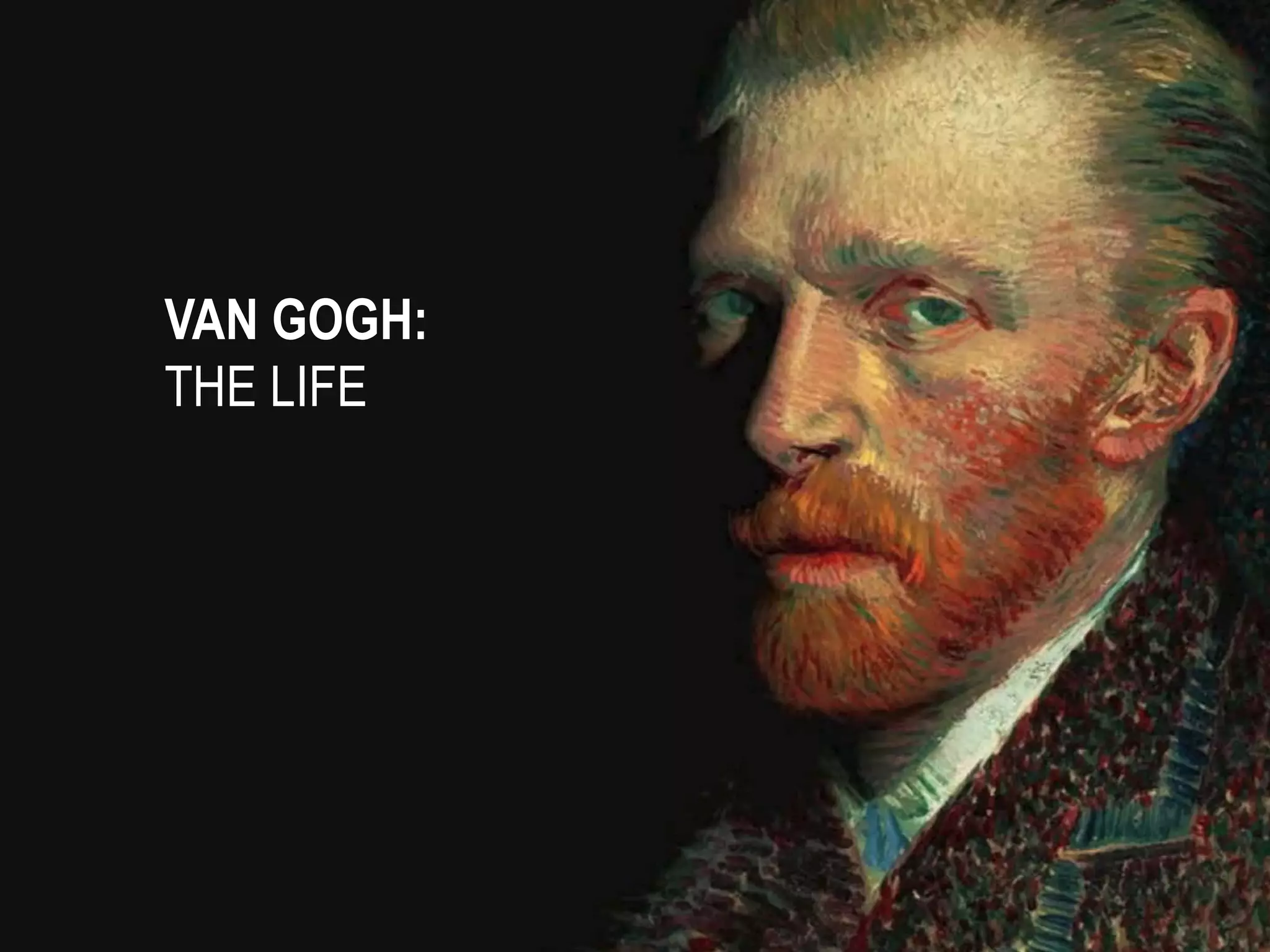
VAN GOGH:
THE LIFE
“I want to paint what I feel
and feel what I paint.”
~ Vincent Willem Van Gogh
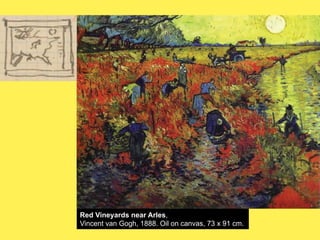
Red Vineyards near Arles,
Vincent van Gogh, 1888. Oil on canvas, 73 x 91 cm.
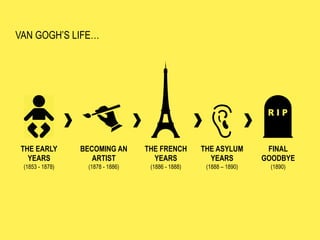
VAN GOGH’S LIFE…

THE EARLY
YEARS

BECOMING AN
ARTIST

THE FRENCH
YEARS

THE ASYLUM
YEARS

FINAL
GOODBYE

(1853 - 1878)
(1878 - 1886)

(1886 - 1888)

(1888 – 1890)

(1890)
THE EARLY YEARS
1853 - 1878
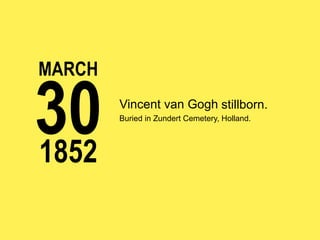
MARCH

30
1852

Vincent van Gogh stillborn.
Buried in Zundert Cemetery, Holland.
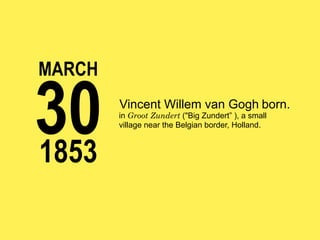
MARCH

30
1853

Vincent Willem van Gogh born.

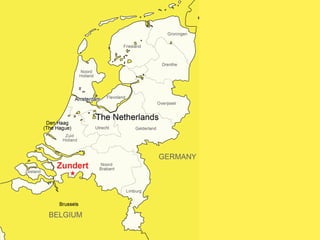
in Groot Zundert ("Big Zundert” ), a small
village near the Belgian border, Holland.
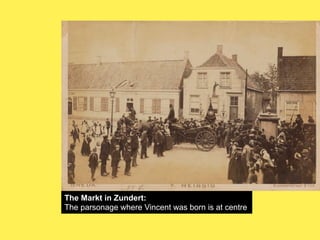
The Markt in Zundert:
The parsonage where Vincent was born is at centre
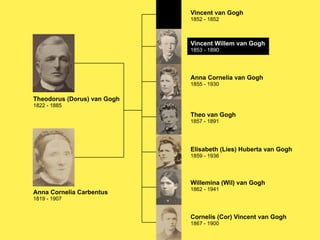
Vincent van Gogh
1852 - 1852

Vincent Willem van Gogh
1853 - 1890

Anna Cornelia van Gogh
1855 - 1930

Theodorus (Dorus) van Gogh
1822 - 1885

Theo van Gogh
1857 - 1891

Elisabeth (Lies) Huberta van Gogh
1859 - 1936

Willemina (Wil) van Gogh
Anna Cornelia Carbentus

1862 - 1941

1819 - 1907

Cornelis (Cor) Vincent van Gogh
1867 - 1900
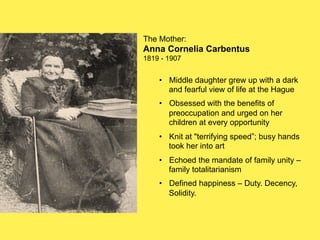
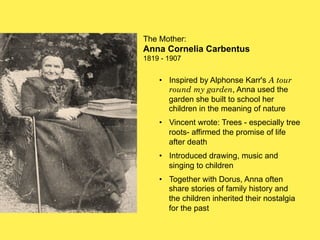
The Mother:

Anna Cornelia Carbentus
1819 - 1907

•! Middle daughter grew up with a dark
and fearful view of life at the Hague
•! Obsessed with the benefits of
preoccupation and urged on her
children at every opportunity
•! Knit at "terrifying speed”; busy hands
took her into art
•! Echoed the mandate of family unity –
family totalitarianism
•! Defined happiness – Duty. Decency,
Solidity.
The Mother:

Anna Cornelia Carbentus
1819 - 1907

•! Inspired by Alphonse Karr's A tour
round my garden, Anna used the
garden she built to school her
children in the meaning of nature
•! Vincent wrote: Trees - especially tree
roots- affirmed the promise of life
after death
•! Introduced drawing, music and
singing to children
•! Together with Dorus, Anna often
share stories of family history and
the children inherited their nostalgia
for the past
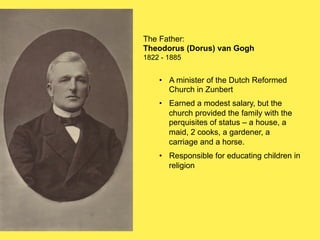
The Father:
Theodorus (Dorus) van Gogh
1822 - 1885

•! A minister of the Dutch Reformed
Church in Zunbert
•! Earned a modest salary, but the
church provided the family with the
perquisites of status – a house, a
maid, 2 cooks, a gardener, a
carriage and a horse.
•! Responsible for educating children in
religion
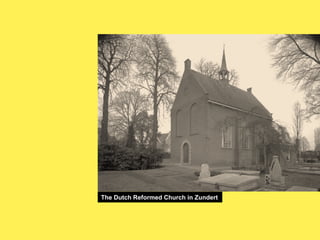
The Dutch Reformed Church in Zundert
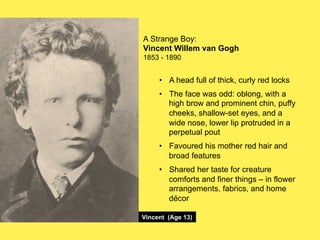
A Strange Boy:
Vincent Willem van Gogh
1853 - 1890

•! A head full of thick, curly red locks
•! The face was odd: oblong, with a
high brow and prominent chin, puffy
cheeks, shallow-set eyes, and a
wide nose, lower lip protruded in a
perpetual pout
•! Favoured his mother red hair and
broad features
•! Shared her taste for creature
comforts and finer things – in flower
arrangements, fabrics, and home
décor
Vincent (Age 13)
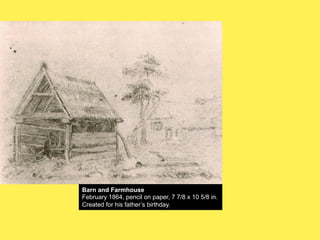
Barn and Farmhouse
February 1864, pencil on paper, 7 7/8 x 10 5/8 in.
Created for his father’s birthday.
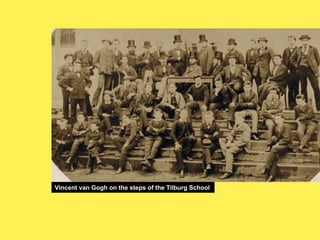
Vincent van Gogh on the steps of the Tilburg School
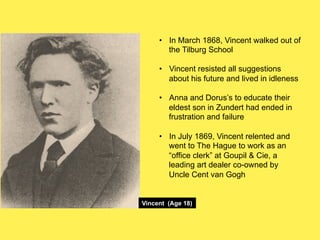
•! In March 1868, Vincent walked out of
the Tilburg School
•! Vincent resisted all suggestions
about his future and lived in idleness
•! Anna and Dorus’s to educate their
eldest son in Zundert had ended in
frustration and failure
•! In July 1869, Vincent relented and
went to The Hague to work as an
“office clerk” at Goupil & Cie, a
leading art dealer co-owned by
Uncle Cent van Gogh

Vincent (Age 18)
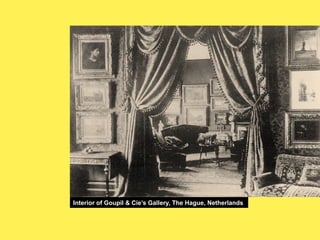
Interior of Goupil & Cie’s Gallery, The Hague, Netherlands
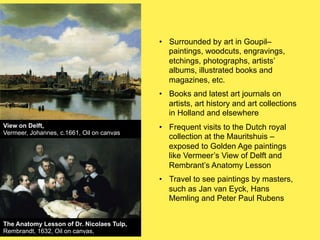
•! Surrounded by art in Goupil–
paintings, woodcuts, engravings,
etchings, photographs, artists’
albums, illustrated books and
magazines, etc.
•! Books and latest art journals on
artists, art history and art collections
in Holland and elsewhere
View on Delft,
Vermeer, Johannes, c.1661, Oil on canvas

•! Frequent visits to the Dutch royal
collection at the Mauritshuis –
exposed to Golden Age paintings
like Vermeer’s View of Delft and
Rembrant’s Anatomy Lesson
•! Travel to see paintings by masters,
such as Jan van Eyck, Hans
Memling and Peter Paul Rubens

The Anatomy Lesson of Dr. Nicolaes Tulp,
Rembrandt, 1632, Oil on canvas,
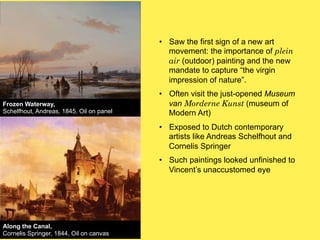
•! Saw the first sign of a new art
movement: the importance of plein
air (outdoor) painting and the new
mandate to capture “the virgin
impression of nature”.
Frozen Waterway,
Schelfhout, Andreas, 1845, Oil on panel

•! Often visit the just-opened Museum
van Morderne Kunst (museum of
Modern Art)
•! Exposed to Dutch contemporary
artists like Andreas Schelfhout and
Cornelis Springer
•! Such paintings looked unfinished to
Vincent’s unaccustomed eye

Along the Canal,
Cornelis Springer, 1844, Oil on canvas
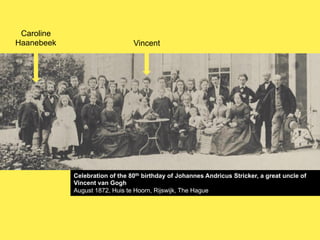
Caroline
Haanebeek

Vincent

Celebration of the 80th birthday of Johannes Andricus Stricker, a great uncle of
Vincent van Gogh
August 1872, Huis te Hoorn, Rijswijk, The Hague
“If I cannot get a good woman, I shall
take a bad one... I would sooner be with
a bad whore than be alone.”
~ Vincent told his brother, Theo

Note: Vincent’s correspondence totaled to more than 2,000 letters. Only 902 letters
were discovered. About four-fifths of them were addressed to his brother, Theo.
•! Vincent got into trouble and he
suspected that his boss, H. G.
Tersteeg, was responsible for
“putting [him] in a bad light”. The
exact details of the trouble remains
unknown.
•! His poor work performance has
been raised to the highest level. His
father, Dorus was extremely
unhappy and say unpleasant things
to him in letters
•! Theo was given a job at Goupil as
well
•! Decision was made to dismiss
Vincent. Plans were made to
arrange him to work in London.
H. G. Tersteeg
While in London between 1873 to 1875:
“The house here is not so
interesting as the one [there]…
Good pictures [are] quite difficult
to find. Tell me especially what
pictures you have seen lately, or
any new etchings or lithographs
have been published. Tell me all
you can about these things, for I
do not see much of them here.”
~ From Vincent to Theo
Ursula Loyer

Eugenie Loyer
87 Hackford Road, Brixton, London
[1873-1875], Pencil and chalk on paper
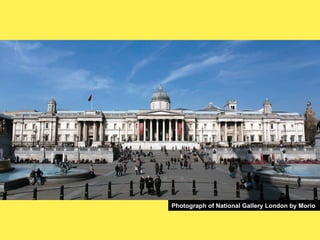
Photograph of National Gallery London by Morio
“I am not what many people think
I am just now.”
~ Vincent response to complaints about his unsuitability in Goupil

In mid-May 1875, Vincent was transferred to Paris
What use is there in banishing him
From one shore and then another…
He is the desolate son
Of a beloved land.
Let us give a homeland
A homeland
To the poor exile
~ From Vincent to his parents, poem L’exile,
translated into Dutch
Uprising of the impressionists
•!

Other names includes impressionalists
and lunatics

•!

Claimed that they represented the “next
wave” in art

•!

Storm broke in March 1875 when the
upstarts (including Monet and Renior) try
to sell some of their paintings at the
city’s central auction house, the Hôtel
Drouot
“50 francs for a Monet landscape.
– That’s for the frame!”

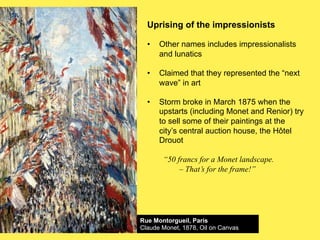
Rue Montorgueil, Paris
Claude Monet, 1878, Oil on Canvas
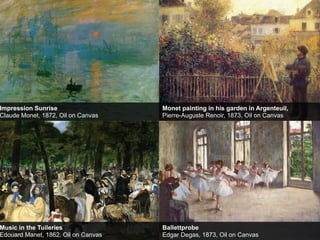
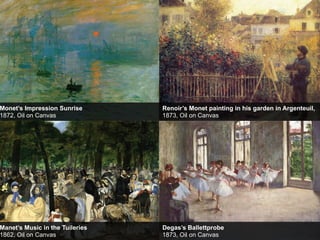
Impression Sunrise
Claude Monet, 1872, Oil on Canvas

Monet painting in his garden in Argenteuil,
Pierre-Auguste Renoir, 1873, Oil on Canvas

Music in the Tuileries
Edouard Manet, 1862, Oil on Canvas

Ballettprobe
Edgar Degas, 1873, Oil on Canvas
“I have seen absolutely nothing about them. From
what you told me about ‘impressionism’, it’s not
quite clear to me what it really is.”
~ Vincent’s response to Theo on the “new artists”
How impetuously a wounded heart rushes…
Towards the first refuge where, young and at peace,
He used to listen to himself singing amidst the
silence
With what bitter zeal, my soul, do you revel
In the house where you were born…
An yet, O chimera, you were deceiving us!
For in your beautiful illusion a superb future
Was opening out its rich sheaves like a glorious
summer,
Its fluttering ears like real suns.

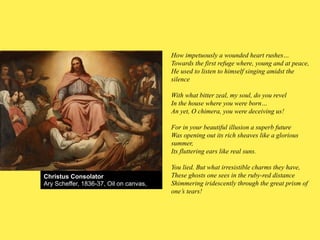
Christus Consolator
Ary Scheffer, 1836-37, Oil on canvas,

You lied. But what irresistible charms they have,
These ghosts one sees in the ruby-red distance
Shimmering iridescently through the great prism of
one’s tears!
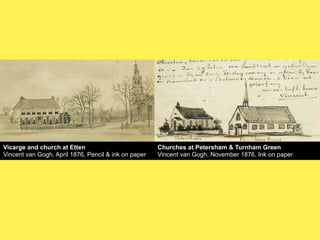
Vicarge and church at Etten
Vincent van Gogh, April 1876, Pencil & ink on paper

Churches at Petersham & Turnham Green
Vincent van Gogh, November 1876, Ink on paper
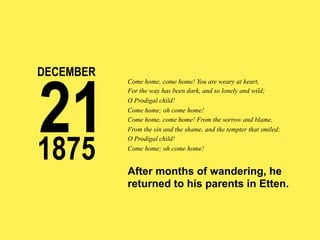
DECEMBER

21
1875

Come home, come home! You are weary at heart,
For the way has been dark, and so lonely and wild;
O Prodigal child!
Come home; oh come home!
Come home, come home! From the sorrow and blame,
From the sin and the shame, and the tempter that smiled;
O Prodigal child!
Come home; oh come home!

After months of wandering, he
returned to his parents in Etten.
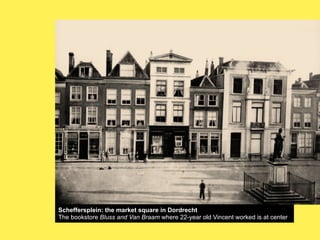
Scheffersplein: the market square in Dordrecht
The bookstore Bluss and Van Braam where 22-year old Vincent worked is at center
From January 1976 to November 1978:
BECOMING AN
ARTIST
1878 - 1886

Painting designed by Adrien Midzic from The Noun Project
“When I think the eyes of so many are fixed on me,
who will know where the fault is if I do not succeed,
who will make me reproaches… the fear of failure,
of disgrace – then I also have the longing: I wish I
were far away from everything!”
~ A Confession by Vincent
•! Au Charbonnage [to the coal fields]
“It always strikes me, that when we
see the image of indescribable and
unutterable desolation – of loneliness,
of poverty and misery, the end of all
things, or their extreme – the rises in
our mind the though of god.”
“The workmen come there to eat their
bread and drink their glass of beer
during the lunch hour”

•! He, too, was heading to
au charbonnage
The “Au Charbonnage” Café
November 1878, Pencil and ink on paper, 40 x 40cm
“… I did not lack courage. I would learn and
observe and come back having something to say
that was really worth hearing – a better and riper
man”.
~ From Vincent to Theo

In November 1878, with no means of support, no
plans and no prospects, Vincent head to Borinage
a.k.a Le pays noir (the black country)
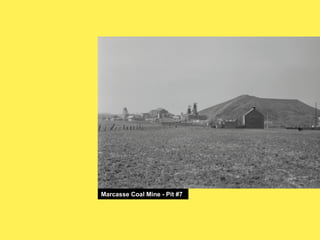
Marcasse Coal Mine - Pit #7
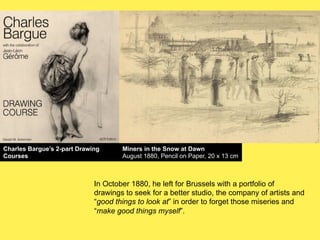
Charles Bargue’s 2-part Drawing
Courses

Miners in the Snow at Dawn
August 1880, Pencil on Paper, 20 x 13 cm

In October 1880, he left for Brussels with a portfolio of
drawings to seek for a better studio, the company of artists and
“good things to look at” in order to forget those miseries and
“make good things myself”.
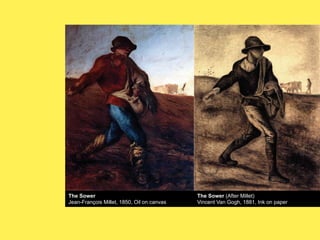
The Sower
Jean-François Millet, 1850, Oil on canvas

The Sower (After Millet)
Vincent Van Gogh, 1881, Ink on paper
“Anyone who has mastered a figure
drawing can earn quite a bit.”
~ From Vincent to Theo

Thinking that if he mastered figure drawing, he
could make the kinds of images that often
appeared in illustrated magazines – especially
images of picturesque country life. Vincent spent a
lot of money hiring models and renting studio for
his drawings.
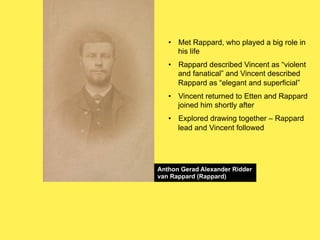
•! Met Rappard, who played a big role in
his life
•! Rappard described Vincent as “violent
and fanatical” and Vincent described
Rappard as “elegant and superficial”
•! Vincent returned to Etten and Rappard
joined him shortly after
•! Explored drawing together – Rappard
lead and Vincent followed

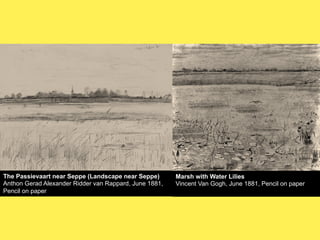
Anthon Gerad Alexander Ridder
van Rappard (Rappard)
The Passievaart near Seppe (Landscape near Seppe)
Anthon Gerad Alexander Ridder van Rappard, June 1881,
Pencil on paper

Marsh with Water Lilies
Vincent Van Gogh, June 1881, Pencil on paper
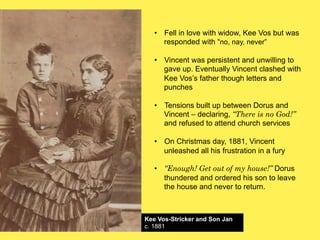
•! Fell in love with widow, Kee Vos but was
responded with “no, nay, never”
•! Vincent was persistent and unwilling to
gave up. Eventually Vincent clashed with
Kee Vos’s father though letters and
punches
•! Tensions built up between Dorus and
Vincent – declaring, “There is no God!”
and refused to attend church services
•! On Christmas day, 1881, Vincent
unleashed all his frustration in a fury
•! “Enough! Get out of my house!” Dorus
thundered and ordered his son to leave
the house and never to return.

Kee Vos-Stricker and Son Jan
c. 1881
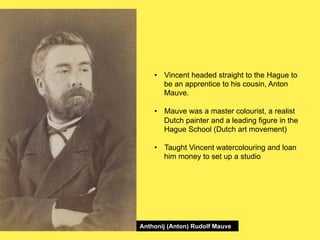
•! Vincent headed straight to the Hague to
be an apprentice to his cousin, Anton
Mauve.
•! Mauve was a master colourist, a realist
Dutch painter and a leading figure in the
Hague School (Dutch art movement)
•! Taught Vincent watercolouring and loan
him money to set up a studio

Anthonij (Anton) Rudolf Mauve
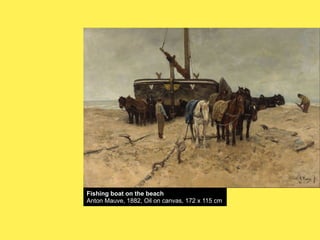
Fishing boat on the beach
Anton Mauve, 1882, Oil on canvas, 172 x 115 cm
•  But the apprenticeship did not last long
(in fact barely a month).
•  Mauve insist that Vincent should start by
drawing from plaster casts – the
traditional method – rather than wasting
money on playacting with street people
•  Vincent find him “narrow-minded,
unfriendly, moody and rather unkind”
•  Mauve banished Vincent from his studio
•  His quick-temper was well-known as he
continued to fought with mentors,
patrons and fellow artists.
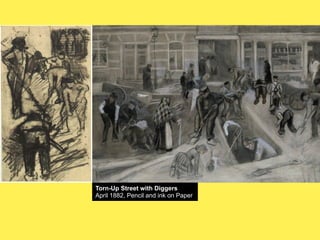
Torn-Up Street with Diggers
April 1882, Pencil and ink on Paper
•! Continued to hire models to re-create
poses from the Bargue exercises,
from his print collection and from his
previous drawings.
•! Subsequently, Vincent asked Theo for
more money to set up a bigger studio
for his models to pose better.
[Why is figure drawing so damn
important to Vincent???]

Woman Sitting on a Basket with Head in Hands
March 1883, Chalk on Paper
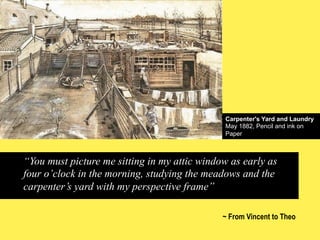
Carpenter's Yard and Laundry
May 1882, Pencil and ink on
Paper

“You must picture me sitting in my attic window as early as
four o’clock in the morning, studying the meadows and the
carpenter’s yard with my perspective frame”
~ From Vincent to Theo
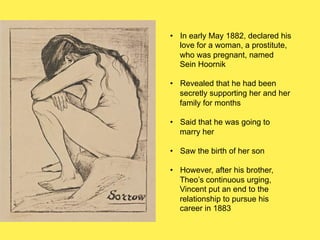
•! In early May 1882, declared his
love for a woman, a prostitute,
who was pregnant, named
Sein Hoornik
•! Revealed that he had been
secretly supporting her and her
family for months
•! Said that he was going to
marry her
•! Saw the birth of her son
•! However, after his brother,
Theo’s continuous urging,
Vincent put an end to the
relationship to pursue his
career in 1883
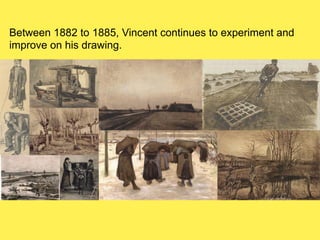
Between 1882 to 1885, Vincent continues to experiment and
improve on his drawing.
MARCH

26
1885

Theodorus (Dorus) van Gogh
passed away after a massive
stroke, aged 63.
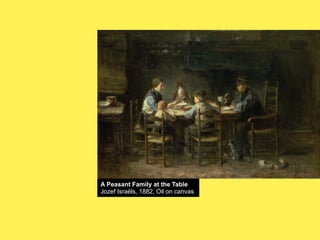
A Peasant Family at the Table
Jozef Israëls, 1882, Oil on canvas
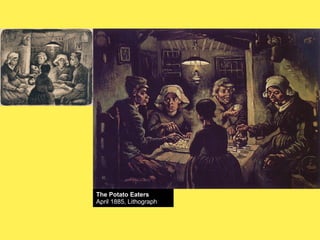
The Potato Eaters
April 1885, Lithograph
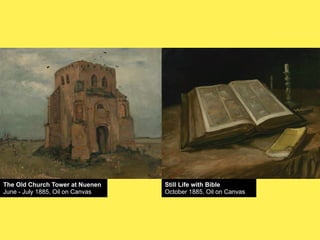
The Old Church Tower at Nuenen
June - July 1885, Oil on Canvas

Still Life with Bible
October 1885, Oil on Canvas
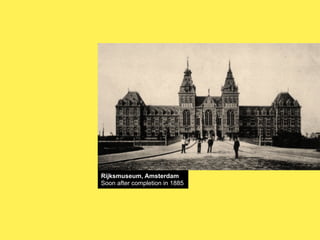
Rijksmuseum, Amsterdam
Soon after completion in 1885
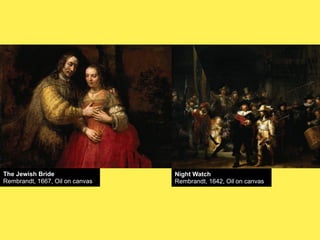
The Jewish Bride
Rembrandt, 1667, Oil on canvas

Night Watch
Rembrandt, 1642, Oil on canvas
Feeling “overstrained and far from well”
•! smoked a pipe to calm his digestion
•! gums grew sore and his teeth loosen
•! developed a hacking cough and losing
weight
Treated for syphilis with mercury
•! bain de siège [seated bath]
•! Side effects include hair loss, sexual
asthenia, insanity, death, stomach
cramps, anemia, depression, organ
failure, sight and hearing impairment,
salivation
•!
Self-portrait with Dark-felt Hat
1886, Oil on canvas

Did not admit the disease to his
brother, Theo
JANUARY

18
1886

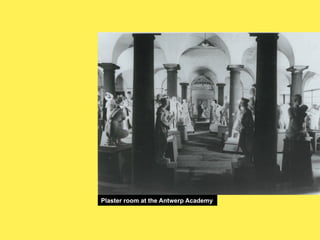
Age 32, Vincent began classes
at the Antwerp Royal Academy,
studying painting (with school
director) and drawing (from plaster
casts of antique sculptures)
Plaster room at the Antwerp Academy
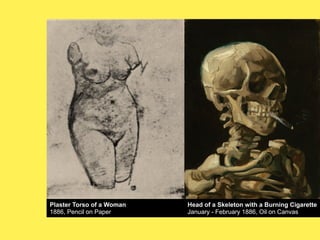
Plaster Torso of a Woman
1886, Pencil on Paper

Venus of aMilo (Plaster) a Burning Cigarette
Head de Skeleton with
January - February 1886, Oil on Canvas
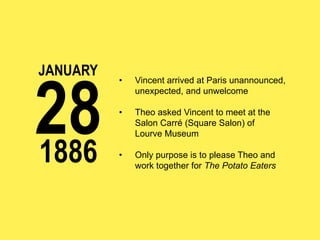
JANUARY

28
1886

• 

Vincent arrived at Paris unannounced,
unexpected, and unwelcome

• 

Theo asked Vincent to meet at the
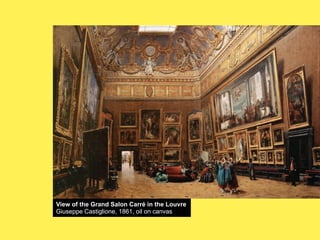
Salon Carré (Square Salon) of
Lourve Museum

• 

Only purpose is to please Theo and
work together for The Potato Eaters
THE FRENCH YEARS
1886 - 1888
View of the Grand Salon Carré in the Louvre
Giuseppe Castiglione, 1861, oil on canvas
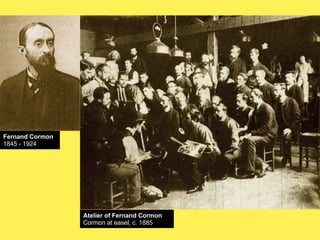
Fernand Cormon
1845 - 1924

Atelier of Fernand Cormon
Cormon at easel, c. 1885
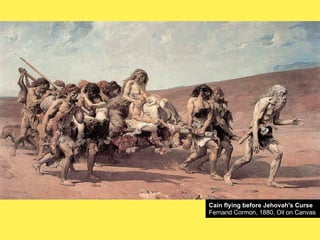
Cain flying before Jehovah's Curse
Fernand Cormon, 1880, Oil on Canvas
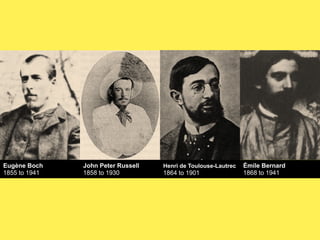
Eugène Boch
1855 to 1941

John Peter Russell
1858 to 1930

John de Toulouse-Lautrec
Henri Peter Russell
1858 to 1930
1864 1901

Émile Bernard
1868 to 1941
Monet’s Impression Sunrise
1872, Oil on Canvas

Renoir’s Monet painting in his garden in Argenteuil,
1873, Oil on Canvas

Manet’s Music in the Tuileries
1862, Oil on Canvas

Degas’s Ballettprobe
1873, Oil on Canvas
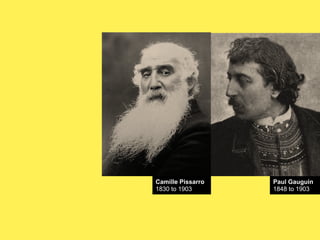
Camille Pissarro
1830 to 1903

Paul Gauguin
1848 to 1903
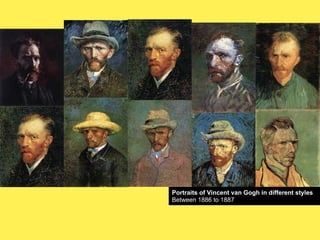
Portraits of Vincent van Gogh in different styles
Between 1886 to 1887
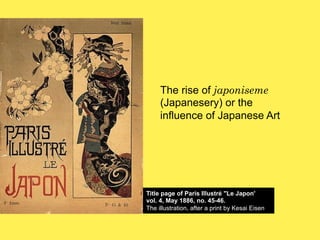
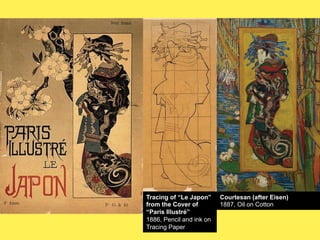
The rise of japoniseme
(Japanesery) or the
influence of Japanese Art

Title page of Paris Illustré "Le Japon'
vol. 4, May 1886, no. 45-46.
The illustration, after a print by Kesai Eisen
Tracing of “Le Japon”
from the Cover of
“Paris Illustré”
1886, Pencil and ink on
Tracing Paper

Courtesan (after Eisen)
1887, Oil on Cotton
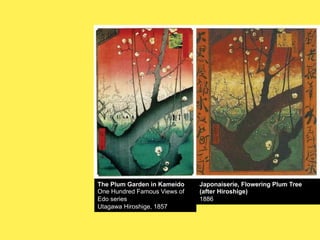
The Plum Garden in Kameido
One Hundred Famous Views of
Edo series
Utagawa Hiroshige, 1857

Japonaiserie, Flowering Plum Tree
(after Hiroshige)
1886
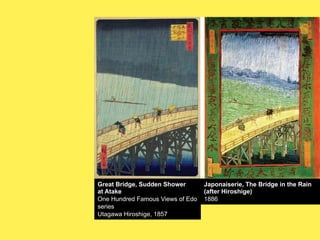
Great Bridge, Sudden Shower
at Atake
One Hundred Famous Views of Edo
series
Utagawa Hiroshige, 1857

Japonaiserie, The Bridge in the Rain
(after Hiroshige)
1886
In February 1888, he left Paris for Arles suddenly.
No one knows the reason only later.

“After Father was no more and I came to Theo in
Paris, then he became so attached to me that I
understood how much he had loved Father… It is a
good thing that I did not stay in Paris, for we, he
and I, would have become so close.”
~ By Vincent, two years later and only months before his death
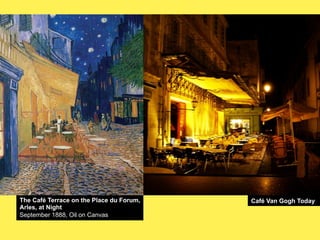
The Café Terrace on the Place du Forum,
Arles, at Night
September 1888, Oil on Canvas

Café Van Gogh Today
The Yellow House (“The Street”)
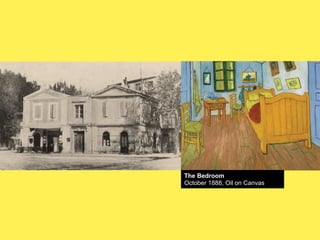
Bedroom
October 1888, Oil Oil on Canvas
September 1888, on Canvas
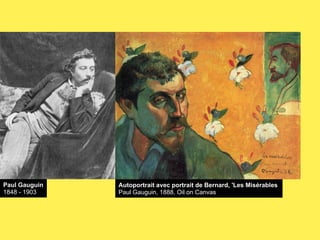
Paul Gauguin
1848 - 1903

Autoportrait avec portrait de Bernard, 'Les Misérables
Paul Gauguin, 1888, Oil on Canvas
SUNFLOWER
PAINTINGS
1888
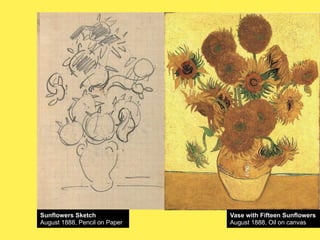
Sunflowers Sketch
August 1888, Pencil on Paper

Vase with Fifteen Sunflowers
August 1888, Oil on canvas
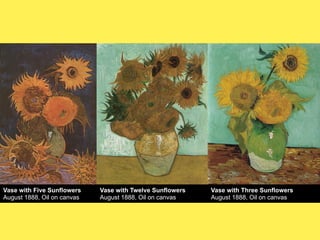
Vase with Five Sunflowers
August 1888, Oil on canvas

Vase with Twelve Sunflowers
August 1888, Oil on canvas

Vase with Three Sunflowers
August 1888, Oil on canvas
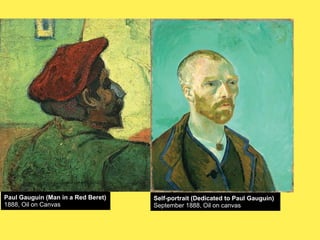
Paul Gauguin (Man in a Red Beret)
1888, Oil on Canvas

Self-portrait (Dedicated to Paul Gauguin)
September 1888, Oil on canvas
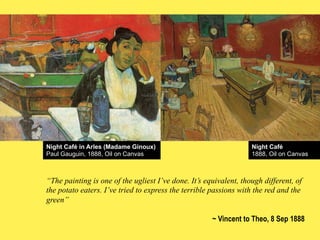
Night Café in Arles (Madame Ginoux)
Paul Gauguin, 1888, Oil on Canvas

Night Café
1888, Oil on Canvas

“The painting is one of the ugliest I’ve done. It’s equivalent, though different, of
the potato eaters. I’ve tried to express the terrible passions with the red and the
green”
~ Vincent to Theo, 8 Sep 1888
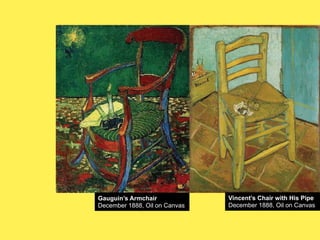
Gauguin’s Armchair
December 1888, Oil on Canvas

Vincent’s Chair with His Pipe
December 1888, Oil on Canvas
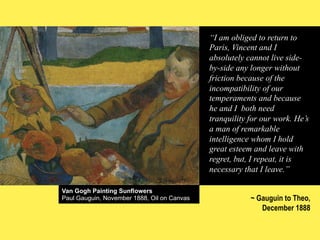
“I am obliged to return to
Paris, Vincent and I
absolutely cannot live sideby-side any longer without
friction because of the
incompatibility of our
temperaments and because
he and I both need
tranquility for our work. He’s
a man of remarkable
intelligence whom I hold
great esteem and leave with
regret, but, I repeat, it is
necessary that I leave.”
Van Gogh Painting Sunflowers
Paul Gauguin, November 1888, Oil on Canvas

~ Gauguin to Theo,
December 1888
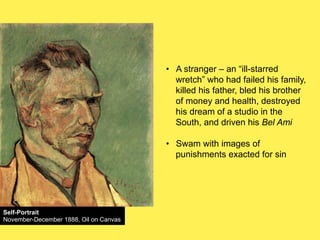
•! A stranger – an “ill-starred
wretch” who had failed his family,
killed his father, bled his brother
of money and health, destroyed
his dream of a studio in the
South, and driven his Bel Ami
•! Swam with images of
punishments exacted for sin

Self-Portrait
November-December 1888, Oil on Canvas
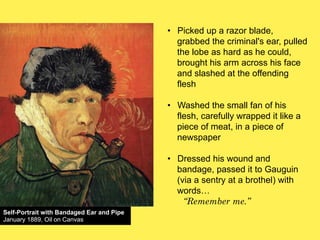
•! Picked up a razor blade,
grabbed the criminal's ear, pulled
the lobe as hard as he could,
brought his arm across his face
and slashed at the offending
flesh
•! Washed the small fan of his
flesh, carefully wrapped it like a
piece of meat, in a piece of
newspaper
•! Dressed his wound and
bandage, passed it to Gauguin
(via a sentry at a brothel) with
words!
“Remember me.”
Self-Portrait with Bandaged Ear and Pipe
January 1889, Oil on Canvas
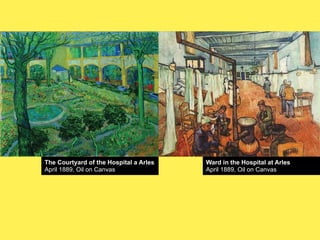
The Courtyard of the Hospital a Arles
April 1889, Oil on Canvas

Ward in the Hospital at Arles
April 1889, Oil on Canvas
MAY

27
1889

Vincent was admitted to the Asylum of
Saint-Paul-de-Mausole, Saint-Rémy,
aged 36.
THE ASYLUM YEARS
1889 - 1890
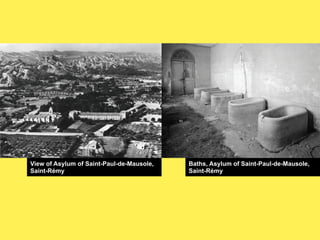
View of Asylum of Saint-Paul-de-Mausole,
Saint-Rémy

Baths, Asylum of Saint-Paul-de-Mausole,
Saint-Rémy
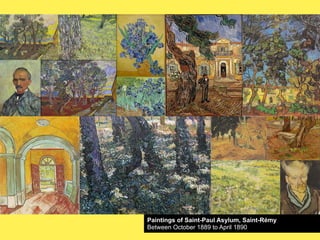
Paintings of Saint-Paul Asylum, Saint-Rémy
Between October 1889 to April 1890
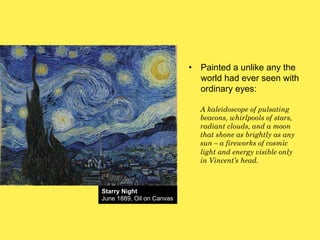
•! Painted a unlike any the
world had ever seen with
ordinary eyes:
A kaleidoscope of pulsating
beacons, whirlpools of stars,
radiant clouds, and a moon
that shone as brightly as any
sun – a fireworks of cosmic
light and energy visible only
in Vincent’s head.

Starry Night
June 1889, Oil on Canvas
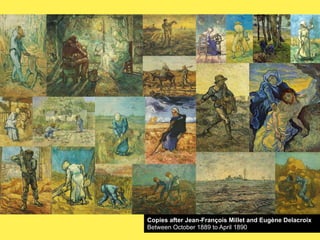
Copies after Jean-François Millet and Eugène Delacroix
Between October 1889 to April 1890
“We painters are always asked to compose ourselves
and to be nothing but composers. Very well – but in
music it isn’t so – and if such a person plays some
Beethoven he’ll add his personal interpretation to it
– in music, and then above all for singing – a
composer’s interpretation is something, and it isn’t a
hard and fast rule that only the composer plays his
own compositions…
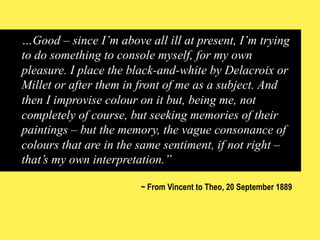
…Good – since I’m above all ill at present, I’m trying
to do something to console myself, for my own
pleasure. I place the black-and-white by Delacroix or
Millet or after them in front of me as a subject. And
then I improvise colour on it but, being me, not
completely of course, but seeking memories of their
paintings – but the memory, the vague consonance of
colours that are in the same sentiment, if not right –
that’s my own interpretation.”
~ From Vincent to Theo, 20 September 1889
JANUARY

31
1890

• 

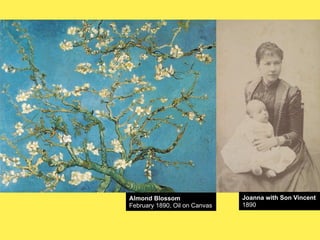
The son of Theo and his wife, Joanna,
was born.

• 

He was named Vincent Van Gogh.
Almond Blossom
February 1890, Oil on Canvas

Joanna with Son Vincent
1890
MAY

16
1890

• 

Vincent was “cured” and discharged from
the Saint-Paul Asylum, Saint Rémy.

• 

He left for Auvers-sur-Oise, near Paris, to
join Theo and his family the next morning.
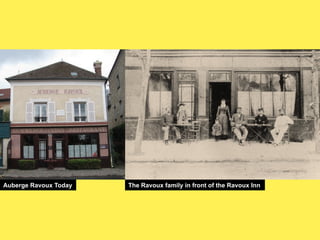
Auberge Ravoux Today

The Ravoux family in front of the Ravoux Inn
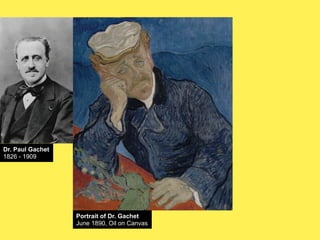
Dr. Paul Gachet
1826 - 1909

Portrait of Dr. Gachet
June 1890, Oil on Canvas
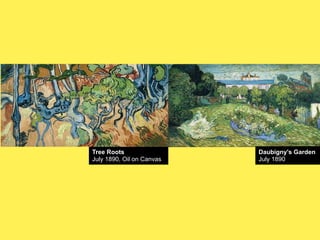
Tree Roots
July 1890, Oil on Canvas

Daubigny's Garden
July 1890
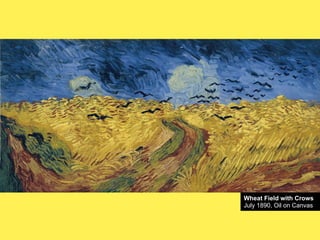
Wheat Field with Crows
July 1890, Oil on Canvas
FINAL GOODBYE
1890
JULY

27
1890

• 

Vincent shot himself at the chest at the
wheat field where he painted before.

• 

He limped back to his room and was
subsequently attended by Dr. Gachet and
another doctor.
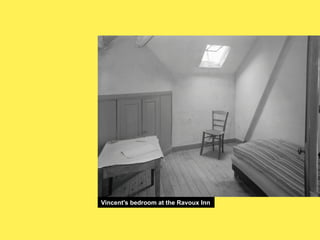
Vincent's bedroom at the Ravoux Inn
“I will not expressly seek death, but
I would not try to evade it if it
happened”.
~ Vincent

No one knows exactly what happened that day.
JULY

28
1890

• 

Theo arrived at mid-day.

• 

Vincent thanked his brother for coming
and giving them this opportunity to “be
together constantly”. He asked about
Jon and the baby.
JULY

29
1890

• 

Half-past midnight, Vincent cradled in his
brother’s arm and struggling for breath.

• 

Vincent uttered his last words:
“I want to die this way”.

• 

Vincent Willem van Gogh, aged 37, died
after about half an hour later.
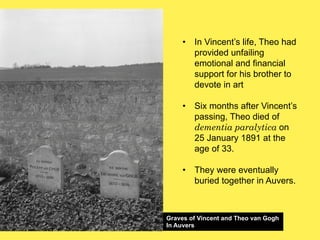
•! In Vincent’s life, Theo had
provided unfailing
emotional and financial
support for his brother to
devote in art
•! Six months after Vincent’s
passing, Theo died of
dementia paralytica on
25 January 1891 at the
age of 33.
•! They were eventually
buried together in Auvers.

Graves of Vincent and Theo van Gogh
In Auvers
In loving memory of my brother,
Randy Sum
1980 - 2012

THANK YOU

Vincent van Gogh: The Life

  • 1.
  • 2.
    “I want topaint what I feel and feel what I paint.” ~ Vincent Willem Van Gogh
  • 3.
    Red Vineyards nearArles, Vincent van Gogh, 1888. Oil on canvas, 73 x 91 cm.
  • 4.
    VAN GOGH’S LIFE… THEEARLY YEARS BECOMING AN ARTIST THE FRENCH YEARS THE ASYLUM YEARS FINAL GOODBYE (1853 - 1878) (1878 - 1886) (1886 - 1888) (1888 – 1890) (1890)
  • 5.
  • 7.
    MARCH 30 1852 Vincent van Goghstillborn. Buried in Zundert Cemetery, Holland.
  • 8.
    MARCH 30 1853 Vincent Willem vanGogh born. in Groot Zundert ("Big Zundert” ), a small village near the Belgian border, Holland.
  • 9.
    The Markt inZundert: The parsonage where Vincent was born is at centre
  • 10.
    Vincent van Gogh 1852- 1852 Vincent Willem van Gogh 1853 - 1890 Anna Cornelia van Gogh 1855 - 1930 Theodorus (Dorus) van Gogh 1822 - 1885 Theo van Gogh 1857 - 1891 Elisabeth (Lies) Huberta van Gogh 1859 - 1936 Willemina (Wil) van Gogh Anna Cornelia Carbentus 1862 - 1941 1819 - 1907 Cornelis (Cor) Vincent van Gogh 1867 - 1900
  • 11.
    The Mother: Anna CorneliaCarbentus 1819 - 1907 •! Middle daughter grew up with a dark and fearful view of life at the Hague •! Obsessed with the benefits of preoccupation and urged on her children at every opportunity •! Knit at "terrifying speed”; busy hands took her into art •! Echoed the mandate of family unity – family totalitarianism •! Defined happiness – Duty. Decency, Solidity.
  • 12.
    The Mother: Anna CorneliaCarbentus 1819 - 1907 •! Inspired by Alphonse Karr's A tour round my garden, Anna used the garden she built to school her children in the meaning of nature •! Vincent wrote: Trees - especially tree roots- affirmed the promise of life after death •! Introduced drawing, music and singing to children •! Together with Dorus, Anna often share stories of family history and the children inherited their nostalgia for the past
  • 13.
    The Father: Theodorus (Dorus)van Gogh 1822 - 1885 •! A minister of the Dutch Reformed Church in Zunbert •! Earned a modest salary, but the church provided the family with the perquisites of status – a house, a maid, 2 cooks, a gardener, a carriage and a horse. •! Responsible for educating children in religion
  • 14.
    The Dutch ReformedChurch in Zundert
  • 15.
    A Strange Boy: VincentWillem van Gogh 1853 - 1890 •! A head full of thick, curly red locks •! The face was odd: oblong, with a high brow and prominent chin, puffy cheeks, shallow-set eyes, and a wide nose, lower lip protruded in a perpetual pout •! Favoured his mother red hair and broad features •! Shared her taste for creature comforts and finer things – in flower arrangements, fabrics, and home décor Vincent (Age 13)
  • 16.
    Barn and Farmhouse February1864, pencil on paper, 7 7/8 x 10 5/8 in. Created for his father’s birthday.
  • 17.
    Vincent van Goghon the steps of the Tilburg School
  • 18.
    •! In March1868, Vincent walked out of the Tilburg School •! Vincent resisted all suggestions about his future and lived in idleness •! Anna and Dorus’s to educate their eldest son in Zundert had ended in frustration and failure •! In July 1869, Vincent relented and went to The Hague to work as an “office clerk” at Goupil & Cie, a leading art dealer co-owned by Uncle Cent van Gogh Vincent (Age 18)
  • 19.
    Interior of Goupil& Cie’s Gallery, The Hague, Netherlands
  • 20.
    •! Surrounded byart in Goupil– paintings, woodcuts, engravings, etchings, photographs, artists’ albums, illustrated books and magazines, etc. •! Books and latest art journals on artists, art history and art collections in Holland and elsewhere View on Delft, Vermeer, Johannes, c.1661, Oil on canvas •! Frequent visits to the Dutch royal collection at the Mauritshuis – exposed to Golden Age paintings like Vermeer’s View of Delft and Rembrant’s Anatomy Lesson •! Travel to see paintings by masters, such as Jan van Eyck, Hans Memling and Peter Paul Rubens The Anatomy Lesson of Dr. Nicolaes Tulp, Rembrandt, 1632, Oil on canvas,
  • 21.
    •! Saw thefirst sign of a new art movement: the importance of plein air (outdoor) painting and the new mandate to capture “the virgin impression of nature”. Frozen Waterway, Schelfhout, Andreas, 1845, Oil on panel •! Often visit the just-opened Museum van Morderne Kunst (museum of Modern Art) •! Exposed to Dutch contemporary artists like Andreas Schelfhout and Cornelis Springer •! Such paintings looked unfinished to Vincent’s unaccustomed eye Along the Canal, Cornelis Springer, 1844, Oil on canvas
  • 22.
    Caroline Haanebeek Vincent Celebration of the80th birthday of Johannes Andricus Stricker, a great uncle of Vincent van Gogh August 1872, Huis te Hoorn, Rijswijk, The Hague
  • 23.
    “If I cannotget a good woman, I shall take a bad one... I would sooner be with a bad whore than be alone.” ~ Vincent told his brother, Theo Note: Vincent’s correspondence totaled to more than 2,000 letters. Only 902 letters were discovered. About four-fifths of them were addressed to his brother, Theo.
  • 24.
    •! Vincent gotinto trouble and he suspected that his boss, H. G. Tersteeg, was responsible for “putting [him] in a bad light”. The exact details of the trouble remains unknown. •! His poor work performance has been raised to the highest level. His father, Dorus was extremely unhappy and say unpleasant things to him in letters •! Theo was given a job at Goupil as well •! Decision was made to dismiss Vincent. Plans were made to arrange him to work in London. H. G. Tersteeg
  • 25.
    While in Londonbetween 1873 to 1875: “The house here is not so interesting as the one [there]… Good pictures [are] quite difficult to find. Tell me especially what pictures you have seen lately, or any new etchings or lithographs have been published. Tell me all you can about these things, for I do not see much of them here.” ~ From Vincent to Theo
  • 26.
    Ursula Loyer Eugenie Loyer 87Hackford Road, Brixton, London [1873-1875], Pencil and chalk on paper
  • 27.
    Photograph of NationalGallery London by Morio
  • 28.
    “I am notwhat many people think I am just now.” ~ Vincent response to complaints about his unsuitability in Goupil In mid-May 1875, Vincent was transferred to Paris
  • 29.
    What use isthere in banishing him From one shore and then another… He is the desolate son Of a beloved land. Let us give a homeland A homeland To the poor exile ~ From Vincent to his parents, poem L’exile, translated into Dutch
  • 30.
    Uprising of theimpressionists •! Other names includes impressionalists and lunatics •! Claimed that they represented the “next wave” in art •! Storm broke in March 1875 when the upstarts (including Monet and Renior) try to sell some of their paintings at the city’s central auction house, the Hôtel Drouot “50 francs for a Monet landscape. – That’s for the frame!” Rue Montorgueil, Paris Claude Monet, 1878, Oil on Canvas
  • 31.
    Impression Sunrise Claude Monet,1872, Oil on Canvas Monet painting in his garden in Argenteuil, Pierre-Auguste Renoir, 1873, Oil on Canvas Music in the Tuileries Edouard Manet, 1862, Oil on Canvas Ballettprobe Edgar Degas, 1873, Oil on Canvas
  • 32.
    “I have seenabsolutely nothing about them. From what you told me about ‘impressionism’, it’s not quite clear to me what it really is.” ~ Vincent’s response to Theo on the “new artists”
  • 33.
    How impetuously awounded heart rushes… Towards the first refuge where, young and at peace, He used to listen to himself singing amidst the silence With what bitter zeal, my soul, do you revel In the house where you were born… An yet, O chimera, you were deceiving us! For in your beautiful illusion a superb future Was opening out its rich sheaves like a glorious summer, Its fluttering ears like real suns. Christus Consolator Ary Scheffer, 1836-37, Oil on canvas, You lied. But what irresistible charms they have, These ghosts one sees in the ruby-red distance Shimmering iridescently through the great prism of one’s tears!
  • 34.
    Vicarge and churchat Etten Vincent van Gogh, April 1876, Pencil & ink on paper Churches at Petersham & Turnham Green Vincent van Gogh, November 1876, Ink on paper
  • 35.
    DECEMBER 21 1875 Come home, comehome! You are weary at heart, For the way has been dark, and so lonely and wild; O Prodigal child! Come home; oh come home! Come home, come home! From the sorrow and blame, From the sin and the shame, and the tempter that smiled; O Prodigal child! Come home; oh come home! After months of wandering, he returned to his parents in Etten.
  • 36.
    Scheffersplein: the marketsquare in Dordrecht The bookstore Bluss and Van Braam where 22-year old Vincent worked is at center
  • 37.
    From January 1976to November 1978:
  • 38.
    BECOMING AN ARTIST 1878 -1886 Painting designed by Adrien Midzic from The Noun Project
  • 39.
    “When I thinkthe eyes of so many are fixed on me, who will know where the fault is if I do not succeed, who will make me reproaches… the fear of failure, of disgrace – then I also have the longing: I wish I were far away from everything!” ~ A Confession by Vincent
  • 40.
    •! Au Charbonnage[to the coal fields] “It always strikes me, that when we see the image of indescribable and unutterable desolation – of loneliness, of poverty and misery, the end of all things, or their extreme – the rises in our mind the though of god.” “The workmen come there to eat their bread and drink their glass of beer during the lunch hour” •! He, too, was heading to au charbonnage The “Au Charbonnage” Café November 1878, Pencil and ink on paper, 40 x 40cm
  • 41.
    “… I didnot lack courage. I would learn and observe and come back having something to say that was really worth hearing – a better and riper man”. ~ From Vincent to Theo In November 1878, with no means of support, no plans and no prospects, Vincent head to Borinage a.k.a Le pays noir (the black country)
  • 42.
  • 43.
    Charles Bargue’s 2-partDrawing Courses Miners in the Snow at Dawn August 1880, Pencil on Paper, 20 x 13 cm In October 1880, he left for Brussels with a portfolio of drawings to seek for a better studio, the company of artists and “good things to look at” in order to forget those miseries and “make good things myself”.
  • 45.
    The Sower Jean-François Millet,1850, Oil on canvas The Sower (After Millet) Vincent Van Gogh, 1881, Ink on paper
  • 46.
    “Anyone who hasmastered a figure drawing can earn quite a bit.” ~ From Vincent to Theo Thinking that if he mastered figure drawing, he could make the kinds of images that often appeared in illustrated magazines – especially images of picturesque country life. Vincent spent a lot of money hiring models and renting studio for his drawings.
  • 47.
    •! Met Rappard,who played a big role in his life •! Rappard described Vincent as “violent and fanatical” and Vincent described Rappard as “elegant and superficial” •! Vincent returned to Etten and Rappard joined him shortly after •! Explored drawing together – Rappard lead and Vincent followed Anthon Gerad Alexander Ridder van Rappard (Rappard)
  • 48.
    The Passievaart nearSeppe (Landscape near Seppe) Anthon Gerad Alexander Ridder van Rappard, June 1881, Pencil on paper Marsh with Water Lilies Vincent Van Gogh, June 1881, Pencil on paper
  • 49.
    •! Fell inlove with widow, Kee Vos but was responded with “no, nay, never” •! Vincent was persistent and unwilling to gave up. Eventually Vincent clashed with Kee Vos’s father though letters and punches •! Tensions built up between Dorus and Vincent – declaring, “There is no God!” and refused to attend church services •! On Christmas day, 1881, Vincent unleashed all his frustration in a fury •! “Enough! Get out of my house!” Dorus thundered and ordered his son to leave the house and never to return. Kee Vos-Stricker and Son Jan c. 1881
  • 50.
    •! Vincent headedstraight to the Hague to be an apprentice to his cousin, Anton Mauve. •! Mauve was a master colourist, a realist Dutch painter and a leading figure in the Hague School (Dutch art movement) •! Taught Vincent watercolouring and loan him money to set up a studio Anthonij (Anton) Rudolf Mauve
  • 51.
    Fishing boat onthe beach Anton Mauve, 1882, Oil on canvas, 172 x 115 cm
  • 52.
    •  But theapprenticeship did not last long (in fact barely a month). •  Mauve insist that Vincent should start by drawing from plaster casts – the traditional method – rather than wasting money on playacting with street people •  Vincent find him “narrow-minded, unfriendly, moody and rather unkind” •  Mauve banished Vincent from his studio •  His quick-temper was well-known as he continued to fought with mentors, patrons and fellow artists.
  • 53.
    Torn-Up Street withDiggers April 1882, Pencil and ink on Paper
  • 54.
    •! Continued tohire models to re-create poses from the Bargue exercises, from his print collection and from his previous drawings. •! Subsequently, Vincent asked Theo for more money to set up a bigger studio for his models to pose better. [Why is figure drawing so damn important to Vincent???] Woman Sitting on a Basket with Head in Hands March 1883, Chalk on Paper
  • 55.
    Carpenter's Yard andLaundry May 1882, Pencil and ink on Paper “You must picture me sitting in my attic window as early as four o’clock in the morning, studying the meadows and the carpenter’s yard with my perspective frame” ~ From Vincent to Theo
  • 56.
    •! In earlyMay 1882, declared his love for a woman, a prostitute, who was pregnant, named Sein Hoornik •! Revealed that he had been secretly supporting her and her family for months •! Said that he was going to marry her •! Saw the birth of her son •! However, after his brother, Theo’s continuous urging, Vincent put an end to the relationship to pursue his career in 1883
  • 57.
    Between 1882 to1885, Vincent continues to experiment and improve on his drawing.
  • 58.
    MARCH 26 1885 Theodorus (Dorus) vanGogh passed away after a massive stroke, aged 63.
  • 59.
    A Peasant Familyat the Table Jozef Israëls, 1882, Oil on canvas
  • 60.
    The Potato Eaters April1885, Lithograph
  • 62.
    The Old ChurchTower at Nuenen June - July 1885, Oil on Canvas Still Life with Bible October 1885, Oil on Canvas
  • 63.
  • 64.
    The Jewish Bride Rembrandt,1667, Oil on canvas Night Watch Rembrandt, 1642, Oil on canvas
  • 65.
    Feeling “overstrained andfar from well” •! smoked a pipe to calm his digestion •! gums grew sore and his teeth loosen •! developed a hacking cough and losing weight Treated for syphilis with mercury •! bain de siège [seated bath] •! Side effects include hair loss, sexual asthenia, insanity, death, stomach cramps, anemia, depression, organ failure, sight and hearing impairment, salivation •! Self-portrait with Dark-felt Hat 1886, Oil on canvas Did not admit the disease to his brother, Theo
  • 66.
    JANUARY 18 1886 Age 32, Vincentbegan classes at the Antwerp Royal Academy, studying painting (with school director) and drawing (from plaster casts of antique sculptures)
  • 67.
    Plaster room atthe Antwerp Academy
  • 68.
    Plaster Torso ofa Woman 1886, Pencil on Paper Venus of aMilo (Plaster) a Burning Cigarette Head de Skeleton with January - February 1886, Oil on Canvas
  • 69.
    JANUARY 28 1886 •  Vincent arrived atParis unannounced, unexpected, and unwelcome •  Theo asked Vincent to meet at the Salon Carré (Square Salon) of Lourve Museum •  Only purpose is to please Theo and work together for The Potato Eaters
  • 70.
  • 71.
    View of theGrand Salon Carré in the Louvre Giuseppe Castiglione, 1861, oil on canvas
  • 72.
    Fernand Cormon 1845 -1924 Atelier of Fernand Cormon Cormon at easel, c. 1885
  • 73.
    Cain flying beforeJehovah's Curse Fernand Cormon, 1880, Oil on Canvas
  • 74.
    Eugène Boch 1855 to1941 John Peter Russell 1858 to 1930 John de Toulouse-Lautrec Henri Peter Russell 1858 to 1930 1864 1901 Émile Bernard 1868 to 1941
  • 75.
    Monet’s Impression Sunrise 1872,Oil on Canvas Renoir’s Monet painting in his garden in Argenteuil, 1873, Oil on Canvas Manet’s Music in the Tuileries 1862, Oil on Canvas Degas’s Ballettprobe 1873, Oil on Canvas
  • 76.
    Camille Pissarro 1830 to1903 Paul Gauguin 1848 to 1903
  • 77.
    Portraits of Vincentvan Gogh in different styles Between 1886 to 1887
  • 78.
    The rise ofjaponiseme (Japanesery) or the influence of Japanese Art Title page of Paris Illustré "Le Japon' vol. 4, May 1886, no. 45-46. The illustration, after a print by Kesai Eisen
  • 79.
    Tracing of “LeJapon” from the Cover of “Paris Illustré” 1886, Pencil and ink on Tracing Paper Courtesan (after Eisen) 1887, Oil on Cotton
  • 80.
    The Plum Gardenin Kameido One Hundred Famous Views of Edo series Utagawa Hiroshige, 1857 Japonaiserie, Flowering Plum Tree (after Hiroshige) 1886
  • 81.
    Great Bridge, SuddenShower at Atake One Hundred Famous Views of Edo series Utagawa Hiroshige, 1857 Japonaiserie, The Bridge in the Rain (after Hiroshige) 1886
  • 82.
    In February 1888,he left Paris for Arles suddenly. No one knows the reason only later. “After Father was no more and I came to Theo in Paris, then he became so attached to me that I understood how much he had loved Father… It is a good thing that I did not stay in Paris, for we, he and I, would have become so close.” ~ By Vincent, two years later and only months before his death
  • 83.
    The Café Terraceon the Place du Forum, Arles, at Night September 1888, Oil on Canvas Café Van Gogh Today
  • 84.
    The Yellow House(“The Street”) Bedroom October 1888, Oil Oil on Canvas September 1888, on Canvas
  • 85.
    Paul Gauguin 1848 -1903 Autoportrait avec portrait de Bernard, 'Les Misérables Paul Gauguin, 1888, Oil on Canvas
  • 86.
  • 87.
    Sunflowers Sketch August 1888,Pencil on Paper Vase with Fifteen Sunflowers August 1888, Oil on canvas
  • 88.
    Vase with FiveSunflowers August 1888, Oil on canvas Vase with Twelve Sunflowers August 1888, Oil on canvas Vase with Three Sunflowers August 1888, Oil on canvas
  • 89.
    Paul Gauguin (Manin a Red Beret) 1888, Oil on Canvas Self-portrait (Dedicated to Paul Gauguin) September 1888, Oil on canvas
  • 90.
    Night Café inArles (Madame Ginoux) Paul Gauguin, 1888, Oil on Canvas Night Café 1888, Oil on Canvas “The painting is one of the ugliest I’ve done. It’s equivalent, though different, of the potato eaters. I’ve tried to express the terrible passions with the red and the green” ~ Vincent to Theo, 8 Sep 1888
  • 91.
    Gauguin’s Armchair December 1888,Oil on Canvas Vincent’s Chair with His Pipe December 1888, Oil on Canvas
  • 92.
    “I am obligedto return to Paris, Vincent and I absolutely cannot live sideby-side any longer without friction because of the incompatibility of our temperaments and because he and I both need tranquility for our work. He’s a man of remarkable intelligence whom I hold great esteem and leave with regret, but, I repeat, it is necessary that I leave.” Van Gogh Painting Sunflowers Paul Gauguin, November 1888, Oil on Canvas ~ Gauguin to Theo, December 1888
  • 93.
    •! A stranger– an “ill-starred wretch” who had failed his family, killed his father, bled his brother of money and health, destroyed his dream of a studio in the South, and driven his Bel Ami •! Swam with images of punishments exacted for sin Self-Portrait November-December 1888, Oil on Canvas
  • 94.
    •! Picked upa razor blade, grabbed the criminal's ear, pulled the lobe as hard as he could, brought his arm across his face and slashed at the offending flesh •! Washed the small fan of his flesh, carefully wrapped it like a piece of meat, in a piece of newspaper •! Dressed his wound and bandage, passed it to Gauguin (via a sentry at a brothel) with words! “Remember me.” Self-Portrait with Bandaged Ear and Pipe January 1889, Oil on Canvas
  • 95.
    The Courtyard ofthe Hospital a Arles April 1889, Oil on Canvas Ward in the Hospital at Arles April 1889, Oil on Canvas
  • 96.
    MAY 27 1889 Vincent was admittedto the Asylum of Saint-Paul-de-Mausole, Saint-Rémy, aged 36.
  • 97.
  • 98.
    View of Asylumof Saint-Paul-de-Mausole, Saint-Rémy Baths, Asylum of Saint-Paul-de-Mausole, Saint-Rémy
  • 99.
    Paintings of Saint-PaulAsylum, Saint-Rémy Between October 1889 to April 1890
  • 100.
    •! Painted aunlike any the world had ever seen with ordinary eyes: A kaleidoscope of pulsating beacons, whirlpools of stars, radiant clouds, and a moon that shone as brightly as any sun – a fireworks of cosmic light and energy visible only in Vincent’s head. Starry Night June 1889, Oil on Canvas
  • 101.
    Copies after Jean-FrançoisMillet and Eugène Delacroix Between October 1889 to April 1890
  • 102.
    “We painters arealways asked to compose ourselves and to be nothing but composers. Very well – but in music it isn’t so – and if such a person plays some Beethoven he’ll add his personal interpretation to it – in music, and then above all for singing – a composer’s interpretation is something, and it isn’t a hard and fast rule that only the composer plays his own compositions…
  • 103.
    …Good – sinceI’m above all ill at present, I’m trying to do something to console myself, for my own pleasure. I place the black-and-white by Delacroix or Millet or after them in front of me as a subject. And then I improvise colour on it but, being me, not completely of course, but seeking memories of their paintings – but the memory, the vague consonance of colours that are in the same sentiment, if not right – that’s my own interpretation.” ~ From Vincent to Theo, 20 September 1889
  • 104.
    JANUARY 31 1890 •  The son ofTheo and his wife, Joanna, was born. •  He was named Vincent Van Gogh.
  • 105.
    Almond Blossom February 1890,Oil on Canvas Joanna with Son Vincent 1890
  • 106.
    MAY 16 1890 •  Vincent was “cured”and discharged from the Saint-Paul Asylum, Saint Rémy. •  He left for Auvers-sur-Oise, near Paris, to join Theo and his family the next morning.
  • 107.
    Auberge Ravoux Today TheRavoux family in front of the Ravoux Inn
  • 108.
    Dr. Paul Gachet 1826- 1909 Portrait of Dr. Gachet June 1890, Oil on Canvas
  • 109.
    Tree Roots July 1890,Oil on Canvas Daubigny's Garden July 1890
  • 110.
    Wheat Field withCrows July 1890, Oil on Canvas
  • 111.
  • 112.
    JULY 27 1890 •  Vincent shot himselfat the chest at the wheat field where he painted before. •  He limped back to his room and was subsequently attended by Dr. Gachet and another doctor.
  • 113.
    Vincent's bedroom atthe Ravoux Inn
  • 114.
    “I will notexpressly seek death, but I would not try to evade it if it happened”. ~ Vincent No one knows exactly what happened that day.
  • 115.
    JULY 28 1890 •  Theo arrived atmid-day. •  Vincent thanked his brother for coming and giving them this opportunity to “be together constantly”. He asked about Jon and the baby.
  • 116.
    JULY 29 1890 •  Half-past midnight, Vincentcradled in his brother’s arm and struggling for breath. •  Vincent uttered his last words: “I want to die this way”. •  Vincent Willem van Gogh, aged 37, died after about half an hour later.
  • 117.
    •! In Vincent’slife, Theo had provided unfailing emotional and financial support for his brother to devote in art •! Six months after Vincent’s passing, Theo died of dementia paralytica on 25 January 1891 at the age of 33. •! They were eventually buried together in Auvers. Graves of Vincent and Theo van Gogh In Auvers
  • 118.
    In loving memoryof my brother, Randy Sum 1980 - 2012 THANK YOU