ADVANCED EDUCATIONAL PSYCHOLOGY
UNIT-I
PSYCHOLOGY AND ITS BASIC SCHOOLS
Dr.N.SASIKUMAR
Assistant Professor
Department of Education
Alagappa University
Karaikudi-630003
INTRODUCTION
The word psychology is derived from Greek
word psycho & logos. ‘Psycho’ means
“soul” and ‘logos’ means “science”. The
science of soul.
First Stage: Psychology was defined as the
“study of the soul”
Second Stage: It was again defined as the
“study of the mind”
 Third Stage: Again it was defined by William
James (1890) as the “Study of Consciousness”
 Fourth Stage: “Study of total Behaviour”
(consciousness and unconsciousness).
 It is scientific because it is systematic study of
observable events/behavior and behavior is
unlearned process where in include reflexes,
physiological process and instincts and it is
learned behavior also because all behavior acquire
through practice.
 Today Psychology is scientific method of
collecting data about individual and groups to
analyze and predict their behavior.
Definitions- Psychology
“Psychology is the scientific study of the
activities of the individual in relation to
his environment”
by: Woodworth & Marquis
“Psychology today concerns itself with
the scientific investigation of behaviour”
by: N.L. Munn
PSYCHOLOGY
Pure Psychology Applied Psychology
Industrial
Crime
Military
Clinical
Animal
Legal
Plant
Educational
Meaning of Educational Psychology
4 Educational psychology is the branch of psychology
concerned with the scientific study of human learning.
4 The study of learning processes, from both cognitive and
behavioral perspectives, allows researchers to understand
individual differences in intelligence, cognitive
development, motivation, self-regulation, and self-concept,
as well as their role in learning.
4 Crow and Crow put it as: “Educational Psychology
describes and explains the learning experience of an
individual from birth through old age”(1973).
4 According to Peel: “Educational Psychology is the science
of education (1956).
4 It is that branch of psychology which deals with teaching
and learning (Skinner 1958).
Nature of Educational Psychology
4 It is an applied branch of fundamental Psychology.
4 It combines two fields i.e. education and psychology.
4 It is the scientific study of human behavior in educational
situation.
4 It is concerned with these factors, principles and techniques
which relate to the various aspects of child’s growth and
development.
4 It is concerned with learning situation and process by which
learning can be more efficient and effective.
4 Educational Psychology, draws heavily from various branches
of psychology, biology, sociology and anthropology
4 Educational Psychology is not as exact as natural sciences since
the human behavior cannot be predicated exactly, because it is
dynamic.
Scope of Educational Psychology
Methods of Educational Psychology
4 Introspection Method
4 Observation Method
4 Anecdotal Method
4 Experimental Method
4 Case Study Method
4 Questionnaire Method
DESCRIPTIVE METHOD
4 Descriptive research methods are pretty
much as they sound — they describe
situations. They do not make accurate
predictions, and they do not determine
cause and effect. There are three main types
of descriptive methods: observational
methods, case-study methods and survey
methods.
Introspection Method: Examination of one's own
conscious thoughts and feelings. In psychology the process
of introspection relies exclusively on observation of one's
mental state, while in a spiritual context it may refer to the
examination of one's soul.
Observation Method: The observation and description of
a subject's behavior. Researchers utilizing
the observational method can exert varying amounts of
control over the environment in which
the observation takes place.
Anecdotal Method: Method based on personal
recollections of a case, as opposed to specific, empirically
derived investigation. Can provide ideas to fuel
further research.
Experimental Method: The experimental method involves
manipulating one variable to determine if changes in one
variable cause changes in another variable.
This method relies on controlled methods, random
assignment and the manipulation of variables to test a
hypothesis.
Case study method: In order to prepare a case history of
data are taken from many sources for example his or her
family history, educational life, medical history and social
life.
This method is very popular in clinical psychology
and life span developmental psychology.
Questionnaire Method:
A questionnaire consists of a set of questions to
which the individual is required to respond.
The items (questions) of the questionnaire can be
either in closed-ended form or in open-ended
form.
In the case of closed-ended item the individual is
provided with limited alternative and he or she has
to choose only one alternative which reflects his
or her view on the item.
In open-ended items the individual is free to give
his or her response the way he or she likes.
SURVEY METHOD
A survey is a research method used for collecting
data from a predefined group of respondents to gain
information and insights into various topics of
interest. They can have multiple purposes, and
researchers can conduct it in many ways depending
on the methodology chosen and the study's goal.
Surveys results provide a snapshot of the attitudes and
behaviors – including thoughts, opinions, and
comments – about your target survey population. This
valuable feedback is your baseline to measure and
establish a benchmark from which to compare results
over time.
Basic Schools of Psychology
SCHOOLS OF PSYCHOLOGY
Structuralism
Functionalism
Behaviorism
Constructivism
Humanism
1. Wilhelm Wundt and Edward Tichner
2. Introspection Method
3. Structures of the mind
4. Identify the elements of thought
through introspection and determine
how these elements create the whole
experience
5. A model of the scientific study of
mental processes
STRUCTURALISM (1879)
WilhelmWundt
LeaderandFounder
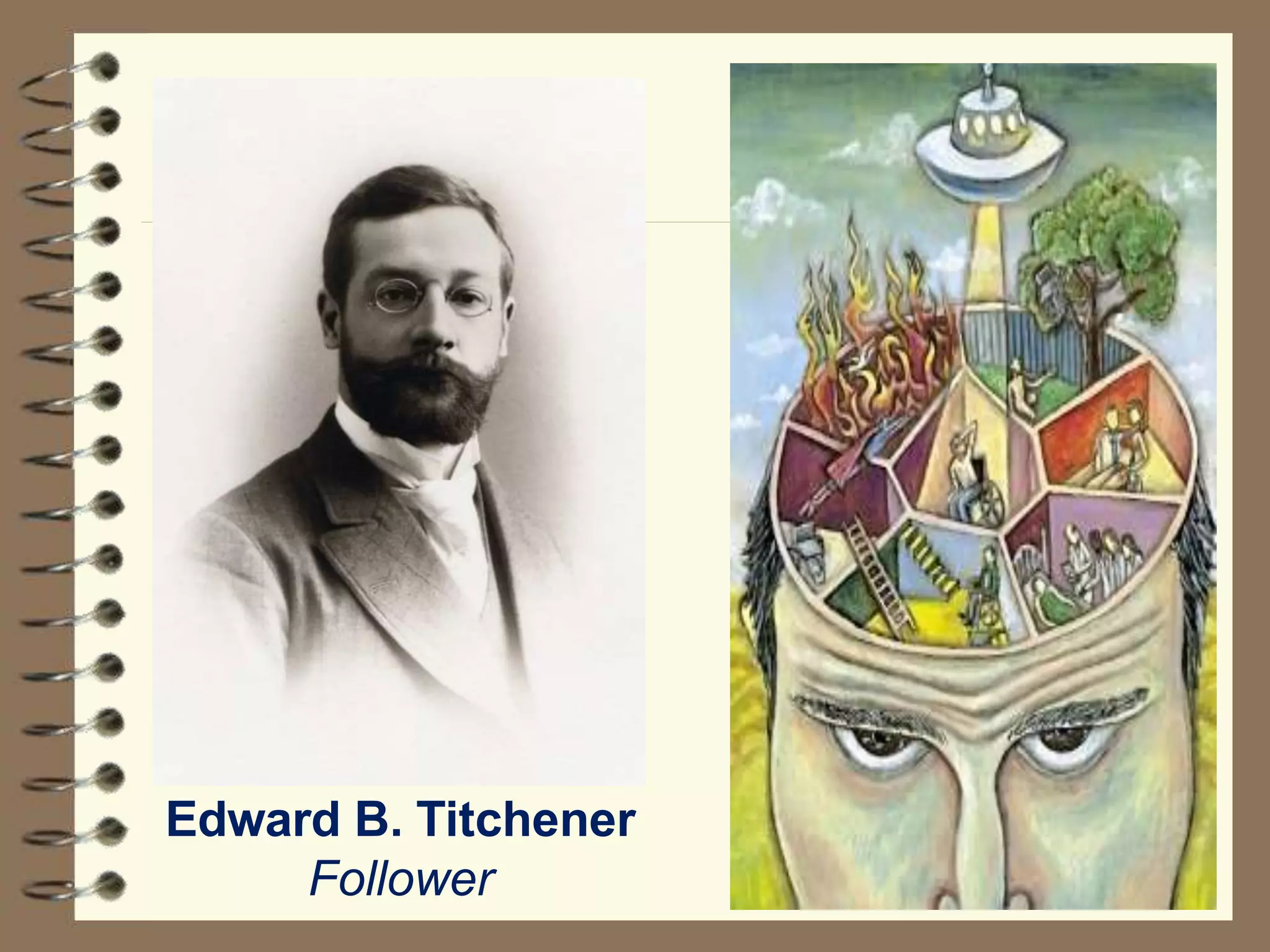
Edward B. Titchener
Follower
FUNCTIONALISM(1898)
1. William James
2. Function of the mind
3. Animal behavior and biological processes
4. How the mind functions to adapt humans and
other animals to their environment
5. Expanded the scope of psychology to include
research on emotions and observable
behavior, psycho testing, modern education
and diversified into industry
Humanism (1960)
1. Carl Rogers and Abraham Maslow
2. All individuals strive to grow, develop and
move toward selfactualization
3. Freewill, selfactualization and human
nature is naturally positive and growth
seeking
4. Personality Research and Psychotherapy
5. No criticisms
1. Humanistic psychology, a movement in
psychology supporting the belief that humans, as
individuals, are unique beings and should be
recognized and treated as such by psychologists
and psychiatrists.
2. The movement grew in opposition to the two
mainstream 20th-century trends in psychology,
behaviourism and psychoanalysis.
3. Humanistic principles attained application during
the “human potential” movement, which became
popular in the United States during the 1960s.
Humanistic school
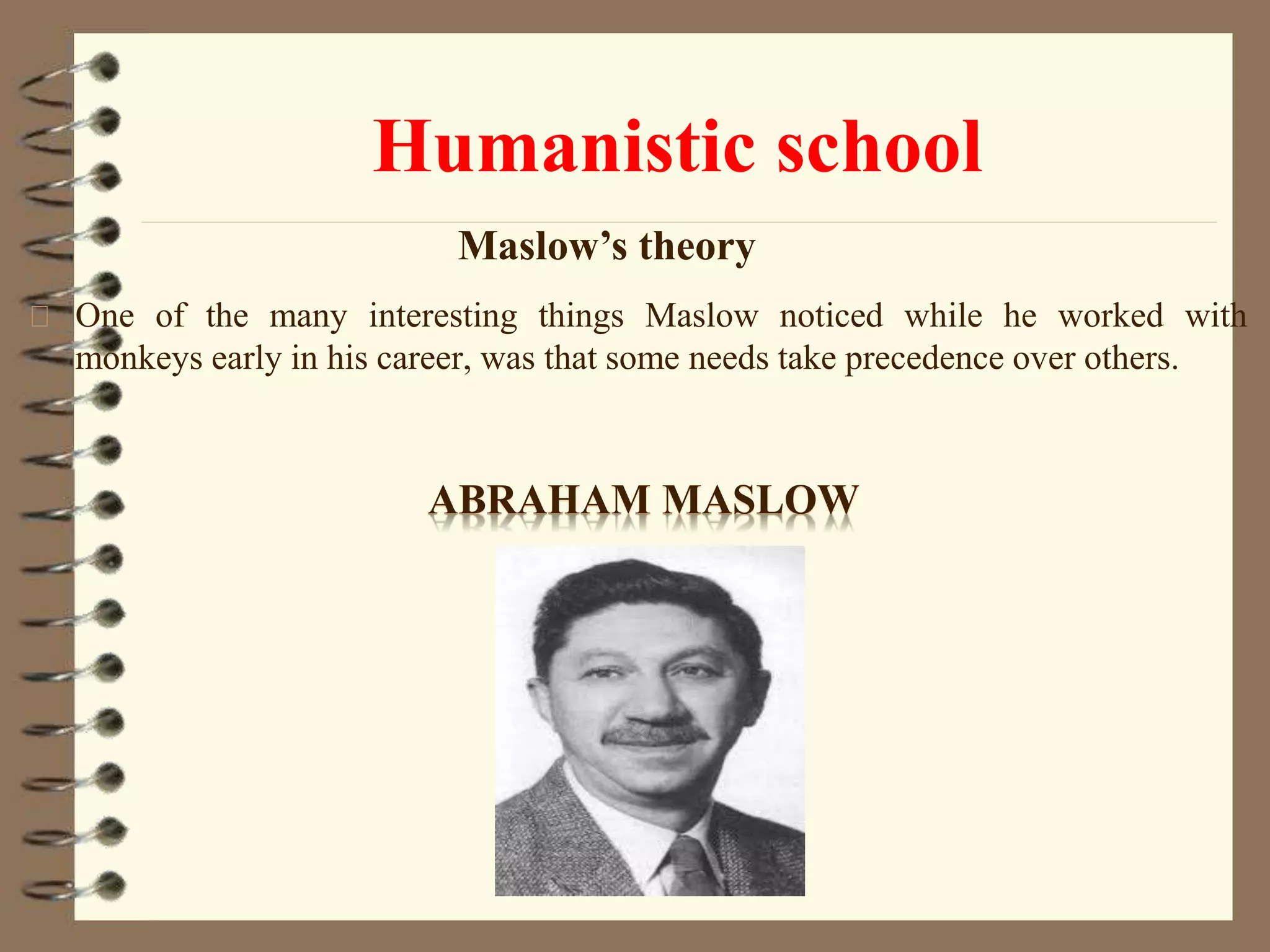
One of the many interesting things Maslow noticed while he worked with
monkeys early in his career, was that some needs take precedence over others.
ABRAHAM MASLOW
Maslow’s theory
Humanistic school
Maslow’s
Hierarchy Of
Needs
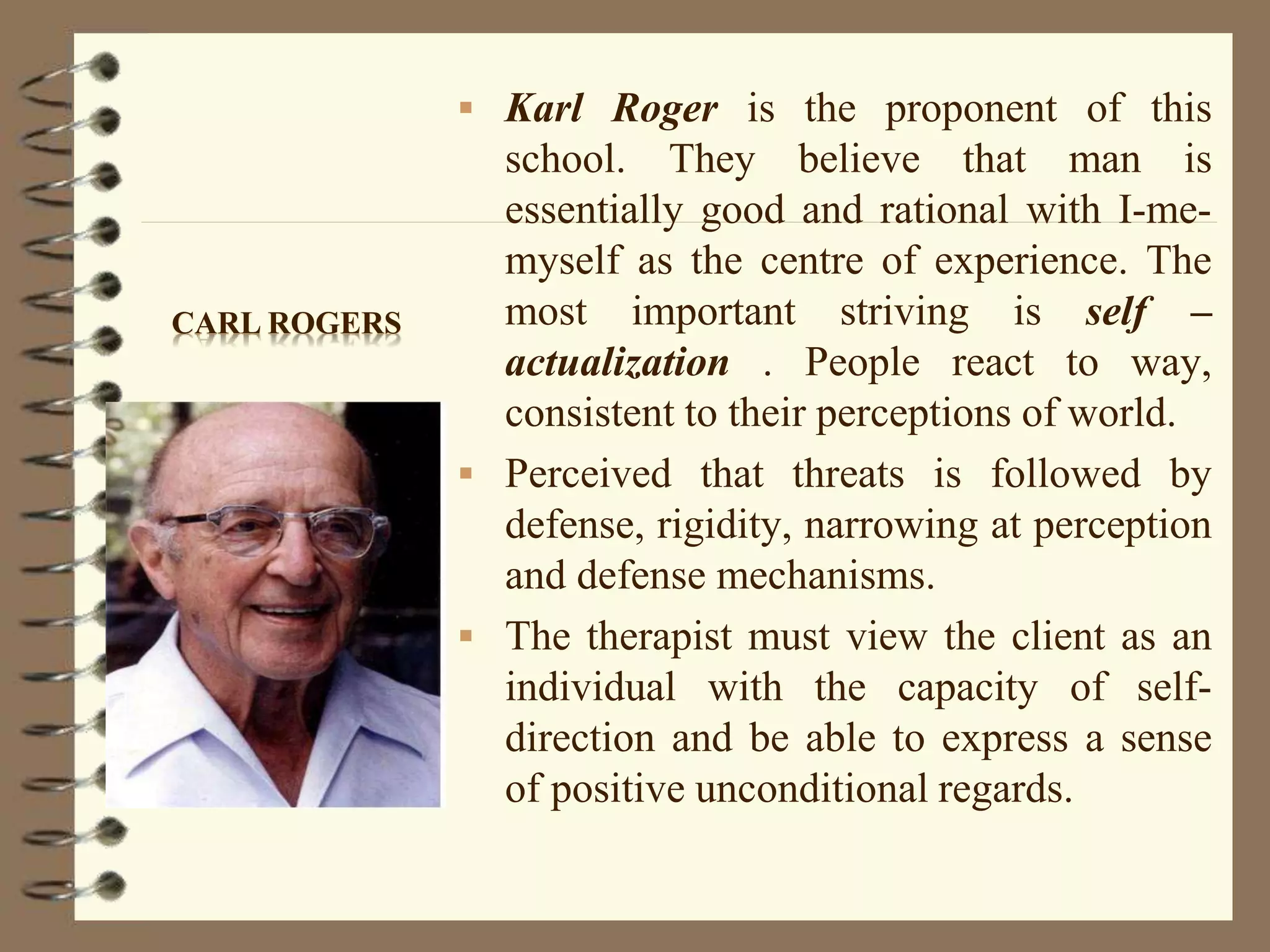
 Karl Roger is the proponent of this
school. They believe that man is
essentially good and rational with I-me-
myself as the centre of experience. The
most important striving is self –
actualization . People react to way,
consistent to their perceptions of world.
 Perceived that threats is followed by
defense, rigidity, narrowing at perception
and defense mechanisms.
 The therapist must view the client as an
individual with the capacity of self-
direction and be able to express a sense
of positive unconditional regards.
CARL ROGERS
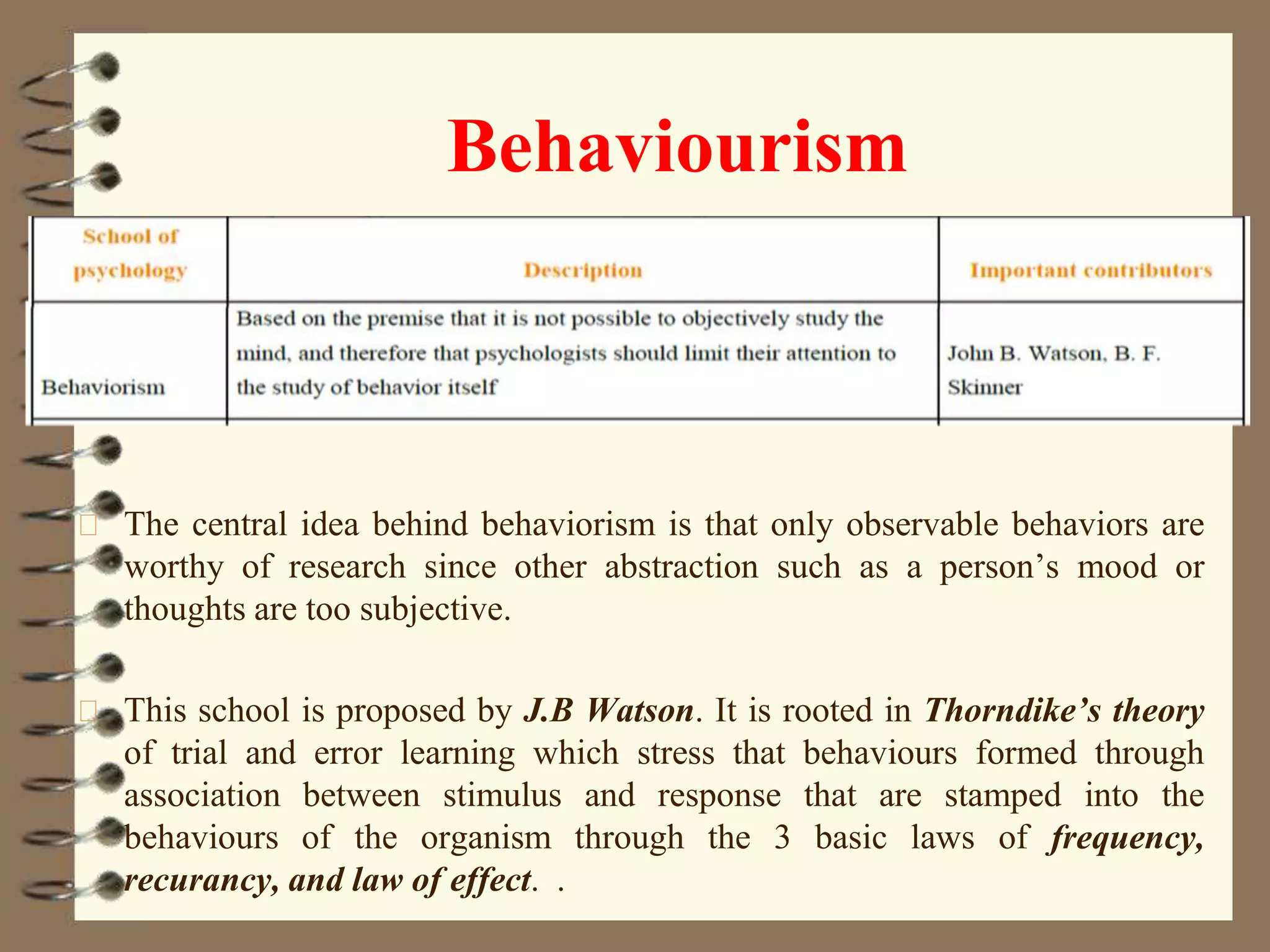
Behaviourism
The central idea behind behaviorism is that only observable behaviors are
worthy of research since other abstraction such as a person’s mood or
thoughts are too subjective.
This school is proposed by J.B Watson. It is rooted in Thorndike’s theory
of trial and error learning which stress that behaviours formed through
association between stimulus and response that are stamped into the
behaviours of the organism through the 3 basic laws of frequency,
recurancy, and law of effect. .
CONSTRUCTIVISM
constructivism refers to many schools of thought that, though
extraordinarily different in their techniques (applied in fields
such as education and psychotherapy), are all connected by a
common critique of previous standard approaches, and by
shared assumptions about the active constructive nature of
human knowledge.
Constructivism is 'an approach to learning that holds that
people actively construct or make their own knowledge and
that reality is determined by the experiences of the learner’
Constructivism is the theory that says learners construct
knowledge rather than just passively take in information. As
people experience the world and reflect upon those
experiences, they build their own representations and
incorporate new information into their pre-existing knowledge
(schemas).
Gestalt school
Sigmund freud’s school of
psychoanalysis (1900)
THANK YOU

PSYCHOLOGY_Unit_I.ppt

  • 1.
    ADVANCED EDUCATIONAL PSYCHOLOGY UNIT-I PSYCHOLOGYAND ITS BASIC SCHOOLS Dr.N.SASIKUMAR Assistant Professor Department of Education Alagappa University Karaikudi-630003
  • 2.
    INTRODUCTION The word psychologyis derived from Greek word psycho & logos. ‘Psycho’ means “soul” and ‘logos’ means “science”. The science of soul. First Stage: Psychology was defined as the “study of the soul” Second Stage: It was again defined as the “study of the mind”
  • 3.
     Third Stage:Again it was defined by William James (1890) as the “Study of Consciousness”  Fourth Stage: “Study of total Behaviour” (consciousness and unconsciousness).  It is scientific because it is systematic study of observable events/behavior and behavior is unlearned process where in include reflexes, physiological process and instincts and it is learned behavior also because all behavior acquire through practice.  Today Psychology is scientific method of collecting data about individual and groups to analyze and predict their behavior.
  • 4.
    Definitions- Psychology “Psychology isthe scientific study of the activities of the individual in relation to his environment” by: Woodworth & Marquis “Psychology today concerns itself with the scientific investigation of behaviour” by: N.L. Munn
  • 5.
    PSYCHOLOGY Pure Psychology AppliedPsychology Industrial Crime Military Clinical Animal Legal Plant Educational
  • 6.
    Meaning of EducationalPsychology 4 Educational psychology is the branch of psychology concerned with the scientific study of human learning. 4 The study of learning processes, from both cognitive and behavioral perspectives, allows researchers to understand individual differences in intelligence, cognitive development, motivation, self-regulation, and self-concept, as well as their role in learning. 4 Crow and Crow put it as: “Educational Psychology describes and explains the learning experience of an individual from birth through old age”(1973). 4 According to Peel: “Educational Psychology is the science of education (1956). 4 It is that branch of psychology which deals with teaching and learning (Skinner 1958).
  • 7.
    Nature of EducationalPsychology 4 It is an applied branch of fundamental Psychology. 4 It combines two fields i.e. education and psychology. 4 It is the scientific study of human behavior in educational situation. 4 It is concerned with these factors, principles and techniques which relate to the various aspects of child’s growth and development. 4 It is concerned with learning situation and process by which learning can be more efficient and effective. 4 Educational Psychology, draws heavily from various branches of psychology, biology, sociology and anthropology 4 Educational Psychology is not as exact as natural sciences since the human behavior cannot be predicated exactly, because it is dynamic.
  • 8.
  • 9.
    Methods of EducationalPsychology 4 Introspection Method 4 Observation Method 4 Anecdotal Method 4 Experimental Method 4 Case Study Method 4 Questionnaire Method
  • 10.
    DESCRIPTIVE METHOD 4 Descriptiveresearch methods are pretty much as they sound — they describe situations. They do not make accurate predictions, and they do not determine cause and effect. There are three main types of descriptive methods: observational methods, case-study methods and survey methods.
  • 11.
    Introspection Method: Examinationof one's own conscious thoughts and feelings. In psychology the process of introspection relies exclusively on observation of one's mental state, while in a spiritual context it may refer to the examination of one's soul. Observation Method: The observation and description of a subject's behavior. Researchers utilizing the observational method can exert varying amounts of control over the environment in which the observation takes place. Anecdotal Method: Method based on personal recollections of a case, as opposed to specific, empirically derived investigation. Can provide ideas to fuel further research.
  • 12.
    Experimental Method: Theexperimental method involves manipulating one variable to determine if changes in one variable cause changes in another variable. This method relies on controlled methods, random assignment and the manipulation of variables to test a hypothesis. Case study method: In order to prepare a case history of data are taken from many sources for example his or her family history, educational life, medical history and social life. This method is very popular in clinical psychology and life span developmental psychology.
  • 13.
    Questionnaire Method: A questionnaireconsists of a set of questions to which the individual is required to respond. The items (questions) of the questionnaire can be either in closed-ended form or in open-ended form. In the case of closed-ended item the individual is provided with limited alternative and he or she has to choose only one alternative which reflects his or her view on the item. In open-ended items the individual is free to give his or her response the way he or she likes.
  • 14.
    SURVEY METHOD A surveyis a research method used for collecting data from a predefined group of respondents to gain information and insights into various topics of interest. They can have multiple purposes, and researchers can conduct it in many ways depending on the methodology chosen and the study's goal. Surveys results provide a snapshot of the attitudes and behaviors – including thoughts, opinions, and comments – about your target survey population. This valuable feedback is your baseline to measure and establish a benchmark from which to compare results over time.
  • 15.
    Basic Schools ofPsychology SCHOOLS OF PSYCHOLOGY Structuralism Functionalism Behaviorism Constructivism Humanism
  • 16.
    1. Wilhelm Wundtand Edward Tichner 2. Introspection Method 3. Structures of the mind 4. Identify the elements of thought through introspection and determine how these elements create the whole experience 5. A model of the scientific study of mental processes STRUCTURALISM (1879)
  • 17.
  • 18.
  • 19.
    FUNCTIONALISM(1898) 1. William James 2.Function of the mind 3. Animal behavior and biological processes 4. How the mind functions to adapt humans and other animals to their environment 5. Expanded the scope of psychology to include research on emotions and observable behavior, psycho testing, modern education and diversified into industry
  • 20.
    Humanism (1960) 1. CarlRogers and Abraham Maslow 2. All individuals strive to grow, develop and move toward selfactualization 3. Freewill, selfactualization and human nature is naturally positive and growth seeking 4. Personality Research and Psychotherapy 5. No criticisms
  • 21.
    1. Humanistic psychology,a movement in psychology supporting the belief that humans, as individuals, are unique beings and should be recognized and treated as such by psychologists and psychiatrists. 2. The movement grew in opposition to the two mainstream 20th-century trends in psychology, behaviourism and psychoanalysis. 3. Humanistic principles attained application during the “human potential” movement, which became popular in the United States during the 1960s.
  • 22.
    Humanistic school One ofthe many interesting things Maslow noticed while he worked with monkeys early in his career, was that some needs take precedence over others. ABRAHAM MASLOW Maslow’s theory
  • 23.
  • 24.
     Karl Rogeris the proponent of this school. They believe that man is essentially good and rational with I-me- myself as the centre of experience. The most important striving is self – actualization . People react to way, consistent to their perceptions of world.  Perceived that threats is followed by defense, rigidity, narrowing at perception and defense mechanisms.  The therapist must view the client as an individual with the capacity of self- direction and be able to express a sense of positive unconditional regards. CARL ROGERS
  • 25.
    Behaviourism The central ideabehind behaviorism is that only observable behaviors are worthy of research since other abstraction such as a person’s mood or thoughts are too subjective. This school is proposed by J.B Watson. It is rooted in Thorndike’s theory of trial and error learning which stress that behaviours formed through association between stimulus and response that are stamped into the behaviours of the organism through the 3 basic laws of frequency, recurancy, and law of effect. .
  • 26.
    CONSTRUCTIVISM constructivism refers tomany schools of thought that, though extraordinarily different in their techniques (applied in fields such as education and psychotherapy), are all connected by a common critique of previous standard approaches, and by shared assumptions about the active constructive nature of human knowledge. Constructivism is 'an approach to learning that holds that people actively construct or make their own knowledge and that reality is determined by the experiences of the learner’ Constructivism is the theory that says learners construct knowledge rather than just passively take in information. As people experience the world and reflect upon those experiences, they build their own representations and incorporate new information into their pre-existing knowledge (schemas).

  • 27.
  • 28.
    Sigmund freud’s schoolof psychoanalysis (1900)
  • 29.