Values Clarification  and Re-orientation gaphor m. panimbang
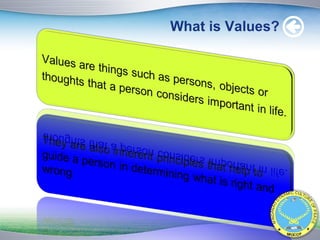
What is Values?
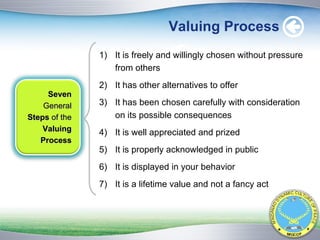
Valuing Process It is freely and willingly chosen without pressure from others It has other alternatives to offer It has been chosen carefully with consideration on its possible consequences It is well appreciated and prized It is properly acknowledged in public It is displayed in your behavior It is a lifetime value and not a fancy act Seven  General  Steps  of the  Valuing Process
Why should we discover our Values? Why should we discover our values?  to gain inner peace  to decrease stress levels to find satisfaction in life to feel fulfilled, happy, content, and worthwhile
Finding out what’s most Important – Our Values Beliefs that we must firmly maintain We must first believe that we are capable of changing now We must also have the belief that if we are going to create long-term change in our lives, that we are responsible, nobody else is going to do it for us. We must have the belief that if we set our sites in a new direction, and then move confidently in that direction, we will successfully arrive near the place we wanted to go We must be certain that our values determine our actions and behaviors
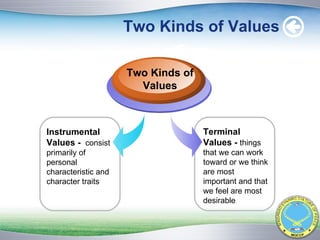
Two Kinds of Values Terminal Values -  things that we can work toward or we think are most important and that we feel are most desirable Instrumental Values -  consist primarily of personal characteristic and character traits Two Kinds of Values
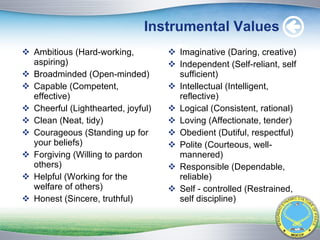
Instrumental Values Ambitious (Hard-working, aspiring) Broadminded (Open-minded) Capable (Competent, effective) Cheerful (Lighthearted, joyful) Clean (Neat, tidy) Courageous (Standing up for your beliefs) Forgiving (Willing to pardon others) Helpful (Working for the welfare of others) Honest (Sincere, truthful) Imaginative (Daring, creative) Independent (Self-reliant, self sufficient) Intellectual (Intelligent, reflective) Logical (Consistent, rational) Loving (Affectionate, tender) Obedient (Dutiful, respectful) Polite (Courteous, well-mannered) Responsible (Dependable, reliable) Self - controlled (Restrained, self discipline)
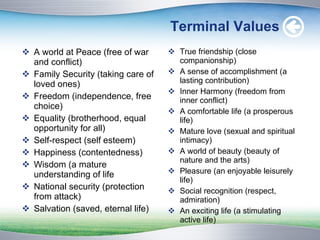
Terminal Values A world at Peace (free of war and conflict) Family Security (taking care of loved ones) Freedom (independence, free choice) Equality (brotherhood, equal opportunity for all) Self-respect (self esteem) Happiness (contentedness) Wisdom (a mature understanding of life National security (protection from attack) Salvation (saved, eternal life) True friendship (close companionship) A sense of accomplishment (a lasting contribution) Inner Harmony (freedom from inner conflict) A comfortable life (a prosperous life) Mature love (sexual and spiritual intimacy) A world of beauty (beauty of nature and the arts) Pleasure (an enjoyable leisurely life) Social recognition (respect, admiration) An exciting life (a stimulating active life)
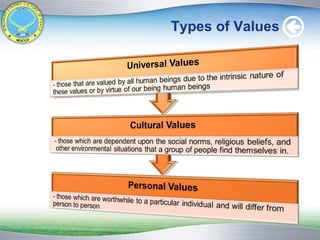
Types of Values
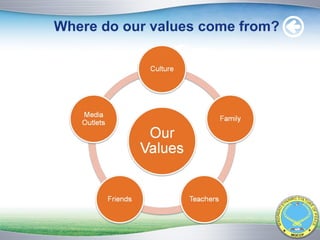
Where do our values come from?
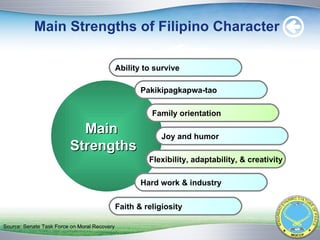
Main Strengths of Filipino Character Pakikipagkapwa-tao Family orientation Joy and humor Flexibility, adaptability, & creativity Hard work & industry Main  Strengths Faith & religiosity Ability to survive Source: Senate Task Force on Moral Recovery
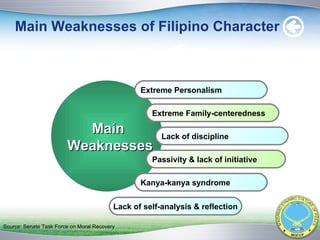
Main Weaknesses of Filipino Character Extreme Personalism Extreme Family-centeredness Lack of discipline Passivity & lack of initiative Kanya-kanya syndrome Main  Weaknesses Lack of self-analysis & reflection Source: Senate Task Force on Moral Recovery
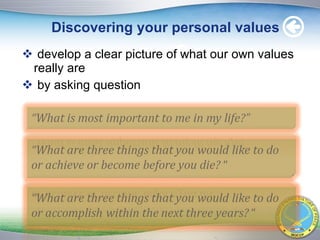
Discovering your personal values develop a clear picture of what our own values really are by asking question
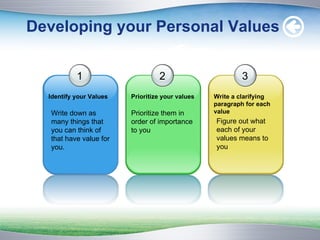
Developing your Personal Values Write down as many things that you can think of that have value for you. Prioritize them in order of importance to you Figure out what each of your values means to you 1 Identify your Values 2 Prioritize your values 3 Write a clarifying paragraph for each value
 

Values Clarification and Re-orientation

  • 1.
    Values Clarification and Re-orientation gaphor m. panimbang
  • 2.
  • 3.
    Valuing Process Itis freely and willingly chosen without pressure from others It has other alternatives to offer It has been chosen carefully with consideration on its possible consequences It is well appreciated and prized It is properly acknowledged in public It is displayed in your behavior It is a lifetime value and not a fancy act Seven General Steps of the Valuing Process
  • 4.
    Why should wediscover our Values? Why should we discover our values? to gain inner peace to decrease stress levels to find satisfaction in life to feel fulfilled, happy, content, and worthwhile
  • 5.
    Finding out what’smost Important – Our Values Beliefs that we must firmly maintain We must first believe that we are capable of changing now We must also have the belief that if we are going to create long-term change in our lives, that we are responsible, nobody else is going to do it for us. We must have the belief that if we set our sites in a new direction, and then move confidently in that direction, we will successfully arrive near the place we wanted to go We must be certain that our values determine our actions and behaviors
  • 6.
    Two Kinds ofValues Terminal Values - things that we can work toward or we think are most important and that we feel are most desirable Instrumental Values - consist primarily of personal characteristic and character traits Two Kinds of Values
  • 7.
    Instrumental Values Ambitious(Hard-working, aspiring) Broadminded (Open-minded) Capable (Competent, effective) Cheerful (Lighthearted, joyful) Clean (Neat, tidy) Courageous (Standing up for your beliefs) Forgiving (Willing to pardon others) Helpful (Working for the welfare of others) Honest (Sincere, truthful) Imaginative (Daring, creative) Independent (Self-reliant, self sufficient) Intellectual (Intelligent, reflective) Logical (Consistent, rational) Loving (Affectionate, tender) Obedient (Dutiful, respectful) Polite (Courteous, well-mannered) Responsible (Dependable, reliable) Self - controlled (Restrained, self discipline)
  • 8.
    Terminal Values Aworld at Peace (free of war and conflict) Family Security (taking care of loved ones) Freedom (independence, free choice) Equality (brotherhood, equal opportunity for all) Self-respect (self esteem) Happiness (contentedness) Wisdom (a mature understanding of life National security (protection from attack) Salvation (saved, eternal life) True friendship (close companionship) A sense of accomplishment (a lasting contribution) Inner Harmony (freedom from inner conflict) A comfortable life (a prosperous life) Mature love (sexual and spiritual intimacy) A world of beauty (beauty of nature and the arts) Pleasure (an enjoyable leisurely life) Social recognition (respect, admiration) An exciting life (a stimulating active life)
  • 9.
  • 10.
    Where do ourvalues come from?
  • 11.
    Main Strengths ofFilipino Character Pakikipagkapwa-tao Family orientation Joy and humor Flexibility, adaptability, & creativity Hard work & industry Main Strengths Faith & religiosity Ability to survive Source: Senate Task Force on Moral Recovery
  • 12.
    Main Weaknesses ofFilipino Character Extreme Personalism Extreme Family-centeredness Lack of discipline Passivity & lack of initiative Kanya-kanya syndrome Main Weaknesses Lack of self-analysis & reflection Source: Senate Task Force on Moral Recovery
  • 13.
    Discovering your personalvalues develop a clear picture of what our own values really are by asking question
  • 14.
    Developing your PersonalValues Write down as many things that you can think of that have value for you. Prioritize them in order of importance to you Figure out what each of your values means to you 1 Identify your Values 2 Prioritize your values 3 Write a clarifying paragraph for each value
  • 15.