What is Value Chain Analysis?
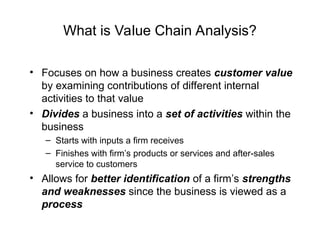
• Focuses on how a business creates customer value
by examining contributions of different internal
activities to that value
• Divides a business into a set of activities within the
business
– Starts with inputs a firm receives
– Finishes with firm’s products or services and after-sales
service to customers
• Allows for better identification of a firm’s strengths
and weaknesses since the business is viewed as a
process
SWOT Analysis
Based on assumption an effective strategy derives from a sound
“fit” between a firm’s internal resources and its external
situation
Numerous environmental
opportunities
A major favorable situation in
a firm’s environment
Major environmental threats
A major unfavorable situation in a
firm’s environment
Substantial internal strengths
A resource advantage relative
to competitors and the needs of
markets firm serves
Critical internal weaknesses
A limitation or deficiency in one or
more resources or competencies
relative to competitors
Internal Analysis: Making Meaningful
Comparisons
Perspectives
to use
1. Comparison with past
performance
2. Stages of
industry
evolution
3. Benchmarking –
comparison with competitors
4. Comparison with
success factors in
industry
Sources of Distinctive Competence at Different
Stages of Industry Evolution
Functional
Area
Introduction Growth Maturity Decline
Marketing Resources/skills
to create
widespread
awareness and
find acceptance
from customers ;
advantageous
access to
distribution
Ability to
establish brand
recognition,
find niche,
reduce price,
solidify strong
distribution
relations, and
develop new
channels
Skills in
aggressively
promoting
products to new
markets and
holding existing
markets; pricing
flexibility; skills
in differentiating
products and
holding
customer loyalty
Cost effective
means of
efficient access
to selected
channels and
markets; strong
customer loyalty
or dependence;
strong company
image
iPOD: 科技行銷的經典案例
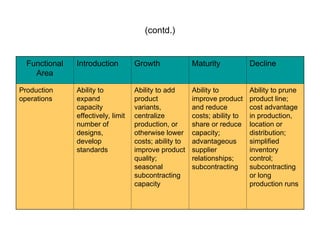
(contd.)
Functional
Area
Introduction Growth Maturity Decline
Production
operations
Ability to
expand
capacity
effectively, limit
number of
designs,
develop
standards
Ability to add
product
variants,
centralize
production, or
otherwise lower
costs; ability to
improve product
quality;
seasonal
subcontracting
capacity
Ability to
improve product
and reduce
costs; ability to
share or reduce
capacity;
advantageous
supplier
relationships;
subcontracting
Ability to prune
product line;
cost advantage
in production,
location or
distribution;
simplified
inventory
control;
subcontracting
or long
production runs
(contd.)
Functional
Area
Introduction Growth Maturity Decline
Finance Resources to
support high net
cash overflow
and initial
losses; ability to
use leverage
effectively
Ability to finance
rapid expansion,
to have net cash
outflows but
increasing
profits;
resources to
support product
improvements
Ability to
generate and
redistribute
increasing net
cash inflows;
effective cost
control systems
Ability to reuse
or liquidate
unneeded
equipment;
advantage in
cost of facilities;
control system
accuracy;
streamlined
management
control
(contd.)
Functional
Area
Introduction Growth Maturity Decline
Personnel Flexibility in
staffing and
training new
management;
existence of
employees with
key skills in new
products or
markets
Existence of an
ability to add
skilled
personnel;
motivated and
loyal workforce
Ability to cost
effectively,
reduce
workforce,
increase
efficiency
Capacity to
reduce and
reallocate
personnel
(contd.)
Functional
Area
Introduction Growth Maturity Decline
Engineering and
R&D
Ability to make
engineering
changes, have
technical bugs in
product and
process
resolved
Skill in quality
and new feature
development;
ability to start
developing
successor
product
Ability to reduce
costs, develop
variants,
differentiate
products
Ability to support
other grown
areas or to apply
product to
unique customer
needs
Key functional
area and
strategy focus
Engineering:
market
penetration
Sales: consumer
loyalty; market
share
Production
efficiency:
successor
products
Finance:
maximum
investment
recovery

Value Chain concept explained that used in industry

  • 1.
    What is ValueChain Analysis? • Focuses on how a business creates customer value by examining contributions of different internal activities to that value • Divides a business into a set of activities within the business – Starts with inputs a firm receives – Finishes with firm’s products or services and after-sales service to customers • Allows for better identification of a firm’s strengths and weaknesses since the business is viewed as a process
  • 2.
    SWOT Analysis Based onassumption an effective strategy derives from a sound “fit” between a firm’s internal resources and its external situation Numerous environmental opportunities A major favorable situation in a firm’s environment Major environmental threats A major unfavorable situation in a firm’s environment Substantial internal strengths A resource advantage relative to competitors and the needs of markets firm serves Critical internal weaknesses A limitation or deficiency in one or more resources or competencies relative to competitors
  • 3.
    Internal Analysis: MakingMeaningful Comparisons Perspectives to use 1. Comparison with past performance 2. Stages of industry evolution 3. Benchmarking – comparison with competitors 4. Comparison with success factors in industry
  • 4.
    Sources of DistinctiveCompetence at Different Stages of Industry Evolution Functional Area Introduction Growth Maturity Decline Marketing Resources/skills to create widespread awareness and find acceptance from customers ; advantageous access to distribution Ability to establish brand recognition, find niche, reduce price, solidify strong distribution relations, and develop new channels Skills in aggressively promoting products to new markets and holding existing markets; pricing flexibility; skills in differentiating products and holding customer loyalty Cost effective means of efficient access to selected channels and markets; strong customer loyalty or dependence; strong company image
  • 5.
  • 6.
    (contd.) Functional Area Introduction Growth MaturityDecline Production operations Ability to expand capacity effectively, limit number of designs, develop standards Ability to add product variants, centralize production, or otherwise lower costs; ability to improve product quality; seasonal subcontracting capacity Ability to improve product and reduce costs; ability to share or reduce capacity; advantageous supplier relationships; subcontracting Ability to prune product line; cost advantage in production, location or distribution; simplified inventory control; subcontracting or long production runs
  • 7.
    (contd.) Functional Area Introduction Growth MaturityDecline Finance Resources to support high net cash overflow and initial losses; ability to use leverage effectively Ability to finance rapid expansion, to have net cash outflows but increasing profits; resources to support product improvements Ability to generate and redistribute increasing net cash inflows; effective cost control systems Ability to reuse or liquidate unneeded equipment; advantage in cost of facilities; control system accuracy; streamlined management control
  • 8.
    (contd.) Functional Area Introduction Growth MaturityDecline Personnel Flexibility in staffing and training new management; existence of employees with key skills in new products or markets Existence of an ability to add skilled personnel; motivated and loyal workforce Ability to cost effectively, reduce workforce, increase efficiency Capacity to reduce and reallocate personnel
  • 9.
    (contd.) Functional Area Introduction Growth MaturityDecline Engineering and R&D Ability to make engineering changes, have technical bugs in product and process resolved Skill in quality and new feature development; ability to start developing successor product Ability to reduce costs, develop variants, differentiate products Ability to support other grown areas or to apply product to unique customer needs Key functional area and strategy focus Engineering: market penetration Sales: consumer loyalty; market share Production efficiency: successor products Finance: maximum investment recovery