Internal Analysis

• SWOT analysis
• Value Chain Analysis
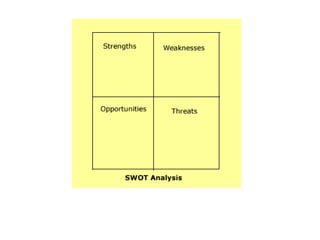
SWOT analysis
• Strengths (internal)
• Weaknesses (internal)
• Opportunities (external)
• Threats (external)
INTERNAL ANALYSIS

“Everything as it
exists in nature has
one perfect
purpose. One
should look for that
one attribute that
makes it unique
from all other things”
   Aristotle
• All organizations have
  strengths and weaknesses in
  the functional areas of
  business.
• No enterprise is equally
  strong or weak in all areas.
• Internal
  strengths/weaknesses,
  coupled with external
  opportunities/threats and a
  clear statement of mission,
  provide the basis for
  establishing objectives and
  strategies.
• A firm’s strengths that cannot be
  easily matched or imitated by
  competitors are called
  distinctive competencies.
• Strategies are designed in part
  to improve on a firm’s
  weaknesses, turning them into
  strengths, and maybe even into
  distinctive competencies.
• Building competitive advantages
  involves taking advantage of
  distinctive competencies.
• Distinctive competence (how
  the organisation is better than or
  different from its competitors).
• The process of performing an
  internal audit closely parallels the
  process of performing an
  external audit.
• Representative managers and
  employees from throughout the
  firm need to be involved in
  determining a firm’s strengths
  and weaknesses.

• Performing an internal audit
  requires gathering, assimilating,
  and evaluating information about
  the firm’s operations.
• Compared to the
  external audit, the
  process of performing an
  internal audit provides
  more opportunity for
  participants to
  understand how their
  jobs, departments, and
  divisions fit into the
  whole organization.
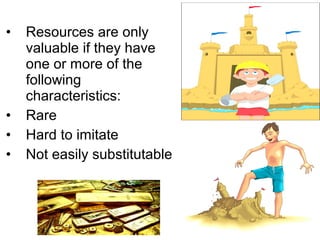
•   Resources are only
    valuable if they have
    one or more of the
    following
    characteristics:
•   Rare
•   Hard to imitate
•   Not easily substitutable
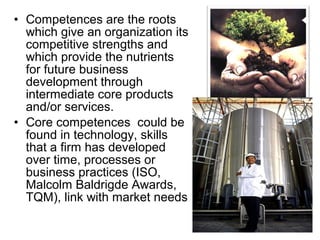
• Competences are the roots
  which give an organization its
  competitive strengths and
  which provide the nutrients
  for future business
  development through
  intermediate core products
  and/or services.
• Core competences could be
  found in technology, skills
  that a firm has developed
  over time, processes or
  business practices (ISO,
  Malcolm Baldrigde Awards,
  TQM), link with market needs
Core competences are
  typically characterized as:
• Unique to the firm
• Sustainable because they are
  hard to imitate or to substitute
• Once the strategic core
  competences have been
  found, they must be nurtured
  at board level by strategic
  investments in people,
  technology, processes and
  infrastructure.
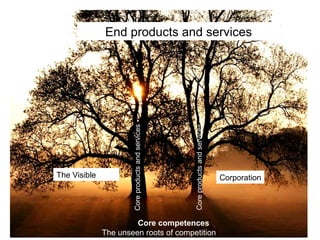
End products and services


                                                   Core products and services
                      Core products and services


The Visible                                                                     Corporation


                       Core competences
              The unseen roots of competition
• VALUE CHAIN ANALYSIS

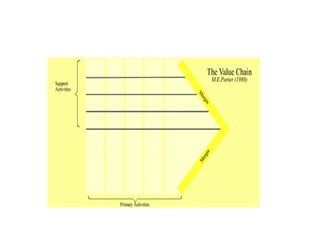
• Porter describes the business of a
  firm as a value chain, in which total
  revenues minus total costs of all
  activities undertaken to develop
  and market a product or service
  yields value.
• Value Chain Analysis refers to the
  process whereby a firm determines the
  costs associated with organizational
  activities from purchasing raw
  materials to manufacturing products to
  marketing those products.
• All firms should use value-chain
  analysis to develop and nurture a core
  competence and develop this
  competence into a distinctive
  competence.
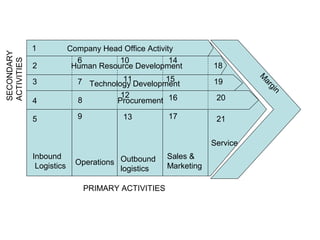
1            Company Head Office Activity
SECONDARY


                            6         10             14
ACTIVITIES


             2             Human Resource Development            18
                                       11        15


                                                                           M
             3              7 Technology Development             19


                                                                            ar
                                                                               gi
                                      12


                                                                                 n
             4              8        Procurement 16               20

             5              9           13           17           21


                                                                 Service
             Inbound                                 Sales &
              Logistics     Operations Outbound      Marketing
                                       logistics

                                PRIMARY ACTIVITIES
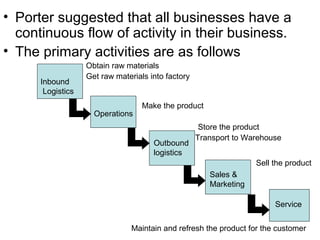
• Porter suggested that all businesses have a
  continuous flow of activity in their business.
• The primary activities are as follows
                   Obtain raw materials
                   Get raw materials into factory
      Inbound
       Logistics
                                   Make the product
                     Operations
                                                     Store the product
                                                    Transport to Warehouse
                                      Outbound
                                      logistics
                                                                   Sell the product
                                                       Sales &
                                                       Marketing

                                                                        Service


                                Maintain and refresh the product for the customer
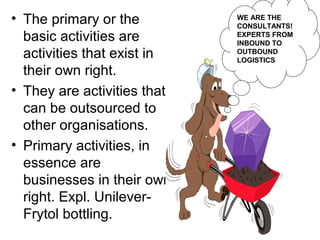
• The primary or the         WE ARE THE
                             CONSULTANTS!
  basic activities are       EXPERTS FROM
                             INBOUND TO
  activities that exist in   OUTBOUND
                             LOGISTICS
  their own right.
• They are activities that
  can be outsourced to
  other organisations.
• Primary activities, in
  essence are
  businesses in their own
  right. Expl. Unilever-
  Frytol bottling.
• Within an organisation
  there are three areas
  that need to be
  managed. These are:
• People
• Information &
  Technology
  Development
• Money
• These activities are
  inherent within the
  primary activities of
  the firm.
• A core competence is a value-chain activity
  that a firm performs especially well.
• When a core competence evolves into a
  major competitive advantage, it is called a
  distinctive competence.
• Firms use benchmarking to determine
  whether its value chain activities are
  competitive compared to rivals.
• This entails measuring the costs of value
  chain activities across an industry to
  determine “best practices” among
  competing firms for the purpose of
  duplicating or improving upon those best
  practices.
• From the Value chain, the
  firm can determine its
  distinctive competence over
  its competitors and also
  know its strengths and
  weaknesses.
• Therefore you can
  capitalise on your strengths
  and gain competitive
  advantage.
• If it is a weakness-improve
  upon it. Since it is a
  competitive disadvantage
  you can outsource it.
• Before strategy implementation, one
  needs to know and study the
  organisation’s resources as a whole in
  terms of
• Organisational Culture
• Management style
• Marketing
• Finance
• Research and Development
• Operations and Production
• Management Information systems
• Internal Factors versus External Factors
• The RBV approach to competitive
  advantage contends that internal
  resources are more important than
  external factors for a firm in achieving and
  sustaining competitive advantage.
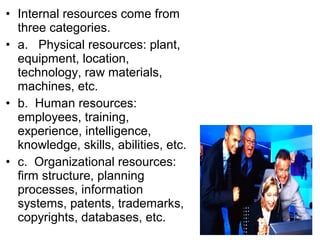
• Internal resources come from
  three categories.
• a. Physical resources: plant,
  equipment, location,
  technology, raw materials,
  machines, etc.
• b. Human resources:
  employees, training,
  experience, intelligence,
  knowledge, skills, abilities, etc.
• c. Organizational resources:
  firm structure, planning
  processes, information
  systems, patents, trademarks,
  copyrights, databases, etc.
•   The Basic Premise is that
•   The mix, type, amount, and nature
    of a firm’s internal resources should
    be considered first and foremost in
    devising strategies that can lead to
    sustainable competitive advantage.
•   Firms should pursue strategies that
    are not currently being
    implemented by any competing
    firm.
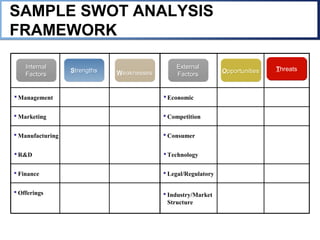
SAMPLE SWOT ANALYSIS
FRAMEWORK

    Internal                                   External                         Threats
                  Strengths   Weaknesses                        Opportunities
    Factors                                    Factors


 Management                                Economic


 Marketing                                 Competition


 Manufacturing                             Consumer


 R&D                                       Technology


 Finance                                   Legal/Regulatory


 Offerings                                 Industry/Market
                                             Structure
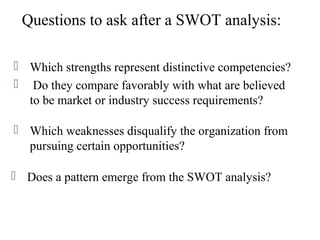
Questions to ask after a SWOT analysis:

 Which strengths represent distinctive competencies?
 Do they compare favorably with what are believed
  to be market or industry success requirements?

 Which weaknesses disqualify the organization from
  pursuing certain opportunities?

 Does a pattern emerge from the SWOT analysis?
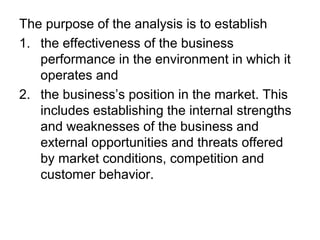
The purpose of the analysis is to establish
1. the effectiveness of the business
   performance in the environment in which it
   operates and
2. the business’s position in the market. This
   includes establishing the internal strengths
   and weaknesses of the business and
   external opportunities and threats offered
   by market conditions, competition and
   customer behavior.
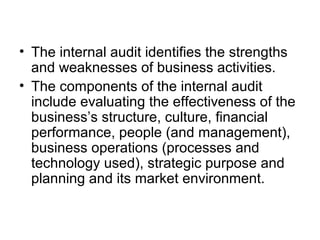
• The internal audit identifies the strengths
  and weaknesses of business activities.
• The components of the internal audit
  include evaluating the effectiveness of the
  business’s structure, culture, financial
  performance, people (and management),
  business operations (processes and
  technology used), strategic purpose and
  planning and its market environment.
Assignment
• Fen Side Golf Course is an internationally
  known Scottish golf facility. It is not just an
  eighteen hole world-class golf course, it
  has a five star hotel with 250 luxury
  rooms, and private leisure centre, indoor
  tennis courts, as well as a series of top
  class restaurants.
• Below are a series of nine activities that
  add value to the Fen Side experience.
  Print out the value chain above and place
  the appropriate letter (below) onto the
  value chain.
• .
• A. All staff are trained to the highest
  industry standards.
• B. The hotel management team focus on
  goals set out in their strategic plan.
• C. All golf course fairways are trimmed and
  watered daily.
• D. Fresh fruit and vegetables are delivered
  and prepared every day.
• E. The hotel has an advanced room
  reservation system.
• F. Fen Side is promoted through
  magazines targeted at the wealthy and
  influential.
• G. The whole experience is based upon
  high quality, professional service at every
  stage.
• H. Limousines are available to take guests
  to airports as they finish their stay.
• I. Fen Side has a series of contracts with
  suppliers of meat and fish
3. internal analysis

  • 1.
    Internal Analysis • SWOTanalysis • Value Chain Analysis
  • 2.
    SWOT analysis • Strengths(internal) • Weaknesses (internal) • Opportunities (external) • Threats (external)
  • 4.
    INTERNAL ANALYSIS “Everything asit exists in nature has one perfect purpose. One should look for that one attribute that makes it unique from all other things” Aristotle
  • 5.
    • All organizationshave strengths and weaknesses in the functional areas of business. • No enterprise is equally strong or weak in all areas. • Internal strengths/weaknesses, coupled with external opportunities/threats and a clear statement of mission, provide the basis for establishing objectives and strategies.
  • 6.
    • A firm’sstrengths that cannot be easily matched or imitated by competitors are called distinctive competencies. • Strategies are designed in part to improve on a firm’s weaknesses, turning them into strengths, and maybe even into distinctive competencies. • Building competitive advantages involves taking advantage of distinctive competencies. • Distinctive competence (how the organisation is better than or different from its competitors).
  • 7.
    • The processof performing an internal audit closely parallels the process of performing an external audit. • Representative managers and employees from throughout the firm need to be involved in determining a firm’s strengths and weaknesses. • Performing an internal audit requires gathering, assimilating, and evaluating information about the firm’s operations.
  • 8.
    • Compared tothe external audit, the process of performing an internal audit provides more opportunity for participants to understand how their jobs, departments, and divisions fit into the whole organization.
  • 9.
    Resources are only valuable if they have one or more of the following characteristics: • Rare • Hard to imitate • Not easily substitutable
  • 10.
    • Competences arethe roots which give an organization its competitive strengths and which provide the nutrients for future business development through intermediate core products and/or services. • Core competences could be found in technology, skills that a firm has developed over time, processes or business practices (ISO, Malcolm Baldrigde Awards, TQM), link with market needs
  • 11.
    Core competences are typically characterized as: • Unique to the firm • Sustainable because they are hard to imitate or to substitute • Once the strategic core competences have been found, they must be nurtured at board level by strategic investments in people, technology, processes and infrastructure.
  • 12.
    End products andservices Core products and services Core products and services The Visible Corporation Core competences The unseen roots of competition
  • 13.
    • VALUE CHAINANALYSIS • Porter describes the business of a firm as a value chain, in which total revenues minus total costs of all activities undertaken to develop and market a product or service yields value.
  • 14.
    • Value ChainAnalysis refers to the process whereby a firm determines the costs associated with organizational activities from purchasing raw materials to manufacturing products to marketing those products. • All firms should use value-chain analysis to develop and nurture a core competence and develop this competence into a distinctive competence.
  • 15.
    1 Company Head Office Activity SECONDARY 6 10 14 ACTIVITIES 2 Human Resource Development 18 11 15 M 3 7 Technology Development 19 ar gi 12 n 4 8 Procurement 16 20 5 9 13 17 21 Service Inbound Sales & Logistics Operations Outbound Marketing logistics PRIMARY ACTIVITIES
  • 16.
    • Porter suggestedthat all businesses have a continuous flow of activity in their business. • The primary activities are as follows Obtain raw materials Get raw materials into factory Inbound Logistics Make the product Operations Store the product Transport to Warehouse Outbound logistics Sell the product Sales & Marketing Service Maintain and refresh the product for the customer
  • 17.
    • The primaryor the WE ARE THE CONSULTANTS! basic activities are EXPERTS FROM INBOUND TO activities that exist in OUTBOUND LOGISTICS their own right. • They are activities that can be outsourced to other organisations. • Primary activities, in essence are businesses in their own right. Expl. Unilever- Frytol bottling.
  • 18.
    • Within anorganisation there are three areas that need to be managed. These are: • People • Information & Technology Development • Money • These activities are inherent within the primary activities of the firm.
  • 19.
    • A corecompetence is a value-chain activity that a firm performs especially well. • When a core competence evolves into a major competitive advantage, it is called a distinctive competence. • Firms use benchmarking to determine whether its value chain activities are competitive compared to rivals. • This entails measuring the costs of value chain activities across an industry to determine “best practices” among competing firms for the purpose of duplicating or improving upon those best practices.
  • 20.
    • From theValue chain, the firm can determine its distinctive competence over its competitors and also know its strengths and weaknesses. • Therefore you can capitalise on your strengths and gain competitive advantage. • If it is a weakness-improve upon it. Since it is a competitive disadvantage you can outsource it.
  • 21.
    • Before strategyimplementation, one needs to know and study the organisation’s resources as a whole in terms of • Organisational Culture • Management style • Marketing • Finance • Research and Development • Operations and Production • Management Information systems
  • 22.
    • Internal Factorsversus External Factors • The RBV approach to competitive advantage contends that internal resources are more important than external factors for a firm in achieving and sustaining competitive advantage.
  • 23.
    • Internal resourcescome from three categories. • a. Physical resources: plant, equipment, location, technology, raw materials, machines, etc. • b. Human resources: employees, training, experience, intelligence, knowledge, skills, abilities, etc. • c. Organizational resources: firm structure, planning processes, information systems, patents, trademarks, copyrights, databases, etc.
  • 24.
    The Basic Premise is that • The mix, type, amount, and nature of a firm’s internal resources should be considered first and foremost in devising strategies that can lead to sustainable competitive advantage. • Firms should pursue strategies that are not currently being implemented by any competing firm.
  • 25.
    SAMPLE SWOT ANALYSIS FRAMEWORK Internal External Threats Strengths Weaknesses Opportunities Factors Factors  Management  Economic  Marketing  Competition  Manufacturing  Consumer  R&D  Technology  Finance  Legal/Regulatory  Offerings  Industry/Market Structure
  • 26.
    Questions to askafter a SWOT analysis:  Which strengths represent distinctive competencies?  Do they compare favorably with what are believed to be market or industry success requirements?  Which weaknesses disqualify the organization from pursuing certain opportunities?  Does a pattern emerge from the SWOT analysis?
  • 27.
    The purpose ofthe analysis is to establish 1. the effectiveness of the business performance in the environment in which it operates and 2. the business’s position in the market. This includes establishing the internal strengths and weaknesses of the business and external opportunities and threats offered by market conditions, competition and customer behavior.
  • 28.
    • The internalaudit identifies the strengths and weaknesses of business activities. • The components of the internal audit include evaluating the effectiveness of the business’s structure, culture, financial performance, people (and management), business operations (processes and technology used), strategic purpose and planning and its market environment.
  • 29.
  • 31.
    • Fen SideGolf Course is an internationally known Scottish golf facility. It is not just an eighteen hole world-class golf course, it has a five star hotel with 250 luxury rooms, and private leisure centre, indoor tennis courts, as well as a series of top class restaurants. • Below are a series of nine activities that add value to the Fen Side experience. Print out the value chain above and place the appropriate letter (below) onto the value chain. • .
  • 32.
    • A. Allstaff are trained to the highest industry standards. • B. The hotel management team focus on goals set out in their strategic plan. • C. All golf course fairways are trimmed and watered daily. • D. Fresh fruit and vegetables are delivered and prepared every day. • E. The hotel has an advanced room reservation system.
  • 33.
    • F. FenSide is promoted through magazines targeted at the wealthy and influential. • G. The whole experience is based upon high quality, professional service at every stage. • H. Limousines are available to take guests to airports as they finish their stay. • I. Fen Side has a series of contracts with suppliers of meat and fish