Situational
Leadership
"Only those who dare to fail greatly can ever
achieve greatly.”
JFK
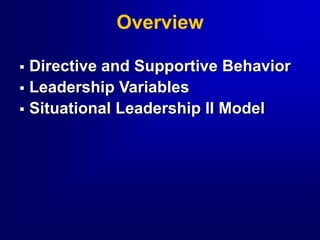
Overview
 Directive and Supportive Behavior
 Leadership Variables
 Situational Leadership II Model
Directive & Supportive Behavior
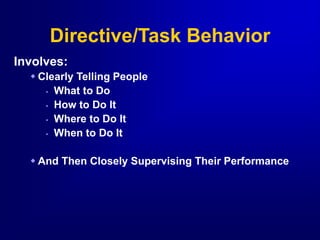
Involves:
 Clearly Telling People
• What to Do
• How to Do It
• Where to Do It
• When to Do It
 And Then Closely Supervising Their Performance
Directive/Task Behavior
Supportive/Relationship
Behavior
Involves:
 Listening to People
 Providing Support and Encouraging Their
Efforts
 Facilitating Their Involvement in
 Problem Solving and Decision Making
Leadership Variables
 Follower
 Boss
 Associates/Peers
 Organization
 Job Demands
 Time
Leadership Variables
Interim Summary
•Directive/Supportive Behavior
•Leadership Variables
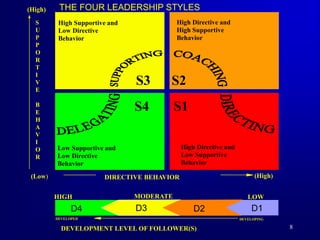
Situational Leadership Model
8
S3
S1
S4
S2
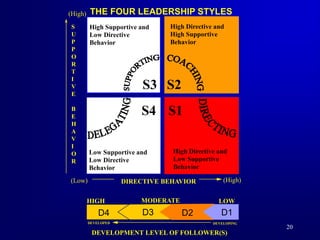
Low Supportive and
Low Directive
Behavior
High Directive and
Low Supportive
Behavior
High Directive and
High Supportive
Behavior
High Supportive and
Low Directive
Behavior
DEVELOPMENT LEVEL OF FOLLOWER(S)
DEVELOPED DEVELOPING
HIGH LOW
MODERATE
D4 D1
D2
D3
THE FOUR LEADERSHIP STYLES
DIRECTIVE BEHAVIOR
(High)
(High)
(Low)
S
U
P
P
O
R
T
I
V
E
B
E
H
A
V
I
O
R
9
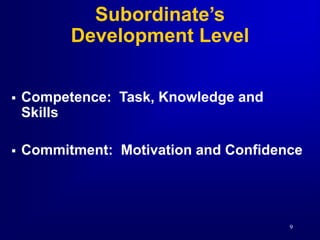
Subordinate’s
Development Level
 Competence: Task, Knowledge and
Skills
 Commitment: Motivation and Confidence
15
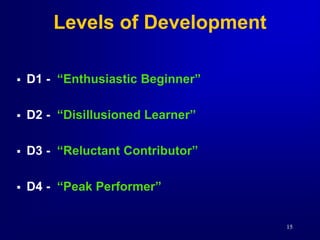
Levels of Development
 D1 - “Enthusiastic Beginner”
 D2 - “Disillusioned Learner”
 D3 - “Reluctant Contributor”
 D4 - “Peak Performer”
Levels of Development
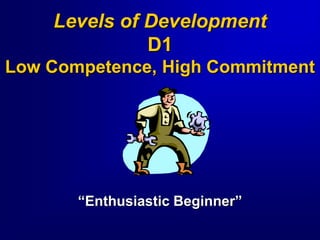
D1
Low Competence, High Commitment
“Enthusiastic Beginner”
Levels of Development
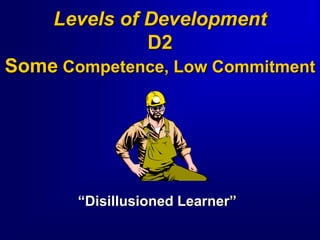
D2
Some Competence, Low Commitment
“Disillusioned Learner”
Levels of Development
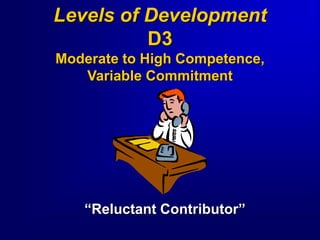
D3
Moderate to High Competence,
Variable Commitment
“Reluctant Contributor”
Levels of Development
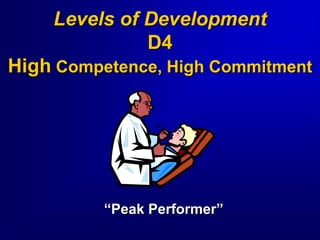
D4
High Competence, High Commitment
“Peak Performer”
15
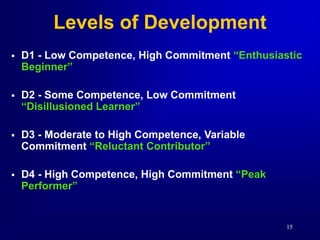
Levels of Development
 D1 - Low Competence, High Commitment “Enthusiastic
Beginner”
 D2 - Some Competence, Low Commitment
“Disillusioned Learner”
 D3 - Moderate to High Competence, Variable
Commitment “Reluctant Contributor”
 D4 - High Competence, High Commitment “Peak
Performer”
Development Level
is
Task Specific!
18
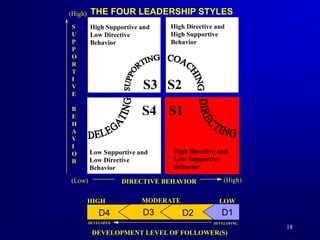
S3
S1
S4
S2
Low Supportive and
Low Directive
Behavior
High Directive and
Low Supportive
Behavior
High Directive and
High Supportive
Behavior
High Supportive and
Low Directive
Behavior
THE FOUR LEADERSHIP STYLES
DIRECTIVE BEHAVIOR
(High)
(High)
(Low)
S
U
P
P
O
R
T
I
V
E
B
E
H
A
V
I
O
R
DEVELOPMENT LEVEL OF FOLLOWER(S)
DEVELOPED DEVELOPING
HIGH LOW
MODERATE
D4 D1
D2
D3
19
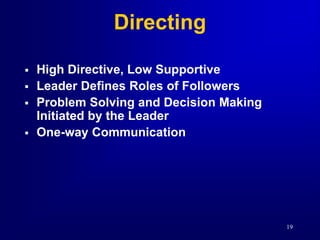
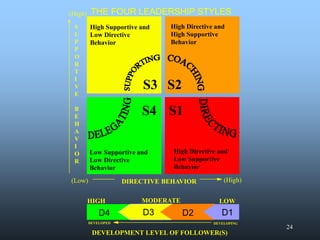
Directing
 High Directive, Low Supportive
 Leader Defines Roles of Followers
 Problem Solving and Decision Making
Initiated by the Leader
 One-way Communication
20
DEVELOPMENT LEVEL OF FOLLOWER(S)
S3
S1
S4
S2
Low Supportive and
Low Directive
Behavior
High Directive and
Low Supportive
Behavior
High Directive and
High Supportive
Behavior
High Supportive and
Low Directive
Behavior
THE FOUR LEADERSHIP STYLES
DIRECTIVE BEHAVIOR
(High)
(High)
(Low)
S
U
P
P
O
R
T
I
V
E
B
E
H
A
V
I
O
R
DEVELOPED DEVELOPING
HIGH LOW
MODERATE
D4 D1
D2
D3
21
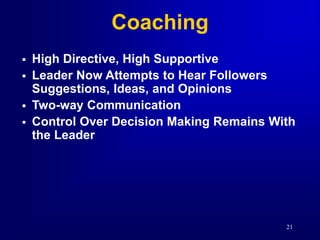
Coaching
 High Directive, High Supportive
 Leader Now Attempts to Hear Followers
Suggestions, Ideas, and Opinions
 Two-way Communication
 Control Over Decision Making Remains With
the Leader
22
S3
S1
S4
S2
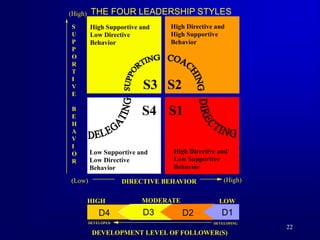
Low Supportive and
Low Directive
Behavior
High Directive and
Low Supportive
Behavior
High Directive and
High Supportive
Behavior
High Supportive and
Low Directive
Behavior
THE FOUR LEADERSHIP STYLES
DIRECTIVE BEHAVIOR
(High)
(High)
(Low)
S
U
P
P
O
R
T
I
V
E
B
E
H
A
V
I
O
R
DEVELOPMENT LEVEL OF FOLLOWER(S)
DEVELOPED DEVELOPING
HIGH LOW
MODERATE
D4 D1
D2
D3
23
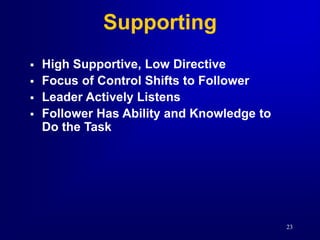
Supporting
 High Supportive, Low Directive
 Focus of Control Shifts to Follower
 Leader Actively Listens
 Follower Has Ability and Knowledge to
Do the Task
24
S3
S1
S4
S2
Low Supportive and
Low Directive
Behavior
High Directive and
Low Supportive
Behavior
High Directive and
High Supportive
Behavior
High Supportive and
Low Directive
Behavior
DEVELOPMENT LEVEL OF FOLLOWER(S)
DEVELOPED DEVELOPING
HIGH LOW
MODERATE
D4 D1
D2
D3
THE FOUR LEADERSHIP STYLES
DIRECTIVE BEHAVIOR
(High)
(High)
(Low)
S
U
P
P
O
R
T
I
V
E
B
E
H
A
V
I
O
R
25
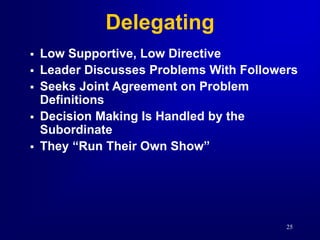
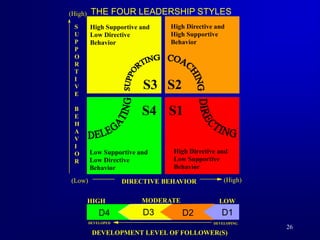
Delegating
 Low Supportive, Low Directive
 Leader Discusses Problems With Followers
 Seeks Joint Agreement on Problem
Definitions
 Decision Making Is Handled by the
Subordinate
 They “Run Their Own Show”
26
S3
S1
S4
S2
Low Supportive and
Low Directive
Behavior
High Directive and
Low Supportive
Behavior
High Directive and
High Supportive
Behavior
High Supportive and
Low Directive
Behavior
DEVELOPMENT LEVEL OF FOLLOWER(S)
DEVELOPED DEVELOPING
HIGH LOW
MODERATE
D4 D1
D2
D3
THE FOUR LEADERSHIP STYLES
DIRECTIVE BEHAVIOR
(High)
(High)
(Low)
S
U
P
P
O
R
T
I
V
E
B
E
H
A
V
I
O
R
What Happens If We Have a
Mismatch of Leadership
Style With Development
Level?
 Tell Them What You Want Them to Do
 Show Them What You Want Them to Do
 Let Them Try - There Is Some Risk
 Observe Performance - Focus on the
Positive
 Manage the Consequences
Increasing Follower
Development Level
 Tell Them What You Want to Do
 Show Them What You Want to Do
 Let Them Try – There is Some Risk
 Observe Performance – Focus on the
Positive
 Manage the Consequences
Five Step to Training
Winners
The Leader’s Goal
Build Your Follower’s Development Level So You
Can Start Using Less Time-consuming Styles
(S3 and S4) and Still Get High Quality Results.
Situational Leadership is not something
you do “TO” people but something you do
“WITH” people.
 Directive and Supportive Behavior
 Leadership Variables
 Situational Leadership II Model
SUMMARY
"Opportunity is missed by most people because it is
dressed in overalls and looks like work." -- Thomas Edison
34
"Washington [D.C.] is a city of Southern
efficiency and Northern charm."
JFK

developing situational leadership skill

  • 1.
    Situational Leadership "Only those whodare to fail greatly can ever achieve greatly.” JFK
  • 2.
    Overview  Directive andSupportive Behavior  Leadership Variables  Situational Leadership II Model
  • 3.
  • 4.
    Involves:  Clearly TellingPeople • What to Do • How to Do It • Where to Do It • When to Do It  And Then Closely Supervising Their Performance Directive/Task Behavior
  • 5.
    Supportive/Relationship Behavior Involves:  Listening toPeople  Providing Support and Encouraging Their Efforts  Facilitating Their Involvement in  Problem Solving and Decision Making
  • 6.
  • 7.
     Follower  Boss Associates/Peers  Organization  Job Demands  Time Leadership Variables
  • 8.
  • 9.
  • 10.
    8 S3 S1 S4 S2 Low Supportive and LowDirective Behavior High Directive and Low Supportive Behavior High Directive and High Supportive Behavior High Supportive and Low Directive Behavior DEVELOPMENT LEVEL OF FOLLOWER(S) DEVELOPED DEVELOPING HIGH LOW MODERATE D4 D1 D2 D3 THE FOUR LEADERSHIP STYLES DIRECTIVE BEHAVIOR (High) (High) (Low) S U P P O R T I V E B E H A V I O R
  • 11.
    9 Subordinate’s Development Level  Competence:Task, Knowledge and Skills  Commitment: Motivation and Confidence
  • 12.
    15 Levels of Development D1 - “Enthusiastic Beginner”  D2 - “Disillusioned Learner”  D3 - “Reluctant Contributor”  D4 - “Peak Performer”
  • 13.
    Levels of Development D1 LowCompetence, High Commitment “Enthusiastic Beginner”
  • 14.
    Levels of Development D2 SomeCompetence, Low Commitment “Disillusioned Learner”
  • 15.
    Levels of Development D3 Moderateto High Competence, Variable Commitment “Reluctant Contributor”
  • 16.
    Levels of Development D4 HighCompetence, High Commitment “Peak Performer”
  • 17.
    15 Levels of Development D1 - Low Competence, High Commitment “Enthusiastic Beginner”  D2 - Some Competence, Low Commitment “Disillusioned Learner”  D3 - Moderate to High Competence, Variable Commitment “Reluctant Contributor”  D4 - High Competence, High Commitment “Peak Performer”
  • 18.
  • 19.
    18 S3 S1 S4 S2 Low Supportive and LowDirective Behavior High Directive and Low Supportive Behavior High Directive and High Supportive Behavior High Supportive and Low Directive Behavior THE FOUR LEADERSHIP STYLES DIRECTIVE BEHAVIOR (High) (High) (Low) S U P P O R T I V E B E H A V I O R DEVELOPMENT LEVEL OF FOLLOWER(S) DEVELOPED DEVELOPING HIGH LOW MODERATE D4 D1 D2 D3
  • 20.
    19 Directing  High Directive,Low Supportive  Leader Defines Roles of Followers  Problem Solving and Decision Making Initiated by the Leader  One-way Communication
  • 21.
    20 DEVELOPMENT LEVEL OFFOLLOWER(S) S3 S1 S4 S2 Low Supportive and Low Directive Behavior High Directive and Low Supportive Behavior High Directive and High Supportive Behavior High Supportive and Low Directive Behavior THE FOUR LEADERSHIP STYLES DIRECTIVE BEHAVIOR (High) (High) (Low) S U P P O R T I V E B E H A V I O R DEVELOPED DEVELOPING HIGH LOW MODERATE D4 D1 D2 D3
  • 22.
    21 Coaching  High Directive,High Supportive  Leader Now Attempts to Hear Followers Suggestions, Ideas, and Opinions  Two-way Communication  Control Over Decision Making Remains With the Leader
  • 23.
    22 S3 S1 S4 S2 Low Supportive and LowDirective Behavior High Directive and Low Supportive Behavior High Directive and High Supportive Behavior High Supportive and Low Directive Behavior THE FOUR LEADERSHIP STYLES DIRECTIVE BEHAVIOR (High) (High) (Low) S U P P O R T I V E B E H A V I O R DEVELOPMENT LEVEL OF FOLLOWER(S) DEVELOPED DEVELOPING HIGH LOW MODERATE D4 D1 D2 D3
  • 24.
    23 Supporting  High Supportive,Low Directive  Focus of Control Shifts to Follower  Leader Actively Listens  Follower Has Ability and Knowledge to Do the Task
  • 25.
    24 S3 S1 S4 S2 Low Supportive and LowDirective Behavior High Directive and Low Supportive Behavior High Directive and High Supportive Behavior High Supportive and Low Directive Behavior DEVELOPMENT LEVEL OF FOLLOWER(S) DEVELOPED DEVELOPING HIGH LOW MODERATE D4 D1 D2 D3 THE FOUR LEADERSHIP STYLES DIRECTIVE BEHAVIOR (High) (High) (Low) S U P P O R T I V E B E H A V I O R
  • 26.
    25 Delegating  Low Supportive,Low Directive  Leader Discusses Problems With Followers  Seeks Joint Agreement on Problem Definitions  Decision Making Is Handled by the Subordinate  They “Run Their Own Show”
  • 27.
    26 S3 S1 S4 S2 Low Supportive and LowDirective Behavior High Directive and Low Supportive Behavior High Directive and High Supportive Behavior High Supportive and Low Directive Behavior DEVELOPMENT LEVEL OF FOLLOWER(S) DEVELOPED DEVELOPING HIGH LOW MODERATE D4 D1 D2 D3 THE FOUR LEADERSHIP STYLES DIRECTIVE BEHAVIOR (High) (High) (Low) S U P P O R T I V E B E H A V I O R
  • 28.
    What Happens IfWe Have a Mismatch of Leadership Style With Development Level?
  • 29.
     Tell ThemWhat You Want Them to Do  Show Them What You Want Them to Do  Let Them Try - There Is Some Risk  Observe Performance - Focus on the Positive  Manage the Consequences Increasing Follower Development Level
  • 30.
     Tell ThemWhat You Want to Do  Show Them What You Want to Do  Let Them Try – There is Some Risk  Observe Performance – Focus on the Positive  Manage the Consequences Five Step to Training Winners
  • 31.
    The Leader’s Goal BuildYour Follower’s Development Level So You Can Start Using Less Time-consuming Styles (S3 and S4) and Still Get High Quality Results.
  • 32.
    Situational Leadership isnot something you do “TO” people but something you do “WITH” people.
  • 33.
     Directive andSupportive Behavior  Leadership Variables  Situational Leadership II Model SUMMARY "Opportunity is missed by most people because it is dressed in overalls and looks like work." -- Thomas Edison
  • 34.
    34 "Washington [D.C.] isa city of Southern efficiency and Northern charm." JFK