Powered by Created by
SAMPLE COMPANY
BUSINESS PLAN SCANNER + COMPANY PROFILE
Contacts
Company full name: Sample Company
Contact email: sample_report@equidam.com
Report date: 06.03.2015
The idea
Scalable business
Demand validated by competitors
Internationalization planned or active
IP protected with barriers
The Team
Team committed part time
Business background with experience
Technical experience
Previous startup experience with successful exit(s)
The Company
Legal entity
Advisory board in place
Expansion stage
Marketing
Few partners contacted
Secured distribution channels
Systemic marketing started
Finance
Post-revenues company
Venture capital investor
Some exit opportunities
Scan business plan in a glance
The Business Plan Scanner displays the main features of the startup project in the form of icons. The color at the top of the icon indicates the impact of that
specific feature on the overall quality of the startup. Green stands for positive impact while red for negative. The purpose of this page is to give the reader an
immediate overview of the startup quality and to make different projects comparable with each other based upon the same criteria. The parameters
analyzed are those identified as of the highest importance to angel investors according to the researches over historical startup investing activity.
Page 1
Copyright Equidam 2015
Powered by Created by
COMPANY PROFILE
Sample Company
Legally constituted: Yes
Year of constitution: 2013
Country: The Netherlands
Scalability: Yes
Selling approach: B2B and B2C
Committed resources
Capital: € 50,000
Time (Months): 12
Time commmitment: Part time
Stage of development:
Stage of development: Expansion stage
Product roll-out: Minimum Viable Product
Profitability: Revenues, negative profits
Investment proposal
Capital needed: € 200,000
Equity offered: 20.0%
Core Business
This is a sample company made by the Equidam team. The figures and facts in here are totally fictional
and are not referred to Equidam or any of Equidam's users
Team
Founders: 3
FTE employees: 13
Management team composition: Only founders
Experience
In the industry(years): 15
Previous startup: Yes, successful exit(s)
Dedication to the project
Founders: All founders committed full time
Staff members: Majority full-time
Skills and capabilities
Business and managerial: Business background and/or experience
Position reached:
Technical: Technical experience but no background
Competition
Target market: Estimated from related markets
Level of competition: Some small players
Competitive products are: On the same level and substantially less innovative
Marketing approach: B2B partnership or sales and Selling agents
Page 2
Copyright Equidam 2015
Powered by Created by
COMPANY PROFILE
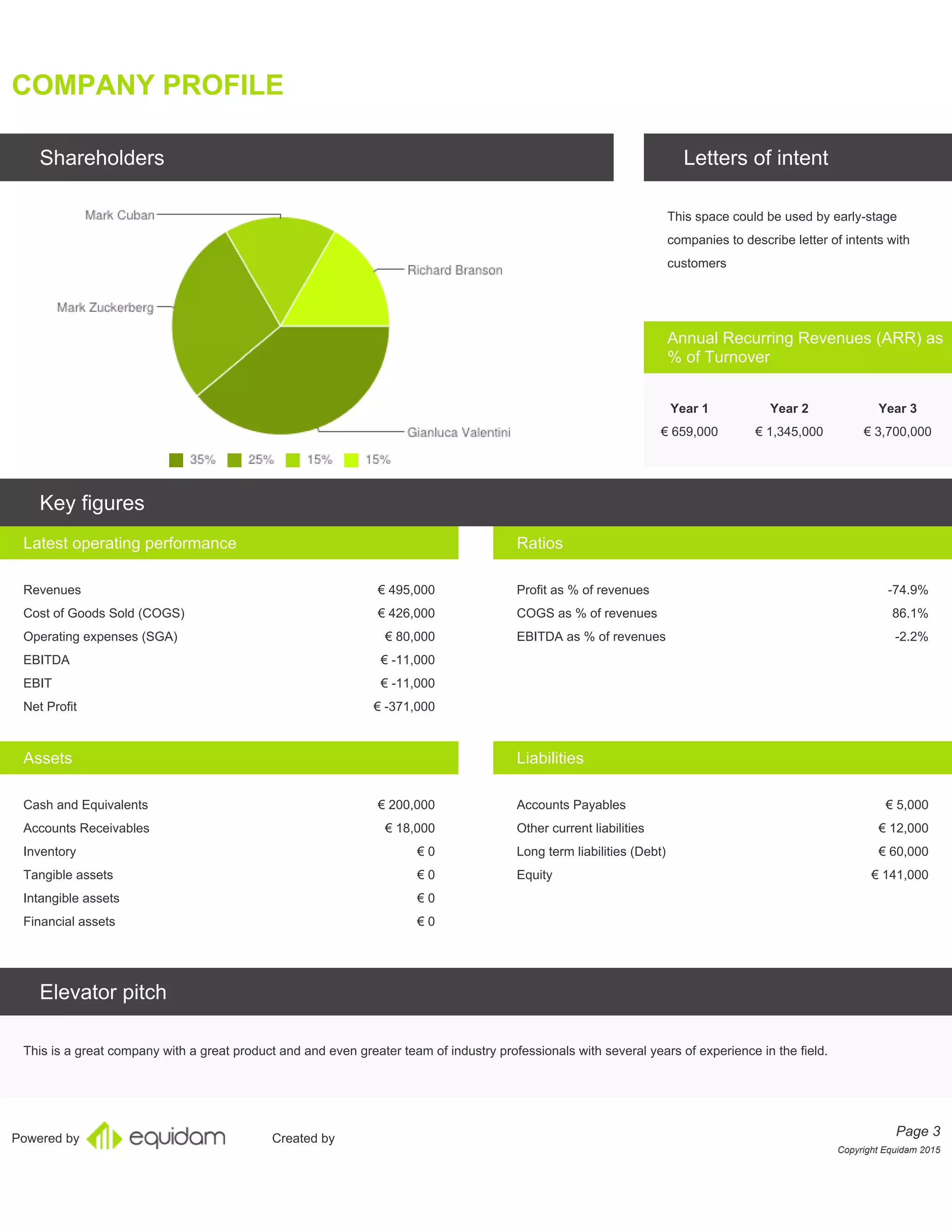
Shareholders Letters of intent
This space could be used by early-stage
companies to describe letter of intents with
customers
Annual Recurring Revenues (ARR) as
% of Turnover
Year 1 Year 2 Year 3
€ 659,000 € 1,345,000 € 3,700,000
Key figures
Latest operating performance Ratios
Revenues € 495,000 Profit as % of revenues -74.9%
Cost of Goods Sold (COGS) € 426,000 . COGS as % of revenues 86.1%
Operating expenses (SGA) € 80,000 EBITDA as % of revenues -2.2%
EBITDA € -11,000
EBIT € -11,000
Net Profit € -371,000
Assets Liabilities
Cash and Equivalents € 200,000 Accounts Payables € 5,000
Accounts Receivables € 18,000 Other current liabilities € 12,000
Inventory € 0 Long term liabilities (Debt) € 60,000
Tangible assets € 0 Equity € 141,000
Intangible assets € 0
Financial assets € 0
Elevator pitch
This is a great company with a great product and and even greater team of industry professionals with several years of experience in the field.
Page 3
Copyright Equidam 2015
Powered by Created by
VALUATION
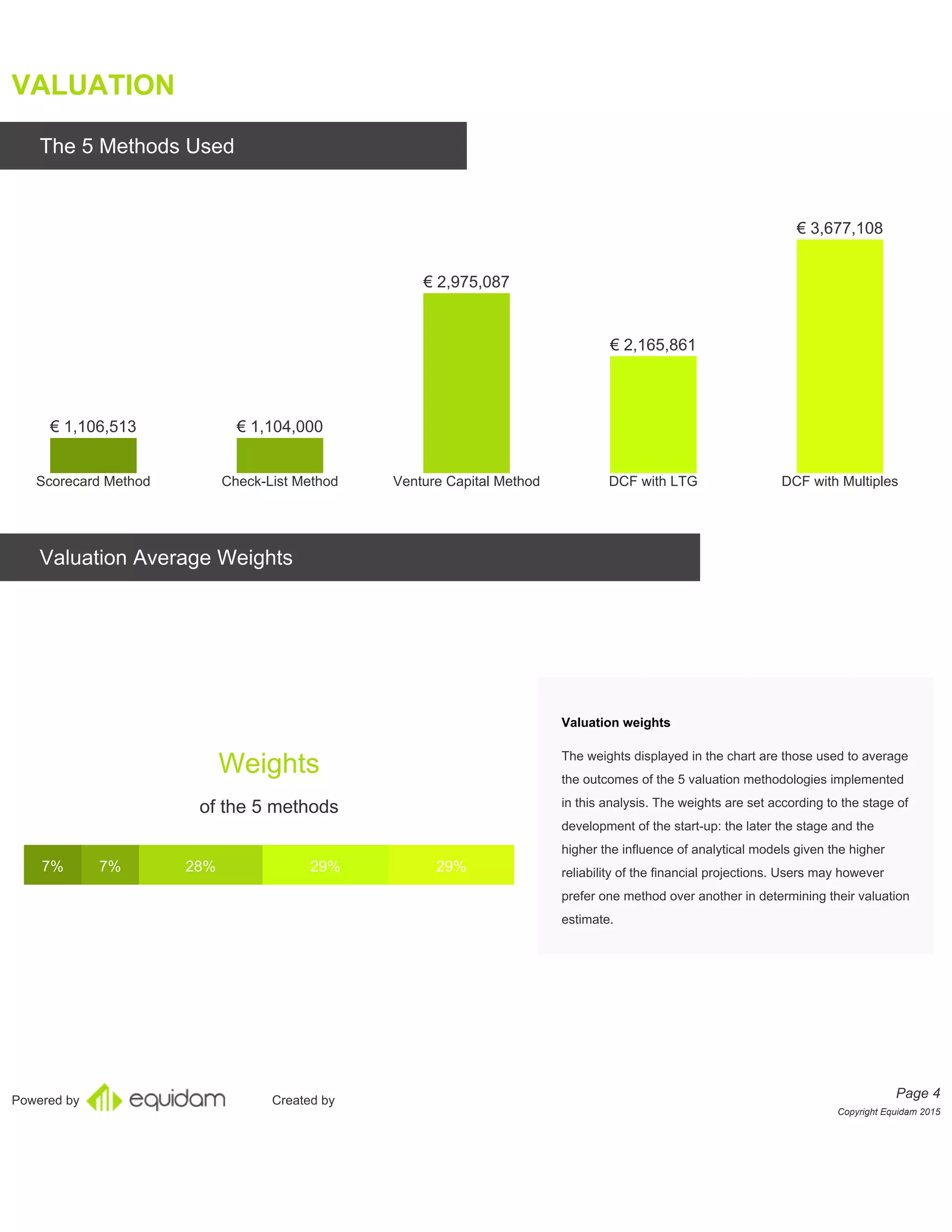
The 5 Methods Used
€ 1,106,513 € 1,104,000
€ 2,975,087
€ 2,165,861
€ 3,677,108
Scorecard Method Check-List Method Venture Capital Method DCF with LTG DCF with Multiples
Valuation Average Weights
Weights
Valuation weights
The weights displayed in the chart are those used to average
the outcomes of the 5 valuation methodologies implemented
in this analysis. The weights are set according to the stage of
development of the start-up: the later the stage and the
higher the influence of analytical models given the higher
reliability of the financial projections. Users may however
prefer one method over another in determining their valuation
estimate.
of the 5 methods
7% 7% 28% 29% 29%
Page 4
Copyright Equidam 2015
Powered by Created by
VALUATION
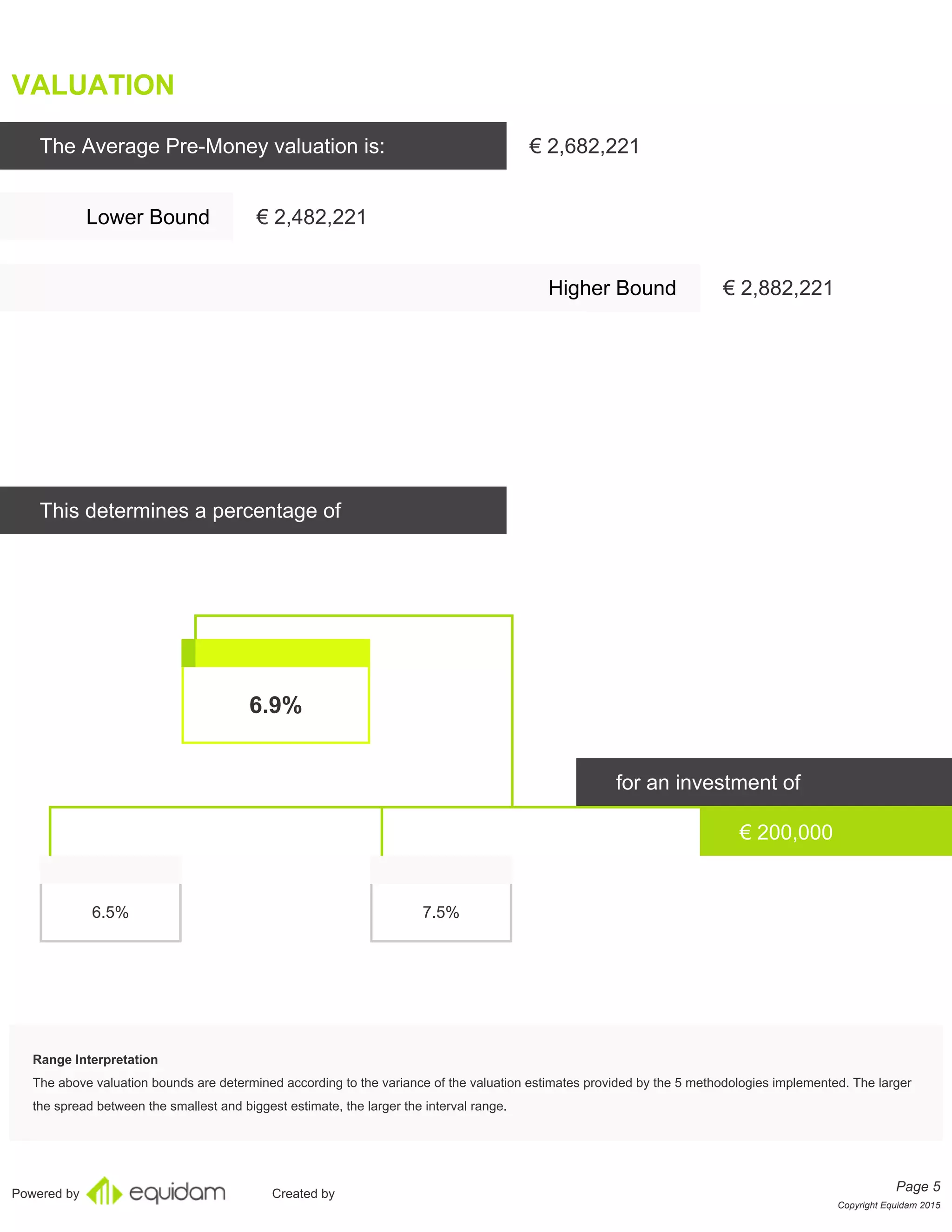
The Average Pre-Money valuation is: € 2,682,221
Lower Bound € 2,482,221
Higher Bound € 2,882,221
This determines a percentage of
for an investment of
6.9%
€ 200,000
6.5% 7.5%
Range Interpretation
The above valuation bounds are determined according to the variance of the valuation estimates provided by the 5 methodologies implemented. The larger
the spread between the smallest and biggest estimate, the larger the interval range.
Page 5
Copyright Equidam 2015
Powered by Created by
HIGH-LEVEL VALUATION
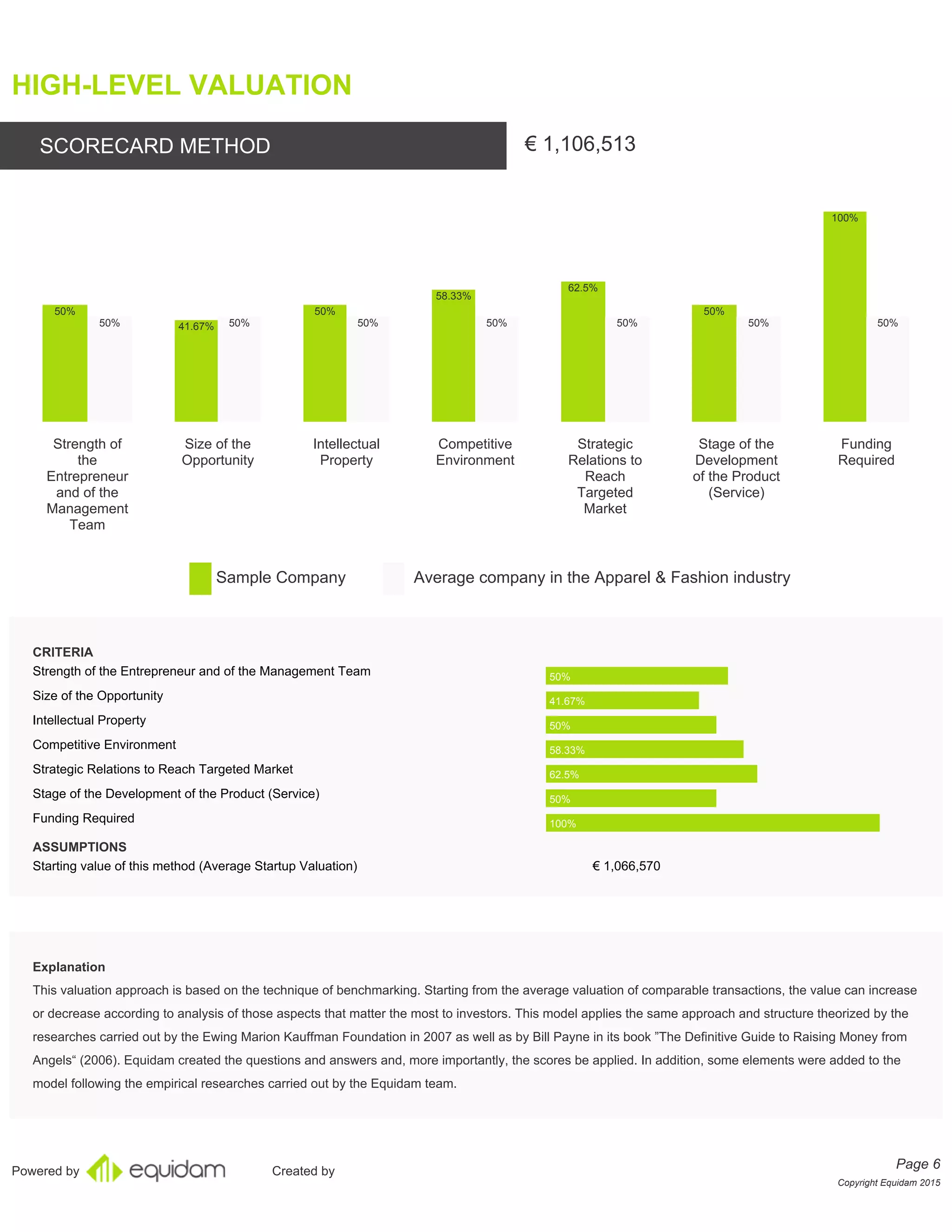
SCORECARD METHOD € 1,106,513
50%
50% 41.67% 50%
50%
50%
58.33%
50%
62.5%
50%
50%
50%
100%
50%
Strength of
the
Entrepreneur
and of the
Management
Team
Size of the
Opportunity
Intellectual
Property
Competitive
Environment
Strategic
Relations to
Reach
Targeted
Market
Stage of the
Development
of the Product
(Service)
Funding
Required
Sample Company Average company in the Apparel & Fashion industry. .
CRITERIA
Strength of the Entrepreneur and of the Management Team 50%
Size of the Opportunity 41.67%
Intellectual Property 50%
Competitive Environment 58.33%
Strategic Relations to Reach Targeted Market 62.5%
Stage of the Development of the Product (Service) 50%
Funding Required 100%
ASSUMPTIONS
Starting value of this method (Average Startup Valuation) € 1,066,570
Explanation
This valuation approach is based on the technique of benchmarking. Starting from the average valuation of comparable transactions, the value can increase
or decrease according to analysis of those aspects that matter the most to investors. This model applies the same approach and structure theorized by the
researches carried out by the Ewing Marion Kauffman Foundation in 2007 as well as by Bill Payne in its book ”The Definitive Guide to Raising Money from
Angels“ (2006). Equidam created the questions and answers and, more importantly, the scores be applied. In addition, some elements were added to the
model following the empirical researches carried out by the Equidam team.
Page 6
Copyright Equidam 2015
Powered by Created by
HIGH-LEVEL VALUATION
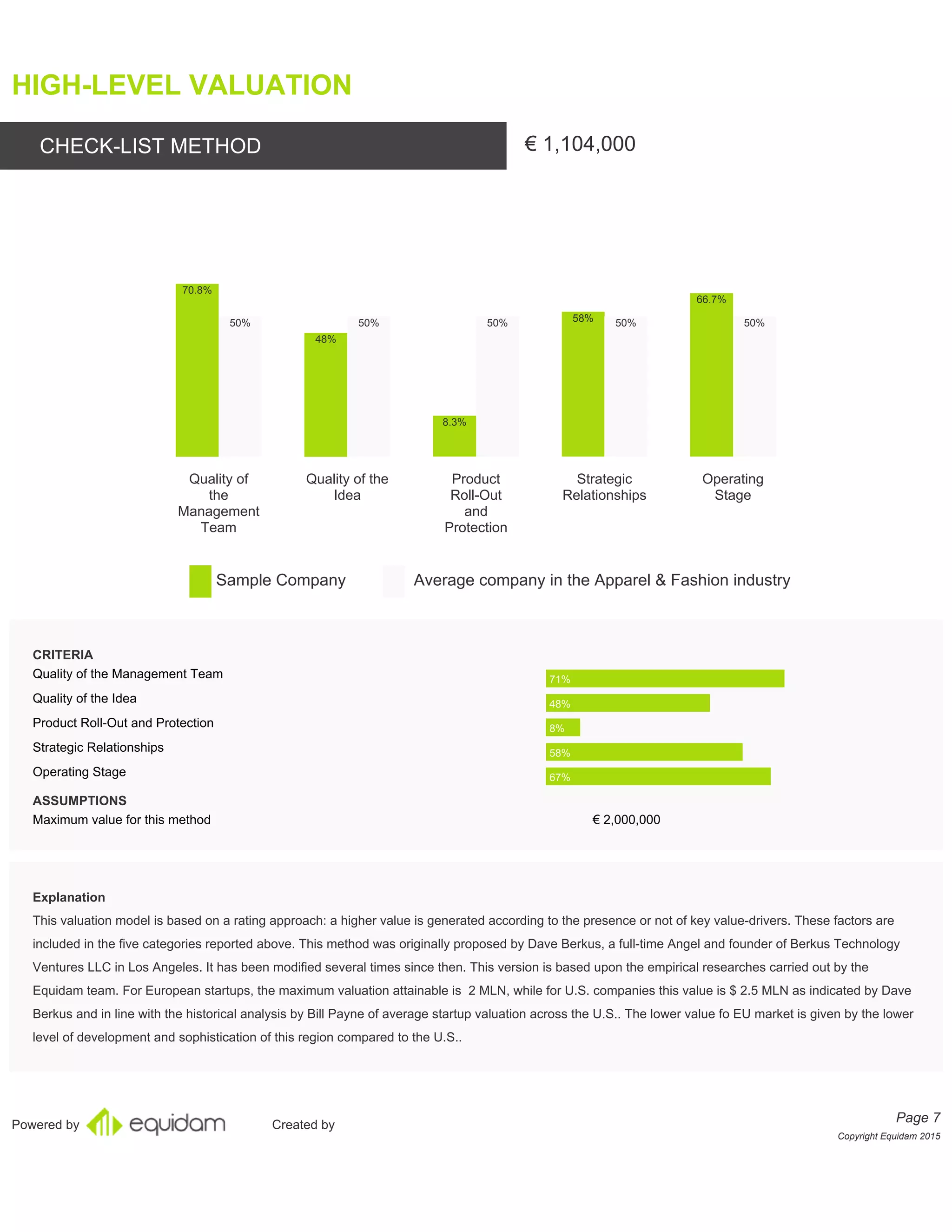
CHECK-LIST METHOD € 1,104,000
a
70.8%
50%
a
48%
50%
a
8.3%
50%
a
58% 50%
a
66.7%
50%
a
Quality of
the
Management
Team
Quality of the
Idea
Product
Roll-Out
and
Protection
Strategic
Relationships
Operating
Stage
Sample Company Average company in the Apparel & Fashion industry. .
CRITERIA
Quality of the Management Team 71%
Quality of the Idea 48%
Product Roll-Out and Protection 8%
Strategic Relationships 58%
Operating Stage 67%
ASSUMPTIONS
Maximum value for this method € 2,000,000
Explanation
This valuation model is based on a rating approach: a higher value is generated according to the presence or not of key value-drivers. These factors are
included in the five categories reported above. This method was originally proposed by Dave Berkus, a full-time Angel and founder of Berkus Technology
Ventures LLC in Los Angeles. It has been modified several times since then. This version is based upon the empirical researches carried out by the
Equidam team. For European startups, the maximum valuation attainable is 2 MLN, while for U.S. companies this value is $ 2.5 MLN as indicated by Dave
Berkus and in line with the historical analysis by Bill Payne of average startup valuation across the U.S.. The lower value fo EU market is given by the lower
level of development and sophistication of this region compared to the U.S..
Page 7
Copyright Equidam 2015
Powered by Created by
FINANCIAL FORECASTS
Revenues
Year 1 Year 2 Year 3
€ 780,000
€ 1,900,000
€ 4,200,000
Best estimate
The stage of development of the company
allows for a reliable estimation of the expected
performance. The projections are based on
the analysis of the track-record.
EBIT
€ -329,525
€ 486,568
€ 1,355,098
The uncertainty featuring financial projections
The projections about the expected performance of the startup are provided by the users and are not, by any means, subject to the previous check by
Equidam. The users are required to indicate the projected values regarding revenues and costs (fixed and variables), while other items as Working Capital,
Depreciation and Amortization and the interest expenses are estimated by Equidam according to industry-specific databases. The Cash Flows are also
estimated by the Equidam algorithm combining users’ inputs and the Equidam data. Equidam provides an indication of the level of reliability of the users’
projections based upon the stage of development of the business. Another way to check the reliability of the projections is offered by the revenues from
contracts in place, displayed in the second page of the Company Profile.
Page 8
Copyright Equidam 2015
Powered by Created by
VC METHOD DCF WITH LTG DCF WITH MULTIPLES
Cash flow of the next three years
€ -470,193
€ 228,976
€ 649,417
€ 1,355,098
Year 3 EBIT
X
9
Industry multiple
€ 2,975,087
Pre-money valuation
60%
discount rate per year
6.3%
Equity
percentage
€ 200,000
Investment
CRITERIA
Exit value in year 3 € 12,195,883
ASSUMPTIONS
Annual discount rate applied 60.04%
The quick approach used by Venture Capital Funds
The venture capital method is a quick approach to the valuation of startup companies. It comprises in estimating the exit value of the startup at the end of the forecast
horizon and ignoring the intermediate cash flows. The exit value is calculated by taking the final financial result of the company and applying the earning multiple
(Price/Earnings ratio). This value is then discounted at a high rate to get the present value. The discount rate is determined by Equidam according to the stage of
development and is reported in the table above. Given its simplistic approach, this model does not apply illiquidity or survival discount as the following to methods do. The
annual discount rate applied already accounts for these issues.
Page 9
Copyright Equidam 2015
Powered by Created by
VC METHOD DCF WITH LTG DCF WITH MULTIPLES
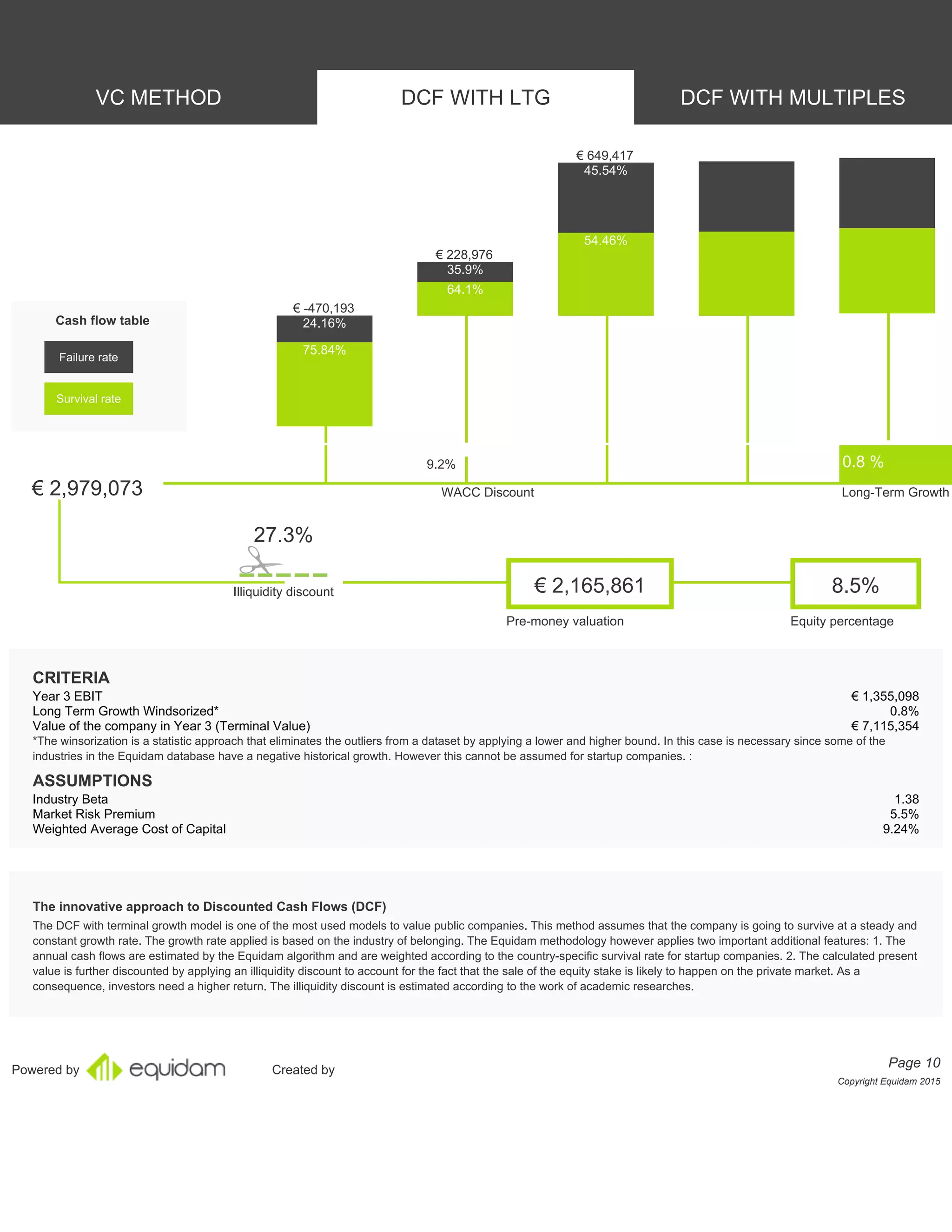
Cash flow table
Failure rate
Survival rate
€ -470,193
24.16%
75.84%
€ 228,976
35.9%
64.1%
€ 649,417
45.54%
54.46%
€ 2,979,073
9.2% 0.8 %
WACC Discount Long-Term Growth
27.3%
Illiquidity discount € 2,165,861
Pre-money valuation
8.5%
Equity percentage
CRITERIA
Year 3 EBIT € 1,355,098
Long Term Growth Windsorized* 0.8%
Value of the company in Year 3 (Terminal Value) € 7,115,354
*The winsorization is a statistic approach that eliminates the outliers from a dataset by applying a lower and higher bound. In this case is necessary since some of the
industries in the Equidam database have a negative historical growth. However this cannot be assumed for startup companies. :
ASSUMPTIONS
Industry Beta 1.38
Market Risk Premium 5.5%
Weighted Average Cost of Capital 9.24%
The innovative approach to Discounted Cash Flows (DCF)
The DCF with terminal growth model is one of the most used models to value public companies. This method assumes that the company is going to survive at a steady and
constant growth rate. The growth rate applied is based on the industry of belonging. The Equidam methodology however applies two important additional features: 1. The
annual cash flows are estimated by the Equidam algorithm and are weighted according to the country-specific survival rate for startup companies. 2. The calculated present
value is further discounted by applying an illiquidity discount to account for the fact that the sale of the equity stake is likely to happen on the private market. As a
consequence, investors need a higher return. The illiquidity discount is estimated according to the work of academic researches.
Page 10
Copyright Equidam 2015
Powered by Created by
VC METHOD DCF WITH LTG DCF WITH MULTIPLES
Cash flow table
Failure rate
Survival rate
€ -470,193
24.16%
75.84%
€ 228,976
35.9%
64.1%
€ 649,417
45.54%
54.46%
€ 1,355,098
Year 3 EBIT
X
9
Industry multiple
€ 5,057,746
9.2%
WACC Discount
27.3%
Illiquidity
discount*
€ 3,677,108
Pre-money valuation
5.2%
Equity percentage
CRITERIA
Year 3 EBIT € 1,355,098
EBIT multiple Year 3 9
Value of the company in Year 3 (Terminal Value) € 12,195,883
Implied Annual Return if sale value realized 145.96%
ASSUMPTIONS
Industry Beta 1.38
Market Risk Premium 5.5%
Weighted Average Cost of Capital 9.24%
Industry peers' comparison
The DCF with exit multiple is the other most used valuation approach. It is based on the assumption that the exit value of the company is determined by the average of
industry peers. The most commonly used multiple is the Price/Earnings (P/E) since the generated estimate is less susceptible to differences in the operating margin among
industry peers. The Equidam methodology also applies: 1. The annual cash flows are estimated by the Equidam algorithm and are weighted according to the
country-specific survival rate for startup companies. 2. The calculated present value is further discounted by applying an illiquidity discount to account for the fact that the
sale of the equity stake is likely to happen on the private market. As a consequence, investors need a higher return. The illiquidity discount is estimated according to the
work of academic researches
Page 11
Copyright Equidam 2015
Powered by Created by
PROFIT AND LOSS CASH FLOW
Average Monthly Profit and Loss First Year
Revenues € 65,000
Cost of goods sold € 79,167
Marketing expenses € 2,875
Salaries € 2,875
Other operating expenses € 5,750
Profit € -25,667
Monthly average burn rate
The analysis of the monthly prospect of revenues and costs is useful in order to get an overview of the monthly break-even point for the startup. In addition, it also gives the
measure of the burn rate, provided the initial investment by external investors. The monthly prospect of revenues and costs only refers to the first year of projections and is
based on the estimates provided by the user.
Page 12
Copyright Equidam 2015
Powered by Created by
PROFIT AND LOSS CASH FLOW
Year 1 Year 2 Year 3
Revenues € 780,000 € 1,900,000 € 4,200,000
sales quantity 0 0 0
Cost of goods sold € 950,000 € 1,150,000 € 2,400,000
Average individual price € 0 € 0 € 0
Average individual cost € 0 € 0 € 0
Gross margin -21.8% 39.5% 42.9%
Selling, General and Administrative € 138,000 € 211,000 € 329,000
EBITDA € -308,000 € 539,000 € 1,471,000
Depreciation and Amortization € 21,525 € 52,432 € 115,902
as % of revenues 2.8% 2.8% 2.8%
EBIT € -329,525 € 486,568 € 1,355,098
Financial Gain-Loss € -5,508 € -22,440 € -2,624
Debt interest payment € 7,508 € 22,440 € 2,624
Interest rate on debt 13.65% 2.05% 2.05%
Cash interest gain € 2,000 € 0 € 0
Taxes € 0 € 32,274 € 338,119
Deferred tax assets € 83,758 € 0 € 0
Effective tax payable € -83,758 € 116,032 € 338,119
Effective tax rate 0% 7% 25%
Profit € -335,032 € 431,854 € 1,014,356
Good understanding of numbers is good understanding of business
Revenues, Cost of Goods Sold and Selling, General and Administrative are provided by the user, while the D and A and Financial expenses are estimated by Equidam.
The former is based upon the average D and A as % of Revenues of the industry peers and the latter upon the COVERAGE RATIO (EBIT/INTEREST PAYED) and then
adding the related risk premium to the Risk Free rate. The risk premia related to the COVERAGE RATIO are fixed as determined by academic researches. The Risk Free
rate is assumed to equal the 10-year maturity German Bund. The tax outlays are determined by applying the country-specific tax rate for companies, as reported in the
Equidam databases.
Page 13
Copyright Equidam 2015
Powered by Created by
PROFIT AND LOSS CASH FLOW
Year 1 Year 2 Year 3
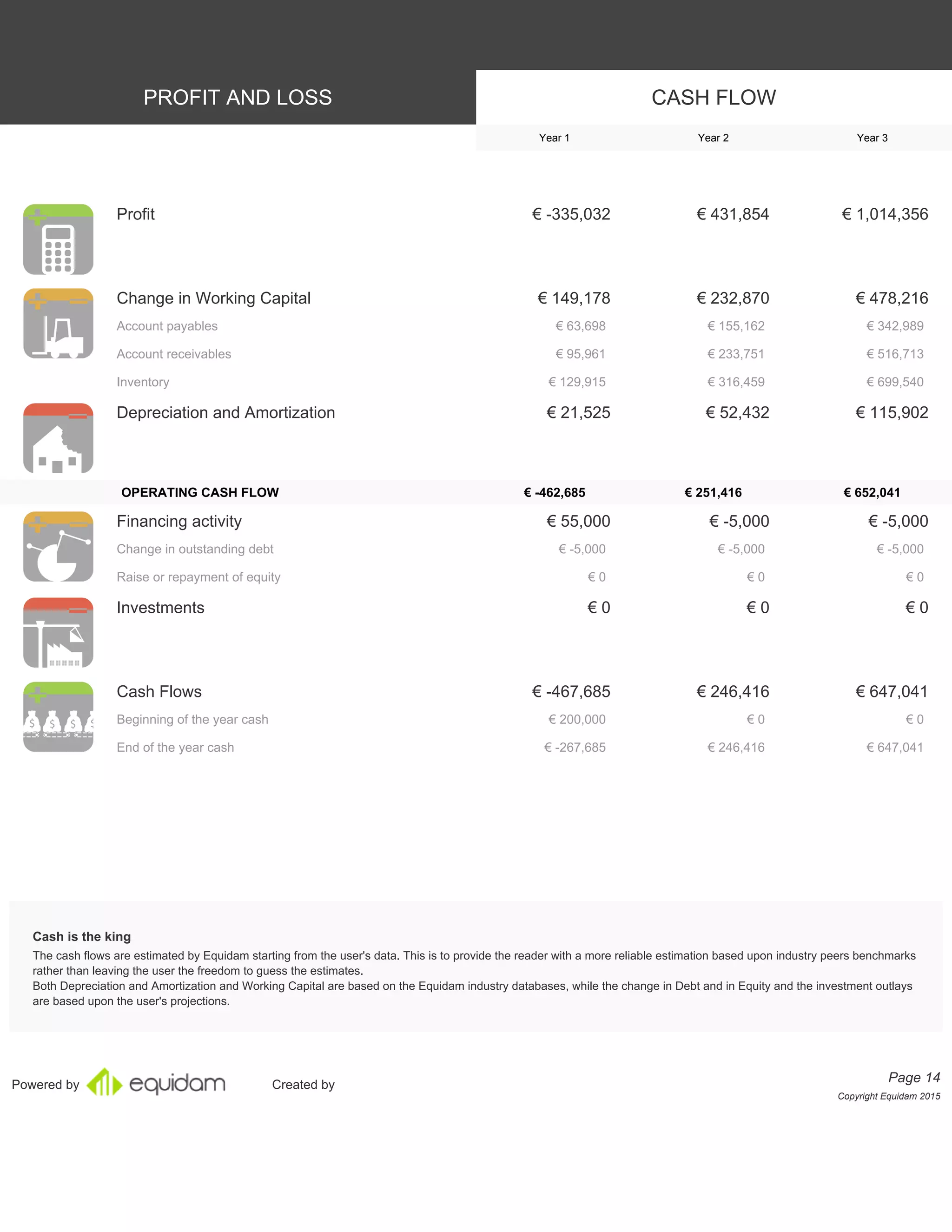
Profit € -335,032 € 431,854 € 1,014,356
Change in Working Capital € 149,178 € 232,870 € 478,216
Account payables € 63,698 € 155,162 € 342,989
Account receivables € 95,961 € 233,751 € 516,713
Inventory € 129,915 € 316,459 € 699,540
Depreciation and Amortization € 21,525 € 52,432 € 115,902
OPERATING CASH FLOW € -462,685 € 251,416 € 652,041
Financing activity € 55,000 € -5,000 € -5,000
Change in outstanding debt € -5,000 € -5,000 € -5,000
Raise or repayment of equity € 0 € 0 € 0
Investments € 0 € 0 € 0
Cash Flows € -467,685 € 246,416 € 647,041
Beginning of the year cash € 200,000 € 0 € 0
End of the year cash € -267,685 € 246,416 € 647,041
Cash is the king
The cash flows are estimated by Equidam starting from the user's data. This is to provide the reader with a more reliable estimation based upon industry peers benchmarks
rather than leaving the user the freedom to guess the estimates.
Both Depreciation and Amortization and Working Capital are based on the Equidam industry databases, while the change in Debt and in Equity and the investment outlays
are based upon the user's projections.
Page 14
Copyright Equidam 2015
APPENDIX
DESCRIPTION SCORECARD METHOD
The years of industry experience of the managers
The managerial and business skills achieved by the managers academically and professionally
The technical skills and capabilities achieved by the managers academically and professionally
The level of managerial responsibility achieved in the past working experiences
The team spirit and comradeship
The size of the staff
The time and economic commitment by the founders and any other member of the staff
The estimated potential size of the market (if provided)
The estimated revenues in the third year according to the stage of the development (if provided)
The geographical scope of the business
The scalability of the business
The analysis of the number of active market players
The quality of competitive products/services
The competitive advantage over competitive products/services
The threat of international competition (if any)
The presence of IP
The type of IP protection applicable
The IP protection in place (if any)
Barriers to entry determined by IP-related aspects
The partnership with vendors and other selling channels
The partnership with strategic market agent to achieve the commercialization
The roll-out of the product/service
The capital need required according to stage of development. Later-stage businesses raising limited budgets are showing higher quality compared
to similar startups seeking larger amounts.
Page 15
Copyright Equidam 2015
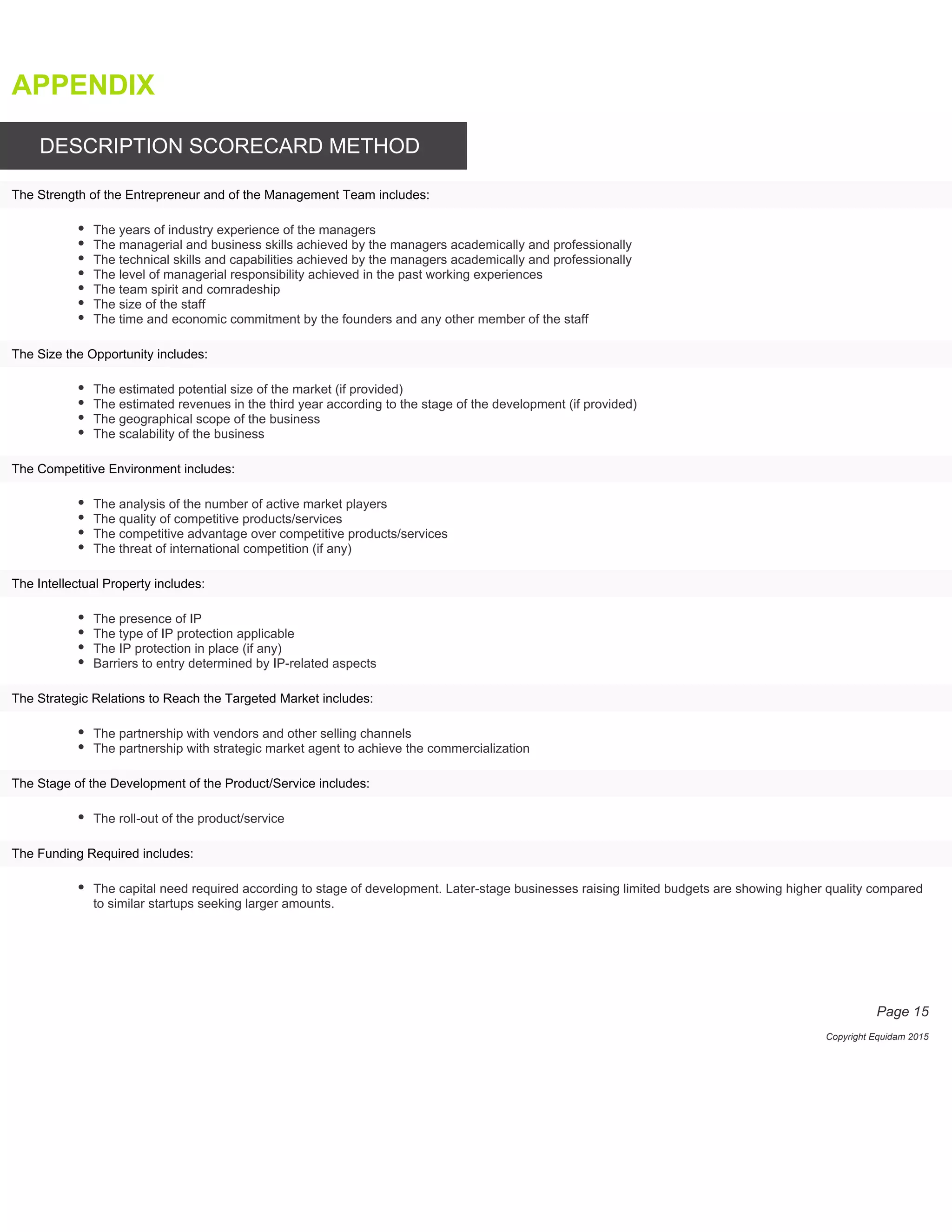
The Strength of the Entrepreneur and of the Management Team includes:
The Size the Opportunity includes:
The Competitive Environment includes:
The Intellectual Property includes:
The Strategic Relations to Reach the Targeted Market includes:
The Stage of the Development of the Product/Service includes:
The Funding Required includes:
APPENDIX
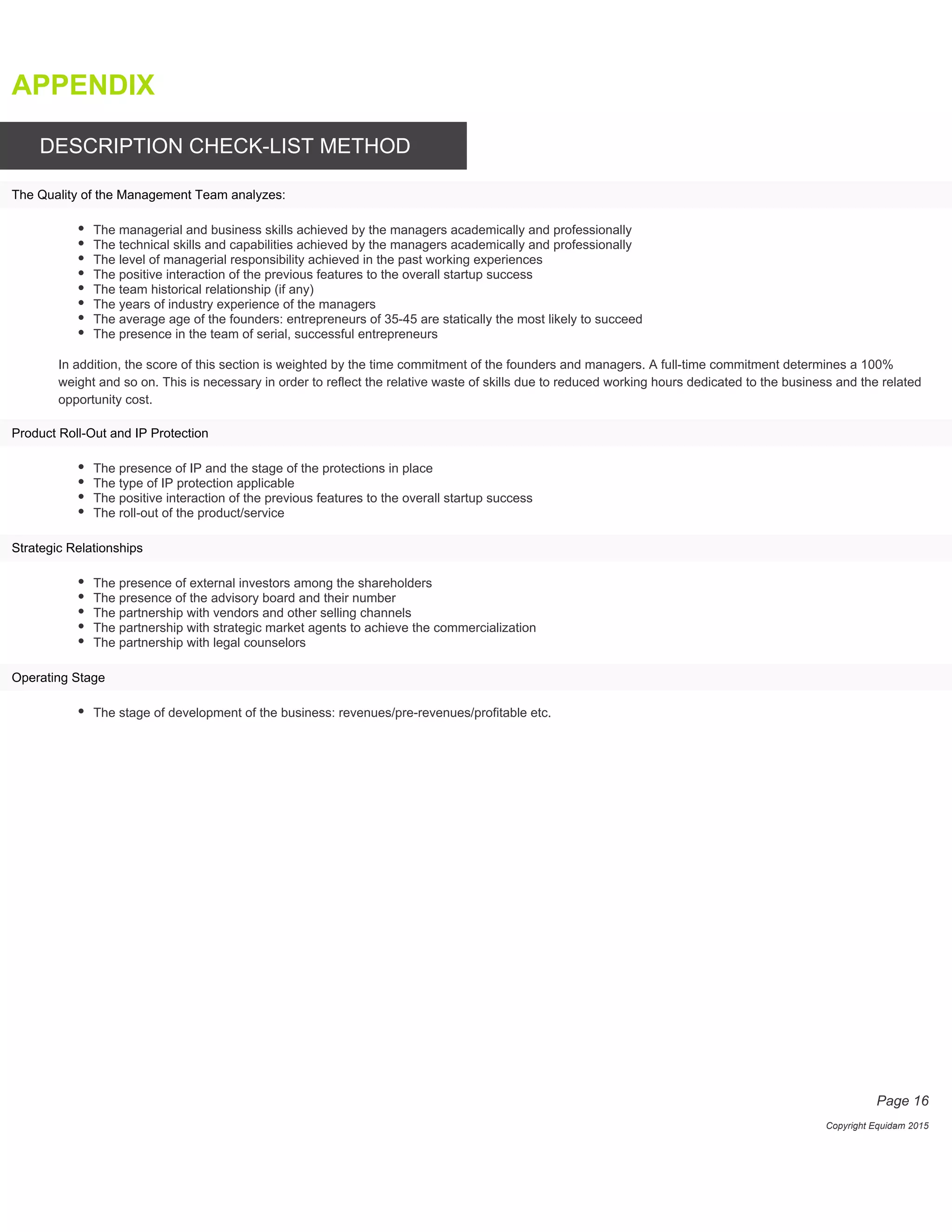
DESCRIPTION CHECK-LIST METHOD
The managerial and business skills achieved by the managers academically and professionally
The technical skills and capabilities achieved by the managers academically and professionally
The level of managerial responsibility achieved in the past working experiences
The positive interaction of the previous features to the overall startup success
The team historical relationship (if any)
The years of industry experience of the managers
The average age of the founders: entrepreneurs of 35-45 are statically the most likely to succeed
The presence in the team of serial, successful entrepreneurs
In addition, the score of this section is weighted by the time commitment of the founders and managers. A full-time commitment determines a 100%
weight and so on. This is necessary in order to reflect the relative waste of skills due to reduced working hours dedicated to the business and the related
opportunity cost.
The presence of IP and the stage of the protections in place
The type of IP protection applicable
The positive interaction of the previous features to the overall startup success
The roll-out of the product/service
The presence of external investors among the shareholders
The presence of the advisory board and their number
The partnership with vendors and other selling channels
The partnership with strategic market agents to achieve the commercialization
The partnership with legal counselors
The stage of development of the business: revenues/pre-revenues/profitable etc.
Page 16
Copyright Equidam 2015
The Quality of the Management Team analyzes:
Product Roll-Out and IP Protection
Strategic Relationships
Operating Stage
Important legal notes
Equidam BV does not represent or endorse the accuracy or reliability of any advice, opinion, statement or any other information
displayed or distributed through this report or its website. The estimates and the data contained herein are made using the
information provided by the user, publicly available information and data for different industries. Equidam BV has not audited or
attempted to confirm this information for accuracy or completeness. Under no circumstances the present report is to be used or
considered as an offer, solicitation, or recommendation to sell, or a solicitation of any offer to buy any security. Equidam BV
excludes any warranties and responsibilities concerning the results to be obtained from the present report nor their use and
shall not be liable for any claims, losses or damages arising from or occasioned by any inaccuracy, error, delay, or omission, or
from use of the report or actions taken in reliance on the information contained in it. The use of this report and the information
provided herein is subject to Equidam BV online Terms of Use and Privacy Policy.

Company valuation report sample

  • 1.
    Powered by Createdby SAMPLE COMPANY BUSINESS PLAN SCANNER + COMPANY PROFILE Contacts Company full name: Sample Company Contact email: sample_report@equidam.com Report date: 06.03.2015 The idea Scalable business Demand validated by competitors Internationalization planned or active IP protected with barriers The Team Team committed part time Business background with experience Technical experience Previous startup experience with successful exit(s) The Company Legal entity Advisory board in place Expansion stage Marketing Few partners contacted Secured distribution channels Systemic marketing started Finance Post-revenues company Venture capital investor Some exit opportunities Scan business plan in a glance The Business Plan Scanner displays the main features of the startup project in the form of icons. The color at the top of the icon indicates the impact of that specific feature on the overall quality of the startup. Green stands for positive impact while red for negative. The purpose of this page is to give the reader an immediate overview of the startup quality and to make different projects comparable with each other based upon the same criteria. The parameters analyzed are those identified as of the highest importance to angel investors according to the researches over historical startup investing activity. Page 1 Copyright Equidam 2015
  • 2.
    Powered by Createdby COMPANY PROFILE Sample Company Legally constituted: Yes Year of constitution: 2013 Country: The Netherlands Scalability: Yes Selling approach: B2B and B2C Committed resources Capital: € 50,000 Time (Months): 12 Time commmitment: Part time Stage of development: Stage of development: Expansion stage Product roll-out: Minimum Viable Product Profitability: Revenues, negative profits Investment proposal Capital needed: € 200,000 Equity offered: 20.0% Core Business This is a sample company made by the Equidam team. The figures and facts in here are totally fictional and are not referred to Equidam or any of Equidam's users Team Founders: 3 FTE employees: 13 Management team composition: Only founders Experience In the industry(years): 15 Previous startup: Yes, successful exit(s) Dedication to the project Founders: All founders committed full time Staff members: Majority full-time Skills and capabilities Business and managerial: Business background and/or experience Position reached: Technical: Technical experience but no background Competition Target market: Estimated from related markets Level of competition: Some small players Competitive products are: On the same level and substantially less innovative Marketing approach: B2B partnership or sales and Selling agents Page 2 Copyright Equidam 2015
  • 3.
    Powered by Createdby COMPANY PROFILE Shareholders Letters of intent This space could be used by early-stage companies to describe letter of intents with customers Annual Recurring Revenues (ARR) as % of Turnover Year 1 Year 2 Year 3 € 659,000 € 1,345,000 € 3,700,000 Key figures Latest operating performance Ratios Revenues € 495,000 Profit as % of revenues -74.9% Cost of Goods Sold (COGS) € 426,000 . COGS as % of revenues 86.1% Operating expenses (SGA) € 80,000 EBITDA as % of revenues -2.2% EBITDA € -11,000 EBIT € -11,000 Net Profit € -371,000 Assets Liabilities Cash and Equivalents € 200,000 Accounts Payables € 5,000 Accounts Receivables € 18,000 Other current liabilities € 12,000 Inventory € 0 Long term liabilities (Debt) € 60,000 Tangible assets € 0 Equity € 141,000 Intangible assets € 0 Financial assets € 0 Elevator pitch This is a great company with a great product and and even greater team of industry professionals with several years of experience in the field. Page 3 Copyright Equidam 2015
  • 4.
    Powered by Createdby VALUATION The 5 Methods Used € 1,106,513 € 1,104,000 € 2,975,087 € 2,165,861 € 3,677,108 Scorecard Method Check-List Method Venture Capital Method DCF with LTG DCF with Multiples Valuation Average Weights Weights Valuation weights The weights displayed in the chart are those used to average the outcomes of the 5 valuation methodologies implemented in this analysis. The weights are set according to the stage of development of the start-up: the later the stage and the higher the influence of analytical models given the higher reliability of the financial projections. Users may however prefer one method over another in determining their valuation estimate. of the 5 methods 7% 7% 28% 29% 29% Page 4 Copyright Equidam 2015
  • 5.
    Powered by Createdby VALUATION The Average Pre-Money valuation is: € 2,682,221 Lower Bound € 2,482,221 Higher Bound € 2,882,221 This determines a percentage of for an investment of 6.9% € 200,000 6.5% 7.5% Range Interpretation The above valuation bounds are determined according to the variance of the valuation estimates provided by the 5 methodologies implemented. The larger the spread between the smallest and biggest estimate, the larger the interval range. Page 5 Copyright Equidam 2015
  • 6.
    Powered by Createdby HIGH-LEVEL VALUATION SCORECARD METHOD € 1,106,513 50% 50% 41.67% 50% 50% 50% 58.33% 50% 62.5% 50% 50% 50% 100% 50% Strength of the Entrepreneur and of the Management Team Size of the Opportunity Intellectual Property Competitive Environment Strategic Relations to Reach Targeted Market Stage of the Development of the Product (Service) Funding Required Sample Company Average company in the Apparel & Fashion industry. . CRITERIA Strength of the Entrepreneur and of the Management Team 50% Size of the Opportunity 41.67% Intellectual Property 50% Competitive Environment 58.33% Strategic Relations to Reach Targeted Market 62.5% Stage of the Development of the Product (Service) 50% Funding Required 100% ASSUMPTIONS Starting value of this method (Average Startup Valuation) € 1,066,570 Explanation This valuation approach is based on the technique of benchmarking. Starting from the average valuation of comparable transactions, the value can increase or decrease according to analysis of those aspects that matter the most to investors. This model applies the same approach and structure theorized by the researches carried out by the Ewing Marion Kauffman Foundation in 2007 as well as by Bill Payne in its book ”The Definitive Guide to Raising Money from Angels“ (2006). Equidam created the questions and answers and, more importantly, the scores be applied. In addition, some elements were added to the model following the empirical researches carried out by the Equidam team. Page 6 Copyright Equidam 2015
  • 7.
    Powered by Createdby HIGH-LEVEL VALUATION CHECK-LIST METHOD € 1,104,000 a 70.8% 50% a 48% 50% a 8.3% 50% a 58% 50% a 66.7% 50% a Quality of the Management Team Quality of the Idea Product Roll-Out and Protection Strategic Relationships Operating Stage Sample Company Average company in the Apparel & Fashion industry. . CRITERIA Quality of the Management Team 71% Quality of the Idea 48% Product Roll-Out and Protection 8% Strategic Relationships 58% Operating Stage 67% ASSUMPTIONS Maximum value for this method € 2,000,000 Explanation This valuation model is based on a rating approach: a higher value is generated according to the presence or not of key value-drivers. These factors are included in the five categories reported above. This method was originally proposed by Dave Berkus, a full-time Angel and founder of Berkus Technology Ventures LLC in Los Angeles. It has been modified several times since then. This version is based upon the empirical researches carried out by the Equidam team. For European startups, the maximum valuation attainable is 2 MLN, while for U.S. companies this value is $ 2.5 MLN as indicated by Dave Berkus and in line with the historical analysis by Bill Payne of average startup valuation across the U.S.. The lower value fo EU market is given by the lower level of development and sophistication of this region compared to the U.S.. Page 7 Copyright Equidam 2015
  • 8.
    Powered by Createdby FINANCIAL FORECASTS Revenues Year 1 Year 2 Year 3 € 780,000 € 1,900,000 € 4,200,000 Best estimate The stage of development of the company allows for a reliable estimation of the expected performance. The projections are based on the analysis of the track-record. EBIT € -329,525 € 486,568 € 1,355,098 The uncertainty featuring financial projections The projections about the expected performance of the startup are provided by the users and are not, by any means, subject to the previous check by Equidam. The users are required to indicate the projected values regarding revenues and costs (fixed and variables), while other items as Working Capital, Depreciation and Amortization and the interest expenses are estimated by Equidam according to industry-specific databases. The Cash Flows are also estimated by the Equidam algorithm combining users’ inputs and the Equidam data. Equidam provides an indication of the level of reliability of the users’ projections based upon the stage of development of the business. Another way to check the reliability of the projections is offered by the revenues from contracts in place, displayed in the second page of the Company Profile. Page 8 Copyright Equidam 2015
  • 9.
    Powered by Createdby VC METHOD DCF WITH LTG DCF WITH MULTIPLES Cash flow of the next three years € -470,193 € 228,976 € 649,417 € 1,355,098 Year 3 EBIT X 9 Industry multiple € 2,975,087 Pre-money valuation 60% discount rate per year 6.3% Equity percentage € 200,000 Investment CRITERIA Exit value in year 3 € 12,195,883 ASSUMPTIONS Annual discount rate applied 60.04% The quick approach used by Venture Capital Funds The venture capital method is a quick approach to the valuation of startup companies. It comprises in estimating the exit value of the startup at the end of the forecast horizon and ignoring the intermediate cash flows. The exit value is calculated by taking the final financial result of the company and applying the earning multiple (Price/Earnings ratio). This value is then discounted at a high rate to get the present value. The discount rate is determined by Equidam according to the stage of development and is reported in the table above. Given its simplistic approach, this model does not apply illiquidity or survival discount as the following to methods do. The annual discount rate applied already accounts for these issues. Page 9 Copyright Equidam 2015
  • 10.
    Powered by Createdby VC METHOD DCF WITH LTG DCF WITH MULTIPLES Cash flow table Failure rate Survival rate € -470,193 24.16% 75.84% € 228,976 35.9% 64.1% € 649,417 45.54% 54.46% € 2,979,073 9.2% 0.8 % WACC Discount Long-Term Growth 27.3% Illiquidity discount € 2,165,861 Pre-money valuation 8.5% Equity percentage CRITERIA Year 3 EBIT € 1,355,098 Long Term Growth Windsorized* 0.8% Value of the company in Year 3 (Terminal Value) € 7,115,354 *The winsorization is a statistic approach that eliminates the outliers from a dataset by applying a lower and higher bound. In this case is necessary since some of the industries in the Equidam database have a negative historical growth. However this cannot be assumed for startup companies. : ASSUMPTIONS Industry Beta 1.38 Market Risk Premium 5.5% Weighted Average Cost of Capital 9.24% The innovative approach to Discounted Cash Flows (DCF) The DCF with terminal growth model is one of the most used models to value public companies. This method assumes that the company is going to survive at a steady and constant growth rate. The growth rate applied is based on the industry of belonging. The Equidam methodology however applies two important additional features: 1. The annual cash flows are estimated by the Equidam algorithm and are weighted according to the country-specific survival rate for startup companies. 2. The calculated present value is further discounted by applying an illiquidity discount to account for the fact that the sale of the equity stake is likely to happen on the private market. As a consequence, investors need a higher return. The illiquidity discount is estimated according to the work of academic researches. Page 10 Copyright Equidam 2015
  • 11.
    Powered by Createdby VC METHOD DCF WITH LTG DCF WITH MULTIPLES Cash flow table Failure rate Survival rate € -470,193 24.16% 75.84% € 228,976 35.9% 64.1% € 649,417 45.54% 54.46% € 1,355,098 Year 3 EBIT X 9 Industry multiple € 5,057,746 9.2% WACC Discount 27.3% Illiquidity discount* € 3,677,108 Pre-money valuation 5.2% Equity percentage CRITERIA Year 3 EBIT € 1,355,098 EBIT multiple Year 3 9 Value of the company in Year 3 (Terminal Value) € 12,195,883 Implied Annual Return if sale value realized 145.96% ASSUMPTIONS Industry Beta 1.38 Market Risk Premium 5.5% Weighted Average Cost of Capital 9.24% Industry peers' comparison The DCF with exit multiple is the other most used valuation approach. It is based on the assumption that the exit value of the company is determined by the average of industry peers. The most commonly used multiple is the Price/Earnings (P/E) since the generated estimate is less susceptible to differences in the operating margin among industry peers. The Equidam methodology also applies: 1. The annual cash flows are estimated by the Equidam algorithm and are weighted according to the country-specific survival rate for startup companies. 2. The calculated present value is further discounted by applying an illiquidity discount to account for the fact that the sale of the equity stake is likely to happen on the private market. As a consequence, investors need a higher return. The illiquidity discount is estimated according to the work of academic researches Page 11 Copyright Equidam 2015
  • 12.
    Powered by Createdby PROFIT AND LOSS CASH FLOW Average Monthly Profit and Loss First Year Revenues € 65,000 Cost of goods sold € 79,167 Marketing expenses € 2,875 Salaries € 2,875 Other operating expenses € 5,750 Profit € -25,667 Monthly average burn rate The analysis of the monthly prospect of revenues and costs is useful in order to get an overview of the monthly break-even point for the startup. In addition, it also gives the measure of the burn rate, provided the initial investment by external investors. The monthly prospect of revenues and costs only refers to the first year of projections and is based on the estimates provided by the user. Page 12 Copyright Equidam 2015
  • 13.
    Powered by Createdby PROFIT AND LOSS CASH FLOW Year 1 Year 2 Year 3 Revenues € 780,000 € 1,900,000 € 4,200,000 sales quantity 0 0 0 Cost of goods sold € 950,000 € 1,150,000 € 2,400,000 Average individual price € 0 € 0 € 0 Average individual cost € 0 € 0 € 0 Gross margin -21.8% 39.5% 42.9% Selling, General and Administrative € 138,000 € 211,000 € 329,000 EBITDA € -308,000 € 539,000 € 1,471,000 Depreciation and Amortization € 21,525 € 52,432 € 115,902 as % of revenues 2.8% 2.8% 2.8% EBIT € -329,525 € 486,568 € 1,355,098 Financial Gain-Loss € -5,508 € -22,440 € -2,624 Debt interest payment € 7,508 € 22,440 € 2,624 Interest rate on debt 13.65% 2.05% 2.05% Cash interest gain € 2,000 € 0 € 0 Taxes € 0 € 32,274 € 338,119 Deferred tax assets € 83,758 € 0 € 0 Effective tax payable € -83,758 € 116,032 € 338,119 Effective tax rate 0% 7% 25% Profit € -335,032 € 431,854 € 1,014,356 Good understanding of numbers is good understanding of business Revenues, Cost of Goods Sold and Selling, General and Administrative are provided by the user, while the D and A and Financial expenses are estimated by Equidam. The former is based upon the average D and A as % of Revenues of the industry peers and the latter upon the COVERAGE RATIO (EBIT/INTEREST PAYED) and then adding the related risk premium to the Risk Free rate. The risk premia related to the COVERAGE RATIO are fixed as determined by academic researches. The Risk Free rate is assumed to equal the 10-year maturity German Bund. The tax outlays are determined by applying the country-specific tax rate for companies, as reported in the Equidam databases. Page 13 Copyright Equidam 2015
  • 14.
    Powered by Createdby PROFIT AND LOSS CASH FLOW Year 1 Year 2 Year 3 Profit € -335,032 € 431,854 € 1,014,356 Change in Working Capital € 149,178 € 232,870 € 478,216 Account payables € 63,698 € 155,162 € 342,989 Account receivables € 95,961 € 233,751 € 516,713 Inventory € 129,915 € 316,459 € 699,540 Depreciation and Amortization € 21,525 € 52,432 € 115,902 OPERATING CASH FLOW € -462,685 € 251,416 € 652,041 Financing activity € 55,000 € -5,000 € -5,000 Change in outstanding debt € -5,000 € -5,000 € -5,000 Raise or repayment of equity € 0 € 0 € 0 Investments € 0 € 0 € 0 Cash Flows € -467,685 € 246,416 € 647,041 Beginning of the year cash € 200,000 € 0 € 0 End of the year cash € -267,685 € 246,416 € 647,041 Cash is the king The cash flows are estimated by Equidam starting from the user's data. This is to provide the reader with a more reliable estimation based upon industry peers benchmarks rather than leaving the user the freedom to guess the estimates. Both Depreciation and Amortization and Working Capital are based on the Equidam industry databases, while the change in Debt and in Equity and the investment outlays are based upon the user's projections. Page 14 Copyright Equidam 2015
  • 15.
    APPENDIX DESCRIPTION SCORECARD METHOD Theyears of industry experience of the managers The managerial and business skills achieved by the managers academically and professionally The technical skills and capabilities achieved by the managers academically and professionally The level of managerial responsibility achieved in the past working experiences The team spirit and comradeship The size of the staff The time and economic commitment by the founders and any other member of the staff The estimated potential size of the market (if provided) The estimated revenues in the third year according to the stage of the development (if provided) The geographical scope of the business The scalability of the business The analysis of the number of active market players The quality of competitive products/services The competitive advantage over competitive products/services The threat of international competition (if any) The presence of IP The type of IP protection applicable The IP protection in place (if any) Barriers to entry determined by IP-related aspects The partnership with vendors and other selling channels The partnership with strategic market agent to achieve the commercialization The roll-out of the product/service The capital need required according to stage of development. Later-stage businesses raising limited budgets are showing higher quality compared to similar startups seeking larger amounts. Page 15 Copyright Equidam 2015 The Strength of the Entrepreneur and of the Management Team includes: The Size the Opportunity includes: The Competitive Environment includes: The Intellectual Property includes: The Strategic Relations to Reach the Targeted Market includes: The Stage of the Development of the Product/Service includes: The Funding Required includes:
  • 16.
    APPENDIX DESCRIPTION CHECK-LIST METHOD Themanagerial and business skills achieved by the managers academically and professionally The technical skills and capabilities achieved by the managers academically and professionally The level of managerial responsibility achieved in the past working experiences The positive interaction of the previous features to the overall startup success The team historical relationship (if any) The years of industry experience of the managers The average age of the founders: entrepreneurs of 35-45 are statically the most likely to succeed The presence in the team of serial, successful entrepreneurs In addition, the score of this section is weighted by the time commitment of the founders and managers. A full-time commitment determines a 100% weight and so on. This is necessary in order to reflect the relative waste of skills due to reduced working hours dedicated to the business and the related opportunity cost. The presence of IP and the stage of the protections in place The type of IP protection applicable The positive interaction of the previous features to the overall startup success The roll-out of the product/service The presence of external investors among the shareholders The presence of the advisory board and their number The partnership with vendors and other selling channels The partnership with strategic market agents to achieve the commercialization The partnership with legal counselors The stage of development of the business: revenues/pre-revenues/profitable etc. Page 16 Copyright Equidam 2015 The Quality of the Management Team analyzes: Product Roll-Out and IP Protection Strategic Relationships Operating Stage
  • 17.
    Important legal notes EquidamBV does not represent or endorse the accuracy or reliability of any advice, opinion, statement or any other information displayed or distributed through this report or its website. The estimates and the data contained herein are made using the information provided by the user, publicly available information and data for different industries. Equidam BV has not audited or attempted to confirm this information for accuracy or completeness. Under no circumstances the present report is to be used or considered as an offer, solicitation, or recommendation to sell, or a solicitation of any offer to buy any security. Equidam BV excludes any warranties and responsibilities concerning the results to be obtained from the present report nor their use and shall not be liable for any claims, losses or damages arising from or occasioned by any inaccuracy, error, delay, or omission, or from use of the report or actions taken in reliance on the information contained in it. The use of this report and the information provided herein is subject to Equidam BV online Terms of Use and Privacy Policy.